Best of the Aughties

So, this is Biblioklept’s 500th post [pauses for applause].

Thank you, thank you. To mark the special occasion, we’ve artfully and scientifically compiled a list of the best stuff of the aughties (or 2000s, or whatever you want to call this decade that’s ending so soon). We know the year’s not over yet, and we readily admit that our list is incomplete: we didn’t read every book published in the decade, listen to every record, watch every film, etc. So, feel free to drop a line and let us know who we forgot (or, perhaps, snubbed).

Here, in no particular order, is the best of the past decade:
Picture 1

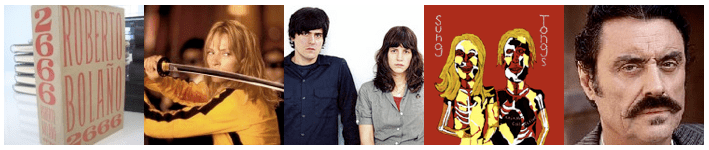
Roberto Bolaño’s 2666, Children of Men, The Fiery Furnaces, The Wire, Kill Bill, Sen to Chihiro no Kamikushi (Spirited Away), The Believer, Peter Jackson’s The Lord of the Rings trilogy, Beyoncé’s “Single Ladies” (and its marvelous video), David Foster Wallaces’s essays in Consider the Lobster, Denis Johnson’s Tree of Smoke, Animal Collective, Barack Obama, Terrence Malick’s The New World, Mad Men, Deadwood, Dave Chappelle, Curb Your Enthusiasm, Mitch Hedberg, R. Kelly, YouTube, Drag City Records, Cormac McCarthy’s The Road, Nathan Rabin’s “My Year of Flops,”

Picture 2

Chris Adrian’s The Children’s Hospital, Extras, Harry Potter on Extras, Dave Eggers’s A Heartbreaking Work of Staggering Genius, Missy Elliott’s “Get Ur Freak On,” Wong Kar-wai’s In the Mood for Love, Pixar movies–especially the latest three: WALL-E, Up, and Ratatouille, McSweeney’s #13 (the Chris Ware Issue), Jimmy Corrigan, the Smartest Kid on Earth, that time the Shins were on Gilmore Girls, the first six episodes of The OC, Arrested Development, Nintendo Wii, Andre 3000’s “Hey Ya!,” The Office, Will Ferrell, Bob Dylan’s Theme Time Radio Hour, Picador Books, Donnie Darko,

Picture 3

Veronica Mars, The Venture Brothers, Home Movies, the third Harry Potter movie, Wikipedia, Bob Dylan’s Chronicles, Jonathan Lethem’s The Fortress of Solitude, DFW’s Oblivion, especially “The Suffering Channel,” Wallace’s 2005 Kenyon commencement address, Wonder Showzen, Toni Morrison’s A Mercy, the totally goofy but totally fun troubadour sequence from Gilmore Girls with Yo La Tengo, Thurston, Kim, and daughter Coco Haley, and Sparks jamming, OutKast’s Stankonia, Pan’s Labyrinth, The Devil’s Backbone, The Orphanage, Cat Power’s “Willie Deadwilder,”Flight of the Conchords, Girl Talk’s Night Ripper, The Daily Show with John Stewart, The Colbert Report,

Picture 4

Andy Samberg’s Digital Shorts, Autotune the News, Tim Tebow, Panda Bear’s Person Pitch, Nels Cline’s guitar solo in “Impossible Germany,” Judd Apatow, Be Kind Rewind, Eternal Sunshine of the Spotless Mind, Thrill Jockey Records, I Heart Huckabees, Chris Bachelder’s U.S.!, David Lynch’s INLAND EMPIRE, Fennesz’s Endless Summer, Gmail, the Coens’ No Country for Old Men, MF Doom (all iterations), Broken Social Scene’s You Forgot It in People, Satrapi’s Persepolis, UGK’s “International Player’s Anthem,” Bob Dylan’s “Things Have Changed,” Bonnie “Prince” Billy,
Picture 5

The Silver Jews’ Tanglewood Numbers, lolcatz, Once, Lynch’s Mulholland Drive, the Coens’ O Brother, Where Art Thou?, web two point oh, 30 Rock, Belle & Sebastian’s “Stay Loose,” It’s Always Sunny in Philadelphia, Philip Pullman’s The Amber Spyglass, Werner Herzog’s Grizzly Man, WordPress, Jim O’Rourke’s Insignificance, the first season of Battlestar Galactica, Superbad, half a dozen or so short stories by Wells Tower, David Cross’s Shut Up, You Fucking Baby!, Drunk History, the action sequence at the end of Tarantino’s Death Proof (and especially the joyous, headcrushing final shot), Slavoj Žižek’s Violence, The Royal Tennenbaums, the first 20 minutes of Gangs of New York,

Picture 7

Firefox, the increasing and continuing availability of English translations of authors like Roberto Bolaño and W.G. Sebald, Bill Murray, Margot at the Wedding, Rachel Getting Married, Top Chef, The Dirty Projector’s Bitte Orca, Battles’ “Atlas,” Revenge of the Sith, Sarah Vowell, Art Spiegelman’s In the Shadow of No Towers, Christoph Waltz’s bravura performance in Inglourious Basterds, the surreal animations of Carson Mell, Margaret Atwood’s Oryx and Crake, Tina Fey’s impression of Sarah Palin, David Mazzucchelli’s Asterios Polyp, Neko Case’s “Star Witness,” Jason Statham, The Pirate Bay,  HDTV, Charles Burns’s Black Hole, &c . . .
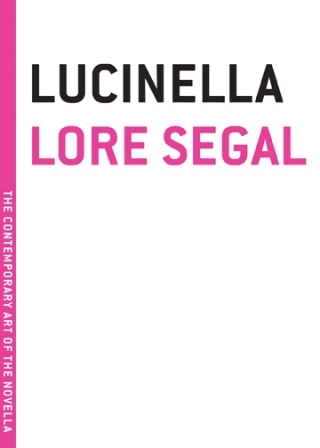
Lucinella — Lore Segal

Lucinella_LoreSegal

The story of a group of poets and critics in the late 60s/early 70s NYC should not be so fun or rewarding. From its first page, Lore Segal’s novella Lucinella invents itself as a scathing satire of writers and would-be writers. Segal’s book paradoxically reveres its subject matter, a back-biting and insular literati; and yet at the same time it exposes their solipsistic, narcissistic, cannibalistic shortcomings. These are not particularly generous people, but they are somehow endearing.

Lucinella takes first-person authority to tell the story–and boy does she take authority, bending reality, reason, and narrative cohesion to fit her whim. Lucinella is a poet (a minor poet, perhaps), and Lucinella is very much a poetic action, an act of creation in thirteen parts. The story begins with our (utra-)self-conscious heroine at the idyllic artists’ retreat Yaddo, where she’s ostensibly trying to compose a poem about a root cellar but really just having a grand ole time with a host of notable intellectuals, the poets and critics who will populate the book. “I will make up an eye here, borrow a nose or two there, and a mustache and something funny someone said and a pea-green sweater, so it’s no use your fitting you keys into my keyholes, to try and figure out who’s who,” Lucinella tells us. No worries, Lucinella, we had no idea who, if anyone, your Betterwheatling and Winterneet and Meyers were based on–heck, it took us a few pages to figure out that your Zeus was, um, y’know, that Zeus.

Segal’s (or Lucinella’s) inventions work within a hyperbolic schema set to slow burn. Describing a fellow poet of greater renown:

This Winterneet walking beside me has walked beside Roethke, breakfasted with Snodgrass and Jarrell–with Auden! Frost is his second cousin; he went to school with Pound, traveled all the way to Ireland once, to have tea with Yeats, and spent the weekend with the Matthew Arnolds. He remembers Keats threw up on his way from anatomy; Winterneet says he admires Wordsworth’s poetry, but couldn’t stand the man.

This is pretty much Lucinella‘s program: plausibly esoteric literary references running amok into sublimely surrealistic sketches. If you don’t like that, take your sense of humor to its doctor. Lucinella’s time at the haven of Yaddo is soon up, and she must return to the monster of Manhattan, where young poet William (despite his too-thin neck) shows up at her doorstep to fall in love and eventually marry her. The two attend every literary party, where they feel alternately bedazzled, thrilled, or–mostly–slighted. William, composer of a never-quite-finished epic about Margery Kempe, takes his snubs especially hard, even when he’s being celebrated (and published). We weren’t there, but it seems that Segal evokes her Manhattanite milieu with painterly (or perhaps cartoonly) accuracy. Really, the infighting intellectuals are reminiscent of poseurs and scenesters of any time and place. Lucinella and William go to parties, throw parties, complain about parties, and throw fits like children when they don’t get invited to parties. It’s all very real and very silly and very funny. In one (literally) fantastic set-piece (okay, the whole book might be a fantasy set-piece), Lucinella meets Old Lucinella and Young Lucinella at a party, giving her an(other) opportunity to critique herself. “There’s old Lucinella, the poet,” says one character. “She hasn’t written much in these last years. Used to be good in a minor way” comes the nonchalant reply. Young Lucinella fares no better, although she does manage an affair with William (don’t worry, Lucinella proper hooks up with Zeus in one of the book’s strangest flights of fancy).

The real seduction, as Lucinella points out at a party (of course), is her attempt to seduce her reader into a trenchant unreality that the poets and critics pretend is reality even as they bemoan the reality that their addiction to unreality is their main reality. Yeah. It’s all a bit surreal, and it all comes to a head quite pointedly twice in the novel. The first unmasking occurs at a symposium where the group holds forth on weighty matters – “Why Read?” – “Why Write?” – “Why Publish?” The house lights come up to reveal our fretting poets addressing an empty hall. Even in 1970, no one cares about reading and writing and publishing. And it’s not just the symposium–when Lucinella hosts a party for her pal Betterwheatling, who’s just published a collection of a criticism, she’s shocked to realize as the party dwindles that, not only has she not read his new book, she’s never read anything he’s written. But that’s not all: “I can tell, with the shock of a certitude, by the set of the line of Betterwheatling’s jaw, by the way his hair falls into his forehead, that Betterwheatling has never read a line I have written either and I flush with pain.” Betterwheatling’s punishment: “I’ll never invite him to another party!” Ahhh . . . the petulance. Oh, all the backstabbing and perceived slighting and posing and posturing leads up to an apocalyptic climax, complete with a proper de-invention of Lucinella. It’s all really great.

If Lucinella is light on plot–which we don’t really think it is, despite its slim build, light weight, and 150 or so pages–it’s big on ideas and even bigger on voice. Lucinella is kinda like that crazy art chick you knew in college who was always working on some project that never quite came to fruition, and her cohorts are just the sort of mad loonies you spend time alternately ducking calls from or hoping to run into at a party (depending on your mood). Her evocation of the youthful excitement and nascent romance of poetry reminds us of some of Roberto Bolaño‘s work, particularly the joyful jocularity of Garcia Madero’s section of The Savage Detectives (Segal’s volume is in no short supply of exclamations points). The book builds to a massive millennial climax, a hodgepodge of social consciousness movements and poetry and block party–a moveable feast of paranoia and art and possibility and good clean fun, and, more than anything else, the death-sentences we impose upon ourselves. But we’re overextending our review. Let’s just say that the book is great, and if you love books that both simultaneously mock and valorize the creative process, you’ll probably dig Lucinella’s metafictional tropes. Highly recommended.

Lucinella is in print again for the first time since the 1970s thanks to indie stronghold Melville House Publishing.

Comic Book Artists and Criminals

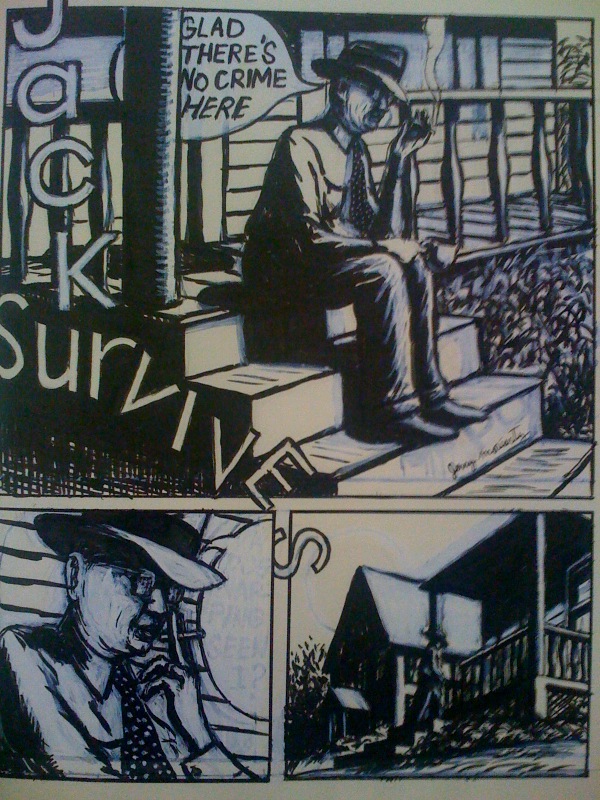
The Beilever’s 2009 Art Issue came in the mail today. It’s got cool interview between Chris Ware and Jerry Moriarty. A large poster of one of Moriarty’s painting comes with issue, which also prints several of the “paintoonist’s” works. But not this one:

Jerry Moriarty
Jerry Moriarty

Image via Molossus, where you can read an insightful review of Moriarty’s collection, The Complete Jack Survives.

The new Believer also features an interview with Aline Kominsky-Crumb, as well as some of her images. But not this one:

need_more_loveWB
Aline Kominsky-Crumb

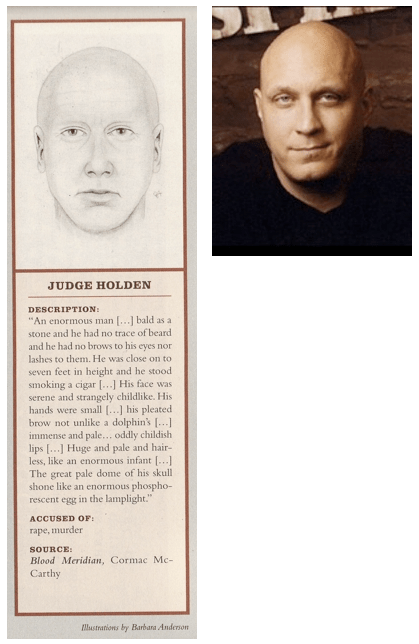
There’s also a pretty cool rogue’s gallery of of famous literary criminals. Forensic artist (y’know, a police sketch-artist) Barbara Anderson recreates eight criminals based solely on literary description. The list includes Oliver Twist’s Fagin, who looks like some dark-elf pedophile, Crime and Punishment’s Raskolnikov, that irascible pedophile Humbert Humbert, and, surprisingly, master forger Wyatt Gwyon, erstwhile hero of William Gaddis’s The Recognitions. One of our all-time favorite baddies is also there, although we really didn’t imagine Blood Meridian‘s Judge Holden would look look like Steve from The Jerry Springer Show:

Picture 2


On Cult Books

I finished Lore Segal’s lovely and perplexing 1976 novella Lucinella today. It’s a witty and rewarding little book that deserves its own review, of course, and I’ll post one later this week. Lucinella is new in print again for the first time in a few decades courtesy of the good folks at Melville House Publishing. The jacket and the press release Melville House sent me both trumpet the book as a “cult classic.” I’ve been reading a number of so-called “cult books” lately–William Gaddis’s The Recognitions, Malcolm Lowry’s Under the Volcano, and John Crowley’s Little, Big. But I’m not really sure what a “cult book” might be. It got me to thinking, of course, and before I went to that ersatz oracle of our time (i.e., a Google search), I thought I’d try to define “cult book” in my own terms:

First, to be clear, a cult book is not (necessarily) a book about cults. It’s a book that has a cultish following (i.e., a group of devoted (perhaps obsessive) fans who work to push the work on anyone who will listen to them).

Second, cult books tend to address or include subject matters and issues outside of mainstream tastes (whatever that means). Of course, what’s open to public discourse changes over time, so what was once a cult book, over time, can soon move into mainstream or even canonical tastes. Hence, a large number of books and authors that once might have been cult are no longer cult.

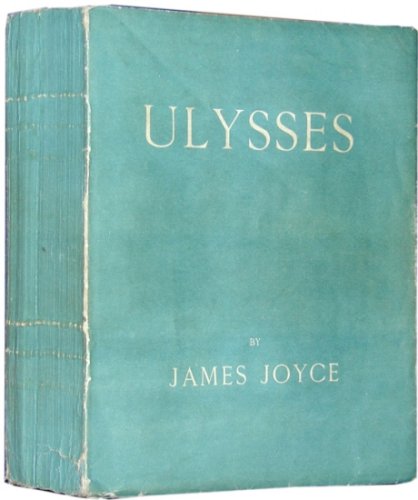
ulysses unrestored copy
First edition of Ulysses

But this doesn’t seem satisfactory: James Joyce’s Ulysses had to be initially smuggled into America; it’s now a canonical standard. William Burroughs’s Naked Lunch faced similar obscenity charges; decades later, Burroughs starred in a Nike ad. Yet, it seems that despite their eventual “mainstreaming” both books have something of a cult status–yet they don’t seem to need a cult the way that Gaddis or Lowry might. But what about Laurence Sterne’s Tristram Shandy? It clearly needs a cult to push it on people in the hopes of it actually being read, despite its canonical status. Which brings us to defining point three:

Third, the cult in question can not be purely academic. Faulkner would probably be a cult author if it weren’t for English professors and teachers with their syllabi and whatnot.

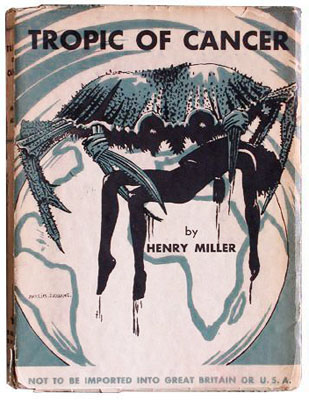
So, what is a cult novel? I have to think that, based on my definitions, cult status is always malleable. Thanks to the internet, readers have greater access to other readers, not to mention an exponentially expanded market of books to access. So I have to think back to high school and college, to those books that friends thrust on me, saying simply, “Read this, you have to,” books that I thrust on others, books that were secreted from hand to hand, clandestinely, until their covers had to be fixed with Duck tape. I think about Hunter S. Thompson’s Fear and Loathing in Las Vegas; anything by Kurt Vonnegut; Sylvia Plath’s The Bell Jar; anything by Charles Bukowski; Tropic of Cancer (or was it Tropic of Capricorn?). Antony Scaduto’s Bob Dylan biography made the rounds in my circle of friends, as did the Led Zep bio, Hammer of the Gods.

tropic-of-cancer
Note the warning that the book is verboten in the US and UK

There was also a pirate copy of The Anarchist Cookbook that someone had downloaded off of something called the internet (this was 1994 or 1995) and printed on a dot matrix printer. William Burroughs, of course. William Gibson. Anthony Burgess. Philip K. Dick. Cerebus. Aldous Huxley (especially Ape and Essence). Lolita. On the Road. Camus. Kafka. In college: John Barth’s Lost in the Funhouse. J.G. Ballard. Douglas Coupland. David Foster Wallace’s Girl with Curious Hair, a book literally pressed on me my freshman year by a friend who simply could not believe I had never read Wallace. To some embarrassment, I suppose, Irvine Welsh. Thomas Pynchon. Hofstadter’s Gödel, Escher, Bach. After college, a refinement I suppose (grad school ironing out some kinks of course): Blood Meridian. W.G. Sebald. Roberto Bolaño. Jorge Luis Borges. The list goes on; I’m sure I’m forgetting hundreds. (Normally, I’d hyperlink most of these authors and books to Biblioklept posts, but there’s just too many. Interested parties, if they exist, may use the search feature).

My list is pretty expansive I suppose (and it’s truncated to be sure), and I concede that the term “expansive” seems at odds with the term “cult.” It seems that all literature that lasts must first build a cult, and I guess that’s a good thing. Anyway–I eventually did google “cult novels” and here’s a few lists. Plenty of overlap with some of the above citations, and some stuff I didn’t think of as well. Also, stuff that I think is too canonical, but, again, make up your own mind:

The Telegraph‘s 50 Best Cult Books

The Cult’s List (chuckpalahniuk.net)

We like this one from Books and Writers

And of course, we’d love to hear from you, dear reader.


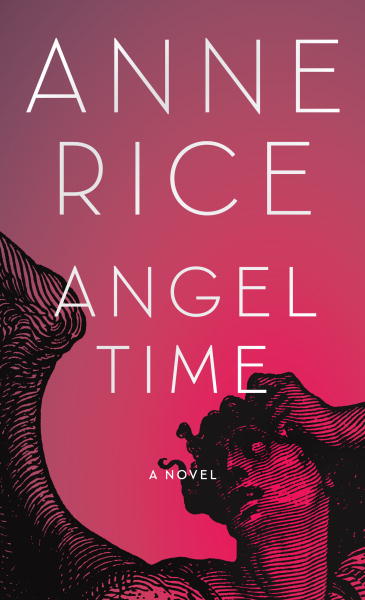
Angel Time — Anne Rice

angel_time

Anne Rice’s newest novel Angel Time continues the one-time Goth queen’s fervent return to Christianity. Angel Time is the story of Toby O’Dare, aka Lucky the Fox, a hit man with a Jesuit education, a dark past, and mad lute-playing skills. At the behest of a wise seraph named Malchiah, O’Dare travels back in time to thirteenth-century England, where, disguised as a monk, he embarks on a mission to save the Jewish population of Norwich. As you might expect with this sort of thing, our killer’s soul is also at stake–redemption, salvation, all that good stuff.

In a longish author’s note, Rice discusses some of the historical basis for her story, noting in particular the story of William of Norwich. From a purely narrative perspective, the plot seems pretty intriguing. We’re suckers for anything medieval, after all. Unfortunately, Angel Time is more Dan Brown than Umberto Eco. While there’s something to be said for the ability to write a real page-turner, Angel Time too-often falls back on leaden exposition and tired phrasing. Rice’s early Lestat novels might have been über-emo drama fests, but they were also wickedly sensual and sometimes alarming in their sexual ambiguity. And Lestat was just all kinds of fun, of course. Toby O’Dare, despite his silly name, is no fun. It’s really Rice’s utter humorlessness about her subject matter which is probably most off-putting of all. Her plot about a time-traveling hit man with an angel on his shoulder is engrossing stuff–so why does it take so long to start? We don’t get to medieval times until over half-way through the book. Perhaps because Angel Time initiates a new series Rice calls Songs of the Seraphim she feels the need to overload the front half with exposition about angels, God, the nature of Heaven, etc. Rice’s didactic tone is at times overbearing here. The metaphysical is best left at least a little mysterious. Similarly, while it’s great to know a hero’s motivations and history, Toby O’Dare’s back-story is so overdetermined as to preclude any real moral dilemma. Sure, he’s sinned, he’s worked as a contract killer–but if a seraph looks into your heart and knows you’re, like, good and stuff, is there any doubt that redemption is not forthcoming?

Perhaps Rice’s next novel in her Seraphim series will leave readers a little more room to breathe–and think. If Rice has left vampires for angels and hell for heaven, is it also necessary that she leave strangeness, wonder, and ambiguity for the stolid certainties of didactic allegory? Maybe we’re being too harsh. There’s undoubtedly an audience out there for Angel Time, and it’s probably fair to say that her work here will challenge audiences more than most books marketed to contemporary Christian audiences. But many of us prefer our literature to pose the challenging questions in ways that make us think. It spoils much of the fun to get all the answers up front.

Angel Time is now available in hardback from Knopf. You can see a trailer for the book here.

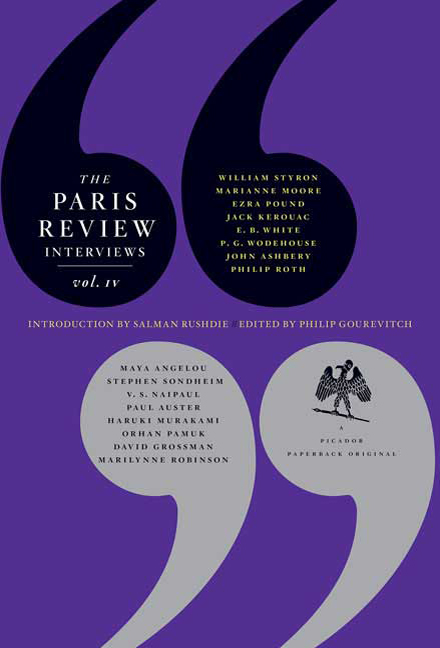
The Paris Review Interviews, IV

9780312427443

The Paris Review Interviews, IV, new this week from Picador, continues a great tradition of writers discussing their motivations, inspirations, methods, and, inevitably, other writers. Volume IV collects sixteen author interviews and is perhaps a bit heavier on contemporary writers than past volumes have been, showcasing current luminaries like Haruki Murakami, Orhan Pamuk, Paul Aster, and Marilynne Robinson. Although most of the interviews take place after the 1970s (with half in the past two decades), elder statespeople like William Styron, Marianne Moore, and the venerable Ezra Pound are also present.

Pound’s interview from 1962 is paradoxically revealing in its guardedness: one senses that the aged poet is trying to edit as he speaks, to achieve some sort of perfection. It’s a bit sad too, as Pound, holed up in a sort of self-imposed exile in an Italian castle, admits, “I suffer from the cumulative isolation of not having had enough contact–fifteen years of living more with ideas than with persons.” (On a less-serious note, however, he also praises Disney’s 1957 film “Perri, that squirrel film, where you have the values of courage and tenderness asserted in a way that everybody can understand. You have got absolute genius there.”)

As one might expect, Jack Kerouac comes off as the complete opposite, talking about his troubles with editor Malcolm Cowley, problems with poetry and prose, and Neal Cassady. There’s a free-flowing verbosity to Kerouac’s speech, but also an intimacy. It’s really quite beautiful. At one point, he gets one of the two poets interviewing him, Aram Saroyan, to repeat each line of Poem 230 from Mexico City Blues as he reads it aloud (Kerouac claims he wrote the poem “purely on morphine.”) As they recite the poem over several pages, Kerouac steps outside of it every now and then to compliment Saroyan’s reading or to critique a particular line, or simply to explain what he was trying to do with his words. We’re not huge fans of Kerouac’s writing, but after this interview, we wanted to be. (Later in the book, a surprised P.G. Wodehouse on Kerouac: “Jack Kerouac died! Did he?” Interviewer: “Yes.” Wodehouse: “Oh . . . Gosh, they do die off, don’t they?” Yes, they do).

One of the stranger interviews in the books is between James Lipton, of all people, and composer Stephen Sondheim. Although we don’t doubt the literary merit of Sondheim, the interview does seem a little out of place (although we will attest that the interview with Maya Angelou convinced us to give her a little more cred. A little). Elsewhere, E.B. White asserts that “You have to write up, not down” to children, and Haruki Murakami sheds insight into his own methods and passions (he often conceives his protagonist as a twin brother, lost at birth; his favorite director is Aki Kaurismäki; he’s thrilled to be mentioned in the liner notes of Radiohead’s Kid A). Murakami also talks about the writers he loves, admires, and feels insecure around (he’s shy to meet Toni Morrison at a special luncheon).

Of course, Murakami’s not alone–there’s plenty of writers dishing on writers here. When we reviewed Volume III of The Paris Review Interviews last year, we noted that both Evelyn Waugh and Raymond Chandler take the time to dis William Faulkner in their interviews. Volume IV kicks off with William Styron, who kinda sorta disses Faulkner as well, saying that “The Sound and the Fury . . . succeeds in spite of itself. Faulkner often simply stays too damn intense for too long a time.” Or Marianne Moore, on fellow poet Hart Crane: “Hart Crane complains of me? Well, I complain of him.” Ah, writers . . . great to know they can be as petty and self-absorbed as the rest of us. And it’s that humanity that shines through in these interviews. The series’s greatest accomplishment is its ability to reveal the frailties and insecurities of its subjects, but also their true personalities and tastes. Many writers work hard to control how they are perceived; cultivating a persona, one often aloof, academic, or roguish, is perhaps key to a successful writer’s identity. The interviews here are never fawning, nor do they aspire to sensationalism in revealing their subjects. Instead, each works as a neat, detailed, and very engrossing little portrait of a fascinating personality. Highly recommended.

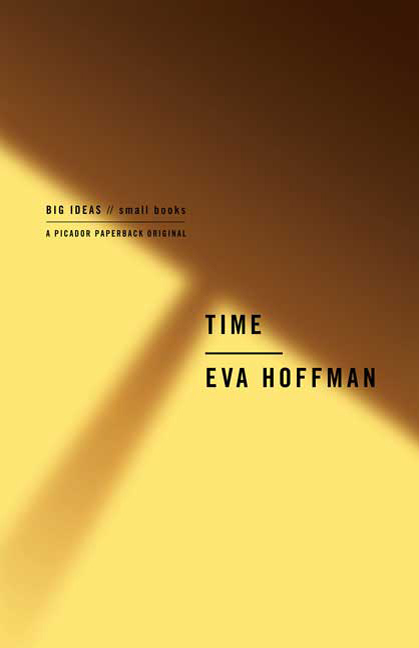
Time – Eva Hoffman

time

Eva Hoffman’s Time, the latest in Picador’s series BIG IDEAS//small books, carefully but playfully examines what time is or might be, how we might measure it, and what it means. Hoffman divides her big idea into four neat chapters, exploring time’s relationship to the human body, mind, culture, and finally, “Time in our Time.” Although the final chapter begins by asking “what kind of social or cultural time do we live in nowadays, and how does this affect the shape of our personal experience?” this question is perhaps at the core of the book, and hence central from its beginning, in Hoffman’s discussion of bodies.

Hoffman’s long essay begins appropriately with a discussion of the human as species, as animal, as a biological entity that must measure the passing of time against itself, against the passing of seasons, and the death of one’s kin. And while Hoffman draws on modern medicine and science in her discussion, citing DNA research and neuroscience, she’s just as likely to search for answers in Shakespeare or Wordsworth. So, while Hoffman brings up current leading scientific research, the heart of the book lies in her ability to temper hard science with what it might actually mean in human terms. For example, Hoffman uses poems by Emily Dickinson (twice) to illustrate the (traumatic) effects that time can toll on the psyche.

This multi-discipline approach has become the hallmark of the BIG IDEAS series, and its exactly what makes the books such a joy to read. Perhaps some might find a discussion of Alzheimer’s disease nestled against a reading of Beckett’s Waiting for Godot to be distasteful, for many of us, the key to finding meaning in big ideas comes not just from the sciences, but also the arts. Hoffman might not have definitive answers for her big questions, but she has plenty of salient, concrete arguments, including a few we’re happy to get behind. After decrying the dissolution of the traditional Spanish siesta, Hoffman writes:

The Protestant ethos driving industrial development was grounded in the ideology of progress and a linear conception of time. It carried traces of the religious belief with which it was originally linked, and an eschatological vision of time in which earthly temporality inevitably moved towards a future where all our efforts would be judged. The work ethic at its height required great discipline of personality, and the sacrifice of presentt pleasures for future goals. It involved a systematic commitment to saving money, so that capital would accumulate, as proof of effort and virtue. The capitalist culture was a culture of the future par excellence; it encouraged its adherents to move through time with a long-term goal in their mind’s eye–or, conversely, with a sense of severe guilt and even sin if they failed to meet their objectives.

Not so in our own, thoroughly disillusioned epoch. After decades of expansion and its spoilages we no longer find ideas of human perfectibility, or even progress, sustainable. Rather, we seem to be driven by being driven. This is, no longer the work ethic but the ethos of conspicuous exertion, and under its aegis we willingly submit ourselves to temporal regimes that would have seemed rigid or even tyrannical by the standards of most other places and periods.

I’m not sure if everyone, at least here in the US, is as completely and savvily attuned to our “disillusioned epoch” as Hoffman suggests–surely many people still believe their drives result from a work ethic, rather than some ideological drive to be “driven.” Still, Hoffman’s salient observation points to the relatively recent exponential change in our relationship to time. She goes on to laundry list YouTube, BlackBerry, and other devices that abridge space and time, and therefore project the illusion of immediacy. Perhaps ironically, Hoffman’s essay contains no mention of Twitter, a program inextricably wed to the most incrementally insignificant accounting of time. While her book is brand new, undoubtedly in the time it took to produce her manuscript Twitter rose from fad to phenomenon; perhaps there just wasn’t time to discuss this new measurement of time. In any case, Time is an appropriate and welcome addition to what’s shaping up to be an enduring and noteworthy series. Recommended.

Time is available now from Picador.

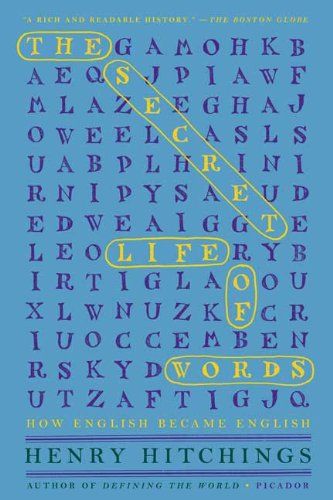
The Secret Life of Words — Henry Hitchings

Upfront: We like words. We think etymology is fun. We consider Bill Bryson something of a hero, and Joseph T. Shipley’s The Origins of English Words is a staple at Biblioklept World Headquarters. We can spend hours at a site like Luciferous Logolepsy, and it’s not just obscure words we love–we’re also likely to pore over nerdy linguistic battles at Word Court for far too long. Unlike most people, we think puns are a sophisticated way to crack a joke. If any of these proclivities seem to align with your own tastes, you’ll likely enjoy Henry Hitchings’s history of the English language The Secret Life of Words as much as we did.

henry_hitchings

Hitchings organizes his book into sixteen parts, each named for a word that will inform the narrative thrust of that particular thrust. After opening, appropriately with “Ensemble” as an introductory overture, Hitchings uses “Invade” as his key term for chapter two. Throughout the book invade comes not only to signify an obvious entry point for a history of English (the Norman conquest of England in 1066), but also a general trend of just how ubiquitous (and perhaps invasive) English has become. Hitchings’s take veers toward post-colonialist theory, with a heavy dash of historical-materialist tendencies to boot. In a chapter titled “Angst,” he comments that “it is impossible not to see the long shadows cast by Marx, Freud and Einstein, the architects of socialism, psychoanalysis, and the atomic age.” Darwin and the American Transcendentalists (whom Hitchings saliently credits with greatly expanding the English language) also figure heavily in his readings. Hitchings is not all Frederic Jameson and post-colonialism, of course (not that we mind that sort of thing around these parts), but his liberal readings on contemporary linguistic issues like the place of Black Vernacular English in modern America are welcome and refreshing. Still, Hitchings’s Secret Life is a balanced affair, drawing not just on readings of master artists in the English language, like Shakespeare, Joyce, and the Romantic poets, but also on a seemingly-endless bibliography of dictionaries, almanacs, histories, and etymologies (Hitchings’s chapter notes, bibliography, and index run to nearly a 100 pages).

At the heart of it all, of course, are words. Each page brims with little etymological factoids. Hitchings clues us in to the fact that venison once simply referred to all hunted game, not just deer. He avers that “It is quite widely known that poppycock comes from the Dutch for ‘doll’s shit.'” (Is it really that widely known? We had no idea). He tells us that while molasses derives from the Portuguese word melaços, we don’t really know where we get the term rum from (some will be content to remain drinking in ignorance, of course). We had no idea that the game chess gets its name via the Persian word for king, shah. And while Hitchings lards his book with plenty of fun little details, they all serve (and serve well) his greater narrative; namely, a history of the English language. While this book isn’t for everyone, we certainly enjoyed it and have already given it a little spot on a shelf of books we return to often, books in English about English. Fun stuff.

The Secret Life of Words is now available in paperback from Picador.

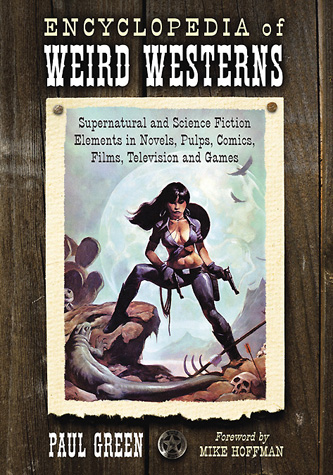
Encyclopedia of Weird Westerns — Paul Green

ww2

In the preface to his Encyclopedia of Weird Westerns, Paul Green gives us the following definition:

Weird Western

A Western story incorporating horror, supernatural or fantasy elements and themes and usually including one or more of the following subjects: vampires, werewolves, mummies, man-made monsters, mythological beings, mutants, zombies, ghosts, haunted buildings, demons, witchcraft, Satanism, possession, demonic or possessed animals, mentalists, shamans, visions, restless or wandering spirits, damned souls, enchantment, shape-shifters, angels, goblins, faeries, sirens, flying horses, psychopathic killers, psychological terror, dismembered moving body parts, spirit guides, the occult, hexes and curses, rising from the dead, talking animals, superhuman abilities, and magical potions.

This fun, hyperbolic list would seem to be enough to cover all possible entries in Green’s almanac of Western weirdness, yet his preface goes on to catalog and define the Weird Menace Western genre (popular in the 1930s), Science Fiction Westerns, Space Westerns, Steampunk Westerns, and even Weird Western Romance. Over the course of about 250 pages, Green attempts to catalog 0ver a 100 years of Weird Western stories, novels, pulps, radio shows, films, TV shows, RPGs and video games. And comic books. Lots and lots of comic books.

You probably know more Weird Westerns than might immediately come to mind. Green hits on examples that have had great mainstream success like Stephen King’s Gunslinger series, the old Kung Fu TV series, and Westworld. He also extends his entries to cover the many forays TV shows and comic books take into the Western Genre, from Star Trek: The Next Generation to MacGyver. Green even contends that Star Wars is a Space Western.

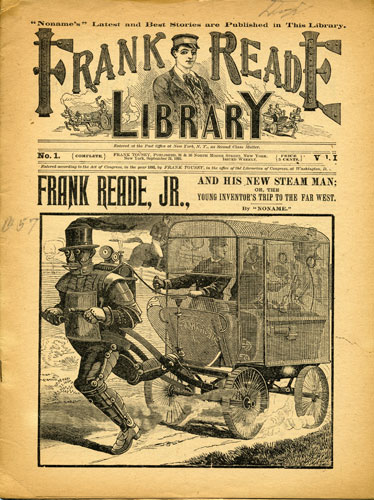
There’s mention of some of our favorite Westerns, like Cormac McCarthy’s Blood Meridian, Jim Jarmusch’s Dead Man, and Alejandro Jodorowsky’s El Topo, as well as the salient recognition that William Burroughs is a writer of Westerns. But for every comic or film or movie or TV show we’ve heard of, like Jonah Hex or The Adventures of Brisco County, Jr., there seem to be at least a dozen bizarre counterparts. How did we not know of the late-nineteenth century steampunk dime novels featuring hero Frank Reade (and either his Steam Man or Steam Horse)? Reade is such an oddity because it’s steampunk contemporaneous with its own setting–which sorta kinda makes it not steampunk but maybe kinda imaginative fiction. Or something. In any case, it’s intriguing.

frankreade

If we hadn’t read Green’s Encyclopedia, we also wouldn’t have any knowledge of Gene Autry’s 1935 space opera film serial, The Phantom Empire. The twelve-parter apparently features Autry as a singing cowboy who has to save his Radio Ranch when speculators want to buy up the supply of Muranian radium under his property. Did we forget to add that the ancient civilization of Mu lives under Radio Ranch?

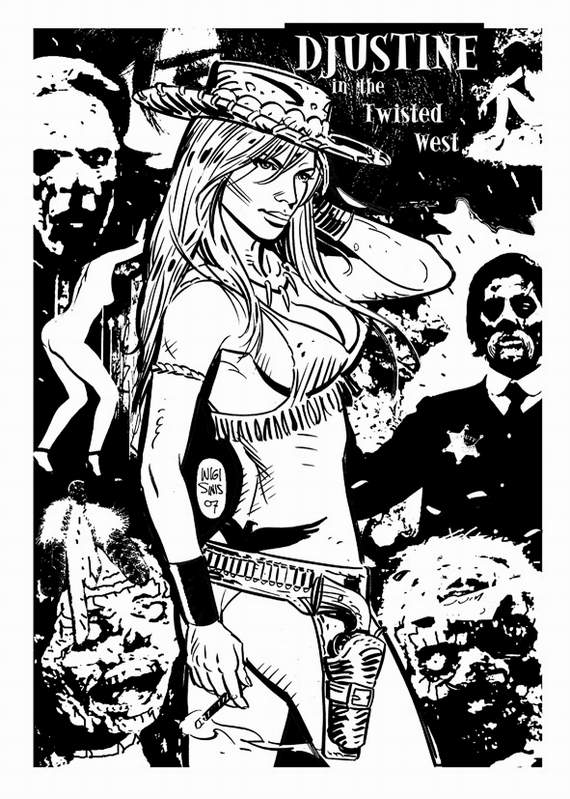
We also, somehow, were previously unaware of the Djustine comics before Green sought to correct this oversight by including two whole pages of images of the buxom lass. His description: “The sexually graphic adventures of the large-breasted female gunslinger Djustine and her fight with the supernatural, including zombies, vampires, and Diabla, daughter of Satan.” You had us at sexually graphic.

djustine-ill

Okay, so we’re probably not going to go stock up on back issues of Djustine (it’s in Italian anyway . . . we swear we’re only interested in the tight-plotting!) . . . But most of the fun of Encyclopedia of Weird Western is simply in all the bizarre descriptions and images, of which there are plenty. I’m not an aficionado, so I can’t testify to the depth or analytic penetration of Green’s catalog, but I do know that I enjoy browsing through the book’s welcome weirdness. It’s a great entry point to any number of strange Google searches. And it’s also got me hunting for a torrent of the 1977 film, Welcome to Blood City.

You probably know by now whether or not any of this is up your alley. We’re digging it. Encyclopedia of Weird Westerns is now available from McFarland.

Doomed He Was

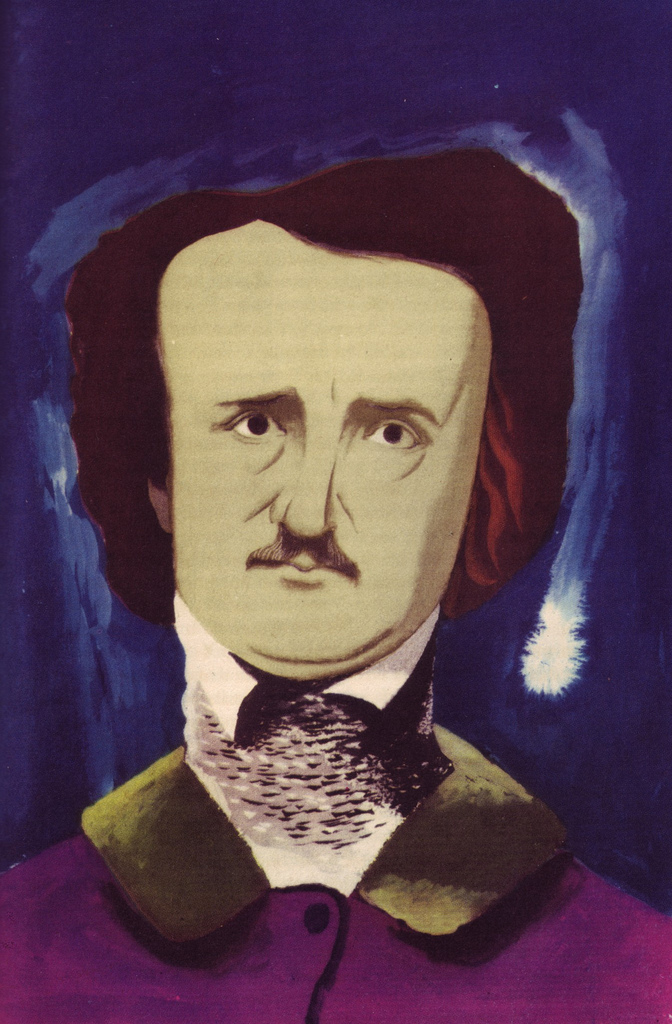
Image of Poe by Edward McKnight Kauffer, via A Journey Round My Skull

So, instead of grading essays like I should’ve today, I reread D. H. Lawrence’s essay on Edgar Allan Poe, collected in the former’s incomparable Studies in Classic American Literature. Lawrence asserts that Poe is “absolutely concerned with the disintegration-processes of his own psyche,” and goes on to try to prove this over a close-reading of some of Poe’s most famous tales, including “Ligeia” and “The Fall of the House of Usher.” Lawrence concludes his essay a bit melodramatically, but it seems to suit Poe’s depraved dilemmas:

But Poe knew only love, love, love, intense vibrations and heightened consciousness. Drugs, women, self destruction, but anyhow the prismatic ecstasy of heightened consciousness and sense of love, of flow. The human soul in him was beside itself. But it was not lost. He told us plainly how it was, so that we should know.

He was an adventurer into vaults and cellars and horrible underground passages of the human soul. He sounded the horror and warning of his own doom.

Doomed he was. He died wanting more love, and love killed him. A ghastly disease, love. Poe telling us of his disease: trying even to make his disease fair and attractive. Even succeeding.

Actually, a University of Maryland Medical Center study finds that rabies likely caused Poe’s death, not love, as Lawrence suggests. Rabies. Not drugs or women–or love–rabies. How’s that for a “disintegration-process”?

Reborn — Susan Sontag

9780312428501

New in trade paperback next week from Picador, Reborn collects the early private writings of Susan Sontag, beginning in 1947 when she was just fourteen. The book begins with the following salvo from 1947: “I believe: (a) That there is no personal god or life after death.” If the phrase seems awfully definitive for such a young person to write, its terse tone is repeatedly undercut in other places in Sontag’s early journals, like when she asks “What does the expression ‘in his cups’ mean?” (he’s drunk, sweetheart). There’s also something almost cute about her entry from 12/19/48: “There are so many books and plays and stories I have to read–Here are just a few.” I feel the same way myself. She goes on to list over 20 authors and titles, including Faulkner’s Sanctuary and Dostoyevsky’s Diary of a Writer. Sontag’s immediate, visceral, and sometimes raw reactions to whatever she’s reading, hearing, and watching, make up a good bulk of Reborn, and there’s something fun, if inessential, to know that she read Huxley’s Eyeless in Gaza and James’s Portrait of a Lady in January of 1950.

Don’t expect, of course, to get a definitive sense of who Sontag was, let alone a narrative account of her life here. Subtitled Journals & Notebooks 1947-1963, Reborn veers closer to the “notebook” side of things. The book certainly doesn’t feel like its 320 pages, mostly because it’s comprised of lists, notes, half-poems, and half-ideas–with the occasional major insight or life-changing moment thrown in in an almost alarmingly casual tone. Check the following consecutive entries:

11/21/50

Excellently staged performance of Don Giovanni last night (City Center). Today, a wonderful opportunity was offered me–to do some research work for a soc[iology] instructor named Philip Rieff, who is working on, among other things, a reader in the sociology of politics + religion. At last the chance to really involve myself in one area with competent guidance.

12/2/50

Last night, or was it early this (Sat.) morning?–I am engaged to Philip Rieff.

If there’s more to this episode in Sontag’s journal, her son David Rieff, the book’s editor, has chosen to elide it (although he has included that, as early as 12/19/56, if his mother is to be believed, he knew “the difference between a sarcophagus and an esophagus”). In an introduction loaded with much hemming and hawing, Rieff acknowledges the rawness of his mother’s private diaries, noting that they were written only for Sontag herself, who had no intention of publishing them. (Rieff’s decision to publish them is an issue of control: Sontag had sold her all of her writing and papers to UCLA and Rieff felt that assuming an editorial role might protect his mother to some extent). And, as one would expect of the notes of a young college student, nothing here is even remotely polished: like the adolescent who so easily denies an afterlife, many of Sontag’s notes and thoughts come across as callow, or at least not on par with the intellectual who gave us On Photography and Notes on ‘Camp.'” A note from 1/2/58 comes across as painfully emo: “How to make my sadness more than a lament for feeling? How to feel? How to burn? How to make anguish metaphysical?” Not that these are unserious questions, but methinks someone’s been hitting the Kierkegaard a bit too hard. When Sontag the diarist steps in–that is to say, the diarist who reflects honestly, as opposed to the academic pulling philosophical poses–we get brusque honesty full of pathos. In a note from 1960, after briefly discussing how her mother’s conflict-aversion led to “the idea that honesty equaled cruelty,” Sontag drops this shocker: “No matter what I have said, my life, my actions say that I have not loved the truth, that I have not wanted the truth.” While I don’t particularly demand self-reflection, this kind of honesty is both rare and affecting coming from an academic.

But why should we expect Sontag’s private journals to be more than they are? It’s more fun to read Reborn elliptically, picking it up and putting it down, browsing through Sontag’s lists of movies, quotes from Rilke and Blake, and various thought-experiments. From 11/4/57:

“Try whiskey. To find a voice. To speak.

Instead of talking.

[ . . . ]

Are the Jews played out? I am proud of being Jewish. Of what?

[ . . . ]

Orc–imaginary mailed beast, dragon, ogre, named after a sea-monster killed by Orlando, in Ariosto’s Orlando Furious

Whiskey, Jews, Orcs–great stuff.

We’ll conclude with one of our favorite moments in the book, which is simply a list of words. In one of the few contextual notes Rieff concedes, he notes that all her life, “SS made lists of words into which she occasionally inserted a person’s name or a brief observation.” The list is from the fall of 1949:

effete

noctambulus

perfervid

detumescence

disheveled

so alluring, so cerebral

sodden

intriguing

corrupt dignity

lotophagous

Continue reading “Reborn — Susan Sontag”

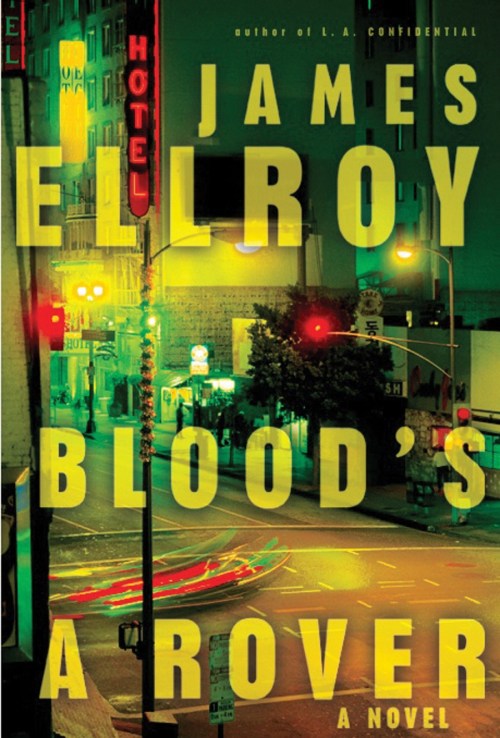
Blood’s a Rover — James Ellroy

bloods-a-rover

A few things up front: this can’t really be a proper review of James Ellroy’s Blood’s a Rover as I’m less than a 100 pages into it and its over a 600 pages long. So far though, the book is fantastic, and has completely ameliorated my mistaken impression of what, exactly, Ellroy is doing. You see, I had long thought of Ellroy, author of L.A. Confidential and The Black Dahlia, as a writer of potboiler genre-fiction–which is to say I never considered him a “serious” writer. But when advanced press for Blood’s a Rover came out, I couldn’t help but ask for a review copy. The idea of an alternate history of the late sixties/early seventies, set to a backdrop of black militant movements, Cuban revolution, and heroin dealing, complete with historical figures like Howard Hughes and J. Edgar Hoover seemed pretty cool.

The opening scene of Blood’s a Rover, a breathtaking armored car robbery, quickly establishes the book’s tense, terse pacing telegraphed through Ellroy’s signature simple sentences (his style: subject-verb-object, repeat–with the occasional clause or adjective thrown in for flair). Ellroy’s rhetorical style perfectly matches his plot, as sentence after sentence hammers away depictions of lurid, unrelenting violence. In a sense, Blood’s comes across as the evil twin of Thomas Pynchon’s recent novel Inherent Vice. Both novels threaten to crush the reader under the densities of their plots, yet, where Pynchon allows his hippie detective Doc Sportello’s marijuana haze to infiltrate (and thus lighten) the novel’s discourse, Ellroy’s technique simply compounds and confounds in its ugliness. But don’t be mistaken–Blood’s is a thrilling book, with tightly-drawn characters doing really mean and interesting things. There’s even a sardonic sense of humor under the punchy grisliness of it all. If Pynchon’s universe propels on the paranoia of not knowing but sensing that the Powers That Be are conspiring against you, Ellroy makes it expressly clear that, yes, a sinister cabal of underworld agents are running the show. And not for the better. Even the novel’s hero Wayne Tedrow Jr. is pretty much a creep (or whatever word you want to pick for a heroin runner who kills his dad in a bid for his step mom’s affection)–but he’s a fascinating creep, and in Ellroy’s plotting, one you want to root for.

So, if you’ve had any passing interest in this book, you probably want to go ahead and pick it up. I’ll do a full, proper review when I finish it, but for now, I want to repent for my erstwhile (and unfounded) prejudices against Ellroy. Makes me wonder what other writers I’ve dismissed out of genre prejudice.

Blood’s a Rover is now available in hardback from Knopf.

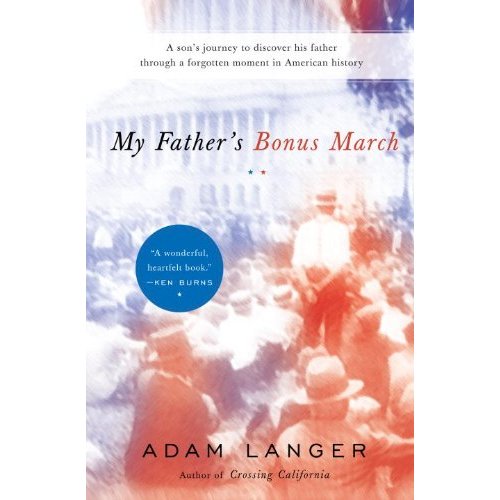
My Father’s Bonus March — Adam Langer

51znHZk3mAL._SS500_

Early in his new memoir My Father’s Bonus March, Adam Langer writes: “It seems appropriate that the most dramatic event in my relationship with my father might be one that I can’t actually remember happening.” Langer then goes on to describe a particularly colorful episode at an old-timey barbershop, wherein he, as a young lad, chokes on a piece of hard candy and is saved by his dad. “My father would never tell me this story,” Langer concludes, revealing the sense of disconnection at the heart of his book. Simply put, My Father’s Bonus March is Langer’s attempt to know, or at least understand his father. Strangely, he uses his father’s passion for a little-remembered event in American history as a means to better know his father, who passed away in 2005, leaving Langer with a sense of unfinished business.

In 1932, a group of WWI Veterans and their families (and sympathizers) camped out in Washington D.C. in protest: it was the middle of the Great Depression and the vets were demanding the bonuses they were promised. (The book’s jacket calls this “a forgotten moment in American history, but I’d like to go on record that, after the intensive hell that was Ms. Bone’s first-period AP US History class, I knew exactly what the bonus march was before I got the review copy). Langer’s father was seven at the time of the protest, but his father served in WWI, and, in any case, it left enough of an impression on him that writing a book on the subject became a life-long dream. Langer’s project is to complete that dream–which he does, quite successfully. Langer’s historical investigation is thorough without dreariness; he draws not just from first-hand sources, like newspapers and editorials covering the march, but also the memoirs and diaries of figures like Eisenhower and Studs Terkel, as well as the work of novelists like John Dos Passos. He even interviews neocon Norman Podhoretz and Bonus March aficionado John Kerry.

Langer’s scholarship is successful, but more affective are his interviews with people who knew his father, including cousins, neighbors, and classmates. Langer has the good sense to present their comments as first-hand accounts, presented with little context. Their stories build a concrete, vivid depiction of Langer’s predominantly Jewish old Chicago West Side neighborhood (“‘GVS’ is what we called it. The Great Vest Side,” one witness recalls). I wish Langer had employed this straightforward documentary technique more often in his memoir as its succinctness and clarity achieves an emotional immediacy in contrast to Langer’s prose passages, which sometimes come across as sentimental or too-artfully constructed. This is simply a matter of taste, of course; I prefer my memoirs raw, and I occasionally found myself grimacing at some of Langer’s constructions, like a trip with his brother to the Hoover Presidential Library or the opening scene with his daughter on the stoop.

At its core, My Father’s Bonus March successfully evokes the reality of one of literature’s oldest narratives–the attempt of the son to know his elusive father (Telemachus and Odysseus, Oedipus and Laius, Stephen and Simon Dedalus, etc.), and it does so with affecting aplomb. Whether we really need another story about a son trying to understand his distant dad is beside the point–Langer has found an inventive and rewarding way to do so. I can’t end without mentioning that at the same time I was reading Bonus March, I also happened to read another memoir about a son trying to better understand his elusive father, Stephen Elliott’s recent essay My Father’s Murder” (published in last month’s issue of The Believer). Elliot’s terse, frank, reportorial style is in direct contrast with Langer’s overt sentimentality, yet both authors are working toward the same theme–one that clearly resonates across styles and genres. With this in mind, I think plenty of readers out there will both identify with and enjoy Langer’s memoir.

My Father’s Bonus March is available October 20th, 2009 from Spiegel & Grau.

Seven Horror Novels Masquerading In Other Genres

We often identify genre simply by its conventions and tropes, and, when October rolls round and we want scary stories, we look for vampires and haunted houses and psycho killers and such. And while there’s plenty of great stuff that adheres to the standard conventions of horror (Lovecraft and Poe come immediately to mind) let’s not overlook novels that offer horror just as keen as any genre exercise. We offer seven horror novels masquerading in other genres:

cormac5.jpg_jpeg_300x1000_q85

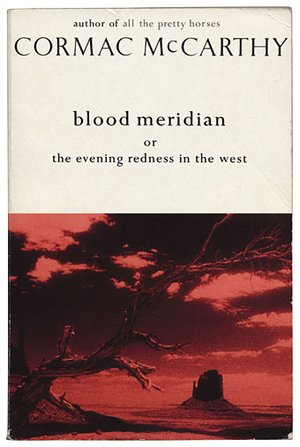
Blood Meridian — Cormac McCarthy

In our review (link above) we called Blood Meridian “a blood-soaked, bloodthirsty bastard of a book.” The story of the Glanton gang’s insane rampage across Mexico and the American Southwest in the 1850s is pure horror. Rape, scalping, dead mules, etc. And Judge Holden. . . [shivers].

Rushing to Paradise — J.G. Ballard

On the surface, Ballard’s 1994 novel Rushing to Paradise seems to be a parable about the hubris of ecological extremism that would eliminate humanity from any natural equation. Dr. Barbara and her band of misfit environmentalists try to “save” the island of St. Esprit from France’s nuclear tests. The group eventually begin living in a cult-like society with Dr. Barbara as its psycho-shaman center. As Dr. Barbara’s anti-humanism comes to outweigh any other value, the island devolves into Lord of the Flies insanity. Wait, should Lord of the Flies be on this list? 

2666 — Roberto Bolaño

Okay. We know. This book ends up on every list we write. What can we do?

While there’s humor and pathos and love and redemption in Bolaño’s masterwork, the longest section of the book, “The Part about the Crimes,” is an unrelenting catalog of vile rapes, murders, and mutilations that remain unresolved. The sinister foreboding of 2666‘s narrative heart overlaps into all of its sections (as well as other Bolaño books); part of the tension in the book–and what makes Bolaño such a gifted writer–is the visceral tension we experience when reading even the simplest  incidents. In the world of 2666, a banal episode like checking into a motel or checking the answering machine becomes loaded with Lynchian dread. Great horrific stuff.

King Lear — William Shakespeare

Macbeth gets all the propers as Shakespeare’s great work of terror (and surely it deserves them). But Lear doesn’t need to dip into the stock and store of the supernatural to achieve its horror. Instead, Shakespeare crafts his terror at the familial level. What would you do if your ungrateful kids humiliated you and left you homeless on the heath? Go a little crazy, perhaps? And while Lear’s daughters Goneril and Regan are pure mean evil, few characters in Shakespeare’s oeuvre are as crafty and conniving as Edmund, the bastard son of Glouscester. And, lest we forget to mention, Lear features shit-eating, self-mutilation, a grisly tableaux of corpses, and an eye-gouging accompanied by one of the Bard’s most enduring lines: “Out vile jelly!Peter Brook chooses to elide the gore in his staging of that infamous scene:

The Trial — Franz Kafka

Kafka captured the essential alienation of the modern world so well that we not only awarded him his own adjective, we also tend to forget how scary his stories are in light, perhaps, of their absurd familiarity. For our money, none surpasses his unfinished novel The Trial, the story of hapless Josef K., a bank clerk arrested by unknown agents for an unspecified crime. While much of K.’s attempt to figure out just who is charging him for what is hilarious in its absurdity, its also deeply dark and really creepy. K. attempts to find some measure of agency in his life, but is ultimately thwarted by forces he can’t comprehend–or even see for that matter. Nowhere is this best expressed than in the famous “Before the Law” episode. If you’re too lazy to read it, check out his animation with narration by the incomparable Orson Welles:

Sanctuary — William Faulkner

In our original review of Sanctuary (link above), we noted that “if you’re into elliptical and confusing depictions of violence, drunken debauchery, creepy voyeurism, and post-lynching sodomy, Sanctuary just might be the book for you.” There’s also a corn-cob rape scene. The novel is about the kidnapping and debauching of Southern belle Temple Drake by the creepy gangster Popeye–and her (maybe) loving every minute of it. The book is totally gross. We got off to a slow start with Faulkner. If you take the time to read our full review above (in which we make some unkind claims) please check out our retraction. In retrospect, Sanctuary is a proto-Lynchian creepfest, and one of the few books we’ve read that has conveyed a total (and nihilistic) sense of ickyness.

n14559

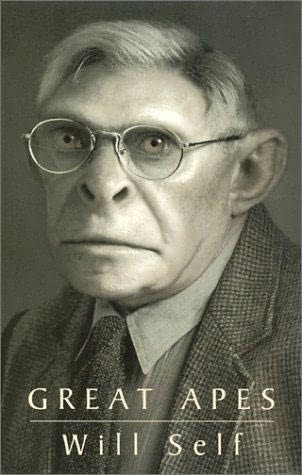
Great Apes — Will Self

Speaking of ickiness…Self’s 1997 novel Great Apes made me totally sick. Nothing repulses me more than images of chimpanzees dressed as humans and Great Apes is the literary equivalent (just look at that cover). After a night of binging on coke and ecstasy, artist Simon Dykes wakes up to find himself in a world where humans and apes have switched roles. Psychoanalysis ensues. While the novel is in part a lovely satire of emerging 21st-century mores, its humor doesn’t outweigh its nightmare grotesquerie. Great Apes so deeply affected us that we haven’t read any of Self’s work since.

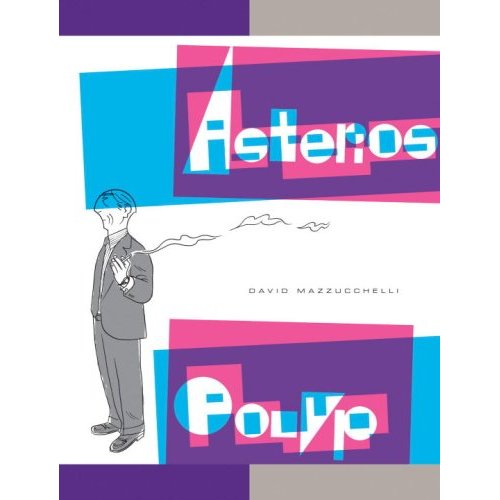
Asterios Polyp — David Mazzucchelli

asterios-750008

Let’s get a few things straight from the get-go: David Mazzuchelli’s graphic novel Asterios Polyp is a masterpiece, an unequivocal advancement of its medium, and an unqualified joy to read. It’s also not only one of the best books we’ve read this year, but also this decade. While such breathless enthusiasm might seem suspect, even a cursory look over Asterios Polyp will reveal that Mazzucchelli has produced a fully-realized work, one that fundamentally reimagines what a graphic novel is, and how it might be read.

Asterios Polyp is a boorish, solipsistic “paper architect” and tenured professor (none of his designs have ever actually been built) whose life goes to shambles after his sensitive wife Hana leaves him. The novel opens with a lightning strike that literally destroys everything that Asterios owns. He grabs three key items–his father’s old lighter, a magnetically-powered watch he bought as a child, and a Swiss Army knife he found on the beach–and hits the road, heading into the great, normal Midwest, where he takes a job as an auto mechanic (in a lovely scene, Asterios the autodidact, after accepting his new job, heads to the library to learn auto repair in an hour). Asterios’s kindly boss Stiff and his hippie wife Ursula take in the poor soul/arrogant prick. As the plot unfolds, Mazzucchelli contrasts Asterios’s past, full of faculty cocktail parties, affairs with grad students, and highbrow conversations, with his incremental rebirth into a more concrete world. “Be not simply good; be good for something,” said Henry David Thoreau–a lesson that Asterios slowly learns as he finally applies his skill and genius to real-world applications, like building a tree house for the couple’s son and creating a solar-powered Cadillac. Asterios’s emergence as a fully-realized human being contrasts sharply with hist past. Although he clearly loved his wife Hana, he was unable to appreciate her as anything other than a prop in relation to himself–how she complimented him, added to him, reflected on him. The flashback scenes with Hana are keenly realistic and loaded with genuine pathos. They are the heart of the novel.

Asterios’s twin brother Ignazio narrates the novel, only there’s a catch–Ignazio died at birth. This trope of twinning underscores Asterios Polyp‘s philosophical thrust. Asterios, in an attempt to understand (and thus control, at least figuratively) the universe, attempts to systematize it in his own intellectual yet limited projections. For Asterios, the world is all duality–life and death, in and out, form and content, exterior and interior, plastic and linear, black and white. Although he’s willing to make pragmatic concessions to shades of gray–Mazzucchelli is far-too savvy to have his lead as a flat, unrealistic allegorical figure–Asterios’s unrelenting idealism nonetheless repeatedly foils any chance for real happiness. Mazzucchelli’s discussions of philosophy, art history, and human relationships are never heavy-handed and always thought-provoking. Beyond this, his cartooning synthesizes words and art to a new level, one in which form and content are seamless, contiguous, and purposeful.

What, exactly, do we mean by this? To put it plain, there are few graphic novels that reinvent the possibilities of the medium. A handful of examples spring to mind: Chris Ware’s Jimmy Corrigan, Dave Sim’s Cerebus, and Art Spiegelman’s Maus. Like Asterios Polyp, these books envision the graphic novel as more than just “pictures + words.” Mazzucchelli utilizes every tool at his disposal. It’s not just his obvious talent as a cartoonist whose inks recall the best work of Will Eisner. It’s not just his fantastic scripting and dialogue (undoubtedly the most neglected facet of the comics medium). It’s also his sense of space, the rhythm of his panels, the perfection of not just each page but the cohesion of all the pages. It’s also the beautiful palette of Asterios Polyp, its codified world of pastels, purples and yellow, blues and pinks, and its spare oranges and reds. It’s also the lettering, where Mazzucchelli achieves something that I haven’t seen done properly since Dave Sim: he gives each character a unique, personal tone, simply through the shape of their words.

Of course, none of Mazzucchelli’s craft and technique would matter if his story wasn’t so compelling. There’s poignancy and pathos in the tale of Asterios Polyp, and we find ourselves rooting for him as he earns his redemption. And none of Asterios’s journey feels forced, a rarity these days it seems. Instead, there’s unexpected beauty here, especially as the novel unwinds–or perhaps, winds up–to its rewarding end. For the record, we’d absolutely love to discuss the last few pages of this book with anyone who’s read it–have you read it? Why haven’t you read it yet? Without spoilers, let’s just say that the conclusion is both fitting and bewildering, satisfying and yet maddening, a perfect cohesion of the book’s thematic exploration of dualities (and the pitfalls of choosing to codify the world into a series of those dualities). Mazzucchelli’s been around forever (you probably remember him, like me, from his early work with Frank Miller on Daredevil and the groundbreaking “Year One” arc of Batman). Amazingly, this is his first solo graphic novel. Hopefully he won’t keep us waiting so long for the next one. Do yourself a favor and get this book now. Very highly recommended.

Asterios Polyp is now available from Pantheon Graphic Novels.

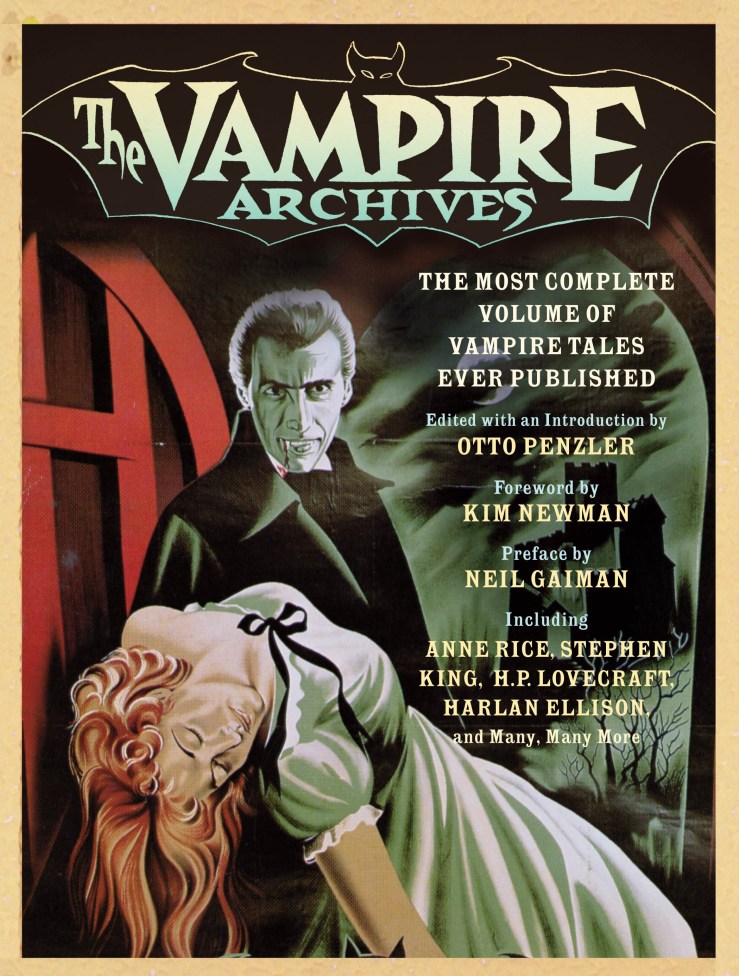
The Vampire Archives

Vampire Archive 4

In his short foreword to Vintage’s massive, new, decidedly unshort The Vampire Archives, Neil Gaiman dryly observes, “And then, one day, they were everywhere. You couldn’t move for vampires. There were paranormal vampire romances and junior paranormal vampire romances . . . Everywhere vampires, stripped down like a simple metaphor for genitalia-free relationships.” We know that vampires are ubiquitous in the late oughties, whether its the turgid teen abstinence vampire theatrics of Twilight,  HBO’s addictive interpretation of Charlaine Harris’s Sookie Stackhouse series, True Blood, the CW’s latest attempt to cash in, The Vampire Diaries or last year’s fantastic film Let The Right One In. Gamian’s theory for the thriving popularity of vampires (he agrees with Stephen King by-way-of Erica Jong that “Vampires . . . were the ultimate zipless fuck”) is as good as any, we suppose, but The Vampire Archives editor Otto Penzler is a bit more historical in his introduction to the volume, pointing beyond the traditionally-accepted notion that Stoker’s Dracula is the first vampire story. Penzler brings up Lilith, the children of Hecate, Lamia, the Chinese monster Kian-si, brain-suckers of American Indian lore, the Scottish Glaistag, and the Brazilian jararaca–just to name a few. He also briefly discusses the lurid histories of Countess Elizabeth Bathory, who believed the blood of virgins would sustain her life, die-hard mad prophet Rasputin, and Vlad the Impaler, the historical basis of Count Dracula. Penzler’s eclectic overture here tellingly highlights the diversity of the 85-plus tales collected in the book.

There are “Pre-Dracula” stories here, like Edgar Allan Poe’s gloomy “Ligeia” and M.E. Braddon’s “Good Lady Ducayne,” as well as classic standards like Bram Stoker’s “Dracula’s Guest” and Jan Neruda’s “The Vampire.” Heavy-hitters like D.H. Lawrence and Guy de Maupassant are represented along with the pop fictions of Stephen King and Clive Barker. Especially welcome are Harlan Ellison’s insightful piece “Lonely Women Are the Vessels of Time” and Richard Matheson’s taut tale “Drink My Red Blood.” Writers often identified readily with genres other than horror, like Ray Bradbury, Tanith Lee, and Sir Arthur Conan Doyle also appear, along with a couple of Romantic poems by Goethe, Byron, and John Keats (while the inclusion of “La Belle Dame sans Merci” is great, it’s weird that The Vampire Archives doesn’t have just a little more room for Keats’s excellent “Lamia.” They could’ve also included Coleridge’s “Christabel,” but hey, we can hardly dispute their claim that the book is “The Most Complete Volume of Vampire Tales Ever Published”). Anne Rice pops up, naturally, with “The Master of Rampling Gate,which wasn’t too emo for our icy blood. We also enjoyed H.P. Lovecraft’s creepy and sinuous story “The Hound.” Grave-robbers, weird amulets, ghoulish killers–great stuff.

If you can’t find enough to feed your need for vampire tales in The Vampire Archives, they’ve been kind enough to include what has to be, at 120 pages, one of the most extensive vampire bibliographies ever–although they note that their list does not include “comics, games, movies, plays, television, or radio programs.” While not every story here is gold, more than most of The Vampire Archives is great gothic fun, whether you dig pulp fiction or psychological realism in your horror. If you’re ready to take the next step past Twilight–you’re not a poseur, are you?–The Vampire Archives is an apt starting place.

October Reading List

October is here–time to read (or reread) favorite scary stories, watch our favorite horror films, and carve up Jack O’ Lanterns. We have a couple of spooky reviews coming up (vampires!) but in the meantime, those searching for a good horror read can troll through a few older posts. Biblioklept: Lazy blogging at its best since 2006.

Two of our favorite posts ever are analyses of the scary stories our students wrote for extra-credit in’06 and ’07. Not sure what happened in ’08, but the ’09 contest is in full effect, yo.

For good horrific fun, check out Quirk Book’s recent Jane Austen mash-ups Sense and Sensibility and Sea Monsters and Pride and Prejudice and Zombies.

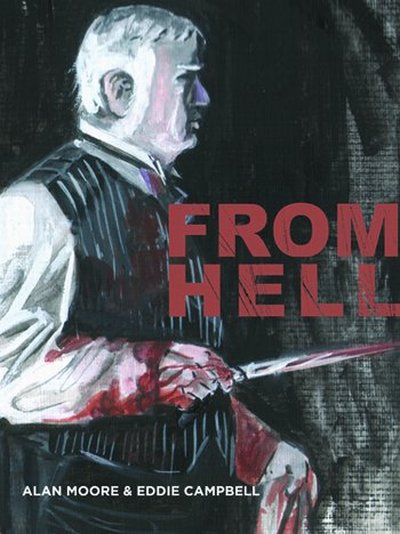
Eddie Campbell Alan Moore From Hell psychogeography

One of our favorite books ever is From Hell, by Eddie Campbell and Alan Moore. If you haven’t read it yet, that should be your sacred Halloween mission in ’09.

Snapshot 2009-10-04 19-58-53

My glorious alma mater, the University of Florida, had a lovely zombie preparedness plan at their official website–up until a day or two ago. When university officials were alerted to the pdf (written in full academic language, complete with citations!) they quickly removed it. Too bad. It was really fun and funny. Don’t worry though, you can still download the official document here.

As non-scary (or at least not overtly-scary) reading goes, we’ve got a pretty big stack of books we vow to get through in October, including W.G. Sebald’s Austerlitz, Julio Cortázar’s Blow-up and Other Stories, and the newest issue of McSweeney’s. There’s also a ton of promos of upcoming releases to wade through.

Back to the scaries–check out the Brothers Quay illustrating His Name Is Alive’s “Are We Still Married?”: