The Tenth Muse — Judith Jones

tenth-muse

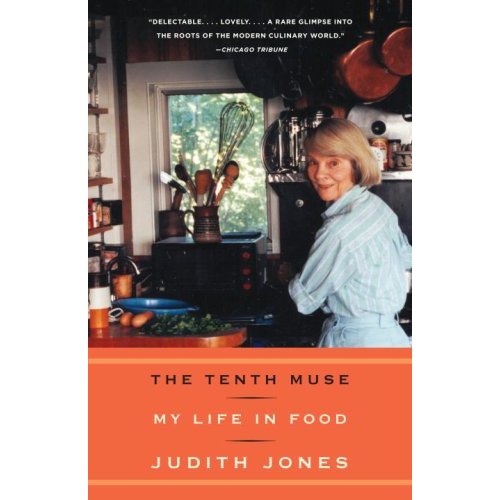
Judith Jones’s memoir The Tenth Muse, aptly subtitled My Life in Food, chronicles the life of one of the most influential foodies you’ve never heard of. The book moves quickly through Jones’s terse blueblooded Vermont childhood, through her time at Bennington College, and her first trip to Paris, all the while keeping Jones’s passion for food as its focus. This passion leads her to move to Paris after her college days, where she and future husband (and fellow writer) Evan Jones can eat pâté to their hearts’ content while palling around with writers, artists, and other beautiful people (even Balthus pops up in her narrative here). After some years of bohemian bliss, Jones returns to the U.S. to champion Julia Child, working hard to get her seminal cook book Mastering the Art of French Cooking to an American audience (she also manages to get The Diary of Anne Frank translated for publication as well). Shocked at the paltry selection of fresh foods in New York City, Jones and her now-husband Evan learn to make many of the fine French foods they enjoyed in their Paris days. At the same time, they continue to introduce a wider audience of Americans to cooks like James Beard, M.F.K. Fisher and Edna Lewis. Through it all, food (rich, thick, luscious French food) remains the primary focus, with the art of writing–and editing–a close second. Jones’s narrative abounds with anecdotes of chefs (Claudia Roden, Lidia Bastianich), editors, and writers (Camus, Capote, Updike), but readers who pine for psychological introspection or juicy melodrama won’t find much to chew on here.

Jones tends to gloss over information that most memoirs would milk for maximum drama. Evan was married when she first began living with him, a fact that would’ve scandalized many women in the 1950s but here goes largely unremarked. Two teenage children are adopted with little explanation or follow-up. Even the focus of Jones’s mastectomy returns to food, her pre-op meal, which Evans sneaks in to the hospital (“good pâté de campagne, some ripe cheese, a baguette, and a bottle of wine”). Also, readers who tend to pay attention to matters of class and economics might find Jones’s complete lack of self-reflection on how her wealth and background have allowed her to live and eat so richly a bit distasteful, particularly when she rails against the state of the modern American kitchen (too unused, or too full of processed, “quick and easy solutions.” Jones would have us killing and dressing beavers we catch on our vast estates, apparently. (Relax, I’m exaggerating (although she does prepare a beaver her son-in-law shoots)–but seriously, preparing a duck for dinner is not nearly as easy as she cheerily suggests)). But ultimately in The Tenth Muse, such lack of reflection simply leaves room for the food, which is really why you want to read this book anyway.

Jones caps off her book with over 80 pages of recipes, lovingly arranged in their own sort of narrative, one that parallels her life story. Jones includes favorite dishes from her early youth (“Spaghetti and Cheese”), plenty of French favorites (“Boudin Blanc,” simple “Baguettes,” “Brains with a Mustard Coating”), and recipes from her country estate (“Gooseberry Tart”). The selection of recipes at the end, “Cooking for One,” inspired by her continued love of complex cooking even after the death of her husband, is particularly poignant (Jones includes seven things to make from one duck).

The Tenth Muse may not meet the usual memoir-reader’s needs for salacious detail or analytical introspection, but those who simply want a glimpse into the life of an influential foodie–and some great recipes to boot–will not be disappointed. Recommended.

The Tenth Muse is now available in paperback from Anchor Books.
The Wasted Vigil — Nadeem Aslam

the-wasted-vigil

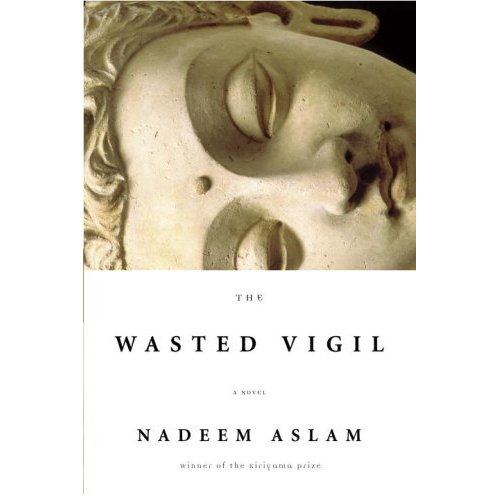
Nadeem Aslam’s new novel The Wasted Vigil ambitiously attempts to contextualize three decades of conflict in Afghanistan through the lives of its three main characters: Marcus, an English doctor living near Tora Bora, whose Afghani wife was killed by the Taliban, Lara, a Russian woman searching for her missing brother who disappeared during the Soviet invasion, and David, the ex-CIA operative tortured by his past. There’s also the young Islamic fundamentalist Casa, who dreams of jihad–possibly the novel’s most interesting character. Aslam weaves these stories together in a meditation on art and war, beauty and violence, and family and politics, never shying away from the brutality of a good stoning or elective amputation.

The Wasted Vigil works best when Aslam restrains his language and communicates in a more journalistic style. These moments are few and far between, however; most of the time, Aslam is overly concerned with explicitly announcing every allusion and broadly indicating the critical or aesthetic importance of even the slightest of his characters’ actions. Aslam’s prose is far more satisfying when he backs away from overblown, overwritten sentences and simply lets his readers figure out what’s going on for themselves. That said, Aslam can certainly turn an artful phrase–it’s just that artful phrase piled upon artful phrase becomes showy, even tacky. Restraint allows prose to build rhythmically and payoff meaningfully, but there isn’t enough restraint here.

Of course, Aslam’s subject matter is hardly restrained. Afghanistan is a place of remarkable violence and brutality, but also a place rich with history and culture. Perhaps Aslam’s editors believed his audience deserved an overtly complex representation of Afghanistan, and perhaps they are right in this belief. After all, the country has been very much in the background of the West’s political conscience for the past decade (translating in to big success for other books about Afghanistan, notably Khaled Hosseini’s The Kite Runner). Undoubtedly, there are a great many who will enjoy The Wasted Vigil. Those fascinated with Afghanistan and its sad, strange, violent history will have more than enough to mull over in this elaborate, intelligent, thoughtful novel.

The Wasted Vigil is now available in hardback from Knopf.

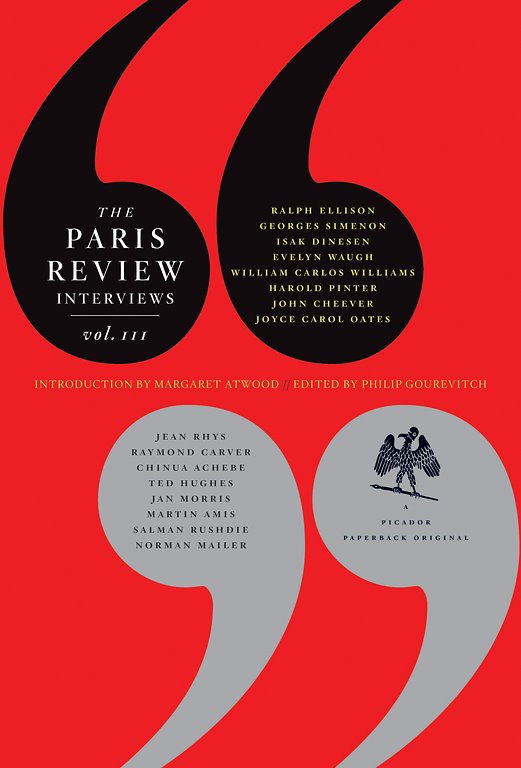
The Paris Review Interviews, Volume III

How much you enjoy the third collection The Paris Review Interviews will depend entirely on how much you enjoy reading intelligent and thoughtful writers discussing intelligent and thoughtful subjects. I happen to love reading author interviews–even interviews with authors I don’t particularly like–and hence, I enjoyed this book quite a bit.

Covering sixteen disparate authors and fifty-two tumultuous years, the interviews here are by turns insightful, hilarious, strange, and at times, infuriating. The first interview (the book is organized chronologically), a 1955 conversation with Ralph Ellison evokes all of these emotions. One can almost feel Ellison’s restraint as he patiently replies to asinine questions like, “Then you consider your novel a purely literary work as opposed to one in the tradition of social protest?” and, “But isn’t it going to be difficult for the Negro writer to escape provincialism when his literature is concerned with a minority?” If anything, these politicized charges prompt Ellison to some of the most salient observations about literature’s universalizing powers that I’ve ever read.

In his 1964 interview, poet William Carlos Williams also sheds quite a bit of light on his art and craft. Interestingly, his wife is also a major part of the interview, discussing at some length her own role in her husband’s writing. Beyond literature, craft, and writing, Williams also sets another early theme that unites the interviews collected here–dissing other writers. He calls T.S. Eliot a “conformist” determined to set poets back twenty years. Evelyn Waugh picks up on this theme in his 1963 interview. Of Faulkner: “I find Faulkner intolerably bad.” And Raymond Chandler: “I’m bored by all those slugs of whiskey. I don’t care for all the violence either.” Zing!

Don’t feel too bad for Chandler, though; he comes off funny and earthy and sad in his 1983 interview, especially when he discusses his alcoholism, and how and why he quit drinking. Apparently, teaching–and drinking–with John Cheever when the two were teaching at the Iowa Writer’s Workshop in 1973 had a major impact on Chandler’s decision to stop drinking.

John Cheever focuses mostly on the writing craft in his 1976 interview–not much talk of drinking here. He does, however, share this insight: “Plot implies narrative and a lot of crap. It is a calculated attempt to hold the reader’s interest at the sacrifice of moral conviction.” I’ve never liked Cheever’s writing, but he’s a great interview. In his 1994 interview, Achebe–an author whose fiction (and essays) I do like comes off as far more insightful and far less pretentious. On why creative writing classes exist: “I think it’s very important for writers who need something else to do, especially in these precarious times. Many writers can’t make a living. So to be able to teach how to write is a valuable to them. But I don’t really know about its value to the student.” Lovely. MFAs beware!

The interviews collected here are funny, smart, and very entertaining–whether its Achebe on general misunderstandings of his famous Conrad essay, Salman Rushdie on New Wave Cinema, or Joyce Carol Oates on Finnegans Wake, The Paris Review Interviews, Volume III is full of smart people talking about smart things–and what’s better than that? Highly recommended.

The Paris Review Interviews, Volume III is available October 28th, 2008 from Picador.

Hitler’s Private Library — Timothy W. Ryback

In Hitler’s Private Library, Timothy W. Ryback works from Walter Benjamin’s assertion that “a private library serves as a permanent and credible witness to the character of its collector.” Ryback delves into the books–the actual, physical books–that Hitler studied and pondered, paying particular attention to the dictator’s annotations and marginalia. To be sure, there are plenty of political tracts–especially anti-Semitic writings, such as Henry Ford’s The International Jew–to be found in Hitler’s library, but far more fascinating is Ryback’s analysis of Hitler’s love for Robinson Crusoe, Shakespeare, Don Quixote, and Uncle Tom’s Cabin, of all books. Hitler’s taste was varied–there’s an early infatuation with Max Osborn’s Berlin, an architectural guide to that city, an obsession with Ibsen’s Peer Gynt, and Hitler’s final day’s poring over a biography of Frederick the Great (he also comforted himself in the final days of his regime by rereading his boyhood favorite Karl May).

The Nazi party’s lurid mania for occultism is well documented, but Ryback brings a fresh perspective here, eschewing tabloid histrionics in favor of a measured approach to Hitler’s volumes of bizarre and arcane works. More troubling is the public misconception that the works of Schopenhauer and Nietchzsche some how gave philosophical weight to the Nazi’s crime spree; Ryback eliminates that notion:

For all the talk of Hitler’s exploitation of Friedrich Nietzsche’s concepts of the “master race” or Arthur Schopenhauer’s notion of the “will to power” that Hitler used to headline the 1934 party rally and Riefenstahl cribbed as a title for her cinematic chronicle of the event, we have little credible evidence of Hitler’s personal engagement with serious philosophy. Most of what we know is tenuous and at best anecdotal.

In short, Hitler was a poseur who recontextualized bit parts of great thinkers into mind-numbing sloganeering for his own ends (luckily, no politicians today would be so crude). Ryback’s even-handedness here is indicative of the project of his book: his is not a psychological study; he never seeks to explain the motivations for Hitler’s evil actions, but rather report what Hitler read closely. What we get in the end is an historicized, contextualized account of a bibliophile who initiated book burnings and mandated reading lists.

Hitler’s Private Library is really a book about books and how what we read shapes and then testifies to who we are and what we did in our life. I am not particularly interested in Hitler or the (well-documented) history of WWII, but I found in Hitler’s Private Library both a fascinating dialogic analysis as well as a new narrative take on some pretty stale material. The philosophy of Walter Benjamin permeates Ryback’s book, which is also a big plus. I’m not sure if the world needs another book about WWII, but I’m always a sucker for books about books. Recommended.

Hitler’s Private Library is available in hardback and ebook on October 21st, 2008 from Knopf.

Road Movie

“Having your book turned into a movie is like seeing your oxen turned into bouillon cubes” — John LeCarre

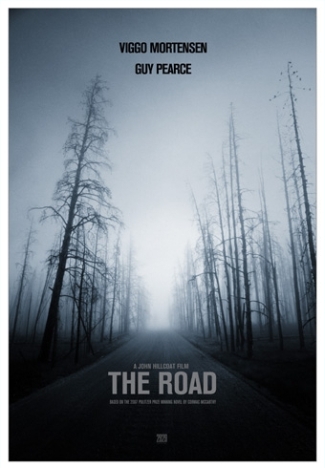
Movies rarely compare favorably to the books from which they are adapted and almost never surpass them. Still, film adaptations of books can be fantastic if handled by the right director–take Mexican director Alfonso Cuarón for example, whose brilliant films Children of Men and Harry Potter and the Prisoner of Azkaban (adaptations of books by P.D James and J.K. Rowling, respectively) convey richly imagined, engrossing worlds. Cuarón’s films join a small stable of adaptations that live up to–if not surpass–the books on which they are based. Most great film adaptations turn good genre fiction into great art. However, great literature doesn’t usually fare so well. Geniuses like Kubrick and Coppola have reconfigured airport reading like Stephen King’s The Shining and Mario Puzo’s The Godfather into cinematic masterpieces, but has anyone ever done justice to Melville or Hemingway or Hawthorne or Fitzgerald (of the four attempts at translating Gatsby to the screen, the 1974 Coppola-produced effort is arguably the best, but consider how short it falls of capturing Fitzgerald’s vision)? Which brings up the question: just how good, bad, or indifferent will the upcoming movie adaptation of Cormac McCarhy’s Pulitzer Prize winner The Road be? We thought we’d navigate the pros and cons here.

What The Road film adaptation has going for it:

The director: Australian director John Hillcoat’s 2005 feature film debut The Proposition captured the bloody violence and moral ambiguity of a world alienated from civilization. We loved the movie, and not enough people have seen it. The tone Hillcoat achieved in The Proposition seems well matched to McCarthy’s grim vision.

The producer: Nick Wechsler’s list of films includes Sex, Lies, and Videotape, The Player, Requiem for a Dream, 25th Hour, and Drugstore Cowboy–so it seems like he knows how to sit back and let a filmmaker create art without trying to, you know, have a massive Hollywood hit.

The leading man: Viggo Mortensen as the father seems like a great choice. Mortensen brought depth to the role he’s most famous for–Aragorn in The Lord of the Rings trilogy–something of a feat when you consider most of his screen time was devoted to scowling, brooding, or chopping up orcs. He was fantastic in the films he did with David Cronenberg, A History of Violence and Eastern Promises (his bathhouse fight scene is unbelievable). Mortensen’s a published author who started his own publishing house, Perceval Press, so he probably understands the literary gravity of The Road.

The story: Anyone who’s read The Road knows that it’s a sad and moving and strangely beautiful take on one of the most hackneyed devices of science fiction: the post-apocalyptic wasteland.

No Country for Old Men: The Coen brothers did a great job with No Country for Old Men.

Potential problem spots for The Road film adaptation:

The cast: We don’t know much about twelve year old Kodi Smit-McPhee who plays the son, but we do know that that is a major role. Let’s hope Kodi is more Jodie, less Jake Lloyd or (shiver) Dakota Fanning. However, Viggo’s had pretty positive things to say about him. Ringers Robert Duvall and Guy Pearce are also in there, but there aren’t too many other speaking parts in the book besides the father and the son, so it’s hard to predict what they’ll be doing–hopefully Hillcoat hasn’t fiddled with the story too much. Charlize Theron is also in the movie. The wife character showed up in a few dreamy flashbacks, but was more of a shadow than a fleshed out character; again, hopefully Hillcoat hasn’t chosen to expand the role to appease a wider demographic.

The story: Some of the best moments of The Road consist of the father’s inner monologues on memory and loss and very few directors can pull off a voice-over successfully (Terrence Malick is the only one who comes to mind right now). Of course, this problem of language is always the problem of movie adaptation.

All the Pretty Horses: Billy Bob Thornton’s leaden 2000 adaptation of the first of McCarthy’s “border trilogy” is pretty boring. I’ll admit that I’ve never finished the book, despite three attempts [ed. note: I finished the “border trilogy” in spring of ’09. Books are far, far, far superior to the film].

No Country for Old Men: Even though the Coens did a great job with No Country for Old Men, the book was still better than the movie–and No Country is, in some ways, McCarthy’s take on a genre novel, the crime procedural. In this sense, the Coens made a smart move, but they still couldn’t convey the depth and meaning of the book–again, much of it delivered via Sheriff Ed Tom Bell’s inner monologues. Although The Road may appear to have genre fiction elements–namely, the tropes of post-apocalyptic sci-fi–to describe it as such would be a severe limitation, as would be to film it in such a manner.

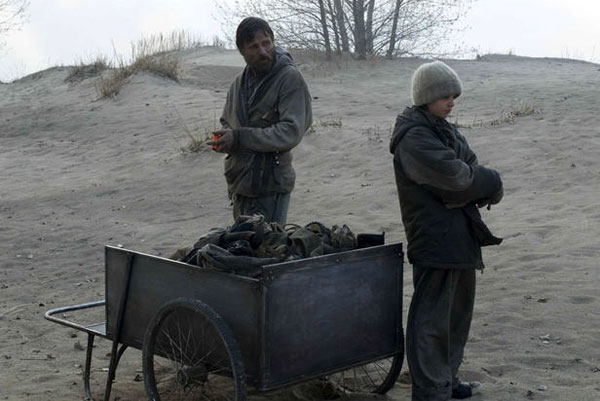
The advance stills: Sure, they’re grim and bleak, but are they grim and bleak enough?

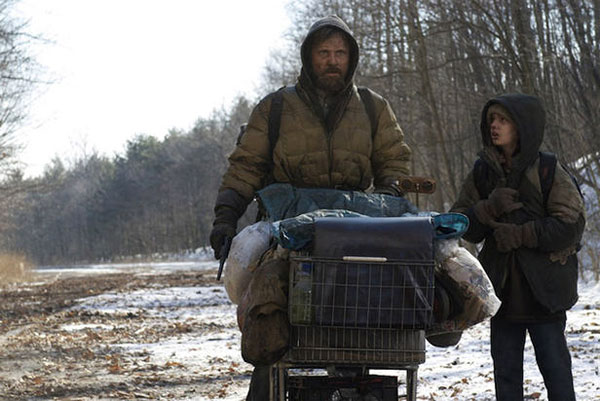
Also, why the stylized cart? If you’ve read the novel, you know what I mean–the cart needs to be a grocery store cart, homeless style! Hang on–

–that’s better! (NB: images link to a gallery of advance images)

Does it seem worth seeing in the theater?

Yes. We’ll be carrying the fire on or around November 26th (and just in time for Thanksgiving!)

Cheat Code

Motoko Rich’s article “The Future of Reading,” published in today’s New York Times, discusses the emerging trend in publishing and education of reaching out to young readers via video games. According to the article–

Increasingly, authors, teachers, librarians and publishers are embracing this fast-paced, image-laden world in the hope that the games will draw children to reading. Spurred by arguments that video games also may teach a kind of digital literacy that is becoming as important as proficiency in print, libraries are hosting gaming tournaments, while schools are exploring how to incorporate video games in the classroom. In New York, the John D. and Catherine T. MacArthur Foundation is supporting efforts to create a proposed public school that will use principles of game design like instant feedback and graphic imagery to promote learning.

Loyal readers will recall that last year I wrote quite positively about the MacArthur grant to promote gaming literacy. However, the trend detailed in today’s article seems like a big step in the wrong direction. While graphic design and computer programming are vital skill sets we should be teaching our kids, trying to hook them on reading through video games is altogether different. It smacks of cheap gimmickry that dismisses outright that reading might be a pleasure unto itself. In an age when the majority of college students can’t handle complex but necessary reading tasks and high school illiteracy rates are woefully underreported, trying to hook kids on books with Dance Dance Revolution just doesn’t seem like a great plan. If anything, it’s yet another step in the dumbing-down of America, a land increasingly hostile to anything with a hint of intellectualism–reading included. No wonder the Nobel Committee are such dicks to the U.S. Buried at the end of the article, luckily, is a voice of reason–

“I actually think reading is pretty great and can compete with video games easily,” said Mark S. Seidenberg, a professor at the University of Wisconsin in Madison who specializes in reading research. “So rather than say, ‘Oh, books are irrelevant in the modern era because there are all these other media available,’ I would ask shouldn’t we be doing a better job of teaching kids how to read?”

Professor Seidenberg seems like a wise and reasonable man. Let’s hope that we can get this country back on track and realize that the skill sets needed to survive and compete in a technological world do not replace but rather augment traditional literacy. Video games are great entertainment but it’s hard to imagine that they could ever trump the depth and breadth of philosophy and cultural currency contained in literature. Let’s not cheat our children out of that heritage by mistakenly believing that they cannot be taught to access it.

Bourbon Island 1730 — Olivier Appollodorus and Lewis Trondheim

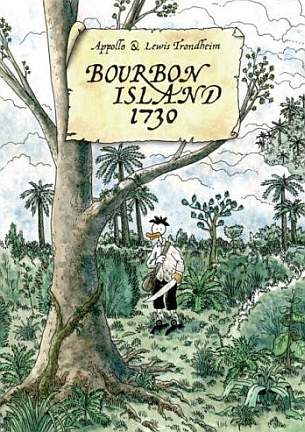
Bourbon Island 1730, part funny animal graphic novel, part historical literature, recounts the story of Raphael Pommeroy who travels from France to Bourbon Island with his ornithology professor in search of a living dodo. On the journey to the French colony, Raphael becomes entranced by pirate tales, and when he arrives to Bourbon Island, he immediately tries to join up with some ex-pirates–unsuccessfully, of course. The French government has offered an amnesty to all pirates, and many have become successful plantation owners. However, their new wealth comes at the expense of the large population of slaves brought to Bourbon Island from Madagascar and Mozambique. The most interesting subplot of Bourbon Island 1730 involves a network of maroons, runaway slaves who have colonized their own villages at the top of the island’s treacherous terrain. When the notorious pirate Captain Buzzard is captured, some of the maroons plan to set him free and lead a revolt against the French colonials. In the meantime, the colonial authorities, including the scheming governor and the greedy priest, are trying to get Buzzard to reveal where he’s hidden a large cache of treasure.

Lewis Trondheim’s art strikes a nice balance between vivid detail and the classic funny animal style, and the book’s measured pacing delivers the story at a nice clip. Appollodorus and Trondheim never rush, taking the time to convey the cultural complexity of Bourbon Island–quite a feat, really, when you consider how much is going on here: the end of a pirate age, the horrors of slavery, and the problematics of colonization. Appollodorus and Trondheim envision Bourbon Island as a strange nexus of slavery and freedom, piracy and central authority, of the meeting of the cultures of Africa, India, and Europe. Leading man Raphael is a hopeless romantic who pines wistfully for the absolute freedom he sees as the life of a pirate and the natural right of all men. And yet, as the book makes clear, idealism can rarely stand up to the corrosive complexity of the real world.

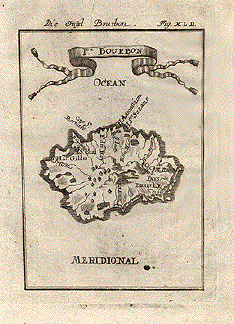
Allain Mallet's 1719 Map of Bourbon Island

With twelve pages of endnotes, Bourbon Island 1730 is just the kind of well-researched historical fiction that would fit neatly into any post-colonial studies course. There’s only one major fault with the book: it ends too quickly. Appollodorus and Trondheim have too many fascinating subplots that they don’t bother to resolve. While we have no problem with ambiguous conclusions, Bourbon feels simply rushed at the end, as it sprints to a virtual non-conclusion. We would’ve been much happier with a cliff-hanger and a promise of a part two. Nonetheless, anyone interested in colonialism and post-colonial studies should check out this book.

Bourbon Island 1730 is available October 28th, 2008 from First Second.

Sarah Palin, Vague Threats, and Why Banned Books Week Matters

We know Sarah Palin loves to read. In a great op/ed piece in today’s Washington Post, Ruth Marcus writes:

Asked in an interview for PBS’s Charlie Rose show last year (http://www.charlierose.com/guests/sarah-palin) about her favorite authors, Palin cited C.S. Lewis — “very, very deep” — and Dr. George Sheehan, a now-deceased writer for Runner’s World magazine whose columns Palin still keeps on hand.

“Very inspiring and very motivating,” she said. “He was an athlete and I think so much of what you learn in athletics about competition and healthy living that he was really able to encapsulate, has stayed with me all these years.”

Also, she got a Garfield desk calendar for Christmas 1987 that made a big impression.

Great stuff. Who doesn’t love to read? Books is where you gets knowledge. However, Palin is the sort of fundamentalist hardliner who thinks she knows what’s best for all of us to read–or not read. By now, you’ve probably heard of the pressure Palin exerted on the librarian of Wasilla. As mayor, Palin inquired how she might go about removing books from the library. Of course, according to most reports, including this one from The Anchorage Daily News earlier this month, “Palin didn’t mention specific books at that meeting.”

Huh. Hard to imagine that Palin didn’t get specific, right?

Palin then wrote the librarian in question a letter telling her she would be fired for lack of loyalty. Although public outcry prevented the firing, the librarian eventually moved away from Wasilla. Palin said at the time, and has maintained since then, that the question was “rhetorical”; she simply wanted to know how one would go about removing “objectionable” books.

Why would you ask how to remove books if you had no intention of removing them?

It’s too easy to dismiss Palin’s inquiries into censorship. Her moralistic will to ban what others read is really an attempt to control ideas, to control thoughts, to control bodies even–the ultimate goal of the far Christian right. It’s the middle of Banned Book’s Week, and it’s time to say “No” to the vacuous (a)moralizing of those like Palin who would presume to dictate what is and is not acceptable to be loaned in a public library. I don’t know about you, but I’m not going to let a woman who apparently believes that “dinosaurs and humans walked the Earth at the same time” tell me what to think or feel or read.

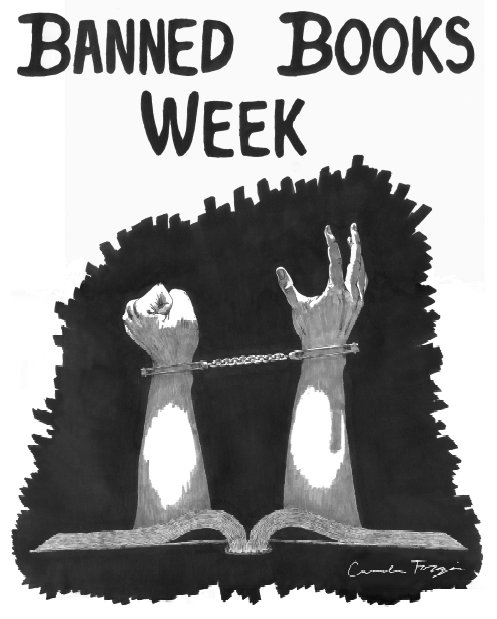
Banned Books Week calls attention to not only the great currency of ideas we have in literature, but to also points out that there are still those who seek to suppress ideas with which they don’t agree. Even as we celebrate these books, we must attack those who would ban them–especially those who work so surreptitiously.

The Adventures of Huckleberry Finn: One of Our Favorite Challenged Books

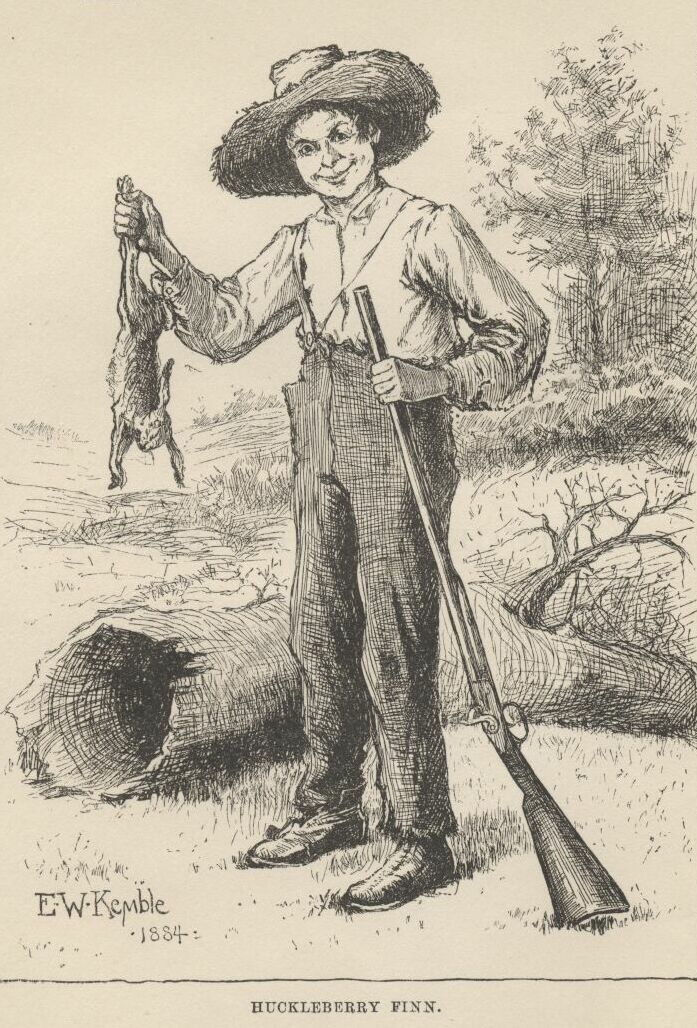
E.W. Kemble's frontispiece to the original 1884 edition
E.W. Kemble's frontispiece to the original illustrated edition

The Adventures of Huckleberry Finn by Mark Twain, undoubtedly one of the Great American Novels, ranks a healthy #5 on the ALA’s list the 100 Most Frequently Challenged Books. Young Huck’s casual colloquial use of the word “nigger” and the cruel hijinks Huck and Tom play on Jim at the novel’s end are two reasons that many have sought to suppress Twain’s masterpiece, including educator and critic John Wallace, who famously called it “the most grotesque example of racist trash ever given our children to read.” Wallace went so far as to suggest that “Any teacher caught trying to use that piece of trash with our children should be fired on the spot, for he or she is either racist, insensitive, naive, incompetent or all of the above.”

I guess I should’ve been fired on the spot, as I’ve used Huck Finn in my classroom a number of times, almost always in conjunction with excerpts from Olaudah Equiano’s Interesting Narrative, some Philis Wheatley poems, and a UN report on modern human trafficking. Context is everything.

While I can concede readily that Huck, the voice of the novel, says some pretty degrading things about Jim, often meant (on Twain’s part) to create humor for the reader, to expect Twain’s treatment of race to be what we in the 21st century want it to be is to not treat the material with any justice. And while Huck Finn may be insensitive at times, it handles the issues of race, slavery, class, and escape from the dominant social order with the complexity and thought that such weighty issues deserve. Ultimately, the novel performs a critique on the hypocrisy of a “Christian,” “democratic” society that thought it was okay to buy and sell people. This critique shows up right in the second page. Consider these lines (boldface mine):

The widow rung a bell for supper, and you had to come to time. When you got to the table you couldn’t go right to eating, but you had to wait for the widow to tuck down her head and grumble a little over the victuals, though there warn’t really anything the matter with them,—that is, nothing only everything was cooked by itself. In a barrel of odds and ends it is different; things get mixed up, and the juice kind of swaps around, and the things go better.

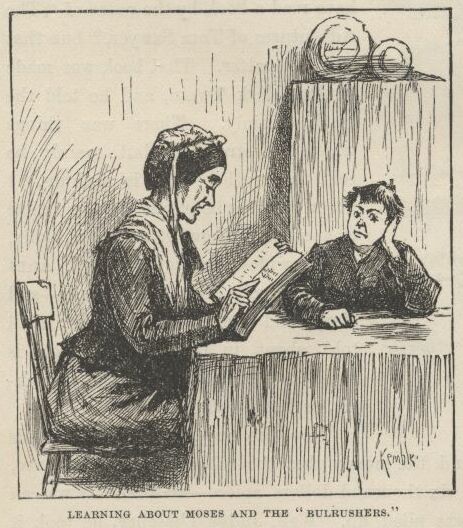
After supper she got out her book and learned me about Moses and the Bulrushers, and I was in a sweat to find out all about him; but by and by she let it out that Moses had been dead a considerable long time; so then I didn’t care no more about him, because I don’t take no stock in dead people.

Huck’s dream is of a delicious mix, a swapping of juices — integration. Additionally, his disregard for the dead Bible heroes reveals that the white Christian society’s obsession with the ancient past comes at the expense of contemporary value. Huck, an orphan, and Jim, separated from his family, will symbolically echo Moses in the bulrushes as they use the great Mississippi as a conduit for escape, for freedom. Huck (or Twain, really) here points out that it’s not enough to look at dead words on a page, on old dead lawgivers–we have to pay attention to the evils and wrongs and hypocrisies that live today.

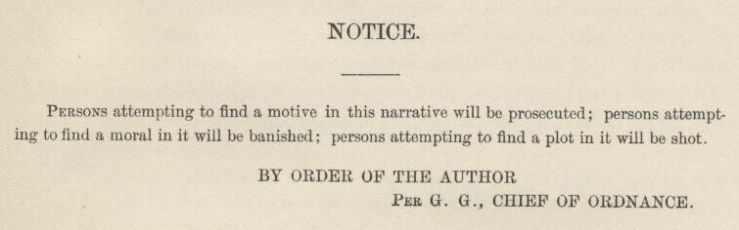
Twain even tells us how to read his book from the outset:

Now, it’s impossible to read a book–a good book–without finding its plot, searching for its moral, or caring about its characters, and Twain knows this. His “Notice” is tantamount to saying “don’t think about an elephant”–he uses irony to tell us we must find motive, moral, and plot here, and that we must do so through this lens of irony.

But of course, you have to read closely for all these things. I suppose it’s technically easier to call something trash, throw it in the garbage, and not have to devote time and energy to thinking about it. Who knows? You might learn something–and we wouldn’t want that, would we?

Banned Books Weeks Begins

From the American Library Association:

Banned Books Week: Celebrating the Freedom to Read is observed during the last week of September each year. Observed since 1982, this annual ALA event reminds Americans not to take this precious democratic freedom for granted. This year, 2008, marks BBW’s 27th anniversary (September 27 through October 4).

BBW celebrates the freedom to choose or the freedom to express one’s opinion even if that opinion might be considered unorthodox or unpopular and stresses the importance of ensuring the availability of those unorthodox or unpopular viewpoints to all who wish to read them. After all, intellectual freedom can exist only where these two essential conditions are met.

BBW is sponsored by the American Booksellers Association, American Booksellers Foundation for Free Expression, American Library Association, American Society of Journalists and Authors, Association of American Publishers, National Association of College Stores, and is endorsed by the Center for the Book in the Library of Congress.

Purchase BBW promotional items—such as the BBW Kit—through the ALA Store.

Explore Banned Books Week further through these resources:

Wabi Sabi–Mark Reibstein and Ed Young

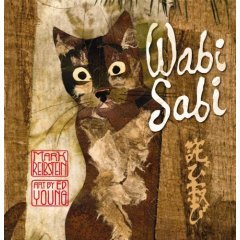
Wabi Sabi tells the story of of a cat from Kyoto named, uh, Wabi Sabi, who goes on a journey of self discovery in order to find out the elusive meaning of her name. Mark Reibstein’s simple but lovely script effectively incorporates haiku poems (including three haiku composed by Wabi Sabi herself, who finds artistic freedom at Ginkaku-ji) that can stand on their own as a simple story. Artist Ed Young brings Reibstein’s story to vivid, shimmering life. Not enough praise will do justice to Young’s rich, dense collage illustrations, which evoke the luxurious complexity one associates with masterpieces of ukiyo-e. Young’s kinetic yet peaceful art resonates with the book’s theme of finding beauty in the incomplete or imperfect, and is probably the best reason to buy this book. Wabi Sabi reads up-and-down as opposed to left-to-right, evoking a traditional scroll, allowing Young to utilize the depth and motion of the full space. The book also features short but detailed (and aesthetically-pleasing) endnotes explain the history of wabi sabi, haiku, and haibun. This short appendix also includes an English translation of the 14 haiku poems by Basho and Shiki that show up in the margins (in kanji, no less) on each of the pages.

Wabi Sabi was too long for my fifteen-month old daughter’s precious attention, and the scroll-style layout made it almost impossible to read with her on my lap (the book is also pretty much impossible for my scanner to handle, unfortunately for you dear reader). Also, I think the illustrations were a little too nuanced and complex for her–very young children tend to like strong, defined lines and bright primary colors. I’m convinced, however, that Wabi Sabi isn’t so much a children’s book as it is an art book for aesthetes with an interest in traditional Japanese culture–and I enjoyed it very much. Recommended.

Wabi Sabi is now available from Little, Brown.

For DFW

This post will be full of typos and rhetorical slips and just generally bad writing. I’m just gonna write and post and I won’t bother editing. Sorry.

This morning, after BLTs with wife and child I checked my email. My buddy Damon sent me this article from the New York Times. Damon’s subject line, “David Foster Wallace dead at 46 (suicide)” kinda blew my mind. I didn’t get past the first lines of the Times report before tears started coming out of my eyes.

I’ve read all of DFW’s books, and, as corny as it sounds, the majority of them spoke so directly to me, so intimately, that I feel as if I’ve lost someone I knew. I’m sure that this isn’t the case at all, because he’s a writer and I’m his audience. He’s not friends or family. But reading him doesn’t feel that way. I would describe his style as a really, really good friend sitting on the couch with you, telling you stories that were both painfully funny and painfully sad. Infinite Jest provided a world of escape–a world I became addicted to–when I felt lonely in a foreign country I’d moved to. Girl with Curious Hair changed forever the way I thought about writing and reading–it opened me up to a whole new bank of authors and styles. But it’s probably DFW’s essays that hit me most directly.

Anyone who’s read the title essay from A Supposedly Fun Thing I’ll Never Do Again, or “Getting Away from Already Being Pretty Much Away from It All” from that same collection knows just how funny and insightful and analytical Wallace could be–all without any of the caustic meanness a lesser writer might employ. DFW’s essays–and fiction–are always negotiating the razor line between earnest emotion and ironic detachment. He hated the latter but understood it was part of a cultural mode, part of the counter-tradition of post- or meta- fiction that he was continuing and responding to with his own writing. The two essays that probably best exemplify this are a Fun Thing‘s “E Unibus Pluram: Television and U.S. Fiction” (this should be required reading for every thinking person) and “Authority and  American Usage,” DFW’s take on who-decides-what-is-proper-grammar-and-diction (collected in Consider the Lobster). I was re-reading the essay last Thursday and last night, with the intention to finish it today, with the intention to use it as part of something else I had planned to write. It will be impossible to finish it with the same reading schema in mind.

Just last week I listened to DFW reading from some as-yet-unpublished stuff; one section, on an overachieving boy that everyone hates is hilarious. The crowd is sometimes laughing too hard for DFW to maintain his rhythm and he has to slow down. In the interview that follows the reading, DFW seems like a really sweet, honest guy.

I remember distinctly my cousin calling me, well over a decade ago now, to tell me that Kurt Cobain had shot himself. I felt nothing then–it seemed perfectly logical. I was a huge Nirvana fan; they were my first concert and a big musical/cultural determiner in my young life. But his suicide seemed normal, natural even to me. I remember thinking “Of course.” When Hunter S. Thompson committed suicide, it seemed strange to me that he’d taken so long to do it. And when one of my favorite writers of all time, Kurt Vonnegut, passed away last year, I felt sad, but not so sad. So it goes.

This, this devastates me though. How could he hang himself? Why? I feel selfish and sad. Will we get another novel? Is it wrong to feel this way? I’m pretty sure that it’s wrong. I think about his body, hanged, and it makes me sick. I honestly felt close to this person. Unlike DeLillo or Pynchon or Barth, there was no veil or mediation in Wallace’s greatest work, no distance between his voice, or his speakers’ voices and my own burning internal ear. I have no pithy statement or philosophical wax for this piece, I have no way of summing up here. I feel sick.

Tree of Smoke — Denis Johnson

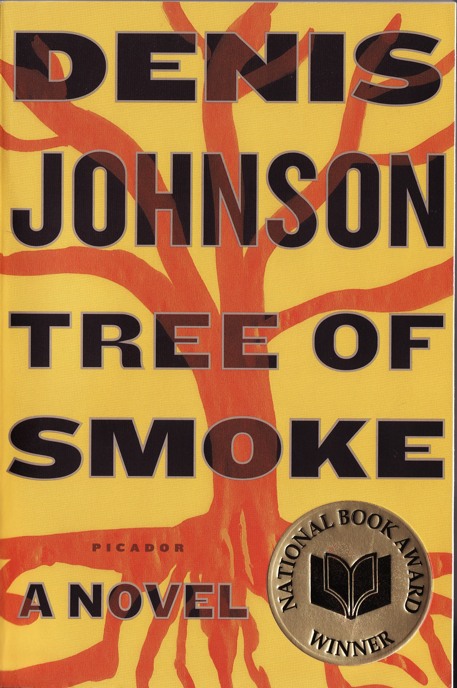
One year after it topped book critics’ best-of 2007 lists everywhere (including ours), Denis Johnson’s Vietnam War epic Tree of Smoke is finally available in a handsome trade-paperback. Picador’s edition retains the original orange and yellow cover, only now affixed with the proud blazon “National Book Award Winner.” However, that Tree of Smoke won this prestigious award no doubt ruffled a few feathers. It still remains an urgently divisive work.

Although plenty of critics and readers loved the novel, including The New York Times‘s Jim Lewis (who cautiously called it “something like a masterpiece”) and Michiko Kakutani, it has had more than its fair share of haters. Consider B.R. Myers’s downright mean review, “A Bright Shining Lie” in The Atlantic. Here, Myers displays the worst kind of vitriol. He’s the critic who feels the need not only to trumpet his hatred of the work he’s assessing, but also to lambaste the dignity, taste, and intellect of anyone who would disagree with him. Myers specifically attacks Johnson’s rhetorical style, his diction and syntax, and concludes that those idiots who would praise such inane, base, and clichéd language (idiots like me, that is) are clearly the cause of all current social and political problems and “have no right to complain about incoherent government.” Uh, sure. Myers’s baseless zealotry aside, it’s worth looking at the popular reception of Tree of Smoke, and what better place to do so than scouring Amazon reviews, right?

A cynic might say that Amazon reviews are the bottom-barrel of literary criticism, yet it’s still worth considering the almost perfectly mathematical split between 5- and 4-starred reviews of the book and 1- and 2-starred reviews (although none of the negative reviews I read on Amazon suggested that praising Johnson’s novel disenfranchised one from political opinions). Put simply, most people tend to either hate or love Tree of Smoke, which, I believe, is a sign of great art. And, were I inclined to inflate my rhetoric to a grandiose level like Myers, I might here wax philosophical about opinion, perspective, history, and the value of great art to ignite debate and discussion within the marketplace of ideas. However, I don’t think a book review is necessarily the best venue to make grand sweeping statements. At best, such writing presents a shallow or hollow endorsement of a collective truth (e.g. “Everyone assesses literature from their own perspective and therefore everyone values books differently”); at worst–in the case of Myers’s grotesque review–we get a pompous, overblown, self-important declaration (here, praising Tree of Smoke = losing the ability to authoritatively comment on society or politics) that can only be supported within the limited rhetorical bounds created the sophist has constructed (i.e. Myers’s review). But I’ve made a long digression, and, worse, I’ve failed to really discuss the book at all.

My initial review of Tree of Smoke last year was really a review of Will Patton’s masterful audio-recording of the novel (I was reading Ulysses for graduate school at the time and simply did not have the time to read both). I loved the experience; Patton did a great job, and I found myself wholly addicted to the narrative. When the advance copy of Tree showed up in the mail earlier this week, I immediately re-read the coda of the book in a single sitting. I would say the measure of a great narrative is not its core, its climax, or its beginning, but how well the conclusion is able to deliver the promises established throughout the book. Tree of Smoke delivers, and its ending continues to haunt the reader well after the book has been set aside. Readers like Myers may not get the payoff–he claims that “Johnson’s failure to understand [his character’s] faith is such that when he uses it to end the novel on an uplifting note, the reader feels nothing.” However, I hardly think that a watery Hallmark-word like “uplifting” properly connotes the weight, pathos, and sheer pain that Johnson conveys and addresses at the end of the book (Myers’s shallow diagnosis leads me to believe he merely skimmed the novel). Ethics of literary criticism aside, the real triumph of Tree of Smoke is simply that Johnson manages to comment in a new way on a subject that, by 2007, had been done to death. Who knew that we needed another story about the Vietnam War? Denis Johnson, apparently. Read the book for yourself. Very highly recommended.

Tree of Smoke is available in paperback from Picador on 2 September, 2008.

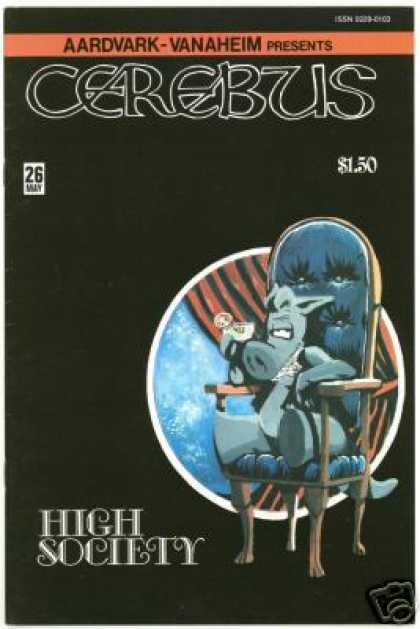
High Society–Dave Sim

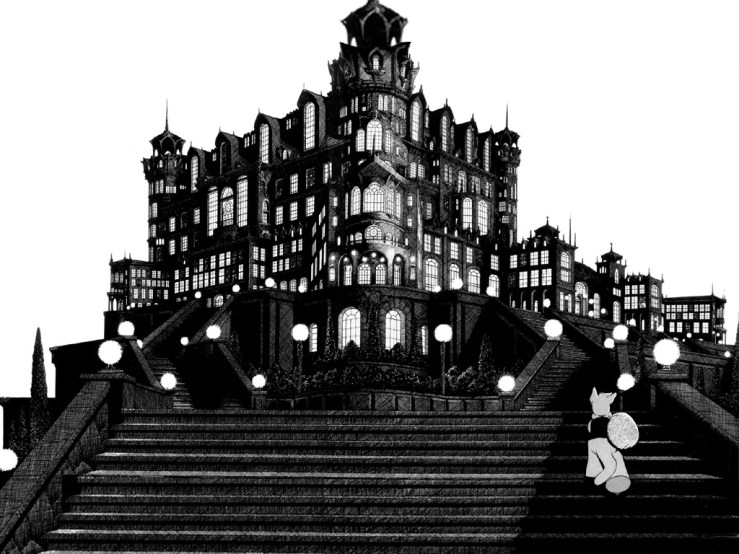
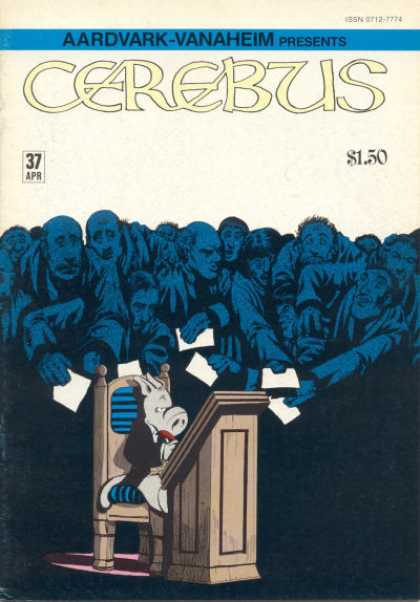
If you’re at all interested in reading any of Dave Sim’s epic 300-issue comic book Cerebus, a book chronicling the life–and death–of a misanthropic mystical barbarian aardvark, High Society is the best (and possibly only) starting point. High Society tells the story of Cerebus’s political adventures in Iest, the largest cosmopolitan city-state of Estarcion. Guided (or perhaps manipulated) by Machiavellian Astoria, Cerebus undertakes a strange, comic odyssey of political ascendancy, culminating in an election for Prime Minister (against Groucho Marx stand-in Lord Julius’s goat, of all things). Sim has a deft ear for political satire and the volume holds up particularly well to a rereading against the backdrop of the current American electoral process. While High Society conveys a certain cynical contempt for the cronyism, deal-making, and the general nasty malfeasance that underwrites politics, there’s also a reconciling of democracy, liberty, and art here that you could never find from a CNN analyst or a Fox News hack. By this point, the crude art and flubbed pacing that hampered the first few years of Cerebus are nowhere to be found. High Society is tightly-plotted, full of smart gags expressed in Sim’s keen lines, without an over-reliance on bubbles overstuffed with exposition.

The book is funny without ever being light, and rereading it again, I was surprised at how moved–and exhilarated–I was by the conclusion. Although the parody of Marvel’s forgotten Batman ripoff Moon Knight doesn’t hold up very well, and the “sideways” issues at the end are an annoying (but interesting) experiment, High Society continues to deliver both laughs and insight about the political process over twenty years after its single-volume publication. Very good stuff, and highly recommended (read it along with/against the 2008 election).

(Strange aside that I couldn’t work into the piece–remember Ken Jennings? That guy who won Jeopardy! like, a year straight? According to his blog he’s a huge Cerebus fan).

Writing in the Ellipses

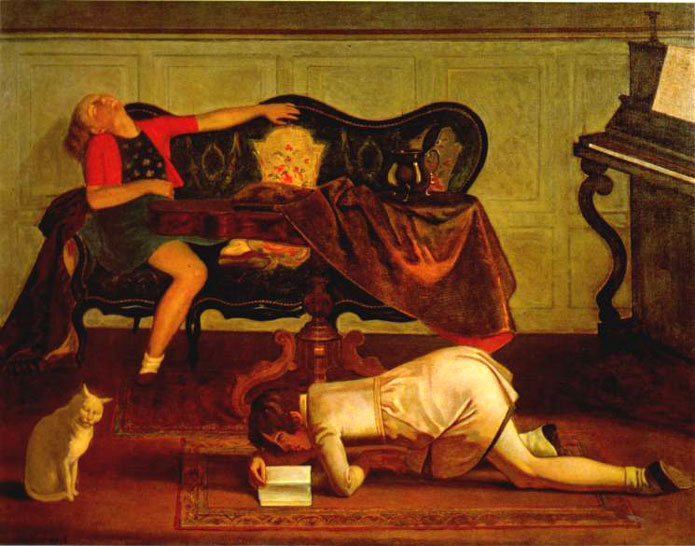
Balthus--The Living Room
Balthus–The Living Room

Flipping through Balthus‘s digressive, discursive, elliptical memoir Vanished Splendors, I came across this notation:

I deeply believe in the genius of painting, which parallels that of childhood. I’ve used painting as a language without really having decided to do so, because it suits me better than writing. Writing tries to be too explicit and go directly to meaning. That’s why I could never be a writer like many of my friends. Some aspects of my life might be clarified by the present short texts, similar to letters. . . . For me, writing can only be in the ellipses, where I express myself; painting conveys this magnificently, sometimes unbeknownst to the painter himself.

Elsewhere, Balthus lists the writers and texts he loves, and gives us (what I believe to be) a great definition for reading:

I often paint young girls who are reading. It’s surely because I saw the act of reading as a way to enter life’s deeper secrets. Reading is the great means of access to myths. Green, Gracq, Char, Jouve, Michaux, and Artuad were frequent passageways, as well as the great holy writings of the Bible and initiates like Dante, Rilke, the Pléiade poets, the great Chinese writers, the mystics John of the Cross and Teresa of Avila, not to mention Carroll, the pure German poet Ludwig Tieck, and Indian epics. All these texts and authors were landmarks in my life, and gave me another dimension of time to which I soon felt myself summoned. My young girls who read in dreaming poses are escaping from fleeting, harmful time . . . Fixing them in the act of reading or dreaming prolongs a privileged, splendid, and magic glimpsed-at time. A suddenly opened curtain sheds light from a window and is seen only by those who know how. Thus a book is a key to open a mysterious trunk containing childhood scents. .

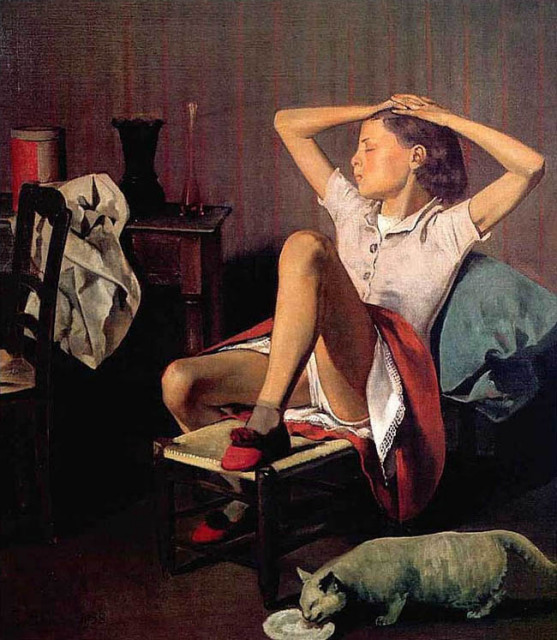
Balthus--Girl with Cat

But, my favorite lines in the book come at the end of the following passage:

Painting is something both embodied and spiritualized. It’s a way of attaining the soul through the body. . . . Being too cerebral and jokey can obstruct an artisan’s manual labor, and impede the ascent to the soul. Believing that my young girls are perversely erotic is to remain on the level of material things. It means understanding nothing about the innocence of adolescent languor, and the truth of childhood.

Exactly. Whenever I look at Girl with Cat, I think, man, that’s not perversely erotic at all…that’s just the innocence of adolescent languor–the real truth of childhood, actually. Nice try, Count Balthasar.

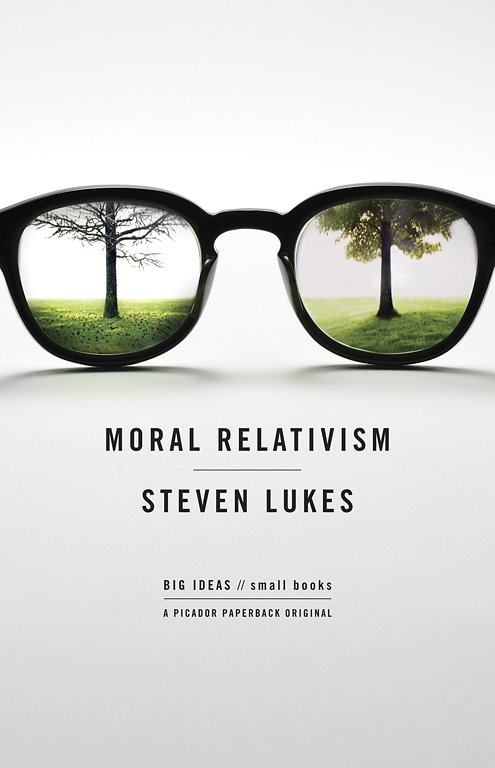
Moral Relativism — Steven Lukes

Moral relativism is the belief that ideals of right and wrong and good and bad are contextually determined by one’s local culture, as opposed to a theory of morality that holds that good and bad exist as absolute, metaphysical values existing cross-culturally, values intrinsic to one’s humanness. At the same time, individuals, even those (sometimes especially those) who see moral relativism as the overwhelmingly rational, sensical position, nonetheless are inextricably tied to their own sense of right and wrong, and this sense often leads them into a position of judgment–and perhaps action–against, over, and/or in reaction to the perceived wrongs of other cultures and societies.

In his new book Moral Relativism, NYU sociology professor Steven Lukes employs an interdisciplinary approach to tackle one of the biggest sticking points of contemporary thought. Using a variety of methods including philosophy, anthropology, history, and literature, Lukes addresses the fundamental conflict of moral relativism: that what’s right and good in one’s own culture may not be right and good in another’s culture, yet a will remains to believe in ideals of universal human rights. Lukes uses a number of timely concrete examples, including female genital circumcision, Islamic fundamentalism, and mass immigration, to assess the costs and payoffs of holding a view that says that no absolute morality exists. Perhaps the most fascinating part of Moral Relativism is Lukes’s negotiation of Western (or globally Northern, as he saliently points out) human rights actions as an extension of colonialism, with the one-time colonists imposing their values–again–upon the one-time colonized.

Lukes concludes that “the question Who are we to judge other cultures? is a bad question.” Arguing that the “postcolonial and multicultural contexts of our time do not require us to see the discourse and practice of human rights as ethnocentric,” Lukes takes up a position–well-argued–that a moral fundamentalist might claim is simply a liberal humanist wanting to have his cake and eat it too. Which, of course, is the problem with the book. It’s a fantastic argument for moral relativism, one that points out that no one–no one–is absolutely relativist, and that, in fact, being a moral relativist entails recognizing that within cultures certain perceived absolutes exist. The idea that right and wrong are relative doesn’t mean that right and wrong are arbitrary or don’t exist–it simply means that ideals of right and wrong have to be reconstituted within different systems of social and cultural order. Yet Lukes’s book isn’t going to convince the types that need convincing. Still, those of us who think that moral relativism is simple common sense will find plenty of concrete, contemporary, real world ammunition here in case we feel like arguing with a–gasp–moral fundamentalist.

Moral Relativism, available now, is part of the new BIG IDEAS // small books series from Picador Books.

In the Land of No Right Angles — Daphne Beal

In the Land of No Right Angles tells the story of Alex, an American college student backpacking in Nepal for a year. Alex’s overseas adventure becomes complicated when she meets fellow American Will. Will prompts Alex to help bring a poor Nepalese girl named Maya to the capital city of Kathmandu, and the three move in to an apartment together. Awkwardness ensues, including a failed threesome, a bad drug trip, and some major cultural misunderstandings. Alex leaves on a sour note, returning eight years later as a professional photojournalist to expose the horrors of human trafficking, only to find Maya embroiled in Bombay’s seedy sex trade.

The novel reads at a rapid clip, propelled by lots of dialog, and Beal certainly shows a complex knowledge of Nepali culture. Still, there’s something pervasively shallow, even troubling about Alex’s interactions with and reactions to her experience with this alien culture that the novel doesn’t quite resolve. The reader is meant to identify with Alex, the privileged American on her adventure to the exotic East. At one point, Alex states, “I wanted to come home different from what I’d been–bolder, wiser, happier.” This desire to find one’s self far away from home is nothing uncommon, of course, yet Alex’s–and Will’s–professed altruism toward their subject, poor little Maya, ultimately comes off as paternalistic and demeaning, culminating in the older Alex’s quest to “save” Maya. It’s hard to feel the empathy or sympathy that Beal wishes to evoke for Alex’s dilemma: in spite of all her questing, she still falls prey to the illusion of her own power as an educated Westerner to control the outcomes of alien others. To take a cue from Edward Said’s work revealing Orientalism in Western thinking, Alex’s East–and the people in it–exist mostly to reify and stabilize her own identity, give her her the adventure she needs to “come home different” with plenty of great stories to share.

Orientalist critique aside, Alex does have a pretty good story to tell. Beal’s descriptions are vivid and the novel has the compressed vitality of a good memoir coupled with a tone of immediacy that makes it easy and enjoyable to read. In the Land of No Right Angles will no doubt end up in more than a few book clubs this fall, and it’s certainly your smarter than average beach read–and there’s still plenty of summer left.

In the Land of No Right Angles is available August 12th from Anchor Books.