John Steinbeck: An Appreciation

I read John Steinbeck’s The Red Pony in the eighth grade and didn’t think much of it. I was more interested in Vonnegut and Kerouac and Kafka and HS Thompson at the time, all of whom seemed more substantial and just plain cooler. The boyhood adventures recounted in The Red Pony seemed hokey to me, and perhaps because of the title, I came to conflate Steinbeck’s novella with Marjorie Kinnan Rawlings’s Where the Red Fern Grows (ed. note: as gentle reader jd points out in the comments below, this is an error on Biblioklept’s part: it was actually Wilson Rawls who wrote Where the Red Fern Grows, Rawlings wrote The Yearling), which we also read that year, and which I also thought was interminably silly. Somehow, I managed to make it through both high school and college never reading anything by Steinbeck, and on the way, I also somehow managed to pick up the idea that he was an inferior or unimportant writer, unequal to Twain or Fitzgerald or Hemingway or Salinger, and certainly more boring than my beloved PK Dick and William Burroughs.

Fortunately, this ignorance was corrected the first year I started teaching high school. A more experienced teacher recommended that I read Of Mice and Men with my ninth graders. I probably wrinkled my nose at the idea (prejudiced as I was), but desperate to find a text that would engage them (as she swore up and down Of Mice and Men would), I gave it a shot.

The story of the child-like Lennie and his brother-keeper George hooked me from the first few paragraphs, and I, along with the students, became entranced, hooked on the book, unable to wait for the next day to read more. The next semester a new group of ninth graders and I worked our way through the book; a little more savvy now, I utilized Gary Sinise’s reading on audio book, possibly the best audio version of a book I’ve ever heard. He also directed and starred in a film version, with John Malkovich’s portrayal of mentally handicapped Lennie translating with realistic warmth and pathos. Sinise’s movie version is nearly perfect. By the fourth time I went through OMAM with the kids, I had introduced all kinds of different approaches to the text: gender readings, readings that focused on the disabled body, readings that troped against the book of Genesis and so on. I found that no matter how many times I read the text, I was never bored, and I always found something new in Steinbeck’s spare language. And it was–and is–Steinbeck’s measured and controlled prose that so impressed (impresses) me. Like Hemingway, Steinbeck eliminates everything extraneous, loading each word and sentence with significance; unlike Hemingway, Steinbeck’s writing shows a keen sensitivity toward persons besides macho white males.

I don’t teach ninth grade anymore, but I always slip a few Steinbeck readings into my AP Language and Composition course. Over the past few years, I’ve read a good deal of The Portable Steinbeck; if you want to boast a decent library of great American literature, this book is essential. Not only does it contain the whole of Of Mice and Men and The Red Pony, it also has carefully-chosen chapters from The Grapes of Wrath that manage to stand on their own (a testament to both editor Pascal Covici, Jr. as well as Steinbeck’s writing). Plus, look at that cover–very cool (I have a class set of these, and one student added a speech bubble to Steinbeck’s image with the text: “I’m a pimp”)
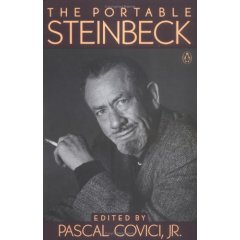
stein.jpg

What prompted this post? Well, I have one tenth-grade section right now–World Literature–and I usually introduce some of the themes I like to cover over the course of the year–colonialism, cultural clash, etc. (we’ll read Achebe’s Things Fall Apart next)–with Steinbeck’s novella The Pearl, a beautiful and sad book that is often overlooked as a lesser work, childhood fare like The Red Pony (admittedly a lesser work). This morning, starting a new reading (sixth? seventh?) with a group of young kids all engaged in a story they didn’t think they wanted to read, I realized that I wanted to say this: Steinbeck is great. Steinbeck is great and that’s something I had to find out from a bunch of kids. Steinbeck is great and I almost didn’t know it because my prejudice prompted me overlook him. Steinbeck is great and I want you to read him. Go for it. You can find a used copy of Of Mice and Men anywhere. It’s about a hundred pages long. If you read a chapter a night, you’ll be done in less than a week. Take the Biblioklept challenge. If you don’t like it, let me know.

How Bluegrass Music Destroyed My Life–John Fahey

dc124.gif

As astute reader Nicky Longlunch pointed out in a comment on my last post on 50 Great Guitarists, John Fahey was not only a fantastic guitarist, he was also a published author. Fahey wrote three books–1970’s Charley Patton, a biography of that great blues guitarist (out of print now unless you buy the Charley Patton box set); 2000’s How Bluegrass Music Destroyed My Life, a collection of mostly humorous anecdotes and stories; and the posthumously published Vampire Vultures, a collection of Fahey’s letters, limericks, and interviews. HBMDML and VV are both still in print from Drag City (you can also read a PDF extract from HBMDML there).

I remember enjoying How Bluegrass Music Destroyed My Life back when it was first published, when Mr. Longlunch was kind enough to let me borrow it (I returned it folks!). I recall it as being funny, insightful, and Bukowski-spare; I recall it also exhibiting the same raw pathos that Bukowski infused in his work, but with none of the vulgar meanness. The best parts of the book detail Fahey’s young years in Maryland. I can’t really remember much else. I’d love to read it again, but I can’t really shell out $20 for a paperback right now. And unfortunately, I can’t just borrow it from Longlunch again, because he is no longer in possession.

In his comment, Longlunch griped at me to “Focus!” and he’s right–this blog is supposed to be focused on stolen books, and, poor guy, his copy of HBMDML is (I’m guessing) somewhere in Texas. Or he’s just misplaced it for the past seven years. Or he’s lying about it being MIA because he doesn’t want to loan it out. Which is fair, I guess.

Before I leave, I should also point out that Fahey isn’t the only author I overlooked in yesterday’s post. For years now, Pete Townshend has been doing “research” for his as-yet-unpublished autobiography. So we have that to look forward to.

We’re Ready for You, Mr. Grodin

charles-grodin.jpg

A post over at RP a few days back reminded me of a long-forgotten chestnut by Charles Grodin, We’re Ready for You, Mr. Grodin, a memoir of the curmudgeon’s odyssey through TV land’s myriad talk shows. For readers too young to recall, Charles Grodin used to go on late-night talk shows and play a misanthropic git, provoking David Letterman or Johnny Carson with mean-spirited jibes. Of course, it was all an act; a kind of toned-down Andy Kaufman bit, perhaps. He even had his own talk show for a couple of years on CNBC; it was pretty all right decent okay (I think he does the Andy Rooney bit on 60 Minutes II now, but I’m not really sure because I won’t watch anything on CBS except Sunday Morning).

Well so and anyway, I remember the book as being pretty good, but obviously this is the sort of thing for Grodin fans only (and I must admit I love Grodin–and not just the Grodin of Seems Like Old Times or Midnight Run, but also the Grodin of Beethoven’s 2nd (superior in many ways to the original) (Grodin also had a cameo in Rosemary’s Baby, you may recall–a film I had a mild obsession with in my college years)).Sadly, I lent this book out and it never came home (hey, come to think of it, I haven’t written about a stolen book in a really long time. Slackin’). I’m not sure who I gave it to, but I have a suspicion a funny-looking redheaded kid might be the culprit. Now if only Michael Keaton would write a book…

Exterminate All Rational Thought: Burroughs at the Movies

naked-lunch1.jpg

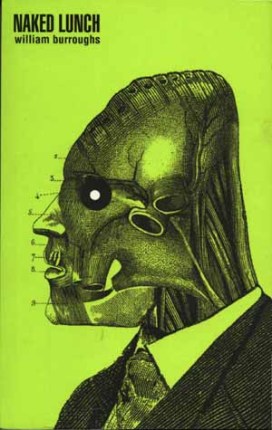
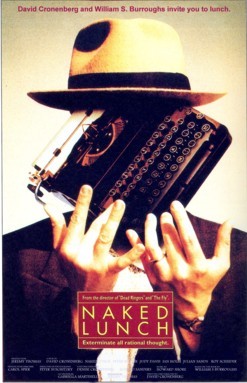
I love Naked Lunch. I love David Cronenberg. Theoretically, I should love David Cronenberg’s film adaptation of William Burrough’s psychosurreal classic. But hey, that’s rational thought for you, right? I didn’t love it in ’93 or ’94, the first time I saw it. Maybe I was too young. Maybe I just didn’t get it (but if that was the case then why did I love the book so much..?) So I watched it again as an undergrad; this was maybe ’99 or ’00. Nope. In fact, I remember thinking “Wow. This is actually pretty bad.” At that point, I was a big Cronenberg fan too. eXistenZ had just come out. eXistenZ is easily my favorite Cronenberg film, and a favorite film in general, and Naked Lunch didn’t hold up well against it or my re-reading of the Burrough’s book. But yet and still, ever the glutton for disappointment, I gave the Naked Lunch movie another shot this weekend, as part of the Biblioklept Summer of Cronenberg Film Festival. Guess what? It’s not a very good movie.

The fault of Cronenberg’s movie is not in failing to adapt the content of Burrough’s book, which is pretty much untranslatable as a narrative movie. Instead, Cronenberg attempts to weld some of the images of Naked Lunch–along with elements of other Burroughs novels such as Nova Express, The Soft Machine, and The Ticket that Exploded–into a cohesive thread using Burroughs’s biography as the overarching frame story. Burroughs’s life story is fascinating–the guy shot his wife in the head, for chrissakes–and lit junkies will love to see characters based on Kerouac and Ginsberg and Paul Bowles–but the end results simply don’t achieve or reflect the spirit of the novel. The bitter, caustic satire of Naked Lunch is almost wholly absent, replaced by wry one-liners from Peter Weller (who woodenly portrays Burroughs’s alter-ego, William Lee (an alter-ego who doesn’t appear in the novel of Naked Lunch at all, incidentally)). Cronenberg seems to underestimate his audience’s capacity for a nonlinear story, taking the loose collection of riffs, routines, and episodes that comprise Naked Lunch, and turning them into a pretty dull meditation on the nature of creativity and the suffering and alienation of the outsider-artist. Worst of all, the audience is asked to identify and sympathize with William Lee–again, this seems to be a negation of the original text.

naked_lunch.jpg

In the end, Cronenberg’s Naked Lunch is just another bad Cronenberg film (see also: his mish-mashed adaptation of J.G. Ballard’s Crash, his boring adaptation of Stephen King’s The Dead Zone). In Naked Lunch, we get the usual Cronenbergian tropes: mechanical objects that become hideously organic, bodily invasion, constant “is this real or is this a dream?” moments, and general dark creepiness. However, they simply don’t work here: Cronenberg is attempting Burroughs-icky resulting only in Cronenberg-icky. Cronenberg’s entire oeuvre is littered with flawed films, but I tend to enjoy them more for their flaws. This one was a no-go though, and I gave it three shots. But, in a way, I believe that Cronenberg deserved three viewings. You never know. Still, I doubt I’ll watch this one again.

If you haven’t seen a Cronenberg film, I suggest starting with Videodrome, A History of Violence, or eXistenZ. He also has a new movie coming out later this year, Eastern Promises starring Naomi Watts. If you haven’t read Burroughs, I suggest starting with Junkie or Queer (or just go ahead and jump into Naked Lunch).

I end with a far better review of Naked Lunch than I’ve provided here, courtesy of The Simpsons. Do you remember that episode where Bart makes a fake driver license (not the one where he’s awarded a real driver license courtesy Mayor Quimby)? And he takes Milhouse and Nelson and Martin on a road trip to the World’s Fair in Knoxville? Well, along the way the boys decide to sneak into an R-rated movie. They leave the theater disappointed; the shot reveals that they’ve just left Naked Lunch. Nelson remarks: “There’s at least two things wrong with that title.” I’ll leave it at that.

Hieroglyphick Bibles and other Marvelous Oddities

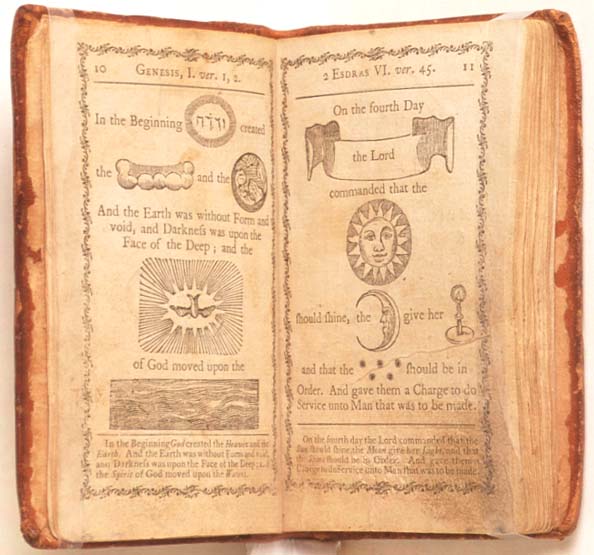
I’ve really been enjoying going through the Library of Congress American Treasures Collection. I came across this Hieroglyphick Bible (1788) the other day and thought it was pretty cool.

hieroglyph.jpg

Of course, I’m a big fan of the graphic novel (as well as the Old Testament) so this was right up my alley. More evidence supporting Scott McCloud‘s argument that the comics form is one of the oldest forms on earth (of course he goes way further back than the eighteenth century, contending that Egyptian hieroglyphs fall into his definition of comics art). Either way, check out LOC’s collection–fun for book nerds and history geeks alike.

Journey into Mohawk Country–Van den Bogaert and O’Connor


mohawk.jpg

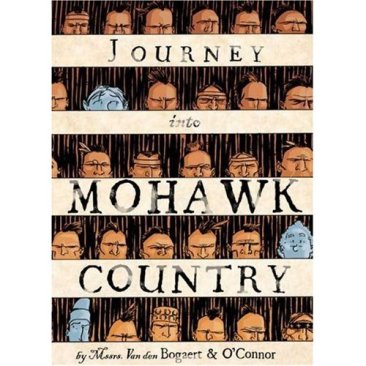
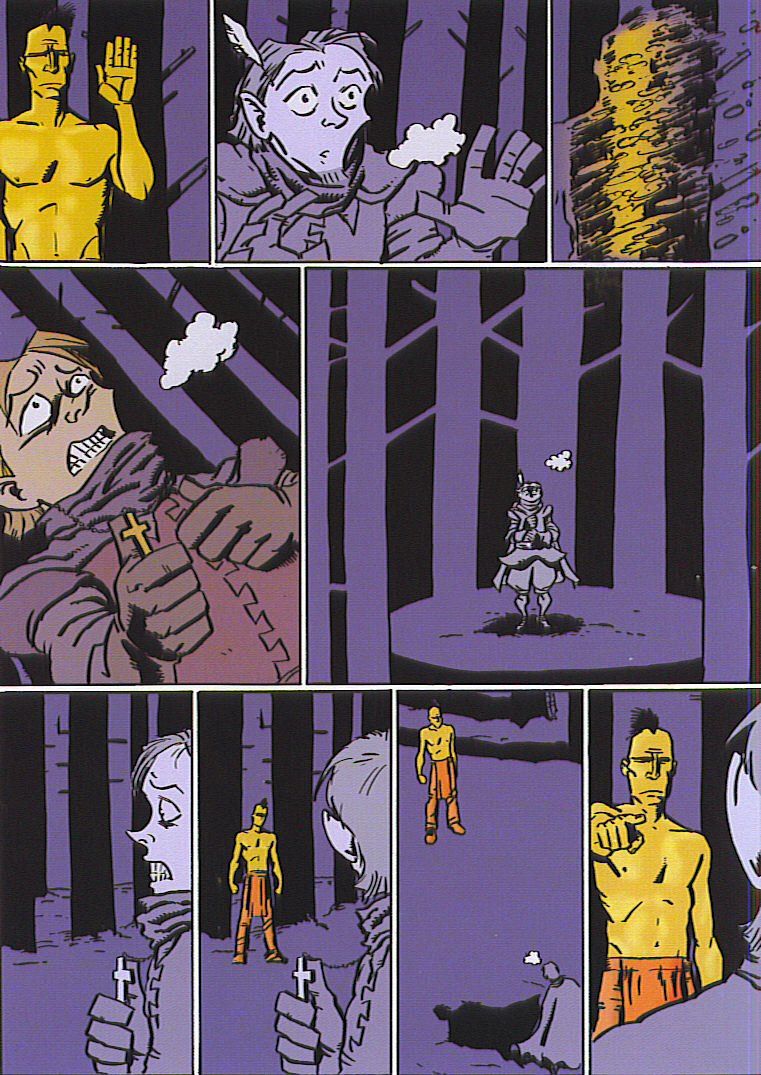
Journey into Mohawk Country is George O’Connor’s adaptation of Harmen Meyndertsz Van den Bogaert’s diary, an historical document detailing the young Dutch explorer’s 1634 journey out west of New Amsterdam to make contact with Indian villages for trade. O’Connor uses Van den Bogaert’s words verbatim, but his graphic novel format allows him extraordinary liberties with the journal’s account. Vague descriptions are literally fleshed out; O’Connor finds innuendo in even the simplest of Van den Bogaert’s entries, illustrating a between-the-lines reading of the Dutchman’s diary. O’Connor even manages to stick a strange epiphanic mystical revelation scene in there. The story itself is pretty simple: Van den Bogaert and his two companions head out into Mohawk country, meet and trade with Indians, eat bear, learn about some alien customs (including a sequence where some Indians show Van den Bogaert how to heal the sick by vomiting on them), and go back to Fort Orange. It’s really the little interpretive scenes around the text-proper, courtesy of O’Connor’s cartoony pictures, that make Journey into Mohawk Country such a pleasure to read. O’Connor’s work here illustrates the first-person narrative’s slippery claims on truth and the limited viability of a “true” historical account. Good stuff.

mohawk2.jpg

No Country for Old Men–Cormac McCarthy

no-country.jpg

Didn’t we write about No Country for Old Men a week or two ago? Yeah, but that was for the upcoming Coen brothers movie; this post is a review of the audiobook, and I’m not creative enough to think of a different title.

So we listened to the entirety of Cormac McCarthy’s No Country for Old Men over the course of two drives: from Jacksonville to St. Pete Beach and back. First off, as far as books-on-CD goes, this one was pretty good. Native Texan Tom Stechshulte manages to get all of the male characters spot on (the women in the novel sound kind of ridiculous though), and the action-filled plot, tight pacing, and simple sentences make for an easy-to-follow-while-driving listening experience (this is my number one criterion for an audiobook–you have to be able to follow the plot while navigating a road littered with truckers and asshole teenagers. F’r’instance, Faulkner’s short stories are almost impossible to follow in audiobook format).

Set in 1980, No Country for Old Men is the story of Llewellyn Moss, a Vietnam vet who stumbles across the aftermath of a drug deal gone bad and a suitcase with 2.4 million dollars in it. Of course, he takes the money and runs. Assassin Chigurh is hot on his heels to collect the drug money, leaving a bloody wake of murder and chaos. Sheriff Bell, a WWII vet who first-person narrates the beginning of each section of the book, is also on the case, trying to track down Llewellyn before he gets himself killed.

The first five discs (of seven) of the book were excellent–an exercise in genre fiction–the crime-suspense novel–that transcends the limits of the genre’s tropes. McCarthy’s spare prose moves at just the right pace, with just the right amount of “literary” interjection. However, the end of the novel morphs (evolves or devolves?) into a meditation on war and the changing nature of America and the American people. McCarthy’s symbols and metaphors seem heavy-handed and downright clunky at times, and in the end, the book becomes something of a reflection on personal failures and regrets, and how these personal failures add up to national failures.

Perhaps because I was driving, and because I had been so involved with characters over the course of five compact discs who suddenly disappeared in the narrative, I was disappointed in the end. Perhaps if I had read the book instead of listening to it on compact disc while driving, I would have found the ending more profound, or even enjoyable. Who knows–reading books vs. listening to them is probably a subject for another post. I do think that the Coen brothers will make a fantastic movie out of this story–potentially on par with Fargo. We’ll see.

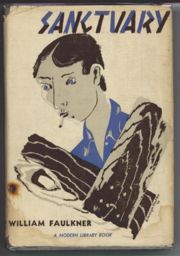
Sanctuary–William Faulkner

sanctuary.jpg

So I’ve been reading William Faulkner’s Sanctuary over the past few days. This was Faulkner’s breakthrough novel, the one that made him famous when it was published in 1931. He claimed that it was pot-boiler pulp fiction, written purely to make money, but who knows. I mean, we’re talking about a guy who chose to start spelling his name with a ‘u’ for some obscure reason–an author who worked from day one at creating the myth of himself as author. So who knows–maybe he actually thought he was writing a great piece of literature when he produced this lurid drivel.

Sanctuary is most famous for the rape of Southern debutante Temple Drake. She is raped with a corn cob. There you go. That’s pretty much all you need to know about this book. However, if you’re into elliptical and confusing depictions of violence, drunken debauchery, creepy voyeurism, and post-lynching sodomy, Sanctuary just might be the book for you.

There are two film adaptations of Sanctuary–1933’s The Story of Temple Drake, and 1961’s Sanctuary. Neither are readily available on VHS or DVD, and for good reason. They’re both pretty terrible. Still, the early sixties take on Sanctuary manages to capture the backwoods grotesque that saturates the novel. Actually, David Lynch could make a pretty decent film out of this.

My final analysis: I’m very very happy that I only have one more novel of Faulkner’s to read–Intruder in the Dust. Sanctuary did nothing but help consolidate my prejudice against Faulkner and my belief that the notion of Faulkner as an American Great is nothing but a scam.

No Country for Old Men

I’ve been reading a lot of Faulkner lately. This has nothing to do with me liking Faulkner (I don’t) or thinking that he’s an American master (at this point, I’m convinced that he’s not. Rather, it seems that a few critics–notably Malcolm Cowley and Cleanth Brooks–decided either that a. Faulkner is really great and/or b. America needs a new master of literary fiction, and it might as well be Faulkner. It seems amazing to me that these two critics conned a whole generation into believing that someone whose books were so unbelievably poorly written was actually, like, a totally awesome and important writer). I’m taking a class that requires me to read Faulkner.

Anyway, over the course of my reading, I got to thinking that the Coen brothers, two guys that have made some of the best American films ever (masterful films, certainly) are fond of Faulkner: the flood in O Brother Where Art Thou? hearkens to Faulkner’s novella Old Man (as does the whole milieu of that film really), the slow southern grotesque of Blood Simple is pure Faulknerian, ditto the gloomy doom of The Man Who Wasn’t There, and the failed screenwriter W.P. Mayhew in Barton Fink is essentially a caricature of Faulkner during his days in Hollywood.

So well and anyway, the Coens have a new movie coming out, No Country for Old Men, based on the Cormac McCarthy novel of the same name. Cormac McCarthy is often compared to Faulkner, though I have no idea why. They’re American? That’s it. They’re American. Like I said though, No Country for Old Men. Early reviews suggest that this is a return to form for the Coens, who have either been stumbling or just lazily cashing in lately (see: Intolerable Cruelty; The Ladykillers)–but we’ll have to wait until November to find out. For now, check out the trailer:

The Road–Cormac McCarthy

114930__road_l.jpg

At this point, I don’t know if it does any good to anyone for me to throw in my two cents regarding Cormac McCarthy’s latest novel The Road. This book won all sorts of awards and critical praise, topped The Believer‘s 2006 readers’ poll, and even became an Oprah’s Book Club selection. In fact, Cormac McCarthy gave his first ever television interview last month on The Oprah Winfrey Show, and I actually watched the damn thing. I was in the hospital; my daughter had just been born. Anyway, like I was saying, after the publication of The Road, everyone in the field of arts and letters and criticism seems to have simultaneously decided to confer “living master” status on Mr. McCarthy, most noting that he is an American writer. This is something we’re desperate for in American literature–masters of the art. And, if you cannot tell already, I have a somewhat cynical attitude toward this desperation, and a wary if not pessimistic approach to anything so unanimously lauded. So when my mother-in-law gave me a copy of The Road as a belated birthday gift–only a few days after the Oprah interview, in fact–I felt a mixture of intrigue and hesitation. I was reading The Children’s Hospital at the time (#3 on The Believer list, incidentally) which gave me some time and distance from the Oprah interview and some of the hype. When I finally finished The Children’s Hospital, I gave myself a little more distance, reading a few Faulkner short stories and a few magazine articles. Finally, I picked up The Road; I read about half of it in one sitting on a Friday night, finishing the rest of it over that weekend. I had to slow down in the end, because I knew that this book was a tragedy; I knew that (more) bad things were going to happen, and I loved the little boy and the man–the protagonists of the novel–and simply put, I put off reading as a way of putting off their deaths (I did the same with the end of The Children’s Hospital; also, just to get it out of the way, both novels are post-apocalyptic. Done with comparisons).

The premise of The Road will remind you of any number of other post-apocalyptic stories you’ve read or seen: the world is over and everything has gone to shit. However, McCarthy is unrelenting in his refusal to provide an explanation or even description for the epic disaster that precedes the events of the novel. Where most stories in the end-of-the-world genre delight in some sort of mythology, The Road eschews any fantastic back story. Instead, we get fragments, glimpses, the briefest hints. The overall effect of this lack of a reason is a stunning, awesome loneliness. This is an abandoned world, desolate, dead, cold, covered in ash. Nothing can live. Besides, the real story of The Road is the touching relationship between a nameless father and son. These are “the good guys” who “carry the fire”–this is the only mythology of the novel, the father’s only lessons to the son. The pair travels south, although their purpose is simply to stay alive, to not die. A large amount of the text is devoted to the simple day-to-day scavenging that is necessary to live, with occasional encounters with other living people being rare, unexpected, and ultimately meaningless. In a world where living people equal a good source of protein, no one can really help these two; all other people are threats–“the bad guys.” And as the novel progresses, the young boy begins to realize that the world is not so simple, that there may not be such a thing as “good guys” and “bad guys.”

The bond between the father and son, so beautifully expressed in McCarthy’s spartan prose, genuinely moved me. Their relationship propels a narrative absent of all but the dimmest kernel of hope; indeed, it doesn’t seem like there can be any future for these two at all in a world where nothing–no plants, no animals–can live. Which brings me to the last few pages of the book. I have a problem with this. First, I guess I should give a spoiler warning. Honestly, I believe that you can know the end of the book and not have it spoiled for you, but in the interest of etiquette: SPOILER WARNING! SPOILER WARNING! SPOILER WARNING! There. May we continue?

So yes, from the beginning of this book, it’s evident that either the father or the boy or both will die by the end of the book. And yes, the father does die, in a scene so moving that I actually cried. Unbelievably, however, McCarthy cops out in the last few pages of the book, and provides a deus ex machina in the form of a loving surrogate family to protect the boy. I mean, the new father figure comes literally out of nowhere and more or less says: “Okay, you’ll be safe now. Don’t worry readers, the kid is gonna make it!” This improbable resolution seems to contradict the 283 pages or so of the novel that preceded it. It seems far more likely in the world and vision that McCarthy crafted that the boy would be left alone to fend for himself. It’s almost as if McCarthy loved the boy too much to see him on his own, unattended to. And of course, a lot of his readers probably felt the same way–I certainly did. I really did. I wanted to see that kid make it, but at the same time the logic of the narrative does not support the ending that McCarthy wrote. Still, this really is a fantastic book–perhaps a bit overrated, but excellent nonetheless. Highly recommended.

The Children’s Hospital — Chris Adrian

childrenshospital.jpg

“The book started out a lot more like a big happy Love Boat episode, then 9/11 (and all that followed) happened and blew it in a new direction.”–Chris Adrian (McSweeney’s interview)

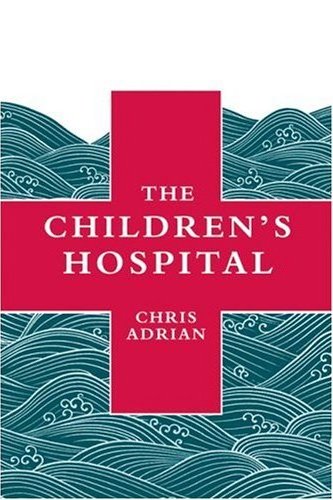
Chris Adrian’s 2006 novel The Children’s Hospital begins with the end of the world. A flood of (excuse me) biblical proportions drowns every living thing on earth with the exception of a children’s hospital which has been specially engineered with the aid of an angel to withstand both the flood as well as life at sea. The residents of the newly nautical hospital–doctors, med students, specialists, nurses, some 699 sick children, portions of their families and sundry others–must navigate an uncertain future drenched in despair and loss. Their mission of helping the ill is the only thing that sustains them–initially.

Central to the story is Jemma Claflin, a mediocre third-year med student with a haunted past. Years before the deluge, each member of her family and her long-term boyfriend died in a horrific way, leaving Jemma unable to love, let alone believe in a positive future. However, as the book progresses, it becomes apparent that Jemma will have to best her fear and become the hero of this epic novel.

I really, really enjoyed The Children’s Hospital. Adrian’s writing communicates a stirring mix of immediacy and pathos, tempered in a cynical humor that sharply bites at any hint of sentimentality. Despite its 615 pages, epic scale, and use of multiple narrative viewpoints, The Children’s Hospital never sprawls into logorrhea–Adrian holds the plot reins tightly at all times, sparingly measuring details which accrue neatly to an affecting payoff. The middle 200 page section of this book is easily the best thing I’ve read in the past few years. I actually had to stand up to read it–the highest Biblioklept endorsement there is. Yes folks–if you have to stand up to read it, it’s truly excellent stuff.

You can read the entirety of Chris Adrian’s short story “A Better Angel” here.

More Alphabet Soup: Brought to You Today by the Letter H

lolita.jpg

H is for Humbert Humbert, the rascally narrator of Vladamir Nabokov’s Lolita. Throughout the novel HH, a sardonic European, provides a running critique of conformist 1950s America, his adopted home. Pining for the haunting, ineffable feeling associated with a brief, tragic childhood love, HH engineers a series of unfortunate events in order to abscond with (and eventually seduce) twelve-year old Lolita Haze. Yep. That’s right. A child-molester made this list. But if you’ve ever read Lolita, you know how charming and funny this son-of-bitch is. Lolita is in a special class of books in the Biblioklept library; it’s one of those books that I’ve read in full at least four times, and one that I pick up and read parts of every year. The first time I read Lolita, I didn’t even realize what a monster HH was–in fact, I tended to sympathize with him, even to the point of sharing his condemnation of Lolita’s bratty, manipulative nature toward the end of the novel. Like Catcher in the Rye, I first read Lolita when I was 16; like Catcher in the Rye, Lolita was an entirely different book when I read it at 21. Somehow the book managed to change again, four or five years later. I’m sure Lolita will be completely different in a year or two when I’m thirty. In fact, I vow here and now to re-read it in full right after my 30th birthday. Who knows what will have happened to it by then? How these books change on you…

Narratological shape-shifting aside Lolita deserves to be read, and read repeatedly. Nabokov’s highly alliterative prose reverberates with lyrical gymnastics, multi-lingual puns, and allusions that will make you feel oh-so clever (if you are indeed oh-so clever enough to get them, of course). Neither Kubrick’s toothless 1962 film adaption or Adrian Lyne’s gauzy 1997 attempt do any justice at all to Nabokov’s words–this is one you simply have to read. Great stuff.

velocity.jpg

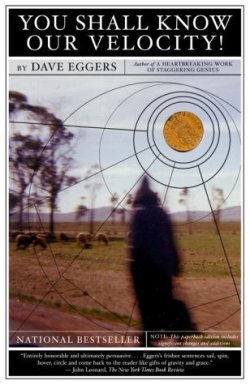
H is also for Hand, zany foil to Will, the tormented narrator of Dave Eggers’s You Shall Know Our Velocity!. In this book, the pair embarks on a futile attempt to travel the globe giving away an enormous amount of money Will has recently received as part of an injury settlement. This scheme turns out to be much more difficult and much more complicated than they had imagined. Hand is one of my favorite characters because he’s just really damn cool–a strange combination of someone’s hip older brother mixed with someone’s annoying younger brother. My favorite part of Velocity is the fifty page section where Hand takes over the narrative, casting doubt on everything that Will has previously told the reader. Will then resumes the narrative, but at that point, the book–and Will’s status as a reliable narrator–has taken an entirely different shape. Although the story ends at a wedding, Velocity is ultimately a tragedy; the very first page announces Will’s death. But again, the whole narrative is cast in ambiguity and doubt. I loved this book so much that I bought it for a friend.

(Incidentally, Hand also tuns up in “The Only Meaning of the Oil-Wet Water,” one of Eggers’s short stories collected in How We Are Hungry).

U.S.!–Chris Bachelder

us.jpg

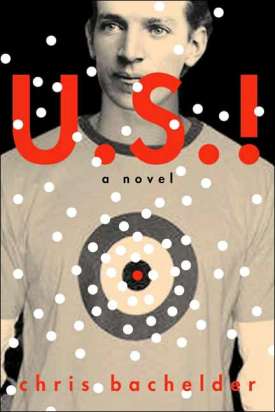
Chris Bachelder‘s superb novel U.S.! portrays an alternate (and somewhat hyperbolic) United States where the Left (big-L) keeps bringing Upton Sinclair (that guy who wrote The Jungle (maybe you read it in high school (I didn’t))) back to life. These would-be revolutionaries try to keep Sinclair (and hope) alive in spite of the fact that right-wing reactionary populist heroes keep assassinating him. In fact, in U.S.!, Upton Sinclair assassination is its own cottage industry.

Bachelder uses a dazzling range of approaches in the first 200 pages of the novel, employing everything from folk song lyrics to Amazon reviews to talk show transcripts in order to flesh out his alternate universe. The first part of U.S.! essentially sets up the last third of the novel, a relatively straight-forward third-person omniscient account of a Fourth of July book-burning in a Southern state. I won’t reveal any more of the plot, because I’m lazy and you should read this book for yourself.

Bachelder’s writing crackles with wit and surprising warmth, especially in the character of Sinclair, who comes across as a (literally) dusty out-of-touch relic, an idealist as equally unable to effect any change in the modern world as he was able to in his own era. Sinclair and the would-be revolutionaries who resuscitate him serve as Bachelder’s critique on America’s stale, impotent left (or is it Left?). Bachelder also savagely criticizes Sinclair’s rhetoric; one of the funniest sections of the first part of the book involves an analysis of exclamation points (and their overuse) in Sinclair’s novels. Toward the end of the novel, Bachelder employs a meta-critical strategy of adding more and more exclamation points to his own writing; the exaggerated gestures comically highlight the cartoonishly grotesque world of U.S.!, at the same time counterbalancing the understated but profound sadness of the novel.

My only gripe with U.S.! would be Bachelder’s rare lapse into what I like to call “workshop fiction”–fiction that seems the contrived and overwritten product of MFA work-shopping (did I mention that Bachelder got his MFA at my alma mater, the University of Florida at Gainesville? (other great writers associated with this glorious institution include Padgett Powell and Harry Crews)). As I noted though, these instances are rare and mostly notable because the majority of the novel is so fresh, original, and readable. This book is funny, poignant, and you should read it.

Leviathan–Jens Harder

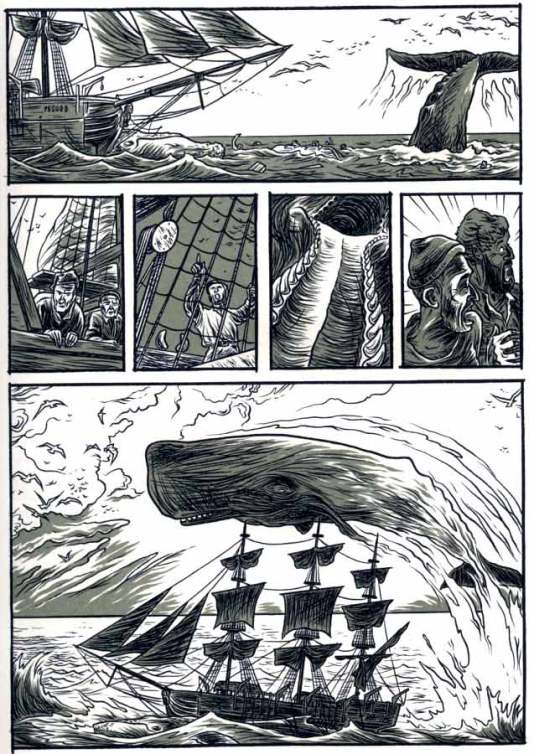
Jens Harder’s Leviathan is a graphic novel in the truest sense. Harder uses scratchy but fluid images to tell the story of a mystical whale who battles a giant squid, saves Noah’s ark, attacks the Pequod, wreaks havoc on a cruise ship, and eventually battles an armada of anachronisms. The only text Harder employs in Leviathan are excerpts and quotes from a variety of sources including the Bible and a host of philosophers; the bulk of quotes come from Melville’s Moby-Dick. Just as that novel begins with an “Etymology” followed by a section called “Extracts,” Harder begins with a section called “Leviathanology,” a collection of quotes about leviathans from the likes of Hobbes, Milton, and the book of Job. These quotes inform the story of Leviathan, connecting the whale to a sublime and unknowable mystery that Harder will explore. Harder’s surreal images often invert notions of “proper” space and time, giving the whale an awesome significance, but also positing the beast as something that denies signification. By eschewing the traditional forms of graphic storytelling, which rely on speech bubbles and clear-cut panel transitions, Harder is able to capture something that is essentially too large to capture. This book works. Highly recommended.

leviathan.jpg

Jonathan Lethem, Emo Comic Books, Realism, Meta-textual Quotes, History’s Actors, and Lazy Writing

There’s a good (and rather long) interview with Jonathan Lethem at the AVClub today. Mr. Lethem is one of our favorite authors here at Biblioklept, Inc. (you may recall our review of his brilliant Fortress of Solitude back in September of 2006 (a mere 1,111 days after the book was initially published)).

In the interview, Lethem references the Talking Heads a number of times, claims to be slowly writing “kind of an emo comic book” for Marvel Comics, goes in-depth on his style and approach to writing, and discusses his new book, You Don’t Love Me, which I have not read yet.

The interview begins with an interesting discussion about realism (specifically, literary realism) which reminded me of an essay I’d read a few days before in the February issue of The Believer by Chris Bachelder (yes, I’m aware that I lazily linked to a Believer article earlier this week).

In “Doctorow’s Brain,” Bachelder ponders on whether such a thing as literary realism can really exist, and if so, what types of books and literature represent that style. I found the essay fascinating–I love all things literary, and I could point plenty of books that could be called “magical realism,” but I would have a really difficult time defining “realism.”  So Bachelder’s inquiry provoked a lot of deep questions about the very nature of writing, communication, memory and history. One of the most fascinating (and scary) pieces of writing he discusses is a quote from one of George W. Bush’s senior advisers, published originally in an October 2004 New York Times Magazine article by Ron Suskind. From Bachelder’s article:

“[…] Ron Suskind’s “Without a Doubt” introduced the Bush administration’s derision of what it calls the “reality-based community”–those reporters who, according to a senior adviser to Bush, “believe that solutions emerge from judicious study of discernible reality.” As the adviser explains to Suskind:

“That’s not the way the world really works anymore. We’re an empire now, and when we act, we create our own reality. And while you’re studying that reality–judiciously, as you will–we’ll act again, creating other new realities, which you can study too, and that’s how things will sort out. We’re history’s actors…and you, all of you, will be left to just study what we do.””

Yikes!

Seven Great Books About Rock and Roll (In No Particular Order)

1. Crazy From the Heat by David Lee Roth

david-lee-roth.jpg

This book is as good as you want it to be and there is absolutely no doubt in my mind that David Lee Roth wrote every word of it (no ghostwriters here, pure Roth). I’m not even sure if there was an editor involved, actually. David Lee Roth takes the chronological approach, giving equal time to Van Halen’s earliest days, their 80s success, and his post-Van Halen, big band days. Particularly interesting is David’s illumination of some of the vocal techniques involved in the production of those early Van Halen records (hamburgers and marijuana cigarettes). This book is a treasured gift from a dear friend.

2. Jimi Hendrix’s Electric Ladyland by John Perry.

082641571701_aa240_sclzzzzzzz_.jpg

I read this in like two days. What a great book. Author John Perry was a young eyewitness to many of Jimi’s London gigs; most of the info here is culled from personal memories and observations, as well as discussions with all the people involved. Perry’s style is simple and always focused on the music. The book is divided into seven sections, including a thorough discussion of the instrumentation involved, a detailed track by track review of the album; even a section about the cover. Perry writes from a musician’s point of view, but the most interesting lines to me are about the initial reaction of the American critical press to Jimi Hendrix:

“Behind a whole raft of complaints about Hendrix’s undignified performance and his irritating failure to fit existing critical categories for black performers, lay the essential point that his songs mysteriously failed to punish the audience for being white. Hendrix didn’t play the wounded, angry black man, or the dignified bearer of oppression; he didn’t provide white critics with a handy receptacle for their guilt. They didn’t know quite what role he fulfilled.”

I got this for fifty cents at the Friends of the Library Sale.

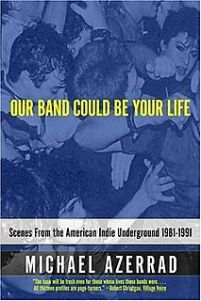
3. Our Band Could Be Your Life by Michael Azerrad.

our-band.jpg

Your life is probably nothing like any of the sort-of-famous indie bands covered here, unless you basically live in a van. I’m actually not even really sure if this qualifies as a great book. This book is actually just “okay.” Chances are, if you’re a fan of Sonic Youth, Ian McKaye, Dinosaur Jr, or Hüsker Dü you probably know most of this stuff already, or at least the stuff that’s interesting. And if you’re a fan of Beat Happening, well, there you go. This book has a whole chapter on Beat Happening. Actually, if you’re really interested in the whole indie rock thing, 1991: The Year Punk Broke is a much better document. But here I go comparing apples to oranges. I bought Our Band Could Be Your Life at Barnes & Noble for like three or four dollars.

4. Chronicles, Volume 1 by Bob Dylan

180px-bob_dylan_chronicles_volume_1.jpg

It took me a long time to get through this. Let me clarify: I read this in large, fifty page chunks, put it down, picked it up again months later. Dylan’s style is discursive and rambling; he elliptically deconstructs his own myth, picking away at the bits of identity he picked off of other musicians and poets on his way to fame. The book never really gets to that fame–to be clear, it discusses the after-effects of Dylan’s fame in detail: the obsessive fans who showed up at his home unannounced, the bewildering pressure to deliver some kind of messianic answer, the expectations to deliver a specific kind of record–but Chronicles spends most of its pages tracing and retracing Dylan’s youth in Minnesota and his days sleeping on friends’ couches in New York City. Will the second and third volumes ever come out? Who knows with this guy. This book was given to me by my cousin for Christmas a few years ago.

*Also recommended: Anthony Scaduto’s biography Bob Dylan.

5 . Transformer by Victor Bockris

transfusa.jpg

Lou Reed is a weirdo, and Victor Bockris wants you to know about it. Starting with Reed’s Long Island youth (complete with electro-shock therapy), Bockris’s biography covers pretty much everything right up through the Velvet Underground’s early nineties reunion: Reeds early apprenticeship in the Brill Building, the nascent days of the VU (plenty of Warhol anecdotes, of course), punk rock, several doomed romances, his years living with a transvestite, his karate skills, his yoga skills, and his all-bran diet, and of course, the drugs. Oh the drugs. Also, Reed’s solo career is also examined (including plenty of material from guitar god Bob Quine). Bockris seems to feel Magic and Loss is something of a watershed moment in modern rock (anyone who accidentally bought this album knows otherwise).

Bockris’s book employs a bitchy, dishy tone, rife with catty comments from everyone whoever worked with Reed: apparently Lou was a total asshole. Bockris reprints some painful comments (e.g. Reed on Springsteen, 1975: “Isn’t Springsteen over the hill?”); the most awkward moment comes in the book’s appendix, in a transcript of a meeting Bockris arranged between Reed and William Burroughs. Bad idea (Reed can’t remember the name of “that book you published”–Naked Lunch). I can’t remember, but I think I got this for like three or four bucks at Barnes & Noble.

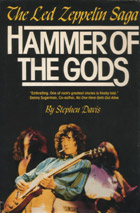
6. Hammer of the Gods by Stephen Davis

hammer_of_the_gods.jpg

“Here’s a red snapper for your red snapper!”

Intrigued? You should be! Burroughs makes a cameo here as well.

I don’t own this one. I read the good bits in high school though.

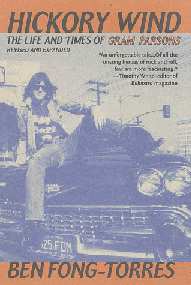
7. Hickory Wind: The Life and Times of Gram Parsons by Ben Fong-Torres

gparsons.jpg

Some jackass made a movie about Gram Parsons’ life a few years ago; I think Johnny Knoxville played Parsons. I didn’t see it, but I’m sure this book is way better. Rolling Stone alum Ben Fong-Torres clearly appreciates Parsons as not only the influential icon that he’s generally recognized as, but also as a truly gifted songwriter. Parsons’ early days in Winterhaven, Waycross, and Jacksonville (he attended the Bolles School) are scrutinized along with his brief stint at Harvard, his time in the Byrds and his days partying with the Rolling Stones in California hippy mansions. Also, another appearance by William Burroughs, who recommended a treatment to help kick the heroin. Parsons’ infamous death in the California desert is also put under the lens, right down to a time-line if I remember correctly. Good stuff. My uncle lent me this book, and yes, I returned it to him. So there.

Lost: Lost in the Funhouse

It’s been a while since I’ve written about a stolen book (ostensibly, this blog is all about book theft. But we’re easily distracted here). John Barth’s Lost in the Funhouse is one of my favorite short story collections ever and it’s been MIA from my library for a couple of years now. The collection starts with “Frame Tale,” a one-page (front and back) meta-commentary that informs the whole text. “Frame Tale” is essentially a marginal strip which says “Once upon a time…” on one side and “there was a tale that began…” on the other. The accompanying directions (a number of the stories come with directions; some are to be read aloud, some are to be tape recorded and played back, some are to be read aloud along to looped recording) direct the reader to cut out a strip of paper and connect the opposing ends, creating a Möbius strip, a commentary on the infinite and cyclical nature of story-telling (Barth expanded on this theme in the three linked novellas of Chimera).

funhouse-pbk.gif funhouse-hbk.jpg

My favorite story in the collection is “Petition,” a letter from a distraught Siamese twin, but the most lauded tale in LITF is the title story. “Lost in the Funhouse” recounts the adventures of young Ambrose as he navigates a bizarre amusement park funhouse during a family vacation to the beach one summer. The story is shot through with sexual anxiety and familial tension; Ambrose’s confused (and sometimes confusing) narrative loops discursively, unwinding and then condensing as he trips over his own thoughts. David Foster Wallace riffs off of “Lost in the Funhouse” in his long short story “Westward the Course of Empire Goes” (from Girl With Curious Hair). Ambrose, a semi-autobiographical stand-in as Barth’s pubescent alter-ego, appears as a a much older writing teacher in DFW’s novella. Clever, hunh? And to think, some people hate post-modernism! I feel bad for these folks.

I think that this collection paired with DFW’s Girl With Curious Hair (or, even better Brief Interviews With Hideous Men) makes a great introduction to post-modern writing. The major tropes, themes, and devices are explored in these books in short, digestible chunks full of humor and (surprise!) emotion. Highly recommended.