How to Read James Joyce’s Ulysses (and Why You Should Avoid “How-to” Guides Like This One)

[Editorial note: What follows is an edit of a piece I first posted on June 16, 2010–Bloomsday. Today marks the 100th anniversary of the first publication of James Joyce’s masterpiece Ulysses. I tried to come up with something original, but I found I had nothing to say that I hadn’t already said here, which essentially amounts to, Read Ulysses. It’s not nearly as difficult as its reputation might suggest. And it’s really funny.]

James Joyce’s Ulysses is a celebrated and praised novel. However, the book’s reputation for density, erudition, and inscrutability still daunts many readers–leading to a glut of guidebooks, summaries, and annotations. Ironically, rather than inviting first-time readers to the text, the sheer volume of these guides to Ulysses can paradoxically repel. Their very existence seems predicated on an intense need, and although some of the guides out there can be helpful, others can get in the way. This need not be. Ulysses deserves its reputation as one the best books in the English language. It generously overflows with insight into the human experience, and it’s very, very funny. And, most importantly, anyone can read it.

Here are a few thoughts on how to read Ulysses, enumerated–because people like lists:

1. Ignore all guides, lists, maps, annotations, summaries, and lectures. You don’t need them; in fact, they could easily weigh down what should be a fun reading experience. Jump right into the text. Don’t worry about getting all the allusions or unpacking all the motifs.

Pretty soon though, you’ll get to the third chapter, known as “Proteus.” It’s admittedly hard to follow. You might want a guide at this point. Or you might just want to give up. (Of course, you might be a genius and totally get what Stephen is thinking about as he wanders the beach. Good for you). If frustration sets in, I suggest skipping the chapter and getting into the rich, earthy consciousness of the book’s hero, Leopold Bloom in chapter four, “Calypso.” It’s great stuff. You can always go back to chapter three later, of course. The real key, at least in my opinion, to reading (and enjoying) Ulysses is getting into Bloom’s head, matching his rhythm and pacing. Do that and you’re golden.

I’ve already advised you, gentle reader, not to follow any guides, so please, ignore the rest of my advice. Quit reading this post and start reading Ulysses.

For those who wish to continue–

2. Choose a suitable copy of the book. The Gabler edition will keep things neat and tidy and it features wide margins for all those clever game-changing annotations you’ll be taking. Several guides, including Harry Blamire’s The New Bloomsday Book align their annotation to the Gabler edition’s pagination.

3. Make a reading schedule and stick to it. The Gabler edition of Ulysses is nearly 700 pages long. That’s a long, long book–but you can read it in just a few weeks. There are eighteen episodes in Ulysses, some longer and more challenging than others, but reading one episode every two days should be no problem. If you can, try to read one episode in one sitting each day. As the book progresses, you’ll find yourself going back to previous chapters to find the figures, motifs, and traces that dance through the book.

4. So you’ve decided you need a guide. First, try to figure out what you want from the guide. Basic plot summary? Analysis? Explication? There’s plenty out there–too much really–so take the time to try to figure out what you want from a guide and then do some browsing and skimming before committing.

The most famous might be Stuart Gilbert’s James Joyce’s Ulysses, a dour book that manages to suck all the fun out of Joyce’s work. In a lecture on Ulysses, Vladimir Nabokov warned “against seeing in Leopold Bloom’s humdrum wanderings and minor adventures on a summer day in Dublin a close parody of the Odyssey,” noting that “it would be a complete waste of time to look for close parallels in every character and every scene in the book.” Nabokov scathingly continued: “One bore, a man called Stuart Gilbert, misled by a tongue-in-cheek list compiled by Joyce himself, found in every chapter the domination of one particular organ . . . but we shall ignore that dull nonsense too.” It’s perhaps too mean to call Gilbert’s guide “nonsense,” but it’s certainly dull. Harry Blamire’s The New Bloomsday Book is a line-by-line annotation that can be quite helpful when Joyce’s stream of consciousness gets a bit muddy; Blamire’s explications maintain a certain analytical neutrality, working mostly to connect the motifs of the book but letting the reader manage meaning. Don Gifford’s Ulysses Annotated is an encyclopedia of minutiae that will get in the way of any first time reader’s enjoyment of the book. Gifford’s notes are interesting but they can distract the reader from the text, and ultimately seem aimed at scholars and fanatics.

Most of the guidebooks I’ve seen for Ulysses share a common problem: they are obtrusive. I think that many readers who want some guidance or insight to aid their reading of Ulysses, rather than moving between books (what a chore!), should listen to some of the fantastic lectures on Joyce that are available. James Heffernan’s lectures for The Teaching Company provide a great overview of the book with some analysis; they are designed to be listened to in tandem with a reading of the book. The best explication I’ve heard though is a series of lectures by Joseph Campbell called Wings of Art. Fantastic stuff, and probably the only guide you really need. It’s unfortunately out of print, but you can find it easily via extralegal means on the internet. Speaking of the internet–there’s obviously a ton of stuff out there. I’ll withhold comment–if you found this post, you can find others, and have undoubtedly already seen many of the maps, schematics, and charts out there.

5. Another strategy: read, but listen to an audiobook as well. This will give you a chance to “reread” the novel. I highly, highly, highly recommend RTÉ’s 1982 full cast production. I reviewed it here some years back.

6. Keep reading. Reread. Add time to that reading schedule you made if you need to. But most of all, have fun. Skip around. If you’re excited about Molly’s famous monologue at the end of the book, go ahead and read it. Again, the point is to enjoy the experience. If you can trick a friend into reading it with you, so much the better. Have at it.

Best Books of 1972?

A conversation with a colleague this week led me on a not-entirely successful search for the “best” books of 1972.

The gist of the conversation is something like this: Asked about the “best” books that came out last year, I admitted I don’t read that much new fiction, so I had no idea.

I also said something cavalier along the lines of, It takes like half a century to know if a novel is important or not. (This is not a statement I entirely believe in.)

So what did folks in 1972 think the best books published that year were?

The first thing I did is check the bestsellers of fiction that year.

(I should be clear that I’m mostly interested in novels here, or books of a novelistic/artistic scope, whatever that means–so I didn’t really pursue nonfiction stuff that much here.)

The New York Time’s fiction bestsellers for 1972 is dominated by two novels: Herman Wouk’s The Winds of War (21 weeks) and Richard Bach’s Jonathan Livingstone Seagull (26 weeks). Fiction bestsellers are often (but not always) entertainments that we don’t expect to last over time, and while Wouk and Bach’s titles still get reprints every decade or so, they aren’t exactly Ulysses (published fifty years earlier in 1922).

So I looked for what titles the NYT critics deemed the best books of 1972. The contemporary NYT comes up with a list of ten titles each year (five fiction, five non-), but things were a little looser fifty years ago. In December of that year, the NYT offered just “Five Significant Books of 1972.”

This list is entirely nonfiction:

The Children of Pride: A True Story of Georgia and the Civil War, edited by Robert Manson Myers (“…a loving work of scholarship. From 6,000 letters written among several branches of a Southern family between 1854 and 1865, Robert Manson Myers has woven 1,200 of them into a massive and touching portrait of a bygone society.”)

The Master by Leon Edel (“With…the fifth and final volume of his biography of Henry James, Leon Edel brings to a close a literary labor of 20 years.”)

Fire in the Lake by Frances FitzGerald (“…the richest kind of contemporary history; it places political and military events in cultural perspective—something rarely done in the hundreds of books written about Vietnam during the last dozen years.”)

The Coming of Age by Simone de Beauvoir, translated by Patrick O’Brian (“…confronts a subject of universal private anguish and universal public silence…she has single‐handedly established a history of and a rhetoric for the process of aging.”)

A Theory of Justice by John Rawls (“…a magisterial exercise in ‘moral geometry.'”)

Rawls’s book is the only one I’ve heard of and de Beauvoir is the only other author whose name I recognize on the list (I did know that there was a ridiculously long multi-volume biography of Henry James). Beyond the list’s being all nonfiction (if there was a fiction version somewhere, I could not find it), it’s also remarkable how long each of the books is: the shortest is 491 pages; the longest is 1,845 pages. Those are long books!

I tried searching for other newspaper and magazine lists of best books of 1972 but came up short. If anyone has anything else to offer for contemporary thoughts on the best of ’72 (by which I mean, folks in ’72 on the best of ’72), I’m all virtual ears.

I then looked into what Goodreads had to say.

I have no idea how their list works, but Richard Adams’s Watership Down tops it. That book completely fucked me up as a kid, which is maybe why I didn’t press too hard when both of my children were reluctant to read it when I pressed it on them. I think it’s a classic though (oh, and it made The New York Times year-end list in 1974–I guess it didn’t get an American publication until then?).

I don’t really think Watership Down is a children’s book, but rounding out the top three on the Goodreads list are two classics of the genre: Arnold Lobel’s Frog and Toad Together and Judith Viorst’s Alexander and the Terrible Horrible No Good Very Bad Day. (Judy Blume’s Tales of a Fourth Grade Nothing comes in way too low at #44.)

And now, because I’m lazy, I will use the rest of the list to offer an incomplete, inconclusive, and ultimately unnecessary list of the best books of 1972. There are many books on the list I’m pilfering from I have not read (including ones by authors whose books I esteem, like Nabokov, Welty, DeLillo, and Atwood), and these books may deserve a spot, as might the many many books that have failed through no fault of their own to wind up under the right eyes, ears, hands.

A list:

Mumbo Jumbo, Ishmael Reed

Invisible Cities, Italo Calvino

The Infernal Desire Machines of Doctor Hoffman, Angela Carter

Watership Down, Richard Adams

The Farthest Shore, Ursula K. LeGuin

Ways of Seeing, John Berger

Roadside Picnic, Arkady Strugatsky and Boris Strugatsky

Chimera, John Barth

Augustus, John Williams

Sadness, Donald Barthelme

“Libraries Destroyed by Fire” | From William Blades’ The Enemies of Books

“Libraries Destroyed by Fire”

from

William Blades’

The Enemies of Books 


THERE are many of the forces of Nature which tend to injure Books; but among them all not one has been half so destructive as Fire. It would be tedious to write out a bare list only of the numerous libraries and bibliographical treasures which, in one way or another, have been seized by the Fire-king as his own. Chance conflagrations, fanatic incendiarism, judicial bonfires, and even household stoves have, time after time, thinned the treasures as well as the rubbish of past ages, until, probably, not one thousandth part of the books that have been are still extant. This destruction cannot, however, be reckoned as all loss; for had not the “cleansing fires” removed mountains of rubbish from our midst, strong destructive measures would have become a necessity from sheer want of space in which to store so many volumes.

Before the invention of Printing, books were comparatively scarce; and, knowing as we do, how very difficult it is, even after the steam-press has been working for half a century, to make a collection of half a million books, we are forced to receive with great incredulity the accounts in old writers of the wonderful extent of ancient libraries.

The historian Gibbon, very incredulous in many things, accepts without questioning the fables told upon this subject. No doubt the libraries of MSS. collected generation after generation by the Egyptian Ptolemies became, in the course of time, the most extensive ever then known; and were famous throughout the world for the costliness of their ornamentation, and importance of their untold contents. Two of these were at Alexandria, the larger of which was in the quarter called Bruchium. These volumes, like all manuscripts of those early ages, were written on sheets of parchment, having a wooden roller at each end so that the reader needed only to unroll a portion at a time. During Caesar’s Alexandrian War, B.C. 48, the larger collection was consumed by fire and again burnt by the Saracens in A.D. 640. An immense loss was inflicted upon mankind thereby; but when we are told of 700,000, or even 500,000 of such volumes being destroyed we instinctively feel that such numbers must be a great exaggeration. Equally incredulous must we be when we read of half a million volumes being burnt at Carthage some centuries later, and other similar accounts. Continue reading ““Libraries Destroyed by Fire” | From William Blades’ The Enemies of Books”

TBR anxieties

It is not a bad problem to have to have a big ole stack of big boys stacked up, waiting to read, but I nevertheless continue to feel anxiety as the stack grows and I head into a new semester, knowing that my reading for work—student papers of course, but also all the other stuff, the rereads of ringers I can’t give up, the new reads I continue to dedicate myself to incorporating into a syllabus, cursing myself when I’m not sure how to do what I think I want to do with them, etc.—but yeah, it’s the knowing that work-based reading will dominate my eyes and brain, both of which have grown duller, slower, and more easily-wearied over the last two years (and I have, after forty-one years of perfect eyesight, taken up glasses to my face to read finer print), and that I will find myself without the reserves to jump into the big books like I used to (I fall asleep sooner too these days–but also wake up sooner too, and do dedicated some of those early morning minutes to reading).

Heimito von Doderer’s The Strudlhof Steps is (translation by Vincent Kling) is one of a few NYRB titles on my list. I’ve jumped into it a few times and I can tell it’s a big deal—maybe something revelatory to me, a big mash of consciousness like Alfred Döblin’s 1929 novel Berlin Alexanderplatz. But other books keep showing up.

Or, really, I keep picking up other books, like Zak Smith’s Gravity’s Rainbow Illustrated, almost eight hundred pictures to go with Thomas Pynchon’s novel. I’ve paged through it, but the anxiety here is the realization that I want to read Gravity’s Rainbow again, which will make me go insane.

The two by Pessoa cause me anxiety for other reasons. I’m pretty sure I will never finish The Book of Disquiet (in translation by Margaret Jull Costa). It’s smart at times, but it’s not really a novel—the catch is the protagonist’s consciousness. And the protagonist often needs a big kick in the ass. Disquiet will riff out some lovely little missives, and then whine a bit. Not my favorite flavor. And yet I feel like I can’t tangle with Writings on Art and Poetical Theory without engaging Pessoa’s aesthetic firsthand (or, really, mediated through translators and editors).

Pessoa’s Writings is published by Contra Mundum, as is Pierre Senges’ Ahab (Sequels) (translation by Jacob Siefring and Tegan Raleigh). I made a bit of dent of the book, but then took a slimmer volume with me on a vacation to some Smoky Mountains. I read Alan Garner’s novel Red Shift there in two or three days and loved it and failed to write about it here. (I am sometimes astounded that for a few years in very early thirties I somehow wrote about every book I read on this blog.) Maybe spring for Ahab.

I’m really excited about Vladmir Sorokin’s postapocalyptic novel Telluria (translation by Max Lawton). I’m so excited that I’ve decided not to have anxiety and commit to a proper review by the time it comes out this summer.

Esther Allen’s translation of Antonio di Benedetto’s 1965 novel Zama is one of the best books I’ve read in the past five years, so I was very happy to get Allen’s translation of El silenciero — The Silentiary–a week or two ago. I was so happy that I added the book to a stack of books I was intending to read, rubbed my eyes really hard, let anxiety pulse through me, and read a little more of the Pessoa (which added a different layer of anxiety).

Writing about these anxieties has not purged them, but maybe I have a plan, or an outline here, a promise to myself (but not you, if you’re reading this, I promise you nothing, to be clear). Maybe I’ll dig in, set an early AM alarm to read an extra hour or so. Maybe I’ll even quit acquiring new books for awhile.

(Or not, no, I’ll just lie to myself some more.)

A (probably incomplete) list of books I read or reread in 2021


☉ indicates a reread.

☆ indicates an outstanding read.


The Real Cool Killers, Chester Himes ☆

The Bachelors, Muriel Spark

Bina, Anakana Schofield

Moby-Dick, Herman Melville ☉☆

Margaret the First, Danielle Dutton ☆

The Florida Keys, Joy Williams

Passages, Ann Quin☆

V., Thomas Pynchon ☉☆

Notes from Childhood, Norah Lange (trans. by Charlotte Whittle)

Albert Angelo, B.S. Johnson ☆

Trawl, B.S. Johnson

House Mother Normal, B.S. Johnson

Outline, Rachel Cusk

Perfume, Patrick Süskind (trans. by John E. Woods) ☆

The Unfortunates, B.S. Johnson

Sassafrass, Cypress, and Indigo, Ntozake Shange

The Final Revival of Opal & Nev, Dawnie Walton

Dope Rider: A Fistful of Delirium, Paul Kirchner

The Postman Always Rings Twice, James M. Cain ☆

By Night in Chile, Roberto Bolaño (trans. by Chris Andrews) ☉☆

Cowboy Graves, Roberto Bolaño (trans. by Natasha Wimmer)

Double Indemnity, James M. Cain

Invisible Cities, Italo Calvino (trans. by William Weaver)☉

If on a winter’s night a traveler…, Italo Calvino (trans. by William Weaver)☉

The Baron in the Trees, Italo Calvino (trans. by Archibald Colquhoun) ☉☆

Mister Boots, Carol Emshwiller

Permanent Earthquake, Evan Dara

The Woman in the Dunes, Kobo Abe (trans. by E. Dale Saunders)

The Slynx, Tatyana Tolstoya (trans. by Jamey Gambrell) ☆

The Shape of Content, Ben Shahn

Anecdotes, Heinrich von Kleist (trans. by Matthew Spencer)

Hurricane Season, Fernanda Melchor (trans. by Sophie Hughes) ☆

Sixty Stories, Donald Barthelme ☉☆

Hiding Man, Tracy Daugherty☉

Body Count, Francie Schwartz

The Old People, A.J. Perry

Carmen Dog, Carol Emshwiller ☆

Remain in Love, Chris Frantz

The Witchcraft of Salem Village, Shirley Jackson

In the Eye of the Wild, Nastassja Martin (trans. Sophie R. Lewis)

Rough Day, Ed Skoog

Letters from Mom, Julio Cortazar (trans. by Magdalena Edwards)

Under the Jaguar Sun, Italo Calvino (trans. by William Weaver)

The Nonexistant Knight, Italo Calvino (trans. by Archibald Colquhoun)

The Cloven Viscount, Italo Calvino (trans. by Archibald Colquhoun)

Don’t Let Me Be Lonely, Claudia Rankine

Blood Meridian, Cormac McCarthy ☉☆

A Mason & Dixon Christmastide | Thomas Pynchon

They discharge the Hands and leave off for the Winter. At Christmastide, the Tavern down the Road from Harlands’ opens its doors, and soon ev’ryone has come inside. Candles beam ev’rywhere. The Surveyors, knowing this year they’ll soon again be heading off in different Directions into America, stand nodding at each other across a Punch-bowl as big as a Bathing-Tub. The Punch is a secret Receipt of the Landlord, including but not limited to peach brandy, locally distill’d Whiskey, and milk. A raft of long Icicles broken from the Eaves floats upon the pale contents of the great rustick Monteith. Everyone’s been exchanging gifts. Somewhere in the coming and going one of the Children is learning to play a metal whistle. Best gowns rustle along the board walls. Adults hold Babies aloft, exclaiming, “The little Sausage!” and pretending to eat them. There are popp’d Corn, green Tomato Mince Pies, pickl’d Oysters, Chestnut Soup, and Kidney Pudding. Mason gives Dixon a Hat, with a metallick Aqua Feather, which Dixon is wearing. Dixon gives Mason a Claret Jug of silver, crafted in Philadelphia. There are Conestoga Cigars for Mr. Harland and a Length of contraband Osnabrigs for Mrs. H. The Children get Sweets from a Philadelphia English-shop, both adults being drawn into prolong’d Negotiations with their Juniors, as to who shall have which of. Mrs. Harland comes over to embrace both Surveyors at once. “Thanks for simmering down this Year. I know it ain’t easy.”
“What a year, Lass,” sighs Dixon.
“Poh. Like eating a Bun,” declares Mason.”

The last paragraphs of Ch. 52 of Thomas Pynchon’s novel Mason & Dixon.

Unread, 2021/Hope to read, 2022

Of course there were millions and millions of books that I left unread in 2021, but here are a few I hope to carve a space for sometime in the next year:

Heimito von Doderer’s The Strudlhof Steps (in translation by Vincent Kling) has been compared to Joyce and Döblin. I got a copy last month and couldn’t commit to the beast’s size. I was trying to make it through Thanksgiving and the end of the 2021 Fall term—this year I’ve favored short books and comfortable rereads I’ve bookended 2021 with rereads of Moby-Dick and Blood Meridian (such comfort!)—The Strudlhof Steps is long long long.

Also long long long (but not as compressed in its typography) is Pierre Senges’ Ahab (Sequels) (in translation is by Jacob Siefring). I’ve dipped into it a few times since I got a copy back in October, but haven’t been able to make the commitment I need to. I’ll get it in in 2022. (Sample here.)

I picked up Alan Garner’s novel Red Shift based on its cover and a blurb from Ursula K. LeGuin—also, it’s pretty short, and, like I’ve said, I’ve done well with short books this year. Hell, maybe I’ll even squeeze it in. Martin Levin’s 1973 minireview in the NYT:

Mr. Garner jump‐cuts nimbly through English history to underscore (I guess) the continuity of such commonalities as love and aggression. Macey is an early Briton, who talks Clockwork Orange style and lays about him in a hypnotic frenzy with his ceremonial stone axe. The axe‐head later becomes a talisman for Thomas Rowley (a 17th‐century citizen who cements it into his chimney) and for Tom, a young 20th‐century Now person, who sells it to the British Museum.

What links these three? Well, there is the artifact. And the place, a rural locus in Cheshire. Finally, there is selfless love —which seems to have survived the centuries. Macey is a twosome with a priestess in the corn festival, who is tender under some trying circumstances. Rowley’s wife stands by him during the bad times of Cromwell. Tom has tender bicycle outings with a student nurse.

Why three periods in time? Well, why not?

I’ve actually read a few chunks of John Berryman’s biography of Stephen Crane (which spine does not read so clearly in yon photograph above). I’ve been picking my way back through Crane, an underappreciated modernist master. I might not read the whole thing straight ever, but I will read it crooked.

Papa Hamlet showed up at the assend of the summer, by which I mean the very beginning of the Fall 2021 semester. This 1889 collaboritve novel by Arno Holz and Johannes Schlaf is available in English translation via James J. Conway for the first time ever. Read an excerpt here.

W.D. Clarke’s novel She Sang to Them, She Sang is a strange shape and volume. Also, for the first time in my life, my eyes are kinda fucked up. I have to wear different cheap glasses to see smaller print. This personal fact is embedded in my encounter with Clarke’s second novel.

I read Kobo Abe’s most famous novel Woman in the Dunes, but failed to get past the first ten pages of Secret Rendezvous (in English translation by Juliet Winters Carpenter). Woman in the Dunes is the sort of thing that I should’ve loved at 19, 20, 25. Maybe Rendezvous will do it for me in ’22.


Donald Barthelme’s Sixty Stories in reverse, Part IX

I am rereading Donald Barthelme’s Sixty Stories, starting with the sixtieth story and working my way to the first and writing about it.

Previous entries:

Stories 60-55

Stories 54-49

Stories 48-43

Stories 42-37

Stories 36-31

Stories 30-25.

Stories 24-19

Stories 18-13.

In this post, stories 12-7

12. “The Dolt” (Unspeakable Practices, Unnatural Acts, 1968)

An odd domestic tale, “The Dolt” features the hostilities of a young married couple, Edward and Barbara. Edward is “preparing to take the National Writer’s Examination, a five-hour fifty-minute examination, for his certificate.” He squabbles with Barbara, who is “very sexually attractive…but also deeply mean.” Barbara doesn’t seem to think much of Edward’s chances at earning his “certificate.” Her lack of confidence seems to bear out as we hear the details of Edward’s entry story, a nineteenth century goof on a baron and his faithless wife:

The Baron, a man of uncommon ability, is chiefly remembered for his notorious and inexplicable blunder at the Battle of Kolin: by withdrawing the column under his command at a crucial moment in the fighting, he earned for himself the greatest part of the blame for Friedrich’s defeat, which resulted in a loss, on the Prussian side, of 13,000 out of 33,000 men. 

There’s potential in the story, and Barbara begins to be persuaded as Edgar reads the story’s “development.” However, the story is missing something crucial:

“But what about the middle?”

“I don’t have the middle!” he thundered.

There’s a pastiche of ironic biographical details here—writerly anxiety, domestic anxiety—that ultimately gives over to Barthelme’s biggest thematic concern: oedipal anxiety. In an final-act swerve, a surreal figure, “the son manqué,” asking if there’s any “grass in the house.” 

The son manqué was eight feet tall and wore a serape woven out of two hundred transistor radios, all turned on and tuned to different stations. Just by looking at him you could hear Portland and Nogales, Mexico.

The giant figure (a strange filial prefiguration of The Dead Father), girded in an amplified cacophony of mass media, suggests an artistic rival that Edgar is unsure he can surpass—even if that rival is a mere manqué. (The word choice “manqué” here is significant in its oddity. Earlier, Edgar points out that, “You put a word like that in now and then to freshen your line…Even though it’s an old word, it’s so old it’s new.) 

The story’s final moment leave us in a limbo derivative of Barthelme’s hero Beckett:

Edgar tried to think of a way to badmouth this immense son leaning over him like a large blaring building. But he couldn’t think of anything. Thinking of anything was beyond him. I sympathize. I myself have these problems. Endings are elusive, middles are nowhere to be found, but worst of all is to begin, to begin, to begin.

11. “Report” (Unspeakable Practices, Unnatural Acts, 1968)

“Report” distills one of the main themes of Thomas Pynchon’s 1973 novel: technology drives warfare; indeed, war is an excuse for the advancement of modern technologies. This is about as direct an anti-war story as we would get from Donald Barthelme. It begins:

Our group is against the war. But the war goes on. I was sent to Cleveland to talk to the engineers. The engineers were meeting in Cleveland. I was supposed to persuade them not to do what they are going to do.

Of course, the directness of those opening lines gets refracted and tangled in obliquity and fantasy, as the narrator (the “Soft Ware man”) learns of the unspeakable and unnatural practices of the engineers:

“The development of the pseudoruminant stomach for underdeveloped peoples,” he went on, “is one of our interesting things you should be interested in. With the pseudo-ruminant stomach they can chew cuds, that is to say, eat grass. Blue is the most popular color worldwide and for that reason we are working with certain strains of your native Kentucky Poa pratensis, or bluegrass, as the staple input for the p/r stomach cycle, which would also give a shot in the arm to our balance-of -payments thing don’t you know” . . . I noticed about me then a great number of metatarsal fractures in banjo splints.

“The kangaroo initiative . . . eight hundred thousand harvested last year . . . highest percentage of edible protein of any herbivore yet studied …”

“Have new kangaroos been planted?”

The engineer looked at me.

The Soft Ware man leaves with the engineer’s promise:

I confidently predict that, although we could employ all this splendid new weaponry I’ve been telling you about, we’re not going to do it.”

The Soft Ware man’s audience does not believe the engineer’s promise though.

10. “Robert Kennedy Saved from Drowning” (Unspeakable Practices, Unnatural Acts, 1968)

The version of  “Robert Kennedy Saved from Drowning” published in Sixty Stories bears a slight difference from the version first published in New American Review and then later in Unspeakable Practices, Unnatural Act. The Sixty Stories version is the only Barthelme story signed with a date of publication. Here, “April, 1968.”

The date is contextually significant, and something that I overlooked the first time I read ” Robert Kennedy Saved from Drowning” some time around the year 2000. At that time, I read the tale as a kind of hagiography. Barthelme’s Bobby Kennedy — “K,” in the story’s vernacular (a nod perhaps to Kafka’s hero?) — is a Modernist man. In the final vignette, he’s saved by the narrator who emerges in this last paragraph as an “I”:

K. in the water. His flat black hat, his black cape, his sword are on the shore. He retains his mask. His hands beat the surface of the water which tears and rips about him. The white foam, the green depths. I throw a line, the coils leaping out over the surface of the water. He has missed it. No, it appears that he has it. His right hand (sword arm) grasps the line that I have thrown him. I am on the bank, the rope wound round my waist, braced against a rock. K. now has both hands on the line. I pull him out of the water. He stands now on the bank, gasping. “Thank you.”

When I first read this story, I thought it was a sympathetic attempt to save RFK — that the “line” was a metatextual reference to writing itself, an imaginative recouping of yet another assassinated Hero of the Sixties. The parodic Pop Art contours of the story were lost on me.

It wasn’t until I read Tracy Daugerty’s biography Hiding Man (and subsequently read Sixty Stories in full) that I understood that RFK was assassinated in June of 1968—two months after the story was first published. Indeed, Daugherty reports that Barthelme was working on the story as early as 1965, and likely only kept up with it after learning that Saul Bellow, whom Barthelme was competitive with, was working on a profile of RFK for LIFE (the Bellow piece never came out).

In an interview with Arthur Schlesinger, Jr., Barthelme stated,

I cannot account for the concluding impulse of the I-character to ‘save’ him other than by reference to John Kennedy’s death; still, a second assassination was unthinkable at that time. In sum, any precision in the piece was the result of watching television and reading the New York Times.

The story’s publication in April, 1968 also coincided with the assassination of Martin Luther King, Jr. As Daugherty notes in Hiding Man,

[Comedian and activist] Dick Gregory went public with the fact that the FBI harassed King. The agency’s code name for him was “Zorro.” Don had dressed RFK in a Zorro costume, in the story’s final scene, to mock Kennedy’s heroic image. The coincidence unnerved him.

9. “Alice” (Unspeakable Practices, Unnatural Acts, 1968)

“Alice” is probably the most formally challenging and experimental piece in Sixty Stories. I use the word “experimental” here in a pejorative sense—I’m not quite sure Barthelme pulls the experiment off. We get something like the stream of consciousness of an obstetrician who wants to fuck Alice, his friend’s wife. (Is the name an evocation of the Alice of the Wonderland? Stein’s beloved Alice B. Toklas?)

The inside of the narrator is a ball of sticky language:

the hinder portion scalding-house good eating Curve B in addition to the usual baths and ablutions military police sumptuousness of the washhouse risking misstatements kept distances iris to iris queen of holes damp, hairy legs note of anger chanting and shouting konk sense of “mold” on the “muff” sense of “talk” on the “surface” konk all sorts of chemical girl who delivered the letter give it a bone plummy bare legs saturated in every belief and ignorance rational living private client bad bosom uncertain workmen mutton-tugger obedience to the rules of the logical system Lord Muck hot tears harmonica rascal

There are some wonderful fragments there — “mutton-tugger obedience to the rules of the logical system” is a lovely insult from our would-be “harmonica rascal” — but the horny chaos becomes a bit of a headache over seven pages. Still, chaos is the point:

that’s chaos can you produce chaos? Alice asked certainly I can produce chaos I said I produced chaos she regarded the chaos chaos is handsome and attractive she said and more durable than regret I said and more nourishing than regret she said

Chaos—here a disruption of both the (illusion of) prescribed linguistic order and the domestic order—offers both rejuvenation and new possibilities. It may be nourishing and durable, but in “Alice,” it’s also exhausting.

8. “Game” (Unspeakable Practices, Unnatural Acts, 1968)

The narrator of “Game” is a first lieutenant in some unspecified branch of the military. Here is his situation:

Shotwell and I watch the console. Shotwell and I live under the ground and watch the console. If certain events take place upon the console, we are to insert our keys in the appropriate locks and turn our keys. Shotwell has a key and I have a key. If we turn our keys simultaneously the bird flies, certain switches are activated and the bird flies. But the bird never flies. In one hundred thirty-three days the bird has not flown. Meanwhile Shotwell and I watch each other. We each wear a .45 and if Shotwell behaves strangely I am supposed to shoot him. If I behave strangely Shotwell is supposed to shoot me. We watch the console and think about shooting each other and think about the bird.

“Game’s” postmodern paranoia is worth of Poe. The story is full of repetitive tics, frequently about who is “well” and “not well.” While the ostensible object of “Game” is Cold War anxieties about nuclear war, the story’s evocation of paranoia continues to resonate. I won’t say too much more about “Game” here, but it’s a nice little funny horror story and well worth the ten minutes it will take you to read it.

7. “The President” (Unspeakable Practices, Unnatural Acts, 1968)

Is strangeness alone enough?

I am not altogether sympathetic to the new President. He is, certainly, a strange fellow (only forty-eight inches high at the shoulder). But is strangeness alone enough? I spoke to Sylvia: “Is strangeness alone enough?”

The titular President’s strangeness charms the nation, leading to waves of mass faintings. While there’s an absurd comedy to the faintings, they also point towards the story’s sinister, paranoid undertones. For all his charisma, the President is an oddity, an unknowable Pop representation driven by unclear, even mystical motivations. There’s a touch of Invasion of the Body Snatchers here—the seventies one with Sutherland and Nimoy—but just a touch. The whole thing ends in the rapturous applause of an audience overwhelmed by the anachronistic spectacle of Strauss’s operetta The Gypsy Baron.

Summary thoughts: I’m not really sure if “The President” works. “Alice” doesn’t, but is more interesting in its not working than it has any right to be. “Dolt” is good but not great. “Robert Kennedy Saved from Drowning” is as good as a story so situated in a historical moment can be. “Report” is very good. “Game” is excellent.

Going forward (in reverse): The last (by which I mean first) six stories, including some of Barthelme’s Greatest Hits, “The Balloon” and “Me and Miss Mandible.”

Also, I will be happy to be done with this project. It’s better to read these stories as morsels. Better not to pig out. Better not to snort them down or shoot them up. Better to let them breathe a bit.

Red Table — Zoey Frank 

Red Table, 2016 by Zoey Frank (b. 1987)

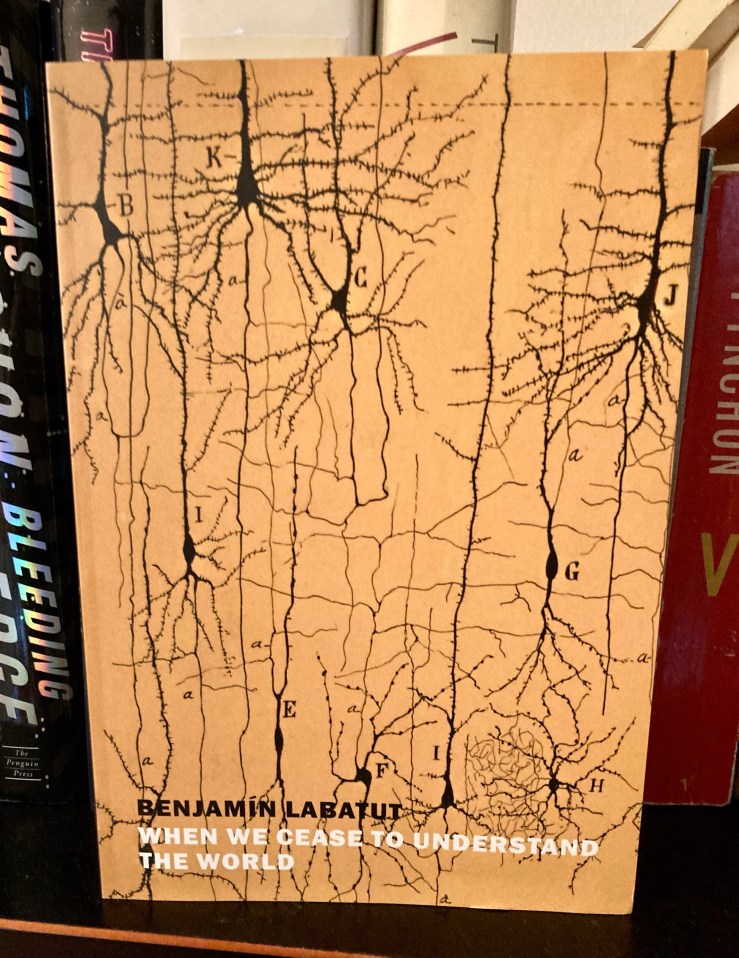
Benjamín Labatu’s When We Cease to Understand the World (Book acquired, 11 Sept. 2021)

Benjamín Labatut’s Booker shortlisted When We Cease to Understand the World is forthcoming in the US from NYRB this fall in translation by Adrian Nathan West. The book bears blurb’s from Geoff Dyer, Mark Haddon, and Philip Pullman and Barack Obama put it on his 2021 summer reading list.

NYRB’s blurb:

When We Cease to Understand the World is a book about the complicated links between scientific and mathematical discovery, madness, and destruction.

Fritz Haber, Alexander Grothendieck, Werner Heisenberg, Erwin Schrödinger—these are some of luminaries into whose troubled lives Benjamín Labatut thrusts the reader, showing us how they grappled with the most profound questions of existence. They have strokes of unparalleled genius, alienate friends and lovers, descend into isolation and insanity. Some of their discoveries reshape human life for the better; others pave the way to chaos and unimaginable suffering. The lines are never clear.

At a breakneck pace and with a wealth of disturbing detail, Labatut uses the imaginative resources of fiction to tell the stories of the scientists and mathematicians who expanded our notions of the possible.

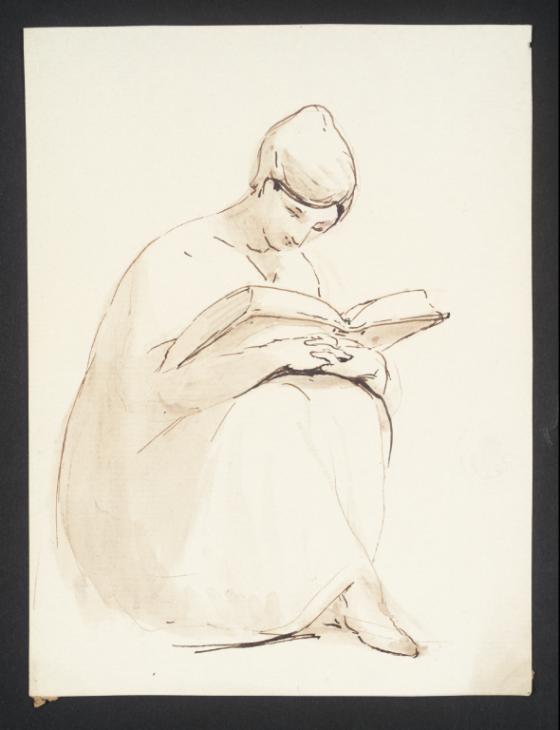
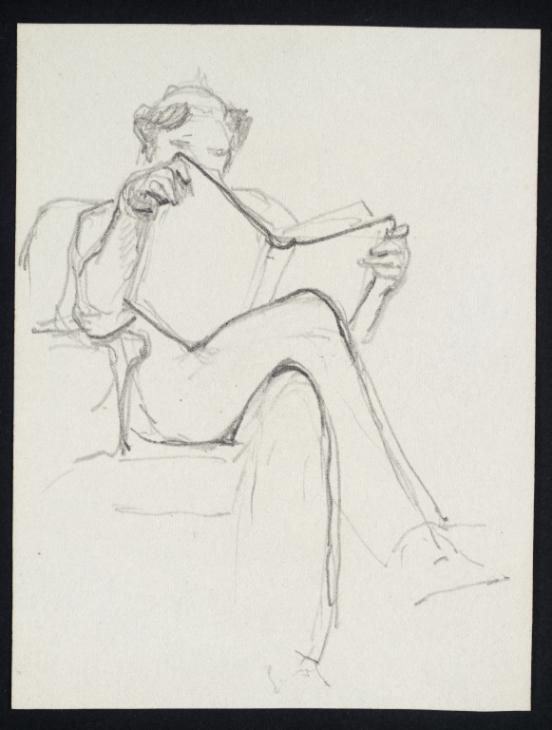
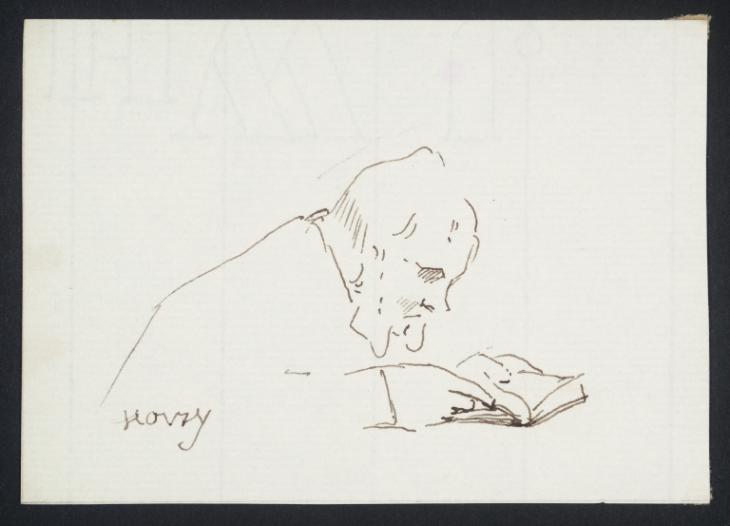
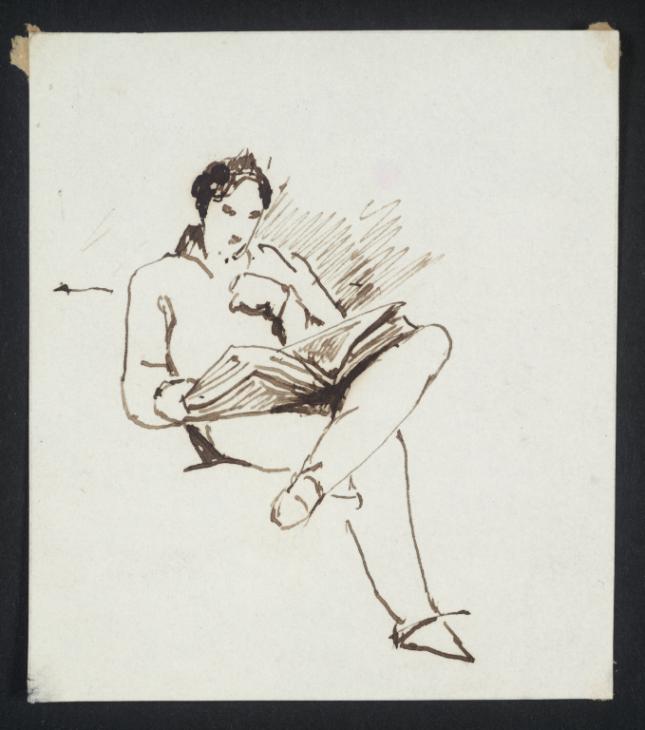
Seven sketches of people reading by George Jones


Untitled, undated sketches of readers by George Jones (1786–1869)

So, then, you noticed in a newspaper that If on a winter’s night a traveler had appeared, the new book by Italo Calvino

An excerpt from If on a winter’s night a traveler

by

Italo Calvino

Translated by William Weaver


So, then, you noticed in a newspaper that If on a winter’s night a traveler had appeared, the new book by Italo Calvino, who hadn’t published for several years. You went to the bookshop and bought the volume. Good for you.

In the shop window you have promptly identified the cover with the title you were looking for. Following this visual trail, you have forced your way through the shop past the thick barricade of Books You Haven’t Read, which were frowning at you from the tables and shelves, trying to cow you. But you know you must never allow yourself to be awed, that among them there extend for acres and acres the Books You Needn’t Read, the Books Made For Purposes Other Than Reading, Books Read Even Before You Open Them Since They Belong To The Category Of Books Read Before Being Written. And thus you pass the outer girdle of ramparts, but then you are attacked by the infantry of the Books That If You Had More Than One Life You Would Certainly Also Read But Unfortunately Your Days Are Numbered. With a rapid maneuver you bypass them and move into the phalanxes of the Books You Mean To Read But There Are Others You Must Read First, the Books Too Expensive Now And You’ll Wait Till They’re Remaindered, the Books ditto When They Come Out In Paperback, Books You Can Borrow From Somebody, Books That Everybody’s Read So It’s As If You Had Read Them, Too. Eluding these assaults, you come up beneath the towers of the fortress, where other troops are holding out:
the Books You’ve Been Planning Top Read For Ages,
the Books You’ve Been Hunting For Years Without Success,
the Books Dealing With Something You’re Working On At The Moment,
the Books You Want To Own So They’ll Be Handy Just In Case,
the Books You Could Put Aside Maybe To Read This Summer,
the Books You Need To Go With Other Books On Your Shelves,
the Books That Fill You With Sudden, Inexplicable Curiosity, Not Easily Justified,

Now you have been able to reduce the countless embattled troops to an array that is, to be sure, very large but still calculable in a finite number; but this relative relief is then undermined by the ambush of the Books Read Long Ago Which It’s Now Time To Reread and the Books You’ve Always Pretended To Have Read And Now It’s Time To Sit Down And Really Read Them.

With a zigzag dash you shake them off and leap straight into the citadel of the New Books Whose Author Or Subject Appeals To You. Even inside this stronghold you can make some breaches in the ranks of the defenders, dividing them into New Books by Authors Or On Subjects Not New (for you or in general) and New Books By Authors Or On Subjects Completely Unknown (at least to you), and defining the attraction they have for you on the basis of your desires and needs for the new and the not new (for the new you seek in the not new and for the not new you seek in the new).

All this simply means that, having rapidly glanced over the titles of the volumes displayed in the bookshop, you have turned toward a stack of If on a winter’s night a traveler fresh off the press, you have grasped a copy, and you have carried it to the cashier so that your right to own it can be established.

You cast another bewildered look at the books around you (or, rather: it was the books that looked at you, with the bewildered gaze of dogs who, from their cages in the city pound, see a former companion go off on the leash of his master, come to rescue him), and out you went.

You derive a special pleasure from a just-published book, and it isn’t only a book you are taking with you but its novelty as well, which could also be merely that of an object fresh from the factory, the youthful bloom of new books, which lasts until the dust jacket begins to yellow, until a veil of smog settles on the top edge, until the binding becomes dog-eared, in the rapid autumn of libraries. No, you hope always to encounter true newness, which, having been new once, will continue to be so. Having read the freshly published book, you will take possession of this newness at the first moment, without having to pursue it, to chase it. Will it happen this time? You never can tell. Let’s see how it begins.

Spilling my life story, I try to do that all the time. Nobody ever wants to listen | Notes on some Thomas Pynchon letters I have not read

I’m sure this is old news to long-time Pynchon fanatics, but I came across two articles earlier this week while searching archives for something else (which I did not find). Both articles were composed by the late theater critic Mel Gussow. The first article, “Pynchon’s Letters Nudge His Mask,” published 4 March 1998, details the then-recent Morgan Library’s acquisition of Pynchon’s correspondence to his former agent Candida Donadio. The collection apparently acquired more than 100 letters, composed from 1963 to 1982. Pynchon fired Donadio in early 1982:

Most of the letters are signed ”later, Tom,” one, ”love, Tom.” Then suddenly on Jan. 5, 1982, he writes, ”As of this date, you are no longer authorized to represent me or my work,” and signs the letter ”Cordially, Thomas Pynchon.” In a follow-up letter, he asks Ms. Donadio’s assistant to send him everything else of his that she still has. He does not mention the letters.

Donadio sold the letters to arts patron Carter Burden for $45,000 in 1984; a few years after his death, his family bequeathed the collection to the Morgan.

Mel Gussow appears to have had complete access to the letters. The first article includes a number of interesting observations. “He typed the letters single space on graph paper, until his Olivetti broke; then he switched to printing in longhand,” Gussow writes. The graph paper detail gels with some of the pics of letters from UT’s Harry Ransom archive. 

According to Gussow’s reading of the letters, Pynchon “moved from Mexico to California, from Texas to London, trying to preserve his anonymity and privacy.” Pynchon is of course well-aware of his reclusive reputation:

When he hears that the humorist H. Allen Smith has written an article for Playboy claiming to be both J. D. Salinger and Thomas Pynchon, he says, ”What no one knows is that Smith is actually Pierre Salinger, and I am H. Allen Smith.”

Pynchon writes of his hatred for Time magazine magnate Henry Luce and his admiration for James Agee’s A Death in the Family. He’s sickened by a 1964 profile by Dick Schaap published in The New York Herald Tribune, claiming it makes him feel “homicidal” — again though, these are private letters. (I have had no success tracking down Schaap’s article; I’m assuming that this Schaap is the same one who made his bones as a New York sportswriter.)

Gussow’s article notes Pynchon’s early self-assurance of his literary abilities:

In April 1964, Mr. Pynchon tells Ms. Donadio he is facing a creative crisis, with four novels in process. With a sudden bravado, he says, ”If they come out on paper anything like they are inside my head then it will be the literary event of the millennium.”

How many of those novels came to fruition? It’s hard to guess, I guess. It’s clear that Pynchon’s ideas might gestate for decades:

In a handwritten letter in January 1975, Mr. Pynchon mentions for the first time another work in progress, Mason & Dixon, 22 years before it was published.

Other points:

Pynchon refers to his second novel The Crying of Lot 49 as “a short story, but with gland trouble.” At one point, he hopes to sell both 49 and his first novel V. to Hollywood. We know Pynchon’s love for film, but Gussow underlines it:

He reveals himself as an avid moviegoer, offering capsule reviews. When the possibility of writing film criticism for Esquire arises, he says he would love to do it and explains: ”I can be crisp, succinct, iconoclastic, noncoterie, nonprogrammatic . . . also curmudgeonly, insulting, bigoted, psychotic and nitpicking. A boy scout’s decade of virtues.”

I’d love to see some of those capsule reviews.

I’d also love to see some of Pynchon’s responses to his peers’ work (if you can call the peers). Donadio sends Pynchon novels, and Gussow notes that, “He is generous in his responses, applauding John Cheever, John Hawkes, Bruce Jay Friedman and lesser-known writers.”

Gussow’s first article concludes with the alarm of Pynchon’s then-lawyer, Jeremy Nussbaum:

”It’s a rather startling event,” said Mr. Nussbaum. ”I’ve never heard of an agent selling letters of a client, except after the death of the client. They were entrusted to her in a relationship of confidence, and they were sold against his wishes.”

Nussbaum’s alarm (which is of course Pynchon’s alarm) bears fruit; a few weeks later (21 March 1998), Mel Gussow reports that “The Morgan Curtails Access to a Trove of Pynchon Letters.” The gist of the whole deal is that Pynchon’s letters to Donadio won’t be available until after his death, and even then with limited access.

Forgive me for indulging in this nonsense. Pynchon’s true contemporary William Gaddis put it best: “What’s any artist, but the dregs of his work? the human shambles that follows it around. What’s left of the man when the work’s done but a shambles of apology?”

Pynchon prefigured the dregs sentiment by almost a decade, in a more self-deprecating mode. Gassow notes that Pynchon writes to his then-agent in ’78 about a suggestion he write his autobiography:

As for spilling my life story, I try to do that all the time. Nobody ever wants to listen, for some strange reason.

It’s all in the novels then.

Dawnie Walton’s The Final Revival of Opal & Nev (Book acquired, 25 May 2021)

My friend texted me yesterday to tell me that Dawnie Walton was on the NPR program Fresh Air. Walton was two years ahead of us in high school, and although I missed the interview, I was psyched when I read the description of her new novel The Final Revival of Opal & Nev. I picked up a copy today and read the first fifty pages.

Walton’s debut novel takes the form of an oral history of the titular fictional interracial 1970s psych duo. The controlling voice is the editor of the oral history, “S. Sunny Shelton” (a pseudonym). She’s the daughter of the duo’s deceased drummer—murdered by a “racist gang”—who was also carrying on an affair with Opal (these facts are laid out in the novel’s opening paragraph, so this isn’t a spoiler–I’m guessing that the climax of the novel (or conclusion?) gets to the murder).

I’m digging The Final Revival of Opal & Nev so far. It has a buzzy, propulsive style—genial and largehearted, even as its episodes deliver a chilling shorthand pop history of the Civil Rights Movement. The non-narrator S. Sunny Shelton is the most intriguing aspect here—what is she emphasizing or omitting in her assemblage of “facts”? (I’m reminded of Todd Haynes’ Velvet Goldmine just a bit.)

Here’s publisher Simon & Schuster’s blurb:

Opal is a fiercely independent young woman pushing against the grain in her style and attitude, Afro-punk before that term existed. Coming of age in Detroit, she can’t imagine settling for a 9-to-5 job—despite her unusual looks, Opal believes she can be a star. So when the aspiring British singer/songwriter Neville Charles discovers her at a bar’s amateur night, she takes him up on his offer to make rock music together for the fledgling Rivington Records.

In early seventies New York City, just as she’s finding her niche as part of a flamboyant and funky creative scene, a rival band signed to her label brandishes a Confederate flag at a promotional concert. Opal’s bold protest and the violence that ensues set off a chain of events that will not only change the lives of those she loves, but also be a deadly reminder that repercussions are always harsher for women, especially black women, who dare to speak their truth.

Decades later, as Opal considers a 2016 reunion with Nev, music journalist S. Sunny Shelton seizes the chance to curate an oral history about her idols. Sunny thought she knew most of the stories leading up to the cult duo’s most politicized chapter. But as her interviews dig deeper, a nasty new allegation from an unexpected source threatens to blow up everything.

Provocative and chilling, The Final Revival of Opal & Nev features a backup chorus of unforgettable voices, a heroine the likes of which we’ve not seen in storytelling, and a daring structure, and introduces a bold new voice in contemporary fiction.

A lurid paperback copy of Harry Crews’s lurid novel A Feast of Snakes (Lurid book acquired, 14 May 2021)

I love to browse my local used bookstore of a Friday afternoon. This afternoon I came across a copy of my favorite Harry Crews novel, A Feast of Snakes. It’s a 1978 massmarket edition from Ballantine. The lurid cover captures the novel’s lurid spirit. It wraps around; here’s the back (I’d scan the whole thing flat but I don’t think the book’s spine would survive):

The art seems to be signed with the (last I’m guessing?) name “Gentile.” If anyone can confirm I’d appreciate it.

I shared the cover on Twitter, where one user pointed out that the publishers seemed to be “pre-emptively casting the film,” with Ed Asner in a supporting role. I’m guessing they would’ve wanted Burt Reynolds for Joe Lon.

The cover captures the sweaty abjection of A Feast of Snakes—it’s a nasty, gnarly novel that pushes the so-called “Southern Grotesque” style into new, gross, territory. If you haven’t read Crews, it’s a perfect starting point (although I’m sure that the novel is like, problematic or whatever in many, many ways). I love the cover, as I’ve said–it fits the novel wonderfully, unlike the more “respectable” cover for my 1998 edition (which I’ll be trading in now):


From the novel: not quite a recipe for snakes:

When they got to his purple double-wide, Joe Lon skinned snakes in a frenzy. He picked up the snakes by the tails as he dipped them out of the metal drums and swung them around and around his head and then popped them like a cowwhip, which caused their heads to explode. Then he nailed them up on a board in the pen and skinned them out with a pair of wire pliers. Elfie was standing in the door of the trailer behind them with a baby on her hip. Full of beer and fascinated with what Joe Lon could feel—or thought he could—the weight of her gaze on his back while he popped and skinned the snakes. He finally turned and looked at her, pulling his lips back from his teeth in a smile that only shamed him.

He called across the yard to her. “Thought we’d cook up some snake and stuff, darlin, have ourselves a feast.”

Her face brightened in the door and she said: “Course we can, Joe Lon, honey.”

Elfie brought him a pan and Joe Lon cut the snakes into half-inch steaks. Duffy turned to Elfie and said: “My name is Duffy Deeter and this is something fine. Want to tell me how you cook up snakes?”

Elfie smiled, trying not to show her teeth. “It’s lots of ways. Way I do mostly is I soak’m in vinegar about ten minutes, drain’m off good, and sprinkle me a little Looseanner redhot on’m, roll’m in flour, and fry’m is the way I mostly do.”

American Short Stories Since 1945 (Book published in 1968 and acquired, 30 April 2021)

I was perusing the anthologies, looking for a book called Anti-Story: An Anthology of Experimental Fiction (1971). I didn’t find it, but the spine of American Short Stories Since 1945 interested me enough to pull it out, and the wonderful cover (by Emanuel Schongut) intrigued me more. The tracklist on the back cover is what got to me:

I’ve read seven of the stories and fourteen of the twenty-six authors here. You probably have too. But there are close to a dozen authors here I’ll admit I’ve never even heard of—authors rectangle-pressed in with favorites of mine like Barthelme, Gass, Jackson, and Pynchon, whose piece “Under the Rose”is part of V., which I recently re-read. (I opened the “Acknowledgements” page to see that “Under the Rose” was first published in Noble Savage 3, May 1961—I checked the “N” anthologies and found Noble Savage #2, but no three for me.)

Edited and introduced by the poet John Hollander, Since 1945 “aims to show the major shapes taken by shorter fiction in America since the end of World War II.” Published in 1968, it’s heavy on the white guys, but I think there’s an attempt here to point toward not just “major shapes,” but new shapes.

I couldn’t not pick it up (I’d brought in some paperbacks to trade, anyway). Maybe I’ll try to read it this summer, posting on each piece. I’m most interested in how the selection of authors shows a tipping over in to postmodernism, a postmodernism many of these guys never signed up for.


A review of Berg, Ann Quin’s grimy oedipal comedy of horrors

ann_quinn_berg_hi_rgb

Ann Quin’s 1964 novel Berg begins with one of the best opening lines I’ve ever read:

A man called Berg, who changed his name to Greb, came to a seaside town intending to kill his father…

This opening line encapsulates the plot of Berg, its terminal ellipses pointing to the radical indecision that propels the novel’s central oedipal conflict—will Berg do it? Can he actually kill his father?

The “seaside town” mentioned in the opening line is presumably Brighton, where Quin was born and died. Quin’s Brighton is hardly a holiday-goer’s paradise though. Grimy and seedy, claustrophobic and cold, it’s populated by carousers and vagabonds. There’s a raucous, sinister energy to Quin’s seaside setting; her Brighton is a combative hamlet pinned against the monstrous swelling sea.

While we sometimes find ourselves in this seaside town’s drunken dancehalls, shadowy train stations, or under grubby piers, most of Berg takes place in a dilapidated boarding house. Here, Alistair Berg (going by Greb) has taken a room adjacent the room his father Nathaniel lives in with his younger mistress Judith. Nathan and Judith’s apartment is a strange horror of antiques and taxidermy beasts. Berg’s apartment is full of the wigs and hair tonics he ostensibly sells for a living. It’s all wonderfully nauseating.

Through the thin wall between these two spaces, Berg hears his father and mistress fight and fuck. He attends both animal grunting and human speech, an imaginative voyeur, and is soon entangled in their lives, as neatly summarized in a letter to his mother Edith, the fourth major character who is never-present yet always-present in the novel. Writing to thank Edith for a food parcel she’s mailed him (Berg is a mama’s boy), he reports:

How are you? Everything here is fine. I’ve seen my father, but so far haven’t revealed who I really am (how Dickensian can one get, and what can I really put—that he’s been fucking another woman next door, and probably a dozen others besides over the past fifteen years, is about to go on tour with some friend in a Vaudeville show, trailing a dummy around, that he’s in love with a budgie…?) Somehow I think you’re better off without him, he seems a bit the worse for wear, not at all like the photograph, or even like the ones you already have of him, and he still hasn’t any money, as far as I can make out he’s sponging left right and centre.

After promising to return home in time for Christmas, Berg signs off with this ambiguous and oedipal ending: “Meanwhile—meanwhile—well I’m going to fuck her too…”

As the novel progresses, the relationships tangle into a Freudian field day: Berg and his father Nathaniel; Berg and his mother; Berg and Judith; Judith and Nathaniel; Nathaniel and Edith. Desire is a funny floating thing in Berg, which plays at times like a horror story and at times like a demented closet farce. As the narrative voice tells us at one point, “no one is without a fetish or two.”

Berg’s desire to kill his father is explored, although his rationale is muddy. Certainly, Edith, whose voice ventriloquizes Berg’s memory, helps spur Berg’s oedipal impulse: “There you see that’s your father who left us both,” she tells him as a boy, pointing to a photograph, adding, “you’ll have to do a lot to overcome him Aly before I die.” So much is loaded into that word overcome. Quin’s novel is precise in its ambiguities, evoking a feeling of consciousness in turmoil.

Berg’s turmoil is indeed the central thrust of the novel. He can’t decide to patricide. Berg works through the justifications for murder, ultimately trying to root out the impetus of his desire to kill his father. “Of course it’s ridiculous to think the whole thing is simply a vehicle for revenge, or even resentment—hardly can it be called personal, not now, indeed I have never felt so objective,” he tells himself at one point, sounding like one of Poe’s maniacs. Quin’s narrative affords him several opportunities to go through with the murder, but, in the novel’s first half anyway, he stalls. “Yes, that’s what it amounts to, decide rather than desire,” he proclaims.

Like Prince Hamlet, Berg is terribly indecisive, spending much of the novel vacillating between action and inaction, letting his consciousness fly through every imaginative possibility. Indeed, the main setting of Berg is not really Brighton or the boarding house, but Alistair Berg’s mind. And yet consciousness is his biggest curse: “Definitely the supreme action is to dispose of the mind, bring reality into something vital, felt, seen, even smelt. A man of action conquering all.” Later, he tells us that “The conscience only sets in when one is static,” coaxing himself toward action. Berg aspires to more than Eliot’s Prufrock. He desires to be more than an attendant lord to swell a progress, start a scene or two.

Indeed, Berg is author, director, and star in this drama of his own creation—he just has to finally follow the call to action. When he finally does snap the mental clapperboard, he comes into the possession—or at least believes he comes into the possession—of his own agency: “How separated from it all he felt, how unique too, no longer the understudy, but the central character as it were, in a play of his own making.”

Throughout Berg, Quin employs a free-indirect style that emphasizes her character’s shifting consciousness. Whatever “reality” Berg experiences is thoroughly mediated by memories of his mother’s voice and his own projections and fantasies. Consider the shift from “he” to “I” in these two sentences:

Half in the light he stood, a Pirandello hero in search of a scene that might project him from the shadow screen on to which he felt he had allowed himself to be thrown. If I could only discover whether cause and effect lie entirely in my power.

Perhaps his dramatic flair comes from his father, a vaudevillian ventriloquist whose most prized possession is a dummy. The dummy is the tragicomic symbol at the heart of Berg, a totem of the way that other voices might inhabit our mouths and drive our desires in bizarre directions. Berg, desirer of the power to cause and effect, often sees others around him as mere props. “She’s not unlike a display dummy really,” he thinks about Judith, who accuses him as someone who’s “always playing a part.” Hefting (what he believes to be) his father’s body, Berg, “aware of the rubbery texture of the flesh,” thinks, “ah well the old man had never been a flesh and blood character really.”

Berg is both victim and hero in a mental-play that he aspires to make real. Consider this wonderful passage that collapses Berg’s monomania, prefigurations of guilt, and dramatic impulses into a courtroom trial:

Alistair Berg, alias Greb, commercial traveller, seller of wigs, hair tonic, paranoiac paramour, do you plead guilty? Yes. Guilty of all things the human condition brings; guilty of being too committed; guilty of defending myself; of defrauding others; guilty of love; loving too much, or not enough; guilty of parochial actions, of universal wish-fulfilments; of conscious martyrdom; of unconscious masochism. Idle hours, fingers that meddle. Alistair Charles Humphrey Greb, alias Berg, you are condemned to life imprisonment until such time you may prove yourself worthy of death.

Berg’s guilt fantasies are bound up in a sense of persecution as well as his notion that he is the real hero of this (his) world, in his belief that he is above “the rest of the country’s cosy mice in their cages of respectability”:

A parasite living on an action I alone dared committing, how can they possibly convict, or even accuse one who’s faced reality, not only in myself, but the whole world, that world which had been rejected, denounced, leaving a space they hardly dared interpreting, let alone sentence.

Although Berg takes place primarily in Our Boy Berg’s consciousness, Quin leavens the fantasy with a hearty ballast of concrete reality. Consider this icky sexual encounter between Berg and Judith, which involves hair tonic and a nosy landlady:

Berg shrank back, bringing Judith with him, she taking the opportunity of pressing closer; sticky, the tonic now drying—gum from a tree—almost making it impossible for Berg to tear himself away. He felt Judith’s warmth, her soft wet tongue in his ear, soon she became intent on biting all available flesh between hairline and collar. But the landlady’s demanding voice made her stop. Berg sank back, while Judith squirmed above him. But as soon as the landlady seemed satisfied that no one was about and closed the door, Judith began licking his fingers. He pulled sharply away, until he lay flat on the floor, his head resting against something quite soft. Judith began wiping his clothes down with a large handkerchief that distinctly smelt of wet fur and hard-boiled sweets. He tried getting up, but she leaned over him, and in the half light he saw her lips curl almost—yes almost—he could swear in a sneer, a positive leer, or was he mistaken and it was only the lustful gaze of a frustrated woman? He jerked sideways. Judith fell right across the body.

Ah, yes — “the body” — well, does Berg carry out his patricide? Of course, in his imagination, a million times—but does his mental-play map onto reality? Do you need to know? Read the book.

Read the book. There’s nothing I can do in this review that approaches the feeling of reading Ann Quin’s Berg. I can make lame comparisons, saying that it reminds me of James Joyce’s Ulysses (in its evocations of loose consciousness), or David Lynch’s Blue Velvet (in its oedipal voyeuristic griminess), or Luis Buñuel’s The Exterminating Angel (for its surreal humor and dense claustrophobia). Or I can point out how ahead of her time Quin was, how Berg bridges modernism to postmodernism while simply not giving a fuck about silly terms like modernism and postmodernism. Or I can smuggle in big chunks of Quin’s prose, as I’ve sought to do, and which I’ll do again, like, here, in this big passage wherein our hero dreams:

Two white-foaming horses with female heads and hooves of fire, with strands of golden mane—honey cones—bore him across a silken screen of sky, over many islands that floated away, and became clouds, a landscape of snow stretching below, and above a canopy of gold. But a harsh voice needled him, pin-pricked his heart, and three drops of blood poured out, extended across the canopy. From this whirlpool a shape formed, then a massive head appeared, without eyes. He turned to the horses, but they were now toads, squat and squeaking, leaping into the hissing pool. The face grew, the mouth opened, swallowing everything, nearer and nearer, until he felt himself being sucked in, down, down and yet farther down, into quicksands of fire and blood, only the dark mass left, as though the very centre of the earth had been reached. The sun exploded between his eyes. He stood up, practically hurling the rug over his shoulder, and jogged towards the station.

Or I can repeat: Read the book.

Of course Berg is Not for Everyone. Its savage humor might get lost on a first read, which might make the intense pain that underwrites the novel difficult to bear. Its ambiguities necessitate that readers launch themselves into a place of radical unknowing—the same space Berg himself enters when he comes to a seaside town, intending to kill his father.

But I loved reading Berg; I loved its sticky, grimy sentences, its wriggly worms of consciousness. I wanted more, and I sought it out, picking up The Unmapped Country, a collection of unpublished Quin stuff edited by Jennifer Hodgson and published by And Other Stories, the indie press that reissued BergHodgson is also a guest on the Blacklisted Podcast episode that focuses on Berg. That episode offers a rallying ringing endorsement, if you need voices besides mine. The Blacklisted episode also features a reading of most of novelist Lee Rourke’s 2010 appreciation for Ann Quin’s Berg. (Rourke had championed online as early as 2007.) Rourke should be commended for being ahead of the curve on resurfacing a writer who feels wholly vital in our own time. He concludes his 2010 piece, “Berg should be read by everyone, if only to give us a glimpse of what the contemporary British novel could be like.” Read the book. 

Quin wrote three other novels before walking into the sea in 1973 and never coming back. Those novels are Three (1966), Passages (1969), and Tripticks (1972). I really hope that And Other Stories will reissue these in the near future. Until then: Read the book. 

[Ed. note—Biblioklept first published this review in the summer of 2019.]