Riff on July 2024 reading, etc.

I experienced the middle weeks of July 2024 as simultaneously rapid and static. Doldrums should never be so frenetic. If this decade were a novel I would’ve put it down several chapters back. I try not to obsess over things I cannot control. I try to get away from screens. I try to go outside, but the feels like heat index here in north Florida goes over a hundred and five every day. (At least it’s raining again and nothing is on fire.) So I try to read more (and actually write more).

This July I read some great stuff.

I finished Katherine Dunn’s first novel Attic a couple of days ago. The book is seriously fucked up—like William Burroughs-Kathy Acker fucked up—an abject rant from a woman in prison in the mode of Ginsberg’s Howl. The narrator seems to be an autofictional version of Dunn herself, which is perhaps why Eric Rosenblum, in his 2022 New Yorker review described it as “largely a realist work in which Dunn emphasizes the trauma of her protagonist’s childhood.” Rosenblum uses the term realism two other times to describe Attic and refers to it at one point as a work of magical realism. If Attic is realism then so is Blood and Guts in High School. I need to read her second and third novels (Truck, 1971 and the posthumous Toad) and then go back and reread Geek Love, which I remember as being Gothic and gross but also whimsical. (I don’t sniff any whimsy in Attic.)

There are eight stories in Oğuz Atay’s story collection Waiting for the Fear (in translation by Ralph Hubbell); I’ve read the first five this summer, including the long title story, which is especially good, as is the opener “Man in a White Overcoat.” Atay’s heroes (I use the term loosely) find their antecedents in Kafka’s weirdos. Or Paul Bowles. Or Jane Bowles. I should have a proper review up near the end of October when NYRB publishes Waiting for the Fear.

I had picked up Mauro Javier Cárdenas’s third novel American Abductions earlier this summer and finally started it a few nights ago after finishing Attic. Each chapter is a run-on sentence that has made me want to keep reading and reading, running on with it. The novel is, at least so far, both challenging and entertaining; it is not difficult, exactly, but rather engrossing. Sometimes I’ll find myself a bit lost in the layered consciousnesses, layers (layerings) of speech in Cárdenas’s sentences—especially when I find myself startled by an image or a joke or idea—and then I’ll wade backwards again and pick up the rhythm and keep going. The plot? I’ll steal from the Dalkey Archive’s blurb: “American Abductions opens in a near-future United States whose omnipresence of data-harvesting and algorithms has enabled the mass incarceration and deportation of Latin Americans—regardless of citizenship.” But that’s not really the plot; I mean, this isn’t a third-person dystopian world-building YA thing. The novel, at least its first half, is about a family, daughters Ada and Eva and their father Antonio, a novelist who was abducted by the titular abductors (the Pale Americans!). It’s also about writing, how we construct memory in a surveillance state, and, I suppose, love.

I reviewed Jean-Baptiste Del Amo’s latest novel The Son of Man (in translation by Frank Wynne) in the middle of July, although I think I probably read it in late June. In my review I suggested that The Son of Man “is ultimately a novel about the atavistic transmission of violence from generation to generation.” I also highly recommended it.

I went on a big Antoine Volodine binge a couple of years ago which stalled out before I got to (what I believe is) his longest novel in English translation, Radiant Terminus. I finally started into it a few weeks ago (in translation by Jeffrey Zuckerman), and I think it might be Volodine’s best work. In my longish review, I declared Radiant Terminus “an astounding novel, a work that will haunt any reader willing to tune into its strange vibrations and haunted frequencies. Very highly recommended.” I think it’s a perfect starting place for anyone interested in Volodine’s so-called post-exotic project.

Denis Johnson’s The Stars at Noon was one of two novels I revisited via audiobook this month (the other is Portis’s Gringos, which we’ll get to in a moment). I honestly didn’t remember much about The Stars at Noon other than its premise and the fact that its narrator was an alcoholic journalist-cum-prostitute in Nicaragua. It hadn’t made the same impression on me as other Johnson novels had when I went through a big Johnson jag in the late nineties and early 2000s, and I think that assessment was correct—it’s simply not as strong as AngelsFiskadoro, or Jesus’ Son. As an audiobook though I enjoyed it, especially in Will Patton’s reading. (His narration of Johnson’s perfect novella Train Dreams is the perfect audiobook.) I guess the audiobook came out in conjunction with Claire Denis’ 2022 adaptation of the film, which I still haven’t seen.

The collection of Remedios Varo’s writings On Homo rodans and Other Writings is another book I read earlier in the summer but didn’t write about until July. I was fortunate enough to get a long interview with the translator, Margaret Carson, and I think the result is one of the better things Biblioklept has published this year.

I picked up Dinah Brooke’s “lost” novel Lord Jim at Home in late June, and then read it in something of a sweat over a few days. In my review, I wrote that

Lord Jim at Home is squalid and startling and nastily horrific. It is abject, lurid, violent, and dark. It is also sad, absurd, mythic, often very funny, and somehow very, very real for all its strangeness. The novels I would most liken Lord Jim at Home to, at least in terms of the aesthetic and emotional experience of reading it, are Ann Quin’s BergAnna Kavan’s Ice, Mervyn Peake’s Gormenghast novels, Virginia Woolf’s Mrs. Dalloway, and James Joyce’s Portrait (as well as bits of Ulysses).

Gringos is the other book I “reread” via audiobook this July. Charles Portis wrote five novels and all of them are perfect—but I think Gringos might be my favorite. David Aaron Baker’s reading of the novel is excellent. He conveys the dry humor of narrator Jimmy Burns as well as the cynical sweet pathos at the core of Portis’s last novel. Highly recommended.

So well I guess July is over; the kids will be back in school again soon, and so will I. The air here will remain swamp thick, humidity that starts cooking you the minute you venture out of the desiccating AC that licensed growth on this weird peninsula. It might let up by November. Maybe because I’ve spent my entire adult career as a teacher I have always thought of August as the end of the year, not December. And some years I feel melancholy at this end, this pivot away from freer hours. But writing this on the last day of July, I think I want a return to routine, to something I can think of as a return to normalcy, the kind of normalcy that makes me appreciate the weird fucked up oddball novels that I do so love to hang out inside of.

It was Dee Brown of Little Rock, the author of Bury My Heart at Wounded Knee | Charles Portis

There were two vessels, the Ouachita and the City of Camden, and they ran on about a two-week cycle—New Orleans-Camden-New Orleans, with stops along the way. The round-trip fare, including a bed and all meals, was $50. Traditional steamboat decorum was imposed, with the men required to wear coats in the dining room. At night, after supper was cleared, the waiters doubled as musicians for a dance.

It was Dee Brown of Little Rock, the author of Bury My Heart at Wounded Knee, who told me about this, and how as a teen-aged boy in the late 1920s he took the Ouachita from New Orleans to Camden. He had a summer job at a filling station between Stephens and Camden, and had often watched the steamer tie up and unload. “‘I’ve got to ride that boat,’ I kept telling myself.” He saved up a bit more than $50 for the adventure—“an enormous sum in those days”—but then thought better of this extravagance. He would keep half of it back. “So I made a reservation for the other end and hitch-hiked down to New Orleans. Hitch-hiking was easy and safe then, and faster than the boat.”

His timing was good, which kept expenses down. He paid a dollar for a night’s lodging at a boarding house near the French Quarter. The trip back was a delight, as Mr. Brown remembers, a leisurely voyage of five or six days. He got full value for his $25. The big splashing wheel pushed the steamer up the Mississippi, the Red, the Black, and at last into the Ouachita at Jonesville, with the two walls of the forest closing in a bit more day by day.

There were fine breakfasts of ham and eggs, when ham was real ham, with grits and hot biscuits. At lunch one day he found a split avocado on his plate, or “alligator pear,” as it was called on the menu. “I had never seen one before. I wouldn’t eat it.” Young Mr. Brown was traveling light and so had to borrow a coat from a waiter at each meal before he could be seated. He had a tiny sleeping cabin to himself with a bunk bed and a single hook on the wall for his wardrobe.

He enjoyed the nightly dances, though he had to sit them out as a wallflower because he didn’t know how to dance. Townsfolk along the way came on board just for the dance, and among them were young Delta sports sneaking drinks of corn whiskey and ginger jake. These were Prohibition days. A young girl from New Orleans, traveling with her family, offered to teach Dee Brown how to dance. “I wanted to dance with her, too, sure, but I just couldn’t bring myself to do it.” This family, he recalls, who had never seen any high ground, marveled over the puny hillocks of the upper river. He remembers an Arkansas woman vowing never again to eat sugar, after seeing the deckhands, dripping with sweat, taking naps on the deck-loaded sacks of sugar.

From “The Forgotten River” by Charles Portis. Collected in Escape Velocity.

“Court Rules: Lion Is a Wild Animal” — Charles Portis

November 24, 1960

Court Rules: Lion Is a Wild Animal

A young Brooklyn longshoreman fought a spirited but losing battle in a Brooklyn courtroom yesterday for the right to keep a pet lion at his home.

After the drawn-out, somewhat tongue-in-cheek proceedings at Flatbush Magistrate’s Court, Magistrate Matthew P. Fagan resolved the issue with a concise decision: “I take judicial notice that the lion is a wild animal. I find the defendant guilty.”

The sentence was a $25 fine or ten days in jail. Anthony Ortolano, twenty-six, of 581 Carroll St., Brooklyn, the defendant, asked for ten days in which to raise the $25 and the magistrate granted the request, noting that Mr. Ortolano’s care of the lion had been exemplary.

The specific charge was Section 197 of the city’s Penal Law which makes harboring a wild animal capable of inflicting bodily harm a misdemeanor.

Mr. Ortolano’s troubles with the law began Friday night when Patrolman Thomas Higgins and another officer stopped a car at Union St. and Seventh Ave. to check on the automobile registration. In the car were Mr. Ortolano, three other men and Cleo, a four-month-old male lion, three and a half feet tall and weighing 125 pounds. Mr. Ortolano has since corrected the name to Leo in light of the discovery made over the weekend.

Leo and Mr. Ortolano were hustled off to the Bergan St. police station, where they cooled their heels while a summons was issued. Leo was taken to the Brooklyn shelter of the American Society For the Prevention of Cruelty to Animals.

The trial began yesterday with Mr. Ortolano’s attorney, William Kunstler of Manhattan, asking the judge if the lion could be brought in the courtroom as evidence that he was friendly and tame.

“Oh hell no,” said Magistrate Fagan. “All these people in here would start running. And I wouldn’t blame them.” About 150 persons were in the room.

Then he turned to some officers and asked if they had the
ir guns ready. “Don’t bring him in under any circumstances,” said the judge, “I will conduct this case outside.”

The judge, attorneys, witnesses, defendant and newsmen repaired to an alley outside the court where Leo had been brought in an ASPCA panel truck. The flap was let down to expose the lion, which was beating his head against the wire netting.

The judge opened court in the alley and read the complaint. Mr. Ortolano allowed Leo to lick his fingers through the cage. Then a noisy group of students from nearby Erasmus Hall High School joined the spectators and Magistrate Fagan decided to take the trial back inside. “I’ll take judicial note that I’ve seen the lion,” he said.

The testimony of witnesses followed.

Patrolman Higgins told of the Friday night arrest. He said that Ortolano had told the police that he had bought the lion two weeks ago for $350 from an animal dealer.

Mr. Ortolano said he had a leash on the lion at the time of the arrest and that the windows of the car were up. He said he had a steel cage for Leo in the backyard at his home.

To prove that the animal was tame, said Mr. Kunstler, he would call as witnesses two animal experts.

The first was Mrs. Helen Martini, of 1026 Old Kingsbridge Road, the Bronx, who said she had been an animal trainer for twenty years. Leo was not ferocious, but “very nervous,” she said. But when she was cross-examined by Irving Singer, Assistant District Attorney, she conceded that the animal belonged in a zoo.

Next came Bob Dietc, a zoo-keeper at Fairlawn, N.J., who said that he had trained Leo himself and that he was safe. “He’s only a baby, you could put him in your vest pocket,” he said.

Asked if it wasn’t true that the animal was unpredictable, Mr. Dietc said, “It’s my opinion that all animals are unpredictable, from chickens to birds.”

After the holidays the ASPCA will turn Leo over to Mr. Dietc who will keep him until he can sell him for Mr. Ortolano. Mr. Ortolano, who has been paying $3.15 a day for horsemeat for Leo, is busy getting together $25.


An article by Charles Portis in The New York Tribune. Portis worked for the Tribune for four years in the 1960s before turning to a career as a novelist. The story above is collected in a miscellany of his non-novels, Escape Velocity.

“Motel #1” — Charles Portis

Untitled (Motel Room with Fluorescents), from The Los Alamos-Portfolio,1965-68 by William Eggleston (b. 1939)

“Motel #1”

by

Charles Portis

From his essay “Motel Life, Lower Reaches,” first published in Oxford American in 2003 and later collected in Escape Velocity.


Back when Roger Miller was King of the Road, in the 1960s, he sang of rooms to let (“no phone, no pool, no pets”) for four bits, or fifty cents. I can’t beat that price, but I did once in those days come across a cabin that went for three dollars. It was in the long, slender highway town of Truth or Consequences, New Mexico.

That cute and unwieldy name, by the way, was taken in 1950 from the name of a quiz/comedy radio show, and has stuck, against long odds. The show was okay, as I recall, a cut or two above the general run of broadcast ephemera, with some funny 1949 moments. But why re-name your town for it? And by now, a half-century later, you would think the townsfolk must surely have repented their whim and gone back to the old name, solid and descriptive, of Hot Springs. But no, and worse, the current New Mexico highway maps no longer offer both names, with the old one in parentheses, as an option, for the comfort of those travelers who wince and hesitate over saying, “Truth or Consequences.” Everyone must now say the whole awkward business.

I was driving across the state at the time, very fast. There were signs along the approaches to town advertising cheaper and cheaper motel rooms. The tone was shrill, desperate, that of an off-season price war. It was a buyer’s market. I began to note the rates and the little extras I could expect for my money. Always in a hurry then, once committed to a road, I stopped only for fuel, snake exhibits, and automobile museums, but I had to pause here, track down the cheapest of these cheap motels, and see it. I would confront the owner and call his bluff.

There were boasts of being AIR COOLED (not quite the same as being air-conditioned) and of  PHONE IN EVERY ROOM,  KITCHENETTES, LOW WEEKLY RATES, CHILDREN FREE, PETS OK, VIBRO BEDS, PLENTY OF HOT WATER, MINIATURE GOLF, KIDDIE POOL, FREE COFFEE, FREE TV, FREE SOUVNIERS. (Along Arkansas roads there are five or six ways of spelling souvenirs, and every single one of them is wrong. The sign painters in New Mexico do a little better with that tricky word, but not much better.) The signs said  SALESMEN WELCOME and  SNOWBIRDS WELCOME and TRUCKS WELCOME/BOBTAILS ONLY—meaning just the tractors themselves; their long semi-trailers would not be welcome. And there were the usual claims, often exaggerated, of having CLEAN ROOMS or NEW ROOMS or CLEAN NEW ROOMS or ALL NEW CLEAN MODERN ROOMS.

I decided not to consider the frills. How could you reckon in cash the delight value of a miniature golf course with its little plaster windmills, tiny waterfalls, and bearded elves perched impudently on plaster toadstools? I would go for price alone, the very lowest advertised price, which turned out to be three dollars. It was a come-on, I knew, a low-ball offer. Sorry, I would be told, but the last of those special rooms had just been taken; the only ones left would be the much nicer $6.50 suites. I would let the owner know what I thought of his sharp practice, but not really expecting him to writhe in shame.

The three-dollar place was an old “tourist court,” a horseshoe arrangement of ramshackle cabins, all joined together by narrow carports. The ports were designed to harbor, snugly, small Ford sedans of 1930s Clyde Barrow vintage, each one with a canvas water bag (“SATURATE BEFORE USING”) hanging from the front bumper, for the crossing of the Great American Desert.

But there were no cars here at all, and no one in the office. I gave the desk bell my customary one ding, not a loutish three or four. An old lady, clearly the owner, perhaps a widow, came up through parted curtains from her cluttered female nest in the rear. She was happy to see me. l asked about a three-dollar room, for one person, one night. She said yes, certainly, all her cabins went for three dollars, and there were vacancies. This, without bothering to crane her neck about and peer over my shoulder, by way of giving my car out there the once-over. Desk clerks do that when I ask for a single, to see if I am trying to conceal a family. These clerks are trained in their motel academies to watch for furtive movement in the back seats of cars, for the hairy domes of human heads, those of wives, tykes, and grannies left crouching low in idling Plymouths.

This old lady had come up in a gentler school. She was honest and her signs were honest and her lodgers were presumed to be more or less honest. She had caught me up short and rattled me. Who was bluffing now? I couldn’t just leave, nor, worse, give her three dollars and then  leave, compounding the insult to her and her yellowish cabins. I paid up and stayed the night, her only guest.

My cabin had a swamp cooler, an evaporative cooling machine that is usually quite effective in that arid country. A true air conditioner (brutal compressor) uses much more electricity than a swamp cooler (small water pump, small fan). But then the cooler does consume water, and the economy of nature is such—no free lunch—that the thing works well only in a region where the humidity is low—under forty percent, say. Where water is scarce, that is, and thus expensive.

It was dry enough here, but my cooler was defective and did nothing more than stir the hot air a bit.

I looked the room over for redeeming touches. It wasn’t so bad, beaten down with use and everything gone brown with age, but honorably so, not disgusting, shabby but clean, a dry decay.

The bedding may have been original stock. That central crater in the mattress hadn’t been wallowed out overnight, but rather by a long series of jumbo salesmen, snorting and thrashing about in troubled sleep. A feeble guest would have trouble getting out of the mattress. He would cry out, feebly, for a helping hand, and nobody in earshot. The small lamp on the bedside table was good, much better for reading than the lighting systems in expensive motels, with their diffused gloom. Motel decorators, who obviously don’t read in bed, are all too fond of giant lampshades, a prevailing murk, and lamp switches that are hard to find and reach. The bath towels were clean but threadbare, and much too short to use as wraparound sarongs while shaving. The few visible insects were dead or torpid. There were no bathroom accretions of soft green or black matter. The lavatory mirror was freckled and had taken on a soft sepia tint. Mineral deposits clogged the shower head, making for a lopsided spraying pattern, but the H and C knobs had not been playfully reversed, nor did they turn the wrong way. There were sash windows you could actually raise, after giving them a few sharp blows with the heels of your hands, to break loose the ancient paint. Here again the feeble guest, seeking a breath of air, would struggle and whimper.

I had paid more and seen worse—murkier and more oppressive rooms, certainly, with that dense black motel murk hanging about in all the corners, impossible to dispel and conducive to so many suicides along our highways, I had seen worse rooms, if not thinner and shorter towels. There was plenty of hot water. I had the privacy of a cabin, and indeed not a single neighbor. What I had was a cottage, and a steal at three dollars.

Early the next morning the lady came tapping at my door. She had a pot of coffee for me on a tray with some buttered toast and a little china jug of honey. It was that unprecedented gesture, I think, and the grace note of the honey—no sealed packet of “Mixed Fruit” generic jelly—that made the place stick in my head so, and not the price at all. I like to think the old cabins lasted out the good old lady’s widowhood. It must have been a close-run finish. And it comes to me now, late, a faint voice, saying the price was really two dollars.

Portis’s Gringos, Essays on Pynchon, Elkin’s End (Books acquired, 29 Sept. 2023)

So two of the three books I picked up today I’d read before, but I couldn’t pass on the editions.

I read Stanley Elkin’s The Living End last summer, checking a digital version out from the library. I wanted something very short and funny at the time, and it worked wonders. I couldn’t pass up this Warner Books edition with design by Gene Light featuring art by Don Ivan Punchatz. I have a few other Elkins in this series and I adore them, even if my eyes are fading to the point that mass market paperbacks cause me to squint.

I also picked up another book I’ve already read, a book I already own a copy of—Charles Portis’s last novel Gringos. But I didn’t own a first edition with this fun, silly cover.

On the last day of 2020, the year I read Gringos, I wrote:

Gringos was the last of Portis’s five novels. I read the other four greedily last year, and pulled them all out when he passed away in February. I started in on Gringos, casually, then just kept reading. Sweet and cynical, spiked with strange heroism, strange grace, and very, very funny, Gringos might just be my favorite Portis novel. But I’d have to read them all again to figure that out.

I also picked up Mindful Pleasures: Essays on Thomas Pynchon, a 1976 collection that seems ahead of its time. From Scott Sanders’ essay “Pynchon’s Paranoid History”:

Watch Norwood, the not-especially-good film adaptation of Charles Portis’s novel Norwood (or don’t watch it, it’s not that good)

I found the 1970 film adaptation of Norwood on YouTube and watched it this morning. It stars Glen Campbell in the title role. He’s reasonably charming but a little too handsome. Kim Darby is also in the film; she starred as Mattie Ross in the 1969 film adaptation of Portis’s True Grit along with Campbell. Norwood was also produced by the same guy as True Grit (Hal Wallis) and shared the same screenwriter (Marguerite Roberts), and it kinda sorta feels like…left overs from that production? I don’t know if that makes sense. Joe Namath and Dom DeLuise also pop up.

It has a few moments (mostly coming on Campbell’s charm delivering lines cribbed from the novel), but it looks terrible and never gets close to the wit and energy of its source material. But I thought I’d share it any way, as a kind of curio for Portisheads who might want to skim through it.


Read “The Wind Bloweth Where It Listeth,” a short story by Charles Portis

“The Wind Bloweth Where It Listeth”

by

Charles Portis


The Editors are spiking most of my copy now, unread. One has described it as “hopeless crap.” My master’s degree means nothing to this pack of half-wits at the Blade. My job is hanging by a thread. But Frankie, an assistant city editor, is not such a bad boss and it was she who, out of the blue, gave me this choice assignment. I was startled. A last chance to make good?

Frankie said, “Get some bright quotes for a change, okay? Or make some up. Not so much of your dreary exposition. Not so many clauses. Get to the point at once. And keep it short for a change, okay? Now, buzz on out to the new Pecking Center on Warehouse Road, near the Loopdale Cutoff. Scoot. Take the brown Gremlin. But check the water in the radiator!” Continue reading “Read “The Wind Bloweth Where It Listeth,” a short story by Charles Portis”

Blog about some recent reading (Spring break/quarantine (?) edition)

img_5159

Left to right:

I used interlibrary loan to check out a copy of Clifford Mead’s Thomas Pynchon: A Bibliography. It’s pretty neat, and includes some photos of Our Reclusive Favorite that I’d never seen before, like this one:

I read Charles Wright’s 1966 novel The Wig last weekend. The novel is amazing—a picaresque, burlesque, Black black comedy that made me want to reread Invisible Man and read all the Ishmael Reed that I’ve left unread. And more Charles Wright. The energy of The Wig enraptured me; Wright’s cartoon vision of 1960’s Harlem is poised just on the edge of horror. I loved loved loved this novel, and aim for a full review sometime this week.

To its right is The Complete Gary Lutz, which I’ve been nibbling at for a few months. It’s like a rich cheese block or a lovely single malt—not something to inhale all at once, but wonderful in moderation.

I’ve also been picking through Escape Velocity: A Charles Portis Miscellany, mostly reading the journalism at the front end. (I’m saving the play, Delray’s New Moon for…I don’t know…like a quarantine or something?)

This afternoon, I dipped into Marrow and Bone, Walter Kempowski’s satirical road novel set in Germany and Poland right before the fall of the Berlin Wall. Charlotte Collins’s translation renders Kempowski’s prose as frank, funny, and often ironic.

I’m a little over halfway through Rudolph Wurlitzer’s 1969 cult classic Nog. The novel is far more abject and despair-inflected than I had imagined, and so far, anyway, the despair and abjection isn’t leavened with any humor that’s registered with me. I dig the absurdity, but I’ve got to admit that the book isn’t working for me. I wanted to love it—-blurbed by Pynchon, right? features an imaginary octopus, right?—but something’s missing for me. (The vague something in the previous sentence is humor—there are maybe some jokes or japes I’m missing, to be fair, but…) The book’s strengths bleed over with its weaknesses. Wurlitzer does an admirable job portraying a consciousness dissolving and resolving, only to desire to not desire consciousness at all, only static, Buddhist peace. Nog is essentially a narrative voice, a howl disintegrating in on itself, bubbling down, and revivifying itself via verbal goo to speak anew. There are Big Western Themes, too—Wurlitzer’s critique of America’s favorite myth of Manifest Destiny is subtle but sharp. The novel’s druggy haze recalls William Burroughs or Allen Ginsberg, but a bit more focused. It so far makes me think of better novels by João Gilberto Noll, though. I very much love two films that Rudolph Wurlitzer wrote: Two-Lane Blacktop (1971; dir. Monte Hellman) and Pat Garrett and Billy the Kid (1973; dir. Sam Peckinpah). I’d love to see two others he wrote: America (1986; dir. Robert Downey Sr.) and Walker (1987; dir. Alex Cox).

Nog also has some really gross sex scenes.

(I think I might be enjoying Wurlitzer’s debut novel more if I hadn’t read The Wig immediately before it.)

The last two skinny volumes there on the right are new joints from Sublunary Editions. Vik Shirley’s Corpses is like a thirty-paragraph prose-poem, part comic, part morbid.  The blurb for Jessica Sequeira’s A Luminous History of the Palm describes the tract:

This little book can be read as a series of small portraits through time, all of which include a palm tree. Or it can be read as a revolutionary tract. The palm is a symbol traced through history, a hidden portal to intimate moments that bring geographies and situations to life. A vital presence, it coaxes out vitality. It’s everywhere once you start to look, a secret joyful emblem.

To the right of Palms is a pothos plant that was formerly thriving on the window sill of my office. Our college’s spring break starts tomorrow, but I wasn’t sure if we’d be coming back after it, so I brought my plants home. It turns out we’ll come back, sans students. I brought my textbooks home too, but I forgot my copy of  S.D. Chrostowska’s novel The Eyelid, which I’d brought to work to snack on. So it isn’t in this blog, except it is.

A Charles Portis miscellany, a signed Stanley Elkin oddity, and Rudolph Wurlitzer’s cult novel Nog (Books acquired, 21 Feb. 2020)

img_5024

I went to my beloved used bookstore the first three Fridays in February, searching for a few things: novels by Rudolph Wurlitzer (no luck); Titus Alone, the last novel in Mervyn Peake’s “Gormenghast” trilogy (no luck; might have to order it); the penultimate Harry Potter novel (for my nine-year-old; plenty of copies—apparently his sister never made it that far).

did pick up Escape Velocity, a compendium of the late great Charles Portis’s journalism, essays, and short stories. There’s also a three-act play, Delray’s New Moon, which The Arkansas Repertory Theatre performed in 1996, and a 2001 interview with Portis that was part of The Gazette Project, which comprised a series of interviews with staff of the now-defunct Arkansas Gazette.

Portis worked for the Gazette early in his career, but it’s Civil Rights reporting for The New York Herald Tribune that’s more immediately compelling. Stories on the Klan rallies, Birmingham terror, and the assassination of Medgar Evers seem to add a new complexity and dimension to the South of Portis’s novels Norwood and The Dog of the South.

The essays in Escape Velocity seem especially promising, and also seem to inform the novels—at least the first one I read, “That New Sound from Nashville,” did. There’s something almost-gonzo about Portis’s technique (some of his early journalism vibrates with local color and ironic editorializing, too).

I’ve only read two of the five short stories in the collection. All are quite short, and the two I read feel like sketches, to be honest. Still, I’m interested in the fiction that Portis produced after his last novel Gringos, and three of the stories are from that era, along with the play Delray’s New Moon, which I hope will be richer than the stories I’ve read so far.

img_5025

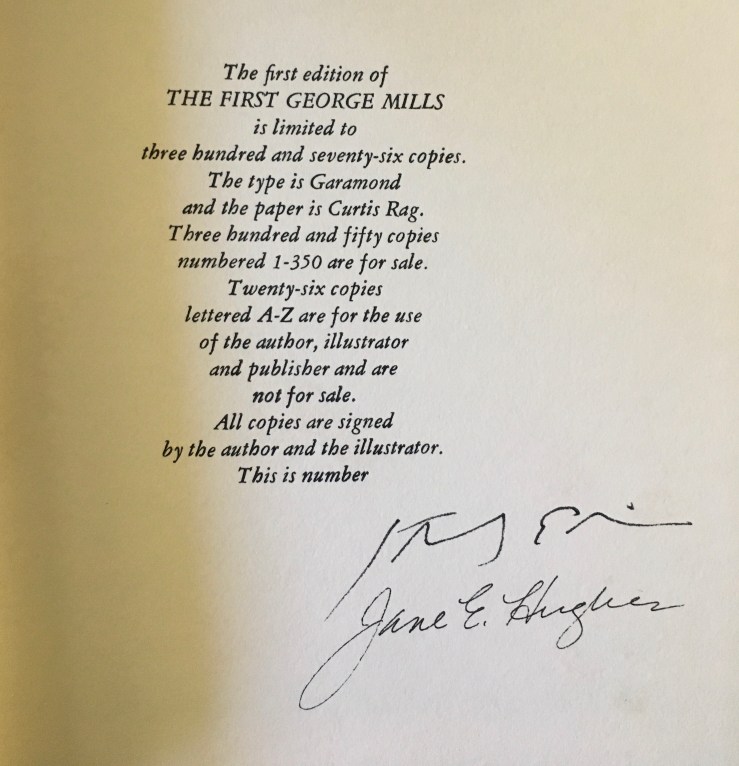
At the bookstore, I spied the gilt spine of The First George Mills, a 1980 oddity that comprises the first part (roughly 50 pages) of Stanley Elkin’s 1982 novel George Mills. The spine struck me as odd—so thin, so irregularly-shaped, etc. The book itself seemed like a novelty almost, and I was surprised to find Elkin’s signature at the end. I was even more surprised to find the signature of Jane Hughes, the apparent illustrator of this volume, whose illustrations do not appear in my copy. A bit of internet browsing seems to suggest that Hughes’s illustrations—of horses—were glued insets. Still, I was happy to forgo five bucks of my trade credit for Elkin’s signature.

When I got home from the bookstore a copy of Rudolph Wurlitzer’s cult classic 1969 novel Nog had arrived in the mail from Two Dollar Radio (along with a sticker and a bookmark and a thank you note—godbless indie publishers). I will be reading this book next, starting tonight. Here is the Thomas Pynchon blurb that made me interested in Wurlitzer:

Wow, this is some book, I mean it’s more than a beautiful and heavy trip, it’s also very important in an evolutionary way, showing us directions we could be moving in — hopefully another sign that the Novel of Bullshit is dead and some kind of re-enlightenment is beginning to arrive, to take hold. Rudolph Wurlitzer is really, really good, and I hope he manages to come down again soon, long enough anyhow to guide us on another one like Nog.

I did not go to the bookstore on this day, the last Friday of February 2020. I finished Gormenghast instead.

Read “I Don’t Talk Service No More,” a short story by Charles Portis

“I Don’t Talk Service No More”

by

Charles Portis


Once you slip past that nurses’ station in the east wing of D-3, you can get into the library at night easy enough if you have the keys. They keep the phone locked up in a desk drawer there but if you have the keys you can get it out and make all the long-distance calls you want to for free, and smoke all the cigarettes you want to, as long as you open a window and don’t let the smoke pile up so thick inside that it sets off the smoke alarm. You don’t want to set that thing to chirping. The library is a small room. There are three walls of paperback westerns and one wall of windows and one desk.

I called up Neap down in Orange, Texas, and he said, “I live in a bog now.” I hadn’t seen him in forty-odd years and I woke him up in the middle of the night and that was the first thing out of his mouth. “My house is sinking. I live in a bog now.” I told him I had been thinking about the Fox Company Raid and thought I would give him a ring. We called it the Fox Company Raid, but it wasn’t a company raid or even a platoon raid, it was just a squad of us, with three or four extra guys carrying pump shotguns for trench work. Neap said he didn’t remember me. Then he said he did remember me, but not very well. He said, “I don’t talk service no more.”

We had been in reserve and had gone back up on the line to relieve some kind of pacifist division. Those boys had something like “Live and Let Live” on their shoulder patches. When they went out on patrol at night, they faked it. They would go out about a hundred yards and lie down in the paddies, and doze off, too, like some of the night nurses on D-3. When they came back, they would say they had been all the way over to the Chinese outposts but had failed to engage the enemy. They failed night after night. Right behind the line the mortar guys sat around in their mortar pits and played cards all day. I don’t believe they even had aiming stakes set up around their pits. They hated to fire those tubes because the Chinese would fire right back. Continue reading “Read “I Don’t Talk Service No More,” a short story by Charles Portis”

Wells Tower remembers Charles Portis

Author Wells Tower (who, come on and finish a novel or another story collection or something, please) has a nice obituary in The New Yorker today for the novelist Charles Portis. From Tower’s essay:

 “Only a mean person won’t enjoy it” is something a critic once wrote about True Grit. In part, I love Portis because I feel less mean when I read him. It’s not just that his novels are gentle and funny; it’s that Portis’s books have a way of conscripting the reader into their governing virtues—punctuality, automotive maintenance, straight talk, emotional continence. Puny virtues, as Portis himself once put it, yet it is a great and comforting gift (in these days especially) to offer readers escape into a place where such virtues reign.

It’s hard to know whether Portis’s work ushered much comfort into his own life. My sense is that he was lonely. I imagine he had a fair bit in common with Jimmy Burns, described in Gringos as a “hard worker,” “solitary as a snake,” and, yes, “punctual.” Portis never married and had no children. He never published another novel after Gringos, from 1991. The closest he gets to self-portraiture comes in his short memoir “Combinations of Jacksons,” the essay published in The Atlantic. Toward the essay’s close, the author spots an “apparition” of his future self in the form of a geezer idling his station wagon alongside Portis at a traffic light in Little Rock. He wore “the gloat of a miser,” Portis writes. “Stiff gray hairs straggled out of the little relief hole at the back of his cap. . . . While not an ornament of our race, neither was he, I thought, the most depraved member of the gang.”

Read the whole thing here.

Read Tower’s review of Portis’s final novel Gringos here.


Blog about some recent reading
img_4994

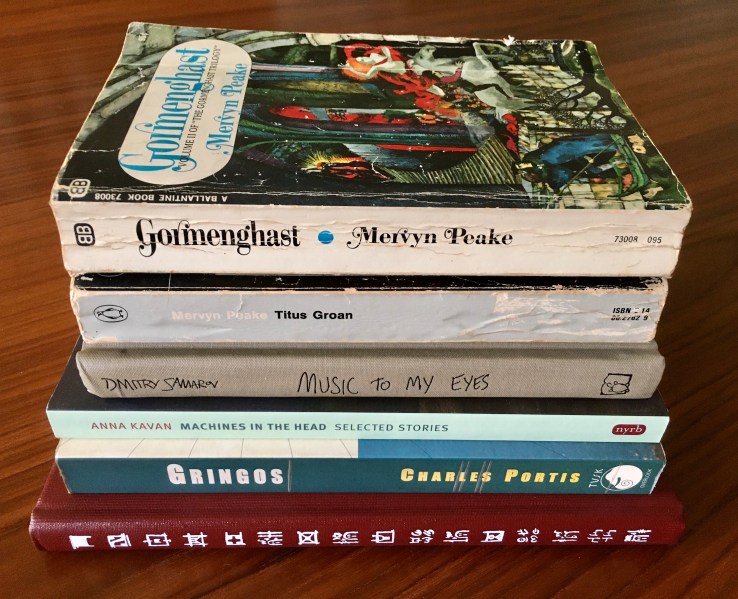
From the top down:

I came across a battered and beautiful copy of Mervyn Peake’s novel Gormenghast by chance a few weeks ago and asked Twitter if the trilogy was any good. The answer was a very enthusiastic, even cultish Yes. I still can’t believe I’d never even heard of Peake’s Gormenghast trilogy until recently—I grew up reading fantasy novels, and Lord of the Rings, the novel that Peake’s trilogy is often compared to, is and was one of my favorite novels of all time. The comparisons to Tolkien though aren’t particularly convincing, beyond the time period the novels were published, and their both being trilogies. Peake’s novels are grungier, wordier, thicker somehow; he plasters word on word on word building a baroque and grotesque world that is rich and full yet nevertheless opaque. He refuses to explain, but he shows. I read Titus Groan, the first novel in the trilogy, in a bit of a fever, feeding on its thickness. It reminded me of Dickens and T.H. White, but also Leonardo’s grotesque caricatures and Aleksei German’s film adaptation of Hard to Be a God. So much abjection! I have failed to discuss the plot: It’s a castle plot, whatever that means. There are insiders and outsiders. An outsider is trying to make his way not just in but also up: That’s Steerpike, the villainous hero of Titus Groan, and Iago-like intellect whose machinations Peake doesn’t just tell us about, but actually harnesses for us to ride around after. Little Titus Groan barely shows up in his eponymous volume, but so far in Gormenghast there’s been a lot more of him, which is cool, even if there’s been less Steerpike so far, which is not so cool. I’m about halfway through and really enjoying it. The novel vacillates between tones, dwelling just a bit-too-long on a bathetic romance before whirling again to other matters: a feral child, assassinations, an exiled retainer in the wild. Great stuff. The books are illustrated by the author:

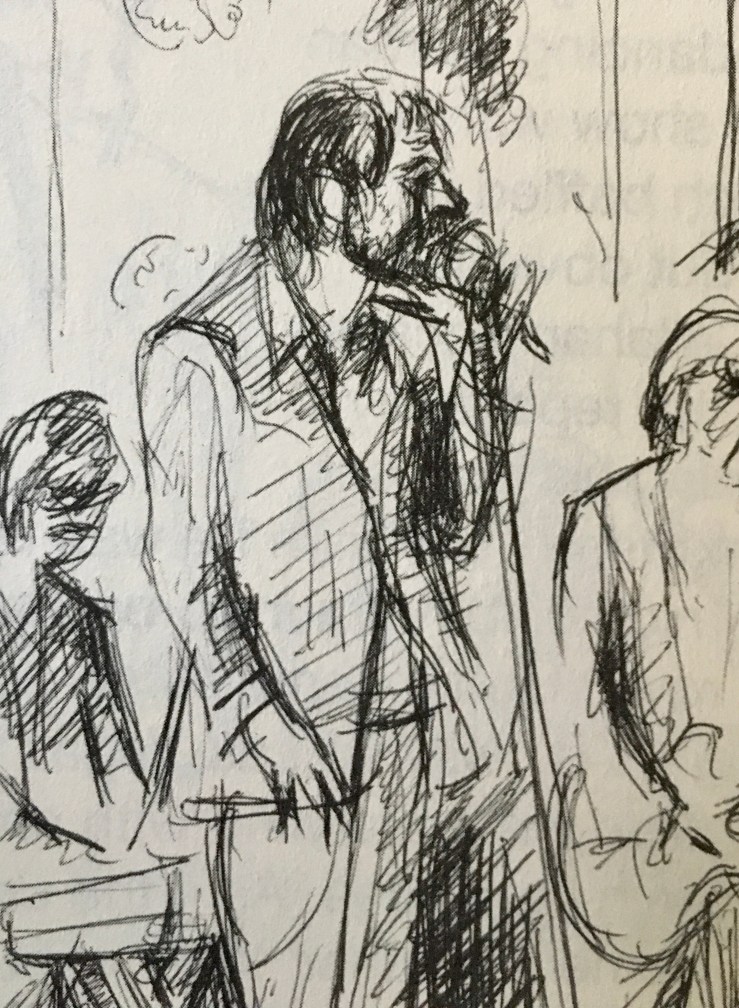
Peake’s Gormenghast books have been my “big” read so far this year, but I’ve slipped in other texts too of course. Dmitry Samarov’s Music to My Eyes is a sort of love-letter (“love” is maybe not the right word) to the Chicago music scene; it also functions as a memoir of sorts. The vignettes and short essays make for quick and entertaining reads. The book is also illustrated by the author; here is his picture of David Berman:

img_4997

I have been slowly making my way through the stories in Anna Kavan’s collection Machines in the Head, which is available (today!) now from NYRB. I have a full review coming next week, but it’s Good Weird Stuff. If you pick it up, I recommend skipping to the later stories and working backwards—Kavan eventually absorbs the Kafka-anxieties that permeate the earlier texts and synthesizes it into something all her own. The book is not illustrated by the author.

The Great American Novelist Charles Portis died yesterday. I pulled his books out, took a pic, wrote a post. Of his five novels, I’ve yet to read Gringos. I ended up reading the first 60-odd pages of it last night, after having pulled it down, and the sentences are too good to not keep going. Portis’s command of voice is amazing, and I love that he’s returned to the first-person here—in this case, the voice of Jimmy Burns, an American living in Merida, working as a part-time tomb raider, but mostly just helping out gringos and Mexicans alike. Gringos is both comic and ominous, cynical and joyful so far. I will keep going. The book isn’t illustrated, but here’s a taste of the prose, from a page I doggeared last night:

And so little fellowship among the writers. They shared a beleaguered faith and they stole freely from one another—the recycling of material was such that their books were all pretty much the same one now—but in private they seldom had a good word for their colleagues.

The notation is about alien-Mayan-conspiracy books, but I think it works as a take on literature in general.

The spine down there at the bottom with its own glyphs is Anasazi, a graphic novel by Mike McCubbins and Matt Bryan. It’s really, really good—I’ve read it twice now, and I have a review planned for The Comics Journal next month. I wrote about it a bit here,  saying;

The joy of Anasazi is sinking into its rich, alien world, sussing out meaning from image, color, and glyphs. The novel has its own grammar. Bryan and McCubbins conjure a world reminiscent of Edgar Rice Burroughs’ Martian novels, Charles Burns’ Last Look trilogy, Kipling’s Mowgli stories, as well as the fantasies of Jean Giraud.

This book is, of course, illustrated by the authors:

img_5001Blog about some recent reading

RIP Charles Portis

m9zxmlvgx70yhcyrctsekf9exavnowl4y1lblmdiury

RIP Charles Portis, 1933-2020

The Arkansas Times and other sources have reported that the novelist Charles Portis has died at the age of 86.

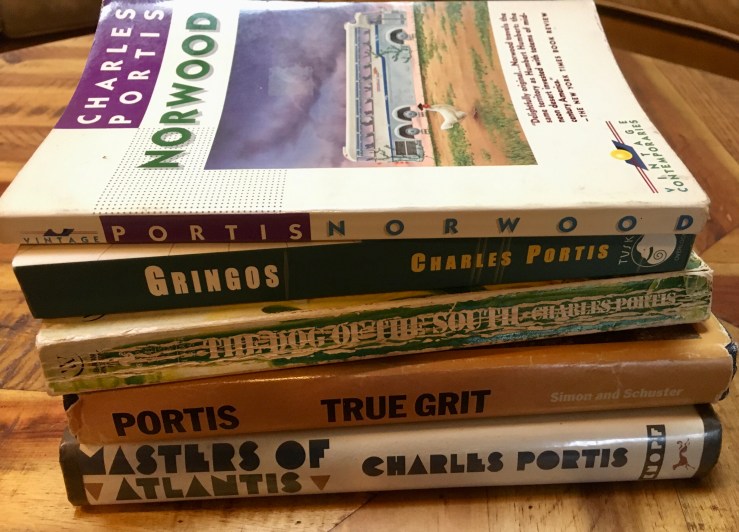
Portis published five novels in his life: NorwoodThe Dog of the SouthMasters of Atlantis, and Gringos, but he’s most likely well-known for his 1968 bestseller True Grit, which has been adapted to film twice. The first adaptation (1969), starring John Wayne, is a much broader affair than the Coen Brother’s 2010 take, which does a better job conveying the novel’s sharp humor. Neither can touch the novel, of course.

Walker Percy blurbed True Grit, comparing it to Adventures of Huckleberry Finn, and he’s not wrong. Told in Mattie Ross’s clipped, witty, yet still-the-slightest-shade-naive voice, True Grit’s narrative voice echoes Huck’s, and is equally achieved and engrossing, a wonderful layering of author-narrator-speaker. The prose is beautiful and Mattie is an endearing, enduring American hero. True Grit is a novel that teens and adults alike will love, and revisit, each time finding it changed. I’m very sorry that I was forty when I first read it, but I can make sure my daughter doesn’t overlook it. True Grit is probably a perfect novel.

Portis’s first novel Norwood (1966) is the first novel I read by him. This impossibly-large but slim novel is the picaresque tale of Norwood Pratt, who kind of bumbles his way across the South after being discharged from the Marines. Portis taps into the same grotesque fount that fed Faulkner and Flannery, Cormac McCarthy and Carson McCullers, but he converts that fuel into something more exuberant, energetic, and joyful than anything those authors ever produced.

img_4990

Eleven years after True Grit, Portis published The Dog of the South, which might be my favorite of the four I’ve read by him. This is a shaggy dog, a road trip novel, ribald, grotesque, and very, very funny. It reads like the novel that Barry Hannah was never quite sober enough to manage, a loose ironic folk-blues ballad of a novel with more structure and tighter refrains than Hannah’s wild jazz. Dog may have some faults, but it’s a wonderful read, and its ending reverberates with earned pathos.

1985’s Masters of Atlantis is probably the consensus favorite among Portis fans. Easily the most sprawling of his books, both in geographical scope and time, Masters is a novel of con-men and poseurs, secret societies and secret scams, capitalism and the price of knowledge. Despite an international cast, like Portis’s first three novels Masters is a very American novel, whatever that means. There’s a Pynchonian paranoid vibe and a Pynchonian zaniness to Masters—the novel reminds me very much of Pynchon’s underrated Against the Day. Masters of Atlantis also belongs to the American tradition of grifter novels, like Melville’s The Confidence-Man, Baum’s Oz books, the Adventures of Tom Sawyer, and even  The Great Gatsby. (It’s more fun to read than any of those.) Told in a third-person voice, Masters feels positively epic compared to the first-person immediacy of True Grit or The Dog of the South, or even the third-person voice of Norwood, which hovers around its protagonist’s brain pan and eye line, and doesn’t flit much farther. Masters is a loose, shaggy epic that seems to sprawl beyond its 250-odd pages.

I have yet to read Portis’s final novel Gringos (1991), which centers on expatriate Americans living in Merida who raid Mayan tombs and hunt UFOs (this may be an inaccurate description). I secured a copy when I was on my Portis binge, but when I finished Masters of Atlantis, I had to pause. Like many readers who fall in love with an author—especially an author with such a slim oeuvre—I tend to read greedily, voraciously, as the cliche goes. Finding Portis at forty felt like a bizarre gift from nowhere (a gift from the author himself, of course). I read all of Cormac McCarthy in my late twenties, an act I now regret. It’s not that I can’t re-read McCarthy—I do all the time—but unless we get another novel, it’s like, That’s it. When I truly fell in love with Pynchon and Gaddis, in my thirties, I consumed their novels, of course, re-reading books like Gravity’s Rainbow an J R—but also leaving one, y’know, in my back pocket, metaphorically: Bleeding Edge and A Frolic of His Own, respectively. Gringos is on the same mental shelf as those volumes, but I’ve taken it down from the actual shelf it was just-until-now resting upon, a to-be-read stack.  I used the adjective final in the first sentence of the previous paragraph to describe Portis’s 1991 novel Gringos. It’s possible that there are more novels, of course, finished or otherwise, and I have to admit that I’ll look forward to seeing them. In the meantime, I’ll start Gringos.


Three Books (that I loved in 2019)

I was having a tough time doing a Three Books post for the end of the year, so I divvied it up a bit, writing about three books I read in 2019 that were actually published in 2019, three books that I read in 2019 that were published in the 2010s, and three books I read in 2019 from indie presses. Here are three books that I loved in 2019.

2019-10-20_185738_3

Norwood by Charles Portis. 1985 trade paperback by Vintage Contemporaries. Cover design by Lorraine Louie. Cover illustration by Rick Lovell.

I could’ve picked any of the four novels by Portis that I read this year, but I read Norwood first, so. I wrote about his novels in a post here.

2019-10-06_172844

Berlin Alexanderplatz by Alfred Döblin. English translation by Michael Hoffmann. Book design by Katy Homans, featuring Georg Grosz’s painting Down with Liebknecht (1919). NRYB trade paperback, 2018.

“Unbe-fucking-lievable”

2019-12-31_134606

Ice by Anna Kavan. 2017 trade paperback from Penguin Classics. Cover illustration by Hsiao-Ron Cheng. No designer credited.

Imperfectly perfect. I wish I’d read it years ago but I’m glad I read it this year. More here. (I fucking loved Ice.)


Three Books

2019-11-10_152719

Masters of Atlantis by Charles Portis. 1985 first-edition hardback from Knopf. Jacket design by Sara Eisenman; jacket illustration by Dagmar Frinta.

2019-11-10_152719_2

The Dog of the South by Charles Portis. 1985 trade paperback from Windstone Trade. Cover art by Linda Bordelon; no designer credited.

2019-11-10_152719_1

True Grit by Charles Portis. 1968 hardback Book Club from Simon & Schuster. Jacket design by Paul Davis.

I picked up a 1985 Vintage Contemporaries edition of Charles Portis’s first novel Norwood this summer and promptly snorted the thing up my brain. I then sought out the rest of Portis, and read most of it, with the exception of Gringos, which I’m, I don’t know, saving, if that makes sense.

True Grit might be the best of the novels, from a technical standpoint. Walker Percy’s blurb on the back of my copy compares it to Adventures of Huckleberry Finn, and he’s not wrong. Mattie Ross’s is as achieved and engrossing and complex as Huck’s, a wonderful layering of author-narrator-speaker. The prose is beautiful and Mattie is an endearing American hero. I wish I had read it years ago. I’ll make sure my kids don’t repeat my error. Like Huck FinnTrue Grit seems like a book one returns to like an old friend, only to find the friend has changed in some deep way. (But of course it’s only you that’s changed you old bastard, reading now through older dimmer eyes.)

While True Grit is likely Portis’s best novel, my favorite in the quartet I’ve read is The Dog of the South, a road trip novel, shaggy, grotesque, and very, very funny. It reads like a novel that Barry Hannah was never quite sober enough to manage—or maybe that’s unfair (I love Hannah, godbless his soul)—maybe what I mean is that Portis’s loose ironic folk-blues ballad of a novel has more structure than Hannah’s jazz. Anyway, I loved Dog, but in spite of and because of its faults.

Masters of Atlantis is the strangest in the quartet. It’s a novel about con-men and poseurs, secret societies and secret scams, capitalism and the price of knowledge. Again, a very American novel, whatever that means. Atlantis has a Pynchonian paranoid vibe and a Pynchonian zaniness. It also belongs to the American tradition of grifter novels (think of Melville’s The Confidence-Man, or Baum’s Oz, or Adventures of Tom Sawyer, or Gatsby, etc.). Atlantis, told in a third-person voice, feels a bit more distant than the first-person immediacy of True Grit or The Dog of the South, or even the third-person voice of Norwood, which hovers around its protagonist’s brain pan and eye line, and doesn’t flit much farther. Atlantis also covers a hearty lifetime of secret society shenanigans. It’s a loose, shaggy epic, and seems to sprawl beyond its 250-odd pages. In any case, I ate it up, just like I ate up the other three. I waited far too long for Charles Portis, but I suppose late is better than never. Highly recommended.

Three Books

2019-10-20_185738_1

Taking Care by Joy Williams. 1985 trade paperback from Vintage Contemporaries. Cover design by Lorraine Louie. Cover illustration by Rick Lovell.

I read this book earlier this year. It’s really great. I reviewed it on this site, writing—

These are stories of domestic doom and incipient madness, alcoholism and lost pets. There’s humor here, but the humor is ice dry, and never applied as even a palliative to the central sadness of Taking Care. Williams’ humor is something closer to cosmic absurdity, a recognition of the ambiguity at the core of being human, of not knowing. It’s the humor of two girls eating chips on a beach, unable to decide if the people they are gazing at are drowning or just having a good time.

2019-10-20_185738_3

Norwood by Charles Portis. 1985 trade paperback by Vintage Contemporaries. Cover design by Lorraine Louie. Cover illustration by Rick Lovell.

Norwood isn’t the best book I’ve read so far this year but it is the book I most enjoyed reading, and after reading it, I sought everything else by Portis (consuming everything so far except the late novel Gringos, which I’m sort of holding onto as like…I dunno? A consolation prize at some point? Is that grim?). I picked Norwood up on a wonderful whim this summer, possibly simply because it was a Vintage Contemporaries edition (and slim). I’m so glad I did. Great read.

2019-10-20_185738_2

Cathedral by Raymond Carver. 1989 trade paperback from Vintage Contemporaries. Cover design by Lorraine Louie. Cover illustration by Garnet Henderson.

This was the first Vintage Contemporaries edition I ever bought. I bought it when I was maybe 17, sometime in the late nineties, I guess, and I was always vaguely embarrassed of the cover, especially when I used it in not one but two college courses at the end of that decade (Carver was still very cool in that era. He seems to have fallen out of favor. Good for him!) Henderson’s ultra-literal cover of the story “Cathedral” is…something. (I still prefer Lovell’s whimsical work, which is more, uh, I dunno, metaphysical (?)). I circled four short story titles on the table of contents for some reason: “A Small Good Thing,” “Where I’m Calling From,” “Vitamins,” and “Cathedral.” All great numbers. I also am fond of “Feathers” and “Chef’s House,” but I didn’t circle those titles. The rest of the stories I don’t remember, although I’m sure I read them at least once or twice.

Jackson/James/Portis (Three books acquired, 5 Sept. 2019)

img_3919

I had not intended to pick up any more books.

I’d been cooped up all week, or kinda sorta cooped, with a very mild cabin fever. This cooping and fever were the fault of Hurricane Dorian, which was slowly slowly slowly heading our way, although in the end, at least for us, not really. I’m deeply thankful and also very sorry for the many people who did meet Dorian. It fucking sucks.

We kept power and internet and everything though, and we also kept our kids, as school and work was cancelled, and everything closed down. We enjoyed a few rare 73 degree bike rides and pretended it was fall. We played card games and pretended like the power had gone out, although our air was coolly conditioned. We invented chores. I culled some books, a whole bankers box full. And I think the four of us (moi, wife, daughter, son) grated on each other after four days of this.

I got out for a bit on Thursday to do some made-up errands, including dropping off the culled books box. I said to myself, We will just drop off the box of books and then drive to the Publix to pick up our meds. We will not browse. I dropped off the books, and then I said to myself, We will browse, but we will not acquire. So I browsed, sticking at first to the weird margins I rarely visit of this big sprawling used books—travel writing and food writing, historical fiction and short story anthologies—before saying, Hey, maybe they have a copy of Charles Portis’s Gringos. They had a copy of Charles Portis’s Gringos. I said to myself, You will regret it if you don’t pick this up. (That same morning, I had tried to make a go at John Kennedy Toole’s A Confederacy of Dunces in the hopes of getting more Portis flavors, after finishing True Grit a few days ago. Alas, it didn’t take. Maybe later? I don’t know. I want to read Gringos.)

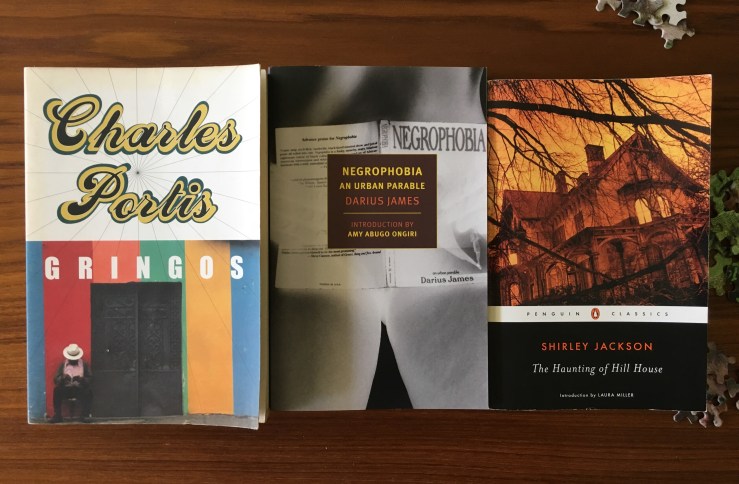
As I was picking up Portis I overheard a mother and her daughter trying to find Nathaniel Hawthorne’s The Scarlet Letter. They were not in the right place. They were in the westerns, an aisle or two over. The daughter was telling the mother how much anxiety the book produced in her. They turned into my aisle, still struggling against the alphabet, when the mother said to the daughter, We just need to find somebody who works here. I do not work there but I said, Hawthorne is down there, and pointed roughly east, where only a few meters away were literally hundreds and hundreds of copies of The Scarlet Letter. This indication was too vague though, and a few steps in the general direction were needed. The mother and daughter team found their way to Hawthorne though, and I lingered in the Js, where I remembered that I’d been meaning to read Shelly Jackson for years now. I had wanted to read We Have Always Lived in the Castle but there were no copies. There were two copies of The Haunting of Hill House. I got the one without the Netflix logo on it.

My eye is very good at scanning NYRB spines, and, while picking at Jacksons, I spied a book called Negrophobia by Darius James. I had never heard of Negrophobia, but the title alone warranted a pull. I opened the book up somewhere in the middle, flicked through—visually wild, cut up and strange, it reminded me a bit of Burroughs or later avant garde stuff, like Kathy Acker. I flipped it over. Kathy Acker blurbed it. Paul Beatty blurbed it. Kara Walker blurbed it! (More visual artists should blurb books.)

I picked up all three books of course. Then I went home and read another chapter of Sylvia Warner Townsend’s The Corner That Held Them.