“One of These Days” — Gabriel García Márquez

“One of These Days”

by Gabriel García Márquez

translated by J.S. Bernstein


Monday dawned warm and rainless. Aurelio Escovar, a dentist without a degree, and a very early riser, opened his office at six. He took some false teeth, still mounted in their plaster mold, out of the glass ease and put on the table a fistful of instruments which he arranged in size order, as if they were on display. He wore a collarless striped shirt, closed at the neck with a golden stud, and pants held up by suspenders. He was erect and skinny, with a look that rarely corresponded to the situation, the way deaf people have of looking.

When he had things arranged on the table, he pulled the drill toward the dental chair and sat down to polish the false teeth. He seemed not to be thinking about what he was doing, but worked steadily, pumping the drill with his feet, even when he didn’t need it.

After eight he stopped for a while to look at the sky through the window, and he saw two pensive buzzards who were drying themselves in the sun on the ridgepole of the house next door. He went on working with the idea that before lunch it would rain again. The shrill voice of his eleven-year-old son interrupted his concentration.

“Papá”

“What?”

“The Mayor wants to know if you’ll pull his tooth.”

“Tell him I’m not here.”

He was polishing a gold tooth. He held it at arm’s length, and examined it with his eyes half closed. His son shouted again from the little waiting room.

“He says you are, too, because he can hear you.”

The dentist kept examining the tooth. Only when he had put it on the table with the finished work did he say:

“So much the better.”

He operated the drill again. He took several pieces of a bridge out of a cardboard box where he kept the things he still had to do and began to polish the gold.

“Papá.”

“What?”

He still hadn’t changed his expression.

“He says if you don’t take out his tooth, he’ll shoot you.”

Without hurrying, with an extremely tranquil movement, he stopped pedaling the drill, pushed it away from the chair, and pulled the lower drawer of the table all the way out. There was a revolver. “O.K.,” he said. “Tell him to come and shoot me.”

He rolled the chair over opposite the door, his hand resting on the edge of the drawer. The Mayor appeared at the door. He had shaved the left side of his face, but the other side, swollen and in pain, had a five-day-old beard. The dentist saw many nights of desperation in his dull eyes. He closed the drawer with his fingertips and said softly:

“Sit down.”

“Good morning,” said the Mayor.

“Morning,” said the dentist.

While the instruments were boiling, the Mayor leaned his skull on the headrest of the chair and felt better. His breath was icy. It was a poor office: an old wooden chair, the pedal drill, a glass case with ceramic bottles. Opposite the chair was a window with a shoulder-high cloth curtain. When he felt the dentist approach, the Mayor braced his heels and opened his mouth.

Aurelio Escovar turned his head toward the light. After inspecting the infected tooth, he closed the Mayor’s jaw with a cautious pressure of his fingers.

“It has to be without anesthesia,” he said.

“Why?”

“Because you have an abscess.”

/>   The Mayor looked him in the eye. “All right,” he said, and tried to smile. The dentist did not return the smile. He brought the basin of sterilized instruments to the worktable and took them out of the water with a pair of cold tweezers, still without hurrying. Then he pushed the spittoon with the tip of his shoe, and went to wash his hands in the washbasin. He did all this without looking at the Mayor. But the Mayor didn’t take his eyes off him.

It was a lower wisdom tooth. The dentist spread his feet and grasped the tooth with the hot forceps. The Mayor seized the arms of the chair, braced his feet with all his strength, and felt an icy void in his kidneys, but didn’t make a sound. The dentist moved only his wrist. Without rancor, rather with a bitter tenderness, he said:

“Now you’ll pay for our twenty dead men.”

The Mayor felt the crunch of bones in his jaw, and his eyes filled with tears. But he didn’t breathe until he felt the tooth come out. Then he saw it through his tears. It seemed so foreign to his pain that he failed to understand his torture of the five previous nights.

Bent over the spittoon, sweating, panting, he unbuttoned his tunic and reached for the handkerchief in his pants pocket. The dentist gave him a clean cloth.

“Dry your tears,” he said.

The Mayor did. He was trembling. While the dentist washed his hands, he saw the crumbling ceiling and a dusty spider web with spider’s eggs and dead insects. The dentist returned, drying his hands. “Go to bed,” he said, “and gargle with salt water.” The Mayor stood up, said goodbye with a casual military salute, and walked toward the door, stretching his legs, without buttoning up his tunic.

“Send the bill,” he said.

“To you or the town?”

The Mayor didn’t look at him. He closed the door and said through the screen:

“It’s the same damn thing.”

Mass-market Monday | Gabriel García Márquez’s No One Writes to the Colonel

No One Writes to the Colonel and Other Stories, Gabriel García Márquez. Translation by J.S. Bernstein. Avon Bard (1973). No cover artist credited. 220 pages.

Another beautiful Avon Bard Latin American series cover that fails to attribute the cover artist. The “other” stories that supplement the titular novella are García Márquez’s 1962 collection Los funerales de la Mamá Grande. When I picked this up I fully expected the translator to be Gregory Rabassa, who did several of García Márquez’s major works, along with many, many of the other Avon Bard LA titles. But it’s J.S. Bernstein; as far as I can tell, this is their (his? her?) most famous translation. (Maybe Rabassa was doing a Richard Bachman thing.)

Continue reading “Mass-market Monday | Gabriel García Márquez’s No One Writes to the Colonel”

A run-on sentence on Gabriel García Márquez’s delirious novel The Autumn of the Patriarch

Gabriel García Márquez’s The Autumn of the Patriarch isn’t so much a novel as it is a delirium, a swamp fever, a sun-bleached hallucination stretched across centuries, a beast that coils and uncoils, bloated with its own rot, a thing that does not begin or end but only festers, looping back on itself in great, heaving tides of unpunctuated or undepunctuated or mispunctuated thought, García Márquez dragging us under, drowning us in the mind or minds of the titular dictator, a paranoid consciousness so swollen with its own power that it warps reality itself, a man who reigns forever and is always dying, whose past rewrites itself with every breath, whose power is infinite and yet always slipping, slipping, slipping through his fingers like the stolen sea, parceled off and shipped to Arizona, because why not, because what is truth if not what he declares it to be, because when you have lived for centuries, when your general is served up at a Thyestean feast, when your nation’s children are disappeared to an island, never to return, when the cattle are branded with your mark, when the very hour itself is subject to your whim, then nothing is real, nothing but the fear, the violence, the rape, the predation, the endless grinding machinery of power that must sustain itself, and so we cycle, we spiral, we convulse through six sections, six deaths, six endless iterations of his reign, six grotesque confirmations that absolute power is an ouroboros swallowing its own tail, devouring itself, erasing itself, until nothing is left but the silence of his ruin, the empty palace where his corpse will be found again and again, where his legacy is nothing but absence, and translator Gregory Rabassa—mad saint, linguistic necromancer—renders it all in English without breaking the spell, his translation a relentless incantation that doesn’t just mimic the novel’s crushing, hypnotic cadence but becomes it, suffocating, pressing, forcing you to inhabit the mind of this eternal, rotting god-tyrant, this cosmic mistake, this doomed and doom-dealing beast whose power, no matter how total, will crumble, will fade, will rot, will vanish into nothing, just like everything else.

An end to the infamy of mules terrified by the edges of precipices as on their backs they carried grand pianos for the masked balls | A sentence from Gabriel García Márquez’s The Autumn of the Patriarch

He was right, because during our time there was no one who doubted the legitimacy of his history, or anyone who could have disclosed or denied it because we couldn’t even establish the identity of his body, there was no other nation except the one that had been made by him in his own image and likeness where space was changed and time corrected by the designs of his absolute will, reconstituted by him ever since the most uncertain origins of his memory as he wandered at random through that house of infamy where no happy person had ever slept, as he tossed cracked corn to the hens who pecked around his hammock and exasperated the servants with orders he pulled out of the air to bring me a lemonade with chopped ice which he had left within reach of his hand, take that chair away from over there and put it over there, and they should put it back where it had been in order to satisfy in that minute way the warm embers of his enormous addiction to giving orders, distracting the everyday pastimes of his power with the patient raking up of ephemeral instants from his remote childhood as he nodded sleepily under the ceiba tree in the courtyard, he would wake up suddenly when he managed to grasp a memory like a piece in a limitless jigsaw puzzle of the nation that lay before him, the great, chimerical, shoreless nation, a realm of mangrove swamps with slow rafts and precipices that had been there before his time when men were so bold that they hunted crocodiles with their hands by placing a stake in their mouths, like that, he would explain to us holding his forefinger against his palate, he told us that on one Good Friday he had heard the hullabaloo of the wind and the scurf smell of the wind and he saw the heavy clouds of locusts that muddied the noonday sky and went along scissoring off everything that stood in their path and left the world all sheared and the light in tatters as on the eve of creation, because he had seen that disaster, he had seen a string of headless roosters hanging by their feet and bleeding drop by drop from the eaves of a house with a broad and crumbling sidewalk where a woman had just died, barefoot he had left his mother’s hand and followed the ragged corpse they were carrying off to bury without a coffin on a cargo litter that was lashed by the blizzard of locusts, because that was what the nation was like then, we didn’t even have coffins for the dead, nothing, he had seen a man who had tried to hang himself with a rope that had already been used by another hanged man from a tree in a village square and the rotted rope broke before it was time and the poor man lay in his death throes on the square to the horror of the ladies coming out of mass, but he didn’t die, they beat him awake with sticks without bothering to find out who he was because in those days no one knew who was who if he wasn’t known in the church, they stuck his ankles between the planks of the stocks and left him there exposed to the elements along with other comrades in suffering because that was what the times of the Goths were like when God ruled more than the government, the evil times of the nation before he gave the order to chop down all trees in village squares to prevent the terrible spectacle of a Sunday hanged man, he had prohibited the use of public stocks, burial without a coffin, everything that might awaken in one’s memory the ignominious laws that existed before his power, he had built the railroad to the upland plains to put an end to the infamy of mules terrified by the edges of precipices as on their backs they carried grand pianos for the masked balls at the coffee plantations, for he had also seen the disaster of the thirty grand pianos destroyed in an abyss and of which they had spoken and written so much even outside the country although only he could give truthful testimony, he had gone to the window by chance at the precise moment in which the rear mule had slipped and had dragged the rest into the abyss, so that no one but he had heard the shriek of terror from the cliff-flung mule train and the endless chords of the pianos that fell with it playing by themselves in the void, hurtling toward the depths of a nation which at that time was like everything that had existed before him, vast and uncertain, to such an extreme that it was impossible to know whether it was night or day in the kind of eternal twilight of the hot steamy mists in the deep canyons where the pianos imported from Austria had broken up into fragments, he had seen that and many other things in that remote world although not even he himself could have been sure with no room for doubt whether they were his own memories or whether he had heard about them on his bad nights of fever during the wars or whether he might have seen them in prints in travel books over which he would linger in ecstasy for long hours during the dead doldrums of power, but none of that mattered, God damn it, they’ll see that with time it will be the truth, he would say, conscious that his real childhood was not that crust of uncertain recollections that he only remembered when the smoke from the cow chips arose and he forgot it forever except that he really had lived it during the calm waters of my only and legitimate wife Leticia Nazareno who would sit him down every afternoon between two and four o’clock at a school desk under the pansy bower to teach him how to read and write, she had put her novice’s tenacity into that heroic enterprise and he matched it with his terrifying old man’s patience, with the terrifying will of his limitless power, with all my heart, so that he would chant with all his soul the tuna in the tin the loony in the bin the neat nightcap, he chanted without hearing himself or without anyone’s hearing him amidst the uproar of his dead mother’s aroused birds that the Indian packs the ointment in the can, papa places the tobacco in his pipe, Cecilia sells seals seeds seats seams scenes sequins seaweed and receivers, Cecilia sells everything, he would laugh, repeating amidst the clamor of the cicadas the reading lesson that Leticia Nazareno chanted to the time of her novice’s metronome, until the limits of the world became saturated with the creatures of your voice and in his vast realm of dreariness there was no other truth but the exemplary truths of the primer, there was nothing but the moon in the mist, the ball and the banana, the bull of Don Eloy, Otilia’s bordered bathrobe, the rote reading lessons which he repeated at every moment and everywhere just like his portraits even in the presence of the treasury minister from Holland who lost the thread of an official visit when the gloomy old man raised the hand with the velvet glove on it in the shadows of his unfathomable power and interrupted the audience to invite him to sing with me my mama’s a mummer, Ismael spent six months on the isle, the lady ate a tomato, imitating with his forefinger the beat of the metronome and repeating from memory Tuesday’s lesson with a perfect diction but with such a bad sense of the occasion that the interview ended as he had wanted it to with the postponement of payment of the Dutch debts for a more propitious moment, for when there would be time, he decided, to the surprise of the lepers, the blind men, the cripples who rose up at dawn among the rosebushes and saw the shadowy old man who gave a silent blessing and chanted three times with high-mass chords I am the king and the law is my thing, he chanted, the seer has fear of beer, a lighthouse is a very high tower with a bright beam which guides sailors at night, he chanted, conscious that in the shadows of his senile happiness there was no time but that of Leticia Nazareno of my life in the shrimp stew of the suffocating gambols of siesta time, there were no other anxieties but those of being naked with you on the sweat-soaked mattress under the captive bat of an electric fan, there was no light but that of your buttocks, Leticia, nothing but your totemic teats, your flat feet, your ramus of rue as a remedy, the oppressive Januaries of the remote island of Antigua where you came into the world one early dawn of solitude that was furrowed by the burning breeze of rotted swamps, they had shut themselves up in the quarters for distinguished guests with the personal order that no one is to come any closer than twenty feet to that door because I’m going to be very busy learning to read and write, so no one interrupted him not even with the news general sir that the black vomit was wreaking havoc among the rural population while the rhythms of my heart got ahead of the metronome because of that invisible force of your wild-animal smell, chanting that the midget is dancing on just one foot, the mule goes to the mill, Otilia washes the tub, kow is spelled with a jackass k, he chanted, while Leticia Nazareno moved aside the herniated testicle to clean him up from the last love-making’s dinky-poo, she submerged him in the lustral waters of the pewter bathtub with lion’s paws and lathered him with Reuter soap, scrubbed him with washcloths, and rinsed him off with the water of boiled herbs as they sang in duet ginger gibber and gentleman are all spelled with a gee, she would daub the joints of his legs with cocoa butter to alleviate the rash from his truss, she would put boric acid powder on the moldy star of his asshole and whack his behind like a tender mother for your bad manners with the minister from Holland, plap, plap, as a penance she asked him to permit the return to the country of the communities of poor nuns so they could go back to taking care of orphan asylums and hospitals and other houses of charity, but he wrapped her in the gloomy aura of his implacable rancor, never in a million years, he sighed, there wasn’t a single power in this world or the other that could make him go against a decision taken by himself alone and aloud, she asked him during the asthmas of love at two in the afternoon that you grant me one thing, my life, only one thing, that the mission territory communities who work on the fringes of the whims of power might return, but he answered her during the anxieties of his urgent husband snorts never in a million years my love, I’d rather be dead than humiliated by that pack of long skirts who saddle Indians instead of mules and pass out beads of colored glass in exchange for gold nose rings and earrings, never in a million years, he protested, insensitive to the pleas of Leticia Nazareno of my misfortune who had crossed her legs to ask him for the restitution of the confessional schools expropriated by the government, the disentailment of property held in mortmain, the sugar mills, the churches turned into barracks, but he turned his face to the wall ready to renounce the insatiable torture of your slow cavernous love-making before I would let my arm be twisted in favor of those bandits of God who for centuries have fed on the liver of the nation, never in a million years, he decided, and yet they did come back general sir, they returned to the country through the narrowest slits, the communities of poor nuns in accordance with his confidential order that they disembark silently in secret coves, they were paid enormous indemnities, their expropriated holdings were restored with interest and the recent laws concerning civil marriage, divorce, lay education were repealed, everything he had decreed aloud during his rage at the comic carnival of the process of the declaration of sainthood for his mother Bendición Alvarado may God keep her in His holy kingdom, God damn it, but Leticia Nazareno was not satisfied with all that but asked for more, she asked him to put your ear to the lower part of my stomach so that you can hear the singing of the creature growing inside, because she had awakened in the middle of the night startled by that deep voice that was describing the aquatic paradise of your insides furrowed by mallow-soft sundowns and winds of pitch, that interior voice that spoke to her of the polyps on your kidneys, the soft steel of your intestines, the warm amber of your urine sleeping in its springs, and to her stomach he put the ear that was buzzing less for him and he heard the secret bubbling of the living creature of his mortal sin, a child of our obscene bellies who would be named Emanuel, which is the name by which other gods know God, and on his forehead he will have the white star of his illustrious origins and he will inherit his mother’s spirit of sacrifice and his father’s greatness and his own destiny of an invisible conductor, but he was to be the shame of heaven and the stigma of the nation because of his illicit nature as long as he refused to consecrate at the altar what he had vilified in bed for so many years of sacrilegious concubinage, and then he opened a way through the foam of the ancient bridal mosquito netting with that snort of a ship’s boiler coming from the depths of his terrible repressed rage shouting never in a million years, better dead than wed, dragging his great feet of a secret bridegroom through the salons of an alien house whose splendor of a different age had been restored after the long period of the shadows of official mourning, the crumbling holy-week crepe had been pulled from the cornices, there was sea light in the bedrooms, flowers on the balconies, martial music, and all of it in fulfillment of an order that he had not given but which had been an order of his without the slightest doubt general sir because it had the tranquil decision of his voice and the unappealable style of his authority, and he approved, agreed, and the shuttered churches opened again, and the cloisters and cemeteries were returned to their former congregations by another order of his which he had not given either but he approved, agreed, the old holy days of obligation had been restored as well as the practices of lent and in through the open balconies came the crowd’s hymns of jubilation that had previously been sung to exalt his glory as they knelt under the burning sun to celebrate the good news that God had been brought in on a ship general sir, really, they had brought Him on your orders, Leticia, by means of a bedroom law which she had promulgated in secret without consulting anybody and which he approved in public so that it would not appear to anyone’s eyes that he had lost the oracles of his authority, for you were the hidden power behind those endless processions which he watched in amazement through the windows of his bedroom as they reached a distance beyond that of the fanatical hordes of his mother Bendición Alvarado whose memory had been erased from the time of men, the tatters of her bridal dress and the starch of her bones had been scattered to the winds and in the crypt the stone with the upside-down letters had been turned over so that even the mention of her name as a birdwoman painter of orioles in repose would not endure till the end of time, and all of that by your orders, because you were the one who had ordered it so that no other woman’s memory would cast a shadow on your memory, Leticia Nazareno of my misfortune, bitch-daughter.


From Gabriel García Márquez’s The Autumn of the Patriarch in translation by Gregory Rabassa.

He saw the three caravels | A sentence from Gabriel García Márquez’s The Autumn of the Patriarch

On another distant December when the house was inaugurated, he had seen from that terrace the line of the hallucinated isles of the Antilles which someone pointed out to him in the showcase of the sea, he had seen the perfumed volcano of Martinique, over there general, he had seen the tuberculosis hospital, the gigantic black man with a lace blouse selling bouquets of gardenias to governors’ wives on the church steps, he had seen the infernal market of Paramaribo, there general, the crabs that came out of the sea and up through the toilets, climbing up onto the tables of ice cream parlors, the diamonds embedded in the teeth of black grandmothers who sold heads of Indians and ginger roots sitting on their safe buttocks under the drenching rain, he had see the solid gold cows on Tanaguarena beach general, the blind visionary of La Guayra who charged two reals to scare off the blandishments of death with a one-string violin, he had seen Trinidad’s burning August, automobiles going the wrong way, the green Hindus who shat in the middle of the street in front of their shops with genuine silkworm shirts and mandarins carved from the whole tusk of an elephant, he had seen Haiti’s nightmare, its blue dogs, the oxcart that collected the dead off the streets at dawn, he had seen the rebirth of Dutch tulips in the gasoline drums of Curacao, the windmill houses with roofs built for snow, the mysterious ocean liner that passed through the center of the city among the hotel kitchens, he had seen the stone enclosure of Cartagena de Indias, its bay closed off by a chain, the light lingering on the balconies, the filthy horses of the hacks who still yawned for the viceroys’ fodder, its smell of shit general sir, how marvelous, tell me, isn’t the world large, and it was, really, and not just large but insidious, because if he went up to the house on the reefs in December it was not to pass the time with those refugees whom he detested as much as his own image in the mirror of misfortune but to be there at the moment of miracles when the December light came out, mother—true and he could see once more the whole universe of the Antilles from Barbados to Veracruz, and then he would forget who had the double-three piece and go to the overlook to contemplate the line of islands as lunatic as sleeping crocodiles in the cistern of the sea, and contemplating the islands he evoked again and relived that historic October Friday when he left his room at dawn and discovered that everybody in the presidential palace was wearing a red biretta, that the new concubines were sweeping the parlors and changing the water in the cages wearing red birettas, that the milkers in the stables, the sentries in their boxes, the cripples on the stairs and the lepers in the rose beds were going about with the red birettas of a carnival Sunday, so he began to look into what had happened to the world while he was sleeping for the people in his house and the inhabitants of the city to be going around wearing red birettas and dragging a string of jingle bells everywhere, and finally he found someone to tell him the truth general sir, that some strangers had arrived who gabbled in funny old talk because they made the word for sea feminine and not masculine, they called macaws poll parrots, canoes rafts, harpoons javelins, and when they saw us going out to greet them and swim around their ships they climbed up onto the yardarms and shouted to each other look there how well-formed, of beauteous body and fine face, and thick-haired and almost like horsehair silk, and when they saw that we were painted so as not to get sunburned they got all excited like wet little parrots and shouted look there how they daub themselves gray, and they are the hue of canary birds, not white nor yet black, and what there be of them, and we didn’t understand why the hell they were making so much fun of us general sir since we were just as normal as the day our mothers bore us and on the other hand they were decked out like the jack of clubs in all that heat, which they made feminine the way Dutch smugglers do, and they wore their hair like women even though they were all men and they shouted that they didn’t understand us in Christian tongue when they were the ones who couldn’t understand what we were shouting, and then they came toward us in their canoes which they called rafts, as we said before, and they were amazed that our harpoons had a shad bone for a tip which they called a fishy tooth, and we traded everything we had for these red birettas and these strings of glass beads that we hung around our necks to please them, and also for these brass bells that can’t be worth more than a penny and for chamber pots and eyeglasses and other goods from Flanders, of the cheapest sort general sir, and since we saw that they were good people and men of good will we went on leading them to the beach without their realizing it, but the trouble was that among the I’ll swap you this for that and that for the other a wild motherfucking trade grew up and after a while everybody was swapping his parrots, his tobacco, his wads of chocolate, his iguana eggs, everything God ever created, because they took and gave everything willingly, and they even wanted to trade a velvet doublet for one of us to show off in Europeland, just imagine general, what a wild affair, but he was so confused that he could not decide whether that lunatic business came within the incumbency of his government, so he went back to his bedroom, opened the window that looked out onto the sea so that perhaps he might discover some new light to shed on the mix-up they had told him about, and he saw the usual battleship that the marines had left behind at the dock, and beyond the battleship, anchored in the shadowy sea, he saw the three caravels.


From Gabriel García Márquez’s The Autumn of the Patriarch in translation by Gregory Rabassa.

Mass-market Monday | Gabriel García Márquez’s The Autumn of the Patriarch

The Autumn of the Patriarch, Gabriel García Márquez. Translation by Gregory Rabassa. Avon Bard (1977). No cover artist credited. 251 pages.

I started in on The Autumn of the Patriarch this afternoon, soaking into its initial pages, which seemed to me at first a grand revision of Faulkner’s “A Rose for Emily,” and then coasted on the sentences through its first section. Here are the first nine sentences:

Over the weekend the vultures got into the presidential palace by pecking through the screens on the balcony windows and the flapping of their wings stirred up the stagnant time inside, and at dawn on Monday the city awoke out of its lethargy of centuries with the warm, soft breeze of a great man dead and rotting grandeur. Only then did we dare go in without attacking the crumbling walls of reinforced stone, as the more resolute had wished, and without using oxbows to knock the main door off its hinges, as others had proposed, because all that was needed was for someone to give a push and the great armored doors that had resisted the lombards of William Dampier during the building’s heroic days gave way. It was like entering the atmosphere of another age, because the air was thinner in the rubble pits of the vast lair of power, and the silence was more ancient, and things were hard to see in the decrepit light. All across the first courtyard, where the paving stones had given way to the underground thrust of weeds, we saw the disorder of the post of the guard who had fled, the weapons abandoned in their racks, the big, long rough-planked tables with plates containing the leftovers of the Sunday lunch that had been interrupted by panic, in shadows we saw the annex where government house had been, colored fungi and pale irises among the unresolved briefs whose normal course had been slower than the pace of the dryest of lives, in the center of the courtyard we saw the baptismal font where more than five generations had been christened with martial sacraments, in the rear we saw the ancient viceregal stable which had been transformed into a coach house, and among the camellias and butterflies we saw the berlin from stirring days, the wagon from the time of the plague, the coach from the year of the comet, the hearse from progress in order, the sleep-walking limousine of the first century of peace, all in good shape under the dusty cobwebs and all painted with the colors of the flag. In the next courtyard, behind an iron grille, were the lunar-dust-covered rosebushes under which the lepers had slept during the great days of the house, and they had proliferated to such a degree in their abandonment that there was scarcely an odorless chink in that atmosphere of roses which mingled with the stench that came to us from the rear of the garden and the stink of the henhouse and the smell of dung and urine ferment of cows and soldiers from the colonial basilica that had been converted into a milking barn. Opening a way through the asphyxiating growth we saw the arches of the gallery with potted carnations and sprigs of astromelias and pansies where the concubines’ quarters had been, and from the variety of domestic leftovers and the quantity of sewing machines we thought it possible that more than a thousand women had lived there with their crews of seven-month runts, we saw the battlefield disorder of the kitchens, clothes rotting in the sun by the wash basins, the open slit trench shared by concubines and soldiers, and in back we saw the Babylonian willows that had been carried alive from Asia Minor in great seagoing hothouses, with their own soil, their sap, and their drizzle, and behind the willows we saw government house, immense and sad, where the vultures were still entering through the chipped blinds. We did not have to knock down the door, as we had thought, for the main door seemed to open by itself with just the push of a voice, so we went up to the main floor along a bare stone stairway where the opera-house carpeting had been torn by the hoofs of the cows, and from the first vestibule on down to the private bedrooms we saw the ruined offices and protocol salons through which the brazen cows wandered, eating the velvet curtains and nibbling at the trim on the chairs, we saw heroic portraits of saints and soldiers thrown to the floor among broken furniture and fresh cow flops, we saw a dining room that had been eaten up by the cows, the music room profaned by the cows’ breakage, the domino tables destroyed and the felt on the billiard tables cropped by the cows, abandoned in a corner we saw the wind machine, the one which counterfeited any phenomenon from the four points of the compass so that the people in the house could bear up under their nostalgia for the sea that had gone away, we saw birdcages hanging everywhere, still covered with the sleeping cloths put on some night the week before, and through the numerous windows we saw the broad and sleeping animal that was the city, still innocent of the historic Monday that was beginning to come to life, and beyond the city, up to the horizon, we saw the dead craters of harsh moon ash on the endless plain where the sea had been. In that forbidden corner which only a few people of privilege had ever come to know, we smelled the vultures’ carnage for the first time, we caught their age-old asthma, their premonitory instinct, and guiding ourselves by the putrefaction of their wing flaps in the reception room we found the wormy shells of the cows, their female animal hindquarters repeated many times in the full-length mirrors, and then we pushed open a side door that connected with an office hidden in the wall, and there we saw him, in his denim uniform without insignia, boots, the gold spur on his left heel, older than all old men and all old animals on land or sea, and he was stretched out on the floor, face down, his right arm bent under his head as a pillow, as he had slept night after night every night of his ever so long life of a solitary despot. Only when we turned him over to look at his face did we realize that it was impossible to recognize him, even though his face had not been pecked away by vultures, because none of us had ever seen him, and even though his profile was on both sides of all coins, on postage stamps, on condom labels, on trusses and scapulars, and even though his engraved picture with the flag across his chest and the dragon of the fatherland was displayed at all times in all places, we knew that they were copies of copies of portraits that had already been considered unfaithful during the time of the comet, when our own parents knew who he was because they had heard tell from theirs, as they had from theirs before them, and from childhood on we grew accustomed to believe that he was alive in the house of power because someone had seen him light the Chinese lanterns at some festival, someone had told about seeing his sad eyes, his pale lips, his pensive hand waving through the liturgical decorations of the presidential coach, because one Sunday many years ago they had brought him the blind man on the street who for five cents would recite the verses of the forgotten poet Ruben Dario and he had come away happy with the nice wad they had paid him for a recital that had been only for him, even though he had not seen him, of course, not because he was blind, but because no mortal had ever seen him since the days of the black vomit and yet we knew that he was there, we knew it because the world went on, life went on, the mail was delivered, the municipal band played its retreat of silly waltzes on Saturday under the dusty palm trees and the dim street lights of the main square, and other old musicians took the places of the dead musicians in the band.

Read “Bitterness for Three Sleepwalkers,” a short story by Gabriel García Márquez

“Bitterness for Three Sleepwalkers”

by

Gabriel García Márquez

translated by Gregory Rabassa


Now we had her there, abandoned in a corner of the house. Someone told us, before we brought her things – her clothes which smelled of newly cut wood, her weightless shoes for the mud – that she would be unable to get used to that slow life, with no sweet tastes, no attraction except that harsh, wattled solitude, always pressing on her back. Someone told us – and a lot of time had passed before we remembered it – that she had also had a childhood. Maybe we didn’t believe it then. But now, seeing her sitting in the corner with her frightened eyes and a finger placed on her lips, maybe we accepted the fact that she’d had a childhood once, that once she’d had a touch that was sensitive to the anticipatory coolness of the rain, and that she always carried an unexpected shadow in profile to her body.

All this – and much more – we believed that afternoon when we realized that above her fearsome subworld she was completely human. We found it out suddenly, as if a glass had been broken inside, when she began to give off anguished shouts; she began to call each one of us by name, speaking amidst tears until we sat down beside her; we began to sing and clap hands as if our shouting could put the scattered pieces of glass back together. Only then were we able to believe that at one time she had had a childhood. It was as if her shouts were like a revelation somehow; as if they had a lot of remembered tree and deep river about them. When she got up, she leaned over a little and, still without covering her face with her apron, still without blowing her nose, and still with tears, she told us:

‘I’ll never smile again.’

We went out into the courtyard, the three of us, not talking: maybe we thought we carried common thoughts. Maybe we thought it would be best not to turn on the lights in the house. She wanted to be alone – maybe – sitting in the dark corner, weaving the final braid which seemed to be the only thing that would survive her passage toward the beast.

Outside, in the courtyard, sunk in the deep vapor of the insects, we sat down to think about her. We’d done it so many times before. We might have said that we were doing what we’d been doing every day of our lives.

Yet it was different that night: she’d said that she would never smile again, and we, who knew her so well, were certain that the nightmare had become the truth. Sitting in a triangle, we imagined her there inside, abstract, incapacitated, unable even to hear the innumerable clocks that measured the marked and minute rhythm with which she was changing into dust. ‘If we only had the courage at least to wish for her death,’ we thought in a chorus. But we wanted her like that: ugly and glacial, like a mean contribution to our hidden defects.

We’d been adults since before, since a long time back. She, however, was the oldest in the house. That same night she had been able to be there, sitting with us, feeling the measured throbbing of the stars, surrounded by healthy sons. She would have been the respectable lady of the house if she had been the wife of a solid citizen or the concubine of a punctual man. But she became accustomed to living in only one dimension, like a straight line, perhaps because her vices or her virtues could not be seen in profile. We’d known that for many years now. We weren’t even surprised one morning, after getting up, when we found her face down in the courtyard, biting the earth in a hard, ecstatic way. Then she smiled, looked at us again; she had fallen out of the second-story window onto the hard clay of the courtyard and had remained there, stiff and concrete, face down on the damp clay. But later we learned that the only thing she had kept intact was her fear of distances, a natural fright upon facing space. We lifted her up by the shoulders. She wasn’t as hard as she had seemed to us at first. On the contrary, her organs were loose, detached from her will, like a lukewarm corpse that hadn’t begun to stiffen.

Her eyes were open, her mouth was dirty with that earth that already must have had a taste of sepulchral sediment for her when we turned her face up to the sun, and it was as if we had placed her in front of a mirror. She looked at us all with a dull, sexless expression that gave us – holding her in my arms now – the measure of her absence. Someone told us she was dead; and afterward she remained smiling with that cold and quiet smile that she wore at night when she moved about the house awake. She said she didn’t know how she got to the courtyard. She said that she’d felt quite warm, that she’d been listening to a cricket, penetrating, sharp, which seemed – so she said – about to knock down the wall of her room, and that she had set herself to remembering Sunday’s prayers, with her cheek tight against the cement floor.

We knew, however, that she couldn’t remember any prayer, for we discovered later that she’d lost the notion of time when she said she’d fallen asleep holding up the inside of the wall that the cricket was pushing on from outside and that she was fast asleep when someone, taking her by the shoulders, moved the wall aside and laid her down with her face to the sun.

That night we knew, sitting in the courtyard, that she would never smile again. Perhaps her inexpressive seriousness pained us in anticipation, her dark and willful living in a corner. It pained us deeply, as we were pained the day we saw her sit down in the corner where she was now; and we heard her say that she wasn’t going to wander through the house any more. At first we couldn’t believe her. We’d seen her for months on end going through the rooms at all hours, her head hard and her shoulders drooping, never stopping, never growing tired. At night we would hear her thick body noise moving between two darknesses, and we would lie awake in bed many times hearing her stealthy walking, following her all through the house with our ears. Once she told us that she had seen the cricket inside the mirror glass, sunken, submerged in the solid transparency, and that it had crossed through the glass surface to reach her. We really didn’t know what she was trying to tell us, but we could all see that her clothes were wet, sticking to her body, as if she had just come out of a cistern. Without trying to explain the phenomenon, we decided to do away with the insects in the house: destroy the objects that obsessed her.

We had the walls cleaned; we ordered them to chop down the plants in the courtyard and it was as if we had cleansed the silence of the night of bits of trash. But we no longer heard her walking, nor did we hear her talking about crickets any more, until the day when, after the last meal, she remained looking at us, she sat down on the cement floor, still looking at us, and said: ‘I’m going to stay here, sitting down,’ and we shuddered, because we could see that she had begun to look like something already almost completely like death.

That had been a long time ago and we had even grown used to seeing her there, sitting, her braid always half wound, as if she had become dissolved in her solitude and, even though she was there to be seen, had lost her natural faculty of being present. That’s why we now knew that she would never smile again; because she had said so in the same convinced and certain way in which she had told us once that she would never walk again. It was as if we were certain that she would tell us later: ‘I’ll never see again,’ or maybe ‘I’ll never hear again,’ and we knew that she was sufficiently human to go along willing the elimination of her vital functions and that spontaneously she would go about ending herself, sense by sense, until one day we would find her leaning against the wall, as if she had fallen asleep for the first time in her life. Perhaps there was still a lot of time left for that, but the three of us, sitting in the courtyard, would have liked to hear her sharp and sudden broken-glass weeping that night, at least to give us the illusion that a baby … a girl baby had been born in the house. In order to believe that she had been born renewed.

Mass-market Monday | Gabriel García Márquez’s One Hundred Years of Solitude

One Hundred Years of Solitude, Gabriel García Márquez. Translation by Gregory Rabassa. Avon Bard (1971). No cover artist credited. 383 pages.

I am a huge fan of the Avon Bard Latin American literature series. (I do wish, however, they had done a better job crediting the cover artists.)

I listened to One Hundred Years of Solitude on audiobook (narrated by John Lee) last week while undertaking a largish home project. I had read the novel maybe twelve years ago, after several false starts, and enjoyed the audiobook very much, even if the story was much, much sadder than I’d remembered. I had registered One Hundred Years of Solitude in my memory as rich and mythic, its robust humor tinged with melancholy spiked with sex and violence. That memory is only partially correct—García Márquez’s novel is darker and more pessimistic than my younger-reader-self could acknowledge.

From John Leonard’s wonderful contemporary review in The New York Times (in which he employs the word haruspex in the second sentence:

You emerge from this marvelous novel as if from a dream, the mind on fire. A dark, ageless figure at the hearth, part historian, part haruspex, in a voice by turns angelic and maniacal, first lulls to sleep your grip on a manageable reality, then locks you into legend and myth. One Hundred Years of Solitude is not only the story of the Buendia family and the Colombian town of Macondo. It is also a recapitulation of our evolutionary and intellectual experience. Macondo is Latin America in microcosm: local autonomy yielding to state authority; anticlericalism; party politics; the coming of the United Fruit Company; aborted revolutions; the rape of innocence by history. And the Buendias (inventors, artisans, soldiers lovers, mystics) seem doomed to ride biological tragi‐cycle in circles from solitude to magic to poetry to science to politics to violence back again to solitude.


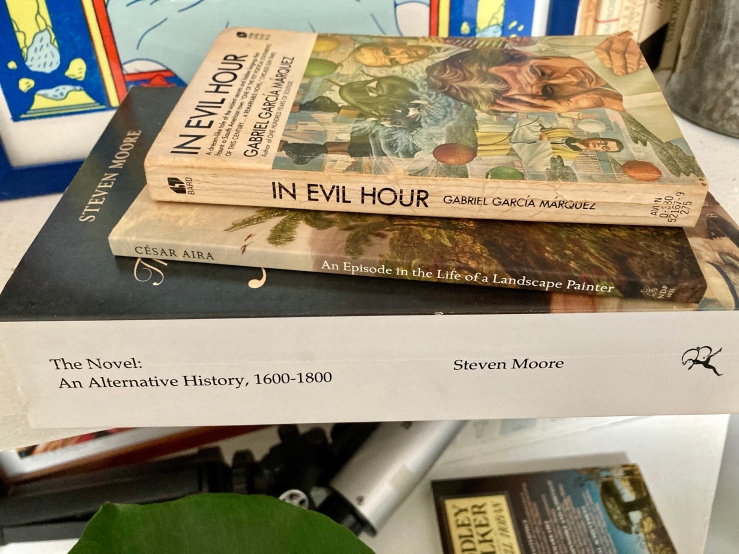
Aira/Márquez/Moore (Books acquired, 18 Aug. 2023)

Last week I read a 1985 Washington Post profile of the American novelist William Gaddis. The profile, by Lloyd Grove, celebrated the publication of Gaddis’s third novel Carpenter’s Gothic. In the profile, Grove paraphrases literary critic Frederick Karl’s 1985 essay “The Mega-Novel” in the following way:

Karl argues that unlike “categories of Jewish novelists, gays, Black writers [and] female authors” who address special interests, “these white Protestant males [Gaddis, Pynchon, John Barth et al.] write very close to what America is,” having “sensed the country as a whole.”

I tracked down and read Karl’s essay “The Mega-Novel”; it is, almost entirely, a sustained argument for the kind of giant-assed so-called “experimental” novels typical of the bracketed Gaddis, Pynchon, and Barth above. And yet Karl seems to slide into and side with Harold Bloom in that old man’s pompous war against the so-called “School of Resentment”; once in the quote above, and then a few pages later, when he chooses to claim that “The Mega-Novelists have avoided the individuation of ethnic, gay, female (or even strictly male) experience and sensed the country as a whole.” Yes—Grove weds this second line in Karl’s covert attack on the “School of Resentment,” this maddening and dismissive “country as a whole” bit to the previous language. The effect is so odd, as if Grove has purposefully ignored every other bit of Karl’s essay and cherry-picked the lines that valorize the Real American Viewpoint™ as White Protestant Straight and Male.

Karl’s essay is, apart from these unnecessary declarations, really quite good—he champions Gaddis’s J R and Joseph McElroy’s Lookout Cartridge in particular. And yet I found myself troubled by his claim that it is the dead white guys who write very close to what America is because they sense the country as a whole, in a way that somehow, like, I guess Ishmael Reed or Fran Ross or Toni Morrison or etc. just can’t. And because I’m so simpatico with Karl’s general idea in “The Mega-Novel,” I found myself looking for his 1983 book American Fictions 1940-1980 : A Comprehensive History and Critical Evaluation.

While I didn’t find it in the literary criticism section of my beloved used bookmine, I did find the second volume of Gaddis-scholar Steven Moore’s The Novel, covering 1600-1800.

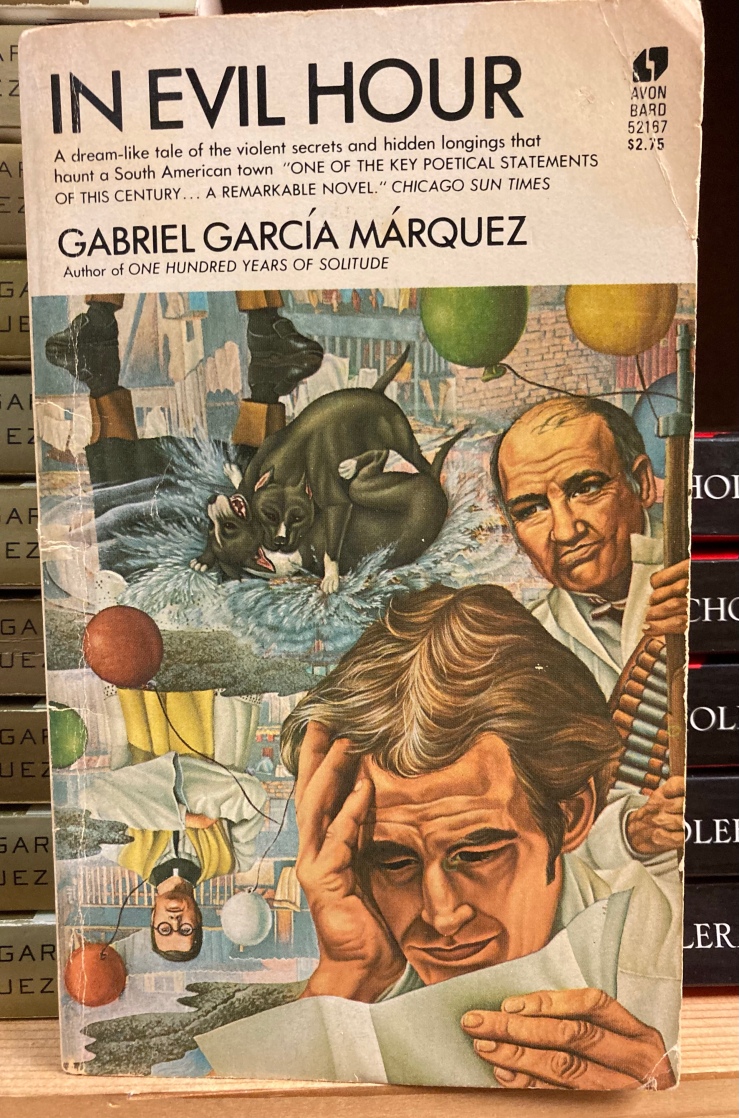
I also picked up César Aira’s An Episode in the Life of a Landscape Painter (in translation by Chris Andrews) and Gabriel García Márquez’s In Evil Hour (in translation by Gregory Rabassa). The latter is another title in Avon/Bard’s Latin American authors series, and I can’t resist them.


The next day, yesterday, Saturday, I participated in an online discussion about the literature of William Gaddis on non-academic forums. (I represented Ye Olde Bloggers, and I will share more about the forum some time in the future.) Early in our forum, one of the participants, the author Jeff Bursey, raised a copy of Frederick Karl’s American Fictions 1940-1980 in front of his webcam. I believe he declared it one of the first places he’d heard of Gaddis, although I could be misremembering. It seemed like a serendipitous moment. I hope to muster more words on most of this later.

Three Books

2019-12-08_113541_2

Mulata by Miguel Ángel Asturias; English trans. by Gregory Rabassa. 1982 mass market paperback from Avon-Bard. The Boschian cover art isn’t credited; neither is the designer credited, although my assumption is that it is Sidney Feinberg, who is credited as designer on Avon-Bard’s edition of Gabriel García Márquez’s novel In Evil Hour.

2019-12-08_113541

In Evil Hour by Gabriel García Márquez; English trans. by Gregory Rabassa. 1980 mass market paperback from Avon-Bard. The cover artist is not credited; book design by Sidney Feinberg,

2019-12-08_113541_1

The Ex-Magician and Other Stories by Murilo Rubião; English trans. by Thomas Colchie.  1984 mass market paperback from Avon-Bard. No cover artist or designer is credited, but my hunch is the design is by Sidney Feinberg.

Blog about acquiring some books (Books acquired, 3 May 2019)

img_2751

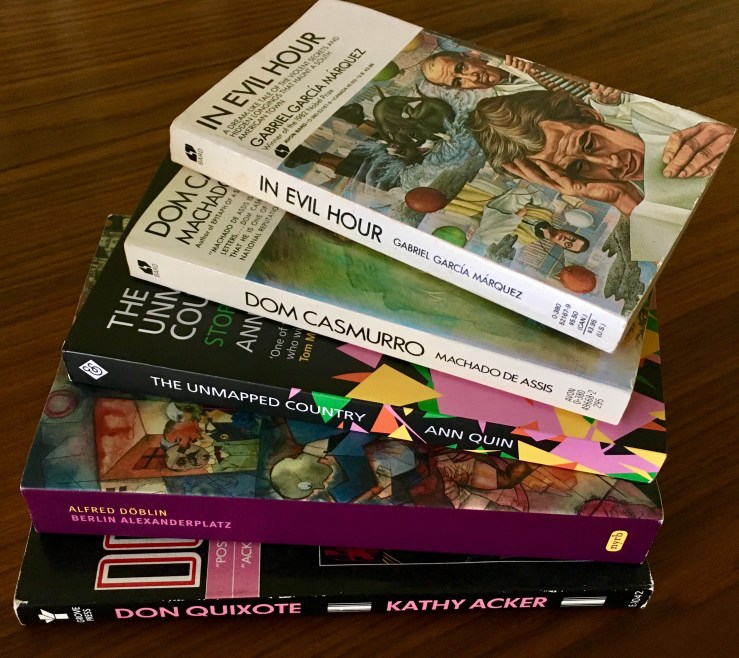
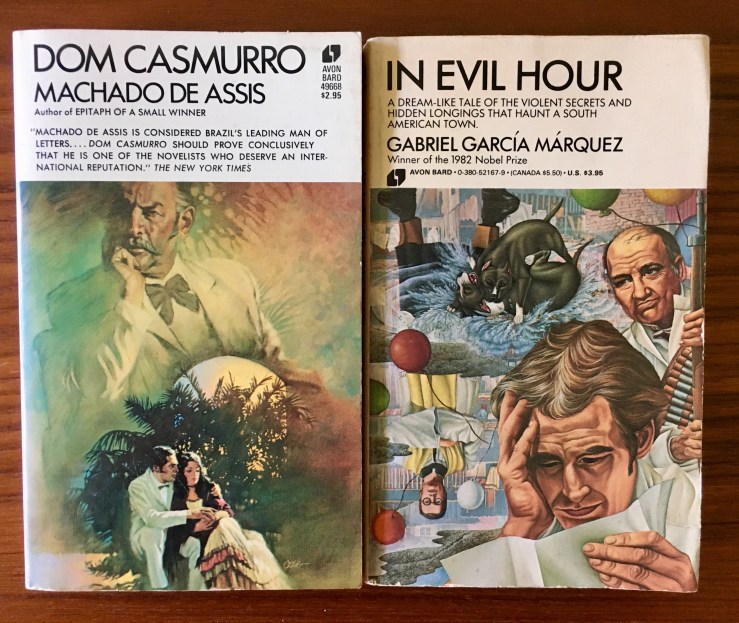
Yesterday marked both my wedding anniversary and the end of my spring semester, so I celebrated by spending a spare hour browsing my beloved used bookshop. I had dropped by last week to drop off a box of trade books—mostly old instructor editions of textbooks no longer in use—but I didn’t pick anything up. I did, however, snap a few photographs of the covers of the old 1980s Latin American authors series that Avon Bard put out. I love these covers, and have bought a few over the years.

I ended up picking up two yesterday: Gabriel Garcia Marquez’s In Evil Hour and Machado de Assis’s Dom Casmurro. The cover for Dom Casmurro is pretty bad, actually, but I want to read it.

img_2752

Near the Machado de Assis, I found a used copy of Berlin Alexanderplatz by Alfred Döblin, which I couldn’t resist. I also found a Grove edition of Kathy Acker’s Don Quixote, which I haven’t read since college.

img_2753

I also got a book in the mail. I loved Ann Quin’s novel Berg so much that I had to get more Quin, so I ordered The Unmapped Country from publisher And Other Stories. Very excited for this one.

img_2754

“The Incredible and Sad Tale of Innocent Eréndira and Her Heartless Grandmother” — Gabriel García Márquez”

“The Incredible and Sad Tale of Innocent Eréndira and Her Heartless Grandmother”

by

Gabriel García Márquez

translation by

Gregory Rabassa


Erendira was bathing her grandmother when the wind of her misfortune began to blow. The enormous mansion of moon like concrete lost in the solitude of the desert trembled down to its foundations with the first attack. But Erendira and her grandmother were used to the risks of the wild nature there, and in the bathroom decorated with a series of peacocks and childish mosaics of Roman baths they scarcely paid any attention to the caliber of the wind.

The grandmother, naked and huge in the marble tub, looked like a handsome white whale. The granddaughter had just turned fourteen and was languid, soft-boned, and too meek for her age. With a parsimony that had something like sacred rigor about it, she was bathing her grandmother with water in which purifying herbs and aromatic leaves had been boiled, the latter clinging to the succulent back, the flowing metal-colored hair, and the powerful shoulders which were so mercilessly tattooed as to put sailors to shame.

“Last night I dreamt I was expecting a letter,” the grandmother said.

Erendira, who never spoke except when it was unavoidable, asked:

“What day was it in the dream?”

“Thursday.”

“Then it was a letter with bad news,” Erendira said, “but it will never arrive.”

When she had finished bathing her grandmother, she took her to her bedroom. The grandmother was so fat that she could only walk by leaning on her granddaughter’s shoulder or on a staff that looked like a bishop’s crosier, but even during her most difficult efforts the power of an antiquated grandeur was evident. In the bedroom, which had been furnished with an excessive and somewhat demented taste, like the whole house, Erendira needed two more hours to get her grandmother ready. She untangled her hair strand by strand, perfumed and combed it, put an equatorially flowered dress on her, put talcum powder on her face, bright red lipstick on her mouth, rouge on her cheeks, musk on her eyelids, and mother-of-pearl polish on her nails, and when she had her decked out like a larger than life-size doll, she led her to an artificial garden with suffocating flowers that were like the ones on the dress, seated her in a large chair that had the foundation and the pedigree of a throne, and left her listening to elusive records on a phonograph that had a speaker like a megaphone. Continue reading ““The Incredible and Sad Tale of Innocent Eréndira and Her Heartless Grandmother” — Gabriel García Márquez””

She left the orbit, sighing: ‘Eyes of a blue dog. I’ve written it everywhere.’ | Gabriel Garcia Marquez

Then she looked at me. I thought that she was looking at me for the first time. But then, when she turned around behind the lamp and I kept feeling her slippery and oily look in back of me, over my shoulder, I understood that it was I who was looking at her for the first time. I lit a cigarette. I took a drag on the harsh, strong smoke, before spinning in the chair, balancing on one of the rear legs. After that I saw her there, as if she’d been standing beside the lamp looking at me every night. For a few brief minutes that’s all we did: look at each other. I looked from the chair, balancing on one of the rear legs. She stood, with a long and quiet hand on the lamp, looking at me. I saw her eyelids lighted up as on every night. It was then that I remembered the usual thing, when I said to her: ‘Eyes of a blue dog.’ Without taking her hand off the lamp she said to me: ‘That. We’ll never forget that.’ She left the orbit, sighing: ‘Eyes of a blue dog. I’ve written it everywhere.’

Read the rest of Gabriel Garcia Marquez’s very short story “Eyes of a Blue Dog.”

RIP Gabriel García Márquez

RIP Gabriel García Márquez, 1927-2014

Gabo the Giant is dead.

Long live the Giant.

Seven Versions of Gabriel García Márquez Wearing a Book as a Hat

1 2 3 47 5 6

“The Incredible and Sad Tale of Innocent Eréndira and Her Heartless Grandmother” — Gabriel García Márquez”

“The Incredible and Sad Tale of Innocent Eréndira and Her Heartless Grandmother” by Gabriel García Márquez

Erendira was bathing her grandmother when the wind of her misfortune began to blow. The enormous mansion of moon like concrete lost in the solitude of the desert trembled down to its foundations with the first attack. But Erendira and her grandmother were used to the risks of the wild nature there, and in the bathroom decorated with a series of peacocks and childish mosaics of Roman baths they scarcely paid any attention to the caliber of the wind.

The grandmother, naked and huge in the marble tub, looked like a handsome white whale. The granddaughter had just turned fourteen and was languid, soft-boned, and too meek for her age. With a parsimony that had something like sacred rigor about it, she was bathing her grandmother with water in which purifying herbs and aromatic leaves had been boiled, the latter clinging to the succulent back, the flowing metal-colored hair, and the powerful shoulders which were so mercilessly tattooed as to put sailors to shame.

“Last night I dreamt I was expecting a letter,” the grandmother said.

Erendira, who never spoke except when it was unavoidable, asked:

“What day was it in the dream?”

“Thursday.”

“Then it was a letter with bad news,” Erendira said, “but it will never arrive.”

When she had finished bathing her grandmother, she took her to her bedroom. The grandmother was so fat that she could only walk by leaning on her granddaughter’s shoulder or on a staff that looked like a bishop’s crosier, but even during her most difficult efforts the power of an antiquated grandeur was evident. In the bedroom, which had been furnished with an excessive and somewhat demented taste, like the whole house, Erendira needed two more hours to get her grandmother ready. She untangled her hair strand by strand, perfumed and combed it, put an equatorially flowered dress on her, put talcum powder on her face, bright red lipstick on her mouth, rouge on her cheeks, musk on her eyelids, and mother-of-pearl polish on her nails, and when she had her decked out like a larger than life-size doll, she led her to an artificial garden with suffocating flowers that were like the ones on the dress, seated her in a large chair that had the foundation and the pedigree of a throne, and left her listening to elusive records on a phonograph that had a speaker like a megaphone. Continue reading ““The Incredible and Sad Tale of Innocent Eréndira and Her Heartless Grandmother” — Gabriel García Márquez””

List with No Name #11

  1.  The Sailor Who Fell From Grace With the Sea
  2. The Big Sleep
  3. The Way of All Flesh
  4. Woodcutters
  5. The Melancholy of Resistance
  6. Aurelia and Other Writings
  7. The Hearing Trumpet
  8. The Invention of Morel
  9. The Narrow Road to the Deep North and Other Travel Sketches
  10. Today I Wrote Nothing
  11. The Red and the Black