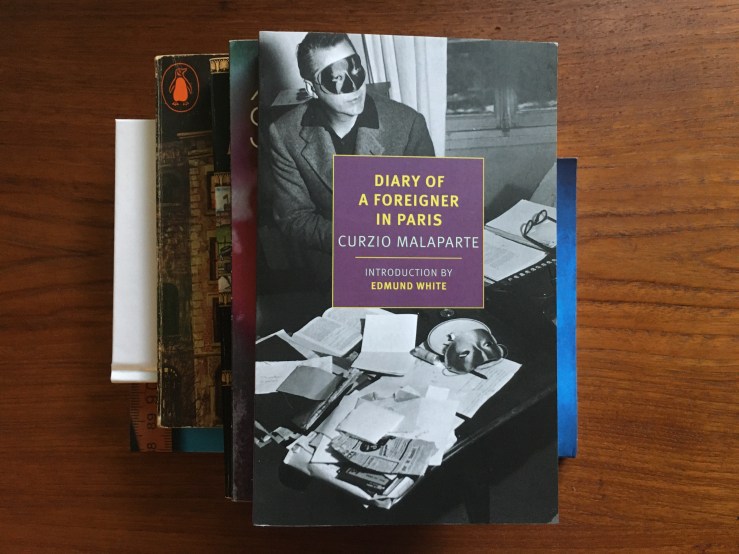
Curzio Malaparte’s Diary of a Foreigner in Paris (Book acquired 27 April 2020)

Curzio Malaparte’s Diary of a Foreigner in Paris is new from NYRB in translation from Stephen Tilley. NYRB’s blurb:

In 1947 Curzio Malaparte returned to Paris for the first time in fourteen years. In between, he had been condemned by Mussolini to five years in exile and, on release, repeatedly imprisoned. In his intervals of freedom, he had been dispatched as a journalist to the Eastern Front, and though many of his reports from the bloodlands of Poland and Ukraine were censored, his experiences there became the basis for his unclassifiable postwar masterpiece and international bestseller, Kaputt. Now, returning to the one country that had always treated him well, the one country he had always loved, he was something of a star, albeit one that shines with a dusky and disturbing light.

The journal he kept while in Paris records a range of meetings with remarkable people—Jean Cocteau and a dourly unwelcoming Albert Camus among them—and is full of Malaparte’s characteristically barbed reflections on the temper of the time. It is a perfect model of ambiguous reserve as well as humorous self-exposure. There is, for example, Malaparte’s curious custom of sitting out at night and barking along with the neighborhood dogs—dogs, after all, were his only friends when in exile. The French find it puzzling, to say the least; when it comes to Switzerland, it is grounds for prosecution!

“How Trees Walk” — Leo Tolstoy

“How Trees Walk”

by

Leo Tolstoy

(Trans. by Leo Wiener)


One day we were cleaning an overgrown path on a hillock near the pond. We cut down a lot of brier bushes, willows, and poplars,—then came the turn of a bird-cherry. It was growing on the path, and it was so old and stout that it could not be less than ten years old. And yet I knew that five years ago the garden had been cleaned. I could not understand how such an old bird-cherry could have grown out there. We cut it down and went farther. Farther away, in another thicket, there grew a similar bird-cherry, even stouter than the first. I looked at its root, and saw that it grew under an old linden. The linden with its branches choked it, and it had stretched out about twelve feet in a straight line, and only then came out to the light, raised its head, and began to blossom.

I cut it down at the root, and was surprised to find it so fresh, while the root was rotten. After we had cut it down, the peasants and I tried to pull it off; but no matter how much we jerked at it, we were unable to drag it away: it seemed to have stuck fast. I said:

“Look whether it has not caught somewhere.”

A workman crawled under it, and called out:

“It has another root; it is out on the path!”

I walked over to him, and saw that it was so.

Not to be choked by the linden, the bird-cherry had gone away from underneath the linden out on the path, about eight feet from its former root. The root which I had cut down was rotten and dry, but the new one was fresh. The bird-cherry had evidently felt that it could[Pg 177] not exist under the linden, so it had stretched out, dropped a branch to the ground, made a root of that branch, and left the other root. Only then did I understand how the first bird-cherry had grown out on the road. It had evidently done the same,—only it had had time to give up the old root, and so I had not found it.

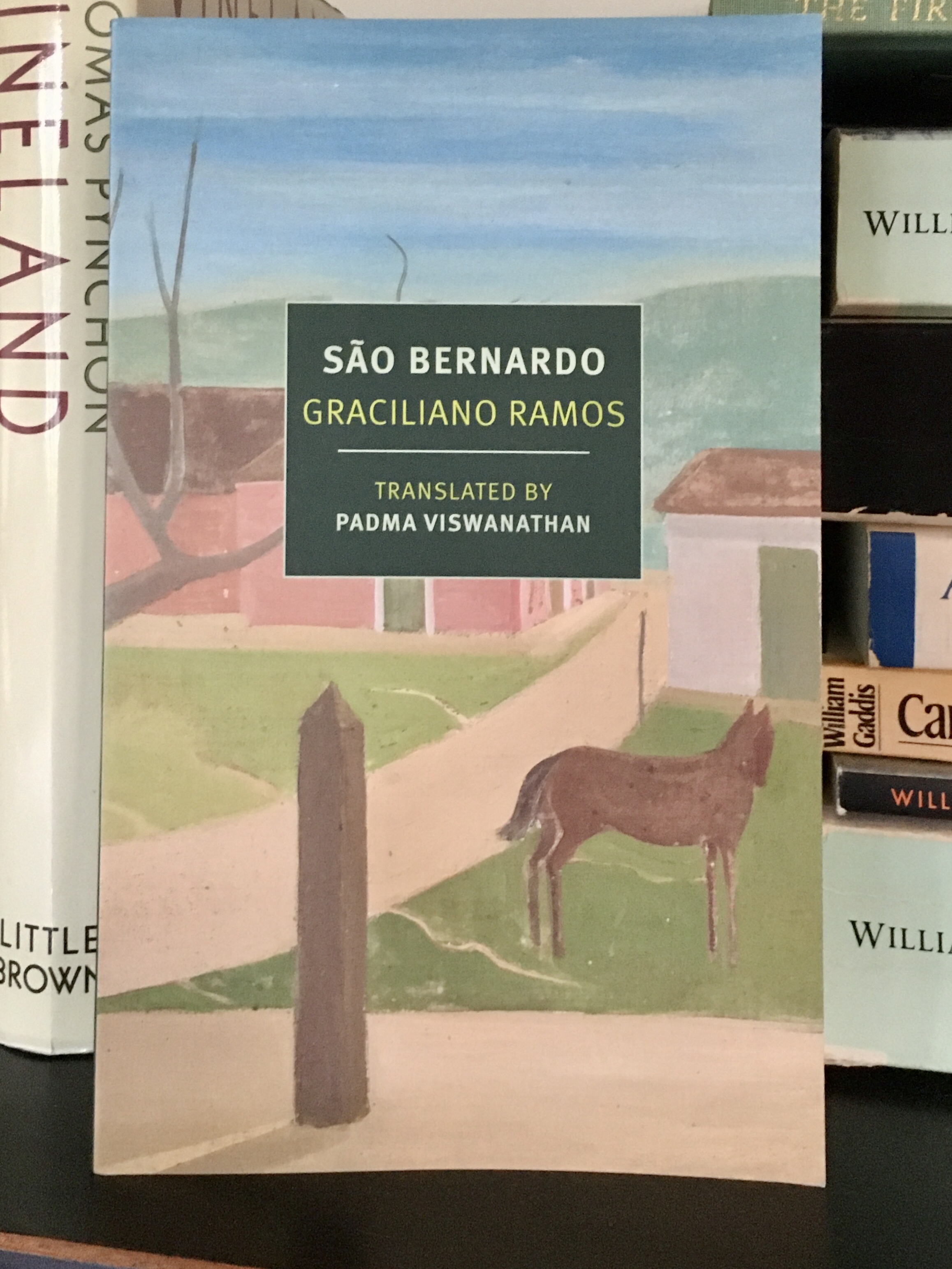
Graciliano Ramos’s São Bernardo (Book acquired, 27 April 2020)

img_5379

A few days ago, a perhaps-not-unprecedented-yet-still-weighty crop of books arrived at Biblioklept World Headquarters. Five, to be clear, which is a lot of good mail in These Uncertain Trying Unprecedented Challenging Difficult Fucked the Fucked Up Times™. At first I felt electric joy, and then I felt overwhelmed, burdened even—I’m in the middle of Pynchon’s latest novel Bleeding Edge and I’m reading this really great as-yet-unpublished novel by Adam Novy and I’m still making my merry way through the voluminous volume The Complete Gary Lutz. (And how did Tyrant, the publisher, get that name? Do they plan on assassinating Lutz to ensure their book is truly complete?) I’m also doing my job, which is a bunch of reading and writing, and trying to do the homeschool thing. Is this a complaint? It is not. I am okay.

But so well and anyway—

The five books that showed up initially were a source of joy but then caused a weird panic. I picked up Graciliano Ramos’s novel São Bernardo (new translation by Padma Viswanathan, btw) this afternoon because it was on top of a neat stack I’d stacked. (A big part of my day is going around and stacking things and wiping down surfaces.) I started reading, and the sentences were good. The first sentence made me want to read the next sentence, a pattern that continued. I read the first eight chapters (I love short chapters, and I love short books—books should be over 700 pages or under 200), and really dig the voice Ramos channels here. Let’s take these early paragraphs, which might could maybe perhaps be the germ of its own separate novel:

Until I was eighteen, I hoed a hard roe, earning five tostoes for twelve hours’ work. That was when I committed my first act worthy of mention. At a wake that ended up in a free-for-all, I moved in on this girl, Germana—a sarara, a blond mulatta, flirty as hell—and tweaked the stern of her ass. The kid about wet herself, she love it so much. Then she flipped and made up to João Fagundes, a guy who changed his name so he could steal horses. The upshot was that I knocked Germana around and knifed João Fagundes. Sot the police chief arrested me. I was beaten with a bullwhip, took my medicine and stewed in my own juices, rotting in jail for three years, nine months, and fifteen days, where I learned to read with Joaquim the shoemaker, who had one of those tiny Bibles, the Protestant kind.

Joaquim the shoemaker died and Germana was ruined. When I got, she’d gone downhill—had an open-door policy and the clap.

(lmao — “a guy who changed his name so he could steal horses.”)

Our narrator is a charming brute who brutally charms his way into ownership of São Bernardo, a ranch gone to seed.

Here’s NYRB’s blurb:

Paulo Honório is a sometime field hand who has kicked and clawed and schemed his way to prosperity, becoming master of the decrepit estate São Bernardo, where once upon a time he toiled. He is ruthless in his exploitation of his fellow man, but when he makes a match with a fine young woman, he is surprised to discover that this latest acquisition, as he sees it, may be somewhat harder to handle. It is in Paulo Honório’s own rough-hewn voice that the great Brazilian writer Graciliano Ramos, often compared to William Faulkner, tells this gritty and dryly funny story of triumph and comeuppance, a tour de force of the writer’s art that is beautifully captured in Padma Viswanathan’s new translation.

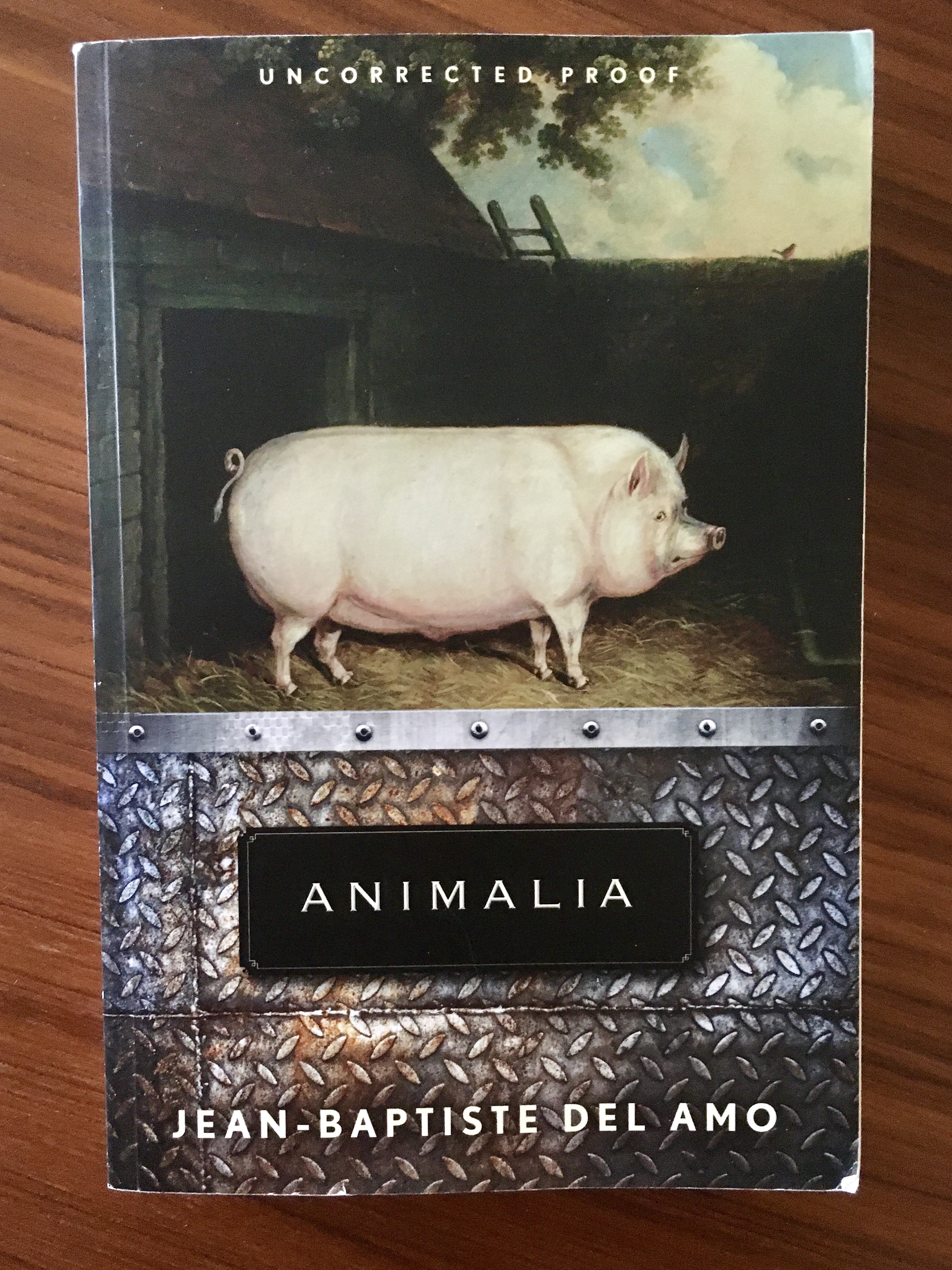
Jean-Baptiste Del Amo’s Animalia (Book acquired 21 April 2020)

img_5359

A number of people whose literary taste I admire and have learned from (including this guy) have told me to read Jean-Baptiste Del Amo’s novel Animalia. (English translation is by Frank Wynne, by the way.)

I avoided any reviews or descriptions (although a bit of chatter and stray lines have led me to believe the book has an abject grimy grittiness to it—and the back of this copy compares it to Cormac McCarthy), but trips to my beloved bookstore never yielded a copy over the past six months or so. I was looking for the Fitzcarraldo Editions edition, which was probably a mistake. Those are hard to come by in the States.

A few weeks—days? —I don’t know man, time has been weird, we all know that right? Like this virus, a post-postmodern moment, has shifted again our human relationship with time/space, revealing that the modernist schedules and movements and timelines and tics that we’d been following, perhaps even believing in, were fictions—which of course, those of us birthed in the postmodern era understood, either fully or at least intuitively—but we had to subscribe to those fictions to like, survive—but now, now, hey, now what is our relationship to time and space?—does anyone else wake up at 3am and then go back to sleep at 7am?—has anyone else ordered a book off the internet, possibly drunk, or possibly in a weird mix of sleep aids and melatonin, or possibly just a bit crazed?—these aren’t real questions—

So—

At some point in the recent past, Fitzcarraldo Editions tweeted about an ebook sale that reminded me to get Animalia. (A basic twitter search reveals that my previous paragraph is as idiotic as you no doubt took it to be, if you bothered to even read it. This happened on 30 March 2020.) Of course, I could not get the ebook in the States.

I’m not sure when exactly I ordered a copy of Animalia from an indie bookseller online. When it showed up the other day I was a bit surprised: first that I’d ordered it, second that it was an uncorrected proof. But I was happy that some idiot version of myself from the past sent me this gift, the first physical book I’ve gotten in what seems like a long time.

From an excerpt of the novel at Granta:

The genetrix, a lean, cold woman, with a ruddy neck and hands that are ever busy, affords the child scant attention. She is content merely to instruct her, to pass on the skills for those chores that are the preserve of their sex, and the child quickly learns to emulate her in her tasks, to mimic her gestures and her bearing. At five years old, she holds herself stiff and staid as a farmer’s wife, feet planted firmly on the ground, clenched fists resting on her narrow hips. She beats the laundry, churns the butter and draws water from the well or the spring without expecting affection or gratitude in return. Before Éléonore was born, the father twice impregnated the genetrix, but her menses are light, irregular, and continued to flow during the months when, in hindsight, she realizes that she was pregnant, though her belly had barely begun to swell. Although scrawny, she had a pot-belly as a child, her organs strained and bloated from parasitic infections contracted through playing in dirt and dungheaps, or eating infected meat, a condition her mother vainly attempted to treat with decoctions of garlic.

One October morning, alone in the sty, tending to the sow about to farrow, the genetrix is felled by a pain and, without even a cry, falls to her knees on the freshly scattered straw whose pale, perfumed dust is still rising in whorls. Her breaking waters drench her undergarments and her thighs. The sow, also in the throes of labour, trots in circles, making high whining sounds, her huge belly jiggling, her teats already swollen with milk, her swollen vulva dilated; and it is here, on her knees, and later on her side, that the genetrix gives birth, like a bitch, like a sow, panting, red-faced, her forehead bathed with sweat. Slipping a hand between her thighs, she feel the viscid mass tearing her apart. She buries her fingers in the fontanelle, rips out the stillborn foetus and flings it far from her. She grips the bluish umbilical cord attached to it and from her belly pulls the placenta which falls to the ground with a spongy sound. She stares at the tiny body covered in vernix caseosa, it looks like a yellowish worm, like the grey and golden larva of a potato beetle ripped from the rich soil and the roots on which it feeds. Daylight filters between loose boards, streaking the sour, dusty air, the bleak half-light that reeks of a knacker’s yard, and falls on the lifeless form lying on the straw. The genetrix gets to her feet, split in two, one hand under her skirt touching the swollen lips of her sex. She steps back, horrified, and leaves the sty, careful to latch the door, leaving to the sow the afterbirth and its fruit. For a long time she leans against the wall of the sty, motionless, gasping for breath. Bright blurred shapes float in her field of vision. Then she leaves the farm and takes the road towards Puy-Larroque, limping through a heavy drizzle that washes her face and the skirt stained brown with lochia. Without a glance at anyone, she crosses the village square. Those who see her notice the soiled skirt she is gripping in one fist, the pallid face, the lips pressed so tightly that the mouth is white as an old scar. Her brown hair has escaped her scarf and is plastered to her face and neck. She pushes open the church door and falls to her knees before the crucifix.

“The Peasant and the Cucumbers,” a short fable by Leo Tolstoy

“The Peasant and the Cucumbers”

by Leo Tolstoy

(trans. by Leo Wiener)


A peasant once went to the gardener’s, to steal cucumbers. He crept up to the cucumbers, and thought:

“I will carry off a bag of cucumbers, which I will sell; with the money I will buy a hen. The hen will lay eggs, hatch them, and raise a lot of chicks. I will feed the chicks and sell them; then I will buy me a young sow, and she will bear a lot of pigs. I will sell the pigs, and buy me a mare; the mare will foal me some colts. I will raise the colts, and sell them. I will buy me a house, and start a garden. In the garden I will sow cucumbers, and will not let them be stolen, but will keep a sharp watch on them. I will hire watchmen, and put them in the cucumber patch, while I myself will come on them, unawares, and shout: ‘Oh, there, keep a sharp lookout!'”

And this he shouted as loud as he could. The watchmen heard it, and they rushed out and beat the peasant.


“Theme for a Tapestry” — Julio Cortázar

2020-03-06_151902_5

(English translation by Paul Blackburn.)

“Avelino Arredondo” — Jorge Luis Borges

“Avelino Arredondo”

by

Jorge Luis Borges

translated by Andrew Hurley


The incident occurred in Montevideo in 1897.

Every Saturday the friends took the same table, off to one side, in the Café del Globo, like
the poor honest men they were, knowing they cannot invite their friends home, or perhaps escaping it. They were all from Montevideo; at first it had been hard to make friends with Arredondo, a man from the interior who didn’t allow confidences or ask questions. He was hardly more than twenty, a lean, dark-skinned young man, a bit on the short side, and perhaps a little clumsy. His face would have been anonymous had it not been rescued by his eyes, which were both sleepy and full of energy. He was a clerk in a dry goods store on Calle Buenos Aires, and he studied law in his spare time. When the others condemned the war that was ravaging the country and that the president (so general opinion believed) was waging for reprehensible reasons, Arredondo remained silent. He also remained silent when the others laughed at him and called him a tightwad.

A short time after the Battle of Cerros Blancos, Arredondo told his friends that they wouldn’t be seeing him for a while; he had to go to Mercedes. The news disturbed no one. Someone told him to watch out for Aparicio Saravia’s gang of gauchos; Arredondo smiled
and said he wasn’t afraid of the Whites. His interlocutor, who had joined the party, said nothing.

It was harder to say good-bye to Clara, his sweetheart. He did it with almost the same
words. He told her not to expect a letter, since he was going to be very, very busy. Clara, who was not in the habit of writing, accepted the condition without protest. The two young people loved each other very much.

Arredondo lived on the outskirts. He had a black servant woman with the same last name as his; her forebears had been slaves of the family back in the time of the Great War. She was a woman of absolute trustworthiness; Arredondo instructed her to tell anyone asking for him that he was away in the country.

He had picked up his last wages at the dry goods store.

He moved into a room at the back of the house, the room that opened onto the patio of packed earth.

The step was pointless, but it helped him begin that reclusion that his will imposed on him.

From the narrow iron bed in which he gradually recovered his habit of taking an afternoon siesta, he looked with some sadness upon an empty bookcase. He had sold all his books, even the volumes of the Introduction to Law. All he had kept was a Bible, which he had never read and never managed to finish.

He went through it page by page, sometimes with interest and some-times with boredom,
and he set himself the task of memorizing an occasional chapter of Exodus and the last of Ecclesiastes. He did not try to understand what he was reading. He was a freethinker, but he let not a night go by without repeating the Lord’s Prayer, as he’d promised his mother when he came to Montevideo—breaking that filial promise might bring bad luck.

He knew that his goal was the morning of August 25. He knew exactly how many days he
had to get through. Once he’d reached his goal, time would cease, or rather nothing that happened afterward would matter. He awaited the day like a man waiting for his joy and his liberation. He had stopped his watch so he wouldn’t always be looking at it, but every night, when he heard the dark, far-off sound of the twelve chimes, he would pull a page off the calendar and think One day less.

At first he tried to construct a routine. Drink some mate, smoke the black cigarettes he rolled, read and review a certain number of pages, try to chat a bit with Clementina when she brought his dinner on a tray, repeat and embellish a certain speech before he blew out the lamp. Talking with Clementina, a woman along in years, was not easy, because her memory had halted far from the city, back in the mundane life of the country.

Arredondo also had a chessboard on which he would play chaotic games that never managed to come to any end. A rook was missing; he would use a bullet or a coin in its place.

To pass the time, every morning Arredondo would clean his room with a rag and a big broom, even chasing down spiderwebs. The black woman didn’t like him to lower himself to such chores—not only because they fell within her purview but also because Arredondo didn’t really do them very well.

He would have liked to wake up when the sun was high, but the habit of getting up with
the dawn was stronger than his mere will. He missed his friends terribly, though he knew without bitterness that they didn’t miss him, given his impregnable reserve. One afternoon, one of them came around to ask after him but was met in the vestibule and turned away. The black woman didn’t know him; Arredondo never learned who it had been. An avid reader of the news, Arredondo found it hard to renounce those museums of ephemera. He was not a thinking man, or one much given to meditation.

His days and his nights were the same, but Sundays weighed on him.

In mid-July he surmised he’d been mistaken in parceling out his time, which bears us along one way or another anyway. At that point he allowed his imagination to wander through the wide countryside of his homeland, now bloody, through the rough fields of Santa Irene where he had once flown kites, to a certain stocky little piebald horse, surely dead by now, through the dust raised by the cattle when the drovers herded them in, to the exhausted stagecoach that arrived every month with its load of trinkets from Fray Bentos, through the bay of La Agraciada where the Thirty-three came ashore, to the Hervidero, through ragged mountains, wildernesses, and rivers, through the Cerro he had scaled to the lighthouse, thinking that on the two banks of the River Plate there was not another like it. From the Cerroon the bay he traveled once to the peak on the Uruguayan coat of arms, and he fell asleep.

Each night the sea breeze was cool, and good for sleeping. He never spent a sleepless night. He loved his sweetheart with all his soul, but he’d been told that a man shouldn’t think about women, especially when there were none to be had. Being in the country had accustomed him to chastity. As for the other matter… he tried to think as little as possible of the man he hated. The sound of the rain on the roof was company for him.

For the man in prison, or the blind man, time flows downstream as though down a slight decline. As he reached the midpoint of his reclusión, Arredondo more than once achieved that virtually timeless time. In the first patio there was a wellhead, and at the bottom, a cistern where a toad lived; it never occurred to Arredondo that it was the toad’s time, bordering on eternity, that he sought.

As the day grew near he began to be impatient again. One night he couldn’t bear it anymore, and he went out for a walk.

Everything seemed different, bigger. As he turned a corner, he saw a light and went into
the general store, where there was a bar. In order to justify being there, he called for a shot of cane brandy. Sitting and talking, their elbows on the wooden bar, were some soldiers. One of them said: “All of you know that it’s strictly outlawed to
give out any news about battles—formal orders against it.

Well, yesterday afternoon something happened to us that you boys are going to like.

Some barracks-mates of mine and I were walking along in front of the newspaper over there, La Razón. And we heard a voice inside that was breaking that order. We didn’t waste a second going in there, either.

The city room was as dark as pitch, but we gunned down that loose-lipped traitor that was talking.

When he finally shut up, we hunted around for him to drag him out by the heels, but we saw it was a machine!—a phonograph they call it, and it talks all by itself!”

Everyone laughed.

Arredondo had been listening intently.

“What do you think—pretty disappointing, eh, buddy?”

Arredondo said nothing. The uniformed man put his face very near Arredondo’s.

“I want to hear how loud you can yell Viva the President of our Country, Juan Idiarte
Borda!”

Arredondo did not disobey. Amid jeers and clapping he gained the door; in the street, he was hit by one last insult: “Nobody ever said cowards were stupid—or had much temper, either!” He had behaved like a coward, but he knew he wasn’t one. He returned slowly and deliberately to his house.

On August 25, Avelino Arredondo woke up at a little past nine. He thought first of Clara, and only later of what day it was. Good-bye to all this work of waiting — I’ve made it, he said to himself in relief. He shaved slowly, taking his time, and in the mirror he met the same face as always. He picked out a red tie and his best clothes. He had a late lunch. The gray sky threatened drizzle; he’d always pictured this day as radiant. He felt a touch of bitterness at leaving his damp room forever. In the vestibule he met the black woman, and he gave her the last pesos that were left. On the sign at the hardware store he saw some colored diamond shapes, and he realized it had been more than two months since he’d thought of them. He headed toward Calle Sarandi. It was a holiday, and very few people were about.

It was not yet three o’clock when he reached the Plaza Matriz. The Te Deum had been sung; a group of well-dressed men, military officers, and prelates was coming down the slow steps of the church. At first glance, the top hats (some still in their hands), the uniforms, the gold braid, the weapons, and the tunics might create the illusion that there were many of them; the truth was, there were no more than about thirty. Though Arredondo felt no fear, he did feel a kind of respect. He asked which of the men was the president.

“The one there walking beside the archbishop with the miter and staff,” he was told.

He took out his pistol and fired. Idiarte Borda took a few steps, fell forward to the ground, and said very clearly, “I’ve been killed.”

Arredondo gave himself up to the authorities.

“I am a Red and I’m proud to say so. I have killed the president, who betrayed and sullied our party. I left my friends and my sweetheart so they would not be dragged into this; I didn’t read the newspapers so that no one could say the newspapers incited me to do this. I alone am responsible for this act of justice. Now try me.”

This is how the events might have taken place, though perhaps in a more complex way; this is how I can dream they happened.

“The Behavior of Mirrors on Easter Island” — Julio Cortázar

2020-03-06_151902_3

(English translation by Paul Blackburn)

Henri Bosco’s Malicroix (Book acquired, 9 March 2020)

img_5152

Henri Bosco’s novel Malicroix (in English translation by Joyce Zonana) is one of NYRB’s new titles. Their blurb:

Henri Bosco, like his contemporary Jean Giono, is one of the regional masters of modern French literature, a writer who dwells above all on the grandeur, beauty, and ferocious unpredictability of the natural world. Malicroix, set in the early nineteenth century, is widely considered to be Bosco’s greatest book. Here he invests a classic coming-of-age story with a wild, mythic glamour.

A nice young man, of stolidly unimaginative, good bourgeois stock, is surprised to inherit a house on an island in the Rhône, in the famously desolate and untamed region of the Camargue. The terms of his great-uncle’s will are even more surprising: the young man must take up solitary residence in the house for a full three months before he will be permitted to take possession of it. With only a taciturn shepherd and his dog for occasional company, he finds himself surrounded by the huge and turbulent river (always threatening to flood the island and surrounding countryside) and the wind, battering at his all-too-fragile house, shrieking from on high. And there is another condition of the will, a challenging task he must perform, even as others scheme to make his house their own. Only under threat can the young man come to terms with both his strange inheritance and himself.

“The Shape of the Sword,” a short story by Jorge Luis Borges

“The Shape of the Sword”

by

Jorge Luis Borges

Translated by Andrew Hurley


His face was traversed by a vengeful scar, an ashen and almost perfect arc that sliced from the temple on one side of his head to his cheek on the other. His true name does not matter; everyone in Tacuarembó called him “the Englishman at La Colorada.” The owner of the land, Cardoso, hadn’t wanted to sell it; I heard that the Englishman plied him with an argument no one could have foreseen—he told him the secret history of the scar. He had come from the border, from Rio Grande do Sul; there were those who said that over in Brazil he had been a smuggler. The fields had gone to grass, the water was bitter; to put things to right, the Englishman worked shoulder to shoulder with his peons. People say he was harsh to the point of cruelty, but scrupulously fair. They also say he liked his drink; once or twice a year he would shut himself up in the room in the belvedere, and two or three days later he would emerge as though from a battle or a spell of dizziness—
pale, shaking, befuddled, and as authoritarian as ever. I recall his glacial eyes, his lean energy, his gray mustache. He was standoffish; the fact is, his Spanish was rudimentary, and tainted with the accents of Brazil. Aside from the occasional business letter or pamphlet, he got no mail.

The last time I made a trip through the northern provinces, high water along the Caraguatá forced me to spend the night at La Colorada. Within a few minutes I thought I sensed that my showing up that way was somehow inopportune. I tried to ingratiate myself with the Englishman, and to do so I seized upon patriotism, that least discerning of passions. I remarked that a country with England’s spirit was invincible. My interlocutor nodded, but added with a smile that he wasn’t English—he was Irish, from Dungarvan. That said, he stopped, as though he had let slip a secret.

We went outside after dinner to have a look at the sky. The clouds had cleared away, but far off behind the sharp peaks, the southern sky, creviced and split with lightning, threatened another storm. Back in the dilapidated dining room, the peon who’d served dinner brought out a bottle of rum. We drank for a long time, in silence.

I am not sure what time it was when I realized that I was drunk; I don’t know what
inspiration or elation or boredom led me to remark on my host’s scar. His face froze; for several seconds I thought he was going to eject me from the house. But at last, his voice perfectly ordinary, he said to me:

“I will tell you the story of my scar under one condition—that no contempt or condemnation be withheld, no mitigation for any iniquity be pleaded.”

I agreed. This is the story he told, his English interspersed with Spanish, and even with Portuguese: In 1922, in one of the cities of Connaught, I was one of the many young men who were conspiring to win Ireland’s independence. Of my companions there, some are still living, working for peace; others, paradoxically, are fighting under English colours, at sea or in the desert; one, the best of us all, was shot at dawn in the courtyard of a prison, executed by men filled with dreams; others (and not the least fortunate, either) met their fate in the anonymous, virtually secret battles of the civil war. We were Republicans and Catholics; we were, I suspect, romantics. For us, Ireland was not just the Utopian future and the unbearable present; it was a bitter yet loving mythology, it was the circular towers and red bogs, it was the repudiation of Parnell, and it was the grand epics that sing the theft of bulls that were heroes in an earlier incarnation, and in other incarnations fish, and mountains. … One evening I shall never forget, there came to us a man, one of our own, from Munster—a man called John Vincent Moon.

He couldn’t have been more than twenty. He was thin yet slack-muscled, all at once—he gave the uncomfortable impression of being an invertebrate. He had studied, ardently and with some vanity, virtually every page of one of those Communist manuals; he would haul out his dialectical materialism to cut off any argument. There are infinite reasons a man may have for hating or loving another man; Moon reduced the history of the world to one sordid economic conflict. He declared that the Revolution was foreordained to triumph. I replied that only lost causes were of any interest to a gentleman…. Night had fallen; we pursued our crosspurposes in the hallway, down the stairs, then through the vague streets.

The verdicts Moon handed down impressed me considerably less than the sense of unappealable and absolute truth with which he issued them. The new comrade did not argue, he did not debate—he pronounced judgement, contemptuously and, to a degree, wrathfully. As we came to the last houses of the city that night, we were stupefied by the sudden sound of gunfire.

(Before this, or afterward, we skirted the blind wall of a factory or a gaol.) We turned down a dirt street; a soldier, huge in the glare, burst out of a torched cottage. He shouted at us to halt. I started walking faster; my comrade did not follow me. I turned around— John Vincent Moon was standing as motionless as a rabbit caught in one’s headlights eternalized, somehow, by terror. I ran back, floored the soldier with a single blow, shook Vincent Moon, cursed him, and ordered him to come with me. I had to take him by the arm; the passion of fear had stripped him of all will. But then we did run—we fled through the conflagration-riddled night. A burst of rifle fire came our way, and a bullet grazed Moon’s right shoulder; as we fled through the pine trees, a weak sob racked his breast.

In that autumn of 1922 I had gone more or less underground, and was living in General Berkeley’s country house. The general (whom I had never seen) was at that time posted to some administrative position or other out in Bengal; the house was less than a hundred years old but it was gloomy and dilapidated and filled with perplexing corridors and pointless antechambers. The museum-cabinet and huge library arrogated to themselves the entire lower floor—there were the controversial and incompatible books that are somehow the history of the nineteenth century; there were scimitars from Nishapur, in whose frozen crescents the wind and violence of battle seemed to be living on. We entered the house (I think I recall) through the rear. Moon, shaking, his mouth dry, mumbled that the events of the night had been “interesting”; I salved and bandaged him, then brought him a cup of tea. The wound was superficial. Suddenly, puzzled, he stammered:

“You took a terrible chance, coming back to save me like that.”

I told him it was nothing. (It was the habit of civil war that impelled me to act as I acted; besides, the imprisonment of a single one of us could imperil the entire cause.)

The next day, Moon had recovered his composure. He accepted a cigarette and subjected me to a harsh interrogation as to the “financial resources of our revolutionary party.” His questions were quite lucid; I told him (truthfully) that the situation was grave. Deep rumblings of gunfire troubled the peace of the south. I told Moon that our comrades were waiting for us. My overcoat and revolver were  up in my room; when I returned, I found Moon lying on the sofa, his eyes closed. He thought he had a fever; he pleaded a painful spasm in his shoulder.

It was then that I realized he was a hopeless coward. I clumsily told him to take care of himself, then left.

I was embarrassed by the man and his fear, shamed by him, as though I myself were the coward, not Vincent Moon. Whatsoever one man does, it is as though all men did it. That is why it is not unfair that a single act of disobedience in a garden should contaminate all humanity; that is why it is not unfair that a single Jew’s crucifixion should be enough to save it. Schopenhauer may have been right—I am other men, any man is all men, Shakespeare is somehow the wretched John Vincent Moon.

We spent nine days in the general’s great house. Of the agonies and the rays of light of that dark war I shall say nothing; my purpose is to tell the story of this scar that affronts me. In my memory, those nine days form a single day—except for the next to last, when our men  stormed a barracks and avenged, life for life, our sixteen comrades fallen to the machine guns at Elphin. I would slip out of the house about dawn, in the blurred confusion of first light. I would be back toward nightfall. My comrade would be waiting for me upstairs; his wound would not allow him to come down. When I look back, I see him with some book of strategy in his hand—F. N. Maude, or Clausewitz. “The weapon of preference for me,” he confessed to me one night, “is artillery.” He enquired into our plans; he enjoyed criticizing or re-thinking them. He was also much given to deploring “our woeful financial base”; dogmatically and sombrely he would prophesy the disastrous end. “C’est une affaire flambée,” he would mutter. To show that his physical cowardice was a matter of indifference to him, he made a great display of mental arrogance.

Thus passed, well or not so well, nine days.

On the tenth, the city fell once and forever into the hands of the Black and Tans. Highsitting, silent horsemen patrolled their beats; there was ash and smoke in the wind. I saw a dead body sprawled on one corner—yet that dead body is less vivid in my memory than the dummy that the soldiers endlessly practised their marksmanship on in the middle of the city square…. I had gone out when dawn was just streaking the sky; before noon, I was back. Moon was in the library, talking to someone; I realized from the tone of his voice that he was speaking on the telephone. Then I heard my name; then, that I’d be back at seven, and then, that I’d be arrested as I came across the lawn. My rational friend was rationally selling me out. I heard him demand certain guarantees of his own safety.

Here my story becomes confused and peters out a bit. I know that I chased the snitch through black corridors of nightmare and steep stairwells of vertigo. Moon knew the house well, every bit as well as I.

Once or twice I lost him, but I managed to corner him before the soldiers arrested me.

From one of the general’s suits of armor, I seized a scimitar, and with that steel crescent left a flourish on his face forever—a half-moon of blood. To you alone, Borges—you who are a stranger—I have made this confession.

Your contempt is perhaps not so painful.”

Here the narrator halted. I saw that his hands were trembling.

“And Moon?” I asked. “What became of Moon?”

“He was paid his Judas silver and he ran off to Brazil. That evening, in the city square, I saw a dummy shot by a firing squad of drunks.”

I waited vainly for the rest of the story. Finally, I asked him to go on.

A groan made his entire body shiver; he gestured, feebly, gently, toward the curving whitish scar.

“Do you not believe me?” he stammered. “Do you not see set upon my face the mark of my iniquity? I have told you the story this way so that you would hear it out. It was I who betrayed the man who saved me and gave me shelter—it is I who am Vincent Moon. Now, despise me.”

Varlam Shalamov’s Sketches of the Criminal World (Book acquired sometime in Dec. 2019)

img_4720

A collection of Varlam Shalamov’s work, called Sketches of the Criminal World, is new from NYRB this week (translated by Donald Rayfield). I finally had a chance to dip into some of Shalamov’s Gulag tales this afternoon, and it’s probably not the right comparison at all, but something about what I read reminded me of Roberto Bolaño’s fiction, or some of his fiction. NYRB’s blurb:

n 1936, Varlam Shalamov, a journalist and writer, was arrested for counterrevolutionary activities and sent to the Soviet Gulag. He survived fifteen years in the prison camps and returned from the Far North to write one of the masterpieces of twentieth-century literature, an epic array of short fictional tales reflecting the years he spent in the Gulag. Sketches of the Criminal World is the second of two volumes (the first, Kolyma Stories, was published by NYRB Classics in 2018) that together constitute the first complete English translation of Shalamov’s stories and the only one to be based on the authorized Russian text.

In this second volume, Shalamov sets out to answer the fundamental moral questions that plagued him in the camps where he encountered firsthand the criminal world as a real place, far more evil than Dostoyevsky’s underground: “How does someone stop being human?” and “How are criminals made?” By 1972, when he was writing his last stories, the camps were being demolished, the guard towers and barracks razed. “Did we exist?” Shalamov asks, then answers without hesitation, “I reply, ‘We did.’”

Read “The Yellow Rose” a very short story by Jorge Luis Borges

“The Yellow Rose”

by

Jorge Luis Borges

Translated by Andrew Hurley


It was neither that afternoon nor the next that Giambattista Marino died— that illustrious man proclaimed by the unanimous mouths of Fame (to use an image that was dear to him) as the new Homer or the new Dante—and yet the motionless and silent act that took place that afternoon was, in fact, the last thing that happened in his life. His brow laureled with years and glory, the man died in a vast Spanish bed with carven pillars. It costs us nothing to picture a serene balcony a few steps away, looking out toward the west, and, below, marbles and laurels and a garden whose terraced steps are mirrored in a rectangular pool. In a goblet, a woman has set a yellow rose; the man murmurs the inevitable lines of poetry that even he, to tell the truth, is a bit tired of by now:

Porpora de’giardin, pompa de’prato,
Gemmadi primavera, occhio d’aprile…

Then the revelation occurred. Marino saw the rose, as Adam had seen it in Paradise, and he realized that it lay within its own eternity, not within his words, and that we might speakabout the rose, allude to it, but never truly express it, and that the tall, haughty volumes that made a golden dimness in the corner of his room were not (as his vanity had dreamed them) a mirror of the world, but just another thing added to the world’s contents.

Marino achieved that epiphany on the eve of his death, and Homer and Dante may have achieved it as well.

Three Books

2019-12-08_113541_2

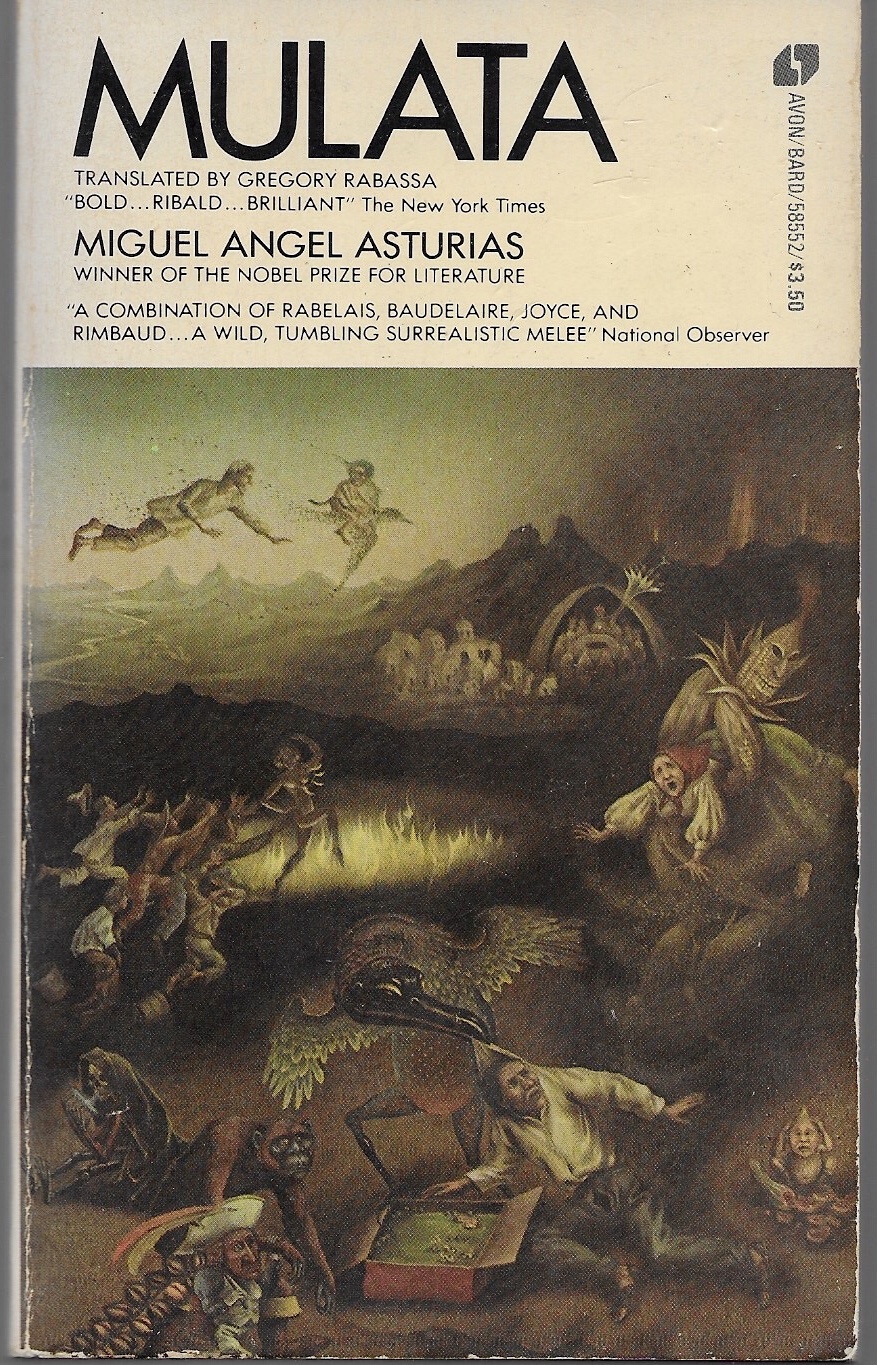
Mulata by Miguel Ángel Asturias; English trans. by Gregory Rabassa. 1982 mass market paperback from Avon-Bard. The Boschian cover art isn’t credited; neither is the designer credited, although my assumption is that it is Sidney Feinberg, who is credited as designer on Avon-Bard’s edition of Gabriel García Márquez’s novel In Evil Hour.

2019-12-08_113541

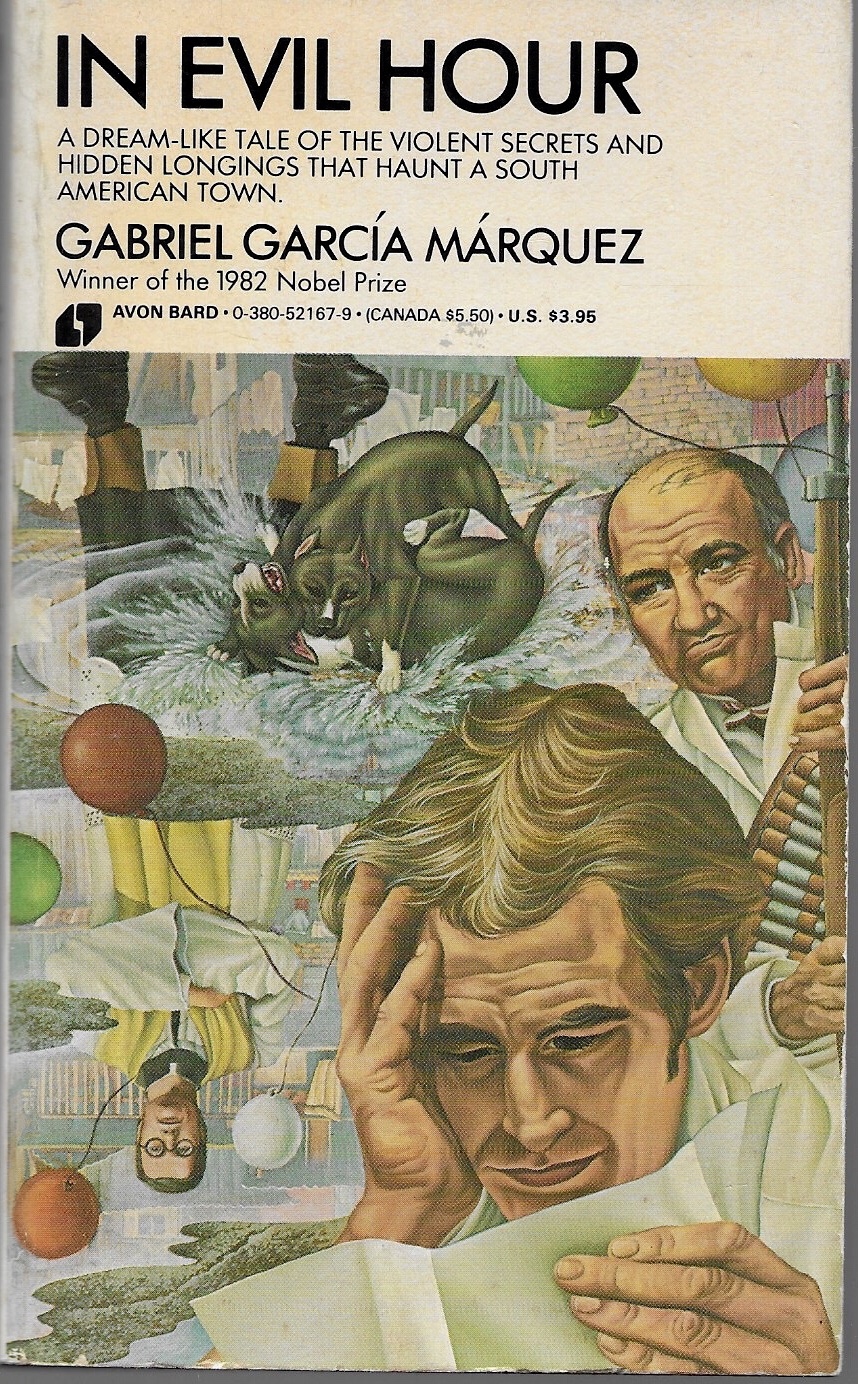
In Evil Hour by Gabriel García Márquez; English trans. by Gregory Rabassa. 1980 mass market paperback from Avon-Bard. The cover artist is not credited; book design by Sidney Feinberg,

2019-12-08_113541_1

The Ex-Magician and Other Stories by Murilo Rubião; English trans. by Thomas Colchie.  1984 mass market paperback from Avon-Bard. No cover artist or designer is credited, but my hunch is the design is by Sidney Feinberg.

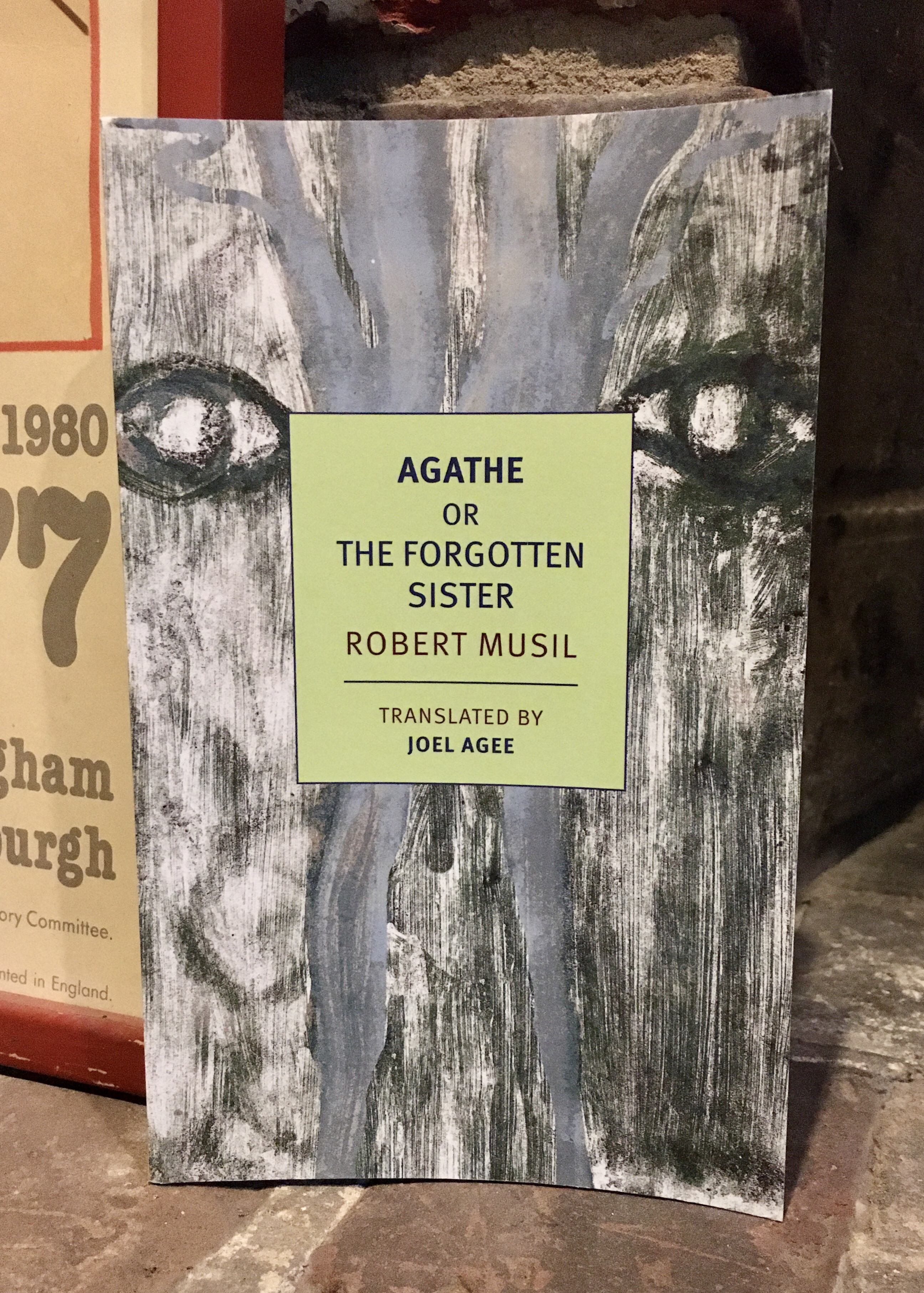
Robert Musil’s Agathe, or The Forgotten Sister (Book acquired like probably the last week of November 2019)

img_4474

In his introduction to Robert Musil’s Agathe, or The Forgotten Sister, NYRB editor Edwin Frank writes that,

Essay, in this quintessentially essayistic novel, is the mode for depicting a mind so active that it nearly constitutes a character independent of the man whose mind it is. That man is a thirty-two-year-old Austrian mathematician known to the reader only by his first name, Ulrich, who, disillusioned in his quest for intellectual glory after reading a newspaper about a racehorse of genius, decides to take a year-long ‘vacation from life,’ which he conceives of as an experiment in pure philosophic contemplation — ‘living essayistically,’ he calls it — in the hope of perhaps, by that pathless route, discovering an occupation better suited to his abilities. If he does not find it within a year, he will put an end to his life, because, to his fanatically logical and consequent mind, an unjustified life is not worth living.

I’ll confess I’ve never read Musil, despite two lukewarm milquetoast attempts, but I liked Frank’s introduction. Seems like I need to read The Man without Qualities before this. Here’s the NYRB blurb:

Agathe is the sister of Ulrich, the restless and elusive “man without qualities” at the center of Robert Musil’s great, unfinished novel of the same name. For years Agathe and Ulrich have ignored each other, but when brother and sister find themselves reunited over the bier of their dead father, they are electrified. Each is the other’s spitting image, and Agathe, who has just separated from her husband, is even more defiant and inquiring than Ulrich. Beginning with a series of increasingly intense “holy conversations,” the two gradually enlarge the boundaries of sexuality, sensuality, identity, and understanding in pursuit of a new, true form of being that they are seeking to discover.

Robert Musil’s The Man Without Qualities is perhaps the most profoundly exploratory and unsettling masterpiece of twentieth-century fiction. Agathe; or, The Forgotten Sister reveals with new clarity a particular dimension of this multidimensional book—the dimension that meant the most to Musil himself and that inspired some of his most searching writing. The outstanding translator Joel Agee captures the acuity, audacity, and unsettling poetry of a book that is meant to be nothing short of life-changing.

Agathe’s English translation is by Joel Agee.

A review of Alfred Döblin’s turbulent, encyclopedic riot of a novel, Berlin Alexanderplatz

2019-10-06_172844

“Unbe-fucking-lievable,” interjects the ominvalent narrator of Alfred Döblin’s 1929 novel  Berlin Alexanderplatz at one point. I’m not sure if the original German (Ist gar nicht zu glauben) conveys the amazed profanity here in Michael Hofmann’s 2018 translation, but “Unbe-fucking-lievable” nevertheless captures the raucous spirit and mutable form of Berlin Alexanderplatz. The novel is a polyglossic spree, an encyclopedic riot, a tragicomic masterpiece of syntax and diction, chopped and screwed, twisted and turned.

What is it about?

The first italicized page summarizes the entire novel in nine neat paragraphs, beginning with this one:

The subject of this book is the life of the former cement worker and haulier Franz Biberkopf in Berlin. As our story begins, he has just been released from prison, where he did time for some stupid stuff; now he is back in Berlin, determined to go straight.

For further clarification: It is the 1920s in Berlin, that slim decadent wedge between those two big wars, and the Weimar capital buzzes with working-class resentment and political unrest. (And drinking. Lots and lots of drinking.)

We soon find out the “stupid stuff” Biberkopf did that landed his ass in jail, and find that the stuff wasn’t so much stupid as stupid and horrific. But by the time we’ve discovered the crimes of Biberkopf, it’s too late: the narrator’s got his sharp teeth sunk into the bit of our brain that pumps sympathy for the supposed hero of the story.

But again: What is it about?

Well:

Biberkopf tries to play it straight, but life on the Alexanderplatz and its seedy environs ain’t easy. He slings newspapers, mixes it up with communists and Nazis alike, and tries to keep his nose clean. But, this being a picaresque tale, he falls in with old associates, falls into old petty crimes, and eventually loses his arm. (Like, literally.) He takes to pimping, thinking it easy, but pimping presents its own problems. There’s love, lust, murder, and betrayal. (And drinking. Lots and lots of drinking.)

What is it about? is not really the right question for Berlin Alexanderplatz. Instead: What is it?

Berlin Alexanderplatz is a literary montage, a vicious collage, an explosion of colors, a carnival of noise and chaos and entropy, told by a narrator who occasionally tries to sort the pieces out for the reader, but usually is more content to drop a metaphorical bomb on us and then spend a dozen or so pages explaining how the bomb got there and who planted it and why the saboteur was so hellbent on destruction in the first place.

Our narrator is a ventriloquist, popping into the consciousnesses and throats of characters major, minor, and peripheral (at best) alike. There’s a cinematic orality to the novel, a shuffling, skipping, vamping voiceyness to Döblin’s prose that Hofmann’s translation renders as a kind of cackling cockney English. It sparks and hoots and howls.

Döblin’s narrator might wander around in Biberkopf’s brain, and then end up in the voice of his girlfriend Mitzi (whom he pimps), or his friend and enemy Reinhold, or just some random cafe sitter or beer drinker at a bar. Döblin’s camera goes anywhere it likes; indeed, Berlin Alexanderplatz is crammed with flights into history, mythology, books of the Bible, math, industry, science. A riff on the First Newtonian Law? Sure. A lengthy treatise on industrial pork butchery? Why not. A retelling of the Book of Job? Of course. Ever wondered why berries sweeten in the cold of winter? Let Döblin’s narrator explain the relationship of temperature, starch, and sugar for you. 

Berlin Alexanderplatz is voluminous, exhausting, exhaustive, ecstatic. Döblin’s narrator grabs a hold of a subject, picks at it, puts it down, picks up later. Sometimes these threads coalesce (the Books of Job and Ecclesiastes became refrains); other riffs seem to be included for no reason other than Döblin’s narrator finds them interesting. He gleefully steals from newspapers, injecting the narrative with tangential-at-best stories of the day: murders and plane crashes and invasions and assassination attempts and failures and successes and crimes, large and small. Döblin’s novel aims to be about everything, about both the small and the big worlds his petty criminal antihero Franz Biberkopf is a citizen of. 

With its voracious, swirling, omnidirectional scope and undulating stylistic turns, Berlin Alexanderplatz readily recalls James Joyce’s big book Ulysses. Döblin’s novel seems less beholden to a series of correspondences than Joyce’s, however—it’s freer, more anarchic really, roiling around in its own entropy. Both novels are bawdy, smart, and very funny of course. With its celebratory attention to Berlin’s seedier side, Berlin Alexanderplatz also recalls the paintings of Otto Dix, Rudolf Schlichter, and George Grosz (whose 1919 painting Panorama adorns the cover of my NYRB edition). There are also notes of Kubrick here—there’s something of both A Clockwork Orange and Barry Lyndon to Berlin Alexanderplatz: the former’s energetic, horrific violence and pastiche-slang; the latter’s ironic and affecting treatment of the traditional bildungsroman. Döblin’s technique of stealing freely from newspapers also reminds me of Félix Fénéon’s Novels in Three Lines, as well as Doris Lessing’s The Golden Notebook, and segments of William Gaddis’s JR and The Recognitions. (All of these work belong in what the protagonist of William Gass’s novel Middle C dubbed “The Inhumanity Museum.”)

General comparisons of other works to Döblin’s great big fat novel don’t really do Berlin Alexanderplatz justice of course. There is simply no substitute for reading it. It is a novel about itself; it is a novel that one doesn’t so much read for plot (or worse, to learn something); rather, it is a novel that produces waves of feelings, confusions, problems in its reader. It is a novel packed with grotesquerie and excess, yes, and the turbulent humor does not leaven the novel’s core meanness. Berlin Alexanderplatz’s spine is a spike of ice, but lots of wonderful juicy rich fat hangs from that icy spine.

And through its meanness, the novel pushes its hero to a strange redemption of sorts, announced on the novel’s very first page: “The terrible thing that was his life acquires a purpose.”

And do I spoil the final line?

Why not: “We know what we know, we had to pay dearly enough for it.”

I did not pay dearly for Berlin Alexanderplatz, either in my money or in my time. I was rewarded. Very highly recommended.

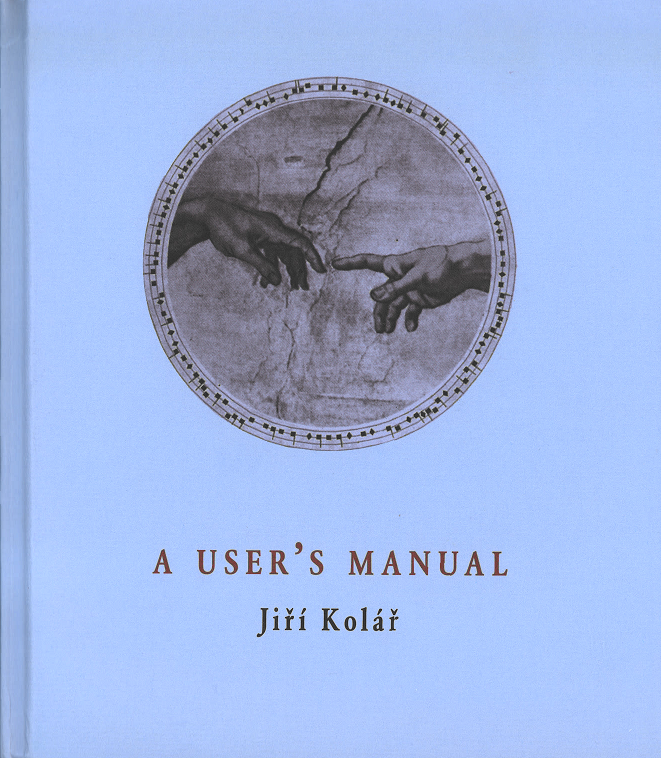
Jiří Kolář’s A User’s Manual (Book acquired, some time in late October)

z

I’ve been slowly enjoying the poems and collages that comprise Jiří Kolář’s collection A User’s Manual (in English translation by Ryan Scott). There are 52 poems and collages here. Each poem is a kind of surrealist recipe, a set of commands that I’ve been trying to follow (in my imagination, I mean).

Capturea

The book itself is beautiful—hardback with full color and black and white illustrations, it fits perfectly with the aesthetic that its publisher Twisted Spoon has been developing for ages now.

Capture

Here’s Twisted Spoon’s blurb:

Written in the 1950s and ’60s, the “action poems” comprising a A User’s Manual were published in their complete form in 1969 when they were paired with the 52 collages of Weekly 1967, the first of Kolář’s celebrated series in which he commented visually on a major event for each week of
the year. Taking the form of directives, largely absurd, the poems mock communist society’s officialese while offering readers an opportunity to create their own poetics by performing the given directions. The collages on the facing pages to the poems are composed of layered documents, image cutouts, newspaper clippings, announcements, letter fragments, reports, or decontextualized words, oftentimes forming concrete patterns or the outlines of figures, to create a sort of “evidential” report on the year. Text and image taken together, the volume displays Kolář’s enduring interest in extracting poetry from the mundane to demolish the barrier separating art from reality, or even to elevate reality itself through this dual poetics to the level of art. What art historian Arsén Pohribný wrote about Weekly 1968 equally applies to Weekly 1967: it “shocks with its abrupt stylistic twists” and is “a Babylonian, hybrid parable of multi-reality.” The volume also includes the complete Czech text as an appendix.

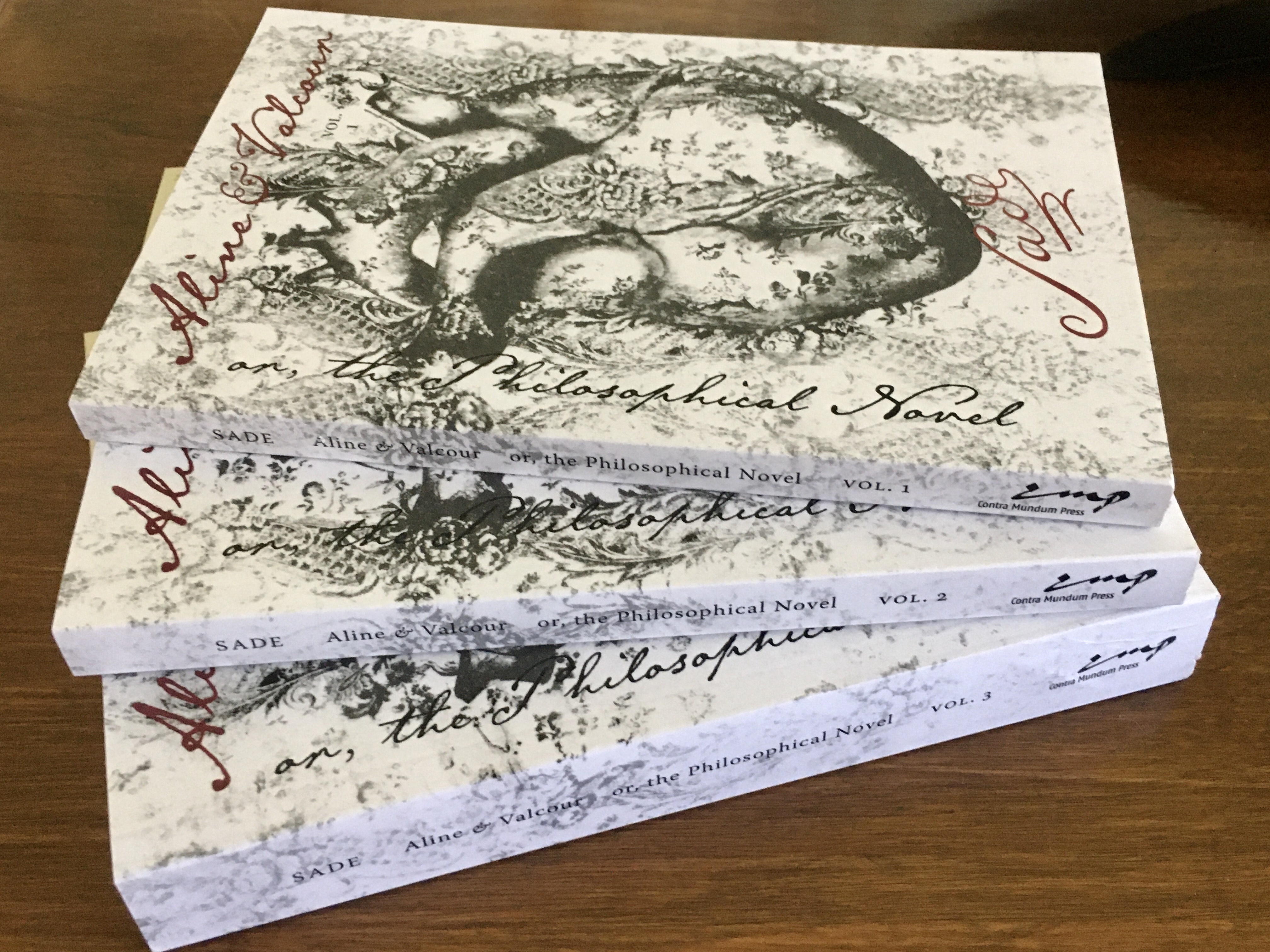
The Marquis de Sade’s Aline and Valcour, or, the Philosophical Novel (Books acquired some time last week)

img_4167

Later this year, indie publisher Contra Mundum Press is releasing a three-volume English translation of the Marquis de Sade’s 1795 epistolary novel Aline and Valcour. The translation is by John Galbraith Simmons and Jocelyne Geneviève Barque.

It looks pretty wild. Here’s Conta Mundum’s blurb:

Set against the impending riptide of the French Revolution and composed while Sade was imprisoned in the Bastille, Aline and Valcour embodies the multiple themes that would become the hallmark of his far more sulfurous works.

This epistolary work combines genres, interweaving the adventure story with the libertine novel and the novel of feelings to create a compelling, unitary tale. Turbulence disrupts virtuous lives when corrupt schemers work incestuous designs upon them that don’t stop with abduction and seduction — as crime imposes tragic obstacles to love and delivers harsh threats to morality and religion.

Embedded within Aline and Valcour are sojourns in unknown lands in Africa and the South Seas: Butua, a cannibalistic dystopia, and Tamoé, a utopian paradise headed by a philosopher-king. In Butua, a lustful chief and callous priesthood rule over a doomed people, with atrocious crimes committed in broad daylight, while in Tamoé happiness and prosperity reign amidst benevolent anarchy.

Although not sexually explicit, Aline and Valcour shared the fate of Sade’s other novels — banned in 1815 and later classified a prohibited work by the French government. Published clandestinely, it did not appear in bookstores until after WWII. Continuously in print in France ever since, today it occupies the first volume of the Pléiade edition of the author’s collected works.

This is the very first rendering of the book into English since its publication in 1795.