On Movie Tie-in Covers

Is there anything worse than a beloved book sporting a movie tie-in cover? (Okay. Maybe Oprah’s blazon is worse).

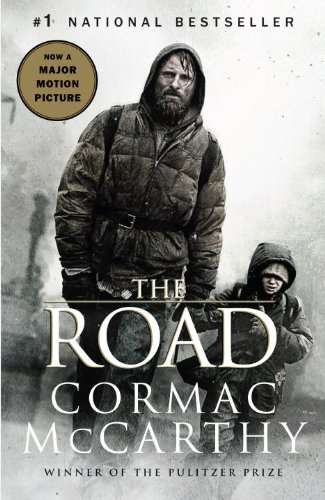
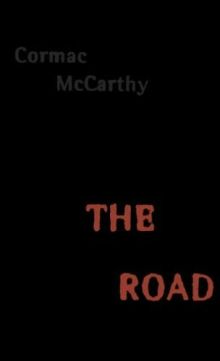
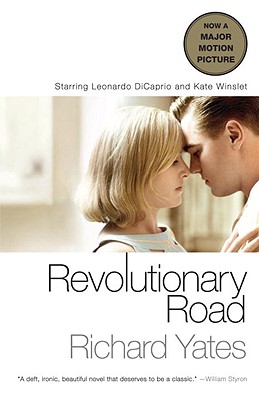
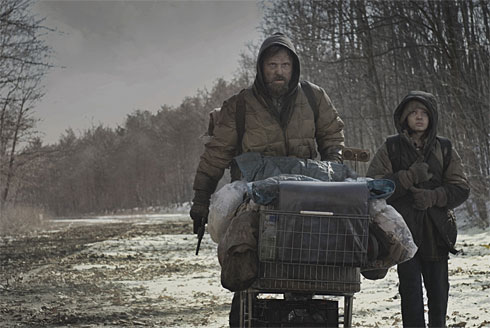
It’s not like the original cover was that great, or that the movie was that bad, but the whole enterprise of slapping grim Viggo Mortensen all over Cormac McCarthy’s The Road doesn’t seem to make much sense (maybe they didn’t realize that the film was going to flop and hoped that it would re-energize book sales). It seems like a slight to any reader new to the book. The austere original cover omits all imagery and thus places McCarthy’s language front and center. Movie tie-ins tend to plaster major Hollywood actors all over the cover, making it difficult for readers to re-frame or re-image the characters that those actors are playing–it’s an egregious intrusion between the writer’s text and the reader. It disrupts visualization. It also tends to look tacky, even when it’s “classy.” Take for example this cover for Richard Yates’s novel Revolutionary Road

I’ve never read the novel, although I’ve often heard it referred to as an under-read or “lost” classic (the film promos made it look dreadfully boring, but there is probably nothing more unfair than judging a book by its movie). Spying its spine, I picked the book up the other day at the bookstore but could not even flick through it. All I could see was Leo and Kate. Then there’s that Big Gold Sticker procliaimng the work is “Now A Major Motion Picture.” The statement, emboldened in all-caps seems set apart in its little golden sphere, but oddly enough there’s a clause that must logically follow it — “Starring Leonardo DiCaprio and Kate Winslet.” The aesthetic logic of the cover though seems to suggest, however ludicrous, that DiCaprio and Winslet actually star in the book. Were I to attempt to read this edition of the book my poor imagination, weakened by years of watery domestic beer and bad television, would not be able to surmount the challenge posed by the cover. Each time I dipped into its pages, surely Yates’s prose, no matter how descriptive or visceral or imagistic, must fall to the glamor of Leo and Kate.

Maybe it’s just me though–I can remember having this problem even in childhood, absolutely hating to read any book that proffered a photograph of a person, especially an actor, masquerading as a character that my imagination was supposed to bring to life. For some reason paintings and other stylized images didn’t –and don’t — offend me in this way.

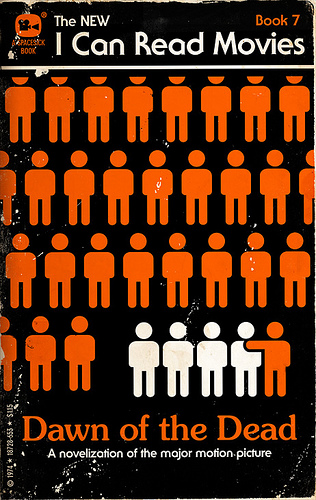
I suppose that movie tie-in covers help sell books and, ultimately, that’s a good thing, but I can’t think of a single one I’ve ever seen that’s aesthetically pleasing. I’m reminded now of Spacesick’s “I Can Read Movies” Series, which achieves the opposite, turning movies into witty, wonderful book covers. Observe:

“Apocalypse Needs A Breather” — China Miéville Riffs on Hillcoat’s Adaptation of The Road

One of Biblioklept’s favorite weirdos, China Miéville takes on a perceived overabundance of apocalypse movies in his article “The End, The End, The End, Etcetera” published in McSweeney’s #33, aka The Panaroma, aka the giant-assed newspaper issue (here’s a quick review: Jeesy Creezy the thing is massive. It’s like a bizarre aesthetic tchtochke that just happens to be overstuffed with all kinds of great writers writing on all kinds of great stuff. I’ve been trying to digest it on Sundays after breakfast with a few coffees but it’s too big. It’s really too much, and it’s also the sort of document that should tell McSweeney’s-haters to fuck off, or at least reveal them as kinda mean-spirited. It’s like a strange, thorough dream, where Stephen King writes your sports section and William Vollman does in-depth national reporting and Chris Ware handles the comics page. Hang on–that’s probably not a legit review. Anyway).

So Miéville basically tells Hollywood to give it a rest with all the apocalypse movies, saying that it’s not that he doesn’t love them, it’s just that there’s such a surplus as of late. “Hollywood has studied at porn’s knee,” he writes, arguing that end-of-the-world flicks like Armegeddon, The Day After Tomorrow, 2012, Wall-E, 9, The Book of Eli and Deep Impact are “sexual fantasies . . . These apocalyptes are clearly scratching various itches.” Miéville dubs the trend in disaster flicks “bukkakalypse,” arguing that these films are “obsessed not only with the world-drenching spurt itself, but with the Face of the Earth wet with its effects, stoically putting up with the soaking.” Charming. +100 internets to any soul daring enough to google “bukkakalypse.”

Miéville focuses the thrust of his article on John Hillcoat’s film adaptation of Cormac McCarthy’s novel The Road. His shorthand review kinda sorta captures my own ambivalence about the film: “Is The Road a good film? Sure. Maybe. Whatever. It depends on what you mean by ‘good.'” Miéville suggests that, “For all its portent, The Road displays a preemptive nostalgia perhaps even more pronounced than in its pulpier cousins.” Citing the father and the boy’s use of a consumerist emblem, the shopping cart, to move on and “carry the fire,” Miéville goes on to argue that,

The film, then, is structured around a punning triptych. There’s that good, lost consumption early on [the loss of a consumerist world]. Then, in the absence of commodity, there’s the terrible, Hobbesian predatory consumption of cannibalism, relentlessly stressed as an ultimate evil, rather than the relatively everyday sordidness it would almost certainly become. And refuse to eat each other? What then? Then the final iteration of the term. The father at last doubles up, coughing bronchially, and hawks up blood. In that shopless nightmare, what else is afflicting him but consumption.

Puns! Okay. As a committed Marxist or materialist (or whatever he is), of course Miéville’s gonna read The Road as an allegory of apocalypse as loss of consumerist possibility (he reads the whole Coca-Cola-drinking episode as a version of lost sacrament). Fair analysis, I guess–not one I particularly buy, but without getting into a whole ball of wax over the intentional fallacy and whatnot, I think that Miéville’s criticism that the film (and book) doesn’t recognize the Darwinian endgame of “Hobbesian predatory consumption” as “the relatively everyday sordidness it would almost certainly become” kinda sorta misses the whole point of the narrative. In my own review of the book, I argued that McCarthy’s refusal to give into the infanticide that the novel’s schema overwhelmingly predicated was hard to swallow (“cop out,” I believe, was my term), but it also seems to me that the moral impetus of the novel involves a refusal of cannibalism, an idea that to survive as a human is more than just to survive as a body. But back to film.

I didn’t particularly care for Hillcoat’s version of The Road, even though I wanted to, even though the actors were great, even though it looked great, etc. I don’t know what I didn’t like about it (okay, I thought Nick Cave’s score was both awful and intrusive, but that seems minor here). It just seemed thoroughly unnecessary and ultimately unfun. Miéville again, this time on an end-of-the-world film I can’t help but love:

The “hope” at the end of Mad Max: Beyond the Thunderdome is that the lost tribes have managed to turn on a few lights in Sydney. Such hankering for drab normality doesn’t have to be particularly convincing to do its rhetorical job. Just as well, really, because seriously? After all the splendidly coiffed and colorful shenanigans of Tina Turner’s Bartertown, is living in a partially revived Bondi really an improvement? Couldn’t we take everything in a different direction altogether? Do something new? The aspirational Good Futures of these Bad Futures are always their pasts–our present.

Although Miéville gives The Road the credit it deserves for being one of the rare apocalypse flicks that “evades this pre-post-facto nostalgia,” he also reiterates my own criticism: it’s just not that fun. And the end of the world should be fun. Miéville doesn’t mention films like Zombieland, a forgettable but enjoyable farce that posits apocalypse as freewheelin’ opportunity, or the self-aware (but not too-self-aware) pastiche Doomsday, a film that fuses every hoary apocalypse trope into 90 minutes of escapist, ass-kicking, thoroughly nonsensical fun. Neither film aspires to great art (unlike Hillcoat’s take on The Road), nor do these films aim for the catharsis-via-annihilation of blockbuster fare like Armegeddon. They’re just good fun, which is all I really want from the end of the world.

Book vs Film

The AV Club’s fun little inventory of literary works that should never be adapted to film again got us to thinking about that age old question — book vs. film. Common wisdom holds that “the book is always better than the film,” with any number of examples as evidence. Some of the works cited on the AV Club’s list are novels that can’t really be translated to film, at least not in philosophical essence (Moby-Dick, for example, and Nabokov’s Lolita, a film that for reasons social and legal, can never be made properly).

Our own observation, or rule of thumb, is that, while canonical “high” literature rarely makes for masterpiece filmmaking, genre fare–done right–can make classic films. In Francis Ford Coppola’s hands, Mario Puzo’s airport bookstore pickup The Godfather became two of the greatest films of all time. Look at what Stephen Spielberg did for Peter Benchley’s beach read Jaws, or what Kubrick did for Stephen King’s pulp horror The Shining. In more recent times, Alfonso Cuarón turned P.D. James’s capable thriller Children of Men into cinematic gold, but, tellingly, stumbled in adapting the Charles Dickens classic Great Expectations. Terrence Malick turned James Jones’s war novel The Thin Red Line into cinematic art and Martin Scorsese spun Goodfellas from Nicholas Pileggi’s Wiseguy–hardly Shakespeare. Danny Boyle has made a career of turning lesser works by writers like Alex Garland and Irvine Welsh into fantastic films.

Very few films present a tough choice, really–we’re still not sure if the Coens’ adaptation of Cormac McCarthy’s No Country for Old Men is better than the book, but it might be. Gary Sinise’s measured take on John Steinbeck’s Of Mice and Men gets just about everything right. Heck, Harold Bloom has even argued quite publicly that John Huston’s version of The Grapes of Wrath is superior to Steinbeck’s. We’re not sure about that one either. Suffice to say that they’re different; that watching a film is not the same as reading a book, nor should it be. We close by saying that we’d love to see Chris Adrian’s The Children’s Hospital adapted to film, preferably by someone awesome like David Lynch or Cuarón, and that, as Sam Peckinpah is long dead, no one should try to adapt Cormac McCarthy’s Blood Meridian.

When Lynch Met Lucas

What if David Lynch had directed Return of the Jedi? Oh the possibilities… YouTube user sciezata77 (I’d love to credit her/his real name) has made a really cool little film using only an iPhone and Lynch’s original audio, detailing Lynch’s meeting with George Lucas. Best line: “We went to a restaurant . . . not that I don’t like salad, but that’s all they had, was salad.”

Bright Star — Campion Does Keats

So I finally got around to watching Jane Campion’s Bright Star last night, a film that quietly studies the final years of Romantic poet John Keats and his relationship with Fanny Brawne. When Keats moves next door to the Brawnes, eldest daughter Fanny, a talented seamstress and flighty flirt, soon becomes intrigued by the poet. Keats, with his love for beauty and truth, represents a world of greater depth than the wits and dandies who usually attempt to court Brawne. Their relationship is, of course, doomed from the outset. Perpetually broke Keats doesn’t have the moolah or means to properly engage Brawne in marriage, but that doesn’t stop the pair from undertaking a furtive, pensive love affair, carried out in long walks on the heath and passionate letters. Oh, and Keats gets sick and dies at 25. That shouldn’t be a spoiler if you’ve studied your Romantics properly, now should it?

Both Abbie Cornish who plays Brawne and Ben Whishaw who plays Keats are excellent in their understatement and reserve, but the standout turn in the movie comes from actor Paul Schneider (from NBC’s Parks & Recreation) who plays Keats’s bankrolling friend Charles Armitage Brown. Brown is a lesser poet whose love and envy of Keats leads him to vex Brawne and Keats’s love at every turn, plaguing them with doubt, and that enemy of Romance, Reason. Schneider invests his character with a boorish charm that never veers into the rote tropes that afflict modern romance film. It’s emblematic of the Campion’s film in a way: Bright Star has every opportunity to devolve into a mundane exercise in doomed romance or a stuffy period piece, but under Campion’s delicate care it manages to match the depth of its subject matter.

Campion wrote the screenplay, presumably using letters from the principals as her primary source. She honors her viewers’ intelligence — far too rare these days — by never cobbling her plot together with easy exposition or forced narrative developments, and it’s that sense of history that lends the film authenticity. Cornish’s Brawne is a protagonist whose personality transformations read as real, and Whishaw’s Keats is never a cartoonish mystic or a moody caricature, but a fully-drawn human. Campion also has the good judgment to let her cinematography convey her story, letting gorgeous shots of the English countryside and cloistered chambers alike convey the mood and rhythm of her story. At times, Bright Star‘s beautiful camerawork recalls Terrence Malick, another director who allows film to “happen” to the viewer as an evocative experience rather than a spoon-feeding. Campion also shows considerable restraint with the film’s wonderful score, never allowing it to color a scene unduly when her actors can do a great job on their own. Bright Star avoids all of the pitfalls that might afflict a period piece, and does a far better job handling the subject of Romantic poetry than a movie has any right to. The film is hardly for everyone (sorry guys, no Jason Statham), but it’s very, very good. Recommended.

David Peace’s Red Riding Film Adaptations Debut in the US

The film adaptations of David Peace‘s Red Riding quartet make their American debut this weekend. The films look pretty cool — kinda like Zodiac. The screen adaptations drop the 1977 segment of Peace’s original quartet, opting instead for the trilogy treatment. You can read Manohla Dargis’s detailed review for The New York Times here and Keith Phipps favorable review at the AV Club here. Trailer:

Sandokan — Nanni Balestrini

Nanni Balestrini’s novella Sandokan, new in English translation from Melville House, tells the story of the rise of the Camorra crime syndicate in the small, poverty-stricken cities around Naples. Balestrini’s unnamed narrator occupies a fascinating insider-outsider perspective: one one hand, he, unlike many of his peers, does not join the gang, or “clan,” as its called–in fact, their behavior repulses him. On the other hand, he’s a native of the small town where Francesco Schiavone (aka Sandokan), Antonio Bardellino, and their henchman rule mercilessly, an eye-witness to the brutality and inhumanity of organized crime. The narrator is a sensitive young man who delineates clearly how the crime cartel was able to achieve such economic prosperity and power in the 70s, 80s, and 90s, detailing the various rackets the clan imposed upon the town, like stealing elections, peddling drugs, and manipulating the agribusiness that is the main source of income for average Neapolitan peasants. The narrator also explores why these small towns fall so easily into the terror of organized crime. The main reason: boredom stemming from little or nothing to do.

Balestrini’s narrator’s description of the Camorra is systematic, detailing the awful history and brutal practices of the syndicate in spare, concrete terms. His explications of the clan’s violence is not so much thrilling as  it is ugly, as the narrator always shows how “normal people” (his words) are cheated, killed, or otherwise harmed by the Camorra. The narrator’s tone is often journalistic but never clinical; he always shows what’s at stake for the “normal people,” how they are affected by these crimes. At times the narrator is wryly funny, a tone that results in large part from his observation that the townspeople, the people he grew up around, begin to normalize the violence. It becomes part of their daily lives and affects them so directly that it becomes casual, and the sensitive narrator is one of only a few not to bow to it, ignore it, or take part in it–yet the violence and crime is so overwhelming that to live with it is to live with absurdity. Balestrini employs a punctuation-free rhetorical style in Sandokan that captures the breathless energy and frustration of the narrator. While many readers might balk at the lack of commas, periods, or semi-colons, I found the technique quite liberating. It enhances the immediacy of the narrator’s voice, the rushed sense of importance to his tale. It also promotes sustained readings of the text–I read most of Sandokan in three enthralled sittings.

Sandokan has its cinematic twin in the 2008 film Gomorra, directed by Matteo Garrone. The film, like the book, illustrates the affect that crime has on a range of “normal people,” mostly occupants of a housing project outside of Naples. As in Sandokan, the ordinary citizens find that they have no choice but to choose between sides as an absurd, petty gang war ravages their already decimated landscape. Where Balestrini’s punctuation-free rhetoric allows readers closer access to his narrator’s pathos-driven story, Garrone lets his camera wander freely over the grim landscape without ever imposing any clear narrative structure. It is not until the film’s final third that the five disparate stories he tells coalesce, and even then, it remains unclear who is on whose side. What is clear is that the violence and crime is quickly stealing–and killing–another generation.

In an age where violence is sensationalized and glamorized, particularly in gangster films and TV shows (do I really need to list them?), Sandokan and Gomorra both lay bare the Darwinian cost of crime. In both narratives, the violence is mundane and inescapable, meaningless yet awful, and very, very dark. Neither narrative is didactic in the least–or even hopeful, for that matter–but their is an implicit suggestion that if only there were some alternative to the Camorra–libraries, social clubs, movie houses–there might be another prospect for the young people in this area.

I highly recommend both Sandokan and Gomorra. As an end note, I’d love to see more of Nanni Balestrini’s work come into English translation, perhaps via Antony Shugaar and Melville House, who’ve done a lovely job here.

Best of the Aughties

So, this is Biblioklept’s 500th post [pauses for applause].

Thank you, thank you. To mark the special occasion, we’ve artfully and scientifically compiled a list of the best stuff of the aughties (or 2000s, or whatever you want to call this decade that’s ending so soon). We know the year’s not over yet, and we readily admit that our list is incomplete: we didn’t read every book published in the decade, listen to every record, watch every film, etc. So, feel free to drop a line and let us know who we forgot (or, perhaps, snubbed).

Here, in no particular order, is the best of the past decade:

Picture 1

Roberto Bolaño’s 2666, Children of Men, The Fiery Furnaces, The Wire, Kill Bill, Sen to Chihiro no Kamikushi (Spirited Away), The Believer, Peter Jackson’s The Lord of the Rings trilogy, Beyoncé’s “Single Ladies” (and its marvelous video), David Foster Wallaces’s essays in Consider the Lobster, Denis Johnson’s Tree of Smoke, Animal Collective, Barack Obama, Terrence Malick’s The New World, Mad Men, Deadwood, Dave Chappelle, Curb Your Enthusiasm, Mitch Hedberg, R. Kelly, YouTube, Drag City Records, Cormac McCarthy’s The Road, Nathan Rabin’s “My Year of Flops,”

Picture 2

Chris Adrian’s The Children’s Hospital, Extras, Harry Potter on Extras, Dave Eggers’s A Heartbreaking Work of Staggering Genius, Missy Elliott’s “Get Ur Freak On,” Wong Kar-wai’s In the Mood for Love, Pixar movies–especially the latest three: WALL-E, Up, and Ratatouille, McSweeney’s #13 (the Chris Ware Issue), Jimmy Corrigan, the Smartest Kid on Earth, that time the Shins were on Gilmore Girls, the first six episodes of The OC, Arrested Development, Nintendo Wii, Andre 3000’s “Hey Ya!,” The Office, Will Ferrell, Bob Dylan’s Theme Time Radio Hour, Picador Books, Donnie Darko,

Picture 3

Veronica Mars, The Venture Brothers, Home Movies, the third Harry Potter movie, Wikipedia, Bob Dylan’s Chronicles, Jonathan Lethem’s The Fortress of Solitude, DFW’s Oblivion, especially “The Suffering Channel,” Wallace’s 2005 Kenyon commencement address, Wonder Showzen, Toni Morrison’s A Mercy, the totally goofy but totally fun troubadour sequence from Gilmore Girls with Yo La Tengo, Thurston, Kim, and daughter Coco Haley, and Sparks jamming, OutKast’s Stankonia, Pan’s Labyrinth, The Devil’s Backbone, The Orphanage, Cat Power’s “Willie Deadwilder,”Flight of the Conchords, Girl Talk’s Night Ripper, The Daily Show with John Stewart, The Colbert Report,

Picture 4

Andy Samberg’s Digital Shorts, Autotune the News, Tim Tebow, Panda Bear’s Person Pitch, Nels Cline’s guitar solo in “Impossible Germany,” Judd Apatow, Be Kind Rewind, Eternal Sunshine of the Spotless Mind, Thrill Jockey Records, I Heart Huckabees, Chris Bachelder’s U.S.!, David Lynch’s INLAND EMPIRE, Fennesz’s Endless Summer, Gmail, the Coens’ No Country for Old Men, MF Doom (all iterations), Broken Social Scene’s You Forgot It in People, Satrapi’s Persepolis, UGK’s “International Player’s Anthem,” Bob Dylan’s “Things Have Changed,” Bonnie “Prince” Billy,

Picture 5

The Silver Jews’ Tanglewood Numbers, lolcatz, Once, Lynch’s Mulholland Drive, the Coens’ O Brother, Where Art Thou?, web two point oh, 30 Rock, Belle & Sebastian’s “Stay Loose,” It’s Always Sunny in Philadelphia, Philip Pullman’s The Amber Spyglass, Werner Herzog’s Grizzly Man, WordPress, Jim O’Rourke’s Insignificance, the first season of Battlestar Galactica, Superbad, half a dozen or so short stories by Wells Tower, David Cross’s Shut Up, You Fucking Baby!, Drunk History, the action sequence at the end of Tarantino’s Death Proof (and especially the joyous, headcrushing final shot), Slavoj Žižek’s Violence, The Royal Tennenbaums, the first 20 minutes of Gangs of New York,

Picture 7

Firefox, the increasing and continuing availability of English translations of authors like Roberto Bolaño and W.G. Sebald, Bill Murray, Margot at the Wedding, Rachel Getting Married, Top Chef, The Dirty Projector’s Bitte Orca, Battles’ “Atlas,” Revenge of the Sith, Sarah Vowell, Art Spiegelman’s In the Shadow of No Towers, Christoph Waltz’s bravura performance in Inglourious Basterds, the surreal animations of Carson Mell, Margaret Atwood’s Oryx and Crake, Tina Fey’s impression of Sarah Palin, David Mazzucchelli’s Asterios Polyp, Neko Case’s “Star Witness,” Jason Statham, The Pirate Bay,  HDTV, Charles Burns’s Black Hole, &c . . .

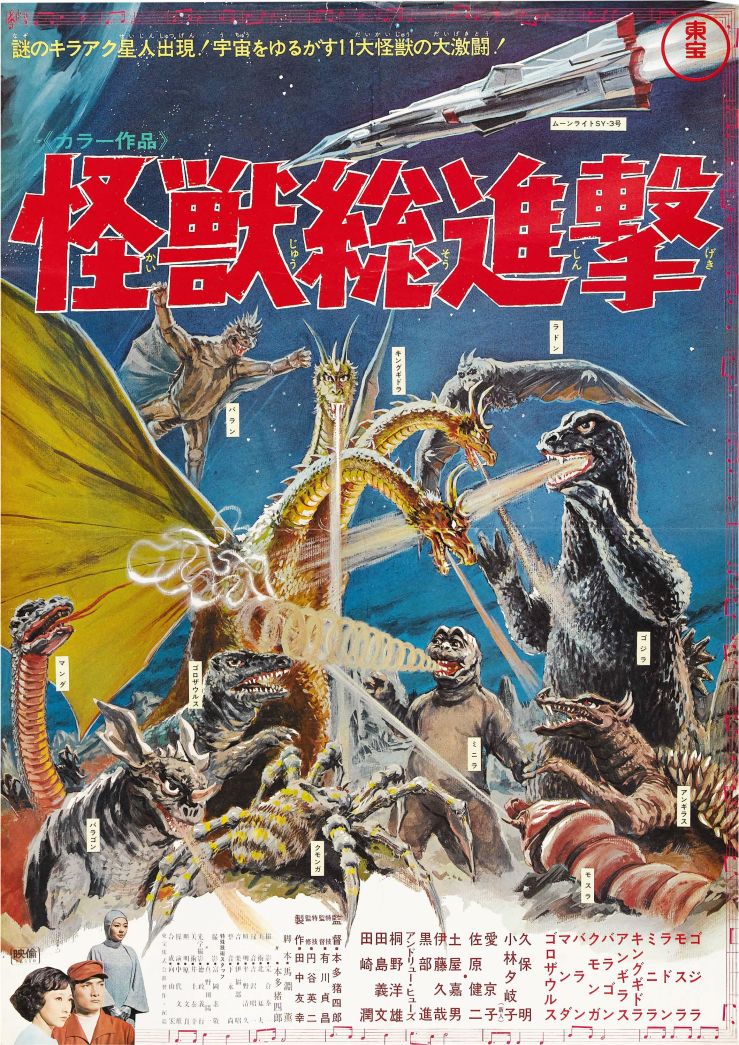
Destroy All Monsters

Wonderfully weird horror movie posters via Wrong Side of the Art‘s fantastic database.

destroy_all_monsters_poster_002
Destroy All Monsters
traveller_1979_poster_01
The Traveler
nosferatu_1979_poster_02
Nosferatu
torso_poster_01
Torso
Antropophagus
Anthropophagous


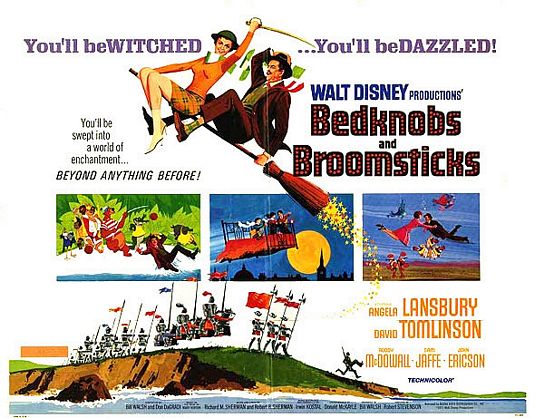
Bedknobs and Broomsticks

bedknobs_and_broomsticks_ver2

We’ve always felt that Bedknobs and Broomsticks is one of Disney’s most unfairly shunned films. This 1971 psychedelic classic combines live action with animation to tell the story of three young children billeted out during the blitz bombings of London in WWII (shades of Narnia). They’re sent to stay with Miss Price (Angela Landsbury), an amateur witch who’s none-too-pleased to take them in. They discover her (very amateurish) witchery, and blackmail her into bewitching a bed into a kind of magical transport. They set off to London, where they hook up with Professor Emelius Brown (David Tomlinson), a conman running a fake-wizarding school with a stolen spell book. The fivesome take off on a magical journey to find the other half of a spell, Substitutiary Locomotion, that Miss Price needs to make inanimate objects come alive (shades of “The Sorcerer’s Apprentice”). Their quest takes them to a number of strange places, including a lovely under-the-sea journey:

–and a soccer match with some animals:

The whole shebang climaxes (as you would expect) with a battle against Nazis:

Fun, fun, fun. An ersatz family on a magical quest, cheap, addictive songs, trippy animation, telekinesis–what’s not to love? And who can resist the metaphorical implications of a bed as a site of magical adventure? We watched this on VHS about a million times growing up. It’s far-superior to Mary Poppins, and something of a proto-Potter take on magic (okay, maybe that’s a stretch). In any case, it’s a fun family film for Halloween, and perhaps one that too-often goes overlooked. Highly recommended.

Reading Kafka and Watching Lynch Will Make You Smarter

We knew it. Reading Kafka’s The Metamorphosis and watching David Lynch’s Blue Velvet at such a young, tender age, didn’t screw us up for nothing. According to a joint study to be published this month in the journal Psychological Science, researchers Proulx and Heine have linked engaging in non-linear, non-traditional narratives with improved ability to recognize patterns. Proulx: “People feel uncomfortable when their expected associations are violated, and that creates an unconscious desire to make sense of their surroundings. That feeling of discomfort may come from a surreal story, or from contemplating their own contradictory behaviors, but either way, people want to get rid of it. So they’re motivated to learn new patterns.” Cool.

Full press release after the jump, or, just try to make sense of this clip from one of our favorite Lynch films, INLAND EMPIRE

Continue reading “Reading Kafka and Watching Lynch Will Make You Smarter”

Back To School

I think I did a similar post two years ago. I teach, I gotta go back to school, the fall, the kids, blah, blah, blah. Anyway. I’ll try to get one proper book review out per week. I’ve got seven or eight really choice looking promo copies and galleys stacked up here, including new trade paperback editions of Marilynne Robinson’s Home and Per Petterson’s To Siberia. Vintage also has a really cool original by Patrick Alexander coming out in September; it’s called Marcel Proust’s Search for Lost Time and its subtitle, A Reader’s Guide to The Remembrance of Things Past pretty much sums it up. I’ve read the first 100 pages and it’s really great, and let’s face it, unless some kinda windfall happens where I can just read books all day, I’m never gonna get around to Proust, so, yeah, this’ll have to do. Proper reviews forthcoming, blah, blah, blah. (Even though William Gaddis’s The Recognitions ain’t gettin’ no shorter).

Waltz Rulz
Waltz Rulz

While I’m doing lazy reviews, let me just say that Quentin Tarantino’s latest film, Inglourious Basterds is a glorious bastard of a mixed-up masterpiece. Christoph Waltz steals the show as SS Col. Hans Landa, but the real star, as usual, is Tarantino’s sense of cinema (whatever that means; c’mon, I was upfront, this is lazy reviewing). Plenty of folks have kinda sorta hated on (or outright hated on) this film, but I loved it. A revenge film about cinema posing as a Western faking as a WWII flick. Great stuff.

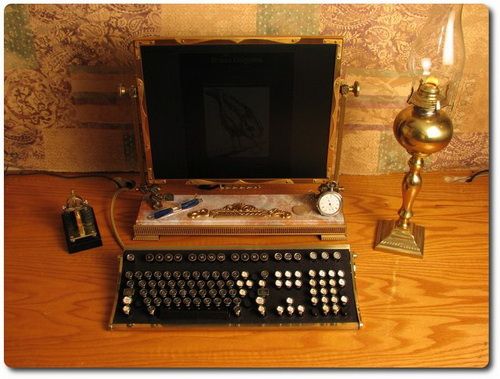
steampunk_12

The last time I did one of these hacky “Back To School” posts, I brought up William Gibson for some reason–which gives me a good transition to this excellent steampunk photoset. While Gibson’s novel The Difference Engine (with co-author Bruce Sterling) is often cited as a progenitor of steampunk, many of the images in the set correspond to ideas Gibson put forth in his “Bridge Trilogy” — he envisioned a future of “organic” computers that some of these folks have gone out and made. I’d like one. Jeez, this is really bad writing, but, hey, back to school right. Like that Deftone’s song (yeah, I know the Deftones aren’t cool or hip or whatever, and I’ve never heard one of their albums, but M2 used to play that video all the time when I was in college 10 years ago and I thought it was pretty great).Cheers.

Road House, Paul Verhoeven, Modern Action Films, and The Ironic Vision of the Viewer

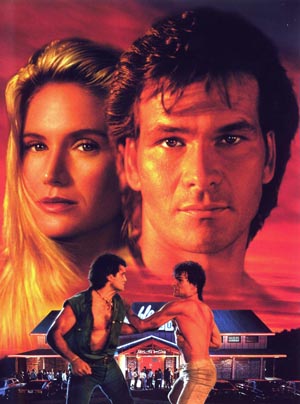
road house

Twenty years after its release, Rowdy Herring’s neo-western Road House holds up better than ever. The film stars an iconic Patrick Swayze as a philosophical cooler named Dalton hired to clean up a road house bar. In this process, Swayze’s Dalton discovers that the small town is under the thumb of the bullying gangster Brad Wesley (played with zealous malice by Ben Gazzara). Dalton cleans up, kicking ass without bothering to take names, and leaving a not-unsubstantial body count. This short plot review in no way conveys the brilliance of this film, which can’t really be captured in words–Road House must be witnessed. You have to see the rampant brawling, hear the awesome dialog (sample: “Pain don’t hurt), experience the spectacle that is Road House. That said, not everyone can appreciate what’s going on here: it merits a 5.7 out of 10 at IMDB and a 42% at Rotten Tomatoes. In short, the film is divisive. In his original review of the film, Roger Ebert wrote, “Road House exists right on the edge between the “good-bad movie” and the merely bad. I hesitate to recommend it, because so much depends on the ironic vision of the viewer.” A careful reading of Ebert’s review reveals that he really enjoyed the film. “Was it intended as a parody?” he asks. “I have no idea, but I laughed more during this movie than during any of the so-called comedies I saw during the same week.”

Ebert’s question of intentionality is instructive (if not ultimately that important). Any savvy viewer–especially those with a fine-tuned sense of “ironic vision”–will have to ask herself whether director Rowdy Herring and his crew meant to create such a sublime parody, or if the resulting masterpiece is just a happy accident. The simple answer to the question is that it doesn’t really matter, of course, but I still find it a curious issue of aesthetics, especially in light of a new breed of action films that are particularly self-aware. These include Jason Statham’s Crank films (2006 and 2009), movies that ask the viewer to suspend any rudimentary understanding of physics in exchange for ninety-minute doses of adrenaline overdrive. I’ve actually just described most Statham vehicles, but it’s the knowingness of the Crank movies that make them such a joy: part of the joke is that the film recognizes its ludicrousness. The Cranks want to make sure that the audience gets that they get that the audience is getting what the films are getting at. 2007’s Shoot ‘Em Up, starring Clive Owen and Paul Giamatti operates on the same principle. Shoot ‘Em Up is a series of action set pieces so ridiculous that the phrase “over the top” doesn’t even begin to function as a critique (during one of the film’s many, many gun battles, Owen’s character delivers a baby and then cuts the umbilical cord by shooting it). In a sense, films like Shoot ‘Em Up and Crank operate outside of any normal critique, including not just visual cues but also dialog to announce their parodic intent (Giamatti’s villain exclaims that “Violence is one of the most fun things to watch,” at one point). This isn’t to say that it’s impossible to be critical of such films (it’s very, very possible, actually), just that the films incorporate a sort of generational “ironic vision” of their audience as part of the viewing experience.

Indeed, these films count their success on the audience’s ability to “get”–and appreciate–the irony being conveyed. While action films have long used irony and meta-fictional devices as part of their vocabulary, those devices have usually been an invitation to the viewer to deepen his or her fantastical identification with the film. 1993’s Schwarzenegger vehicle The Last Action Hero is a consummate example here; in this dreadful film an action hero comes to life at the behest of a young boy who becomes a surrogate for the audience. The meta-troping here isn’t so much ironic; rather, it’s just another reification of hero-spectacle-audience dynamics. Films like Shoot ‘Em Up and Crank, in contrast, ultimately disconnect the heroic-identification most traditional action movies strive for. This isn’t to say that the audience member’s ironic vision prevents him or her from living vicariously for 90 minutes through the hero (or, more accurately, anti-hero)–it’s just that the vicarious, distorted nature of the identification is always on display. Put another way, Shoot ‘Em Up, Crank, and other movies that fit this mold (these might include Tony Scott’s unfairly maligned 2005 film Domino, 2008’s Death Race, 2007’s Smokin’ Aces, and even Robert Rodriguez’s Planet Terror (although surely that particular film is a separate discussion)) invite their audiences to both revel in and mock the conventions of heroic narrative filmmaking. These films take place entirely within scare quotes; there’s no danger that their irony might be misinterpreted. Only the most callow of viewers will not “get” the intentionality of parodic irony here (contrast Ebert’s unconfused review of Shoot ‘Em Up with his questioning of Road House; there’s not a hint of nervousness that the silliness of the latter might be unintentional). These films wink so often at the viewer that the gesture becomes a distracting nervous tic.

While I have a certain fondness for the parodic, ironic action films I’ve mentioned, I have to admit that their greatest failure is, ironically, their defining characteristic. They announce their parodic content at all times, squashing any of the anxieties about intention that a viewing of Road House engenders, and, in doing so, they lose an unqualifiable, unquantifiable joy. The greatest parodies never announce themselves as such, and thus create a contradictory balance of trust and anxiety from savvy viewers. In my estimation, no one does this better than director Paul Verhoeven, auteur behind Robocop, Starship Troopers, and Showgirls. Verhoeven’s films are doubly generous: on one hand, they function beautifully as straightforward Hollywood fare; on the other hand, with the assistance of a particular ironic vision, they are brilliant satires of not just culture and politics, but also of the very art of filmmaking and the implicit contract between film and audience. In contrast with the studied irony of certain latter day action movies, the films of Verhoeven don’t blink, let alone wink at their audience, making the irony that much more delicious. Road House, without the benefit of a director with the oeuvre of Verhoeven, is certainly one of the most quizzical documents of the late eighties. Is the film self-aware? Swayze’s winning performance gives nothing away, allowing the audience to fully identify with his rampant bad-assery. There is no simple answer to the question the film must prompt to any contemporary viewer, just as it did to Ebert in 1989: “Is this for real?” It’s that anxiety of indulgence, of undecidability, this central ambiguity that makes Road House such a joy to watch. The film does not force you to watch it through any particular ideological lens. Celebrate Road House‘s 20th anniversary by giving it a proper re-viewing; whether you bring your ironic vision is up to you.

Cronenberg Does DeLillo

David_Cronenberg2_bw

Via the AV Club:

Because he likes nothing more than to bring impossible-to-adapt novels to the big screen (see: Naked Lunch, Crash), Canadian super-genius David Cronenberg is set to direct the feature adaptation of Don DeLillo’s Cosmopolis. Released in 2003 to mixed notices, DeLillo’s book takes place almost entirely inside the limousine of a 28-year-old billionaire asset manager as he makes his way slowly across Manhattan in order to get a haircut. Traffic is slowed by everything from a Presidential motorcade to a rapper’s funeral, and several character [sic] slip into the limo alongside him. The trick for Cronenberg is to figure out how to make his hero’s adventure remotely cinematic, but if he pulls it off, the book has plenty to say about life in the new economy.

Shooting will commence in Toronto and New York next year.

We’ve thoroughly enjoyed Cronenberg’s last couple of films (A History of Violence, Eastern Promises) but his adaptations of J.G. Ballard’s Crash was problematic at best, and his take on William Burroughs’s Naked Lunch doesn’t even make for a good flawed film, in our humble expert opinion (here’s our review). We didn’t really like Cosmopolis either. Still, our interest is piqued. Here’s Cronenberg discussing Viggo Mortensen’s bathhouse fight scene in Eastern Promises:

Hayao Miyazaki’s Ponyo on the Cliff by the Sea Reviewed

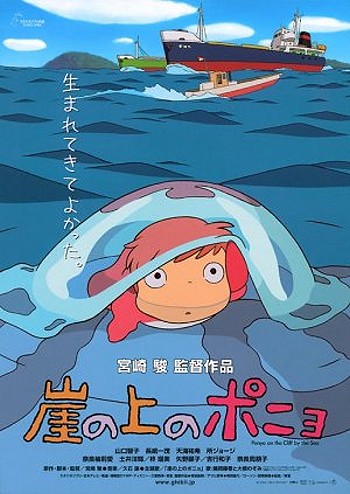
ponyo

Before Hayao Miyazaki‘s latest opus, Ponyo on the Cliff by the Sea (Gake no Ue no Ponyo) gets Disneyfied this August, interested parties might wish to purloin one of the pirate copies floating around and get a sneak peek. I’m not advocating not going to the movies to see the film–one of the greatest pleasures of Miyazaki’s works is the sensory overload of his stunning visuals–but Disney’s dubbed versions tend to over-explicate Miyazaki’s mysteries, draining his films of some of the unsettling ambiguities that make them so interesting.

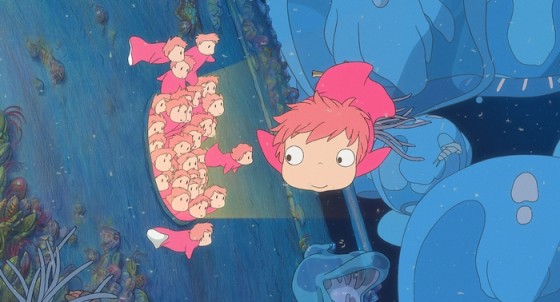
Ponyo tells the story of a little fish-girl (girl-fish?), a mermaid who escapes from her mad-scientist father and meets a boy named Sosuke. After tasting some of Sosuke’s blood, Ponyo begins to morph into a human. However, her transmutation causes bizarre and violent weather, including a giant tsunami resulting in a massive flood; even the moon starts to pull out of orbit. Sosuke and Ponyo navigate this surreal post-flood world, searching for Sosuke’s mother Lisa. The tale of these children is sweet but never maudlin, and like most Miyazaki films, Ponyo taps into sentimentality and pathos without ever becoming mawkish.

ponyo2-560x302

Visually, Miyazaki employs a sketchy, watery style here, painted in beautiful pastels and flashy complimenting brights. The look of this film is a significant departure from the fine detail and rich heaviness of Miyazaki’s masterpiece, Spirited Away (Sen to Chihiro no Kamikakushi), and might disappoint some, but we thought it was both beautiful and fitting. Of course, we were watching a pirated version that someone lovingly and bravely shot in a theater, undoubtedly inferior to the spectacle we expect from the theatrical release.

Perhaps the best critic of the film would be my two-year old daughter, who sat riveted and zombie-eyed throughout the whole film, only diverting her gaze occasionally to clarify some plot point. She loved the movie and talked about it the whole next morning, pretending that she was Ponyo (or, alternately, that someone else was Ponyo). Ponyo has more in common with Miyazaki’s lighter, kid-friendlier films like My Neighbor Totoro and Kiki’s Delivery Service than it does with his epic adventure films like Nausicaa and Princess Mononoke, but it retains enough adventure and glows with enough charm to keep longtime fans and newbies alike invested for all of its ninety minutes. Great good stuff. Here’s the trailer for the US release:


Harry Potter Sex Romp, Part II

First thing’s first: if you’re looking for Harry Potter slash fiction, you’ll have to check out our original Harry Potter Sex Romp post for links, you dirty dawg (you’re weird but you’re welcome). Just like that post a few years ago, this post’s title is really kinda sorta mostly irrelevant to what this post is about. What is it about? I want to take a look at some of the homoerotic tension in the new Harry Potter movie, Harry Potter and the Half-Blood Prince. If you want to find a proper review of the film, with plot summary and insight, shop around. That’s not gonna happen here.

Also, there will be SPOILERS, okay? Fair warning.

INTL_HarryDumbledore (Large)
#1 Stunnas

Okay. So, I saw the new film last night (henceforth HP6). And it was pretty good or whatever. But I noticed a subtext that cracked me up quite a bit, an underlying motif that might be lost on most summer blockbuster audiences. I’m talking about the implicit love between men and boys in this film.

At the beginning of the film, in an apparently insignificant scene, young Harry makes a date with an attractive young girl. However, old man Dumbledore shows up and dashes any hopes for a late sumer romance. Instead of meeting up with this lithe young thing, Harry has to grip hard to Dumbledore’s stiff arm to be apparated away to meet Horace Slughorn, an old potions master. Dumbledore uses Harry as fresh young bait for Slughorn, who has something the old wizard needs–a key memory about the development of Tom Riddle–Voldemort–a former protégé of Horace’s (lots of mentors and mentees here). Much of the narrative’s conflict revolves around the task Dumbledore has given Harry; it’s almost as if Dumbledore is pimping out the young wizard. These multiple man-boy relationships are doubled darkly in the failing bond between Snape and emo Draco.

In contrast, heterosexual relationships between the teens are treated with a lightness and even frivolity that codes such romances as ephemeral, or perhaps even inessential. Although the film solidifies the groundwork for the long-term relationships between the series’ principals (Harry-Ginny/Ron-Hermione), the real love story here is between older men and their young apprentices. HP6 depicts teen romance as silly without coloring any of its fragility with pathos. What the film really argues for is a sort of Greek or Platonic ideal of love; that love exists as a conduit for wisdom, passed from an older, experienced man to a younger boy in exchange for some of that youth’s beauty and vitality. Although moments of teenage adventure punctuate the film, the real scope of heroic encounters are shared between older men and their attendant lads (particularly Dumbledore and Harry, although even Snape, through the annotations of his old textbook, manages to plant part of himself into Harry).

The film reaches its climax with a lot of phallic wand waving and a bit of indecision over who gets to shoot off at whom. The climactic scene encodes the strange aggressions and series of shifting allegiances between the male wizards present. Dumbledore becomes the tragic figure; his death allows for Harry’s maturation, enacting a definitive arc in Harry’s Oedipal complex, where Dumbledore is both father figure and secret sex object. The weight of this tragedy initiates Harry into the adult world and adult responsibilities.

So why bother to write about this? No reason really, and I’m sure plenty of readers will find my analysis insupportable, silly, offensive, or just plain wrong. That’s fine. I guess I mostly find it remarkable that this motif should prevail so heavily in a summer blockbuster. There was also a whole drug motif going on–so many of the film’s plot development hinge on the ingestion of mind-altering substances–so maybe I just like the idea that the film is kinda sorta subversive.

More Excerpts from Werner Herzog’s Conquest of the Useless

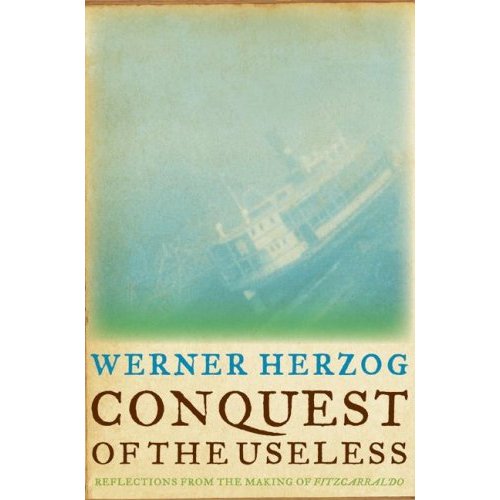
conquest

Last month, we were delighted to read some excerpts from Conquest of the Useless, Werner Herzog‘s forthcoming account of the making of his epic Fitzcarraldo (we wrote about it here). The paragons of moral literature at Vice Magazine have henceforth published a few more excerpts, available here. Here’s a morsel to whet the appetite:

I hurried to the first-aid station and saw a native man and a woman, both of whom had been struck with enormous arrows. They had been fishing for the camp three hours upstream by speedboat, and had spent the night on a sandbank. During the night they had been ambushed and shot at close range by Amehuacas. The woman had been hit by three arrows and almost bled to death. The wounds were close together. One arrow had gone all the way through her body just above her kidney, one had bounced off her hip bone, and the most life-threatening one was still sticking in her abdomen, broken off on the inner side of her pelvis. I spent several hours helping out while she was operated on, shining a powerful flashlight into her abdominal cavity and with the other hand spraying insect repellent to try to drive away the clouds of mosquitoes the blood had attracted. The man still had an arrow made of razor-sharp bamboo and almost thirty centimeters long sticking through his throat. He had broken off the two-meter-long shaft himself, and was gripping it in his hand. In his state of shock he refused to let go of it. The arrow’s tip, which looked more like the point of a lance, had spliced open one of his shoulders along the collarbone and was sticking crossways through his neck, with the tip lodged in his shoulder on the other side. He seemed to be in less immediate danger and was operated on only after the woman. Here is what had happened: the man, his wife, and a younger man, all three of them Machiguengas from Shivankoreni, who provide us with yucca, had gone up the Camisea to hunt. They were sleeping on a sandbank, and during the night the woman woke up because the man next to her was gasping strangely. Thinking a jaguar had got him by the throat, she grabbed a still glowing branch from the fire and jumped up. At that moment she was struck by three arrows. The younger man woke up; he had a shotgun with him, and, grasping the situation, fired two shots blindly into the night, since everything was happening in pitch darkness and complete silence. None of the three saw any trace of the attacking Amehuacas; they disappeared, leaving only a few footprints in the sand.

Lovely!