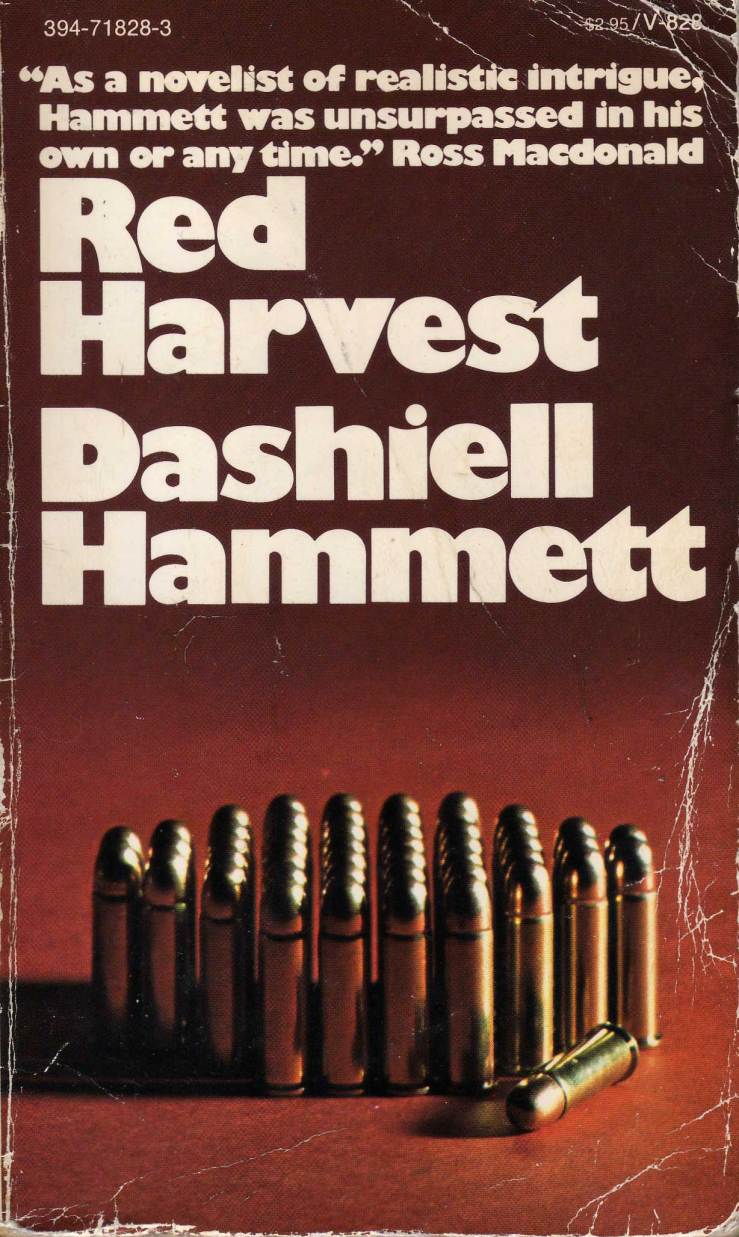
Red Harvest — Dashiell Hammett

Dashiell Hammett’s first published novel, Red Harvest, stars an unnamed dick, but the book isn’t so much a detective novel as it is an exploration of the destruction and renewal of a vice-ridden mining town named Personville.  The city boss, who serves “Poisonville” as both mayor and company president, can no longer control the strikebreakers he imported to bust up a prolonged work stoppage.  Initially retained by the editor of the daily paper to conduct background research for a developing story, the Continental Op is reluctantly hired by the mayor  to return the town to respectability.

Red Harvest is no murder mystery in the Scooby Doo sense because, unlike the Spillane novels reviewed last week, there is no particular villain to unmask.  Here, the action unfolds as the Continental Agency operative learns the personal histories of the town’s power players, assesses their motivations, and determines how best to play one set of guns against another.  The simple brilliance of this novel is Hammett’s ability to create believable characters in a handful of sentences, and then send them out to wreak mayhem against others.  Poisonville is as much a living character as Conan Doyle’s London or Bolaño’s Santa Teresa because it is so central to its citizens’ hopes, frustrations, and fears.  The detective apprehends, as bodies multiply, that the town is somehow getting the better of him.

The Continental Op might just be a stand-in for Hammet’s ideal reader.  Even though he’s privy to the same information we are, the detective is uniquely able to separate the relevant from the misleading and move the narrative forward.  He ingratiates himself with each of the opposing camps in town, analyzes their situations, and dispenses advice to their leaders based upon their own best interests.  Although the shakedowns, shootings, and betrayals were probably inevitable, the Op is the catalyst, the omnipotent narrator annihilating and rebuilding alliances.  Our detective’s actions lead to more than a dozen deaths, a prison break, riots in the street, blackmail, and his own frame-up for murder.

Rarely do writers trust their lead characters to create, and not merely experience, their own story.  I imagine that most characters, and most living human beings, aren’t capable or don’t want to always be in charge, preferring often just to passively accept whatever is foisted upon them.  Hammett’s writing in Red Harvest is so precise and inviting that those who pick it up might convince themselves, as they flip backwards twenty pages or so, that they could have played puppet-master just as easily.

Michael Greenberg on Roberto Bolaño

At The New York TimesMichael Greenberg tries to unpack the recent explosion of Roberto Bolaño books now available to English-reading audiences, including Antwerp, The Insufferable Gaucho, and The Return. From Greenberg’s review–

The Chilean writer Roberto Bolaño has to be one of the most improbable international literary celebrities since William Burroughs and Henry Miller, two writers whose work Bolaño’s occasionally resembles. His subjects are sex, poetry, death, solitude, violent crime and the desperate glimmers of transcendence that sometimes attend them. The prose is dark, intimate and sneakily touching. His lens is largely (though not literally) autobiographical, and seems narrowly focused at first. There are no sweeping historical gestures in Bolaño. Yet he has given us a subtle portrait of Latin America during the last quarter of the 20th century — a period of death squads, exile, “disappeared” citizens and state-sponsored terror. The nightmarish sense of human life being as discardable as clay permeates his writing.

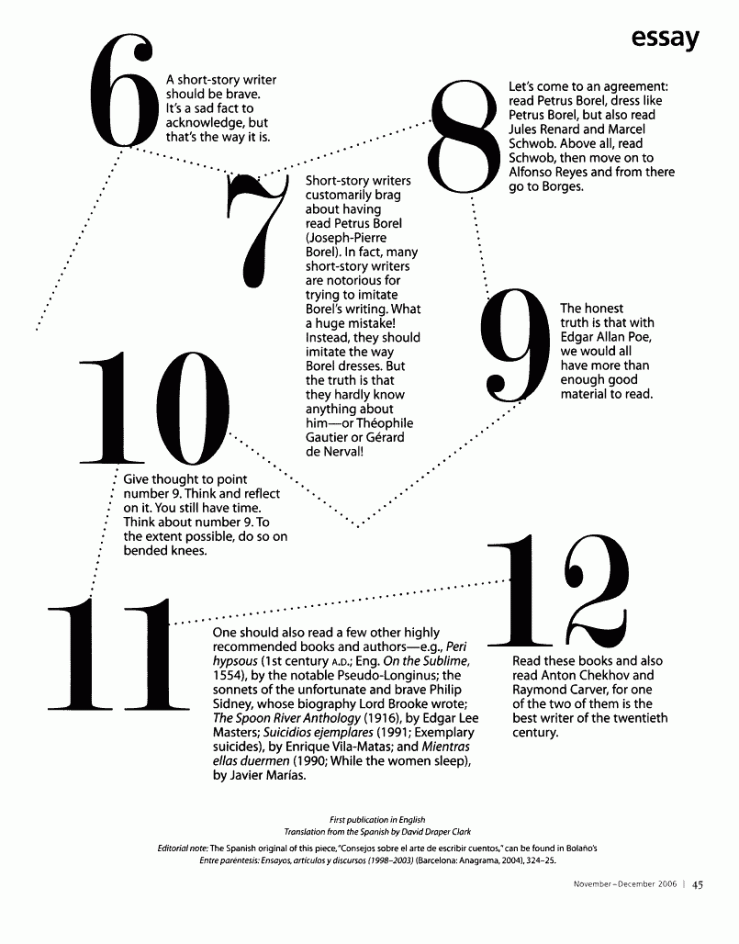
“Advice on the Art of Writing Short Stories” — Roberto Bolaño

Originally published in World Literature Today. Images via Defining Myself Secondhand.

Biblioklept’s 777th Post Spectacular

Welcome to Biblioklept’s 777th Post Spectacular*

*Not guaranteed to be spectacular.

777 seems like a beautiful enough number to celebrate, and because we’re terribly lazy, let’s celebrate by sharing reviews of seven of our favorite novels that have been published since this blog started back in the hoary yesteryear of 2006. In (more or less) chronological order–

The Children’s Hospital–Chris Adrian — A post-apocalyptic love boat with metaphysical overtones, Adrian’s end of the world novel remains underrated and under-read.

The Road — Cormac McCarthy That ending gets me every time. The first ending, I mean, the real one, the one between the father and son, not the tacked on wish-fulfillment fantasy after it. Avoid the movie.

A Mercy — Toni Morrison –Slender and profound, A Mercy should be required reading for all students of American history. Or maybe just all Americans.

Tree of Smoke — Denis Johnson — Nobody knew we needed another novel about the Vietnam War and then Johnson went and showed us that we did. But it’s fair to say his book is about more than that; it’s an espionage thriller about the human soul.

2666 — Roberto Bolaño — How did he do it? Maybe it was because he was dying, his life-force transferred to the page. Words as viscera. God, the blood of the thing. 2666 is both the labyrinth and the minotaur.

Asterios Polyp — David Mazzucchelli — We laughed, we cried, and oh god that ending, right? Wait, you haven’t read Asterios Polyp yet? Is that because it’s a graphic novel, a, gasp, comic book? Go get it. Read it. Come back. We’ll wait.

C — Tom McCarthy — Too much has been made over whether McCarthy’s newest novel (out in the States next week) is modernist or Modernist or post-modernist or avant-garde or whatever–these are dreadfully boring arguments when stacked against the book itself, which is complex, rich, enriching, maddening.

Roberto Bolaño Portrait by Phillip Fivel Nessen

Roberto Bolaño portrait by Phillip Fivel Nessen

I love this portrait of Roberto Bolaño by Phillip Fivel Nessen.

“I Never Went to Blanes” — Diego Trelles Paz Remembers Roberto Bolaño

Diego Trelles Paz remembers Roberto Bolaño at n +1. Although Paz never met the author (despite several attempts) they corresponded, and he shares some of the emails. Here’s Paz on The Savage Detectives

What did I like about Bolaño’s novel?

In formal terms, it was clear to me that his prose, while apparently simple, has a restrained and suggestive lyricism and a powerful musicality that are very different than what the authors of the “Boom” produced. Reading Bolaño generated an instant addiction in me: whether due to the lucid and demystifying spirit with which he adopts diverse genres or to his eagerness to involve us as active readers, to offer us fragmented works so we might fill them in with our imaginations. We become accomplices who search for truth through narrative devices that blend reality with fiction, facts with conjectures, apocryphal characters with historical ones. As the critic José Miguel Oviedo has said, “Bolaño always ends up turning his readers into detectives.”

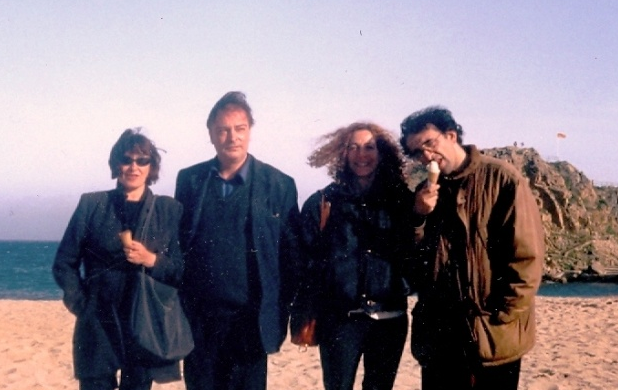
The article also features this marvelous image of Bolaño enjoying an ice cream cone–

Granta 110 Features Roberto Bolaño, Tom McCarthy, Dave Eggers, Sex

Subtly titled Sex, issue 110 of the long-running literary journal Granta hits stands this week, and it looks like a doozy. There’s a story by Roberto Bolaño called “The Redhead” about “a disturbing encounter between an eighteen-year-old girl and a narcotics cop.” Charming. No description for Tom McCarthy’s “The Spa,” but presumably it will involve sex, and Dave Eggers’s drawings “Four Animals Contemplating Sex” promises to be self-descriptive. Lots of other stuff too, of course. Order Granta 110 here. The journal has also produced short videos for four of the pieces in Sex, all directed by Luke Seomore and Joseph Bull. You can see them at the oh-so-cleverly titled website This is not a purse; the vid for Bolaño’s “The Redhead” is embedded below.

Chris Andrews at The New Yorker

The New Yorker‘s Book Bench blog interviews Chris Andrews. The magazine published Andrews’s translation of Roberto Bolaño’s short story “Prefiguration of Lalo Cura” earlier this week. From the interview:

A book that’s a joy to read can be frustrating to translate when, for whatever reason, the process keeps jamming up. And it’s very hard to predict just how hard a book will be to translate until you really get down to it, because smallish but time-consuming problems can be virtually invisible on a first reading. But of course translating has its joys as well: moving in slow motion through a fictional world, exploring its dimmer recesses, listening to what echoes in it, handling rich vocabularies …

“Prefiguration of Lalo Cura” — Roberto Bolaño

The New Yorker has published another short story by Roberto Bolaño. It’s called “Prefiguration of Lalo Cura” and it backgrounds a character from 2666, Olegario Cura Exposito (page 384, if you want to correlate things). The first paragraph:

It’s hard to believe, but I was born in a neighborhood called Los Empalados: The Impaled. The name glows like the moon. The name opens a way through the dream with its horn, and man follows that path. A quaking path. Invariably harsh. The path that leads into or out of Hell. That’s what it all comes down to. Getting closer to Hell or farther away. Me, for example, I’ve had people killed. I’ve given the best birthday presents. I’ve backed projects of epic proportions. I’ve opened my eyes in the dark. Once, I opened them by slow degrees in total darkness, and all I saw or imagined was that name: Los Empalados, shining like the star of destiny

Size Matters

I went to my favorite local bookstore this afternoon and for reasons beyond me I was compelled to pick up Jonathan Littell’s divisive 2009 novel The Kindly Ones, a massive tome running to almost 1000 pages in its trade paperback edition. Okay. The reasons I bought it are not completely beyond me: they mostly stem from Paul La Farge’s essay “A Scanner Darkly,” published in the May, 2009 issue of The Believer. Previous Believer feature essays have led to me picking up excellent books by writers I’d never heard of, including 2666 and The Rings of Saturn. Anyway, the book is massive, and I don’t really have time to read it any time soon. There is a hobbit-sized stack of review copies lingering by my nightstand, more arriving all the time, not to mention the books I habitually pick up weekly. Which, more often than not, tend to be pretty big like, uh, The Kindly Ones.

Why is this? Why the attraction to big books? In his essay included at the end of Bolaño’s 2666, Ignacio Echevarría cites a passage from the book where literature professor Amalfitano wonders that:

Now even bookish pharmacists are afraid to take on the great, imperfect, torrential works, books that blaze paths into the unknown. They choose the perfect exercises of the great masters. Or what amounts to the same thing: they want to watch the great masters spar, but they have no interest in real combat, when the great masters struggle against something that terrifies us all, that something that cows us and spurs us on, amid blood and mortal wounds and stench.

The “bookish pharmacist” in question has explained that he favors the preciseness of “Bartleby” over Moby-Dick, the polish of The Metamorphosis over The Trial. Amalfitano, Bolaño’s stand-in, points out that it takes “the great, imperfect, torrential works” to “blaze paths into the unknown.” Put another way, the masters need space; space to overflow, make errors, experiment, joust with other masters, play in and with time. Obviously, the passage (as Echevarría and a million other critics have noted) is a defense for the sprawl of 2666 itself, but I think it speaks to why many readers are drawn to the big books. They can be ragged and overflowing but they also have more room to take the measure of spirit, soul, life. They can evoke this world and others. They can be grand.

Not to say that the smaller books can’t do this in turn. Denis Johnson’s Jesus’ Son is masterful in its precision and humor. But Tree of Smoke is the better book. David Foster Wallace’s Infinite Jest trumps everything else the man wrote. White Noise is more manageable than (and perhaps superior to) Underworld, but the bigger book allows Don DeLillo the space he needs to explore so much of American history and American psyche. And these are just contemporary examples. There’s James Joyce and Marcel Proust, Dostoevsky and Tolstoy. Sterne. Cervantes. Supply your own names.

But I also love novellas and those long short stories of strange size like Joyce’s “The Dead” or, yes, “Bartleby” (sidebar: Really, what is “Bartleby”? A long short story? A short novella? What is it?). There’s something pure and refreshing about them, especially when consumed quickly, especially when consumed between a few of those long books. And a confession: I love it when review copies come in that hover around 200 pages, particularly when the novel is the writer’s first or second. There’s a glut, a horrendous, miserable glut, of first-time novelists who feel they must say everything about everything in 380 or 450 or, God forbid, 500+ pages. It’s really too much. I suppose the rule, if there has to be a rule (there doesn’t) is impossibly simple (and perhaps just impossible): if you’re going to write a really, really big book, make sure it’s addictive, compulsive reading. I’m not sure if The Kindly Ones is great art or a potboiler posing as art, but I am pretty certain that its length alone, for whatever reason, is part of its attraction.

“A Strange Kind of Vibration” — Chris Andrews on Translating Roberto Bolaño

The Australian is running a new article about one of Roberto Bolaño’s English translators, Chris Andrews. Reporter Bernard Lane reveals that

Andrews had been badgering publishers for translation work. In 2001 he badgered the right publisher, Christopher MacLehose of Harvill Press in London, at the right time. MacLehose had just bought the first English rights to Bolano and his translator had fallen by the wayside. Andrews knew and admired Bolano’s [sic] writing, thanks to his acquisition of Spanish at the universities of Melbourne and La Trobe. He got the job and out came By Night in Chile.

Andrews on Bolaño–

“I think of him as a pan-American author, as an author of the western hemisphere,” says Andrews. Bolano’s reception in Britain had been slow at first, not that his prose was a problem.

“There are a lot of important features of Bolano’s style that can be transferred from one language to another,” Andrews says, “The big syntactic patterns, the patterns of repetition, the long sentences, the bursts, the parenthetical remarks; that comes across.”

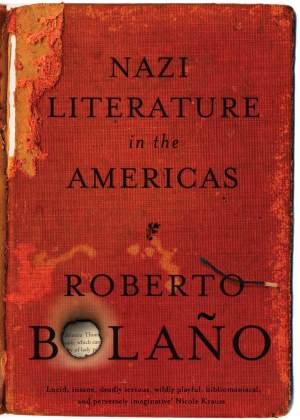
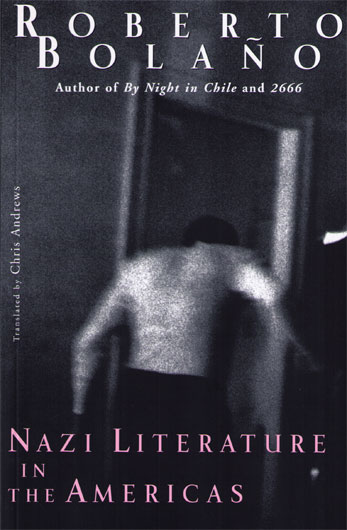
The article centers around Andrews’s translation of Nazi Literature in the Americas. We absolutely love the Picador edition’s cover for the UK, Australia, and similar markets. It captures the book’s apocryphal tone, its violence–and also its sharp sense of humor. On that book specifically (and Bolaño’s work in general)–

In a sea of allusion, English readers may feel adrift. “I don’t think it matters very much,” says Andrews. “It’s probably going to be read by people who have already got an interest in Bolano.

“One of the nice things about those bits of Bolano that are full of references and allusions is that it is hard to draw the line between the historical characters and the fictional ones.

“In different literary cultures, there are different norms about what you need to explain. In the French translation of Bolano, there are footnotes.”

Wouldn’t readers halfway familiar with Bolano suspect they were dealing with yet another level of artifice? “I think they would,” Andrews says, “even if it said ‘translator’s note’.”

The article details what techniques Andrews employs when stuck, particularly with regional dialects and slang. Andrews also talks about his correspondence with Bolaño himself,  in the last few years of the Chilean’s life. Here’s Andrews describing his attraction to Bolaño:

The prose has a mesmerising quality that intrigues Andrews.

“There’s a character in one of the stories I’ve just been translating who’s an actor called El Pajarito [Little Bird] Gomez. He’s a skinny, unimpressive-looking guy, but as soon as he appears on camera he vibrates in a weird way that almost hypnotises the viewer.

“When I read that, I thought, that’s a bit like what happens with Bolano’s prose for many readers, that it has a strange kind of vibration.”

“William Burns” — Roberto Bolaño

Hey! Check it out: new (well, new as these things go) fiction from Roberto Bolaño. The New Yorker has published a selection called William Burns,” which may or may not be (but we’re thinking probably is) an excerpt from a longer work, one that will probably come out in the nearish future. Chris Andrews translates. “William Burns” tells the story of the eponymous Californian, a “laid-back guy who never lost his cool,” who seems to be a private investigator entrusted to protect two women from a killer. The story builds in typical Bolaño fashion: plenty of sinister, Lynchian ambiance punctuated by strange humor, with a good shot of banality to smooth things out. Our favorite passage:

If I were a dog, I thought resentfully, these women would show me a bit more consideration. Later, after I realized that none of us were feeling sleepy, they started talking about children, and their voices made my heart recoil. I have seen terrible, evil things, sights to make a hard man flinch, but, listening to the women that night, my heart recoiled so violently it almost disappeared. I tried to butt in, I tried to find out if they were recalling scenes from childhood or talking about real children in the present, but I couldn’t. My throat felt as if it were packed with bandages and cotton swabs.

Nazi Literature in the Americas — Roberto Bolaño

I was talking with a friend last weekend about Roberto Bolaño and he remarked that many of the early slim novels from this remarkable writer tend to read like sketches for his masterwork 2666. This is a more than fair assessment and also one that shouldn’t–and doesn’t–detract from enjoying these books. But it’s difficult to read the nightmare-rant of By Night in Chile or the paranoiac dread invested in the tales in Last Evenings on Earth without recalling the layered themes of violence and art that underpin 2666. Bolaño’s fake-encyclopedia, Nazi Literature in the Americas is perhaps, by its very nature, the sketchiest of these sketches, yet that term, “sketch” — well it’s just plain wrong here. While most of the book’s entries are marked by brevity, none are undercooked. Rather–and I hate that I’m about to crib from critic Francisco Goldman’s blurb on the back of the book, but he’s spot on–the book is a “key cosmology to Bolaño’s literary universe.” In short, Nazi Literature in the Americas helps to confirm that, like J.R.R. Tolkien, Bolaño was a writer with a fully-realized universe at his disposal, one with its own heroes and villains, histories and myths, and yes, like Tolkien, its own literature.

Nazi Literature in the Americas is a stunning, ugly, highly-enjoyable, and often hilarious book. It details the exploits, both literary and non-, of over two dozen fictional writers from North, Central, and South America. While few of the writers are actually practicing Nazis, all are right-wingers and most are crazy failures. Big surprise that Bolaño would write about crazy, failed writers, right? And that is the central paradox of the book: while the writers here are anti-Semites and fascists and neo-Nazis who represent the worst in human values and ethics, they also darkly mirror Bolaño himself, or at least his fictional stand-ins. For example, the (anti-)heroes Ignacio Zubieta and Jesús Fernández-Gómez are Colombian writers who side first with the fascists and then the Nazis, yet they come across as doubles for the Mexican lefty poets Ulises Lima and Arturo Belano, the (anti-)heroes of The Savage Detectives. The pair pops up a few times in the course of the book as well, most notably in the section on Daniela de Montecriesto, who was a minor character in 2666.

She’s not the only character to traverse Bolaño books. The final chapter of Nazi Literature, its longest, tells the story of Ramírez Hoffman, the aviator-poet-serial killer whose story is extended in the novella Distant Star. Hoffman’s entry, besides being the longest, is also the only written in the first-person. The narrator is even identified as “Bolaño.”

At times the reader will find himself sympathizing with Bolaño’s monsters. The sci-fi writer Gustavo Border says: “I have been tormented, spat on, and deceived so often–the only way I could go on living and writing was to find spiritual refuge in an ideal place.” Bolaño immediately cuts the pathos with humor; Border ends his sad comment: “In a way, I’m like a woman trapped in a man’s body.” Elsewhere, what’s most shocking is not how much sympathy Bolaño evokes, but how interesting the literature he describes sounds. Take Segundo José Heredia’s Saturnalia, for instance:

Saturnalia, the story of two young friends who in the course of a week-long journey through France are confronted with the most horrendous acts they have ever witnessed, without being able to tell for sure whether or not they are dreaming. The novel includes scenes of rape, sexual and workplace sadism, incest, impaling, and human sacrifice in prisons crowded to the physical limit; there are convoluted murder plots in the tradition of Conan Doyle, colorful and realistic descriptions of every Paris neighborhood, and, incidentally, one of the most vivid and spine-chilling female characters in Venezuelan literature since 1950: Elisenda, the enemy of the two young men.

It sounds horrific but I’d love to read it. It also sounds like a Bolaño novel, with its nightmare violence, prisons, and detective plots.

In one telling aside, one of Bolaño’s writers realizes that “literature . . . is a surreptitious form of violence.” Bolaño’s oeuvre seems to work from this thesis, or perhaps work to enact this thesis. If the writers of of Nazi Literature are villains, they are also sympathetic in their villainy, not for their racist viewpoints, which are subtly but repeatedly mocked and condemned, but rather for the fact that as writers and artists they have no hope; like Oedipus they are fated to violence. Like Bolaño himself, they both channel and engender violence. Their failure, of course, is to seek to regulate or otherwise give meaning to that violence via ideology and dogma. Tellingly, Bolaño investigates–and perhaps corrects–this failure in his opus 2666 which resists easy answers and scapegoats.

And so to return to our point of entry: Nazi Literature in the Americas will probably be enjoyed most by those who’ve trucked through 2666 or some of Bolaño’s other works. It’s a quick, propulsive read, and while quite funny–and at times scary–it’s most fascinating as a document that further fleshes out the Bolañoverse. Highly recommended.

“The Philosophy of Furniture” — Edgar Allan Poe

“There is reason, it is said, in the roasting of eggs, and there is philosophy even in furniture — a philosophy nevertheless which seems to be more imperfectly understood by Americans than by any civilized nation upon the face of the earth.”

I started Roberto Bolaño’s faux-encyclopedia, Nazi Literature in the Americas last night. In the first section, Edelmira Thompson de Mendiluce creates a room based on Edgar Allan Poe’s essay “The Philosophy of Furniture.” I’d never read or even heard of that essay up until now, and, given Bolaño’s penchant for invention, I wondered for a moment if it even really existed. Edelmira recreates the room according Poe’s specifications and then writes Poe’s Room, her defining novel, in its rich confines. The essay exists outside of Bolaño, of course, as does the room–it’s part of the Edgar Allan Poe National Historic Site.

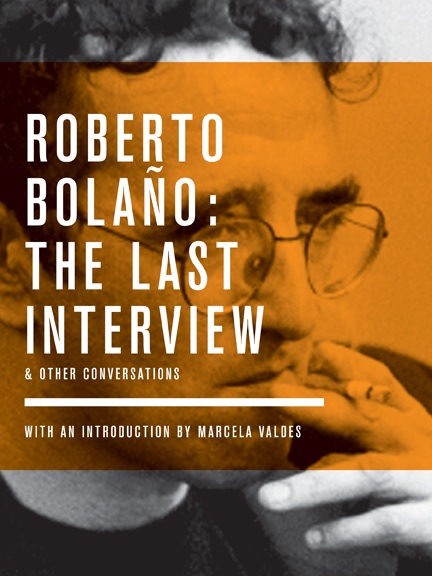
Roberto Bolaño: The Last Interview

I hate reviews that hem and haw too much over context, but I feel that a proper review of Roberto Bolaño: The Last Interview has to begin with some background information. But because I love you, gentle reader, as much as I hate context-driven reviews, here’s the quick version: if you, like me, have found yourself compelled to read everything by Bolaño that you could get your hands on in the the past year or two, then you should buy and read The Last Interview because you will enjoy it. Now for the context:

When Bolaño died at age 50 in 2003, he was only just rising to prominence as a fiction writer, with most of that prominence still restricted to the Spanish-speaking world. Bolaño’s tremendous success has been mostly posthumous and there really aren’t that many interviews with the man. Roberto Bolaño: The Last Interview collects four of them, scattered between 1999 and 2003. Up until now, not all of these interviews were available in English (unless you took the time to put them in a translator program like Babel Fish. Which I did. Quick note: Sybil Perez’s translations here are better than the syntax soup I got via Babel Fish). The book gets its name from Bolaño’s last interview, conducted by Mónica Maristain in a 2003 issue of the Mexican edition of Playboy; that longish interview makes up the bulk of this book. There’s also an essay entitled “Alone Among the Ghosts” by Marcela Valdes, previously published in a 2008 issue of The Nation.

“Alone Among the Ghosts” works as a sort of preface for the interviews, providing a brief overview of Bolaño’s oeuvre and shedding light on his working methods. In particular, “Ghosts” details how Bolaño researched the gruesome crimes at the heart of 2666. The interviews that follow range in tone from flighty (Maristain’s Playboy interview) to intimate (Carmen Boullosa’s inteview in Bomb), but all share one common trait: each interviewer attempts to get Roberto Bolaño to name his place in the canons of Spanish and world literature. The interviews, much like Bolaño’s at-times-esoteric (at least to this English speaker) novel The Savage Detectives, are chock full of literary references to Spanish-language writers, poets, and critics, and each interviewer seems to delight in pushing Bolaño into saying something provocative about other writers. Tom McCartan’s annotations, located in the margins of this extra-wide book, help to enlighten those of us who are unfamiliar with the greater (and lesser) fights and scandals of Latin American literature. In his books, Bolaño often satirized the petty in-fighting between various literary groups, at the same time revealing the paradoxically serious nature of these conflicts. One of the best examples comes from The Savage Detectives–Bolaño’s stand-in Arturo Belano fights a duel with a critic on a beach in an episode that’s both hilarious, pathetic, and slightly horrifying. In the interviews, you get the sense that Bolaño is both provoking literary battles and, at the same time, downplaying them. He’s serious about his aesthetic values but knows that most of the world is not–he knows that most of the world is concerned with more immediate and perhaps weightier concerns like family, sex, and death. It’s on these subjects that Bolaño the interviewee is more poignant and candid–and fun.

There is a sense of creation in these interviews, of Bolaño creating a public self through his answers. It’s at these times that you can almost sense Bolaño writing. On the one hand, it’s a treat to see his voice so fresh and immediate, but on the other hand, in the context of an interview, it lends credence to the notion that he’s resisting presenting an authentic “self” (please put aside all postmodern arguments about authenticity, identity, and textuality for a few moments). Consider his response to his “enemies”:

Every time I read that someone has spoken badly of me I begin to cry, I drag myself across the floor, I scratch myself, I stop writing indefinitely, I lose my appetite, I smoke less, I engage in sport, I go for walks on the edge of the sea, which by the way is less than 30 meters from my house, and I ask the seagulls, whose ancestors ate the fish who ate Ulysses: Why me? Why? I’ve done you no harm.

A lovely passage. Apparent sincerity gives way to hyperbole gives way to healthy habits gives way to literary allusion–and perhaps hints of bathos. I get the sense that Bolaño is pulling a collective leg here, yet, there must be a kernel of truth to the notion that his critics affect him. In any case, the response, in its compelling rhythm and pathetic humor, might fit neatly into one of Bolaño’s books, where the author has often blurred the lines between fact and fiction.

These interviews will no doubt be pored over as “Bolaño Studies” hits academia hard, and would-be Bolaño scholars try to parse out their own narratives against the myriad gaps in Bolaño’s record. For more on the many inconsistencies in Bolaño’s life, check out this story from the The New York Times, which interviews family, friends, and literary associates to tease truth out of some of Bolaño’s grander embellishments. Of course, Bolaño was not solely responsible for all exaggerations. From the interview first published in Turia:

“It’s the typical Latin American tango. In the first book edited for me in Germany, they give me one month in prison; in the second book–seeing that the first one hadn’t sold so well–they raise it to three months; in the third book I’m up to four months, in the fourth it’s five. The way it’s going, I should still be a prisoner now.”

The New York Times article questions whether Bolaño even spent the eight days in a Chilean prison that he claims he did. Whether or not that ruins the authenticity of Bolaño’s short story “Dance Card,” collected in Last Evenings on Earth, is totally up to you of course, dear reader, but I think that self-invention has always been the privilege of the writer. If the interviews collected in The Last Interview reveal a myth-maker creating a self, they are also transparent and humorous in these creations. Highly recommended.

Roberto Bolaño: The Last Interview is now available from Melville House. For a detailed account of the authors mentioned in the interviews, read Tom McCartan’s fantastic series “What Bolaño Read.”
Let’s Not Be Pretentious

Mónica Maristain interviewing Roberto Bolaño, collected in Roberto Bolaño: The Last Interview:

MM: John Lennon, Lady Di, or Elvis Presley?

RB: The Pogues. Or Suicide. Or Bob Dylan. Well, but let’s not be pretentious: Elvis forever. Elvis and his golden voice, with a sheriff’s badge, driving a Mustang and stuffing himself with pills.

“The Son Never Asked to Be Born” — Roberto Bolaño’s Parenting Advice

Roberto Bolaño, from an interview with Eliseo Álvarez, republished this month in Melville House’s Roberto Bolaño: The Last Interview:

I suppose that within his brutality and his courage–he is a very courageous man–my father loved me as I love my son. In the end, one could talk for hours about the relationship between a father and a son. The only clear thing is that a father has to be willing to be spat upon by his son as many times as the son wishes to do it. Even still the father will not have paid a tenth of what he owes because the son never asked to be born. If you brought him into this world, the least you can do is put up with whatever insult he wants to offer.

Okay, so sons didn’t ask to be born, but what about daughters? How did Bolaño feel about his daughter?

I won’t say anymore. I’ll start to cry. The only explanation I could give would be to cry. It’s beyond the beyond.

Reading these quotes, I thought about two of my favorite depictions of fathers and children in Bolaño’s work. First, there’s Bolaño as the son, “B,” in the title track from the collection Last Evenings on Earth. The story is a strange mix of sinister and funny, with the (perhaps overly literary) son fearing for his dad, a boxer who, at least in the son-narrator’s view, doesn’t seem to be paying attention to just how bad things seem to be turning on the pair’s vacation to Acapulco. Then there’s (possibly) Bolaño as parent, this time in the form of Oscar Amalfitano in 2666. If Bolaño would cry for his daughter’s safety, for anxiety and wariness of a cruel world, then Amalfitano becomes a literary center for those fears. And, if you’ve read that book, you know his paranoia is justified. In any case, it’s clear that Bolaño loved his children deeply. In another of the the book’s interviews–literally, “The Last Interview,” Bolaño, the exile who lived everywhere said, “my only country is my two children.” He even asked that his masterpiece 2666 be divvied up into five parts in the hopes that it would provide steady income for his son and daughter.

For more about Bolaño, check out Tom McCartan’s fantastic limited-run series, “What Bolaño Read.” We’ll do our best to get a full review out before McCartan (who annotated The Last Interview, by the way) addresses everything in the book.