The Believer’s 2010 Reader Survey: (What Some Jokers Thought Were) The Best Books of 2009

The Believer‘s annual reader survey is always kinda sorta interesting. Here’s the top 20; linked titles go to Biblioklept reviews:

  1. Buffalo Lockjaw—Greg Ames
  2. Everything Ravaged, Everything Burned—Wells Tower
  3. Let the Great World Spin—Colum McCann
  4. Invisible—Paul Auster
  5. A Gate at the Stairs—Lorrie Moore
  6. Inherent Vice—Thomas Pynchon
  7. Juliet, Naked—Nick Hornby
  8. Chronic City—Jonathan Lethem
  9. Wolf Hall—Hilary Mantel
  10. The Anthologist—Nicholson Baker
  11. Await Your Reply—Dan Chaon
  12. Ablutions—Patrick deWitt
  13. The Interrogative Mood—Padgett Powell
  14. The Financial Lives of the Poets—Jess Walter
  15. This Is Where I Leave You—Jonathan Tropper
  16. Sag Harbor—Colson Whitehead
  17. The Way Through Doors—Jesse Ball
  18. The Children’s Book—A. S. Byatt
  19. Summertime—J. M. Coetzee
  20. The Selected Works of T. S. Spivet—Reif Larsen

Read the rest of the list–honorable mentions–here. Read Biblioklept’s Best of 2009 list here.

“They Just Want to Look in the Mirror” — William T. Vollmann

Vice Magazine has published an excerpt from William T. Vollmann’s new book Kissing the Mask: Beauty, Understatement, and Femininity in Japanese Noh Theater. Read the excerpt here. The picture above is Mr. Vollmann in drag, one of the themes of his new book. Here is an excerpt from Vice‘s excerpt:

The best mask of my self (never mind my soul) may well be a chujo; my forehead will soon begin to wrinkle in a pattern like roots, and I often bear the sparse mustache, gaping mouth, and blackened teeth of the loyal bewildered lieutenant; perhaps I belong to the Komparu school. What the artist inscribed on the back of my face I will never know, being unable to see myself objectively the way a professional Noh actor would. Most of the time I am a sturdy man who wears the same clothes often, preferring garments of lifelong reliability; I shave carelessly and shrug off my latest wrinkles, because anyhow I never possessed even a waki’s hope of being beautiful, nor felt the loss.

Nietzsche’s Draconian Law Against Writers

From Human, All Too Human (aphorism 193):

Draconian law against writers. One should regard a writer as a criminal who deserves acquittal or clemency only in the rarest cases: that would be a way to keep books from getting out of hand.

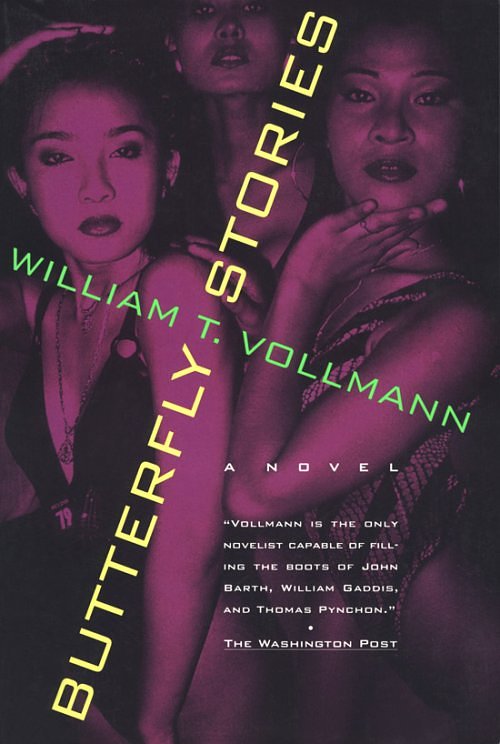
Butterfly Stories — William T. Vollmann

In his 1994 novel Butterfly Stories, William T. Vollmann explores the intense cost of unrelenting idealism. Butterfly Stories is a tragic-comic bildungsroman centered around the life of a protagonist who is almost certainly a semi-autobiographical stand-in for Vollmann. He’s never named in the text; few of the characters are. Instead, he goes by various appellations: the butterfly boy, the boy who wanted to be a journalist, the journalist, the husband. These names square with the protagonist’s painful idealism. He’s a professional alien, a traveler who reports on all the beautiful ugly poor places we Quiet (Ugly) Americans forget about (or never know of in the first place). The main set piece in Butterfly Stories takes place in Thailand and Cambodia:

Once upon a time a journalist and a photographer set out to whore their way across Asia. They got a New York magazine to pay for it. They each armed themselves with a tube of coll soft K-Y jelly and a box of Trojans. The photographer, who knew such essential Thai phrases as: very beautiful!, how much?, thank you and I’m gonna knock you around! (topsa-lopsa-lei), preferred the extra-strength lubricated, while the journalist selected the non-lubricated with special receptacle end. The journalist never tried the photographer’s condoms because he didn’t even use his own as much as (to be honest) he should have; but the photographer, who tried both, decided that the journalist had really made the right decision from a standpoint of friction and hence sensation; so that is the real moral of this story, and those who don’t want anything but morals need read no further.

I’ve quoted the passage at length because I think it delineates a good deal of Vollmann’s program very quickly: whoring-as-gonzo-journalism, a foreshadowing of the sexual grotesquerie to come, blackly ironic humor, and an uncomfortable gap between protagonist and narrator. It’s that gap between the narrator’s ironic detachment and the journalist’s earnest search for meaning–and love–in a world of violence and prostitution that made the book rewarding for me. However, I suspect many will not enjoy (perhaps even hate) this disconnect. The journalist falls in love with several prostitutes throughout the course of the novel, fixating on a Cambodian girl named Vanna in particular. His obsession with Vanna overcomes him, surpasses any rational course of action, and leads him to divorce his wife back in San Francisco in the hopes of marrying a girl he, over time, can no longer even visualize. In short, idealism tortures the protagonist; he’s in love with the idea of love. Late in the novel, he thinks (his thinking framed by the narrator, of course):

Better not to try anything than to be wicked! — That’s how most people acted, and they were probably right, dying their lumpish lives without collecting more than their share of the general blame; but he’d do whatever he was called to do . . .

And later, hallucinating in one of his STD-fueled fevers, he remembers the bully that tormented him back when he was the butterfly boy: “I’m not afraid of you anymore . . . Because I have someone whose life means more to me than mine.” The protagonist’s unrelentingly romanticized view of self-sacrifice is ultimately a defense mechanism against the world’s (equally unrelenting) Darwinian violence.

Vollmann’s milieu of disease-infested, war-torn, economically depressed lands dramatizes this conflict. The violence of the Khmer Rouge, the depravity of prostitution, and the specter of AIDS underpin the novel, and are never mere props for Vollmann, who places his protagonist in a paradoxically privileged vantage point from which to observe, investigate–or ignore–the atrocities of poverty.  The book succeeds because of the tension between the narrator’s judgmental, ironic perspective and the protagonist’s big-hearted but ultimately facile dream of a self-sacrificing love. The narrator sees–and lets us see–the ironic selfishness of the protagonist’s dream to save the world, one prostitute at a time.

Just under 300 pages and larded with the author’s spidery black-ink sketches, Butterfly Stories is one of Vollmann’s shorter and more digestible (if that word may be used) volumes. It is bleakly funny, often depressing, and filled with erudite asides on Nobel prizewinners, transvestites, and the benefits of whiskey. And benadryl. Can’t forget the benadryl. Vollmann has an astounding gift for crafting concrete sentences that burst into blistering abstraction, but he can also drift rather aimlessly at times. Does he have an editor? What other literary writer can put out a book of at least 500 pages every year? Butterfly Stories may be a good start for those interested in Vollmann but daunted by his prolific output. It will also repel many readers with its grotesque depictions of sex, which recall Henry Miller and the best of Charles Bukowksi. I liked it very much. Recommended.


William T. Vollman’s Self-portrait

Beaton Does Gatsby

Cartoonist Kate Beaton lampoons F. Scott Fitzgerald’s The Great Gatsby at her site Hark, A Vagrant. Wonderful send-up of what has to be one of America’s most overrated novels.

The 1st Annual Moby Awards to Honor the Best (and Worst) Book Trailers

Next month (May 20th, 2010 to be precise), the fine folks at indie publisher Melville House will honor the best–and worst–book trailers. The invite promises awards for “Best Cameo,” “Best Author Appearance,” and, of course, “Best Trailer” (“both Big and Low budgets”). Melville House honcho Dennis Loy Johnson will host and author John Wray (Lowboy) will be among the special cadre of envelope-openers. Judges include Carolyn Kellogg (LA Times) and Slate’s Troy Patterson, who wondered if books really needed trailers last year. Nominate trailers here. Not sure how I feel about book trailers, but I like this one for Pynchon’s Inherent Vice, probably mostly because he reads the damn thing and it cracks me up–

David Foster Wallace on Book Tour Sex, Blue Velvet, and Bandanas

Flavorwire has compiled a fantastic collection of David Foster Wallace quotes from David Lipsky’s new book, Although Of Course You End Up Becoming Yourself. A few excerpts:

On book tour sex:
“I didn’t get laid on this tour. The thing about fame is interesting, although I would have liked to get laid on the tour and I did not….People come up, they kind of slither up during readings or whatever. But it seems like, what I want is not to have to take any action. I don’t want to have to say, ‘Would you like to come back to the hotel?’ I want them to say, ‘I am coming back to the hotel. Where is your hotel?’ None of ‘em do that….I just can’t stand to look like I’m actively trading on this sexually. Even though of course that’s—I would be happy to do that.”

On Blue Velvet:
“I remember going to see Blue Velvet. . . . It absolutely made me shake. And I went back and saw it again the next day. And there was somethin’ about…it was my first hint that being a surrealist, or being a weird writer, didn’t exempt you from certain responsibilities. But it in fact upped them. . . . David Lynch, Blue Velvet coming out when it did, I think saved me from droppin’ out of school. And saved me maybe even from quittin’ as a writer. ‘Cause I’d always—if I could have made a movie, right at that time? That would have been it. I mean, I vibrated on every frequency.”

On the origin of the trademark bandana:
“I started wearing bandannas in Tucson because it was a hundred degrees all the time. When it’s really hot, I would perspire so much that I would drip on the page. Actually, I started wearing it that year, and then it became a big help in Yaddo in ’87 because I would drip into the typewriter, and I was worried that I would get a shock. And then I discovered that I felt better with them on. And then I dated a woman who…said there were these various chakras, and one of the big ones was what she called the spout hole, at the very top of your cranium. And in a lot of cultures, it was considered better to keep your head covered. And then I began thinking about the phrase, Keeping your head together, you know? …. It’s a security blanket for me. . . . It makes me…feel kind of creepy that people view it as an affectation or trademark or something. It’s more just a foible, it’s the recognition of a weakness, which is that I’m just kind of worried my head’s going to explode.”


Sam Lipsyte Interviewed at ReadRollShow

ReadRollShow‘s Dave Weich interviews Sam Lipsyte. Great little short clips, perfect for internet viewing. They have three up so far, all embedded below–

The Friends of Eddie Coyle — George V. Higgins

There are two distinct ironies in the title of George V. Higgins’s landmark 1970 novel The Friends of Eddie Coyle. The first is the word “friends” to describe the collection of folks on both sides of the law who Coyle tries to get over on in order to get out of an upcoming prison sentence (of course, most of these folks are looking to use or set up Coyle in turn). The second irony is that Eddie Coyle (aka Eddie Fingers aka “the stocky man”) is not so much the headliner here as he is the catalyst in a sharp and gritty tale of Boston gangsters, gunrunners, student radicals,  cops, state police, and federal agents.

Like David Simon did three decades later in his Baltimore opus The Wire, Higgins throws his audience into the deep end. Coyle features almost no exposition. Instead Higgins, a former U.S. Attorney, forwards his intricate and fast-paced plot using machine-gun dialogue. While many crime writers fall for the lure of hyperbolic argot, Higgins’s dialogue rings very true and very raw. He trusts the reader to sort out the complex relationships between hustlers and dupes, cops and finks from their conversations alone; the rest of the prose is reserved for tight, cinematic descriptions of gritty urban Boston at the end of the 1960s. The imagery is straight out of a Scorcese film, and like that director, Higgins has a wonderful gift for showing his audience action without getting in the way. Coyle features a description of a bank robbery that is so clean, precise, and sharp that I wouldn’t be surprised to hear that someone somewhere had used it as a how-to manual.

Higgins also spares authorial intrusion when it comes to a moral voice in his novel. There are certainly bad guys here, to be sure, but they are complex and human, just like the cops and feds who hunt them. In this sense, Coyle is the prototype of a type of crime fiction that came to rise in the cinema of the ’70s–gritty actioners that viewed crime and punishment through a lens of absolute ambiguity. At the same time, Coyle doesn’t unravel into a mere shaggy dog story–there’s a definite conclusion to the story here, even if it doesn’t satisfy the district attorney who tries to make sense of it all (like, in a metaphysical sense) at the end.

I’ve read more crime fiction in the past year than I ever have before, inspired perhaps by “The Part About the Crimes” in Bolaño’s 2666 or Jonathan Lethem’s forays into noir. I wrote a little bit about this the other week when I praised Denis Johnson’s noveau-noir exercise Nobody Move for its purity and its “willingness to be what it is” (whatever that means). (The tone of Nobody Move is downright lighthearted next to Coyle. Not that they need to be compared–I enjoyed both very much). What I did not directly address in that post is my own prejudice against genre fiction, a prejudice that inflamed me in my early teens to such a degree that I probably outright disregarded a lot of great writing. But there’s always more great writing out there than one can read in a lifetime, so why dwell on the past? Suffice to say that The Friends of Eddie Coyle should correct any prejudicial notions of the limits of crime fiction. Highly recommended.

The Friends of Eddie Coyle 40th Anniversary Edition with a new introduction by Dennis Lehane is new this month from Picador.

Granta 110 Features Roberto Bolaño, Tom McCarthy, Dave Eggers, Sex

Subtly titled Sex, issue 110 of the long-running literary journal Granta hits stands this week, and it looks like a doozy. There’s a story by Roberto Bolaño called “The Redhead” about “a disturbing encounter between an eighteen-year-old girl and a narcotics cop.” Charming. No description for Tom McCarthy’s “The Spa,” but presumably it will involve sex, and Dave Eggers’s drawings “Four Animals Contemplating Sex” promises to be self-descriptive. Lots of other stuff too, of course. Order Granta 110 here. The journal has also produced short videos for four of the pieces in Sex, all directed by Luke Seomore and Joseph Bull. You can see them at the oh-so-cleverly titled website This is not a purse; the vid for Bolaño’s “The Redhead” is embedded below.

Post-postmodern Satire and More Juggalo Wonder

Two weeks ago, I wrote a piece about the Insane Clown Posse and Juggalo culture where I argued that ICP’s project, so heavily distorted in the tropes and defenses of postmodernity, is essentially resistant to ironic satire and even parody. My piece was prompted largely by ICP’s newest video, Miracles,” a mawkish, sweetly dumb anthem brought to life as a mutant Spencer’s Gifts blacklight poster. A day or two after I posted, a friend sent me Daniel O’Brien’s article in Cracked, Learn Your Motherf#@kin’ Science: A Textbook for Juggalos.O’Brien’s piece seeks to correct ICP’s notion that “rainbows,” “giraffes,” and “magnets” are somehow unexplainable “miracles”; he uses Juggalo vernacular to address the myriad questions (and misapprehensions) expressed in “Miracles.” O’Brien juxtaposes Juggalo-speak against the schema of school texts to point out that “Miracles” is insanely, almost heroically stupid. He does this to be funny, of course, but I think that there’s a sense of exasperation to his parody. It buckles under the strain of mocking something already so radically open to an ironic viewpoint as to render said viewpoint null and void.

About a week after O’Brien and I ran our pieces on “Miracles,” Saturday Night Live attempted another parody of ICP (see my first post for more on their first attempt). Here’s their spoof of “Miracles”:

Again, it’s not very funny. There’s no insight or satirical value, no allegorical leap–it’s just an ironic viewpoint. But what else could it be? What’s left to a satirist when his subject is literally a clown in oversized shorts rapping about the magical mysteries of magnets? In her review of the episode at AV Club, Claire Zullkey wondered, “if SNL should get much credit for a near line-by-line parody of an Insane Clown Posse video that is already ridiculous and ironic,” and Annie Wu at TV Squad noted that “it quickly became obvious that the real Insane Clown Posse video was funnier. Sorry, ‘SNL,’ but no matter how hard you try, you cannot top unintentional ICP hilarity.”

But are ICP unintentional? As I argued in my previous post, they clearly tap into authenticity or “realness” in their project, both in their music and in their connection to their fans, the Juggalos. At the same time, this authenticity is bolstered by commonplace idioms and tropes of postmodernism–code names, fictional personas, costumes, make-up, self-invented mythos, argot, and a keen emphasis on self-referentiality. These postmodern defenses render the question of intentionality radically ambiguous. This is why the old techniques of satire and parody do not hold up very well against ICP: the realness of the thing in itself transcends the ironic viewpoint. Cracked did a much better job with this video:

It’s hardly hilarious, but its mash-up technique actually surpasses ironic-viewpoint-as-parody: there’s some real commentary here. The mash-up artist juxtaposes two “real” sources–a Glade Plug-in ad and clips from the original “Miracles” video and the result is genuine satire. What’s being mocked though isn’t the inanity of the Insane Clown Posse, but the larger inanity of mass commercial culture itself, in which people are encouraged to lose critical perspective, to be reduced to a child-like state of wonder by a fucking air freshener, a consumer product. The satire works by pointing out that the ICP video isn’t really any dumber than most other commercials–it’s just so brazenly over-the-top that we notice its inanity. Indeed “Miracles” calls attention to its inanity. It’s self-aware (perhaps). In any case, this juxtaposition of “the real” shows us that successful post-postmodern satire will not invoke an ironic viewpoint, but rather call attention to the limits of an ironic viewpoint. The “loudness” of ICP’s stupidity is so extreme that we take an ironic view, but what of the far-more subtle stupidities of Glade Plug-in commercials and their ilk? If “Miracles” is to be instructive, let us learn from its distortions, for what it distorts is really just part and parcel of 21st century American culture. It is a priori irony. It is meta-criticism. But it need not be instructive. It can simply be enjoyed for (whatever) it is.

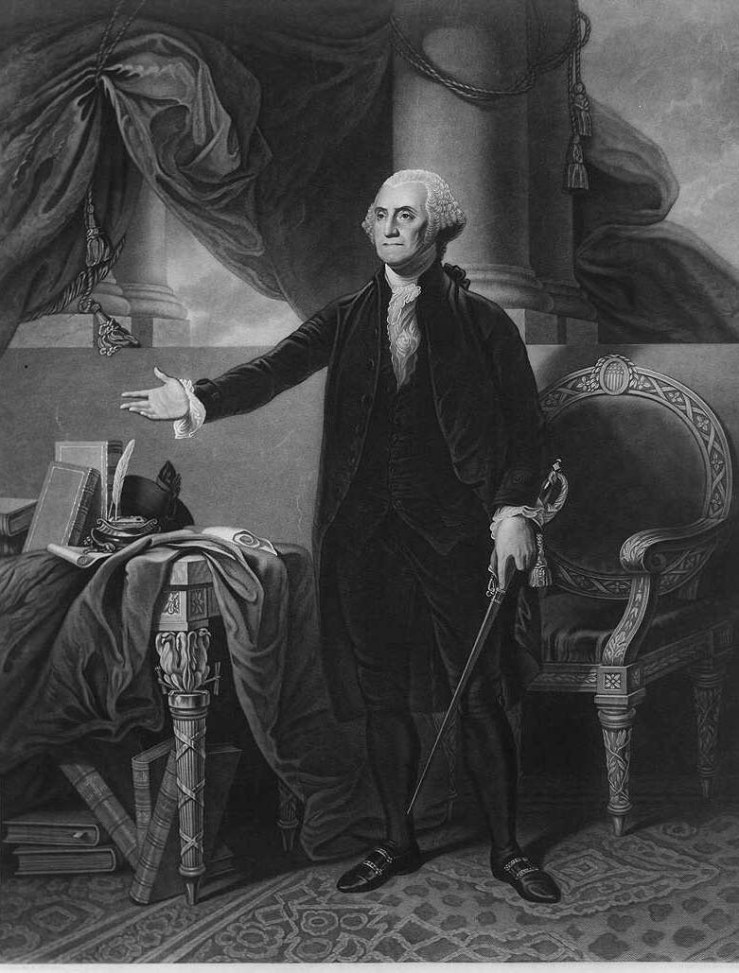
George Washington: Founding Father, Proud Patriot, Biblioklept

George Washington was a biblioklept. MobyLives hipped us to Ed Pilkington’s Guardian article. From the article:

Founder of a nation, trouncer of the English, God-fearing family man: all in all, George Washington has enjoyed a pretty decent reputation. Until now, that is.

The hero who crossed the Delaware river may not have been quite so squeaky clean when it came to borrowing library books.

The New York Society Library, the city’s only lender of books at the time of Washington’s presidency, has revealed that the first American president took out two volumes and pointedly failed to return them.

At today’s prices, adjusted for inflation, he would face a late fine of $300,000.

The library’s ledgers show that Washington took out the books on 5 October 1789, some five months into his presidency at a time when New York was still the capital. They were an essay on international affairs called Law of Nations and the twelfth volume of a 14-volume collection of debates from the English House of Commons.

The ledger simply referred to the borrower as “President” in quill pen, and had no return date.

The Five Geekiest Ways to Celebrate Shakespeare’s Birthday

Want to celebrate William Shakespeare’s birthday (Shakes would be 446 today)? Sure you do. And, undoubtedly, you wish to do so in the geekiest way possible, right? Check out Geekosystem’s post, The Five Geekiest Ways to Celebrate Shakespeare’s Birthday.

In Brief: Beach’s Epistles, Vollmann’s Mummy Sex, and Eggers’s Wild Things

Sylvia Beach was the nexus point for Modernist and ex-pat literature for much of the first half of the twentieth century, running the Left Bank bookstore Shakespeare & Company until the Nazi occupation of Paris in 1941. She was the first publisher of Joyce’s Ulysses, she translated Paul Valéry into English, and was close friends to a good many great writers, including William Carlos Williams, Ezra Pound, H.D., and Ernest Hemingway. In The Letters of Sylvia Beach, editor Keri Walsh compiles many of Beach’s letters from 1901 to just before her death in 1962. Framed by a concise biographical introduction and a useful glossary of correspondents, Letters reveals private insights into a fascinating literary period. There’s a sweetness to Beach’s letters, whether she’s inviting the Fitzgeralds to come to a dinner party or asking Richard Wright (“Dick”) how much he thinks a fair price for a record player is. The Letters of Sylvia Beach is out now from Columbia UP.
I’m a couple of chapters into William T. Vollmann’s 1993 novel Butterfly Stories, one of his (three? four? Dude’s prolific) books about prostitution. The bullied butterfly grows up to be a boy who wants to be a journalist and then a journalist/inept sex tourist in southeast Asia. Good stuff. Here’s a mordantly elegant passage:
Once he began to combine cutting his wrists and half-asphyxiating himself he believed that he’d found the ideal. Afterwards he’d dream of mummy sex with the gentle girl, by which he meant her body being suspended ropelessly above him, then slowly drifting down; when her knee touched his leg he jerked and then went limp there; her hands reached his hands, which died; her breasts rolled softly upon his heart which fibrillated and stopped; finally she lay on top of him, quite docile and still soft . . . He knew that the others didn’t like mummy sex, but that was because they didn’t understand it; they thought that it must be cold; they thought that she must paint her mouth with something to make it look black and smell horrible and soften like something rotten . . . He wanted to open her up until the pelvis snapped like breaking a wishbone. Would that be mummy sex?

Here’s a one-star review of the book from Amazon: “This book is a sordid collection of junk. I picked it out at random from a library shelf and did not enjoy/like/sympathize with even one thing about it. Don’t waste your time.” Guy didn’t like the mummy sex, I guess.

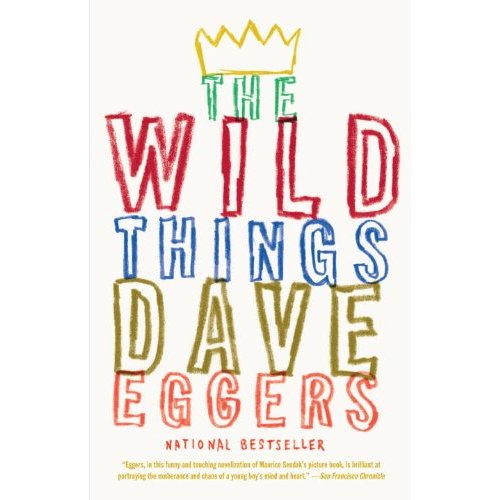
Been working through my reader’s copy of Dave Eggers’s The Wild Things, new in trade paperback from Vintage. I’m having a hard time envisioning a kind of review of the book that escapes the context of the book; that it’s a novelization of a movie script of a Maurice Sendak book of maybe a few dozen words. I loved that book growing up, so no reason that it should be adapted into a feature film, but hoped for the best due to Eggers’s involvement and the fact that the incomparable Spike Jonze was at the rudder. Or helm. Or whatever naval metaphor you wish. Anyway, I absolutely hated the movie–it was mostly melancholy and downright depressing at times. Whereas Sendak’s book channels the joys of transgressive energy while reiterating the need for stable familial order, Jonze’s movie was all sorrow and loss, the hangover of youth, each ecstasy overshadowed in darkness. Too much yin, not enough yang. Anyway. I’ll try to give the book its proper, fair due on its own terms without all that baggage. Full review forthcoming.
Criticism

BodyWorld — Dash Shaw

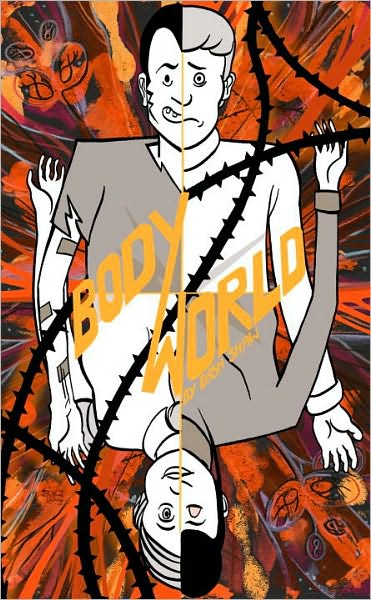
In the future Dash Shaw proposes in his graphic novel BodyWorld, the Second Civil War and rapid industrial growth have left most of America a concrete sprawl by 2060. An exception is Boney Borough, a (literal) green zone somewhere on the Atlantic seaboard. This small secluded town is a new Eden in an otherwise gray world. Enter Professor Paulie Panther, a fuck-up par excellence. He goes to Boney Borough as part of a freelance mission to find out about a new, strange plant he’s found there via the internet. Professor Panther, you see, is a botanist and poet, a would-be scientist who finds out about the psychopharmacological properties of plants by smoking them up in big fat joints (when he’s not too busy trying to commit suicide or stumbling around on one or more of the various drugs to which he’s addicted). Professor Panther is the perfect acerbic foil to the homogeneous folk of Boney Borough. He gets hot for teacher Jem Jewel, turns-on Peach Pearl, the small town girl who wants to go to the big city, and pisses off and confuses her dumb jock boyfriend Billy-Bob Borg. The alliterative names (along with Shaw’s sharp, cartoonish style) recall–and subvert–the classic all-Americanism of Archie comics. Professor Panther soon discovers that the mystery plant, when smoked, grants the user strange telepathic abilities–namely, users sense the “body-mind” of the bodies of others around them.

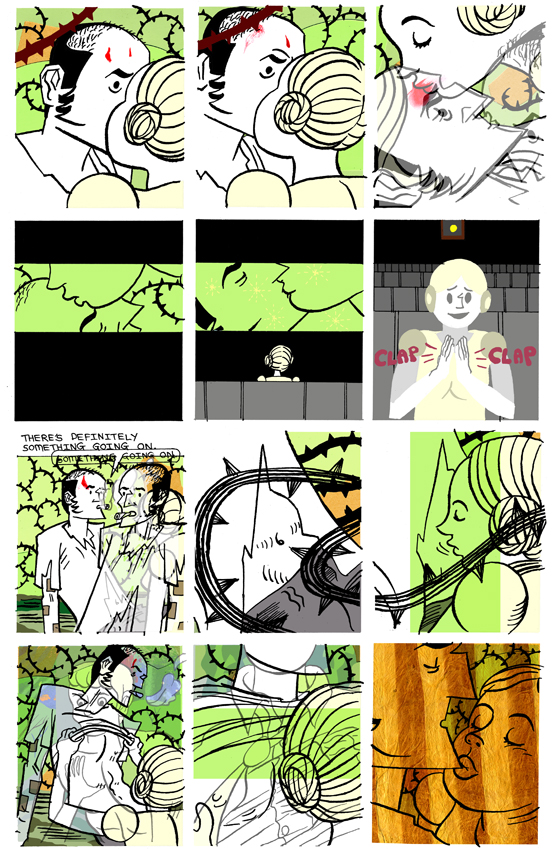
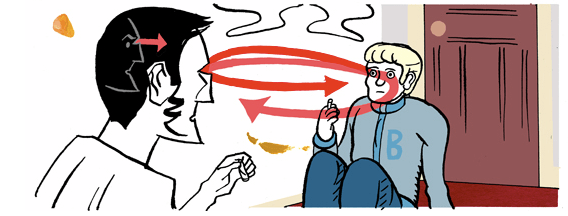
The plant’s telepathic effects allow Shaw to explore what happens within a literalized I-see-you-seeing-me-seeing-you-seeing-me (seeing-y0u-seeing-me . . .) structure. His bright Pop Art goes Cubist in psychedelic trip scenes, superimposing images to show a surreal conflation of not just the melding of two people’s pasts and presents, but those people’s perceptions of past and present. Very heady stuff–but seeing Shaw’s work is superior to my description, of course. Observe, as Panther sees Pearl seeing Panther seeing Pearl idealizing their attempt at romance:

BodyWorld is sardonically humorous in its psychoanalytic visions, guided in no small part by Professor Panther’s hilarious outsider perspective, but also tempered by Shaw’s larger project, a sci-fi satire of American exurbanist insularity. We wrote earlier this month about science fiction’s tendency to work within the dichotomy of wastelands and green zones, and Shaw’s work is no exception. His marvelous trick is to keep us within the green zone of Boney Borough the whole time and to make us identify with a waster, Panther. The greatest irony is that in this futurist vision, the zombies are the ones in the green zone.

Not everyone’s a conformist though. There are exceptions, of course, especially in the seedy Outer Rim where Panther takes up transient residence. We meet a psychotic latter-day Johnny Appleseed who certainly shares Panther’s weirdo proclivities. The episode is a marvelous spoof on the corny “origin stories” standard in Golden and Silver Age comics, with Shaw’s treatment more loving than mocking. To tell more about this weirdo might spoil the climax of Shaw’s graphic novel, and we don’t want to do that, of course, because you’re going to want to read it, aren’t you? Suffice to say that it’s part and parcel of Shaw’s program, a sweet and sour subversion of the 1950s comics and contemporary conformist groupthink politics. Shaw owes some debt to the neat precision, spacing, and rhythm of Chris Ware, as well as the haunting inks and sharp wit of Charles Burns but it would be a mistake to see this young talent as anything but original. Still, while we’re making comparisons: Richard Kelly could make a messy, sprawling treasure of a film out of BodyWorld.

You can read all of BodyWorld now at Shaw’s website, or you can do what I did and read Pantheon’s new graphic novel version (Pantheon, you will remember, brought us the David Mazzucchelli’s outstanding graphic novel Asterios Polyp). Either way, you should read it. Highly recommended.