“Wrong Note” — Thomas Bernhard

20140721-162337-59017776.jpg

Two Rats — Vincent van Gogh

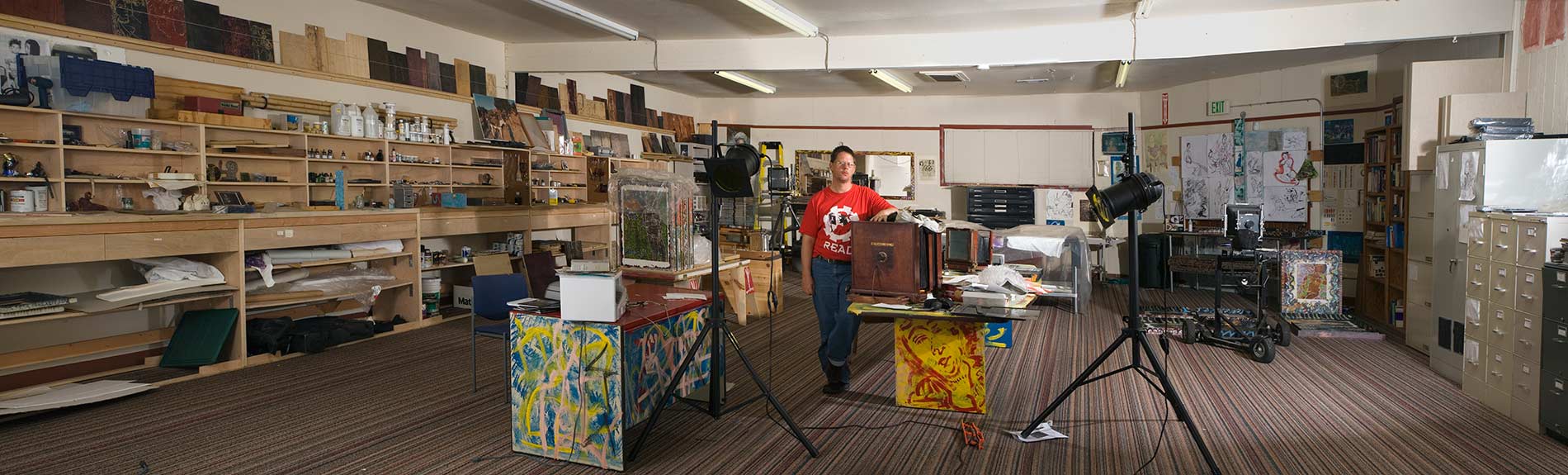
Vollmann in His Studio


There’s a great big fat long profile of William T. Vollmann by Tom Bissell at The New Republic—it’s one of the better pieces I’ve read on an author who is more widely read about than, you know, read.

From the profile, details of a visit to Vollmann’s studio:

Half of Vollmann’s studio felt like a proper gallery, with finished pieces handsomely framed and displayed. The other half was split into what looked like a used bookstore on one side and a struggling industrial arts business on the other. I imagined Vollmann had a gallery somewhere that showed his stuff, yes? Actually, no. “I’ve had a couple of photographer friends who have shows,” Vollmann said. “Every time, they always end up impoverished.” He employs “a couple dealers” who sell his work to various institutions, but he considers his studio a “perpetual gallery.” Vollmann gets additional income from Ohio State, which has been buying Vollmann’s work and manuscripts for several years. Vollmann has no idea why Ohio State has shown such interest in his work, but he’s grateful to the institution, which has been paying the mortgage on his studio for the last decade.

He began our tour proper while a dinging train from the city’s light-rail line rumbled by, just feet from his curtained windows. Woodcuts, watercolors, ink sketches, silver-gelatin black-and-white photographs, portraits. “Gum-printing is a nineteenth-century technique,” he told me. “It’s the most permanent coloring process. But it’s slow, and toxic. … I also have this device here, which is based in dental technology. … It’s like a non-vibrating, very high-speed Dremel tool. … This was originally drawn with pen and ink, and then I had a magnesium block made with a photo resist.” Some of the pieces he showed me were complete; most were not. He estimated that he has “dozens and dozens” of pieces going at any one time.

Vollmann’s most important artistic influences are Gauguin and what he described as the “power colors” of Native American art. His other inescapable influence is the female body. The majority of Vollmann’s visual art centers upon women generally and geishas, sex workers, and those he calls “goddesses” specifically. Usually they are nude. From where I was standing I counted at least two dozen vaginas, their fleshy machinery painstakingly drawn and then painted over with a delicate red slash. Vollmann uses live models, so every vagina within sight is currently out there right now, wandering the world.

A New Yorker Short Fiction Reading List


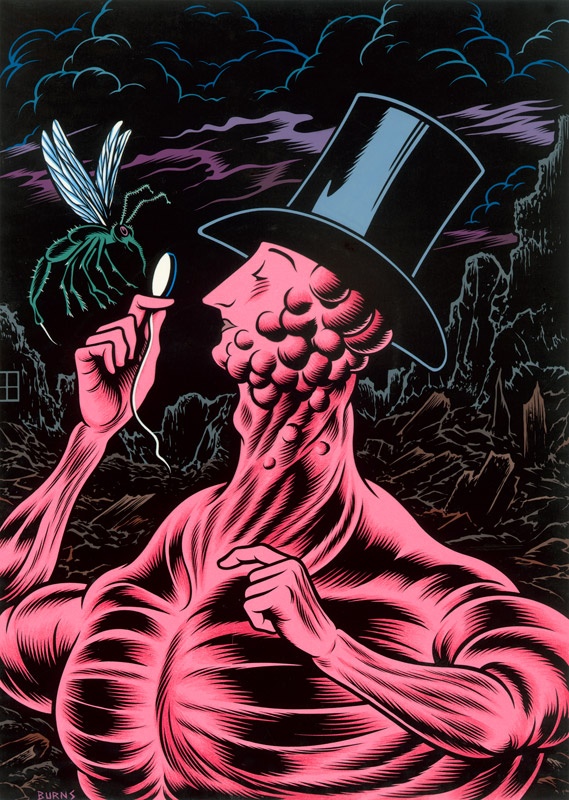
Mutant Eustace Tilley (The New Yorker's Mascot) by Charles Burns
Mutant Eustace Tilley (The New Yorker’s Mascot) by Charles Burns

As you, savvy reader, are undoubtedly already aware, The New Yorker has opened up some of its archive for the rest of the summer (to show off its website redesign, I guess).

Here’s a reading list of short fiction from the archives (admittedly, some of the stuff I wanted to put on here is still behind a paywall).

Some of the stories on the list are classics, some are pieces I’ve shared on this blog before, some are excerpts from longer works, and a few are stories I have yet to read myself.

“The Daughters of the Moon” by Italo Calvino

“Backbone” by David Foster Wallace

“1966” by Denis Johnson

“My Father Addresses Me on the Facts of Old Age” by Grace Paley

“The Insufferable Gaucho” by Roberto Bolaño

“Victory Lap” by George Saunders

“Leopard” by Wells Tower

“Gorse Is Not People” by Janet Frame

“Rough Deeds” by Annie Proulx

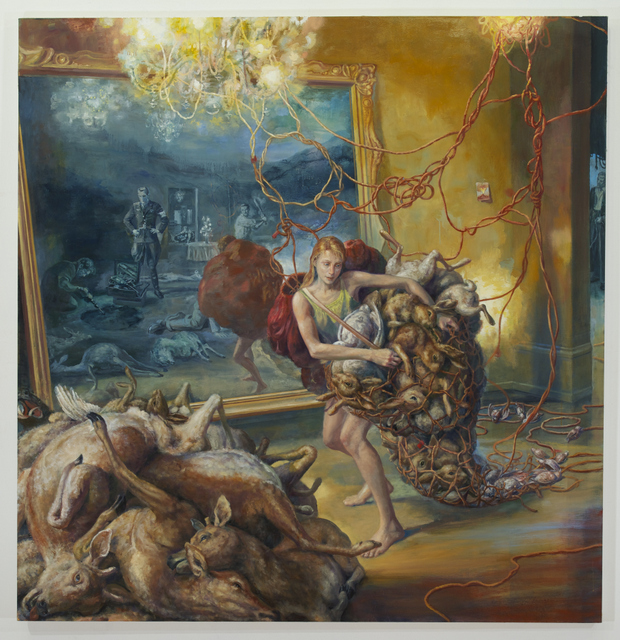
Self Portrait as Gatherer — Julie Heffernan

Julie-Heffernan-Self-Portrait-as-Gatherer_2013_Oil-on-canvas-68x66

“Gavin Highly” — Janet Frame

Did it happen this way? The land lay like stone, and one night, all night long, rain pelted down on it the way people, they say, hammer hard on a stone to find blood. And in the morning the land was cut in two by a deep flow of creek, clotted with red weed—Gavin Highly’s creek.

But all this was a long time ago. I did not know back then that hearts could be laid out like land and cut in two by storms coming out of the sky, or that dreams could be thrown, as Gavin Highly threw the ashes of his fire or his oyster shells or his old tins and bottles or his scraps of food, deep into the dark flowing divided heart to be buried there. I did not know, and my brother did not know. We cared more about plums—ah, they were yellow and dusty blue and hung on trees, over Gavin Highly’s fence, and in the early autumn the sun burned on each plum till its tight yellow or blue dusty skin gave in and rolled up like a blind to let in more sun. The plums split and were ripe and we ate them and, if Gavin Highly caught us, all he said, in one breath, was “Hop-it-you.” I think he understood about plums.

Read the rest of Janet Frame’s story “Gavin Highly” at The New Yorker.

A Compelling Reason — Felix Vallotton

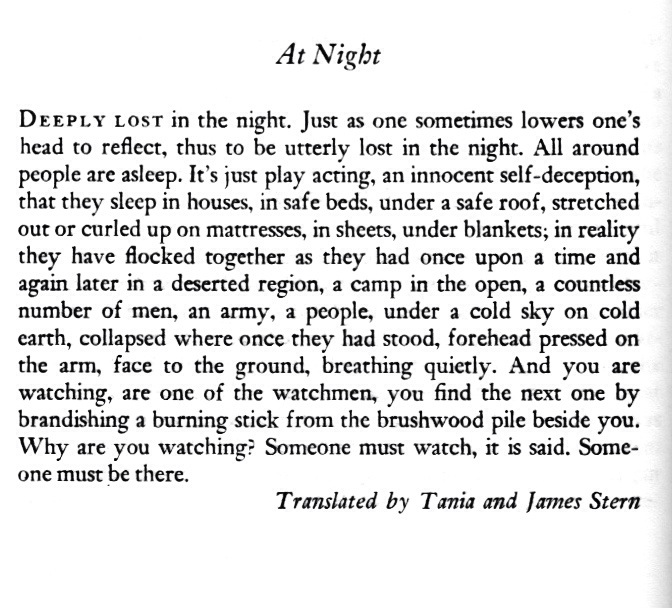
“At Night” — Franz Kafka

20140721-162337-59017116.jpg

Japanese Trailer for Studio Ghibli’s Newest Film, When Marnie Was There

When-Marnie-Was-There-Ghibli

From Beating — Tommi Musturi

beating

David Lynch Interviewed by Mike Figgis

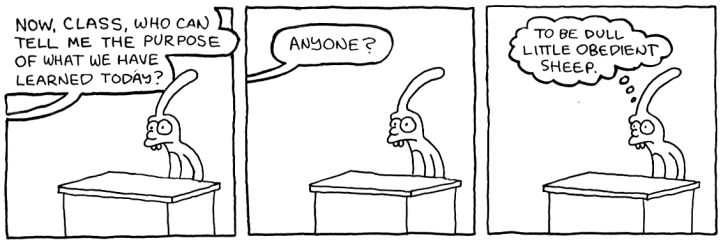
Purpose (Life in Hell)

purpose

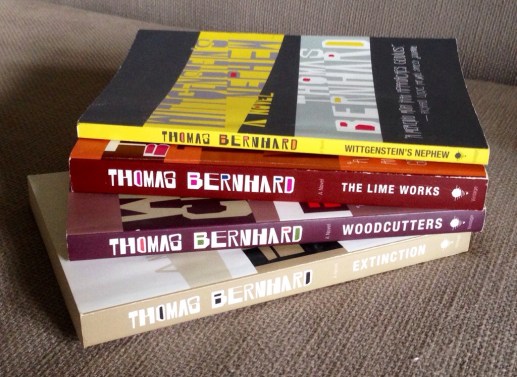
Four by Thomas Bernhard (Books Acquired, 7.15.2014)

20140716-162726-59246033.jpg

So the other week, Turner wrote, at my favorite local bookstore—a labyrinthine maze you wouldn’t believe, formed from wooden frames filled with dusty paper stacks, obstacles of boxed books, unexplored (the boxed books, not the shelves), littering the pathways (the boxed books)—just under 2 million books (all the books, shelved, and boxed), if a certain clerk is to be believed (and I believe her)—and you wouldn’t believe, and I know you wouldn’t believe because I go there often enough, me, living just a mile away, sometimes walking, briskly, or at an even pace—and with this free time on my hands, and with all these unsolicited review copies, creating a little pool of credit, of trade of etc.—I know you wouldn’t believe because I so often hear the irregular clientele remarking on their own personal disbelief, or their own befuddlement, or, more often, I see them get lost, and even then I’m enjoying that, maybe offering (mis)direction, or, more likely, intercepting the high school seniors—What are you reading? Yes? Faulkner! No! Not that edition!—And so the other week at my favorite local bookstore, I happened upon, neatly stacked in a to-be-shelved shelf, a neatly stacked stack of Thomas Bernhard novels, or, more precisely, a compliment stack of Thomas Bernhard novels, a so-called stack of novels that I did not so-call “own,” a so-called stack of Thomas Bernhard novels that I had not read, not to mention have in my own personal possession, a little series of Vintage English translation editions that could be nestled next to my own meager collection, already, yes, Gargoyles and Correction and Concrete and Yes and The Loser and The Voice Imitator and Frostbut not Old Masters, and Old Masters not in this neatly-stacked bundle (it was never a bundle), no, not Old Masters, which, Turner wrote, Chang wrote about on this so-called website, no, no not Old Masters, not in the so-called bundle, but what to begrudge, begrudge that, no, Turner thought and wrote, and then, looking back over what he had written, thought, No, this is rubbish, I must delete all this, I must erase all this and not push publish.

Woman Reading Book with Orange — Georgy Kurasov

tumblr_nf2hcwWAxE1qz6f9yo3_1280

Two Fighting Hummingbirds with Two Orchids — Martin Johnson Heade

That long long, bloated epicene tract “The Waste Land” by Eliot (Barry Hannah)

That long long, bloated epicene tract “The Waste Land” by Eliot—the slideshow of some snug librarian on the rag—was nothing, unworthy, in the notes that every sissy throws away. I would not talk to students about it. You throw it down like pickled eggs with nine Buds and move on to giving it to the preacher’s wife on a hill while she spits on a photograph of her husband.

From Barry Hannah’s short story “Ride, Fly, Penetrate, Loiter.” Collected in Captain Maximus. (Captain Maximus is the narrator here, by the bye).

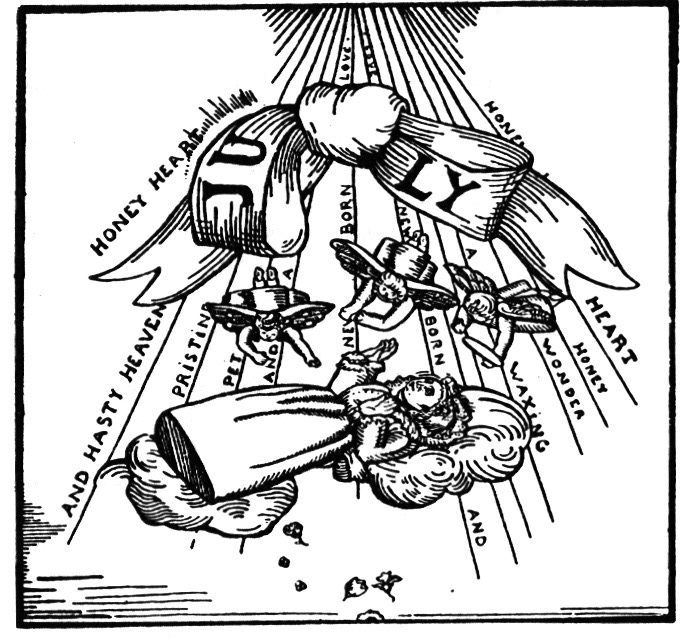
July — Djuna Barnes

20140721-162338-59018441.jpg

From Djuna Barnes’s Ladies Almanack.