Making a weekend trip from the east coast of Florida to its Gulf shores, my family and I listened to Nicol Williamson’s early 1970s recording of J.R.R. Tolkien’s The Hobbit. Williamson’s recording is rich and expressive, his command of each voice bringing Tolkien’s characters to life.
I first heard Williamson’s recording over twenty years ago on a series of LPs that I checked out from the library. I had probably already read The Hobbit half a dozen times by then, but Williamson’s sonorous voice—along with the music and audio production effects—added another layer to Middle Earth.
My daughter, five, already familiar with the 1977 Rankin-Bass film, had no problem keeping pace with the story (although she occasionally asked me to pause for clarification on a few finer points, such as the delicate distinctions between goblins and trolls, or just who exactly is this guy Bard who shows up all of a sudden?) My favorite part of the entire weekend was my two year old imitating Gollum, sniveling a sinister, “My precious!” while squinting gleefully.
There are few books I’ve read as many times as Tolkien’s The Lord of the Rings trilogy: I read it countless times between the ages of 11 and 15, read it again as an undergrad, then read it again–twice, I’m not ashamed to admit—when Peter Jackson’s adaptations came out. However, despite reading The Hobbit repeatedly as a kid, I’ve never really gone back to it. It traffics in a gentle folklore that seems out of square with the epic mythmaking in The Lord of the Rings, and I think that I was always unsettled by a certain discontinuity between the two books that was easier to ignore if I never went back to The Hobbit.
Memory has a way of eliding details, and books are especially susceptible to this wearing down and smoothing out. So, I remembered The Hobbit as a quest, a miniature epic with Bilbo Baggins leaving the comforts of home to find treasure guarded by the dragon Smaug. I remembered Gandalf and the thirteen dwarves invading Bilbo’s tidy hobbit hole; I remembered trolls who turn to stone; I remembered riddles with Gollum and a ring that turns its wearer invisible; I remembered Mirkwood and barrels and the mountain lair of a dragon. I vaguely remembered the Battle of Five Armies, where the enormous eagles literally swoop in and save the day, deus ex machina style.
Listening to the unabridged audio, I was struck by just how much had escaped my memory: I barely recalled the spiders of Mirkwood or the talking ravens or the part where the wargs tree the dwarves. I had completely forgotten the shapeshifter Beorn, a creature straight out of Scandinavian myth.
One of Tolkien’s original illustrations for The Hobbit
What I found most strange in revisiting The Hobbit though was its radical compression, its tendency and willingness to pivot sharply, to cast its characters about or trample them under (metaphorical and sometimes literal) foot, or throw them in dungeons or barrels or some other danger.
Whereas The Lord of the Rings progresses from the folkloric feel of The Shire through to the high-adventure sweep of Icelandic saga and ultimately to a King Jamesish condensation of near-pure archetypery (and back again, of course), The Hobbit showcases a rambling, flowing, discursive, “out of the frying pan, into the fire” rhythm.
In short, The Hobbit, as it turns out, is a picaresque novel.
And just what is a picaresque novel, and why is The Hobbit one?, you may or may not ask.
Michael Seidel offers a clear definition in his introduction to Daniel Defoe’s Moll Flanders (an excellent picaresque, by the way):
. . . the tradition of Continental picaresque, or rogue, literature . . . became popular throughout Europe with the publication of Lazarillo de Tormes (1554) in Spain. Picarós and picarás are orphans, vagabonds, desperadoes, and reprobates trying to manipulate the conventions of a world largely determined by established family and class connections. . . . Picaresque fiction is the story of outsiders trying to get in, and the fortunes of the protagonist often depend on adaptable, protean, and duplicitous behavior as picaresque characters become who they need to be to survive.
The Hobbit is very much the story of the topsy-turvy turns of Bilbo Baggins’s identity. At the adventure’s outset, he’s a respectable—comfortable—Baggins of Bag End. Not the sort of fellow who goes on adventures. And yet he’s enlisted by Gandalf to serve as burglar for the expedition, a picaró in the making who steals a purse from a troll and never looks back.
It’s not just Bilbo’s various thefts, but also his “adaptable, protean, and duplicitous behavior” that marks him as a picaró. His scheming is evident repeatedly in the novel, whether he’s riddling with Gollum or Smaug, devising a breakout from the Elf King of Mirkwood’s dungeon, or playing the long con against the parties involved in the Battle of Five Armies. He echoes Gandalf in this way, whose talents seem to veer more toward trickery and cunning than dazzling spells or marvelous magic.
Bilbo’s picaresque turns of fortune and turns of identity are neatly summarized in a late exchange with yon dragon Smaug, who immediately calls him out as a picaró:
“You have nice manners for a thief and a liar,” said the dragon. “You seem familiar with my name, but I don’t seem to remember smelling you before. Who are you and where do you come from, may I ask?”
“You may indeed! I come from under the hill, and under hills and over the hills my paths led. And through the air, I am he that walks unseen.”
“So I can well believe,” said Smaug, “but that is hardly our usual name.”
“I am the clue-finder, the web-cutter, the stinging fly. I am chosen for the lucky number.”
“Lovely titles!” sneered the dragon. “But lucky numbers don’t always come off.”
“I am he that buries his friends alive and drowns them and draws them alive again from the water. I came from the end of a bag, but no bag went over me.”
“These don’t sound so creditable,” scoffed Smaug.
“I am the friend of bears and the guest of eagles. I am Ringwinner and Luckwearer; and I am Barrel-rider,” went on Bilbo beginning to be pleased with his riddling.
“That’s better!” said Smaug. “But don’t let your imagination run away with you!”
But imagination is of course the primary tool of the picaró, and Bilbo is no slouch: The Hobbit condemns evil, greedy Smaug when it shows the rewards of letting “your imagination run away with you.” Indeed, the entire novel is a running away, a constant deflection of stable identity, as Bilbo twists and turns his way back to The Shire.
And what happens to Bilbo? What happens to that once-stable, once-comfortable identity? We learn at the novel’s end about the queering of his identity—
. . . he had lost his reputation. It is true that for ever after he remained an elf-friend, and had the honour of dwarves, wizards, and all such folk as ever passed that way; but he was no longer quite respectable. He was in fact held by all the hobbits of the neighbourhood to be ‘queer’—except by his nephews and nieces on the Took side, but even they were not encouraged in their friendship by their elders. I am sorry to say he did not mind.
So! Queer, strange Baggins the picaró embraces his “Took side,” his disreputable adventuring side. And still the narrative comes to a lovely cozy warm respectable ending, Bilbo’s identity transformed, sullied, illuminated, and enlarged by his picaresque adventure.
And the picaresque? Well, maybe I’ve stretched its definition a bit simply because I’m so fond of picaresque narratives these days. Maybe I’ve simply revisited a childhood classic and imposed a new viewpoint upon it. (And maybe years and years from now I’ll revisit it again with grandchildren, and find something new and different there as well. I hope).
I think what I enjoyed most about The Hobbit this time was hearing the rambling discursiveness of it all—here we have a narrative that understands the perilous and precarious position of the storyteller, he or she who might lose the thread—or worse, lose the audience!—at any damn time. So keep the story sailing, shifting, rambling out into new moods, modes, movements.
And this is the power of The Hobbit—which is to say the staying power of The Hobbit—its ability to evoke the imaginative force of one damned thing after another sheerly happening for generation after generation.
[Editorial note: Biblioklept originally published this review in October of 2012. I’m rerunning it today in honor of The Hobbit’s 80th anniversary. My daughter is five years older, and has since read the book on her own. She loves it.]
I returned to classes on Monday after 10 humid, uncomfortable, and often scary days “off” due to Hurricane Irma. In the slim hour and change between my last lecture and my kids’ school dismissal, I swung by my favorite used bookshop. I was worried that it might have flooded, but the waters didn’t get to the inventory (well over a million books).
I picked up a a PKD Daw edition, a mass market paperback, Deus Irae, co-authored with Roger Zelazny. I’ve been picking up pretty much any early PKD mass market ppbk; new editions of his stuff tend to be pretty boring. I had to pick between two editions:
I also picked up Eddie Campbell’s Alec: How to Be an Artist, which I gobbled up the other day in two sittings. There’s a pretty neat canon of graphic novels at the end, which I’ll share later this week. The cover looks like an illustration of Roberto Bolaño to me.
I also picked up two Roald Dahl books we didn’t have, Esio Trot and Danny the Champion of the World, which my kids read immediately and greedily.
I will define science fiction, first, by saying what sf is not. It cannot be defined as “a story (or novel or play) set in the future,” since there exists such a thing as space adventure, which is set in the future but is not sf: it is just that: adventures, fights and wars in the future in space involving super-advanced technology. Why, then, is it not science fiction? It would seem to be, and Doris Lessing (e.g.) supposes that it is. However, space adventure lacks the distinct new idea that is the essential ingredient. Also, there can be science fiction set in the present: the alternate world story or novel. So if we separate sf from the future and also from ultra-advanced technology, what then do we have that can be called sf?
We have a fictitious world; that is the first step: it is a society that does not in fact exist, but is predicated on our known society; that is, our known society acts as a jumping-off point for it; the society advances out of our own in some way, perhaps orthogonally, as with the alternate world story or novel. It is our world dislocated by some kind of mental effort on the part of the author, our world transformed into that which it is not or not yet. This world must differ from the given in at least one way, and this one way must be sufficient to give rise to events that could not occur in our society—or in any known society present or past. There must be a coherent idea involved in this dislocation; that is, the dislocation must be a conceptual one, not merely a trivial or bizarre one—this is the essence of science fiction, the conceptual dislocation within the society so that as a result a new society is generated in the author’s mind, transferred to paper, and from paper it occurs as a convulsive shock in the reader’s mind, the shock of dysrecognition. He knows that it is not his actual world that he is reading about.
Now, to separate science fiction from fantasy. This is impossible to do, and a moment’s thought will show why. Take psionics; take mutants such as we find in Ted Sturgeon’s wonderful MORE THAN HUMAN. If the reader believes that such mutants could exist, then he will view Sturgeon’s novel as science fiction. If, however, he believes that such mutants are, like wizards and dragons, not possible, nor will ever be possible, then he is reading a fantasy novel. Fantasy involves that which general opinion regards as impossible; science fiction involves that which general opinion regards as possible under the right circumstances. This is in essence a judgment-call, since what is possible and what is not possible is not objectively known but is, rather, a subjective belief on the part of the author and of the reader.
Now to define good science fiction. The conceptual dislocation—the new idea, in other words—must be truly new (or a new variation on an old one) and it must be intellectually stimulating to the reader; it must invade his mind and wake it up to the possibility of something he had not up to then thought of. Thus “good science fiction” is a value term, not an objective thing, and yet, I think, there really is such a thing, objectively, as good science fiction.
I think Dr. Willis McNelly at the California State University at Fullerton put it best when he said that the true protagonist of an sf story or novel is an idea and not a person. If it is good sf the idea is new, it is stimulating, and, probably most important of all, it sets off a chain-reaction of ramification-ideas in the mind of the reader; it so-to-speak unlocks the reader’s mind so that that mind, like the author’s, begins to create. Thus sf is creative and it inspires creativity, which mainstream fiction by-and-large does not do. We who read sf (I am speaking as a reader now, not a writer) read it because we love to experience this chain-reaction of ideas being set off in our minds by something we read, something with a new idea in it; hence the very best science fiction ultimately winds up being a collaboration between author and reader, in which both create—and enjoy doing it: joy is the essential and final ingredient of science fiction, the joy of discovery of newness.
(in a letter) May 14,1981
From a letter by Philip K. Dick, used as the preface to The Collected Stories of Philip K. Dick, Vol. 1.
This question, central to the science of therolinguistics, has been answered—heuristically—by the very existence of the science. Language is communication. That is the axiom on which all our theory and research rest, and from which all our discoveries derive; and the success of the discoveries testifies to the validity of the axiom. But to the related, yet not identical question, What is Art? we have not yet given a satisfactory answer.
Tolstoy, in the book whose title is that very question, answered it firmly and clearly: Art, too, is communication. This answer has, I believe, been accepted without examination or criticism by therolinguists. For example: Why do therolinguists study only animals?
Why, because plants do not communicate.
Plants do not communicate; that is a fact. Therefore plants have no language; very well; that follows from our basic axiom. Therefore, also, plants have no art. But stay! That does not follow from the basic axiom, but only from the unexamined Tolstoyan corollary.
What if art is not communicative?
Or, what if some art is communicative, and some art is not?
Ourselves animals, active, predators, we look (naturally enough) for an active, predatory, communicative art; and when we find it, we recognise it. The development of this power of recognition and the skills of appreciation is a recent and glorious achievement.
But I submit that, for all the tremendous advances made by therolinguistics during the last decades, we are only at the beginning of our age of discovery. We must not become slaves to our own axioms. We have not yet lifted our eyes to the vaster horizons before us. We have not faced the almost terrifying challenge of the Plant.
If a non-communicative, vegetative art exists, we must rethink the very elements of our science, and learn a whole new set of techniques.
For it is simply not possible to bring the critical and technical skills appropriate to the study of Weasel murder mysteries, or Batrachian erotica, or the tunnel sagas of the earthworm, to bear on the art of the redwood or the zucchini.
This is proved conclusively by the failure—a noble failure—of the efforts of Dr. Srivas, in Calcutta, using time-lapse photography, to produce a lexicon of Sunflower. His attempt was daring, but doomed to failure. For his approach was kinetic—a method appropriate to the communicative arts of the tortoise, the oyster, and the sloth. He saw the extreme slowness of the kinesis of plants, and only that, as the problem to be solved.
But the problem was far greater. The art he sought, if it exists, is a non-communicative art: and probably a non-kinetic one. It is possible that Time, the essential element, matrix, and measure of all known animal art, does not enter into vegetable art at all. The plants may use the meter of eternity. We do not know.
We do not know. All we can guess is that the putative Art of the Plant is entirely different from the Art of the Animal. What it is, we cannot say; we have not yet discovered it. Yet I predict with some certainty that it exists, and that when it is found it will prove to be, not an action, but a reaction: not a communication, but a reception. It will be exactly the opposite of the art we know and recognise. It will be the first passive art known to us.
Can we in fact know it? Can we ever understand it?
It will be immensely difficult. That is clear. But we should not despair. Remember that so late as the mid-twentieth century, most scientists, and many artists, did not believe that Dolphin would ever be comprehensible to the human brain—or worth comprehending! Let another century pass, and we may seem equally laughable. “Do you realise,” the phytolinguist will say to the aesthetic critic, “that they couldn’t even read Eggplant?” And they will smile at our ignorance, as they pick up their rucksacks and hike on up to read the newly deciphered lyrics of the lichen on the north face of Pike’s Peak.
And with them, or after them, may there not come that even bolder adventurer—the first geolinguist, who, ignoring the delicate, transient lyrics of the lichen, will read beneath it the still less communicative, still more passive, wholly atemporal, cold, volcanic poetry of the rocks: each one a word spoken, how long ago, by the earth itself, in the immense solitude, the immenser community, of space.
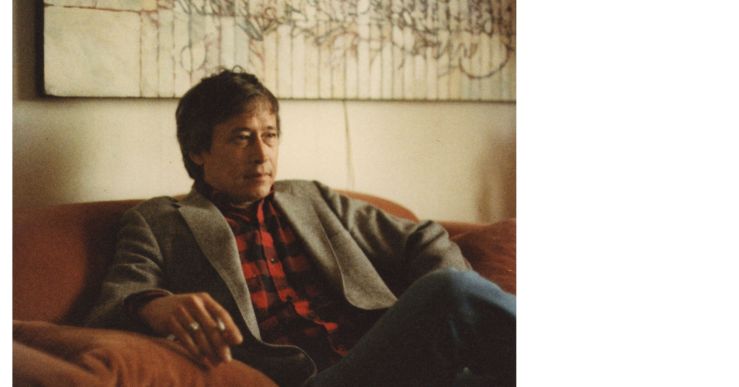
Hannah had driven out to Hollywood proudly on his Triumph motorcycle, he and Altman having settled on a meeting place, whereupon Altman was to guide him the rest of the way to his home in Malibu. But when Altman arrived, Hannah hadn’t showed. The filmmaker waited for an hour, increasingly frustrated, until he noticed, across the street, a peep show and adult video store. As Rapp remembers him putting it, Altman thought to himself, “That fucker would be just crazy enough . . .” He wandered inside the adult emporium and there found Hannah, deeply absorbed.
The article is pretty great, larded with nuggets from Hannah’s correspondence and not a few wild anecdotes. Check it out.






 Biblioklept