“On the Pleasure Derived from Objects of Terror” (1773)
by
Anna Letitia Aikin
That the exercise of our benevolent feelings, as called forth by the view of human afflictions, should be a source of pleasure, cannot appear wonderful to one who considers that relation between the moral and natural system of man, which has connected a degree of satisfaction with every action or emotion productive of the general welfare. The painful sensation immediately arising from a scene of misery, is so much softened and alleviated by the reflex sense of self-approbation on attending virtuous sympathy, that we find, on the whole, a very exquisite and refined pleasure remaining, which makes us desirous of again being witnesses to such scenes, instead of flying from them with disgust and horror. It is obvious how greatly such a provision must conduce to the ends of mutual support and assistance. But the apparent delight with which we dwell upon objects of pure terror, where our moral feelings are not in the least concerned, and no passion seems to be excited but the depressing one of fear, is a paradox of the heart, much more difficult of solution.
The reality of this source of pleasure seems evident from daily observation. The greediness with which the tales of ghosts and goblins, of murders, earthquakes, fires, shipwrecks, and all the most terrible disasters attending human life, are devoured by every ear, must have been generally remarked. Tragedy, the most favourite work of fiction, has taken a full share of those scenes; “it has supt full with horrors”–and has, perhaps, been more indebted to its tender and pathetic parts. The ghost of Hamlet, Macbeth descending into the witches’ cave, and the tent scene in Richard, command as forcibly the attention of our souls as the parting of Jasseir and Belvidera, the fall of Wolsey, or the death of Shore. The inspiration of terror was by the antient critics assigned as the peculiar province of tragedy; and the Greek and Roman tragedians have introduced some extraordinary personages for this purpose: not only the shades of the dead, but the furies and other fabulous inhabitants of the infernal regions. Collins, in his most poetical ode to Fear, has finely enforced this idea. “Tho’ gentle Pity claims her mingled part, Yet all the thunders of the scene are thine.” The old Gothic romance and the Eastern tale, with their genii, giants, enchantments, and transformations, however a refined critic may censure them as absurd and extravagant, will ever retain a most powerful influence on the mind, and interest the reader independently of all perculiarity of taste. Thus the great Milton, who had a strong bias to these wildnesses of the imagination, has with striking effect made the stories “of forests and enchantments drear,” a favourite subject with his Penseroso; and had undoubtedly their awakening images strong upon his mind when he breaks out,
“Call up him that left half-told
The story of Cambuscan bold; &c.”How are we then to account for the pleasure derived from such objects? I have often been led to imagine that there is a deception in these cases; and that the avidity with which we attend is not a proof of our receiving real pleasure. The pain of suspense, and the irresistible desire of satisfying curiosity, when once raised, for our eagerness to go quite through an adventure, though we suffer actual pain during the whole course of it. We rather chuse to suffer the smart pang of a violent emotion than the uneasy craving of an unsatisfied desire. That this principle, in many instances, may involuntarily carry us through what we dislike, I am convinced from experience. This is the impulse which renders the poorest and most insipid narrative interesting when once we get fairly into it; and I have frequently felt it with regard to our modern novels, which, if lying on my table, and taken up in an idle hour, have led me through the most tedious and disgusting pages, while, like Pistol eating his leek, I have swallowed and execrated to the end. And it will not only force us through dulness, but through actual torture–through the relation of a Damien’s execution, or an inquisitor’s act of faith. When children, therefore, listen with pale and mute attention to the frightful stories of apparitions, we are not, perhaps, to imagine that they are in a state of enjoyment, any more than the poor bird which is dropping into the mouth of the rattlesnake–they are chained by the ears, and fascinated by curiosity. This solution, however, does not satisfy me with respect to the well-wrought scenes of aritificial terror which are formed by a sublime and vigorous imagination. Here, though we know before-hand what to expect, we enter into them with eagerness, in quest of a pleasure already experienced. This is the pleasure constantly attached to the excitement of surprise from new and wonderful objects. A strange and unexpected event awakens the mind, and keeps it on the stretch; and where the agency of invisible beings is introduced, of “forms unseen, and mightier far than we,” our imagination, darting forth, explores with rapture the new world which is laid open to its view, and rejoices in the expansion of its powers. Passion and fancy cooperating elevate the soul to its highest pitch; and the pain of terror is lost in amazement.
Hence the more wild, fanciful, and extraordinary are the circumstance of a scene of horror, the more pleasure we receive from it; and where they are too near common nature, though violently borne by curiosity through the adventure, we cannot repeat it or reflect on it, without an overbalance of pain. In the Arabian Nights are many most striking examples of the terrible joined with the marvellous: the story of Alladin, and the travels of Sinbad, are particularly excellent. The Castle of Otranto is a very spirited modern attempt upon the same plan of mixed terror, adapted to the model of Gothic romance. The best conceived, and most strongly worked-up scene of mere natural horror that I recollect, is in Smollett’s Ferdinand Count Fathom; where the hero, entertained in a lone house in a forest, finds a corpse just slaughtered in the room where he is sent to sleep, and the door of which is locked upon him. It may be amusing for the reader to compare his feelings upon these, and from thence form his opinion of the justness of my theory.
If, after our historically discontinuous examples of the paranoid style, we now take the long jump to the contemporary right wing, we find some rather important differences from the nineteenth-century movements. The spokesmen of those earlier movements felt that they stood for causes and personal types that were still in possession of their country—that they were fending off threats to a still established way of life. But the modern right wing…feels dispossessed: America has been largely taken away from them and their kind, though they are determined to try to repossess it and to prevent the final destructive act of subversion. The old American virtues have already been eaten away by cosmopolitans and intellectuals; the old competitive capitalism has been gradually undermined by socialistic and communistic schemers; the old national security and independence have been destroyed by treasonous plots, having as their most powerful agents not merely outsiders and foreigners as of old but major statesmen who are at the very centers of American power. Their predecessors had discovered conspiracies; the modern radical right finds conspiracy to be betrayal from on high.
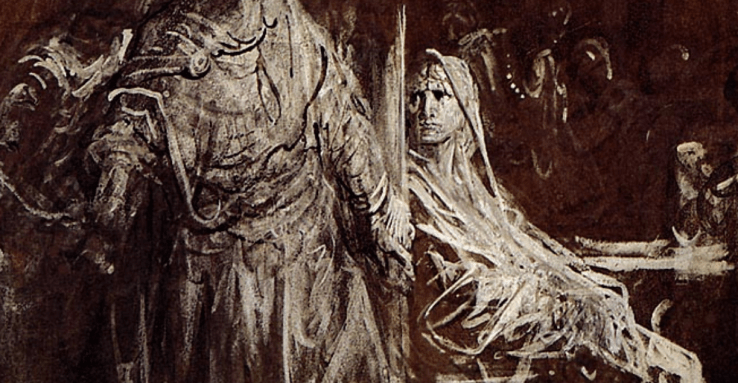
Detail from Spectrum Appearance of Banquo by Gustave Doré.
Roberto Bolaño’s short story “The Return” is so good that it has two perfect opening paragraphs:
I have good news and bad news. The good news is that there is life (of a kind) after this life. The bad news is that Jean-Claude Villeneuve is a necrophiliac.
That’s a hell of a way to start a story! Bolaño lays out his two themes—the afterlife and necrophilia—in a jovial, almost cavalier, but dare I say sweet, even charming way. And then this paragraph:
Death caught up with me in a Paris disco at four in the morning. My doctor had warned me, but some things are stronger than reason. I was convinced, mistakenly (and even now it’s something I regret), that drinking and dancing were not the most hazardous of my passions. Another reason I kept going out every night to the fashionable places in Paris was my routine as a middle manager at Fracsa; I was after what I couldn’t find at work or in what people call the inner life: the buzz that you get from a certain excess.
Those are the first two paragraphs, and maybe they’ll entice you to read the story. However, the following riff includes what some people might consider spoilers; my hope is that if you’ve never read it before, you’ll take it on faith that “The Return” is a great, great story and you’ll go read it and stop reading this riff now. (Maybe come back later though after you’ve read it).
“The Return” is a ghost story that transmutes the horror of death and the abjection of the corpse into love, empathy, and communication—and art. It’s a beautiful ghost tale in the Romantic, Gothic tradition of Edgar Allan Poe, from whom Bolaño drew heavily. However, while Poe’s tales of necrophilia (like the poem “Annabel Lee,” “The Fall of the House of Usher,” and “Berenice” to name just a few) obsess over repression, loss, burial, and imperfect and violent attempts at restoration, Bolaño’s “The Return” offers its readers a peaceful reconciliation with death. It’s collected in The Return (New Directions, English translation by Chris Andrews), which is a perfect introduction to Bolaño—so many great stories there (“Buba,” “Clara,” “William Burns,” etc.). So go read it.
So but and anyway: a close reading continued for those inclined.
Our narrator is a ghost, a man who died on the dance floor. Bolaño’s next move is so ridiculous that it almost seems unbelievable at first:
Like just about everyone else, I went to see Ghost, I don’t know if you remember it, a box office hit, with Demi Moore and Whoopi Goldberg, the one where Patrick Swayze gets killed and his body is left lying on a Manhattan street, or in an alley, maybe, on a dirty pavement anyway, while in a special-effects extravaganza (they were special for the time, anyway) his soul comes out of his body and stares at it in astonishment. Well, apart from the special effects, I thought it was idiotic. A typical Hollywood cop-out, inane and unbelievable.
But when my turn came, that’s exactly what happened.
The narrator is quick to accept the conceit—he’s quick to accept a lot in this story. He concedes of Hollywood artifice that there’s “more to American naiveté than meets the eye; it can hide something that we Europeans can’t or don’t want to understand.” This acceptance quickly turns into a new affect: strange joy: “Once I was dead, I felt like bursting out laughing.” (Forgive me, but it’s impossible for me not to note that “The Return” was composed very late in Bolaño’s too-short life, that its composition strikes me as a kind of love letter to his audience, more than a consolation prize: a gift).
Our ghost-narrator, not quite sure what to do, follows his corpse to the morgue: “What a paltry thing it seemed, my body or my ex-body (I’m not sure how to put it), confronted with the labyrinthine bureaucracy of death.” The labyrinthine bureaucracy of death!
The (metaphysical) narrator then starts to reflect on metaphysical matters:
The feeling of dizziness gradually abated, although at one point I got to thinking about heaven and hell, reward and punishment, and I had a panic attack, but that bout of irrational fear was soon over. And, in fact, I was starting to feel better.
Bolaño’s narrator quickly overcomes a religious tradition of “irrational fear” and guilt; here, death–by which I mean ghosthood—is life anew. In his new life|death, the narrator comes to understand the “insomnia and pervasive insecurity” (note here the language of Poe) he once felt over his “being a toy (or less than a toy) for [his lover] Cécile.” The ghost-narrator can find a certain grace in his one-time desire to be desired, his desire for solidity.
So. The plot, yes? Well, Bolaño’s already announced his theme of necrophilia, yes? How do we get there?
Two orderlies from the morgue sneak the body away, transporting it to the most beautiful house (mansion!) that the narrator has ever seen. The orderlies are described variously as hipsters, poseurs, and (significantly) “pseudo-artists.” Despite employing these terms, the narrator is ultimately sympathetic to the orderlies. (As an aside, I can’t help reading the two as figurations of those romantic dogs Ulises Lima and Arturo Belano, strivers, would-be greats, youth).
The orderlies deliver the body to a famous fashion designer, Jean-Claude Villeneuve. And:
I didn’t know what his intentions were—I’ve always been an innocent. If I’d known, I would have been nervous. But I didn’t, so I sat down in one of the comfortable leather armchairs in the room and waited.
Our narrator is again identified with innocence and naïveté (one senses that it preceded his rebirth)—but Bolaño lets his tale play out in an unexpected way. The abjection that follows doesn’t corrupt innocence; rather, it allows for empathetic communication.
But, reader, thou art forewarned—Bolaño literalizes the necrophilia that is merely metaphorical in Poe:
…after a quarter of an hour of cuddling in the semi-darkness I noticed that he had an erection. My god, I thought, now he’s going to sodomize me. But that’s not what happened. To my surprise, the designer rubbed himself against one of my thighs till he came. I would have liked to shut my eyes at that point but I couldn’t. My reactions were contradictory; I felt disgusted by what I was seeing, grateful for not having been sodomized, surprised to discover Villeneuve’s secret, angry at the orderlies for having rented out my body, and even flattered to have served, unwillingly, as an object of desire for one of the most famous men in France.
What a paragraph!—shocking, humorous, human.
Our narrator immediately judges the taboo-breaking that has occurred as abject: “You should be ashamed, I said.”
But then something supernatural happens—the designer responds to the ghost.
I knew at once that he had heard me. It seemed like a miracle. Suddenly I felt so happy that I forgave him his act of depravity.
Human recognition—contact—becomes a “miracle” here (recalling the word “grace” from before), transmuting abject depravity into radical forgiveness. And then the narrator declares aloud:
It’s not a problem, I said in a conciliatory tone, You’re forgiven.
These are the words so many of us long to hear—but maybe most of all we wish to hear them when we are most wrapped up in our private abject sins. It’s as if Bolaño here absolves all the mad aesthetes of the Gothic tradition in one empathetic quip.
But of course, our necrophiliac-designer must worry that he’s going mad, mustn’t he? He searches for speakers, bugs—any physical explanation for that metaphysical voice. Again, our narrator is empathetic; again the language here points to Poe, but also to a reversal of Poe’s abject pain:
From experience I know that trying to wrench yourself out of a nightmare is futile and simply adds pain to pain or terror to terror.
The narrator then sets about proving that he’s real (or if not “real,” then at least that the narrator isn’t insane) by describing the various beautiful objects in the designer’s home. Aesthetic sensation confirms shared perception.
This tour of proof concludes in the style of Poe, in a tomb-space, all aesthetic objects removed, like something from “Usher”:
…we came to a little room, covered inside with a layer of cement, in which there was nothing, not one piece of furniture, not a single light, and we shut ourselves in that room, in the dark. An embarrassing situation, on the face of it, but for me it was like a second or a third birth; that is, it was like hope beginning and with it the desperate awareness of hope.
The abject embarrassment of the human body in close contact with a stranger is converted into rebirth and hope.
As the story ends, the fake-artist orderlies arrive in the morning to retrieve the narrator’s corpse. He realizes that he could continue haunting his body, but makes the choice to let it go:
But I mustn’t give in to sentimentality, I thought, and when the orderlies’ car left the garden and vanished down that elegant, tree-lined street, I didn’t feel the slightest twinge of nostalgia or sadness or melancholy.
In accepting the loss of his body without “nostalgia or sadness or melancholy,” our narrator affirms his new life.
The tale concludes with the narrator returning to the designer’s living room to discover that the man has been talking aloud—to the narrator, whom he believed was still with him. The story ends with this beautiful line:
I let him go on talking as long as he liked.
Reconciliation and acceptance rule in the end. Bolaño turns Gothic horror and abject pain into human empathy here.
Am I reading too much into the tale if I find in it a declaration of Bolaño’s acceptance of his own impending death? Perhaps. In any case, those who’ve formed an opinion of the man’s work based solely on the grisly reputation of 2666 would do well to check out “The Return.”
[Ed. note–Biblioklept originally ran this review in October of 2015].
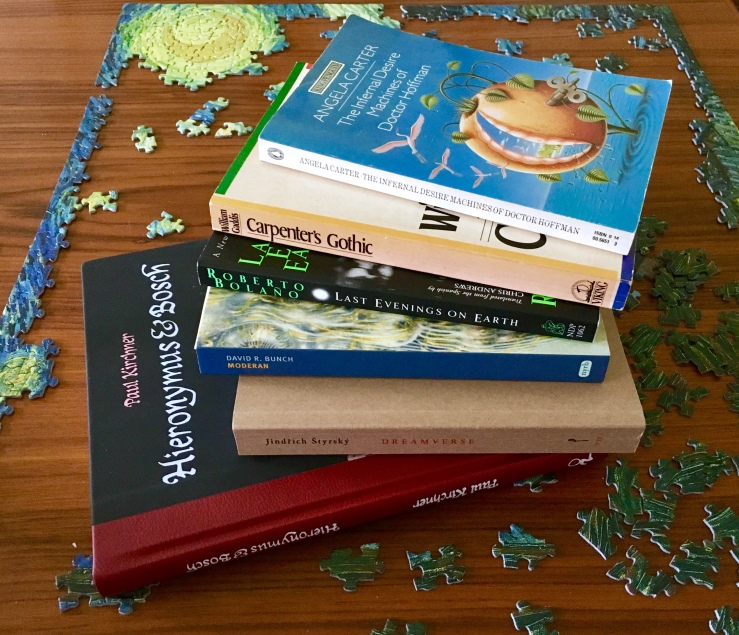
I ended up reading the last two chapters of William Gaddis’s novel Carpenter’s Gothica few times, trying to figure out exactly what happened. I then read Steven Moore’s excellent essay on the novel, “Carpenter’s Gothic or, The Ambiguities.” (If you have library access to the Infobase database Bloom’s Literature, you can find the essay there; if not, here’s a .pdf version). Moore offers a tidy summary of Carpenter’s Gothic—a summary which should be avoided by anyone who wants to read the novel. Because Carpenter’s Gothic isn’t so much about what happens but how it happens. Moore writes:
As is the case with any summary of a Gaddis novel, this one not only fails to do justice to the novel’s complex tapestry of events but also subverts the manner in which these events are conveyed. Opening Carpenter’s Gothic is like opening the lid of a jigsaw puzzle: all the pieces seem to be there, but it is up to the reader to fit those pieces together. …Even after multiple readings, several events remain ambiguous, sometimes because too little information is given, sometimes because there are two conflicting accounts and no way to confirm either.
Moore then lays out the novel’s theme in clear, precise language:
Such narrative strategies are designed not to baffle or frustrate the reader but to dramatize the novel’s central philosophic conflict, that between revealed truth versus acquired knowledge. Nothing is “revealed” by a godlike omniscient narrator in this novel; the reader learns “what really happens” only through study, attention, and the application of intelligence.
Quite frankly, Moore has written an essay that I wish I had written myself. I had been sketching parallels between Carpenter’s Gothic and Leslie Fiedler’s classic study Love and Death in the American Novel all throughout my reading; Moore ends up citing Fiedler a few times in his essay, in particularly working from Fiedler’s idea of how Gothicism manifests in American writing. (Moore does not bring up Fiedler’s critique of masculinity though, which opens up an occasion for me to write—once I’ve reread the puzzle though).
Anyway—I loved loved loved Carpenter’s Gothic, and I read it at just about the right time: It’s a Halloween novel. Great stuff.
In line with the Halloween theme: I had been working on a post about horror, about how I love scary films, grotesque literature, and weird art, because fantasy evocations of terror offer a reprieve from anxiety, from true dread, etc. Like, you know, a climate change report—I mean, that’s genuinely horrifying. But scary films and scary stories almost never really scare me. So I was thinking about literature that does produce dread in me, anxiety in me, and listing out examples in my draft, and so well anyway I reread Roberto Bolaño’s short story “Last Evenings on Earth.” I wrote about the collection named for the story almost a decade ago on this blog, focusing on the “ebb and flow between dread and release, fear and humor, ironic detachment and romantic idealism” in the tales:
In “Last Evenings on Earth,” B takes a vacation to Acapulco with his father. Bolaño’s rhetoric in this tale is masterful: he draws each scene with a reportorial, even terse distance, noting the smallest of actions, but leaving the analytical connections up to his reader. Even though B sees his holiday with his dad heading toward “disaster,” toward “the price they must pay for existing,” he cannot process what this disaster is, or what paying this price means. The story builds to a thick, nervous dread, made all the more anxious by the strange suspicion that no, things are actually fine, we’re all just being paranoid here. (Not true!)
I’m not sure if I’ll get the essay I was planning together any time soon, but I’m glad I reread “Last Evenings.”
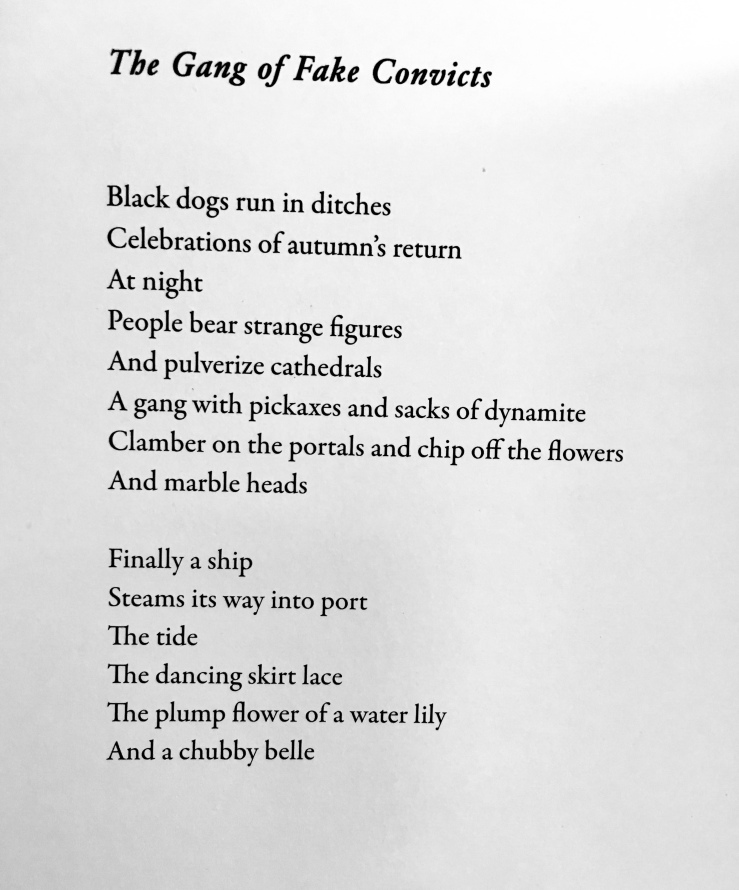
There’s a strange background plot in “Last Evenings” in which Bolaño’s stand-in “B” dwells over a book of French surrealist poets, one of whom disappears mysteriously. Jindřich Štyrský isn’t French—he’s Czech—but he was a surrealist poet (and artist and essayist and etc.), so I couldn’t help inserting him into Bolaño’s story. I’ve been reading Dreamverse, which ripples with sensual horror. I wrote about it here. Here’s one of Štyrský’s poems (in English translation by Jed Slast); I think you can get the flavor from this one:
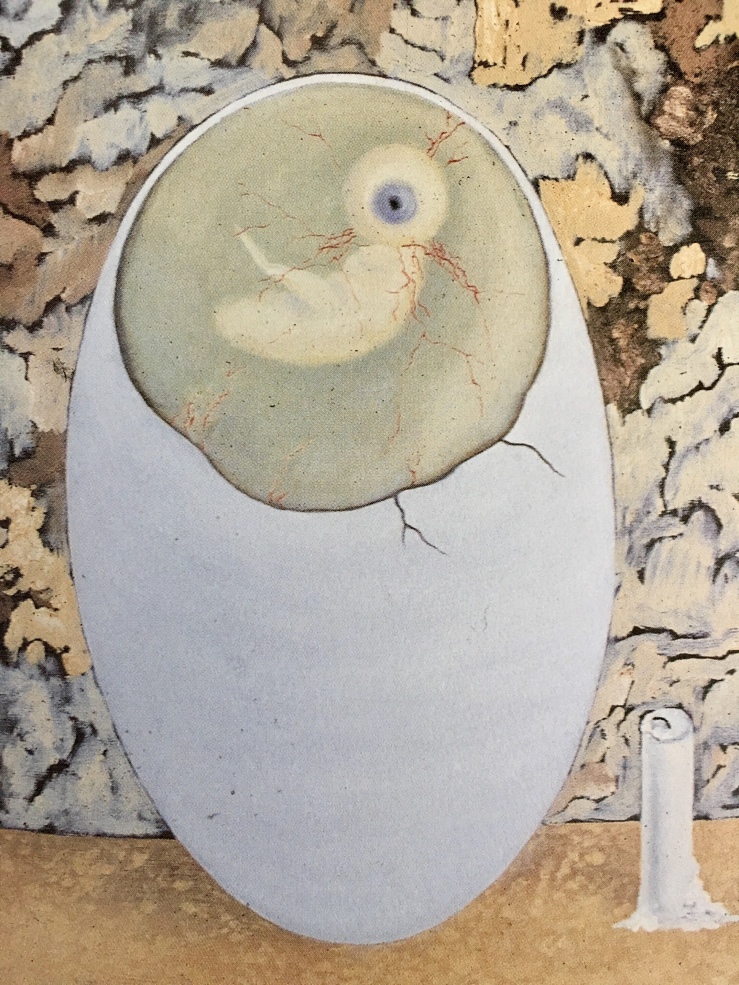
And here’s a detail from his 1937 painting Transformation:
I’ve finished the first section of David Bunch’s Moderan, which is a kind of post-nuke dystopia satire on toxic masculinity. While many of the tropes for these stories (most of which were written in the 1960s and ’70s) might seem familiar—cyborgs and dome homes, caste systems and ultraviolence, a world of made and not born ruled by manunkind (to steal from E.E. Cummings)—it’s the way that Bunch conveys this world that is so astounding. Moderan is told in its own idiom; the voice of our narrator Stronghold-10 booms with a bravado that’s ultimately undercut by the authorial irony that lurks under its surface. I will eventually write a proper review of Moderan, but the book seems equal to the task of satirizing the trajectory of our zeitgeist.
I started Angela Carter’s novel The Infernal Desire Machines of Doctor Hoffman last night and the first chapter is amazing.
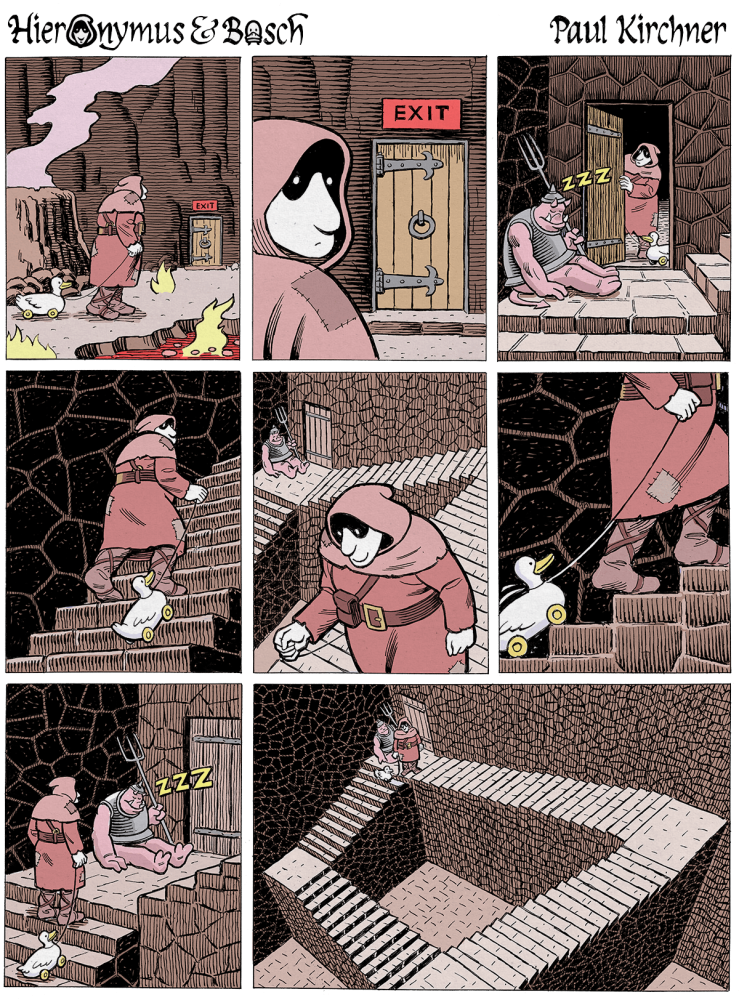
Finally, I got a hard copy of Paul Kirchner’s new collection, Hieronymus & Bosch which finds humor in the horror of hell. The collection is lovely—I should have a post about it here later this week and hopefully a review at The Comics Journal later this month. For now though, a sample strip:
Objects would suddenly fall or fall apart, cars go off course, dogs drop to their knees. The Army was doing sound experiments at a nearby desert in those days. I was nervous all the rest of my life, she wrote. She was a novelist and enjoyed some success. But always she had the fantasy of a different kind of novel, and although gradually realizing that all novelists share this fantasy, she persisted in it, without knowing what the novel would be except true and obvious while it was happening. Now I’m writing, she would be able to say.
She broke off.
Where would you put a third arm? is a question asked in creativity-assessment tests, or so I have heard. Will this different kind of novel be like that, like a third arm? I hate creativity, she said. Certainly not like a third arm. It would be less and less and less, not more. Barthes died, he never got there. She named other attempts—Flaubert, etc. Other renunciators, none of them clear on what to renounce. This chair I’m sitting in, she thought. Its fantastic wovenness, a wicker chair, old, from the back porch, brought in for winter. Me sitting here, by a lamp, wrapped in a quilt, beside the giant black windows, this December blackness, this 4:30 a.m. kitchen as it reflects on the glass. The glass too cold to touch. The loudness of the silence of a kitchen at night. The small creak of my chair.





 Biblioklept