
A Conversation about Evan Dara’s Novel Flee (Part 1)

[Context/editorial note: I’ve been meaning to read Evan Dara’s latest novel Flee for a while nowand when Biblioklept contributor Ryan Chang told me he’d be reading it as part of a contemporary literature class I decided to join him. This is the first part of a two-part discussion which took place over a few weeks of emails. — ET].   

Edwin Turner: So you’re reading Evan Dara’s Flee for a class, right? What’s the name of the class again? What are some of the other texts in the class?

Ryan Chang: Yeah, a class called 21st Century Fiction: What is Contemporary? We started out reading Reed’s Mumbo Jumbo and Acker’s Empire of the Senseless. We just finished reading Egan’s A Visit From The Goon Squad (awful), and we’re moving onto Chaon’s Await Your Reply and Pynchon’s Bleeding Edge. Everything, up to Pynchon, has as its central conflict the dissolution of the subject vis. the postmodern. Perhaps because of the spatialization of time (Egan, Reed) or a steroidal fungibility of a self because of technology (Chaon). The awareness of how deeply we are disciplined by master narratives (Acker). We’ve yet to get to Blake Butler’s There Is No Year and Richard Powers’ The Echo Maker, which I’m looking forward to after the Chaon and Egan who, in their attempt to write novels critical of the contemporary (more so of Egan, who does nothing but neuter the very real state of late capitalism’s terror into entertainment), do not make it past the merely interesting. I liked the Egan much less than the Chaon; part of the problem is the prose style, I think — it’s characteristically white American, shaped by sentimentality and preoccupied with the syntax of conventional form. In other words, the blueberry muffin prose styles betray the experimental forms in which they’re enveloped.

ET: I always have to look up the word fungibility. Dara’s Flee seems to fit into that early theme you mention, the conflict of the dissolution of the subject, which is both the book’s formal rhetorical strategy, but also its plot program, encapsulated (maybe) on page 45: “What is the weight of we?” What do you make of Dara’s style here? Like initial impression?

RC: I’m about ~40 pages in. I think I mentioned in the Books Acquired thing I wrote that Dara, stylistically, is hitting hard on Gaddis. Admittedly, I’m most familiar with the late Gaddis — Carpenter’s Gothic. (Agape Agape, too, but this is, of course, his letter to Bernhard.) I like that both focus on voice, on streams of speech that collide or blur into each other. The Gaddis influence is more of an echo than anything.
Specifically re: Dara — the interruptions, digressions and hesitations immediately struck me as something like a Tragic Greek chorus that, having incurred some sort of its own trauma (and not acting only as the all-knowing unconscious of the play), is completely disoriented, confused of its own purpose. But amidst the cacophony–or something like a directed cacophony towards the reader–they are still unwittingly functioning as a chorus. They’re giving us the stage for Flee’s story, hinting quietly at the book’s central plot conflict. Also naming characters (Carol, Rick, Marcus, etc), which is now more intriguing to me at the passage from p.45 you mention. What’s also different in Carpenter’s Gothic is, while that whole book remains on one diegetic level (as far as I can remember, it’s been a few years) because no narrator ever announces itself, in Dara, there’s a blurring of diegetic arenas, a refusal to centralize any narrative authority. Ok, so, re: dissolution of the subject: It seems that not only are the chorus members interrupting themselves, but they’re also interrupting the narrator as well. Each left-margin emdash cuts the narrator off, in a way, if you will. That scene when they’re pitying Rick, acting as a narrator with dialogue tags. The commonly individuated voice of the narrator is subsumed into the characters’ diegetic arena; a tension between the collective and individual implicit in prose structure alone. It also seems, by “36,551,” that whatever the population is fleeing from is not collectively driven (ie., the pity for Mark’s poorly planned meetings for something, we don’t know what yet), but selfishly driven. And in the flattening power of numbers, that selfishness — a hermetic individuality — becomes collective. There is a kind of infinite distance between I and we that, perhaps, the book is trying to trace? Or its relationship in the temporality of the novel is a perpetual expanding/contracting relationship, like a rubber band?

As far as I am in the book, the interruptions and digressions also have a hysteria to them that points to something the chorus is ignoring even in the face of the beginnings of a series of rude awakenings. Each voice just bemoans this dissolution of themselves; but, especially in the scene where Rick is, like, torn apart for his idea in service of the township, each voice is just narcissistically concerned with how it’s going to inconvenience them, rather than the potential worth of Rick’s idea.

ET: I teach an introductory American lit class, and today we were talking about Faulkner’s short story “A Rose for Emily,” which I think offers this wonderful example of a first-person plural narrator, this kind of limited chorus that is not-quite omniscient, not-quite omnipresent, and hardly omnipotent. It’s this weird we that seems able to transcend time, but not space—it can live for more than eighty years but it can’t see into Emily Grierson’s house. Its limitations are human; its limitations are the limitations of all the members of a community. I had your email in the back of my head while I was riffing on all this today—that, yes, the we is this fiction that we all subscribe to (hey look, I just used it!)—it’s our linguistic tag for culture, religion, whatever—but it requires some other—a you, I guess, that we can all point to, an Emily Grierson that’s only part of the we by paradoxically not being a part of the we, by defining the weFlee doesn’t seem to have that other, at least not in the first seven chapters anyway, although it does foreground two protagonists in Rick and Carol—something that Dara’s first novel The Lost Scrapbook does not do. The Lost Scrapbook is far more polyglossic than Flee also, which again reminds me of Faulkner’s story in its unified we-ness—Flee‘s narrative voice somehow unifies entropy, breakdown, the chaotic rumbling becomes this throbbing tone of dissolution (“There’s no here here,” page 79), where the narcissistic flight of each member of the community paradoxically underwrites the viability of a community, the possibility of a community… Continue reading “A Conversation about Evan Dara’s Novel Flee (Part 1)”

An Interview with Christopher K. Coffman and Daniel Lukes, Editors of William T. Vollmann: A Critical Companion (Part I)

William T. Vollmann: A Critical Companion, new from University of Delaware Press, collects academic essays and memoir-vignettes by a range of critics and authors to make the case that Vollmann is, as the blurb claims, the “most ambitious, productive, and important living author in the US.” I interviewed the book’s editors, Christopher K. Coffman and Daniel Lukes, over a series of emails.

If you live in NYC (or feel like traveling), you can check out the book launch for William T. Vollmann: A Critical Companion this weekend, hosted by Coffman and Lukes (4:30pm at the 11th Street Bar).

This is the first part of a two-part interview.

IMG_5107

Biblioklept: How did William T. Vollmann: A Critical Companion come about?

Daniel Lukes: The starting point would be the MLA panel I put together in January 2011, called “William T. Vollmann: Methodologies and Morals.” Chris’s was the first abstract I received and I remember being impressed with its confidence of vision. Michael Hemmingson also gave a paper, and Larry McCaffery was kind enough to act as respondent. Joshua Jensen was also a panelist. I kept in touch with Chris and we very soon decided that there was a hole in the market, so to speak, so we put out a call for papers and took it from there.

One of my favorite things about putting together this book has been connecting with – and being exposed to – such a range of perspectives on Vollmann: people seem to come at him from – and find in his works – so many different angles. It’s bewildering and thrilling to talk about the same author with someone and not quite believe you are doing so. And I think this started for me, in a way, at least as far as this book is concerned, with reading Chris’ MLA abstract.

Biblioklept: I first heard about Vollmann in connection to David Foster Wallace (Wallace namechecks him in his essay “A Supposedly Fun Thing I’ll Never Do Again”). A friend “loaned” me his copy of The Ice-Shirt and I never gave it back. When was the first time you read Vollmann?

Christopher K. Coffman: I first encountered William T. Vollmann’s work about ten years ago. At the time, I had just finished grad school, and as my dissertation work had been focused on aspects of modern and contemporary poetry, I had let my attention to contemporary prose slip a bit. When I realized this had happened, I starting reading a lot of recent fiction. Of course David Foster Wallace’s books were part of this effort, and I, like so many others, really developed a love for Infinite Jest and some of the stories in Girl with Curious Hair. My memory’s a bit fuzzy on the timeline, but my best guess, given what I know I was reading and thinking about at the time, is that in my reading around DFW I discovered the Summer 1993 issue of The Review of Contemporary Fiction with which Larry McCaffery had been involved, and that the interview with DFW in that issue–along with the WTV materials themselves–woke me up to WTV and his work. I can’t say enough about how important Larry’s championing of WTV has been, and continues to be. Of course, one could say that about his support for so many of the interesting things that have happened in fiction during the past three or four decades. His interviews, his editorial work, the part he played with the Fiction Collective …. the list of the ways that he identifies and promotes some of the best work out there could go on for a while, and no one else that I know of has done it as well as Larry has for as long as he has. Anyway, as I was pretty much broke at the time, my reading choices were governed in large part by what I could find at libraries or local used bookstores, and The Ice-Shirt was the first volume I came across in one of these venues. I was already a huge fan of The Sot-Weed Factor and Mason & Dixon, and the entire Seven Dreams project very much struck me as a next step forward along the trajectory those books described. As a consequence, I immediately started tracking down and reading not only the rest of the Dreams, but also everything else I could find by WTV.

What about The Ice-Shirt that really won me over, aside from my impression that this was another brilliant reinterpretation of the historical novel, is that WTV was clearly bringing together and pushing to their limits some of my favorite characteristics of post-1945 American fiction (structural hijinks of a sort familiar from works by figures like Barth and Barthelme, a fearlessness in terms of subject matter and the occasional emergence of a vatic tone that reminded me of Burroughs, an autofictional element of the sort you see in Hunter S. Thompson). Furthermore, as a literary critic, I was really intrigued by two additional aspects of the text: the degree to which The Ice-Shirt foregrounds the many ways that it is itself an extended interpretation of earlier texts (the sagas on which he draws for many of the novel’s characters and much of its action), and the inclusion of extensive paratexts–the notes, glossaries, timelines, and so forth. In short, this seemed like a book that united my favorite characteristics of contemporary literary fiction with a dedication to the sort of work that I, as a scholar, spend a lot of my time doing. How could I resist? It took my readings of a few more of WTV’s books for me to be able to recognize what I would argue are his other most significant characteristics: his global scope and his deep moral vision.

As for your also having begun reading WTV with The Ice-Shirt: It’s an interesting coincidence to me that we both started with that book. I have always assumed that most people start into WTV via either the prostitute writings (which have a sort of underground cachet by virtue of subject matter) or Europe Central (which is of course the book that got the most mainstream attention), but here we both are with The Ice-Shirt. WTV has indicated he sees it as under-realized in certain ways, but I am still quite fond of it, even in comparison to some of the later books. Continue reading “An Interview with Christopher K. Coffman and Daniel Lukes, Editors of William T. Vollmann: A Critical Companion (Part I)”

A short riff on a favorite scene from Richard Linklater’s film Boyhood

boyhood_color10

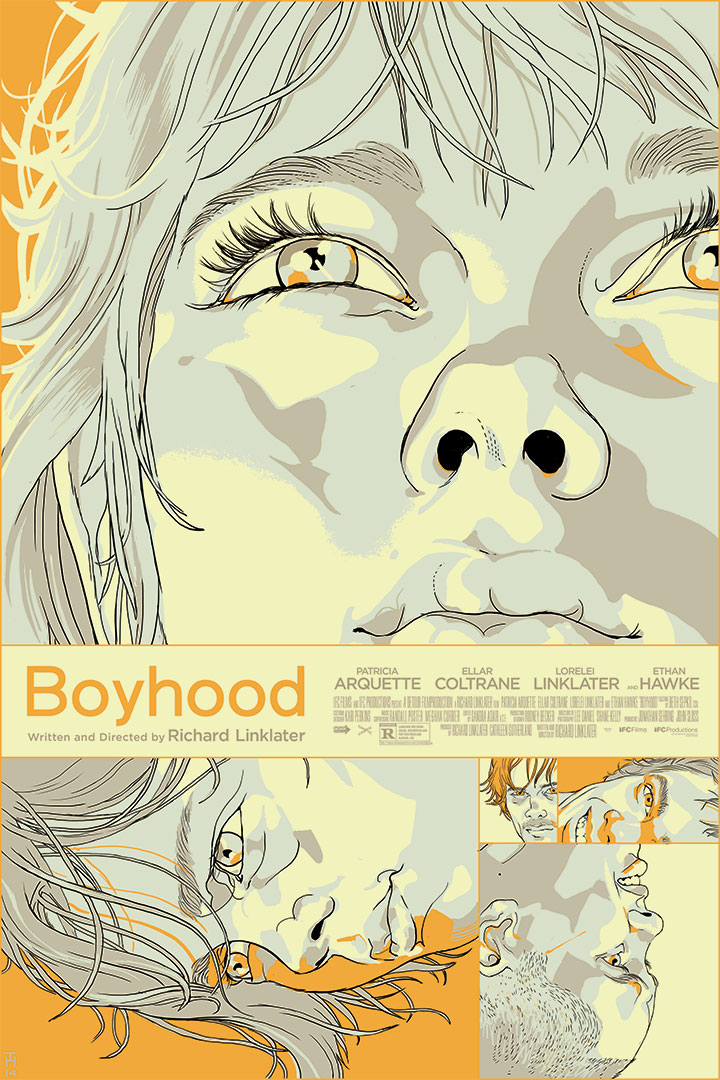
I absolutely loved Richard Linklater’s film Boyhood, which is nominated for a few Oscars this year, including Best Picture. (Boyhood is too good to win best picture; I’m fine with that prize going to Iñárritu’s faux-art film Birdman). A rich and sentimental evocation of “reality,” Boyhood synthesizes the best elements of Linklater’s previous films, and like many of those films—Slacker, the Before trilogy, Waking LifeDazed and ConfusedBoyhood isn’t really about anything. Of course it’s also kinda sorta about everything: family, love, growth, education, life. Etc.

The central formal device of Boyhood—namely, that Linklater shot the film over twelve years using the same actors—has been remarked upon at great length by others, so I won’t touch on it, other than to say that I found watching Ellar Coltrane’s Mason grow up profoundly moving. The aesthetic experience of Boyhood is its greatest pleasure, much like its sister film The Tree of Life. And although Boyhood’s aesthetic power relies in large part on our witnessing its characters grow and age, its emotional tenor, its vibe, inheres from scene to scene.

Capture

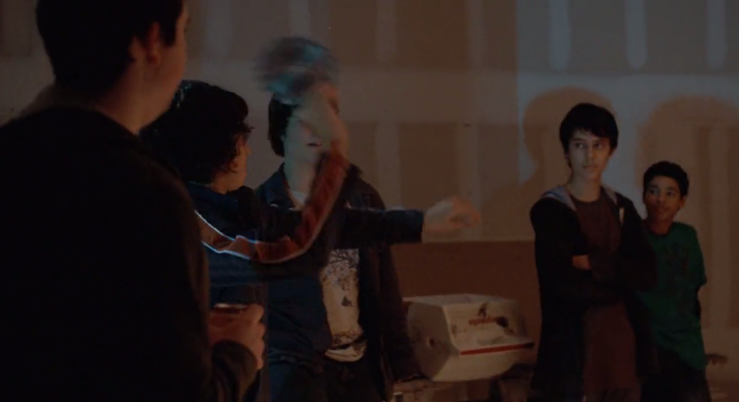
There are many wonderful moments in the film, some more memorable than others, but a favorite of mine takes place at an overnight “camping trip” in a house that’s still under construction. Mason is maybe, what, thirteen here?—I’m not quite sure, but he tells his mother the truth about where he’s going, if not entirely the truth about what he’ll be doing there…which is, what? Not much really—the younger kids hang out with the older kids, drink a beer or two, lie about sex—stuff kids do. The scene captures the same not-quite-boring hangout vibe that permeates Dazed and Confused and Waking Life—a kind of familiar realness.

Linklater is a master at evoking a sense of place. And this place, this house—it’s simultaneously boring, calming, and horrifying. On one hand, we’ve been there before—the abandoned house, the empty parking lot, the little switch of trees that aren’t quite woods, not really—the free space where we can play at being adults. On the other hand, Boyhood has allowed us—or maybe I should not extend my pronoun to the plural? No?—Okay: Boyhood has allowed me, this viewer, a kind of paternalistic view of Mason (“my-son”) who is, after all, growing up before our very eyes (sorry for slipping back into the first-person plural there). And here Linklater has young Mason—whom we trust to do the right thing and all but still—here Linklater has staged Mason & co. in an abandoned house full of scrap wood and power tools and circular saw blades which the young men are of course throwing into the sheet rock with gleeful abandon.

I flinched as the blades flew forcefully past Mason and his friend; in any other film they would have to cut into flesh and bone, be tools for forces tragic or comic. Plot devices. But in Boyhood they are the toys of boys playing at growing up. Nothing happens. No grievous injury or terrible death—the sort of thing that usually licenses, I don’t know, the central character’s maturation. Not even a comic wound. Nothing. The blade-throwing is just normal bored stupid teenage amusement. It’s the sort of thing that Mason’s mom—and a paternalistic viewer like me—might find horrifying—You could get very badly hurt, Mason!—but he doesn’t. He’s fine. He’s alive.

For me, this particular scene—not the strongest or the strangest or the most memorable or moving—is nevertheless a key moment in Boyhood, not just because it disrupts audience expectations (the film is full of such gentle disruptions), but because it engenders and then discharges my own parental anxieties. That’s a form of catharsis, I guess, but not a catharsis of tragedy. It’s catharsis for reality.

Some notes on beginning Evan Dara’s novel Flee

B8jFz0WCYAAghDz

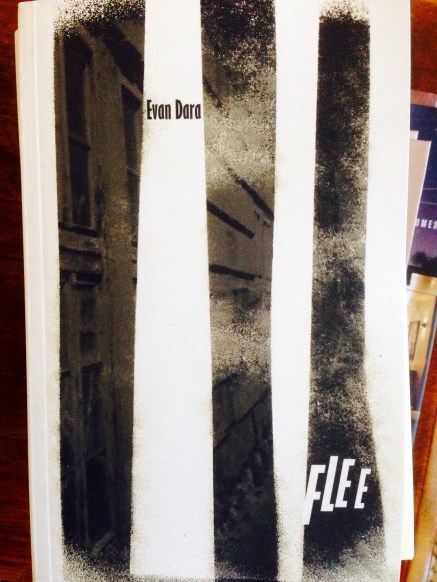
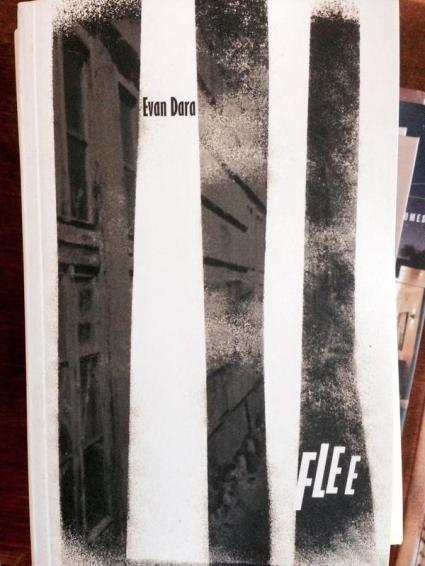
A. What a cover on Evan Dara’s 2013 novel Flee, don’t you agree?

B. From the back cover:

IMG_5030

C. That’s all there is. Well, okay, there’s an ISBN too. But no blurbs, no other text.

D. “Something always going on—” is the first line of Flee. It’s also an apt description of Dara’s formal technique, a constantly-shifting series of dialogues, monologues, overlapping, cross-cutting, diverging—always out there ahead of the reader. That dash there—that dash is the simple summative signal of it all, a little typographic pole that simultaneously connects and interrupts.

E. The most obvious point of comparison for Dara’s technique (besides his amazing debut novel The Lost Scrapbook) is William Gaddis’s stuff, particularly J Rthe verbal dazzle, the few stray lines of poetic stage-setting in lieu of traditional exposition—the throw-the-reader-in-the-deep-end stuff. David Foster Wallace frequently attempted the same rhetorical mode, most successfully in §19 of The Pale King. (It’s entirely likely that The Lost Scrapbook could have had the same following that Infinite Jest achieved had Dara done anything to promote the book. But here I think of Gaddis in his Paris Review interview: “I’d go back to The Recognitions where Wyatt asks what people want from the man they didn’t get from his work, because presumably that’s where he’s tried to distill this ‘life and personality and views’ you speak of. What’s any artist but the dregs of his work: I gave that line to Wyatt thirty-odd years ago and as far as I’m concerned it’s still valid”).

F. The point of contrast though is Dara’s abrupt transition, sometimes it seems mid-sentence, from one speaker to the next. Just as we feel (nearly) comfortable with who this particular narrator might be, another voice interjects, or rather continues, or re-trajects the discourse—as in the second chapter of Flee (“38,842”), where a college student driving home in snowy weather to pick up a book by Paul Krugman gives over to a number of speakers all describing the closing of the local university, Pitkinson (this closing’s being the presumable, like, plot of Flee so far I suppose)—faculty and staff and townies and residents—until a grad student takes over to report the speech of one Professor Gray, himself bearing witness to the downfall of the school (Ghost Sociology is the issue)—and then of course the chapter gives over to more rumor, more speculation. “Something always going on—.”

G. So I’ve read the first three chapters (“38,839,” “38,842,” “36,551”). But wait: The next chapter (“35,717”–do the titles reflect the dwindling population of the town (Anderburg)?)—but wait the next chapter, I see by scanning, offers some new, perhaps, rhetorical gesture—a section in a different font? Chunkier paragraphs?

I have to go see about this. (More to come).

Jane Bowles’s novel Two Serious Ladies confounds with sinister humor and dark delight

Two Women, Gwen John

Here’s a short review of Jane Bowles’s only novel, Two Serious Ladies: The book is amazing, a confounding, energetic picaresque suffused with sinister humor and dark delight. I read it knowing nothing about the plot on the recommendation of Ben Marcus, who described it as “so insane, so beautiful, and in some sense, unknowable to me. On the surface, it’s not really about much, but the arrangement of words does something chemical to me.” My recommendation is to dispense with the rest of my review and read Bowles’s novel.

“Unknowable” is a fair description, and Two Serious Ladies was met with bewilderment when it was first published in 1943, as Negar Azimi points out in the comprehensive essay “The Madness of Queen Jane”:

Edith Walton, writing in the Times Book Review, called the book senseless and silly: “To attempt to unravel the plot of ‘Two Serious Ladies’ would be to risk, I am sure, one’s own sanity.” Another reviewer said, simply, “The book is about nothing.” Jane’s family, in the meantime, found it unseemly in its stark depiction of lesbianism. Its characters, who have goals and motivations that are hard to grasp, were difficult to relate to. Yet another critic wrote, “The only shocking thing about this novel is that it ever managed to find its way to print.” Jane was only twenty-four.

The notion that “The book is about nothing,” is corrected by Marcus’s qualifier about its “surface”: Two Serious Ladies moves through the phenomenological world that its characters experience, but it does not mediate the concrete contours of that world in a way that its characters can name for the reader. When the characters, those two serious ladies, do stumble into language that might name, pin down, or otherwise fix their experience, fix their consciousness into a stable relation with the world, Bowles spins the wheel again, flings her characters into new scenarios. Moments of epiphany are transitory and hard-purchased. A (perhaps) illustrating passage, offered without context:

Mrs. Copperfield started to tremble after the girl had closed the door behind her. She trembled so violently that she shook the bed. She was suffering as much as she had ever suffered because she was going to do what she wanted to do. But it would not make her happy. She did not have the courage to stop from doing what she wanted to do. She knew that it would not make her happy, because only the dreams of crazy people come true. She thought that she was only interested in duplicating a dream, but in doing so she necessarily became the complete victim of a nightmare.

The free indirect style here still hides so much from the reader, who must suss the characters’ unnamed desires from bewildering details alone. The passage above shows us fear and trembling, dream, nightmare—and crazy people. What does Copperfield want to do? One subtext here is a lesbian desire seemingly comprehended by everyone but Mrs. Copperfield herself. (In some of the book’s strangest moments, Mr. Copperfield leaves his near-mad wife in a dangerous part of a foreign city to encounter hookers of every stripe). Two Serious Ladies is about women searching for something, but something they can’t name, can’t conceive in language—but can perhaps imagine. Continue reading “Jane Bowles’s novel Two Serious Ladies confounds with sinister humor and dark delight”

Reading There Will Be Blood as the expanded epilogue to Blood Meridian

Watching (again) Paul Thomas Anderson’s 2007 film There Will Be Blood last night, it struck me that the film can be read as an expansion of the epilogue to Cormac McCarthy’s 1985 novel Blood Meridian.

Here is that infamously perplexing passage, a strange note that punctuates the devastating infanticidal horror at the novel’s core:

In the dawn there is a man progressing over the plain by means of holes which he is making in the ground. He uses an implement with two handles and he chucks it into the hole and he enkindles the stone in the hole with his steel hole by hole striking the fire out of the rock which God has put there. On the plain behind him are the wanderers in search of bones and those who do not search and they move haltingly in the light like mechanisms whose movements are monitored with escapement and pallet so that they appear restrained by a prudence or reflectiveness which has no inner reality and they cross in their progress one by one that track of holes that runs to the rim of the visible ground and which seems less the pursuit of some continuance than the verification of a principle, a validation of sequence and causality as if each round and perfect hole owed its existence to the one before it there on that prairie upon which are the bones and the gatherers of bones and those who do not gather. He strikes fire in the hole and draws out his steel. Then they all move on again.

I’ve heard numerous interpretations of this passage over the years. Many of the interpretations dwell on the metaphorical power of the epilogue—it’s the final gnostic clue in the Judge’s web of mysteries; it’s the Promethean redemption of humanity against the Judge’s evil; it’s the spirit of civilization that will measure and conquer the bloody West, a progressive new dawn; it’s Cormac McCarthy’s signature, his designation of himself as the writer who carries the fire.

I’m fine with all of these interpretations, for I foolishly take Judge Holden at his word when he points out that, “Your heart’s desire is to be told some mystery. The mystery is that there is no mystery.” Let me eschew the symbolic then, at least momentarily, for the literal.

The epilogue’s literal imagery suggests a man working with post hole diggers: Is he building a fence? Constructing telegraph poles? Exploring? Surveying? Whatever his intentions, he marks and measures the land.

Whether the digger is a leader or not, he has followers, “the wanderers in search of bones” as well as “those who do not search.” Bones of what? Are the searchers hunting relics? (To revert to the metaphorical—sorry—are these bones the dead eyes Emerson warned us not to look through?). Or are the bones something else—dinosaur bones, Texas tea, carbon, fuel?

there will be blood

So There Will Blood and there will be bones: Daniel Day-Lewis’s Daniel Plainview, a misanthropic, near-malevolent, and ultimately murderous oil man—what I want to say is that he is (a failed version of) McCarthy’s Epilogue Digger. Is not There Will Be Blood  a film about digging, about holes, falling in holes, dying in holes, striking fire from holes? And is not There Will Be Blood also a film about the abjection of holes—the oil, the mud, the muck, the blood that coats hands and faces, eyes, lips, ears burst? Of the recapitulation of the hole as the primal space for culture—a fertile, generative, fecund, deadly space? The hole as the space of shame and possibility? Daniel Plainview, surveying California, marking lines for his followers to follow, striking oil, striking fire. No?

There-Will-Be-Blood-daniel-day-lewis-859163_427_321

We might see in Paul Thomas Anderson’s film a repetitious revision of McCarthy’s novel—a recasting of sorts, with Plainview possessed by Glanton’s maniacal spirit—and Glanton in turn possessed by the spirit of the Judge, the dark omnipresent bad father. Both film and novel mediate their Oedipal dramas in an utterly masculine world. Blood Meridian affords more speaking roles to women than There Will Be Blood does, but both see fit to discharge any notion of a mother from the Oedipal contests they depict, rendering the kid in each narrative the warden of strange gangs, strange wanderers. Anderson allows H.W. to suffer but live and perhaps thrive, to find a mate, to escape into new and alien territory, outside of the holes his surrogate father has dug. Our would-be hero of Blood Meridian, the kid, dies in an outhouse, an abject hole.

And Daniel Plainview—he murders the false priest (which the judge failed to do—although Tobin was a true priest though ex-priest), murders a version of himself—another brother, another Abel. He’s not a good guy. If we read McCarthy’s epilogue through his latest novel, The Road, or even through some of the lines in No Country for Old Men, we can see that “the good guys” are charged with carrying the fire—and is this not what the Epilogue Digger is doing? Carrying the fire, freeing the fire from the earth? Plainview would like to carry the fire, to generate new life, new communities, but he fails, he falls, he crumbles. He abandons his child, and then denies his child. “I’m finished!”

Am I finished? I’m now more confused than when I started this riff. The germ of the idea woke with me this morning—the alien landscape of PTA’s film seemed to restage for me moments in McCarthy’s novel in some waking dream—and like a dream seemed perfectly illogically logical. But bound up in my language I’m not so sure. What I did detect in the film, last night, that I had previously perhaps missed, or maybe forgotten, was how admirable Daniel Plainview often is, especially early on in the film—decisive, bold, asserting his own agency and working with his own hands, he’s a Nietzschean figure. But his paranoia gives way to madness and corruption. Okay. I’m finished.

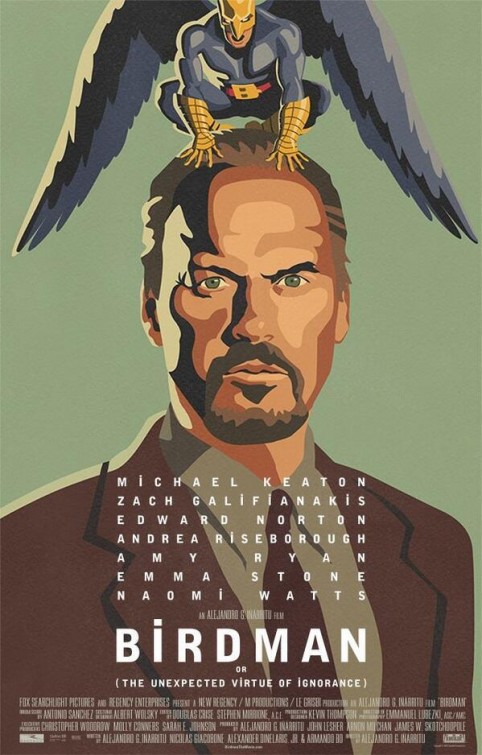
Alejandro González Iñárritu’s Film Birdman Reviewed

YLSqP80

Alejandro González Iñárritu’s film Birdman relies heavily on a central stylistic conceit: The film unfolds as one continuous uninterrupted shot, the camera unblinking, restlessly moving after Riggan Thomson (Michael Keaton), a washed-up actor who has put everything he has—financially, physically, mentally—into a Broadway adaptation of Raymond Carver’s “What We Talk About When We Talk About Love.”

The shot isn’t really continuous (any savvy viewer will spot the cuts), but the effect is powerful and engaging early on, especially when Keaton shares the lens with Edward Norton, who plays Mike, a wild foil to Keaton’s Riggan. Mike is the artist, the theater actor, the method actor, the real deal; Riggan is just a celebrity—or rather was a celebrity, the star of the Birdman franchise. The nod to Keaton’s Batman films is not even a nod, but one of several meta-crutches that Iñárritu rests all the film’s supposed “weight” on. Birdman wants to be heavy, but it feels hollow. Good thing it’s always in motion.

Birdman suffers by comparison to a handful of other films, notably Aleksandr Sokurov’s masterpiece Russian Ark in particular. Sokurov’s film, also filmed in one continuous take, does a finer job plumbing the mysteries of aesthetics (and any of aesthetics’ supposed nemeses) than Birdman. Sokurov’s film also bewilders, where Birdman’s contours are fairly familiar stuff. Another film that stages (and restages) what Birdman would like to be doing with more force is Charlie Kaufman’s deeply flawed and very brilliant film Synecdoche, New York, an alienating study of art, performance, and audience.

Of course I’ve just done exactly what Keaton’s Riggan howls against late in Birdman’s second act. He confronts the theater critic who has promised to kill his play, screaming that she, as a critic, takes no risks, puts nothing on the line. Her words are just labels; all she does is make weak comparisons. Has Iñárritu built a defense into this scene? Are we to empathize with Keaton’s Riggan? Or with Norton’s Mike? Or with the other characters whom Riggan alternately alienates and draws back in, including his ex-wife, his daughter, his girlfriend, his co-star, and his best friend? Or maybe we empathize with Riggan’s Birdman, the voice that haunts him, the voice that haunts itself into existence?

Anchored by fantastic performances—what a joy to see Keaton carry a movie again—great cinematography by Emmanuel Lubezki , and a jazz percussion score, Birdman is an entertaining way to pass two hours, but the profundity it seeks in its final moments simply isn’t there. The film’s formal structuring device, the uninterrupted shot, would like to penetrate its hero’s consciousness, but always seems to fail, necessitating voice-over or dialogue to clumsily underline the main idea. (Should I unfairly contrast this weakness with the far more powerful long-takes in Gaspar Noé’s Enter the Void? No? Okay). Birdman strives to explore the tangle between art and entertainment, but at the end we’re left with yet another Hollywood satire of ego and celebrity. Birdman is amusing when it seeks to be penetrating, clever when it seeks to be profound. And it made Raymond Carver’s story look like lurid dinner theater. But these are just labels.

DFW’s Brief Interviews with Hideous Men, books as memory objects, etc.

2015/01/img_4925.jpg

On our short walk home from her school yesterday, my darling daughter inquires if we can go to the bookstore. She needs some new Junie B. Jones, she reports. I assent.

This particular bookstore is about a mile away, a big labyrinth of shelves and stacks and strange little closets crammed with books. The owner once kindly estimated to me that the place houses somewhere between one million and two million books, but probably not more than three million books. The place is a hive, or better yet a brain. An archive.

On this warmish January afternoon, a coverless paperback wedged and warped keeps the front door propped open. My daughter doesn’t dally, fetching up a bevy of Ms. Jones’ adventures (and the third volume of Ivy + Bean to boot: “It’s Ivy “plus” Bean, not Ivy “and” Bean, her graceful correction).

We have a few minutes before we need to pick up my son, so I do a fairly regular patrol about the premises, looking for a copy of Jane Bowles’s Two Serious Ladies for a colleague. No dice. And, out of weird old habits, go past the last shelf, where Vollmann’s underattended tomes rest near David Foster Wallace novels, always depleted. I like to look at the new covers, I guess.

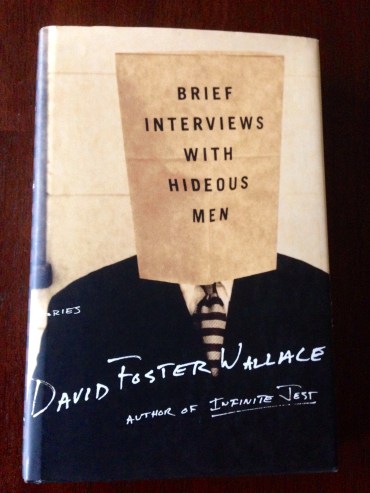
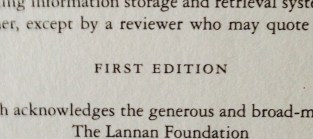
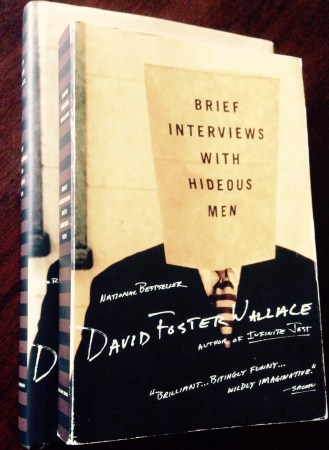
Well so and anyway, I spied a pristine hardcover copy of Brief Interviews with Hideous Men, clearly never read, and thought, Oh hey, this must be a first edition. Which it was and Oh hey you don’t need this book.

2015/01/img_4926.jpg

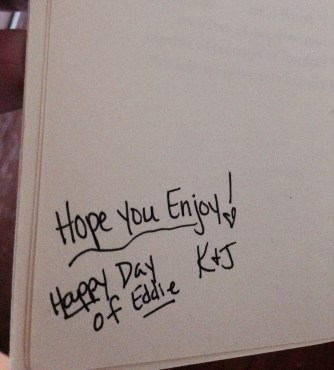
There is nothing rare or especially valuable about a first hardback U.S. edition of Hideous Men. The store is selling it for half of the publisher’s recommended price, but I have more than enough credit (thanks unsolicited review copies!) to pick it up. Which I do. Despite of course already owning it in the far more flexible trade paperback edition (first edition!) inscribed by some of the dearest damn friends who gave it to me for a birthday, an edition I reread memorably over a few weeks in Italy, an edition warped by strange moistures (I’d love to pretend the warping arose from the salty splash of the ancient Mediterranean but my own body sweat is a far more likely culprit).

2015/01/img_4927.jpg

Brief Interviews is my favorite collection of David Foster Wallace stories. The stories here are much better than those in his first collection, Girl with Curious Hair (which, the first DFW I read, has a special place in my gizzards), and though there’s nothing here that can touch the best moments of Oblivion (“The Suffering Channel” and “Good Old Neon”), the collection is cohesive, propulsive, engaging, its longer pieces punctuated by blips and vignettes. Here is the first selection, “A Radically Condensed History of Postindustrial Life”:

When they were introduced, he made a witticism, hoping to be liked. She laughed very hard, hoping to be liked. Then each drove home alone, staring straight ahead, with the very same twist to their faces.

The man who’d introduced them didn’t much like either of them, though he acted as if he did, anxious as he was to preserve good relations at all times. One never knew, after all, now did one now did one now did one.

So I picked up the hardback first edition, realizing that what I really wanted (in addition to this edition that I didn’t and don’t really need) was the copy that I read in college, the copy I borrowed from UF’s Library West (I’ll pay you $10,000 if you can think of a better library name, which you can’t), a flat brown squashed brick—-I must’ve been one of the first to read it, this was in ’99 or early ’00—I checked it out three times and then I had to return it. I ripped off “Adult World (I)” and “Adult World (II)” (these are actually the same story, but…) for a project in some bullshit class I was taking at the time, some class called Post-Historical Visual Culture or some other such nonsense—I didn’t rip off the plot, but the structure, the whole narrative/outline thing that Wallace did there. (My story was about a geneticist trying to clone a son or maybe someone to love, I can’t recall, shudder to recall…And why was I turning in a story and not an essay?!).

Why do I want the very edition that I first read, Dewey’s decimals imprinted on its drab jacketless spine? Why do I want an object that proclaims first, first, first, even though I don’t need it—why the compulsion? And then the sentimental compulsion to keep a less sturdy paperback version just because my name is incribed in itjust because I recall so vividly shaving my beard in Minori in Amalfi after reading “Tri-Stan: I Sold Sissee Nar to Ecko” and realizing that Oh my god this story is fucking terrible, DFW, I get what you’re doing, but my god. 

A book is a memory object, a placeholder, a bookmark for the memory of the reading experience, because we don’t remember what we read, not really. I have a few novels committed to memory (more or less) through yearly rereading, through teaching, but on the whole the details fade, the misremembering opens to misreading. My dream is to disband all of my books, march them out into the world, my memory secure, transcendent, stable, eternal, etc.—the objects gone, their dusty physicality imprinted in some psychic library of the soul. But I don’t believe in my dream, and even though I dig e-books, they don’t shock my memory in the same way that old pressed leaves do. So I live with these guys, nestled together unnecessarily, necessarily so.

2015/01/img_4928.jpg

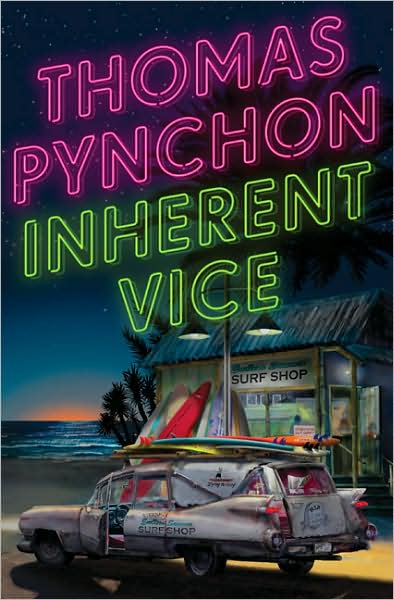
A few quick thoughts on Paul Thomas Anderson’s film Inherent Vice

IV POSTER HORIZONTAL

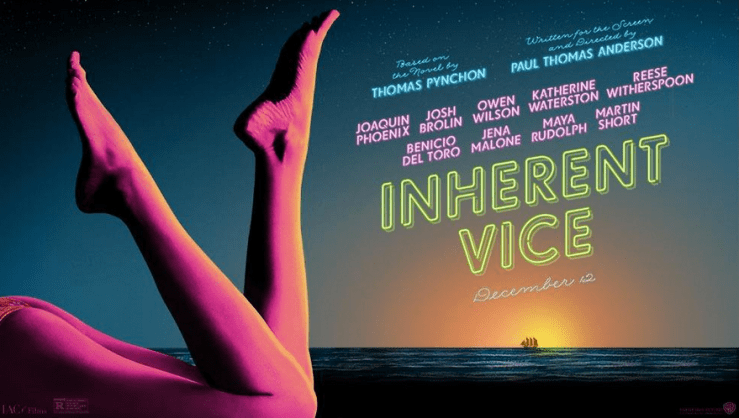
A. Let’s start with this: I need to see Paul Thomas Anderson’s film adaptation of Thomas Pynchon’s novel Inherent Vice again. Like, I’m compelled. 

B. But maybe a quick sketch before, no? Like, here in my office hours, before an afternoon class, when I should be shuffling through a few early papers—and, like away from the novel, which I’ve been rereading bits of? With the intention of re: point A seeing it again this weekend.

C. A claim, bold or otherwise: PTA’s film is better than Pynchon’s novel.

D. (Apples and oranges, bro, thou protest).

E. Okay so point C: What do I mean by better? I’m not really sure.

F. Maybe what I mean is: PTA slows down Pynchon’s novel. Expands the tension, the euphoria, the weirdness under the lines of dialogue.

G. (The film’s dialogue seems composed entirely from the text of the novel. Verbatim).

H. (But verbatim—how verbatim?: There are those gaps, those wonderful gaps that PTA fills—with color and smoke and sound and legs legs legs).

I. PTA also underlines plot connections for the reader, limning the paranoid contours that connect conspiracy-theory paranoia to vertically-integrated capitalism.

J. Okay, so point I: I’m not saying that clarifying the plot for the viewer (in a way that Pynchon arguably does not) makes the film, better—what I’m saying is that critics who contend the film fails to cohere are maybe missing the point.

K. Here’s a point: Inherent Vice offers the most coherent and balanced conclusion of any of Paul Thomas Anderson’s film. The final act performs the spirit behind Pynchon’s letters, offering a vision of fraternal love, or of caritas, if not love—of partnerships, of how to feed the hungry, the famished. (Poor famished Bigfoot). Of resistance to the pavement.

tumblr_l13jimngTJ1qahhqf

L. Or, another way to flesh out point C, or revise point C:

PTA gives us—and by us let’s be clear I mean me—a new reading of the novel. (And of course not just PTA, but his marvelous ensemble, too marvelous to remark on at length here). PTA’s reading of Doc’s reunion with Shasta—surely one of the film’s most intense moments—is entirely different than my own reading, and rereading that scene after viewing, I feel like Anderson and Joaquin Phoenix and Katherine Waterston read the scene right, or read the scene, depict the scene, perform the scene in a way that illustrates the darkest strands of sunny smoky searing Inherent Vice.

M. The aforementioned scene—Doc reunited with one (sort of) partner—is balanced neatly against two other key scenes: The final scene between Doc and (sort of) partner Bigfoot, and the scene in which Doc restores Coy to his family. Brother’s keeper.

N. (Parenthetically: I fell in love with the movie in its opening minutes. In those opening drumbeats of Can’s “Vitamin C”).

O. So I have to rush to class and discuss Kate Chopin and not PTA’s Inherent Vice, which is what I’d rather riff on. Not really a world of inconvenience, but…(oh, and I love how that Pynchonian byword echoed through the film).

P. End on P for Pynchon and Paul TA and Promise: Promise to rewatch, reread, rewrite.

I review my review of Thomas Pynchon’s novel Inherent Vice an hour before seeing PTA’s film adaptation

I’m leaving to (finally) see Paul Thomas Anderson’s film Inherent Vice in a few minutes.

I’m going with my uncle. (I also saw No Country for Old Men with him in the theater. This point seems hardly worth these parentheses).

Below, in block quotes, is my review of Thomas Pynchon’s Inherent Vice (which I published here—the review obviously—in 2009). My 2015 comments are interposed.

inherent_vice

Thomas Pynchon’s latest novel, Inherent Vice

Oh god I used to bold face key terms jesus christ sorry.

is a detective-fiction genre exercise/parody set in a cartoonish, madcap circa-1970 L.A. redolent with marijuana smoke, patchouli, and paranoia.

“genre exercise”…”madcap”…ugh!

Navigating this druggy haze is private detective Doc Sportello, who, at the behest of his ex-girlfriend, searches for a missing billionaire in a plot tangled up with surfers, junkies, rock bands, New Age cults, the FBI, and a mysterious syndicate known as the Golden Fang–and that’s not even half of it.

Not a bad little summary, bro.

At a mere 369 pages, Inherent Vice is considerably shorter than Pynchon’s last novel Against the Day, not to mention his masterpieces Gravity’s Rainbow and Mason & Dixon, and while it might not weigh in with those novels, it does bear plenty of the same Pynchonian trademarks: a strong picaresque bent, a mix of high and low culture, plenty of pop culture references, random sex, scat jokes, characters with silly names (too many to keep track of, of course), original songs, paranoia, paranoia, paranoia, and a central irreverence that borders on disregard for the reader.

Uh…

And like Pynchon’s other works, Inherent Vice is a parody, a take on detective noir, but also a lovely little rip on the sort of novels that populate beaches and airport bookstores all over the world. It’s also a send-up of L.A. stories and drug novels, and really a hate/love letter to the “psychedelic 60s” (to use Sportello’s term), with much in common with Pynchon’s own Vineland (although comparisons to Elmore Leonard, Raymond Chandler, The Big Lebowski and even Chinatown wouldn’t be out of place either).

When I heard the PTA was adapting Inherent Vice, I thought: Wait, the Coens already did that before Pynchon wrote the book.

While most of Inherent Vice reverberates with zany goofiness and cheap thrills,

Clichés, bro.

Pynchon also uses the novel as a kind of cultural critique, proposing that modern America begins at the end of the sixties (the specter of the Manson family, the ultimate outsiders, haunts the book). The irony, of course–and undoubtedly it is purposeful irony–is that Pynchon has made similar arguments before: Gravity’s Rainbow locates the end of WWII as the beginning of modern America; the misadventures of the eponymous heroes of Mason & Dixon foreground an emerging American mythology; V. situates American place against the rise of a globally interdependent world.

Uh…

If Inherent Vice works in an idiom of nostalgia, it also works to undermine and puncture that nostalgia. Feeling a little melancholy, Doc remarks on the paradox underlying the sixties that “you lived in a climate of unquestioning hippie belief, pretending to trust everybody while always expecting be sold out.” In one of the novel’s most salient passages–one that has nothing to do with the plot, of course–Doc watches a music store where “in every window . . . appeared a hippie freak or a small party of hippie freaks, each listening on headphones to a different rock ‘n’ roll album and moving around at a different rhythm.” Doc’s reaction to this scene is remarkably prescient:

. . . Doc was used to outdoor concerts where thousands of people congregated to listen to music for free, and where it all got sort of blended together into a single public self, because everybody was having the same experience. But here, each person was listening in solitude, confinement and mutual silence, and some of them later at the register would actually be spending money to hear rock ‘n’ roll. It seemed to Doc like some strange kind of dues or payback. More and more lately he’d been brooding about this great collective dream that everybody was being encouraged to stay tripping around in. Only now and then would you get an unplanned glimpse at the other side.

Oh cool you finally quoted from the book. Not a bad little riff.

If Doc’s tone is elegiac, the novel’s discourse works to undercut it, highlighting not so much the “great collective dream” of “a single public self,” but rather pointing out that not only was such a dream inherently false, an inherent vice, but also that this illusion came at a great price–one that people are perhaps paying even today. Doc’s take on the emerging postmodern culture is ironized elsewhere in one of the book’s more interesting subplots involving the earliest version of the internet. When Doc’s tech-savvy former mentor hips him to some info from ARPANET – “I swear it’s like acid,” he claims – Doc responds dubiously that “they outlawed acid as soon as they found out it was a channel to somethin they didn’t want us to see? Why should information be any different?” Doc’s paranoia (and if you smoked a hundred joints a day, you’d be paranoid too) might be a survival trait, but it also sometimes leads to this kind of shortsightedness.

Will PTA’s film convey the ironies I found here? Or were the ironies even there?

Intrinsic ironies aside, Inherent Vice can be read straightforward as a (not-so-straightforward) detective novel, living up to the promise of its cheesy cover. Honoring the genre, Pynchon writes more economically than ever, and injects plenty of action to keep up the pace in his narrative. It’s a page-turner, whatever that means, and while it’s not exactly Pynchon-lite, it’s hardly a heavy-hitter, nor does it aspire to be.

I’m not sure if I believe any of that, bro. Did I believe it even when I wrote it? It’s a shaggy dog story, and shaggy dogs unravel, or tangle, rather—they don’t weave into a big clear picture. And maybe it is a heavy hitter. (Heavy one-hitter).

At the same time, Pynchon fans are going to find plenty to dissect in this parody, and should not be disappointed with IV‘s more limited scope (don’t worry, there’s no restraint here folks–and who are we kidding, Pynchon is more or less critic-proof at this point in his career, isn’t he?). Inherent Vice is good dirty fun, a book that can be appreciated on any of several different levels, depending on “where you’re at,” as the hippies in the book like to say. Recommended.

Oh geez.

Okay, I should write more but my uncle says it’s time to roll.

Reading/Have Read/Should Write About

2015/01/img_4843.jpg

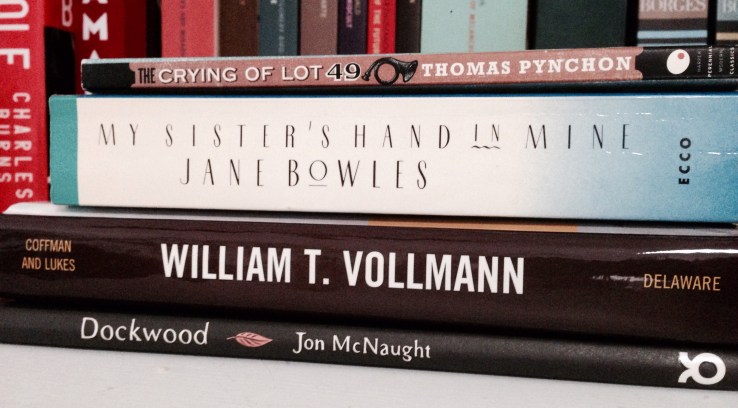
The Crying of Lot 49 by Thomas Pynchon

After a few false starts over the last decade, I finally submerged myself in Thomas Pynchon’s Mason & Dixon in those bourbon-soaked weeks between Thanksgiving and New Year. I read the book as a sort of sequel to the book Pynchon wrote after it, Against the Daysimply because I read Against the Day in 2013, before M&D. Both books are excellent, and seem to me more achieved in their vision than Inherent Vice or V or Vineland. The obvious comparison point for the pair though is Pynchon’s other big book (and, by reputation, his Big Book) Gravity’s Rainbow which I haven’t read since my freshman year of college—which is almost the same as not having read it at all. I intend to read it later this year (or maybe earlier?), but I also haven’t read The Crying of Lot 49 since my undergrad days either (which is to say, like, coming up on twenty years jesus). I’m about half way through and not zapped by it really—there are some funny jokes, but it’s just not as rich as Mason & Dixon or Against the Day (which is not meant to be a complaint, just an observation. And while I’m observing stuff parenthetically: What most bothers my attention most as I read are the reminders of David Foster Wallace’s The Broom of the System, which I have reread more recently than TCoL49).

Two Serious Ladies by Jane Bowles (collected in My Sister’s Hand in Mine)

What to say about Jane Bowles’s only novel? It goes: Propelled on its own sinister energy it goes, its vignettes flowing (or jerking or shifting or pitching wildly or dipping or soaring or sneaking) into each other with wonderfully dark comic force. I’ve sketched a full review I hope to be able to write, but for now let me excerpt a paragraph from Negar Azimi’s essay “The Madness of Queen Jane” from last summer in The New Yorker:

When it was first published, in 1943, “Two Serious Ladies” received lukewarm, even baffled, reviews. Edith Walton, writing in the Times Book Review, called the book senseless and silly: “To attempt to unravel the plot of ‘Two Serious Ladies’ would be to risk, I am sure, one’s own sanity.” Another reviewer said, simply, “The book is about nothing.” Jane’s family, in the meantime, found it unseemly in its stark depiction of lesbianism. Its characters, who have goals and motivations that are hard to grasp, were difficult to relate to. Yet another critic wrote, “The only shocking thing about this novel is that it ever managed to find its way to print.” Jane was only twenty-four.

Wharton’s line should intrigue, not repel readers. And: “The book is about nothing” — well, okay, that’s completely untrue—the book is about women searching for something, but something they can’t name, can’t conceive in language but can perhaps imagine. These women are on the brink of all those things one can be brinked upon: abysses, madness, abysses of madness, etc. But: “The book is about nothing” — well, okay, Two Serious Ladies resists unfolding in the way in which we expect narratives to be about something—Bowles withholds exposition, clarification, and motivation—well, okay, not withholds, but rather hides, or obscures, or enshadows.

I don’t have the verbs for this book.

But I loved reading it, feeling estranged from it while simultaneously invited into its darkness, bewildered by its transpositions, as Jane Bowles moves her verbal camera from one character to another—Wait, what? Okay, I guess we’re going over here now?!—its picaresque energy a strange dark joy. More to come.

William T. Vollmann: A Critical Companion, a collection of essays edited by Christopher K. Coffman and Daniel Lukes

I’ve been dipping into this kind of at random, but it’s very rewarding, and I think it would make a surprisingly good introduction to Vollmann. To be clear, academic criticism is never a substitute for, y’know, reading the author’s actual texts, the range here covers voluminous Vollmann. And look, I’ll be honest, I’ll probably never read Argall, so I very much appreciated Buell Wisner situating it for me in his essay. One of the treats of this book is how an academic essay like Wisner’s—a well-researched close reading with 64 reference notes—is followed by a reflective and informal piece by Carla Bolte on designing Vollmann’s books (“Bill’s books are not for everyone. We all know that,” she offers at one point). Good stuff, more to come.

Dockwood by Jon McNaught

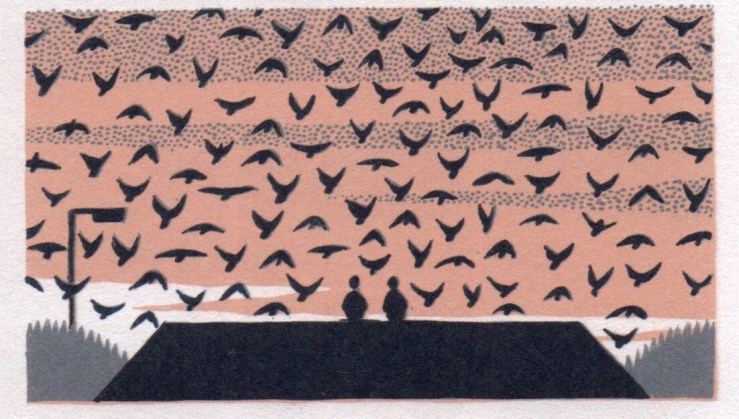
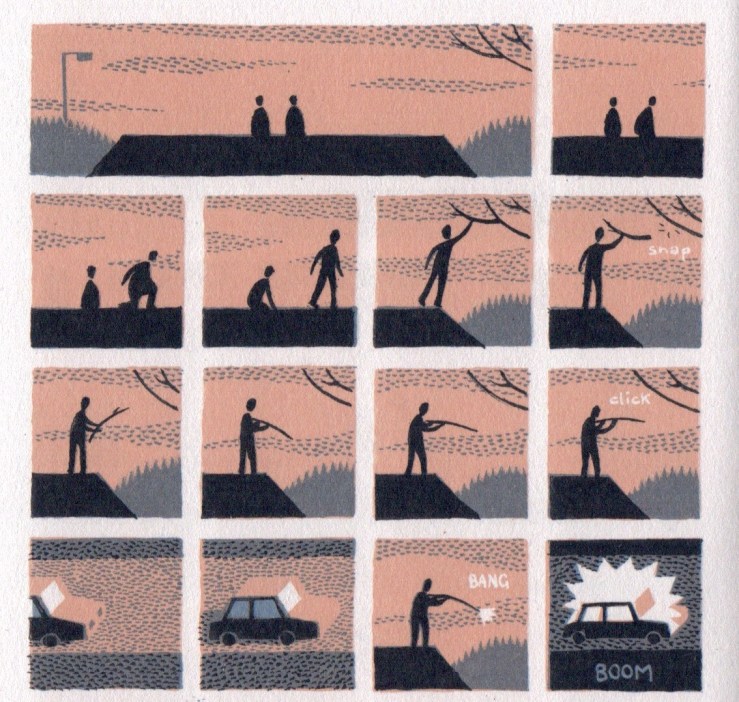
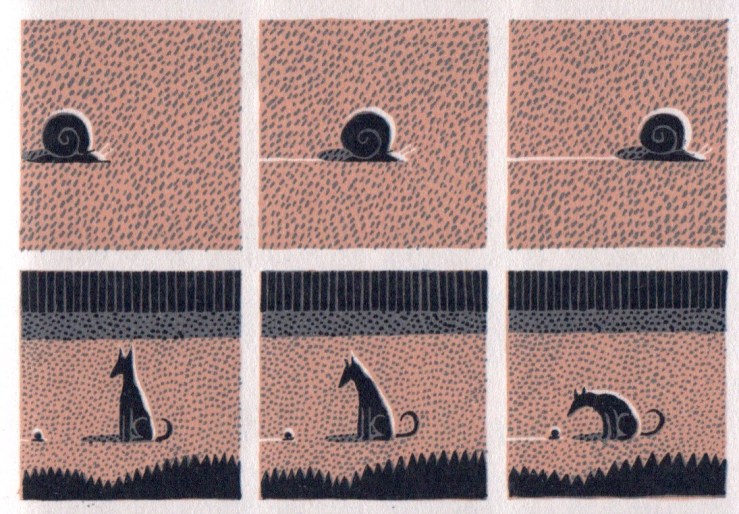
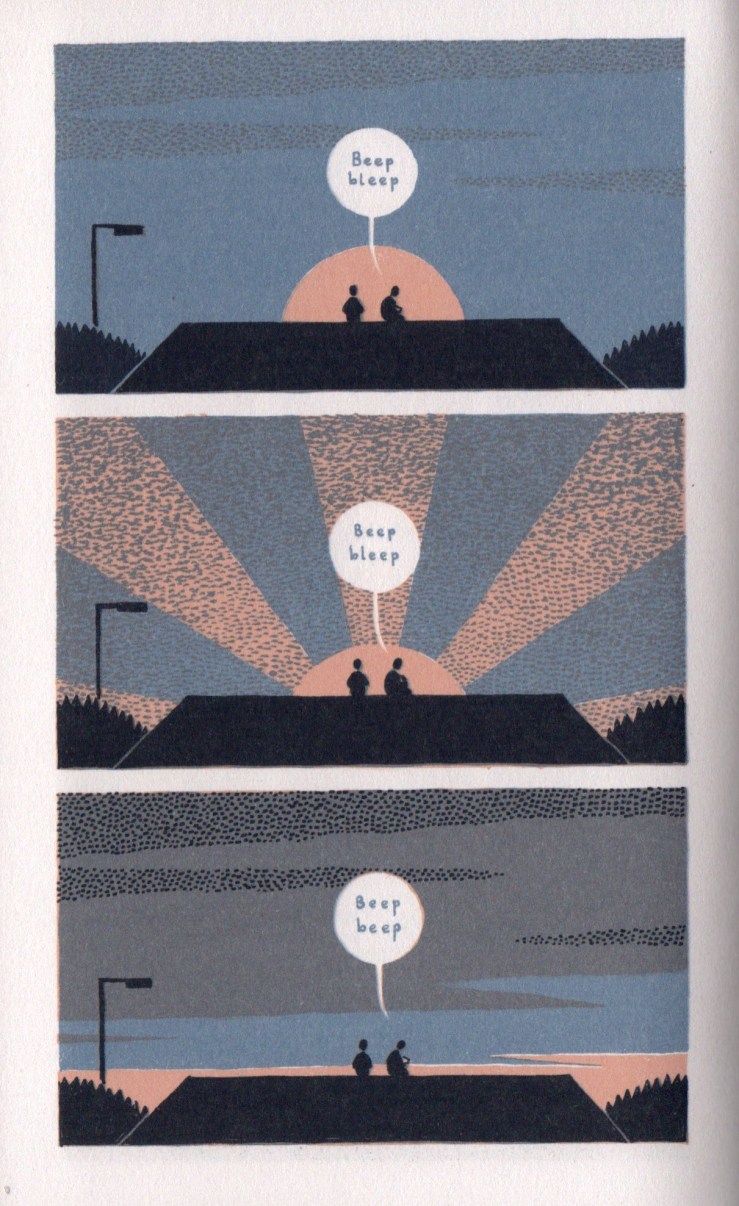
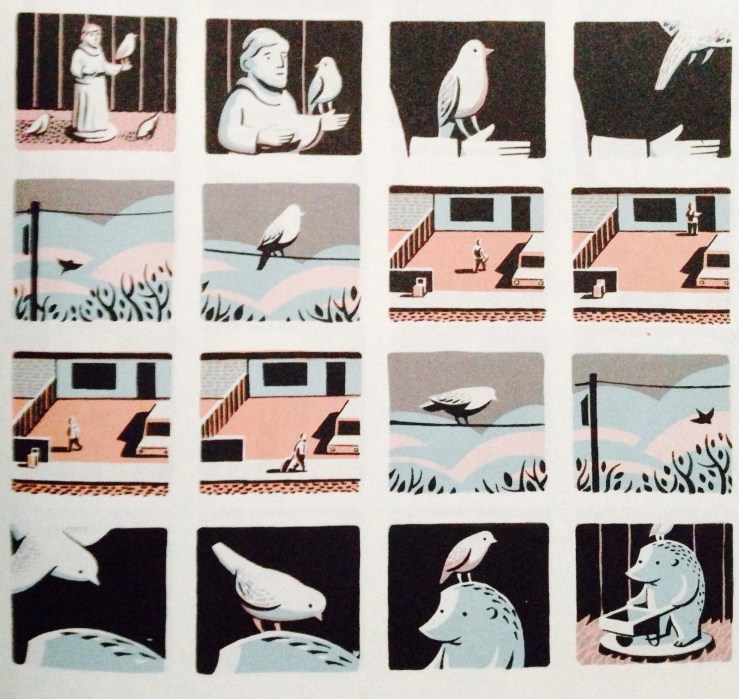
I owe this marvelous book a proper review. Dockwood is a kind of visual prose-poem, tranquil, meditative, autumnal. The book is its own total aesthetic; McNaught uses color and form to evoke feeling here, with minimal, unobtrusive dialogue that functions more as ambiance than exposition. Lovely.

IMG_4849

Thomas Pynchon’s Mason & Dixon (Third Riff: The Rabbi of Prague)

A. I’m a few chapters–three, precisely—from finishing Mason & Dixon. “Finishing” is not the right verb here, though—Pynchon’s novel is so rich, funny, strange, and energetic that I want to return to it immediately.

B. But I need to backtrack a bit, riff on one of my favorite episodes—Chapter 50.

C. (First riff and second riff for those inclined).

D. In Chapter 50,

’tis Dixon’s luck to discover The Rabbi of Prague, headquarters of a Kabbalistick Faith, in Correspondence with the Elect Cohens of Paris, whose private Salute they now greet Dixon with, the Fingers spread two and two, and the Thumb held away from them likewise, said to represent the Hebrew letter Shin and to signify, “Live long and prosper.”

Pynchon plays here on the reader’s initial understanding of the signal and phrase as a pop culture reference—


—but the goof isn’t merely postmodernist shtick—Pynchon is pointing to how the invisible manifests itself in signs and wonders, covert, cryptic, but perhaps—perhaps—decipherable.

E. (Maybe this needs clarification: The Rabbi of Prague is a tavern. I lost track of how many bars taverns pubs inns alehouses coffeehouses etc. show up in M&D). Continue reading “Thomas Pynchon’s Mason & Dixon (Third Riff: The Rabbi of Prague)”

Thomas Pynchon’s Mason & Dixon (Second Riff: The Pygmies’ Discovery of Great Britain)

A. Okay. So I finished the first section of Mason & Dixon a few days ago. I’m now at the part where our titular heroes are smoking weed and eating snacks with George Washington. I can’t possibly handle all the material I’ve read so far—even in a riff (here’s the first riff for anyone inclined)—so instead I’ll annotate a few passages from Ch. 19, one of my favorite episodes so far.

B. Setting and context: 1762. “The George,” a pub in Gloucestershire (Mason’s home county). The patrons at the tavern are heatedly discussing the eleven days that went “missing” when the British moved from the Julian calendar to the Gregorian calendar.

One (satirical) source for this controversy comes from William Hogarth’s 1755 painting An Election Entertainment; in the detail below, you can read (barely) the slogan  “Give us our Eleven Days” on the black banner under the man’s foot.

a

A bit more context, via History Today:

In 1750 England and her empire, including the American colonies, still adhered to the old Julian calendar, which was now eleven days ahead of the Gregorian calendar, introduced in 1582 by Pope Gregory XIII and in use in most of Europe.

Attempts in the sixteenth and seventeenth centuries to adopt the new calendar had broken on the rock of the Church of England, which denounced it as popish. The prime mover in changing the situation was George Parker, second Earl of Macclesfield, a keen astronomer and a Fellow of the Royal Society. He was assisted in his calculations by his friend James Bradley…

I emphasized Bradley—Mason’s mentor—and Macclesfield as they are minor characters in this episode.

Basically, the pub patrons demand that Mason explain what happened to the missing eleven days.

C. Okay—so this whole episode, this discussion of time and space clearly helps underline the big themes of Mason & Dixon: How to measure the intangible, the invisible—how to pin down the metaphysical to the physical—how to know and how to not know. (Hence all the paranoia). Continue reading “Thomas Pynchon’s Mason & Dixon (Second Riff: The Pygmies’ Discovery of Great Britain)”

Thomas Pynchon’s Mason & Dixon (First Riff)

A. Mason & Dixon: I bought my copy at Shaman Bookstore in Chiang Mai, Thailand, in the fall of 2002. I had just read and absorbed V., but could not get into Mason & Dixon. Chalk up this initial failure to the novel’s daunting scope, the formal characteristics of its faux-18th c. style, too much Thai whiskey, etc. I made attempts again over the years, sporadic ones, small dents, etc., including a half-hearted attempt after reading the book’s sort-of sequel, Against the Day last year. But of course I needed space from/for a big-assed Pynchon novel, so, a year later, I finally commit to Mason & Dixon. I’ve read the first 15 chapters.

B. “against the Day”: The phrase leaps out in the third paragraph of Chapter 13 (p. 125), imploring me to read Mason & Dixon as a prequel of sorts to Against the Day. The themes, motifs, and formal devices of both novels are utterly Pynchonian, of course (he tautologically types): Paranoia, global powers contesting for domination, science, adventure, means and methods of conveyance, dick jokes, ditties, inebriating substances, all manner of rascalism, man’s inhumanity to etc. And condiments!

C. “ketjap”: Against the Day gave us a history of the cult of mayonnaiseMason & Dixon is the ketchup book. (Not really but maybe really).

D. “The Learned English Dog”: We meet this marvelous beast, this talking dog, early in the novel, and he of course reminds me immediately of Pugnax, the loyal and brave companion to the Chums of Chance in Against the Day.

E. “invisible”: Just as in Against the Day, Pynchon sounds the note “invisible” repeatedly to highlight some of the Big Themes of the novel. Mason & Dixon is about The Age of Reason, or about the limitations of The Age of Reason, or about the limitations of even the very conceptualization of an Age of Reason—an age when “Men of Science” like our titular Daring Duo sought to make the invisible—the passage of the stars and time itself—visible, measurable, defined, bordered, colonized, etc.

F. “…please do not come to the Learned English Dog if it’s religious Comfort you’re after. I may be preternatural, but I am not supernatural. ‘Tis the Age of Reason, rrrf? There is ever an Explanation at hand, and no such thing as a Talking Dog,—Talking Dogs belong with Dragons and Unicorns.” Said the Talking Dog.

G. “inconvenience”: The first time I notice the word—another of Pynchon’s signatures—is in Ch. 3 (p. 28). It stands out: A sailor by the name of Fender-Belly Bodine claims that he once sailed on the H.M.S. Inconvenience. The Chums of Chance of course sail the heavens on their airship The Inconvenience. 

H. But again: “inconvenience” (and iterations of the same) thread through Mason & Dixon: Why? What to make of the word? Perhaps—just a perhaps—The Age of Reason is really a rhetorical substitution for The Age of Convenience, the Age of Better Living (For Some Folks) Through Science. Convenience: The application of some kind of method or utility—relies on measurement, on demarcation, on prediction, etc. Convenience, then, perhaps then, as the practical aim of the age of science.

I. And Inconvenience, then, perhaps then, as a disruptive metaphysical force (?).

J. I’ve neglected entirely to remark on the 18th c. style. Maybe another time.

K. Also the songs.

L. But I will, before closing, remark quickly on how much I enjoy how Pynchon riffs on jocular forms—jokes you mean, right?—to compose elements of the narrative. Early on, Dixon tries to tell a joke about “this Jesuit, this Corsican, and this Chinaman” before he’s stopped by a mortified Mason; they return to the joke about a hundred pages later (still no punchline). Globalization is already there.

M. (Also: An extended episode in the Dutch Cape of South Africa riffs repeatedly on the farmer’s daughters joke. No insight at all here—just love how Pynchon uses the joke to move his narrative along).

M. Okay, then: Just a few opening notes, just a little riff, a sketch, some initial ideas. More to come. Loving the book so far.

J.G. Ballard’s “The Subliminal Man,” John Carpenter’s They Live, and Black Friday

Today is Black Friday in America. I don’t think it’s necessary to remark at length on the bizarre disjunction between this exercise in consumerism-as-culture and the intended spirit of the Thanksgiving holiday that precedes it. Indeed, I think that the cognitive dissonance that underwrites Black Friday—the compulsion to suffer (and cause suffering), both physically and mentally,  to “save” money on “consumer goods” (sorry for all the scare quotes, but these terms are euphemisms and must be placed under suspicion)—I think that this cognitive dissonance is nakedly apparent to all who choose to (or are forced to) actively engage in Black Friday. The name itself is dark, ominous, wonderfully satanic.

Rereading “The Subliminal Man,” I was struck by how presciently J.G. Ballard anticipated not only the contours of consumerist culture—urban sprawl, a debt-based economy, the mechanization of leisure, the illusion of freedom of choice—but also how closely he intuited the human, psychological responses to the consumerist society he saw on the horizon. Half a century after its publication, “The Subliminal Man” seems more relevant than ever.

The premise of the tale is fairly straightforward and fits neatly with the schema of many other early Ballard stories: Franklin, an overworked doctor, is approached by Hathaway, a “crazy beatnik,” who refuses to take part in the non-stop consumerism of contemporary society. Hathaway can “see” the subliminal messages sent through advertising. He asks for Franklin’s help in stopping the spread of these messages. Hathaway reasons that the messages are intended to enforce consumerist society:

Ultimately we’ll all be working and spending twenty–four hours a day, seven days a week. No one will dare refuse. Think what a slump would mean – millions of lay–offs, people with time on their hands and nothing to spend it on. Real leisure, not just time spent buying things . . .

The fear of a slump. You know the new economic dogmas. Unless output rises by a steady inflationary five per cent the economy is stagnating. Ten years ago increased efficiency alone would raise output, but the advantages there are minimal now and only one thing is left. More work. Subliminal advertising will provide the spur.

Franklin is unconvinced, even though he is already working Saturdays and Sunday mornings to payoff TVs, radios, and other electronic goods that he and his wife replace every few months. Soon, however, he realizes that something is wrong:

He began his inventory after hearing the newscast, and discovered that in the previous fortnight he and Judith had traded in their Car (previous model 2 months old) 2 TV sets (4 months) Power mower (7 months) Electric cooker (5 months) Hair dryer (4 months) Refrigerator (3 months) 2 radios (7 months) Record player (5 months) Cocktail bar (8 months)

Franklin finally sees the truth, but only after Hathaway takes to blowing up signs’ switch boxes (the word “terrorism” is of course not used in the text, although it surely would be today):

Then the flicker of lights cleared and steadied, blazing out continuously, and together the crowd looked up at the decks of brilliant letters. The phrases, and every combination of them possible, were entirely familiar, and Franklin knew that he had been reading them for weeks as he passed up and down the expressway.

BUY NOW BUY NOW BUY NOW BUY NOW BUY NEW CAR NOW NEW CAR NOW NEW CAR NOW

YES YES YES YES YES YES YES YES YES YES

Like many Ballard stories, “The Subliminal Man” ends on a pessimistic note, with Franklin choosing to ignore his brief enlightenment and give in. Ballard drives his criticism home in the final image of the story, with Franklin and his wife heading out to shop:

They walked out into the trim drive, the shadows of the signs swinging across the quiet neighbourhood as the day progressed, sweeping over the heads of the people on their way to the supermarket like the blades of enormous scythes.

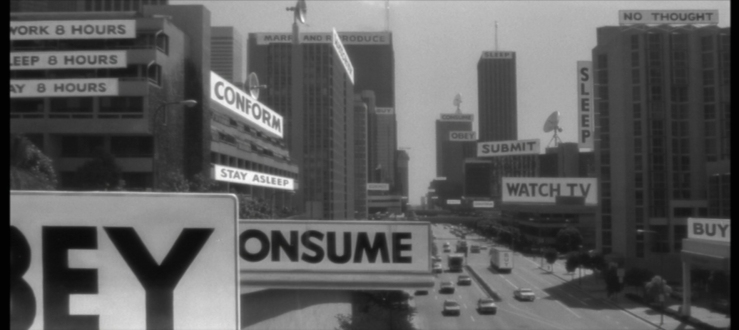
“The Subliminal Man” offers a critique of consumerism that John Carpenter would make with more humor, violence, and force in his 1988 film They Live. In Carpenter’s film, the hero John Nada (played by Roddy Piper) finds a pair of sunglasses that allow him to see through the ads, billboards, and other commercials he’s exposed. What’s underneath? Naked consumerism:

they-live-billboard

The images here recall the opening lines of “The Subliminal Man”: ‘The signs, Doctor! Have you seen the signs?’ Like Ballard’s story, Carpenter’s film is about waking up, to seeing the controlling messages under the surface.

In his film The Pervert’s Guide to Ideology, Slavoj Žižek offers a compelling critique of just how painful it is to wake up to these messages:


It’s worth pointing out that Carpenter offers a far more optimistic vision than Ballard. Ballard’s hero gives in—goes back to sleep, shuts his eyes. Carpenter’s hero Nada resists the subliminal messages—he actually takes up arms against them. This active resistance is possible because Carpenter allows his narrative an existential escape hatch: In They Live, there are real, genuine bad guys, body-snatching ugly-assed aliens—others that have imposed consumerism on humanity to enslave them. That’s the big trick to They Live: It’s not us, it’s them.

Ballard understands that there is no them; indeed, even as the story skirts around the idea of a conspiracy to dupe consumers into cycles of nonstop buying, working, and disposing, it never pins that conspiracy on any individual or group. There’s no attack on corporations or government—there’s not even a nebulous “them” or “they” that appears to have controlling agency in “The Subliminal Man.” Rather, Ballard’s story posits ideology as the controlling force, with the only escape a kind of forced suicide.

I don’t think that those who engage in consumerism-as-sport, in shopping-as-a-feeling are as blind as Ballard or Carpenter represent. I think they are aware. Hell, they enjoy it. What I think Ballard and Carpenter (and others, of course) really point to is the deep dissatisfaction that many of us feel with this dominant mode of life. For Ballard, we have resistance in the form of the beatnik Hathaway, an artist, a creator, a person who can perceive what real leisure would mean. For Carpenter, Nada is the resister—an outsider, a loner, a weirdo too. It’s somehow far more satisfying to believe that those who engage in spectacle consumerism are brainwashed by aliens than it is to have to come to terms with the notion that these people are acting through their own agency, of their own will and volition. Happy shopping everyone!

Ed. note: Biblioklept published a version of this post last year. It is offered again now in the spirit of Thanksgiving leftovers.

List with No Name #48

  1. The desire to manufacture and maintain happiness leads our culture, our society, our whatever to repeatedly perform contrived aesthetic scenarios.
  2. Happiness being, perhaps, a modern, or at least modernish, invention.
  3. Modernish affect.
  4. And happiness, we maybe telling ourselves, the goal, the telos, the whatever, of religion, politics, culture.
  5. Like many Americans, I have absolutely no idea what will make me happy.
  6. I know that happiness is not stable.
  7. One of Blake’s chimney sweepers remarks that because he is happy and dances and sings they (God/priest/king) are absolved from the belief that they’ve done him injury.
  8. Religion, or the practice and observance of religion, is the maintenance, repetition, and performance of contrived aesthetic scenarios.
  9. Months ago at a baptism I witnessed a man sway.
  10. The swayer swayed rhythmically: his eyes closed, his brow wrinkled, his mouth downturned in the pretense of ecstasy—he swayed to the guitar-strumming of an Episcopalian priest, who plucked and sang a song I’d never heard.
  11. The assembled witnesses mumbling through words of which they weren’t sure.
  12. (Or mute, glaring, like my brother, my father, myself).
  13. Later the priest reserved damning words for this world.
  14. (I’ve committed no details of the sermon to memory, but we may file the whole damn deal under “Platonic shadows of some other promised Real-to-Come“).
  15. And yet the backdrop of the whole affair—did I mention this baptism was outside?—this backdrop was the mighty north-flowing St Johns River, a beautiful spring day, hot, goddamn was it hot-–this backdrop was beautiful, ecstatically beautiful, the deep dark blue choppy river, so broad, coursed in the background, dotted with white sails—trees: announce them: cypress, sweetbay, oak—they swayed—or their branches swayed, their green leaves tickled in the occasional too-brief wind—the sky blazed azure, that’s the word we have, streaked with violent clouds (they were not fluffy)—birds flew—can I remember them, the birds? Let’s license my memory: let’s say white ibises beat past the spectacle, that black vultures hovered not too close. Let’s imagine limpkins and red-shouldered hawks, like the proud avian who lives in the oak across the street from me. Ospreys. Hell, throw in a bald eagle.
  16. The world, this world, which is to say this particular aesthetic arrangement had the potential to authorize happiness—and yet the man in black yapped on about its utter falsenessthis world, this beautiful beautiful world.
  17. Emily Dickinson claimed to keep the Sabbath at home, by which I think she meant her back yard. Sounds nice there—the sermon is never long, and instead of getting to Heaven at last – you’re going, all along.
  18. (I had to preserve and repeat and maintain the aesthetics of Ms. Dickinson’s dash).
  19. I went and stood in the shade and tried to feel happy.
  20. But the man, the swaying man—his performance of ecstasy—all this, mixed with the sermon to spoil the happiness, which I probably enjoyed just as much—the which there referring to the feeling of feeling spoiled happiness, or rather the feeling of potential happiness spoiled.
  21. That the feeling of the feeling was as pure as it might be, mediated by Nature and its enemy Religion.
  22. And finding the man’s swaying performance so thoroughly unconvincing, having witnessed ecstasy my own damn self, at least once or even twice in thirty-five years.
  23. And maybe even experiencing ecstasy, its edges, its agony.
  24. (Ms. Dickinson reported that she liked a look of agony. Its truth).
  25. That ecstasy, or awe, or reverence, or pick your own synonym, because, hey, language is weak as usual, as always, as always-shall-be—language can’t pin down transcendence to a signifying utterance—where was I, am I?—that ecstasy might be pantomimed in the service of a service, of a system, of a religion—this is the shadow of happiness, the shadow of the ideal of happiness: the problem. The problem.
  26. I was never close enough to hear the infant’s cries, coos, wails, burbles, sounds, which she must have uttered—maybe she slept through the ordeal—but any sounds she made must have been the purest utterances at the occasion, the repetitions of Nature, still outside of the culture in which we had gathered to inscribe her.
  27. I wrote all this for me, not for you, not for anyone else—but let me end with the cloying sentimental jeering pretense that I wrote it for the baptized baby, a supporting character in this narrative, whose life I hope is mostly happy.

A Too Many Cooks Riff, Focusing on The Killer, Who Is There Right from the Beginning

If you haven’t yet seen Too Many Cooks, Casper Kelly’s short film for Adult Swim, here it is:


Too Many Cooks compels and rewards/punishes its audience not because of its comedic elements, but rather for its horror. Kelly has made one of the finest little horror films I’ve ever seen.

The central techniques of Too Many Cooks–repetition, collage, and genre parody—are fairly obvious and wonderfully synthesized. The film relies on an understanding that its audience has a particular way of seeing. The intended audience of Too Many Cooks has:

1) An understanding and acceptance of the postmodern tradition of repeating a punchline (or set-up) past the point of humor. And–

2) A particular ironic vision that delights in seeing commercial TV genre conventions of yore skewered.

Too Many Cooks succeeds by disrupting both ways of seeing. Its audiovisual repetitions (oh my lord the song!) become insane tics in a horror story that the viewer did not expect to happen—despite a number of early clues.

In his essay “The Philosophy of Composition,” Edgar Allan Poe suggests that when “men speak of Beauty, they mean, precisely, not a quality, as is supposed, but an effect.” Let us substitute “Horror” for “Beauty” (Poe would not mind, I think) and we have a fair description of what the filmmakers behind Too Many Cooks have created: A short piece of art that, by its arrangement, editing, of particulars—including its audience’s preconceptions—creates the effect of horror.

That horror emanates from the secret protagonist of Too Many Cooks, a mad-eyed killer who haunts the film first from its peripheries before eventually overtaking it. (He bears a slight resemblance to the philosopher Slavoj Žižek).

The Killer is the organizing principle of Too Many Cooks. He’s right there from the beginning, a specter whose agency throughout the piece subverts audience expectations. It’s not the uber-Father (who begat too many Cooks) who is the film’s central figure, but the infanticidal Killer.

Here is the first time we see The Killer, just 20 seconds in. He’s there on the right, sweater-vested (like a dad):

2

And then a few seconds later, lurking on the Brady/Cosby/Bundy stairs, still obscure:

a

The Killer next shows up about 90 seconds in; this is, unless I’m wrong, the first time we see his visage. It’s also the moment when Too Many Cooks’s early joke on corny nineties sitcom intros really starts to wear thin—the filmmakers offer us repeated images of cooks as if to underscore the tedious point.

90secs

And there’s The Killer in the second family photo:2andhalf

Continue reading “A Too Many Cooks Riff, Focusing on The Killer, Who Is There Right from the Beginning”