Mitch Hedberg…Outside!

Danae — Max Slevogt

danaeblog

“All art constantly aspires towards the condition of music”

Portrait of a Lady Spinning — Maerten van Heemskerck

portrait-of-a-lady-spinninghalfhd

Nathaniel Hawthorne’s journal entry for April 7th, 1840

April 7th.–It appears to me to have been the most uncomfortable day that ever was inflicted on poor mortals. . . . Besides the bleak, unkindly air, I have been plagued by two sets of coal-shovelers at the same time, and have been obliged to keep two separate tallies simultaneously. But I was conscious that all this was merely a vision and a fantasy, and that, in reality, I was not half frozen by the bitter blast, nor tormented by those grimy coal-heavers, but that I was basking quietly in the sunshine of eternity, . . . Any sort of bodily and earthly torment may serve to make us sensible that we have a soul that is not within the jurisdiction of such shadowy demons,–it separates the immortal within us from the mortal. But the wind has blown my brains into such confusion that I cannot philosophize now.

Nathaniel Hawthorne’s journal entry for April 7th, 1840.

“For a Coming Extinction” — W.S. Merwin

“For a Coming Extinction”
by
W.S. Merwin

Gray whale
Now that we are sending you to The End
That great god
Tell him
That we who follow you invented forgiveness
And forgive nothing


I write as though you could understand
And I could say it
One must always pretend something
Among the dying
When you have left the seas nodding on their stalks
Empty of you
Tell him that we were made
On another day


The bewilderment will diminish like an echo
Winding along your inner mountains
Unheard by us
And find its way out
Leaving behind it the future
Dead
And ours


When you will not see again
The whale calves trying the light
Consider what you will find in the black garden
And its court
The sea cows the Great Auks the gorillas
The irreplaceable hosts ranged countless
And fore-ordaining as stars
Our sacrifices


Join your word to theirs
Tell him
That it is we who are important

Beheading of St. Catherine — Albrecht Altdorfer

beheading-of-st-catherine-1506hd

Lydia Davis’s “In a House Beseiged,” visually adapted by Roman Muradov

housebeseiged1-1

Enjoy the rest of Roman Muradov’s visual adaptation of Lydia Davis’s microfiction at The Paris Review.

RIP Merle Haggard

RIP Merle Haggard, 1937-2016. One of the realest.

Levitation — Moebius

dessinmoebius

The reason the Dead do not return nowadays is the boredom of it | “On the Return of the Dead,” Hilaire Belloc

“On the Return of the Dead”

by

Hilaire Belloc

from On Nothing and Kindred Subjects (1908)


The reason the Dead do not return nowadays is the boredom of it.

In the old time they would come casually, as suited them, without fuss and thinly, as it were, which is their nature; but when such visits were doubted even by those who received them and when new and false names were given them the Dead did not find it worth while. It was always a trouble; they did it really more for our sakes than for theirs and they would be recognised or stay where they were.

I am not certain that they might not have changed with the times and come frankly and positively, as some urged them to do, had it not been for Rabelais’ failure towards the end of the Boer war. Rabelais (it will be remembered) appeared in London at the very beginning of the season in 1902. Everybody knows one part of the story or another, but if I put down the gist of it here I shall be of service, for very few people have got it quite right all through, and yet that story alone can explain why one cannot get the dead to come back at all now even in the old doubtful way they did in the ’80’s and early ’90’s of the last century.

There is a place in heaven where a group of writers have put up a colonnade on a little hill looking south over the plains. There are thrones there with the names of the owners on them. It is a sort of Club.

Rabelais was quarrelling with some fool who had missed fire with a medium and was saying that the modern world wanted positive unmistakable appearances: he said he ought to know, because he had begun the modern world. Lucian said it would fail just as much as any other way; Rabelais hotly said it wouldn’t. He said he would come to London and lecture at the London School of Economics and establish a good solid objective relationship between the two worlds. Lucian said it would end badly. Rabelais, who had been drinking, lost his temper and did at once what he had only been boasting he would do. He materialised at some expense, and he announced his lecture. Then the trouble began, and I am honestly of opinion that if we had treated the experiment more decently we should not have this recent reluctance on the part of the Dead to pay us reasonable attention.

In the first place, when it was announced that Rabelais had returned to life and was about to deliver a lecture at the London School of Economics, Mrs. Whirtle, who was a learned woman, with a well-deserved reputation in the field of objective psychology, called it a rumour and discredited it (in a public lecture) on these three grounds:

(a) That Rabelais being dead so long ago would not come back to life now.

(b) That even if he did come back to life it was quite out of his habit to give lectures.

(c) That even if he had come back to life and did mean to lecture, he would never lecture at the London School of Economics, which was engaged upon matters principally formulated since Rabelais’ day and with which, moreover, Rabelais’ “essentially synthetical” mind would find a difficulty in grappling. Continue reading “The reason the Dead do not return nowadays is the boredom of it | “On the Return of the Dead,” Hilaire Belloc”

The Two Sisters — Theodore Chasseriau

thc3a9odore_chassc3a9riau_003

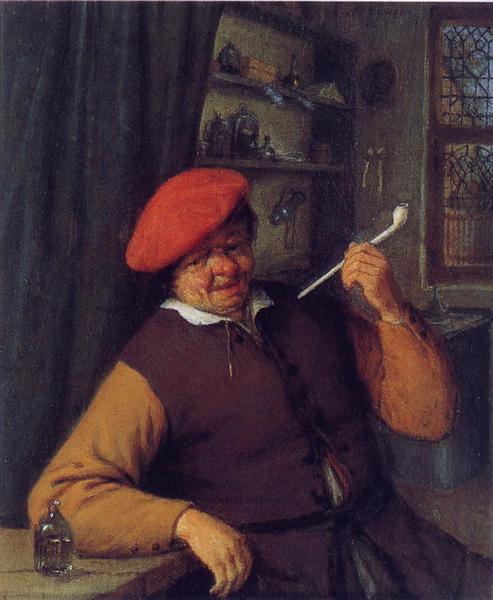
Inn Scene — Adriaen van Ostade

inn-scenelarge

Sounds of Spring — Franz Stuck

sounds-of-spring-1910

Three Books

img_1930

Collected Stories by William Faulkner. 1977 first edition trade paperback from Vintage. This book is 900 pages, exactly, not including the ancillary pages that detail publication dates and rights, as well as Vintage’s back catalog—and yet not one of those pages manages to credit the cover designer or photographer.

I’ve been reading/re-reading this very slowly, with the loose goal of finishing this year.

img_1929

Nausicaä of the Valley of the Wind, Vol. 4 by Hayao Miyazaki. English translation by David Lewis and Toren Smith. Studio Ghibli Library edition by Viz Media, 2010. No designer credited, but the cover is by Miyazaki and I imagine we can probably credit Studio Ghibli with the design.

I started rereading Nausicaä this week after revisiting Princess Mononoke this week. Then I got horribly ill, and the only stuff I can really read when I’m really sick are comics. I scanned Vol. 4 for this week’s Three Books post; I finished it pretty late last night. Vol 5-7 remain.

img_1931

Junkets on a Sad Planet by Tom Clark. First edition trade paperback by Black Sparrow Press, 1994. Cover design by Barbara Martin. The image is of Benjamin Robert Haydon’s life mask for John Keats (from a photo by Christopher Oxford).

I awoke around 1am in the middle of last week, and unable to sleep, I wandered to our den and randomly took this from the shelf to begin reading/rereading. The book (its title is a pun) is difficult to explain, a beautiful experience, rich. Here’s Clark’s own description: “…an extended reflection on the modern poet’s life, as Keats lived it. The book may be read by turns as poetic novel, biography in verse, allegorical masque, historical oratorio for several voices.”

“Memoirs of a Madman” — Nikolai Gogol

Poprishchin, Ilya Repin (1882)


“Memoirs of a Madman”

by

Nikolai Gogol

English translation by Claud Field

from The Mantle and Other Stories


October 3rd. — A strange occurrence has taken place today. I got up fairly late, and when Mawra brought me my clean boots, I asked her how late it was. When I heard it had long struck ten, I dressed as quickly as possible.

To tell the truth, I would rather not have gone to the office at all today, for I know beforehand that our department-chief will look as sour as vinegar. For some time past he has been in the habit of saying to me, “Look here, my friend; there is something wrong with your head. You often rush about as though you were possessed. Then you make such confused abstracts of the documents that the devil himself cannot make them out; you write the title without any capital letters, and add neither the date nor the docket-number.” The long-legged scoundrel! He is certainly envious of me, because I sit in the director’s work-room, and mend His Excellency’s pens. In a word, I should not have gone to the office if I had not hoped to meet the accountant, and perhaps squeeze a little advance out of this skinflint.

A terrible man, this accountant! As for his advancing one’s salary once in a way — you might sooner expect the skies to fall. You may beg and beseech him, and be on the very verge of ruin — this grey devil won’t budge an inch. At the same time, his own cook at home, as all the world knows, boxes his ears.

I really don’t see what good one gets by serving in our department. There are no plums there. In the fiscal and judicial offices it is quite different. There some ungainly fellow sits in a corner and writes and writes; he has such a shabby coat and such an ugly mug that one would like to spit on both of them. But you should see what a splendid country-house he has rented. He would not condescend to accept a gilt porcelain cup as a present. “You can give that to your family doctor,” he would say. Nothing less than a pair of chestnut horses, a fine carriage, or a beaver-fur coat worth three hundred roubles would be good enough for him. And yet he seems so mild and quiet, and asks so amiably, “Please lend me your penknife; I wish to mend my pen.” Nevertheless, he knows how to scarify a petitioner till he has hardly a whole stitch left on his body. Continue reading ““Memoirs of a Madman” — Nikolai Gogol”

The Measure of All Things — Marc Dennis

marc-dennis-the-measure-of-all-things_2013_oil_on_linen_66x72inches