“Exotic smoking practices around the world, of great anthropological value!” (Pynchon’s Against the Day)

Observers of the Fair had remarked how, as one moved up and down its Midway, the more European, civilized, and . . . well, frankly, white exhibits located closer to the center of the “White City” seemed to be, whereas the farther from that alabaster Metropolis one ventured, the more evident grew the signs of cultural darkness and savagery. To the boys it seemed that they were making their way through a separate, lampless world, out beyond some obscure threshold, with its own economic life, social habits, and codes, aware of itself as having little if anything to do with the official Fair. . . . As if the halflight ruling this perhaps even unmapped periphery were not a simple scarcity of streetlamps but deliberately provided in the interests of mercy, as a necessary veiling for the faces here, which held an urgency somehow too intense for the full light of day and those innocent American visitors with their Kodaks and parasols who might somehow happen across this place. Here in the shadows, the faces moving by smiled, grimaced, or stared directly at Lindsay and Miles as if somehow they knew them, as if in the boys’ long career of adventure in exotic corners of the world there had been accumulating, unknown to them, a reserve of mistranslation, offense taken, debt entered into, here being reexpressed as a strange Limbo they must negotiate their way through, expecting at any moment a “runin” with some enemy from an earlier day, before they might gain the safety of the lights in the distance.

Armed “bouncers,” drawn from the ranks of the Chicago police, patrolled the shadows restlessly. A Zulu theatrical company reenacted the massacre of British troops at Isandhlwana. Pygmies sang Christian hymns in the Pygmy dialect, Jewish klezmer ensembles filled the night with unearthly clarionet solos, Brazilian Indians allowed themselves to be swallowed by giant anacondas, only to climb out again, undigested and apparently with no discomfort to the snake. Indian swamis levitated, Chinese boxers feinted, kicked, and threw one another to and fro.

Temptation, much to Lindsay’s chagrin, lurked at every step. Pavilions here seemed almost to represent not nations of the world but Deadly Sins.   Pitchmen in their efforts at persuasion all but seized the ambulant youths by their lapels.

“Exotic smoking practices around the world, of great anthropological value!”

“Scientific exhibit here boys, latest improvements to the hypodermic syringe and its many uses!”

Here were Waziris from Waziristan exhibiting upon one another various techniques for waylaying travelers, which reckoned in that country as a major source of income. . . . Tarahumara Indians from northern Mexico crouched, apparently in total nakedness, inside lathandplaster replicas of the caves of their native Sierra Madre, pretending to eat visionproducing cacti that sent them into dramatic convulsions scarcely distinguishable from those of the common “geek” long familiar to American carnivalgoers. . . . Tungus reindeer herders stood gesturing up at a gigantic sign reading SPECIAL REINDEER SHOW, and calling out in their native tongue to the tip gathered in front, while a pair of young women in quite revealing costumes—who, being blonde and so forth, did not, actually, appear to share with the Tungus many racial characteristics—gyrated next to a very patient male reindeer, caressing him with scandalous intimacy, and accosting passersby with suggestive phrases in English, such as “Come in and learn dozens ways to have fun in Siberia!” and “See what really goes on during long winter nights!”

“This doesn’t seem,” Lindsay adrift between fascination and disbelief, “quite . . . authentic, somehow.”

An early episode from Thomas Pynchon’s novel Against the Day; here, the Chums of Chance have flown to Chicago to visit the “World’s Columbian Exposition recently opened there;” Lindsay Noseworth and Miles Blundell fearlessly go beyond “the fabled ‘White City,’ its great Ferris wheel, alabaster temples of commerce and industry, sparkling lagoons, and the thousand more such wonders, of both a scientific and an artistic nature.”

Conversation with Smaug — J.R.R. Tolkien

smaug tolkien

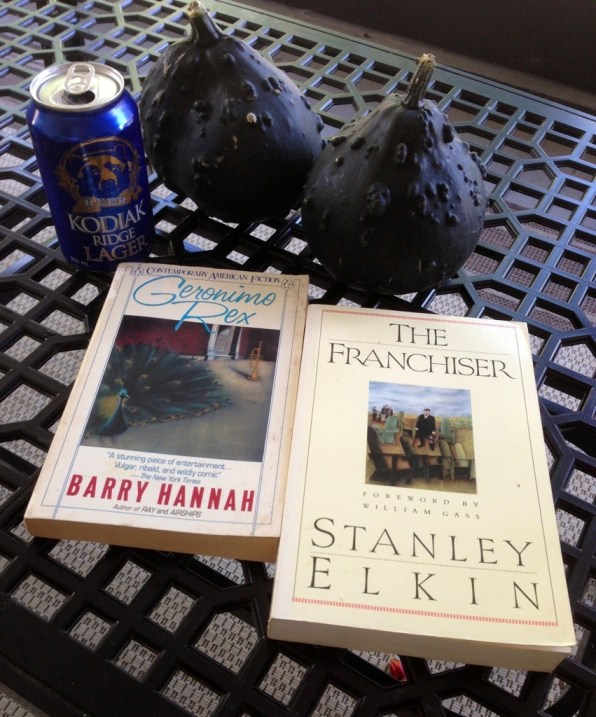
Barry Hannah/Stanley Elkin (Books Acquired, 5.29.2013)

20130529-164927.jpg

I was thrilled to find a somewhat tattered copy of Barry Hannah’s Geronimo Rex, after trolling the [huge, unorganized] “HA” section of my favorite used bookstore. Years ago, I found like seven of Hannah’s books used there and picked up only one. I devoured it, returned, the rest were gone. Regrets, regrets. I will review this maybe at the end of the summer (?) — until then:  reviews of Hannah’s Airshps, Hey Jack!, and Ray.

I’ve never read Stanley Elkin, but sort of feel like I should. Mr. BLCKDGRD (-a, -o, -e) suggested The Franchiser as a good starting point (although he said that The Magic Kingdom is his pers. fav. {disney fan?}). Some dude named Billy Gass wrote the forward. 

Also pictured: Two weird black gourds that grew in my garden, right in the midst of my cucumber patch. Also: Kodiak Ridge Lager, a weak lager with a beautiful blue an’ gold can.

The Monkey Who Had Seen the World — Edwin Henry Landseer

“Today, there’s no present to people” (Barry Hannah)

My aunts told wonderful stories. Not to me, but to each other. We had a very strong family. My mother’s sisters loved each other intensely. The uncles loved each other intensely. Those were the days when it meant something to travel, when people were still grinning because you could drive a car over a hundred miles. So when they got together they really narrated. Children were supposed to be quiet, so we’d all go to bed, but I’d still hear these stories going into the night and people’s laughter. It was a delightful way to go to sleep on Christmas or Thanksgiving. They had huge senses of humor. Humor meant everything to them because they had all been through the war and the depression, and now they had decent work and jobs. I think there’s no kind of happiness and laughter as after you’ve made something after a tough grade.

I was born in Clinton, Mississippi, which had 1,500–2,500 people when I was growing up—a village. Now it’s impossible to go back to these places because they’re not there anymore. My generation, we were the war children, and so there’s just hurt all over the continent because there’s no place to go home to.

Today, there’s no present to people. Nobody wants to listen for very long to anybody talking, except in certain places—in a bar, in a confessional, or maybe a shrink’s office. All they say is, Yeah, yeah, yeah. Men don’t even tell dirty jokes much anymore.

Nobody stops to talk except the instructors at college who’re paid for it. So it was a much more primitive time back then. More heartfelt. A more patient time, and I was the beneficiary of that.

From The Paris Review’s interview with Barry Hannah.


The Bible Lesson, or Anne and Tobias — Gerrit Dou

Vagabond — Remedios Varo

List with No Name #26

  1. Spirited Away
  2. Ponyo
  3. Nausicaä of the Valley of the Wind
  4. My Neighbor Totoro
  5. Howl’s Moving Castle
  6. Kiki’s Delivery Service
  7. Porco Rosso
  8. Princess Mononoke
  9. Castle in the Sky
 

Confession

The following is the complete text of an email someone sent me today:

I give you permission to publish this anonymously. Do you do that?

***

It seems that I have stolen many books. Let me elaborate on these and the occasions on which I thieved.

Although packs of baseball cards such as I used to steal from gas stations as a young boy are not books per se, this is how my thieving began. Perhaps. Or perhaps my thieving began further in my past than my memory now reaches.

I stole from a university library Omensetter’s Luck by William Gass–an earnest accident that I did not seek to right after I noticed I had escaped with it and that the magnetic gate had not reacted with its electronic screeching to alert the responsibles.

From the same erudite friend I stole The Captive Mind by Milosz, and also Le Parti pris by Francis Ponge. Perhaps Grass’s The Tin Drum too.

From an institute in France I stole an edition of selections from Apollinaire’s Alcools, as well as a Surrealist anthology. And both of André Breton’s Surrealist manifestos. From my host family I stole a book of Blaise Cendrars’s poetry.

Accidentally from a bookstore I stole Washington Square by Henry James. Honest.

From a library I stole Nicholas Mosley’s Serpent, as well as a book called The Art of Not Working, or some such title.

I have probably stolen ten or so other books. Titles escape me. That’s not too bad, I suppose.

Oh yes, I also stole that book Marilyn Manson wrote in the 1990s, and I gave it as a gift to a romantic interest. How unromantic this seems now.

I think I stole many books as an adolescent. Some of these I placed in my pants, held against my abdomen by the pressure of my pants waistline or belt. I think I stole numerous books related to sex when I was young.

I don’t think I’ve hardly ever borrowed a book and not returned it.

***

I give you permission to publish this anonymously. Do you do that?


You know, I don’t normally do that (i.e. this), but I guess I could start.

If anyone else feels like anonymously confessing to book theft, email me.


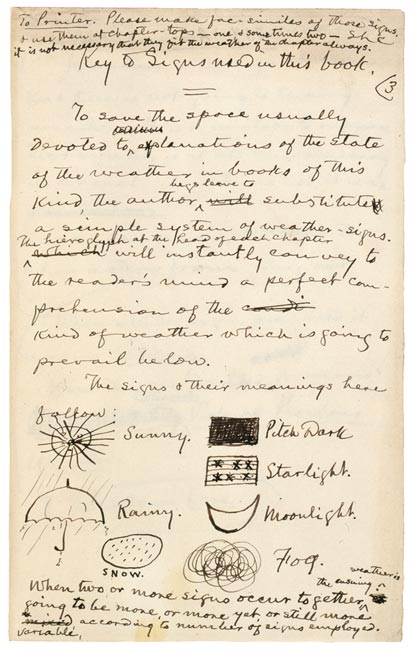
Handwritten Manuscript Page from Mark Twain’s Pudd’nhead Wilson

twain_ma881-882

(Via/about).

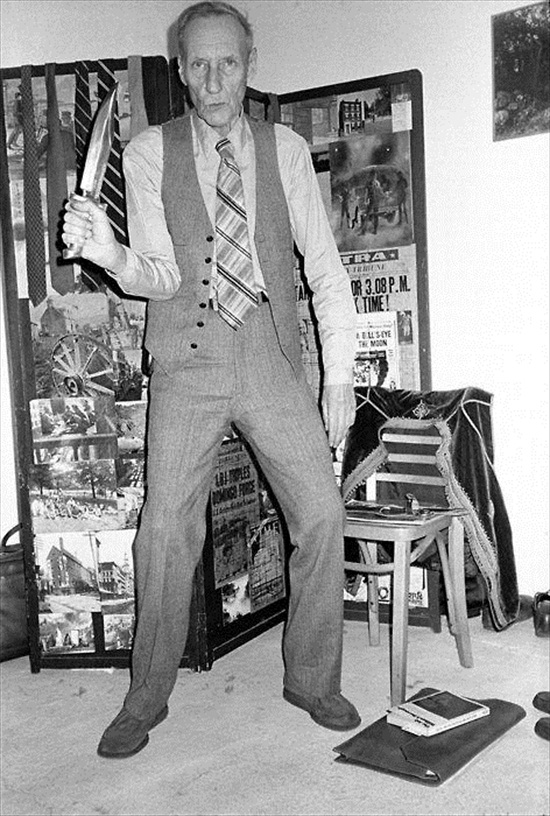
William S. Burroughs Wielding a Knife

william burroughs wielding a knife

“A Still Moment” by Eudora Welty

“A Still Moment” by Eudora Welty

Lorenzo Dow rode the Old Natchez Trace at top speed upon a race horse, and the cry of the itinerant Man of God, “I must have souls! And souls I must have!” rang in his own windy ears. He rode as if never to stop, toward his night’s appointment.

It was the hour of sunset. All the souls that he had saved and all those he had not took dusky shapes in the mist that hung between the high banks, and seemed by their great number and density to block his way, and showed no signs of melting or changing back into mist, so that he feared his passage was to be difficult forever. The poor souls that were not saved were darker and more pitiful than those that were, and still there was not any of the radiance he would have hoped to see in such a congregation.

“Light up, in God’s name!” he called, in the pain of his disappointment.

Then a whole swarm of fireflies instantly flickered all around him, up and down, back and forth, first one golden light and then another, flashing without any of the weariness that had held back the souls. These were the signs sent from God that he had not seen the accumulated radiance of saved souls because he was not able, and that his eyes were more able to see the fireflies of the Lord than His blessed souls.

“Lord, give me the strength to see the angels when I am in Paradise,” he said. “Do not let my eyes remain in this failing proportion to my – loving heart always.”

He gasped and held on. It was that day’s complexity of horse- trading that had left him in the end with a Spanish race horse for which he was bound to send money in November from Georgia. Riding faster on the beast and still faster until he felt as if he were flying he sent thoughts of love with matching speed to his wife Peggy in Massachusetts. He found it effortless to love at a distance. He could look at the flowering trees and love Peggy in fullness, just as he could see his visions and love God. And Peggy, to whom he had not spoken until he could speak fateful words (“Would she accept of such an object as him?”), Peggy, the bride, with whom he had spent a few hours of time, showing of herself a small round handwriting, declared all in one letter, her first, that she felt the same as he, and that the fear was never of separation, but only of death.

Lorenzo well knew that it was Death that opened underfoot, that rippled by at night, that was the silence the birds did their singing in. He was close to death, closer than any animal or bird. On the back of one horse after another, winding them all, he was always riding toward it or away from it, and the Lord sent him directions with protection in His mind.

Just then he rode into a thicket of Indians taking aim with their new guns. One stepped out and took the horse by the bridle, it stopped at a touch, and the rest made a closing circle. The guns pointed.

“Incline!” The inner voice spoke sternly and with its customary lightning-quickness.

Lorenzo inclined all the way forward and put his head to the horse’s silky mane, his body to its body, until a bullet meant for him would endanger the horse and make his death of no value. Prone he rode out through the circle of Indians, his obedience to the voice leaving him almost fearless, almost careless with joy.

But as he straightened and pressed ahead, care caught up with him again. Turning half-beast and half-divine, dividing himself like a heathen Centaur, he had escaped his death once more. But was it to be always by some metamorphosis of himself that he escaped, some humiliation of his faith, some admission to strength and argumentation and not frailty? Each time when he acted so it was at the command of an instinct that he took at once as the word of an angel, until too late, when he knew it was the word of the Devil. He had roared like a tiger at Indians, he had submerged himself in water blowing the savage bubbles of the alligator, and they skirted him by. He had prostrated himself to appear dead, and deceived bears. But all the time God would have protected him in His own way, less hurried, more divine.

Even now he saw a serpent crossing the Trace, giving out knowing glances.

He cried, “I know you now!,” and the serpent gave him one look out of which all the fire had been taken, and went away in two darts into the tangle.

He rode on, all expectation, and the voices in the throats of the wild beasts went, almost without his noticing when, into words. “Praise God,” they said. “Deliver us from one another.” Birds especially sang of divine love which was the one ceaseless protection. “Peace, in peace,” were their words so many times when they spoke from the briars, in a courteous sort of inflection, and he turned his countenance toward all perched creatures with a benevolence striving to match their own.

Continue reading ““A Still Moment” by Eudora Welty” →

Chair Car — Edward Hopper

“Come to King’s Landing and take your rightful seat on my Iron Throne!” (Venture Bros.)

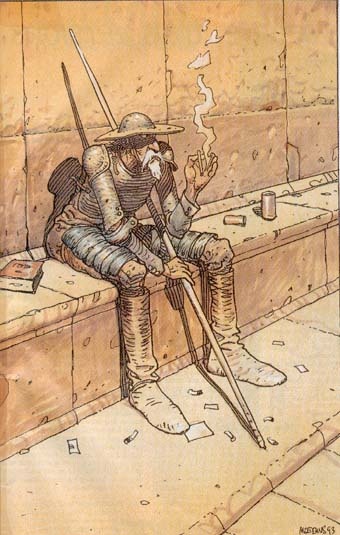
Don Quixote — Moebius

donquixotemoebius

The Oceanides — Gustave Dore

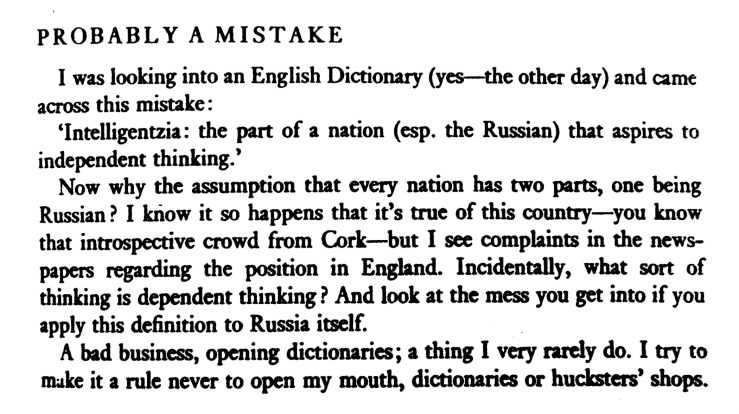
“Probably a Mistake” — Flann O’Brien

mistake