Little Lit: Strange Stories for Strange Kids is a collection of comix (and other oddities) for kids, edited by Art Spiegelman and his wifeartist/publisher Françoise Mouly. I saw at random and picked it up for my daughter, whose birthday was the next day. She loves, loves, loves this book, spending hours poring over all its weird images and picture games. Cover is by the great Charles Burns; there are also comics by Spiegelman, the late great Maurice Sendak—
—a weird search picture by Martin Handford (here’s a detail)—-
—and comics by other notables like David Sedaris, Paul Auster, Claude Ponti, Jules Feiffer, and Kim Deitch. The endpapers — “Strange Cartoon Lessons” are by Kaz:
I also picked up Burning Your Boats, which collects all of Angela Carter’s short stories:
I was looking for her dystopian novel The Passion of New Eve, but no go. Of course, I couldn’t pass up this volume, which comprises four collections, as well as early and uncollected stuff.
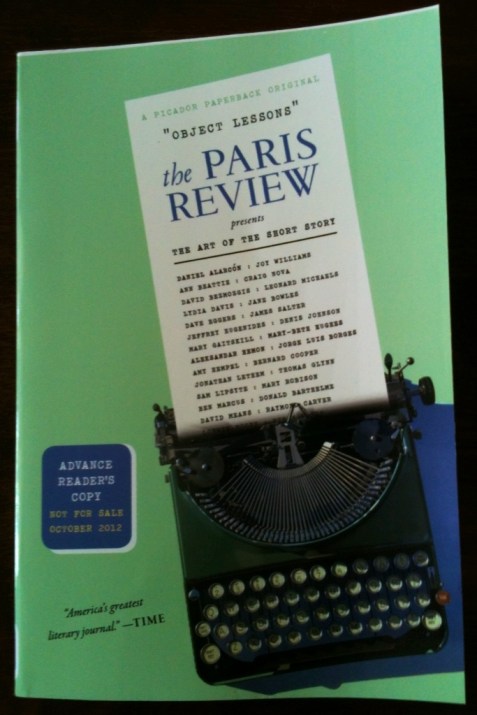
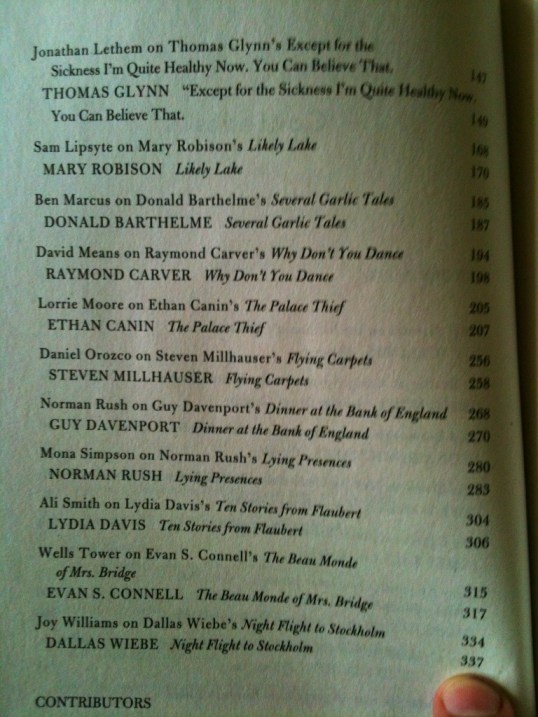
Okay: This one is really cool: Object Lessons features a bunch of short stories, some you may have read, each with a short lead-in (two-five pages) by another writer. So, we get Jeffrey Eugenides on Denis Johnson, or Ben Marcus on Donald Barthelme, or Lydia Davis on Jane Bowles, or Ali Smith on Lydia Davis. You know what, let me just share the table of contents (review down the line):
1984’s Dune is unquestionably the worst movie of Lynch’s career, and it’s pretty darn bad. In some ways it seems that Lynch was miscast as its director: Eraserhead had been one of those sell-your-own-plasma-to-buy-the-film-stock masterpieces, with a tiny and largely unpaid cast and crew. Dune, on the other hand, had one of the biggest budgets in Hollywood history, and its production staff was the size of a small Caribbean nation, and the movie involved lavish and cutting-edge special effects (half the fourteen-month shooting schedule was given over to miniatures and stop-action). Plus Herbert’s novel itself is incredibly long and complex, and so besides all the headaches of a major commercial production financed by men in Ray-Bans Lynch also had trouble making cinematic sense of the plot, which even in the novel is convoluted to the point of pain. In short, Dune’s direction called for a combination technician and administrator, and Lynch, though as good a technician as anyone in film, is more like the type of bright child you sometimes see who’s ingenious at structuring fantasies and gets totally immersed in them but will let other kids take part in them only if he retains complete imaginative control over the game and its rules and appurtenances—in short very definitely not an administrator.
Watching Dune again on video you can see that some of its defects are clearly Lynch’s responsibility, e.g. casting the nerdy and potato-faced Kyle MacLachlan as an epic hero and the Police’s resoundingly unthespian Sting as a psycho villain, or—worse—trying to provide plot exposition by having characters’ thoughts audibilized (w/ that slight thinking-out-loud reverb) on the soundtrack while the camera zooms in on the character making a thinking-face, a cheesy old device that Saturday Night Live had already been parodying for years when Dune came out. The overall result is a movie that’s funny while it’s trying to be deadly serious, which is as good a definition of a flop as there is, and Dune was indeed a huge, pretentious, incoherent flop. But a good part of the incoherence is the responsibility of De Laurentiis’s producers, who cut thousands of feet of film out of Lynch’s final print right before the movie’s release, apparently already smelling disaster and wanting to get the movie down to more like a normal theatrical running-time. Even on video, it’s not hard to see where a lot of these cuts were made; the movie looks gutted, unintentionally surreal.
In a strange way, though, Dune actually ended up being Lynch’s “big break” as a filmmaker. The version of Dune that finally appeared in the theaters was by all reliable reports heartbreaking for him, the kind of debacle that in myths about Innocent, Idealistic Artists In The Maw Of The Hollywood Process signals the violent end of the artist’s Innocence—seduced, overwhelmed, fucked over, left to take the public heat and the mogul’s wrath. The experience could easily have turned Lynch into an embittered hack (though probably a rich hack), doing f/x-intensive gorefests for commercial studios. Or it could have sent him scurrying to the safety of academe, making obscure plotless l6mm.’s for the pipe-and-beret crowd. The experience did neither. Lynch both hung in and, on some level, gave up. Dune convinced him of something that all the really interesting independent filmmakers—Campion, the Coens, Jarmusch, Jaglom—seem to steer by. “The experience taught me a valuable lesson,” he told an interviewer years later. “I learned I would rather not make a film than make one where I don’t have final cut.”
—From “David Lynch Keeps His Head” by David Foster Wallace; collected in A Supposedly Fun Thing I’ll Never Do Again.
The whole point of these books acquired posts is to try to document interesting stuff that comes in before it winds up in my pile for months (to put things in perspective, I got a reader copy of Adam Johnson’s The Orphan Master’s Son back in January, and have finally gotten around to reading it just now). I usually spend a week or two looking over the book, maybe publish a blurb or an excerpt of the book along with a photo, and then file it in one of three stacks — now, later, or never. Anyway, Siri Hustvedt’s new collection of essays Living, Thinking, Looking ended up never getting stacked anywhere, because I kept going back to it, poking into her essays on Goya, Gerhard Richter, Freud, reading her riff on sleeping, which somehow synthesizes Macbeth and Nabokov and REM science, pausing over her consideration of the Bush admin’s rhetoric. I haven’t finished the book but I will. Hustvedt combines her keen intellect with a range of ideas to explore her subjects (primarily, if the title didn’t tip you, living, thinking, looking). There’s a lot of lit here, a lot of psych, and plenty of art. Good stuff.
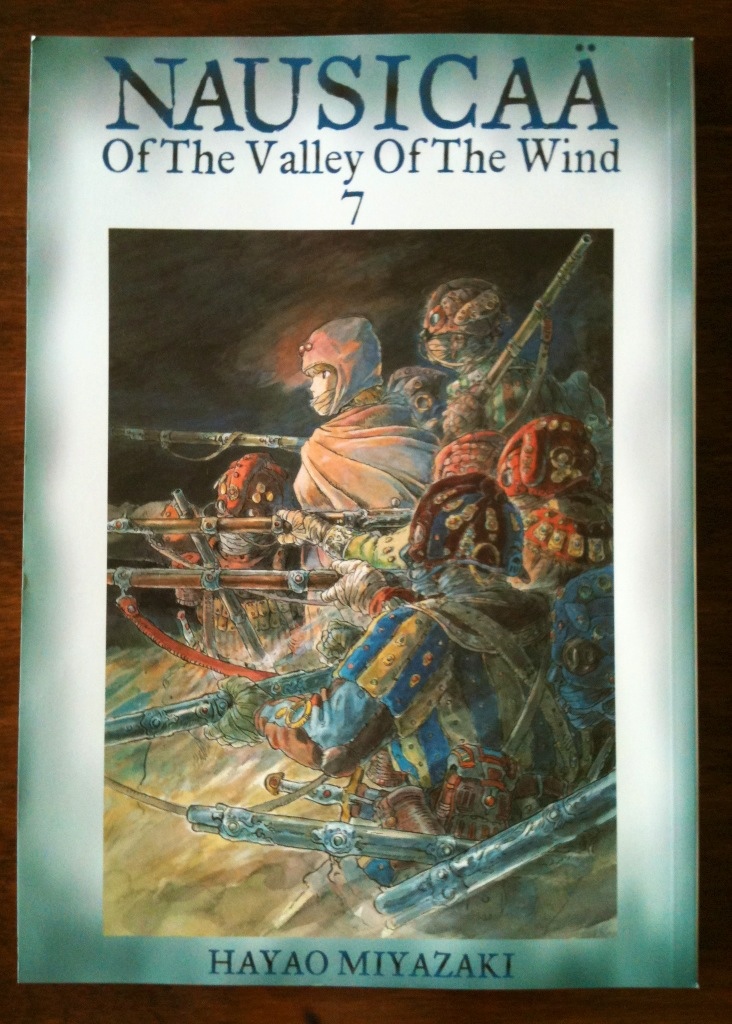
A birthday gift from my daughter. I got volumes 4-6 for Valentine’s Day from my darling wife, but have held off on reading them because I didn’t have the final volume, which is this one, volume 7.
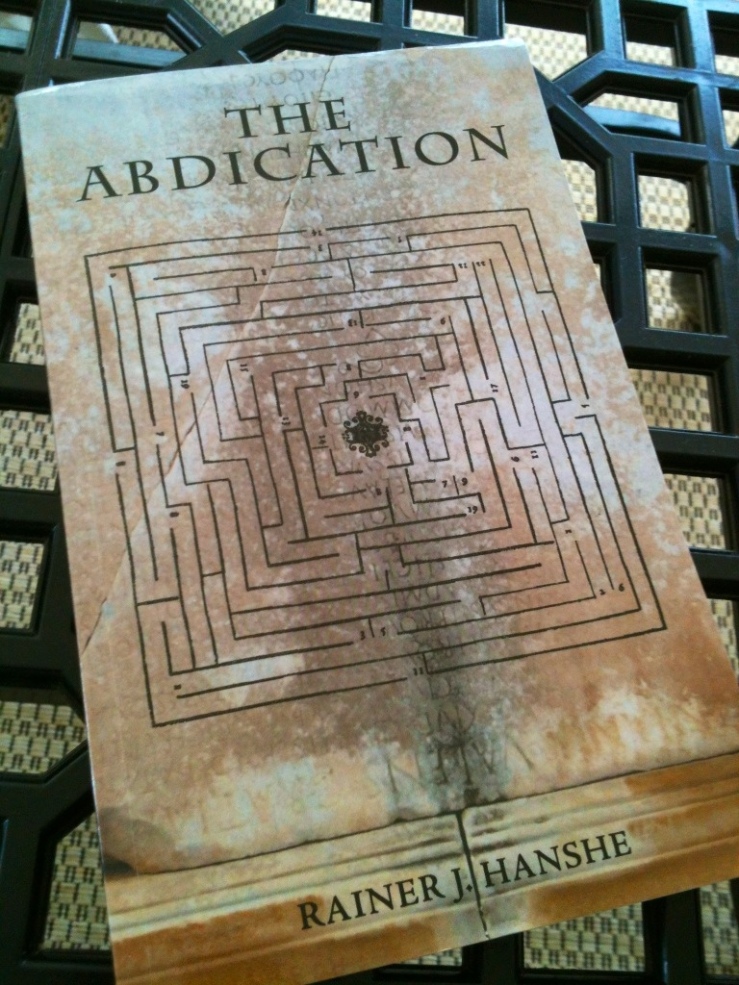
Rainer J. Hanshe’s The Abdication. Started this one the yesterday. Very weird, very cool. More thoughts to come, but here’s the blurb:
Spring 2032: an enigmatic bandleader named Triboulet arrives by helicopter in Rome, where his carnivalesque troupe awaits with a legion of animals and unruly kids. When provoking states of joyous panic through their ritualistic frenzies, the troupe’s arrival proves restorative, for the world is beset with famines, plagues, and religious conflicts, which Triboulet seeks to neutralize with freeing laughter. As he and his troupe begin constructing strange edifices in the Eternal City, sacred sites around the world suffer terrible, often beguiling forms of vandalism, and rumors abound that the Christ has actually finally returned.
Although radical Islamic sects claim responsibility for the vandalism, the culprits remain unknown: is it the Jihadists, anarcho-atheist intellectuals, or eco-terrorists? Religious and political authorities grow leery of the troupe and suspicious of Triboulet, whose true identity remains a mystery. The very future of the world is at stake, and while touring Israel during Christmas, Triboulet and his raucous band of pranksters bear witness to the world’s pivotal crossing into a new reality.
Albert Camus noted that ‘the metaphysics of the worst’ expresses itself in a literature of damnation and argued that ‘we have still not yet found the exit’ from such literature. With his second novel, Hanshe has found the way out, offering in fact something not only promising, but astounding, a pathway that is into a new reality, into a ‘physics of the best.’ The Abdication is a true ero(t)icomic epic.
A list of great sci-fi movies would undoubtedly include Ridley Scott’s signature films, Alien (1979) and Blade Runner (1982), but I don’t know if there’s enough room on that list for Scott’s latest Prometheus, a gorgeous collection of set-pieces smeared onto a messy, hole-filled plot, signifying nothing. I’ve already written at some length about Prometheus’s metaphysical shortcomings, but I’m never especially happy to write negative reviews without providing alternatives. Here are seven movies that demonstrate the best in depth of intellect that the genre has to offer.
1. Metropolis, 1927 (Dir. Fritz Lang)
Metropolis foregrounds many of the tropes that will come to dominate serious sci-fi (film and literature alike). The dystopian future of Metropolis imposes a strict division of classes, relegating the poor workers to underground drudgery while the (literal) upper class enjoy privileged leisure. Lang explores this divide via a Romeo & Juliet story of sorts—Freder, son of the city’s Master becomes infatuated with Maria, a girl from the underworld. He follows her into the labyrinth under the city and soon witnesses industrial horrors that harm the subterranean workers. The plot becomes more complicated when a mad scientist unveils an automaton—a robotic Maria—that he will use as part of a nefarious scheme. Metropolis’s expressionistic design and camera work still seem fresh and innovative almost a century after filming, and the film’s take on class disparity is as affecting as ever.
2. Alphaville, 1965 (Dir. Jean-Luc Godard)
Godard’s dystopian New Wave crime noir talkie follows the strange exploits of Lemmy Caution, who drives in from the Outlands in his Ford Galaxie to find a missing agent, capture the founder of Alphaville, and destroy Alpha 60, the totalitarian computer that keeps Alphaville’s citizens from indulging in poetry (or other forms of free expression). Godard makes no attempt to design a future: Alphaville is filmed in contemporary Paris. The effect is baffling; Alphaville is an exercise in uncanny realizations. The dialogue is pure New Wave stuff—crammed with literary and art reference—and will just as likely bore as many audience members as it enthralls. In the end though, Anna Karina as Natacha von Braun is reason enough to watch this film.
3. 2001: A Space Odyssey,1968 (Dir. Stanley Kubrick).
Watch it. Then watch it again.
4. Solaris, 1972 (Dir. Andrei Tarkovsky)
Tarkovsky’s Solaris is a slow, engrossing meditation on grief. Based on the novel by Polish writer Stanisław Lem, Solaris centers on psychologist Kris Kelvin, who goes to the space station orbiting the planet Solaris in order to investigate the series of emotional collapses that the crew have suffered. Kelvin soon slips into his own existential crisis, as a ghost–or psychological construct—of his dead wife appears to him. Solaris is gorgeous and measured, using its near-three-hour running time to grand effect.
5. The Thing, 1982 (Dir. John Carpenter)
Antarctic research station. Shapeshifting parasites. Kurt Russell. Dogs. Flamethrowers. Blood tests. Kurt Russell’s beard. Ennio Morricone’s score. Wilford Fucking Brimley. Paranoia. Paranoia. Paranoia.
6. Nausicaä of the Valley of the Wind, 1984 (Dir. Hayao Miyazaki)
A millennium after apocalyptic war destroys human civilizations, the groups that remain scramble to control the few resources left on the planet. A toxic jungle swarming with mutant insects—and dominated by the giant Ohmus—encroaches on the few bastions of clean soil that remain to humankind. Adventurous Princess Nausicaä though learns the secrets of the jungle—and also knows how to communicate with the Ohmus—only she has to navigate sides in the emerging war between rival kingdoms. Miyazaki’s film, based on his manga, is lush and detailed, a fully-realized world that is simultaneously frightening and beautiful. The film’s take on ecology is not so much preachy as it is prescient.
7. Primer, 2004 (Dir. Shane Carruth)
Primer was shot on a $7,000 budget, but it never looks or feels cheap. This story of four engineers who invent a time machine in a garage is decidedly unglamorous and consistently engaging; Carruth (who also wrote and stars in the film) throws the audience into the deep end, offering no exposition, let alone explication for the audience to latch onto. The film explores the bizarre moral implications—and possible side effects (and defects) of time travel.
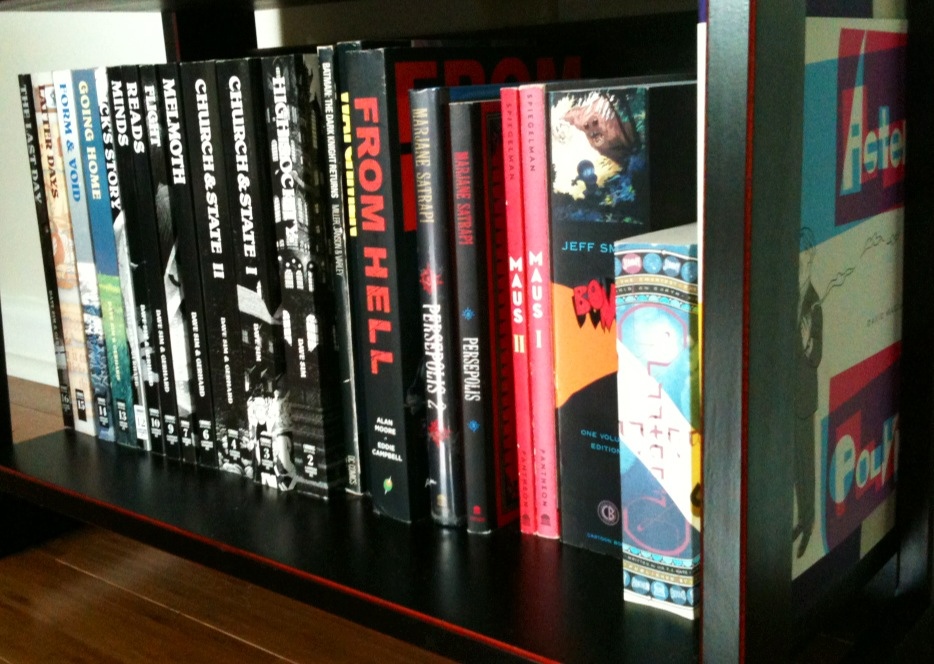
Book shelves series #24, twenty-fourth Sunday of 2012: In which we glance at canonical comics.
So we’ve hit the last shelf in a series of triplets; next week: new room.
This shelf holds graphic novels, including stuff by Alan Moore, Marjane Satrapi, David Mazzucchelli, Jeff Smith, Art Spiegelman, and Chris Ware. There’s also most of Dave Sim’s epic series Cerebus here.
I wrote about Dave Sim and Cerebus back in week 6 of this project, when I looked at the actual comic books I owned in the series. From that post:
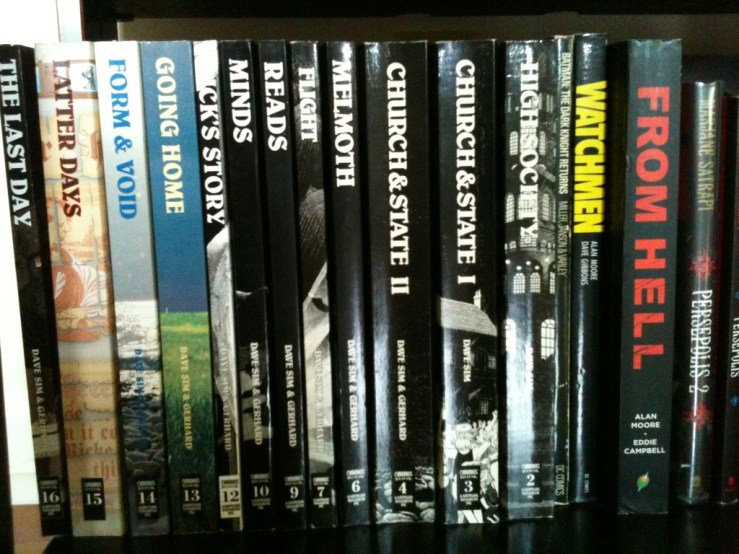
I bought issues of Cerebus intermittently for years at a time, usually getting frustrated and then waiting for the “phone book” graphic novel editions of the series. Sim, along with background artist Gerhard, produced 300 issues of Cerebus over 25 years. The issues from the early ’80s to the early ’90s are brilliant; eventually Sim cracked though and went on an insane, reactionary (and arguably deeply misogynistic) bent. He created his own religion, a mix of hardline Judaism, Islam, and Christianity, and the later books in the series suffered greatly, as the book detoured to chronicle projects that seemed far outside its original scope (including strange, long satires of Hemingway and Fitzgerald).
These are the phone books I referenced. Looking over them again, I keep reminding myself to try and reread the last two books to see if I missed anything.
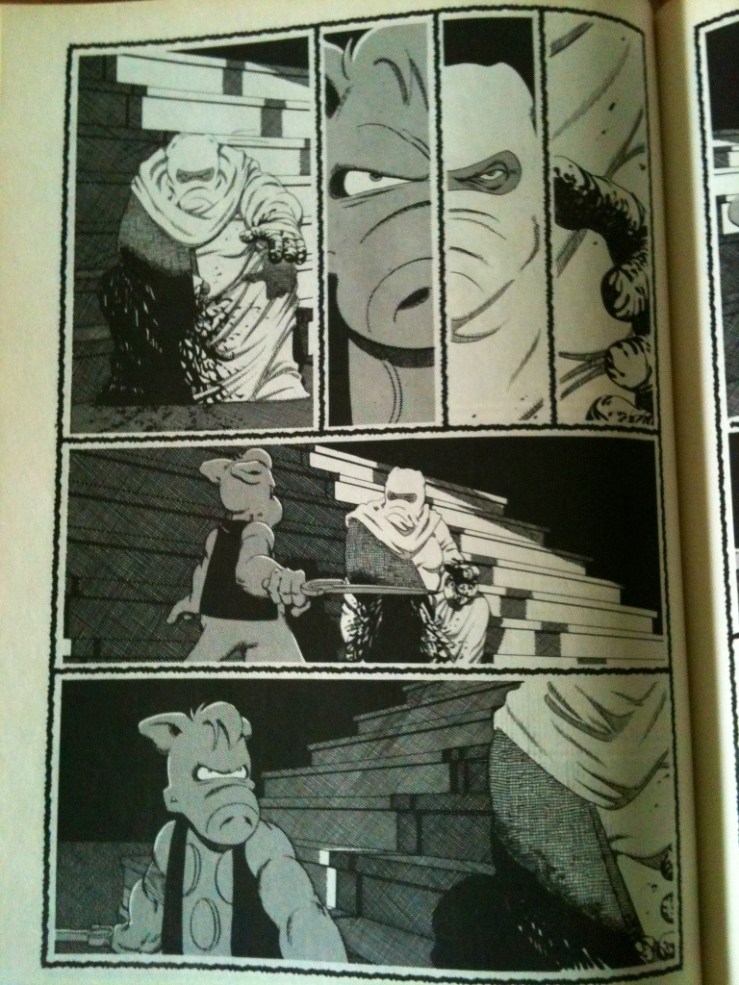
Somewhat at random, I opened Reads, the novel that signaled the beginning of Sim’s estrangement from sanity. It opened to this page, part of a climactic scene between Cerebus and Cirin, leader of the matriarchy that will rule Iest (don’t ask):
Get a free chair and sit down. Don’t worry about anything. Especially this. We’re living beings and forming a society; we’re creating a total, social future. Don’t worry about it. The kitchen’s reasonably orderly. I crawled out of bed as sick as I was and threw a rug out the window.
INTERVIEWER
Now the first question I wanted to ask you. What fills your day?
OLSON
Nothing. But nothing, literally, except my friends.
INTERVIEWER
These are very straight questions.
OLSON
Ah, that’s what interviews are made of.
INTERVIEWER
Why have you chosen poetry as a medium of artistic creation?
OLSON
I think I made a hell of a mistake. That’s the first confidence I have. The other is that—I didn’t really have anything else to do. I mean I didn’t even have enough imagination to think of something else. I was supposed to go to Holy Cross because I wanted to play baseball. I did, too. That’s the only reason I wanted to go to Holy Cross. It had nothing to do with being a priest.
INTERVIEWER
Are you able to write poetry while remaining in the usual conditions of life—without renouncing or giving up anything?
OLSON
That’s the trouble. That’s what I’ve done. What I’ve caused and lost. That describes it perfectly. I’ve absolutely.
INTERVIEWER
Are the conditions of life at the beginning of a work . . .
OLSON
I’m afraid as well at the end. It’s like being sunk in a cockpit. I read the most beautiful story about how Will Rogers and Wiley Post were lost; they stomped onto a lake about ten miles from Anchorage, Alaska, to ask an Indian if Anchorage was in that direction and when they took off, they plunged back into the lake. The poor boy was not near enough to rescue them, so he ran ten miles to Anchorage to get the people to come out. He said one of the men had a sort of a cloth on his eye and the guy then knew Post and Rogers were lost. Wiley Post put down on pontoons; so he must have come up off this freshwater lake and went poomp. Isn’t that one of those great national treasures. I’ll deal you cards, man. I’ll make you a tarot.
INTERVIEWER
Does poetry constitute the aim of your existence?
OLSON
Of course I don’t live for poetry; I live far more than anybody else does. And forever and why not. Because it is the only thing. But what do you do meanwhile? So what do you do with the rest of the time? That’s all. I said I promised to witness. But I mean I can’t always.
INTERVIEWER
Would you say that the more you understand what you are doing in your writing, the greater the results?
OLSON
Well, it’s just one of those things that you’re absolutely so bitterly uninterested in that you can’t even live. Somehow it is so interesting that you can’t imagine. It is nothing, but it breaks your heart. That’s all. It doesn’t mean a thing. Do you remember the eagle? Farmer Jones gets higher and higher and he is held in one of the eagle’s claws and he says you wouldn’t shit me would you? That’s one of the greatest moments in American poetry. In fact, it is the great moment in American poetry. What a blessing we got.
INTERVIEWER
Does Ezra Pound’s teaching bear any relevance to how your poems are formed on the page?
OLSON
My masters are pretty pertinent. Don’t cheat your own balloon. I mean—literally—like a trip around the moon—the Jules Verne—I read that trip . . . it is so completely applicable today. They don’t have any improvements yet.
INTERVIEWER
Do you write by hand or directly on the typewriter? Does either method indicate a specific way in which the poem falls on the page?
OLSON
Yeah. Robert Duncan is the first man to ask me the query. He discovered when he first came to see me that I wrote on the machine and never bothered to correct. There’s the stuff. Give me half a bottle. Justice reigns.



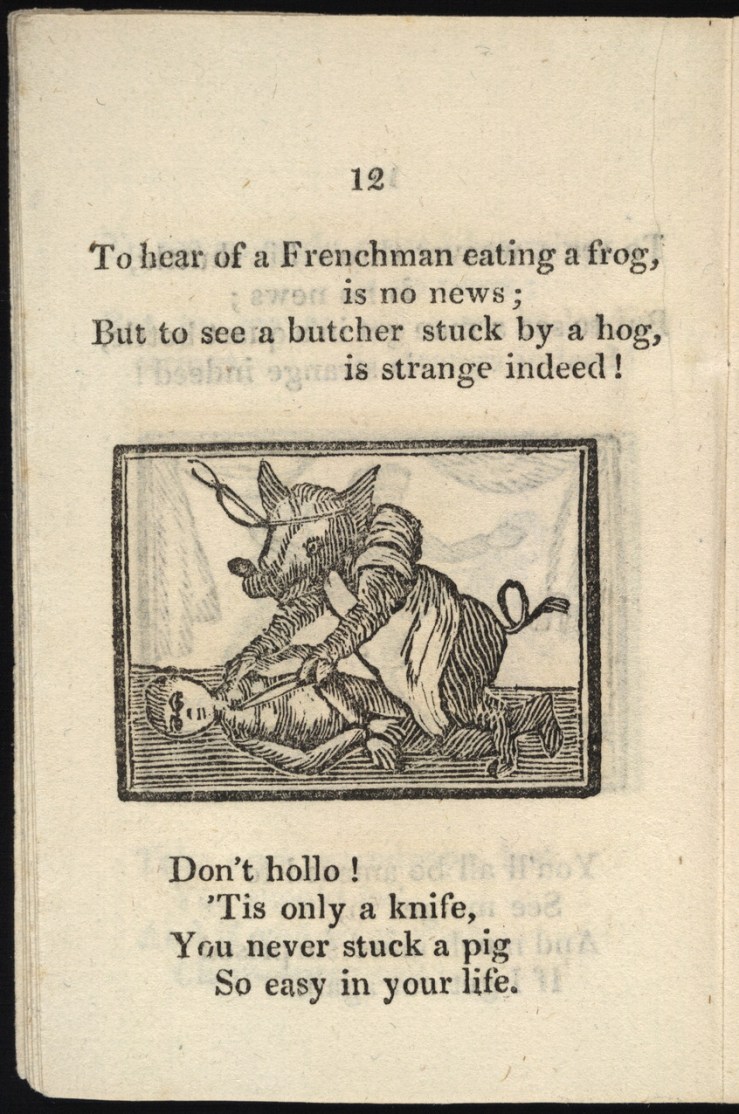 (From The World turned upside down, or, No news, and strange news (1820) by J. Kendrew.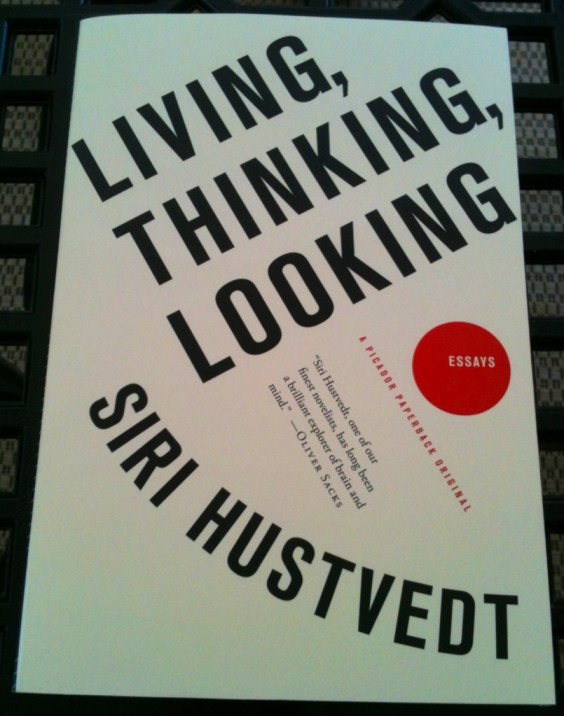




 Biblioklept