Dawnie Walton’s The Final Revival of Opal & Nev (Book acquired, 25 May 2021)

My friend texted me yesterday to tell me that Dawnie Walton was on the NPR program Fresh Air. Walton was two years ahead of us in high school, and although I missed the interview, I was psyched when I read the description of her new novel The Final Revival of Opal & Nev. I picked up a copy today and read the first fifty pages.

Walton’s debut novel takes the form of an oral history of the titular fictional interracial 1970s psych duo. The controlling voice is the editor of the oral history, “S. Sunny Shelton” (a pseudonym). She’s the daughter of the duo’s deceased drummer—murdered by a “racist gang”—who was also carrying on an affair with Opal (these facts are laid out in the novel’s opening paragraph, so this isn’t a spoiler–I’m guessing that the climax of the novel (or conclusion?) gets to the murder).

I’m digging The Final Revival of Opal & Nev so far. It has a buzzy, propulsive style—genial and largehearted, even as its episodes deliver a chilling shorthand pop history of the Civil Rights Movement. The non-narrator S. Sunny Shelton is the most intriguing aspect here—what is she emphasizing or omitting in her assemblage of “facts”? (I’m reminded of Todd Haynes’ Velvet Goldmine just a bit.)

Here’s publisher Simon & Schuster’s blurb:

Opal is a fiercely independent young woman pushing against the grain in her style and attitude, Afro-punk before that term existed. Coming of age in Detroit, she can’t imagine settling for a 9-to-5 job—despite her unusual looks, Opal believes she can be a star. So when the aspiring British singer/songwriter Neville Charles discovers her at a bar’s amateur night, she takes him up on his offer to make rock music together for the fledgling Rivington Records.

In early seventies New York City, just as she’s finding her niche as part of a flamboyant and funky creative scene, a rival band signed to her label brandishes a Confederate flag at a promotional concert. Opal’s bold protest and the violence that ensues set off a chain of events that will not only change the lives of those she loves, but also be a deadly reminder that repercussions are always harsher for women, especially black women, who dare to speak their truth.

Decades later, as Opal considers a 2016 reunion with Nev, music journalist S. Sunny Shelton seizes the chance to curate an oral history about her idols. Sunny thought she knew most of the stories leading up to the cult duo’s most politicized chapter. But as her interviews dig deeper, a nasty new allegation from an unexpected source threatens to blow up everything.

Provocative and chilling, The Final Revival of Opal & Nev features a backup chorus of unforgettable voices, a heroine the likes of which we’ve not seen in storytelling, and a daring structure, and introduces a bold new voice in contemporary fiction.

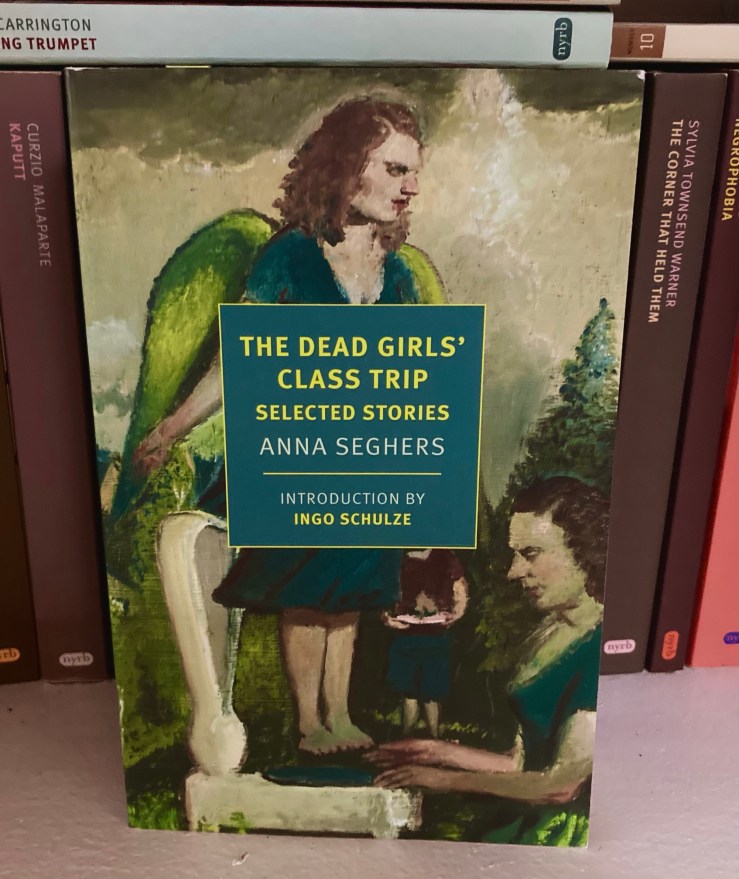
Anna Seghers’s short story collection, The Dead Girls’ Class Trip (Book acquired, 14 May 2021)

NYRB have a collection of Anna Seghers’s short stories coming out next month. The Dead Girls’ Class Trip is both translated and edited by Margot Bettauer Dembo and includes an introduction by German author Ingo Schulze. There are sixteen stories in the collection, some quite long and others quite short. Many have ominous titles, like “Jan Is Going to Die,” “Shelter,” “The End,” “A Man Becomes a Nazi,” and the title story, of course. I read a shorter tale the other day, “The Square,” and it was a depressing little ominous microfiction. I also read “The Three Trees,” three micros arboreally bound. The first piece, “The Knight’s Tree,” condenses history, humor, and despair into a few sentences:

The Dead Girls’ Class Trip drops mid June from NYRB. Their blurb:

Best known for the anti-fascist novel The Seventh Cross and the existential thriller Transit, Anna Seghers was also a gifted writer of short fiction. The stories she wrote throughout her life reflect her political activism as well as her deep engagement with myth; they are also some of her most formally experimental work. This selection of Seghers’s best stories, written between 1925 and 1965, displays the range of her creativity over the years. It includes her most famous short fiction, such as the autobiographical “The Dead Girls’ Class Trip,” and others, like “Jans Is Going to Die,” that have been translated into English here for the first time. There are psychologically penetrating stories about young men corrupted by desperation and women bound by circumstance, as well as enigmatic tales of bewilderment and enchantment based on myths and legends, like “The Best Tales of Woynok, the Thief,” “The Three Trees,” and “Tales of Artemis.” In her stories, Seghers used the German language in especially unconventional and challenging ways, and Margot Bettauer Dembo’s sensitive and skilled translation preserves this distinction.

New Snake Creek comix from Drew Lerman

I’ve been a fan of Drew Lerman’s strip Snake Creek for a few years now. Reviewing Lerman’s first collection (simply titled Snake Creek) in The Comics Journal, Brian Nicholson wrote that,

Looking at these strips, you’re looking at something that recalls George Herriman, Harvey Kurtzman, Robert Crumb, Daniel Clowes, Matt Groening, but also thinking: What if Stanley Elkin drew a comic strip?

What if Elkin drew a comic strip indeed?

Like Elkin, Lerman plays with a variety of voices and rhythms in his work. There’s a zaniness to the Snake Creek world, but also an almost-melancholy seriousness to it as well. His main characters are Dav and Roy. Roy is something of a would-be tortured artist; Roy his familiar/foil, a spritely interlocutor to bounce ideas off of. Like the swamp-dwellers of Walt Kelly’s seminal strip Pogo, there’s a real affection between the two characters that anchors the surreal plasticity of Lerman’s work in genuine emotion.

I got three Snake Creek comix last week and tried not to read them too quickly on Sunday afternoon. I needed to get the bad taste of a Serious Contemporary Novel out of my brain, and Detective! Double Digest did the trick. There are two stories here: Lerman’s “Cryonic Pain: A Snake Creek Mystery” and on the literal flipside, Pete Faecke’s “The Big Love Triangle” (which has a scuzzy punk noir vibe).

From Pete Faecke’s “The Big Love Triangle.”

Lerman’s detective story is an existentialist affair—a goofing riff on the myth of Sisyphus and the burden of a consciousness constrained by mortality and time. It’s also full of verbal slapstick and surreal shenanigans.

From Drew Lerman’s “Cryonic Pain.”
Back cover of Drew Lerman’s Schtick

Schtick is a mini-comic in full color compromised of five vignettes, each one a riff or routine rooted in vaudevillian humor and composed in an original vernacular. The longest of the pieces, “Herbit and Sheiler,” is an extended play on linguistic misunderstandings—good stuff.

From Drew Lerman’s strip “Levi & Cohn,” Schtick

My favorite of the three comix is the most recent, “Head Trip,” the cover feature for the latest issue of the Miami-based comics journal Spiny Orb Weaver. (The issue also features an essay by comics critic Rob Clough, an autobiographical comic by Chris López, and a lengthy interview with Lerman, conducted by SOW editor Neil Brideau.)

Detail from Drew Lerman’s cover for Spiny Orb Weaver no. 2

“Head Trip” sees Dav and Roy trying to take Snake Creek’s most anguished character, Head on a Stone, on an adventure he can remember. Unable to move or communicate, but nevertheless burdened by consciousness, Head on a Stone is a tragic figure, a “pulsing node of dread,” as Dav puts it. Dav and Roy decide, in their wisely wisdom, to take the large rock seafaring. What follows is an ironic series of tragic-comic-tragic-etc. reversals of fortune (as well as some of Lerman’s most lyrical work to date with his strip). “Head Trip” is as linguistically loose and visually goofy as we might expect from anything set in the Snake Creek universe, and also achieves a level of poignancy we might not expect. Great stuff.

From Drew Lerman’s “Head Trip.”


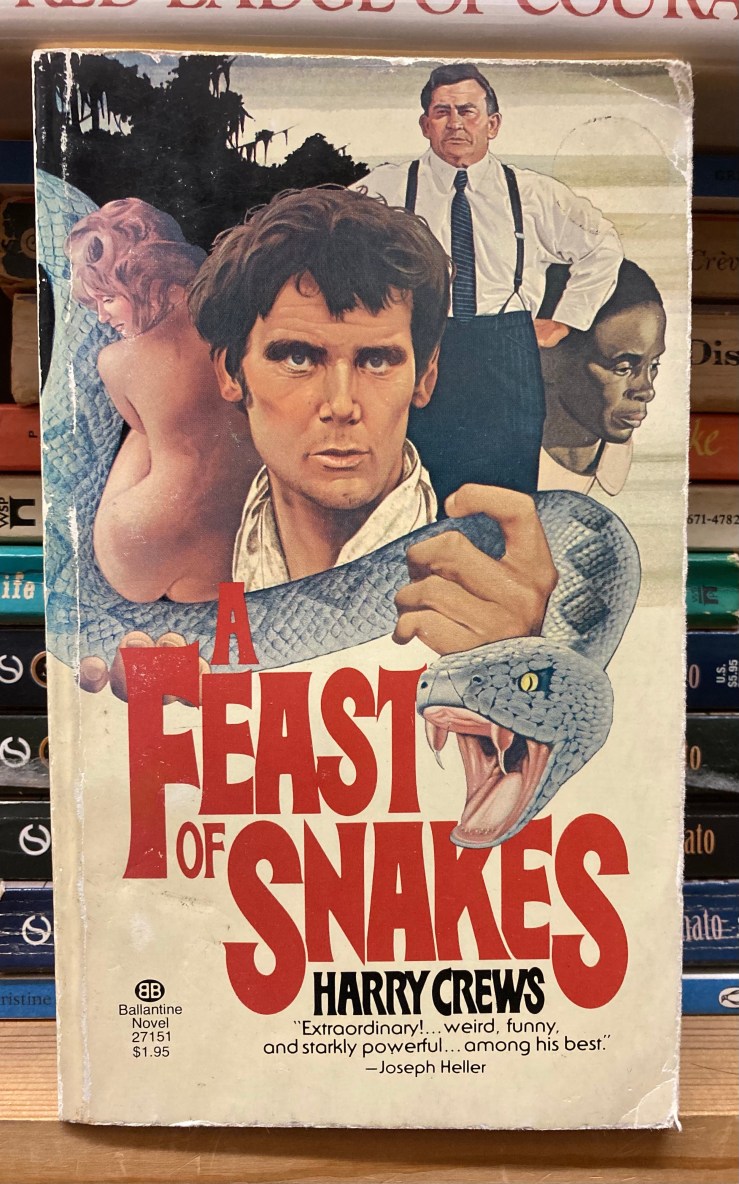
A lurid paperback copy of Harry Crews’s lurid novel A Feast of Snakes (Lurid book acquired, 14 May 2021)

I love to browse my local used bookstore of a Friday afternoon. This afternoon I came across a copy of my favorite Harry Crews novel, A Feast of Snakes. It’s a 1978 massmarket edition from Ballantine. The lurid cover captures the novel’s lurid spirit. It wraps around; here’s the back (I’d scan the whole thing flat but I don’t think the book’s spine would survive):

The art seems to be signed with the (last I’m guessing?) name “Gentile.” If anyone can confirm I’d appreciate it.

I shared the cover on Twitter, where one user pointed out that the publishers seemed to be “pre-emptively casting the film,” with Ed Asner in a supporting role. I’m guessing they would’ve wanted Burt Reynolds for Joe Lon.

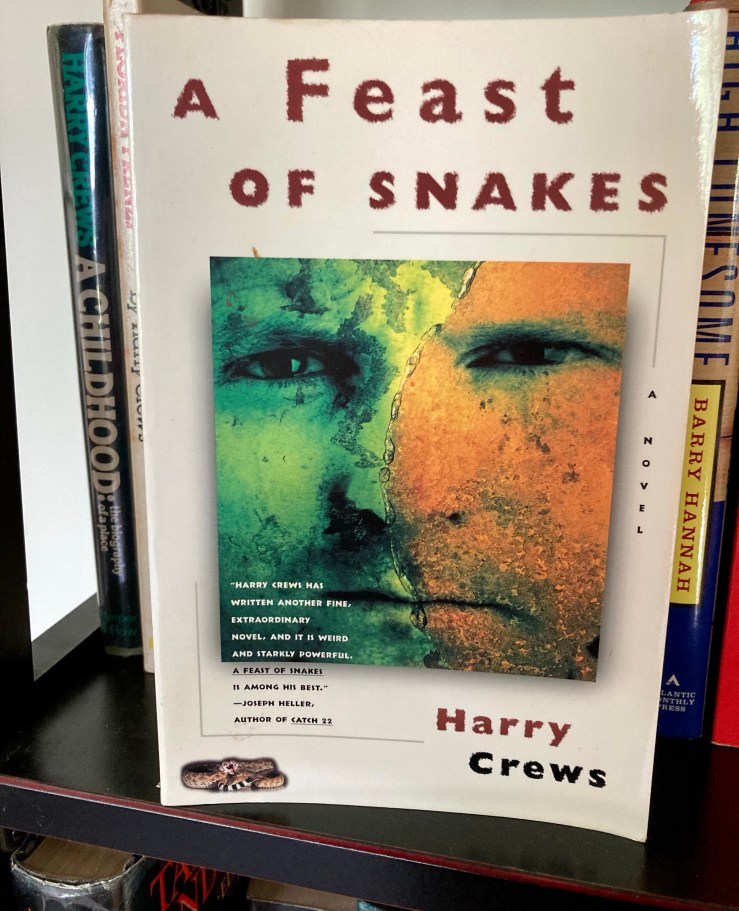
The cover captures the sweaty abjection of A Feast of Snakes—it’s a nasty, gnarly novel that pushes the so-called “Southern Grotesque” style into new, gross, territory. If you haven’t read Crews, it’s a perfect starting point (although I’m sure that the novel is like, problematic or whatever in many, many ways). I love the cover, as I’ve said–it fits the novel wonderfully, unlike the more “respectable” cover for my 1998 edition (which I’ll be trading in now):


From the novel: not quite a recipe for snakes:

When they got to his purple double-wide, Joe Lon skinned snakes in a frenzy. He picked up the snakes by the tails as he dipped them out of the metal drums and swung them around and around his head and then popped them like a cowwhip, which caused their heads to explode. Then he nailed them up on a board in the pen and skinned them out with a pair of wire pliers. Elfie was standing in the door of the trailer behind them with a baby on her hip. Full of beer and fascinated with what Joe Lon could feel—or thought he could—the weight of her gaze on his back while he popped and skinned the snakes. He finally turned and looked at her, pulling his lips back from his teeth in a smile that only shamed him.

He called across the yard to her. “Thought we’d cook up some snake and stuff, darlin, have ourselves a feast.”

Her face brightened in the door and she said: “Course we can, Joe Lon, honey.”

Elfie brought him a pan and Joe Lon cut the snakes into half-inch steaks. Duffy turned to Elfie and said: “My name is Duffy Deeter and this is something fine. Want to tell me how you cook up snakes?”

Elfie smiled, trying not to show her teeth. “It’s lots of ways. Way I do mostly is I soak’m in vinegar about ten minutes, drain’m off good, and sprinkle me a little Looseanner redhot on’m, roll’m in flour, and fry’m is the way I mostly do.”

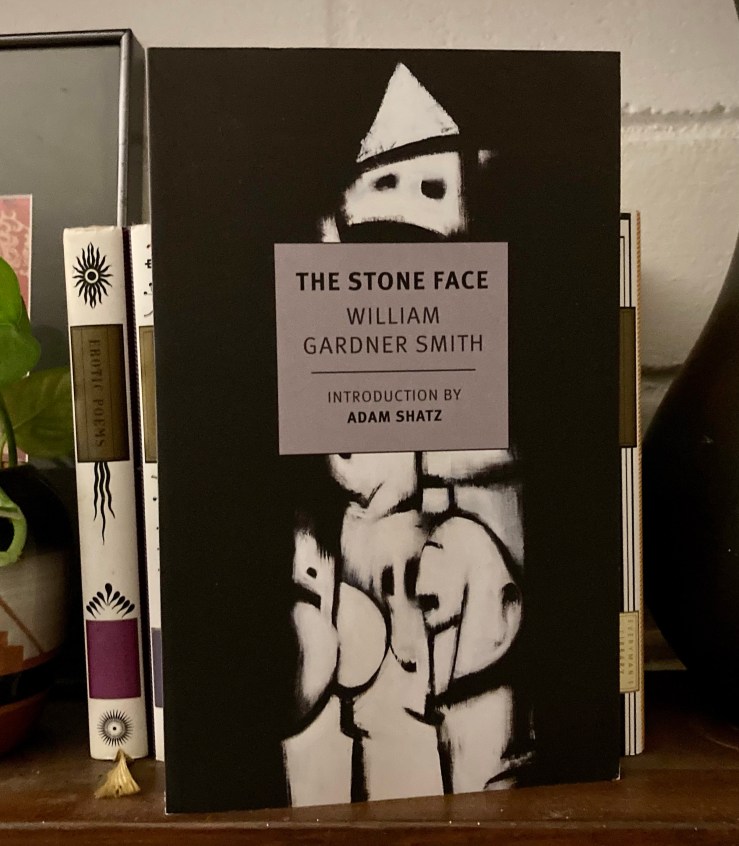
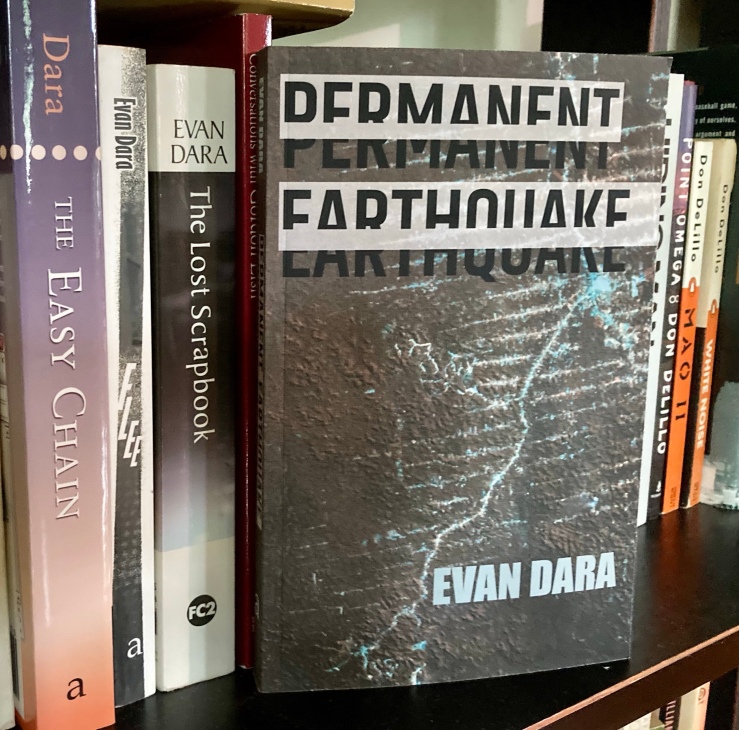
Four novels by the sixties avant-garde novelist B.S. Johnson (Books acquired the first week of May, 2021)

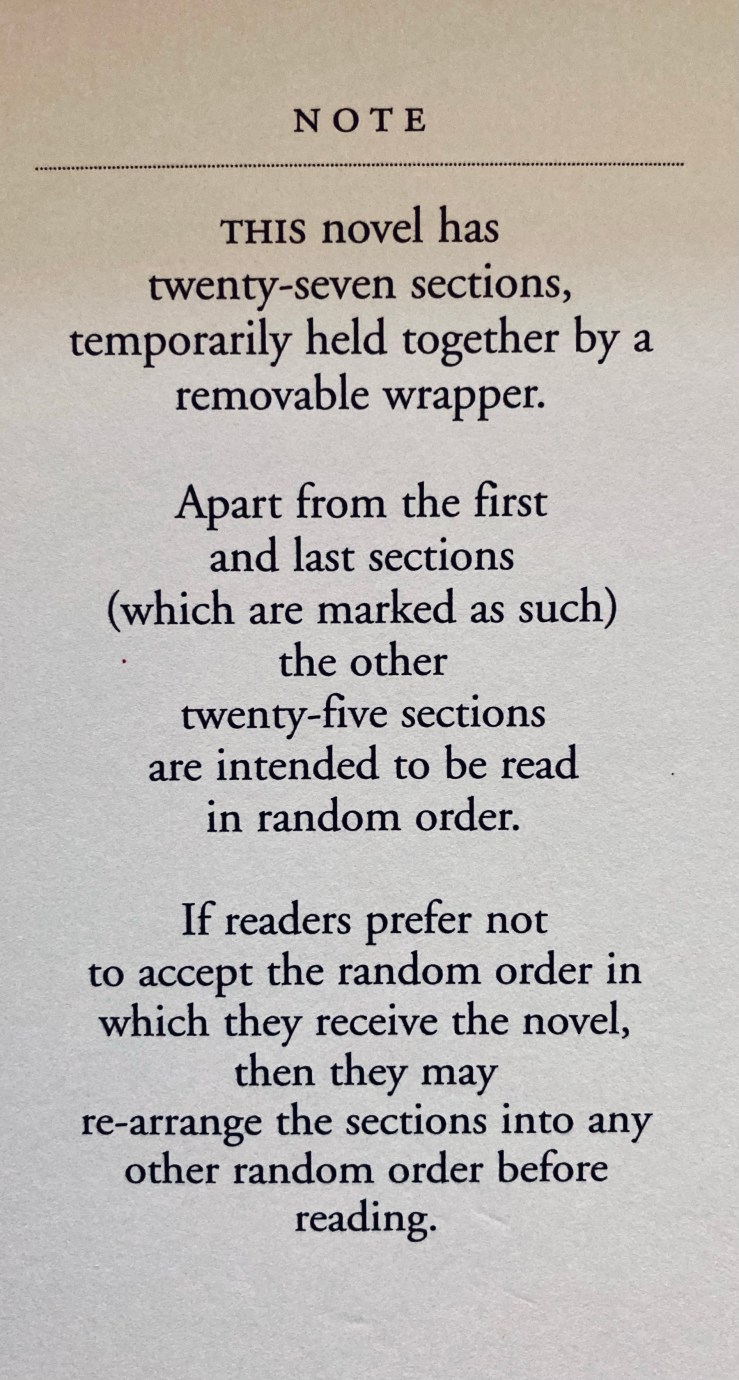
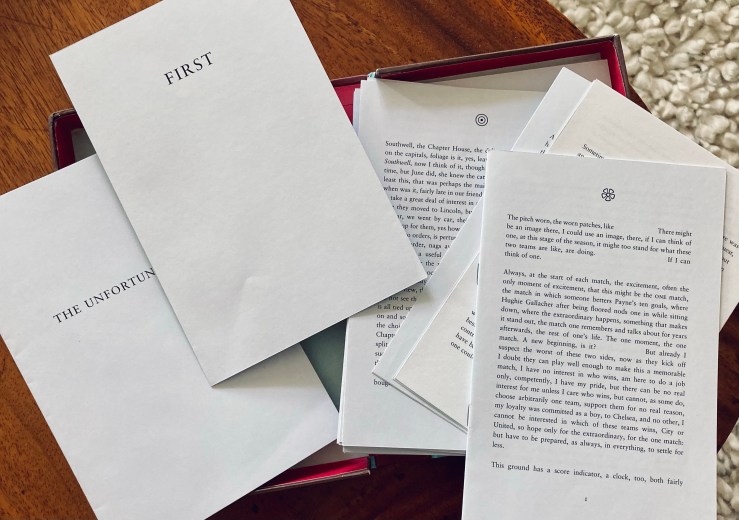
I think the first time I heard of the British experimental novelist B.S. Johnson was some time around 2008 or so, when New Directions republished his “book in a box,” The Unfortunates (1969). I thought it sounded like a cool but maybe gimmicky idea at the time, and then Johnson dropped off my radar until more recently. I started to see his name pop up when I’d search out more information about the British avant-garde novelist Ann Quin, whose novel Berg I consider perfect.

So I asked around and ended up finding an online copy of Picador’s omnibus reissue of three of Johnson’s novels: Albert Angelo (1964), Trawl (1966), and House Mother Normal (1971). I also ordered Johnson’s penultimate novel Christie Malry’s Own Double-Entry (1973) (as well as a copy of The Unfortunates which has yet to arrive).

I tucked into the omnibus last week, starting with Albert Angelo, which I think is the superior of the three novels the edition collects (I’ve still got a final third of Trawl to go, but I can’t see it turning a corner). AA is an experimental pastiche, a bildungsroman that ironizes the künstlerroman. Our hero Albie, trained as an architect, makes his so-called living as a substitute teacher in some of London’s rougher schools. His narrative is an assemblage of stream-of-consciousness, dramatic dialogues, advertisements, and other rhetorical techniques—including literally cutting out parts of a few pages.

Albie is angry and witty and generally good company throughout the brief novel. Albert Angelo will resonate with teachers who remember those rough first years—sympathy with the students, anger at the system, but also a realization that they are in a kind of battle to earn the respect of their pupils. (Near the end of the novel, we get a litany of student essays that Albie has assigned. The subject: Albie himself. Student reviews are, for the most part, scathing.) Johnson’s assemblage is impressive, energetic, and still feels fresh over fifty years later.

House Mother Normal is also a lively novel, with an energy we might not expect in a novel subtitled A Geriatric Comedy. The novel takes place over a few hours in a single day in a nursing homes, telling the same “narrative” from the viewpoint of eight residents—as well as the titular house mother. Each resident (and the house mother) gets twenty-one pages to relate their version of the days events. Or, more accurately, we dwell in their consciousness for those twenty-one pages. Some residents are of clearer minds than others, but together, they offer a fragmented minor Sadean saga that is both abject and occasionally moving.

Trawl is a more “traditional” novel, at least in the modernist sense. Unlike House Mother Normal and Albert AngeloTrawl takes a straightforward, stream-of-consciousness first-person tack, detailing three weeks the narrator—a version of Johnson himself—spent on a deep-sea trawler in the Barents Sea. It’s a sort of memoir, loosely figured around the various women that the narrator has successfully or unsuccessfully bedded, with dips into his childhood billeted away from his London family in World War II. In between, we get snapshots of life on the trawler. The unifying theme of the book is shame, paralleled with the narrator’s desire to create a work of Great Art. The narrator peppers his memoir with interjections that the whole thing is boring, worthless, and meaningless. Like I mentioned above, I haven’t gotten to the end of Trawl, but it became a slog about a third of the way in. Johnson’s narrator hems and haws, hedges and defers—and comments on his hemming and hawing. It seems to approach the confessional style of American poetry in the l950s and 1960s without revealing too much. I don’t know. There’s something guarded about it, even as it tries to be a naked affair. I’m hoping I like Christie Malry’s Own Double-Entry more. Here’s publisher New Direction’s blurb:

In a brief but productive career, B.S. Johnson (1933-73) was recognized as the most original of the English experimental writers of his generation. Combining a bellicose avant-gardism with pointed social concerns, he won the praise of critics and fellow writers as well as a readership not usually gained by a literary maverick. Christie Malry’s Own Double-Entry is Johnson’s most broadly humorous book, though as readers will discover, his humor has a bite. Christie is a simple man. His job in a bank puts him next to but not in possession of money. He encounters the principles of Double-Entry Bookkeeping and adapts them in his own dramatic fashion to settle his account with society. Under the column headed “Aggravation” for offenses received from society (the unpleasantness of the bank manager is the first on an ever-growing list), debit Christie; under “Recompense,” for offenses given back (scratching the façade of an office block), credit Christie. All accounts are to be settled in full, and they are — in the most alarming way.

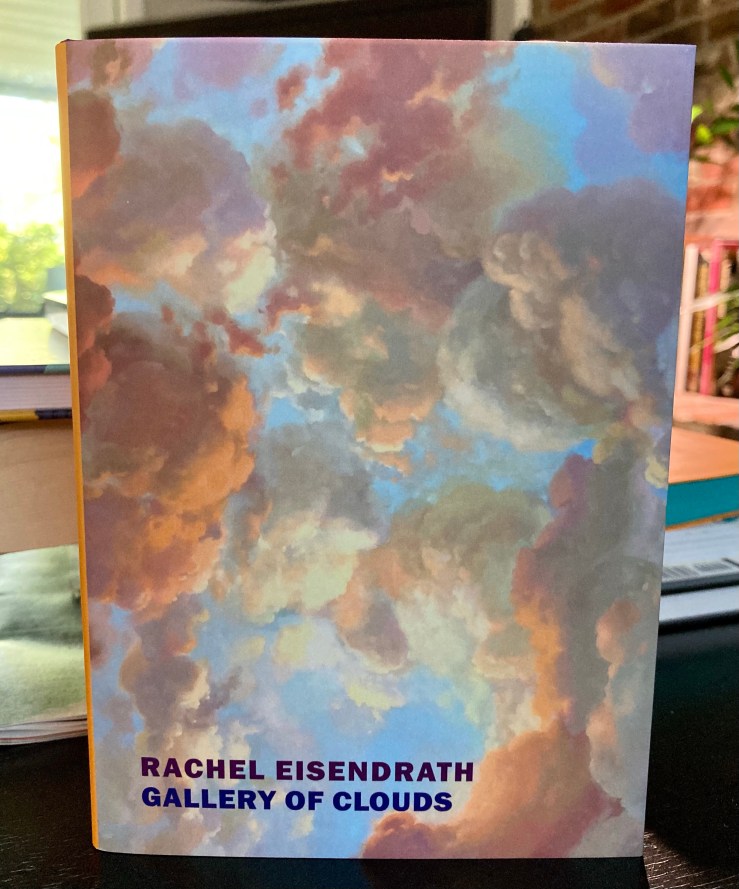
Rachel Eisendrath’s Gallery of Clouds (Book acquired, like maybe three weeks ago?)

Rachel Eisendrath’s Gallery of Clouds is new in hardback (?!) from NYRB. The book showed up a few weeks ago at Biblioklept International Headquarters on a week when like six books showed up. I finally got into it the other week, and it’s cool stuff. Gallery of Clouds has a Sebaldian vibe—discursive, academic, encyclopedic, and frank, with lots of black and white photographs—but it’s also its own thing.

NYRB’s blurb:

Largely unknown to readers today, Sir Philip Sidney’s sixteenth-century pastoral romance Arcadia was long considered one of the finest works of prose fiction in the English language. Shakespeare borrowed an episode from it for King Lear; Virginia Woolf saw it as “some luminous globe” wherein “all the seeds of English fiction lie latent.” In Gallery of Clouds, the Renaissance scholar Rachel Eisendrath has written an extraordinary homage to Arcadia in the form of a book-length essay divided into passing clouds: “The clouds in my Arcadia, the one I found and the one I made, hold light and color. They take on the forms of other things: a cat, the sea, my grandmother, the gesture of a teacher I loved, a friend, a girlfriend, a ship at sail, my mother. These clouds stay still only as long as I look at them, and then they change.”

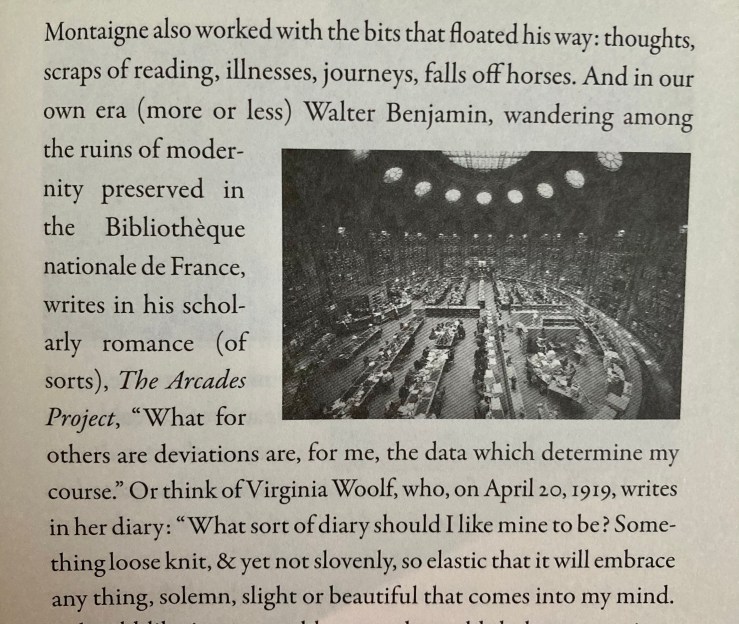
Gallery of Clouds opens in New York City with a dream, or a vision, of meeting Virginia Woolf in the afterlife. Eisendrath holds out her manuscript—an infinite moment passes—and Woolf takes it and begins to read. From here, in this act of magical reading, the book scrolls out in a series of reflective pieces linked through metaphors and ideas. Golden threadlines tie each part to the next: a rupture of time in a Pisanello painting; Montaigne’s practice of revision in his essays; a segue through Vivian Gordon Harsh, the first African American head librarian in the Chicago public library system; a brief history of prose style; a meditation on the active versus the contemplative life; the story of Sarapion, a fifth-century monk; the persistence of the pastoral; image-making and thought; reading Willa Cather to her grandmother in her Chicago apartment; the deviations of Walter Benjamin’s “scholarly romance,” The Arcades Project. Eisendrath’s wondrously woven hybrid work extols the materiality of reading, its pleasures and delights, with wild leaps and abounding grace.

Paul Kirchner’s Dope Rider: A Fistful of Delirium (Book acquired, 7 April 2021)

I am a huge fan of Paul Kirchner’s bold and witty comix. I fell in love with his cult strip The Bus some years back, and was thrilled when he revised the series with The Bus 2. Both volumes were published in handsome editions by the fine folks at Tanibis. The French publisher also released a retrospective collection of Kirchner’s work to date, the essential compendium Awaiting the Collapse. Tanibis also published the collected Hieronymus & Bosch, strip, another entry in the cartoonists explosive output in the twentyteens.

Now, Tanibis has published A Fistful of Delirium, the recent adventures of the resurrected hero Dope Rider. Kirchner’s Dope Rider is a mystical skeleton weedslinger, a philosophical wanderer prone to surreal transformation. Our cowboy rides again here via the full-page full-color strips Kirchner ran in High Times from 2015-2020. Here’s Tanibis’s blurb:

Dope Rider is back in town! After a 30-year hiatus, Paul Kirchner brought back to life the iconic bony stoner whose first adventures were a staple of the psychedelic counter-culture magazine High Times in the 1970s.

The stories collected in this book appeared in High Times between January 2015 and May 2020. Despite the years, Dope Rider has stayed essentially the same, still smoking his ever-present joint, getting high and chasing metaphysical dragons through whimsical realities in meticulously illustrated and colorful one-page adventures. Fans of the original Dope Rider comics will still find the bold graphical innovations, dubious puns and wild dreamscapes inspired by classical painting and western movies that were some of Dope Rider’s trademark.

This time though, Kirchner draws from a much larger panel of influences, including modern pop – and pot – culture (lines and characters from Star Wars as well as references to Denver as the US weed capital can be found here and there) and a wider range of artistic references, from Alice in Wonderland to 2001, A Space Odyssey to Ed Roth’s Kustom Kulture. Native American culture and mythology, only hinted at in the classic adventures, is also much more present in the form of Chief, one of Dope Rider’s new sidekicks. Kirchner’s playful, tongue-in-cheek humor binds together all these influences into stories that mock both the mundane and the nonsensical alike.

You can get a signed edition from Kirchner’s website. Full review down the line.

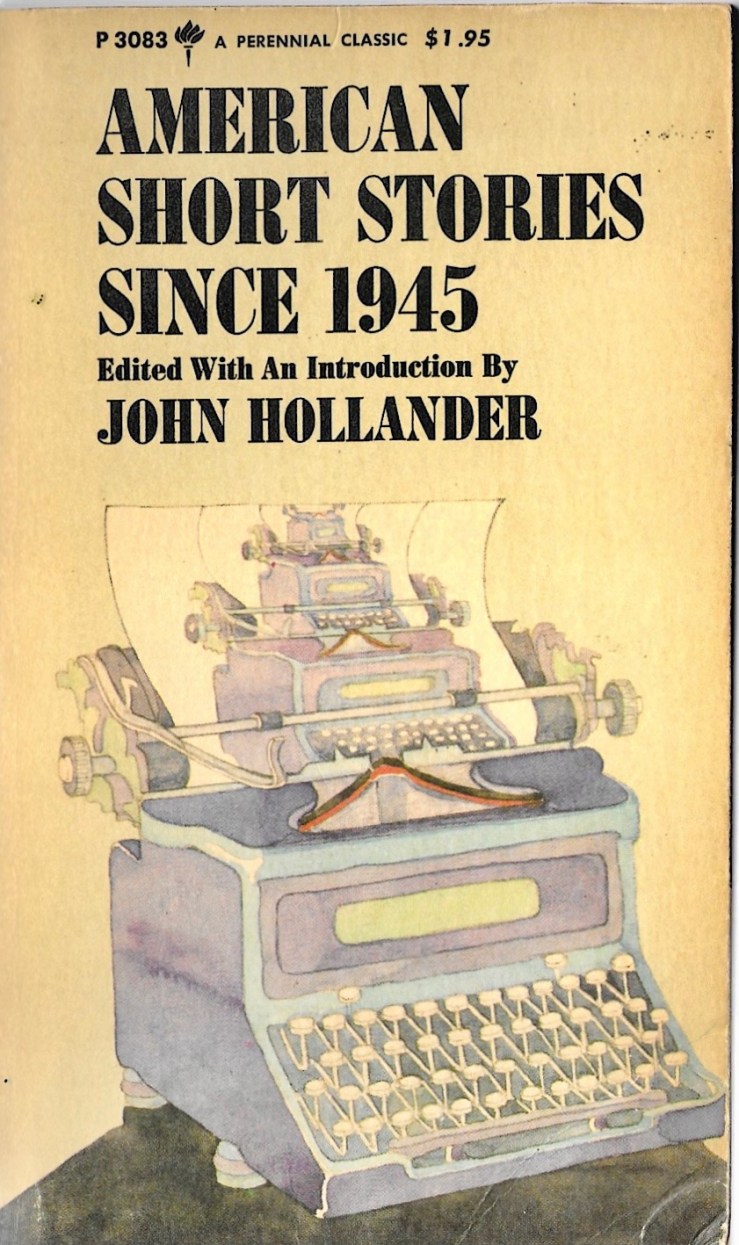
American Short Stories Since 1945 (Book published in 1968 and acquired, 30 April 2021)

I was perusing the anthologies, looking for a book called Anti-Story: An Anthology of Experimental Fiction (1971). I didn’t find it, but the spine of American Short Stories Since 1945 interested me enough to pull it out, and the wonderful cover (by Emanuel Schongut) intrigued me more. The tracklist on the back cover is what got to me:

I’ve read seven of the stories and fourteen of the twenty-six authors here. You probably have too. But there are close to a dozen authors here I’ll admit I’ve never even heard of—authors rectangle-pressed in with favorites of mine like Barthelme, Gass, Jackson, and Pynchon, whose piece “Under the Rose”is part of V., which I recently re-read. (I opened the “Acknowledgements” page to see that “Under the Rose” was first published in Noble Savage 3, May 1961—I checked the “N” anthologies and found Noble Savage #2, but no three for me.)

Edited and introduced by the poet John Hollander, Since 1945 “aims to show the major shapes taken by shorter fiction in America since the end of World War II.” Published in 1968, it’s heavy on the white guys, but I think there’s an attempt here to point toward not just “major shapes,” but new shapes.

I couldn’t not pick it up (I’d brought in some paperbacks to trade, anyway). Maybe I’ll try to read it this summer, posting on each piece. I’m most interested in how the selection of authors shows a tipping over in to postmodernism, a postmodernism many of these guys never signed up for.


Books acquired, May Day 2021

Every year, within a week or two of Mother’s Day, our family likes to get a place in a proximal walkable beach town. Some place not too far a drive from our simple ranch home near the mighty northward-flowing St. Johns River, some place not too touristy, some place with nachos and beer and etc. St. Augustine Beach is a favorite and frequent spot, but this year we opted for St. Simons Island, a sea island off the Georgia coastline. We did not do a trip in 2020, for obvious reasons, but the wife and I have been fully vaccinated for weeks now, and we knew we’d be more or less outside for the entire weekend, so the fam drove an hour north. It was the first time we’d been out like this since March of 2020, when we stayed on a houseboat on Jekyll Island (the sea island immediately north of St. Simons). It was a nice, chill weekend—fried fish, golf carts, minigolf, the beach (with thousands of dead jellyfish to amuse the kids).

The Literary Guild of St. Simons was also having their annual spring sale–basically a Friends of the Library sale, if you know what that is. If you don’t: outdoors, lots of flat boxes of books, books, books. I ended up picking up more than I should have—I haven’t even done any of these stupid “books acquired” posts for the last three books that came in (including the lovely book I was reading this weekend, Rachel Eisendrath’s Gallery of Clouds)–but I have it on no small authority that these semi-annual Guild sales help fund most of the SSI library’s budget. (Also, as is often the case with these things, it was cheaper to add a book or two than not to.)

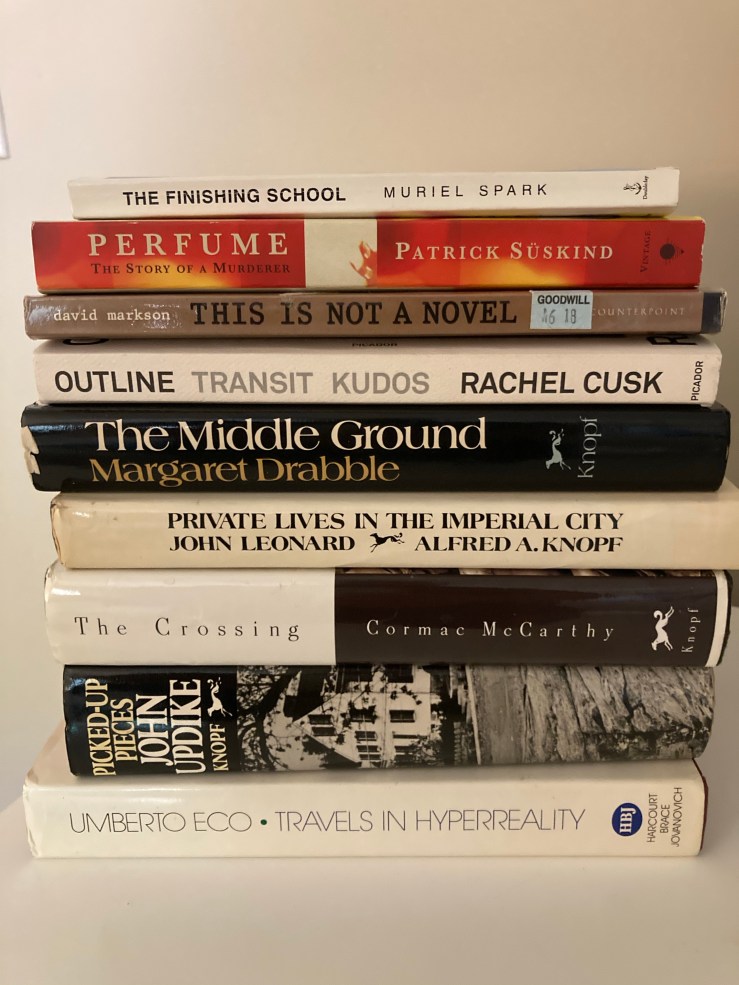
So: Top of stack to bottom:

The Finishing School, Muriel Spark. This is, I believe, the last novel Spark wrote. It came out in 2004; I read a bunch of her earlier stuff last year (and her early novel The Bachelors this March), but it was the mid-period novel Loitering with Intent that I thought the best. I’m not sure if this last novel has the best reputation, but Kakutani hated it, so maybe I’ll dig it. (Oh, and this edition is an ARC!)

Perfume: The Story of a Murderer, Patrick Suskind (trans. by John E. Woods). I loved the 2006 film adaptation. No idea if the book is any good, but the story is all kindsa fucked up.

This Is Not a Novel, David Markson. Look, I already own a copy. But I have a friend who doesn’t (I think).

Outline, Rachel Cusk. I think this is the first of these, right? Admittedly I avoided Cusk’s trilogy, which seemed overhyped (like Knausgaard, maybe?), but for a dollar I’ll give it a shot.

The Middle Ground, Margaret Drabble. A pristine first edition of a mid-period Drabble novel which is perhaps a take on Mrs. Dalloway. Drabble was nowhere on my radar until a few weeks ago when I read that the experimental British novelist B.S. Johnson included her on a list of (then) contemporary British writers he esteemed as writing “as though it mattered.”

Private Lives in the Imperial City, John Leonard. I mostly knew Leonard’s work as a reviewer for Harper’s—his column “New Books” was a go-to for me for a decade, and I wouldn’t presume to say I learned anything from him about writing book reviews (he would be horrified if he cared enough to be horrified), but I thought him an exemplary critic. But mostly fun to read. I didn’t even know about his New York Times column, “Private Lives,” which he wrote between 1977 and 1980. I had no idea what Private Lives was about—I just loved the spine (and then the great cover, featuring a Frank Stella painting)—but most of all I knew I wanted a book by John Leonard. I ended up spending a nice chunk of Saturday reading through the columns, which read like witty, snarky, intimate blog posts—stories about friends, relatives, exploits in New York and abroad. Leonard hates parties; Leonard hated Blow-Up; Leonard finds compassion for a loudmouth on a coast-to-coast flight. This might be the gem in the batch.

The Crossing, Cormac McCarthy. Hey. Look. I own it. But I don’t own it in first edition hardback, right? I recall it as my favorite of the so-called “Border Trilogy.”

Picked Up Pieces, John Updike. I’ve never been a big fan of Updike’s fiction, but I’ve always found something to admire in his criticism and nonfiction. He’s holding a turtle on the cover of this edition. The final section is called something like “One Big Interview,” and the last question asks him which animal he most admires, and he answers that it is the turtle.

I’m pretty sure that the Leonard and Updike (and probably the Drabble) all came from the same collection—there was basically a near-complete set of pristine first-editions of Updikes and John Cheevers, as well as a heavy dose of Philip Roths—all in impeccable condition, tidy jackets, no foxing, clearly read, but unmarked.

Travels in Hyperreality, Umberto Eco. There was also a first-edition of Foucault’s Pendulum in hardback, which I should’ve picked up instead.

Mario Levrero’s The Luminous Novel (Book acquired, 30 March 2021)

Mario Levrero’s The Luminous Novel is forthcoming in English translation by Annie McDermott from the good folks at And Other Stories. It’s a big ole book! Here is And Other Stories’ blurb:

A writer attempts to complete the novel for which he has been awarded a big fat Guggenheim grant, though for a long time he succeeds mainly in procrastinating – getting an electrician to rewire his living room so he can reposition his computer, buying an armchair, or rather, two: ‘In one, you can’t possibly read: it’s uncomfortable and your back ends up crooked and sore. In the other, you can’t possibly relax: the hard backrest means you have to sit up straight and pay attention, which makes it ideal if you want to read.’

Insomniacs, romantics and anyone who’s ever written (or failed to write) will fall in love with this compelling masterpiece told by a true original, with all his infuriating faults, charming wit and intriguing musings.

I loved the last two And Other Stories editions I read, by the way. I highly recommend Norah Lange’s Notes from Childhood (translated by Nora Whittle) — I wrote about it here.

The other AOS book was Ann Quin’s 1969 avant garde novel Passages, which is unlike anything else I’ve ever read (although Joyce’s Ulysses, Jane Bowles’s Two Serious Ladies, Beckett, Derrida’s Glas, and Julia Kristeva come to mind). I reread it last weekend in an attempt to outline a review, which I hope to have up soon.

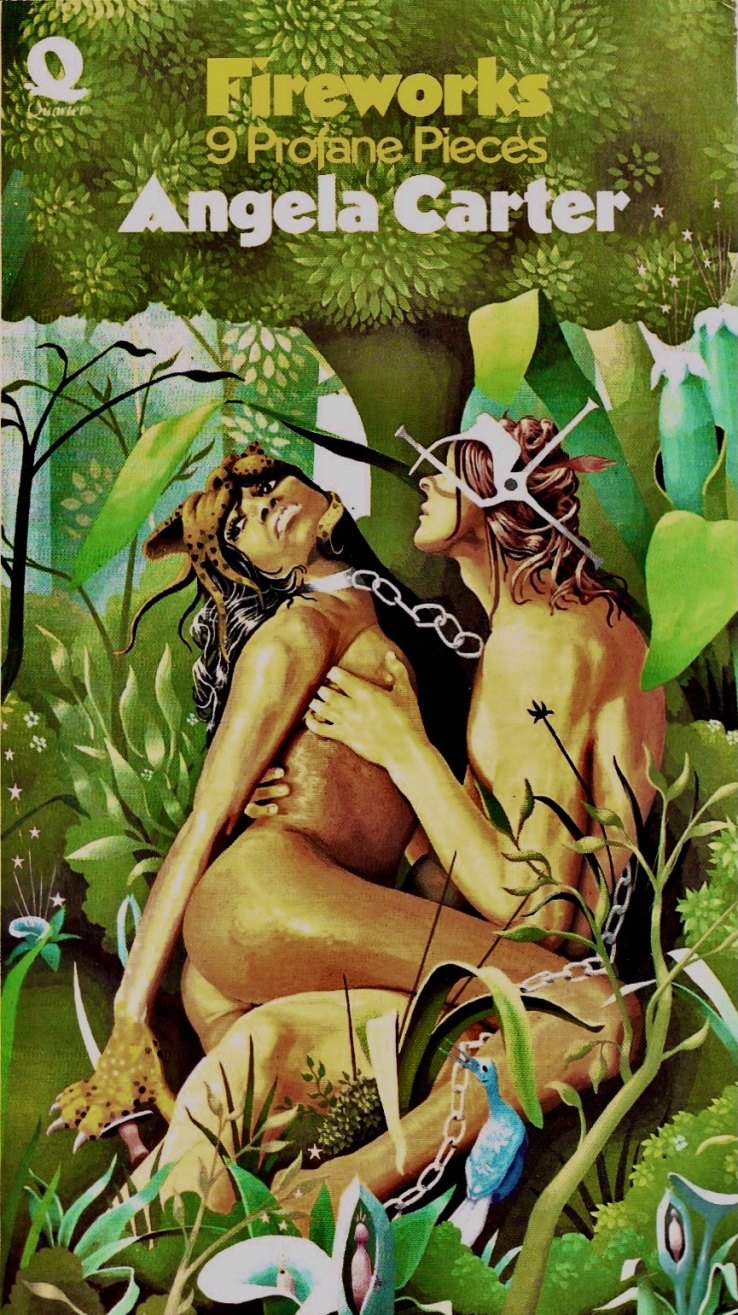
Angela Carter’s Fireworks (Book acquired, 2 April 2021)

I came across this 1976 first edition paperback of Angela Carter’s collection Fireworks two weeks ago and couldn’t pass it up, even though all of Fireworks is collected in Burning Your Boats, which I already own. I love the hornyassed cover by Bob Foulke. I cannot find anything else by Foulke on the internet.

Here is the opening of “The Executioner’s Beautiful Daughter”:

Here, we are high in the uplands.

A baleful almost-music, that of the tuneless cadences of an untutored orchestra repercussing in an ecstatic agony of echoes against the sounding boards of the mountains, lured us into the village square where we discover them twanging, plucking and abusing with horsehair bows a wide variety of crude stringed instruments. Our feet crunch upon dryly whispering shifting sawdust freshly scattered over impacted surfaces of years of sawdust clotted, here and there, with blood shed so long ago it has, with age, acquired the colour and texture of rust . . . sad, ominous stains, a threat, a menace, memorials of pain.

There is no brightness in the air. Today the sun will not irradiate the heroes of the dark spectacle to which accident and disharmony combined to invite us. Here, where the air is choked all day with diffuse moisture tremulously, endlessly the point of becoming rain, light falls as if filtered through muslin so at all hours a crepuscular gloaming prevails; the sky looks as though it is about to weep and so, gloomily illuminated through unshed tears, the tableau vivant before us is suffused with the sepia tints of an old photograph and nothing within it moves. The intent immobility of the spectators, wholly absorbed as they are in the performance of their hieratic ritual, is scarcely that of living things and this tableau vivant might be better termed a nature morte for the mirthless carnival is a celebration of a death. Their eyes, the whites of which are yellowish, are all fixed, as if attached by taut, invisible strings upon a wooden block lacquered black with the spilt dews of a millennia of victims.

And now the rustic bandsmen suspend their unmclodious music. This death must be concluded in the most dramatic silence. The wild mountain-dwellers are gathered together to watch a public execution; that is the only entertainment the country offers.

Time, suspended like the rain, begins again in silence, slowly.

Baudelaire’s Paris Spleen (Book acquired, sometime in February 2021)

The nice people at Contra Mundum continue to put out new Charles Baudelaire translations. Paris Spleen is out in a new translation from Rainer J. Hanshe. A little taste:

I wish I could get drunk on virtue. I’ll settle for wine.

Here’s Contra Mundum’s blurb:

In the 1850s, ancien and Haussmannian Paris clash, giving birth to a violent disjunction. At that moment in time, an other present is born, a new history, like Baudelaire’s poet freely abandoning his halo on the macadam. The laurel crown has been discarded; the pastoral poet is dead; classical lyric poetry is dead. The steam-driven, gaslit, electrically-charged poet is born. “Retreat Academic Muse!,” Baudelaire commands, “I don’t care about that old stutterer.”

With Paris Spleen, we move toward a new rhythm, a rhythm born of the pace, speed, and reality of a metropolis hitherto never seen or experienced. It is the rhythm of the street, of the swift-moving eye, of overloaded senses and hyper-perception, of newspapers and optical devices. Baudelaire’s life spans the essential birth of whole new forms of technology, including steam locomotives, gas light, and electricity, not to speak of the typewriter and the Daguerreotype. The dandy sees and moves with the coming speed of light. His life is one lived in the midst of illumination, mechanics, and simulacra.

Baudelaire’s Paris is a place of experience, a metropolis that spawns unique and particular realities, a kaleidoscope of visions and mirror of alternative societies. The grist of his poems is not ancient Greece or the Renaissance. As he stated in the so-called preface to Paris Spleen, it is especially from frequenting great cities, from the crossroads of their innumerable relations, that the haunting ideal of the prose poem was born. Our flâneur wanders swiftly through crowds, in contact, but anonymous, extracting from the city material to forge his new ars poetica, like a bricolage artist.

The future is called forth. The street is the new Olympus; the phantasmagoric city is a big harlot whose infernal charm continually rejuvenates the poet. The ironic, infernal beacon is the totem of the new age: the age of dissonance, the age of artificial paradises. “I love you, O infamous capital!” the poet exults.

Here is Paris Spleen, an invitation to voyage, to have the entirety of Baudelaire’s Paris enter into our flesh and for us to undergo contagion, if our spleens can handle it.

Transfixed before the mirror, arm in arm so no one could cheat, we gambled as to who would be the first to die | On Norah Lange’s Notes from Childhood (Book acquired, 30 March 2021)

I’ll admit I’d never heard of Norah Lange until the nice people at indie superpublisher And Other Stories alerted me to her memoir, Notes from Childhood.

Lange was an Argentinian writer, publishing poems and prose from the 1920s through  the 1950s. She was part of the Florida Group, along with Jorge Luis Borges and his sister, the painter Norah Borges, as well as Victoria Ocampo and others, and first published her poems in ultraist magazines.

In her note at the end of Notes from Childhood, Lange’s translator Charlotte Whittle suggests that Lange’s memoir marked a break from the ultraist school, embracing a new style of prose—her own style. Whittle points out that Lange’s “approach to memory” trains its “gaze on domestic, family scenes.”

Whittle continues,

Far from being a linear autobiography or tale of coming of age, this narrative takes the form of a constellation of pieces of childhood, and these pieces provide Lange with ground for experimentation.

I read the first forty pages of Notes from Childhood this afternoon; the book showed up last week and I didn’t have a spare half hour to carve from a day to sink into it.

I didn’t have a spare half hour this afternoon, but I opened it, after moving a pile of books to another pile of books, and then I just kept reading.

Lange’s Notes feels subtly cinematic—in vivid flashes, brief vignettes, scenes of a page or two, she conjure the irreal reality of childhood. The memoir opens in a hotel, where, in the dining room, Lange and her sisters spy the “owner of the circus, and next to him the strongest woman in the world,” who, every night “lifts three men with her teeth.” They later light lamps in their new old house to “watch the spiders and kissing bugs all over the walls.”

A few pages later, Lange describes her mother riding sidesaddle horseback in nine succinct but powerful paragraphs. She frames the poetic photograph for her reader:

I see her framed with a gentleness no one could touch without taking something away, without adding more grace than that which was essential and true.

And our narrator riffs on her eldest sister, Irene, framed through a “third window” in one chapter: “I was always a little afraid and a little in awe of her. She was six years older than me. Sometimes, she was allowed to sit at the table in the large dining room during visits from family friends.” Irene at the big table! We get a trickle of information about whispers of Irene, who is growing up while our narrator remains a child:

Susana and I, the youngest two, weren’t shrewd enough to guess the reason for these long whispering sessions. One afternoon, I heard them speak of breasts. When I think back, I understand the fear she must have felt—the first sister, all alone—when she saw her body begin to curve, her rib cage lose its rigidity, her breasts start to ache and stir imperceptibly.

A few chapters later (there aren’t really chapters in Notes), sister Marta, convalescent, repeats, “God is evil. God is evil.” A few pages later, schoolbound, Little Lange is enchanted by typeface:

Words in capital letters, like TWILIGHT, DISCOVERY, DAGUERREOTYPE, LABYRINTH, and THERAPEUTIC, brought me a zeal and contentment all by themselves that now I would have to describe as aesthetic.

And then this wonderful weird episode. Scene: Lange and the sisters:

We had made big hats out of paper and the five of us stood before the mirror, each absorbed by the reflection of her own face, contemplating the effect of shadow over our eyes, the changing glimmer taken on by the light from the window as it fell on our hair against the newspaper.

The door opened suddenly, and a gust of air caused the hats to teeter on our heads.

One of my sisters said,

“The first one who loses her hat will die before the others…”

Transfixed before the mirror, arm in arm so no one could cheat, we gambled as to who would be the first to die.

Great stuff! Read an excerpt of Notes from Childhood here.

Thomas Pynchon: A Bibliography (Book acquired and then unacquired in that long COVID march of March 2020-March 2021)

Clifford Mead’s Thomas Pynchon: A Bibliography was published in 1989 by Dalkey. As far as I can tell, the book is out of print and has not been updated.

I checked out Thomas Pynchon: A Bibliography via interlibrary loan back in early March, 2020. My librarian borrowed it for me from the good librarians at the University of South Florida. I can’t really recall why I wanted it—probably not anything specific. I’ve used ILL to get a number of weird or rare items in the past, including a pristine copy of Samuel Chamberlain’s My Confessions (a major source for Cormac McCarthy’s Blood Meridian), and a handful of early stories by William Gaddis (I did not need to get my hands on this juvenalia).

I probably got the bibliography on Tuesday, March 10, 2020. I think that’s the date because I tweeted this photo from its appendix:

If I recall correctly, I had taken that Monday (March 9th) and the preceding Friday off work. My family and I went to Georgia’s coastal Golden Isles and stayed on a houseboat for a few nights. It was the end of my kids’ spring break, and I would have a week of work before my spring break started.

This—the family vacation week—was the first week of March and I was beginning to get pretty paranoid about COVID-19. But I’d been paranoid and tired and really just exhausted for four years straight by now.

I took a break from Mervyn Peake’s Gormenghast trilogy to read Charles Wright’s novel The Wig that weekend. I read it on a houseboat with a corny name on Jekyll Island. We rode bikes around the island and ate sea food, fried food. It was beautiful.

I came back to work, worried but happy to get the Pynchon bibliography, even if it only went to ’89, thus leaving out, like, the last three decades. That must have been, like I said, Tuesday, March 10th.

On Wednesday, March 11th, the NBA canceled their season and I knew what was up.

My department chair decorated our office suite with glittery shamrocks for the upcoming St. Patrick’s Day.

I filled a box with the books and binders and gear I figured I needed to teach from home after Spring Break. A colleague made a joke, something like a, Hey did you get fired with that box in your hands? joke.

(Maybe I’ll see him this fall?)

(Those St. Patrick’s Day decorations are still up, by the way, and, once again, out of season. Although I think they fit the mode of the day, the zeitgeist, the long tacky sparkling sad celebratory day.)

And you more or less know the rest, having lived it in your own first-person perspective.

For most of the year that passed I kept Thomas Pynchon: A Bilbiography with my textbooks. I reached out to my librarian around the time it was due, 10 May 2020 (my wife and I were supposed to be in Chicago then; we weren’t). My librarian said to keep the book in good condition.

In the meantime, I picked up some of the books that Thomas Pynchon had blurbed, often preferring his blurbs to the novels he blurbed.

I read some of his juvenalia again, like “Ye Legend of Sir Stupid and the Purple Knight”:

In May I  finally read Pynchon’s latest (last?!) novel Bleeding Edge.

I looked online for bootleg editions of the material that showed up in Slow Learner. I read more of Slow Learner, leaving two tales…just to leave them, just to not have exhausted a…final supply?

In the absence of March Madness college basketball, I ran a silly bracket of dystopian/sci fi writers — “zeitgeisty” writers” — and Pynchon won, beating out J.G. Ballard, who I still think should have won.

(Someone wrote in to tell me that it was the “most shite” thing that I’ve ever done on the blog and to never do it again. Thanks guy! That felt good.)

And also,

I worried, fretted, washed, ranted, cried even at times, but

I never missed a meal and my family had a regular four square game going and Florida actually gave us real Spring weather, crisp and cool and sunny, and the trees bloomed and budded, and I figure in some ways I was as happy as I’ve ever been.

And the year passed, with its plague, its violent racism, its protests, all swelling into its ugly electioneering.

And then this Spring 2021 semester I went back in, setting my feet on campus for Tues and Thurs classes and the world seemed a bit more normal. We got a normal, boring president; a lot of us started to get the vaccine. Things felt…better? Like other folks, I looked forward to hanging out with all the folks I’d seen so little of in the last year.

I got my first vax jab a few weeks ago; I get my second this Friday. I look forward to hanging with “The Boys” (and “the girls,” and etc.)


At some point in the last year I shelved Thomas Pynchon: A Bibliography with the rest of the Pynchon books in the house. I just assumed that it was mine, that it was an artifact of the plague year. My covid acquired.

But last week my librarian let me know, Hey, USF wants that Pynchon book back. I held on to it a second week, revisiting it in parts, but mostly to write this here blog post, mostly to find another way to say, Hey, what a year, eh? I’ll drop it off with my librarian tomorrow, but I think it’ll make me feel a bit sad.

But also maybe relieved.


Vítězslav Nezval’s Woman in the Plural (Book acquired, sometime last week)

Woman in the Plural is a newly-translated collection of poems and plays by Vítězslav Nezval. The new translation is by Ka (the volume also features art by Karel Teige).

Here’s a taste:

And here’s publisher Twisted Spoon’s blurb:

In the summer of 1935, Vítězslav Nezval, already one of the most celebrated Czech poets of his generation, embarked on a period of manic creativity that would result in three volumes of poetry written and published in a two-year span (1935-37), mirrored by three volumes of memoir-like poetic prose. These collections would not only reshape Czech poetry, blending approaches developed by the French Surrealists with national cultural sensibilities and political concerns, taken together they are among the highest achievements of the interwar avant-garde. Woman in the Plural (1936), the first volume in this loose trilogy, adopted “objective chance” as its modus operandi (whereas the third and final volume, The Absolute Gravedigger (1937), was guided by the paranoiac-critical method).

Appearing in English translation for the first time, Woman in the Plural displays Nezval’s prodigious talents in a variety of forms, styles, and genres as he spins images of the female form like a zoetrope to create novel and hallucinatory ways of conceiving woman’s mythical, divine, and creative power. It is an eclectic collection that blends profound free verse, at times reading like a cascade of automatic writing, with pages from Nezval’s dream journal, an exuberant set of Surrealist exercises, and a full-length play of chance encounters with “a woman like any other,” all the while addressing the social and political uncertainties of the 1930s. Led off by Karel Teige’s original collages from the first edition, Woman in the Plural is a vibrant and volatile tour de force from one of the greatest European artists of the 20th century.

Judith Schalansky’s Pocket Atlas of Remote Islands (Book acquired, 5 Feb. 2021)

I have no idea how Judith Schalansky’s Atlas was not on my atlas until earlier this month when BLCKDGRD sent me a copy. (For reading the whale book again, I think?)

Anyway, god love him forever.

It’s a beautiful big little small expansive book, as Sadie Stein attests in The Paris Review:

There’s a book I’ve returned to again and again, ever since its clementine-orange cover first caught my eye at a museum bookstore: A Pocket Atlas of Remote Islands by Judith Schalansky, translated from the German by Christine Lo.

The subtitle is Fifty Islands I Have Not Visited and Never Will, but don’t worry: this book isn’t precious. At least, not too precious—despite the somewhat whimsical conceit, the author approaches her idiosyncratic task with seriousness. The book looks serious, until you read that quirky subtitle: it looks like a pocket atlas. But then you open it. And each remote island’s entry—St. Kilda in the Atlantic, the Carolines of Micronesia, the American Pagan—is a prose poem of sorts. Facts sit side-by-side with a kind of highly personal fiction; we are given latitudes and detailed maps, but also lore and speculation. Of the antipodes the author writes, “cattle that are brought here die quickly and quietly in the dun-colored steppes of grass. And the thunderous echo of waves breaking against the hollows of the jagged coastline never ceases.”


Schalansky’s Atlas is not-exactly history, not-exactly prose-poetry—it seems to evoke its own genre out of preexisting modes.

This guy on Amazon was dissatisfied though:

The line maps are beautiful, but I’m no sailor.

(When the little book showed up, my darling wife insisted we give it to our charmed friend who’s spent the past few years sailing around the globe on his goddamn charmed catamaran, winding up in New Zealand around the time of the Covid thing. I told her this book was mine. But in the big-spirited spiritedness of Mr. BLCKDGRD, I’ll send him his own copy.)

Joy Williams’s State of Grace (Book acquired, 22 Feb. 2021–and some covers of books unacquired)

I did a Big Clean a weekend or two past, including a thorough dusting of shelves. I always try to purge titles that I know I’ll never read, reread, or that I have no real attachment to. I filled a box with about 25 books, mostly novels, mostly paperbacks, and took it to my favorite used bookstore.

There, I found to my joy Joy Williams’s first novel State of Grace in my beloved preferred ugly Vintage Contemporaries edition. (I loved Williams’s collection Taking Care, which I read as a VC edition.) I’ve got a big stack of newly-published novels that I need to get to once I finish rereading Whale-Book, but who knows. Maybe I’ll get to it sometime before summer.

In the meantime, here’s the first graf of Gail Godwin’s 1973 NYT review:

The fated heroine of this bleak but beautifully‐crafted first novel may well be the final, perfected archetype of all the “sad ladies”: that formidably fashionable sorority which has impinged on the past decade or so of American fiction. But I’ll remember Kate Jackson; I’ll reread her stubbornly depressing story, picking out those cleverly‐hidden but ever‐present clues of grace. Kate is no simple “slice‐of‐despair” character; her sad story becomes, through the author’s skill and intention, transsubstantiated into significant myth. This book is neither a self‐indulgent journal of despair, nor journalism of despair. It is premeditated, articulate, artistic—a novel.

As always, I browsed. Here are some covers that caught my eye, but I did not leave with them–just these photos: