To picture the predicament of worldly people, if admitted to paradise.
As the architecture of a country always follows the earliest structures, American architecture should be a refinement of the log-house. The Egyptian is so of the cavern and mound; the Chinese, of the tent; the Gothic, of overarching trees; the Greek, of a cabin.
“Though we speak nonsense, God will pick out the meaning of it,”–an extempore prayer by a New England divine.
In old times it must have been much less customary than now to drink pure water. Walker emphatically mentions, among the sufferings of a clergyman’s wife and family in the Great Rebellion, that they were forced to drink water, with crab-apples stamped in it to relish it.
Mr. Kirby, author of a work on the History, Habits, and Instincts of Animals, questions whether there may not be an abyss of waters within the globe, communicating with the ocean, and whether the huge animals of the Saurian tribe–great reptiles, supposed to be exclusively antediluvian, and now extinct–may not be inhabitants of it. He quotes a passage from Revelation, where the creatures under the earth are spoken of as distinct from those of the sea, and speaks of a Saurian fossil that has been found deep in the subterranean regions. He thinks, or suggests, that these may be the dragons of Scripture.
It has seemed to the writer, that Emerson is greater—his identity more complete perhaps—in the realms of revelation—natural disclosure—than in those of poetry, philosophy, or prophecy. Though a great poet and prophet, he is greater, possibly, as an invader of the unknown,—America’s deepest explorer of the spiritual immensities,—a seer painting his discoveries in masses and with any color that may lie at hand—cosmic, religious, human, even sensuous; a recorder, freely describing the inevitable struggle in the soul’s uprise—perceiving from this inward source alone, that every “ultimate fact is only the first of a new series”; a discoverer, whose heart knows, with Voltaire, “that man seriously reflects when left alone,” and would then discover, if he can, that “wondrous chain which links the heavens with earth—the world of beings subject to one law.” In his reflections Emerson, unlike Plato, is not afraid to ride Arion’s Dolphin, and to go wherever he is carried—to Parnassus or to “Musketaquid.”
We see him standing on a summit, at the door of the infinite where many men do not care to climb, peering into the mysteries of life, contemplating the eternities, hurling back whatever he discovers there,—now, thunderbolts for us to grasp, if we can, and translate—now placing quietly, even tenderly, in our hands, things that we may see without effort—if we won’t see them, so much the worse for us.
We see him,—a mountain-guide, so intensely on the lookout for the trail of his star, that he has no time to stop and retrace his footprints, which may often seem indistinct to his followers, who find it easier and perhaps safer to keep their eyes on the ground. And there is a chance that this guide could not always retrace his steps if he tried—and why should he!—he is on the road, conscious only that, though his star may not lie within walking distance, he must reach it before his wagon can be hitched to it—a Prometheus illuminating a privilege of the Gods—lighting a fuse that is laid towards men. Emerson reveals the less not by an analysis of itself, but by bringing men towards the greater. He does not try to reveal, personally, but leads, rather, to a field where revelation is a harvest-part, where it is known by the perceptions of the soul towards the absolute law. He leads us towards this law, which is a realization of what experience has suggested and philosophy hoped for. He leads us, conscious that the aspects of truth, as he sees them, may change as often as truth remains constant. Revelation perhaps, is but prophecy intensified—the intensifying of its mason-work as well as its steeple. Simple prophecy, while concerned with the past, reveals but the future, while revelation is concerned with all time. The power in Emerson’s prophecy confuses it with—or at least makes it seem to approach—revelation. It is prophecy with no time element. Emerson tells, as few bards could, of what will happen in the past, for his future is eternity and the past is a part of that. And so like all true prophets, he is always modern, and will grow modern with the years—for his substance is not relative but a measure of eternal truths determined rather by a universalist than by a partialist. He measured, as Michel Angelo said true artists should, “with the eye and not the hand.” But to attribute modernism to his substance, though not to his expression, is an anachronism—and as futile as calling today’s sunset modern.
As revelation and prophecy, in their common acceptance are resolved by man, from the absolute and universal, to the relative and personal, and as Emerson’s tendency is fundamentally the opposite, it is easier, safer and so apparently clearer, to think of him as a poet of natural and revealed philosophy. And as such, a prophet—but not one to be confused with those singing soothsayers, whose pockets are filled, as are the pockets of conservative-reaction and radical demagoguery in pulpit, street-corner, bank and columns, with dogmatic fortune-tellings. Emerson, as a prophet in these lower heights, was a conservative, in that he seldom lost his head, and a radical, in that he seldom cared whether he lost it or not. He was a born radical as are all true conservatives. He was too much “absorbed by the absolute,” too much of the universal to be either—though he could be both at once. To Cotton Mather, he would have been a demagogue, to a real demagogue he would not be understood, as it was with no self interest that he laid his hand on reality. The nearer any subject or an attribute of it, approaches to the perfect truth at its base, the more does qualification become necessary. Radicalism must always qualify itself. Emerson clarifies as he qualifies, by plunging into, rather than “emerging from Carlyle’s soul-confusing labyrinths of speculative radicalism.” The radicalism that we hear much about today, is not Emerson’s kind—but of thinner fiber—it qualifies itself by going to A “root” and often cutting other roots in the process; it is usually impotent as dynamite in its cause and sometimes as harmful to the wholesome progress of all causes; it is qualified by its failure. But the Radicalism of Emerson plunges to all roots, it becomes greater than itself—greater than all its formal or informal doctrines—too advanced and too conservative for any specific result—too catholic for all the churches—for the nearer it is to truth, the farther it is from a truth, and the more it is qualified by its future possibilities. Continue reading ““Emerson” — Charles Ives”→
So I have this other site, Gustave Doré’s Don Quixote, which simply runs, in more or less chronological order, Doré’s engravings for Miguel Cervantes’ Don Quixote. Updates four or five times a week. Check it out (or don’t).
2. So I read The Tramp Steamer’s Last Port of Call last week. At 66 pages (in a tiny font), it’s the shortest novella in the book. It’s also the first story where we don’t really get an adventure or misadventure of Maqroll, who more or less sits this one out. Instead, an unnamed narrator—a writer of mundane tracts but also poems—tells the story. And of course, because this is Mutis, there is a second storyteller embedded in this tale, a Basque sailor, captain of the titular steamer. The shifting, labyrinthine connections between the steamer, the narrator, the Basque sailor, and a Lebanese woman named Warda frame the plot of The Tramp Steamer’s Last Port of Call.
3. Even though Maqroll the Gaviero is on the margins of this tale, the text resonates with his weary, picaresque spirit. And even though his name doesn’t even appear until the novella’s second half, we nevertheless get one of the more lucid descriptions of our anti-hero thus far in the collection:
The other man, whose name he never understood clearly but who was also called Gaviero, was treated by Bashur with unreserved familiarity and listened to with the greatest attention in matters relating to commercial shipping and the operation of freighters in the most remote corners of the world. The Basque could not determine if Gaviero was a nickname, a surname, or simply a designation left over from the time he was a lookout in his youth. A man of few words, with a rather odd, corrosive sense of humor, he was extremely attentive and sensitive in his friendships, knowledgeable about the most unexpected professions, and, while not a womanize, very conscious of, one might say dependent on, a feminine presence.
4. As fate—and fate is the major theme of The Tramp Steamer’s Last Port of Call (and maybe all of Maqroll, and maybe all of Latin American literature, and maybe all of literature, but specifically the major theme of The Tramp Steamer’s Last Port of Call, which organizes itself around the interconnections between its narrator and the Basque captain)—as fate would have it, the narrator knows the Gaviero,
an old friend whose confidences and tales I have been collecting for many years, considering them of some interest to those who enjoy hearing about the unusual, contrary lives of people who do not follow the common path of gray routine in an age of mindless conformity.
(The above citation is, of course, a wonderful metatextual review of Mutis’s big book).
The narrator doesn’t reveal that he knows the Gaviero though; he doesn’t wish to pollute the Basque captain’s story.
5. Back to fate and chance for a moment: “Chance is always suspect, and much that is fraudulent imitates it.” This might be the thesis statement of The Tramp Steamer’s Last Port of Call. Maybe.
6. The Tramp Steamer’s Last Port of Call, much like the novellas that precede it, is very much a study of heterogeneity, depicting of a world of shifting identities and ever-changing motivations and outcomes. Words like labyrinth, maze, and intertwine repeat in the text, whether Mutis is describing rivers or cultures or individuals. The text is larded with blends and syntheses, but I’ll grab one simple example, one of the rare times this particular novella returns to the Gaviero. Talking to the narrator, the Basque captain says:
I realized that my own provincial and national prejudices had kept me from seeing the enormous wealth of experience and the solid, warm humanity of this man, whose nationality I never learned, as I never learned the correct pronunciation of his name, which sounded vaguely Scottish but could also have been Turkish or Iranian. I found out later that he carried a Cypriot passport. But that doesn’t mean anything, because he himself hinted I should not put too much faith in its authenticity.
7. What is most authentic in the ever-shifting world Mutis depicts? I think it’s food. I can’t think of another writer who depicts scenes of gustation with such sybaritic pleasure. Mutis never neglects to describe a meal, even on a humble tugboat:
Each tug had two cabins for passengers, who shared with the captain the food prepared by two Jamaican women whose culinary talents we never tired of celebrating. The pork in plum sauce, the rice with coconut and fried plantains, the succulent stews made of river fish, and, and indispensable and always welcome complement to the meals, the miraculously refreshing pear juice with vodka that left us splendidly disposed to enjoy the constantly changing panorama of the river and its banks; thanks to the magic of that imponderable drink, everything took place in a velvety, contented distance that we never attempted to decipher.
8. Okay, authentic might not be right word. Everything in Mutis’s novella is authentic, true even when it’s not true. I suppose I mean stable. But: Our narrator warns us that if we try to replicate the pear and vodka drink we’ll fail, like all the others who try.
9. Let me try again: What is most authentic—I realize I’ve already employed the superlative; mea culpa—what is most authentic in the world that Mutis depicts is the strange intersections of pleasure and sorrow, the way these modes intertwine the labyrinths of our lives.
The Tramp Steamer’s Last Port of Call is a beautiful, dark, sad love story.
Possibly alert to the dangers of doting on his hero, Mutis next provides a tale in which Maqroll hardly appears, except as a cherished acquaintance of the principals. In “The Tramp Steamer’s Last Port of Call,” the shortest of the lot and one of the best, the narrator relates an experience he himself has had, in a voice close to what we know of Mutis’s own life: “I had to go to Helsinki to attend a meeting of directors of internal publications for various oil companies.” In Helsinki, he asks to be driven to the point from which he can see across the Gulf of Finland to St. Petersburg, a shimmering sight passingly eclipsed by the transit of a decrepit tramp steamer:
The captain’s bridge, and the row of cabins on the deck for crew members and occasional passengers, had been painted white a long time before. Now a coat of grime, oil, and urine gave them an indefinite color, the color of misery, of irreparable decadence, of desperate, incessant use. The chimerical freighter slipped through the water to the agonized gasp of its machinery and the irregular rhythm of driving rods that threatened at any moment to fall silent forever.
He sees the wretched, plucky ship, which fragmentary letters on its bow identify as the Halcyon, three more times—in Costa Rica, in Jamaica, and in the delta of the Orinoco River. Its apparition invades his dreams. While on another errand for the oil company, travelling downriver to a strike-threatened seaport refinery, he occupies one of the two cabins in a small tugboat; the other is occupied by a Basque sea captain called Jon Iturri, who, it turns out, was the captain of the ghostly tramp steamer, which broke up and sank in the Orinoco. Its owner, Iturri relates, was a Lebanese woman, a younger sister of Abdul Bashur, named Warda. At their first meeting, he says, he was stunned by her “almost Hellenic” beauty:
“Her blue-black hair was as dense as honey and fell to shoulders as straight as those of the kouros in the Athens Museum. Her narrow hips, curving gently into long, somewhat full legs, recalled statues of Venus in the Vatican Museum and gave her erect body a definitive femininity that immediately dispelled a certain boyish air. Large, firm breasts completed the effect of her hips.”
As he got to know her better, his admiration intensified: “Warda, when she was naked, acquired a kind of aura that emanated from the perfection of her body, the texture of her moist, elastic skin, and that face: seen from above, when we were in bed, it took on even more of the qualities of a Delphic vision.” But the lovestruck captain was fifty, and a non-Muslim, and Warda was twenty-four and, the longer she lived in Europe, ever more approving of the conservative ways of her native Lebanon. The tramp steamer, which she inherited from an uncle, was financing her European sojourn with its hard-won profits; she flew to Iturri’s ports of call and spent rapturous days in hotels with him, but their romance could last only as long as the fragile tramp steamer did. Warda’s perfect, elastic, symmetrical beauty was one with the listing, disintegrating body of the ship as it conveyed her aging lover from port to port. The story, Mutis tells us at the outset, “has something of the eternal legends that have bewitched us over the centuries”; he ends by assuring us that “there has been only one love story since the beginning of time.” Not a happy one.
The Twelfth Apartment is a forthcoming thriller from William Ryan. Macmillan’s blurb:
The new Captain Korolev mystery set in 1930s Stalinist Russia, from the lauded author of The Holy Thief and The Bloody Meadow
Moscow, 1937. Captain Korolev, a police investigator, is enjoying a long-overdue visit from his young son Yuri when an eminent scientist is shot dead within sight of the Kremlin and Korolev is ordered to find the killer.
It soon emerges that the victim, a man who it appears would stop at nothing to fulfil his ambitions, was engaged in research of great interest to those at the very top ranks of Soviet power. When another scientist is brutally murdered, and evidence of the professors’ dark experiments is hastily removed, Korolev begins to realise that, along with having a difficult case to solve, he’s caught in a dangerous battle between two warring factions of the NKVD. And then his son Yuri goes missing . . .
A desperate race against time, set against a city gripped by Stalin’s Great Terror and teeming with spies, street children and Thieves, The Twelfth Department confirms William Ryan as one of the most compelling historical crime novelists at work today.
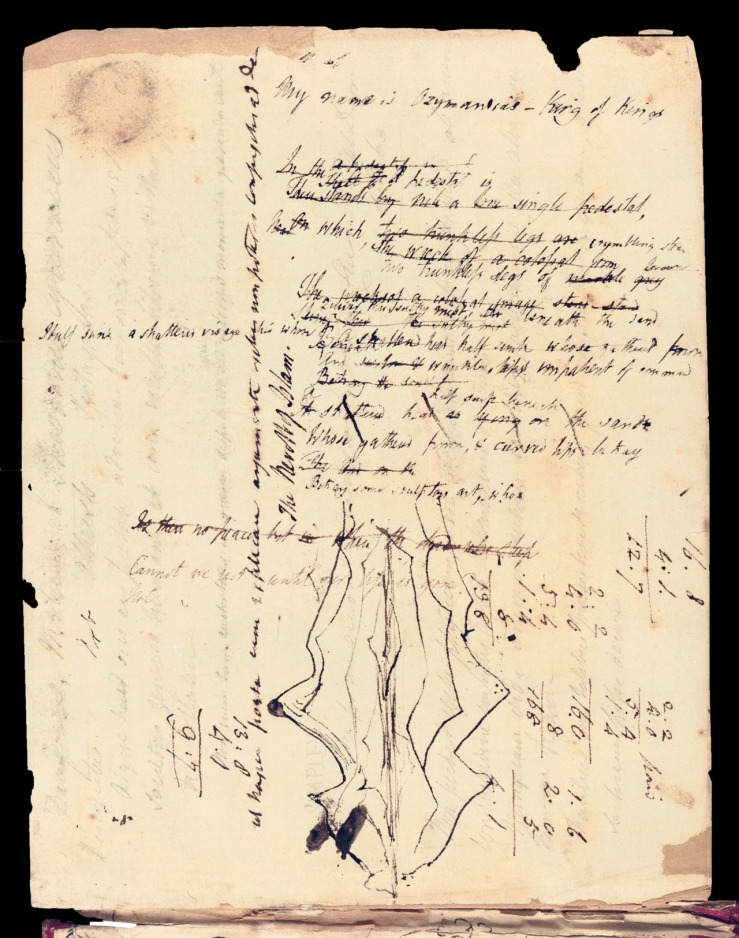
I met a traveller from an antique land,
Who said — “two vast and trunkless legs of stone
Stand in the desert … near them, on the sand,
Half sunk a shattered visage lies, whose frown,
And wrinkled lips, and sneer of cold command,
Tell that its sculptor well those passions read
Which yet survive, stamped on these lifeless things,
The hand that mocked them, and the heart that fed;
And on the pedestal these words appear:
My name is Ozymandias, King of Kings,
Look on my Works ye Mighty, and despair!
Nothing beside remains. Round the decay
Of that colossal Wreck, boundless and bare
The lone and level sands stretch far away.” —









 Biblioklept