Books Acquired, 4.10.2012

20120417-145226.jpg

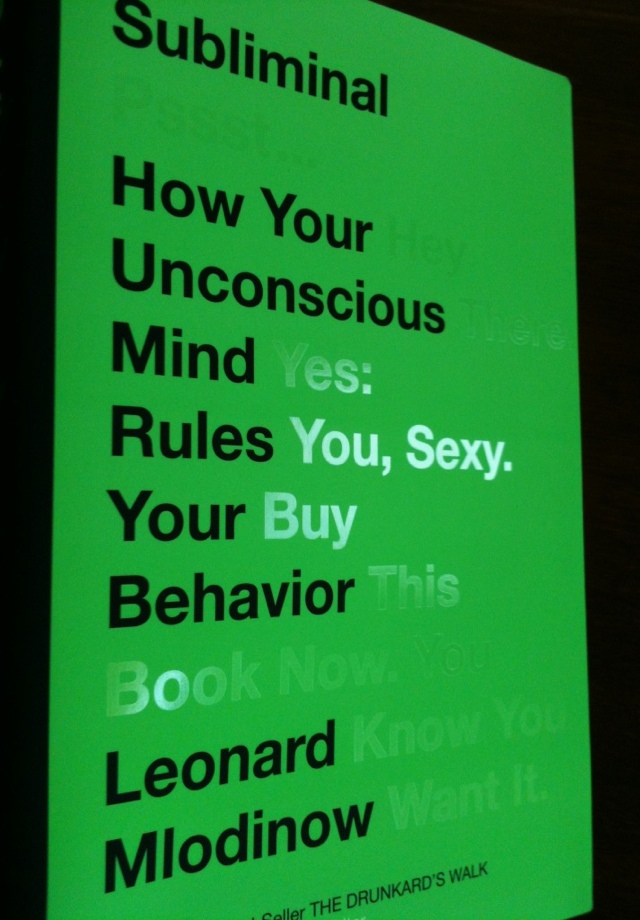
Subliminal by Leonard Mldodinow is new from Random House. Their description:

Leonard Mlodinow, the best-selling author of The Drunkard’s Walk and coauthor of The Grand Design (with Stephen Hawking), gives us a startling and eye-opening examination of how the unconscious mind shapes our experience of the world and how, for instance, we often misperceive our relationships with family, friends, and business associates, misunderstand the reasons for our investment decisions, and misremember important events.

Your preference in politicians, the amount you tip your waiter—all judgments and perceptions reflect the workings of our mind on two levels: the conscious, of which we are aware, and the unconscious, which is hidden from us. The latter has long been the subject of speculation, but over the past two decades researchers have developed remarkable new tools for probing the hidden, or subliminal, workings of the mind. The result of this explosion of research is a new science of the unconscious and a sea change in our understanding of how the subliminal mind affects the way we live.

Employing his trademark wit and lucid, accessible explanations of the most obscure scientific subjects, Leonard Mlodinow takes us on a tour of this research, unraveling the complexities of the subliminal self and increasing our understanding of how the human mind works and how we interact with friends, strangers, spouses, and coworkers. In the process he changes our view of ourselves and the world around us.

Read a profile of Mlodinow at The Los Angeles Times (dude used to work on MacGyver, so . . .)

20120417-145237.jpg

Also new from Random House is Against Wind and Tide, a collection of letters, journals, and other documents by Anne Morrow Lindbergh. Jacket copy:

Why, as an eager and talented writer, has Anne Morrow Lindbergh published so relatively little in forty years of marriage?” asked reviewer John Barkham in 1970. “After a promising start with those first books on flying, she tapered off into long silences broken by an infrequent volume of verse or prose.”  Many years later, Lindbergh replied with a quote from Harriet Beecher Stowe, who claimed that writing, for a wife and mother, is “rowing against wind and tide.”

In this sixth and final collection of Lindbergh’s diaries and letters, taking us from 1947 to 1986, we mark her progress as she navigated a remarkable life and a remarkable century with enthusiasm and delight, humor and wit, sorrow and bewilderment, but above all devoted to finding the essential truth in life’s experiences through a hard-won spirituality and a passion for literature.

Between the inevitable squalls of life with her beloved but elusive husband, the aviator Charles A. Lindbergh, she shepherded their five children through whooping cough, horned toads, fiancés, the Vietnam War, and their own personal tragedies.  She researched and wrote many books and articles on issues ranging from the condition of Europe after World War II to the meaning of marriage to the launch of Apollo 8.  She published one of the most beloved books of inspiration of all time, Gift from the Sea. She left penetrating accounts of meetings with such luminaries as John and Jacqueline Kennedy, Thornton Wilder, Enrico Fermi, Leland and Slim Hayward, and the Frank Lloyd Wrights. And she found time to compose extraordinarily insightful and moving letters of consolation to friends and to others whose losses touched her deeply.

More than any previous books by or about Anne Morrow Lindbergh, Against Wind and Tide makes us privy to the demons that plagued this fairy-tale bride, and introduces us to some of the people—men as well as women—who provided solace as she braved the tides of time and aging, war and politics, birth and death. Here is an eloquent and often startling collection of writings from one of the most admired women of our time.

“Authenticity’s Wiped Out” — A Passage from William Gaddis’s Last Novel, Agapē Agape

William Gaddis’s last novel Agapē Agape is a bitter, funny rant, a monologic stream-of-consciousness that, through its extreme powers of synthesis, spills over into heteroglossic eruptions, a carnival of erudite voices. Driven by terrible physical pain, hints of madness, and, most of all, the need to “explain all this” before he dies, the voice of the novel (surely Gaddis himself) channels cultural historian Johan Huizinga and philosopher Walter Benjamin into a conversation about the conflict of art and commerce set against the backdrop of the rise of mass culture:

. . . falls right into line doesn’t it, collapse of authenticity collapse of religion collapse of values what Huizinga called one of the most important phases in the history of civilization, and Walter Benjamin picks it up in his Art in the Age of Mechanical Reproduction in this heap somewhere, the authentic work of art is based in ritual he says, and wait Mr. Benjamin, got to get in there the romantic mid-eighteenth century aesthetic pleasure in the worship of art was the privilege of the few. I was saying, Mr. Huizinga, that the authentic work of art had its base in ritual, and mass reproduction freed it from this parasitical dependence. Ah, quite so Mr. Benjamin quite so, turn of the century religion was losing its steam and art came in as its substitute would you say? Absolutely Mr. Huizinga, and I’d add that this massive technical reproduction of works of art could be manipulated, changed the way the masses looked at art and manipulated them. Inadvertently Mr. Benjamin you might say that art now became public property, for the simply educated Mona Lisa and the Last Supper became calendar art to hang over the kitchen sink. Absolutely Mr. Huizinga, Paul Valery saw it coming, visual and auditory images brought into homes from far away like water gas and electricity and finally, God help us all, the television. Positively Mr. Benjamin, with mechanization, advertising artworks made directly for a market what America’s all about. Always has been, Mr. Huizinga. Always has been, Mr. Benjamin. Everything becomes an item of commerce and the market names the price. And the price becomes the criterion for everything. Absolutely Mr. Huizinga! Authenticity’s wiped out when the uniqueness of every reality is overcome by the acceptance of its reproduction, so art is designed for its reproducibility. Give them the choice, Mr. Benjamin, and the mass will always choose the fake. Choose the fake, Mr. Huizinga! Authenticity’s wiped out, it’s wiped out Mr. Benjamin. Wiped out, Mr. Huizinga. Choose the fake, Mr. Benjamin. Absolutely, Mr. Huizinga! Positively Mr. Benjamowww! Good God! a way to find a sharp pencil just sit still avoid stress stop singing what, anybody heard me they’d think I was losing my, that I’d lost it yes maybe I have . . .

A Pictorial Chart of English Literature

(Via the Library of Congress).

Book Acquired, 4.14.2012

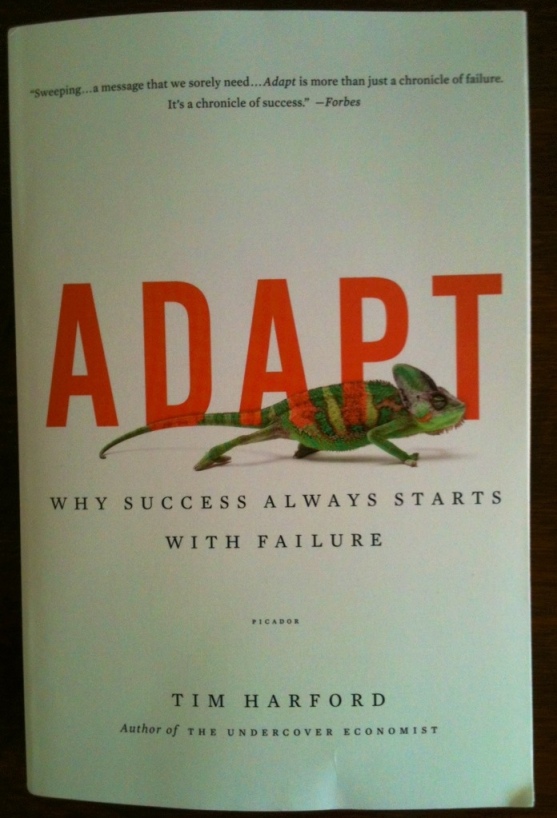
20120417-113551.jpg

Adapt by Tim Harford. New from Picador. Their description:

In this groundbreaking book, Tim Harford, the Undercover Economist, shows us a new and inspiring approach to solving the most pressing problems in our lives. When faced with complex situations, we have all become accustomed to looking to our leaders to set out a plan of action and blaze a path to success. Harford argues that today’s challenges simply cannot be tackled with ready-made solutions and expert opinion; the world has become far too unpredictable and profoundly complex. Instead, we must adapt.

Deftly weaving together psychology, evolutionary biology, anthropology, physics, and economics, along with the compelling story of hard-won lessons learned in the field, Harford makes a passionate case for the importance of adaptive trial and error in tackling issues such as climate change, poverty, and financial crises—as well as in fostering innovation and creativity in our business and personal lives.

Taking us from corporate boardrooms to the deserts of Iraq, Adapt clearly explains the necessary ingredients for turning failure into success. It is a breakthrough handbook for surviving—and prospering— in our complex and ever-shifting world.

“A Snake Is Afraid of a Man That Is Naked,” and Other Great Occult Tips on Animals (Heinrich Cornelius Agrippa von Nettesheim)

From Heinrich Cornelius Agrippa von Nettesheim’s Three Books of Occult Philosophy or Magic, (1533)

The bird called bustard flies away at the sight of a horse, and a hart runs away at the sight of a ram, as also of a viper.

An elephant trembles at the hearing of the grunting of a hog, so doth a lion at the sight of a cock; and panthers will not touch them that are anointed all over with the broth of a hen, especially if garlic hath been boiled in it.

There is also enmity betwixt foxes and swans, bulls and jackdaws.

Amongst birds, also, some are at perpetual strife one with another, as also with other animals, as jackdaws and owls, the kite and crows, the turtle and ring-tail, egepis and eagles, harts and dragons.

Also amongst water animals there is enmity, as betwixt dolphins and whirlpools, mullets and pikes, lampreys and congers.

Also the fish called pourcontrel makes the lobster so much afraid that the lobster, seeing the other but near him, is struck dead.

The lobster and conger tear one the other.

The civet cat is said to stand so in awe of the panther that he hath no power to resist him or touch his skin; and they say that if the skins of both of them be hanged up one against the other, the hairs of the panther’s skin fall off.

And Orus Apollo saith in his hieroglyphics, if any one be girt about with the skin of the civet cat that he may pass safely through the middle of his enemies and not at all be afraid.

Also the lamb is very much afraid of the wolf and flies from him. And they say that if the tail or skin or head of a wolf be hanged upon the sheep-coate the sheep are much troubled and cannot eat their meat for fear.

And Pliny makes mention of a bird, called marlin, that breaks crows’ eggs, whose young are so annoyed by the fox that she also will pinch and pull the fox’s whelps, and the fox herself also; which when the crows see, they help the fox against her, as against a common enemy.

The little bird called a linnet, living in thistles, hates asses, because they eat the flowers of thistles.

Also there is such a bitter enmity betwixt the little bird called esalon and the ass that their blood will not mix together, and that at the braying of the ass both the eggs and young of the esalon perish.

There is also such a disagreement betwixt the olive-tree and a wanton, that if she plant it, it will either be always unfruitful or altogether wither.

A lion fears nothing so much as fired torches, and will be tamed by nothing so much as by these; and the wolf fears neither sword nor spear, but a stone—by the throwing of which, a wound being made, worms breed in the wolf.

A horse fears a camel so that he cannot endure to see so much as his picture.

An elephant, when he rageth, is quieted by seeing of a cock.

A snake is afraid of a man that is naked, but pursues a man that is clothed.

A mad bull is tamed by being tied to a fig-tree.

(NB: I took the editorial liberty of turning Agrippa’s marvelous paragraphs into a list, which I think reads a bit better, or at least more absurdly).

Keith Miller’s The Book on Fire, A Tale of Biblioklepts, Bibliophiles, and Bibliomania

Balthazar, the hero of Keith Miller’s agile and trippy novel The Book on Fire, is a biblioklept. He comes to Alexandria to rob the famous library, a cavernous, labyrinthine complex that still exists–under heavy guard—in Miller’s mystical version of that ancient Egyptian city. Miller’s Alexandria is a byzantine maze, humming with a turn-of-the-century buzz, a kaleidoscope world that strongly reminded me of the strange cityscapes of William Gibson or William Burroughs. Here, Balthazar describes his attraction to Alexandria:
This is the city of books, where children are admonished if they don’t bring a book to the breakfast table, where they’re ordered by their mothers to drop their books and go play on the street, where bedtime tales sometimes continue, chapter after chapter, till well after midnight, parents pinching their children to keep them awake. This is a city where men beat their wives with books, the women shielding their heads with books. A city of book-whores, who fuck for books, and their bibliogiglios. A city of book-beggars, who spit on your money, gesturing with their stumps to the paperback in your hand.

What a town for a book thief! Balthazar plans to rob the Library of Alexandria, but he spends his early months stealing rare books from private homes. Soon, he’s trailed by Zeinab, a book prostitute who burns each volume she’s paid with. After a sexual interlude (“like fucking a wounded ferret,” Balthazar tells us), Zeinab introduces our hero to a guild of thieves and helps guide him through Alexandria’s frenetic underworld. In time, Balthazar breaches the forbidden, intoxicating library:

I read impossibly gorgeous scripts. Scripts in which each hieroglyph filled a page and took a day to write, but could express an entire philosophy. Scripts in which each letter stood for a notion, so the writing dictated thought patterns rather than words. Scripts that had no meaning at all, or that started out meaningfully but then, as the author was caught up in the physical act of writing, became relationships of lines and shapes on paper, beautiful and abstract. Private scripts, the authors long dead, so the script stood isolated, unreadable precious nonetheless. Rainforest scripts of samara and turaco crest. Marine scripts of shark tooth and sand dollar. I passed through rooms of books the size of doors, each cover the death of an eland, and rooms of books dainty as ladybirds. Books written on communion wafers, grains of rice, sheets of ice.

For Balthazar, books are a drug, and the Library of Alexandria is the heady nexus point for his addiction. No wonder then that he becomes obsessed with the young librarian Shireen, whom he plots to free (or perhaps steal) from the library—a plan that comes into conflict with Zeinab’s own designs. And while The Book of Fire does have the strong, page turning plot of a thriller, that plot exists mostly as the bones for Miller to hang rapturous descriptions of reading and books and, best of all, his strange Alexandria, a city of marvels. Good stuff.

People in the Sun — Edward Hopper

Book Shelves #16, 4.15.2012

20120415-113741.jpg

Book shelves series #16, sixteenth Sunday of 2012.

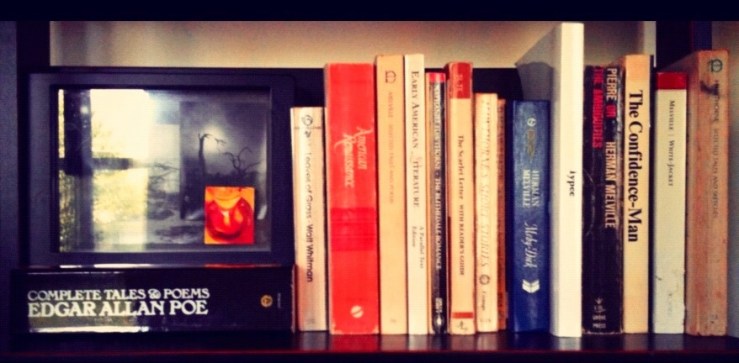
It’s hard to photograph books, and using an iPhone 3gs probably doesn’t help. Lots of glare. Anyway: This shelf houses mostly Melville, with some Hawthorne, Poe, and Whitman, as well as some critical works on the American Renaissance movement. (Henry James and F.O. Matthiessen). I have other versions of a lot of these books, including a fraternal twin in my office, a bit bulkier (Emerson, Dickinson, Thoreau, etc.), although these days I’m apt to go to the Kindle for American Renaissance stuff. Here’s a better angle, perhaps:

20120415-113756.jpg

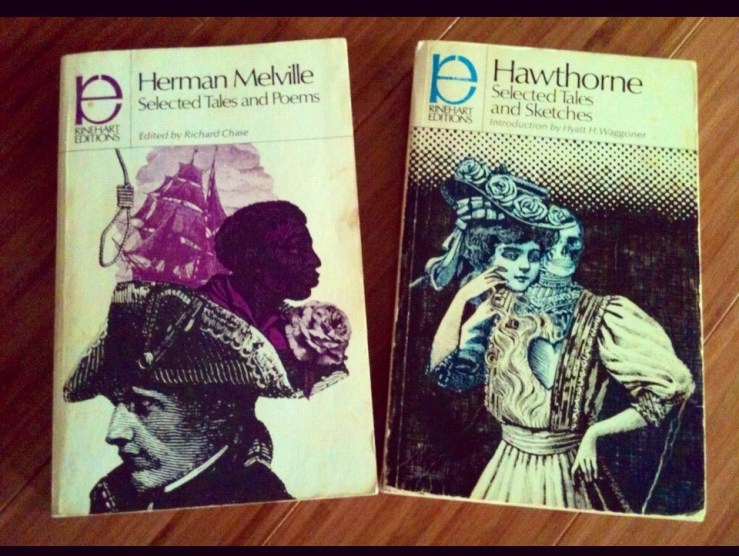
The version of Typee is bizarre: no colophon, no publisher info, just text. I love these midcentury Rinehart Editions of Hathorne and Melville stuff:

20120415-113807.jpg

“Rhetoric” — A Page from James Joyce’s Notebooks

This page is from a notebook that contains some of Joyce’s preparatory notes for Ulysses—there are notes for characters (“Stephen,” “Simon,” “Leopold,” etc.) as well as lists (“Books,” “Recipes”) and general ideas (“Theosophy”). This particular page, “Rhetoric,” seems to be part of the material that went into the “Aeolus” chapter of Ulysses, which plays with the windiness of rhetorical figures. From the National Library of Ireland, via UbuWeb.

Roberto Bolaño’s The Secret of Evil (Book Acquired, 4.09.2012)

20120414-140951.jpg

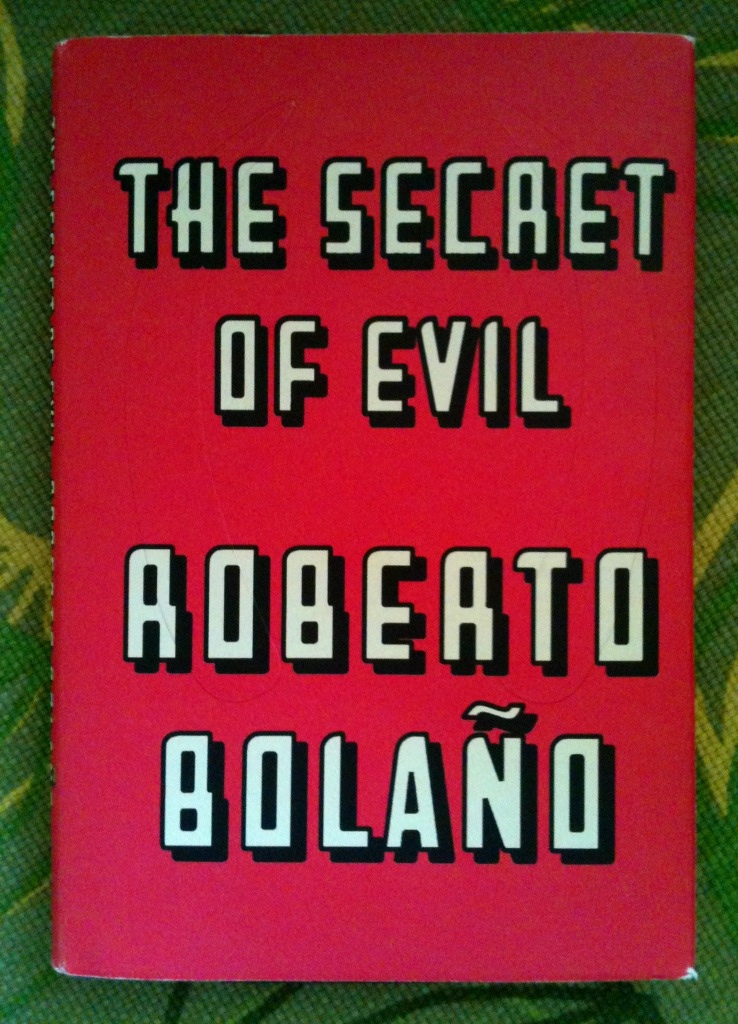
How you react to a “new” book by Roberto Bolaño at this point is probably dependent on how much you love or loathe his work—although I imagine those indifferent to or unfamiliar with his writing might be unduly put off by this point at the volume of material that this writer drops posthumously [insert Tupac joke here].

I’m a fan though, so I’m excited about The Secret of Evil, even if the material collected here is in part unfinished . . . although, as Ignacio Echevarria points out in his introduction, all of Bolaño’s “narratives, not just The Secret of Evil, seem to be governed by a poetics of inconclusiveness.” A few of the pieces in Evil have already been excerpted, and I read a few this weekend (who can resist a Bolaño text called “Crimes”?), and while some pieces here are sketchier than others, there’s that preponderance of life force that we expect from late period Bolaño, from a man who seemed to pour what was left of himself into his words and sentences.

From publisher New Directions’ website:

Opening this book is like being granted access to the Chilean master’s personal files. Included in this one-of-a-kind collection is everything Roberto Bolaño was working on just before his death in 2003, and everything that he wanted to share with his readers. Fans of his writing will find familiar characters in new settings, and entirely new stories and styles, too.

A North American journalist in Paris is woken at 4 a.m. by a mysterious caller with urgent information. Daniela de Montecristo (familiar to readers of Nazi Literature in the Americas and 2666) recounts the loss of her virginity. Arturo Belano returns to Mexico City and meets the last disciples of Ulises Lima, who play in a band called The Asshole of Morelos. Belano’s son Gerónimo disappears in Berlin during the Days of Chaos in 2005. Memories of a return to the native land; Argentine writers as gangsters; zombie schlock as allegory…and much more.

“Mediæval mythology, rich and gorgeous, is a compound like Corinthian brass”

Mediæval mythology, rich and gorgeous, is a compound like Corinthian brass, into which many pure ores have been fused, or it is a full turbid river drawn from numerous feeders, which had their sources in remote climes. It is a blending of primæval Keltic, Teutonic, Scandinavian, Italic, and Arab traditions, each adding a beauty, each yielding a charm, bat each accretion rendering the analysis more difficult. Pacciuchelli says:–“The Anio flows into the Tiber; pure as crystal it meets the tawny stream, and is lost in it, so that there is no more Anio, but the united stream is all Tiber.” So is it with each tributary to the tide of mediæval mythology. The moment it has blended its waters with the great and onward rolling flood, it is impossible to detect it with certainty; it has swollen the stream, but has lost its own identity. If we would analyse a particular myth, we must not go at once to the body of mediæval superstition, but strike at one of the tributaries before its absorption.

From Sabine Baring-Gould’s marvelous volume The Book of Were-Wolves (1865).

“It Sounds Like the Title of a David Lynch Film” — A Passage from Roberto Bolaño’s 2666

A passage from Roberto Bolaño’s opus 2666

The card for the Santa Teresa cybercafe was a deep red, so red that it was hard to read what was printed on it. On the back, in a lighter red, was a map that showed exactly where the cafe was located. He asked the receptionist to translate the name of the place. The clerk laughed and said it was called Fire, Walk With Me.

“It sounds like the title of a David Lynch film,” said Fate.

The clerk shrugged and said that all of Mexico was a collage of diverse and wide-ranging homages.

“Every single thing in this country is an homage to everything in the world, even the things that haven’t happened yet,” he said.

After he told Fate how to get to the cybercafe, they talked for a while about Lynch’s films. The clerk had seen all of them. Fate had seen only three or four. According to the clerk, Lynch’s greatest achievement was the TV series Twin Peaks. Fate liked The Elephant Man best, maybe because he’d often felt like the elephant man himself, wanting to be like other people but at the same time knowing he was different. When the clerk asked him whether he’d heard that Michael Jackson had bought or tried to buy the skeleton of the elephant man, Fate shrugged and said that Michael Jackson was sick. I don’t think so, said the clerk, watching something presumably important that was happening on TV just then.

“In my opinion,” he said with his eyes fixed on the TV Fate couldn’t see, “Michael knows things the rest of us don’t.”

“We all know things we think nobody else knows,” said Fate.

“Self Defense” — Nietzsche

104 Self Defence.—If self defence is in general held a valid justification, then nearly every manifestation of so called immoral egoism must be justified, too. Pain is inflicted, robbery or killing done in order to maintain life or to protect oneself and ward off harm. A man lies when cunning and delusion are valid means of self preservation. To injure intentionally when our safety and our existence are involved, or the continuance of our well being, is conceded to be moral. The state itself injures from this motive when it hangs criminals. In unintentional injury the immoral, of course, can not be present, as accident alone is involved. But is there any sort of intentional injury in which our existence and the maintenance of our well being be not involved? Is there such a thing as injuring from absolute badness, for example, in the case of cruelty? If a man does not know what pain an act occasions, that act is not one of wickedness. Thus the child is not bad to the animal, not evil. It disturbs and rends it as if it were one of its playthings. Does a man ever fully know how much pain an act may cause another? As far as our nervous system extends, we shield ourselves from pain. If it extended further, that is, to our fellow men, we would never cause anyone else any pain (except in such cases as we cause it to ourselves, when we cut ourselves, surgically, to heal our ills, or strive and trouble ourselves to gain health). We conclude from analogy that something pains somebody and can in consequence, through recollection and the power of imagination, feel pain also. But what a difference there always is between the tooth ache and the pain (sympathy) that the spectacle of tooth ache occasions! Therefore when injury is inflicted from so called badness the degree of pain thereby experienced is always unknown to us: in so far, however, as pleasure is felt in the act (a sense of one’s own power, of one’s own excitation) the act is committed to maintain the well being of the individual and hence comes under the purview of self defence and lying for self preservation. Without pleasure, there is no life; the struggle for pleasure is the struggle for life. Whether the individual shall carry on this struggle in such a way that he be called good or in such a way that he be called bad is something that the standard and the capacity of his own intellect must determine for him.

From Human, All Too Human by Friedrich Nietzsche

“I Felt an Irresistible Repulsion and Tedium” — Tolstoy Disses Shakespeare

From the beginning of Leo Tolsoy’s attack on William  ShakespeareA Critical Essay on Shakespeare:

I remember the astonishment I felt when I first read Shakespeare. I expected to receive a powerful esthetic pleasure, but having read, one after the other, works regarded as his best: “King Lear,” “Romeo and Juliet,” “Hamlet” and “Macbeth,” not only did I feel no delight, but I felt an irresistible repulsion and tedium, and doubted as to whether I was senseless in feeling works regarded as the summit of perfection by the whole of the civilized world to be trivial and positively bad, or whether the significance which this civilized world attributes to the works of Shakespeare was itself senseless. My consternation was increased by the fact that I always keenly felt the beauties of poetry in every form; then why should artistic works recognized by the whole world as those of a genius,—the works of Shakespeare,—not only fail to please me, but be disagreeable to me?

For a long time I could not believe in myself, and during fifty years, in order to test myself, I several times recommenced reading Shakespeare in every possible form, in Russian, in English, in German and in Schlegel’s translation, as I was advised. Several times I read the dramas and the comedies and historical plays, and I invariably underwent the same feelings: repulsion, weariness, and bewilderment. At the present time, before writing this preface, being desirous once more to test myself, I have, as an old man of seventy-five, again read the whole of Shakespeare, including the historical plays, the “Henrys,” “Troilus and Cressida,” the “Tempest,” “Cymbeline,” and I have felt, with even greater force, the same feelings,—this time, however, not of bewilderment, but of firm, indubitable conviction that the unquestionable glory of a great genius which Shakespeare enjoys, and which compels writers of our time to imitate him and readers and spectators to discover in him non-existent merits,—thereby distorting their esthetic and ethical understanding,—is a great evil, as is every untruth.

Tolstoy spends most of the rest of the (long) essay showing why he believes King Lear a terrible piece of literature. His rubric is of course terribly subjective, aesthetic, and perhaps ultimately rooted in his own literary mission of realism and social reform—but what I find most remarkable is that, despite all his claims to have read and reread Shakespeare (in English, Russian and German!) he never mentions actually watching a performance of the play.

I read Tolstoy’s gripes last night and felt the need (why?!) to reply, but found this morning that George Orwell already did so. From  Orwell’s rebuttal to Tolstoy, “Lear, Tolstoy and the Fool“:

Artistic theories such as Tolstoy’s are quite worthless, because they not only start out with arbitrary assumptions, but depend on vague terms (‘sincere’, ‘important’ and so forth) which can be interpreted in any way one chooses. Properly speaking one cannot answer Tolstoy’s attack. The interesting question is: why did he make it? But it should be noticed in passing that he uses many weak or dishonest arguments. Some of them are worth pointing out, not because they invalidate his main charge but because they are, so to speak, evidence of malice. . . .

There is no argument by which one can defend a poem. It defends itself by surviving, or it is indefensible. And if this test is valid, I think the verdict in Shakespeare’s case must be “not guilty”. Like every other writer, Shakespeare will be forgotten sooner or later, but it is unlikely that a heavier indictment will ever be brought against him. Tolstoy was perhaps the most admired literary man of his age, and he was certainly not its least able pamphleteer. He turned all his powers of denunciation against Shakespeare, like all the guns of a battleship roaring simultaneously. And with what result? Forty years later Shakespeare is still there completely unaffected, and of the attempt to demolish him nothing remains except the yellowing pages of a pamphlet which hardly anyone has read, and which would be forgotten altogether if Tolstoy had not also been the author of WAR AND PEACE and ANNA KARENINA.

For Want of Sleep — Emma Bennett

(Via/more).

Walt Whitman’s Cardboard Butterfly

(More/background/controversy)

“Walter, Leave Off” — D.H. Lawrence on Walt Whitman

From Lawrence’s chapter on Whitman in Studies in Classic American Literature (more):

POST-MORTEM effects?

But what of Walt Whitman?

The ‘good grey poet’.

Was he a ghost, with all his physicality?

The good grey poet.

Post-mortem effects. Ghosts.

A certain ghoulish insistency. A certain horrible pottage of human parts. A certain stridency and portentousness. A luridness about his beatitudes.

DEMOCRACY! THESE STATES! EIDOLONS! LOVERS, ENDLESS LOVERS!

ONE IDENTITY!

ONE IDENTITY!

I AM HE THAT ACHES WITH AMOROUS LOVE.

Do you believe me, when I say post-mortem effects ?

When the Pequod went down, she left many a rank and dirty steamboat still fussing in the seas. The Pequod sinks with all her souls, but their bodies rise again to man innumerable tramp steamers, and ocean-crossing liners. Corpses.

What we mean is that people may go on, keep on, and rush on, without souls. They have their ego and their will, that is enough to keep them going.

So that you see, the sinking of the Pequod was only a metaphysical tragedy after all. The world goes on just the same. The ship of the soul is sunk. But the machine-manipulating body works just the same: digests, chews gum, admires Botticelli and aches with amorous love.

I AM HE THAT ACHES WITH AMOROUS LOVE.

What do you make of that? I AM HE THAT ACHES. First generalization. First uncomfortable universalization. WITH AMOROUS LOVE! Oh, God! Better a bellyache. A bellyache is at least specific. But the ACHE OF AMOROUS LOVE!

Think of having that under your skin. All that!

I AM HE THAT ACHES WITH AMOROUS LOVE.

Walter, leave off. You are not HE. You are just a limited Walter. And your ache doesn’t include all Amorous Love, by any means. If you ache you only ache with a small bit of amorous love, and there’s so much more stays outside the cover of your ache, that you might be a bit milder about it.

I AM HE THAT ACHES WITH AMOROUS LOVE.

CHUFF! CHUFF! CHUFF!

CHU-CHU-CHU-CHU-CHUFF!

Reminds one of a steam-engine. A locomotive. They’re the only things that seem to me to ache with amorous love. All that steam inside them. Forty million foot-pounds pressure. The ache of AMOROUS LOVE. Steam-pressure. CHUFF!

An ordinary man aches with love for Belinda, or his Native Land, or the Ocean, or the Stars, or the Oversoul: if he feels that an ache is in the fashion.

It takes a steam-engine to ache with AMOROUS LOVE. All of it.

Walt was really too superhuman. The danger of the superman is that he is mechanical.