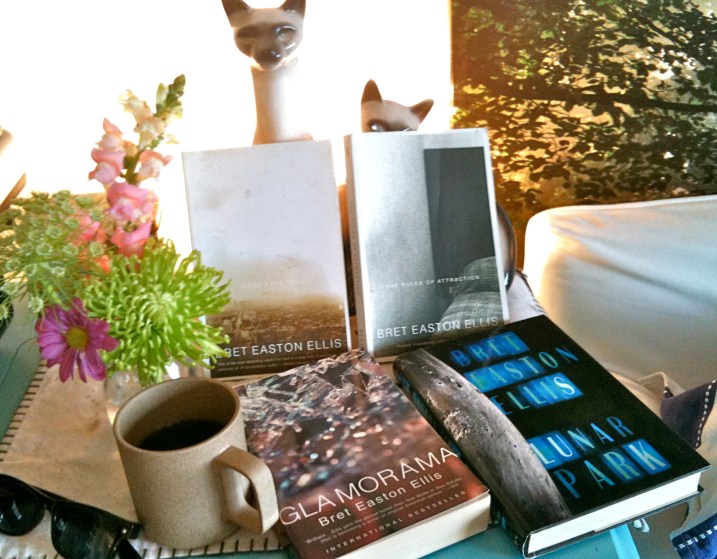
In high school I bought American Psycho from Barnes & Noble and read it in a few weeks. I knew it was full of awful, horrible stuff that I would never be able to forget but I did it anyways. I was fascinated, revolted; I laughed out loud. I became that one guy that burst everyone’s bubble by telling them that the movie sucked or at least totally missed the point of the book (whatever point there might have been) and that it also left out every one of the funniest scenes, and, oh that the ending was total bullshit. People would ask me if I “liked” the book and I would evasively respond: “I don’t know if it’s a book one can actually like…” or “I don’t know if like is the right word…”—and just generally avoid making any kind of decision about the book, or its author, that prince of darkness Bret Easton Ellis.
But Bret Easton Ellis intrigued me. Later, when the film Rules of Attraction came out I saw it in the theater by myself and purchased the DVD. It was a much better film than AP, and that was satisfying to me in some way. I didn’t read the book, nor was I moved to seek out Less Than Zero, although at some point I found Glamorama at a used store and bought it for the heck of it, but I don’t think I ever even tried to read it. I was interested in BEE but only from afar. He had definitely scarred me with AP. It was a singular experience at the time and (to this day has maybe been matched only by Jerzy Kosinski with my combined readings of Steps and The Painted Bird). I wasn’t really looking to be haunted in that way any time soon.
I can still remember where I was when I heard about Lunar Park. I read about it at The New York Times, on the family computer at a friend’s parents’ house in Rutland Vermont. I saw that Ellis had a new book, skimmed the article, and saw mention of “meta” elements, the use of a character named “Bret Ellis” who was decidedly not intended to be the actual author of the book, but rather a sort of parallel dimension version of BEE who had settled down in the suburbs and had kids. This was all interesting to me and I made the mental note, “Read Lunar Park.” That was in August 2005.
Fast forward to May 2010. In the five years since Lunar Park came out everything about my life has changed. I am living in Los Angeles pursuing a career in screenwriting. I have been married for a year and I have an apartment and two cats. And it is in this apartment that I come across a VICE interview with the man himself, on the eve of the publication of his new novel Imperial Bedrooms. I find myself reading the interview and it dawns on me that I have never read or heard this man speak, I’ve barely seen photographs of him, and that basically everything I think I know about him has been pure conjecture derived from conversations over the years.
My idea of Bret Ellis as this detached, cynical, deviant creature is immediately thrown out the window by seeing pictures of him wearing a hooded sweatshirt and sitting at a desk. In some of the photos green palm trees can be seen behind him and it becomes clear very quickly in the interview that he now lives in Los Angeles as well. I end up reading the entire article and thinking that Ellis is just a guy like anyone else, not especially pretentious or malevolent, as he had been accused of being by people I had spoken with at times. And what’s more he made reference to “the Stephen King part” of Lunar Park.
My mind exploded.
What Stephen King part? I remembered and reinstated my mental note: “Read Lunar Park.”
And a few weeks later, as though on cue a beautiful hardback first edition copy of LP appeared at the used book stand at my neighborhood farmer’s market. I bought it on a Saturday morning and opened as I was cooking lunch, expecting to get a taste and maybe read a page or two while the food cooked. I ended up sitting on the couch for the entire day reading. That night I couldn’t wait for my wife to fall asleep so I could sit up late and maybe finish, and I started to do just that until I became so frightened by the story that I literally had to put it away until it was light outside. I had a little trouble sleeping that night but ultimately it was okay, and the next day I finished the book. Immediately I was on the phone telling friends to read it. I made several of my local friends borrow my copy and one-by-one everyone came back to me with the same positive report, and regardless of their previous experience or lack-there-of with Ellis’s writing, everyone who read it adored it.
My admiration extended past just the book or my experience reading it. It reconciled the past and my memories and suddenly I found myself saying “I like Bret Easton Ellis” or even going so far as to thinking of myself as a fan of his. I slowly started keeping up with his online presence, (going so far as even joining Twitter just to follow him) and I find the experience genuinely rewarding. Don’t get me wrong: he’s obviously a weird guy sometimes (anyone who could write the habitrail scene in AP would have to be I guess) and I don’t always agree with his randomly asserted opinions about books and movies (I disagree in particular with him about music: our tastes are just simply different). But overall, I think he has a valid and useful perspective on culture and entertainment. Perhaps some of the detractors still see him as the austere, decadent, nihilistic provocateur that I feared and resented in high school, but I have an impossible time jiving that notion with the man who tweeted recently that he had been talked into getting really stoned and going to see The Lorax.
And I guess this all ties in with his recent series of tweets that he is considering a pseudosequel to American Psycho. Suddenly, this proposition seemed so appealing. It’s been twelve years since I read AP, and in that time I don’t think I’ve ever opened it again, and now suddenly I find myself wanting more, hoping that Ellis decides to go through with it.
So yesterday in excited anticipation I went down to the farmer’s market and this time the used book guy had two beautiful paperback copies of Rules of Attraction and Less Than Zero. I bought them both. Even if Ellis does convince himself to write the Los Angeles Patrick Bateman story, it will be years before it will be published and in my hands, so I guess I need to relax and catch up on everything I missed out on so far.
The Gospels are powerful not simply because Christ performed miracles and taught kindness, strength, and humility. Humanity has long attributed to certain individuals impossible deeds, tremendous suffering, and inordinate wisdom. We survey the collective memory and search for meaning in the lives of renowned teachers so that they might serve as an example during our own unpredictable, harrowing journey. What separates the story of Jesus from the stories of other merely great people in history is the idea that God manifested itself to humans as a human: wracked with doubt, vulnerable to temptation, victim of unimaginable pain. Although he taught that love is the first commandment, Christ was flailed, tortured, left to die on a cross between two thieves, all ostensibly for no benefit but our own. Wasn’t it Borges who said that every story is either the Odyssey or the Crucifixion? The stories we tell each other, in their reflection, become the same nothing cycle of words, told again and again, a record of our inadequacy and cowardice.
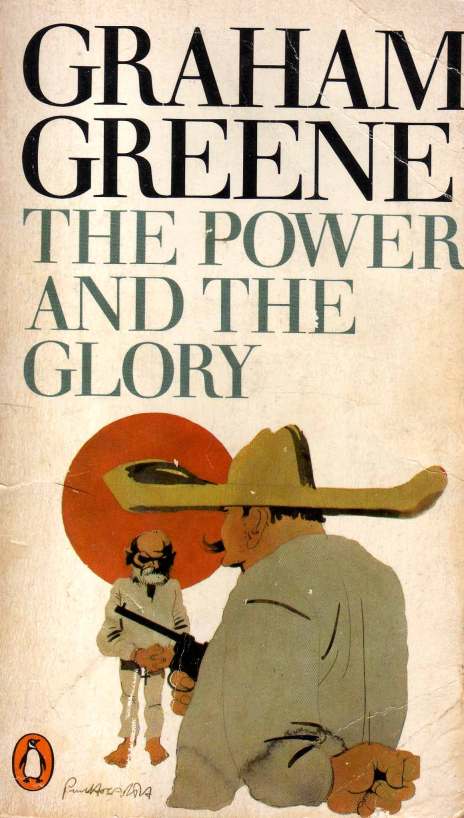
Graham Greene, in his short and powerful novel The Power and the Glory, considers the life and death of Jesus as henarrates the life of a man brought low by pride and circumstances. The last priest someplace in southwestern Mexico flees from the authorities. His hunters seek to free the peasant farmers who populate the land from exploitation and superstition with their own imperfect liberation theologies: the abolition of superstition and private property; the self-sufficiency that follows honest labor. The men in red shirts ride horses and believe in the impending, always near, revolution. On the back of a mule, the father sneaks from town to town, trying to fulfill his duty, but without understanding the significance of the words that tumble clumsily from his mouth in Latin. He performs sacred rites in exchange for sanctuary until even a hiding spot is denied to him. The police have started to execute men and boys in villages who they believe have colluded to shelter this wayward man of God.
As the priest travels, he finds himself stripped not only of the vestments of his profession: his chalice, his incense, his robes, and his bible, but his own air of invincibility, privilege and comfort. Exposed, fearful, living in a state of mortal sin and unable to confess, this fallen man of God, like Christ himself, is destroyed. The priest is, by his own admission, a bad one. He drinks heavily and thinks too much of his own comfort. Led to his profession not so much by attention to the divine will but by a desire for status and privilege, during his exile he recalls fondly dinners lavish dinners with wealthy members of his assembly and the gifts they gave him. While he may have seen that the most of his flock made a meager living on small farms after taxes and fees paid to local bosses, he never stopped to consider the meaning of his own observations, busying himself instead with ambitions for his own greater glory. He is, for the first half of the book, greedy, proud, and self-concerned.
But, as he eludes the authorities and traverses the country, he becomes, in Greene’s capable hands, a symbol of redemption and an affirmation of a full but unrealized life. Words that lacked meaning help to ameliorate the strongest pain he has ever felt. He is jailed, extorted, and rejected by the people who love him the most, but in humiliation finds real faith. Performing the sacred rites of his profession, he confronts the banality of evil and comes to finally realize the true power of the promise he brought to those who came to him:
He had an immense self-importance; he was unable to picture a world in which he was only a typical part — a world of treachery, violence, and lust in which his shame was altogether insignificant. How often the priest had heard the same confession — Man was so limited he hadn’t even the ingenuity to invent a new vice: the animals knew as much. It was for this world that Christ had did; the more evil you saw and heard about you, the greater glory lay around the death. It was too easy to die for what was good or beautiful, for home or children or a civilization — it needed a God to die for the half-hearted and the corrupt.
This is a book about religion and faith, but The Power and the Glory doesn’t require its reader to have an inclination towards either. It is an adventure story, recounted in bold, confident sentences, about a normal man who fears that incorrect choices will cause him to suffer. This fear is real and it manifests itself in the priest’s moral and ethical dilemmas. We are asked to ponder those things that lead from sadness to strength. The priest is us: we see ourselves completely in him and give him our sympathy.
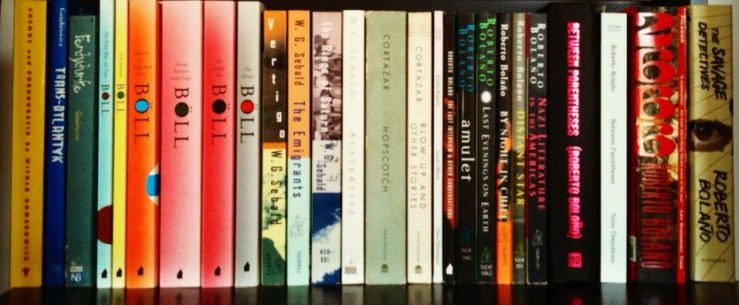
The shelf holds literature in translation: Witold Gombrowicz, Heinrich Böll, W.G. Sebald, Julio Cortázar, and Roberto Bolaño. There was a geode bookend here until Thursday, when I reorganized (finally giving the Gombrowicz a home and restoring the finished copy of Between Parentheses to its brothers). No, I never finished Hopscotch, nor much of the Böll (although I did read Irish Journal, The Train Was on Time, and The Clown); I haven’t read Ferdydurke yet either.
Was happy to get a finished copy of Laszlo Krasznahorkai’s Satantango (new in English translation for the first time from the good people at New Directions). From Jacob Silverman’s review at The New York Times:
As in much of Krasznahorkai’s work, a sense of hallucinatory conspiracy is in the air. People speak ominously, if vaguely, about what lies ahead. They see visions and hear bells they can’t place. “If they read the papers properly,” one character says, “they would know that there is a real crisis out there.”
But there is also a shared belief that things aren’t as they appear. Some mistake must have been made; things can’t be as bad as they seem. And so the residents “are waiting. They’re waiting patiently, like the long-suffering lot they are, in the firm conviction that someone has conned them. They are waiting, belly to the ground, like cats at pig-killing time, hoping for scraps.” (This repetition, with its gradual slathering of metaphoric detail, characterizes Krasznahorkai’s style.)
I started the ARC I got of Satantango (mistitled on the spine; see below), but got sidetracked with epic books by William Gaddis and William Vollmann. (Blame the Bills). I will give the book my full attention in the nearish future.
From Sabine Baring-Gould’s indispensable work Curious Myths of the Middle Ages (1866):
There is a Polish story of a witch who made a girdle of human skin and laid it across the threshold of a door where a marriage-feast was being held. On the bridal pair stepping across the girdle they were transformed into wolves. Three years after the witch sought them out, and cast over them dresses of fur with the hair turned outward, whereupon they recovered their human forms, but, unfortunately, the dress cast over the bridegroom was too scanty, and did not extend over his tail, so that, when he was restored to his former condition, he retained his lupine caudal appendage, and this became hereditary in his family; so that all Poles with tails are lineal descendants of the ancestor to whom this little misfortune happened.
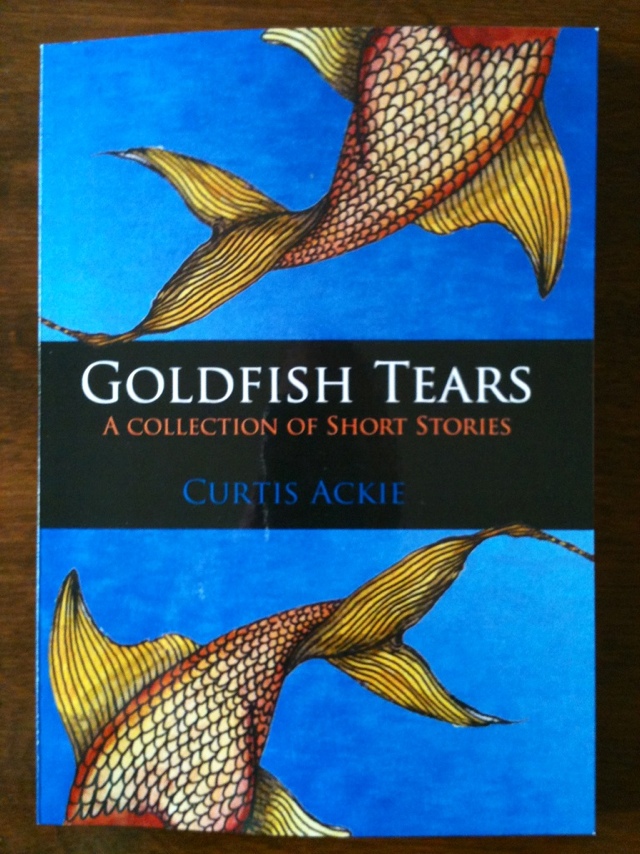
Goldfish Tears by Curtis Ackie: A good looking collection of shorts. Here’s the descriptor:
A perturbed bachelor is beleaguered by his misbehaving shadow; a reclusive alchemist builds a machine to right his wife’s disfigurement; the sun forgets to rise over a sleepy town in the middle of nowhere. Equal parts haunting and outlandish, Goldfish Tears is an enchanting collection of short stories by Curtis Ackie, a young British-born author concerned with the magic of dreams as escapism.
One of my favorite passages in Ulysses (it’s from the “Cyclops” chapter, episode 12). Hilarious–
He wore a long unsleeved garment of recently flayed oxhide reaching to the knees in a loose kilt and this was bound about his middle by a girdle of plaited straw and rushes. Beneath this he wore trews of deerskin, roughly stitched with gut. His nether extremities were encased in high Balbriggan buskins dyed in lichen purple, the feet being shod with brogues of salted cowhide laced with the windpipe of the same beast. From his girdle hung a row of seastones which dangled at every movement of his portentous frame and on these were graven with rude yet striking art the tribal images of many Irish heroes and heroines of antiquity, Cuchulin, Conn of hundred battles, Niall of nine hostages, Brian of Kincora, the Ardri Malachi, Art MacMurragh, Shane O’Neill, Father John Murphy, Owen Roe, Patrick Sarsfield, Red Hugh O’Donnell, Red Jim MacDermott, Soggarth Eoghan O’Growney, Michael Dwyer, Francy Higgins, Henry Joy M’Cracken, Goliath, Horace Wheatley, Thomas Conneff, Peg Woffington, the Village Blacksmith, Captain Moonlight, Captain Boycott, Dante Alighieri, Christopher Columbus, S. Fursa, S. Brendan, Marshal Mac-Mahon, Charlemagne, Theobald Wolfe Tone, the Mother of the Maccabees, the Last of the Mohicans, the Rose of Castille, the Man for Galway, The Man that Broke the Bank at Monte Carlo, The Man in the Gap, The Woman Who Didn’t, Benjamin Franklin, Napoleon Bonaparte, John L. Sullivan, Cleopatra, Savourneen Deelish, Julius Caesar, Paracelsus, sir Thomas Lipton, William Tell, Michelangelo, Hayes, Muhammad, the Bride of Lammermoor, Peter the Hermit, Peter the Packer, Dark Rosaleen, Patrick W. Shakespeare, Brian Confucius, Murtagh Gutenberg, Patricio Velasquez, Captain Nemo, Tristan and Isolde, the first Prince of Wales, Thomas Cook and Son, the Bold Soldier Boy, Arrah na Pogue, Dick Turpin, Ludwig Beethoven, the Colleen Bawn, Waddler Healy, Angus the Culdee, Dolly Mount, Sidney Parade, Ben Howth, Valentine Greatrakes, Adam and Eve, Arthur Wellesley, Boss Croker, Herodotus, Jack the Giantkiller, Gautama Buddha, Lady Godiva, The Lily of Killarney, Balor of the Evil Eye, the Queen of Sheba, Acky Nagle, Joe Nagle, Alessandro Volta, Jeremiah O’Donovan Rossa, Don Philip O’Sullivan Beare. A couched spear of acuminated granite rested by him while at his feet reposed a savage animal of the canine tribe whose stertorous gasps announced that he was sunk in uneasy slumber, a supposition confirmed by hoarse growls and spasmodic movements which his master repressed from time to time by tranquillising blows of a mighty cudgel rudely fashioned out of paleolithic stone.
From Robert Louis Stevenson’s essay “The Books Which Have Influenced Me”:
I come next to Whitman’s Leaves of Grass, a book of singular service, a book which tumbled the world upside down for me, blew into space a thousand cobwebs of genteel and ethical illusion, and, having thus shaken my tabernacle of lies, set me back again upon a strong foundation of all the original and manly virtues. But it is, once more, only a book for those who have the gift of reading. I will be very frank–I believe it is so with all good books except, perhaps, fiction. The average man lives, and must live, so wholly in convention, that gun-powder charges of the truth are more apt to discompose than to invigorate his creed. Either he cries out upon blasphemy and indecency, and crouches the closer round that little idol of part-truths and part-conveniences which is the contemporary deity, or he is convinced by what is new, forgets what is old, and becomes truly blasphemous and indecent himself. New truth is only useful to supplement the old; rough truth is only wanted to expand, not to destroy, our civil and often elegant conventions. He who cannot judge had better stick to fiction and the daily papers. There he will get little harm, and, in the first at least, some good.
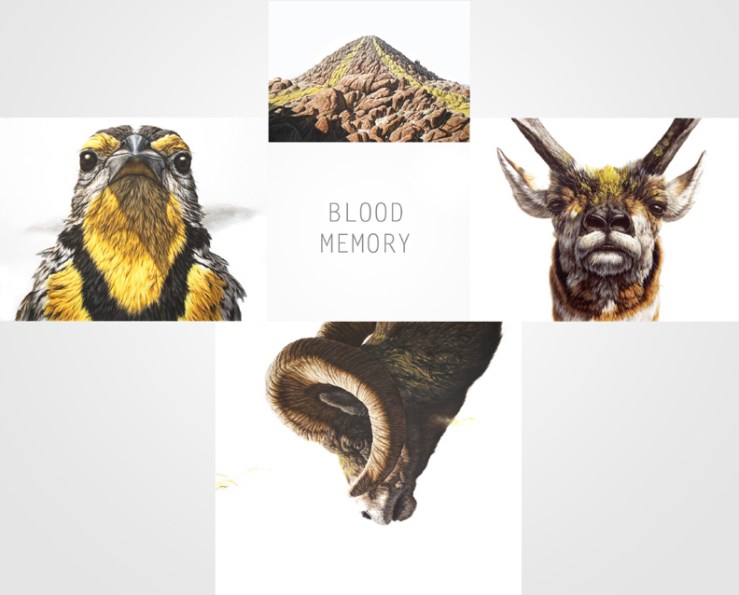
George Boorujy’s marvelous paintings explore humanity’s paradoxical engagements and disengagements with “Nature” — a system that we are manifestly a part of, yet nevertheless philosophically define ourselves against. The first Boorujy painting I saw, a gorgeous bluebird, stunned me: simultaneously delicate and fierce, it emanates pride but also an ineffable quality that surpasses rational, systematic thought. The painting’s vivid colors and subject recalled to me Albrecht Dürer’sWing of a Blue Roller. I soon found more of Boorujy’s work at the P.P.O.W. Gallery home to the artist’s second solo show, Blood Memory (535 W. 22nd St., NYC, March 15th — April 14th). Blood Memory continues Boorujy’s depiction of animals and landscapes, subjects that resonate with his extensive travels across the US as well as his background in marine biology, a subject the New Jersey native initially pursued at the University of Miami before switching to a BFA. He completed his MFA at the School of Visual Arts in NYC. Boorujy is based out of Brooklyn; he paints and teaches, and works a project called New York Pelagic, where he launches original drawings of water birds (along with a questionnaire) in glass bottles into New York waterways. Check out his website.
Father -- George Boorujy -- Part of Blood Memory
I was thrilled to talk to George over a series of emails: he was personable, funny, and very generous. He ended his first email with one of the best sign-offs I’ve ever read: “I’m gonna go drink in the shower now.” Like many folks of delicate sensibilities and fine upbringing, I too enjoy shower beers. We rapped about Florida, ecology, Swamplandia!, the arts and sciences, the Hipster Mujahideen, the possibility of a racist ibis, and much more.
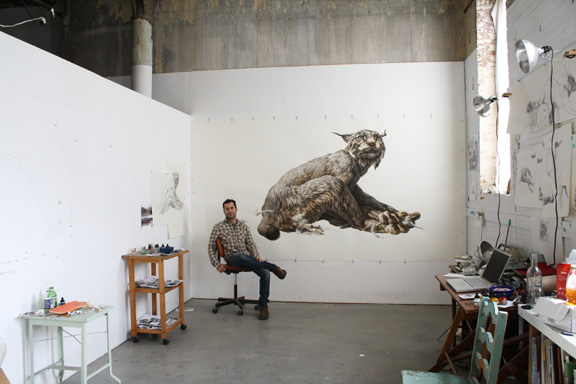
The Artist in repose next to the freshly completed work When Was It That I Knew You
Biblioklept: Tell us about your solo show at the P.P.O.W. Gallery. It’s called Blood Memory—what kind of pieces are you showing?
George Boorujy: Animals. Surprise! But really this is the most purely animal show or body of work that I’ve done. I think there’s only one piece that isn’t of an animal. They’re mostly portrait type pieces, some quite large. I’m finishing up a lynx which is 6 by 11 feet. It sort of looks like Goya’s Colossus. There’s a black white-tailed doe, a meadowlark, a blue jay, a ram, a pronghorn, a frigate bird, a cormorant, another few deer, a Burmese python (hi Florida!). And a mountain. I always seem to need a mountain.
Biblioklept: Your past work has often focused on animals and landscapes, often with implicit ecological arguments. I know you initially studied marine biology in school—how did that course of study influence your art?
GB: I think my brain is somewhat organized like a school where arts and sciences are lumped together. So I’m using the practice of art instead of the practice of science to explore the things I’m interested in. Art and science are very similar in many ways. They are often both a pursuit of the truth. Just different tools and methods are used. Although I am an environmentalist (whatever that actually means) I try not to have any explicit agenda with the work. I want it to stir the viewer or trigger something within them, but not give them an answer or a specific point of view. If I make a piece that shows a manipulated landscape, I’m not necessarily saying it is wrong to manipulate the landscape. We all do it, and we all take advantage of fossil fuels – I love fossil fuels! They’re amazing and we should respect them more and conserve them more – I just want to show what is. Same goes for the treatment of an animal. I’m sure they’re stand-ins for something in my deep sub-conscious, but they are also just what they are, with all attendant veins and ticks and dust in their fur.
Biblioklept: How do you make your animals look so imperious, so proud?
GB: I think maybe it’s because I make them big. I try to actually give them a very indifferent expression so that people can read whatever they want into it. I suppose there is an inherent pride in the form of the animal itself because it is the result of millions of years of evolution that have made it this far. A lot of people think they look sad, which isn’t intended either. I was leaving the studio a few months back when I had a lot of them up and they all looked very judgmental. But then it was better the next day.
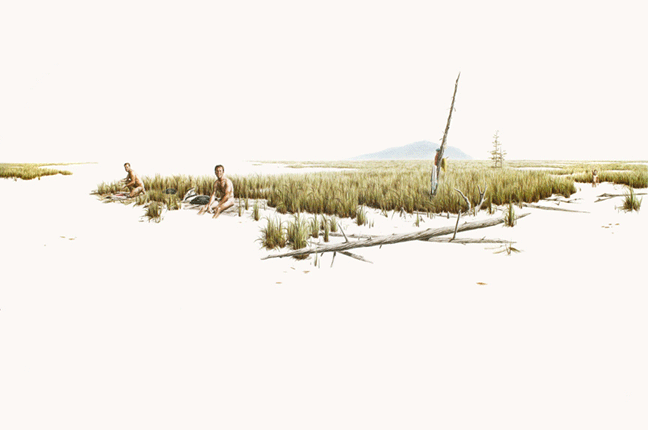
Hunters, George Boorujy
Biblioklept: Let’s shift to people for a moment (although people are animals too, of course). In works like Moraine and Hunters there’s a sense—at least for me—of distance, or almost intrusion (even voyeurism, if I’m being honest). I find your picture of Lincoln fascinating too. I’m curious about how you actually create these pictures: How do you plan them? How do you execute them? What motivates them?
GB: I’m happy that you felt like a voyeur. I never want the pieces to be just observations, I want them to be interactions. Those two pieces in particular could have ended up looking like dioramas or re-enactments or something if there wasn’t the eye contact and the acknowledgement of the viewer. In Hunters, there’s even a small boy hailing the viewer on the right hand side. As though the viewer was coming up in a canoe or something.
As much as I love to draw people, it’s tricky. As soon as you see someone you immediately jump to, “Who’s that? What’s her deal?” We have so much baggage and built in signifiers that it’s difficult to represent someone as a human not of a particular era or class or culture. I wanted both of those pieces to look as though they could be taking place a thousand years in the future or ten thousand years in the past. Hence, no clothes. But no clothes in situations where there would be no clothes – on the beach (a clue there with the title, Moraine, as in a glacial moraine. I live in Brooklyn down the hill from a glacial moraine, and really all of Long Island is a glacial moraine), or in the case of Hunters, people who have just come out of the water or are doing something in the water. I had to be careful with how to depict the men – one of which is me – would they be bearded? I was afraid they’d look too caveman-ish, or too much like the Hipster Muhajideen (I coined that by the way). I wanted them to be kempt as I wasn’t interested in depicting a post apocalyptic scenario or a definable Paleolithic one either. I also like the play between the indifferent expressions on the men and the smiling hailing boy.
As far as creating them, with the animals I usually make a sculpture first and then make the two-dimensional image out of that because there would be no pictures of the animals in the poses and situations that I put them. With the people, I took some pictures of myself and my friends. Then I changed some things here and there. The girls are my sister and her childhood best friend – but they weren’t naked! They had on bathing suits! And the guys are me and my friend, although it’s my body both times because I changed my mind on a pose. Nudity is a funny thing – I wanted to show them naked, but not in a sexy way. So that’s why they’re pretty modest, even though I guess you can see my dick in the one.
That same issue came up with the Lincoln piece. Originally I thought about doing him full body. But then I knew people would just be looking at his penis, which wasn’t the point. It’s easy to be sensationalistic. Harder to go for the slow burn. And I love the slow burn. Not saying that I always get there, but I am more interested in that generally. I looked at as many pictures of Lincoln that I could find and then came up with a good amalgam. With him it was almost the opposite of what I do when depicting people. Instead of going for neutrality, I was interested in showing one of the most recognizable figures as what he – and all of us – was. A human, an animal. It’s sort of like what I’m always doing, trying to make people re-see what they have seen a million times. Like, what was Lincoln? What does a jack-rabbit really look like? What are we? What are these other beings, what makes a horse?.
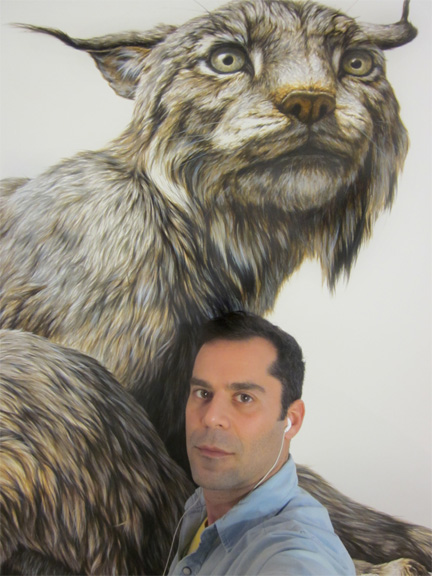
"I really do mix my inks in shot glasses. I'm not that much of a drunk."
Biblioklept: What are you reading now?
GB: This seems like a set-up but I actually am reading that biography of Audubon by Rhodes. It is such a good read. Tracing Audubon really traces the beginning of the country, and that guy got around. So you get these really interesting portraits of cities we know today in their infancy, and cities that were once prominent but are now considered backwaters. And the countryside and rivers before they were drastically changed. I often think about how weird it is that when my grandfather was a child we still had passenger pigeons and Carolina parakeets. That’s not so very long ago. Now the parakeets I see are introduced monk parakeets or escaped pets. If they become established then it will be less than a geological blip where we didn’t have parakeets here. The life between introduced and native is an interesting one to ponder.
Biblioklept: As we’re on birds, it seems like a good time to bring up your New York Pelagic project. You put original drawings of birds along with questionnaires in bottles and set them loose on New York waterways. Your blog discusses the motivations and goals behind the project in detail, but maybe you could give our readers a brief overview of your expectations? Is it difficult seeing your original work float away?
GB: It’s funny, I really had no idea what to expect. I was afraid none would ever be found. But, depending on how you count it, four or five have been found out of… 15? I actually have to update the blog and do some counting. So that’s a pretty good ration considering. I didn’t expect the project to become such an exploration of the city, I’ll tell you that much. But honestly, the history of New York is so amazing, and so rich, that you can’t pick your nose without flicking a booger on an old Dutch millstone or some such thing. And it is compelling. I didn’t expect to get so writer-y. I’ve never really written before, and it’s actually pretty fun. And as far as responses I was hoping people would be excited and happy. Which, except for once, they were.
As far as letting the work go, it is surprisingly easy. I thought I’d be more sad about it. But in actuality I’ve done some of them twice to make sure the one in the bottle is really good, not just middling. I want people to find something beautiful. And even if it never gets found there’s something very satisfying about letting something I’ve worked hard on go away. Christ, I ain’t no Buddhist, but there’s something zen about it I suppose. Maybe it’s a good foil to the other work I do which is so labor intensive and made to be seen and hopefully preserved. There’s also something so nice about it being pictures of seabirds that go (mostly) missing. We don’t see then really, just the gulls in the parking lot for most of us. The large majority of them live in habitats that don’t really overlap with ours.
Biblioklept: Let’s talk Florida — you went to Miami, I went to UF in Gainesville, and I live in Northeast Florida now, which is basically a different state than South Florida . . .
GB: Miami is totally a different country. From North Florida and from the rest of the U.S. I was always bummed about not doing a semester abroad when I was there, but then realized that going there is basically eight semesters abroad. So funny that you went to UF. Our big rivals were the Seminoles of course. Which I remember some people used to refer to as the Semen Holes. Which wasn’t as disturbing as a t-shirt I remember of our mascot — an ibis of all things! – jerking off on a Seminole Indian. I would kill for that shirt now, no matter how many racist nightmares it would induce. If an ibis can be racist against a Native American . . .
I love Florida in all it’s David Lynchian beauty. Hmmm . . . this brings me to something that I read recently having to do with Florida – [Karen Russell’s] Swamplandia! I hated it. And for very specific reasons. She is trying desperately to be funny, but she’s not. And it really brings down the whole thing.Every character in the book is trying so hard to out-quirk the next. There’s no straight man. Not that there has to be per se, but there is no anchor to the book. And I like flawed characters, but none of hers are particularly likeable. Even with all their quirks—in defter hands it would work. But like I said, she’s just not a funny writer and it seems like she thinks she has to be. Which is a shame, because there’s an interlude in the book (which I think was in The New Yorker) which is beautiful. So well written and evocative and moody. And well told. It’s not funny, but not everything has to be. I wish she had just expanded that into a whole novel instead of crowbarring a bunch of kooks around it. But now I’m listening to State of Wonder as I finish up a painting for the show and it is excellent.
Biblioklept: Have you ever stolen a book?
GB: I thought I hadn’t, but then I realized I had. And this seems almost like a plant as well. It was a Swedish publication about Seabirds. And I really passively stole it from the New York Public Library. I honestly think I was the only one who ever took it out. And then I kept bringing it back late. And then one time it was so late that they just billed me for it as a lost book. I could have returned it, but it was only like 14 bucks! Over the years I had probably paid 20 in late fees on it already. Wait—maybe I didn’t steal one because I paid the 14 bucks. But it was somehow dishonest.
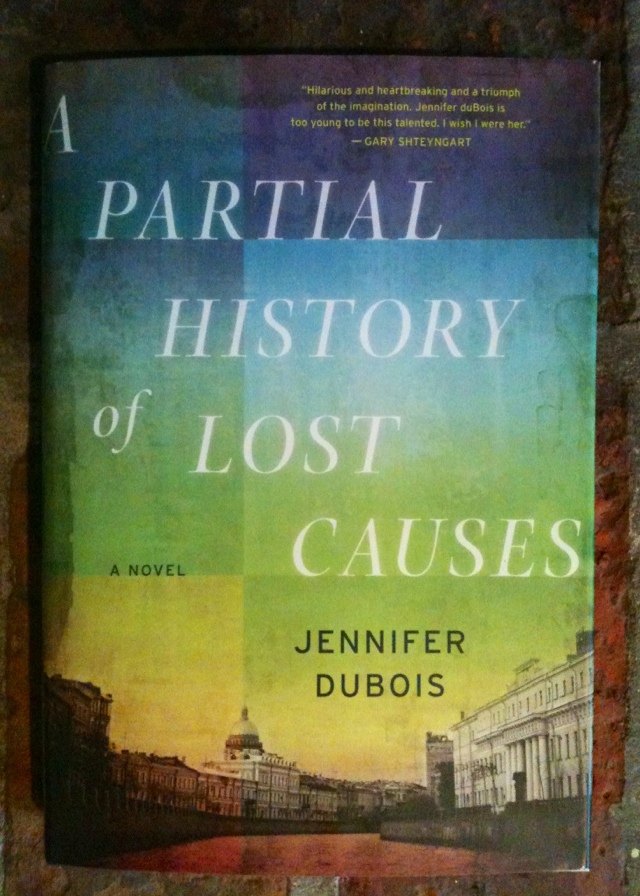
A Partial History of Lost Causes by Jennifer DuBois. Publisher Random House’s copy:
In Jennifer duBois’s mesmerizing and exquisitely rendered debut novel, a long-lost letter links two disparate characters, each searching for meaning against seemingly insurmountable odds.
In St. Petersburg, Russia, world chess champion Aleksandr Bezetov begins a quixotic quest. With his renowned Cold War–era tournaments behind him, Aleksandr has turned to politics, launching a dissident presidential campaign against Vladimir Putin. He knows he will not win—and that he is risking his life in the process—but a deeper conviction propels him forward. And in the same way that he cannot abandon his aims, he cannot erase the memory of a mysterious woman he loved in his youth.
In Cambridge, Massachusetts, thirty-year-old English lecturer Irina Ellison is on an improbable quest of her own. Certain she has inherited Huntington’s disease—the same cruel illness that ended her father’s life—she struggles with a sense of purpose. When Irina finds an old, photocopied letter her father had written to the young Aleksandr Bezetov, she makes a fateful decision. Her father had asked the Soviet chess prodigy a profound question—How does one proceed against a lost cause?—but never received an adequate reply. Leaving everything behind, Irina travels to Russia to find Bezetov and get an answer for her father, and for herself.
Spanning two continents and the dramatic sweep of history, A Partial History of Lost Causes reveals the stubbornness and splendor of the human will even in the most trying times. With uncommon perception and wit, Jennifer duBois explores the power of memory, the depths of human courage, and the endurance of love.







 Biblioklept