Selections from One-Star Amazon Reviews of Virginia Woolf’s Mrs. Dalloway

[Editorial note: The following citations come from one-star Amazon reviews Virginia Woolf’s novel Mrs. Dalloway. I’ve preserved the reviewers’ original punctuation and spelling. More one-star Amazon reviews.].


I had been warned about Woolf

written, I believe, to impress rather than to relate.

I don’t appreciate her writing and keep coming back for more

I may not be giving it a fair review since I only made it to page 65

pages and pages of surreal metaphors that go on for 10 paragraphs

Woolf had a huge obsession with semi-colons

The book just does not make any sense

I really liked the movie “the Hours”

nonsensical semi-flashbacks

Groundbreaking prose?

I tried, I really did

describing nothing

Written by a lesbian

Kind of like F. Scott Fitzgerald’s works

DO read “The Hours”, you will be impressed

I kept losing track of which character was musing about nothing

I suppose Woolf is considered a genius since she was apparently a cavalier writer of her generation

Let us listen to an old farty woman stream her consciousness to us to hear, pointless thoughts that go nowhere

I’m grateful that contemporary writers can at least string together 2 sentences that follow one another in a logical sequence

Lets burn every sentence she ever penned to end all the unneccesary suffering that curious readers have to go through when they first pick up “Mrs. Dalloway.”

My suggestion: just watch The Hours – you’ll get all the beauty and none of the confusion

the person responsible, Virginia Wolf, has been dead for quite some time now

i have no interest in reading about that lifestyle

am stuck in her growling semicolons

slower than a tortoise

ramblings of a lunatic

As bad as Faulkner

So much language

dreadfully boring

run-on sentences

“literary” drivel

terribly written

so many words

and never getting to a plot

Stream of conscience you say?

I normally enjoy stream of consciousness

The narrative reads like the inner thoughts of a sugar crazed autistic kid with ADD in the middle of a carnival

everyone i know who likes this book only does so because he or she was told by some professor that it’s supposed to be good and can provide no evidence to confirm it

This book certainly shows the depravity of man and a self-centered life and the meaningless found amongst those who think of none but themselves.

The absence of spacing to differentiate between each character’s thought process makes for unnecessary confusion

I really liked the idea of the story taking place over the course of one day

THIS BOOK IS WORSE THAN AIDS!

meandering and repetetive

will suffice as kindling

The party! The party!

VW was mentally-ill

“Dense”

put me off

definitley not a fun read

pretty gross hair and stuff on it/ in it

I had had to read it, or was supposed to

haven’t been able to get past the first chapter

lovely idea, virginia and i applaud you for your creativity

I felt like I was reading some writing student’s homework assignment

The Hours is better, despite its inspiration

this story line is too depressing for me

Descriptions were beaten to death

Not one thing uplifting

I am an avid reader!

the book failed

hyphens
Ezra Pound wondered which should be sovereign, the verb or the noun (William H. Gass)

It is too easy—the name game—in this case.

Christened “Pound, Ezra Loomis.” If used as a verb, “pound” means to beat. If used as a noun, “pound” signifies a unit of weight, a measure of money, pressure of air, or physical force. From time to time, apropos poetry, Pound wondered which should be sovereign, the verb or the noun, and concluded, if his practice may be entered as evidence, that the verb was most noticed when knocked off the sentence like a phallus from a kouros—“Spiretop alevel the well curb”—and when effects were hammered back into their causes with naillike hyphens—“Seal sport in the spray-whited circles of cliff-wash”—hence into a compaction like a headache … splitting.

As location, a pound sequesters sick animals and strays. “Places of confinement for lawbreakers” is the definition that immediately precedes Pound’s name in The American Heritage Dictionary, after which we encounter the listing for “pound of flesh” and read of “a debt harshly insisted upon.” Certainly a pound is a large bite by any standard, yet it resembles, in being Shylock’s payment, the neschek of the Jews: money for the rent of money; not a gnaw but, in the way it feels coming due, not a nibble either. It is a tax on use, this thinning of the dime, as if money would otherwise be free of entropy; although to put the bite on someone has come to mean to beg for a loan, possibly as a return of favor, where the request is clearly not intended to invite the interest of the loan’s own teeth. So one meaning of “pound” has a relative called “blood money.” It suggests racial forfeiture.

On the other hand, the pound of flesh we subtract from the flank of a steer may increase our girth and relieve many a primordial anxiety. We call it “putting our money to work.” Wear and repair, profit or loss, depends upon your point of view, the angle of the bank and the direction of the bounce. Our poet depended without protest, for much of his life, upon funds supplied by the family of his wife.

The first few paragraphs of William H. Gass’s essay “Ezra Pound.” Collected in Finding a Form.

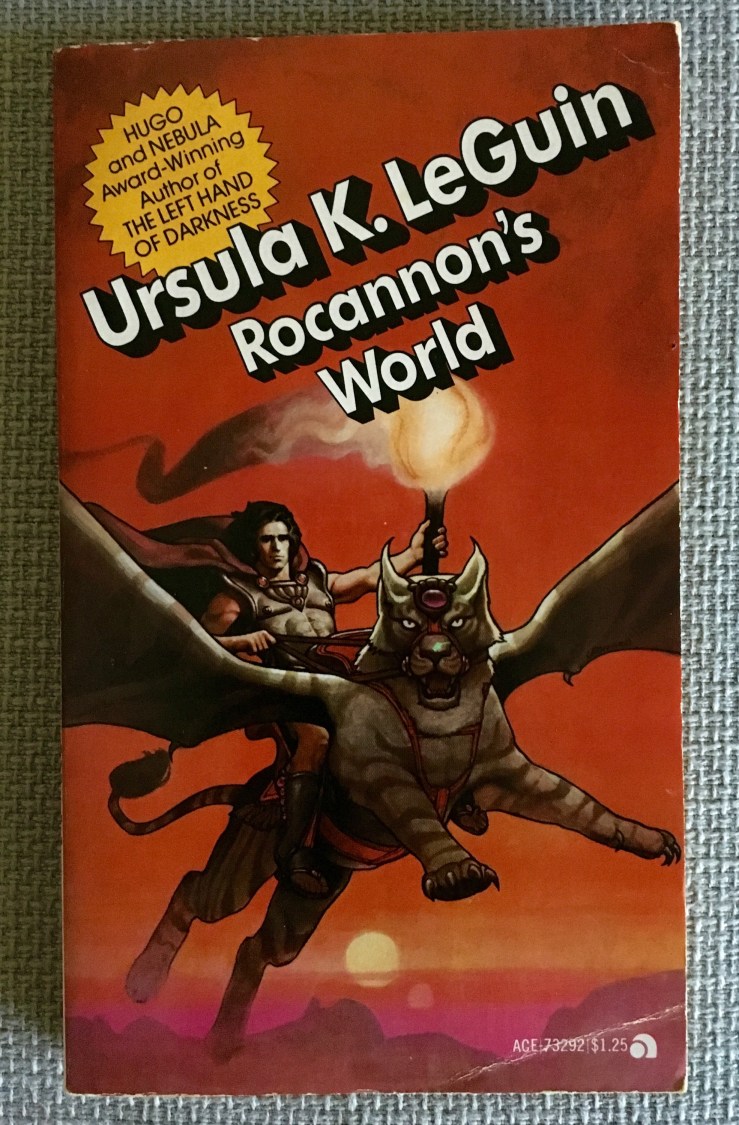
Ursula K. Le Guin’s novel Rocannon’s World (Book acquired, 11.07.2015)

IMG_0544

I just picked up Ursula K. Le Guin’s first novel Rocannon’s World on novelist Adam Novy’s recommendation. (Have you read Novy’s novel The Avian Gospels? It’s great).
IMG_0546

Like 60 seconds of that film adaptation of JG Ballard’s High-Rise

How could one tell where the American dream ended and the Faustian nightmare began

But why, one is driven to ask, why has the tale of terror so special an appeal to Americans? Surely its success must be derived in part from the failure of love in our fiction; the death of love left a vacuum at the affective heart of the American novel into which there rushed the love of death. The triumph of the genteel sentimental incapacitated even our most talented writers, left them incapable of dealing with the relations of men and women as subtly and convincingly as the prose writers in the great novelistic tradition of France. Our novelists, deprived of the subject that sustained Stendhal or Constant, Flaubert or Proust, that seemed indeed to them the subject of the novel, turned to fables of loneliness and terror.

Moreover, in the United States, certain special guilts awaited projection in the gothic form. A dream of innocence had sent Europeans across the ocean to build a new society immune to the compounded evil of the past from which no one else in Europe could ever feel himself free. But the slaughter of the Indians, who would not yield their lands to the carriers of utopia, and the abominations of the slave trade, in which the black man, rum, and money were inextricably entwined in a knot of guilt, provided new evidence that evil did not remain with the world that had been left behind—but stayed alive in the human heart, which had come the long way to America only to confront the horrifying image of itself. Finally, there was the myth of Faust and of the diabolic bargain, which, though not yet isolated from gothic themes of lesser importance (that isolation was to be the word of American writers!), came quite soon to seem identical with the American myth itself.

How could one tell where the American dream ended and the Faustian nightmare began; they held in common the hope of breaking through all limits and restraints, of reaching a place of total freedom where one could with impunity deny the Fall, live as if innocence rather than guilt were the birthright of all men. In Huck’s blithe assertion, “All right, I’ll go to Hell,” is betrayed a significant undermeaning of the Faustian amor fati, at least in its “boyish” American form: the secret belief that damnation is not all it is cracked up to be.

From Leslie Fiedler’s Love and Death in the American Novel (1960).

Most newness is new in all the same old ways (William H. Gass)

‘Make it new,’ Ezra Pound commanded, and ‘innovative’ is a good name for some kinds of fiction; however, most newness is new in all the same old ways: falsely, as products are said to be new by virtue of minuscule and trivial additions; or vapidly, when the touted differences are pointless; or opportunistically, when alterations are made simply in order to profit from imaginary improvements; or differentially, when newness merely marks a moment, place, or person off from others and gives it its own identity, however dopey.

From William H. Gass’s essay “Anywhere but Kansas.” Collected in Tests of Time.

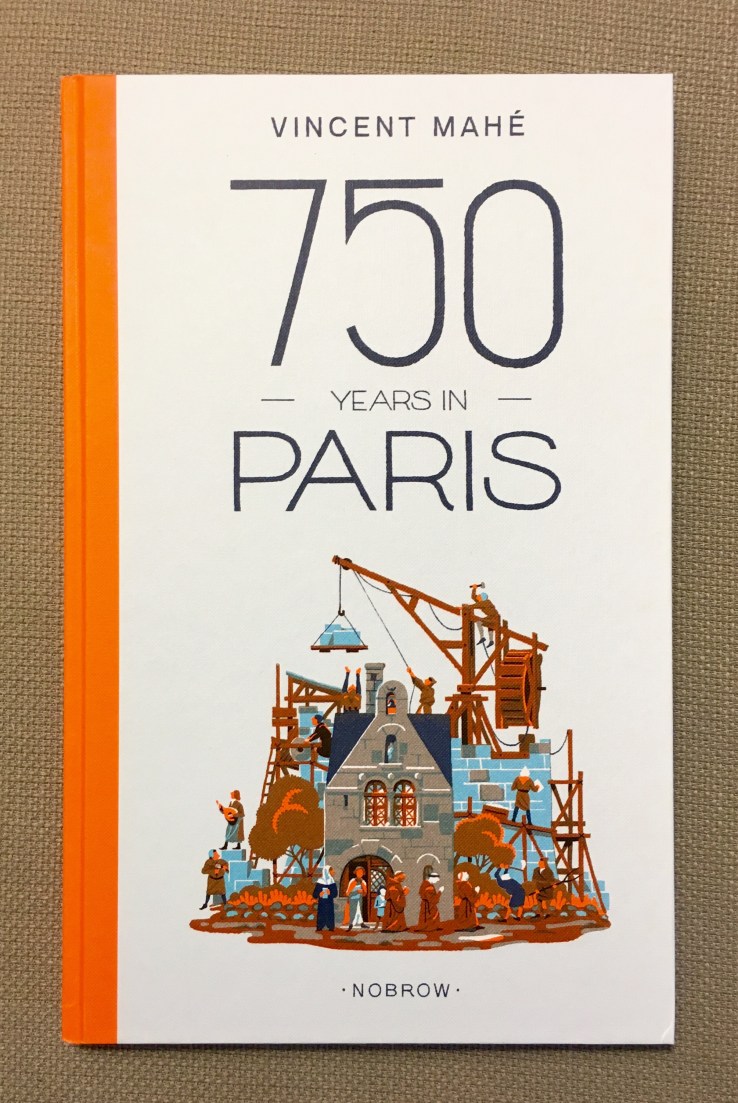
Vincent Mahé’s 750 Years in Paris (Beautiful book acquired, 10.28.2015)

IMG_0534

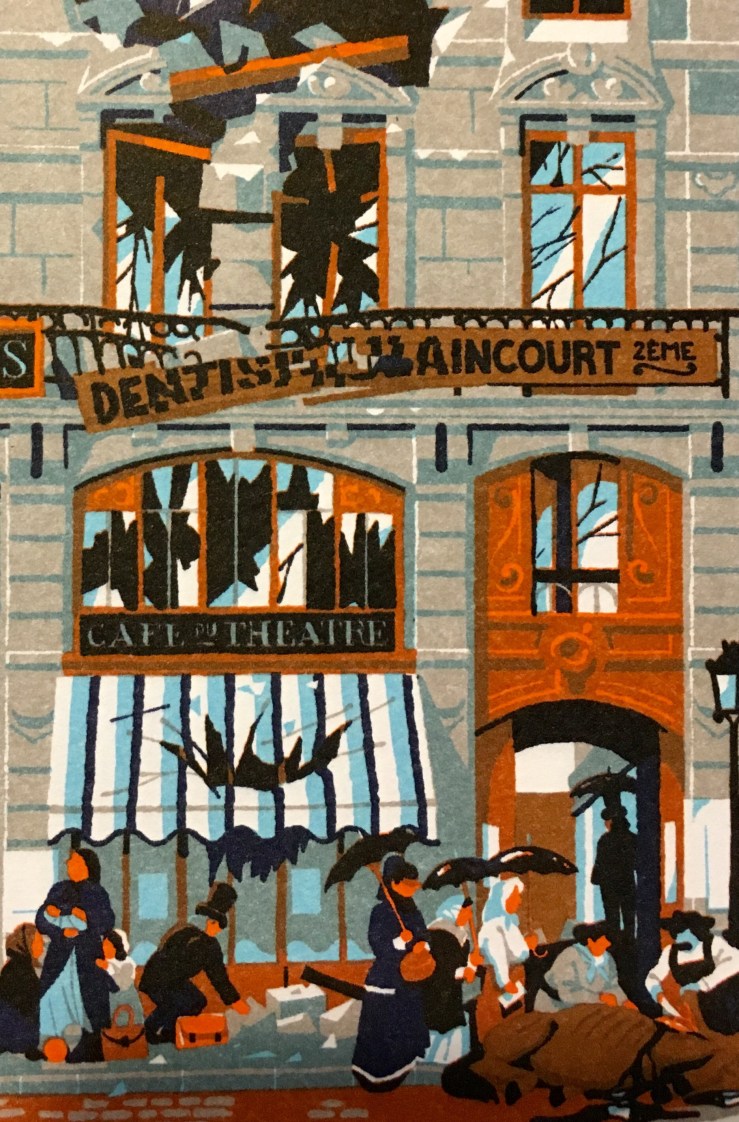
I’ve said it before, but the good people at Nobrow are making some of the best literary objects I’ve seen in years—the graphic novels they publish are smart, beautiful, strange, and witty. The last time I wrote about a Nobrow title, it was Jon McNaught’s Birchwood Close, which I read after a weekend of (very) primitive island camping. In a little coincidence (or not), Nobrow’s new title, Vincent Mahé’s 750 Years in Paris showed up as I was packing my Subaru for a camping trip with my family. I couldn’t help but fly too-quickly through the pages, before relinquishing it to my daughter, who tried to take it camping with us. “I need something to read on the beach,” she claimed, but I told her it was too big to take along (it’s about the height of a wine bottle). In truth, I just didn’t want to risk the book’s getting damaged. We read it again a few times when we got home—first very quickly, then more slowly. Fun.
IMG_0535

I owe the thing a proper review, but for now here’s Nobrow’s blurb:

If you could stand still for 750 years, what could you learn about the world? It’s time to find out.

A literary graphic novel unlike anything else on the racks, 750 Years tells the story of our time, focusing on one single building in France as it sees its way through the upheavals of history. Beginning in the 13th Century and making its way towards today, this historically accurate story is the eagerly anticipated debut from Vincent Mahé.

IMG_0536

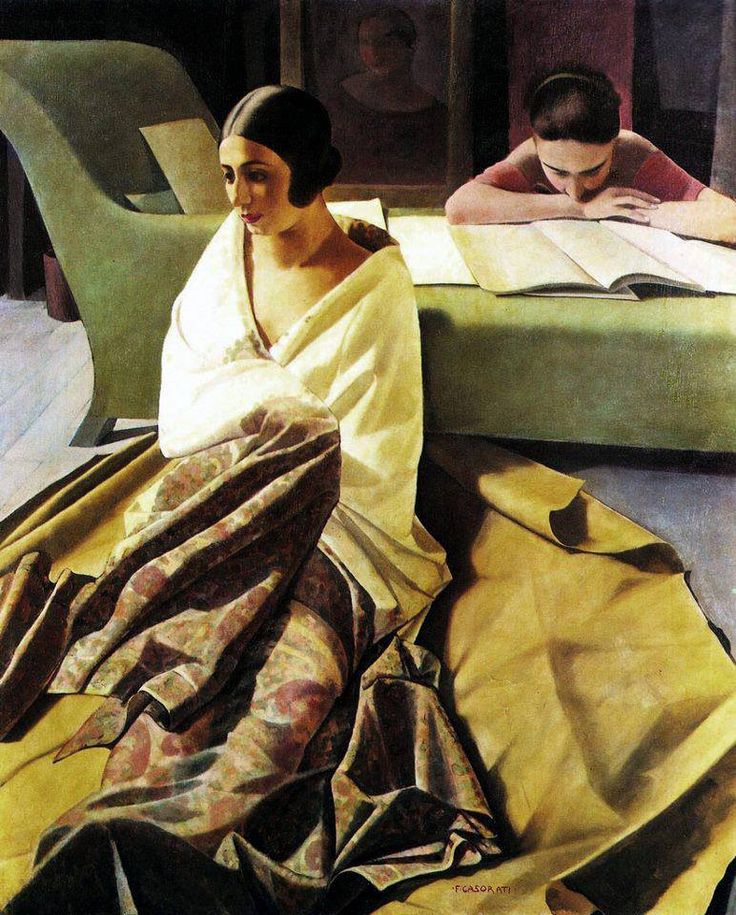
Raja — Felice Casorati

fc

nogu: naked. Gk gumnos.

Screenshot 2015-11-01 at 4

From Joseph T. Shipley’s The Origin of English Words: A Discursive Dictionary of Indo-European Roots.

Reviews and riffs of September and October, 2015 (and an unrelated tiger)

The only way I could muster a review of Gordon Lish’s challenging novel (spokening?!) Cess was in a faux-dialog with myself.

I reread Cormac McCarthy’s Suttree in September and considered if Suttree dies at the end.

Then I reread Blood Meridian for the umpteenth time.

I reviewed Penguin Classics bicentennial edition of Jane Austen’s Emma.

I wrote about Kazuo Ishiguro’s novel The Buried Giant, arguing it was most successful as an evocation of “not knowing.”

Ryan Chang and I continued our discussion of New American Stories, an anthology edited by Ben Marcus. We mostly rapped about stories by Robert Coover and Tao Lin.

I had somehow never read Ursula K. Le Guin’s The Lathe of Heaven before October of 2015.

And, special for Halloween, but really just because I really wanted to reread it, I wrote about one of my favorite ghost tales, Roberto Bolaño’s short story “The Return.”

I also read Autobiography of Red and Red Doc> by Anne Carson during September-October, but erased everything I tried to write on them. I found Autobiography particularly excellent—a real How is this possible? kind of read.

Unrelated tiger by Utagawa Kunisada:

The Night-Hag Visiting Lapland Witches — Henry Fuseli

ep1980.411.R

“The Legend of Sleepy Hollow” — Washington Irving

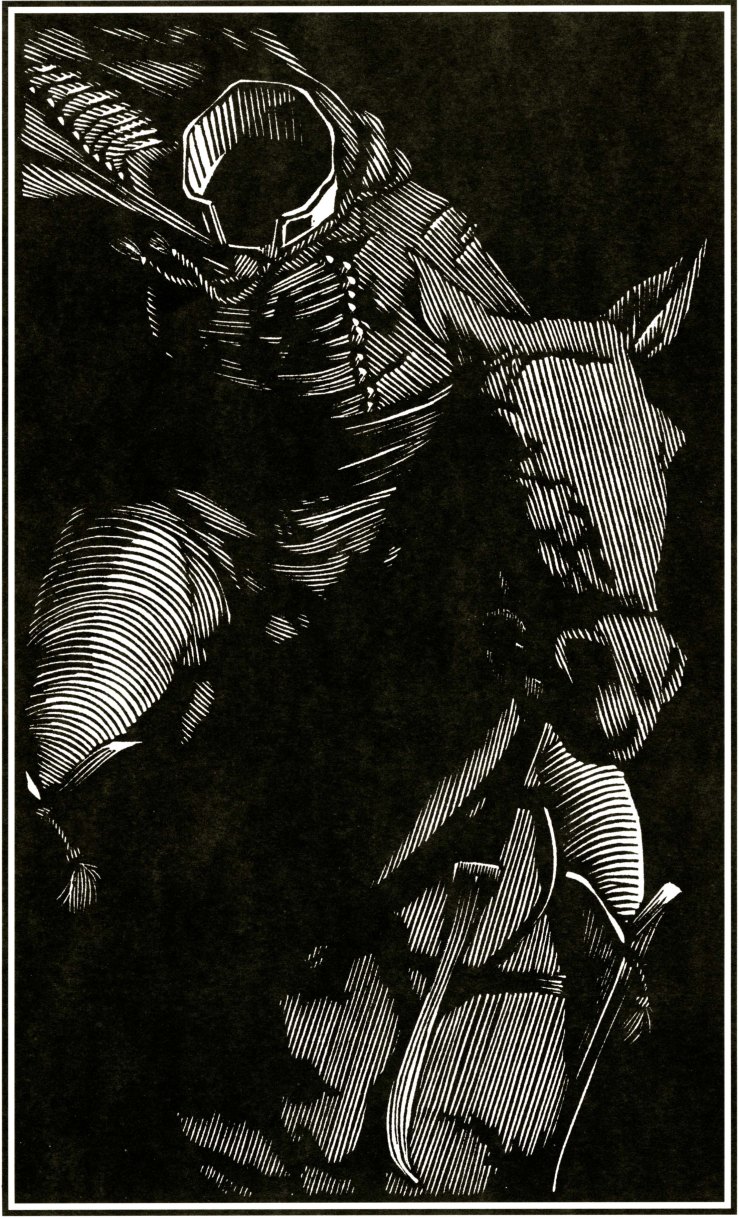
The Headless Horseman, Barry Moser

“The Legend of Sleepy Hollow”

by

Washington Irving


FOUND AMONG THE PAPERS
OF THE LATE DIEDRICH KNICKERBOCKER.

        A pleasing land of drowsy head it was,
          Of dreams that wave before the half-shut eye;
        And of gay castles in the clouds that pass,
          Forever flushing round a summer sky.
                                         CASTLE OF INDOLENCE.

In the bosom of one of those spacious coves which indent the eastern shore of the Hudson, at that broad expansion of the river denominated by the ancient Dutch navigators the Tappan Zee, and where they always prudently shortened sail and implored the protection of St. Nicholas when they crossed, there lies a small market town or rural port, which by some is called Greensburgh, but which is more generally and properly known by the name of Tarry Town. This name was given, we are told, in former days, by the good housewives of the adjacent country, from the inveterate propensity of their husbands to linger about the village tavern on market days. Be that as it may, I do not vouch for the fact, but merely advert to it, for the sake of being precise and authentic. Not far from this village, perhaps about two miles, there is a little valley or rather lap of land among high hills, which is one of the quietest places in the whole world. A small brook glides through it, with just murmur enough to lull one to repose; and the occasional whistle of a quail or tapping of a woodpecker is almost the only sound that ever breaks in upon the uniform tranquillity.

I recollect that, when a stripling, my first exploit in squirrel-shooting was in a grove of tall walnut-trees that shades one side of the valley. I had wandered into it at noontime, when all nature is peculiarly quiet, and was startled by the roar of my own gun, as it broke the Sabbath stillness around and was prolonged and reverberated by the angry echoes. If ever I should wish for a retreat whither I might steal from the world and its distractions, and dream quietly away the remnant of a troubled life, I know of none more promising than this little valley.

From the listless repose of the place, and the peculiar character of its inhabitants, who are descendants from the original Dutch settlers, this sequestered glen has long been known by the name of SLEEPY HOLLOW, and its rustic lads are called the Sleepy Hollow Boys throughout all the neighboring country. A drowsy, dreamy influence seems to hang over the land, and to pervade the very atmosphere. Some say that the place was bewitched by a High German doctor, during the early days of the settlement; others, that an old Indian chief, the prophet or wizard of his tribe, held his powwows there before the country was discovered by Master Hendrick Hudson. Certain it is, the place still continues under the sway of some witching power, that holds a spell over the minds of the good people, causing them to walk in a continual reverie. They are given to all kinds of marvellous beliefs, are subject to trances and visions, and frequently see strange sights, and hear music and voices in the air. The whole neighborhood abounds with local tales, haunted spots, and twilight superstitions; stars shoot and meteors glare oftener across the valley than in any other part of the country, and the nightmare, with her whole ninefold, seems to make it the favorite scene of her gambols.

Continue reading ““The Legend of Sleepy Hollow” — Washington Irving” →

A riff on my favorite ghost story, Roberto Bolaño’s “The Return”

Roberto Bolaño’s short story “The Return” is so good that it has two perfect opening paragraphs:

I have good news and bad news. The good news is that there is life (of a kind) after this life. The bad news is that Jean-Claude Villeneuve is a necrophiliac.

That’s a hell of a way to start a story! Bolaño lays out his two themes—the afterlife and necrophilia—in a jovial, almost cavalier, but dare I say sweet, even charming way. And then this paragraph:

Death caught up with me in a Paris disco at four in the morning. My doctor had warned me, but some things are stronger than reason. I was convinced, mistakenly (and even now it’s something I regret), that drinking and dancing were not the most hazardous of my passions. Another reason I kept going out every night to the fashionable places in Paris was my routine as a middle manager at Fracsa; I was after what I couldn’t find at work or in what people call the inner life: the buzz that you get from a certain excess.

Those are the first two paragraphs, and maybe they’ll entice you to read the story. However, the following riff includes what some people might consider spoilers; my hope is that if you’ve never read it before, you’ll take it on faith that “The Return” is a great, great story and you’ll go read it and stop reading this riff now. (Maybe come back later though after you’ve read it).

“The Return” is a ghost story that transmutes the horror of death and the abjection of the corpse into love, empathy, and communication—and art. It’s a beautiful ghost tale in the Romantic, Gothic tradition of Edgar Allan Poe, from whom Bolaño drew heavily. However, while Poe’s tales of necrophilia (like the poem “Annabel Lee,” “The Fall of the House of Usher,” and “Berenice” to name just a few) obsess over repression, loss, burial, and imperfect and violent attempts at restoration, Bolaño’s “The Return” offers its readers a peaceful reconciliation with death. It’s collected in The Return (New Directions, English translation by Chris Andrews), which is a perfect introduction to Bolaño—so many great stories there (“Buba,” “Clara,” “William Burns,” etc.). So go read it.

Continue reading “A riff on my favorite ghost story, Roberto Bolaño’s “The Return”” →

Flesh — Ivan Albright

Illustration for Algernon Blackwood’s The Wendigo — Matt Fox

Illustration for Blackwood's "The Wendigo," Matt Fox

Read The Wendigo at Project Gutenberg.

Poe’s writer’s block (The Far Side)

20140801-165913-61153007.jpg

Some content on this page was disabled on May 26, 2021 as a result of a DMCA takedown notice from Gary Larson. You can learn more about the DMCA here:

https://wordpress.com/support/copyright-and-the-dmca/

The Witch — Salvator Rosa

rosa