
Category: Books
What books does William T. Vollmann find himself returning to again and again?
William T. Vollmann is the interviewee in the New York Times feature “By the Book” this week. It’s a fun read (he chooses Sappho to write his life story, which cracked me up). From the piece:
What books do you find yourself returning to again and again?
I often reread certain parts of my Oxford Revised Standard Bible, which I recommend for the maps and footnotes. The parables of Jesus are haunting in the fashion of certain Zen koans. And the story of Jacob, Leah and Rachel, and the way it leads to young Joseph’s conceit and fall, is of gripping psychological interest. When she was very young I used to tell my daughter about the coat of many colors, and she would say: “But, why, Daddy? Why did they throw Joseph underground?” — “Because they were jealous.” — “Why were they jealous?” — “Because his father loved him more than the others.” She and I would follow the story backward and forward; its elegance was so perfect that my little child could understand it.
Georg Christoph Lichtenberg always inspires me to try to be myself. Here is one of his powerful aphorisms: “I believe that man is in the last resort so free a being that his right to be whatever he believes himself to be cannot be contested.”
I love that fountainhead of Norse myth and saga, the Elder Edda. It is, after all, part of my ethnocultural heritage. Its glorification of ruthless and often pointless cruelty troubles me, and I refuse to identify with that. But I can enjoy the delicate eeriness of other ghost stories without reveling in gruesome murders and wailing horrors, so why can’t I drink in the strangeness of Skirnir’s ride down to Hel on his quest to win the giant maiden? Moreover, the Norse ethos privileges steadfast endurance in the face of pain, bravery in the face of inevitable doom, and loyalty. These qualities would well become all of us mortals, and may grow more relevant once climate change really kicks in.
Freedom and the Self: Essays on the Philosophy of David Foster Wallace (Book acquired 7.21.2015)

Freedom and the Self: Essays on the Philosophy of David Foster Wallace is new from Columbia University Press. Their blurb:
The book Fate, Time, and Language: An Essay on Free Will, published in 2010 by Columbia University Press, presented David Foster Wallace’s challenge to Richard Taylor’s argument for fatalism. In this anthology, notable philosophers engage directly with that work and assess Wallace’s reply to Taylor as well as other aspects of Wallace’s thought.
With an introduction by Steven M. Cahn and Maureen Eckert, this collection includes essays by William Hasker (Huntington University), Gila Sher (University of California, San Diego), Marcello Oreste Fiocco (University of California, Irvine), Daniel R. Kelly (Purdue University), Nathan Ballantyne (Fordham University), Justin Tosi (University of Arizona), and Maureen Eckert. These thinkers explore Wallace’s philosophical and literary work, illustrating remarkable ways in which his philosophical views influenced and were influenced by themes developed in his other writings, both fictional and nonfictional. Together with Fate, Time, and Language, this critical set unlocks key components of Wallace’s work and its traces in modern literature and thought.
Charmed Particles (Book acquired a few weeks back)
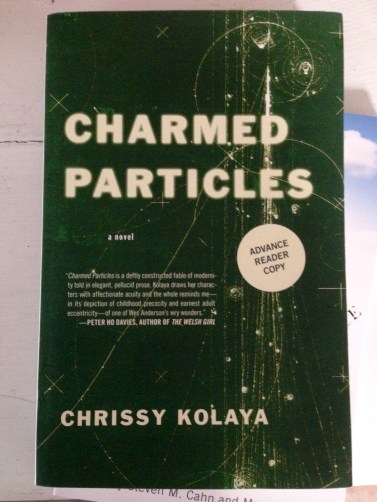
Chrissy Kolaya’s novel Charmed Particles is forthcoming this fall from Dzanc. Their blurb:
Rural Nicolet, Illinois, is a city anchored between two opposing forces, a living history museum and a laboratory for experiments in high-energy particle physics. When the proposal to build a Superconducting Super Collider under the town sparks debate between the scientists and the locals, two families find themselves on opposite sides of the controversy that fractures the community, exposing deep cultural rifts between longtime friends.
Abhijat, a theoretical physicist from India now working at the National Accelerator Research Laboratory, has a sole obsession: the charm quark, a revolutionary particle and his springboard to international recognition. The search for answers to abstract questions blinds him to the burgeoning distance between him and his wife and daughter. Across town, Rose Winchester strives to raise her precocious daughter Lily, stitching together an unconventional marriage from the brief visits and astounding letters of her husband Randolph, the last great gentleman explorer.
Charmed Particles traces the collision of past and progress, science and tradition, and the unimagined elements that may arise in the aftermath.
RIP E.L. Doctorow

RIP E.L. Doctorow, 1931-2015
Ragtime–-what a book. Up there with the best of the metafictionists, if also different, to its credit. I dug The March too, even though historical fiction isn’t my bag. Read “Wakefield,” Doctorow’s recasting of Hawthorne’s classic tale. First paragraph:
People will say that I left my wife and I suppose, as a factual matter, I did, but where was the intentionality? I had no thought of deserting her. It was a series of odd circumstances that put me in the garage attic with all the junk furniture and the raccoon droppings—which is how I began to leave her, all unknowing, of course—whereas I could have walked in the door as I had done every evening after work in the fourteen years and two children of our marriage. Diana would think of her last sight of me, that same morning, when she pulled up to the station and slammed on the brakes, and I got out of the car and, before closing the door, leaned in with a cryptic smile to say goodbye—she would think that I had left her from that moment. In fact, I was ready to let bygones be bygones and, in another fact, I came home the very same evening with every expectation of entering the house that I, we, had bought for the raising of our children. And, to be absolutely honest, I remember I was feeling that kind of blood stir you get in anticipation of sex, because marital arguments had that effect on me.
A riff on J.G. Ballard’s superb degenerate satire High-Rise
 With the bad taste of a recentish YAish post-apocalyptish novel in my brain, I riffled through some old sci-fi titles, hoping to find something to hit “reset.” J.G. Ballard’s 1975 novel High-Rise—which I hadn’t read since I was a teenager—wrapped me up immediately with its opening sentence:
Later, as he sat on his balcony eating the dog, Dr Robert Laing reflected on the unusual events that had taken place within this huge apartment building during the previous three months.
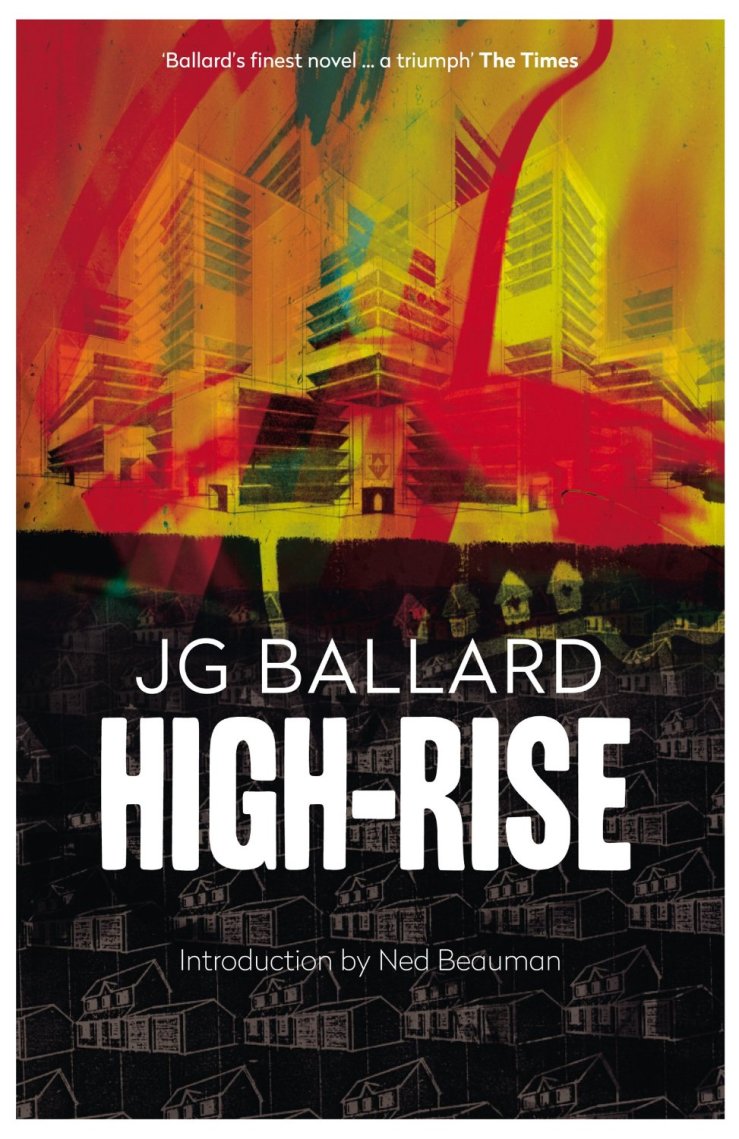
- (If the promise of that first line doesn’t intrigue you, High-Rise isn’t for you. Maybe you’ll enjoy all the old High-Rise covers I couldn’t help but to scatter through this riff).
- The first chapter of High-Rise is aptly titled “Critical Mass.” This is a book where things, uh, escalate quickly, if you’ll forgive my indulging in the parlance of our times. Ballard dispenses with any simmering in his tale of depraved debauchery (or is that debauched depravity?). He gets that pot boilin’.

- Depravity. Debauchery. Degeneration. The boiling pot of late-20th century consciousness.
- So, what is High-Rise about? Like, the plot, man? Class-war in a high-rise condo: A self-contained society that fails, its id overspilling into sex and violence: The veneer dissolved in piss and spite. And the best part? Ballard dispenses with any sort of explanation whatsoever. We begin at critical mass. He counted on his late-20th-century reader to intuit the whole damn deal (or throw down the book in defensive disgust).
- Ballard structures the book around three anti-heroes, who represent, probably, id, ego, and superego—or rather, what I mean to say is ironic send-ups of id, ego, and superego—with the high-rise itself a kind of consciousness in crisis.

- From the middle-class (and perhaps ego)—the 25th floor—there’s Dr. Robert Laing—not really a practicing doctor, no, but he works at a teaching hospital. Ballard tricks us into thinking he’s the protagonist—which I guess he is!—by which I mean audience surrogate, and also typical Ballardian hero (divorced; mama issues; a drinker). His name may recall to you the (anti-)psychiatrist R.D. Laing (as well as, perhaps, Language).
- We might find a tidy—as in sanitary–summary of High-Rise in this brief excerpt, where our ego hero Laing packs away his tools and totems of the old world in anticipation of the new one to come:
In this suitcase-sized cavity he hid away his cheque book and insurance policies, tax returns and share certificates. Lastly, he forced in his medical case with vials of morphine, antibiotics and cardiac stimulants. When he nailed the floorboards back into place he felt that he was sealing away for ever the last residues of his previous life, and preparing himself without reservation for the new one to come.
- The phrase “to come” — as in a future to come — repeats throughout High-Rise—a kind of irony, ultimately, that I shouldn’t step all over here. I’ll get back to that momentarily, but—
- Ballard soon trips us up by shifting his free-indirect style from Laing to Richard Wilder of the 2nd floor. A bestial brawny brawly dude (and the only father in this trio of anti-heroes) Wilder (c’mon with that name man!) is id id id all the way down (up). Wilder’s also a filmmaker, a camera in his hand, a sensing thing all the way down (up). He causes some problems.
- (The idea that a middle-class man like Wilder might represent the proletariat here is addressed in more (although oblique) depth in Ballard’s 2003 novel Millennium People).
- And then the super-ego/upper crust: Anthony Royal (O! c’mon with that name dammit!) of the penthouse. He’s the literal architect of the high-rise, which makes him possibly maybe probably responsible for its many, many design flaws, which boil down to intake, outtake, and power, but look like parking, garbage, and electricity.

- And so Ballard shuttles us between these three consciousnesses, like the elevators that symbolically anchor this novel. (Anchor is a terrible verb for these mobile metaphors. Or maybe it’s the precise verb).
- Like I said in point 5, Ballard doesn’t really bother to foreground the causes for the high-rises’s society’s degenerate descent (ascent?)—instead, he offers concrete contours and psychological descriptions. Like this one, when a psychiatrist (yep) offers this analysis to Laing (and the reader, of course):
I had a bucket of urine thrown over me this afternoon. Much more of that and I may take up a cudgel myself. It’s a mistake to imagine that we’re all moving towards a state of happy primitivism. The model here seems to be less the noble savage than our un-innocent post-Freudian selves, outraged by all that over-indulgent toilet-training, dedicated breast-feeding and parental affection — obviously a more dangerous mix than anything our Victorian forebears had to cope with. Our neighbours had happy childhoods to a man and still feel angry. Perhaps they resent never having had a chance to become perverse . . .
- (“Perverse” is a term that repeats throughout High-Rise, and I had to leave in those bucket of urine and cudgel details).
- The concrete contours, the description, the late-20th century analysis—that’s the reason to boil along with High-Rise. The book is fucking fun in its thrilling awful decadence—it’s Lord of the Flies for adults, with the spiritual mumbo-jumbo replaced with psychiatric mumbo-jumbo. Or Salò.
- Back to that future to come thing, here’s another citation, at some length (enjoy those concrete contours), but with my emphasis in boldface if you’re in some big fucking hurry:
Still uncertain how long he had been awake, or what he had been doing half an hour earlier, Laing sat down among the empty bottles and refuse on the kitchen floor. He gazed up at the derelict washing-machine and refrigerator, now only used as garbage-bins. He found it hard to remember what their original function had been. To some extent they had taken on a new significance, a role that he had yet to understand. Even the run-down nature of the high-rise was a model of the world into which the future was carrying them, a landscape beyond technology where everything was either derelict or, more ambiguously, recombined in unexpected but more meaningful ways. Laing pondered this — sometimes he found it difficult not to believe that they were living in a future that had already taken place, and was now exhausted.
- Ballard’s describing the late 20th century there, but perhaps he intuits the beginning of the 21st as well.
- —Or maybe those are the same thing, I suppose—I mean, High-Rise was published in 1975, four decades ago, but doesn’t feel that old. For some perspective, Karel Capek’s War with the Newts was published in 1936, almost forty years before High-Rise, and that novel doesn’t feel horribly dated either, a tribute to its sharp satire.
- —Which is my way of transitioning to the probably completely non-controversial idea that High-Rise is wonderful dark satire. Ballard ushers our consciousness to the high-rise’s summit through surrogate Laing, the limited concrete prose focused on the failed doctor’s misperception of transcendence. Laing perceives himself as the conquering brute, alpha male par excellence, inheritor not only of the falling high-rise, but also its female cohort, his harem in a future to come, his genealogical generativity restored. Laing can’t see that he’s been x’ed out of this equation, the failed phallic figure jutting impotently into mother sky.
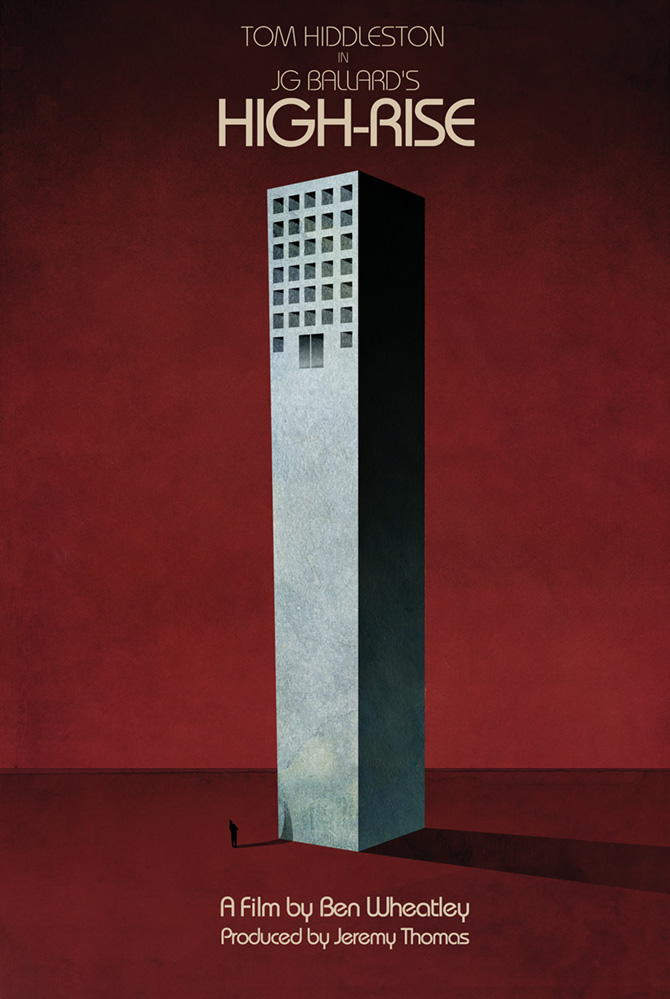
- So you know that High-Rise is going to be a movie? A Major Motion Picture? Starring Tom Hiddleston? As cynical as I am, I think the book should make a fine film—it’s adaptable, yes. It could even be a great video game. A video game where you eat a dog. A video game where you think you win, but you don’t.
“Montparnasse” — Ernest Hemingway

Like the librarians of Babel in Borges’s story (Georges Perec)

From “The Art and Manner of Arranging One’s Books,” collected in Species of Spaces and Other Pieces. English translation by John Surrock.
Sunday, 19 July, slept, awoke, slept, awoke, miserable life (Kafka)
Sunday, 19 July, slept, awoke, slept, awoke, miserable life. When I think about it, I must say that my education has done me great harm in some respects. I was not, as a matter of fact, educated in any out-of-the-way place, in a ruin, say, in the mountains – something against which in fact I could not have brought myself to say a word of reproach. In spite of the risk of all my former teachers not understanding this, I should prefer most of all to have been such a little dweller in the ruins, burnt by the sun which would have shone for me there on the tepid ivy between the remains on every side; even though I might have been weak at first under the pressure of my good qualities, which would have grown tall in me with the might of weeds.
From Franz Kafka’s July 19th, 1920 diary entry. From The Diaries of Franz Kafka. Translated from the German by Joseph Kresh.
Screams from the abattoir | J.G. Ballard on Francis Bacon
In 1955 there was a modest retrospective of Francis Bacon’s paintings at the Institute of Contemporary Arts, followed in 1962 by a far larger retrospective at the Tate Gallery, which was a revelation to me. I still think of Bacon as the greatest painter of the post-war world. Sadly, when I met him in the 1980s I found, like many others before me, that he was not interested in receiving compliments or in talking about his own work. I suspect that he was still sensitive to charges of gratuitous violence and sensationalism that were levelled at him in the 1950s and 1960s. He chose as his official interviewer the art critic David Sylvester, who was careful to steer clear of the questions everyone was eager to hear answered, and only asked Bacon about his handling of space and other academic topics. In his replies Bacon adopted the same elliptical and evasive language, with the result that we know less about the motives of this extraordinary painter than we do of almost any other 20th-century artist. At least Crivelli’s Annunciation in the 1950s was not screened behind endless lectures on Renaissance perspective and the fluctuating price of lapis lazuli.
Bacon’s paintings were screams from the abattoir, cries from the execution pits of World War II. His deranged executives and his princes of death in their pontiffs’ robes lacked all pity and remorse. His popes screamed because they knew there was no God. Bacon went even further than the surrealists, assuming our complicity in the mid-century’s horrors. It was we who sat in those claustrophobic rooms, like TV hospitality suites in need of a coat of paint, under a naked light bulb that might signal the arrival of the dead, the only witnesses at our last interview.
Yet Bacon kept hope alive at a dark time, and looking at his paintings gave me a surge of confidence. I knew there was a link of some kind with the surrealists, with the dead doctors lying in their wooden chests in the dissecting room, with film noir and with the peacock and the loaf of bread in Crivelli’s Annunciation. There were links to Hemingway and Camus and Nathanael West. A jigsaw inside my head was trying to assemble itself, but the picture when it finally emerged would appear in an unexpected place.
From J.G. Ballard’s autobiography Miracles of Life.
Young Man Reading by Candle Light — Matthias Stom

Crivelli’s Annunciation | J.G. Ballard
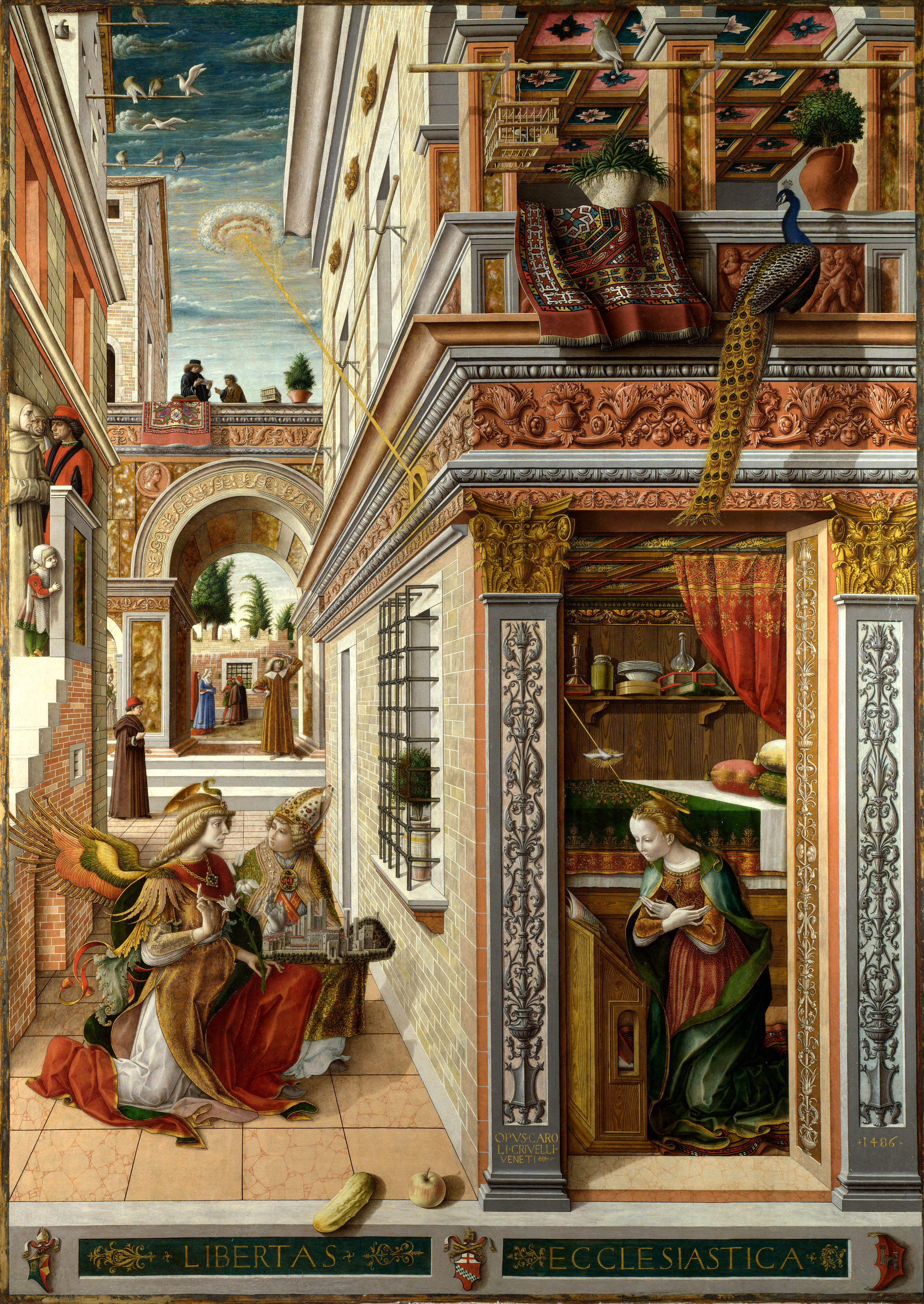
I am sure that a large part of the enduring mystery of the Renaissance masterpieces in the National Gallery was due to the absence of the explanatory matter that now drains away much of the strangeness and poetry of the Old Masters. I would stare at Crivelli’s Annunciation, charmed by the peacocks, loaves of bread and other incongruous items, the passer-by reading a book on the bridge and the Virgin in her jewel box of a house. I was forced to use my own imagination to stitch these elements into a master narrative that made some kind of sense, rather than read an extended wall caption and be solemnly told that the peacock was a symbol of eternal life. Perish the thought, and let the exquisite bird be itself, and nothing more or less than itself. What could be more natural, and more mysterious, than a peacock and a loaf of bread appearing on the scene to celebrate the forthcoming birth of the Saviour?
From J.G. Ballard’s autobiography Miracles of Life.
Three Dishes of Sweetmeats and Chestnuts with Three Glasses on a Table — Osias Beert

Inside the Machine (Book acquired 6.25.2015)
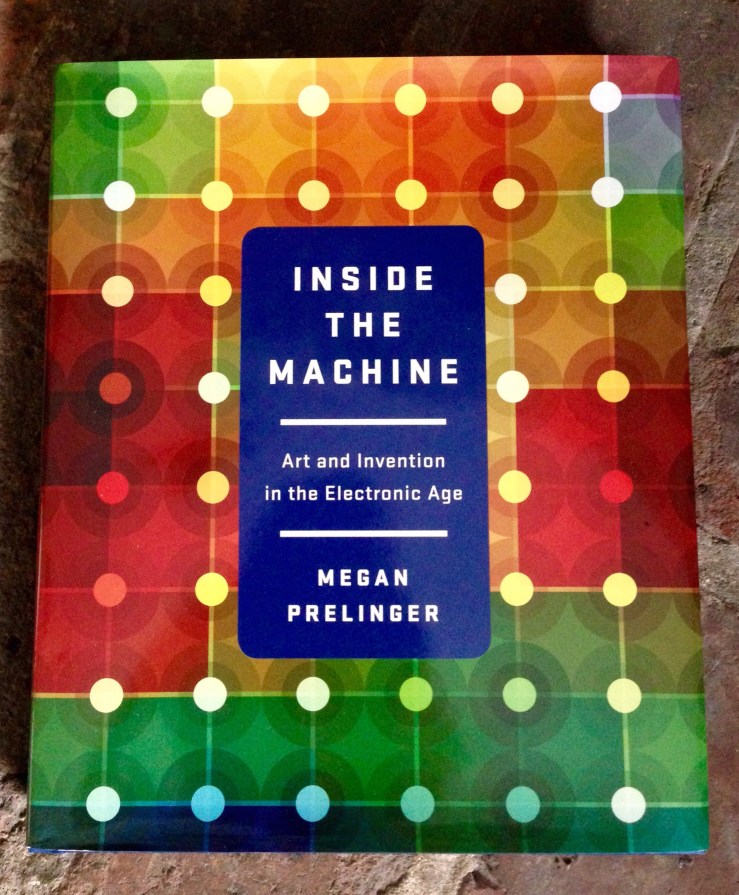
My crappy iPhone pics aren’t doing justice to these images from Megan Prelinger’s Inside the Machine (glossy pages are hard to photograph). Book is out in August from W.W. Norton—their blurb:
A visual history of the electronic age captures the collision of technology and art—and our collective visions of the future.
A hidden history of the twentieth century’s brilliant innovations—as seen through art and images of electronics that fed the dreams of millions.
A rich historical account of electronic technology in the twentieth century, Inside the Machine journeys from the very origins of electronics, vacuum tubes, through the invention of cathode-ray tubes and transistors to the bold frontier of digital computing in the 1960s.
But, as cultural historian Megan Prelinger explores here, the history of electronics in the twentieth century is not only a history of scientific discoveries carried out in laboratories across America. It is also a story shaped by a generation of artists, designers, and creative thinkers who gave imaginative form to the most elusive matter of all: electrons and their revolutionary powers.
As inventors learned to channel the flow of electrons, starting revolutions in automation, bionics, and cybernetics, generations of commercial artists moved through the traditions of Futurism, Bauhaus, modernism, and conceptual art, finding ways to link art and technology as never before.
A visual tour of this dynamic era, Inside the Machine traces advances and practical revolutions in automation, bionics, computer language, and even cybernetics. Nestled alongside are surprising glimpses into the inner workings of corporations that shaped the modern world: AT&T, General Electric, Lockheed Martin.
While electronics may have indelibly changed our age, Inside the Machinereveals a little-known explosion of creativity in the history of electronics and the minds behind it.
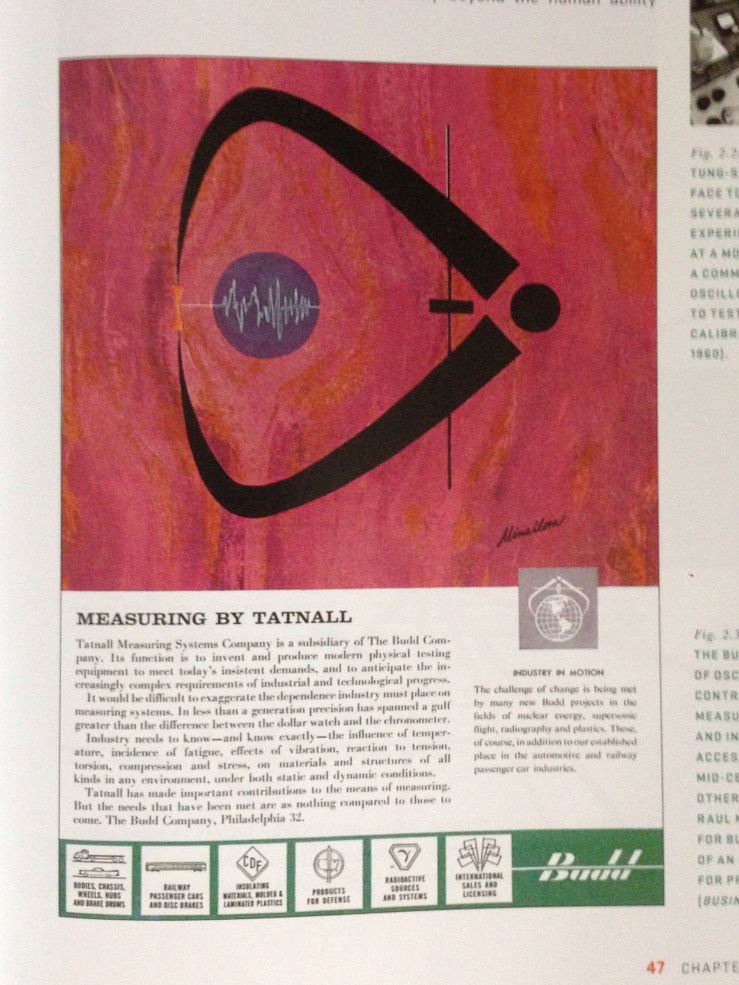
Continue reading “Inside the Machine (Book acquired 6.25.2015)”
Fête nationale — Theophile Steinlen

A review of Nell Zink’s extraordinary novel The Wallcreeper
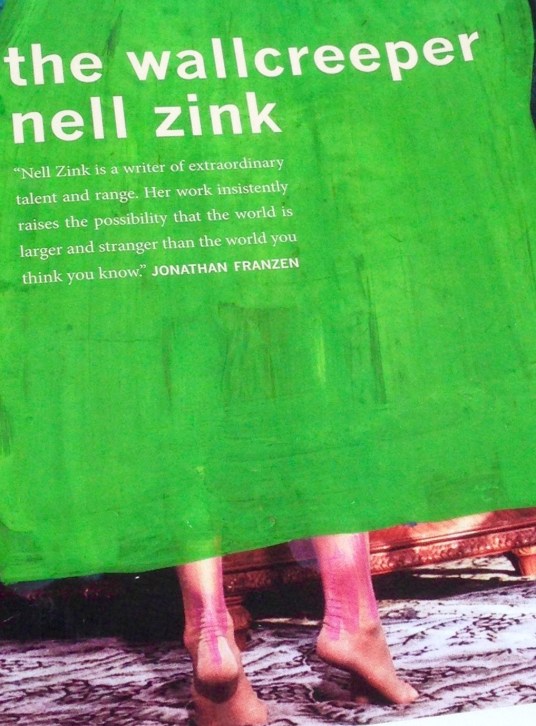
The short review is, “Nell Zink’s début novel The Wallcreeper is extraordinary.”
But this argument is insufficient, unsupported, you, dear reader, may protest. Why should you spend your hard-earned time reading The Wallcreeper, eh? (I read the book in four sittings. I was late to Sunday dinner for finishing the thing). To invert one of the better book short book reviews I’ve ever read: Every sentence made me want to read the next sentence. Is that not a good enough reason to read The Wallcreeper? Maybe you want to read some of those sentences. Here’s the first one:
I was looking at the map when Stephen swerved, hit the rock, and occasioned the miscarriage.
Or a page or two later when our heroine/narrator Tiffany describes how she met Stephen:
Our first meeting prevented a crime. He saw me standing in front of the open gate of the vault.
(Don’t worry about that crime). Oh, and, on that first meeting with Stephen:
It was one of those moments where you think: We will definitely fuck. It might take a while, though, because Stephen looked as respectable as I did.
And here’s a simile from Tiffany, just because I love the line and can wedge it in here:
After the cranes had landed, the geese passed overhead in so many Vs that they merged into Xs and covered the entire sky like a fishnet stocking.
It occurs to me now that I’m probably doing this wrong, right? I should be summarizing the book a bit, no? I’m not particularly interested in that—the plot is the sentences—I mean, yeah, there’s a plot, about Tiffany and Stephen in Berne and later Berlin—and some other places too—and the different lovers they take and the various projects they undertake—music, language acquisition, ecoterrorism—and lots of birdwatching.
Maybe I should lazily just reblurb Keith Gessen’s blurb:
Who is Nell Zink? She claims to be an expatriate living in northeast Germany. Maybe she is; maybe she isn’t. I don’t know. I do know that this first novel arrives with a voice that is fully formed: mature, hilarious, terrifyingly intelligent, and wicked. The novel is about a bird-loving American couple that moves to Europe and becomes, basically, eco-terrorists. This is strange, and interesting, but in between is some writing about marriage, love, fidelity, Europe, and saving the earth that is as funny and as grown-up as anything I’ve read in years. And there are some jokes in here that a young Don DeLillo would kill to have written. I hope he doesn’t kill Nell Zink
The DeLillo comparison is apt, but Zink’s novel is funnier than anything DeLillo’s done in ages. Maybe that’s not fair. “Funny” seems like a weak word, really, for Zink and her narrator Tiffany (and Stephen)—all the words I would use to describe what Zink’s doing here seem pale and imprecise. I mean witty, smart, intelligent, devastating, confounding. Extraordinary, right, that was the word I used above, yes? (He looks the word up in an online dictionary, somehow at 36 and a lifelong native English speaker unsure what it actually means). A placeholder like strange would work, except some of y’all take that word as a pejorative. Eccentric or quirky imply, I think, a rhetorical imprecision wholly absent from the novel. The Wallcreeper is a precise book. The book is very good. It is an interesting book. (What awful sentences those were! But true).
Can you know a book through the words the reviewer uses to describe it though? (No). Can you really know a character through the words she launches your way, anyway? In The Wallcreeper, Tiffany doesn’t really know herself, or Stephen, and the narrative is in some ways her kinda sorta finding out about herself (and Stephen, and other stuff), in a non-urgent manner. Or maybe very urgent, I don’t know—she and Stephen are in a constant state of crisis, sort of, or epiphany-making—
Our marriage had begun in the most daunting way imaginable. We had barely known each other, and then we had those accidents and that jarring disconnect between causes (empty-headed young people liking each other, wallcreepers) and effects (pain, death).
A wallcreeper is a small bird with crimson wings, by the way.
The titular wallcreeper, also by the way, is the thing that makes Stephen swerve in that opening sentence I shared for you above. The book is full of swerves, dips, dives, turns—each sentence swerves into the next, artfully, gracefully, precisely. Tiffany’s consciousness, or the language that Zink uses to represent Tiffany’s consciousness, swerves:
We walked down into the lower garden and sat on a bench. He looked into the pond and remarked favorably on the lack of goldfish. I thought of all the spawn-guzzling carp I had admired in the past and felt abashed. I shrank at the vulgarity of raptures over beauty, nature’s most irrelevant and unnecessary quality.
Beautiful!
But where was I? I think swerves was the metaphor I was batting about a bit—well, I suppose I could go on, suggest that all that swerving swerves up to Something More, that the novel swerves (swells? no, not swells) to an ending shot-through with mythical undertones (which our narrator punctures)—I mean to say that, yes, okay, the novel is a wonderful witty aesthetic read—each sentence made me want to read the next sentence—but readers who require More Than That will also get it. Or maybe not. The Wallcreeper, like all extraordinary novels, is Not For Everyone. The Wallcreeper was/is for me though, and I hope it will also be for you too.
The Wallcreeper is available directly from publisher The Dorothy Project and finer bookshops.
Dazzling/Clever — Norton Juster

From The Dot and the Line, 1963, by Norton Juster. More/via The Visual Telling of Stories.
 Biblioklept