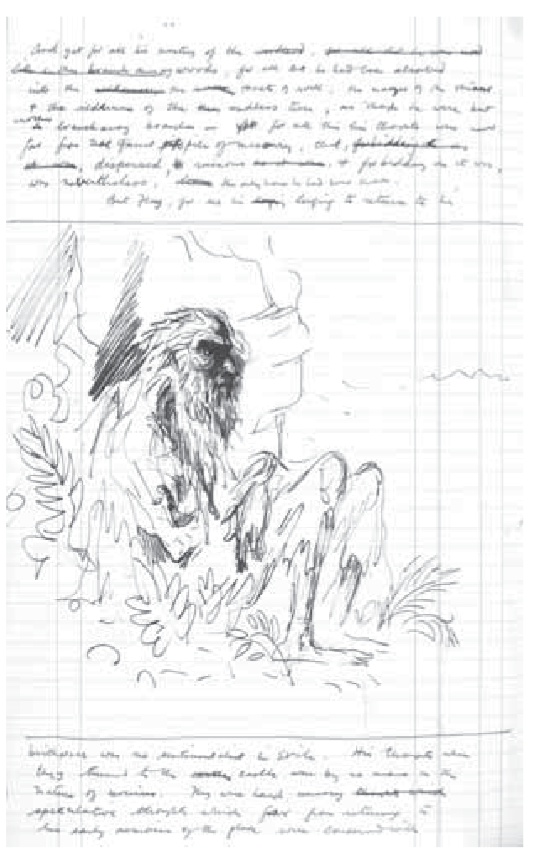
Manuscript Illustration of Flay — Mervyn Peake

Cormac McCarthy: Would you wish the Nobel Prize off on a friend or an enemy? 

Who should be the next American Nobel Prize winner?

CORMAC McCARTHY: Would you wish the Nobel Prize off on a friend or an enemy?

What would you have done, do you think, if it hadn’t been for writing?

CORMAC McCARTHY: I think I can say that if I hadn’t been a writer I’d have been what I have been all my life anyway: one more unemployed person of dubious character.

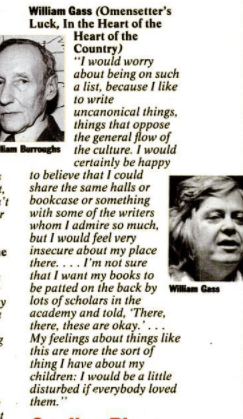
From “Don’t Everybody Talk at Once! (The Esquire Literary Survey).” Published in Esquire, August 1986.

The “article” consists of a ten-question questionnaire Esquire fiction editor Rust Hills sent to around fifty American writers. These are the only two answers from Cormac McCarthy.

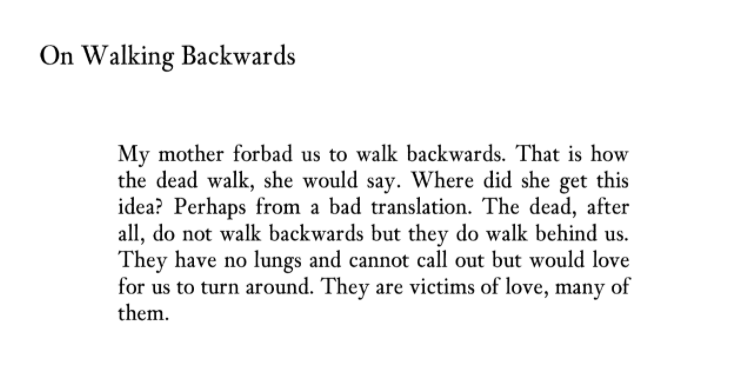
“On Walking Backwards” — Anne Carson

“Parable of Cervantes and the Quixote” — Jorge Luis Borges

“Parable of Cervantes and the Quixote

by

Jorge Luis Borges

Translated by Andrew Hurley


Weary of his land of Spain, an old soldier of the king’s army sought solace in the vast
geographies of Ariosto, in that valley of the moon in which one finds the time that is squandered by dreams, and in the golden idol of Muhammad stolen by Montalbán.

In gentle self-mockery, this old soldier conceived a credulous man—his mind unsettled by the reading of all those wonders—who took it into his head to ride out in search of adventures and enchantments in prosaic places with names such as El Toboso and Montici.

Defeated by reality, by Spain, don Quixote died in 1614 in the town of his birth. He was survived only a short time by Miguel de Cervantes.

For both the dreamer and the dreamed, that entire adventure had been the clash of two worlds; the unreal world of romances and the common everyday world of the seventeenth century.

They never suspected that the years would at last smooth away the discord, never suspected that in the eyes of the future, La Mancha and Montici and the lean figure of the Knight of Mournful Countenance would be no less poetic than the adventures of Sindbad or the vast geographies of Ariosto.

For in the beginning of literature there is myth, as there is also in the end of it.

The Minus Times Interview with Barry Hannah

From The Collected Minus Times.

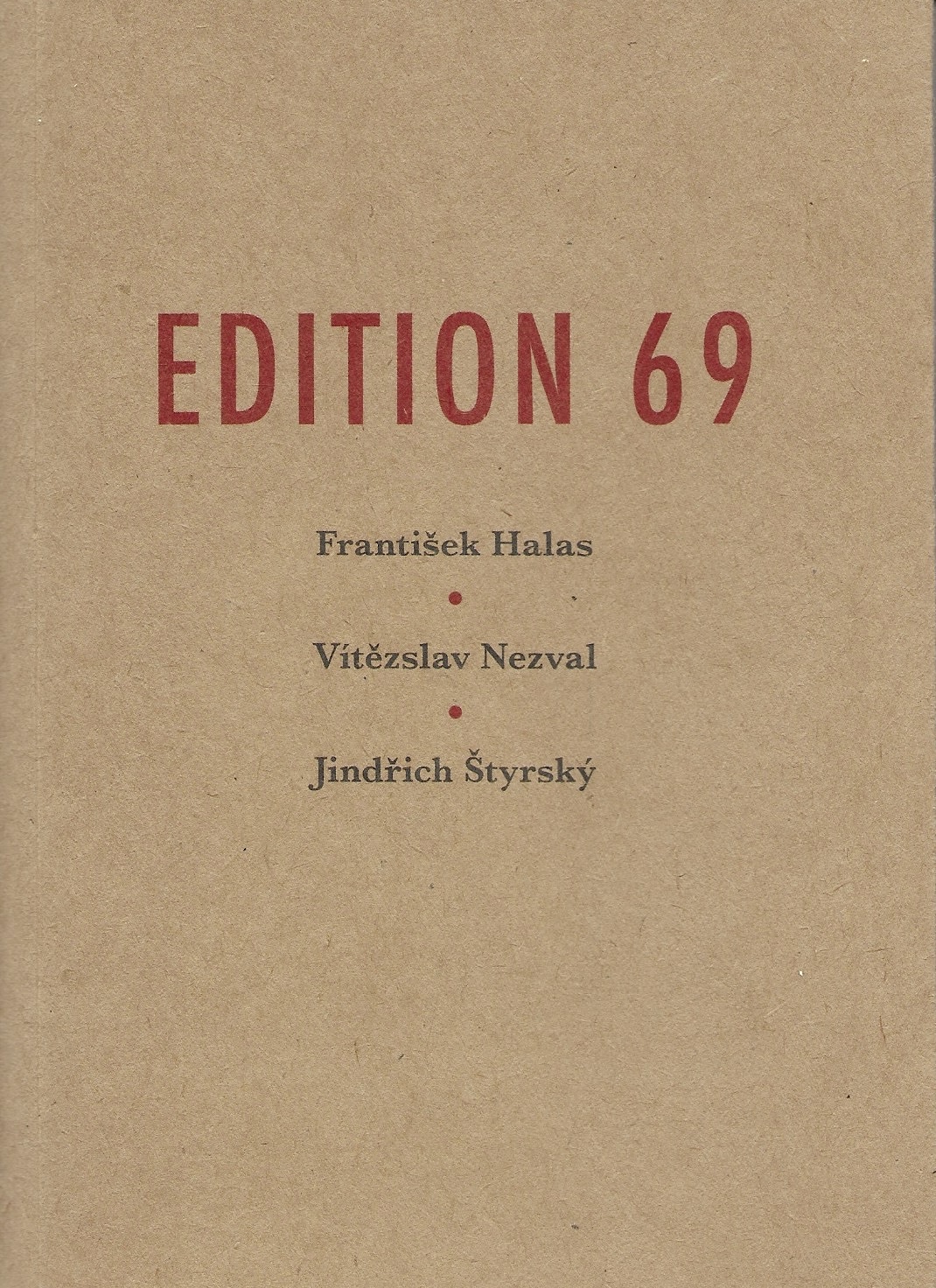
A review of Edition 69, a collection of interwar pornophilic Czech surrealism

New from Twisted Spoon Press, Edition 69 collects three previously-untranslated volumes of Czech artist and writer Jindřich Štyrský’s private-press books of the same name. Beginning in 1931, Štyrský published six volumes of Edition 69. The series was devoted to outré erotic writing and art — “pornophilia,” as the biologist/poet/philosopher Bohuslav Brouk puts it in an essay accompanying the sixth and final volume of Edition 69.

Because of Czech censorship laws, Štyrský’s project was limited to subscribers and friends, with each volume running under 200 editions (the final volume was limited to 69 copies). Undoubtedly, the material in Edition 69 would present an affront—indeed an intentional affront—to the “supercilious psyches of the ruling peacocks,” to again borrow from Brouk (rendered wonderfully here in Jed Slast’s estimable English translation—I should’ve mentioned Slast earlier!). Much of the material in Twisted Spoon’s new collection of Edition 69 still provokes and disturbs nearly a century after their original publication.

Three of the original volumes of Edition 69 presented Czech translations–in some cases the first—of writers like the Marquis de Sade, along with accompanying illustrations by Toyen and Rudolf Krajc. Following its mission of bringing Czech literature to an English-reading audience, Twisted Spoon’s Edition 69 collects the three volumes by Czech artists in translation by Jed Slast: Vítězslav Nezval’s Sexual Nocturne (1931), František Halas’s Thyrsos (1932), and Štyrský’s own Emilie Comes to Me in a Dream (1933). (Štyrský designed and illustrated each of these volumes.)

Nezval’s fragmentary surrealist dream-memoir Sexual Nocturne is the strongest of the three pieces in Edition 69. Nezval gives us an abject, dissolving reminiscence of an unnamed narrator’s boarding school days, centering on a trip to the local bordello and culminating in a return visit years later, one soaked in alcohol and despair. It’s a creepy and decidedly unsexy story, directly referencing Poe’s “The Raven” and Whitman’s “The City Dead-House” (and cribbing more Gothic gloom from a handful of penny dreadfuls).

Sexual Nocturne is a Freudian ramble into adolescent sexual frustration, voyeurism, and ultimately loss, loneliness, and insanity. It’s also a wonderful exploration of the connection between taboo bodily functions and taboo words. In one notable scene, our narrator sends a missive to a crush containing an obscenity, only to be discovered by the bourgeois landlord of his boarding house:

His views reflected those of society. How ridiculous. A writer is expected to make a fool of himself by employing periphrastic expressions while the word ‘fuck’ is nonpareil for conveying sexual intercourse. Fortunately there are old dictionaries where this world has its monument. How I sought it out! When the kiss of lovers pronounces it during coitus it is infused with a sudden vertigo. I have little tolerance for its disgraceful and comic synonyms. They convey nothing, just mealy-mouthed puffballs that make me want to retch when I encounter them.

The word FUCK is diamond-hard, translucent, a classic. As if adopting the appearance of a gem from a noble Alexandrine, it has, since it is forbidden, a magical power. It is one of the Kabbalistic abbreviations for the erotic aura, and I love it.

I love it! I love that second paragraph so much. It’s one of the best paragraphs I’ve read all year.

The collages by Štyrský that accompany Sexual Nocturne are reminiscent of Max Ernst’s work in A Week of Sundays, but less frenetic. At times they sync with the tale’s dream logic, and when they don’t, fine. It’s interwar surrealism, baby!

František Halas’s Thyrsos is far less successful. Halas’s poems can’t quite live up to their namesake, let alone the Sophocles’ quote that precedes them (“Not to be born is, beyond all estimation, best; but when a man has seen the light of day, this is next best by far, that with utmost speed he should go back from where he came”).

The opener, “Leda’s Sorrow,” isn’t particularly bad, but it’s nothing special either:

Other poems celebrate incest, arcadian bacchanalia, and old-man boners. Halas’s poem about cunnilingus (“The Taste of Love”) is particularly bad. Outlier “In the Field” connects the collection’s larger themes of sex-as-death’s-twin, evoking a scene of what might be a battle field, with trenches and barbed wire, a solitary man jerking off “like a demon” over what I take to be a foxhole. For the most part though, Thyrsos is a strange mix of ribald and whimsical with occasional sex tips thrown in. It’s weak stuff. In his translator’s note, Slast admits that “perhaps it’s understandable that Halas considered this thin collection of poems juvenile and much inferior to his other work.” Štyrský’s pen-and-ink illustrations are simple and charming though, even if their simple charm seems to point to the fact that Halas’s ditties are out of place in the queasy surrealism of the rest of the collection.

Štyrský’s Emilie Comes to Me in a Dream reads like a mix of dream writing and automatic writing. It’s stranger and more poetic than the prose in Nezval’s Nocturne, but neither as funny nor as profound. And yet it has its moments, as it shifts from sensuality to pornography to death obsession. “I came to love the fragrance of her crotch,” our narrator declares, and then appends his description: “a mix of laundry room and mouse hole, a pincushion forgotten in a bed of lilies of the valley.” He tells us he “was prone to seeing in dissolve,” and the prose bears it out later, in a linguistic episode that mirrors Štyrský’s surrealist collage techniques:

Later I placed an aquarium in the window. In it I cultivated a golden-haired vulva and a magnificent penis specimen and delicate veins on its temples. Yet in time I threw in everything I had ever loved: shards of broken teacups, hairpins, Barbora’s slipper, light bulbs, shadows, cigarette butts, sardine tins, my entire correspondence, and used condoms. Many strange creatures were born in this world. I considered myself a creator, and with justification.

After the dream writing, Štyrský delivers a sexually-explicit photomontage that’s simultaneously frank and ambiguous, ironic and sincere, sensual and abject. The photographic collages wed sex and death, desire and repulsion.

Štyrský’s Emilie includes a (previously-mentioned) postscript by Bohuslav Brouk, which, while at times academic and philosophical, plainly spells out that the mission of the so-called “pornophiles” is to give a big FUCK YOU to the repressed and repressive bourgeoisie. Brouk intellectualizes pornophilia, arguing against the conservative mindset that strives for immortal purity. He argues in favor of embracing corporeal animality: “The body will continue to demonstrate mortality as the fate of all humans, and for this reason any reference to human animality so gravely offends those who dream of its antithesis.” Hence, sex and death—blood, sweat, tears, semen—are the abject markers of the fucking circle of life, right? Our dude continues:

The body is the last argument of those who have been unjustly marginalized and ignored, because it demonstrates beyond question the groundlessness of all social distinctions in comparison to the might of nature.

I’ll give Brouk the last quote here because I think what he wrote resonates still in These Stupid Times.

Edition 69 has its highs and its lows, but I think it’s another important document of Czech surrealism from Twisted Spoon, and in its finest moments it reminds us that we are bodies pulling a psyche around, no matter how much we fool ourselves. Nice.

Meantime, I continued to stand on the oozy margin of the stream | Nathaniel Hawthorne’s journal entry for August 24th, 1842

August 24th.–I left home at five o’clock this morning to catch some fish for breakfast. I shook our summer apple-tree, and ate the golden apple which fell from it. Methinks these early apples, which come as a golden promise before the treasures of autumnal fruit, are almost more delicious than anything that comes afterwards. We have but one such tree in our orchard; but it supplies us with a daily abundance, and probably will do so for at least a week to come. Meantime other trees begin to cast their ripening windfalls upon the grass; and when I taste them, and perceive their mellowed flavor and blackening seeds, I feel somewhat overwhelmed with the impending bounties of Providence. I suppose Adam, in Paradise, did not like to see his fruits decaying on the ground, after he had watched them through the sunny days of the world’s first summer. However, insects, at the worst, will hold a festival upon them, so that they will not be thrown away, in the great scheme of Nature. Moreover, I have one advantage over the primeval Adam, inasmuch as there is a chance of disposing of my superfluous fruits among people who inhabit no Paradise of their own.

Passing a little way down along the river-side, I threw in my line, and soon drew out one of the smallest possible of fishes. It seemed to be a pretty good morning for the angler,–an autumnal coolness in the air, a clear sky, but with a fog across the lowlands and on the surface of the river, which a gentle breeze sometimes condensed into wreaths. At first, I could barely discern the opposite shore of the river; but, as the sun arose, the vapors gradually dispersed, till only a warm, smoky tint was left along the water’s surface. The farm-houses across the river made their appearance out of the dusky cloud; the voices of boys were heard, shouting to the cattle as they drove them to the pastures; a man whetted his scythe, and set to work in a neighboring meadow. Meantime, I continued to stand on the oozy margin of the stream, beguiling the little fish; and though the scaly inhabitants of our river partake somewhat of the character of their native element, and are but sluggish biters, still I contrived to pull out not far from two dozen. They were all bream, a broad, flat, almost circular fish, shaped a good deal like a flounder, but swimming on their edges, instead of on their sides. As far as mere pleasure is concerned, it is hardly worth while to fish in our river, it is so much like angling in a mud-puddle; and one does not attach the idea of freshness and purity to the fishes, as we do to those which inhabit swift, transparent streams, or haunt the shores of the great briny deep. Standing on the weedy margin, and throwing the line over the elder-bushes that dip into the water, it seems as if we could catch nothing but frogs and mud-turtles, or reptiles akin to them. And even when a fish of reputable aspect is drawn out, one feels a shyness about touching him. As to our river, its character was admirably expressed last night by some one who said “it was too lazy to keep itself clean.” I might write pages and pages, and only obscure the impression which this brief sentence conveys. Nevertheless, we made bold to eat some of my fish for breakfast, and found them very savory; and the rest shall meet with due entertainment at dinner, together with some shell-beans, green corn, and cucumbers from our garden; so this day’s food comes directly and entirely from beneficent Nature, without the intervention of any third person between her and us.

Nathaniel Hawthorne’s journal entry, 24 August 1842. From American Note-Books.

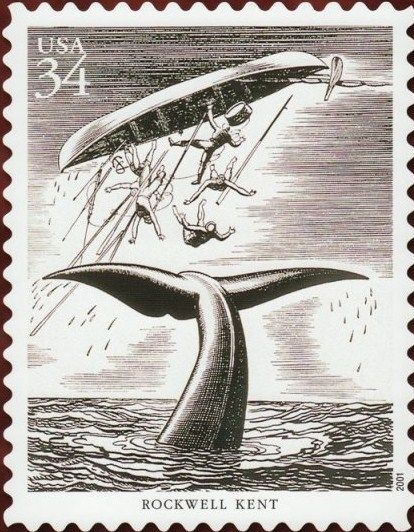
Rockwell Kent’s Moby-Dick USPS Stamp

8becb1822b7a341e5f0475df3129a6cf


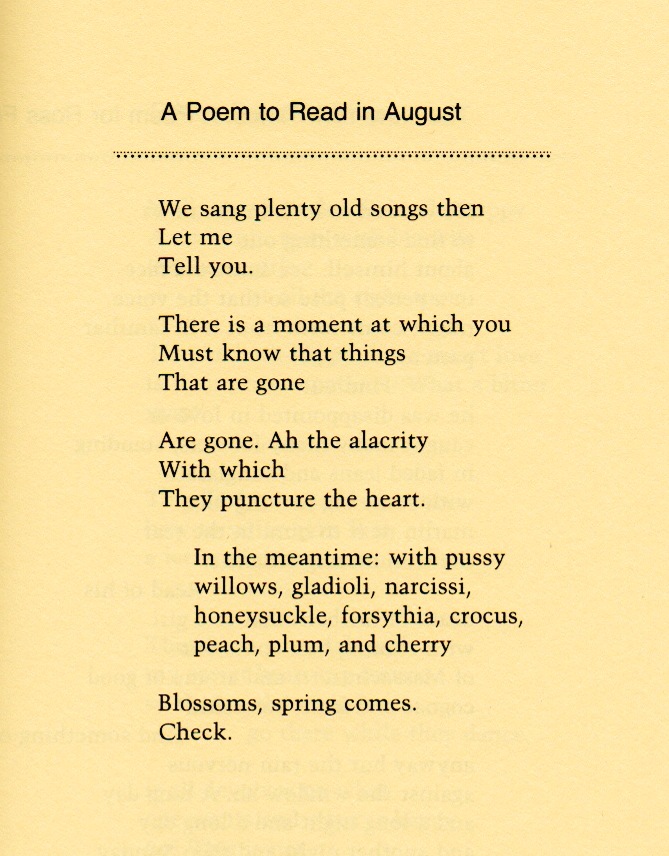
“A Poem to Read in August” — Gilbert Sorrentino

IMG_3021

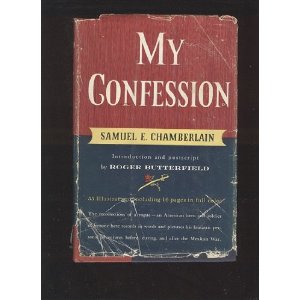
“Books are made out of books” | Blood Meridian and Samuel Chamberlain

In his 1992 interview with The New York Times, Cormac McCarthy said, “The ugly fact is books are made out of books. The novel depends for its life on the novels that have been written.” McCarthy’s masterpiece Blood Meridian, as many critics have noted, is made of some of the finest literature out there–the King James Bible, Moby-Dick, Dante’s Inferno, Paradise Lost, Faulkner, and Shakespeare. While Blood Meridian echoes and alludes to these authors and books thematically, structurally, and linguistically, it also owes much of its materiality to Samuel Chamberlain’s My Confession: The Recollections of a Rogue.

Chamberlain, much like the Kid, Blood Meridian’s erstwhile protagonist, ran away from home as a teenager. He joined the Illinois Second Volunteer Regiment and later fought in the Mexican-American War. Confession details Chamberlain’s involvement with John Glanton’s gang of scalp-hunters. The following summary comes from the University of Virginia’s American Studies webpage

According to Chamberlain, John Glanton was born in South Carolina and migrated to Stephen Austin’s settlement in Texas. There he fell in love with an orphan girl and was prepared to marry her. One day while he was gone, Lipan warriors raided the area scalping the elderly and the children and kidnapping the women- including Glanton’s fiancee. Glanton and the other settlers pursued and slaughtered the natives, but during the battle the women were tomahawked and scalped. Legend has it, Glanton began a series of retaliatory raids which always yielded “fresh scalps.” When Texas fought for its independence from Mexico, Glanton fought with Col. Fannin, and was one of the few to escape the slaughter of that regiment at the hands of the Mexican Gen. Urrea- the man who would eventually employ Glanton as a scalp hunter. During the Range Wars, Glanton took no side but simply assassinated individuals who had crossed him. He was banished, to no avail, by Gen. Sam Houston and fought as a “free Ranger” in the war against Mexico. Following the war he took up the Urrea’s offer of $50 per Apache scalp (with a bonus of $1000 for the scalp of the Chief Santana). Local rumor had it that Glanton always “raised the hair” of the Indians he killed and that he had a “mule load of these barbarous trophies, smoke-dried” in his hut even before he turned professional.


Chamberlain’s Confession also describes a  figure named Judge Holden. Again, from U of V’s summary–

Glanton’s gang consisted of “Sonorans, Cherokee and Delaware Indians, French Canadians, Texans, Irishmen, a Negro and a full-blooded Comanche,” and when Chamberlain joined them they had gathered thirty-seven scalps and considerable losses from two recent raids (Chamberlain implies that they had just begun their careers as scalp hunters but other sources suggest that they had been engaged in the trade for sometime- regardless there is little specific documentation of their prior activities). Second in command to Glanton was a Texan- Judge Holden. In describing him, Chamberlain claimed, “a cooler blooded villain never went unhung;” Holden was well over six feet, “had a fleshy frame, [and] a dull tallow colored face destitute of hair and all expression” and was well educated in geology and mineralogy, fluent in native dialects, a good musician, and “plum centre” with a firearm. Chamberlain saw him also as a coward who would avoid equal combat if possible but would not hesitate to kill Indians or Mexicans if he had the advantage. Rumors also abounded about atrocities committed in Texas and the Cherokee nation by him under a different name. Before the gang left Frontreras, Chamberlain claims that a ten year old girl was found “foully violated and murdered” with “the mark of a large hand on her throat,” but no one ever directly accused Holden.


It’s fascinating to note how much of the Judge is already there–the pedophilia, the marksmanship, the scholarship, and, most interesting of all, the lack of hair. Confession goes on to detail the killing, scalping, raping, and raiding spree that comprises the center of Blood Meridian. Chamberlain even describes the final battle with the Yumas, an event that signals the dissolution of the Glanton gang in McCarthy’s novel.

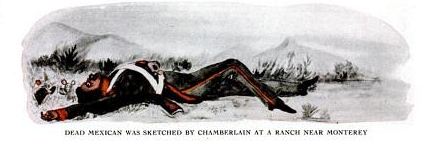
Content aside, Chamberlain’s prose also seems to presage McCarthy’s prose. In his book Different Travelers, Different Eyes, James H. Maguire notes that, “Both venereal and martial, the gore of [Chamberlain’s] prose evokes Gothic revulsion, while his unschooled art, with its stark architectural angles and leaden, keen-edged shadows, can chill with the surreal horrors of the later Greco-Italian painter Giorgio de Chirico.” Yes, Chamberlain was an amateur painter (find his paintings throughout this post), and undoubtedly some of this imagery crept into Blood Meridian.

You can view many of Chamberlain’s paintings and read an edit of his Confession in three editions of Life magazine from 1956, digitally preserved thanks to Google Books–here’s Part I, Part II, and Part III. Many critics have pointed out that Chamberlain’s narrative, beyond its casual racism and sexism, is rife with factual and historical errors. He also apparently indulges in the habit of describing battles and other events in vivid detail, even when there was no way he could have been there. No matter. The ugly fact is that books are made out of books, after all, and if Chamberlain’s Confession traffics in re-appropriating the adventure stories of the day, at least we have Blood Meridian to show for his efforts.

[Ed. note–Biblioklept first ran this post in September of 2010.]

Nathaniel Hawthorne’s journal entry for July 20th, 1837

July 20th.–A drive yesterday afternoon to a pond in the vicinity of Augusta, about nine miles off, to fish for white perch. Remarkables: the steering of the boat through the crooked, labyrinthine brook, into the open pond,–the man who acted as pilot,–his talking with B—- about politics, the bank, the iron money of “a king who came to reign, in Greece, over a city called Sparta,”–his advice to B—- to come amongst the laborers on the mill-dam, because it stimulated them “to see a man grinning amongst them.” The man took hearty tugs at a bottle of good Scotch whiskey, and became pretty merry. The fish caught were the yellow perch, which are not esteemed for eating; the white perch, a beautiful, silvery, round-backed fish, which bites eagerly, runs about with the line while being pulled up, makes good sport for the angler, and an admirable dish; a great chub; and three horned pouts, which swallow the hook into their lowest entrails. Several dozen fish were taken in an hour or two, and then we returned to the shop where we had left our horse and wagon, the pilot very eccentric behind us. It was a small, dingy shop, dimly lighted by a single inch of candle, faintly disclosing various boxes, barrels standing on end, articles hanging from the ceiling; the proprietor at the counter, whereon appear gin and brandy, respectively contained in a tin pint-measure and an earthenware jug, with two or three tumblers beside them, out of which nearly all the party drank; some coming up to the counter frankly, others lingering in the background, waiting to be pressed, two paying for their own liquor and withdrawing. B—- treated them twice round. The pilot, after drinking his brandy, gave a history of our fishing expedition, and how many and how large fish we caught. B—- making acquaintances and renewing them, and gaining great credit for liberality and free-heartedness,–two or three boys looking on and listening to the talk,–the shopkeeper smiling behind his counter, with the tarnished tin scales beside him,–the inch of candle burning down almost to extinction. So we got into our wagon, with the fish, and drove to Robinson’s tavern, almost five miles off, where we supped and passed the night In the bar-room was a fat old countryman on a journey, and a quack doctor of the vicinity, and an Englishman with a peculiar accent. Seeing B—-‘s jointed and brass-mounted fishing-pole, he took it for a theodolite, and supposed that we had been on a surveying expedition. At supper, which consisted of bread, butter, cheese, cake, doughnuts and gooseberry-pie, we were waited upon by a tall, very tall woman, young and maiden-looking, yet with a strongly outlined and determined face. Afterwards we found her to be the wife of mine host. She poured out our tea, came in when we rang the table-bell to refill our cups, and again retired. While at supper, the fat old traveller was ushered through the room into a contiguous bedroom. My own chamber, apparently the best in the house, had its walls ornamented with a small, gilt-framed, foot-square looking-glass, with a hair-brush hanging beneath it; a record of the deaths of the family written on a black tomb, in an engraving, where a father, mother, and child were represented in a graveyard, weeping over said tomb; the mourners dressed in black, country-cut clothes; the engraving executed in Vermont. There was also a wood engraving of the Declaration of Independence, with fac-similes of the autographs; a portrait of the Empress Josephine, and another of Spring. In the two closets of this chamber were mine hostess’s cloak, best bonnet, and go-to-meeting apparel. There was a good bed, in which I slept tolerably well, and, rising betimes, ate breakfast, consisting of some of our own fish, and then started for Augusta. The fat old traveller had gone off with the harness of our wagon, which the hostler had put on to his horse by mistake. The tavern-keeper gave us his own harness, and started in pursuit of the old man, who was probably aware of the exchange, and well satisfied with it.

Our drive to Augusta, six or seven miles, was very pleasant, a heavy rain having fallen during the night, and laid the oppressive dust of the day before. The road lay parallel with the Kennebec, of which we occasionally had near glimpses. The country swells back from the river in hills and ridges, without any interval of level ground; and there were frequent woods, filling up the valleys or crowning the summits. The land is good, the farms look neat, and the houses comfortable. The latter are generally but of one story, but with large barns; and it was a good sign, that, while we saw no houses unfinished nor out of repair, one man at least had found it expedient to make an addition to his dwelling. At the distance of more than two miles, we had a view of white Augusta, with its steeples, and the State-House, at the farther end of the town. Observable matters along the road were the stage,–all the dust of yesterday brushed off, and no new dust contracted,–full of passengers, inside and out; among them some gentlemanly people and pretty girls, all looking fresh and unsullied, rosy, cheerful, and curious as to the face of the country, the faces of passing travellers, and the incidents of their journey; not yet damped, in the morning sunshine, by long miles of jolting over rough and hilly roads,–to compare this with their appearance at midday, and as they drive into Bangor at dusk; two women dashing along in a wagon, and with a child, rattling pretty speedily down hill;–people looking at us from the open doors and windows;–the children staring from the wayside;–the mowers stopping, for a moment, the sway of their scythes;–the matron of a family, indistinctly seen at some distance within the house her head and shoulders appearing through the window, drawing her handkerchief over her bosom, which had been uncovered to give the baby its breakfast,–the said baby, or its immediate predecessor, sitting at the door, turning round to creep away on all fours;–a man building a flat-bottomed boat by the roadside: he talked with B—- about the Boundary question, and swore fervently in favor of driving the British “into hell’s kitchen” by main force.

Colonel B—-, the engineer of the mill-dam, is now here, after about a fortnight’s absence. He is a plain country squire, with a good figure, but with rather a heavy brow; a rough complexion; a gait stiff, and a general rigidity of manner, something like that of a schoolmaster. He originated in a country town, and is a self-educated man. As he walked down the gravel-path to-day, after dinner, he took up a scythe, which one of the mowers had left on the sward, and began to mow, with quite a scientific swing. On the coming of the mower, he laid it down, perhaps a little ashamed of his amusement. I was interested in this; to see a man, after twenty-five years of scientific occupation, thus trying whether his arms retained their strength and skill for the labors of his youth,–mindful of the day when he wore striped trousers, and toiled in his shirt-sleeves,–and now tasting again, for pastime, this drudgery beneath a fervid sun. He stood awhile, looking at the workmen, and then went to oversee the laborers at the mill-dam.

Nathaniel Hawthorne’s journal entry, 20 July 1837. From American Note-Books.

Illustration for Poe’s “The Masque of Red Death” — Ivor Abrahams

The Masque of the Red Death 1976 by Ivor Abrahams born 1935

Illustration for Poe’s “The Masque of Red Death,” 1976 by Ivor Abrahams (1935–2015)

“The Masque of Red Death”

by

Edgar Allan Poe


The “Red Death” had long devastated the country. No pestilence had ever been so fatal, or so hideous. Blood was its Avatar and its seal—the redness and the horror of blood. There were sharp pains, and sudden dizziness, and then profuse bleeding at the pores, with dissolution. The scarlet stains upon the body and especially upon the face of the victim, were the pest ban which shut him out from the aid and from the sympathy of his fellow-men. And the whole seizure, progress and termination of the disease, were the incidents of half an hour.

But the Prince Prospero was happy and dauntless and sagacious. When his dominions were half depopulated, he summoned to his presence a thousand hale and light-hearted friends from among the knights and dames of his court, and with these retired to the deep seclusion of one of his castellated abbeys. This was an extensive and magnificent structure, the creation of the prince’s own eccentric yet august taste. A strong and lofty wall girdled it in. This wall had gates of iron. The courtiers, having entered, brought furnaces and massy hammers and welded the bolts. They resolved to leave means neither of ingress nor egress to the sudden impulses of despair or of frenzy from within. The abbey was amply provisioned. With such precautions the courtiers might bid defiance to contagion. The external world could take care of itself. In the meantime it was folly to grieve, or to think. The prince had provided all the appliances of pleasure. There were buffoons, there were improvisatori, there were ballet-dancers, there were musicians, there was Beauty, there was wine. All these and security were within. Without was the “Red Death”.

It was towards the close of the fifth or sixth month of his seclusion, and while the pestilence raged most furiously abroad, that the Prince Prospero entertained his thousand friends at a masked ball of the most unusual magnificence. Continue reading “Illustration for Poe’s “The Masque of Red Death” — Ivor Abrahams”

Catalogue these books (A passage from Joyce’s Uylsses)

What final visual impression was communicated to him by the mirror?

The optical reflection of several inverted volumes improperly arranged and not in the order of their common letters with scintillating titles on the two bookshelves opposite.

Catalogue these books.

Thom’s Dublin Post Office Directory, 1886.

Denis Florence M’Carthy’s Poetical Works (copper beechleaf bookmark at p. 5).

Shakespeare’s Works (dark crimson morocco, goldtooled).

The Useful Ready Reckoner (brown cloth).

The Secret History of the Court of Charles II (red cloth, tooled binding).

The Child’s Guide (blue cloth).

The Beauties of Killarney (wrappers).

When We Were Boys by William O’Brien M. P. (green cloth, slightly faded, envelope bookmark at p. 217).

Thoughts from Spinoza (maroon leather).

The Story of the Heavens by Sir Robert Ball (blue cloth).

Ellis’s Three Trips to Madagascar (brown cloth, title obliterated).

The Stark-Munro Letters by A. Conan Doyle, property of the City of Dublin Public Library, 106 Capel street, lent 21 May (Whitsun Eve) 1904, due 4 June 1904, 13 days overdue (black cloth binding, bearing white letternumber ticket).

Voyages in China by “Viator” (recovered with brown paper, red ink title).

Philosophy of the Talmud (sewn pamphlet).

Lockhart’s Life of Napoleon (cover wanting, marginal annotations, minimising victories, aggrandising defeats of the protagonist).

Soll und Haben by Gustav Freytag (black boards, Gothic characters, cigarette coupon bookmark at p. 24).

Hozier’s History of the Russo-Turkish War (brown cloth, 2 volumes, with gummed label, Garrison Library, Governor’s Parade, Gibraltar, on verso of cover).

Laurence Bloomfield in Ireland by William Allingham (second edition, green cloth, gilt trefoil design, previous owner’s name on recto of flyleaf erased).

A Handbook of Astronomy (cover, brown leather, detached, 5 plates, antique letterpress long primer, author’s footnotes nonpareil, marginal clues brevier, captions small pica).

The Hidden Life of Christ (black boards).

In the Track of the Sun (yellow cloth, titlepage missing, recurrent title intestation).

Physical Strength and How to Obtain It by Eugen Sandow (red cloth).

Short but yet Plain Elements of Geometry written in French by F. Ignat. Pardies and rendered into Engliſh by John Harris D. D. London, printed for R. Knaplock at the Biſhop’s Head, MDCCXI, with dedicatory epiſtle to his worthy friend Charles Cox, eſquire, Member of Parliament for the burgh of Southwark and having ink calligraphed statement on the flyleaf certifying that the book was the property of Michael Gallagher, dated this 10th day of May 1822 and requeſting the perſon who should find it, if the book should be loſt or go aſtray, to reſtore it to Michael Gallagher, carpenter, Dufery Gate, Enniſcorthy, county Wicklow, the fineſt place in the world.

From James Joyce’s Ulysses.

“A Very Real Story” — Julio Cortázar

2020-03-06_151902_4

(English translation by Paul Blackburn.)

The Essential Short Stories of J.G. Ballard

jgb_complete_ss4003111

I. “Manhole 69” (1957)

II. “Chronopolis” (1960)

III.  “The Voices of Time” (1960)

IV. “The Overloaded Man” (1961)

V. “Billennium” (1961)

VI. “Thirteen to Centaurus” (1962)

VII. “The Subliminal Man” (1963)

VIII. “End-Game” (1963)

IX. “Time of Passage” (1964)

X. “The Lost Leonardo” (1964)

XI. “The Terminal Beach” (1964)

XII. “The Drowned Giant” (1964)

XIII. “The Beach Murders” (1966)

XIV.  “The Assassination of John Fitzgerald Kennedy Considered as a Downhill Motor Race” (1966)

XV. “Why I Want to Fuck Ronald Reagan” (1968)

XVI. “Notes Towards a Mental Breakdown” (1976)

XVII. “The Index” (1977)

XVIII. “The Dead Time” (1977)

XIX. “News from the Sun” (1981)

XX. “Myths of the Near Future” (1982)

XXI. “Memories of the Space Age” (1982)

XXII. “Answers to a Questionnaire” (1985)

XXIII. “A Guide to Virtual Death” (1992)

At 1200 pages and just under 100 stories, The Complete Short Stories is frankly too complete—but I read them all anyway. The list above is my suggestion for a volume I’d call The Essential Short Stories of J.G. Ballard. Each selection on the list is linked to a riff I wrote; in several cases, links to the full text of the story can be found at the riff.

[Ed. note: Biblioklept originally ran a series of posts on The Complete Short Stories of J.G. Ballard between October 2013 and March 2014.]

The Complete Short Stories of J.G. Ballard (Eleventh Riff: The Nineties)

jgb_complete_ss4003111

PREVIOUSLY:

Introductions + stories 1956-1959

Stories of 1960

Stories of 1961

Stories of 1962

“The Subliminal Man,” Black Friday, and Consumerism

Stories of 1963-1964

Stories of 1966

Closing out the sixties

The seventies

The eighties

IN THIS RIFF:

“Dream Cargoes” (1990)

“A Guide to Virtual Death” (1992)

“The Message from Mars” (1992)

“Report from an Obscure Planet” (1992)

“The Secret Autobiography of J G B” (1981/2009)

“The Dying Fall” (1996)

“Dream Cargoes” (1990)

By the 1990s Ballard had written essentially the same stories over and over—with diminishing returns. Some of the weakness in the later entries in the Complete Short Stories can be attributed to Ballard’s prescience. The world caught up to him at some point, blunting his satire into something goofier, more cartoonish, but also sharpening the reactionary streak that always glowed under the surface of his writing. At his peak, Ballard used his stories to provoke readers into looking at their culture in a new way, and the best of those stories still retain a futurist power. However, many of the late period stories blazon their moral outrage in a wearisome didactic streak.

1990’s “Dream Cargoes” is paint-by-numbers Ballard: Themes of time, sleep, mutation, ecological disaster, birds, etc. The plot anticipates one of Ballard’s weaker novels, Rushing to Paradise (1994), a day-glo nightmare about misguided attempts to steward the forces of nature. And like Rushing to Paradise, the prose here is weak—Ballard relies on the stock phrases that litter his earliest stories.

“The Message from Mars” (1992) / “Report from an Obscure Planet” (1992) / “A Guide to Virtual Death” (1992)

“The Message from Mars” anticipates public disinterest in astronomy (and science in general), the end of NASA’s space shuttle program, and China’s emerging dominance as a world power with space flight capability. So there you go. (It also posits the horror of a President Quayle!). Ballard sends a group of astronauts on a Mars mission, refuses to share their findings with us, and then leaves them, once they land, in their space shuttle, where they live on for decades, silent, incommunicado, alienated from humanity in their self-imposed exile. Ballard’s cynicism is balanced by his refusal to overstate any kind of moral here—the story succeeds in its evocation of mystery.

“Report from an Obscure Planet” is another riff on millennial anxieties, written in the perspective of a “we” condemning the human race for its shortsighted, disastrous treatment of the planet. Ballard doesn’t seem to keen on the future wonders promised by computers:

Driven by the need for a more lifelike replica of the scenes of carnage that most entertained them, the people of this unhappy world had invented an advanced and apparently interiorised version of their television screens, a virtual replica of reality in which they could act out their most deviant fantasies. These three–dimensional simulations were generated by their computers, and had reached a stage of development in the last years of the millennium in which the imitation of reality was more convincing than the original. It may even have become the new reality to the extent that their cities and highways, their fellow citizens and, ultimately, themselves seemed mere illusions by comparison with the electronically generated amusement park where they preferred to play. Here they could assume any identity, create and fulfill any desire, and explore the most deviant dreams.  

While “Report from an Obscure Planet” uses a didactic narrator and a heavy hand to telegraph its message, its companion piece “A Guide to Virtual Death” is far more fun, wicked, and shockingly accurate (if wildly hyperbolic). Sure, yes, okay—another list from Ballard, and okay, yes, sure—I tend to be keen on his lists (“The Index,” “The Assassination of John Fitzgerald Kennedy Considered as a Downhill Motor Race”)—but they also tend to be his strongest pieces. As usual with his list-stories, Ballard feels obligated to begin with a note:

For reasons amply documented elsewhere, intelligent life on earth became extinct in the closing hours of the 20th Century. Among the clues left to us, the following schedule of a day’s television programmes transmitted to an unnamed city in the northern hemisphere on December 23, 1999, offers its own intriguing insight into the origins of the disaster.

6.00 am Porno–Disco. Wake yourself up with his–and–her hard–core sex images played to a disco beat.

7.00 Weather Report. Today’s expected micro–climates in the city’s hotel atriums, shopping malls and office complexes. Hilton International promises an afternoon snow–shower as a Christmas appetiser.

7.15 News Round–up. What our news–makers have planned for you. Maybe a small war, a synthetic earthquake or a famine–zone! charity tie–in.

7.45 Breakfast Time. Gourmet meals to watch as you eat your diet cellulose.

Brief but Essential. Go ahead and read the whole thing.

“The Dying Fall” (1996) / “The Secret Autobiography of J G B” (1981/2009)

The American edition of Complete Stories is more complete than the British volume, including two extra stories. “The Dying Fall” (read it here if you like) is an unfortunate last entry, a weak note in a grand tome. It’s not bad; it’s simply not good, yet another revenge tale with a bad wife, etc. It feels like a frame for Ballard to riff on architecture and psychoanalysis.

“The Secret Autobiography of J G B” is much stronger (you can read it here), although it was also composed at his peak and republished (“rediscovered”) after his death. The final lines would have made a fitting end for the entire collection:

When the summer was followed by a mild autumn, B had established a pleasant and comfortable existence for himself. He had abundant stocks of tinned food, fuel, and water with which to survive the winter. The river was nearby, clear and free of all pollution, and petrol was easy to obtain, in unlimited quantities, from the filling stations and parked cars. At the local police station, he assembled a small armory of pistols and carbines, to deal with any unexpected menace that might appear.

But his only visitors were the birds, and he scattered handfuls of rice and seeds on his lawn and on those of his former neighbors. Already he had begun to forget them, and Shepperton soon became an extraordinary aviary, filled with birds of every species.

Thus the year ended peacefully, and B was ready to begin his true work.

On the horizon:

I am done! Sort of. One more post—I’ll revisit these riffs and select the tales that I would include in a collection I would call The Essential Short Stories of J.G. Ballard.

[Ed. note: Biblioklept originally ran a series of posts on The Complete Short Stories of J.G. Ballard between October 2013 and March 2014.]

The Complete Short Stories of J.G. Ballard (Tenth Riff: The Eighties)

jgb_complete_ss4003111

PREVIOUSLY:

Introductions + stories 1956-1959

Stories of 1960

Stories of 1961

Stories of 1962

“The Subliminal Man,” Black Friday, and Consumerism

Stories of 1963-1964

Stories of 1966

Closing out the sixties

The seventies

IN THIS RIFF:

“A Host of Furious Fancies” (1980)

“News from the Sun” (1981)

“Memories of the Space Age” (1982)

“Myths of the Near Future” (1982)

“Report on an Unidentified Space Station” (1982)

“The Object of the Attack” (1984)

“Answers to a Questionnaire” (1985)

“The Man Who Walked on the Moon” (1985)

“The Secret History of World War 3” (1988)

“Love in a Colder Climate” (1989)

“The Enormous Space” (1989)

“The Largest Theme Park in the World” (1989)

“War Fever” (1989)

“News from the Sun” (1981) / “Myths of the Near Future” (1982) / “Memories of the Space Age” (1982)

Let me first confess how happy I am to be finished with this enormously enormous book (okay, not physically enormous on my Kindle, but still…). Let me also confess to dread at having to finish out these riffs (no, no one is forcing me, but still…). At this point, I feel like I could write my own Ballard story—a crazed astronaut here, a drained swimming pool there, a femme fatale, some psychotropic drugs, armchair psychology, a swamp, some birds (perhaps), a plane or two, time obsession, sex obsession, space obsession. Obsession obsession Anyway. Ballard arguably peaks in the early 1980s; everything after reads like a day-glow Keith Haringesque pop-approximation of his grittier seventies stuff—or (worse) scolding wrapped up in little morality plays.

But, like I said (wrote), Ballard is in his prime in the early 1980s, and “News,” “Myths,” and “Memories” are some of his finest stories (file these triplets in my quasi-fictional-but-c’mon-we-can-make-this-happen collection The Essential Short Stories of J.G. Ballard)—they are also some of his most Ballardian, riffing on space-travel-as-cosmic-taboo, paranoid parables obsessed with time. A particularly Ballardian paragraph (from “Memories”):

He had almost ceased to breathe. Here, at the centre of the space grounds, he could feel time rapidly engorging itself. The infinite pasts and future of the forest had fused together. A long–tailed parakeet paused among the branches over his head, an electric emblem of itself more magnificent than a peacock. A jewelled snake hung from a bough, gathering to it all the embroidered skins it had once shed.

(Parenthetical aside: “Myths” and “Memories” are both set in Florida. Ballard’s depiction of Florida feels thoroughly inauthentic (I’m Floridian), but that inauthenticity also feels thoroughly appropriate).

 “A Host of Furious Fancies” (1980)

Ballard constructs this little tale around a psychoanalytic reading of Cinderella:

The entire fairy tale of Cinderella was being enacted, perhaps unconsciously, by this deranged heiress. If she herself was Cinderella, Dr Valentina Gabor was the fairy godmother, and her magic wand the hypodermic syringe she waved about so spectacularly. The role of the pumpkin was played by the ‘sacred mushroom’, the hallucinogenic fungus from which psilocybin was extracted. Under its influence even an ancient laundry van would seem like a golden coach. And as for the ‘ball’, this of course was the whole psychedelic trip.

But who then was Prince Charming? As I arrived at the great mansion at the end of its drive it occurred to me that I might be unwittingly casting myself in the role, fulfilling a fantasy demanded by this unhappy girl. . . .

For all my resistance to that pseudo–science, it occurred to me that once again a psychoanalytic explanation made complete sense of these bizarre events and the fable of Cinderella that underpinned them. I walked up the staircase past the dismembered clock. Despite the fear–crazed assault on them, the erect hands still stood upright on the midnight hour – that time when the ball ended, when the courtships and frivolities of the party were over and the serious business of a real sexual relationship began. Fearful of that male erection, Cinderella always fled at midnight.

Etc.

Ballard’s Freudian riff would be more interesting as an essay.

(The story also showcases some of his typical chauvinism: The psychiatrist is described as the “woman psychiatrist” — just as earlier a dentist is referred to as a “lady dentist,” etc. Straight through to the end of the collection. In the 1990s).

“Report on an Unidentified Space Station” (1982) / “The Enormous Space” (1989)

“Report” and “Space” both read like takes on Sigizmund Krzhizhanovsky’s Soviet-era short story “Quadraturin” — both concern space, that corollary to time, and, just as Ballard repeatedly posits time as a matter of perspective, he treats space—area—the same way here. “Report” is a bit more satisfying than “Space,” which feels like a retread of so many of Ballard’s revenge stories—only with, uh, some comical cannibalism.

  1. “The Object of the Attack” (1984) / “Answers to a Questionnaire” (1985)

“Attack” and “Questionnaire” are maybe the same story—only “Questionnaire” is essentially perfect, whereas “Attack” feels like a clumsy, heavy first draft (but only because “Questionnaire” exists—do you see what I mean by this?)

Both stories showcase Ballard’s syntheses of religion (messianic; apocalyptic) and assassination (political; media-saturated). While “Attack” employs a discursive-but-still-linear approach to the theme, “Answers to a Questionnaire” gives us a discontinuous but more engaging riff in the form of (uh) exactly what its title promises.  First fifth:

1) Yes.

2) Male (?)

3) do Terminal 3, London Airport, Heathrow.

4) Twenty–seven.

5) Unknown.

6) Dr Barnardo’s Primary, Kingston–upon–Thames; HM Borstal, Send, Surrey; Brunel University Computer Sciences Department.

7) Floor cleaner, Mecca Amusement Arcades, Leicester Square.

8) If I can avoid it.

9) Systems Analyst, Sperry–Univac, 1979–83.

10) Manchester Crown Court, 1984.

11) Credit card and computer fraud.

12) Guilty.

13) Two years, HM Prison, Parkhurst.

14) Stockhausen, de Kooning, Jack Kerouac.

15) Whenever possible.

16) Twice a day.

17) NSU, Herpes, gonorrhoea.

18) Husbands.

19) My greatest ambition is to turn into a TV programme.

20) I first saw the deceased on 17 February 1986, in the chapel at London Airport. He was praying in the front pew.

Essential, natch.

“The Man Who Walked on the Moon” (1985)

I should’ve wedged this passable but ultimately forgettable little tale in elsewhere. J.G. Ballard’s faux memoir of a faux astronaut. Pass.

“The Secret History of World War 3” (1988)

“The Secret History of World War 3” is Ballard’s “I told you so” sequel to one of his best stories (frankly a much better story), 1968’s “Why I Want to Fuck Ronald Reagan.” In his unofficial sequel, Ballard imagines (the horror!) of a third Reagan term (post-Bush 1), in which the country is obsessed with the President’s (lack of) health:

…the nation’s TV screens became a scoreboard registering every detail of the President’s physical and mental functions. His brave, if tremulous, heartbeat drew its trace along the lower edge of the screen, while above it newscasters expanded on his daily physical routines, on the twenty–eight feet he had walked in the rose garden, the calorie count of his modest lunches, the results of his latest brain–scan, read–outs of his kidney, liver and lung function. In addition, there was a daunting sequence of personality and IQ tests, all designed to reassure the American public that the man at the helm of the free world was more than equal to the daunting tasks that faced him across the Oval Office desk.

The story concerns a man who—alone, always alone, despite his wife, I mean this is Ballard here, hero’s alone (and rightjustified) in his paraonoia—a man who is the only person to remember the brief outbreak of WW3, wedged, as it is, among updates of Ronnie and Nancy’s bowel movements. The story is farcical but juvenile, and if it seems surprisingly sophomoric, it’s worth noting that “TSHofWW3” echoes not just “Fuck Ronald Reagan,” but also one of Ballard’s earliest efforts, “Escapement” (1956), where a man sits on his couch in disbelief as his wife (stand-in for the whole world) fails to perceive what he perceives.

“Love in a Colder Climate” (1989) / “The Largest Theme Park in the World” (1989) /“War Fever” (1989)

A trio of late period lectures blazoned in the day glow approximations that anyone who live in the late eighties will not-so-fondly recall. Ballard evokes the neon apocalyptic impulses of the day, reworking his familiar themes—reproduction, civilization, war (etc.). Our baroque surrealist’s strokes are broader, not as sharp, more magnified—more Haring than Delvaux. Michel Houellebecq will pick up JGB’s torch here (with arguably better results) a decade and a half later.

On the horizon:

A handful of stories of the nineties: Or: Ballard returns to the same well with diminishing returns.

[Ed. note: Biblioklept originally ran a series of posts on The Complete Short Stories of J.G. Ballard between October 2013 and March 2014.]