“Hawthorne and His Mosses” — Herman Melville

“Hawthorne and His Mosses” by Herman Melville

A papered chamber in a fine old farm-house–a mile from any other dwelling, and dipped to the eaves in foliage–surrounded by mountains, old woods, and Indian ponds,–this, surely is the place to write of Hawthorne. Some charm is in this northern air, for love and duty seem both impelling to the task. A man of a deep and noble nature has seized me in this seclusion. His wild, witch voice rings through me; or, in softer cadences, I seem to hear it in the songs of the hill-side birds, that sing in the larch trees at my window.

Would that all excellent books were foundlings, without father or mother, that so it might be, we could glorify them, without including their ostensible authors. Nor would any true man take exception to this;–least of all, he who writes,–“When the Artist rises high enough to achieve the Beautiful, the symbol by which he makes it perceptible to mortal senses becomes of little value in his eyes, while his spirit possesses itself in the enjoyment of the reality.”

But more than this, I know not what would be the right name to put on the title-page of an excellent book, but this I feel, that the names of all fine authors are fictitious ones, far more than that of Junius,–simply standing, as they do, for the mystical, ever-eluding Spirit of all Beauty, which ubiquitously possesses men of genius. Purely imaginative as this fancy may appear, it nevertheless seems to receive some warranty from the fact, that on a personal interview no great author has ever come up to the idea of his reader. But that dust of which our bodies are composed, how can it fitly express the nobler intelligences among us? With reverence be it spoken, that not even in the case of one deemed more than man, not even in our Saviour, did his visible frame betoken anything of the augustness of the nature within. Else, how could those Jewish eyewitnesses fail to see heaven in his glance.

It is curious, how a man may travel along a country road, and yet miss the grandest, or sweetest of prospects, by reason of an intervening hedge, so like all other hedges, as in no way to hint of the wide landscape beyond. So has it been with me concerning the enchanting landscape in the soul of this Hawthorne, this most excellent Man of Mosses. His “Old Manse” has been written now four years, but I never read it till a day or two since. I had seen it in the book-stores–heard of it often–even had it recommended to me by a tasteful friend, as a rare, quiet book, perhaps too deserving of popularity to be popular. But there are so many books called “excellent,” and so much unpopular merit, that amid the thick stir of other things, the hint of my tasteful friend was disregarded; and for four years the Mosses on the Old Manse never refreshed me with their perennial green. It may be, however, that all this while, the book, like wine, was only improving in flavor and body. At any rate, it so chanced that this long procrastination eventuated in a happy result. At breakfast the other day, a mountain girl, a cousin of mine, who for the last two weeks has every morning helped me to strawberries and raspberries,–which like the roses and pearls in the fairy-tale, seemed to fall into the saucer from those strawberry-beds her cheeks,–this delightful crature, this charming Cherry says to me–“I see you spend your mornings in the hay-mow; and yesterday I found there ‘Dwight’s Travels in New England’. Now I have something far better than that,–something more congenial to our summer on these hills. Take these raspberries, and then I will give you some moss.”–“Moss!” said I–“Yes, and you must take it to the barn with you, and good-bye to ‘Dwight.'” Continue reading ““Hawthorne and His Mosses” — Herman Melville”

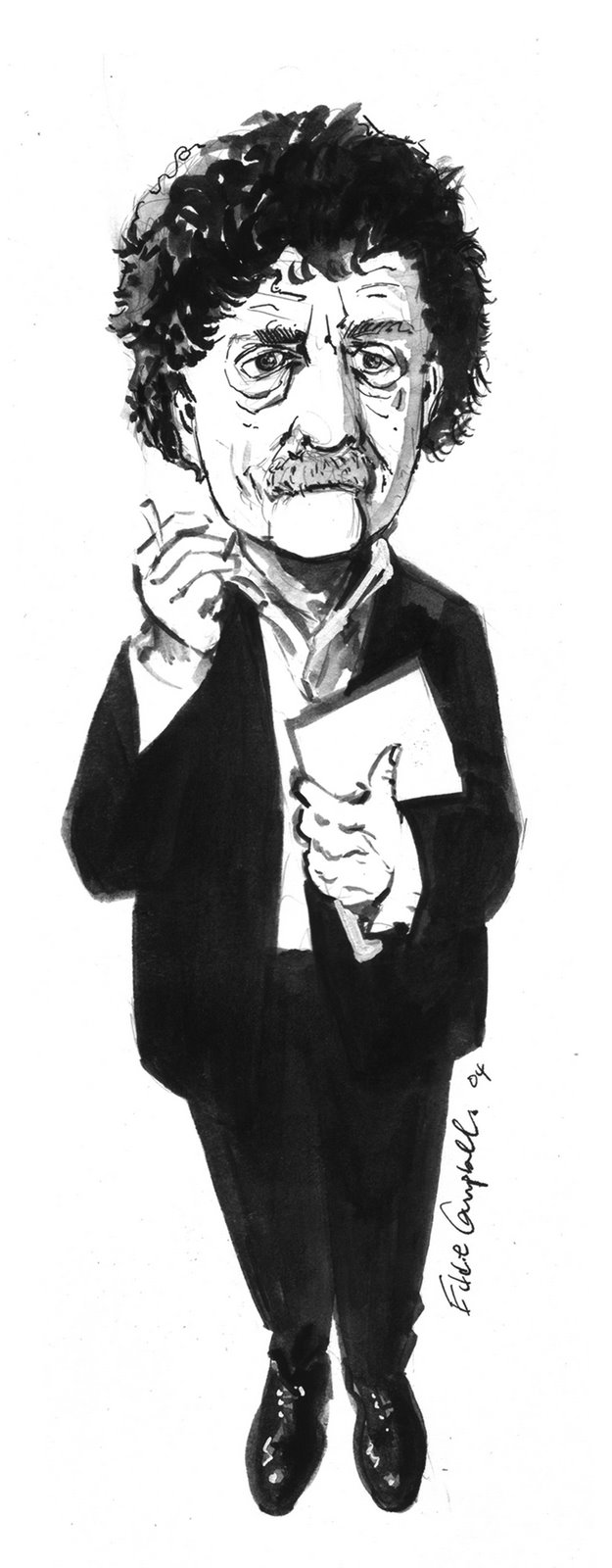
Portrait of Kurt Vonnegut — Eddie Campbell

Kurt Vonnegut

(Via).

“All Our Figments and Alogisms” | The Kafkaesque, Borgesian, Phildickian Worlds of Sigizmund Krzhizhanovsky

20130602-142757.jpg

At some point I acquired the notion, probably a fair one, that comparing writers to other writers is critically lazy. At the same time, writers write after other writers, through other writers, to other writers, against other writers, in other writers, out of other writers, on top of other writers, and so on. Literature is archaeological. And if I’m honest, a lot of the time it’s the comparison to another writer that prompts my interest in a writer I haven’t read.

Let me get to what I was getting at:

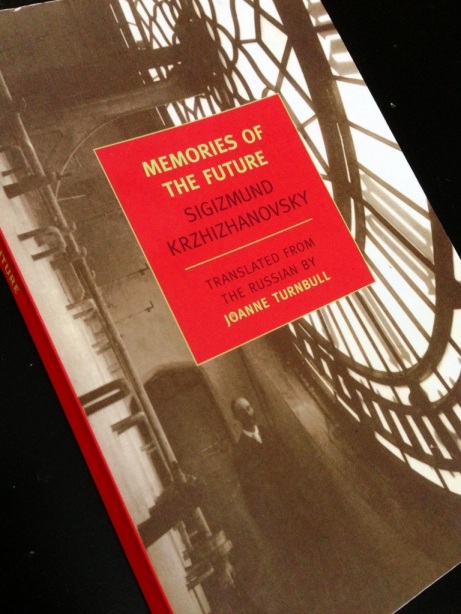
Sigizmund Krzhizhanovsky: Russian, 1887-1950: His collection Memories of the Future: Seven stories in spirited translation by Joanne Turnbull: Available in English from the good folks at NYRB: It’s the sort of book that deserves its own book. Etc.

In lieu of writing that book, quite beyond my power, I’ll compare Sigizmund Krzhizhanovsky to some other writers in the hope of piquing your interest in this neglected master.

***

KAFKAESQUE

You knew I would start here.

Four years senior to Krzhizhanovsky, Mr. Kafka of Prague was our Russian writer’s contemporary (if we want to use our postmodern imaginations). I was tempted to simply type “K” for Kafka, but they are both K. Kafkaesque is invoked frequently enough to potentially sap the adjective’s potency, but consider that the same nebulous yet very real forces that shaped (warped?) Kafka (which, in turn Kafka shaped (warped) in his own writing) shaped (warped?) Krzhizhanovsky. Unseen, displaced authority, alienation, and absurdity, yes, but also humor, the line of hysteria, the constraining order that induces madness. The nightmare of modernity.

From “The Branch Line”:

“Speaking in more modern terms,” the fine print went on, “our nightmares, weighing as they do on the brain, gradually form a sort of moral ceiling that is always about to come crashing down on one’s head: some of our customer’s call this ‘world history.’ But that’s not the point. The point is the durability, unwakeability, high depressiveness, and wide availability of our nightmares: mass-market products good for all eras and classes, nighttime and daytime, moonlight and sunlight, closed eyes and open.”

BULGAKOVIAN

If Kafka was Krzhizhanovsky’s psychical contemporary, Mikhail Bulgakov (Russian, b. 1891) is his geographic one. Both men were writing through (and to some extent, against) the Russian Revolution, rendering the crowded buzz of new Moscow in manic strokes. Humming under the surface of Bulgakov’s masterpiece The Master and Margarita is the threat of disappearance, the loss of personal space, but also absurd humor. These themes run through the seven stories collected in Memories of the Future, but perhaps evince most strongly in “Quadraturin” (maybe Krzhizhanovsky’s most famous story), where furtive bachelor Sutulin obtains a samizdat device that expands his tiny apartment—ad infinitum into limitless space and terror.

From “Quadraturin”:

In their sleep and in their fear, the occupants of the quadratures adjacent to citizen Sutulin’s eighty-six square feet couldn’t make head or tail of the timbre and intonation of the cry that woke them in teh middle of the night and compelled them to rush to the threshold of the Sutulin cell: for a man who is lost and dying in the wilderness to cry out is both futile and belated: but if even so—against all sense—he does cry out, then, most likely, thus.

BORGESIAN

So much of Kafkaesque applies to Borgesian, and perhaps I’ve quickly run up against one of the central problems of comparison: The originary: The source of the source: Primary (etc.). No matter. Krzhizhanovsky’s modernism is Borgesian: Tale-telling: nested tales, circular tales, winding tales, labyrinths and mirrors, trap doors and hidden texts (motives), narrators who tell us a story as if it’s just a distraction in the middle of some bigger story we won’t get to hear—yet. Could there be a more Borgesian title than “The Bookmark,” a tale loaded with hundreds of tales. (Okay, maybe not hundreds, but still loaded with that Scheherazade programming, that infinite looping…).

From “Someone Else’s Theme”:

And an invented person makes the greatest impression, naturally, on the seemingly not-invented, real person who, upon finding his reflection in a book, feels replaced and redoubled. This person cannot forgive his feeling of double insult: here I, a real, not-invented person, shall go to my grave and nothingness in ten or twenty years, whereas this fabricated, not-real “almost I” shall go on living and living as though it were the most natural thing in the world; more unforgivable still is the awareness that someone, some author, made you up like an arithmetic problem, what’s more he figured you out, arrived at an answer over which you struggled your entire life in vain, he divined your existence without ever having met you, he penned his way into your innermost thoughts, which you tried so hard to hide from yourself. One must refute the author and vindicate oneself. At once!

HAWTHORNESQUE

It might be easy to go to Poe for a comparison: He’s famous for his tales, and Krzhizhanovsky is a tale-master—whereas Hawthorne’s estimable short stories are often overlooked because he happened to write what may or may not be The Great American Novel. But Hawthorne’s dark romantic imagination, his weird sci-fi streak, and his wry sense of humor offer a better frame of reference for Krzhizhanovsky’s contours. Krzhizhanovsky is also fond of Hawthorne’s closing gambit, the “It-was-all-a-dream-or-hey-was-it?” maneuver. Both writers practice allegorical destabilization in their deeply darkly ironic parables. Soul detectives.

From “The Branch Line”:

He knew from experience that dreams, like the thieves in the parable, come unseen, they slip under foreheads, trying to avoid the eyes, and only there—under the cranial roof, safe and sound, sprawled the brain—do they throw off their invisibility.

DOSTOEVSKIAN

Krzhizhanovsky directly invokes several Russian writers by name, including Gogol and Turgenev, but Fyodor Dostoevsky seems to pop up the most. This makes sense. Dostoevsky is Krzhizhanovsky’s parent-writer. Or maybe Raskolnikov is. Or maybe the Underground Man is. Like Dostoevsky, Krzhizhanovsky crafts alienated loners and thrusts them into absurd moral quandaries.

From “Red Snow”:

Resignation to one’s fate takes practice. Like any art. Or so citizen Shushashin maintains. He begins every day—after putting on his shoes and washing his face, before throwing on his jacket—with an exercise. Again, the expression is his. This expression works like this: he walks over to the wall, puts his back up against it and stands there in an attitude of utter resignation. For a minute or two. And that’s all. The exercise is over. He can begin to live.

O’BRIENESQUE

Flann O’Brien’s The Third Policeman channels Crime and Punishment via the dream machines of Hawthorne, Wells, Verne et al—all elements we might find in Memories of the Future. And of course O’Brien is Kafkaesque, Borgesian, etc. The stories-within-stories, the fake philosophers, the hefty strawmen, the dreams, the nightmares…Must I draw this out?

From “The Bookmark”:

‘I remember I tossed all night, my elbows bumping against the hard theme that layers our entire life. My pen, as soon as I dipped it in ink, wrote Animal Disputans. That was the title. Next came…Perhaps this doesn’t interest you?’

‘Please go on.’

‘I took the title and the first verses of my song, if you will, from an old and long-forgotten book by the Danish humorist Holberg. This book—Nicolai Klimmi Her subterraneum, I believe it’s called—describes the fantastic adventures of a traveler who winds up, I can’t remember how, inside the Earth. The traveler is astonished to find that inside the planet, as inside a hermetically sealed vessel, lives a race with its own hermetically sealed State system, way of life, culture, everything that is customary in such cases. Over time the life of these undergroundlings—once rife with wars and conflict, cut off, hidden away beneath miles of crust—sorted itself out and settled into a harmonious routine. The problems of the hermetically sealed were all solved, everything ironed out and agreed upon. But in memory of those long-ago wars, Nicolai Klimmi tells us—no, please listen, it’s rather touching—the land’s noblest and richest magnates raised animal disputans. There isn’t anything to argue about in an isolated country where everything has been determined and predetermined in saecula saculorum but these disputants were trained for the purpose, fed a special diet that irritated the liver and sublingual nerve, then pitted against one another and forced to argue till they were hoarse and foaming at the mouth—to unanimous laughter and merry halloos from the lovers of old traditions…

PHILDICKIAN

I think we can all agree that Memories of the Future could be the title of a Philip K. Dick story, right? The story of the same title (the longest in the collection, a novella, really) strongly recalls Dick, channeling him through time travel, and Phildickian themes course throughout the book: Paranoia, identity crisis, cynicism, the realization that the waking life might conceal alternative consciousness…

From “The Branch Line”:

Haven’t we managed to unify dreams? Haven’t we hoodwinked humanity with that sweet million-brain dream of brotherhood, a united dream about unity? Flags the color of poppy petals flutter above the crowds. Reality is fighting back. But its blazing suns don’t frighten the newly ascendant underground. Sleepers’ eyes are shielded by eyelids. Yesterday’s utopia has become today’s science. We’ll break the backs of facts. We’ll rout their status quos: you’ll see those status quos turn tail and run. If an ‘I’ should rise up against our ‘we’, we’ll hurl him down a well of nightmares headfirst. We’ll hide the sun behind black blots, we’ll plunge the whole world into a deep, static slumber. We’ll even put the idea of waking to sleep, and if it resists, we’ll gouge out its eyes.

BOLAÑOESQUE

While reading Memories of the Future, I sometimes pretended that Krzhizhanovsky (and his doppelganger writer-protagonists) were versions of Boris Abramovich Ansky, the dissident Russian writer who appears (via diaries and fragments) in “The Part About Archimboldi” in Roberto Bolaño’s 2666. Sure, I brought some of that metatextual layering with me, but Krzhizhanovsky’s Borgesian stories repeatedly destabilize the notion of an authoritative narrator or storyteller, like matryoshka dolls that open into eggs that open into dreams and nightmares. Like Bolaño’s work, Krzhizhanovsky’s writing skates across an abyss of horror. The Krzhizhanovskian milieu shares psychic space with the Bolañoverse—in particular, both writers seem to love to walk their characters through graveyards.

From “The Thirteenth Category of Reason”:

That’s how it always is: first you call on your friends, and then—when the hearses have delivered them—on their graves. Now my turn too has come to exchange people for graves. The cemetery where I go more and more often lies behind high crenelated walls and looks from the outside like a fortress: only when the fighters have all fallen will the gates open. You walk in—first past a chaos of crosses, then past the inner wall—to the new crossless cemetery: gone are the monumental statics of the old human sepulchers, the massive family vaults and stone angels with their penguin-like wings grazing the earth: red metal starts on thin wire stems fidget nervously in the wind.

***

By way of conclusion, I’ll submit that Krzhizhanovsky is just as notable for his divergences from the writers I’ve listed above as he is for any similarities. There are also plenty of names that could be added to the list above, and readers of Krzhizhanovsky will likely protest that I’ve failed to underscore the political underpinnings of his writing (for the record, the seven stories in Memories of the Future clearly respond to (and in many ways protest and satirize) early Soviet politics and lifestyle, but Krzhizhanovsky’s approach is coded, oblique, and in this sense, timeless).

I’ll end with with another citation from “The Thirteenth Category of Reason,” a story that plays with Kant’s twelve categories of conception. Krzhizhanovsky’s work is always dialogic; he’s always performing voices, but occasionally one slips through that I take to be a more direct version of the author’s own. Here, Krzhizhanovsky offers a possible thesis statement for his project—his desire to write outside the confines of reason, his desire to find meaning in “all our figments and alogisms”:

For you see, all those who are off (I won’t look for another definition) or, rather, out of their heads, evicted, so to speak, from all twelve Kantian categories of reason, must naturally seek refuge in a thirteenth category, a sort of logical lean-to slouched against objective obligatory thinking. Given that the thirteenth category of reason is where we entertain, in essence, all our figments and alogisms, the old gravedigger may be useful to my projected cycle of “fantastic” stories.

That projected cycle of fantastic stories is Memories of the Future.

“The Star-Child” — Oscar Wilde

“The Star-Child” by Oscar Wilde

Once upon a time two poor Woodcutters were making their way home through a great pine-forest.  It was winter, and a night of bitter cold.  The snow lay thick upon the ground, and upon the branches of the trees: the frost kept snapping the little twigs on either side of them, as they passed: and when they came to the Mountain-Torrent she was hanging motionless in air, for the Ice-King had kissed her.

So cold was it that even the animals and the birds did not know what to make of it.

‘Ugh!’ snarled the Wolf, as he limped through the brushwood with his tail between his legs, ‘this is perfectly monstrous weather.  Why doesn’t the Government look to it?’

‘Weet! weet! weet!’ twittered the green Linnets, ‘the old Earth is dead and they have laid her out in her white shroud.’

‘The Earth is going to be married, and this is her bridal dress,’ whispered the Turtle-doves to each other.  Their little pink feet were quite frost-bitten, but they felt that it was their duty to take a romantic view of the situation.

‘Nonsense!’ growled the Wolf.  ‘I tell you that it is all the fault of the Government, and if you don’t believe me I shall eat you.’  The Wolf had a thoroughly practical mind, and was never at a loss for a good argument.

‘Well, for my own part,’ said the Woodpecker, who was a born philosopher, ‘I don’t care an atomic theory for explanations.  If a thing is so, it is so, and at present it is terribly cold.’

Terribly cold it certainly was.  The little Squirrels, who lived inside the tall fir-tree, kept rubbing each other’s noses to keep themselves warm, and the Rabbits curled themselves up in their holes, and did not venture even to look out of doors.  The only people who seemed to enjoy it were the great horned Owls.  Their feathers were quite stiff with rime, but they did not mind, and they rolled their large yellow eyes, and called out to each other across the forest, ‘Tu-whit!  Tu-whoo!  Tu-whit!  Tu-whoo! what delightful weather we are having!’ Continue reading ““The Star-Child” — Oscar Wilde”

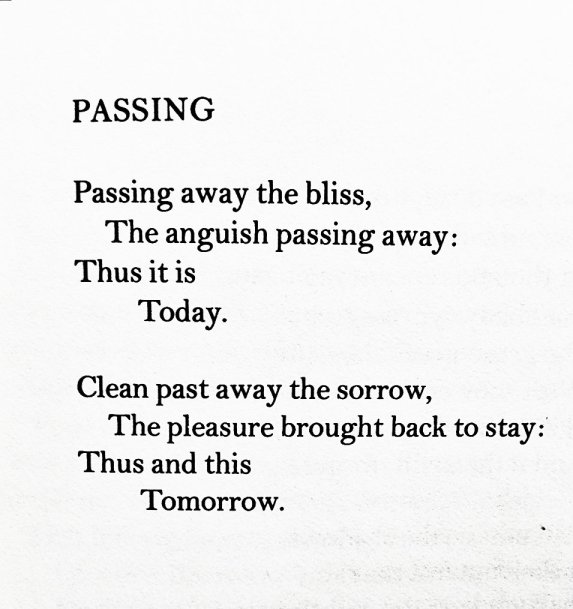
“Passing” — Christina Rossetti

passing

“Fenimore Cooper’s Literary Offenses” — Mark Twain

“Fenimore Cooper’s Literary Offenses” by Mark Twain


“The Pathfinder” and “The Deerslayer” stand at the head of Cooper’s novels as artistic creations. There are others of his works which contain parts as perfect as are to be found in these, and scenes even more thrilling. Not one can be compared with either of them as a finished whole. The defects in both of these tales are comparatively slight. They were pure works of art. 
–Professor Lounsbury


The five tales reveal an extraordinary fullness of invention. … One of the very greatest characters in fiction, Natty Bumppo… The craft of the woodsman, the tricks of the trapper, all the delicate art of the forest were familiar to Cooper from his youth up.
–Professor Matthews


Cooper is the greatest artist in the domain of romantic fiction in America.
–Wilkie Collins


It seems to me that it was far from right for the Professor of English Literature at Yale, the Professor of English Literature in Columbia, and Wilkie Collins to deliver opinions on Cooper’s literature without having read some of it. It would have been much more decorous to keep silent and let persons talk who have read Cooper.

Cooper’s art has some defects. In one place in “Deerslayer,” and in the restricted space of two-thirds of a page, Cooper has scored 114 offenses against literary art out of a possible 115. It breaks the record.

There are nineteen rules governing literary art in domain of romantic fiction — some say twenty-two. In “Deerslayer,” Cooper violated eighteen of them. These eighteen require:

1. That a tale shall accomplish something and arrive somewhere. But the “Deerslayer” tale accomplishes nothing and arrives in air.

2. They require that the episodes in a tale shall be necessary parts of the tale, and shall help to develop it. But as the “Deerslayer” tale is not a tale, and accomplishes nothing and arrives nowhere, the episodes have no rightful place in the work, since there was nothing for them to develop.

3. They require that the personages in a tale shall be alive, except in the case of corpses, and that always the reader shall be able to tell the corpses from the others. But this detail has often been overlooked in the “Deerslayer” tale.

4. They require that the personages in a tale, both dead and alive, shall exhibit a sufficient excuse for being there. But this detail also has been overlooked in the “Deerslayer” tale.

5. The require that when the personages of a tale deal in conversation, the talk shall sound like human talk, and be talk such as human beings would be likely to talk in the given circumstances, and have a discoverable meaning, also a discoverable purpose, and a show of relevancy, and remain in the neighborhood of the subject at hand, and be interesting to the reader, and help out the tale, and stop when the people cannot think of anything more to say. But this requirement has been ignored from the beginning of the “Deerslayer” tale to the end of it.

6. They require that when the author describes the character of a personage in the tale, the conduct and conversation of that personage shall justify said description. But this law gets little or no attention in the “Deerslayer” tale, as Natty Bumppo’s case will amply prove.

7. They require that when a personage talks like an illustrated, gilt-edged, tree-calf, hand-tooled, seven- dollar Friendship’s Offering in the beginning of a paragraph, he shall not talk like a negro minstrel in the end of it. But this rule is flung down and danced upon in the “Deerslayer” tale.

8. They require that crass stupidities shall not be played upon the reader as “the craft of the woodsman, the delicate art of the forest,” by either the author or the people in the tale. But this rule is persistently violated in the “Deerslayer” tale.

9. They require that the personages of a tale shall confine themselves to possibilities and let miracles alone; or, if they venture a miracle, the author must so plausibly set it forth as to make it look possible and reasonable. But these rules are not respected in the “Deerslayer” tale.

10. They require that the author shall make the reader feel a deep interest in the personages of his tale and in their fate; and that he shall make the reader love the good people in the tale and hate the bad ones. But the reader of the “Deerslayer” tale dislikes the good people in it, is indifferent to the others, and wishes they would all get drowned together.

11. They require that the characters in a tale shall be so clearly defined that the reader can tell beforehand what each will do in a given emergency. But in the “Deerslayer” tale, this rule is vacated.

In addition to these large rules, there are some little ones. These require that the author shall:

12. Say what he is proposing to say, not merely come near it.

13. Use the right word, not its second cousin.

14. Eschew surplusage.

15. Not omit necessary details.

16. Avoid slovenliness of form.

17. Use good grammar.

18. Employ a simple and straightforward style.

Even these seven are coldly and persistently violated in the “Deerslayer” tale.

Cooper’s gift in the way of invention was not a rich endowment; but such as it was he liked to work it, he was pleased with the effects, and indeed he did some quite sweet things with it. In his little box of stage-properties he kept six or eight cunning devices, tricks, artifices for his savages and woodsmen to deceive and circumvent each other with, and he was never so happy as when he was working these innocent things and seeing them go. A favorite one was to make a moccasined person tread in the tracks of a moccasined enemy, and thus hide his own trail. Cooper wore out barrels and barrels of moccasins in working that trick. Another stage-property that he pulled out of his box pretty frequently was the broken twig. He prized his broken twig above all the rest of his effects, and worked it the hardest. It is a restful chapter in any book of his when somebody doesn’t step on a dry twig and alarm all the reds and whites for two hundred yards around. Every time a Cooper person is in peril, and absolute silence is worth four dollars a minute, he is sure to step on a dry twig. There may be a hundred other handier things to step on, but that wouldn’t satisfy Cooper. Cooper requires him to turn out and find a dry twig; and if he can’t do it, go and borrow one. In fact, the Leatherstocking Series ought to have been called the Broken Twig Series. Continue reading ““Fenimore Cooper’s Literary Offenses” — Mark Twain”

Animal Disputans (Sigizmund Krzhizhanovsky)

From Sigizmund Krzhizhanovsky’s short story “The Bookmark”:

‘I remember I tossed all night, my elbows bumping against the hard theme that layers our entire life. My pen, as soon as I dipped it in ink, wrote Animal Disputans. That was the title. Next came…Perhaps this doesn’t interest you?’

‘Please go on.’

‘I took the title and the first verses of my song, if you will, from an old and long-forgotten book by the Danish humorist Holberg. This book—Nicolai Klimmi Her subterraneum, I believe it’s called—describes the fantastic adventures of a traveler who winds up, I can’t remember how, inside the Earth. The traveler is astonished to find that inside the planet, as inside a hermetically sealed vessel, lives a race with its own hermetically sealed State system, way of life, culture, everything that is customary in such cases. Over time the life of these undergroundlings—once rife with wars and conflict, cut off, hidden away beneath miles of crust—sorted itself out and settled into a harmonious routine. The problems of the hermetically sealed were all solved, everything ironed out and agreed upon. But in memory of those long-ago wars, Nicolai Klimmi tells us—no, please listen, it’s rather touching—the land’s noblest and richest magnates raised animal disputans. There isn’t anything to argue about in an isolated country where everything has been determined and predetermined in saecula saculorum but these disputants were trained for the purpose, fed a special diet that irritated the liver and sublingual nerve, then pitted against one another and forced to argue till they were hoarse and foaming at the mouth—to unanimous laughter and merry halloos from the lovers of old traditions…

“Saturday Afternoon” — Erskine Caldwell

“Saturday Afternoon” by Erskine Caldwell

Tom Denny shoved the hunk of meat out of his way and stretched out on the meat block. He wanted to lie on his back and rest. The meat block was the only comfortable place in the butcher shop where a man could stretch out and Tom just had to rest every once in a while. He could prop his foot on the edge of the block, swing the other leg across his knee and be fairly comfortable with a hunk of rump steak under his head. The meat was nice and cool just after it came from the icehouse. Tom did that. He wanted to rest himself a while and he had to be comfortable on the meat block. He kicked off his shoes so he could wiggle his toes. Tom’s butcher shop did not have a very pleasant smell. Strangers who went in to buy Tom’s meat for the first time were always asking him what it was that had died between the walls. The smell got worse and worse year after year.

Tom bit off a chew of tobacco and made himself comfortable on the meat block.

There was a swarm of flies buzzing around the place; those lazy, stinging, fat and greasy flies that lived in Tom’s butcher shop. A screen door at the front kept out some of them that tried to get inside, but if they were used to coming in and filling up on the fresh blood on the meat block they knew how to fly around to the back door where there had never been a screen.

Everybody ate Tom’s meat, and liked it. There was no other butcher shop in town. You walked in and said, “Hello, Tom. How’s everything today?” “Everything’s slick as a whistle with me, but my old woman’s got the chills and fever again.” Then after Tom had finished telling how it felt to have chills and fever, you said, “I want a pound of pork chops, Tom.” And Tom said, “By gosh, I’ll git it for you right away.” While you stood around waiting for the chops Tom turned the hunk of beef over two or three times businesslike and hacked off a pound of pork for you. If you wanted veal it was all the same to Tom. He slammed the hunk of beef around several times making a great to-do, and got the veal for you. He pleased everybody. Ask Tom for any kind of meat you could name, and Tom had it right there on the meat block waiting to be cut off and weighed. Continue reading ““Saturday Afternoon” — Erskine Caldwell”

“Of Projectors” — Daniel Defoe

“Of Projectors” by Daniel Defoe

Man is the worst of all God’s creatures to shift for himself; no other animal is ever starved to death; nature without has provided them both food and clothes, and nature within has placed an instinct that never fails to direct them to proper means for a supply; but man must either work or starve, slave or die. He has indeed reason given him to direct him, and few who follow the dictates of that reason come to such unhappy exigences; but when by the errors of a man’s youth he has reduced himself to such a degree of distress as to be absolutely without three things—money, friends, and health— he dies in a ditch, or in some worse place, a hospital.

Ten thousand ways there are to bring a man to this, and but very few to bring him out again.

Death is the universal deliverer, and therefore some who want courage to bear what they see before them, hang themselves for fear; for certainly self-destruction is the effect of cowardice in the highest extreme.

Others break the bounds of laws to satisfy that general law of nature, and turn open thieves, house-breakers, highwaymen, clippers, coiners, &c., till they run the length of the gallows, and get a deliverance the nearest way at St. Tyburn.

Others, being masters of more cunning than their neighbours, turn their thoughts to private methods of trick and cheat, a modern way of thieving every jot as criminal, and in some degree worse than the other, by which honest men are gulled with fair pretences to part from their money, and then left to take their course with the author, who skulks behind the curtain of a protection, or in the Mint or Friars, and bids defiance as well to honesty as the law.

Others, yet urged by the same necessity, turn their thoughts to honest invention, founded upon the platform of ingenuity and integrity.

These two last sorts are those we call projectors; and as there was always more geese than swans, the number of the latter are very inconsiderable in comparison of the former; and as the greater number denominates the less, the just contempt we have of the former sort bespatters the other, who, like cuckolds, bear the reproach of other people’s crimes.

A mere projector, then, is a contemptible thing, driven by his own desperate fortune to such a strait that he must be delivered by a miracle, or starve; and when he has beat his brains for some such miracle in vain, he finds no remedy but to paint up some bauble or other, as players make puppets talk big, to show like a strange thing, and then cry it up for a new invention, gets a patent for it, divides it into shares, and they must be sold. Ways and means are not wanting to swell the new whim to a vast magnitude; thousands and hundreds of thousands are the least of his discourse, and sometimes millions, till the ambition of some honest coxcomb is wheedled to part with his money for it, and then (nascitur ridiculus mus) the adventurer is left to carry on the project, and the projector laughs at him. The diver shall walk at the bottom of the Thames, the saltpetre maker shall build Tom T-d’s pond into houses, the engineers build models and windmills to draw water, till funds are raised to carry it on by men who have more money than brains, and then good-night patent and invention; the projector has done his business and is gone.

But the honest projector is he who, having by fair and plain principles of sense, honesty, and ingenuity brought any contrivance to a suitable perfection, makes out what he pretends to, picks nobody’s pocket, puts his project in execution, and contents himself with the real produce as the profit of his invention.

A Scholar Seated at a Table with Books — Rembrandt

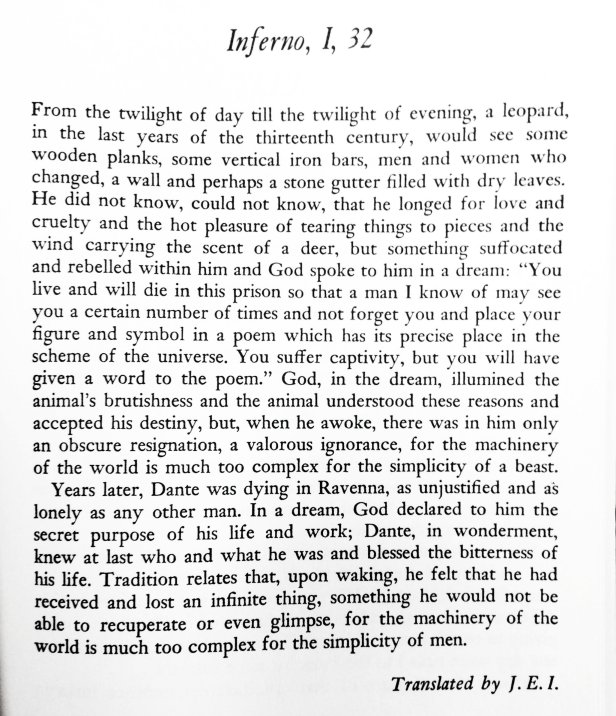
“Inferno, I, 32” — Jorge Luis Borges

jlb

Dante and Virgil — Camille Corot

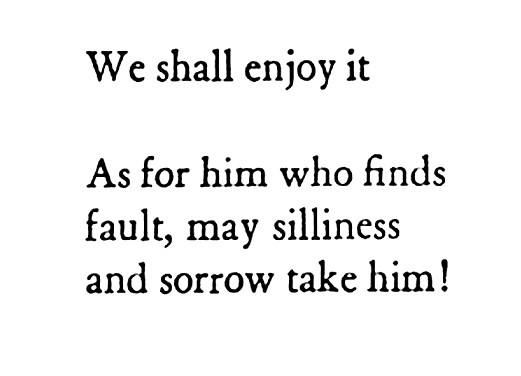
We shall enjoy it (Sappho)

Capture

Smoking Makes You Look Cool (Part III)

Clarice Lispector
Clarice Lispector
conrad
Joseph Conrad
james baldwin
James Baldwin
Barry Hannah
Barry Hannah
art spiegelman
Art Spiegelman
paul bowles
Paul Bowles
langston hughes
Langston Hughes
images (1)
Patricia Highsmith
T.S._Eliot,_1923
T.S.Eliot

(Parts I and II (don’t worry, everyone already yelled at me re: “smoking unhealthy,” etc., and yes, whole post was probably just an excuse to run that pic of Lispector)).


“Of Superstition” — Francis Bacon

“Of Superstition” by Francis Bacon

IT WERE better to have no opinion of God at all, than such an opinion, as is unworthy of him. For the one is unbelief, the other is contumely; and certainly superstition is the reproach of the Deity. Plutarch saith well to that purpose: Surely (saith he) I had rather a great deal, men should say, there was no such man at all, as Plutarch, than that they should say, that there was one Plutarch, that would eat his children as soon as they were born; as the poets speak of Saturn. And as the contumely is greater towards God, so the danger is greater towards men. Atheism leaves a man to sense, to philosophy, to natural piety, to laws, to reputation; all which may be guides to an outward moral virtue, though religion were not; but superstition dismounts all these, and erecteth an absolute monarchy, in the minds of men. Therefore theism did never perturb states; for it makes men wary of themselves, as looking no further: and we see the times inclined to atheism (as the time of Augustus Caesar) were civil times. But superstition hath been the confusion of many states, and bringeth in a new primum mobile, that ravisheth all the spheres of government. The master of superstition, is the people; and in all superstition, wise men follow fools; and arguments are fitted to practice, in a reversed order. It was gravely said by some of the prelates in the Council of Trent, where the doctrine of the Schoolmen bare great sway, that the Schoolmen were like astronomers, which did feign eccentrics and epicycles, and such engines of orbs, to save the phenomena; though they knew there were no such things; and in like manner, that the Schoolmen had framed a number of subtle and intricate axioms, and theorems, to save the practice of the church. The causes of superstition are: pleasing and sensual rites and ceremonies; excess of outward and pharisaical holiness; overgreat reverence of traditions, which cannot but load the church; the stratagems of prelates, for their own ambition and lucre; the favoring too much of good intentions, which openeth the gate to conceits and novelties; the taking an aim at divine matters, by human, which cannot but breed mixture of imaginations: and, lastly, barbarous times, especially joined with calamities and disasters. Superstition, without a veil, is a deformed thing; for, as it addeth deformity to an ape, to be so like a man, so the similitude of superstition to religion, makes it the more deformed. And as wholesome meat corrupteth to little worms, so good forms and orders corrupt, into a number of petty observances. There is a superstition in avoiding superstition, when men think to do best, if they go furthest from the superstition, formerly received; therefore care would be had that (as it fareth in ill purgings) the good be not taken away with the bad; which commonly is done, when the people is the reformer.


“Exotic smoking practices around the world, of great anthropological value!” (Pynchon’s Against the Day)

Observers of the Fair had remarked how, as one moved up and down its Midway, the more European, civilized, and . . . well, frankly, white exhibits located closer to the center of the “White City” seemed to be, whereas the farther from that alabaster Metropolis one ventured, the more evident grew the signs of cultural darkness and savagery. To the boys it seemed that they were making their way through a separate, lampless world, out beyond some obscure threshold, with its own economic life, social habits, and codes, aware of itself as having little if anything to do with the official Fair. . . . As if the halflight ruling this perhaps even unmapped periphery were not a simple scarcity of streetlamps but deliberately provided in the interests of mercy, as a necessary veiling for the faces here, which held an urgency somehow too intense for the full light of day and those innocent American visitors with their Kodaks and parasols who might somehow happen across this place. Here in the shadows, the faces moving by smiled, grimaced, or stared directly at Lindsay and Miles as if somehow they knew them, as if in the boys’ long career of adventure in exotic corners of the world there had been accumulating, unknown to them, a reserve of mistranslation, offense taken, debt entered into, here being reexpressed as a strange Limbo they must negotiate their way through, expecting at any moment a “runin” with some enemy from an earlier day, before they might gain the safety of the lights in the distance.

Armed “bouncers,” drawn from the ranks of the Chicago police, patrolled the shadows restlessly. A Zulu theatrical company reenacted the massacre of British troops at Isandhlwana. Pygmies sang Christian hymns in the Pygmy dialect, Jewish klezmer ensembles filled the night with unearthly clarionet solos, Brazilian Indians allowed themselves to be swallowed by giant anacondas, only to climb out again, undigested and apparently with no discomfort to the snake. Indian swamis levitated, Chinese boxers feinted, kicked, and threw one another to and fro.

Temptation, much to Lindsay’s chagrin, lurked at every step. Pavilions here seemed almost to represent not nations of the world but Deadly Sins.   Pitchmen in their efforts at persuasion all but seized the ambulant youths by their lapels.

“Exotic smoking practices around the world, of great anthropological value!”

“Scientific exhibit here boys, latest improvements to the hypodermic syringe and its many uses!”

Here were Waziris from Waziristan exhibiting upon one another various techniques for waylaying travelers, which reckoned in that country as a major source of income. . . . Tarahumara Indians from northern Mexico crouched, apparently in total nakedness, inside lathandplaster replicas of the caves of their native Sierra Madre, pretending to eat visionproducing cacti that sent them into dramatic convulsions scarcely distinguishable from those of the common “geek” long familiar to American carnivalgoers. . . . Tungus reindeer herders stood gesturing up at a gigantic sign reading SPECIAL REINDEER SHOW, and calling out in their native tongue to the tip gathered in front, while a pair of young women in quite revealing costumes—who, being blonde and so forth, did not, actually, appear to share with the Tungus many racial characteristics—gyrated next to a very patient male reindeer, caressing him with scandalous intimacy, and accosting passersby with suggestive phrases in English, such as “Come in and learn dozens ways to have fun in Siberia!” and “See what really goes on during long winter nights!”

“This doesn’t seem,” Lindsay adrift between fascination and disbelief, “quite . . . authentic, somehow.”

An early episode from Thomas Pynchon’s novel Against the Day; here, the Chums of Chance have flown to Chicago to visit the “World’s Columbian Exposition recently opened there;” Lindsay Noseworth and Miles Blundell fearlessly go beyond “the fabled ‘White City,’ its great Ferris wheel, alabaster temples of commerce and industry, sparkling lagoons, and the thousand more such wonders, of both a scientific and an artistic nature.”

Conversation with Smaug — J.R.R. Tolkien

smaug tolkien