The fact that Henry Armstrong was buried did not seem to him to prove that he was dead: he had always been a hard man to convince. That he really was buried, the testimony of his senses compelled him to admit. His posture – flat upon his back, with his hands crossed upon his stomach and tied with something that he easily broke without profitably altering the situation – the strict confinement of his entire person, the black darkness and profound silence, made a body of evidence impossible to controvert and he accepted it without cavil.
But dead – no; he was only very, very ill. He had, withal, the invalid’s apathy and did not greatly concern himself about the uncommon fate that had been allotted to him. No philosopher was he – just a plain, commonplace person gifted, for the time being, with a pathological indifference: the organ that he feared consequences with was torpid. So, with no particular apprehension for his immediate future, he fell asleep and all was peace with Henry Armstrong.
But something was going on overhead. It was a dark summer night, shot through with infrequent shimmers of lightning silently firing a cloud lying low in the west and portending a storm. These brief, stammering illuminations brought out with ghastly distinctness the monuments and headstones of the cemetery and seemed to set them dancing. It was not a night in which any credible witness was likely to be straying about a cemetery, so the three men who were there, digging into the grave of Henry Armstrong, felt reasonably secure.
Two of them were young students from a medical college a few miles away; the third was a gigantic negro known as Jess. For many years Jess had been employed about the cemetery as a man-of-all-work and it was his favorite pleasantry that he knew “every soul in the place.” From the nature of what he was now doing it was inferable that the place was not so populous as its register may have shown it to be.
Outside the wall, at the part of the grounds farthest from the public road, were a horse and a light wagon, waiting.
The work of excavation was not difficult: the earth with which the grave had been loosely filled a few hours before offered little resistance and was soon thrown out. Removal of the casket from its box was less easy, but it was taken out, for it was a perquisite of Jess, who carefully unscrewed the cover and laid it aside, exposing the body in black trousers and white shirt. At that instant the air sprang to flame, a cracking shock of thunder shook the stunned world and Henry Armstrong tranquilly sat up. With inarticulate cries the men fled in terror, each in a different direction. For nothing on earth could two of them have been persuaded to return. But Jess was of another breed.
In the gray of the morning the two students, pallid and haggard from anxiety and with the terror of their adventure still beating tumultuously in their blood, met at the medical college.
“You saw it?” cried one.
“God! yes – what are we to do?”
They went around to the rear of the building, where they saw a horse, attached to a light wagon, hitched to a gatepost near the door of the dissecting-room. Mechanically they entered the room. On a bench in the obscurity sat the negro Jess. He rose, grinning, all eyes and teeth.
“I’m waiting for my pay,” he said.
Stretched naked on a long table lay the body of Henry Armstrong, the head defiled with blood and clay from a blow with a spade.
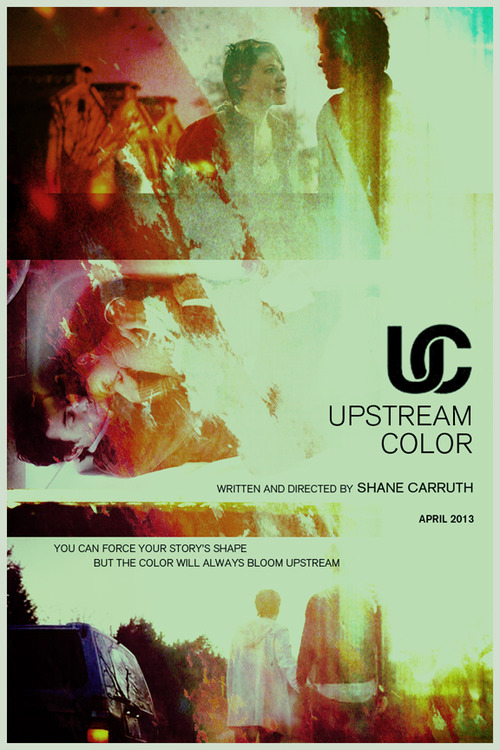
1. I managed to avoid reading anything about Shane Carruth’s new film Upstream Color before I saw it.
I just knew that this was the guy who did Primer, this was his new film, and I wanted to see it because Primer was so strange and engaging.
2. Two immediate responses after viewing Upstream Color:
i). The desire to see Upstream Color again and
ii). The desire to read what other people thought about Upstream Color.
3. (My wife and I, reading the credits, pausing the credits, reassessing the film against the backdrop of the credits, arguing about the film, discussing the film, etc.).
4. I think it’s better that if you have any interest at all in Upstream Color that you just see it cold [update/warning: the comments section of this post is full of spoilers]. But I know that 100 minutes is an investment of time, so maybe you’d like some kind of précis or at least description. So, a loose attempt, which surely will devolve into fragments and references:
Upstream Color is a sci-film, sort of.
Or maybe its a mystery film about ethics and biology.
Maybe a nature film, sort of.
Henry David Thoreau’s Walden.
Worms—parasites.
Theft.
Pigs.
Shades of Philip K. Dick, David Cronenberg, Terence Malick, but also something utterly original.
Mind control.
Trauma.
Ambient music.
Orchids.
Sampling nature.
Memory.
Swimming.
Drowning.
Creation: knitting, paper chains, music, seeds, life, children, etc.
A film that can and should be described as poetic.
It’s a love story, too.
5. It occurs to me that there’s a trailer for the film. I haven’t seen it yet. Should we watch it?
6. Does that do it for you? I don’t know how to do this anymore. Recommend things. I don’t know, the trailer makes the film perhaps look more pretentious than it is. It isn’t pretentious. It isn’t even confusing—just perplexing, haunting, troubling.
7. (Wanted: Quinoa Valley Record Co., complete discography).
8. My take on Upstream Color, spoiler-free, supporting-detail-free:
The film is about agency, about drive, about how the characters (and, implicitly, us, we, the audience, who identify with the characters on the screen) may be driven by something beyond us, something controlling us like a parasite (internal) or from afar like a ventriloquist (external). That even when we do assert agency the effect, the fallout, the shape lays beyond us, upstream.
9. (This morning, my wife telling me about her dream, a nightmare that our young daughter had ingested hallucinogenic mushrooms, clearly a response to the film).
10. I haven’t done a good job of really saying anything about the film. So, lazily:
I think Caleb Crain provides a perceptive and persuasive reading of the film in his essay “The Thoreau Poison.” He reads the film through the American transcendentalists, particularly Thoreau, of course, but also Emerson and Hawthorne.
There’s also a piece at Slate by Forrest Wickman that perhaps over-explicates but nonetheless offers perspective, including elements of Carruth’s own take.
11. (I will avoid Carruth’s explanation of the film until I’ve seen it a second time. Maybe I’ll avoid his explanation forever).
12. A take on Upstream Color that I don’t quite buy into (the take is my own): The film perhaps invites us to find metaphysical entities in two of its secondary characters, both of whom exert influence (creative and destructive) over the primary characters. Something something godlike, something something devillike.
I like that the film offers this simple duality and then crushes it, shows something far more complicated, suggests a cycle far more strange.
13. (White orchid. Blue orchid. Yellow orchid).
14. Upstream Color features minimal dialogue and nothing approaching traditional exposition, but we still learn about its characters, come to feel for them, feel their desires and traumas. The film is cerebral and philosophical, but it’s also emotional, offering an aesthetic that sublimely overwhelms the viewer.
15. Carruth wrote, produced, directed, scored, photographed, cast and starred in Upstream Color. (I’m sure he did a lot of other stuff too). He also distributed the film himself. The entire filmmaking process was untouched by the Hollywood system. There’s so much hope for film as an art form in this knowledge.
16. Parting thoughts: See Upstream Color. Resist imposing whatever film grammar you usually bring with you to the movies. Resist the temptation to see the film as a puzzle to figure out. See Upstream Color.
What are fairy stories for? Freud gave an answer – they were related to daydreams and wish-fulfilment fantasies, in which the questing self meets helpers and enemies, and in which the ending is always happy. He wondered if myths were the “secular dreams of youthful humanity” but distinguished myths from fairy tales by claiming that myth is “related to disaster”. It can also be argued that myth is related to the human need to know what was before, and what will be after the individual life, the living society. Myths are concerned with origins, the fear of death, and the hope for the overcoming of death in another world. The universe of Asgard and Valhalla, of Olympus and Hades, is not the fairy-tale unreal world with its visiting suns and moons, castles and undifferentiated forests. We don’t put it together in our imaginations in the same way. There is neither explanation nor teaching in the true wonder tale.
Other things which are not essentially part of true fairy tales are character, psychological causation, and real morality. Princesses are virtually interchangeable – they are either kind and modest and housewifely, or vain and stupid and inconsiderate. They are called “princesses” but peasants and merchants’ daughters have the same limited and recognisable natures. Simpletons and gallant princes have the same chance of solving riddles, obtaining magic feathers, or keys, the same insect or fishy helpers. Lazy girls are caught out by boasts that they can spin flax into gold, and are helped by strange brownies, or dwarves, or other creatures. The best single description I know of the world of the fairy tale is that of Max Lüthi who describes it as an abstract world, full of discrete, interchangeable people, objects and incidents, all of which are isolated and are nevertheless interconnected, in a kind of web or network of two-dimensional meaning. Everything in the tales appears to happen entirely by chance – and this has the strange effect of making it appear that nothing happens by chance, that everything is fated.
We were stationed in the little town of N—-. The life of an officer in the army is well known. In the morning, drill and the riding-school; dinner with the Colonel or at a Jewish restaurant; in the evening, punch and cards. In N—- there was not one open house, not a single marriageable girl. We used to meet in each other’s rooms, where, except our uniforms, we never saw anything.
One civilian only was admitted into our society. He was about thirty-five years of age, and therefore we looked upon him as an old fellow. His experience gave him great advantage over us, and his habitual taciturnity, stern disposition and caustic tongue produced a deep impression upon our young minds. Some mystery surrounded his existence; he had the appearance of a Russian, although his name was a foreign one. He had formerly served in the Hussars, and with distinction. Nobody knew the cause that had induced him to retire from the service and settle in a wretched little village, where he lived poorly and, at the same time, extravagantly. He always went on foot, and constantly wore a shabby black overcoat, but the officers of our regiment were ever welcome at his table. His dinners, it is true, never consisted of more than two or three dishes, prepared by a retired soldier, but the champagne flowed like water. Nobody knew what his circumstances were, or what his income was, and nobody dared to question him about them. He had a collection of books, consisting chiefly of works on military matters and a few novels. He willingly lent them to us to read, and never asked for them back; on the other hand, he never returned to the owner the books that were lent to him. His principal amusement was shooting with a pistol. The walls of his room were riddled with bullets, and were as full of holes as a honey-comb. A rich collection of pistols was the only luxury in the humble cottage where he lived. The skill which he had acquired with his favourite weapon was simply incredible; and if he had offered to shoot a pear off somebody’s forage-cap, not a man in our regiment would have hesitated to place the object upon his head.
Our conversation often turned upon duels. Silvio — so I will call him — never joined in it. When asked if he had ever fought, he drily replied he had; but he entered into no particulars, and it was evident that such questions were not to his liking. We came to the conclusion that he had upon his conscience the memory of some unhappy victim of his terrible skill. Moreover, it never entered into the head of any of us to suspect him of anything like cowardice. There are persons whose mere look is sufficient to repel such a suspicion. But an unexpected incident occurred which astounded us all.
One day, about ten of our officers dined with Silvio. They drank as usual, that is to say, a great deal. After dinner we asked our host to hold the bank for a game at faro. For a long time he refused, for he hardly ever played, but at last he ordered cards to be brought, placed half a hundred ducats upon the table, and sat down to deal. We took our places round him, and the play began. It was Silvio’s custom to preserve a complete silence when playing. He never disputed, and never entered into explanations. If the punter made a mistake in calculating, he immediately paid him the difference or noted down the surplus. We were acquainted with this habit of his, and we always allowed him to have his own way; but among us on this occasion was an officer who had only recently been transferred to our regiment. During the course of the game, this officer absently scored one point too many. Silvio took the chalk and noted down the correct account according to his usual custom. The officer, thinking that he had made a mistake, began to enter into explanations. Silvio continued dealing in silence. The officer, losing patience, took the brush and rubbed out what he considered was wrong. Silvio took the chalk and corrected the score again. The officer, heated with wine, play, and the laughter of his comrades, considered himself grossly insulted, and in his rage he seized a brass candlestick from the table, and hurled it at Silvio, who barely succeeded in avoiding the missile. We were filled with consternation. Silvio rose, white with rage, and with gleaming eyes, said:
Near Rattlesnake Creek, on the side of a little draw stood Canute’s shanty. North, east, south, stretched the level Nebraska plain of long rust-red grass that undulated constantly in the wind. To the west the ground was broken and rough, and a narrow strip of timber wound along the turbid, muddy little stream that had scarcely ambition enough to crawl over its black bottom. If it had not been for the few stunted cottonwoods and elms that grew along its banks, Canute would have shot himself years ago. The Norwegians are a timber-loving people, and if there is even a turtle pond with a few plum bushes around it they seem irresistibly drawn toward it.
As to the shanty itself, Canute had built it without aid of any kind, for when he first squatted along the banks of Rattlesnake Creek there was not a human being within twenty miles. It was built of logs split in halves, the chinks stopped with mud and plaster. The roof was covered with earth and was supported by one gigantic beam curved in the shape of a round arch. It was almost impossible that any tree had ever grown in that shape. The Norwegians used to say that Canute had taken the log across his knee and bent it into the shape he wished. There were two rooms, or rather there was one room with a partition made of ash saplings interwoven and bound together like big straw basket work. In one corner there was a cook stove, rusted and broken. In the other a bed made of unplaned planks and poles. It was fully eight feet long, and upon it was a heap of dark bed clothing. There was a chair and a bench of colossal proportions. There was an ordinary kitchen cupboard with a few cracked dirty dishes in it, and beside it on a tall box a tin washbasin. Under the bed was a pile of pint flasks, some broken, some whole, all empty. On the wood box lay a pair of shoes of almost incredible dimensions. On the wall hung a saddle, a gun, and some ragged clothing, conspicuous among which was a suit of dark cloth, apparently new, with a paper collar carefully wrapped in a red silk handkerchief and pinned to the sleeve. Over the door hung a wolf and a badger skin, and on the door itself a brace of thirty or forty snake skins whose noisy tails rattled ominously every time it opened. The strangest things in the shanty were the wide windowsills. At first glance they looked as though they had been ruthlessly hacked and mutilated with a hatchet, but on closer inspection all the notches and holes in the wood took form and shape. There seemed to be a series of pictures. They were, in a rough way, artistic, but the figures were heavy and labored, as though they had been cut very slowly and with very awkward instruments. There were men plowing with little horned imps sitting on their shoulders and on their horses’ heads. There were men praying with a skull hanging over their heads and little demons behind them mocking their attitudes. There were men fighting with big serpents, and skeletons dancing together. All about these pictures were blooming vines and foliage such as never grew in this world, and coiled among the branches of the vines there was always the scaly body of a serpent, and behind every flower there was a serpent’s head. It was a veritable Dance of Death by one who had felt its sting. In the wood box lay some boards, and every inch of them was cut up in the same manner. Sometimes the work was very rude and careless, and looked as though the hand of the workman had trembled. It would sometimes have been hard to distinguish the men from their evil geniuses but for one fact, the men were always grave and were either toiling or praying, while the devils were always smiling and dancing. Several of these boards had been split for kindling and it was evident that the artist did not value his work highly.
It was the first day of winter on the Divide. Canute stumbled into his shanty carrying a basket of cobs, and after filling the stove, sat down on a stool and crouched his seven foot frame over the fire, staring drearily out of the window at the wide gray sky. He knew by heart every individual clump of bunch grass in the miles of red shaggy prairie that stretched before his cabin. He knew it in all the deceitful loveliness of its early summer, in all the bitter barrenness of its autumn. He had seen it smitten by all the plagues of Egypt. He had seen it parched by drought, and sogged by rain, beaten by hail, and swept by fire, and in the grasshopper years he had seen it eaten as bare and clean as bones that the vultures have left. After the great fires he had seen it stretch for miles and miles, black and smoking as the floor of hell. Continue reading ““On the Divide” — Willa Cather”→
Out fifteen miles below Monterey, on the wild coast, the Torres family had their farm, a few sloping acres above a cliff that dropped to the brown reefs and to the hissing white waters of the ocean. Behind the farm the stone mountains stood up against the sky. The farm buildings huddled like the clinging aphids on the mountain skirts, crouched low to the ground as though the wind might blow them into the sea. The little shack, the rattling, rotting barn were gray-bitten with sea salt, beaten by the damp wind until they had taken on the color of the granite hills. Two horses, a red cow and a red calf, half a dozen pigs and a flock of lean, multicolored chickens stocked the place. A little corn was raised on the sterile slope, and it grew short and thick under the wind, and all the cobs formed on the landward sides of the stalks.
Mama Torres, a lean, dry woman with ancient eyes, had ruled the farm for ten years, ever since her husband tripped over a stone in the field one day and fell full length on a rattlesnake. When one is bitten on the chest there is not much that can be done.
Mama Torres had three children, two undersized black ones of twelve and fourteen, Emilio and Rosy, whom Mama kept fishing on the rocks below the farm when the sea was kind and when the truant officer was in some distant part of Monterey County. And there was Pepe, the tall smiling son of nineteen, a gentle, affectionate boy, but very lazy. Pepe had a tall head, pointed at the top, and from its peak coarse black hair grew down like a thatch all around. Over his smiling little eyes Mama cut a straight bang so he could see. Pepe had sharp Indian cheekbones and an eagle nose, but his mouth was as sweet and shapely as a girl’s mouth, and his chin was fragile and chiseled. He was loose and gangling, all legs and feet and wrists, and he was very lazy. Mama thought him fine and brave, but she never told him so. She said, “Some lazy cow must have got into thy father’s family, else how could I have a son like thee.” And she said, “When I carried thee, a sneaking lazy coyote came out of the brush and looked at me one day. That must have made thee so.”
Pepe smiled sheepishly and stabbed at the ground with his knife to keep the blade sharp and free from rust. It was his inheritance, that knife, his father’s knife. The long heavy blade folded back into the black handle. There was a button on the handle. When Pepe pressed the button, the blade leaped out ready for use. The knife was with Pepe always, for it had been his father’s knife.
One sunny morning when the sea below the cliff was glinting and blue and the white surf creamed on the reef, when even the stone mountains looked kindly, Mama Torres called out the door of the shack, “Pepe, I have a labor for thee.”
There was no answer. Mama listened. From behind the barn she heard a burst of laughter. She lifted her full long skirt and walked in the direction of the noise.
Pepe was sitting on the ground with his back against a box. His white teeth glistened. On either side of him stood the two black ones, tense and expectant. Fifteen feet away a redwood post was set in the ground. Pepe’s right hand lay limply in his lap, and in the palm the big black knife rested. The blade was closed back into the handle. Pepe looked smiling at the sky.
Suddenly Emilio cried, “Ya!”
Pepe’s wrist flicked like the head of a snake. The blade seemed to fly open in midair, and with a thump the point dug into the redwood post, and the black handle quivered. The three burst into excited laughter. Rosy ran to the post and pulled out the knife and brought it back to Pepe. He closed the blade and settled the knife carefully in his listless palm again. He grinned self-consciously at the sky.
Ilan Stavans is a Mexican-American writer and translator. His work spans from the study of Latin American culture, to “Spanglish,” to translation; his work takes the form of books and comic-strips; and he is highly regarded internationally as a literary and cultural critic and has received numerous awards and honors. He is the Lewis-Sebring Professor in Latin American and Latino Culture at Amherst College.
I recently had the opportunity to sit down with Stavans at Amherst’s Frost Library to discuss The Plain in Flames, his 2012 translation of Juan Rulfo’s short story collection, El Llano en Llamas.His is the second translation of this work into English, the first being George Schade’s The Burning Plain.
Juan Rulfo, a highly influential Mexican writer, was born on this date 96 years ago. He died in 1986. Stavans introduces Rulfo beautifully here.
You mention in the introduction your fascination with the book growing up. When did you first read El Llano en Llamas, and when did the translation project begin?
Growing up in Mexico in the 70s and 80s, Rulfo was already an established figure, a classic. When I first discovered Latin American literature in general, reading One Hundred Years of Solitude, Hopscotch, Conversation in the Cathedral, and other important books of the 1960s and 70s, to which I was coming somewhat late, maybe a decade or so after they had been published, there was a constant reference, a constant moving around the figure that had fostered that type of new writing from Latin America. More than one figure, there were two or three to be honest – one of them was Borges, another one was unquestionably Juan Rulfo.
Juan Rulfo was by then already known as a man of very few words. He had published only two books: El Llano en Llamas and Pedro Páramo, a collection of short stories first, and two years later, a relatively short novel – and I say relatively short because, in that period that I am recalling, the novels that were coming out from Latin America were hefty and ambitious and epic, and this was ambitious and epic and hefty but short. It had myth as its main quest. And, you know, there are writers that you read, you enjoy, and you forget. And then there are writers that you read and you are transformed. Rulfo, from the moment I discovered him is … in very few words, in very few pages, he’s capable of creating an entire world, entirely complex and entirely vivid in its imagery. And growing up in Mexico, that world was very close to me. It is the world of the countryside, of the provinces; it is the world of pride, and proud working- class people living in the llanos, in the villages, outside of Mexico City.
And so I had a reference, I knew what he was writing about. And I also knew that he was writing about it in a way that, for us, illuminated their existence, if you would see them as simply part of the landscape. Now it was giving them an inner life. It was simply stunning.
I went beyond and wanted to meet Rulfo at one point. I knew that he was the head of El Instituto Indigenista, an institute created and devoted to fostering a better understanding of aboriginal and indigenous communities and indigenous cultures, but it was always very hard to get in touch with him. He was never in the office. And only as time went by did I discover how difficult it was to get to talk to him because of his reserve, his shyness.
He is one of the towering figures of Latin American literature.
Did you ever get a chance to meet him?
I saw him in an event, but I never talked one-on-one to him. In retrospect, it is… it’s fine [laughs]. I find sometimes that talking to writers that one admires is a difficult task.
Was his speaking rhetoric like his writing?
He was a man of very few words. Even when he was…
…in front of the microphone.
But he was a man that, when you saw him, you would not think necessarily that he would be able to create these astonishing stories. I think the stories are part and parcel of how Latin American reality should be understood.
Garcia Márquez, in an entire novel, One Hundred Years of Solitude, can make you understand what is it in the DNA of the culture that makes it move. I think that Rulfo does that in one story, sometimes in one paragraph. Not surprisingly, Garcia Márquez sees Rulfo as a major influence.
When did the translation of this begin?
At one point I was doing a book of conversations that a Chilean historian had invited me to engage in on Hispanic culture; it’s called What is la hispanidad?. It was a very festive project. In delivering it to the publisher, who had already given us a contract, the editor said to me, “Would you consider doing some translations for me?” And I said, I love translation; it would have to be something precious, it would have to be a diamond or a jewel. “What do you have in mind?” And I said, if you had, Ilan, to choose the one book that you think you would like to translate and you think people should see differently, which one would that be? And I said without hesitation, El Llano en Llamas. They had published it in an earlier edition.
So I had started the conversation, and one thing led to another; he got in touch with the Juan Rulfo estate. The Juan Rulfo estate is partially run by one of his sons who is a filmmaker. I was asked to translate one of the stories to see how my translation would be different. I did “It’s Because We’re So Poor.” They liked it very much and we decided to do it.
The project altogether took a year and a half; the translation was commissioned in 2010, thereabouts.
It’s Because We’re So Poor – Lauren Flinner
You said you wanted to pick a gem. But was there any indication to you that it was in need of a newtranslation? Because The Burning Plain has been out since 1967. I’m wondering if you thought that that translationwas merely dated, or if you think there is an historical significance in publishing it in 2012, and if there were any faults in The Burning Plain that you noticed.
Let me answer that question by taking a step back and telling you that over the years I have been very interested in translation, not only in the practice of translation, but what translation means for us as a culture, the history of translation, and the impact of translation in the shaping of Latin American identity. Who were the first translators? What role did they play upon the arrival of the conquistadors and the missionaries? How has translating foreign culture shaped Latin American civilization? Who did the 19th century politicians read… of the French, or of the British, or of the Italian politicians of the time, or political philosophers? So the idea of translation has been with me for quite some time.
I also, in 2001, published an autobiography, a memoir, called On Borrowed Words, that is an investigation of the life that I have lived in four different languages. My first language was Yiddish, then I switched to Spanish, and then switched to Hebrew, and now I’m communicating with you in English. So this coming and going of languages is very close to my heart.
In 2003, I, by then, was already really deep into the study of Spanglish, the mixing of Spanish and English. I had published a translation into Spanglish of the first chapter of Don Quixote that later on I finished, and it’s now coming out in comic strip form at the end of this year. And so, the idea of what we translate, how we translate, what the impact of translation is, was very much with me when the editor of Texas University Press suggested this project.
And I knew that classics are books that need to be reread. And that, when doing a new translation, you are inviting readers to reread the book. You are not supplanting, necessarily, the first, earlier translations; you’re inviting readers to see them anew. Dressing them up in a different way. There are 22 full translations of Don Quixote into English. And so the question is, do we need 22? And the answer is, well, every generation needs its own reading of Don Quixote. And I think El Llano en Llamas is a classic; it needs different approaches, different interpretations, and that’s why I wanted to do it.
I had my own qualms with the translation that had been published in 1967, but more than anything I wanted to bring new attention to the book, try my luck, and also, show that the English language has changed, and that the approaches to translation have changed since the 60s.
I noticed, in The Plain in Flames, certain Spanish words are italicized. Whereas, in The Burning Plain, words like “chicalote” and “jarillas” are not italicized. They seem to be more integrated into the text that way. Does that ignore their origin?
No… I don’t believe that that is fully accurate. I did actually the opposite in many cases. There were words that were not italicized in my translation that are italicized in the George Schade translation because they had become much more common; they are less foreign from the 1960s to 2012; Spanish has become commonplace, a common language in the United States, and my argument is that in doing a new translation, we are reaching a readership that doesn’t have the foreignness, or the kind of alienation from the Spanish language that readers in the 1960s had.
However, there are certain words that are underlined in the original Spanish. For instance, in the story “It’s Because We’re So Poor,” the name of one of the daughters is italicized, and the name of the cow is italicized, and we did not want to take that away.
It’s an idiosyncratic strategy of Rulfo’s. He has a selective, unique way of choosing what to emphasize, and I thought my duty as a translator was to replicate that.
On the other hand, there are words that you don’t need to italicize anymore. And there are other words that, I thought, by using the italicized form, you would be telling the reader that this word is unique in English as it is unique in Spanish. And that was the purpose of it.
If I had to do a recount, I would say that there are fewer words that are italicized in my version than the Schade.
So for example, in the title story, “¡Viva mi general Petronilo Flores!” is not italicized.
Exactly. You also have to factor in that, in my age, I’ve already learned how to deal with the presence of copy editors who on occasion will tell you, “Are you sure you don’t want to italicize this word? English language readers are not going to…” and you have to defend your position. You have to make sure that by the time you reach the copy editor, you have a strategy, you have a declared approach to how to do it, without necessarily including that in the prologue or in a glossary or anything of that sort.
I noticed that in The Burning Plain, Schade omits certain words that in your translation, you have included. For example, “tequesquite salt” and “pasojos de agua,” which is an idiom. Are those common enough Spasnish phrases and words now? Are some of them uncommon? Do you think that, if we keep having future translations, like with Don Quixote, will we see more of these Spanish idioms?
One of the differences between the George Schade translation of 1967 and the one that I did is that in the interim, Juan Rulfo died, and the Juan Rulfo Foundation established a standardized Spanish version of El Llano en Llamas. And when I said to the foundation that I wanted to do the translation, they said they’d want me to work on the standardized version.
The standardized version included a few more stories than the one that Schade had, and it also included stories that had more paragraphs, or less paragraphs, or sentences that had been twisted and changed. [Rulfo edited some of the stories even after they were published.] Ultimately, the foundation had decided that the most authoritative version of any particular story was the latest one approved by Rulfo. So that meant that the text that I had in front of me to work on was not necessarily the same that Schade had.
At the same time, I did thorough research in every single story and when I found that there was a discrepancy between what the standard edition had, what Schade had, and what two other versions that are also considered canonical in Spanish had, I would send a letter to the foundation that asked, “Are we sure that we want to have this paragraph here?… Is this approved?…” and there would be a dialogue with them.
So, on occasion it was a creative decision on my part; on many others I was basing it on the authoritative text that the foundation had established.
They Have Given Us the Land – Sophie Leetmaa
In the introduction you mention the perfection of some of these stories. On the outset you talk about the “elusive quest” for perfection in short story writing. As a translator, that must become an extreme obstacle or difficulty. I’m wondering how this idea of perfection impacted your work. And also if you think, concurrently, that a perfect translation is possible. How does perfection translate, if you will? Does the idea of perfection always change with time?
There is no such thing as a perfect text. For the same reason, there is never going to be a perfect translation. And yet, as translators we should strive for as close to perfection as our translation is capable of being.
And what do I mean by perfection? As genuine, as authentic, as truthful, as loyal, and as artistic and creative as that can be. Every translation is a product of its time and space. My translation was defined by the factors that have defined me as an individual, and the translation by George Schade likewise was defined by the factors, the forces that shaped him as an individual. Whoever is going to come in 10 years, 15-20 years, 40 years, is going to live life differently, is going to register the temperature of language, the Spanish and English languages, in a different way, and the languages will have changed by then. So those translations will reflect the time and the cultural texture of the moment.
I think that a classic is a book that survives its time and space. It survives very often thanks to translation, and very often it is the translator that “updates” the original by making it palatable, by making it accessible, by fitting it in to the time in which we live.
I believe that the explosion of Hispanic culture in the United States in the last 20-30 years has redefined the way we see Latin American literature, that the first translations of some of these classics were the result of a moment of initiation, of discovery, of freshness, and today we have assimilated that work and we see that Spanish is not as foreign; there is a Latin America living within the United States. And so the translation that I tried to produce is a translation that reflects some of those changes.
I adore Chekhov. I adore Isaac Babel, I adore Kafka. I don’t read Czech, I don’t read Russian. I partially read German. And for that reason, the way I will access any of these writers will always be through translation. There is always going to be an intermediary between me and Isaac Babel, or Kafka, or Chekhov. I have to trust the translator as an intermediary, as a conduit, and yet I know – and I hope everybody knows – that we are not reading the original, that somebody has offered a filter, or a veil. There is a very important, early modern Jewish poet who said once that to read a book in translation is to kiss a bride through a veil. You are kissing the bride, but there is something in between.
In the second part of Don Quixote toward the end, Don Quixote and Sancho enter a bookstore in Barcelona, and they are talking about translation, and Don Quixote tells Sancho that to read a book in translation is the equivalent of looking at a Flemish carpet from the back. You know there are colors, you know there are silhouettes, but they are not fully what you’re seeing.
One hopes to come as close as possible, and that is the strife that we have in perfection. Not hoping to be perfect is a failure; achieving perfection is impossible.
Coming from the translation so recently, do you think that future translations seem possible at all? That there are future readings or events that could impact how this work is retranslated?
Because of the laws and the mechanics of the market, this translation is going to be around for some time, and things are going to be seen through what is happening between now and whenever the next translation comes along: things that have to do with immigration, that have to do with assimilation, that have to do with ways of changing culture.
The original book came out in 1953; that is mid-20th century. We are already in the 21st century. Mexico continues to be a poor country, but now there’s a growing middle class. The middle class reads Rulfo in a way that the middle class in the 1950s didn’t, because poverty has changed in Mexico and because the countryside is now seen as a tourist destination, because there’s something kitsch about peasant life in Latin America that these writers, like Rulfo, have helped to provide. The scene of a donkey, with a poor campesino walking around, carries a certain cache that is kitschy and what we call in Spanish “cursi” that didn’t exist 50 years ago and that might change dramatically later. Cultures are always in persistent transformation, and that pushes us to read writers in a different way.
I wanted to ask more about the act of translation. Julio Cortázar also speaks about perfection in the short story in his essay “On the Short Story and Its Environs.” In it he speaks of writing a short story as a sort of exorcism, and how the story gains autonomy separate from whomever wrote it. He argues that the story is projected “into universal existence, where the narrator is no longer the one who has blown the bubble out of his clay pipe.”
Surely there is a responsibility of the translator to maintain a certain style of the writer himself. But do you think that there is a similar ecstasy, or exorcism, in translating a short story?
I believe that writing a short story, in literary terms, is arguably the most difficult task. In my view, it is much harder to produce a good short story than to produce a good novel. A short story is, as I mentioned to you before, like a diamond, like a precious stone. Every single corner, every single edge, needs to polished just in the right way. There are hundreds and thousands of short stories. But there are very few extraordinary short stories. And those short stories are the ones that, you read them and you feel the world is no longer the same. You have all of a sudden seen the color of existence under a new light thanks to this particular writer, thanks to 3 or 4 pages of this particular writer. That is enough for that transformation to happen.
But once the short story takes place, once it is published, it no longer belongs to the author. It no longer belongs to its original creator. It belongs to whoever is reading it; and the act of finding the story, and of having an intercourse with the story, is an act of creation, because the story is the encounter between he or she who gave birth to it, and he or she who receives it. And without the receiver, the story doesn’t exist.
Likewise with translation, a good story needs a midwife that will enable it to get into the world just in the right way. There are hundreds of thousands of translations. But a good translation, it seems to me, is the one gets into the essence of the story, is able to read the DNA of the author and tries to convey the mapping of that DNA in the new language, in the receiving language. It is a big task [laughs].
You have to be synchronized in two cultures. You have to understand beyond the words how the original cultures moves, what makes it tick. And you have to get into the receiving culture and be able to translate, meaning transpose, meaning recreate, in that receiving language, what is conveyed in the first one. I think it is as much as a creative task as the task of writing a story. And it is as much the writer’s and the translator’s as it is the reader’s. But it is none of theirs anymore the moment it is published. Once my translation is out, it is not mine anymore but it belongs to a man whose last name is Stavans, who could be really anybody… the fact is, it’s already in the world as it is, and I have become secondary. It is the object as such that has life.
What in water did Bloom, waterlover, drawer of water, watercarrier, returning to the range, admire?
Its universality: its democratic equality and constancy to its nature in seeking its own level: its vastness in the ocean of Mercator’s projection: its unplumbed profundity in the Sundam trench of the Pacific exceeding 8000 fathoms: the restlessness of its waves and surface particles visiting in turn all points of its seaboard: the independence of its units: the variability of states of sea: its hydrostatic quiescence in calm: its hydrokinetic turgidity in neap and spring tides: its subsidence after devastation: its sterility in the circumpolar icecaps, arctic and antarctic: its climatic and commercial significance: its preponderance of 3 to 1 over the dry land of the globe: its indisputable hegemony extending in square leagues over all the region below the subequatorial tropic of Capricorn: the multisecular stability of its primeval basin: its luteofulvous bed: its capacity to dissolve and hold in solution all soluble substances including millions of tons of the most precious metals: its slow erosions of peninsulas and islands, its persistent formation of homothetic islands, peninsulas and downwardtending promontories: its alluvial deposits: its weight and volume and density: its imperturbability in lagoons and highland tarns: its gradation of colours in the torrid and temperate and frigid zones: its vehicular ramifications in continental lakecontained streams and confluent oceanflowing rivers with their tributaries and transoceanic currents, gulfstream, north and south equatorial courses: its violence in seaquakes, waterspouts, Artesian wells, eruptions, torrents, eddies, freshets, spates, groundswells, watersheds, waterpartings, geysers, cataracts, whirlpools, maelstroms, inundations, deluges, cloudbursts: its vast circumterrestrial ahorizontal curve: its secrecy in springs and latent humidity, revealed by rhabdomantic or hygrometric instruments and exemplified by the well by the hole in the wall at Ashtown gate, saturation of air, distillation of dew: the simplicity of its composition, two constituent parts of hydrogen with one constituent part of oxygen: its healing virtues: its buoyancy in the waters of the Dead Sea: its persevering penetrativeness in runnels, gullies, inadequate dams, leaks on shipboard: its properties for cleansing, quenching thirst and fire, nourishing vegetation: its infallibility as paradigm and paragon: its metamorphoses as vapour, mist, cloud, rain, sleet, snow, hail: its strength in rigid hydrants: its variety of forms in loughs and bays and gulfs and bights and guts and lagoons and atolls and archipelagos and sounds and fjords and minches and tidal estuaries and arms of sea: its solidity in glaciers, icebergs, icefloes: its docility in working hydraulic millwheels, turbines, dynamos, electric power stations, bleachworks, tanneries, scutchmills: its utility in canals, rivers, if navigable, floating and graving docks: its potentiality derivable from harnessed tides or watercourses falling from level to level: its submarine fauna and flora (anacoustic, photophobe), numerically, if not literally, the inhabitants of the globe: its ubiquity as constituting 90 percent of the human body: the noxiousness of its effluvia in lacustrine marshes, pestilential fens, faded flowerwater, stagnant pools in the waning moon.
From the penultimate episode of James Joyce’s Ulysses.
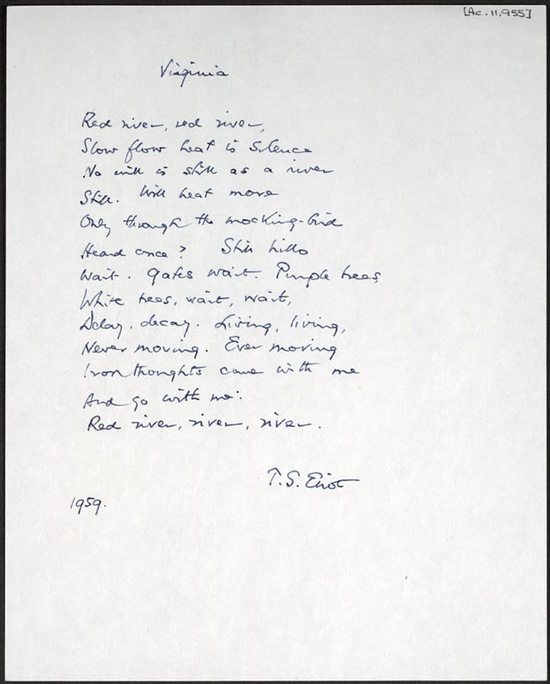
Red river, red river,
Slow flow heat is silence
No will is still as a river
Still. Will heat move
Only through the mocking-bird
Heard once? Still hills
Wait. Gates wait. Purple trees,
White trees, wait, wait,
Delay, decay. Living, living,
Never moving. Ever moving
Iron thoughts came with me
And go with me:
Red river, river, river.




 Biblioklept