An Extract from an Extract from Flann O’Brien’s At Swim-Two-Birds

Title of Book referred to: The Athenian Oracle, being an Entire COLLECTION of all the Valuable QUESTIONS and ANSWERS in the old Athenian Mercuries intermixed with many CASES in Divinity, Hiftory, Philofophy, Mathematicks, Love, Poetry, never before publifhed.

Extract from Book referred to:

1. Whether it be poffible for a woman fo carnally to know a Man in her fleep as to conceive, for I am fure that this and no way other was I got with Child.

2. Whether it be lawful to ufe Means to put a ftop to this growing mifchief, and kill it in the Embryo; this being the only way to avert the Thunderclap of my Father’s Indignation.

To the firft Question, Madam, we are very pofitive, that you are luckily miftaken, for the thing is abfolutely impoffible if you know nothing of it; indeed, we had an account of a Widow that made fuch a pretence, and fhe might have better credit than a maid, who can have no plea but dead drunk, or in fome fwooning fit, and our Phyficians will hardly allow a poffibility of the thing then. So that you may fet your heart at reft, and think no more of the matter, unlefs for your diverfion.

As for the fecond Queftion, fuch practices are murder, and thofe that are fo unhappy as to come under fuch Circumftances if they ufe the forementioned means, will certainly one day find the remedy worfe than the Difeafe. There are wifer methods to be taken in fuch Cafes, as a fmall journey and a Confident. And afterwards, fuch a pious and good life as may redreff fuch an heavy miffortune.

Questions, a Selection of Further: Almond, why fo bitter being taken in the mouth, and yet the Oyl fo very fweet? Apprentice, reduced to want, how may he relieve himself? Blood, is the eating of it lawful? Baptifm, adminiftered by a Mid-wife or Lay Hand, is it lawful? Devil, why called Lucifer; and elfewhere the Prince of Darknefs? Eftate, gotten by felling lewd Books, can it profper? Eyes, what Method muft I take with ’em when weak? Horfe, with a round fundament, why does he emit a fquare Excrement? Happinefs, what is it? Lady, difturbed in her Bed, your thoughts of it? Light, is it a Body? Myftae or Cabalifts, what d’ye think of them? Marriage, is not the End of it, in a great Meafure, loft nowadays? Poem, by Mr. Tate? Virginity, is it a Vertue? Wind, what is it? Wife, is it lawful for a Man to beat her? Wife, if an ill one, may I pray that God wou’d take her to himfelf?

Conclusion of the foregoing.

From Flann O’Brien’s novel At Swim-Two-Birds.

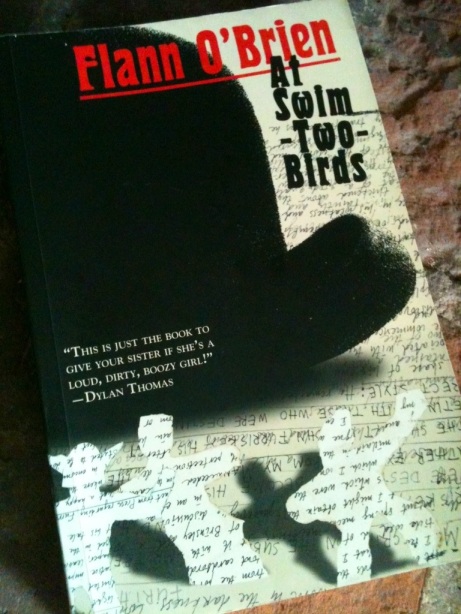
Flann O’Brien’s Novel At Swim-Two-Birds Is a Postmodernist Masterpiece of Comic Storytelling

20130210-161617.jpg

The vibrant force of storytelling in Flann O’Brien’s excellent first novel At Swim-Two-Birds threatens to overwhelm reader and narrator alike—and what a strange joy it is to be overwhelmed. This novel overflows with stories; its plot threads twist into each other, break out of each other, erupt into new ideas, characters, riffs, sketches. First published in 1939—the same year as James Joyce’s Finnegans WakeAt Swim-Two-Birds seems light years ahead of its time—indeed, this is a book that is still ahead of its time.

Summarizing At Swim-Two-Birds is difficult but worth attempting. We have an unnamed narrator, a student living with his uncle who doesn’t think much of how his nephew spends his time. Our narrator likes to imbibe large quantities of porter and wax philosophical with his friends about his literary projects. These projects, our narrator’s riffs and scribblings, begin to take on lives of their own: they intersect, overlap, intermarry, degenerate and regenerate.

The book’s opening paragraph announces the novel’s intention to disregard the classical unities of action, place, and time:

Having placed in my mouth sufficient bread for three minutes’ chewing, I withdrew my powers of sensual perception and retired into the privacy of my mind, my eyes and face assuming a vacant and preoccupied expression. I reflected on the subject of my spare-time literary activities. One beginning and one ending for a book was a thing I did not agree with. A good book may have three openings entirely dissimilar and inter-related only in the prescience of the author, or for that matter one hundred times as many endings.

First, we meet “Pooka MacPhellimey, a member of the devil class,” a hobgoblin of Irish folklore (he turns out to be a thoughtful and polite fellow). Then, there’s John Furriskey, who “was born at the age of twenty-five and entered the world with a memory but without a personal experience to account for it.” Furriskey is the literary creation of another of the narrator’s literary creations, one Dermot Trellis, a grumpy old man who writes Westerns; Trellis (an author, it’s worth reiterating) is the eventual antagonist of the novel, the target for all of the other characters’ vengeance. The third opening offers up Finn Mac Cool, “a legendary hero of old Ireland.”

Much of the early part of At Swim-Two-Birds features Finn Mac Cool holding forth on all matters Irish in wonderfully baroque and hyperbolic passages. Here’s a snippet (a long one!), featuring Finn on the ideal man:

When pursued by a host, he must stick a spear in the world and hide behind it and vanish in its narrow shelter or he is not taken for want of sorcery. Likewise he must hide beneath a twig, or behind a dried leaf, or under a red stone, or vanish at full speed into the seat of his hempen drawers without changing his course or abating his pace or angering the men of Erin. Two young fosterlings he must carry under the armpits to his jacket through the whole of Erin, and six arm-bearing warriors in his seat together. If he be delivered of a warrior or a blue spear, he is not taken. One hundred head of cattle he must accommodate with wisdom about his person when walking all Erin, the half about his armpits and the half about his trews, his mouth never halting from the discoursing of sweet poetry. One thousand rams he must sequester about his trunks with no offence to the men of Erin, or he is unknown to Finn. He must swiftly milk a fat cow and carry milk-pail and cow for twenty years in the seat of his drawers. When pursued in a chariot by the men of Erin he must dismount, place horse and chariot in the slack of his seat and hide behind his spear, the same being stuck upright in Erin. Unless he accomplishes these feats, he is not wanted of Finn. But if he do them all and be skillful, he is of Finn’s people.

It’s hard not to feel something of Joyce in the passage (I’m particularly reminded of the Cyclops episode of Ulysses), and O’Brien’s narrator name-checks Joyce (along with Aldous Huxley) in the first few pages of the book. The narrator’s comically mechanical and precise descriptions also recall Joyce. Joyce and O’Brien drew from the same well of mythology, but O’Brien more keenly attunes his focus on Irish legend and folklore in At Swim-Two-Birds, while Joyce’s project skews to archetypes. Similarities and divergences aside, there’s something strangely fitting about O’Brien’s Finn Mac Cool dreaming his way into other characters’ lives in At Swim-Two-Birds, as if this Finn is the psychic twin of Joyce’s Finn.

Indeed, such a reading would fit neatly into our young narrator’s ideas about the function of character in literature:

Characters should be interchangeable as between one book and another. The entire corpus of existing literature should be regarded as a limbo from which discerning authors could draw their characters as required, creating only when they failed to find a suitable existing puppet. The modern novel should be largely a work of reference. Most authors spend their time saying what has been said before – usually said much better. A wealth of references to existing works would acquaint the reader instantaneously with the nature of each character, would obviate tiresome explanations and would effectively preclude mountebanks, upstarts, thimble-riggers and persons of inferior education from an understanding of contemporary literature.

This decree strikes me as wonderfully post-postmodernist. That the “modern novel should be largely a work of reference” finds its suitable echo over half a century later in the note-card novels of David Markson (and other reality smugglers). The citation above serves as a metatextual description of At Swim-Two-Birds itself: O’Brien’s narrator framing the various tales that erupt in the novel, but also undoing the frames, allowing his characters to converge, to tell their own stories (and within those stories characters tell other stories…).

In its finest moments (of which there are many), At Swim-Two-Birds operates on an ad hoc logic that it creates and describes in motion, a kind of improvised dream response pattern. Most books, particularly postmodern books, teach the reader how to read them—that is, most novels provide keys, hints, and reading rules early enough in the text to allow perceptive readers to interpret (subjectively, of course) what the novel is doing. O’Brien’s novel in toto, with its discontinuities, gaps, eruptions, and juxtapositions, paradoxically is its own discrete, unified key.

But I seem to be getting bogged down in a bit of literary theory, which is not my intent at all.

Instead, let me draw attention to a wonderful extended jaunt in the middle of At Swim-Two-Birds where the Pooka MacPhellimey enters into an ersatz quest with the Good Fairy, two cowboyish thugs (or thuggish cowboys) named Slug and Shorty, the poet Jem Casey, and the mad King Sweeny. This ragtag band sets out to bequeath gifts to the forthcoming child of Miss Lamont (the creation of a creation of a creation). These episodes unfold in comic bravado, their slapstick rhythms recalling the manic but precise energy of Buster Keaton and Charlie Chaplin and the linguistic brio of the Marx brothers. This miniature picaresque is tempered in sweet pathos for poor crazy Sweeny who must be plied forward with the promise of a feast. The poor man, broken, starving, and living solely on watercress, falls into despair. What eventually moves him? The force of language:

And getting around the invalid in a jabbering ring, they rubbed him and cajoled and coaxed, and plied him with honey-talk and long sweet-lilted sentences full of fine words, and promised him metheglin and mugs of viscous tarblack mead thickened with white yeast and the spoils from hives of mountain-bees, and corn-coarse nourishing farls of wheaten bread dipped in musk-scented liquors and sodden with Belgian sherry, an orchard and a swarm of furry honey-glutted bees and a bin of sun-bronzed grain from the granaries of the Orient in every drop as it dripped at the lifting of the hand to the mouth, and inky quids of strong-smoked tabacca with cherrywood pipes, hubble-bubbles, duidins, meerschaums, clays, hickory hookahs and steel-stemmed pipes with enamel bowls, the lot of them laid side by side in a cradle of lustrous blue plush, a huge pipe-case and pipe-rack ingeniously combined and circumscribed with a durable quality of black imitation leather over a framework of stout cedarwood dovetailed and intricately worked and made to last, the whole being handsomely finished and untouched by hand and packed in good-quality transparent cellophane, a present calculated to warm the cockles of the heart of any smoker. They also did not hesitate to promise him sides of hairy bacon, the mainstay and the staff of life of the country classes, and lamb-chops still succulent with young blood, autumn-heavy yarns from venerable stooping trees, bracelets and garlands of browned sausages and two baskets of peerless eggs fresh-collected, a waiting hand under the hen’s bottom. They beguiled him with the mention of salads and crome custards and the grainy disorder of pulpy boiled rhubarb, matchless as a physic for the bowels, olives and acorns and rabbit-pie, and venison roasted on a smoky spit, and mulatto thick-tipped delphy cups of black-strong tea. They foreshadowed the felicity of billowy beds of swansdown carefully laid crosswise on springy rushes and sequestered with a canopy of bearskins and generous goatspelts, a couch for a king with fleshly delectations and fifteen hundred olive-mellow concubines in constant attendance against the hour of desire. Chariots they talked about and duncrusted pies exuberant with a sweat of crimson juice, and tall crocks full of eddying foam-washed stout, and wailing prisoners in chains on their knees for mercy, humbled enemies crouching in sackcloth with their upturned eye-whites suppliant. They mentioned the leap of a fire on a cold night, long sleeps in the shadows and leaden-eyed forgetfulness hour on hour – princely oblivion. And as they talked, they threaded through the twilight and the sudden sun-pools of the wild country.

I’ve perhaps overshared here, let our characters babble on too long—but the verbal dexterity of the passage above illustrates O’Brien’s rhetorical force, the force he lends his characters in order that they should move their insane and desperate friend forward. There’s a sublime alchemy at work here, where imagination turns into words and words turn into food and drink.

I also fear these big chunks of text I’ve pulled from At Swim-Two-Birds don’t highlight O’Brien’s extraordinary talent at rendering speech. The dialogue in this novel is hilarious but nuanced, its ironies rarely if ever remarked upon by intrusive attributions. That O’Brien’s narrator’s characters (and their characters…) speak through the layers of texts adds to the book’s juxtapositions.

These juxtapositions will perhaps confuse or even alienate many readers. At Swim-Two-Birds can be read as an attack on the classical unities of action, place, and time. O’Brien’s novel is a send-up of stability, order, and tradition. Some of the novel’s best moments are its strangest indulgences, as when O’Brien (or his narrator) gives the novel over to citations from imaginary antique texts, or allows his characters to indulge in a seemingly endless recitation of obscure facts, or satirizes the moral dangers of tea-tasting. These moments seem to erupt from nowhere, bizarre, wonderful, joyous.

At Swim-Two-Birds lacks the cohesion of theme and voice that characterizes O’Brien’s other masterpiece, The Third Policeman, but this is hardly a deficiency. At Swim-Two-Birds is one of those rare books that actually deserves to be called dazzling, a critic’s crutch-word that mars too many blurbs. Its dazzle derives from its rhetorical force, its humor, and its openness to experiment with not just the novelistic form, but the form of storytelling itself. And it’s here that O’Brien’s novel is most real—he captures the strangeness of storytelling, its mutability, its crazy rhythms. Ultimately, this is a novel unconcerned with providing pat answers and clear solutions. I loved this book, loved reading it—and then immediately rereading it. I’ll let O’Brien get the last word:

Answers do not matter so much as questions, said the Good Fairy. A good question is very hard to answer. The better the question the harder the answer. There is no answer at all to a very good question.

“Imperfect Resume” — Flann O’Brien

Selection from Flann O’Brien’s novel At Swim-Two-Birds:

The following, imperfect resume or summary as it is, may be taken as a general indication of the scholarly trend of the conversation sustained without apparent effort by the three of them.

It is not generally known, observed Mr. Furriskey, that the coefficient of expansion of all gases is the same. A gas expands to the extent of a hundred and seventy-third part of its own volume in respect of each degree of increased temperature centrigrade. The specific gravity of ice is 0.92, marble 2.70, iron (cast) 7.20 and iron (wrought) 7.79. One mile is equal to 1.6093 kilometres reckoned to the nearest ten-thousandth part of a whole number.

True, Mr. Furriskey, remarked Mr. Paul Shanahan with a quiet smile that revealed a whiteness of the teeth, but a man who confines knowledge to formulae necessary for the resolution of an algebraic or other similar perplexity, the same deserves to be shot with a fusil, or old-fashioned light musket. True knowledge is unpractised or abstract usefulness. Consider this, that salt in solution is an excellent emetic and may be administered with safety to persons who are accustomed to eat poisonous berries or consume cacodyl, an evil-smelling compound of arsenic and methyl. A cold watch-key applied to the neck will relieve nose-bleeding. Banana-skins are invaluable for imparting a gloss to brown shoes.

To say that salt in solution, Lamont objected finely, is a pleasing emetic is a triviality related to inconsequent ephemera – the ever-perishing plasms of the human body. The body is too transient a vessel to warrant other than perfunctory investigation. Only in this regard is it important, that it affords the mind a basis for speculation and conjecture. Let me recommend to you, Mr. Shanahan, the truer spiritual prophylaxis contained in the mathematics of Mr. Furriskey. Ratiocination on the ordered basis of arithmetic is man’s passport to the infinite. God is the root of minus one. He is too great a profundity to be compassed by human cerebration. But Evil is finite and comprehensible and admits of calculation. Minus One, Zero and Plus One are the three insoluble riddles of the Creation.

Mr. Shanahan laughed in a cultured manner.

The riddle of the universe I might solve if I had a mind to, he said, but I prefer the question to the answer. It serves men like us as a bottomless pretext for scholarly dialectic.

Other points not unworthy of mention, mentioned Mr. Furriskey in an absent-minded though refined manner, are the following: the great pyramid at Gizeh is 450 feet high and ranks as one of the seven wonders of the world, the others being the hanging gardens of Babylon, the tomb of Mausolus in Asia Minor, the colossus of Rhodes, the temple of Diana, the statue of Jupiter at Olympia and the Pharos Lighthouse built by Ptolemy the First about three hundred and fifty years B.C. Hydrogen freezes at minus 253 degrees centigrade, equivalent to minus 423 on the Fahrenheit computation.

Everyday or colloquial names for chemical substances, observed Mr. Shanahan, cream of tartar – bitartate of potassium, plaster of Paris – sulphate of calcium, water – oxide of hydrogen. Bells and watches on board ship: first dog – 4 p.m. to 6 p.m., second dog – 6 p.m. to 8 p.m., afternoon-noon to 4 p.m. Paris, son of Priam, King of Troy, carried off the wife of Menelaus, King of Sparta and thus caused the Trojan War.

The name of the wife, said Lamont, was Helen. A camel is unable to swim owing to the curious anatomical distribution of its weight, which would cause its head to be immersed if the animal were placed in deep water. Capacity in electricity is measured by the farad; one microfarad is equal to one millionth of a farad. A carbuncle is a fleshy excrescence resembling the wattles of a turkey-cock. Sphragistics is the study of engraved seals.


Excellent, remarked Mr. Furriskey with that quiet smile which endeared him to everyone who happened to come his way, but do not overlook this, that the velocity of light in vacuo is 186,325 miles per second. The velocity of sound in air is 1,120 feet per second, in tin 8,150 feet per second, in walnut mahogany and heavy timbers 11,000 feet per second approximately; in firwood, 20,000 feet per second. Sine 15 degrees is equal to the root of six minus the root of two, the whole divided by four. Percentages of £1: 1-1/4 per cent, threepence; 5 per cent, one shilling; 12-1/2 percent, a half a crown. Some metric equivalents: one mile equals 1.6093 kilometres; one inch equals 2.54 centimetres; one ounce equals 28.352 grams. The chemical symbol of Calcium is Ca and of Cadmium, Cd. A Trapezoid may be defined as a four-sided figure capable of being transformed into two triangles by the means of a diagonal line.

Some curious facts about the Bible, Mr. Lamont mentioned politely, the longest chapter is Psalm 119 and the briefest, Psalm 117. The Apocrypha contains 14 Books. The first English translation was published in A.D. 1535.

Some notable dates in the history of the world, observed Mr. Shanahan, B.C. 753, foundation of Rome by Romulus, 490 B.C., Battle of Marathon, A.D. 1498, Vasco da Gama sailed around South Africa and reached India, 23 April 1564 Shakespeare was born.

It was then that Mr. Furriskey surprised and indeed, delighted his companions, not to mention our two friends, by a little act which at once demonstrated his resource and his generous urge to spread enlightenment. With the end of his costly malacca cane, he cleared away the dead leaves at his feet and drew the outline of three dials or clock-faces on the fertile soil in this fashion:

0 0 0 9 \ 1 1 9 9 1 8 \ 2 2 8 8 2 o o. o-,._ 7 3 3 \ 7 7 3 6 4 4 `6 6 4 5 5 5

How to read the gas-meter, he announced. Similar dials to these somewhat crudely depicted at my feet may be observed on any gas-meter. To ascertain the consumption of gas, one should procure pencil and paper and write down the figures nearest to the indicator on each dial – thus in the present hypothetical case 963. To this one should add two zeros or noughts, making the number 96,300. This is the answer and represents the consumption of gas in cubic feet. The reading of the electric-meter for the discovery of consumption in Kilowatt-hours is more intricate than the above and would require the help of six dials fox demonstration purposes – more indeed than I have room for in the space I have cleared of withered leaves, even assuming the existing dials could be adapted for the purpose.

Thereafter these three savant or wise men of the East began to talk together in a rapid manner and showered forth pearls of knowledge and erudition, gems without price, invaluable carbuncles of sophistry and scholastic science, thomistic maxims, intricate theorems in plane geometry and lengthy extracts from Kant’s Kritik der reinischen Vernunst. Frequent use was made of words unheard of by illiterates and persons of inferior education exempli gratia saburra or foul granular deposit in the pit of the stomach, tachylyte, a vitreous form of basalt, tapir, a hoofed mammal with the appearance of a swine, capon, castrated cock, triacontahedral, having thirty sides or surfaces and botargo, relish of mullet or tunny roe. The following terms relating to the science of medicine were used with surprising frequency videlicet thyme, exophthalmus, scirrhus, and mycetoma meaning respectively food when acted upon by gastric juices and converted into acid pulp, protrusion of the eye-ball, hard malignant tumour and fungoid disease of hand or foot. Aestho-therapy was touched upon and reference made to the duodenum, that is, the primary part of the small intestine, and the caecum or blind gut. Flowers and plants rarely mentioned in ordinary conversation were accorded their technical or quasi-botanical titles without difficulty or hesitation for instance now fraxinella species of garden dittany, canna plant with decorative blossoms, bifoliate of two leaves (also bifurcate forked), cardamom spice from the germinal capsules of certain East India plants, granadilla passion flower, knapweed hard-stemmed worthless plant, campanulla plant with bell-shaped blossoms, and dittany see fraxinella above. Unusual animals mentioned were the pangolin, chipmuck, echidna, babiroussa and bandicoot, of which a brief descriptive account would be (respectively), scabrous-spined scaly ant-eater, American squirrel aliter wood-rat, Australian toothless animal resembling the hedgehog, Asiatic wild-hog, large Indian insectivorous marsupial resembling the rat.

 

“Moral Effects of Tea-Tasting” (From Flann O’Brien’s At Swim-Two-Birds)

Moral Effects of Tea-Tasting.

The long-continued use of tea has a distinct effect upon the character. This has been too often noticed and remarked to be questioned. There are tea-sots in every great charitable institution – particularly those for the maintenance of the aged. Their symptoms are generally mental irritability, muscular tremors, and sleeplessness. The following is an account of one of the cases observed. The immediate effects upon him are as follows: In about ten minutes the face becomes flushed, the whole body feels warm and heated and a sort of intellectual intoxication comes on, much the same in character, it would seem, as that which occurs in the rarefied air of a mountain. He feels elated, exhilarated, troubles and cares vanish, everything seems bright and cheerful, his body feels light and elastic, his mind clear, his ideas abundant, vivid, and flowing fluently into words. At the end of an hour’s tasting a slight reaction begins to set in; some headache comes on, the face feels wrinkled and shrivelled, particularly about the eyes, which also get dark under the lids. At the end of two hours this reaction becomes firmly established, the flushed warm feeling has passed off, the hands and feet are cold, a nervous tremor comes on, accompanied with great mental depression. And he is now so excitable that every noise startles him; he is in a state of complete unrest; he can neither walk nor sit down, owing to his mental condition, and he settles into complete gloom. Copious and frequent urinations are always present, as also certain dyspeptic symptoms, such as eructations of wind, sour taste, and others. His mental condition is peculiar. He lives in a state of dread that some accident may happen to him; in the omnibus fears a collision; crossing the street, fears that he will be crushed by passing teams; walking on the sidewalks, fears that a sign may fall, or watches the eaves of houses, thinking that a brick may fall down and kill him; under the apprehension that every dog he meets is going to bite the calves of his legs, he carries an umbrella in all weathers as a defence against such an attack.

Conclusion of the foregoing.

From Flann O’Brien’s novel At Swim-Two-Birds.


“Man Carrying Thing” — Wallace Stevens

“Man Carrying Thing” by Wallace Stevens:

The poem must resist the intelligence
Almost successfully. Illustration:

A brune figure in winter evening resists
Identity. The thing he carries resists

The most necessitous sense. Accept them, then,
As secondary (parts not quite perceived

Of the obvious whole, uncertain particles
Of the certain solid, the primary free from doubt,

Things floating like the first hundred flakes of snow
Out of a storm we must endure all night,

Out of a storm of secondary things),
A horror of thoughts that suddenly are real.

We must endure our thoughts all night, until
The bright obvious stands motionless in cold.


“The Oblong Box” — Edgar Allan Poe

“The Oblong Box” by Edgar Allan Poe

SOME years ago, I engaged passage from Charleston, S. C, to the city of New York, in the fine packet-ship “Independence,” Captain Hardy. We were to sail on the fifteenth of the month (June), weather permitting; and on the fourteenth, I went on board to arrange some matters in my state-room.

I found that we were to have a great many passengers, including a more than usual number of ladies. On the list were several of my acquaintances, and among other names, I was rejoiced to see that of Mr. Cornelius Wyatt, a young artist, for whom I entertained feelings of warm friendship. He had been with me a fellow-student at C— University, where we were very much together. He had the ordinary temperament of genius, and was a compound of misanthropy, sensibility, and enthusiasm. To these qualities he united the warmest and truest heart which ever beat in a human bosom.

I observed that his name was carded upon three state-rooms; and, upon again referring to the list of passengers, I found that he had engaged passage for himself, wife, and two sisters—his own. The state-rooms were sufficiently roomy, and each had two berths, one above the other. These berths, to be sure, were so exceedingly narrow as to be insufficient for more than one person; still, I could not comprehend why there were three state-rooms for these four persons. I was, just at that epoch, in one of those moody frames of mind which make a man abnormally inquisitive about trifles: and I confess, with shame, that I busied myself in a variety of ill-bred and preposterous conjectures about this matter of the supernumerary state-room. It was no business of mine, to be sure, but with none the less pertinacity did I occupy myself in attempts to resolve the enigma. At last I reached a conclusion which wrought in me great wonder why I had not arrived at it before. “It is a servant of course,” I said; “what a fool I am, not sooner to have thought of so obvious a solution!” And then I again repaired to the list—but here I saw distinctly that no servant was to come with the party, although, in fact, it had been the original design to bring one—for the words “and servant” had been first written and then overscored. “Oh, extra baggage, to be sure,” I now said to myself—”something he wishes not to be put in the hold—something to be kept under his own eye—ah, I have it—a painting or so—and this is what he has been bargaining about with Nicolino, the Italian Jew.” This idea satisfied me, and I dismissed my curiosity for the nonce. Continue reading ““The Oblong Box” — Edgar Allan Poe”

“I’ll order a complete man after a desirable pattern” (Moby-Dick)

I do deem it now a most meaning thing, that that old Greek, Prometheus, who made men, they say, should have been a blacksmith, and animated them with fire; for what’s made in fire must properly belong to fire; and so hell’s probable. How the soot flies! This must be the remainder the Greek made the Africans of. Carpenter, when he’s through with that buckle, tell him to forge a pair of steel shoulder-blades; there’s a pedlar aboard with a crushing pack.

Sir?

Hold; while Prometheus is about it, I’ll order a complete man after a desirable pattern. Imprimis, fifty feet high in his socks; then, chest modelled after the Thames Tunnel; then, legs with roots to ’em, to stay in one place; then, arms three feet through the wrist; no heart at all, brass forehead, and about a quarter of an acre of fine brains; and let me see—shall I order eyes to see outwards? No, but put a sky-light on top of his head to illuminate inwards. There, take the order, and away.

From “Ahab and The Carpenter,” Chapter 108 of Melville’s Moby-Dick.


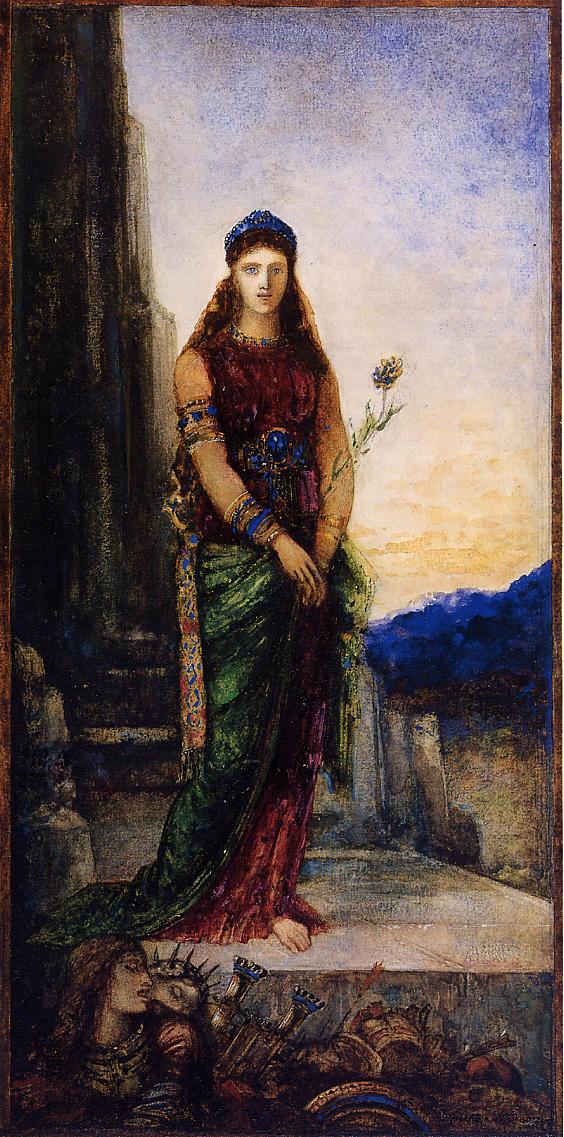
Helen on the Walls of Troy — Gustave Moreau

helen-on-the-walls-of-troy

“Experts” — A.A. Milne

“Experts” by A.A. Milne

The man in front of the fire was telling us a story about his wife and a bottle of claret. He had taken her to the best restaurant in Paris and had introduced her to a bottle of the famous Chateau Whatsitsname, 1320 (or thereabouts), a wine absolutely priceless–although the management, with its customary courtesy, had allowed him to pay a certain amount for it. Not realizing that it was actually the famous Whatsitsname, she had drunk it in the ordinary way, neither holding it up to the light and saying, “Ah, there’s a wine!” nor rolling it round the palate before swallowing. On the next day they went to a commonplace restaurant and drank a local and contemporary vintage at five francs the bottle, of similar colour but very different temperament. When she had finished her glass, she said hesitatingly, “Of course, I don’t know anything about wine, and I dare say I’m quite wrong, but I can’t help feeling that the claret we had last night was better than this.”

The man in front of the fire was rather amused by this, as were most of his audience. For myself, I felt that the lady demanded my admiration rather than my amusement. Without the assistance of the labels, many of us might have decided that it was the five-franc vintage which was the better wine. She didn’t. Indeed, I am inclined to read more into the story than is perhaps there; I believe that she had misunderstood her husband, and had thought that the second bottle was the famous, aged, and priceless Chateau Whatsitsname, and that, in spite of this, she gave it as her opinion that the first wine, cheap and modern though it might be, was the better. Hats off, then, to a brave woman! How many of us would have her courage and her honesty?

But perhaps you who read this are an expert on wine. If so, you are lucky. I am an expert on nothing–nothing, anyhow, that matters. I envy all you experts tremendously. When I see a cigar-expert listening to his cigar before putting it in his mouth I wish that I were as great a man as he. Privately sometimes I have listened to a cigar, but it has told me nothing. The only way I can tell whether it is good or bad is by smoking it. Even then I could not tell you (without the assistance of the band) whether it was a Sancho Panza or a Guoco Piano. I could only tell you whether I liked it or not, a question of no importance whatever.

Lately I have been trying to become a furniture-expert, but it is a disheartening business. I have a book called Chats on Old Furniture–a terrible title to have to ask for in a shop, but I asked boldly. Perhaps the word “chat” does not make other people feel as unhappy as it makes me. But even after reading this book I am not really an expert. I know now that it is no good listening to a Chippendale chair to see if it is really Chippendale; one must stroke it in order to find out whether it is a “genuine antique” or only a modern reproduction; but it is obvious that years of stroking would be necessary before an article of furniture would be properly responsive. Is it worth while wasting these years of one’s life? Indeed, is it worth while (I ask nervously) bothering whether a chair or a table is antique or modern so long as it is both useful and beautiful?

Well, let me tell you what happened to us yesterday. We found a dresser which appealed to us considerably, and we stood in front of it, looking at it. We decided that except for a little curley-wiggle at the top it was the jolliest dresser we had seen, “That’s a fine old dresser,” said the shopman, coming up at that moment, and he smacked it encouragingly. “A really fine old dresser, that.” We agreed. “Except for those curley-wiggles,” I added, pointing to them with my umbrella. “If we could take those off.” He looked at me reproachfully. “You wouldn’t take those off—-” he said. “Why, that’s what tells you that it’s a Welsh dresser of 1720.” We didn’t buy that dresser. We decided that the size or the price was all wrong. But I wonder now, supposing we had bought it, whether we should have had the pluck to remove the curley-wiggles (and let people mistake it for an English dresser of 1920) in order that, so abbreviated, it might have been more beautiful.

For furniture is not beautiful merely because it is old. It is absurd to suppose that everything made in 1720–or 1620 or 1520–was made beautifully, as it would be absurd to say that everything made in 1920 was beautiful. No doubt there will always be people who will regard the passing of time as sufficient justification for any article of furniture; I could wish that they were equally tolerant among the arts as among the crafts, so that in 2120 this very article which I write now could be referred to with awe as a genuine 1920; but all that the passage of time can really do for your dresser is to give a more beautiful surface and tone to the wood. This, surely, is a matter which you can judge for yourself without being an expert. If your dresser looks old you have got from it all that age can give you; if it looks beautiful you have got from it all that a craftsman of any period can give you; why worry, then, as to whether or not it is a “genuine antique”? The expert may tell you that it is a fake, but the fact that he has suddenly said so has not made your dining-room less beautiful. Or if it is less beautiful, it is only because an “expert” is now in it. Hurry him out.

“…his body was a sentry-box and this soliloquizer on guard there…” (Moby-Dick)

Yet, as previously hinted, this omnitooled, open-and-shut carpenter, was, after all, no mere machine of an automaton. If he did not have a common soul in him, he had a subtle something that somehow anomalously did its duty. What that was, whether essence of quicksilver, or a few drops of hartshorn, there is no telling. But there it was; and there it had abided for now some sixty years or more. And this it was, this same unaccountable, cunning life-principle in him; this it was, that kept him a great part of the time soliloquizing; but only like an unreasoning wheel, which also hummingly soliloquizes; or rather, his body was a sentry-box and this soliloquizer on guard there, and talking all the time to keep himself awake.

From “The Carpenter,” Chapter 107 of Melville’s Moby-Dick.

“Blizzard” — William Carlos Williams

“Blizzard” by William Carlos Williams–

Snow falls:
years of anger following
hours that float idly down —
the blizzard
drifts its weight
deeper and deeper for three days
or sixty years, eh? Then
the sun! a clutter of
yellow and blue flakes —
Hairy looking trees stand out
in long alleys
over a wild solitude.
The man turns and there —
his solitary track stretched out
upon the world.

“On the Fear of Death” — William Hazlitt

“On the Fear of Death” by William Hazlitt

And our little life is rounded with a sleep.

Perhaps the best cure for the fear of death is to reflect that life has a beginning as well as an end. There was a time when we were not: this gives us no concern—why, then, should it trouble us that a time will come when we shall cease to be? I have no wish to have been alive a hundred years ago, or in the reign of Queen Anne: why should I regret and lay it so much to heart that I shall not be alive a hundred years hence, in the reign of I cannot tell whom?

When Bickerstaff wrote his Essays I knew nothing of the subjects of them; nay, much later, and but the other day, as it were, in the beginning of the reign of George III., when Goldsmith, Johnson, Burke, used to meet at the Globe, when Garrick was in his glory, and Reynolds was over head and ears with his portraits, and Sterne brought out the volumes of Tristram Shandyyear by year, it was without consulting me: I had not the slightest intimation of what was going on: the debates in the House of Commons on the American War, or the firing at Bunker’s Hill, disturbed not me: yet I thought this no evil—I neither ate, drank, nor was merry, yet I did not complain: I had not then looked out into this breathing world, yet I was well; and the world did quite as well without me as I did without it! Why, then, should I make all this outcry about parting with it, and being no worse off than I was before? There is nothing in the recollection that at a certain time we were not come into the world that ‘the gorge rises at’—why should we revolt at the idea that we must one day go out of it? To die is only to be as we were before we were born; yet no one feels any remorse, or regret, or repugnance, in contemplating this last idea. It is rather a relief and disburthening of the mind: it seems to have been holiday-time with us then: we were not called to appear upon the stage of life, to wear robes or tatters, to laugh or cry, be hooted or applauded; we had lain perdus all this while, snug, out of harm’s way; and had slept out our thousands of centuries without wanting to be waked up; at peace and free from care, in a long nonage, in a sleep deeper and calmer than that of infancy, wrapped in the softest and finest dust. And the worst that we dread is, after a short, fretful, feverish being, after vain hopes and idle fears, to sink to final repose again, and forget the troubled dream of life!… Ye armed men, knights templars, that sleep in the stone aisles of that old Temple church, where all is silent above, and where a deeper silence reigns below (not broken by the pealing organ), are ye not contented where ye lie? Or would you come out of your long homes to go to the Holy War? Or do ye complain that pain no longer visits you, that sickness has done its worst, that you have paid the last debt to nature, that you hear no more of the thickening phalanx of the foe, or your lady’s waning love; and that while this ball of earth rolls its eternal round, no sound shall ever pierce through to disturb your lasting repose, fixed as the marble over your tombs, breathless as the grave that holds you! And thou, oh! thou, to whom my heart turns, and will turn while it has feeling left, who didst love in vain, and whose first was thy last sigh, wilt not thou too rest in peace (or wilt thou cry to me complaining from thy clay-cold bed) when that sad heart is no longer sad, and that sorrow is dead which thou wert only called into the world to feel! Continue reading ““On the Fear of Death” — William Hazlitt”

“How to Write a Novel” — Gordon Lish

“How to Write a Novel” by Gordon Lish

First make sure you have enough time. It is crucial that you have enough time to make things up. Myself, I do not have time enough for anything like that.

But I’ll tell you what’s what. It will not be hard for you to follow me doing it.

Just listen.

Just watch.

I’m composing these instructions on an I.B.M. Selectric. I got it back in 1961. I did not buy it. I finessed it or I finagled it or I stole it.

The person who is the unexpressed direct object of one or the other of these verbs was rich. He said you can borrow this thing, use it for a while. Then he stuck his other thing in my wife’s thing. They still have their things and I have this thing and I’m not giving it up.

It’s given tip-top service. I really loved it when I first saw it, and I still love it just as much.

I never cover it over with anything. I don’t cover it over with anything like a cover or anything—because I like to look at it—the shape.  I.B.M. is good at giving a thing a nice shape. I always look at the shape of things before I snap of the light in a room.

I think 1961 was the Selectric’s first year.

I talk to engineers whenever I get a chance. I don’t mean the kind that build bridges. I mean the fellows that service things. Those are the engineers I talk to.

You know what one of those fellows once told me once? Buy the first of whatever it is! He said buy the first one of whatever it is because the maker of it is never going to knock himself out like that again—making, you know, all of the others after that. That’s why this one’s still going fine after so many wonderful, wonderful years.

The same goes for the Polaroid camera I’ve got. I’ve got the oldest one there is. You know how old that is? Here’s how old it is. It’s called, they call it, the Polaroid Land Camera.

That’s how goddamn old it is!

No shit, it was a first one—it was the very first Polaroid the Polaroid people made!

You want to see pictures? Look at these pictures! Tell me when in your life you ever saw in your life pictures as sharp as these pictures!

Because they’e this big when I start out with them. You see how big? Next to nothing, right? But then what? But then I go get them all blown up as big as life! See them? Look at them all over the walls if you don’t know what I mean!

That’s resolution for you , isn’t it?

Well, that’s my second wife, okay?

They’re framed all over the place.

People come in here and then they look at them and then they smack their heads.

My God, they say, such pictures!

I say, original issue, a maker knows his game.

“A Winter Walk” — Henry David Thoreau

“A Winter Walk” by Henry David Thoreau

The wind has gently murmured through the blinds, or puffed with feathery softness against the windows, and occasionally sighed like a summer zephyr lifting the leaves along, the livelong night. The meadow-mouse has slept in his snug gallery in the sod, the owl has sat in a hollow tree in the depth of the swamp, the rabbit, the squirrel, and the fox have all been housed. The watch-dog has lain quiet on the hearth, and the cattle have stood silent in their stalls. The earth itself has slept, as it were its first, not its last sleep, save when some street-sign or wood-house door has faintly creaked upon its hinge, cheering forlorn nature at her midnight work,—the only sound awake twixt Venus and Mars,—advertising us of a remote inward warmth, a divine cheer and fellowship, where gods are met together, but where it is very bleak for men to stand. But while the earth has slumbered, all the air has been alive with feathery flakes descending, as if some northern Ceres reigned, showering her silvery grain over all the fields.

We sleep, and at length awake to the still reality of a winter morning. The snow lies warm as cotton or down upon the window-sill; the broadened sash and frosted panes admit a dim and private light, which enhances the snug cheer within. The stillness of the morning is impressive. The floor creaks under our feet as we move toward the window to look abroad through some clear space over the fields. We see the roofs stand under their snow burden. From the eaves and fences hang stalactites of snow, and in the yard stand stalagmites covering some concealed core. The trees and shrubs rear white arms to the sky on every side; and where were walls and fences, we see fantastic forms stretching in frolic gambols across the dusky landscape, as if nature had strewn her fresh designs over the fields by night as models for man’s art.

Silently we unlatch the door, letting the drift fall in, and step abroad to face the cutting air. Already the stars have lost some of their sparkle, and a dull, leaden mist skirts the horizon. A lurid brazen light in the east proclaims the approach of day, while the western landscape is dim and spectral still, and clothed in a sombre Tartarian light, like the shadowy realms. They are Infernal sounds only that you hear,—the crowing of cocks, the barking of dogs, the chopping of wood, the lowing of kine, all seem to come from Pluto’s barn-yard and beyond the Styx;—not for any melancholy they suggest, but their twilight bustle is too solemn and mysterious for earth. The recent tracks of the fox or otter, in the yard, remind us that each hour of the night is crowded with events, and the primeval nature is still working and making tracks in the snow. Opening the gate, we tread briskly along the lone country road, crunching the dry and crisped snow under our feet, or aroused by the sharp clear creak of the wood-sled, just starting for the distant market, from the early farmer’s door, where it has lain the summer long, dreaming amid the chips and stubble; while far through the drifts and powdered windows we see the farmer’s early candle, like a paled star, emitting a lonely beam, as if some severe virtue were at its matins there. And one by one the smokes begin to ascend from the chimneys amidst the trees and snows. Continue reading ““A Winter Walk” — Henry David Thoreau”

See Robert Altman’s Adaptation of Harold Pinter’s Play, The Room

“The Glass Dog” — L. Frank Baum

“The Glass Dog” by L. Frank Baum

An accomplished wizard once lived on the top floor of a tenement house and passed his time in thoughtful study and studious thought. What he didn’t know about wizardry was hardly worth knowing, for he possessed all the books and recipes of all the wizards who had lived before him; and, moreover, he had invented several wizardments himself.

This admirable person would have been completely happy but for the numerous interruptions to his studies caused by folk who came to consult him about their troubles (in which he was not interested), and by the loud knocks of the iceman, the milkman, the baker’s boy, the laundryman and the peanut woman. He never dealt with any of these people; but they rapped at his door every day to see him about this or that or to try to sell him their wares. Just when he was most deeply interested in his books or engaged in watching the bubbling of a cauldron there would come a knock at his door. And after sending the intruder away he always found he had lost his train of thought or ruined his compound.

At length these interruptions aroused his anger, and he decided he must have a dog to keep people away from his door. He didn’t know where to find a dog, but in the next room lived a poor glass-blower with whom he had a slight acquaintance; so he went into the man’s apartment and asked:

“Where can I find a dog?”

“What sort of a dog?” inquired the glass-blower.

“A good dog. One that will bark at people and drive them away. One that will be no trouble to keep and won’t expect to be fed. One that has no fleas and is neat in his habits. One that will obey me when I speak to him. In short, a good dog,” said the wizard.

“Such a dog is hard to find,” returned the glass-blower, who was busy making a blue glass flower pot with a pink glass rosebush in it, having green glass leaves and yellow glass roses.

The wizard watched him thoughtfully.

“Why cannot you blow me a dog out of glass?” he asked, presently.

“I can,” declared the glass-blower; “but it would not bark at people, you know.” Continue reading ““The Glass Dog” — L. Frank Baum”

Portrait of Ivan Turgenev — Vasily Perov