“No more my splintered heart and maddened hand were turned against the wolfish world” (Moby-Dick)

As I sat there in that now lonely room; the fire burning low, in that mild stage when, after its first intensity has warmed the air, it then only glows to be looked at; the evening shades and phantoms gathering round the casements, and peering in upon us silent, solitary twain; the storm booming without in solemn swells; I began to be sensible of strange feelings. I felt a melting in me. No more my splintered heart and maddened hand were turned against the wolfish world. This soothing savage had redeemed it. There he sat, his very indifference speaking a nature in which there lurked no civilized hypocrisies and bland deceits. Wild he was; a very sight of sights to see; yet I began to feel myself mysteriously drawn towards him. And those same things that would have repelled most others, they were the very magnets that thus drew me. I’ll try a pagan friend, thought I, since Christian kindness has proved but hollow courtesy. I drew my bench near him, and made some friendly signs and hints, doing my best to talk with him meanwhile. At first he little noticed these advances; but presently, upon my referring to his last night’s hospitalities, he made out to ask me whether we were again to be bedfellows. I told him yes; whereat I thought he looked pleased, perhaps a little complimented.

From Chapter 10 of Herman Melville’s Moby-Dick.

H.P. Lovecraft’s Advice to Young Writers

“Literary Composition” by H.P. Lovecraft

(First published in the January, 1920 issue of The United Amateur)

In a former article our readers have been shewn the fundamental sources of literary inspiration, and the leading prerequisites to expression. It remains to furnish hints concerning expression itself; its forms, customs, and technicalities, in order that the young writer may lose nothing of force or charm in presenting his ideas to the public.

Grammar

A review of the elements of English grammar would be foreign to the purpose of this department. The subject is one taught in all common schools, and may be presumed to be understood by every aspirant to authorship. It is necessary, however, to caution the beginner to keep a reliable grammar and dictionary always beside him, that he may avoid in his compositions the frequent errors which imperceptibly corrupt even the purest ordinary speech. As a general rule, it is well to give close critical scrutiny to all colloquial phrases and expressions of doubtful parsing, as well as to all words and usages which have a strained or unfamiliar sound. The human memory is not to be trusted too far, and most minds harbour a considerable number of slight linguistic faults and inelegancies picked up from random discourse or from the pages of newspapers, magazines, and popular modern books.

Types of Mistakes

Most of the mistakes of young authors, aside from those gross violations of syntax which ordinary education corrects, may perhaps be enumerated as follows.

(1) Erroneous plurals of nouns, as vallies or echos.
(2) Barbarous compound nouns, as viewpoint or upkeep.
(3) Want of correspondence in number between noun and verb where the two are widely separated or the construction involved.
(4) Ambiguous use of pronouns.
(5) Erroneous case of pronouns, as whom for who, and vice versa, or phrases like “between you and I,” or “Let we who are loyal, act promptly.”
(6) Erroneous use of shall and will, and of other auxiliary verbs.
(7) Use of intransitive for transitive verbs, as “he was graduated from college,” or vice versa, as “he ingratiated with the tyrant.”
(8) Use of nouns for verbs, as “he motored to Boston,” or “he voiced a protest.”
(9) Errors in moods and tenses of verbs, as “If I was he, I should do otherwise,” or “He said the earth was round.”
(10) The split infinitive, as “to calmly glide.”
(11) The erroneous perfect infinitive, as “Last week I expected to have met you.”
(12) False verb-forms, as “I pled with him.”
(13) Use of like for as, as “I strive to write like Pope wrote.”
(14) Misuse of prepositions, as “The gift was bestowed to an unworthy object,” or “The gold was divided between the five men.”
(15) The superfluous conjunction, as “I wish for you to do this.”
(16) Use of words in wrong senses, as “The book greatly intrigued me,” “Leave me take this,” “He was obsessed with the idea,” or “He is a meticulous writer.”
(17) Erroneous use of non-Anglicised foreign forms, as “a strange phenomena,” or “two stratas of clouds.”
(18) Use of false or unauthorized words, as burglarize or supremest.
(19) Errors of taste, including vulgarisms, pompousness, repetition, vagueness, ambiguousness, colloquialism, bathos, bombast, pleonasm, tautology, harshness, mixed metaphor, and every sort of rhetorical awkwardness.
(20) Errors of spelling and punctuation, and confusion of forms such as that which leads many to place an apostrophe in the possessive pronoun its.

Of all blunders, there is hardly one which might not be avoided through diligent study of simple textbooks on grammar and rhetoric, intelligent perusal of the best authors, and care and forethought in composition. Almost no excuse exists for their persistent occurrence, since the sources of correction are so numerous and so available. Many of the popular manuals of good English are extremely useful, especially to persons whose reading is not as yet extensive; but such works sometimes err in being too pedantically precise and formal. For correct writing, the cultivation of patience and mental accuracy is essential. Throughout the young author’s period of apprenticeship, he must keep reliable dictionaries and textbooks at his elbow; eschewing as far as possible that hasty extemporaneous manner of writing which is the privilege of more advanced students. He must take no popular usage for granted, nor must he ever hesitate, in case of doubt, to fall back on the authority of his books. Continue reading “H.P. Lovecraft’s Advice to Young Writers”

“The Witch” — Anton Chekhov

“The Witch” — Anton Chekhov

IT was approaching nightfall. The sexton, Savely Gykin, was lying in his huge bed in the hut adjoining the church. He was not asleep, though it was his habit to go to sleep at the same time as the hens. His coarse red hair peeped from under one end of the greasy patchwork quilt, made up of coloured rags, while his big unwashed feet stuck out from the other. He was listening. His hut adjoined the wall that encircled the church and the solitary window in it looked out upon the open country. And out there a regular battle was going on. It was hard to say who was being wiped off the face of the earth, and for the sake of whose destruction nature was being churned up into such a ferment; but, judging from the unceasing malignant roar, someone was getting it very hot. A victorious force was in full chase over the fields, storming in the forest and on the church roof, battering spitefully with its fists upon the windows, raging and tearing, while something vanquished was howling and wailing…. A plaintive lament sobbed at the window, on the roof, or in the stove. It sounded not like a call for help, but like a cry of misery, a consciousness that it was too late, that there was no salvation. The snowdrifts were covered with a thin coating of ice; tears quivered on them and on the trees; a dark slush of mud and melting snow flowed along the roads and paths. In short, it was thawing, but through the dark night the heavens failed to see it, and flung flakes of fresh snow upon the melting earth at a terrific rate. And the wind staggered like a drunkard. It would not let the snow settle on the ground, and whirled it round in the darkness at random.

Savely listened to all this din and frowned. The fact was that he knew, or at any rate suspected, what all this racket outside the window was tending to and whose handiwork it was.

“I know!” he muttered, shaking his finger menacingly under the bedclothes; “I know all about it.” Continue reading ““The Witch” — Anton Chekhov”

“Birds and Birds and Birds” — Walt Whitman

A little later—bright weather.—An unusual melodiousness, these days, (last of April and first of May) from the blackbirds; indeed all sorts of birds, darting, whistling, hopping or perch’d on trees. Never before have I seen, heard, or been in the midst of, and got so flooded and saturated with them and their performances, as this current month. Such oceans, such successions of them. Let me make a list of those I find here:

Black birds (plenty,) Meadow-larks (plenty,)
Ring doves, Cat-birds (plenty,)
Owls, Cuckoos,
Woodpeckers, Pond snipes (plenty,)
King-birds, Cheewinks,
Crows (plenty,) Quawks,
Wrens, Ground robins,
Kingfishers, Ravens,
Quails, Gray snipes,
Turkey-buzzards, Eagles,
Hen-hawks, High-holes,
Yellow birds, Herons,
Thrushes, Tits,
Reed birds, Woodpigeons.

Early came the

Blue birds, Meadow-lark,
Killdeer, White-bellied swallow,
Plover, Sandpiper,
Robin, Wilson’s thrush,
Woodcock, Flicker.

From Walt Whitman’s Specimen Days.


Charles Bukowski’s Worst Hangover

“The Right Eye of the Commander” — Bret Harte

“The Right Eye of the Commander” — Bret Harte

The year of grace 1797 passed away on the coast of California in a southwesterly gale. The little bay of San Carlos, albeit sheltered by the headlands of the blessed Trinity, was rough and turbulent; its foam clung quivering to the seaward wall of the Mission garden; the air was filled with flying sand and spume, and as the Senor Commandante, Hermenegildo Salvatierra, looked from the deep embrasured window of the Presidio guardroom, he felt the salt breath of the distant sea buffet a color into his smoke-dried cheeks.

The Commander, I have said, was gazing thoughtfully from the window of the guardroom. He may have been reviewing the events of the year now about to pass away. But, like the garrison at the Presidio, there was little to review; the year, like its predecessors, had been uneventful—the days had slipped by in a delicious monotony of simple duties, unbroken by incident or interruption. The regularly recurring feasts and saints’ days, the half-yearly courier from San Diego, the rare transport ship and rarer foreign vessel, were the mere details of his patriarchal life. If there was no achievement, there was certainly no failure. Abundant harvests and patient industry amply supplied the wants of Presidio and Mission. Isolated from the family of nations, the wars which shook the world concerned them not so much as the last earthquake; the struggle that emancipated their sister colonies on the other side of the continent to them had no suggestiveness. In short, it was that glorious Indian summer of California history around which so much poetical haze still lingers—that bland, indolent autumn of Spanish rule, so soon to be followed by the wintry storms of Mexican independence and the reviving spring of American conquest.

The Commander turned from the window and walked toward the fire that burned brightly on the deep ovenlike hearth. A pile of copybooks, the work of the Presidio school, lay on the table. As he turned over the leaves with a paternal interest, and surveyed the fair round Scripture text—the first pious pothooks of the pupils of San Carlos—an audible commentary fell from his lips: “‘Abimelech took her from Abraham’—ah, little one, excellent!—’Jacob sent to see his brother’—body of Christ! that upstroke of thine, Paquita, is marvelous; the Governor shall see it!” A film of honest pride dimmed the Commander’s left eye—the right, alas! twenty years before had been sealed by an Indian arrow. He rubbed it softly with the sleeve of his leather jacket, and continued: “‘The Ishmaelites having arrived—'”

He stopped, for there was a step in the courtyard, a foot upon the threshold, and a stranger entered. With the instinct of an old soldier, the Commander, after one glance at the intruder, turned quickly toward the wall, where his trusty Toledo hung, or should have been hanging. But it was not there, and as he recalled that the last time he had seen that weapon it was being ridden up and down the gallery by Pepito, the infant son of Bautista, the tortilla-maker, he blushed and then contented himself with frowning upon the intruder. Continue reading ““The Right Eye of the Commander” — Bret Harte”

R.I.P. 2012

RIP Charles Durning

RIP Pandit Ravi Shankar

RIP Comix Legend Spain Rodriguez

RIP Roy Bates, Prince of Sealand

RIP Tony Scott

RIP Joe Kubert

RIP Robert Hughes

RIP Gore Vidal

RIP Chris Marker

RIP Mystery Writer Donald J. Sobol, Creator of Encyclopedia Brown

RIP Andrew Sarris

RIP Ray Bradbury

RIP Doc Watson

RIP Carlos Fuentes

RIP Maurice Sendak

RIP Adam Yauch

RIP Levon Helm

RIP Neil Armstrong

RIP Cynthia Dall

RIP Harry Crews, an Underappreciated Southern Great

RIP Jean Giraud aka Moebius

RIP Mike Kelley

RIP Etta James

RIP Davy Jones

RIP Earl Scuggs

“New Year’s Eve” / “New Year’s Night” — D.H.Lawrence

Two poems by D.H. Lawrence:

“New Year’s Eve”—

There are only two things now,
The great black night scooped out
And this fire-glow.

This fire-glow, the core,
And we the two ripe pips
That are held in store.

Listen, the darkness rings
As it circulates round our fire.
Take off your things.

Your shoulders, your bruised throat!
Your breasts, your nakedness!
This fiery coat!

As the darkness flickers and dips,
As the firelight falls and leaps
From your feet to your lips!

“New Year’s Night”—

Now you are mine, to-night at last I say it;
You’re a dove I have bought for sacrifice,
And to-night I slay it.

Here in my arms my naked sacrifice!
Death, do you hear, in my arms I am bringing
My offering, bought at great price.

She’s a silvery dove worth more than all I’ve got.
Now I offer her up to the ancient, inexorable God,
Who knows me not.

Look, she’s a wonderful dove, without blemish or spot!
I sacrifice all in her, my last of the world,
Pride, strength, all the lot.

All, all on the altar! And death swooping down
Like a falcon. ’Tis God has taken the victim;
I have won my renown.


Book Shelves #53, 12.30.2012 (Final Entry)

Book shelves series #53, fifty-third—and final!—Sunday of 2012: In which I take a few photos at random.

I somehow managed to squeeze 52 weeks of shots out of all the book-bearing surfaces of my home (—oh—I did one week from my office).

For the last in this series (yay!) I simply walked through the rooms of the house, took a few shots, and then put them in digital frames.

For the most part, my method was thoughtless, although I did grab a pic of a bookcase new to our house (second pic, top left) that dominates my son’s room.

I also took a pic of Perec’s essay collection because one of his essays inspired this (awful, awful) project.

From that essay, “The Art and Manner of Arranging One’s Books”:

We should first of all distinguish stable classifications from provisional ones. Stable classifications are those which, in principle, you continue to respect; provisional classifications are those supposed to last only a few days, the time it takes for a book to discover, or rediscover, its definitive place. This may be a book recently acquired and not read yet, or else a book recently read that you don’t quite know where to place and which you have promised to yourself you will put away on the occasion of a forthcoming ‘great arranging’, or else a book whose reading has been interrupted and that you don’t to classify before taking it up again and finishing it, or else a book you have used constantly over a given period, or else a book you have taken down to look up a piece of information or a reference and which you haven’t yet put back in its place, or else a book that you can’t put back in its place, or else a book that you can’t put back in its rightful place because it doesn’t belong to you and you’ve several times promised to give it back, etc.

20121230-103829.jpg

20121230-103740.jpg

20121230-103752.jpg

20121230-103804.jpg

So, what did I get out of doing this project?

1. Photographing books is difficult—I mean physically. They all reflect light differently.

2. Doing a regularly-scheduled project is difficult.

3. I have too many books.

Okay. That’s it. Finis.

“The Whale Tooth” — Jack London

“The Whale Tooth” by Jack London

It was in the early days in Fiji, when John Starhurst arose in the mission house at Rewa Village and announced his intention of carrying the gospel throughout all Viti Levu. Now Viti Levu means the “Great Land,” it being the largest island in a group composed of many large islands, to say nothing of hundreds of small ones. Here and there on the coasts, living by most precarious tenure, was a sprinkling of missionaries, traders, bêche-de-mer fishers, and whaleship deserters. The smoke of the hot ovens arose under their windows, and the bodies of the slain were dragged by their doors on the way to the feasting.

The Lotu, or the Worship, was progressing slowly, and, often, in crablike fashion. Chiefs, who announced themselves Christians and were welcomed into the body of the chapel, had a distressing habit of backsliding in order to partake of the flesh of some favorite enemy. Eat or be eaten had been the law of the land; and eat or be eaten promised to remain the law of the land for a long time to come. There were chiefs, such as Tanoa, Tuiveikoso, and Tuikilakila, who had literally eaten hundreds of their fellow men. But among these gluttons Ra Undreundre ranked highest. Ra Undreundre lived at Takiraki. He kept a register of his gustatory exploits. A row of stones outside his house marked the bodies he had eaten. This row was two hundred and thirty paces long, and the stones in it numbered eight hundred and seventy-two. Each stone represented a body. The row of stones might have been longer, had not Ra Undreundre unfortunately received a spear in the small of his back in a bush skirmish on Somo Somo and been served up on the table of Naungavuli, whose mediocre string of stones numbered only forty-eight.

The hard-worked, fever-stricken missionaries stuck doggedly to their task, at times despairing, and looking forward for some special manifestation, some outburst of Pentecostal fire that would bring a glorious harvest of souls. But cannibal Fiji had remained obdurate. The frizzle-headed man-eaters were loath to leave their fleshpots so long as the harvest of human carcases was plentiful. Sometimes, when the harvest was too plentiful, they imposed on the missionaries by letting the word slip out that on such a day there would be a killing and a barbecue. Promptly the missionaries would buy the lives of the victims with stick tobacco, fathoms of calico, and quarts of trade beads. Natheless the chiefs drove a handsome trade in thus disposing of their surplus live meat. Also, they could always go out and catch more. Continue reading ““The Whale Tooth” — Jack London”

“Joyce” — Ezra Pound

“Joyce” by Ezra Pound

Despite the War, despite the paper shortage, and despite those old-established publishers whose god is their belly and whose god-father was the late F.T. Palgrave, there is a new edition of James Joyce’s “A Portrait of the Artist as a Young Man.”

It is extremely gratifying that this book should have “reached its fourth thousand,” and the fact is significant in just so far as it marks the beginning of a new phase of English publishing, a phase comparable to that started in France some years ago by the Mercure.

The old houses, even those, or even more those, which once had a literary tradition, or at least literary pretensions, having ceased to care a damn about literature, the lovers of good writing have “struck”; have sufficiently banded themselves together to get a few good books into print, and even into circulation. The actual output is small in bulk, a few brochures of translations, Eliot’s “Prufrock,” Joyce’s “A Portrait,” and Wyndham Lewis’ “Tarr,” but I have it on good authority that at least one other periodical will start publishing its authors after the War, so there are new rods in pickle for the old fat-stomached contingent and for the cardboard generation.

Joyce’s “A Portrait” is literature; it has become almost the prose bible of a few people, and I think I have encountered at least three hundred admirers of the book, certainly that number of people who, whether they “like” it or not, are wholly convinced of its merits. Continue reading ““Joyce” — Ezra Pound”

Thomas Pynchon Reviews Oakley Hall’s Novel Warlock

Tombstone, Arizona, during the 1880’s is, in ways, our national Camelot: a never-never land where American virtues are embodied in the Earps, and the opposite evils in the Clanton gang; where the confrontation at the OK corral takes on some of the dry purity of the Arthurian joust. Oakley Hall, in his very fine novel Warlock (Viking) has restored to the myth of Tombstone its full, mortal, blooded humanity. Wyatt Earp is transmogrified into a gunfighter named Blaisdell who, partly because of his blown-up image in the Wild West magazines of the day, believes he is a hero. He is summoned to the embattled town of Warlock by a committee of nervous citizens expressly to be a hero, but finds that he cannot, at last, live up to his image; that there is a flaw not only in him, but also, we feel, in the entire set of assumptions that have allowed the image to exist. It is Blaisdell’s private abyss, and not too different from the town’s public one. Before the agonized epic of Warlock is over with — the rebellion of the proto-Wobblies working in the mines, the struggling for political control of the area, the gunfighting, mob violence, the personal crises of those in power — the collective awareness that is Warlock must face its own inescapable Horror: that what is called society, with its law and order, is as frail, as precarious, as flesh and can be snuffed out and assimilated back into the desert as easily as a corpse can. It is the deep sensitivity to abysses that makesWarlock one of our best American novels. For we are a nation that can, many of us, toss with all aplomb our candy wrapper into the Grand Canyon itself, snap a color shot and drive away; and we need voices like Oakley Hall’s to remind us how far that piece of paper, still fluttering brightly behind us, has to fall.

Thomas Pynchon’s 1965 review of Oakley Hall’s novel Warlock. Via/more.


“Wakefield” — Nathaniel Hawthorne

“Wakefield” by Nathaniel Hawthorne

In some old magazine or newspaper, I recollect a story, told as truth, of a man – let us call him Wakefield – who absented himself for a long time, from his wife. The fact, thus abstractedly is not very uncommon, nor – without a proper distinction of circumstances – to be condemned either as naughty or nonsensical. Howbeit, this, though far from the most aggravated, is perhaps the strangest instance, on record, of marital delinquency; and, moreover, as remarkable a freak as may be found in the whole list of human oddities. The wedded couple lived in London. The man, under presence of going a journey, took lodgings in the next street to his own house, and there, unheard of by his wife or friends, and without the shadow of a reason for such self-banishment, dwelt upwards of twenty years. During that period, he beheld his home every day, and frequently the forlorn Mrs. Wakefield. And after so great a gap in his matrimonial felicity – when his death was reckoned certain, his estate settled, his name dismissed from memory, and his wife, long, long ago, resigned to her autumnal widowhood – he entered the door one evening, quietly, as from a day’s absence, and became a loving spouse till death.

This outline is all that I remember. But the incident, though of the purest originality, unexampled, and probably never to be repeated, is one, I think, which appeals to the general sympathies of mankind. We know, each for himself, that none of us would perpetrate such a folly, yet feel as if some other might. To my own contemplations, at least, it has often recurred, always wonder, but with a sense that the story must be true, and a conception of its hero’s character. Whenever any subject so forcibly affects the mind, time is well spent in thinking of it. If the reader choose, let him do his own meditation; or if he prefer to ramble with me through the twenty years of Wakefield’s vagary, I bid him welcome; trusting that there will be a pervading spirit and a moral, even should we fail to find them, done up neatly, and condensed into the final sentence. Thought has always its efficacy, and every striking incident its moral. Continue reading ““Wakefield” — Nathaniel Hawthorne”

“The Tuft of Kelp” — Herman Melville

“The Tuft of Kelp” by Herman Melville—

All dripping in tangles green,
Cast up by a lonely sea
If purer for that, O Weed,
Bitterer, too, are ye?

Some Books I Plan to Read in 2013

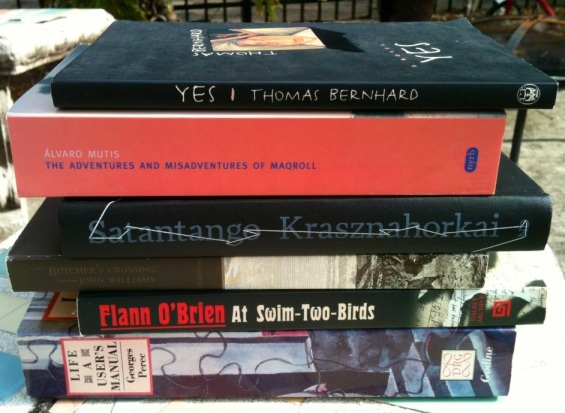
20121228-105736.jpg

There are only a handful of forthcoming titles that I know about right now that I’m looking forward to reading next year: story collections from Sam Lipsyte (The Fun Parts) and George Saunders (Tenth of December), and a new novel from William Gass called Middle C. I’m also hoping Keith Ridgway’s Hawthorn and Child will finally get a US release, because I’d like to read it too.

There are a few newish books that I didn’t read in 2012 that I’ll try to catch up to this year—Ben Marcus’s The Flame Alphabet, László Krasznahorkai’s Satantango, and Laurent Binet’s HHhH.

I do not currently possess any of these books.

I also look forward to reading Evan Lavender-Smith’s From Old Notebooks, back in print again from Dzanc (who I am sure will get the copy I ordered to me any day now).

At the top of my list though are the books I’m currently reading: Alvaro Mutis’s Maqroll novellas and Flann O’Brien’s At Swim-Two-Birds.

Stuff I’ve been saying I’ll read for a few years now that I hope to get to:

Cortazar’s Hopscotch, John Williams’s Butcher’s Crossing, Gombrowicz’s Ferdydurke, and, at the top of the heap, Georges Perec’s Life A User’s Manual.

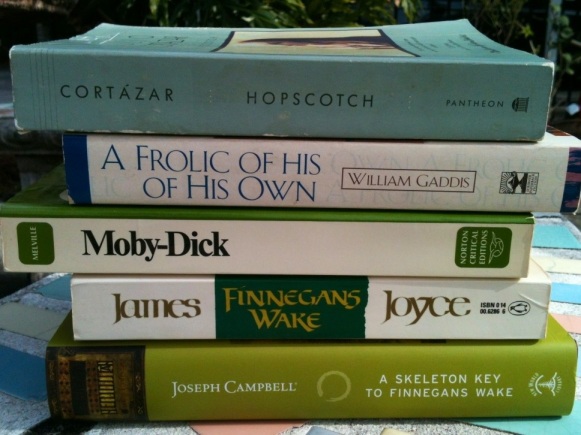
20121228-111213.jpg

I have a few books by Thomas Bernhard that I’ll probably get into this year (when I feel called to a misanthropic monologue), and I’ll gobble up anything else by Barry Hannah that I can get my mitts on. I read William Gaddis’s “big books” last year, but I still haven’t read A Frolic of His Own, which I’ve heard is superior to Carpenter’s Gothic.

I’ll reread Moby-Dick this year (or at least listen to William Hootkins’s brilliant audio version) and I’ll probably end up rereading some book that I hadn’t planned to at all (this happened with 2666 and The Savage Detectives this year—who knows? I haven’t read Gravity’s Rainbow since college, and I haven’t reread Infinite Jest in full, and I’d love to go through Suttree again . . . ).

I dipped my toe into Finnegans Wake this year—I’ve found reading it on the Kindle late at night and then going through Joseph Campbell’s Skeleton Key the next morning is rewarding—and I’ll probably keep at it in 2013. Maybe I’ll make it to chapter 3.

But enough of my rambling—What books do you, dear reader, look forward to in 2013?

“The Lagoon” — Joseph Conrad

“The Lagoon” by Joseph Conrad

The white man, leaning with both arms over the roof of the little house in the stern of the boat, said to the steersman–

‘We will pass the night in Arsat’s clearing. It is late.’

The Malay only grunted, and went on looking fixedly at the river. The white man rested his chin on his crossed arms and gazed at the wake of the boat. At the end of the straight avenue of forests cut by the intense glitter of the river, the sun appeared unclouded and dazzling, poised low over the water that shone smoothly like a band of metal. The forests, somber and dull, stood motionless and silent on each side of the broad stream. At the foot of big, towering trees, trunkless nipa palms rose from the mud of the bank, in bunches of leaves enormous and heavy, that hung unstirring over the brown swirl of eddies. In the stillness of the air every tree, every leaf, every bough, every tendril of creeper and every petal of minute blossoms seemed to have been bewitched into an immobility perfect and final. Nothing moved on the river but the eight paddles that rose flashing regularly, dipped together with a single splash; while the steersman swept right and left with a periodic and sudden flourish of his blade describing a glinting semicircle above his head. The churnedup water frothed alongside with a confused murmur. And the white man’s canoe, advancing up stream in the short-lived disturbance of its own making, seemed to enter the portals of a land from which the very memory of motion had for ever departed.

The white man, turning his back upon the setting sun, looked along the empty and broad expanse of the sea-reach. For the last three miles of its course the wandering, hesitating river, as if enticed irresistibly by the freedom of an open horizon, flows straight into the sea, flows straight to the east – to the east that harbors both light and darkness. Astern of the boat the repeated call of some bird, a cry discordant and feeble, skipped along over the smooth water and lost itself, before it could reach the other shore, in the breathless silence of the world.

     The steersman dug his paddle into the stream, and held hard with stiffened arms, his body thrown forward. The water gurgled aloud; and suddenly the long straight reach seemed to pivot on its center, the forests swung in a semicircle, and the slanting beams of sunset touched the broadside of the canoe with a fiery glow, throwing the slender and distorted shadows of its crew upon the streaked glitter of the river. The white man turned to look ahead. The course of the boat had been altered at right-angles to the stream, and the carved dragon-head of its prow was pointing now at a gap in the fringing bushes of the bank. It glided through, brushing the overhanging twigs, and disappeared from the river like some slim and amphibious creature leaving the water for its lair in the forests. Continue reading ““The Lagoon” — Joseph Conrad”