Jacques Derrida and Jorge Luis Borges

I Try to Riff on Both Flesh and Not, DFW’s New Essay Collection, Which I Haven’t Read, as I Drink Red Wine to Numb the Election Coverage (Book Acquired, 11.06.2012)

20121106-203121.jpg

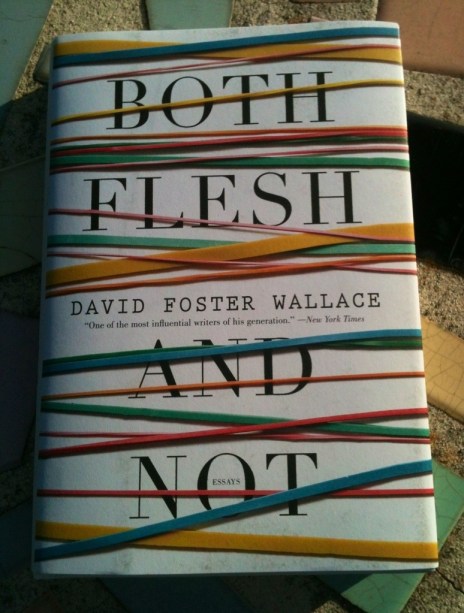
1. Today, I picked up Both Flesh and Not, a collection of David Foster Wallace essays and short pieces. I specifically ordered this book from my local bookstore (I didn’t get a review copy), and I bought it in hardback (I generally dislike hardbacks).

2. I should be reading it now—I’d like to be reading it—but I’m flicking between the five or six channels I have, usually stopping on PBS, and then scanning Twitter and other online media, because, hey, it’s Election Day in America.

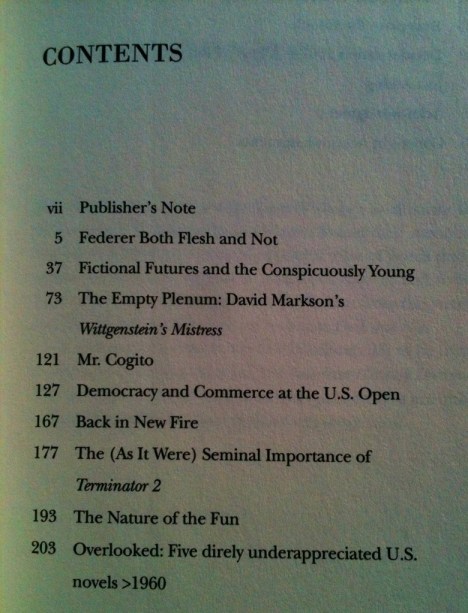
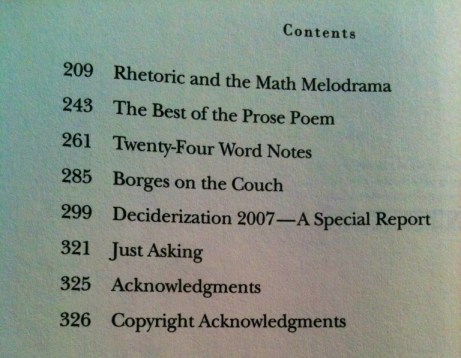
3. I’ve already read several of the pieces in Both Flesh. You might have too. Here’s the table of contents:
20121106-203459.jpg

20121106-203507.jpg

4. But a lot of it I haven’t read. I’m eager to dig into the piece on David Markson, and the piece on Brat Pack writers, “Fictional Futures,” which was later repurposed in “E Unibus Pluram.”

5. I spent most of the afternoon riffling through it, trying not to think about the election results that would be coming in the next few years. I played outside with my kids, building a strange hut out of giant elephant leaves and then a small nest out of pine straw. I photographed the planes that daily fly over our neighborhood, slow, heavy supply planes that drift in lazy routine arcs from the nearby naval base, not loud as jets, but bulky. Elephant mothers, pregnant.

20121106-211636.jpg

6. I remembered that Wallace killed himself in an election year, in September. I remember how I felt.

7. (Please don’t think this riff is really about anything. I’m distracted. I’ve imbibed some wine. Some Xanax might be involved).

8. Speaking of posts in 2008—

I went back just now, and riffled through the site’s archives from November of 2008. (Back when I’d post like three, maybe four times a week. Once a day at most).

A lot of vitriol there. A lot of vitriol for Palin, and a lot of vitriol for the emerging sentiment that would galvanize in what would become the Tea Party movement.

I wrote about the Election Night too. About Jesse Jackson’s tears. I even wrote about finding some respite from cynicism in Obama’s election. (Don’t worry, I’m as cynical as ever. Moreso—

9. —but

I remember watching the inauguration in 2009. I was still teaching high school. I had third period planning and I watched the whole shebang in an empty lab on the school’s third floor with my friend Derek, a black Muslim who taught history in the classroom next to mine. It was cold up there and empty. I remember he asked me if the election poem was good and I asked him what he thought (I thought it was good). I remember we cried a little in spite of ourselves and clutched at each other. The world seemed so much more possible. I’m clutching to this memory now, which is deep and rich and I hope to keep forever. It presents through pinot and Xanax).

10. Is this a bait and switch? I apologize. Look, I love you reader. Really, I do. I do.

11. So, another detail from the Wallace collection:

The selections are intercut with definitions from his vocabulary list for The American Heritage Dictionary. Like so:

20121106-203548.jpg

12. What was I doing here? I don’t know. Let me just wrap it up. I should be writing about DFW and the book but I can’t. Distracted. I’ll schedule the post. Let it stand. Let it roll at 11:11am tomorrow? (To clarify–it’s 9:55pm on 11/06/2012).

Okay, I’ll do that. Finish the rest in the comments? Sure. And some more, of course, about the book.
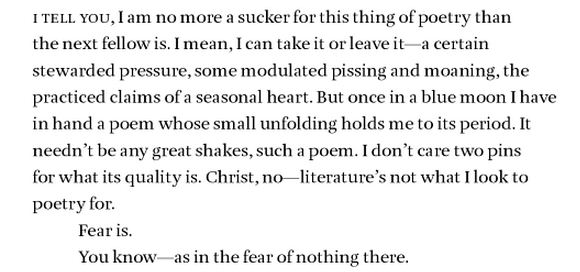
“Some Modulated Pissing and Moaning” (Gordon Lish on Poetry)


From Gordon Lish’s story “How to Write a Poem.”

“Election Day” — William Carlos Williams”

“Election Day,” William Carlos Williams:

Warm sun, quiet air
an old man sits

in the doorway of
a broken house—

boards for windows
plaster falling

from between the stones
and strokes the head

of a spotted dog

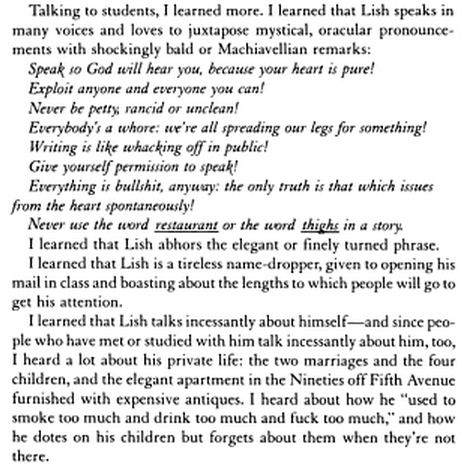
“What I Know About Gordon Lish” (1986 Spy Magazine Feature)

From a 1986 Spy magazine feature on editor/writer/hero Gordon Lish:

Henry Miller Riffs on Nietzsche and Dostoevsky (Film)

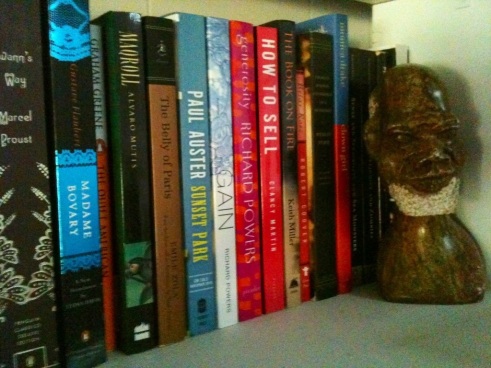
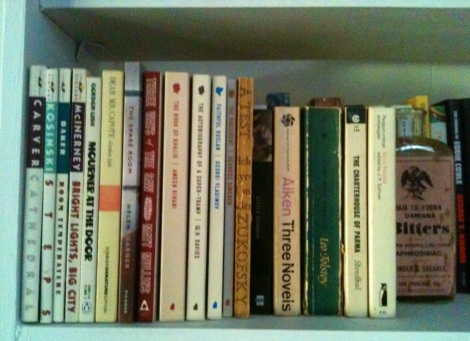
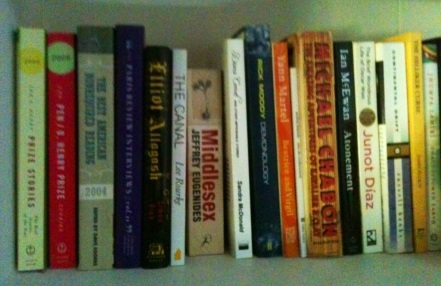
Book Shelves #45, 11.04.2012

20121103-171422.jpg

Book shelves series #45, forty-fifth Sunday of 2012

Yon shelf, murky, dim:

20121103-171436.jpg

Homeboy on the end, once my parents’,  tschotchke of time in ’80s South Africa, used to work as a bookend, now he just hangs out on this double-booked shelf.

20121103-171448.jpg

Front layer:

20121103-171458.jpg

Back layer, including a number of volumes (to be clear: Chabon, Martel, Diaz, Eugenides) I should just trade in.

20121103-171526.jpg

(Also: I hate this project and wish I’d never started it).

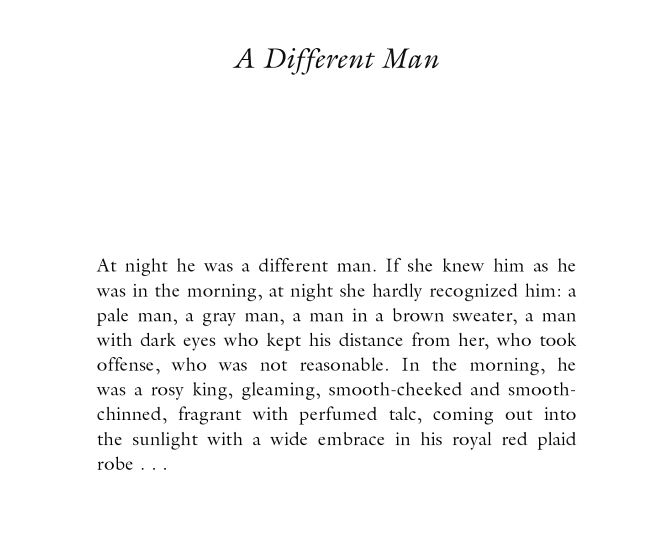
“A Different Man” — Lydia Davis

D.T. Max Talks About His David Foster Wallace Biography

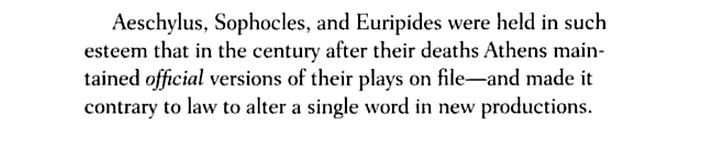
David Markson Comments on Some Athenian Playwrights

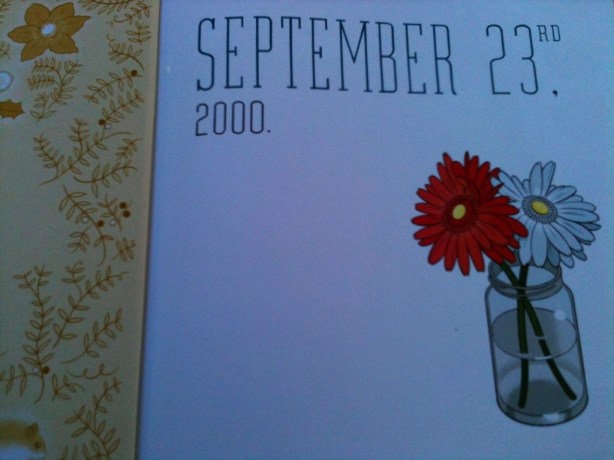
Reading Chris Ware’s Building Stories / September 23rd, 2000

20121101-205324.jpg

September 23rd, 2000 is one of the longer pieces in Chris Ware’s box set, Building Stories. Part of the joy and frustration of Building Stories is its free form—the possibility of reading one piece before another, of getting one tale or perspective before another. I started with Branford, which seems in retrospective a fairly neutral opening—it introduces many of the themes that develop in Building Stories but none of the major characters. I then read I just met, which introduces a couple suffering a sour relationship.

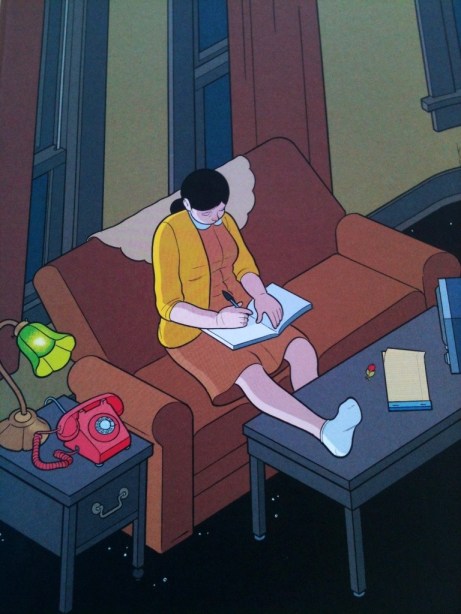
September introduces (to me, anyway), two major “new” (again, “new” to me; these characters appear central in other books and pamphlets of the collection and obliquely in others): The “lonely girl,” a would-be artist sporting a prosthetic leg, and the “old lady,” landlord of the building. Most of September takes the form of lonely girl’s diary entries.

20121101-205339.jpg

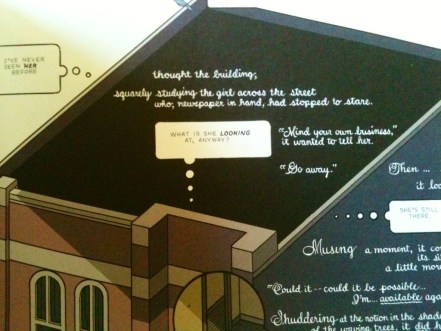
I noted two characters (again, new to me), but the building itself also gets a voice and prominent role in September; its thoughts and memories frame the narrative:

20121101-205351.jpg

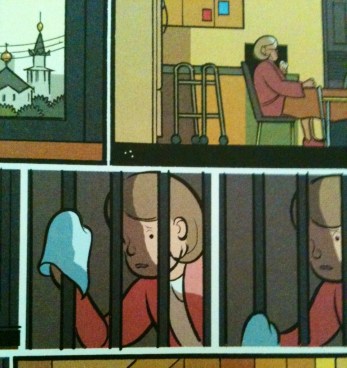
September frames the repetitions, the loops, the patterns that undoubtedly will resurface throughout Building Stories. We get access to the characters dreams, which seem to overlap and echo each other—and then repeat in real life, albeit in other forms. The landlady, recalling her youth, seems to echo the loneliness and despair of the lonely girl, as well as the pain of the woman in the sour relationship. We see that the building has in fact been a kind of prison for her, preventing her from forming real relationships:

20121101-205408.jpg

Other echoes are more subtle—a close up of a bee, for instance, either foreshadows or calls back to (or both, of course) Branford, the Best Bee in the World.

20121101-205429.jpg

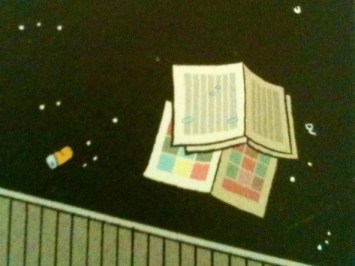
We can see the Branford episode again, here in the tiny detail of a soda can, a major setting for that episode. I was more fascinated by the newspaper though, particularly the colorful squares of a comics section, a reference Ware’s medium and perhaps a visual suggestion of Building Stories itself. The detail is tiny, but meaningful:

20121101-205421.jpg

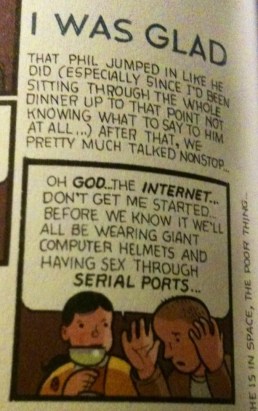
In a later part of September, we see a direct reference to the end of I just met:

20121101-205436.jpg

I imagine that there were other references, call backs, and echoes in September that I won’t get until later.

The story—well, it’s beautiful, a perfect short story, self-contained but thematically resonant with the larger project. The ending is so damn sweet and perfect that it brought a little tear to my eye. And yet: Was that the ending? Of course not. The sense of rhetorical resolution—that is to say the so-called happy ending—will almost surely be punctured, deflated, or otherwise complicated by one of the next texts I read. More to come.

“Montparnasse” — Ernest Hemingway

“Hysteria” — T.S. Eliot

Hemingway in Hospital Bed

(From a June, 1944 issue of LIFE)

“Toenails” — Jorge Luis Borges

Read “The Werewolf,” A Short Fable by Angela Carter

“The Werewolf,” a short story by Angela Carter (collected in The Bloody Chamber and Burning Your Boats):

It is a northern country; they have cold weather, they have cold hearts.Cold; tempest; wild beasts in the forest. It is a hard life. Their houses are built of logs, dark and smoky within. There will be a crude icon of the virgin behind a guttering candle, the leg of a pig hung up to cure, a string of drying mushrooms. A bed, a stool, a table. Harsh, brief, poor lives.To these upland woodsmen, the Devil is as reals as you or I. More so; they have not seen us nor even know that we exist, but the Devil they glimpse often in the graveyards, those bleak and touching townships of the dead where the graves are marked with portraits of the deceased in the naif style and there are no flowers to put in front of them, no flowers grow there, so they put out small votive offerings, little loaves, sometimes a cake that the bears come lumbering from the margins of the forests to snatch away. At midnight, especially on Walpurgisnacht, the Devil holds picnics in the graveyards and invites the witches; then they dig up fresh corpses, and eat them. Anyone will tell you that.Wreaths of garlic on the doors keep out the vampires. A blue-eyed child born feet first on the night of St. John’s Eve will have second sight. When they discover a witch – some old woman whose cheeses ripen when her neighbours’ do not, another old woman whose black cat, oh, sinister! follows her about all the time, they strip the crone, search for her marks, for the supernumerary nipple her familiar sucks. They soon find it. Then they stone her to death.

Winter and cold weather.

Go and visit grandmother, who has been sick. Take her the oatcakes I’ve baked for her on the hearthstone and a little pot of butter.

The good child does as her mother bids – five miles’ trudge through the forest; do not leave the path because of the bears, the wild boar, the starving wolves. Here, take your father’s hunting knife; you know how to use it.

The child had a scabbby coat of sheepskin to keep out the cold, she knew the forest too well to fear it but she must always be on her guard. When she heard that freezing howl of a wolf, she dropped her gifts, seized her knife, and turned on the beast.

It was a huge one, with red eyes and running, grizzled chops; any but a mountaineer’s child would have died of fright at the sight of it. It went for her throat, as wolves do, but she made a great swipe at it with her father’s knife and slashed off its right forepaw.

The wolf let out a gulp, almost a sob, when it saw what had happened to it; wolves are less brave than they seem. It went lolloping off disconsolately between the trees as well as it could on three legs, leaving a trail of blood behind it. The child wiped the blade of her knife clean on her apron, wrapped up the wolf’s paw in the cloth in which her mother had packed the oatcakes and went on towards her grandmother’s house. Soon it came on to snow so thickly that the path and any footsteps, track or spoor that might have been upon it were obscured.

She found her grandmother was so sick she had taken to her bed and fallen into a fretful sleep, moaning and shaking so that the child guessed she had a fever. She felt the forehead, it burned. She shook out the cloth from her basket, to use it to make the old woman a cold compress, and the wolf’s paw fell to the floor.

But it was no longer a wolf’s paw. It was a hand, chopped off at the wrist, a hand toughened with work and freckled with old age. There was a wedding ring on the third finger and a wart in the index finger. By the wart, she knew it for her grandmother’s hand.

She pulled back the sheet but the old woman woke up, at that, and began to struggle, squawking and shrieking like a thing possessed. But the child was strong, and armed with her father’s hunting knife; she managed to hold her grandmother down long enough to see the cause of her fever. There was a bloody stump where her right hand should have been, festering already.

The child crossed herself and cried out so loud the neighbours heard her and come rushing in. They know the wart on the hand at once for a witch’s nipple; they drove the old woman, in her shift as she was, out into the snow with sticks, beating her old carcass as far as the edge of the forest, and pelted her with stones until she fell dead.

Now the child lived in her grandmother’s house; she prospered.

Charles Burns’s The Hive (Book Acquired 10.15.2012)

20121030-155650.jpg

For some reason—some reason founded on no reason at all but rather superstitious suspicion—I didn’t believe Charles Burns would follow up X’ed Out, the first chapter of a proposed trilogy. I suppose X’ed Out had unresolved cult classic written all over it (written metaphorically, of course).

X’ed Out was one of my favorite books of 2010. From my review:

In Black Hole, Burns established himself as a master illustrator and a gifted storyteller, using severe black and white contrast to evoke that tale’s terrible pain and pathos. X’ed Out appropriately brings rich, complex color to Burns’s method, and the book’s oversized dimensions showcase the art beautifully. This is a gorgeous book, both attractive and repulsive (much like Freud’s concept of “the uncanny,” which is very much at work in Burns’s plot). Like I said at the top, fans of Burns’s comix likely already know they want to read X’ed Out; weirdos who love Burroughs and Ballard and other great ghastly fiction will also wish to take note. Highly recommended.

20121030-155702.jpg

So, of course I was stoked when Burns’s sequel The Hive showed up a few weeks ago—in fact, the only thing that got in the way of me reading it immediately was that it showed up in a package along with Chris Ware’s Building Stories (this is, without question, the best package I’ve received in six years of doing the blog).

20121030-155714.jpg

Anyway, I’ll be revisiting X’ed Out and then reviewing The Hive in the next week or so. For now, a few pics. Two from the interior above. And our hero Doug, in his alter-ego/costume Nitnit (inverse Tintin):

20121030-155722.jpg

I dig this panel in particular: A take on Roy Lichtenstein via Raymond Pettibon via the romance comics those pop artists were riffing on:

20121030-155729.jpg