The Problems of Bartleby

20121112-120230.jpg

What are the problems of Herman Melville’s story “Bartleby, the Scrivener: A Story of Wall Street”?

This question seems like a bad starting place.

Let me share an anecdote instead.

—I was in the tenth grade the first time I read “Bartleby.”

At the time, I thought I was a teacher’s dream—a sharp reader, someone who loved English class, someone with opinions about the texts we read. Lots and lots of opinions. In retrospect, I realize that I was a nightmare for poor Ms. Hall, a wonderful teacher who I’m sure dreaded our meetings (there were like 15 guys in the class, all unruly).

Simply put, I didn’t want to do things her way.

So she gave me a copy of Billy Budd, Sailor and Other Stories and told me to read “Bartleby,” suggesting that there was something I might learn from it.

I don’t know if backfired is exactly the right term for the results of this experiment. I do know that “Bartleby” offered me a brilliant retort—a literary allusion!—to refuse any task I didn’t feel like undertaking in 10th grade English:

“I would prefer not to.”

—While we’re here—

“I would prefer not to”

So, this is clearly one of the problems of “Bartleby,” if not the core problem condensed into one utterance: Why would? Why the conditional?

Consider, vs. I prefer not to, a constative (or maybe even performative) utterance.

But Bartleby “would prefer not to.”

Contrast this with the imperative must that the narrator employs:

At the expiration of that period, I peeped behind the screen, and lo!
Bartleby was there.

I buttoned up my coat, balanced myself; advanced slowly towards him, touched his shoulder, and said, “The time has come; you must quit this place; I am sorry for you; here is money; but you must go.”

“I would prefer not,” he replied, with his back still towards me.

“You must.”

He remained silent.

Now I had an unbounded confidence in this man’s common honesty. He had frequently restored to me sixpences and shillings carelessly dropped upon the floor, for I am apt to be very reckless in such shirt-button affairs. The proceeding then which followed will not be deemed extraordinary.

“Bartleby,” said I, “I owe you twelve dollars on account; here are thirty-two; the odd twenty are yours.—Will you take it?” and I handed the bills towards him.

These brief lines perhaps serve to summarize Melville’s tale.

We see here the basic plot—our titular scrivener will not leave the lawyer’s office after weeks of refusing (although refusing is not quite the right word) to work.

We also see here what I take to be the theme of “Bartleby,” the strange ethical position Bartleby’s (conditional) would prefer not to places the narrator’s (imperative) must set against the moral backdrop of do unto others: namely, an impossible ethical position for a Wall Street lawyer especially and most of us in general.

And “Bartleby,” as you’ll no doubt recall, is in some ways Melville trying to work out the problems of Matthew 25:35-39—

For I was an hungred, and ye gave me meat: I was thirsty, and ye gave me drink: I was a stranger, and ye took me in:

Naked, and ye clothed me: I was sick, and ye visited me: I was in prison, and ye came unto me.

Then shall the righteous answer him, saying, Lord, when saw we thee an hungred, and fed thee? or thirsty, and gave thee drink?

When saw we thee a stranger, and took thee in? or naked, and clothed thee?

Or when saw we thee sick, or in prison, and came unto thee?

Perhaps our narrator tries to do these things—tries to feed and clothe and help this stranger Bartleby—but he can’t. Because Bartleby won’t give him an agency to relate to.

Because Bartleby’s utterance “I would prefer not to” denies the performative or constantive or declarative—indeed, it suspends or disrupts its own conditionality, the relation of the subject to its predicate verb.

Or consider one of Bartleby’s only other lines: “What is wanted?” His grammar again suspends agency, disrupts the notion of a stable I (let alone objective case me) that the narrator can interface with, dictate to, interrogate, see his own narcissistic reflection in).

—Hang on though, I was telling an anecdote. It was about the first time I read “Bartleby,” when I was fourteen or fifteen. This is the book:

20121112-150751.jpg

I stole it of course, or never returned it. Yes, that’s duct tape on its side. It is more or less falling apart. Here’s the back, barcode and all.

20121112-150740.jpg

Over the years, like many readers, I returned many times to “Bartleby,” reading it again in high school, then in college, then in grad school. I read it unassigned too, of course—when I read Kafka and it recalled itself to me, and when I read Moby-Dick for the first time. I read it when compelled. And then I read it with my own students. (I read most of the other stuff in the collection too, of course — Billy Budd and then later (why so much later?!) Benito Cereno).

I scrawled through so much of the book that my annotations are basically worthless, virtually everything underlined or circled:

20121112-151659.jpg

So we butt up against the problems of “Bartleby”—the problems of interpretation. How to figure an eponymous “hero” who is no more than a phantom, a trace, a lack? How to hash out a narrator who presents himself in relatively admirable terms and yet is so clearly an ethical failure? Why oh why would Bartleby prefer not to? Is the story a tragedy or a comedy? Does it present a world with rules, codes, ethics, or is all absurd here—nihilistic even? Is Bartleby a Christ figure? An ascetic monk? A ghost? Is the story just about Melville’s own anger over the poor reception of Pierre? How much of contemporary transcendentalist thought can we find in the story?

—Slight shift:

The kind people of Melville House were sporting enough to send a copy of “Bartleby” my way. The book is part of their HybridBooks project; these books offer “digital illuminations” along with traditional (uh, paper) books.

I’d requested a HybridBook—any one of them, really—because I now read about half the time on a Kindle Fire—so I was particularly interested in what a “hybrid” had to offer. What is the reading experience like?

First, the book itself is part of Melville House’s Art of the Novella series—beautiful, minimal design with French flaps. I read it on my porch the afternoon it arrived, enjoying its pristine, white, unmarked pages. Then, I checked out the “Digital Illuminations.”

The illuminations are available in several device-specific options, all easy to download with the QRC that comes with the book. I read most of the illuminations on my Kindle, but I also put them on my iPhone and my laptop. I had originally intended this post to be specifically about the digital illuminations, but hell, “Bartleby” is just too damn freighted a read for me at this point. Anyway, there’s a lot of good stuff in there, including “The Transcendentalist” by Ralph Waldo Emerson, selections from Jonathan Edwards and Joseph Priestly, Thoreau’s “Civil Disobedience,” and several excerpts from Melville himself, including letters, other books, and reviews. What I found must, uh, illuminating was “Of Some of the Sources of Poetry Amongst Democratic Nations” from Democracy in America by Alexis de Tocqueville. There are also illustrations, including a map; there’s even a recipe for ginger nuts. I wish that MH had included a digital copy of the book though. From a practical, concrete standpoint, I found it easier to switch between the free public domain version of “Bartleby” on my Kindle and MH’s illuminations than it would have been to pick up the physical book.

Now, to shift back (perhaps):

Do the digital illuminations help to answer or solve or address some of the problems of “Bartleby,” some of the issues posed above?

Should they?

—I suppose the hedging answer is yes and no.

The additional material illuminates some of the philosophical, political, historical, and even personal context for “Bartleby.” The material is edited with minimal intrusion, but with enough explication to clearly connect the various selections to Melville’s story. If I’m reading with my teacher hat on (this is a metaphor; there is no literal hat), I’d say you probably couldn’t do better than what Melville House has put together here. The digital illuminations provide a strong foundation for an informed reading, a range of texts that speak (obliquely or otherwise) to “Bartleby.”

Does it all add up to a deeper or richer understanding of “Bartleby”?

Should it?

—Well. No. And then no.

I mean, would we want a series of essays that would provide the missing pieces that would allow us to puzzle out “Bartleby”? Could we even trust such pieces, let alone trust ourselves to trust such pieces? Isn’t this strange uncertainty why “Bartleby” endures—and endures apart from Moby-Dick or Billy Budd, strange texts themselves, but also not nearly as confounding?

“Bartleby” simultaneously wriggles and plays dead; it burns with apparent wit but then reminds us that we might not be in on the joke. It is Kafkaesque thirty years before Kafka was even born. It shakes off its allegorical idiom the minute we think we might limn its contours. It makes us read it again because we cannot pin it down.

—But maybe you want to pin it down, tickle it, torture it, make it solve its problems (or at least respond, damn it!).

And maybe I claimed that “Bartleby” was about something—that it was about ethical relations, about duty to one’s fellows—especially when a fellow isn’t a fellow but rather the trace of a fellowthe idea of a fellowa ghost.

So, look, here’s a take on it:

The narrator—let’s call him Lawyer—Lawyer, see he’s a dick, in the parlance of our times. He’s a dick because he doesn’t know that he’s a dick, which is one of the constituting factors of the ontological state of being a dick. He also does not want to see himself as being a dick (this is another factor in the ontological state of being a dick). He wants to see himself as a good guy, this Wall Street dickhead, but Bartleby won’t let him do that. Bartleby won’t even let him see himself at all: Bartleby doesn’t reflect back. He prefers not to.

Our Lawyer, see, he’s all buttoned up, he’s snug (these are his words). He tells us upfront that he possesses “a profound conviction that the easiest way of life is the best”; he repeatedly points out the way that people are “useful” to him (or to others). He sees no possibility of an ethics outside of usefulness; on top of that, he cannot see that he cannot see any possibility of an ethics based on anything but “usefulness” (or the negative economy of obstruction figured in Bartleby).

And ah Bartleby, ah humanity: One time model employee, once apparently free from the eccentricities that plague the Lawyer’s other scriveners, Turkey and Nippers. Machinelike.

Bartleby mechanically completes large quantities of copies without comment or complaint.  But when asked to simply read in unison with Lawyer and his scriveners, Bartleby replies: “I would prefer not to.” Bartleby will not read with others—he is literally not on the same page as his colleagues.

Lawyer confronts Bartleby with his noncompliance; Bartleby repeats his mantra. Fuck mantra though because it’s not a mantra. It’s only repeated for Lawyer, to Lawyer, really, who can’t schematize/name/pin down Bartleby’s response. In fact, I would prefer not to so startles Lawyer that he says he’s  “unmanned” by the words. So he rationalizes Bartleby’s odd response, internalizes it, paraphrases it, if you like.

And then Bartleby ceases to even do his copying work. Oh the anarchy! But wait, there’s not even anarchy. There’s not even protest. There’s just big nothing. But not even big nothing—instead the smallest nothing (which proves that big nothing is possible).

So Lawyer attempts to “help” Bartleby. Lawyer believes doing so is his “Christian duty.” And to know that this duty has been met, Lawyer needs Bartleby to be his echo. But Bartleby’s I prefer not to denies this narcissistic exchange. He empties his I of ego (shades of Emerson’s Transparent Eyeball).

Confused, Lawyer tries to pay off Bartleby. When that doesn’t work, Lawyer actually packs up and moves to a new office. But even here he can’t cut off Bartleby. The office’s landlord comes to Lawyer to remove Bartleby.

And when Bartleby refuses to leave the office he is taken to “the Tombs”—prison.

Here, Lawyer tries to provide comfort for Bartleby (hearken ye back to Matthew 25:35-39). He arranges for Bartleby to receive good food in the prison. Bartleby prefers not to eat though, and dies curled up in the fetal position during a visit by Lawyer.

Lawyer is the first reader of Bartleby. But like many readers of “Bartleby,” he is confused.

Lawyer’s confusion results from his need for safety—for ease, for comfort, for a snug, buttoned-upness—and that safety is bought through an affirmation of first-person experience: namely, in the affirmation of the self in the other. That security is bought through assimilating another person’s first-person perspective. But Bartleby is empty of I, of self, of ego.

Bartleby would prefer not to: He will not be ventriloquized: He will not echo: He will not read from the same script: He will not be “of use,” as Lawyer puts it.

So Bartleby dissipates and dissolves: He goes down in the Tombs: a ghost, and impossibility, presence coupled with absence.

— And the epilogue:

We all recall the epilogue, yes?

Lawyer offers up “one little item of rumor,” a morsel, a “vague report . . . that Bartleby had been a subordinate clerk in the Dead Letter Office at Washington.” The idea tears the narrator up inside: “Dead letters! does it not sound like dead men?”

For Lawyer, Bartleby is a dead letter, a failed letter.

Did Melville worry that “Bartleby” would be a failed letter? That it would not find an audience? That his work would not be delivered? If he did, it seems too then that Bartleby’s negations foreclose or reject this concern. Not sure of how to wrap up this riff, I’ll retreat to the safety of my title.

We find the final problems (in basic narrative chronology, that is) of “Bartleby” in its final line. Has Lawyer learned from his experience? Can he empathize, finally feel something for Bartleby beyond the confines of a perceived ethical duty? Is Bartleby a place holder for all humanity? Or is Bartleby in opposition to humanity? What does it mean—-

Ah Bartleby! Ah humanity!

?
Read “A Baby Tramp,” A Short Story by Ambrose Bierce

“A Baby Tramp” by Ambrose Bierce

If you had seen little Jo standing at the street corner in the rain, you would hardly have admired him. It was apparently an ordinary autumn rainstorm, but the water which fell upon Jo (who was hardly old enough to be either just or unjust, and so perhaps did not come under the law of impartial distribution) appeared to have some property peculiar to itself: one would have said it was dark and adhesive — sticky. But that could hardly be so, even in Blackburg, where things certainly did occur that were a good deal out of the common.

For example, ten or twelve years before, a shower of small frogs had fallen, as is credibly attested by a contemporaneous chronicle, the record concluding with a somewhat obscure statement to the effect that the chronicler considered it good growing-weather for Frenchmen.

Some years later Blackburg had a fall of crimson snow; it is cold in Blackburg when winter is on, and the snows are frequent and deep. There can be no doubt of it — the snow in this instance was of the colour of blood and melted into water of the same hue, if water it was, not blood. The phenomenon had attracted wide attention, and science had as many explanations as there were scientists who knew nothing about it. But the men of Blackburg — men who for many years had lived right there where the red snow fell, and might be supposed to know a good deal about the matter — shook their heads and said something would come of it.

And something did, for the next summer was made memorable by the prevalence of a mysterious disease — epidemic, endemic, or the Lord knows what, though the physicians didn’t — which carried away a full half of the population. Most of the other half carried themselves away and were slow to return, but finally came back, and were now increasing and multiplying as before, but Blackburg had not since been altogether the same.

Of quite another kind, though equally ‘out of the common,’ was the incident of Hetty Parlow’s ghost. Hetty Parlow’s maiden name had been Brownon, and in Blackburg that meant more than one would think.

Continue reading “Read “A Baby Tramp,” A Short Story by Ambrose Bierce”

David Foster Wallace on INTERPRET-ME Novels

Certain novels not only cry out for what we call “critical interpretations” but actually try to help direct them . . .  Books I tend to associate with this INTERPRET-ME phenomenon include stuff like Candide, Witold Gombrowicz’s Cosmos, Hesse’s The Glass Bead Game, Sartre’s Nausea, Camus’s The Stranger. These five are works of genius of a particular kind: they shout their genius. Mr. Markson, in Wittgenstein’s Mistress, tends rather to whisper, but his w.o.g.’s no less successful . . . Clearly the book was/is in some way “about” Wittgenstein, given the title. This is one of the ways an INTERPRET-ME fiction clues the critical reader in about what the book’s to be seen as on a tertiary level “about”: the title: Ulysses’s title, its structure as Odyssean/Telemachean map (succeeds); Goldstein’s The Mind-Body Problem (really terrible); Cortázar’s Hopscotch (succeeds exactly to the extent that one ignores the invitation to hop around in it); Burroughs’s Queer and Junkie (fail successfully (?)). 

From David Foster Wallace’s essay “The Empty Plenum: David Markson’s Wittgenstein’s Mistress,” which is collected in Both Flesh and Not.

Judge Holden Holds Forth on War (Blood Meridian)

From Chapter XVII of Cormac McCarthy’s novel Blood Meridian

They grew gaunted and lank under the white suns of those days and their hollow burnedout eyes were like those of noctambulants surprised by day. Crouched under their hats they seemed fugitives on some grander scale, like beings for whom the sun hungered. Even the judge grew silent and speculative. He’d spoke of purging oneself of those things that lay claim to a man but that body receiving his remarks counted themselves well done with any claims at all. They rode on and the wind drove the fine gray dust before them and they rode an army of gray-beards, gray men, gray horses. The mountains to the north lay sunwise in corrugated folds and the days were cool and the nights were cold and they sat about the fire each in his round of darkness in that round of dark while the idiot watched from his cage at the edge of the light. The judge cracked with the back of an axe the shinbone on an antelope and the hot marrow dripped smoking on the stones. They watched him. The subject was war.

The good book says that he that lives by the sword shall perish by the sword, said the black.

The judge smiled, his face shining with grease.

What right man would have it any other way? he said.

The good book does indeed count war an evil, said Irving. Yet there’s many a bloody tale of war inside it.

It makes no difference what men think of war, said the judge. War endures. As well ask men what they think of stone. War was always here. Before man was, war waited for him. The ultimate trade awaiting its ultimate practitioner. That is the way it was and will be. That way and not some other way.

He turned to Brown, from whom he’d heard some whispered slur or demurrer. Ah Davy, he said. It’s your own trade we honor here. Why not rather take a small bow. Let each acknowledge each.

My trade?

Certainly.

What is my trade?

War. War is your trade. Is it not?

And it aint yours?

Mine too. Very much so.

What about all them notebooks and bones and stuff?

All other trades are contained in that of war.

Is that why war endures?

No. It endures because young men love it and old men love it in them. Those that fought, those that did not.

That’s your notion.

The judge smiled. Men are born for games. Nothing else. Every child knows that play is nobler than work. He knows too that the worth or merit of a game is not inherent in the game itself but rather in the value of that which is put at hazard. Games of chance require a wager to have meaning at all. Games of sport involve the skill and strength of the opponents and the humiliation of defeat and the pride of victory are in themselves sufficient stake because they inhere in the worth of the principals and define them. But trial of chance or trial of worth all games aspire to the condition of war for here that which is wagered swallows up game, player, all.

Suppose two men at cards with nothing to wager save their lives. Who has not heard such a tale? A turn of the card. The whole universe for such a player has labored clanking to this moment which will tell if he is to die at that man’s hand or that man at his. What more certain validation of a man’s worth could there be? This enhancement of the game to its ultimate state admits no argument concerning the notion of fate. The selection of one man over another is a preference absolute and irrevocable and it is a dull man indeed who could reckon so profound a decision without agency or significance either one. In such games as have for their stake the annihilation of the defeated the decisions are quite clear. This man holding this particular arrangement of cards in his hand is thereby removed from existence. This is the nature of war, whose stake is at once the game and the authority and the justification. Seen so, war is the truest form of divination. It is the testing of one’s will and the will of another within that larger will which because it binds them is therefore forced to select. War is the ultimate game because war is at last a forcing of the unity of existence. War is god. Brown studied the judge.

You’re crazy Holden. Crazy at last.

The judge smiled.


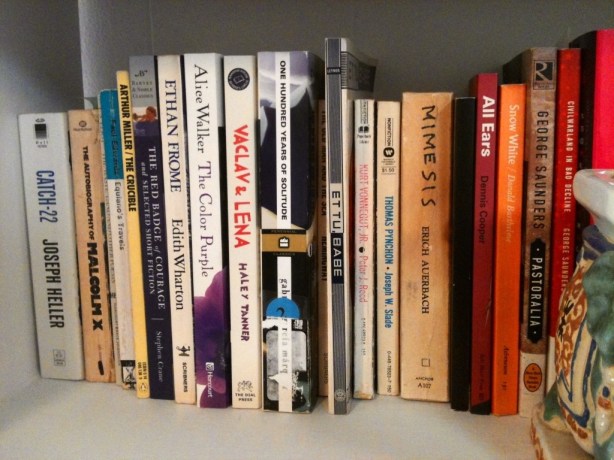
Book Shelves #46, 11.11.2012

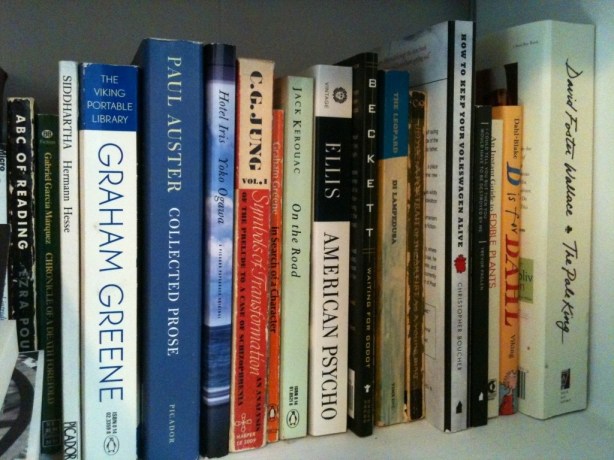
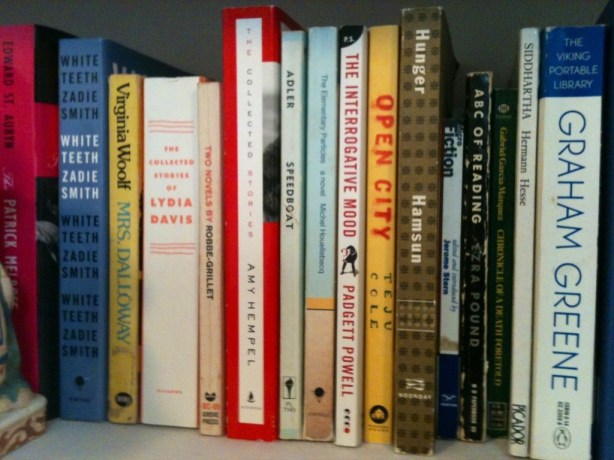
20121111-111049.jpg

Book shelves series #46, forty-sixth Sunday of 2012

Another double-stacked shelf. This one even has a stack of drifters.

This shelf is at my eye/arm level, and looking at it this way, I see that it gets a lot of shuffling—I can see where I started certain projects for the site.

I can see books that are in line, so to speak, for either proper shelving or for reading.

The mounding stack on the shelf below is a bit out of control, although most of what sits there comes from other places (I kinda sorta wrote about those here).

Below: Unsorted stuff that I’ve been reading of an afternoon:

20121111-111057.jpg

This is the front stack—books that need proper shelving elsewhere, books that I’ve read (and sometimes reviewed here) in the past few months, or meant to read, or in some other way consulted or read from:

20121111-111105.jpg

The far right side of the shelf—again, a very mixed bag. I think I originally intended to properly shelf everything here and then got sidetracked:

20121111-111113.jpg

Moving left:

20121111-111124.jpg

And here’s what’s behind the front stack—okay, I can see now the edges of an idea I had for shelving; I also see where I just abandoned that idea:

20121111-111133.jpg

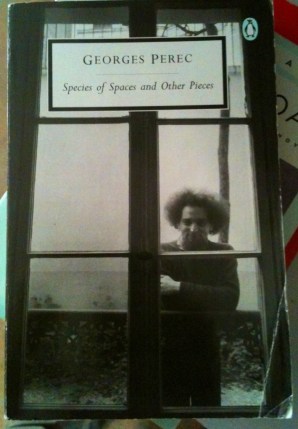
This whole project I blame on an essay by Georges Perec, collected in this one:

20121111-111157.jpg

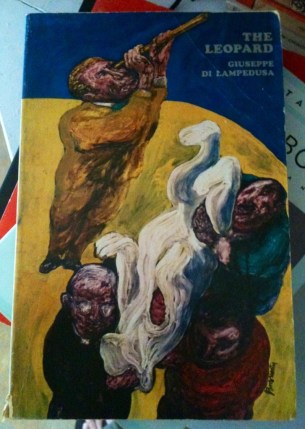
This is one of my favorite book covers:

20121111-111149.jpg

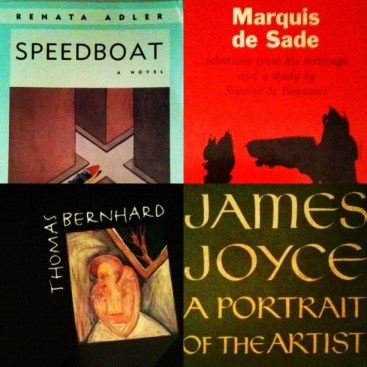
More covers I like from this shelf:

20121111-111204.jpg

Eleven Authors Who Were Also Veterans of War

Eleven Authors Who Were Also Veterans of War

1. Stendahl (Napoleonic Wars)

2. Ambrose Bierce (Union Army, American Civil War)

3. Erich Maria Remarque (German Army, WWI)

4. George Orwell (Republican Army, Spanish Civil War)

5. Kurt Vonnegut (U.S. Army, WWII)

6. Joseph Heller (U.S. Air Force, WWII)

7. Eveyln Waugh (British Royal Marines, WWII)

8. Norman Mailer (U.S Army, WWII)

9. Gore Vidal (U.S. Army, WWII)

10. Tim O’Brien (U.S. Army, Vietnam War)

11. Anthony Swofford (U.S. Marine Corps, Persian Gulf War)


“Parable of Cervantes and Don Quixote” — Jorge Luis Borges

Waiting for Elmo — Sesame Street Does Beckett

Why I’m Not Particularly Interested in Reading a DFW Biography

(Think about it — the personal lives of most people who spend 14 hours a day sitting there alone, reading and writing, are not going to be thrill rides to hear about.)

–David Foster Wallace on literary biography in general and Edwin Williamson’s Borges: A Life in particular; from “Borges on the Couch,” a 2004 NYT piece republished this month in the David Foster Wallace collection Both Flesh and Not.

Reading Chris Ware’s Building Stories / Untitled Wordless Loop

20121109-140907.jpg

Continuing this project:

I’ve thus far titled the pieces I’ve been reading of Chris Ware’s Building Stories in a rather ad hoc fashion, but this entry is a wordless affair.

It continues the story of the “lonely girl,” the “cripple” who is the primary narrator of September 23rd, 2000.

Here, we see her raising her daughter in a series of wordless, precise panels that span roughly a decade.

Building Stories’s brilliance derives in large part from its precision and economy—Ware tells a story on every page, a chapter in every small panel:

20121109-140920.jpg

I’m a parent (my daughter is five, my son is two), and so much of this untitled piece struck me as utterly real and authentic—so true in the details.

There’s a moment when our mother looks up to see her daughter reading—silently, to herself—that is bittersweet, a kind of gentle heartbreak:

20121109-140926.jpg

There’s a fine line between the precise evocation of emotion and sentimental schlock, but Ware never comes close to treading it here—he’s always firmly on the side of the real.

And yet this doesn’t come at the expense of evocations of wonder, as we can see in the panels below:

20121109-140934.jpg

As I’ve suggested a few times already, Building Stories is a sort of  Möbius strip; this particular comic nearly literalizes this metaphor.

It begins with our mother drifting from sleep to waking memory, and ends thusly, a strange loop documenting how fast and how slow life changes.

“The Great Bridge Between Modernism and Post-modernism” — David Foster Wallace on Jorge Luis Borges

. . . Borges is arguably the great bridge between modernism and post-modernism in world literature. He is modernist in that his fiction shows a first-rate human mind stripped of all foundations in religious or ideological certainty — a mind turned thus wholly in on itself. His stories are inbent and hermetic, with the oblique terror of a game whose rules are unknown and its stakes everything.

And the mind of those stories is nearly always a mind that lives in and through books. This is because Borges the writer is, fundamentally, a reader. The dense, obscure allusiveness of his fiction is not a tic, or even really a style; and it is no accident that his best stories are often fake essays, or reviews of fictitious books, or have texts at their plots’ centers, or have as protagonists Homer or Dante or Averroes. Whether for seminal artistic reasons or neurotic personal ones or both, Borges collapses reader and writer into a new kind of aesthetic agent, one who makes stories out of stories, one for whom reading is essentially — consciously — a creative act. This is not, however, because Borges is a metafictionist or a cleverly disguised critic. It is because he knows that there’s finally no difference — that murderer and victim, detective and fugitive, performer and audience are the same. Obviously, this has postmodern implications (hence the pontine claim above), but Borges’s is really a mystical insight, and a profound one. It’s also frightening, since the line between monism and solipsism is thin and porous, more to do with spirit than with mind per se. And, as an artistic program, this kind of collapse/transcendence of individual identity is also paradoxical, requiring a grotesque self-obsession combined with an almost total effacement of self and personality. Tics and obsessions aside, what makes a Borges story Borgesian is the odd, ineluctable sense you get that no one and everyone did it.

—From “Borges on the Couch,” a 2004 NYT piece republished this month in the David Foster Wallace collection Both Flesh and Not.


Ticket of Admission to a Lecture by Walt Whitman on Abraham Lincoln

Ticket of admission to a lecture by Walt Whitman on Abraham Lincoln,"  initialed by Whitman at lower right. Lecture "to be delivered on Thursday, April 14th [1887], at 4 o'clock P. M., in the Madison Square Theatre, New-York."

(Via/about).

Read “A Tree, A Rock, A Cloud,” a Short Story by Carson McCullers

“A Tree, A Rock, A Cloud” by Carson McCullers

It was raining that morning, and still very dark. When the boy reached the streetcar café he had almost finished his route and he went in for a cup of coffee. The place was an all-night café owned by a bitter and stingy man called Leo. After the raw, empty street, the café seemed friendly and bright: along the counter there were a couple of soldiers, three spinners from the cotton mill, and in a corner a man who sat hunched over with his nose and half his face down in a beer mug. The boy wore a helmet such as aviators wear. When he went into the café he unbuckled the chin strap and raised the right flap up over his pink little ear; often as he drank his coffee someone would speak to him in a friendly way. But this morning Leo did not look into his face and none of the men were talking. He paid and was leaving the café when a voice called out to him:

“Son! Hey Son!”

He turned back and the man in the corner was crooking his finger and nodding to him. He had brought his face out of the beer mug and he seemed suddenly very happy. The man was long and pale, with a big nose and faded orange hair.

“Hey Son!”

The boy went toward him. He was an undersized boy of about twelve, with one shoulder drawn higher than the other because of the weight of the paper sack. His face was shallow, freckled, and his eyes were round child eyes.

“Yeah Mister?”

The man laid one hand on the paper boy’s shoulders, then grasped the boy’s chin and turned his face slowly from one side to the other. The boy shrank back uneasily.

“Say! What’s the big idea?”

The boy’s voice was shrill; inside the café it was suddenly very quiet.

The man said slowly. “I love you.”

All along the counter the men laughed. The boy, who had scowled and sidled away, did not know what to do. He looked over the counter at Leo, and Leo watched him with a weary, brittle jeer. The boy tried to laugh also. But the man was serious and sad.

“I did not mean to tease you, Son,” he said. “Sit down and have a beer with me. There is something I have to explain.”

Cautiously, out of the corner of his eye, the paper boy questioned the men along the counter to see what he should do. But they had gone back to their beer or their breakfast and did not notice him. Leo put a cup of coffee on the counter and a little jug of cream.

“He is a minor,” Leo said. Continue reading “Read “A Tree, A Rock, A Cloud,” a Short Story by Carson McCullers”

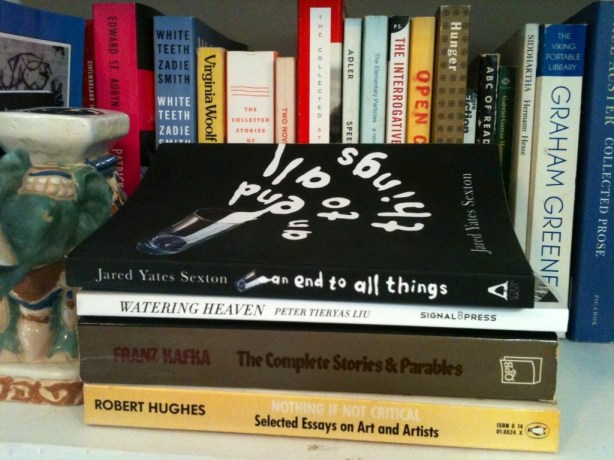
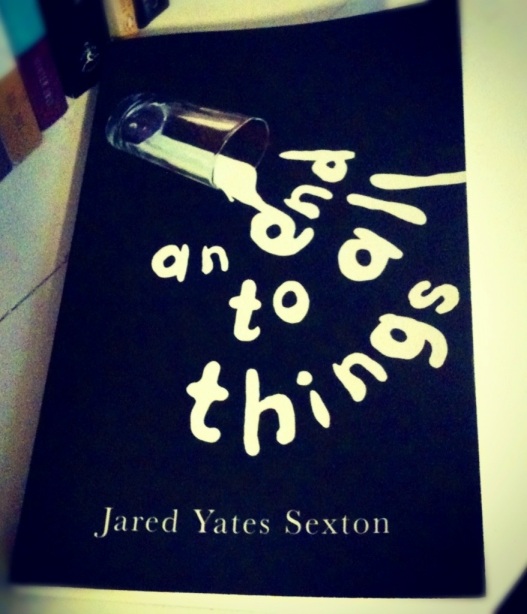
Jared Yates Sexton’s An End to All Things (Book Acquired Sometime Last Month)

20121018-174605.jpg

Jared Yates Sexton’s An End to All Things immediately appealed to me when it arrived last month. This collection is stocked with short, precise, unpretentious stories. Great sentences—shades of Hannah, Carver, Pancake. I’ve read about half a dozen so far, parceling them out over spare afternoon minutes and it’s good stuff—feels real without the strains of literary realism. You can read a story at publisher Atticus Books’ site, “You Never Ask Me About My Dreams” (great title). The first few paragraphs:

At that point things had been rough for a couple of months and I would’ve done anything to ease the tension. I set an alarm for half an hour earlier than usual. I thought if I had some breakfast going when Cathy got up she’d have to see that I cared.

After all, cooking wasn’t the easiest thing to do in our house. Both of us hated dishes so the kitchen was always a mess. There were pots and pans stacked on the counters and plates in the sink. Some still had clumps of food stuck to them. I even had to rinse out a bowl to use. Somehow there were a couple of clean forks and knives in the drawer. I got some eggs from the fridge and went to work scrambling the yolks.

“I Went to the Gypsy” — Charles Simic

Books I’ve Read All or Most of in the Past Eight Months and Failed to Write About

20121108-160535.jpg

Three Aphorisms on Writing (Goethe)