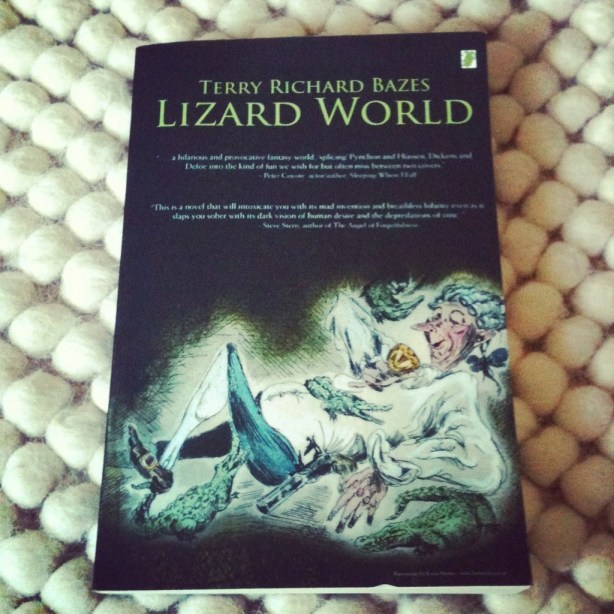
Lizard World (Book Acquired, 9.26.2012)


20121002-170037.jpg

This one is wonderfully weird stuff. Terry Richard Bazes’s Lizard World. Here’s a blurb from Grove Press founder Barney Rosset:

Lizard World opens with Josiah Fludd, a disenchanted character from the Early Modern World, exhuming a female corpse for a customer, whose interest in the carcass is presumed by the gravedigger to be a sexual one. Fludd’s blasé attitude vanishes when, on delivery of the corpse, he watches its feet sawed off, and he learns that they are meant to replace his patron’s nether claws. From this startling introduction Terry Richard Bazes pushes us into a bizarre world that vacillates between the past and present—and is told by a writer whose imagination seems to have no bounds.

Here’s an excerpt:

I being then in my nineteenth year and little more than a beggar — intent, by hook or by crook, to become a chirurgeon and yet utterly without means to feed and clothe my body (much less to learn the merest rudiments of my profession) — it came about that at  length I did find a way both to earn my bread and pursue my studies by  undertaking to perform a service — a wholly necessary and harmless service albeit one from which my more prosperous school-mates turned away with horror and revulsion.  So it was that I got my sustenance and was suffered to sit with all the paying scholars — provided it was in the very backermost row — and watch whilst our professor  probed the deepest mysteries of a fresh cadaver.
Now just exactly how and whence these cadavers were supplied were questions my finical  colleagues dared not closely entertain, although in gross they knew the truth and shunned me like a leper. But I cared not a fart for their esteem, so long as I could learn, and the short of it was that I advanced quickly in my studies and was oft besought by my professors for a specimen and consequently was upon ever the most constant look-out for the newly dead.
For this purpose it was my practice to put on the clothes and countenance of a mourner and, thus disguised, to frequent the very meanest of country churches in the hope that there I might chance upon some humble obsequies.  If fortune smiled, and some farmer or laundress had departed this life, then I would repair under the cloak of  starlight unto the churchyard,  still in mourning attire  and carrying a fistful of daisies and a Bible, lest I be questioned of my purpose and require a ready pretext.  The great secret of the art was to work with utmost haste and efface the smallest evidence of theft. Therefore, by the light of my lantern, I studied the disposition of each rock, each wreath of flowers — and, thus informed of the state to which the grave must later be restored, now proceeded to violate the soil, but only so much as to permit my shovel to break the very head-piece of the box.  This method, once perfected, allowed me — in a trice — to draw the carcass out, conceal it in a sack, restore the injured earth, and load my stiffened burden on a waiting dung-cart.

For more excerpts, check out Bazes’s site; more to come.


“Were he my brother, why then I’d have murdered poor Werther” (Goethe)

Ask whomever you will but you’ll never find out where I’m lodging,

High society’s lords, ladies so groomed and refined.

“Tell me, was Werther authentic? Did all of that happen in real life?”

“Lotte, oh where did she live, Werther’s only true love?”

How many times have I cursed those frivolous pages that broadcast

Out among all mankind passions I felt in my youth!

Were he my brother, why then I’d have murdered poor Werther.

Yet his despondent ghost couldn’t have sought worse revenge.

That’s the way “Marlborough,” the ditty, follows the Englishman’s travels

Down to Livorno from France, thence from Livorno to Rome,

All of the way into Naples and then, should he flee on to Madras,

“Marlborough” will surely be there, “Marlborough” sung in the port.

Happily now I’ve escaped, and my mistress knows Werther and Lotte

Not a whit better than who might be this man in her bed:

That he’s a foreigner, footloose and lusty, is all she could tell you,

Who beyond mountains and snow, dwelt in a house made of wood.

From Section I of Goethe’s Erotica Romana.

Men Reading — Francisco Goya

Ralph Ellison Interview (Film, 1966)

Chris Ware on DFW’s Novel The Pale King

Crippled Robot painting by Chris Ware

Cartoonist/graphic novelist/chronicler of shame and despair Chris Ware wrote about his favorite books for Foyles bookstore. The list includes UlyssesMoby-Dick, and works by cartoonists like Lynda Barry and Ivan Brunetti. Here’s what Ware wrote about David Foster Wallace’s posthumous novel The Pale King:

The first great novel of the 21st century uses the sinister beauty of the American Tax Code as a springboard from which to launch into a genuinely serious discussion of the origins and importance of civic responsibility amidst the hazy, blurred stupidity of a country in quick decline. Contrary to many reviews, I don’t think it’s about boredom, and it’s certainly not boring. Another posthumous editor-to-manuscript resuscitation, the book hangs heavy with the clotted spectre of Wallace’s suicide, which makes the writing glow all the more painfully through it.

List with No Name #10

1. 2666, Roberto Bolaño

2. The Pale King, David Foster Wallace

3.  Train Dreams, Denis Johnson

4. The Last Novel, David Markson

5. Samuel Johnson Is Indignant, Lydia Davis

6. Agapē Agape, William Gaddis

7. C, Tom McCarthy

8. No Country for Old Men, Cormac McCarthy

9. Sandokan, Nanni Balestrini

10. Open City, Teju Cole

“I have been reading about Dickens” (Kafka)

(From Kafka’s Diaries).

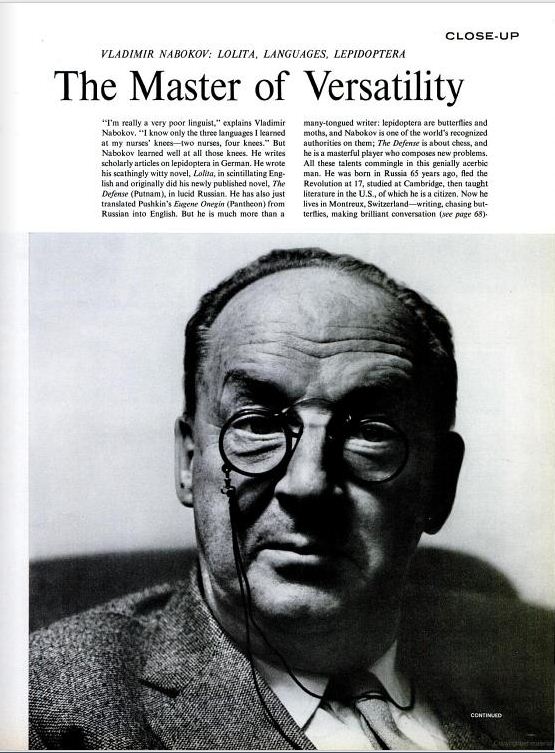
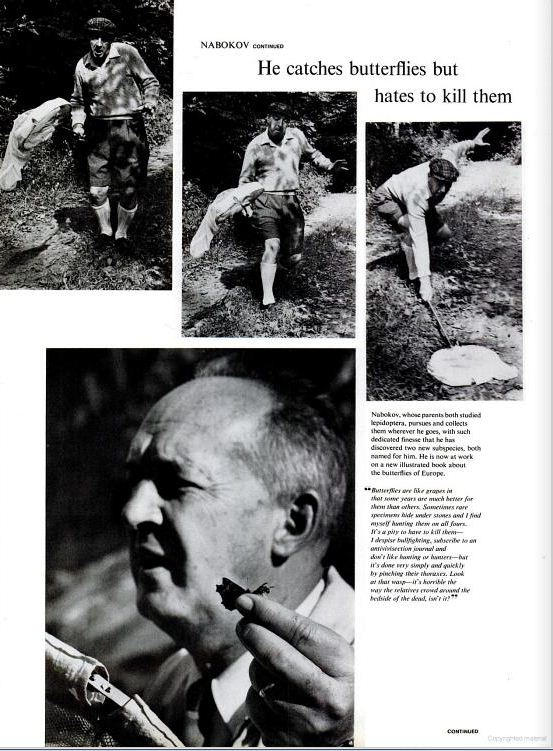
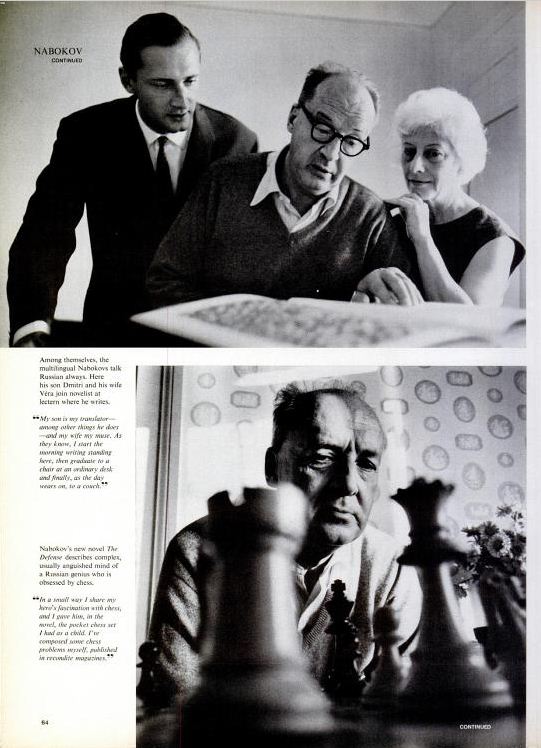
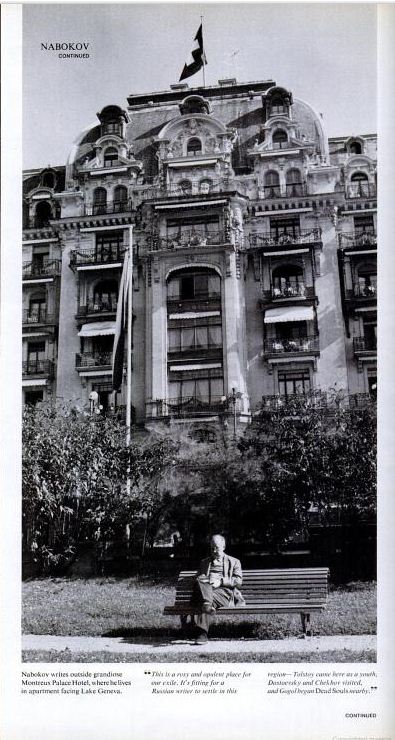
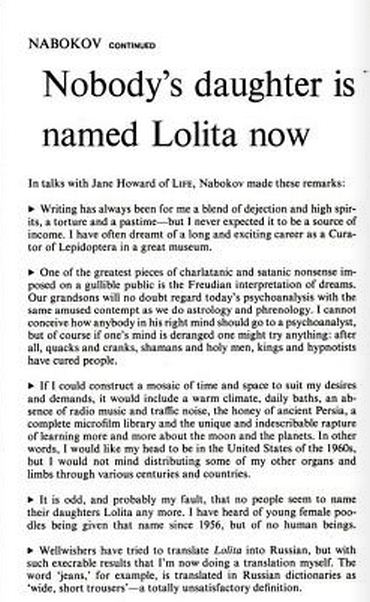
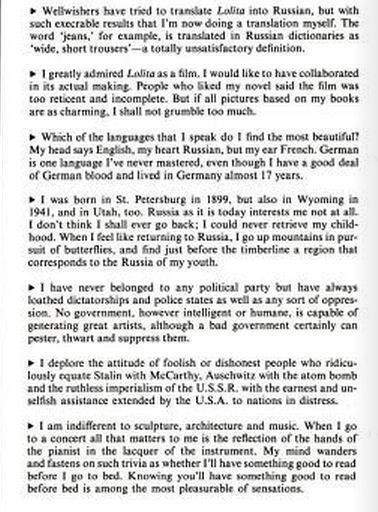
Vladimir Nabokov: Lolita, Languages, Lepidoptera (1964 LIFE Magazine Profile)

(From a 1964 LIFE profile; my favorite line: “It is odd, and probably my fault, that no people seem to name their daughters Lolita anymore. I have heard of young female poodles being given that name since 1956, but of no human beings.”)

Self-discovery (Kafka)


(From Kafka’s diaries).

Read “Bobok,” a Short Story by Fyodor Dostoevsky

“Bobok,” a short story by Fyodor Dostoevsky:

Bobok — From Somebody’s Diary

Semyon Ardalyonovitch said to me all of a sudden the day before yesterday: “Why, will you ever be sober, Ivan Ivano- vitch? Tell me that, pray.”

A strange requirement. I did not resent it, I am a timid man; but here they have actually made me out mad. An artist painted my portrait as it happened: “After all, you are a literary man,” he said. I submitted, he exhibited it. I read: “Go and look at that morbid face suggesting insanity.”

It may be so, but think of putting it so bluntly into print. In print everything ought to be decorous; there ought to be ideals, while instead of that…

Say it indirectly, at least; that’s what you have style for. But no, he doesn’t care to do it indirectly. Nowadays humour and a fine style have disappeared, and abuse is accepted as wit. I do not resent it: but God knows I am not enough of a literary man to go out of my mind. I have written a novel, it has not been published. I have written articles – they have been refused. Those articles I took about from one editor to another; everywhere they refused them: you have no salt they told me. “What sort of salt do you want?” I asked with a eer. “Attic salt?”

They did not even understand, For the most part I translate from the French for the booksellers. I write advertisements for shopkeepers too: “Unique opportunity! Fine tea, from our own plantations… ” I made a nice little sum over a panegyric on his deceased excellency Pyotr Matveyitch. I compiled the “Art of pleasing the ladies”, a commission from a bookseller. I have brought out some six little works of this kind in the course of my life. I am thinking of making a collection of the bons mobs of Voltaire, but am afraid it may seem a little flat to our people. Voltaire’s no good now; nowadays we want a cudgel, not Voltaire. We knock each other’s last teeth out nowadays. Well, so that’s the whole extent of my literary activity. Though indeed I do send round letters to the editors gratis and fully signed. I give them all sorts of counsels and admonitions, criticise and point out the true path. The letter I sent last week to an editor’s office was the fortieth I had sent in the last two years. I have wasted four roubles over stamps alone for them. My temper is at the bottom of it all.

I believe that the artist who painted me did so not for the sake of literature, but for the sake of two symmetrical warts on my forehead, a natural phenomenon, he would say. They have no ideas, so now they are out for phenomena. And didn’t he succeed in getting my warts in his portrait – to the life. That is what they call realism.

Continue reading “Read “Bobok,” a Short Story by Fyodor Dostoevsky”

Sebald’s After Nature (Book Acquired, 9.21.2012)

20120930-142202.jpg

W.G. Sebald’s poetry collection After Nature. Not really poetry. Or maybe it is poetry. I don’t know what poetry is.

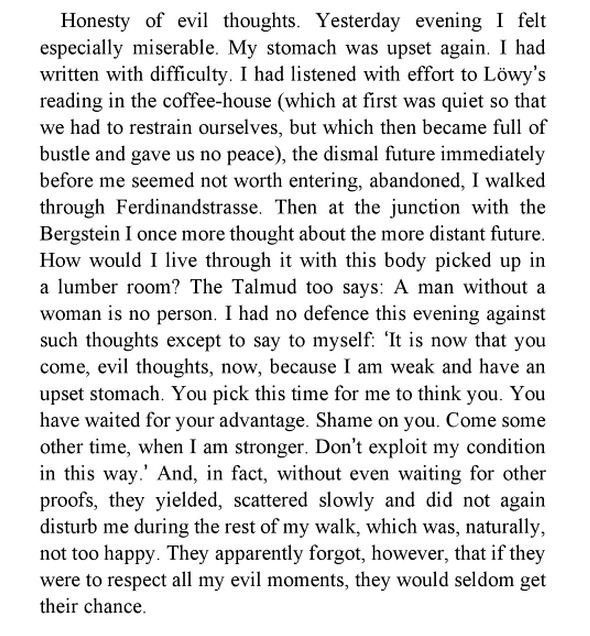
Honesty of Evil Thoughts (Kafka)

From Kafka’s Diaries.

Does Bret Easton Ellis Consider Himself a Serious Novelist?

INTERVIEWER

Do you not consider yourself a serious novelist?

ELLIS

I recently got into one of those weird, terrible fights writers can find themselves in with a friend who has for a long time been writing novels he can’t get published. For twenty-five years I’ve been trying to help him. He can’t rise to the occasion. He can’t write a novel because he doesn’t have the passion to write a novel. He’s writing a novel to make the money, get the film rights, become famous, whatever—all the wrong reasons. When he asked me to read the latest one, I told him, “Look, if this novel is superpassionate, and it really is about shit you’re going through, and pain, and it means the fucking world to you, by all means send it to me.” He said, “Yeah, it’s totally all those things,” and he sent it to me, and it was absolutely like all the others. I flipped out. I went ballistic on him. I said, “You never took this seriously! From the time you were twenty-three, it was always some kind of sterile exercise, like an imitation of a novel. And you never talk passionately about writers. I never hear you talk about books you’re reading. You just saw that a young writer in the eighties could make some cash from a literary novel. It was moneymaking to you.” And my friend was shocked, or pretended to be. “You know, it’s really amazing to hear you say that, Bret, because looking at your career and reading your books, I never thought you actually took it seriously. I saw your books as trendy knockoffs. I saw you as kind of a hack. I never thought you were really serious.” I mean, he’s not representative of the kind of person anyone should take seriously in literary matters, but when my friend said that, I’ll admit it gave me pause. I thought, What does it mean to be a “serious” novelist? Regardless of how my books have turned out, or how some people might have read them, I clearly don’t think I write trendy knockoffs. My books have all been very deeply felt. You don’t spend eight years of your life working on a trendy knockoff. In that sense I’ve been serious. But I don’t do lots of things that other serious ­writers do. I don’t write book reviews. I don’t sit on panels about the state of the novel. I don’t go to writer conferences. I don’t teach writing seminars. I don’t hang out at Yaddo or MacDowell. I’m not concerned with my reputation as a writer or where I stand relative to other writers. I’m not competitive or professionally ambitious. I don’t think about my work and my career in an overarching or systematic way. I don’t think about myself, as I think most writers do, as progressing toward some ideal of greatness. There’s no grand plan. All I know is that I write the books I want to write. All that other stuff is meaningless to me.

From Ellis’s Paris Review interview.

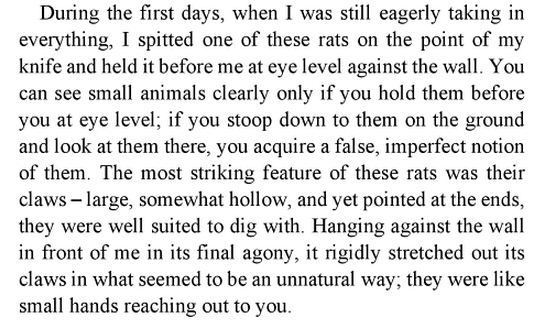
Kafka Spits a Rat

From Kafka’s unfinished and very strange story “Memoirs of the Kalda Railway.” Collected in Diaries.

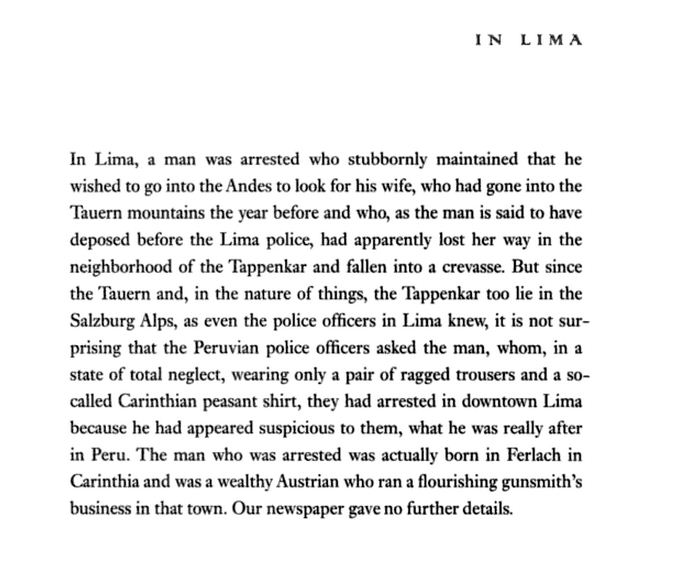
“In Lima” — Thomas Bernhard

Kafka Doodle

Kafka doodle. From his Diaries (vol.1).

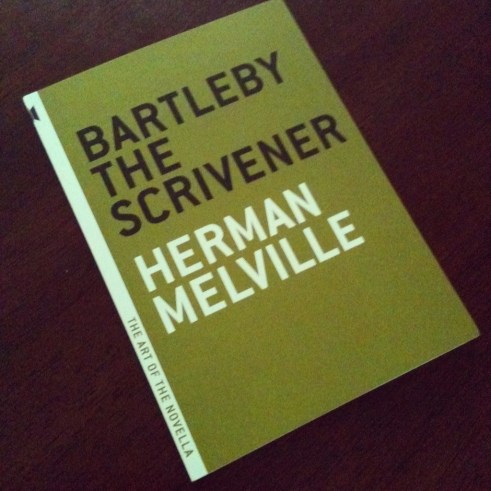
Bartleby the Scrivener (Book Acquired, 9.25.2012)


20120925-164256.jpg

The good people at Melville House sent me their edition of Melville’s classic novella Bartleby the Scrivener. I’ve read it at least half a dozen times since the 10th grade, but the Melville House version is part of their Hybrid Books series, which features digital illuminations. I shall report in full in a week or two, focusing on what the illuminations add to the book, and what the reading experience is like.