
INTERVIEWERDo you not consider yourself a serious novelist?
ELLISI recently got into one of those weird, terrible fights writers can find themselves in with a friend who has for a long time been writing novels he can’t get published. For twenty-five years I’ve been trying to help him. He can’t rise to the occasion. He can’t write a novel because he doesn’t have the passion to write a novel. He’s writing a novel to make the money, get the film rights, become famous, whatever—all the wrong reasons. When he asked me to read the latest one, I told him, “Look, if this novel is superpassionate, and it really is about shit you’re going through, and pain, and it means the fucking world to you, by all means send it to me.” He said, “Yeah, it’s totally all those things,” and he sent it to me, and it was absolutely like all the others. I flipped out. I went ballistic on him. I said, “You never took this seriously! From the time you were twenty-three, it was always some kind of sterile exercise, like an imitation of a novel. And you never talk passionately about writers. I never hear you talk about books you’re reading. You just saw that a young writer in the eighties could make some cash from a literary novel. It was moneymaking to you.” And my friend was shocked, or pretended to be. “You know, it’s really amazing to hear you say that, Bret, because looking at your career and reading your books, I never thought you actually took it seriously. I saw your books as trendy knockoffs. I saw you as kind of a hack. I never thought you were really serious.” I mean, he’s not representative of the kind of person anyone should take seriously in literary matters, but when my friend said that, I’ll admit it gave me pause. I thought, What does it mean to be a “serious” novelist? Regardless of how my books have turned out, or how some people might have read them, I clearly don’t think I write trendy knockoffs. My books have all been very deeply felt. You don’t spend eight years of your life working on a trendy knockoff. In that sense I’ve been serious. But I don’t do lots of things that other serious writers do. I don’t write book reviews. I don’t sit on panels about the state of the novel. I don’t go to writer conferences. I don’t teach writing seminars. I don’t hang out at Yaddo or MacDowell. I’m not concerned with my reputation as a writer or where I stand relative to other writers. I’m not competitive or professionally ambitious. I don’t think about my work and my career in an overarching or systematic way. I don’t think about myself, as I think most writers do, as progressing toward some ideal of greatness. There’s no grand plan. All I know is that I write the books I want to write. All that other stuff is meaningless to me.
Category: Literature
Kafka Spits a Rat
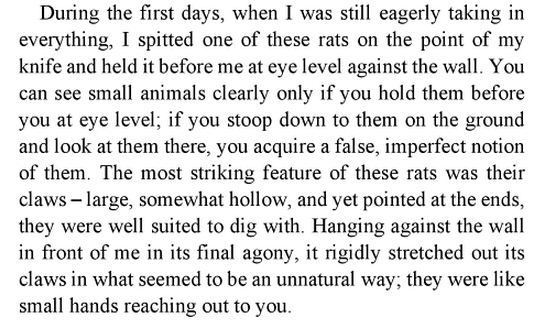
From Kafka’s unfinished and very strange story “Memoirs of the Kalda Railway.” Collected in Diaries.
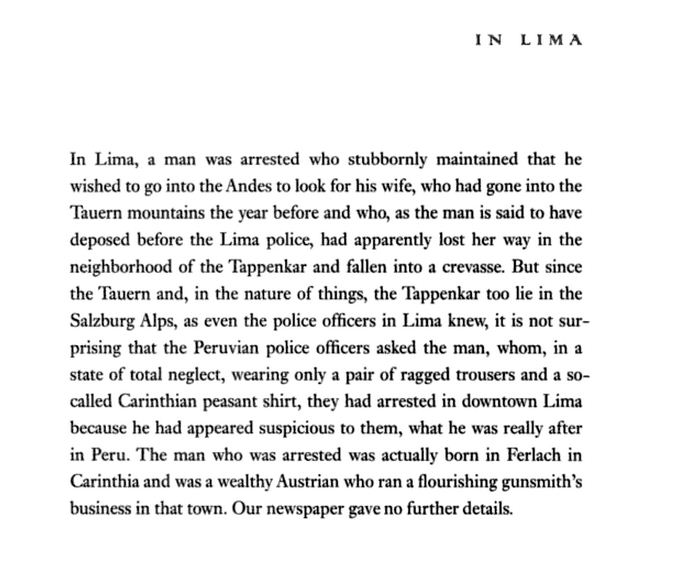
“In Lima” — Thomas Bernhard
Kafka Doodle

Kafka doodle. From his Diaries (vol.1).
Bartleby the Scrivener (Book Acquired, 9.25.2012)
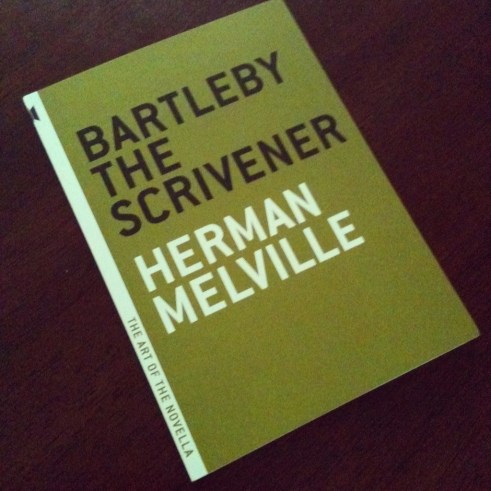
The good people at Melville House sent me their edition of Melville’s classic novella Bartleby the Scrivener. I’ve read it at least half a dozen times since the 10th grade, but the Melville House version is part of their Hybrid Books series, which features digital illuminations. I shall report in full in a week or two, focusing on what the illuminations add to the book, and what the reading experience is like.
“Do You Despair?” (Kafka)

(From a 1910 diary entry).
Orson Welles as Falstaff in Chimes at Midnight (Full Film)
Poor Old Robinson Crusoe
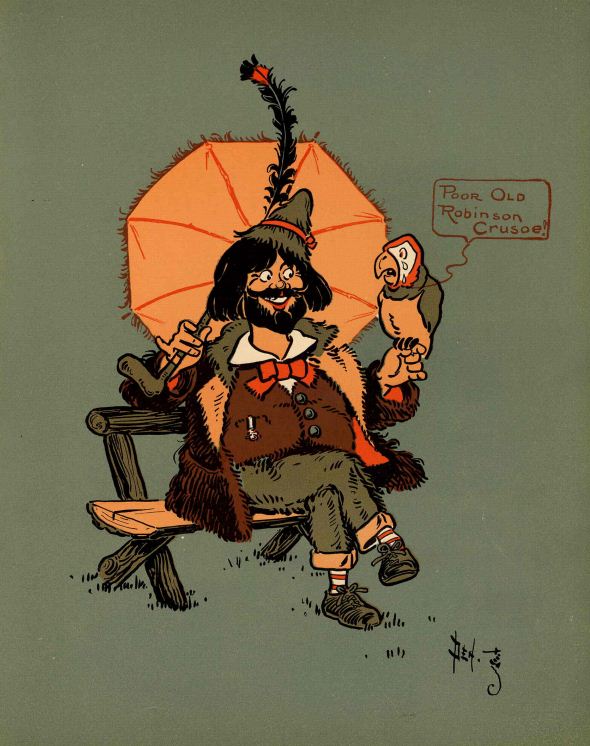
From Denslow’s Humpty Dumpty / Adapted and Illustrated by W.W. Denslow.
Barry Hannah Fragment (From “Water Liars”)
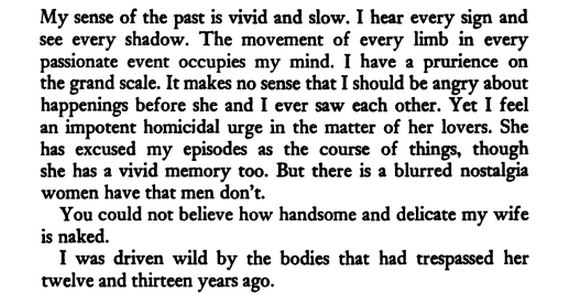
From the Barry Hannah story “Water Liars,” collected in Airships.
The Blood of a Poet — Jean Cocteau (Full Film)
Tests and Composition Exercises for Young Writers — Ezra Pound

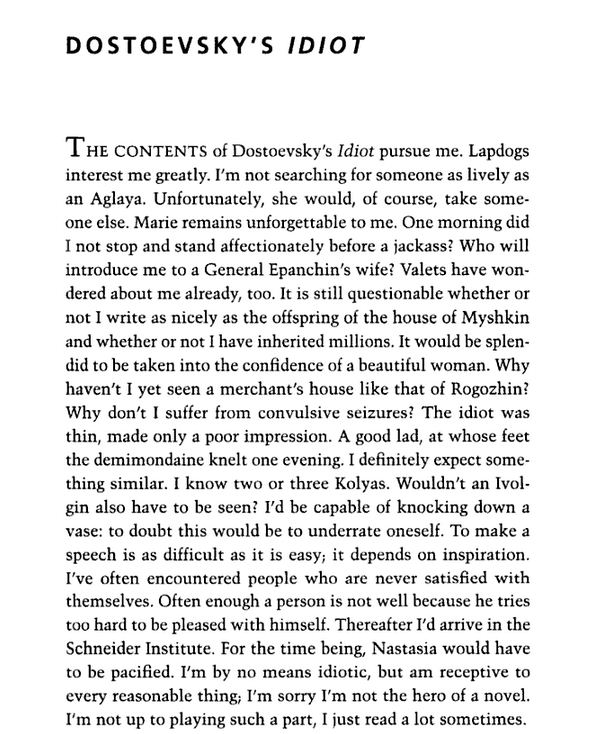
“Dostoevsky’s Idiot” — Robert Walser
Modernism at the Barricades (Book Acquired, Some Weeks Ago)

I’ve been digging Stephen Eric Bronner’s tight synthesis of modernism, Modernism at the Barricades, which traces the historical rise of expressionism, futurism, surrealism and more against the political, social, and historical backdrop of the emerging 20th century. Bronner’s book is a sharp but concise primer of sorts, using examples like the correspondence between Schoenberg and Kandinsky and the paintings of Emil Nolde to illuminate the big concepts and cultural aims of different modernist movements. Photographs, prints, and posters (like the proclamation below) help to illustrate Bronner’s chapters as well.
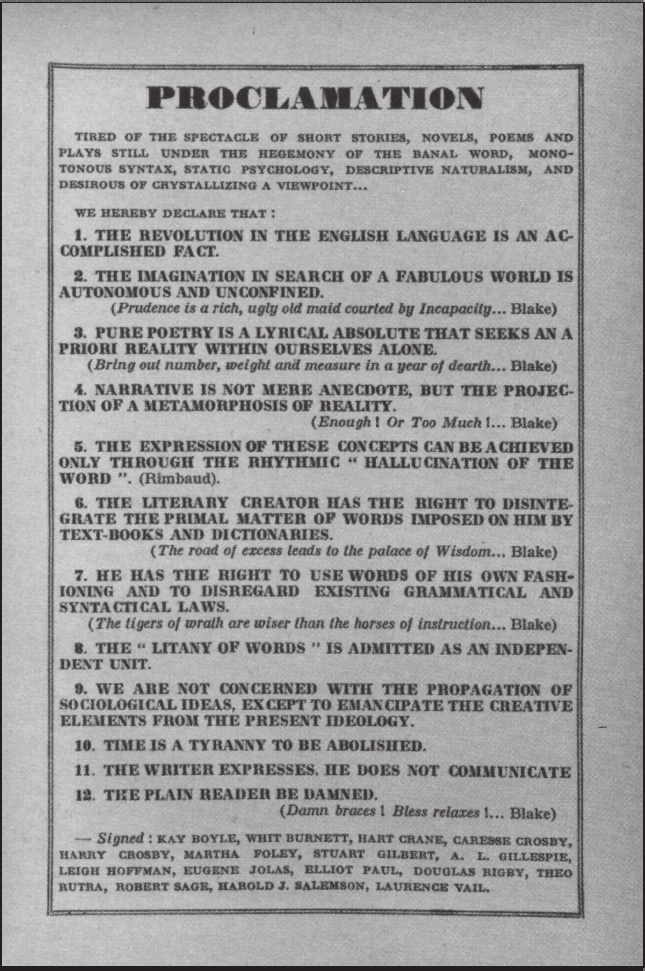
Bronner’s book would make a handy starting point to any student beginning a study of modernism. It doesn’t try to exhaustively account for each and every modernist, but neither does it forsake specificity in favor of a broad overview. Best of all, Bronner is clear and concise, an attribute which unfortunately is all too rare in academic writing. There’s a lucid sensibility that seems to govern the book, which we can see from its earliest chapter. Here Bronner delineates modernism’s cultural project and at the same time points out some of modernism’s own shortsightedness:
Modernism would call into question every aspect of modern life, from the architecture through which our apartments are designed, to the furniture in which we sit, to the comic books our children read, to the films we watch and the museums we visit, to the experience of time and individual possibility that mark our lives. Modernists may have believed that they were contesting modernity, but their efforts and their hopes were shaped by it. Their activities legitimated what they intended to oppose. Their critique, in short, presupposed its object. Modernists believed that they were contesting tradition in the name of the new and the constraints of everyday life in the name of multiplied experience and individual freedom. These artists were essentially anarchists imbued with what Georg Lukács termed “romantic anti-capitalism.”
They opposed the “system” without understanding how it worked or what radical political transformation required and implied. Oddly, they never understood how deeply they were enmeshed in what they opposed. Modernists envisioned an apocalypse that had no place for institutions or agents generated within modernity. Theirs was less a concern with class consciousness than an opposition to the alienating and reifying constraints of modernity. Unfettered freedom of expression and a transformation in the experience of everyday life were the modernists’ goals. Even when seduced by totalitarian movements, whether of the left or the right, most of them despised what Czeslaw Milosz called the“captive mind.” Not all the problems that they uncovered—sexual repression and generational conflicts, among others—required utopian solutions. But their utopian inclinations were transparent from the beginning. Modernists believed that the new would not come from within modernity, but would appear as an external event or force for which, culturally, the vanguard would act as a catalyst.
Good stuff. Modernism at the Barricades is new in hardback from Columbia University Press.
Maverick Jetpants in the City of Quality (Book Acquired, 9.21.2012)
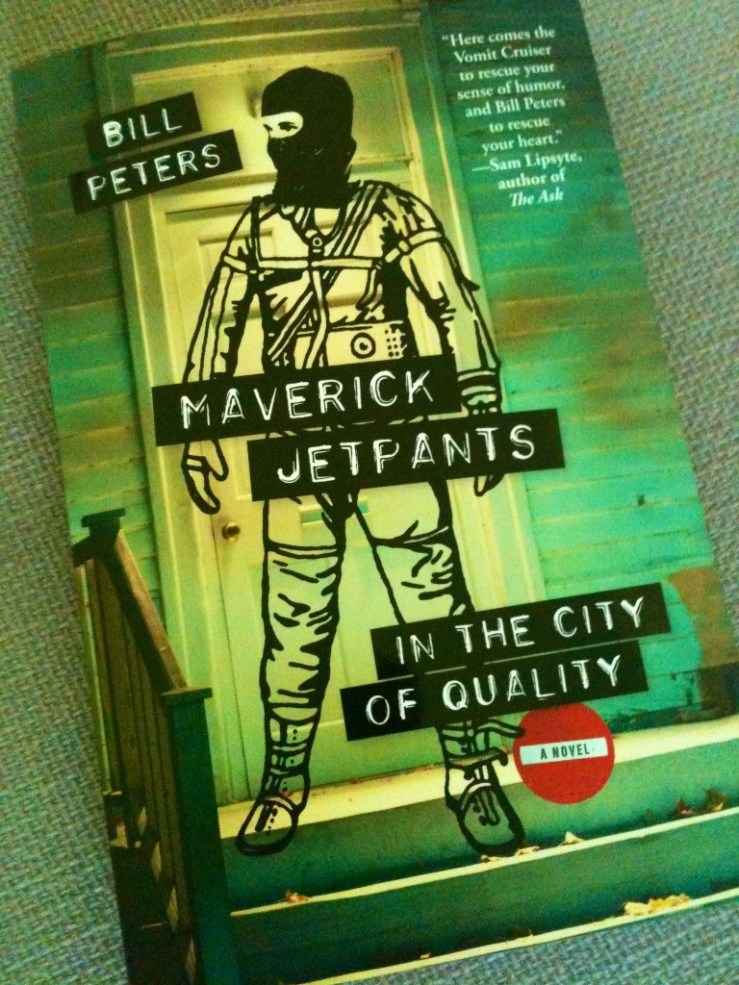
Bill Peters — Maverick Jetpants in the City of Quality. Not sure if that title is brilliant or awful. This one comes out from Black Balloon next month. Their blurb:
Rochester, New York, 1999: An arsonist is loose on the streets of a city in decline. Gone are the days of Rioting in the Vomit Cruiser, searching for a possible Tokyo Rocking Horse. In this hilarious, wildly original debut novel, Nathan Gray and best friend Necro live by the code of Joke Royalty, a system of in-jokes known only to a select few. But as the reality of full-time employment, possible spouses, and Neo-Nazis encroaches, their friendship unravels, threatening their dreams of becoming Kodak Park Winjas.
Among the gravest Hellstacheries: Necro’s strangely vicious drawings and his sudden interest in a group of weapons enthusiasts who may or may not be responsible for the fires erupting through downtown. With no Holy Grail Points left to his name, Nate ventures into Rochester’s strangest corners to find out if his best friend is a domestic terrorist Pinning Bow Ties on the Dead or simply Maverick Jetpantsing on with his life–perhaps even beyond The City of Quality.
Biblioklept fave Sam Lipsyte also provides a blurb:
Do you want laughter, suffering, and friendship, Rochester-style? Do you want to marinate in raucous sadness? I know you do. So be ready, everybody. Here comes the Vomit Cruiser to rescue your sense of humor, and Bill Peters to rescue your heart.
The Pennants of Passive Attitudes and Emotions (William H. Gass)
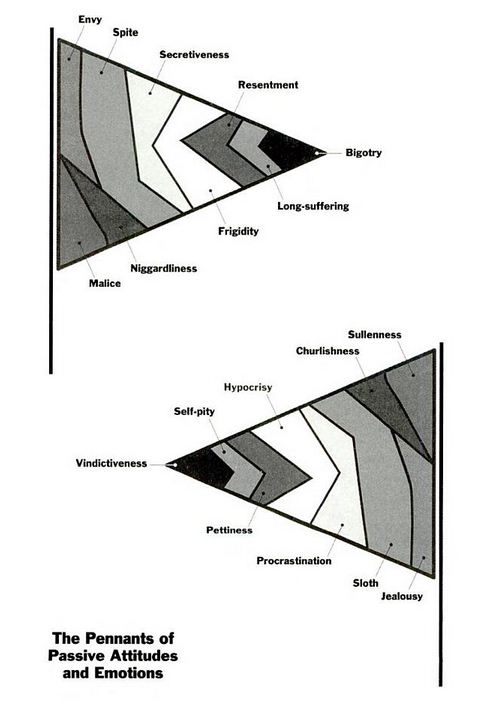
(From William Gass’s 1995 novel The Tunnel; The Quarterly Conversation will lead a Big Read of The Tunnel starting next week).
I Review Object Lessons, Where 20 Contemporary Authors Select and Introduce 20 Short Stories from The Paris Review
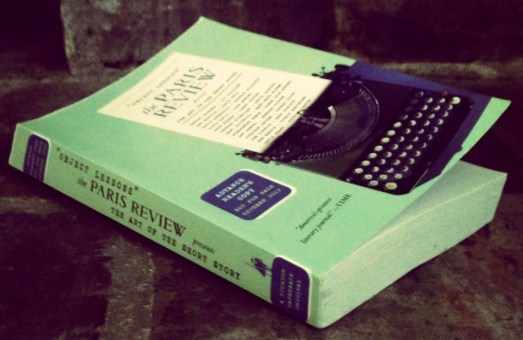
Object Lessons anthologizes 20 stories published in the Paris Review over the past fifty years. “It is not a greatest hits anthology,” advises the brief editor’s note, “Instead, we asked twenty masters of the genre to choose a story from the Paris Review archives—a personal favorite—and to describe the key to its success as a work of fiction.” Hence, we get Ann Beattie introducing Craig Nova’s “Another Drunk Gambler,” Amy Hempel introducing Bernard Cooper’s “Old Birds,” and Sam Lipsyte introducing Mary Robinson’s “Likely Lake.”
Most of the introductions are short—most are fewer than three pages—and each author approaches his or her selection differently. Ben Marcus, prefacing “Several Garlic Tales,” tells us that, “Donald Barthelme was a magician of language, and it would be most respectful, perhaps even ethical, not to look too closely into the workings of his magic.” Marcus proposes a few approaches to find meaning in Barthelme’s surreal tale, but never over-explicates. In contrast, Lydia Davis’s surprisingly long intro to Jane Bowles’s “Emmy Moore’s Journal” is a sentence-to-paragraph close reading; Davis interrogates Bowles’s diction and syntax and concludes her little essay by situating Bowles’s (underappreciated) place in the canon. Davis’s insights are compelling, but one wonders if they wouldn’t be better appreciated after reading the story.
Davis also appears as author of one of the selected stories—Ali Smith picks Davis’s excellent number “Ten Stories from Flaubert.” Smith’s intro is wonderful, explaining the genesis of “Ten Stories,” which “came about when Davis (who is also a translator) was working on a a new translation of Madame Bovary and reading through Flaubert’s letters to his friend and lover Louise Colet.” I’m a huge fan of Lydia Davis, whose work defies easy definition. Smith wonders about her selection: “Are they translations? Are they by Flaubert? Are they by Davis?” The questions are better than answers.
Occasionally an author veers close to spoiling the story he introduces, as does Jeffrey Eugenides when he gracelessly steps all over Denis Johnson’s already-much-anthologized classic “Car Crash While Hitch Hiking.” Elsewhere, Jonathan Lethem mashes and minces misplaced metaphors in his confusing and forgettable introduction to Thomas Glynn’s story “Except for the Sickness I’m Quite Healthy Now. You Can Believe That.” Lethem’s sloppy, unrestrained attempt to dazzle is regrettable. He’s like the warm-up act that tries too hard to show up the headliner and winds up falling on his face.
For the most part though, the introductions simply allow readers new ways to see a story they’ve perhaps read before, as in Aleksandar Hemon’s preface to Jorge Luis Borges’s “Funes the Memorious” or David Means’s preface to Raymond Carver’s “Why Don’t You Dance.” Means suggests that “A great story is like an itch that has to be scratched eternally . . . We’re left with more questions than answers, and more answers than questions; therefore, the paradoxical quality of a good story is that it seems to give us everything we need and yet not quite enough to fulfill a sense of having been shown a full life.” Surprisingly good is Dave Eggers’s intro to James Salter’s “Bangkok,” which reads almost like a loose riff of notes that a harried but talented adjunct might bring to his Creative Writing 101 workshop. Eggers showcases keen intuition about Salter’s narrative coupled with an eagerness that makes one want to read the story.
And what about those stories? If I’ve focused more on the introductions than the stories themselves, it’s perhaps because I’ve taken for granted that the selections are solid for an anthology. Sure, any reader might have his or her gripes, but the range of talent here is undeniable, and the spectrum of stories is satisfying. Object Lessons would make a fine addition to the syllabus of any beginning writing course, and any young person interested in honing her craft could do worse than attending the examples collected here. To be clear, Object Lessons is in no way some master course in How to Write a Short Story, but it does provide the most valuable writer’s tool—good reading.
Untitled List from the Fall of 1949 — Susan Sontag
From Susan Sontag’s notebooks, collected in Reborn—
effete
noctambulus
perfervid
detumescence
disheveled
so alluring, so cerebral
sodden
intriguing
corrupt dignity
lotophagous
elegiac
Meleager
disponibility
pardine
demotic
Harriette Wilson
garbure
satura
succulent
competent intellectual vulgarity of Aldous Huxley
Yellow Book preciousness
secretive
sturdy
pedantry + lechery
spleen
ribaldry
ilex
Klaxon

