One of my favorite passages in Ulysses (it’s from the “Cyclops” chapter, episode 12). Hilarious–
He wore a long unsleeved garment of recently flayed oxhide reaching to the knees in a loose kilt and this was bound about his middle by a girdle of plaited straw and rushes. Beneath this he wore trews of deerskin, roughly stitched with gut. His nether extremities were encased in high Balbriggan buskins dyed in lichen purple, the feet being shod with brogues of salted cowhide laced with the windpipe of the same beast. From his girdle hung a row of seastones which dangled at every movement of his portentous frame and on these were graven with rude yet striking art the tribal images of many Irish heroes and heroines of antiquity, Cuchulin, Conn of hundred battles, Niall of nine hostages, Brian of Kincora, the Ardri Malachi, Art MacMurragh, Shane O’Neill, Father John Murphy, Owen Roe, Patrick Sarsfield, Red Hugh O’Donnell, Red Jim MacDermott, Soggarth Eoghan O’Growney, Michael Dwyer, Francy Higgins, Henry Joy M’Cracken, Goliath, Horace Wheatley, Thomas Conneff, Peg Woffington, the Village Blacksmith, Captain Moonlight, Captain Boycott, Dante Alighieri, Christopher Columbus, S. Fursa, S. Brendan, Marshal Mac-Mahon, Charlemagne, Theobald Wolfe Tone, the Mother of the Maccabees, the Last of the Mohicans, the Rose of Castille, the Man for Galway, The Man that Broke the Bank at Monte Carlo, The Man in the Gap, The Woman Who Didn’t, Benjamin Franklin, Napoleon Bonaparte, John L. Sullivan, Cleopatra, Savourneen Deelish, Julius Caesar, Paracelsus, sir Thomas Lipton, William Tell, Michelangelo, Hayes, Muhammad, the Bride of Lammermoor, Peter the Hermit, Peter the Packer, Dark Rosaleen, Patrick W. Shakespeare, Brian Confucius, Murtagh Gutenberg, Patricio Velasquez, Captain Nemo, Tristan and Isolde, the first Prince of Wales, Thomas Cook and Son, the Bold Soldier Boy, Arrah na Pogue, Dick Turpin, Ludwig Beethoven, the Colleen Bawn, Waddler Healy, Angus the Culdee, Dolly Mount, Sidney Parade, Ben Howth, Valentine Greatrakes, Adam and Eve, Arthur Wellesley, Boss Croker, Herodotus, Jack the Giantkiller, Gautama Buddha, Lady Godiva, The Lily of Killarney, Balor of the Evil Eye, the Queen of Sheba, Acky Nagle, Joe Nagle, Alessandro Volta, Jeremiah O’Donovan Rossa, Don Philip O’Sullivan Beare. A couched spear of acuminated granite rested by him while at his feet reposed a savage animal of the canine tribe whose stertorous gasps announced that he was sunk in uneasy slumber, a supposition confirmed by hoarse growls and spasmodic movements which his master repressed from time to time by tranquillising blows of a mighty cudgel rudely fashioned out of paleolithic stone.
From Robert Louis Stevenson’s essay “The Books Which Have Influenced Me”:
I come next to Whitman’s Leaves of Grass, a book of singular service, a book which tumbled the world upside down for me, blew into space a thousand cobwebs of genteel and ethical illusion, and, having thus shaken my tabernacle of lies, set me back again upon a strong foundation of all the original and manly virtues. But it is, once more, only a book for those who have the gift of reading. I will be very frank–I believe it is so with all good books except, perhaps, fiction. The average man lives, and must live, so wholly in convention, that gun-powder charges of the truth are more apt to discompose than to invigorate his creed. Either he cries out upon blasphemy and indecency, and crouches the closer round that little idol of part-truths and part-conveniences which is the contemporary deity, or he is convinced by what is new, forgets what is old, and becomes truly blasphemous and indecent himself. New truth is only useful to supplement the old; rough truth is only wanted to expand, not to destroy, our civil and often elegant conventions. He who cannot judge had better stick to fiction and the daily papers. There he will get little harm, and, in the first at least, some good.
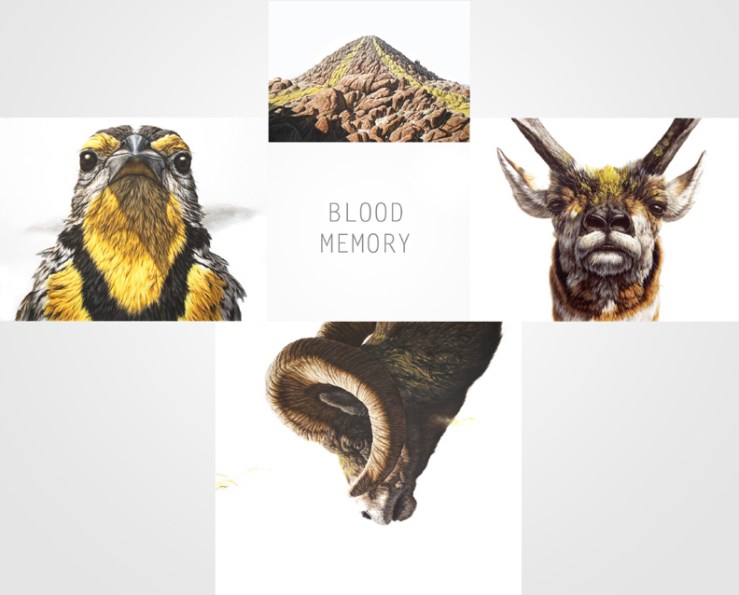
George Boorujy’s marvelous paintings explore humanity’s paradoxical engagements and disengagements with “Nature” — a system that we are manifestly a part of, yet nevertheless philosophically define ourselves against. The first Boorujy painting I saw, a gorgeous bluebird, stunned me: simultaneously delicate and fierce, it emanates pride but also an ineffable quality that surpasses rational, systematic thought. The painting’s vivid colors and subject recalled to me Albrecht Dürer’sWing of a Blue Roller. I soon found more of Boorujy’s work at the P.P.O.W. Gallery home to the artist’s second solo show, Blood Memory (535 W. 22nd St., NYC, March 15th — April 14th). Blood Memory continues Boorujy’s depiction of animals and landscapes, subjects that resonate with his extensive travels across the US as well as his background in marine biology, a subject the New Jersey native initially pursued at the University of Miami before switching to a BFA. He completed his MFA at the School of Visual Arts in NYC. Boorujy is based out of Brooklyn; he paints and teaches, and works a project called New York Pelagic, where he launches original drawings of water birds (along with a questionnaire) in glass bottles into New York waterways. Check out his website.
Father -- George Boorujy -- Part of Blood Memory
I was thrilled to talk to George over a series of emails: he was personable, funny, and very generous. He ended his first email with one of the best sign-offs I’ve ever read: “I’m gonna go drink in the shower now.” Like many folks of delicate sensibilities and fine upbringing, I too enjoy shower beers. We rapped about Florida, ecology, Swamplandia!, the arts and sciences, the Hipster Mujahideen, the possibility of a racist ibis, and much more.
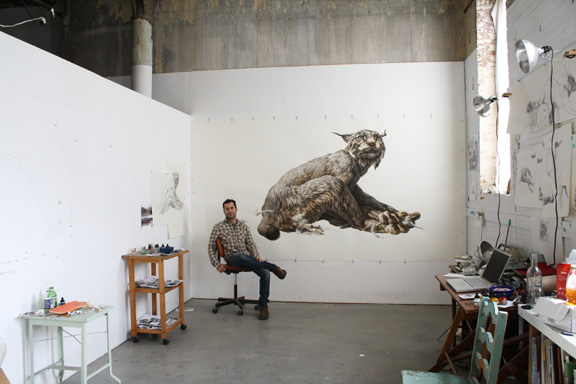
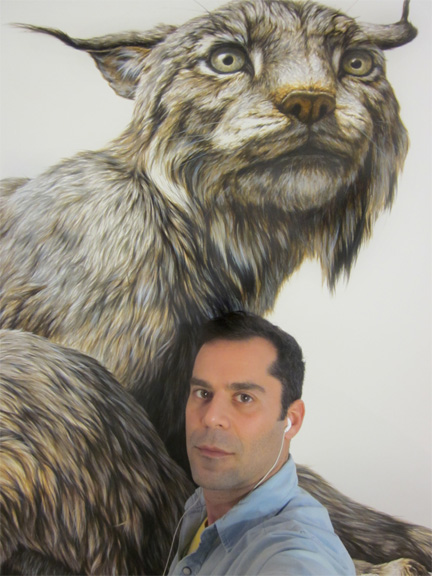
The Artist in repose next to the freshly completed work When Was It That I Knew You
Biblioklept: Tell us about your solo show at the P.P.O.W. Gallery. It’s called Blood Memory—what kind of pieces are you showing?
George Boorujy: Animals. Surprise! But really this is the most purely animal show or body of work that I’ve done. I think there’s only one piece that isn’t of an animal. They’re mostly portrait type pieces, some quite large. I’m finishing up a lynx which is 6 by 11 feet. It sort of looks like Goya’s Colossus. There’s a black white-tailed doe, a meadowlark, a blue jay, a ram, a pronghorn, a frigate bird, a cormorant, another few deer, a Burmese python (hi Florida!). And a mountain. I always seem to need a mountain.
Biblioklept: Your past work has often focused on animals and landscapes, often with implicit ecological arguments. I know you initially studied marine biology in school—how did that course of study influence your art?
GB: I think my brain is somewhat organized like a school where arts and sciences are lumped together. So I’m using the practice of art instead of the practice of science to explore the things I’m interested in. Art and science are very similar in many ways. They are often both a pursuit of the truth. Just different tools and methods are used. Although I am an environmentalist (whatever that actually means) I try not to have any explicit agenda with the work. I want it to stir the viewer or trigger something within them, but not give them an answer or a specific point of view. If I make a piece that shows a manipulated landscape, I’m not necessarily saying it is wrong to manipulate the landscape. We all do it, and we all take advantage of fossil fuels – I love fossil fuels! They’re amazing and we should respect them more and conserve them more – I just want to show what is. Same goes for the treatment of an animal. I’m sure they’re stand-ins for something in my deep sub-conscious, but they are also just what they are, with all attendant veins and ticks and dust in their fur.
Biblioklept: How do you make your animals look so imperious, so proud?
GB: I think maybe it’s because I make them big. I try to actually give them a very indifferent expression so that people can read whatever they want into it. I suppose there is an inherent pride in the form of the animal itself because it is the result of millions of years of evolution that have made it this far. A lot of people think they look sad, which isn’t intended either. I was leaving the studio a few months back when I had a lot of them up and they all looked very judgmental. But then it was better the next day.
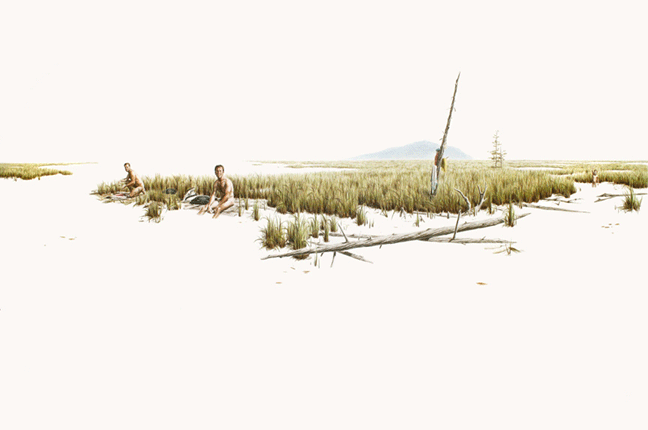
Hunters, George Boorujy
Biblioklept: Let’s shift to people for a moment (although people are animals too, of course). In works like Moraine and Hunters there’s a sense—at least for me—of distance, or almost intrusion (even voyeurism, if I’m being honest). I find your picture of Lincoln fascinating too. I’m curious about how you actually create these pictures: How do you plan them? How do you execute them? What motivates them?
GB: I’m happy that you felt like a voyeur. I never want the pieces to be just observations, I want them to be interactions. Those two pieces in particular could have ended up looking like dioramas or re-enactments or something if there wasn’t the eye contact and the acknowledgement of the viewer. In Hunters, there’s even a small boy hailing the viewer on the right hand side. As though the viewer was coming up in a canoe or something.
As much as I love to draw people, it’s tricky. As soon as you see someone you immediately jump to, “Who’s that? What’s her deal?” We have so much baggage and built in signifiers that it’s difficult to represent someone as a human not of a particular era or class or culture. I wanted both of those pieces to look as though they could be taking place a thousand years in the future or ten thousand years in the past. Hence, no clothes. But no clothes in situations where there would be no clothes – on the beach (a clue there with the title, Moraine, as in a glacial moraine. I live in Brooklyn down the hill from a glacial moraine, and really all of Long Island is a glacial moraine), or in the case of Hunters, people who have just come out of the water or are doing something in the water. I had to be careful with how to depict the men – one of which is me – would they be bearded? I was afraid they’d look too caveman-ish, or too much like the Hipster Muhajideen (I coined that by the way). I wanted them to be kempt as I wasn’t interested in depicting a post apocalyptic scenario or a definable Paleolithic one either. I also like the play between the indifferent expressions on the men and the smiling hailing boy.
As far as creating them, with the animals I usually make a sculpture first and then make the two-dimensional image out of that because there would be no pictures of the animals in the poses and situations that I put them. With the people, I took some pictures of myself and my friends. Then I changed some things here and there. The girls are my sister and her childhood best friend – but they weren’t naked! They had on bathing suits! And the guys are me and my friend, although it’s my body both times because I changed my mind on a pose. Nudity is a funny thing – I wanted to show them naked, but not in a sexy way. So that’s why they’re pretty modest, even though I guess you can see my dick in the one.
That same issue came up with the Lincoln piece. Originally I thought about doing him full body. But then I knew people would just be looking at his penis, which wasn’t the point. It’s easy to be sensationalistic. Harder to go for the slow burn. And I love the slow burn. Not saying that I always get there, but I am more interested in that generally. I looked at as many pictures of Lincoln that I could find and then came up with a good amalgam. With him it was almost the opposite of what I do when depicting people. Instead of going for neutrality, I was interested in showing one of the most recognizable figures as what he – and all of us – was. A human, an animal. It’s sort of like what I’m always doing, trying to make people re-see what they have seen a million times. Like, what was Lincoln? What does a jack-rabbit really look like? What are we? What are these other beings, what makes a horse?.
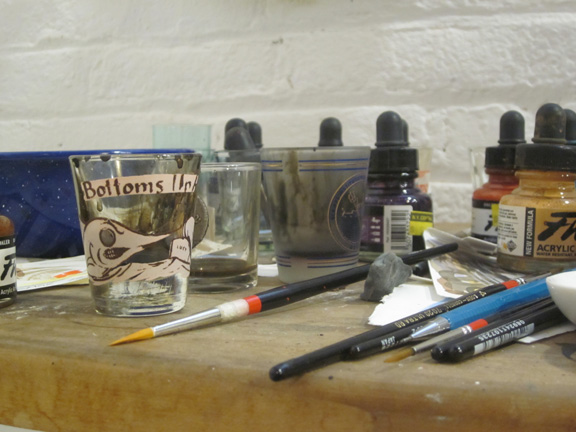
"I really do mix my inks in shot glasses. I'm not that much of a drunk."
Biblioklept: What are you reading now?
GB: This seems like a set-up but I actually am reading that biography of Audubon by Rhodes. It is such a good read. Tracing Audubon really traces the beginning of the country, and that guy got around. So you get these really interesting portraits of cities we know today in their infancy, and cities that were once prominent but are now considered backwaters. And the countryside and rivers before they were drastically changed. I often think about how weird it is that when my grandfather was a child we still had passenger pigeons and Carolina parakeets. That’s not so very long ago. Now the parakeets I see are introduced monk parakeets or escaped pets. If they become established then it will be less than a geological blip where we didn’t have parakeets here. The life between introduced and native is an interesting one to ponder.
Biblioklept: As we’re on birds, it seems like a good time to bring up your New York Pelagic project. You put original drawings of birds along with questionnaires in bottles and set them loose on New York waterways. Your blog discusses the motivations and goals behind the project in detail, but maybe you could give our readers a brief overview of your expectations? Is it difficult seeing your original work float away?
GB: It’s funny, I really had no idea what to expect. I was afraid none would ever be found. But, depending on how you count it, four or five have been found out of… 15? I actually have to update the blog and do some counting. So that’s a pretty good ration considering. I didn’t expect the project to become such an exploration of the city, I’ll tell you that much. But honestly, the history of New York is so amazing, and so rich, that you can’t pick your nose without flicking a booger on an old Dutch millstone or some such thing. And it is compelling. I didn’t expect to get so writer-y. I’ve never really written before, and it’s actually pretty fun. And as far as responses I was hoping people would be excited and happy. Which, except for once, they were.
As far as letting the work go, it is surprisingly easy. I thought I’d be more sad about it. But in actuality I’ve done some of them twice to make sure the one in the bottle is really good, not just middling. I want people to find something beautiful. And even if it never gets found there’s something very satisfying about letting something I’ve worked hard on go away. Christ, I ain’t no Buddhist, but there’s something zen about it I suppose. Maybe it’s a good foil to the other work I do which is so labor intensive and made to be seen and hopefully preserved. There’s also something so nice about it being pictures of seabirds that go (mostly) missing. We don’t see then really, just the gulls in the parking lot for most of us. The large majority of them live in habitats that don’t really overlap with ours.
Biblioklept: Let’s talk Florida — you went to Miami, I went to UF in Gainesville, and I live in Northeast Florida now, which is basically a different state than South Florida . . .
GB: Miami is totally a different country. From North Florida and from the rest of the U.S. I was always bummed about not doing a semester abroad when I was there, but then realized that going there is basically eight semesters abroad. So funny that you went to UF. Our big rivals were the Seminoles of course. Which I remember some people used to refer to as the Semen Holes. Which wasn’t as disturbing as a t-shirt I remember of our mascot — an ibis of all things! – jerking off on a Seminole Indian. I would kill for that shirt now, no matter how many racist nightmares it would induce. If an ibis can be racist against a Native American . . .
I love Florida in all it’s David Lynchian beauty. Hmmm . . . this brings me to something that I read recently having to do with Florida – [Karen Russell’s] Swamplandia! I hated it. And for very specific reasons. She is trying desperately to be funny, but she’s not. And it really brings down the whole thing.Every character in the book is trying so hard to out-quirk the next. There’s no straight man. Not that there has to be per se, but there is no anchor to the book. And I like flawed characters, but none of hers are particularly likeable. Even with all their quirks—in defter hands it would work. But like I said, she’s just not a funny writer and it seems like she thinks she has to be. Which is a shame, because there’s an interlude in the book (which I think was in The New Yorker) which is beautiful. So well written and evocative and moody. And well told. It’s not funny, but not everything has to be. I wish she had just expanded that into a whole novel instead of crowbarring a bunch of kooks around it. But now I’m listening to State of Wonder as I finish up a painting for the show and it is excellent.
Biblioklept: Have you ever stolen a book?
GB: I thought I hadn’t, but then I realized I had. And this seems almost like a plant as well. It was a Swedish publication about Seabirds. And I really passively stole it from the New York Public Library. I honestly think I was the only one who ever took it out. And then I kept bringing it back late. And then one time it was so late that they just billed me for it as a lost book. I could have returned it, but it was only like 14 bucks! Over the years I had probably paid 20 in late fees on it already. Wait—maybe I didn’t steal one because I paid the 14 bucks. But it was somehow dishonest.
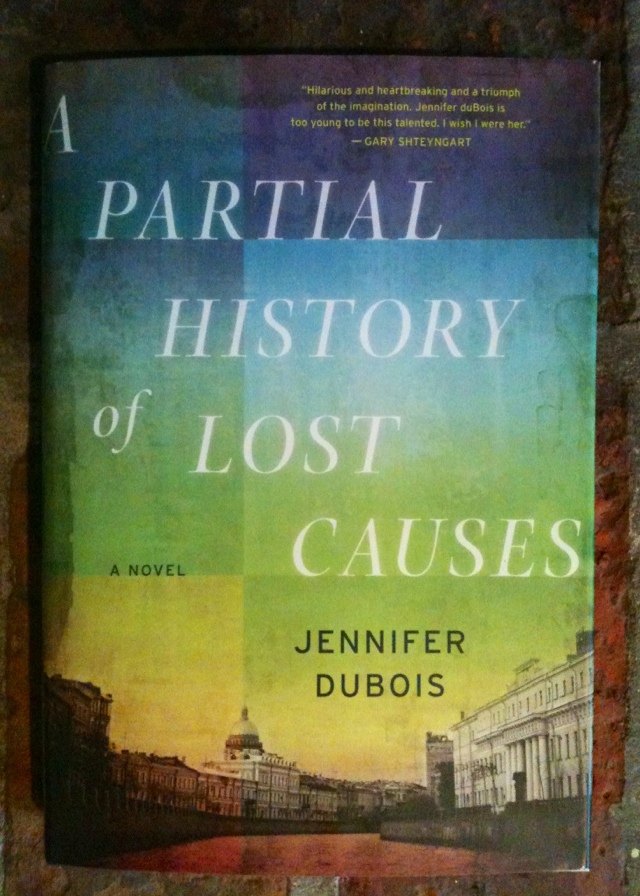
A Partial History of Lost Causes by Jennifer DuBois. Publisher Random House’s copy:
In Jennifer duBois’s mesmerizing and exquisitely rendered debut novel, a long-lost letter links two disparate characters, each searching for meaning against seemingly insurmountable odds.
In St. Petersburg, Russia, world chess champion Aleksandr Bezetov begins a quixotic quest. With his renowned Cold War–era tournaments behind him, Aleksandr has turned to politics, launching a dissident presidential campaign against Vladimir Putin. He knows he will not win—and that he is risking his life in the process—but a deeper conviction propels him forward. And in the same way that he cannot abandon his aims, he cannot erase the memory of a mysterious woman he loved in his youth.
In Cambridge, Massachusetts, thirty-year-old English lecturer Irina Ellison is on an improbable quest of her own. Certain she has inherited Huntington’s disease—the same cruel illness that ended her father’s life—she struggles with a sense of purpose. When Irina finds an old, photocopied letter her father had written to the young Aleksandr Bezetov, she makes a fateful decision. Her father had asked the Soviet chess prodigy a profound question—How does one proceed against a lost cause?—but never received an adequate reply. Leaving everything behind, Irina travels to Russia to find Bezetov and get an answer for her father, and for herself.
Spanning two continents and the dramatic sweep of history, A Partial History of Lost Causes reveals the stubbornness and splendor of the human will even in the most trying times. With uncommon perception and wit, Jennifer duBois explores the power of memory, the depths of human courage, and the endurance of love.
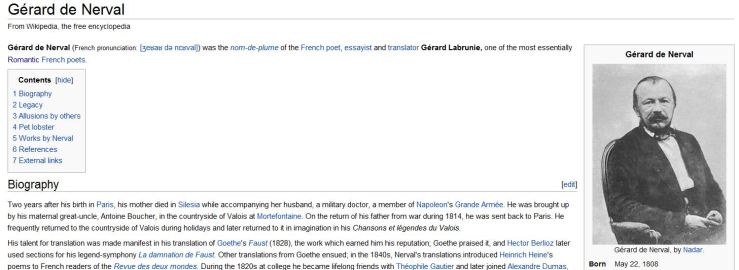
I’ve been reading Michel Houellebecq’s latest novel The Map and the Territory on my Kindle Fire, which is handy because I can easily hover my index over an unknown reference and figure out what Mich-dawg is getting at. Anyway, near the beginning of Part III, H-bomb drops a reference to French Romantic poet and essayist Gérard de Nerval, whom I will cop to not recognizing. But the detail seemed significant, so let my index finger hover I did, but, no dice, Nervs wasn’t in the preloaded dictionary—so I went to the next option: Le Wikipedia. And here’s a snapshot of what I saw:
The man’s life is divided into seven neat sections there on Wikipedia, and what’s right square in the middle? Pet lobster. Holmes had a pet lobster:
With all due respect for cats, however, let us consider the case for the humble lobster. The poet Gérard de Nerval had a penchant for lobsters, or at least for one lobster. Nerval was seen one day taking his pet lobster for a walk in the gardens of the Palais-Royal in Paris. He conducted his crustacean about at the end of a long blue ribbon. As word of this feat of eccentricity spread, Nerval was challenged to explain himself. “And what,” he said, “could be quite so ridiculous as making a dog, a cat, a gazelle, a lion or any other beast follow one about. I have affection for lobsters. They are tranquil, serious and they know the secrets of the sea.” (The episode is captured by Guillaume Apollinaire in a collection of anecdotes from 1911). Was there any basis to this story? A generation of Nerval scholars attempted to debunk it, but then a letter to his childhood friend Laura LeBeau was discovered. Nerval had just returned from some days at the seaside at the Atlantic coastal town of La Rochelle: “and so, dear Laura, upon my regaining the town square I was accosted by the mayor who demanded that I should make a full and frank apology for stealing from the lobster nets. I will not bore you with the rest of the story, but suffice to say that reparations were made, and little Thibault is now here with me in the city…” Nerval, it seems, had liberated Thibault the lobster from certain death in a pot of boiling water and brought him home to Paris. Thus we know that it was Thibault, and not just “some lobster,” who went for that celebrated promenade in the gardens of the Palais-Royal.
Book shelves series #11, eleventh Sunday of 2012. DeLillo, Denis Johnson, Pynchon (no, I have not read Against the Day nor finished Mason & Dixon). There’s also a hardback copy of Bolaño’s Between Parentheses; I have an ARC of the same shelved with the other Bolaños, which are on the shelf under—but the finished copy won’t fit on the shelf and it fits here. For now.
A tale of the four elements from The Old-English Jest Book, a volume supposedly owned and used by William Shakespeare:
In the old world when all thyng could speke, the iiii elementys mette to geder for many thynges whych they had to do, because they must meddell alway one wyth a nother, and had communicacion to gyder of dyuers maters; and by cause they coulde not conclude all theyr maters at that season, they appoyntyd to breke communicacion for that tyme and to mete agayne another tyme. Therfore eche one of them shewed to other where theyr most abydyng was and where theyr felows shoulde fynde them, yf nede shuld requyre; and fyrste the erthe sayde: bretherne, ye knowe well as for me I am permanent alway and not remouable; therfore ye may be sure to haue me alway whan ye lyste. The wather sayde: yf ye lyst to seke me, ye shall be sure to haue me under a toft of grene rushes or elles in a womans eye. The wynde sayde: yf ye lyst to speke wyth me, ye shall be sure to haue me among aspyn leuys or els in a womans tong. Then quod the fyre: yf any of you lyst to seke me, ye shall euer be sure to fynd me in a flynt stone er elles in a womans harte.
By thys tale ye may lerne as well the properte of the iiii elementys as the properteis of a woman.
All of David Markson’s references in The Last Novel to Walt Whiman:
I am he that aches with amorous love. Wrote Whitman.
Walter, leave off.
Wrote D. H. Lawrence.
Walt Whitman’s claim — never in any way verified — that he had fathered at least six illegitimate children.
Gerard Manley Hopkins, on realizing that he feels a certain kinship with Whitman:
As he is a very great scoundrel this is not a very pleasant confession.
A writer of something occasionally like English — and a man of something occasionally like genius.
Swinburne called Whitman.
Future generations will regard Bob Dylan with the awe reserved for Blake, Whitman, Picasso and the like.
Said an otherwise seemingly rational writer named Jonathan Lethem.
Before the Euro, the portrait of Yeats on Ireland’s twenty-pound note.
America’s Whitman twenty-dollar bill, when?
The Melville ten?
Twenty-five years after his death, Poe’s remains were disinterred from what had been little better than a pauper’s grave and reburied more formally.
Walt Whitman, who made the journey from Camden to Baltimore in spite of being disabled from a recent stroke, was the only literary figure to appear at the ceremonies.
In his Paris Review interview, Nicholson Baker says that “one of the questions House of Holesis trying to answer” is: is “there still a point to writing words about sex when you can see anything you want, and a lot of things you don’t want to see, on the Web?” The book answers a goofy, gooey, bright-hearted “yes” to this question, unfolding its pornographic vignettes in a surreal Ovidian holiday, a midsummer’s night sexfest that sails lusty and smiling over the borders of morality, social convention, and plain old biology. Baker creates an organic, oozing world where genitalia is swapped freely between lovers, where one might exchange an arm for a bigger dick, where old tattoos get fucked away, where a woman and a tree can make sweet, sweet love:
She looked out from her high-splayed vantage and she said, “I’m a treefucking woman!” Dappled sunlight shone and emptied itself onto her. She squeezed her Kegeling love muscle around the smooth, thickened branch within, and when the wind came up again all the leaves twittered and shook. The tree itself shuddered: It was having some kind of orgasm.
If it seems like I’m getting ahead of myself, citing text before outlining plot, I assure you I’m not: There really isn’t much of a plot to House of Holes. Well, if there is one, it’s something like this: Lila, a large-breasted madame runs The House of Holes, an equal-opportunity brothel/fantasy factory that can only be accessed through portals that appear in strange spaces. This pornographic Arcadia operates on slippery wet-dream logic in which strangers cheerfully and eagerly engage in all sorts of raunch. Characters of varying physical attributes screw their way through a surreal holiday. There are a few conflicts, most of which are too light to touch on (this is a light book, for sure).
Two conflicts stand out with some (slight) weight though:
First, there’s the Pornmonster, “a personification of polymorphousness unlike anything the world of human suck-fuckery has ever known.” The Pornmonster is the mutant offspring of all the bad porn slurry collected on a pornsucking mission (don’t ask). The Pornmonster is typical of Baker’s tone throughout House of Holes, and its polymorphousness embodies the book’s depictions of sexual metamorphoses. This monster is tamed through playful, loving lust, and becomes a good guy, its raw sexual energy redirected for the forces of good (i.e., good sex). This is a book full of good guys.
Second, there’s the Pearloiner, an embittered, sexually-jealous TSA agent who steals clitorises (two of our heroines are afflicted by this heinous crime). The Pearloiner is a product of post-Homeland Security draconian measures, and her inclusion is about as close to contemporary culture criticism that House of Holes approaches. Sexy fun times interest Baker more.
Like the Pornmonster, the Pearloiner finds herself redeemed at the end of the book; moral shifts of allegiance are as easy as physical transformations in House of Holes. The Pearloiner and the Pornmonster alike atone their sins with a facile simplicity that fits the ludic silliness of Baker’s book. They are invited to participate in the handjob contest that (quite literally) climaxes the book. It’s an easy, orgasmic end to an easy, orgasmic book.
In some ways, House of Holes is more remarkable for what it’s not. Most of the so-called pornographic literature (or literature of pornography, if you prefer) that I’ve read has a darker streak. (I’m thinking of Anaïs Nin, Henry Miller, de Sade,The Story of O, Alan Moore’s The Lost Girls, etc.). Holes shares Willliam Burroughs’s sense of surreal transmogrification and picaresque rambling and J.G. Ballard’s infatuation with the bizarre intersections of sex and technology, but it’s never sinister or cruel, or honestly, even disturbing.
“House of Holes is a fundamentally good-natured book,” suggests Baker in his Paris Review interview, also pointing out that it’s a work of “crazy joy”—and he’s absolutely right: The book is joyous, good-natured, affable even. When Baker approaches a remotely Sadean cuckold fantasy he punctures it with a politeness that’s humorous—but he also dramatically lowers any stakes that may have been in play. In short, this is a novel of pure fun, of infinite gain and no loss (quite literally—Lose an arm? Get it back. Lose a clit? Get it back). Holes is silky and slippery and light, more ephemeral than ethereal in the end.
But shame on me. I seem to be faulting the book for not doing something it never sets out to do (namely, I seem to be faulting Holes for a lack of depravity and depth and darkness, three “d’s” the book’s rubric never sets out to register). It’s pure fantasy stuff, reminiscent of the partner-swapping exercise A Midsummer Night’s Dream (I am not saying Baker is Shakespeare) or the erotic shifts in Metamorphoses (ditto: Baker is no Ovid) or the voluptuous Victorian serial The Pearl: dreamy, and perhaps (small r) romantic, but not turbulent—sure, Holes will ruffle unwitting feathers (let’s be clear, it’s pointedly sexually graphic), but it’s unlikely to damage anyone’s soul. (If you’re worried about soul-damage, check out the editorial style-sheet for Holes, which lays out Baker’s invented porn-lexicon).
Is House of Holes a novel or a flimsy pornographic riff? Baker is less interested in ideas than he is in sensations, or rather representations of sensations (which is the most literature can do anyway, I suppose). Holes is unwilling to offer any answers or explications about the deep mysteries behind human desire, but it does pose questions about those desires, and it poses those questions with shameless glee. A fun, breezy read.
Michel Houellebecq talks sex, frustration, and prostitution in his 2010Paris Review interview:
INTERVIEWER
Of course, it was the numerous sex scenes that got you a lot of attention in the media.
HOUELLEBECQ
I’m not sure that there are such an unusual number of sex scenes in my novel.
I don’t think that’s what was shocking. What shocked people was that I
depicted sexual failure. I wrote about sexuality in a nonglorifying way. Most of all I described a basic reality: a person filled with sexual desire who can’t satisfy it. That’s what people don’t like to hear about. Sex is supposed to be positive. Showing frustrated sexual desire is obscene. But it’s also the truth. The real question is, Who is allowed to have sex? I don’t understand, for example, how teachers survive with all these alarming young girls. When women become sexual tourists, that is even more hidden, shameful, and taboo than when men do it. Just as, when a woman professor puts her hand on a student’s thigh, it’s even worse, even more unspeakable.
INTERVIEWER
A constant refrain in your novels is that sex and money are the dominant values of this world.
HOUELLEBECQ
It’s strange, I’m fifty years old and I still haven’t made up my mind whether sex is good or not. I have my doubts about money too. So it’s odd that I’m considered an ideological writer. It seems to me that I am mostly exposing my doubts. I do have certain convictions. For example, the fact that you can pay a girl, that I think is a good thing. Undeniably. An immense sign of progress.
INTERVIEWER
You mean prostitutes?
HOUELLEBECQ
Yes. I’m all for prostitution.
INTERVIEWER
Why?
HOUELLEBECQ
Because everybody wins. It doesn’t interest me personally, but I think it’s a good thing. A lot of British and Americans pay for it. They’re happy. The girls are happy. They make a lot of money.
INTERVIEWER
How do you know that the girls are happy?
HOUELLEBECQ
I talk to them. It’s very difficult because they don’t really speak English, but I talk to them.
INTERVIEWER
What about the more commonly held idea that these women are victims who are forced into these circumstances?
HOUELLEBECQ
It’s not true. Not in Thailand. It’s just stupid to have objections about it.
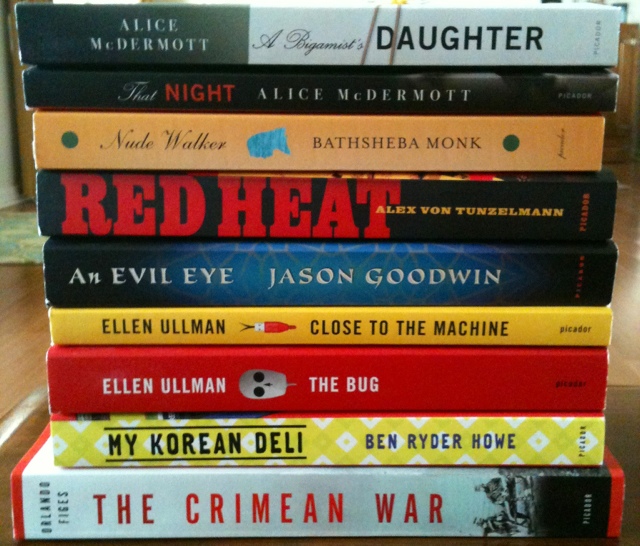
The kind folks at Picador sent a nice box of titles to Biblioklept World Headquarters a few weeks ago; I’ve had enough time to mull over them a bit and do something of a write-up. Here goes.
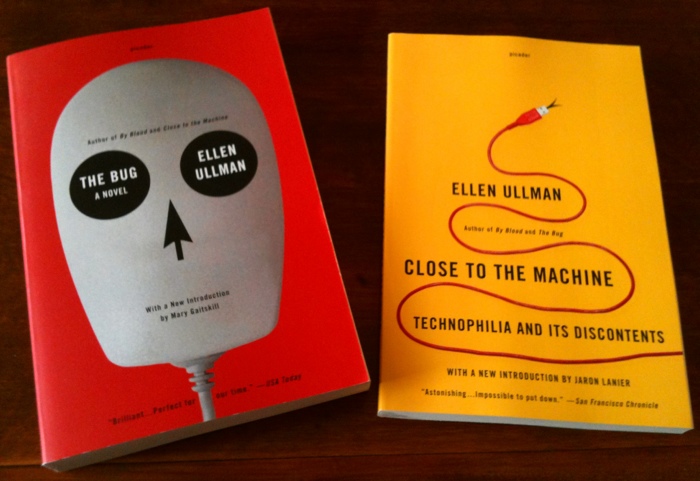
Next month, coinciding with her new novel By Blood (from FS&G), Picador re-releases (in new editions) two from Ellen Ullman:Close to the Machine and The Bug, which features a new introduction by Mary Gaitskill. Machine is a sort-of-memoir about the dawn of the tech-era; Ullman recounts her experiences as a female software engineer finding a place in the boys’ club of programming. Love these covers:
The Bug, a novel is tech without the noir, cyber without the punk—something different and fresh. It reminds me of Douglas Coupland’s Microserfs only because I can’t think of what else to compare it to. Pub’s write-up:
Ellen Ullman is a “rarity, a computer programmer with a poet’s feeling for language” (Laura Miller, Salon). The Bug breaks new ground in literary fiction, offering us a deep look into the internal lives of people in the technical world. Set in a start-up company in 1984, this highly acclaimed first novel explores what happens when a baffling software flaw—a bug so teasing it is named “the Jester”—threatens the survival of the humans beings who created it.
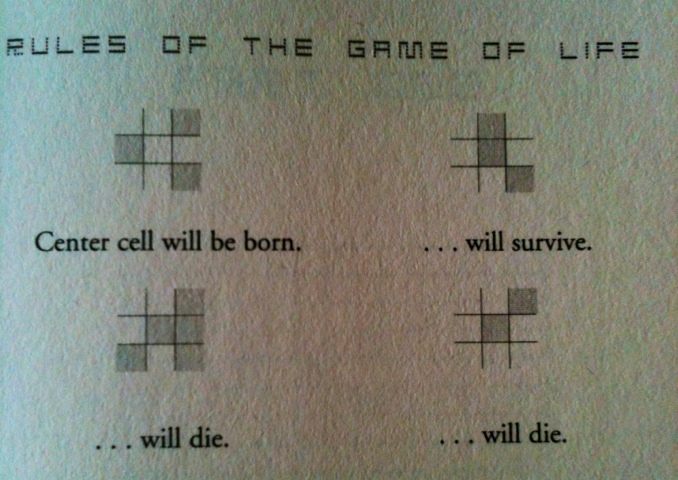
The Bug features a playfulness of the page, a willingness to examine the intersection of code and poetry. Example:
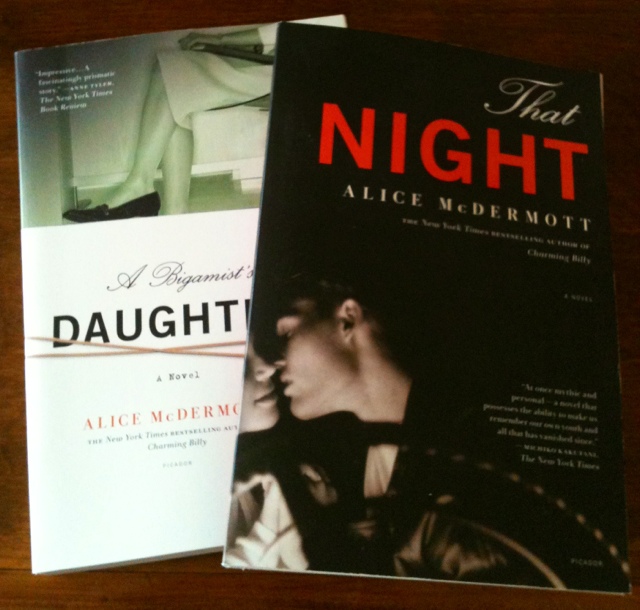
Alice McDermott also gets reissues: A Bigamist’s Daughter and That Night, which my wife picked up. That Night was a finalist for the Pulitzer and the National Book Award. It seems a little sexy and dangerous. Again, pub’s blurb:
It is high summer, the early 1960s. Sheryl and Rick, two Long Island teenagers, share an intense, all-consuming love. But Sheryl’s widowed mother steps between them, and one moonlit night Rick and a gang of hoodlums descend upon her quiet neighborhood. That night, driven by Rick’s determination to reclaim Sheryl, the young men provoke a violent confrontation, and as fathers step forward to protect their turf, notions of innocence belonging to both sides of the brawl are fractured forever. Alice McDermott’s That Night is “a moving and captivating novel, both celebration and elegy…a rare and memorable work” (The Cleveland Plain Dealer).
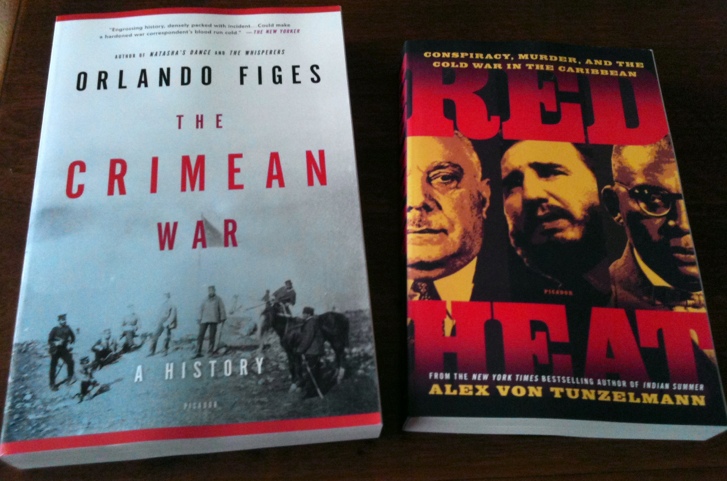
Two history books in the package: Orlando Figes’sThe Crimean War and Red Heat by Alex von Tunzelmann.
Here’s an excerpt from the Figes book (which is, uh, about the Crimean War):
Two world wars have obscured the huge scale and enormous human cost of the Crimean War. Today it seems to us a relatively minor war; it is almost forgotten, like the plaques and gravestones in those churchyards. Even in the countries that took part in it (Russia, Britain, France, Piedmont-Sardinia in Italy and the Ottoman Empire, including those territories that would later make up Romania and Bulgaria) there are not many people today who could say what the Crimean War was all about. But for our ancestors before the First World War the Crimea was the major conflict of the nineteenth century, the most important war of their lifetimes, just as the world wars of the twentieth century are the dominant historical landmarks of our lives.
Red Heat is not the novelization of the 1988 Schwarzenegger buddy-cop film (nor, sadly, a novelization of the 1985 Linda Blair women-in-prison film of the same name). Von Tunzelmann’s book examines the relationship between the island nations to the U.S.’s immediate south to America and Russia. Like I said, no Schwarzenegger, but plenty of strong men. From Jad Adam’s review in The Guardian:
Red Heat deftly juggles the stories of three countries – Cuba, Haiti and the Dominican Republic – and their relationship with the superpowers, where things were not as they seemed. Von Tunzelmann asserts that the political labels of the region were a sham: “democracy” was dictatorship; leaders veered to the rhetoric of the right or left according to advantage; a communist was anyone, however rightwing or nationalistic, whom the ruling regime wanted tarnished in the eyes of the US
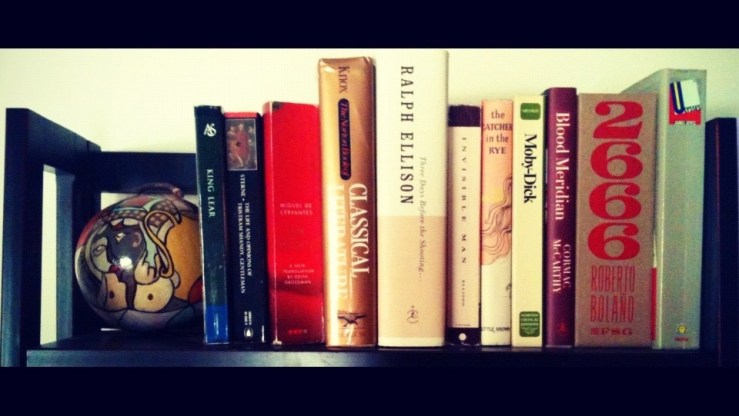
Book shelves series #10, tenth Sunday of 2012. I’m very ill today. These are some books; I own multiple copies of some of these. A painted gourd stands in as a book end. Look, I’m really ill today, these are books, I think you get the idea.







 Biblioklept