A Riff on the Kindle Fire

20120131-201536.jpg

1. I got a Kindle Fire for Christmas this year, and have been using it for about a month now. I’m not sure how to go about “reviewing” this product, so I’m going to riff a bit.

2. Let’s get the whole Amazon-as-Evil-Empire thing out of the way up front: Yes, Amazon’s business practices are unsavory; yes, attempting to decimate the publishing industry as it currently exists is Not Good; yes, their practices threaten brick-and-mortar stores (the kind that actually pay local and state taxes!); yes their practices work to undermine key figures in the publishing industry—y’know, people like editors.

3. Picking up on that last clause: self-publishing (and the self-publishing “revolution” that e-readers like the Kindle Fire entail) may seem fine and dandy cotton candy, but there’s a reason that editors (and publishers and publicists, etc.) exist. These people make books better. These people make books. (And no, by the way, I’m not interested in reading your self-published ebook, so quit sending me email blasts).

4. Seems like I’m riffing out a lot of context, so let’s keep going: Perhaps you read whinypants Jonathan Franzen decrying the impending moral failures/societal breakdown that will result from ebooks replacing print editions. Franzen’s position is, of course, reactionary and conservative, and deeply rooted in the fear that the perfect Platonic permanence of books will be subverted or decimated.

5. Franzen’s reaction is rooted in part against a (common, teleological, utopian) misconception about the longevity and stability of digital content. Simply put, many people are operating under a dramatic misunderstanding of just how unstable digital content is. Where will all these books be stored, and in what format? Who will be responsible for archiving these materials?

6. A simple thought experiment, germane to item 5 above: Think back on all the obsolete media that you have used in your lifetime. I am in my thirties; my list would include cassette tapes, VHS tapes, laser disks, floppy disks, minidiscs, CDRs . . . (I don’t include vinyl records in this list. I still own hundreds of them and play them regularly).

7. To recontextualize: Printed books are a far more stable format than ebooks.

8. To wit: Ursula LeGuin in her essay “Staying Awake” from a 2008 issue of Harper’s:

The book itself is a curious artifact, not showy in its technology but complex and extremely efficient: a really neat little device, compact, often very pleasant to look at and handle, that can last decades, even centuries. It doesn’t have to be plugged in, activated, or performed by a machine; all it needs is light, a human eye, and a human mind. It is not one of a kind, and it is not ephemeral. It lasts. It is reliable. If a book told you something when you were fifteen, it will tell it to you again when you are fifty, though you may understand it so differently that it seems you’re reading a whole new book.

9. Points 2-8 seem like so much hemming and hawing, so much reticence to discuss what I seemed to promise at the outset: Some sense of what reading on the Kindle Fire is like.

10. Some things I like very much about reading on the Kindle Fire:

It creates its own light for night reading.

It’s easy to highlight and annotate passages (and then open up a new screen to look at just those highlights and annotations, isolated from the text proper).

It’s lightweight and ergonomic and, when I read with it over my head, my wrists don’t constrict and go tingly.

It holds a lot of books.
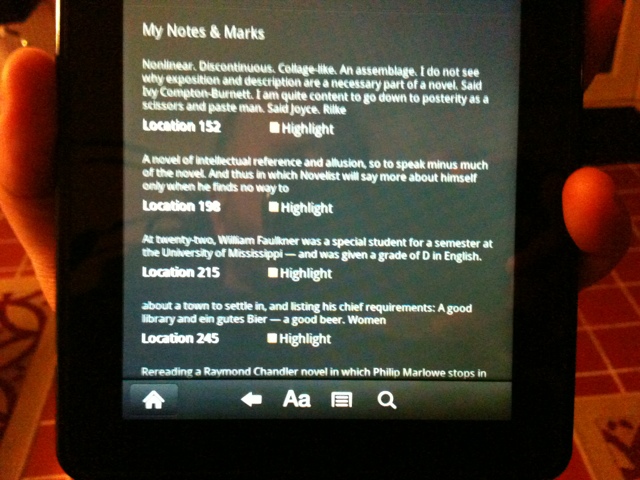
20120131-194740.jpg

11. Some things I like about the Kindle Fire that I would think I wouldn’t like about the Kindle Fire, were I to read such a list from another person:

I can determine how far I have read into a book as a percentage.

I can stop and browse the internet in the middle of reading.

I can look up words or even wikis as I go by simply hovering a finger over a word or phrase.

12. My daughter loves the thing. Loves loves loves it. She is probably the primary user. She is four and a half. I think the interactive books she adores are marvelous.

13. Some things I don’t like about the Kindle Fire:

No book smell.

One texture for all books: This is probably the biggest problem I can see with the Kindle Fire.

It requires a battery charge, so there’s a built in level of accessibility; a sense that one must needs “prepare” ahead of time to read, perhaps (unlike our old friend the print book, which only requires a light source).

No bath time reading.

I can’t read it around my daughter, because she will attempt to take it, or, at minimum, curl up in my lap.

It is not possible to have like three or four books open at once.

Can’t read .cbr files. Why? Why?

I had to buy a USB micro B cable to connect the Kindle to the computer that I use to store digital content. Why not include this cable, Amazon? (It’s almost as if the company wants consumers to be solely reliant on Amazon’s services as a content provider . . .)

14. I’ve found it nearly impossible to read an electronic book on the Kindle that I started as a print book. For example, I’m about half-way through Teju Cole’s novel Open City; the kind publicist who sent it to me also sent me an electronic version of the text. I began the print copy in earnest, but the other night, after reading a bit of Hawthorne on the Kindle, I found myself wanting to sink back into Cole’s Sebaldian orbit. When I found my place in the text though, I felt alienated, bleak even, as if I were not reading the definitive version of Cole’s book but instead its cheap ghost. There is no intellectual or objective justification for this feeling. Call it a vibe or a habit.

20120131-194747.jpg

15. Books that I enjoy reading on the Kindle Fire:

David Markson’s The Last Novel, which perhaps begs to be read on such a device.

Anything by Nietzsche, but his aphoristic works especially.

A .pdf version of Luigi Serafini’s rare and expensive book The Codex Seraphinianus (one of many verboten tomes on my Kindle, but remember the name of this site if you please . . .)

Anything by Whitman, especially letters and other non-essentials that I would not normally pursue.

Ditto Hawthorne.

Ditto Dickinson.

Ditto Melville.

Oh, and beyond the overlooked and underfamous works of certain American Renaissance faves: Moby-Dick too, which seems looser, freer, more aphoristic on the Kindle. (Why?)

Neal Stephenson’s novel Snow Crash, which seems simultaneously dated and futuristic. Like William Gibson with a strong streak of Pynchonian sillies.

And Gibson: Rereading Burning Chrome. Had forgotten how good some of these shorts are.

Houellebecq’s Whatever: its brevity, its succinctness gels with my nascent Kindle habits, or perhaps instructs my Kindle habits, or more likely creates my Kindle habits.

16. To return to a point in #13 above: The Kindle Fire necessarily imposes a uniform texture on every book that one reads on it; this would be true of any e-reader. Sure, you can change the background (white, black, or a sepia color, which is what I prefer), fonts, sizes, spacing, etc. — but there is no sense of physicality, of individual identity, of, dare I say it, specialness, to the texts. I am aware that these are terribly subjective and overtly Romantic terms, but hell, I like physical books. I like their covers and their smells and their discolorations. I like leaving bookmarks in every book that I finish or abandon—I almost always find a new bookmark for every book that I read (the autobookmark on the Kindle is useful, but how can it compare with a photograph of my son or drawing by my daughter or a postcard from a stranger or a scrap of poetry from a discontinued textbook or an old grocery list of my wife’s from years before we were married?).

17. I titled this post “A Riff on the Kindle Fire,” but that’s a bit ambiguous I suppose: I did not compose the post on the Kindle Fire, which I find awkward re: blogging/wordprocessing. I used a laptop (with some help from an iPhone). Maybe the preposition “about” would be more suitable.

18. By way of closing, after four weeks with the thing:

It’s light.

It’s convenient for night reading, but you probably shouldn’t take it in the bath.

No book smell.

William Gaddis on Hipsters: “An Ill-dressed, Underfed, Overdrunken Group of Squatters with Minds So Highly Developed That They Were Excused from Good Manners”

gaddis_large

Love this passage from William Gaddis’s The Recognitions. Mocking “hipsterism” has been around forever (or at least 50 years):

And by now they were at the door of the Viareggio, a small Italian bar of nepotistic honesty before it was discovered by exotics. Neighborhood folk still came, in small vanquished numbers and mostly in the afternoon, before the two small dining rooms and the bar were taken over by the educated classes, an ill-dressed, underfed, overdrunken group of squatters with minds so highly developed that they were excused from good manners, tastes so refined in one direction that they were excused for having none in any other, emotions so cultivated that the only aberration was normality, all afloat here on sodden pools of depravity calculated only to manifest the pricelessness of what they were throwing away, the three sexes in two colors, a group of people all mentally and physically the wrong size.

Cormac McCarthy, Unchallenged King of Literary Mule Carnage

In his essay “The Dead Mule Rides Again,” Jerry Leath Mills argues

. . . there is indeed a single, simple, litmus-like test for the quality of southernness in literature, one easily formulated into a question to be asked of any literary text and whose answer may be taken as definitive, delimiting, and final. The test is: Is there a dead mule in it?

Mills’s convincing textual evidence draws on over thirty authors, but declares Cormac McCarthy “unchallenged king of literary mule carnage.” Some proof:

4. Decapitation by irate opera singer. Cormac McCarthy, who far surpasses even Faulkner in the mayhem he visits upon literary mules (see #s 5, 6, 7, 9, 14, 15), includes in his recent novel The Crossing (1994) the following dialogue about a mule whose recalcitrance proves insufferable to the artistic temperament of a singer assigned to tend him in a road company:

What was it he done to the mule?

He tried to cut off the head with a machete. . . .

I wouldn’t have thought you could cut off a mule’s head with a machete.

Of course not. Only a drunken fool would attempt such a feat. When the hacking availed not he began to saw. . . .

What happened to the mule?

The mule? The mule died. Of course

5. Drowning. This is Faulkner’s most commonly employed means of dispatch for the mules in his works. In the flood scenes he renders so effectively, we inevitably find drowned mules floating down river. As opposed to the train-struck animals in “Mule in the Yard” (see # 3), which are instrumental in developing motive and plot, Faulkner’s drowned mules tend to fall into the decorative or ornamental category, employed chiefly for drama, mood, and atmosphere. In As I Lay Dying (1930), for example, Darl recreates a wagon disaster in the surging stream: “Between two hills I see the mules once more. They roll up out of the water in succession, turning completely over, their legs stiffly extended as when they had lost contact with the earth”. In the “Old Man” sections of The Wild Palms (1939), the flood throws forth its “charging welter of dead cows and mules and outhouses and cabins and hencoops,” and Faulkner’s prose strikes an elegiac note as the convict’s skiff rides “even upon the backs of the mules as though even in death they were not to escape that burden-bearing doom with which their eunuch race was cursed”. Before the ordeal ends, the accumulation of mule carcasses reaches almost cosmic proportions as the stranded convict remembers “that other wave, the second wall of water full of houses and dead mules building up behind him in the swamp”.

Robert Morgan’s story “Poinsett’s Bridge” (1989) picks up the drowned mule topos in distinctly Faulknerian terms: “The body of a mule shot by in the current, and then a chicken coop”; but Cormac McCarthy (see #s 4, 6, 7, 9, 14, 15) varies it in Blood Meridian (1985) by having a mule drowned intentionally: “The Yumas were swimming the few sorry mules . . . across the river. . . . Downriver they’d drowned one of the animals and towed it ashore to be butchered”. (On recurrent uses of mules as culinary items see # 14.)

That the image of the drowned mule also occupies a subliterary folk status in the South is perhaps attested by a common simile in which a wealthy person is said to have “enough money to burn up a wet mule.”

6. Falls from cliffs. The novel Blood Meridian (1985) establishes Cormac McCarthy as unchallenged king of literary mule carnage. No fewer than fifty-nine specific mules die in the book, plus dozens more that are alluded to in groups and bunches. Mules are shot, roasted, drowned, knifed, and slain by thirst; but the largest number, 50 out of a conducta of 122 mules carrying quicksilver for mining, plummet from a single cliff during an ambush, performing an almost choreographic display of motion and color, “the animals dropping silently as martyrs, turning sedately in the empty air and exploding on the rocks below in startling bursts of blood and silver as the flasks broke open and the mercury loomed wobbling in the air in great sheets and lobes and small trembling satellites. . . . Half a hundred mules had been ridden off the escarpment”. (See also #s 4, 5, 7, 9, 14, 15.)

. . .

7. Fall into subterranean cavity. Near the conclusion of Cormac McCarthy’s Child of God (1973), “Arthur Ogle was plowing an upland field one evening when the plow was snatched from his hands. He looked in time to see his span of mules disappear into the earth taking the plow with them” (195). These doomed mules qualify as highly functional in the story, since a search for their bodies leads to the discovery of a number of human corpses stored in the caves underground for sexual use by the necrophiliac Lester Ballard. (See also #s 4, 5, 6, 9, 14, 15.)

. . .

9. Gunshot wounds. The high quotient of gunplay in southern fiction quite naturally extends to some of the mules that grace its pages. . . .

Mules absorb lead throughout much of Cormac McCarthy’Blood Meridian (1985), one providing a shield against incoming fire: “He . . . crouched under the ribs of a dead mule and recharged the pistol”.

. . .

14. Stab wounds. . . .

But mules are consumed readily by man, beast, and fowl in Cormac McCarthy‘s Blood Meridian (1985), and a character in Bernice Kelly Harris’s Purslane (1939) finds the practice a perfectly acceptable topic for mealtime conversation: “Uncle Millard near the foot of the table was telling about the Christmas dinner he ate in the pesthouse years ago, declaring it was fried dog and mouse stew with a slice of boiled mule”.

15. Thirst. Alkali flats in Cormac McCarthy‘s Blood Meridian (1985) yield no shortage of “the black and desiccated shapes of horses and mules. . . . These parched beasts had died with their necks stretched in agony in the sand”

. . .

18. Submersion in domestic metaphor. Once again, Cormac McCarthy creates an exclusive category (see # 4) with a scene in Cities of the Plain (1998):

When he turned around Billy [Parham] was standing in the doorway watching him [John Grady Cole].

This the honeymoon suite? he said.

You’re lookin at it.

He leaned in the doorframe and took his cigarettes from his shirtpocket and shucked one out and lit it.

The only thing you ain’t got here is a dead mule in the floor.

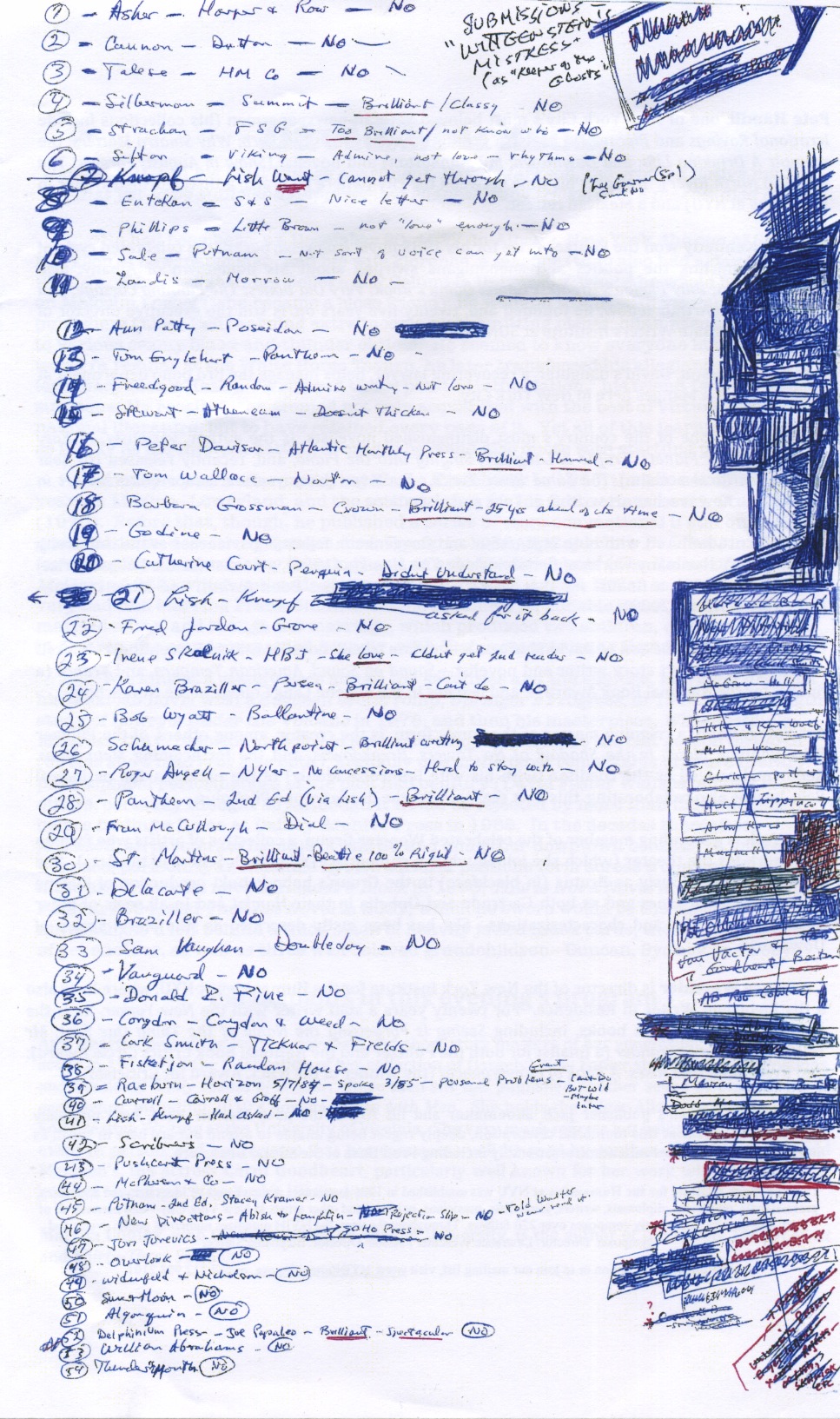
List of Rejections of Wittgenstein’s Mistress — David Markson

(Via/cheers).

“A Well-Meaning, Sincere Hypocrite” — William Gaddis on His Title Character, JR (And Capitalism)

More from William Gaddis’s 1986 Paris Review interview:

INTERVIEWER

Is JR’s story something you extrapolated from life only, or did you rely on sociologies devoted to how the corporate world works upon social values, human qualities, and relationships in American culture?

GADDIS

The boy himself is a total invention, completely sui generis. The reason he is eleven is because he is in this prepubescent age where he is amoral, with a clear conscience, dealing with people who are immoral, unscrupulous; they realize what scruples are, but push them aside, whereas his good cheer and greed he considers perfectly normal. He thinks this is what you’re supposed to do; he is not going to wait around; he is in a hurry, as you should be in America—get on with it, get going. He is very scrupulous about obeying the letter of the law and then (never making the distinction) evading the spirit of the law at every possible turn. He is in these ways an innocent and is well-meaning, a sincere hypocrite. With Bast, he does think he’s helping him out. As for the corporate world, I do read the newspapers, clip things, ideas, articles, and just use them as fodder. But all that hardly requires a text in sociology. And this may be the place to make a further point. I’m frequently seen in the conservative press as being out there on the barricades shouting: Down with capitalism! I do see it in the end as really the most workable system we’ve produced. So what we’re talking about is not the system itself, but its abuses, I don’t mean criminal but the abundant abuses just within the letter of the law. The essential question is whether it can survive these abuses given free rein and whether these abuses are inherent in the system itself. I should think it is perfectly clear in my work—calling attention, satirizing these abuses—that our best hope lies in bringing things under better and more equitable control, cutting back the temptations to unmitigated greed and bemused dishonesty . . . in other words that these abuses the system has fostered are not essential, but running out of moral or ethical control can certainly threaten its survival.

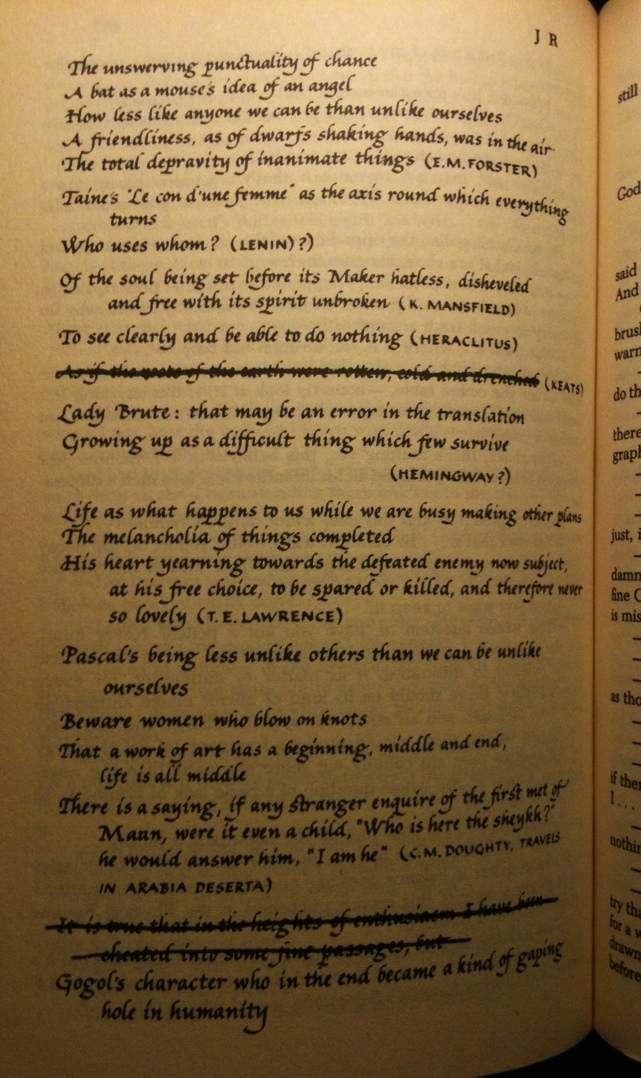
“The Unswerving Punctuality of Chance” (And Other Citations from William Gaddis’s Novel JR)

20120128-185406.jpg

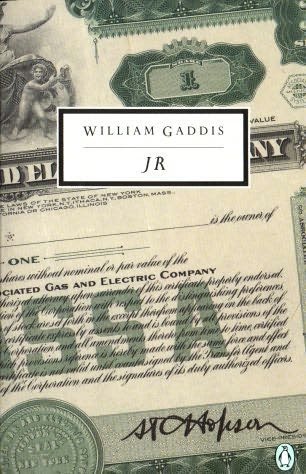
In JR, the sprawling novel of capitalism and art by William Gaddis, Jack Gibbs loads his pockets with crumpled newspaper clippings, racing forms, and citations for a book he’s working on. “More trash,” he mutters about this list (which appears on page 486 of my Penguin Twentieth Century Classics Edition).

Books Acquired, 1.25.2012 (Malcolm Lowry, Paul Auster, and William Gaddis)

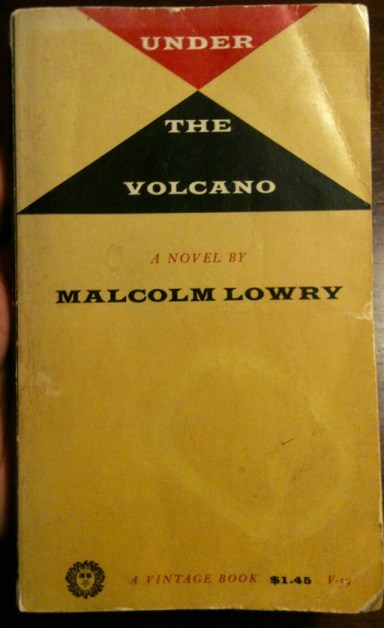
I go to the bookstore once a week, whether I need books or not, which I really don’t. This week, I picked up a book I’ve already read, Lowry’s late-modernist classic Under the Volcano, simply because I hate the cover of the version I have (a bland movie tie-in). Anyway, I’ve been prowling for a version that includes an introduction by William Vollmann, but I saw this midcentury paperback with a nice minimal vibe and had to snap it up (also, it was a dollar, and “I’d buy that for a dollar!”):

20120126-181349.jpg

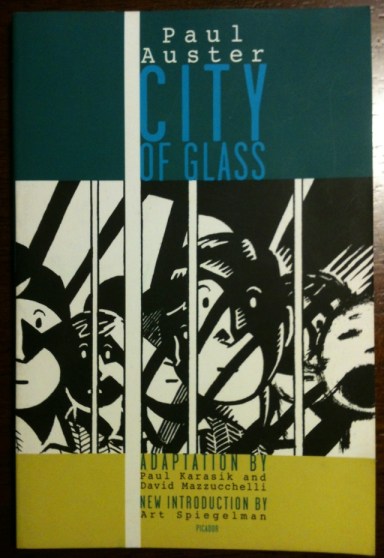
I’m not a huge Paul Auster fan, but I do like artist David Mazzucchelli’s work (especially his novel Asterios Polyp), so when I saw a crisp used copy of the graphic novelization of City of Glass (with an intro by Art Spiegelman), I had to snap it up:

20120126-181414.jpg

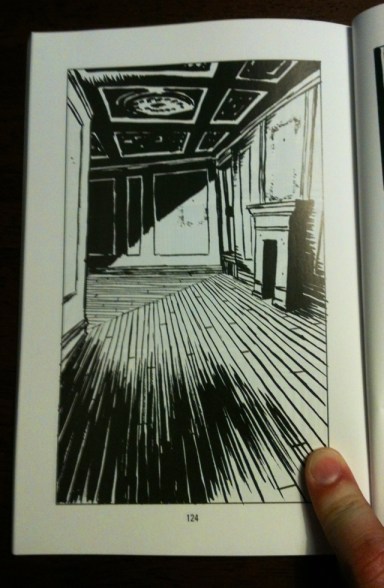
A splash page of a stark empty room which I’m sure is meaningful in some way:

20120126-181426.jpg

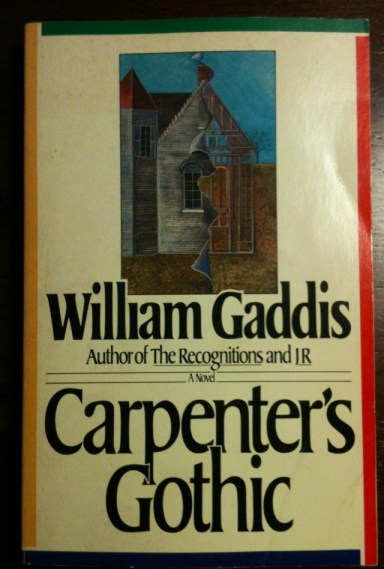
Also, couldn’t help pick up a used copy of Gaddis’s late novel Carpenter’s Gothic, even though I know there’s no way I’ll get to it anytime soon.

20120126-181435.jpg

Maurice Sendak on The Colbert Report (In Case You Missed It)

Vodpod videos no longer available. Vodpod videos no longer available.

Book Acquired, 1.23.2012 — New Lapham’s Quarterly

20120125-161536.jpg

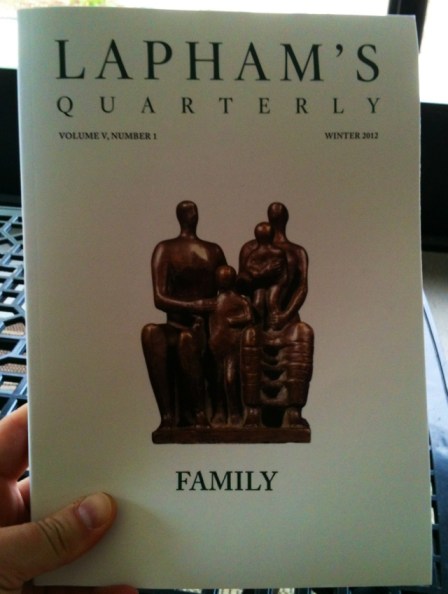
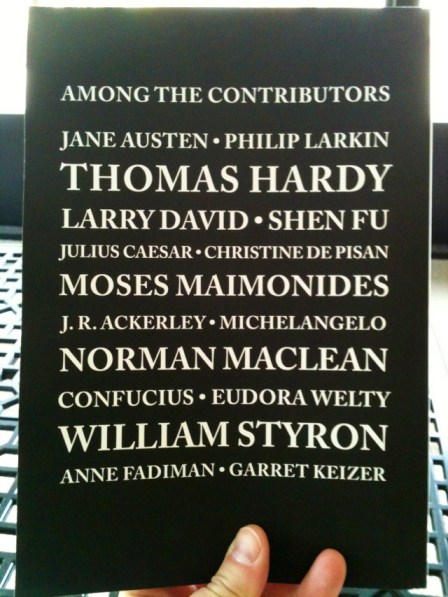
I was a relatively consistent subscriber to Harper’s magazine from 1997 to 2006, with brief flirtations after that year. Anyway, at some point my subscriptions to Harper’s, The Believer, McSweeney’s, etc. became too much. Just didn’t have time to read them all. I’m down to one subscription a year. Last year it was The Paris Review—and I very much enjoyed it. This year: Lapham’s Quarterly. The quarterly is right up my alley—short selections from (seemingly) 100s of authors. The back:

20120125-161543.jpg

The magazine also features plenty of art selections, as well as tables, graphs, and other editorial content—but on the whole, Lapham’s Quarterly reminds me of my favorite aspect of Harper’s, the “Readings” selections.

20120125-161551.jpg

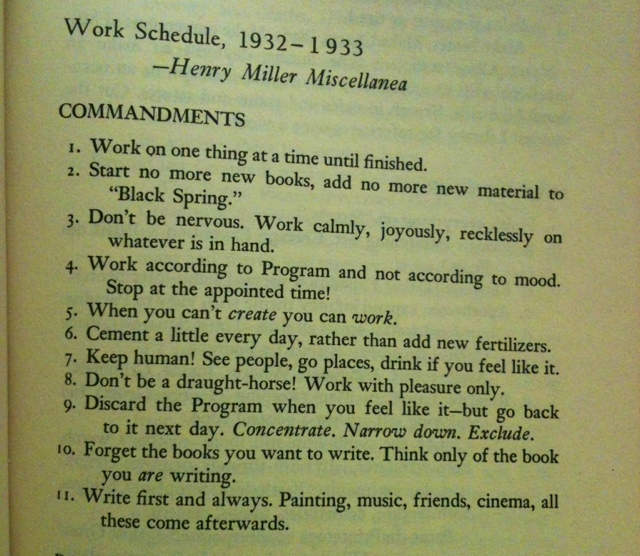
Henry Miller’s Eleven Commandments

20120125-160347.jpg

(From Henry Miller on Writing, New Directions).

Book Acquired, 1.19.2012 — The Future of Ice

20120124-220452.jpg

Big thanks to Biblioklept reader (and frequent commenter) ccllyyddee, who sent me his copy of Gretel Ehrlich’s The Future of Ice. I dipped into it a bit this weekend; Ehrlich seems to be walking that strange line between the physical and metaphysical. A description from her website–

In this gripping circumnavigation of the Arctic Circle, Gretel Ehrlich paints a vivid portrait of the indigenous cultures that inhabit the starkly beautiful boreal landscape surrounding the Arctic Ocean, an ice-bound wilderness that includes northern Siberia, northwestern Greenland, Canada’s vast Nunavut, and northern Alaska. Ehrlich’s expedition, supported by the National Geographic Society, documents what remains of these cultures, specifically the similarities and differences among them, including hunting traditions, shamanic and ceremonial practices, languages and legends—the ways in which they have survived, or have been assimilated, and how they are adapting to the impact of climate change on their ice-age cultures.

Ehrlich is fascinated by what she calls the ecology of culture—the ways in which the human presence of indigenous Arctic people is intricately interwoven with land, rock, river, sea, and ice. Depicting human-caused climate change as only the latest and most destructive of the ills and abuses first peoples have been suffering for 250 years, Ehrlich’s haunting and lovely prose portrays ancient tribes and traditions on the edge of extinction and captures the austere beauty of their various lifeways in the frozen dreamscape of the world they have always known.

F. Scott Fitzgerald’s “Dyed Siberian Horse” (And Twelve Other Descriptions of Things and Atmosphere)

More from F. Scott Fitzgerald’s magical Notebooks

143 Days of this February were white and magical, the nights were starry and crystalline. The town lay under a cold glory.

144 Dyed Siberian horse.

145 As thin as a repeated dream.

146 The sea was coming up in little intimidating rushes.

147 The island floated, a boat becalmed, upon the almost perceptible curve of the world.

148 Lost in the immensity of surfaceless blue sky like air piled on air.

151 On the great swell of the Blue Danube, the summer ball rocked into motion.

152 A circus ring for ponies in country houses.

153 The tense, sunny room seemed romantic to Becky, with its odor of esoteric gases, the faint perfumes of future knowledge, the low electric sizz in the glass cells.

154 A rambling frame structure that had been a residence in the 80’s, the country poorhouse in the 1900’s, and now was a residence again.

155 The groans of moribund plumbing.

156 The silvery “Hey!” of a telephone.

161 Whining, tinkling hoochie-coochie show.

“The Charade of the So-Called Free Market” — William Gaddis on What Moved Him to Write JR

From William Gaddis’s 1986 Paris Review interview:

INTERVIEWER

What moved you to write JR?

GADDIS

Even though I should have known from The Recognitions that the world was not waiting breathlessly for my message, that it already knew, and was quite happy to live with all these false values, I’d always been intrigued by the charade of the so-called free market, so-called free enterprise system, the stock market conceived of as what was called a “people’s capitalism” where you “owned a part of the company” and so forth. All of which is true; you own shares in a company, so you literally do own part of the assets. But if you own a hundred shares out of six or sixty or six hundred million, you’re not going to influence things very much. Also, the fact that people buy securities—the very word in this context is comic—not because they are excited by the product—often you don’t know what the company makes—but simply for profit: The stock looks good and you buy it. The moment it looks bad you sell it. What had actually happened in the company is not your concern. In many ways I thought . . . the childishness of all this. Because JR himself, which is why he is eleven years old, is motivated only by good-natured greed. JR was, in other words, to be a commentary on this free enterprise system running out of control. Looking around us now with a two-trillion-dollar federal deficit and billions of private debt and the banks, the farms, basic industry all in serious trouble, it seems to have been rather prophetic.

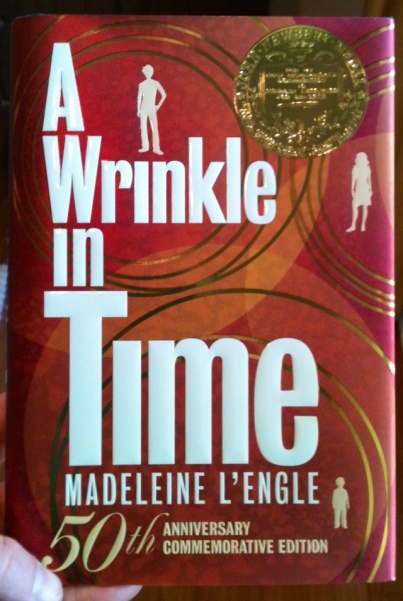
Book Acquired, 1.18.2012 — 50th Anniversary Edition of Madeleine L’Engle’s Classic A Wrinkle in Time

20120122-120441.jpg

The 50th anniversary edition of Madeleine L’Engle’s innovative YA classic A Wrinkle in Time showed up at the house last week (I wrote a bit about Wrinkle as well).

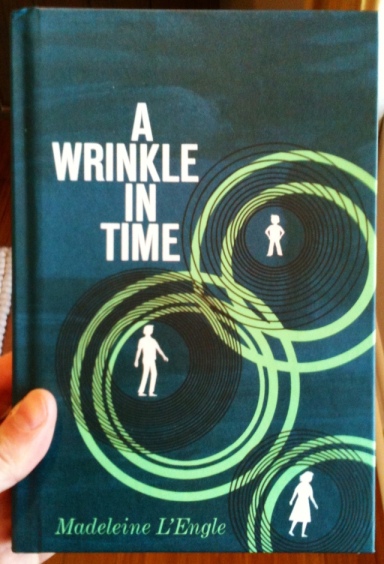
The new edition is chock full of extras, including manuscript pages, photos, and more. My favorite detail though is the actual cover—the one under the dust jackets (I hate dust jackets):

20120122-120459.jpg

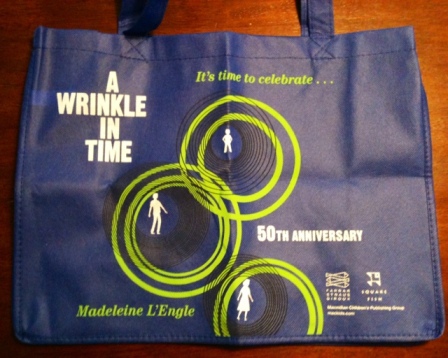
The kind people at Macmillan also sent along a bag—a first—one I’ll proudly use when I do my grocery shopping:

20120122-120509.jpg

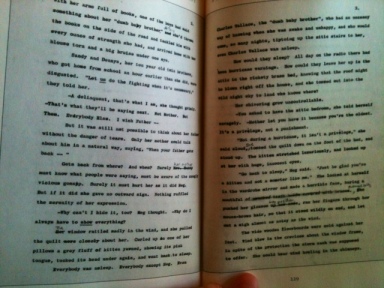
A blurry shot of the manuscript section:

20120122-120517.jpg

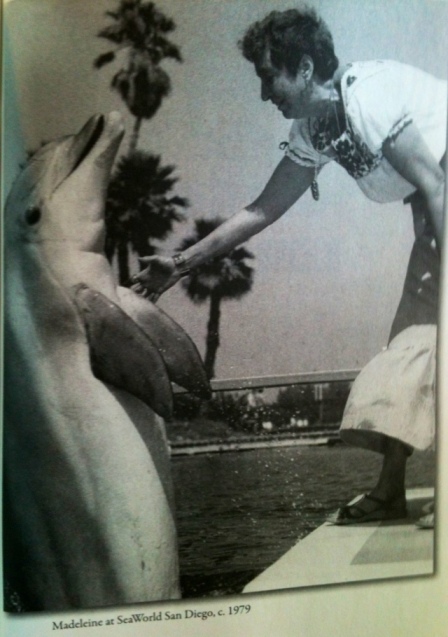
Madeleine and a dolphin:

20120122-120526.jpg

I Riff on William Gaddis’s Enormous Novel J R (From About Half Way Through)

1. I want to write about William Gaddis’s novel J R, which I am about half way through now.

2. I’ve been listening to the audiobook version, read with operatic aplomb by Nick Sullivan. I’ve also been rereading bits here and there in my trade paperback copy.

3. What is J R about? Money. Capitalism. Art. Education. Desperate people. America.

4. The question posed in #3 is a fair question, but probably not the right question, or at least not the right first question about J R. Instead—What is the form of J RHow is J R?

5. A simple answer is that the novel is almost entirely dialog, usually unattributed (although made clear once one learns the reading rules for J R). These episodes of dialogue are couched in brief, pristine, precise, concrete—yet poetic—descriptions of setting. Otherwise, no exposition. Reminiscent of a movie script, almost.

6. A more complex answer: J R, overstuffed with voices, characters (shadows and doubles), and motifs, is an opera, or a riff on an opera, at least.

7. A few of the motifs in J R: paper, shoes, opera, T.V. equipment, entropy, chaos, novels, failure, frustration, mechanization, noise, hunting, war, music, commercials, trains, eruptions of nonconformity, advertising, the rotten shallowness of modern life . . .

8. Okay, so maybe that list of motifs dipped into themes. It’s certainly incomplete (but my reading of J R is incomplete, so . . .)

9. Well hang on so what’s it about? What happens?—This is a hard question to answer even though there are plenty of concrete answers. A little more riffage then—

10. Our eponymous hero, snot-nosed JR (of the sixth grade) amasses a paper fortune by trading cheap stocks. He does this from a payphone (that he engineers to have installed!) in school.

11. JR’s unwilling agent—his emissary into the adult world—is Edward Bast, a struggling young composer who is fired from his teaching position at JR’s school after going (quite literally) off script during a lesson.

12. Echoes of Bast: Thomas Eigen, struggling writer. Jack Gibbs, struggling writer human. Gibbs, a frustrated, exasperated, alcoholic intellectual is perhaps the soul of the book. (Or at least my favorite character).

13. Characters in J R tend to be frustrated or oblivious. The oblivious characters tend to be rich and powerful; the frustrated tend to be artistic and intellectual.

14. Hence, satire: J R is very, very funny.

15. J R was published over 35 years ago, but its take on Wall Street, greed, the mechanization of education, the marginalization of art in society, and the increasing anti-intellectualism in America is more relevant than ever.

16. So, even when J R is funny, it’s also deeply sad.

17. Occasionally, there’s a histrionic pitch to Gaddis’s dialog: his frustrated people, in their frustrated marriages and frustrated jobs, explode. But J R is an opera, I suppose, and we might come to accept histrionics in an opera.

18. Young JR is a fascinating study, an innocent of sorts who attempts to navigate the ridiculous rules of his society. He is immature; he lacks human experience (he’s only 11, after all), and, like most young children, lacks empathy or foresight. He’s the perfect predatory capitalist.

19. All the love (whether familial or romantic or sexual) in J R (thus far, anyway) is frustrated, blocked, barred, delayed, interrupted . . .

20. I’m particularly fascinated by the scenes in JR’s school, particularly the ones involving Principal Whiteback, who, in addition to his educational duties, is also president of a local bank. Whiteback is a consummate yes man; he babbles out in an unending stammer of doubletalk; he’s a fount of delicious ironic humor. Sadly though, he’s also absolutely real, the kind of educational administrator who thinks a school should be run like a corporation.

21. The middlebrow novelist Jonathan Franzen, who has the unlikely and undeserved reputation of being a literary genius, famously called Gaddis “Mr. Difficult” (in an essay of the same name).

22. Franzen’s essay is interesting and instructive though flawed (he couldn’t make it through the second half of J R). From the essay:

“J R” is written for the active reader. You’re well advised to carry a pencil with which to flag plot points and draw flow charts on the inside back cover. The novel is a welter of dozens of interconnecting scams, deals, seductions, extortions, and betrayals. Between scenes, when the dialogue yields briefly to run-on sentences whose effect is like a blurry handheld video or a speeded-up movie, the images that flash by are of denatured, commercialized landscapes — trees being felled, fields paved over, roads widened — that recall to the modern reader how aesthetically shocking postwar automotive America must have been, how dismaying and portentous the first strip malls, the first five-acre parking lots.

23. Franzen, of course, is not heir to Gaddis. If there is one (and there doesn’t need to be, but still), it’s David Foster Wallace. Reading J R I am constantly reminded of Wallace’s work.

24. But also Joyce. J R is thoroughly Joycean, at least in its formal aspects: that friction between the deteriorated language of commerce and the high aims of art; the sense and sound and rhythms of the street. (Is there a character more frustrated in Western literature than Stephen Dedalus? Surely he finds some heirs in Gibbs, Bast, and Eigen . . .)

25. Gaddis denied (or at least deflected) a Joycean influence. Better to say then that they were both writing the 20th century, only from different ends of said century.

26. And then a question for navel-gazing lit major types, a question of little import, perhaps a meaningless question (certainly a dull one for most decent folks): Is J R late modernism or postmodernism? Late-late modernism?

27. Gaddis shows a touch of the nameyphilia that we see (out of control) in Pynchon: Hence, Miss Flesch, Father Haight, the diCephalis family, Nurse Waddams, Stella Angel, Major Hyde, etc.

28. To return to the plot, or the non-plot, of J R: As I’ve said, I’m only half way through the thing, but I can’t see its shape. That sentence might need a “yet” at the end; or, J R might be so much chaos.

29. In any case, I will report again at the end, if not sooner.

William Gaddis on James Joyce

William Gaddis on James Joyce (via/more):

I recall a most ingenious piece in a Wisconsin quarterly some years ago in which The Recognitions’ debt to Ulysses was established in such minute detail I was doubtful of my own firm recollection of never having read Ulysses.

(March 1972 letter to Jean [?] Howes)

I’ve about reached the end of the line on questions about what I did or didn’t read of Joyce’s 30 years ago. All I read of Ulysses was Molly Bloom at the end which was being circulated for salacious rather than literary merits; No I did not read Finnegans Wake though I think a phrase about “psychoanaloosing” one’s self from it is in The Recognitions; Yes I read some of Dubliners but don’t recall how many & remember only a story called “Counterparts”; Yes I read a play called Exiles which at the time I found highly unsuccessful; Yes I believe I read Portrait of an Artist but also think I may not have finished it; No I did not read commentary on Joyce’s work & absorb details without reading the original. I also read, & believe with a good deal more absorbtion [sic], Eliot, Dostoevski, Forster, Rolfe, Waugh, why bother to go on, anyone seeking Joyce finds Joyce even if both Joyce & the victim found the item in Shakespear, read right past whole lines lifted bodily from Eliot &c, all of which will probably go on so long as Joyce remains an academic cottage industry.

(June 1975 letter to Grace Eckley)

Book Shelves #4, 1.22.2012

Book shelves series #4, fourth Sunday of 2012: In which we finally leave the master bedroom and check out the books in my children’s rooms.

In the previous weeks, I illustrated that my kids — a girl and a boy, 4 and 1, respectively (tack on a “half” to each of those numbers if you care to) — my kids leave books all over the house. Their books are everywhere. They are as bad as I am. I indicated at the beginning of this year-long series that the documentation would never be stable or absolute; that books float through my house, come and go like bad house guests or silly ghosts—this is probably more true of the children’s books in this house than any other kind of book.

This week, I photograph the book shelves in my kids’ rooms, starting with my daughter’s. This is her big bookshelf:

20120121-174110.jpg

I did not photograph the big pile of books that set to the left. A close up of any of these shelves would reveal a mix of classics—stuff that my wife and I read and cherished as kids—and newer stuff as well. Here’s a shelf, sort of at random—it’s unusually well-organized:

20120121-174117.jpg

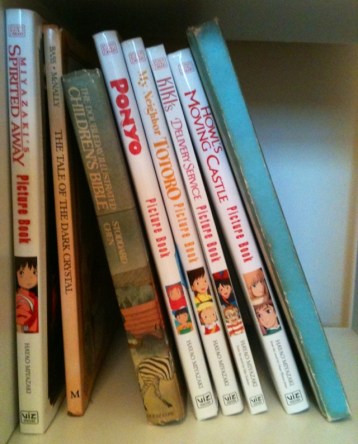
There’s a lot of Studio Ghibli books here; most narrativize Hayao Miyazaki’s films (we’re big fans in this house). My daughter loves these. The bible was my bible; the blue-spined book is this:

20120121-174125.jpg

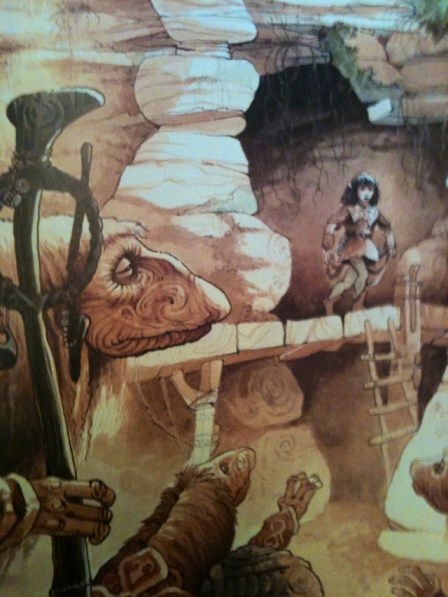
You might also note a book version of Jim Henson’s creepy classic The Dark Crystal; this was mine as a kid and it disturbed the hell out of me, so I gave it to my daughter, of course:

20120121-174143.jpg

The Studio Ghibli books combine beautiful stills of the film with narrative prose and comic book speech bubbles. From the standpoint of a fan of the films, they’re really interesting because they explicate some of the ambiguity. Our daughter loves them and asks for them (too much!):

20120121-174149.jpg

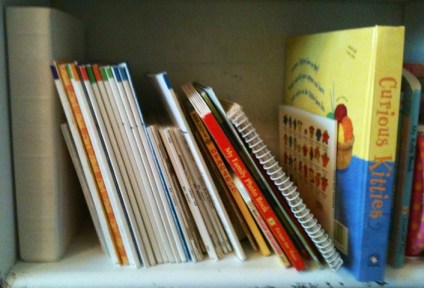
Another shelf from another book shelf—the only shelf with books on it in this piece of furniture, actually. Not interesting, but I said I’d photograph all book shelves as part of this project:

20120121-174157.jpg

Before my wife and I married, we lived in Tokyo for a while; we bought a bunch of these board books at a 100 yen shop. Here’s one:

20120121-174203.jpg

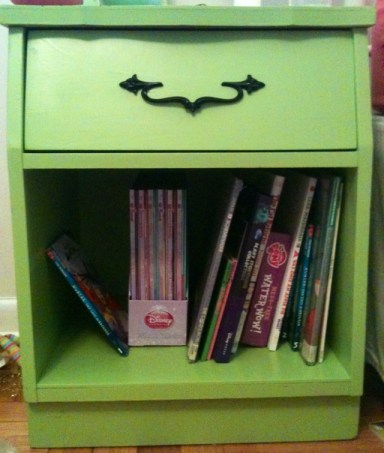
Night stand: always a place of shelving instability:

20120121-174209.jpg

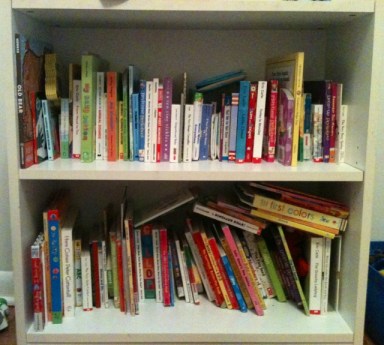
The book shelf in my son’s room—lots of board books, Eric Carle, stuff like that. He likes trains and dogs:

20120121-174219.jpg

So, I covered both of the kid’s rooms in one post in the hopes of getting to more interesting volumes in the next few weeks. On deck: the den/kitchen space, featuring cookbooks, art books, and travel volumes.