Yes, she could feel within herself the presence of a perfect animal. She resisted the idea of unleashing this animal one day. Perhaps for fear of causing some embarrassment or because she was afraid of some revelation… No, no — she repeated to herself- one mustn’t be afraid of being creative. Deep down, the animal probably repelled her because she still felt anxious to please and to be loved by someone as powerful as her dead aunt. Even if only to humiliate her afterwards and disown her without giving it another thought. For the best saying, as well as being the most recent was: goodness makes me want to vomit. Goodness was lukewarm and weak, it stank of raw meat that had been lying around for a long time without, however, becoming completely rotten. It was freshened up from time to time, seasoned sufficiently to preserve it, a lump of lukewarm, stagnating meat.
From Clarice Lispector’s novel Near to the Wild Heart.
I have to move through Near to the Wild Heart very slowly—Lispector’s representation of her narrator’s shifts in consciousness is slippery, abstract, terrifying at times, often beautiful, alienating, complex. As in The Hour of the Star, there’s an intense vein of abjection that unifies the work—its narrator’s navigation of internal and external worlds—that simultaneously attracts and compels me.
Novelist’s personal genre. For all its seeming fragmentation, nonetheless obstinately cross-referential and of cryptic interconnective syntax.
–David Markson, The Last Novel, 2007
I think I’m beginning to understand. What I’m writing is an infranovel.
–Laurent Binet, HHhH, 2010 / English trans. by Sam Taylor, 2012.
. . . it’s safe to say that in a true war story nothing is absolutely true.
–Tim O’Brien, The Things They Carried, 1990.
From the current (18 April 2014) Wikipedia entry for Laurent Binet’s novel HHhH:
HHhH is the debut novel of French author Laurent Binet. It recounts Operation Anthropoid, the assassination of Nazi leader Reinhard Heydrich in Prague during World War II. It was awarded the 2010 Prix Goncourt du Premier Roman.
The novel follows the history of the operation and the life of its protagonists – Heydrich and his assassins Jozef Gabčík and Jan Kubiš. But it is also interlaced with the author’s account of the process of researching and writing the book, his commentary about other literary and media treatments of the subject, and reflections about the extent to which the behavior of real people may of necessity be fictionalised in a historical novel.
The title is an acronym for Himmlers Hirn heisst Heydrich (“Himmler‘s brain is called Heydrich”), a quip about Heydrich said to have circulated in Nazi Germany.
If I were the narrator of HHhH—which is to say, if I were a version of Binet, a version that I might describe (and am describing, I guess) as Binet-the-writer-performing-Binet-the-author-performing-Binet-the-author-as-narrator-narrating-the-author-trying-to-write-HHhH (awful description)—if I were the narrator of HHhH I’d probably now dole out a droll little chapter about how the gesture I’ve just committed (lazily using Wikipedia to summarize the novel and prefacing that lazy summary with a few citations that might make cribbing from Wikipedia seem, I dunno, clever (which I do not think said cribbing is))—If I were the narrator of HHhH I might riff on how what I just did is the result of some kind of 21st-century paralysis induced by an overload of information combined with a deep sincere genuine honest-to-gawd love for my subject.
Or maybe I’d just claim to be writing an infrareview.
Has this been a bad start?
I think HHhH gets off to a bad start, but I could be wrong.
Maybe you should judge for yourself, dear reader. Here is its first paragraph:
Gabčík—that’s his name—really did exist. Lying alone on a little iron bed, did he hear, from outside, beyond the shutters of a darkened apartment, the unmistakable creaking of the Prague tramways? I want to believe so. I know Prague well, so I can imagine the tram’s number (but perhaps it’s changed?), its route, and the place where Gabčík waits, thinking and listening. We are at the corner of Vyšehradská and Trojická. The number 18 tram (or the number 22) has stopped in front of the Botanical Gardens. We are, most important, in 1942. In The Book of Laughter and Forgetting, Milan Kundera implies that he feels a bit ashamed at having to name his characters. And although this shame is hardly perceptible in his novels, which are full of Tomášes, Tominas, and Terezas, we can intuit the obvious meaning: what could be more vulgar than to arbitrarily give—from a childish desire for verisimilitude or, at best, mere convenience—an invented name to an invented character? In my opinion, Kundera should have gone further: what could be more vulgar than an invented character?
Actually, rereading it now, this seems like a perfect start, although I’ll admit it stalled me on the first few attempts. I mean, that’s a bit alienating, yes? Names, dates, places—and then a shift to Kundera, the immediate assault on fiction? But it fits, in retrospect. Maybe this is another way of saying that HHhH, despite a difficult first few chapters (What is the book about? What is the book?) quickly becomes thrilling, engrossing, a cerebral spy novel, a study in power and terror, a love letter to Prague, a moody bit of flanerie, at times—and mostly an intertextual adventure yarn that shouldn’t work but does, that succeeds wildly.
In chapters that are often short, punchy, and precise, Binet spends much of the first part of the novel building the character of Reinhard Heydrich, “‘the Hangman,’ ‘the Butcher,’ ‘the Blond Beast.” Binet’s Heydrich is fascinating but never sympathetic, a psychological portrait that Binet draws in spite of himself. The author’s radical ambivalence is evident in two early consecutive chapters, which are worth sharing in full, I think, as they illustrate both Binet’s prose as well as his program. Chapter 16:
Little Heydrich—cute, blond, studious, hardworking, loved by his parents. Violinist, pianist, junior chemist. A boy with a shrill voice which earns him a nickname, the first in a long list: at school, they call him “the Goat.” At this point in his life, it is still possible to mock him without risking death. But it is during this delicate period of childhood that one learns resentment.
And Chapter 17:
In Death Is My Trade, Robert Merle creates a novelized biography of Rudolph Höss, the commandant of Auschwitz, based on firsthand accounts and on notes that Höss himself wrote in prison before being hanged in 1947. The whole of the first part is given over to his childhood and his unbelievably deadening upbringing at the hands of an ultraconservative and emotionally crippled father. It’s obvious what the author is trying to do: find the causes, if not the explanations, for the path this man would later take. Robert Merle attempts to guess—I say guess, not understand—how someone becomes commandant of Auschwitz.
This is not my intention—I say intention, not ambition—with regard to Heydrich. I do not claim that Heydrich ended up in charge of the Final Solution because his schoolmates called him “the Goat” when he was ten years old. Nor do I think that the ragging he took because they thought he was a Jew should necessarily explain anything. I mention these facts only for the ironic coloring they give to his destiny: “the Goat” will grow up to be the man called, at the height of his power, “the most dangerous man in the Third Reich.” And the Jew, Süss, will become the Great Architect of the Holocaust. Who could have guessed such a thing?
Throughout HHhH, Binet-the-narrator repeatedly voices his concerns for spending so much time on Heydrich; these anxieties are frequently tethered to other texts (as we see both in the first paragraph of the novel, and in the first line of Chapter 17). It’s not just that the Nazis in particular were such fastidious record-keepers (“The Nazis love burning books, but not files”); it’s also that WWII has arguably produced more literature—narrative entertainment!—than anyone could hope to wade through.
But Binet-narrator assures us he’s waded, especially into territories where Heyrdrich might show his yellow head. Blazoning an often truculent anxiety of influence, the narrator of HHhH reflects and opines on numerous Nazi narratives, from Kenneth Brannagh’s role as Heydrich in Conspiracy to Rutger Hauer in Twilight of the Eagles (adapted from a Robert Harris novel, it sounds like a ripoff of PK Dick’s The Man in the High Castle) to Jonathan Littell’s The Kindly Ones to William T. Vollmann’s Europe Central. Binet also lards the novel with historical documents, like journal entries, newspaper records, excerpts from speeches, etc., along with rumor and speculation. He often crams a story or an anecdote into HHhH that he claims has no business there, like the (apocryphal?) tale of a soccer match between occupied Ukraine and the Nazis:
. . . none of the main characters of Operation Anthropoid is involved, so theoretically it has no place in my novel. But one of the great advantages of the genre is the almost unlimited freedom it gives the author.
This kind of bait and switch is characteristic of HHhH, and it should be annoying as hell. But for some reason it isn’t—just the right amount of restraint? Just the right note of ironic dissonance? I’m not sure. Binet’s earnest pleas that he wishes to do justice to the reality of his characters can become overbearing at times, but the earnestness is tempered in a kind of postmodern distance. But maybe I brought that with me. (Although of course the reader bears some responsibility, especially in such an intertextual reading).
Binet-as-narrator pleads at the gaps in history:
My story has as many holes in it as a novel. But in an ordinary novel, it is the novelist who decides where these holes should occur. Because I am a slave to my scruples, I’m incapable of making that decision.
But of course the rhetoric here, the language itself, is a contrivance, a making, a bit of artifice—a decision. And, near the end of HHhH, exhausted from witnessing, from channeling that witnessing:
Worn-out by my muddled efforts to salute these people, I tremble with guilt at the thought of all those hundreds, those thousands, whom I have allowed to die in anonymity. But I want to believe that people exist even if we don’t speak of them.
Binet-as-narrator overestimates his powers if he thinks that he allowed those anonymous deaths. But his creation does not stink of hubris.
No, what happens here—and gosh darn, I’ve really failed to describe it adequatley—what HHhH ultimately offers is the very thing it sets out to deconstruct: A ripping, gripping adventure yarn. The final sequence—I really want to just lay it all out here, now, but c’mon, spoilers! You should read this book!—the final sequence deserves more than the review-hack cliches I’ll rest on here: Breathtaking, spellbinding, engrossing, thrilling, etc. Just wonderful, and Binet knows it, stretches it out, repeatedly gnashes and wails that he doesn’t want it to end, and for good reason—it’s really damn good.
I listened to Audible’s unabridged version of HHhH, narrated by John Lee (and then reread sections at night on my Kindle). Lee’s been a dealbreaker for me in the past (I barely made it through his narration of Martin’s A Feast for Crows and gave up on his take on China Miéville’s Kraken), but his evocation of the narrator’s voice here is perfect—intelligent, slightly ironic. Perhaps it helps that Binet is unequivocal about his characters’ voices (which are rare in the novel)—he’s always pointing out, Hey, look here, I’m the ventriloquist! I looked forward to the narrative in my commute and often lingered over chores to listen longer. Great stuff.
Is HHhH an infranovel? I don’t know because I don’t know really what Binet means by “infranovel.” It is an entertaining and smart take on a worn-out genre though, which is more than enough. Recommended.
From Thomas Firminger Thiselton-Dyer’s indispensable volume Folk-lore in Shakespeare:
Easter. According to a popular superstition, it is considered unlucky to omit wearing new clothes on Easter Day, to which Shakespeare no doubt alludes in “Romeo and Juliet” (iii. 1), when he makes Mercutio ask Benvolio whether he did “not fall out with a tailor for wearing his new doublet before Easter.” In East Yorkshire, on Easter Eve, young folks go to the nearest market-town to buy some new article of dress or personal adornment to wear for the first time on Easter Day, as otherwise they believe that birds—notably rooks or “crakes”—will spoil their clothes. In “Poor Robin’s Almanac” we are told: “At Easter let your clothes be new, Or else be sure you will it rue.” Some think that the custom of “clacking” at Easter—which is not quite obsolete in some counties—is incidentally alluded to in “Measure for Measure” (iii. 2) by Lucio: “his use was, to put a ducat in her clack-dish.” [649] The clack or clap dish was a wooden dish with a movable cover, formerly carried by beggars, which they clacked and clattered to show that it was empty. In this they received the alms. Lepers and other paupers deemed infectious originally used it, that the sound might give warning not to approach too near, and alms be given without touching the person. A popular name for Easter Monday was Black Monday, so called, says Stow, because “in the 34th of Edward III. (1360), the 14th of April, and the morrow after Easter Day, King Edward, with his host, lay before the city of Paris; which day was full dark of mist and hail, and so bitter cold, that many men died on their horses’ backs with the cold. Wherefore unto this day it hath been call’d the Blacke Monday.” Thus, in the “Merchant of Venice” (ii. 5), Launcelot says, “it was not for nothing that my nose fell a-bleeding on Black Monday last at six o’clock i’ the morning.”
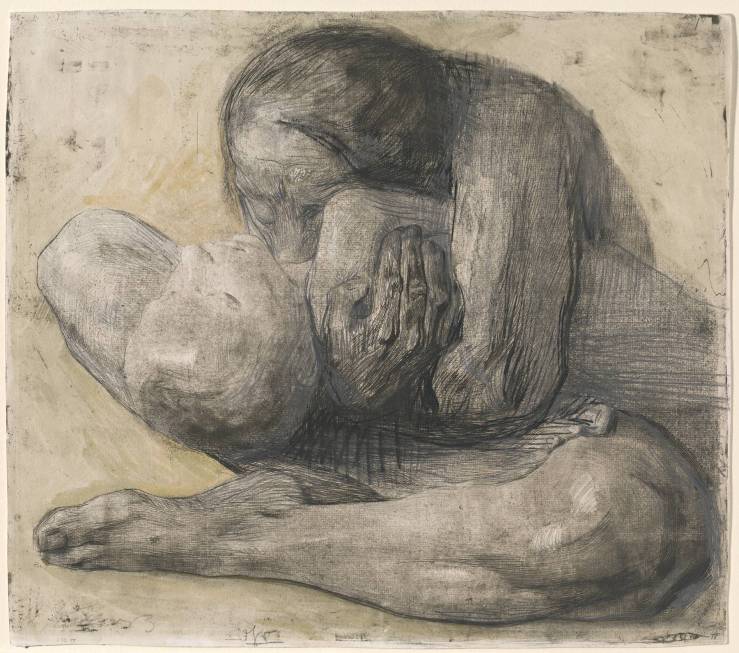
She worked without reference to the fiery proto-Cubism of those years, the representational, classical past as dead as the Second Reich itself, dead, dead!—as dead as the Tsarist officers who’d now sunk beneath their own weedy mucky parade grounds so that the Party of Lenin and Stalin could march across their moldering faces. Since 1912 she had kept a room on Siegmund-shof for her plastic arts. That was where she would create the mourning woman out of stone. Mostly she carved, etched, and painted in that flat on Weissenbürgerstrasse. Those were the years when the figures in other people’s paintings began to go ever flatter, more garish, more distorted, the colors hurtful to her although she liked some of the galloping calligraphic riders in Kandinsky. Grosz’s desperately angry caricatures, the X-ray bitterness of Otto Dix, not to mention abstract constructivism; she didn’t swim with that tide. Käthe Kollwitz kept painting poor people, starving people (white figures in dark fields, dark chalk on brown Ingres paper), raped women, mothers with dying children, mothers with dead children. In the end she depicted mainly herself, her stricken, simian face thinking and grieving. She too was a mother with a dead child.
Vladimir Nabokov’s recipe for eggs (à la Nabocoque, natch)–
Boil water in a saucepan (bubbles mean it is boiling!). Take two eggs (for one person) out of the refrigerator. Hold them under the hot tap water to make them ready for what awaits them.
Place each in a pan, one after the other, and let them slip soundlessly into the (boiling) water. Consult your wristwatch. Stand over them with a spoon preventing them (they are apt to roll) from knocking against the damned side of the pan.
If, however, an egg cracks in the water (now bubbling like mad) and starts to disgorge a cloud of white stuff like a medium in an oldfashioned seance, fish it out and throw it away. Take another and be more careful.
After 200 seconds have passed, or, say, 240 (taking interruptions into account), start scooping the eggs out. Place them, round end up, in two egg cups. With a small spoon tap-tap in a circle and hen pry open the lid of the shell. Have some salt and buttered bread (white) ready. Eat.
Most literary critics agree that fiction cannot be reduced to mere falsehood. Well-crafted protagonists come to life, pornography causes orgasms, and the pretense that life is what we want it to be may conceivably bring about the desired condition. Hence religious parables, socialist realism, Nazi propaganda. And if this story likewise crawls with reactionary supernaturalism, that might be because its author longs to see letters scuttling across ceilings, cautiously beginning to reify themselves into angels. For if they could only do that, then why not us?
At The Honest Ulsterman, Darran Anderson talks with Stephen Crowe about illustrating James Joyce’s Finnegans Wake in his project Wake in Progress. From the interview:
DA: Do you approach the book as a puzzle or a palette? Do you try to make your artwork close to what Joyce might have meant or do you embrace the possibilities of your own interpretations? Is it possible or even desirable to try to work out what Joyce meant?
SC: Clearly Joyce meant to say something – it’s not just a stream of gibberish. So as an illustrator I think I owe it to the text to try to understand as much of it as I can. I try to figure out at least a couple of different ways to interpret every passage, but I certainly don’t exhaust every avenue. There’s a limit to how much information I can cram into the illustrations anyway. On the other hand, I do think that there are portions of the book where it’s not really important to understand it on a semantic level. Joyce was deeply influenced by music in his writing, and I think it’s fine to appreciate some of the book quite passively, as if it were music. I would agree that there’s no such thing as “understanding” the book entirely. Partial incomprehensibility is part of its design.
Fascinating story today at The Paris Reviewabout a first edition of Jorge Luis Borges’s early poems stolen—and then returned (perhaps?)—to the National Library of Argentina. Forgeries, facsimiles, and book thefts! The following paragraph points out that Borges himself was once director of the library:
The National Library is as old as Argentina: it was created in 1810, together with the first national government, and its first director was Mariano Moreno, one of the greatest national heroes and the founder of the country’s first newspaper. The library was, at one point, something to be proud of, and Borges’s name is inextricably linked to its history; he was its director for eighteen years, between 1955 and 1973. By then, books were already disappearing from its shelves. When asked whether this was true, he replied, in typical fashion, “I can’t tell whether books are being stolen, because I’m blind.”
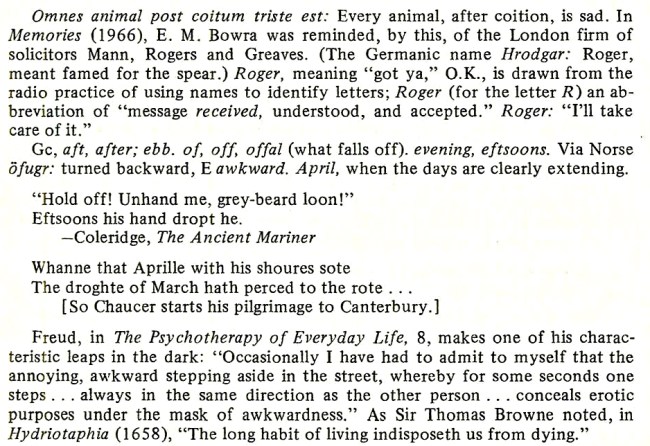
From Joseph T. Shipley’s The Origin of English Words: A Discursive Dictionary of Indo-European Roots. I’ve found the book indispensable for years now—its discursiveness is a lunatic joy to get lost in. Anyway, the above passages extend/unwind from the root ap/apo; I found it while looking up the eytmology of poseur.







 Biblioklept