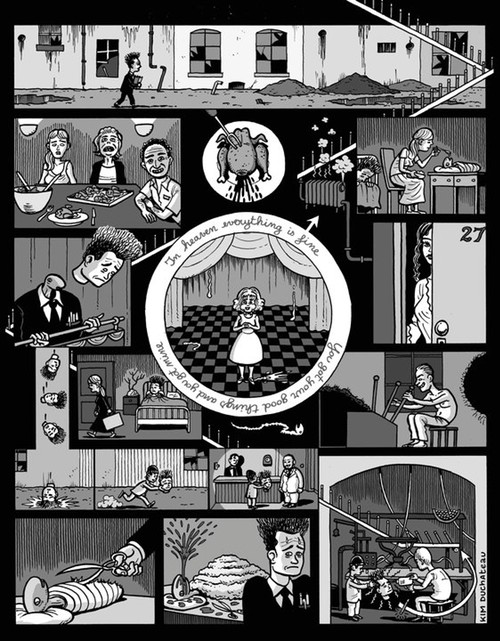
Cartoonist Kim Duchateau distills David Lynch’s Eraserhead down to one page. (Via via via).
And, as a creepy Friday bonus–

Tao Lin’s novel Eeeee Eee Eeee, adapted by librarian Kacper Jarecki and friends. More info here and here. The trailer is sort of like a sweded version of a nonexistent studio version of Eeeee Eee Eeee.
The AV Club interviews director Terry Zwigoff about his movie Crumb (and some other stuff). From the interview–
The idea was to do a documentary on the three Crumb brothers. It was never a documentary about Robert Crumb in my head. I had met Charles and Max and liked them both, and I collected artwork from all three brothers. I even spent a night at their parents’ house, and met his father when he was still alive. So it started taking shape in my mind, and it seemed to me like a good idea for a film if Robert would do it. Not so much because I had access to Robert and he was willing to cooperate, but because I felt comfortable knowing that as his friend, I’d been exposed to facts that other people wouldn’t have known. And there were some things Robert never even thought to tell me about, not because he was trying to withhold information from me, but because he couldn’t tell what would be interesting and what wouldn’t. He couldn’t be objective about it.
Here’s a clip from the movie–

Things that happen in director Nicolas Winding Refn’s new film Valhalla Rising:
A one-eyed warrior (let’s just call him One Eye) gets revenge against the dudes who have enslaved him (they’ve been making him fight chained-to-a-pole gladiator-style for kicks).
(This is, by the way, likely set in some Scandinavian country during the Middle Ages, in case you need some context).
One Eye blood-eagles a dude.
One Eye does not kill the slave boy who brought him food when he was chained up. The boy becomes One Eye’s mouthpiece, because One Eye never talks. The boy names One Eye “One Eye.” In the film’s only moment of humor, the boy says “You need a name. And you do have only one eye.”
For some unclear reason, One Eye and the boy team up with a band of Christian Vikings who are planning to invade the Holy Land. Maybe they join the Christian Vikings because the bastards who enslaved them were pagans? No. I don’t think that’s it.
The Viking ship gets lost in an existential mist. Despair ensues.
They arrive somewhere. Are they in the Holy Land? They’re somewhere.
There’s no food. Some Vikings dissent. People are flipping out. They want to go home. Some Lord of the Flies-type craziness kicks in.
Valhalla Rising rumbles to an intense, surreal climax, which I will not spoil here.
Things that don’t happen in director Nicolas Winding Refn’s new film Valhalla Rising:
Lots of talking.
Any appearance by a woman.
Explicit context or exposition with respect to setting, plot, or character motivation.
Coherent or unproblematic resolution, clear and defined conflict, epiphanies, or other moments of transformation. (Hang on, maybe there is an epiphany, but it’s likely the viewer’s, not a character’s).
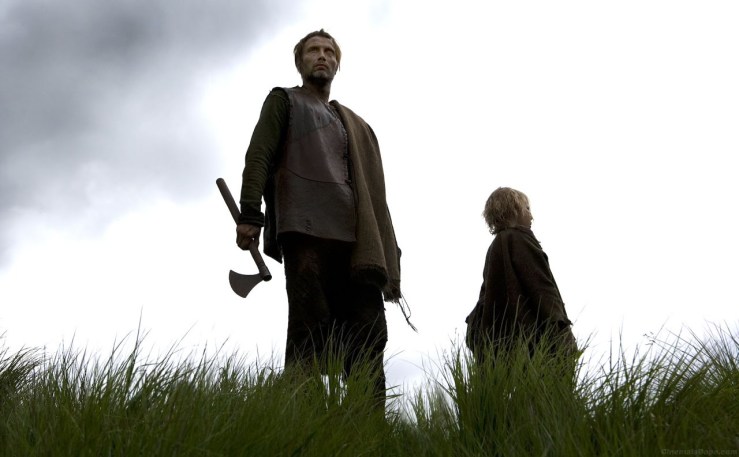
Some more thoughts on Valhalla Rising, in a non-list form:
Valhalla Rising begins with a quotation asserting that before the introduction of monotheism, there’s just man and nature in the world. The film then goes about showing how cruel this relationship is and how the apparently assuaging claims of Christianity have no purchase on the world’s intrinsic, bloody Darwinism. There is no social contract in Valhalla Rising, only brain busting with axes, confounding weather, and a lack of easily available food. If there’s a religious commentary that links the fact that the Norse god Odin only had one eye to One Eye tenuously throwing in his lot with Christian marauders, I can’t find it. The film plays out like a version of King Lear where all sense of family, philosophy, and art has been stripped away, leaving only the cruel heath (and maybe the eye-gouging scene). Valhalla Rising may actually be closer to Ran, Akira Kurosawa’s version of Lear, with its unrelenting silence punctuated by moments of warrior violence. But hang on, Lear is a bad comparison altogether, isn’t it? Maybe better to say Valhalla Rising recalls Werner Herzog’s jungles and madmen, or Terrence Malick’s lonely vistas. But if Refn’s film recalls those greats, it also has a strong whiff of Jason Statham all over it. Not that its violence is cartoonish or that it’s a mere actioner, but it is a violent film that refuses to reflect on its violence, that posits violence not just as a necessity but as normal, as constituent of existence itself. In some ways the film recalls Cormac McCarthy’s novel The Road, only more meandering and aimless. One Eye and the slave boy are not “carrying the fire.”
Valhalla Rising was shot in the gorgeous highlands of Scotland, and director of photography Morten Soborg evokes expressionist depth in this landscape, balancing the natural deep browns, verdant greens, and grays of the setting with rich blues and bursts of fireblood red. Peter Peter and Peter Kyed’s soundtrack sounds at times like an arty death metal band’s extended druggy tune up, but when it starts chugging, it really works. Mads Mikkelsen’s silent performance as One Eye will likely strike a cultish cord for those who like their badassery served up cold and mean. It’s more nuanced than it has a right to be in a film that is, like the aforementioned Herzog and Malick’s films (as well as maybe Wong Kar Wai), more of a mood than a narrative. Valhalla Rising is not a film for everyone; those who want the swelling moral clarity of say, Braveheart, need not apply, and even though I’ve name dropped Herzog and Malick in this review, Refn’s film is something else. Whatever it is, I enjoyed it very much.
Before I get into the details of Aleksandr Sokurov’s 2002 film Russian Ark, I implore you to stop reading my review and simply get a hold of the film and watch it. It’s a marvelous, rewarding, dreamy experience. That’s not a very convincing argument of course, but I think that the best way to see this gorgeous film is with no preconceptions, with as little information as possible–not because there are plot twists that a review might give away, but rather because the pleasure of Russian Ark is its narrative immediacy–and any review will seek to mediate that immediacy. So I’ve hemmed and hawed. If you need further convincing, read on.
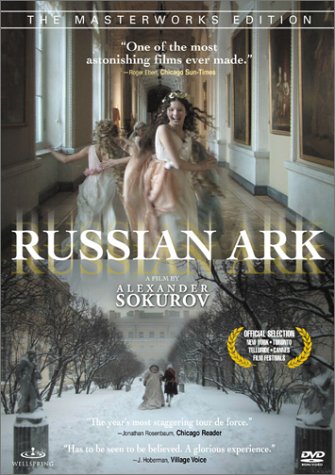
It’s hard to know where to begin, so I’ll let Don DeLillo do it for me. In his latest novella, Point Omega, his filmmaker protagonist describes it as an ideal for the kind of truth he’d like to capture in one of his own films:
There’s a Russian film, feature film, Russian Ark, Aleksandr Sokurov. A single extended shot, about a thousand actors and extras, three orchestras, history, fantasy, crowd scenes, ballroom scenes and then an hour into the movie a waiter drops a napkin, no cut, can’t cut, camera flying down hallways and around corners. Ninety-nine minutes.
That was enough for me to get hold of Russian Ark and watch it, or rather experience it (I think experience is the best verb here, corny as that sounds), but perhaps, gentle reader, you’d like some plot details. Let’s give it a shot. The film begins in darkness, with its unnamed/unseen protagonist describing the vague details of his last memory, a violent accident that he remembers little about. But before we go on, I should point out a few things: this protagonist is unseen because he is essentially the camera; his movement propels the film–is the film–and although he is his own character, he is also a surrogate for the audience. His first-person experience dictates the film, is the film, and although he has ghostly access to the characters who float through the gorgeous halls of the State Hermitage in St. Petersburg, they cannot see or hear him. There is one character who can see him however, an unnamed black-clad 19th-century French aristocrat who the protagonist comes to call “the European.” Neither the European or the protagonist understand why they are in the Hermitage or how they got there; the European is even more perplexed to find that he now speaks perfect Russian. Unlike the protagonist, the European can interact with the denizens of the Hermitage, and interact he does, by turns offending, menacing, or charming (or at least attempting to charm) the characters that the pair encounters as they drift through the ballrooms, galleries, and courtyards of this beautiful palace. Initially, the European repeatedly insults Russian culture, which he believes a pale imitation of European aesthetics. He even protests that one of the fine orchestras that they stumble upon must be manned with Italian players, as Russian musicians simply couldn’t be so skilled. But as they wander the halls, the European slowly succumbs to the rich beauty and opulence of the Hermitage; although he never states it outright, he relents his prejudice against Russian culture, and perhaps even learns a new way of seeing beauty.

And who wouldn’t be moved by the beauty here? Russian Ark functions in some way as a guided tour of the Hermitage, although that term, “guided tour” implies a stuffiness that’s antithetical to the looseness of this film. The camera lingers on a painting or statue; the protagonist offers his thoughts, the European his; perhaps an erstwhile docent steps in to explicate a point of technique or symbolism. It’s wonderful. In one stunning moment (scene would not be the right word for this movie which is of course one long scene), the European argues violently with a boy over a painting of the apostles Peter and Paul. The boy admits to knowing nothing of the scriptures, yet he’s deeply moved by the wisdom and promise that the painting connotes; the European cannot understand how the painting’s aura alone can transmit its meaning to the ignorant lad. The scene begins at 6:38 in the clip below:
The European’s clash with the boy echoes the larger (and yet subtle) clashes of the film, as characters, artworks, and musical styles of different epochs float into or burst out of or parade around in the grand rooms of the Hermitage. There’s Pushkin, Peter the Great, Catherine the Great, Anastasia. There’s an incredible scene where Tsar Nicholas I is offered an apology by the Shah of Iran for the death of an ambassador; there’s a wonderful ballroom dance that moves the European to great joy. In one of the film’s pockets of horror, a layman labors in a strange utility room building his coffin; it is the siege of Leningrad in WWII where over a million people died at the hands of the Nazis. The European, of course, has no knowledge of these events, being after his time, and the disjunction between the protagonist’s contemporary perspective of history and his own provides for a fascinating, if not wholly fleshed out, conflict.
Indeed, one of the greatest pleasures of Russian Ark is its refusal to narrativize or philosophize history beyond a first-person perspective walk through the halls of the Hermitage. The movie erupts into little pockets of exuberant joy or strange, desperate violence; sometimes the protagonist is drawn in, but just as often he’s repelled, and looks for another avenue, like a dreamer willing his own escape. To call the movie dream-like would be an understatement, and like a dream, Russian Ark‘s divergent set pieces overwhelm the senses in their rich splendor. Like the protagonist and the European, I found myself repeatedly entranced by a painting or a concert or a dance or a strange little moment, only to be interrupted by another character intruding into the frame, bearing new information, discordant news that disrupts the dream logic (while paradoxically ushering in a new set piece). Russian Ark distracts its audience, sending them inward; in contemplation, the viewer loses the thread–but is there a thread? Is real life a narrative? Are dreams even narratives? Some of my favorite moments of the film happened when my anxiety at having been distracted by some gorgeous detail was confirmed by the protagonist, who all of a sudden has lost the European, or who is startled by the bustling arrival of new people. But of course, in this film, the viewer is the protagonist.
But writing about Russian Ark is no good, not really. You have to just see it (but I already said that, right?) To quote again from DeLillo’s Point Omega, “The true life is not reducible to words spoken or written, not by anyone, ever.” Sokurov’s film collapses history and art and beauty into a beautiful, edifying, sometimes terrifying dream, a dream that, in its adherence to first-person perspective, is a marvelous approximation of true life. Highly recommended.
Is there anything worse than a beloved book sporting a movie tie-in cover? (Okay. Maybe Oprah’s blazon is worse).

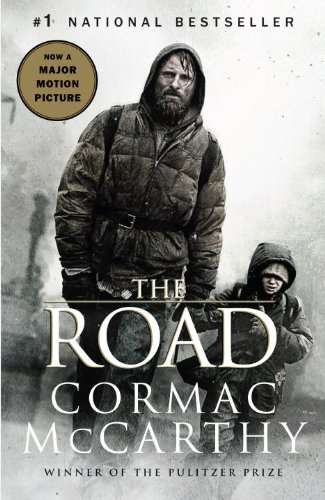
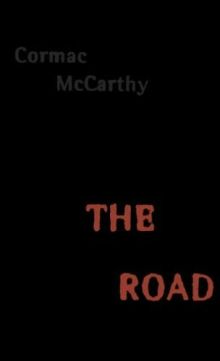
It’s not like the original cover was that great, or that the movie was that bad, but the whole enterprise of slapping grim Viggo Mortensen all over Cormac McCarthy’s The Road doesn’t seem to make much sense (maybe they didn’t realize that the film was going to flop and hoped that it would re-energize book sales). It seems like a slight to any reader new to the book. The austere original cover omits all imagery and thus places McCarthy’s language front and center. Movie tie-ins tend to plaster major Hollywood actors all over the cover, making it difficult for readers to re-frame or re-image the characters that those actors are playing–it’s an egregious intrusion between the writer’s text and the reader. It disrupts visualization. It also tends to look tacky, even when it’s “classy.” Take for example this cover for Richard Yates’s novel Revolutionary Road —
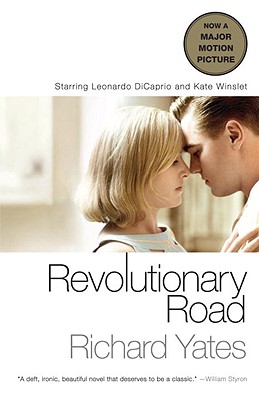 I’ve never read the novel, although I’ve often heard it referred to as an under-read or “lost” classic (the film promos made it look dreadfully boring, but there is probably nothing more unfair than judging a book by its movie). Spying its spine, I picked the book up the other day at the bookstore but could not even flick through it. All I could see was Leo and Kate. Then there’s that Big Gold Sticker procliaimng the work is “Now A Major Motion Picture.” The statement, emboldened in all-caps seems set apart in its little golden sphere, but oddly enough there’s a clause that must logically follow it — “Starring Leonardo DiCaprio and Kate Winslet.” The aesthetic logic of the cover though seems to suggest, however ludicrous, that DiCaprio and Winslet actually star in the book. Were I to attempt to read this edition of the book my poor imagination, weakened by years of watery domestic beer and bad television, would not be able to surmount the challenge posed by the cover. Each time I dipped into its pages, surely Yates’s prose, no matter how descriptive or visceral or imagistic, must fall to the glamor of Leo and Kate.
Maybe it’s just me though–I can remember having this problem even in childhood, absolutely hating to read any book that proffered a photograph of a person, especially an actor, masquerading as a character that my imagination was supposed to bring to life. For some reason paintings and other stylized images didn’t –and don’t — offend me in this way.
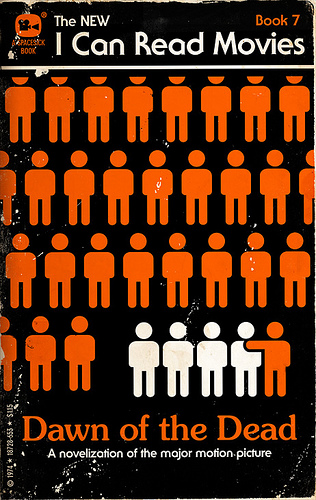
I suppose that movie tie-in covers help sell books and, ultimately, that’s a good thing, but I can’t think of a single one I’ve ever seen that’s aesthetically pleasing. I’m reminded now of Spacesick’s “I Can Read Movies” Series, which achieves the opposite, turning movies into witty, wonderful book covers. Observe:


One of Biblioklept’s favorite weirdos, China Miéville takes on a perceived overabundance of apocalypse movies in his article “The End, The End, The End, Etcetera” published in McSweeney’s #33, aka The Panaroma, aka the giant-assed newspaper issue (here’s a quick review: Jeesy Creezy the thing is massive. It’s like a bizarre aesthetic tchtochke that just happens to be overstuffed with all kinds of great writers writing on all kinds of great stuff. I’ve been trying to digest it on Sundays after breakfast with a few coffees but it’s too big. It’s really too much, and it’s also the sort of document that should tell McSweeney’s-haters to fuck off, or at least reveal them as kinda mean-spirited. It’s like a strange, thorough dream, where Stephen King writes your sports section and William Vollman does in-depth national reporting and Chris Ware handles the comics page. Hang on–that’s probably not a legit review. Anyway).
So Miéville basically tells Hollywood to give it a rest with all the apocalypse movies, saying that it’s not that he doesn’t love them, it’s just that there’s such a surplus as of late. “Hollywood has studied at porn’s knee,” he writes, arguing that end-of-the-world flicks like Armegeddon, The Day After Tomorrow, 2012, Wall-E, 9, The Book of Eli and Deep Impact are “sexual fantasies . . . These apocalyptes are clearly scratching various itches.” Miéville dubs the trend in disaster flicks “bukkakalypse,” arguing that these films are “obsessed not only with the world-drenching spurt itself, but with the Face of the Earth wet with its effects, stoically putting up with the soaking.” Charming. +100 internets to any soul daring enough to google “bukkakalypse.”
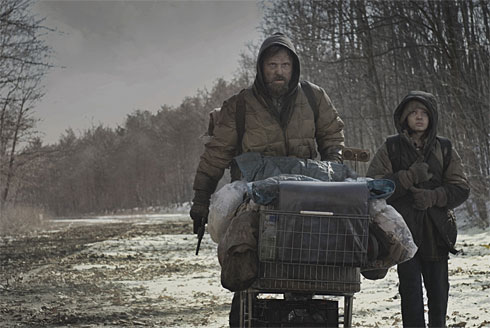
Miéville focuses the thrust of his article on John Hillcoat’s film adaptation of Cormac McCarthy’s novel The Road. His shorthand review kinda sorta captures my own ambivalence about the film: “Is The Road a good film? Sure. Maybe. Whatever. It depends on what you mean by ‘good.'” Miéville suggests that, “For all its portent, The Road displays a preemptive nostalgia perhaps even more pronounced than in its pulpier cousins.” Citing the father and the boy’s use of a consumerist emblem, the shopping cart, to move on and “carry the fire,” Miéville goes on to argue that,
The film, then, is structured around a punning triptych. There’s that good, lost consumption early on [the loss of a consumerist world]. Then, in the absence of commodity, there’s the terrible, Hobbesian predatory consumption of cannibalism, relentlessly stressed as an ultimate evil, rather than the relatively everyday sordidness it would almost certainly become. And refuse to eat each other? What then? Then the final iteration of the term. The father at last doubles up, coughing bronchially, and hawks up blood. In that shopless nightmare, what else is afflicting him but consumption.
Puns! Okay. As a committed Marxist or materialist (or whatever he is), of course Miéville’s gonna read The Road as an allegory of apocalypse as loss of consumerist possibility (he reads the whole Coca-Cola-drinking episode as a version of lost sacrament). Fair analysis, I guess–not one I particularly buy, but without getting into a whole ball of wax over the intentional fallacy and whatnot, I think that Miéville’s criticism that the film (and book) doesn’t recognize the Darwinian endgame of “Hobbesian predatory consumption” as “the relatively everyday sordidness it would almost certainly become” kinda sorta misses the whole point of the narrative. In my own review of the book, I argued that McCarthy’s refusal to give into the infanticide that the novel’s schema overwhelmingly predicated was hard to swallow (“cop out,” I believe, was my term), but it also seems to me that the moral impetus of the novel involves a refusal of cannibalism, an idea that to survive as a human is more than just to survive as a body. But back to film.
I didn’t particularly care for Hillcoat’s version of The Road, even though I wanted to, even though the actors were great, even though it looked great, etc. I don’t know what I didn’t like about it (okay, I thought Nick Cave’s score was both awful and intrusive, but that seems minor here). It just seemed thoroughly unnecessary and ultimately unfun. Miéville again, this time on an end-of-the-world film I can’t help but love:
The “hope” at the end of Mad Max: Beyond the Thunderdome is that the lost tribes have managed to turn on a few lights in Sydney. Such hankering for drab normality doesn’t have to be particularly convincing to do its rhetorical job. Just as well, really, because seriously? After all the splendidly coiffed and colorful shenanigans of Tina Turner’s Bartertown, is living in a partially revived Bondi really an improvement? Couldn’t we take everything in a different direction altogether? Do something new? The aspirational Good Futures of these Bad Futures are always their pasts–our present.
Although Miéville gives The Road the credit it deserves for being one of the rare apocalypse flicks that “evades this pre-post-facto nostalgia,” he also reiterates my own criticism: it’s just not that fun. And the end of the world should be fun. Miéville doesn’t mention films like Zombieland, a forgettable but enjoyable farce that posits apocalypse as freewheelin’ opportunity, or the self-aware (but not too-self-aware) pastiche Doomsday, a film that fuses every hoary apocalypse trope into 90 minutes of escapist, ass-kicking, thoroughly nonsensical fun. Neither film aspires to great art (unlike Hillcoat’s take on The Road), nor do these films aim for the catharsis-via-annihilation of blockbuster fare like Armegeddon. They’re just good fun, which is all I really want from the end of the world.
The AV Club’s fun little inventory of literary works that should never be adapted to film again got us to thinking about that age old question — book vs. film. Common wisdom holds that “the book is always better than the film,” with any number of examples as evidence. Some of the works cited on the AV Club’s list are novels that can’t really be translated to film, at least not in philosophical essence (Moby-Dick, for example, and Nabokov’s Lolita, a film that for reasons social and legal, can never be made properly).
Our own observation, or rule of thumb, is that, while canonical “high” literature rarely makes for masterpiece filmmaking, genre fare–done right–can make classic films. In Francis Ford Coppola’s hands, Mario Puzo’s airport bookstore pickup The Godfather became two of the greatest films of all time. Look at what Stephen Spielberg did for Peter Benchley’s beach read Jaws, or what Kubrick did for Stephen King’s pulp horror The Shining. In more recent times, Alfonso Cuarón turned P.D. James’s capable thriller Children of Men into cinematic gold, but, tellingly, stumbled in adapting the Charles Dickens classic Great Expectations. Terrence Malick turned James Jones’s war novel The Thin Red Line into cinematic art and Martin Scorsese spun Goodfellas from Nicholas Pileggi’s Wiseguy–hardly Shakespeare. Danny Boyle has made a career of turning lesser works by writers like Alex Garland and Irvine Welsh into fantastic films.
Very few films present a tough choice, really–we’re still not sure if the Coens’ adaptation of Cormac McCarthy’s No Country for Old Men is better than the book, but it might be. Gary Sinise’s measured take on John Steinbeck’s Of Mice and Men gets just about everything right. Heck, Harold Bloom has even argued quite publicly that John Huston’s version of The Grapes of Wrath is superior to Steinbeck’s. We’re not sure about that one either. Suffice to say that they’re different; that watching a film is not the same as reading a book, nor should it be. We close by saying that we’d love to see Chris Adrian’s The Children’s Hospital adapted to film, preferably by someone awesome like David Lynch or Cuarón, and that, as Sam Peckinpah is long dead, no one should try to adapt Cormac McCarthy’s Blood Meridian.
What if David Lynch had directed Return of the Jedi? Oh the possibilities… YouTube user sciezata77 (I’d love to credit her/his real name) has made a really cool little film using only an iPhone and Lynch’s original audio, detailing Lynch’s meeting with George Lucas. Best line: “We went to a restaurant . . . not that I don’t like salad, but that’s all they had, was salad.”

So I finally got around to watching Jane Campion’s Bright Star last night, a film that quietly studies the final years of Romantic poet John Keats and his relationship with Fanny Brawne. When Keats moves next door to the Brawnes, eldest daughter Fanny, a talented seamstress and flighty flirt, soon becomes intrigued by the poet. Keats, with his love for beauty and truth, represents a world of greater depth than the wits and dandies who usually attempt to court Brawne. Their relationship is, of course, doomed from the outset. Perpetually broke Keats doesn’t have the moolah or means to properly engage Brawne in marriage, but that doesn’t stop the pair from undertaking a furtive, pensive love affair, carried out in long walks on the heath and passionate letters. Oh, and Keats gets sick and dies at 25. That shouldn’t be a spoiler if you’ve studied your Romantics properly, now should it?
Both Abbie Cornish who plays Brawne and Ben Whishaw who plays Keats are excellent in their understatement and reserve, but the standout turn in the movie comes from actor Paul Schneider (from NBC’s Parks & Recreation) who plays Keats’s bankrolling friend Charles Armitage Brown. Brown is a lesser poet whose love and envy of Keats leads him to vex Brawne and Keats’s love at every turn, plaguing them with doubt, and that enemy of Romance, Reason. Schneider invests his character with a boorish charm that never veers into the rote tropes that afflict modern romance film. It’s emblematic of the Campion’s film in a way: Bright Star has every opportunity to devolve into a mundane exercise in doomed romance or a stuffy period piece, but under Campion’s delicate care it manages to match the depth of its subject matter.
Campion wrote the screenplay, presumably using letters from the principals as her primary source. She honors her viewers’ intelligence — far too rare these days — by never cobbling her plot together with easy exposition or forced narrative developments, and it’s that sense of history that lends the film authenticity. Cornish’s Brawne is a protagonist whose personality transformations read as real, and Whishaw’s Keats is never a cartoonish mystic or a moody caricature, but a fully-drawn human. Campion also has the good judgment to let her cinematography convey her story, letting gorgeous shots of the English countryside and cloistered chambers alike convey the mood and rhythm of her story. At times, Bright Star‘s beautiful camerawork recalls Terrence Malick, another director who allows film to “happen” to the viewer as an evocative experience rather than a spoon-feeding. Campion also shows considerable restraint with the film’s wonderful score, never allowing it to color a scene unduly when her actors can do a great job on their own. Bright Star avoids all of the pitfalls that might afflict a period piece, and does a far better job handling the subject of Romantic poetry than a movie has any right to. The film is hardly for everyone (sorry guys, no Jason Statham), but it’s very, very good. Recommended.
The film adaptations of David Peace‘s Red Riding quartet make their American debut this weekend. The films look pretty cool — kinda like Zodiac. The screen adaptations drop the 1977 segment of Peace’s original quartet, opting instead for the trilogy treatment. You can read Manohla Dargis’s detailed review for The New York Times here and Keith Phipps favorable review at the AV Club here. Trailer:

Nanni Balestrini’s novella Sandokan, new in English translation from Melville House, tells the story of the rise of the Camorra crime syndicate in the small, poverty-stricken cities around Naples. Balestrini’s unnamed narrator occupies a fascinating insider-outsider perspective: one one hand, he, unlike many of his peers, does not join the gang, or “clan,” as its called–in fact, their behavior repulses him. On the other hand, he’s a native of the small town where Francesco Schiavone (aka Sandokan), Antonio Bardellino, and their henchman rule mercilessly, an eye-witness to the brutality and inhumanity of organized crime. The narrator is a sensitive young man who delineates clearly how the crime cartel was able to achieve such economic prosperity and power in the 70s, 80s, and 90s, detailing the various rackets the clan imposed upon the town, like stealing elections, peddling drugs, and manipulating the agribusiness that is the main source of income for average Neapolitan peasants. The narrator also explores why these small towns fall so easily into the terror of organized crime. The main reason: boredom stemming from little or nothing to do.
Balestrini’s narrator’s description of the Camorra is systematic, detailing the awful history and brutal practices of the syndicate in spare, concrete terms. His explications of the clan’s violence is not so much thrilling as it is ugly, as the narrator always shows how “normal people” (his words) are cheated, killed, or otherwise harmed by the Camorra. The narrator’s tone is often journalistic but never clinical; he always shows what’s at stake for the “normal people,” how they are affected by these crimes. At times the narrator is wryly funny, a tone that results in large part from his observation that the townspeople, the people he grew up around, begin to normalize the violence. It becomes part of their daily lives and affects them so directly that it becomes casual, and the sensitive narrator is one of only a few not to bow to it, ignore it, or take part in it–yet the violence and crime is so overwhelming that to live with it is to live with absurdity. Balestrini employs a punctuation-free rhetorical style in Sandokan that captures the breathless energy and frustration of the narrator. While many readers might balk at the lack of commas, periods, or semi-colons, I found the technique quite liberating. It enhances the immediacy of the narrator’s voice, the rushed sense of importance to his tale. It also promotes sustained readings of the text–I read most of Sandokan in three enthralled sittings.
Sandokan has its cinematic twin in the 2008 film Gomorra, directed by Matteo Garrone. The film, like the book, illustrates the affect that crime has on a range of “normal people,” mostly occupants of a housing project outside of Naples. As in Sandokan, the ordinary citizens find that they have no choice but to choose between sides as an absurd, petty gang war ravages their already decimated landscape. Where Balestrini’s punctuation-free rhetoric allows readers closer access to his narrator’s pathos-driven story, Garrone lets his camera wander freely over the grim landscape without ever imposing any clear narrative structure. It is not until the film’s final third that the five disparate stories he tells coalesce, and even then, it remains unclear who is on whose side. What is clear is that the violence and crime is quickly stealing–and killing–another generation.
In an age where violence is sensationalized and glamorized, particularly in gangster films and TV shows (do I really need to list them?), Sandokan and Gomorra both lay bare the Darwinian cost of crime. In both narratives, the violence is mundane and inescapable, meaningless yet awful, and very, very dark. Neither narrative is didactic in the least–or even hopeful, for that matter–but their is an implicit suggestion that if only there were some alternative to the Camorra–libraries, social clubs, movie houses–there might be another prospect for the young people in this area.
I highly recommend both Sandokan and Gomorra. As an end note, I’d love to see more of Nanni Balestrini’s work come into English translation, perhaps via Antony Shugaar and Melville House, who’ve done a lovely job here.
So, this is Biblioklept’s 500th post [pauses for applause].
Thank you, thank you. To mark the special occasion, we’ve artfully and scientifically compiled a list of the best stuff of the aughties (or 2000s, or whatever you want to call this decade that’s ending so soon). We know the year’s not over yet, and we readily admit that our list is incomplete: we didn’t read every book published in the decade, listen to every record, watch every film, etc. So, feel free to drop a line and let us know who we forgot (or, perhaps, snubbed).
Here, in no particular order, is the best of the past decade:
Roberto Bolaño’s 2666, Children of Men, The Fiery Furnaces, The Wire, Kill Bill, Sen to Chihiro no Kamikushi (Spirited Away), The Believer, Peter Jackson’s The Lord of the Rings trilogy, Beyoncé’s “Single Ladies” (and its marvelous video), David Foster Wallaces’s essays in Consider the Lobster, Denis Johnson’s Tree of Smoke, Animal Collective, Barack Obama, Terrence Malick’s The New World, Mad Men, Deadwood, Dave Chappelle, Curb Your Enthusiasm, Mitch Hedberg, R. Kelly, YouTube, Drag City Records, Cormac McCarthy’s The Road, Nathan Rabin’s “My Year of Flops,”

Chris Adrian’s The Children’s Hospital, Extras, Harry Potter on Extras, Dave Eggers’s A Heartbreaking Work of Staggering Genius, Missy Elliott’s “Get Ur Freak On,” Wong Kar-wai’s In the Mood for Love, Pixar movies–especially the latest three: WALL-E, Up, and Ratatouille, McSweeney’s #13 (the Chris Ware Issue), Jimmy Corrigan, the Smartest Kid on Earth, that time the Shins were on Gilmore Girls, the first six episodes of The OC, Arrested Development, Nintendo Wii, Andre 3000’s “Hey Ya!,” The Office, Will Ferrell, Bob Dylan’s Theme Time Radio Hour, Picador Books, Donnie Darko,

Veronica Mars, The Venture Brothers, Home Movies, the third Harry Potter movie, Wikipedia, Bob Dylan’s Chronicles, Jonathan Lethem’s The Fortress of Solitude, DFW’s Oblivion, especially “The Suffering Channel,” Wallace’s 2005 Kenyon commencement address, Wonder Showzen, Toni Morrison’s A Mercy, the totally goofy but totally fun troubadour sequence from Gilmore Girls with Yo La Tengo, Thurston, Kim, and daughter Coco Haley, and Sparks jamming, OutKast’s Stankonia, Pan’s Labyrinth, The Devil’s Backbone, The Orphanage, Cat Power’s “Willie Deadwilder,”Flight of the Conchords, Girl Talk’s Night Ripper, The Daily Show with John Stewart, The Colbert Report,

Andy Samberg’s Digital Shorts, Autotune the News, Tim Tebow, Panda Bear’s Person Pitch, Nels Cline’s guitar solo in “Impossible Germany,” Judd Apatow, Be Kind Rewind, Eternal Sunshine of the Spotless Mind, Thrill Jockey Records, I Heart Huckabees, Chris Bachelder’s U.S.!, David Lynch’s INLAND EMPIRE, Fennesz’s Endless Summer, Gmail, the Coens’ No Country for Old Men, MF Doom (all iterations), Broken Social Scene’s You Forgot It in People, Satrapi’s Persepolis, UGK’s “International Player’s Anthem,” Bob Dylan’s “Things Have Changed,” Bonnie “Prince” Billy,
The Silver Jews’ Tanglewood Numbers, lolcatz, Once, Lynch’s Mulholland Drive, the Coens’ O Brother, Where Art Thou?, web two point oh, 30 Rock, Belle & Sebastian’s “Stay Loose,” It’s Always Sunny in Philadelphia, Philip Pullman’s The Amber Spyglass, Werner Herzog’s Grizzly Man, WordPress, Jim O’Rourke’s Insignificance, the first season of Battlestar Galactica, Superbad, half a dozen or so short stories by Wells Tower, David Cross’s Shut Up, You Fucking Baby!, Drunk History, the action sequence at the end of Tarantino’s Death Proof (and especially the joyous, headcrushing final shot), Slavoj Žižek’s Violence, The Royal Tennenbaums, the first 20 minutes of Gangs of New York,

Firefox, the increasing and continuing availability of English translations of authors like Roberto Bolaño and W.G. Sebald, Bill Murray, Margot at the Wedding, Rachel Getting Married, Top Chef, The Dirty Projector’s Bitte Orca, Battles’ “Atlas,” Revenge of the Sith, Sarah Vowell, Art Spiegelman’s In the Shadow of No Towers, Christoph Waltz’s bravura performance in Inglourious Basterds, the surreal animations of Carson Mell, Margaret Atwood’s Oryx and Crake, Tina Fey’s impression of Sarah Palin, David Mazzucchelli’s Asterios Polyp, Neko Case’s “Star Witness,” Jason Statham, The Pirate Bay, HDTV, Charles Burns’s Black Hole, &c . . .
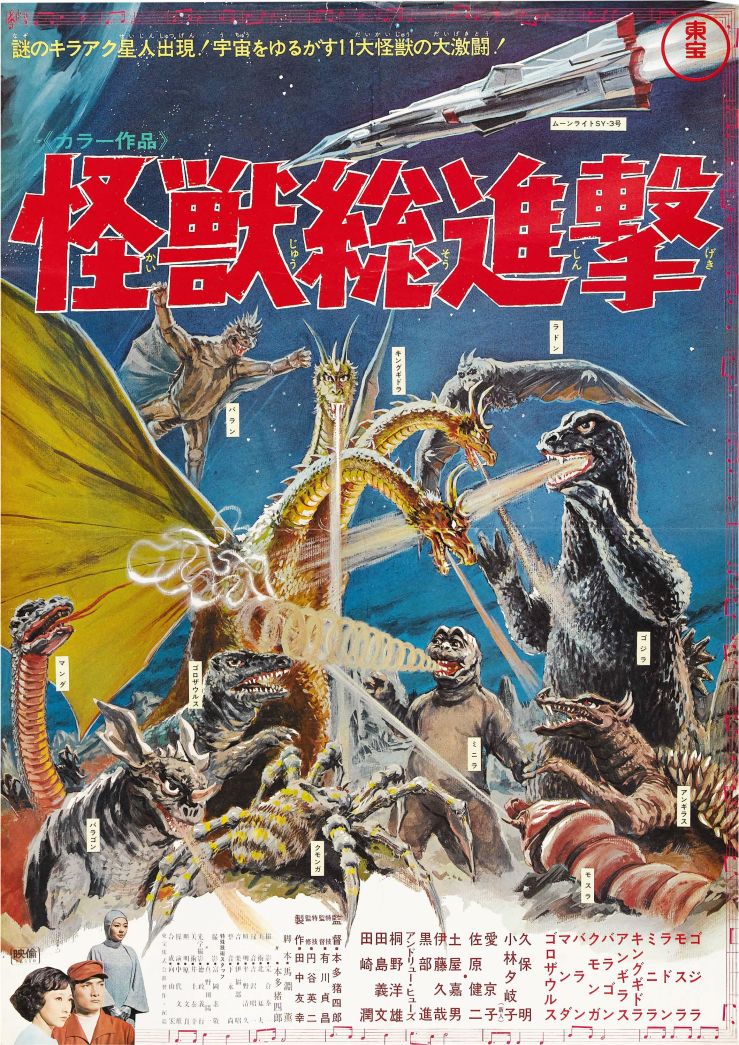
Wonderfully weird horror movie posters via Wrong Side of the Art‘s fantastic database.


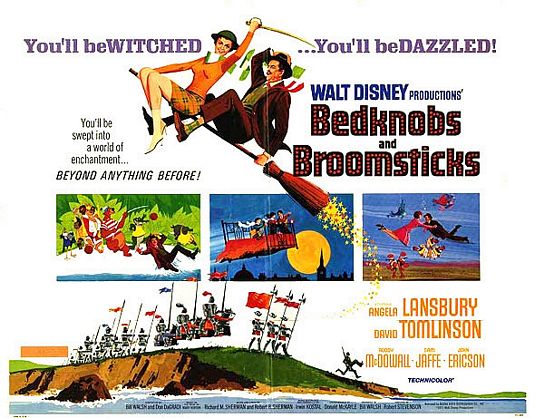
We’ve always felt that Bedknobs and Broomsticks is one of Disney’s most unfairly shunned films. This 1971 psychedelic classic combines live action with animation to tell the story of three young children billeted out during the blitz bombings of London in WWII (shades of Narnia). They’re sent to stay with Miss Price (Angela Landsbury), an amateur witch who’s none-too-pleased to take them in. They discover her (very amateurish) witchery, and blackmail her into bewitching a bed into a kind of magical transport. They set off to London, where they hook up with Professor Emelius Brown (David Tomlinson), a conman running a fake-wizarding school with a stolen spell book. The fivesome take off on a magical journey to find the other half of a spell, Substitutiary Locomotion, that Miss Price needs to make inanimate objects come alive (shades of “The Sorcerer’s Apprentice”). Their quest takes them to a number of strange places, including a lovely under-the-sea journey:
–and a soccer match with some animals:
The whole shebang climaxes (as you would expect) with a battle against Nazis:
Fun, fun, fun. An ersatz family on a magical quest, cheap, addictive songs, trippy animation, telekinesis–what’s not to love? And who can resist the metaphorical implications of a bed as a site of magical adventure? We watched this on VHS about a million times growing up. It’s far-superior to Mary Poppins, and something of a proto-Potter take on magic (okay, maybe that’s a stretch). In any case, it’s a fun family film for Halloween, and perhaps one that too-often goes overlooked. Highly recommended.
We knew it. Reading Kafka’s The Metamorphosis and watching David Lynch’s Blue Velvet at such a young, tender age, didn’t screw us up for nothing. According to a joint study to be published this month in the journal Psychological Science, researchers Proulx and Heine have linked engaging in non-linear, non-traditional narratives with improved ability to recognize patterns. Proulx: “People feel uncomfortable when their expected associations are violated, and that creates an unconscious desire to make sense of their surroundings. That feeling of discomfort may come from a surreal story, or from contemplating their own contradictory behaviors, but either way, people want to get rid of it. So they’re motivated to learn new patterns.” Cool.
Full press release after the jump, or, just try to make sense of this clip from one of our favorite Lynch films, INLAND EMPIRE
Continue reading “Reading Kafka and Watching Lynch Will Make You Smarter”
I think I did a similar post two years ago. I teach, I gotta go back to school, the fall, the kids, blah, blah, blah. Anyway. I’ll try to get one proper book review out per week. I’ve got seven or eight really choice looking promo copies and galleys stacked up here, including new trade paperback editions of Marilynne Robinson’s Home and Per Petterson’s To Siberia. Vintage also has a really cool original by Patrick Alexander coming out in September; it’s called Marcel Proust’s Search for Lost Time and its subtitle, A Reader’s Guide to The Remembrance of Things Past pretty much sums it up. I’ve read the first 100 pages and it’s really great, and let’s face it, unless some kinda windfall happens where I can just read books all day, I’m never gonna get around to Proust, so, yeah, this’ll have to do. Proper reviews forthcoming, blah, blah, blah. (Even though William Gaddis’s The Recognitions ain’t gettin’ no shorter).
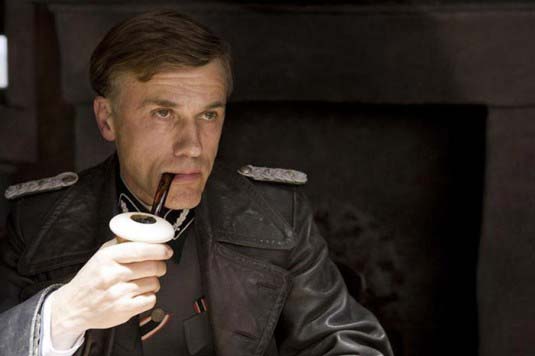
While I’m doing lazy reviews, let me just say that Quentin Tarantino’s latest film, Inglourious Basterds is a glorious bastard of a mixed-up masterpiece. Christoph Waltz steals the show as SS Col. Hans Landa, but the real star, as usual, is Tarantino’s sense of cinema (whatever that means; c’mon, I was upfront, this is lazy reviewing). Plenty of folks have kinda sorta hated on (or outright hated on) this film, but I loved it. A revenge film about cinema posing as a Western faking as a WWII flick. Great stuff.
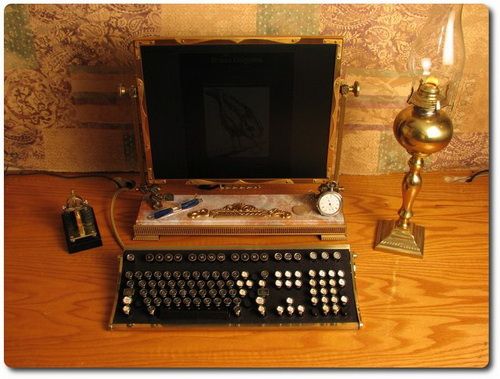
The last time I did one of these hacky “Back To School” posts, I brought up William Gibson for some reason–which gives me a good transition to this excellent steampunk photoset. While Gibson’s novel The Difference Engine (with co-author Bruce Sterling) is often cited as a progenitor of steampunk, many of the images in the set correspond to ideas Gibson put forth in his “Bridge Trilogy” — he envisioned a future of “organic” computers that some of these folks have gone out and made. I’d like one. Jeez, this is really bad writing, but, hey, back to school right. Like that Deftone’s song (yeah, I know the Deftones aren’t cool or hip or whatever, and I’ve never heard one of their albums, but M2 used to play that video all the time when I was in college 10 years ago and I thought it was pretty great).Cheers.
 Biblioklept