2010 was a banner year for the much maligned Detroit duo Insane Clown Posse. They hosted their annual Gathering (with only minimal rock throwing), released their revisionist Western epic, Big Money Rustlas, and even sponsored an inspired toy drive this Christmas. It’s the release of their single “Miracles,” however, that puts them on our “Heroes” list. Pure motherfucking magic. (We wrote about ICP’s problematic place in postmodernity here and here).
Category: Music
Heroes of 2010 — T.I.
What Kind of Songs Did Johnny Cash Love?
“I love songs about horses, railroads, land, judgment day, family, hard times, whiskey, courtship, marriage, adultery, separation, murder, war, prison, rambling, damnation, home, salvation, death, pride, humor, piety, rebellion, patriotism, larceny, determination, tragedy, rowdiness, heartbreak and love. And Mother and God.”
From the liner notes to American Recordings. I read the quote here.
Brian Eno Interviewed
Dick Flash (jeez, what a great name) of Pork Magazine (another great name) interviews mad genius Brian Eno:
Kanye West Halloween Mask
“. . . the horror . . .” (Via).

Odds and Ends
At A Piece of Monologue, Rhys Tranter reviews Simon Critchley’s “philosophical antidote to the self-help manual,” How to Stop Living and Start Worrying. Read our review of Critchley’s The Book of Dead Philosophers here.
MobyLives expands Flavorwire’s post on author photo clichés to include Melville House authors.
Here’s an author photo we love: Harold Bloom wearing big headphones and looking kinda skeptical and very green (the image is by Paul Festa from his film Apparition of the Eternal Church)–

If you still haven’t done your Juggalo Studies homework for this week, read Camille Dodero’s inspired report from this year’s The Gathering (at The Village Voice). And then watch “Miracles” again, because, hey, it only gets better. It still shocks the eyelids.
We love this tumblr (or is it tumblog?)–Anatomy–even if it looks like they aren’t doing much these days. C’mon guys. We need more gifs like this–

Finally, check out Stanford Kay’s series of paintings of books and bookshelves, “Gutenberg Variations.” Like abstract expressionism, only good (via) —

Charles Burns/Krzysztof Penderecki Mash-up
Okay, “mash-up” might not be the best term, but this video is pretty cool. YouTube user songtotube sets cartoonist Charles Burns’s segment from Peur(s) du Noir to a section of Krzysztof Penderecki’s “Polymorphia.” Good creepy fun. Or not.
“The Ludlow Massacre” — Woody Guthrie
Read Howard Zinn on The Ludlow Massacre. Happy Labor Day!
RIP Satoshi Kon
Japanese filmmaker Satoshi Kon died yesterday at the young age of 47, apparently from cancer. Kon’s films included Tokyo Godfathers, Perfect Blue, Millennium Actress, and Paprika, visually stunning and emotionally resonant works that helped to prove that manga was a medium, not a genre. More here. Watch the parade scene from Paprika. Chaotic eye candy.
Rock and Roll Will Save Your Life — Steve Almond
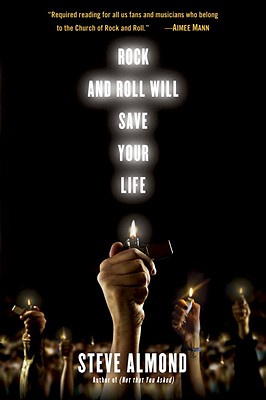
Rock and Roll Will Save Your Life, Steve Almond’s new memoir-via-music-journalism, is far fresher, funnier, and insightful than its dopey name or silly cover will attest. Not that Rock and Roll Will Save Your Life is a wholly terrible name (even presented in cruciform arrangement), or that the unironic waving of lighters in the air is an awfully hokey image–but both seem counter-intuitive to the playful, self-deprecating spirit of Almond’s book. I suppose that the publisher wants to highlight a rock-as-religion motif that kinda sorta exists in the book (further compounded by the pull-quote from Aimee Mann: “Required reading for all us fans and musicians who belong to the Church of Rock and Roll”). Almond’s book is, I suppose, about being religious about music–that is, about being fanatical, crazy, bonkers about music. He calls these people–he is Exhibit #1, of course–Drooling Fanatics, or DFs for short. Drooling Fanatics are
. . . wannabes, geeks, professional worshippers, the sort of guys and dolls who walk around with songs ringing in our ears at all hours, who acquire albums compulsively, who fall in love with one record per week minimum and cannot resist telling other people–people frankly not interested–what they should be listening to and why and forcing homemade compilations into their hands and then calling them to see what they thought of these compilations, in particular the syncopated handclaps on track fourteen.
You might know some Drooling Fanatics; I know many of them. In fact, I have some DF-tendencies myself that I manage to keep in check. It’s this keen sense of self-awareness–geek-awareness–that makes Almond’s memoir so charming and engaging, particularly when he’s recounting interviews and experiences with obscure also-rans like Nil Lara, Bob Schneider, and Joe Henry. Almond’s devotion to these lesser-known artists permeates his text. His Drooling Fanaticism makes a great case for their music and even as he rants that they didn’t gain the fame and superstardom they surely deserve, he also admits that part of the Drooling Fanatic’s love for his or her artist is the special love of knowing something the rest of the world doesn’t know. Not that Almond doesn’t have various run-ins with famous people. An interview with Dave Grohl leads to Almond’s epiphany near the end of the book that being a good father and husband, doing your job to the best of your ability, and engaging fully in your own life is more important than the illusion of fame or “artistic integrity.”
Yes, “epiphany” is right–Almond’s memoir manages to avoid most pitfalls of that genre, but it still follows a recognizable arc, right up to a moment of insight and maturation. Almond punctuates this loosely-chronological framework with lists that claim to take the piss out of rock critics (who notoriously love to make lists) but, are, of course, lists. They don’t add anything to the book and they will certainly date it, and Almond’s entire chapter of lists of rock star kid names is mildly amusing but ultimately distracting. Far more successful are the “Reluctant Exegesis” sections of the book, where Almond interprets the lyrics of swill like Toto’s “Africa” and Air Supply’s “All out of Love” (he finds shades of Heidegger in the latter). These tongue-in-cheek exercises show Almond’s humorous tone as well as his skill as a critic; they also fit neatly into his memoir, contributing to the narrative proper.
Almond’s book is refreshing, both as a memoir and as a form of rock criticism. Music critics and memoirists alike are far-too often self-serious, even solemn about their work. Almond’s memoir reveals that the coolness meant to exude from many modern music critics is really an overt symptom of Drooling Fanaticism, a pose meant to close (or at least reconcile) the gap between artist and reviewer. Almond fills that gap with heartfelt joy, and, best of all, he achieves the real job of any music critic–he makes you want to listen to the stuff he’s writing about for yourself. Recommended.
Rock and Roll Will Save Your Life is available April 13 from Random House.
Let’s Not Be Pretentious
Mónica Maristain interviewing Roberto Bolaño, collected in Roberto Bolaño: The Last Interview:
MM: John Lennon, Lady Di, or Elvis Presley?
RB: The Pogues. Or Suicide. Or Bob Dylan. Well, but let’s not be pretentious: Elvis forever. Elvis and his golden voice, with a sheriff’s badge, driving a Mustang and stuffing himself with pills.
Christmas in the Heart — Bob Dylan
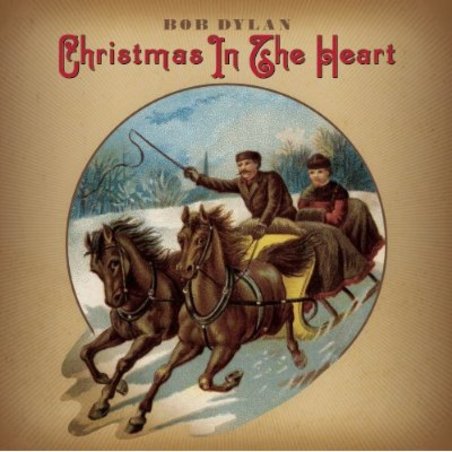
When Bob Dylan’s Christmas in the Heart came out a few months ago, most critics obsessed over the ironic possibilities of a Bob Dylan Christmas album, especially one called Christmas in the Heart, especially one with that cover. Had these critics forgotten that Dylan has always held his cards tight to his chest? That he’s been producing his albums for years now under the kinda-Christmasy pseudonym Jack Frost? That he only does what he really wants to do? For many of these critics, the fact that all proceeds of the album go to Feeding America functioned almost as an excuse for (more) weird behavior from Dylan. All one has to do, of course, is simply listen to the music to find that Christmas in the Heart is a minor masterpiece in the Christmas music genre and a wonderful, strange fit in the Dylan canon.
Dylan tackles fifteen carols and classics in a consistent, old-timey style evocative of Les Paul and Mary Ford and other hybrid Country & Western of the immediate post-WWII era. Dylan’s production is warm and simple, showcasing the talent of his players and backup singers. Opener “Here Comes Santa Claus” sets a lively pace that slows down over the course of the album’s first side, through a lush “Do You Hear What I Hear?” to a version of “I’ll Be Home for Christmas” that wrangles just the right mix of bitter and sweet. Dylan’s version of “Little Drummer Boy” is downright ethereal. The album picks up again with its only barnburner, a fired-up version of Lawrence Welk’s polka, “Must Be Christmas.” Do yourself a favor and enrich your life by watching the marvelous video (seriously watch it, if for nothing else than for Dylan’s surreal wig):
The energy and strange, chaotic madness of “Must Be Christmas” makes for the lively climax of the album, and the video clearly represents Dylan’s vision of Christmas as carnival. Not that it’s all ritual madness, of course. The commercial/spiritual paradox of Christmas comes out in the end, as the record winds down with the secular melancholy of “The Christmas Song” followed by the stirring hymn “O’ Little Town of Bethlehem.” If there’s any concern that Dylan is somehow not entirely earnest in his Christmas music–or too earnest in his irony, perhaps–one simply has to listen to the spirit in his gravelly, aging voice. Christmas in the Heart may be ironic, but that shouldn’t diminish its pleasures at all: it’s a self-conscious, loving irony, far from sneering, and certainly not a trick on the listener. It’s a gift of music, really (as corny as that sounds), one that asks the reader to laugh along with it, but also to feel genuine sentiment in the beauty here. Highly recommended–especially on 180 gram vinyl (the vinyl addition includes the album on CD and a 7″ single of “Must Be Christmas” and a B-side of Bob reading “‘Twas the Night Before Christmas” with backing music by John Fahey).
Best of the Aughties
So, this is Biblioklept’s 500th post [pauses for applause].
Thank you, thank you. To mark the special occasion, we’ve artfully and scientifically compiled a list of the best stuff of the aughties (or 2000s, or whatever you want to call this decade that’s ending so soon). We know the year’s not over yet, and we readily admit that our list is incomplete: we didn’t read every book published in the decade, listen to every record, watch every film, etc. So, feel free to drop a line and let us know who we forgot (or, perhaps, snubbed).
Here, in no particular order, is the best of the past decade:
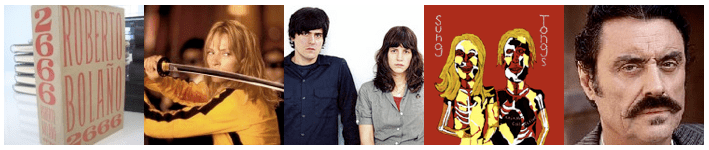
Roberto Bolaño’s 2666, Children of Men, The Fiery Furnaces, The Wire, Kill Bill, Sen to Chihiro no Kamikushi (Spirited Away), The Believer, Peter Jackson’s The Lord of the Rings trilogy, Beyoncé’s “Single Ladies” (and its marvelous video), David Foster Wallaces’s essays in Consider the Lobster, Denis Johnson’s Tree of Smoke, Animal Collective, Barack Obama, Terrence Malick’s The New World, Mad Men, Deadwood, Dave Chappelle, Curb Your Enthusiasm, Mitch Hedberg, R. Kelly, YouTube, Drag City Records, Cormac McCarthy’s The Road, Nathan Rabin’s “My Year of Flops,”

Chris Adrian’s The Children’s Hospital, Extras, Harry Potter on Extras, Dave Eggers’s A Heartbreaking Work of Staggering Genius, Missy Elliott’s “Get Ur Freak On,” Wong Kar-wai’s In the Mood for Love, Pixar movies–especially the latest three: WALL-E, Up, and Ratatouille, McSweeney’s #13 (the Chris Ware Issue), Jimmy Corrigan, the Smartest Kid on Earth, that time the Shins were on Gilmore Girls, the first six episodes of The OC, Arrested Development, Nintendo Wii, Andre 3000’s “Hey Ya!,” The Office, Will Ferrell, Bob Dylan’s Theme Time Radio Hour, Picador Books, Donnie Darko,

Veronica Mars, The Venture Brothers, Home Movies, the third Harry Potter movie, Wikipedia, Bob Dylan’s Chronicles, Jonathan Lethem’s The Fortress of Solitude, DFW’s Oblivion, especially “The Suffering Channel,” Wallace’s 2005 Kenyon commencement address, Wonder Showzen, Toni Morrison’s A Mercy, the totally goofy but totally fun troubadour sequence from Gilmore Girls with Yo La Tengo, Thurston, Kim, and daughter Coco Haley, and Sparks jamming, OutKast’s Stankonia, Pan’s Labyrinth, The Devil’s Backbone, The Orphanage, Cat Power’s “Willie Deadwilder,”Flight of the Conchords, Girl Talk’s Night Ripper, The Daily Show with John Stewart, The Colbert Report,

Andy Samberg’s Digital Shorts, Autotune the News, Tim Tebow, Panda Bear’s Person Pitch, Nels Cline’s guitar solo in “Impossible Germany,” Judd Apatow, Be Kind Rewind, Eternal Sunshine of the Spotless Mind, Thrill Jockey Records, I Heart Huckabees, Chris Bachelder’s U.S.!, David Lynch’s INLAND EMPIRE, Fennesz’s Endless Summer, Gmail, the Coens’ No Country for Old Men, MF Doom (all iterations), Broken Social Scene’s You Forgot It in People, Satrapi’s Persepolis, UGK’s “International Player’s Anthem,” Bob Dylan’s “Things Have Changed,” Bonnie “Prince” Billy,
The Silver Jews’ Tanglewood Numbers, lolcatz, Once, Lynch’s Mulholland Drive, the Coens’ O Brother, Where Art Thou?, web two point oh, 30 Rock, Belle & Sebastian’s “Stay Loose,” It’s Always Sunny in Philadelphia, Philip Pullman’s The Amber Spyglass, Werner Herzog’s Grizzly Man, WordPress, Jim O’Rourke’s Insignificance, the first season of Battlestar Galactica, Superbad, half a dozen or so short stories by Wells Tower, David Cross’s Shut Up, You Fucking Baby!, Drunk History, the action sequence at the end of Tarantino’s Death Proof (and especially the joyous, headcrushing final shot), Slavoj Žižek’s Violence, The Royal Tennenbaums, the first 20 minutes of Gangs of New York,

Firefox, the increasing and continuing availability of English translations of authors like Roberto Bolaño and W.G. Sebald, Bill Murray, Margot at the Wedding, Rachel Getting Married, Top Chef, The Dirty Projector’s Bitte Orca, Battles’ “Atlas,” Revenge of the Sith, Sarah Vowell, Art Spiegelman’s In the Shadow of No Towers, Christoph Waltz’s bravura performance in Inglourious Basterds, the surreal animations of Carson Mell, Margaret Atwood’s Oryx and Crake, Tina Fey’s impression of Sarah Palin, David Mazzucchelli’s Asterios Polyp, Neko Case’s “Star Witness,” Jason Statham, The Pirate Bay, HDTV, Charles Burns’s Black Hole, &c . . .
A Modern Symphony of Music that Is Not Music but Asks that You Remember Music

We are just loving the advance reading copy of David Byrne’s Bicycle Diaries that we got in the mail today. Plenty of quotable material from Byrne’s discursive journeys, but why not share one of our favorite musician’s thoughts on ring tones?
I hear the faint cacophony of many distant cell-phone rings in the train car–snippets of Mozart and hip-hop, old-school ring tones, and pop-song fragments–all emanating out of minuscule phone speakers. All tinkling away here and there. All incredibly poor reproductions of other music. These ring tones are “signs” for “real” music. This is music not meant to be actually listened to as music, but to remind you of and refer to other, real, music. These are audio road signs that proclaim “I am a Mozart person” or, more often, “I can’t even be bothered to select a ring tone.” A modern symphony of music that is not music but asks that you remember music.
The Visitor — Jim O’Rourke
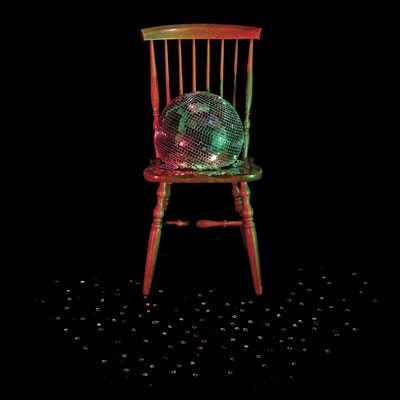
After a minute of deliberate, restrained acoustic guitar phrases accompanied with a few touches of piano, Jim O’Rourke’s The Visitor unfolds suddenly into a warm, rich, full-band arrangement, humming with sinewy slide guitars and clippety-clop percussion. For ten short, gorgeous seconds, O’Rourke declares that, after having made listeners wait for over a decade for a follow up to his brilliant instrumental suite Bad Timing, he won’t delay the magic any longer. After those ten seconds, the music returns to that solitary guitar, but just a minute later, the full band is back again, establishing a rhythm that will permeate the disc.
Space, delay, and restraint have long been some of O’Rourke’s sharpest tools: fans of Bad Timing can attest to the sublime payoff in the record’s final moments, and his work in Gastr del Sol with David Grubbs often challenged audiences’ patience, rewarding them in oblique moments of beauty too strange to name. Not that O’Rourke’s music is wholly strange–in fact, I can’t think of another musician who makes recordings sound so damn good. He has an almost preternatural gift for sonic spaces, whether as a solo artist or as a producer (and auxiliary member) of groups like Stereolab and The High Llamas (or more obscure acts like Wilco and Sonic Youth). In short, we expect that a Jim O’Rourke record (a “proper” one–not one of his (many, many) forays into experimental/improvisational collaboration) will sound really fucking good. In this sense, The Visitor isn’t particularly revelatory: it’s a great-sounding, expertly-played, 38-minute suite of music. It affirms what we know about O’Rourke, and leaves us wanting more.
For a record with such a unified sound and vision, The Visitor is also paradoxically all over the place. It’s one complete track, at least in digital form, and while there are clearly discrete passages, it’s nearly impossible to find where they might distinctly begin or end. Unlike its most obvious predecessor, Bad Timing, an album divided into four tracks, there are no seams showing here. Neither is there any reliance on electronic trickery or production shenanigans (which O’Rourke followers know he could pull off standing on his head). The Visitor is pure musicianship, full of resonant organs, lovely acoustic guitars, and a host of other instruments in the Americana vein that O’Rourke so clearly cherishes (it’s impossible not to hear nods to heroes of his like Van Dyke Parks and John Fahey here, of course). There are amazing moments, like at 11:25 or so when O’Rourke channels Dickey Betts for a killer micro-solo, or does a Brian May send-up at 20:40. There are woodwinds, there are banjos, there are instruments working together that I cannot identify. And it all sounds very, very good.
Undoubtedly, The Visitor will have its detractors. Unlike O’Rourke’s 1999 pop masterpiece Eureka, it is not an album of songs to know and love; neither is it remotely close to 2001’s more aggressive Insignificance. It is, as I’ve stated a few times now, a single suite of instrumental music, perhaps too pleasant for some or too weird for others. And while I’m very enthusiastic about it–I’ve listened to it about 25 times over the past three days–I admit that it also whets my appetite for a follow-up to O’Rourke’s more pop-oriented records. I’d love to hear the guy’s imperfect voice sing those mean, mean lyrics again. And I hope he won’t make us wait another eight years for one. Final verdict: buy The Visitor, listen to it, love it.
Jim O’Rourke’s The Visitor is available September 8th, 2009 from Drag City (who will mail it to you postage-paid for a mere $14 vinyl, $12 CD) or your favorite record store.
The Music of Pynchon’s Inherent Vice
Thomas Pynchon‘s latest novel, Inherent Vice is loaded with musical references–the radio’s always buzzing, bands are always hammering out jams, and hero Doc Sportello is always singing a verse or two. Wouldn’t it be cool if someone would take the time to make a playlist of all the tunes in the book? Okay, that was a lame set-up. Obviously somebody did take the time, and according to the text accompanying the original list at Amazon (yeah, I’m shamelessly cutting and pasting and also saving you time), “the playlist that follows is designed exclusively for Amazon.com, courtesy of Thomas Pynchon.” Hmmmm…wonder if Pynchon made the list himself–after all, he writes his own book jacket blurbs, and he even narrated the trailer for Inherent Vice. Pretty cool. Links go to downloads (not free, sorry) or artist pages. In cases of no links, the band or artist is one of Pynchon’s original creations (although we’d really, really love to hear “Soul Gidget,” or really anything by Meatball Flag). Bonus vid after the list.
- “Bamboo” by Johnny and the Hurricanes
- “Bang Bang” by The Bonzo Dog Band
- Bootleg Tape by Elephant’s Memory
- “Can’t Buy Me Love” by The Beatles
- “Desafinado” by Stan Getz & Astrud Gilberto, with Charlie Byrd
- Elusive Butterfly by Bob Lind
- “Fly Me to the Moon” by Frank Sinatra
- “Full Moon in Pisces” performed by Lark
- “God Only Knows” by The Beach Boys
- The Greatest Hits of Tommy James and The Shondells
- “Happy Trails to You” by Roy Rogers
- “Help Me, Rhonda” by The Beach Boys
- “Here Come the Hodads” by The Marketts
- “The Ice Caps” by Tiny Tim
- “Interstellar Overdrive” by Pink Floyd
- “It Never Entered My Mind” by Andrea Marcovicci
- “Just the Lasagna (Semi-Bossa Nova)” by Carmine & the Cal-Zones
- “Long Trip Out” by Spotted Dick
- “Motion by the Ocean” by The Boards
- “People Are Strange (When You’re a Stranger)” by The Doors
- “Pipeline” by The Chantays
- “Quentin’s Theme” (Theme Song from “Dark Shadows”) performed by Charles Randolph Grean Sounde
- Rembetissa by Roza Eskenazi
- “Repossess Man” by Droolin’ Floyd Womack
- “Skyful of Hearts” performed by Larry “Doc” Sportello
- “Something Happened to Me Yesterday” by The Rolling Stones
- “Something in the Air” by Thunderclap Newman
- “Soul Gidget” by Meatball Flag
- “Stranger in Love” performed by The Spaniels
- “Sugar Sugar” by The Archies
- “Super Market” by Fapardokly
- “Surfin’ Bird” by The Trashmen
- “Telstar” by The Tornados
- “Tequila” by The Champs
- Theme Song from “The Big Valley” performed by Beer
- “There’s No Business Like Show Business” by Ethel Merman
- Vincebus Eruptum by Blue Cheer
- “Volare” by Domenico Modugno
- “Wabash Cannonball” by Roy Acuff & His Crazy Tennesseans
- “Wipeout” by The Surfaris
- “Wouldn’t It Be Nice” by The Beach Boys
- “Yummy Yummy Yummy” performed by Ohio Express
Waiting for The Visitor
We’re pretty psyched about Jim O’Rourke‘s upcoming album, The Visitor, out on Drag City September 8th. O’Rourke hasn’t put out a “pop” record (as opposed to “experimental,” something of a false dichotomy really) since 2001’s Insignificance. Apparently, the new record is in the vein of one of our all-time favorite records, 1997’s Bad Timing. Supposedly the record will take the form of one long suite of music called “The Visitor,” and according to this interview from last year, “pretty much everyone is going to be disappointed.” He also says that the new record will be “pt. 4” after Bad Timing, Eureka, and Insignificance, so it’s hard to imagine being disappointed. Here’s the (we think) Nic Roeg connection (quick note: the three albums just cited are named after Nic Roeg films): in 1976’s The Man Who Fell to Earth, David Bowie plays a space alien stranded on Earth who records an album under the name The Visitor. Here’s the cover of The Visitor:
Here’s a Eureka-era audio interview with O’Rourke that you can download. He talks about his prolific powers, the influence of Godard and Roeg on his work, hierarchy and didacticism in music, the cheesy sax solo on “Eureka” (“Of course it’s stupid!”), and why listening to music is a process of education. Good stuff. Or, if you want music, not words, here’s the sorta kinda rarity, “Never Again,” from the Chicago 2018 comp. Also good stuff.
 Biblioklept