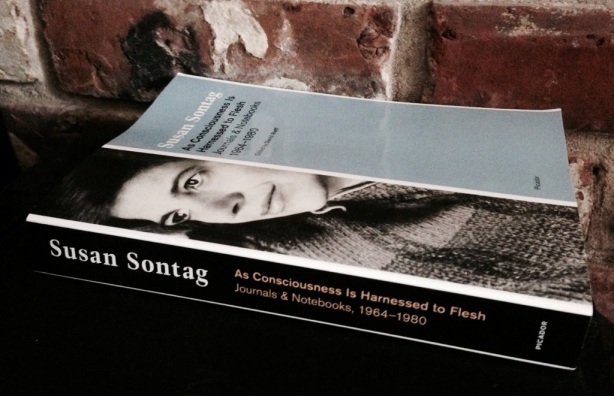
“Recycling one’s own life with books” |Thirteen Notes on Susan Sontag’s Notebook Collection, As Consciousness Is Harnessed to Flesh

20130929-103619.jpg

1. “In my more extravagant moments,” writes David Rieff in his introduction to Susan Sontag’s As Consciousness Is Harnessed to Flesh, “I sometimes think that my mother’s journals, of which this is the second of three volumes, are not just the autobiography she never got around to writing…but the great autobiographical novel she never cared to write.”

2. In my review of Reborn, the first of the trilogy Rieff alludes to, I wrote, “Don’t expect, of course, to get a definitive sense of who Sontag was, let alone a narrative account of her life here. Subtitled Journals & Notebooks 1947-1963Reborn veers closer to the “notebook” side of things.”

As Consciousness Is Harnessed to Flesh is far closer to the ‘notebook’ side of things too, which I think most readers (or maybe I just mean me here) will appreciate.

3. I mean, this isn’t the autobiographical novel that Rieff suggests it might be (except of course it is).

Consciousness/Flesh offers something better: access to Sontag’s consciousness in its prime, not quite ripe, but full, heavy, bursting with intellectual energy,  her mind attuned to (and attuning) the tumult of the time the journals cover, 1964 through 1980.

It’s an autobiography stripped of the pretense of presentation; it’s a novel stripped of the pretense of storytelling.

4. Sontag’s intellect and spirit course through the book’s 500 pages, eliding any distinction between lives personal and professional. “What sex is the ‘I’?” she writes, “Who has the right to say ‘I’?” The journals see her working through (if not resolving, thankfully) such issues.

5. An entry from late 1964, clearly background for Sontag’s seminal essay “Notes on Camp” (itself a series of notes), moves through a some thoughts on artists and poets, from Warhol to Breton to Duchamp (“DUCHAMP”) to simply “Style,” which, Rieff’s editorial note tells us, has a box drawn around it. The entry then moves to define

Work of Art

An experiment, a research (solving a “problem”) vs. form of a play

—before turning to a series of notes on the films of Michelangelo Antonioni.

6. A page or two later (1965) delivers the kind of gold vein we wish to discover in author’s notebooks:

PLOTS & SITUATIONS

Redemptive friendship (two women)

Novel in letters: the recluse-artist and his dealer a clairvoyant

A voyage to the underworld (Homer, Vergil [sic]Steppenwolf)

Matricide

An assassination

A collective hallucination (Story)

A theft

A work of art which is really a machine for dominating human beings

The discovery of a lost mss.

Two incestuous sisters

A space ship has landed

An ageing movie actress

A novel about the future. Machines. Each man has his own machine (memory bank, codified decision maker, etc.) You “play the machine. Instant everything.

Smuggling a huge art-work (painting? Sculpture?) out of the country in pieces—called “The Invention of Liberty”

A project: sanctity (based on SW [Simone Weil]—with honesty of Sylvia Plath—only way to solve sex “I” is talk about it

Jealousy

7. The list above—and there’s so much material like it in Consciousness/Flesh—is why I love author’s notebooks, We get to see the raw material here and imagine along with the writer (if we choose), free of the clutter and weight of execution, of prose, of damnable detail.

There’s something joyfully cryptic about Sontag’s notes, like the solitary entry “…Habits of despair” in late July of 1970—or a few months later: “A convention of mutants (Marvel comics).”

If we wish we can puzzle the notes out, treat them as clues or keys that fit to the work she was publishing at the time or to the personal circumstances of her private life. Or (and to be clear, I choose this or) we can let these notes stand as strange figures in an unconventional autobiographical novel.

8. Those looking for more direct material about Sontag’s life (and really, why do you want more and what more do you want?) will likely be disappointed—everything here is oblique (lovely, lovely oblique).

Still, there are moments of intense personal detail, like this 1964 entry where Sontag describes her body:

Body type

  • Tall
  • Low blood pressure
  • Needs lots of sleep
  • Sudden craving for pure sugar (but dislike desserts—not a high enough concentration)
  • Intolerance for liquor
  • Heavy smoking
  • Tendency to anemia
  • Heavy protein craving
  • Asthma
  • Migraines
  • Very good stomach—no heartburn, constipation, etc.
  • Negligible menstrual cramps
  • Easily tired by standing
  • Like heights
  • Enjoy seeing deformed people (voyeuristic)
  • Nailbiting
  • Teeth grinding
  • Nearsighted, astigmatism
  • Frileuse (very sensitive to cold, like hot summers)
  • Not very sensitive to noise (high degree of selective auditory focus)

There’s more autobiographical detail in that list than anyone craving a lurid expose could (should) hope for.

9. For many readers (or maybe I just mean me here) Consciousness/Flesh will be most fascinating as a curatorial project.

Sontag offers her list of best films (not in order),her ideal short story collection, and more. The collection often breaks into lists—like the ones we see above—but also into names—films, authors, books, essays, ideas, etc.

10. At times, Consciousness/Flesh resembles something close to David Markson’s so-called “notecard” novels (Reader’s Block, This Is Not a NovelVanishing Point, The Last Novel):

Napoleon’s wet, chubby back (Tolstoy).

and

Wordsworth’s ‘wise passiveness.’

and

Nabokov talks of minor readers. ‘There must be minor readers because there are minor writers.’

and

Camus (Notebooks, Vol. II): ‘Is there a tragic dilettante-ism?'”

and

‘To think is to exaggerate.’ — Valéry.

and so on…

11. Sometimes, the lists Sontag offers—

(offers is not the right verb at all here—these are Sontag’s personal journals and notebooks, her private ideas, material never intended for public consumption, but yes we are greedy, yes; and some of us (or maybe I just mean me here) are greedier than others, far more interested in her private ideas and notes and lists than the essays and stories and novels she generated from them—and so no, she didn’t offer this, my verb is all wrong)

—sometimes Sontag [creates/notes/generates] very personal lists, like “Movies I saw as a child, when they came out” (composed 11/25/65). There’s something tender here, imagining the child Sontag watching Fantasia or Rebecca or Citizen Kane or The Wizard of Oz in the theater; and then later, the adult Sontag, crafting her own lists, making those connections between past and present.

12. While Reborn showcased the intimate thoughts of a nascent (and at times naïve) intellect, Consciousness/Flesh shows us an assured writer at perhaps her zenith. In September of 1975, Sontag defines herself as a writer:

I am an adversary writer, a polemical writer. I write to support what is attacked, to attack what is acclaimed. But thereby I put myself in an emotionally uncomfortable position. I don’t, secretly, hope to convince, and can’t help being dismayed when my minority taste (ideas) becomes majority taste (ideas): then I want to attack again. I can’t help but be in an adversary relation to my own work.

13. Readers looking for a memoir or biography might be disappointed in Consciousness/Flesh; readers who seek to scrape its contours for “wisdom” (or worse, writing advice) should be castigated.

But As Consciousness Is Harnessed to Flesh will reward those readers who take it on its own terms as an oblique, discursive (and incomplete) record of Sontag’s brilliant mind.

I’ll close this riff with one last note from the book, a fitting encapsulation of the relationship between reader and author—and, most importantly, author-as-reader-and-rereader:

Recycling one’s own life with books.

As Consciousness Is Harnessed to Flesh is new in trade paperback from Picador; you can read excerpts from the book at their site.

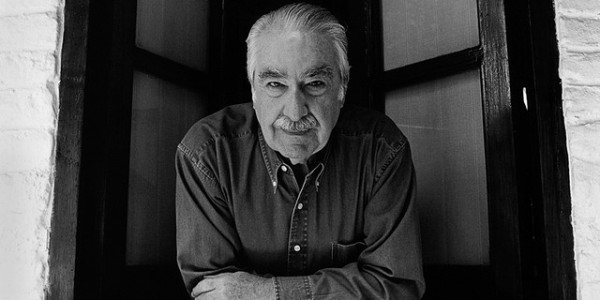
RIP Álvaro Mutis

Alvaro-Mutis-600x300

RIP Álvaro Mutis, 1923 – 2013

Colombian writer Álvaro Mutis died in Mexico City today. He was ninety.

Mutis is likely most famous in the English-speaking world for his excellent series of picaresque novellas focusing on the Gaviero, which have been collected as The Adventures and Misadventures of Maqroll. I first learned of the book through a friend who reviewed it on this blog; his review made me pick it up and read and riff on it myself. I don’t know if I can overstate how wonderful these novellas are. I’ve mixed them into my readings over the past year, breaking up the space between new novels by taking a trip with the Gaviero. They are something beyond palate-cleansers; they are the kind of adventure narratives that made me fall in love with reading in the first place. I feel strangely fortunate that there are two more I have yet to read.

Here’s John Updike’s thorough, excellent review of The Adventures and Misadventures of Maqroll.

And: a 2001 interview with Mutis by Francisco Goldman. From that interview:

FG: If you could travel with Maqroll to any period, which would it be?

AM: The 18th century. Casanova and I would have been friends. I would have been friends with the Prince de Ligne and I would have lived in Paris and Venice. I’d take the elegant life, the brilliant prose, like Voltaire—each time you read him you realize that he’s the real thing. And that is where my interest in the 18th century ends; once they get to the French Revolution and the horror and saving of mankind, that’s where I exit.

And a few last scraps from Un Bel Morir:

All the stories and lies about his past accumulating until they formed another being, always present and naturally more deeply loved than his own pale, useless existence composed of nausea and dreams.

A crack of wood waking him in the humble hotel on the Rue de Rempart and, in the middle of the night, leaving him on that shore where only God is aware of other people.

The eyelid twitching with the autonomous speed of one who knows he is in the hands of death. The eyelid of the man he had to kill, with repugnance, with no anger, to save the life of a woman whom he now found unbearable. 

All his waiting. All the emptiness of that nameless time used up in the foolishness of negotiations, proceedings, journeys, blank days, mistaken itineraries. All that life, from which he now begs, as he slips through the wounded dark toward death, some of the leftover scraps he thinks he has a right to. 

Gargoyles, Thomas Bernhard’s Philosophical Novel of Abject Madness

In its English translation, Thomas Bernhard’s 1967 breakthrough novel Verstörung received the title GargoylesVerstörung translates to something like distress or disturbance, while Gargoyles (obviously) evokes Gothic monsters. Considered together, both titles communicate this philosophical novel’s themes of abjection, decay, and madness.

Bernhard explores these themes by dividing the novel into two sections that occur over the span of the same day. In the first section, “First Page,” a country doctor takes his son on his daily rounds in rural Stryia, “a relatively large and ‘difficult’ district.” The son, a mining engineer student and aspiring scientist, is ostensibly the narrator of Gargoyles. He tells us that his father “was taking me with him for the sake of my studies.” Their journey culminates in a visit to Hochgobernitz, the gloomy castle of Prince Saurau, an insane, suicidal aristocrat who mourns his own son’s self-exile to England, where he has gone to study. While the doctor’s son remains the narrator of the book in “The Prince,” the second part of Gargoyles, Prince Saurau overwhelms the novel with the force of his monologue, a tirade that gobbles up all that comes before it. His monologue ventriloquizes the narrator’s consciousness, echoing in the young man’s skull long after he’s left the castle.

The prince’s monologue is a prototypical Bernhardian rant that will be familiar to anyone who’s read The Loser or Correction (and undoubtedly other Bernhard novels I haven’t read yet). Unlike those novels, Gargoyles offers its first section “First Page” as a point of contrast to the monologue that will come later. These episodes are short and digestible, and while hardly conventional, they are far easier to handle than the sustained intensity of the prince’s monologue. The grotesque cavalcade that the doctor and son trek through in “First Page” allows Bernhard to set out his themes — not neatly or precisely, but clearly — before the prince commences to swallow and then vomit them.

Here are the first two paragraphs of the novel:

On the twenty-sixth my father drove off to Salla at two o’clock in the morning to see to a schoolteacher whom he found dying and left dead. From there he set out toward Hüllberg to treat a child who had fallen into a hog tub full of boiling water that spring. Discharged from the hospital weeks ago, it was now back with its parents.

He liked seeing the child, and dropped by there whenever he could. The parents were simple people, the father a miner in Köflach, the mother a servant in a butcher’s household in Voitsberg. But the child was not left alone all day; it was in the care of one of the mother’s sisters. On this day my father described the child to me in greater detail than ever before, adding that he was afraid it had only a short time to live. “I can say for a certainty that it won’t last through the winter, so I am going to see it as often as possible now,” he said. It struck me that he spoke of the child as a beloved person, very quietly and without having to consider his words.

The specter of infanticide and the doctor’s resistance to it haunts the novel. We can also sense a cerebral chilliness in the narrator, who is “struck” by his father’s empathy. The doctor’s empathy repeats throughout the novel; we next see it clearly when he’s brought to attend an innkeeper’s wife assaulted in the early morning “without the slightest provocation” by one of the drunken miners who frequented her inn. Unconscious for hours before police or doctor are even called for, the woman dies. But—

It was of no importance that the innkeeper had not notified him of the fatal blow until three hours after the incident, my father said. The woman could not have been saved. The deceased woman was thirty-three, and my father had known her for years. It had always seemed to him that innkeepers treated their wives with extreme callousness, he said. They themselves usually went to bed early, having overworked themselves all day on their slaughtering, their cattle dealing, their farms. But because they thought of nothing but the business, they left their wives to take care of the taverns until the early morning hours, exposed to the male clients who drank steadily so that as the night wore on their natural brutality became less and less restrained.

As the day unfolds, the “natural brutality” that the doctor is up against evinces again and again in the various gargoyles he attends to. The rumor of the innkeeper’s wife’s murder floats in the background as a reminder of violence and brutality that bizarrely unites this community of outsiders.

Those outsiders: a bedridden, dying woman with a feeble-minded son and a murderer for a brother; a retired industrialist, living “like man and wife” with his half-sister, who devotes “himself to a literary work over which he agonized, even as it kept his mind off his inner agony”; the school teacher whose death initiates the novel; mill workers murdering exotic birds with the help of a young bewildered Turk; an insane and deformed man, the son’s age, attended to and cared for by his sister. And the prince. But I’ve rushed through so much here, so much force of language, so much terror, so much horror.

These gargoyles live, if it can be called that, in abject, isolated otherness. The doctor diagnoses it for his son:

. . . no human being could continue to exist in such total isolation without doing severe damage to his intellect and psyche. It was a well-known phenomenon, my father said, that at a crisis in their lives some people seek out a dungeon, voluntarily enter it, and devote their lives—which they regard as philosophically oriented—to some scholarly task or to some imaginative scientific obsession. They always take with them into their dungeon some creature who is attached to them. In most cases they sooner or later destroy this creature who has entered the dungeon with them, and then themselves. The process always goes slowly at first.

There is something of a warning here for the doctor’s son, who tells us at one point: “Every day I completely built myself up, and completely destroyed myself.” Like Roithamer of Correction, the son is something of a control freak (“Only through such control can man be happy and perceive his own nature”), and, like Roithamer and so many other Bernhardian figures, he has a frail (perhaps suicidal) sister who could perhaps fall prey to his idealism—who might indeed be the “creature who has entered the dungeon” with him.

There’s also the risk, one which the doctor perhaps did not account for when he set out to help his son with his “studies,” that the son might fall into the prince’s dungeon. But perhaps I’m making too much of the doctor’s empathy, of his resistance to brutality and his commitment to caring for those who repel all others. His own philosophy seems coded in misanthropy and failure. “All of living is nothing but a fervid attempt to move closer together,” he says at one point. But also: “Communication is impossible.”

The resistance to abjection is paradoxical—as the doctor points out, the “philosophically oriented” and “imaginative scientific obsession[s]” often lead people deeper into the abyss—as the prince’s monologue will illustrate. Each of the gargoyles presented in the text offers a rare and special talent—art, music, philosophy, etc. Sussing out the novel’s treatment of the philosophies it invokes is beyond my ken, but I can’t resist lazily dropping a few names: Kant, Marx, Nietzsche, Pascal, Diederot (all on the doctor’s reading list), and Schopenhauer, whose philosophy of the will surely informs the text more than I can manage here. (From the prince’s father’s suicide note: “Schopenhauer has always been the best nourishment for me”). And while I’m lazily dropping names: Edgar Allan Poe, King Lear, Macbeth, Dostoevsky, and Francisco Goya—especially his Los caprichos, a few of which accompany this review . (And although he came after, I can’t help but read Roberto Bolaño in some of the more grotesque, horrific passages).

The levels of ventriloquizing and the layers of madness set against the novel’s depiction of radical repression lead to an abyssal paradox, perhaps best figured not in the philosophers Bernhard invokes but in the novel’s backdrop: a dark, enveloping gorge, the yawning chasm that surrounds the high walls of the castle the prince walks with his auditors. These walls are the stage from which the prince performs his monologue; their visceral dramatic emphasis derives from the abyss below. In an ironic note at the beginning of “The Prince,” the son remarks, “From here, I thought, you probably had the finest view of the entire country.”

Upon this stage, Bernhard’s main characters function as asymmetrical parallels (forgive the purposeful absurdity of this oxymoron). The father and his son the narrator are set against the prince and his absent son. In a particularly bizarre episode, the prince recounts a dream:

“But my son,” he said, “will destroy Hochgobernitz as soon as he receives it into his hands.”

Last night, the prince said, he had had a dream. “In this dream,” he said, “I was able to look at a sheet of paper moving slowly from far below to high up, paper on which my own son had written the following. I see every word that my son is writing on that sheet of paper,” the prince said. “It is my son’s hand writing it. My son writes: As one who has taken refuge in scientific allegories I seemed to have cured myself of my father for good, as one cures oneself of a contagious disease. But today I see that this disease is an elemental, shattering fatal illness of which everyone without exception dies. Eight months after my father’s suicide—note that, Doctor, after his father’s suicide, after my suicide; my son writes about my suicide!—eight months after my father’s suicide everything is already ruined, and I can say that I have ruined it. I can say that I have ruined Hochgobernitz, my son writes, and he writes: I have ruined this flourishing economy! This tremendous, anachronistic agricultural and forest economy. I suddenly see, my son writes,” the prince said, “that by liquidating the business even though or precisely because it is the best, I am for the first time implementing my theory, my son writes!” the prince said.

Note the strange layers of narration and creation here. The prince’s son, a creation of the prince, exists in the prince’s dream (another creation) where he creates a manuscript. All this creation though points to destruction—of the father, of the ancestral estate. The prince’s impulses signal self-erasure, suicide as a kind of radical return of the repressed (here, Austria’s inability to speak about, reconcile, admit its complicity in the horrors of World War 2).

The doctor contrasts with the prince, perhaps representing an order, health, and sanity that serve to sharpen and darken the abject decay of the crazed aristocrat. “My father goes to see the prince only to treat him for his insomnia,” observes the narrator, “without doing anything about his real illness . . . his madness.” But can the doctor really treat the prince’s illness?

Both fathers in their respective philosophies signal the possible paths that might be inherited by their sons (and, if you like, by allegorical extension the sons could represent Austria, or perhaps even Western Europe). How to live against the promise of suicide, against the perils of infanticide, against the kind of “natural brutality” that leads to murder, insanity, the abyss?

This problem is encoded into Bernhard’s rhetorical technique. The prince’s devastating monologue consumes the narrative, reader and narrator alike. By the end of the novel, he’s infiltrated (and perhaps infected) the narrator’s consciousness, highlighting the dramatic stakes here—of being ventriloquized, possessed by the diseases of history and authority—an illness that trends to self-destruction. It’s worth sharing a passage at some length; the following section highlights and perhaps even condenses what I take to be the core themes of Gargoyles:

“Whenever I look at people, I look at unhappy people,” the prince said. “They are people who carry their torment into the streets and thus make the world a comedy, which is of course laughable. In this comedy they all suffer from tumors both mental and physical; they take pleasure in their fatal illness. When they hear its name, no matter whether the scene is London, Brussels, or Styria, they are frightened, but they try not to show their fright. All these people conceal the actual play within the comedy that this world is. Whenever they feel themselves unobserved, they run away from themselves toward themselves. Grotesque. But we do not even see the most ridiculous side of it because the most ridiculous side is always the reverse side. God sometimes speaks to them, but he uses the same vulgar words as they themselves, the same clumsy phrases. Whether a person has a gigantic factory or a gigantic farm or an equally gigantic sentence of Pascal’s in his head, is all the same,” the prince said. “It is poverty that makes people the same; at the human core, even the greatest wealth is poverty. In men’s minds and bodies poverty is always simultaneously a poverty of the body and a poverty of the mind, which necessarily makes them sick and drives them mad. Listen to me, Doctor, all my life I have seen nothing but sick people and madmen. Wherever I look, the worn and the dying look back at me. All the billions of the human race spread over the five continents are nothing but one vast community of the dying. Comedy!” the prince said. “Every person I see and everyone I hear anything about, no matter what it is, prove to me the absolute obtuseness of this whole human race and that this whole human race and all of nature are a fraud. Comedy. The world actually is, as has so often been said, a stage on which roles are forever being rehearsed. Wherever we look it is a perpetual learning to speak and learning to walk and learning to think and learning by heart, learning to cheat, learning to die, learning to be dead. This is what takes up all our time. Men are nothing but actors putting on a show all too familiar to us. Learners of roles,” the prince said. “Each of us is forever learning one (his) or several or all imaginable roles, without knowing why he is learning them (or for whom). This stage is an unending torment and no one feels that the events on it are a pleasure. But everything that happens on this stage happens naturally. A critic to explain the play is constantly being sought. When the curtain rises, everything is over.” Life, he went on, changing his image, was a school in which death was being taught. It was filled with millions and billions of pupils and teachers. The world was the school of death. “First the world is the elementary school of death, then the secondary school of death, then, for the very few, the university of death,” the prince said. People alternate as teachers or pupils in these schools. “The only attainable goal of study is death,” he said.

Such searing nihilism here—the prince angrily mourns the grotesqueness of the world, the lack of agency of people to control their own fate, to be but players, dummies mumbling someone else’s script. And it all leads to death. For the prince, dialogue is impossible in the face of this death: “All interlocutors are always mutually pushing one another into all abysses.” But the prince, notably, is his own interlocutor; he pushes himself into abysses of his own contrivance.

Neither is love a solution for the prince:

“We face questions like an open grave about to be filled. It is also absurd, you know, for me to be talking of the absurdity,” he said. “My character can justly be called thoroughly unloving. But with equal justice I call the world utterly unloving. Love is an absurdity for which there is no place in nature.

And community?

We see in a person frailties which at once make us see the frailties of the community in which we live, the frailties of all communities, the state; we feel them, we see through them, we catastrophize them.

But is this necessarily the essential view of the novel? I don’t think it plausible to argue that the prince’s monologue be read entirely ironically, but it’s worth bearing in mind that both his auditors understand him to be mentally ill and terribly isolated. The guy is histrionic, a drama fiend holding forth on his stage. And while his acerbic misanthropy and nihilism may scorch, it’s also very, very funny. I chuckled a lot reading Gargoyles.

But yes—the prince is sincere in his pain. “We assume the spirit of the walls that surround us,” he declares near the end of the novel. He’s a a prisoner in his own gloomy castle, the dungeon he refuses to leave. He resents his son’s self-exile to London, but also longs—literally dreams for—his son to return to destroy that dungeon.

Of his family: “But probably all these creatures deserve ruthlessness more than pity.” I think that But is important here. The doctor, like the prince, also situates everyone on an axis of ruthlessness and pity. The doctor is full of cruel observations about the gargoyles he encounters. But: But he gets up, goes out, does his rounds, tries in some way to mitigate some of the “natural brutality” of the world. And he tries to show this world—and this method—to his son this as well, for his son’s “studies.” In the room of the lonely, dying woman, the son remarks of his father: “I noticed that he made an effort to stretch out the call, for all his eagerness to leave.” The son, in thrall to the prince’s monologue, perhaps fails to notice that his father also stretches out his time on the castle wall despite an eagerness to leave the prince.

By the end of the novel, we see the prince’s consciousness inhabiting the son’s thoughts:

In bed I thought: What did the prince say? “Always wanting to change everything has been a constant craving with me, an outrageous desire which leads to the most painful disputes. The catastrophe begins with getting out of bed. 

The pessimism and sheer despair here erupts into black comedy with that last line, one echoed in Bernhard’s later novel Correction: “Waking up is the always frightening minimum of existence.” If to simply get out of bed (which, of course, is where the son is as he work’s through the prince’s ideas) is to invoke and invite disaster and despair, it’s worth noting that this simple action—getting out of bed—is what the doctor performs each day, even if it means he wakes to a dead teacher, a boiled infant, a murdered wife. While hardly a beacon of optimism or hope, the doctor nonetheless figures an alternative to the prince’s abject madness. If we “assume the spirit of the walls that surround us,” the doctor understands that it’s important to leave those walls, to not seek out dungeons—and drag others into dungeons with us.

Gargoyles is by turns bleak and nihilistic. It’s also energetic, profound, and at times very, very funny. Its opening section will likely provide an accessible introduction to readers interested in Bernhard, with the prince’s monologue offering the full Bernhardian experience. Dark, cruel, and taxing, Gargoyles isn’t particularly fun reading—except when it is. Highly recommended.

David Gordon Green’s Prince Avalanche Reviewed

prince-avalanche-poster

At this point, pretty much anything anyone writes about director David Gordon Green sets out to divide his early “promising” work—impressionistic, Malick-beholden films like All the Real Girls and George Washington—from more recent stoner comedies like Pineapple Express, the much-vilified-now-but-future-cult-classic Your Highness, and Green’s work on Eastbound & Down.

The critical line on Green’s latest film, Prince Avalanche, is that it synthesizes the poetic and artistic impulses of the earlier films with the commercial comedy of what came after—that, in shortGreen has found his way again. I don’t think that this is especially true.

Based on the 2011 Icelandic film Either WayPrince Avalanche floats around the barest wisp of a plot. It’s the end of the 1980s, and in the middle of wildfire-ravaged Texas, uptight Alvin (Paul Rudd) and slacker Lance (Emile Hirsch, channeling a sensitive Jack Black) paint yellow lines on the old rural roads and hammer in new signposts. They squabble, share vodka with an alcoholic truck driver, and encounter a woman whose house has burned down. We learn that Lance has scored the job because his sister is Alvin’s girlfriend—but that romantic relationship looks pretty rocky from the get-go.

Prince Avalanche is never better than its opening scenes, where Alvin and Lance wordlessly perform their duties, hammering stakes into the ground and measuring out yellow dashes. Green is confident enough to let the camera linger on his actors, and most of the memorable scenes are simple—Paul Rudd’s motions as he sets up a folding table, or Hirsch tying down equipment to the work jeep. The blasted Texas forest is beautiful, as new growth mixes with charred tree trunks in frames by turns surreal and painterly.

The story line of Prince Avalanche isn’t especially bad; it’s just not especially good, or even interesting. There’s simply too much indie dramedy quirkiness going on here, and when Green’s plotting hits familiar arc-driven beats—a climactic fight, a scene of drunken abandon—the story feels false against the pure, beautiful cinematography. The original score by postrockers Explosions in the Sky is maddeningly intrusive, buzzing with overly-detailed blips and rhythm huffs that sound at times like Tangerine Dream’s work on Risky Business. Calm down!

This is all perhaps a way of saying that the “synthesis” many critics have detected in Prince Avalanche is not particularly satisfying. It’s true that the film is smaller and more intimate than Green’s last effort, the execrable and indefensible into-the-night film The Sitter, but Prince Avalanche is just as much a product of formula as that film.

In most of his films, Green retells the same core story about a lonely young man with communication troubles who really just wants a friend (this is Paul Schneider in All the Real Girls or James Franco in Pineapple Express or Danny McBride in Your Highness). Prince Avalanche is no different, but it seems unsure of pulling off its emotional impact without all the indie-quirk baggage. It feels bloated at a scant 96 minutes and would be a far better film if, like the burned and beautiful world it depicts, it was willing to strip away more of its protective layers. (It doesn’t help that Kelly Reichardt told a similar story far better in 2006 with her film Old Joy).

Perhaps I’m being too harsh on the film—I’ll confess I wanted it to be great, something that could transcend the self-seriousness of All the Real Girls and surpass the final, perfect diner scene of Pineapple Express (the single moment where Green best combines his Malick-tinged naturalism with his sense of bromance-up-too-late humor).

Of course I could be dead wrong—I might catch the film on cable in a year and see something there that I missed the first time. Like most viewers, I had no love for Your Highness on first viewing but have since sat through it at least four times—it’s a failure, to be sure, but a compelling, bizarre failure, one that I find funnier and more self-aware each time. And the same promise that Green has always shown in all his work (okay, not The Sitter) shines brightly throughout Prince Avalanche. The final shot of the film shows us children joyfully chasing a chicken. It’s one of the finest moments in the film, and I wish Green’s lens lingered there longer—I’d like to see what happens next.

“…the Mask’s desire was to be invisible, unthreatening, transparent yet mercilessly deceptive…” / Another Pynchon Riff

Capture

IT WAS MIDAPRIL, Carnevale had been over for weeks, and Lent was coming to a close, skies too drawn and pallid to weep for the fate of the cyclic Christ, the city having slowly regained a maskless condition, with a strange dull shine on the paving of the Piazza, less a reflection of the sky than a soft glow from regions below. But the silent communion of masks was not quite done here.

On one of the outer islands in the Lagoon, which had belonged to the Spongiatosta family for centuries, over an hour away even by motor craft, stood a slowly drowning palazzo. Here at midnight between Holy Saturday and Easter Sunday began the secret counter-Carnevale known as Carnesalve, not a farewell but an enthusiastic welcome to flesh in all its promise. As object of desire, as food, as temple, as gateway to conditions beyond immediate knowledge.

With no interference from authority, church or civic, all this bounded world here succumbed to a masked imperative, all hold on verbatim identities loosening until lost altogether in the delirium. Eventually, after a day or two, there would emerge the certainty that there had always existed separately a world in which masks were the real, everyday faces, faces with their own rules of expression, which knew and understand one another—a secret life of Masks. It was not quite the same as during Carnevale, when civilians were allowed to pretend to be members of the Maskworld, to borrow some of that hieratic distance, that deeper intimacy with the unexpressed dreams of Masks. At Carnevale, masks had suggested a privileged indifference to the world of flesh, which one was after all bidding farewell to. But here at Carnesalve, as in espionage, or some revolutionary project, the Mask’s desire was to be invisible, unthreatening, transparent yet mercilessly deceptive, as beneath its dark authority danger ruled and all was transgressed.

1. Okay—I know it’s been like forever since I riffed on Thomas Pynchon’s novel Against the Day (here, “forever” = a few weeks), but I took a week off from the novel, which turned into two weeks, which is a bad habit, yes, but here we are, and I’m nearing the end of the shaggy beast. I don’t think Pynchon is going to tie all the loose threads  into some perfect picture for me, but I don’t think I’d want that anyway.

2. Where I am in the book: Cyprian, Cyprian, Cyprian. The beginning of The Great War. Just waaaaaay too much going on to even bother to begin to try to summarize.

3. Cyprian is surely the most fascinating character of Against the Day, but his somewhat late arrival in the text feels, I don’t know, lumpy or something. Something about reading such a long book—we make a kind of investment in certain plots, figures, characters, and Pynchon here sort of moves them into the background, or disappears them completely, for long, long stretches. I’m thinking about The Chums of Chance in particular, but also Lew Basnight, the Tunguska event, the Vibes vs. the Traverses, etc. Thematically it’s all there, but this stretch with Cyprian’s dark adventures, while fantastic, also feels almost like a novella shoehorned into the final chapters of an epic. This is not a complaint.

4. I’ve shared a few citations from Against the Day since my last riff, but the one above (my Kindle tells me its at the 82% mark, if that means anything to you) seems to resonate with what I take to be the major themes and motifs of the novel.

I’m thinking specifically of the final line: “But here at Carnesalve, as in espionage, or some revolutionary project, the Mask’s desire was to be invisible, unthreatening, transparent yet mercilessly deceptive, as beneath its dark authority danger ruled and all was transgressed.”

Invisible is obviously a key word in Against the Day, and the novel turns on concepts of doubling, masking, transgression, themes that the Carnevale-Carnesalve disjunction highlights (flesh vs. spirit, visible vs. invisible, etc.).

5. Actually, now that I think about it, Cyprian probably most embodies, or, rather, embodies most complexly, Pynchon’s themes of doubling, masking, and transgression. He’s his own doppelganger. (Even the name suggest a kind of bilocation — Cyprus, that ancient crossroads of East and West).

6. And —

The Carnesalve chapter culminates in a truly salacious sex scene, an S&M-fueled ménage à trois that somehow simultaneously punctures the novels structure of doubling (cause, uh, a three-way) at the same time it reinforces it (Cyprian as self-double). I’m not sure if any of this that I’m saying makes any sense at all.

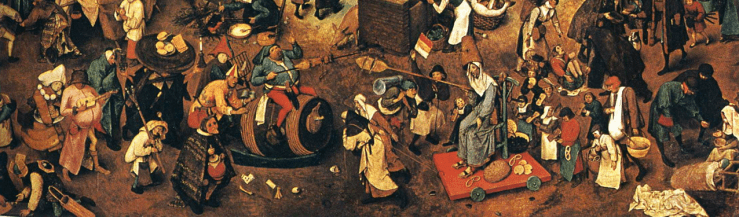
7. The image at the top of this riff is a detail from The Fight Between Carnival and Lent by Pieter Bruegel.

theNewerYork, a Worthy Alternative to Your iPhone

20130709-154848.jpg

Like many (maybe most) Americans, my first impulse when I have to wait somewhere is to pull out my smart phone and dick around. I like to dick around on Twitter, which often leads me to stuff that I scan or gaze or graze through, with a kind of distracted, even half-hearted, attention. Because I’m also attending to something else—the waiting.

I had to wait, or be patient, or be a patient, or what have you several times last month, and each time I brought with me the newest or forthcomingest issue of theNewerYork—issue 3 (or III, depending on press materials). It fits neatly in my pocket and most of the pieces are a page at most—a perfect alternative to my iPhone, with none of the eye-deadening numbness that so often happens with long binges on a tiny screen.

theNewerYork describes itself as

a weird sort of literary mag. Our rule: no short stories, no poetry, no essays. We want to play around with literary form and narration, we want to screw with your mind! There will be personal letters, flash-fictions, glossaries, aphorisms, manuals, lists and other absurdities. We received over 600 submissions from all over the world. We’ve got flash fictions of sex and drugs, teenage romances, philosophical treatises, pretentious definitions, web forums, silly, sappy, scary stuff.

That’s a pretty apt description. To hijack and cannibalize my write-up of the last issue, theNewerYork’s “willingness to showcase experimentation in what goes on paper for people to look at and read is both a strength and a weakness.” This third issue sees an all-around increase in quality, from the production design, to the art, to the writing.

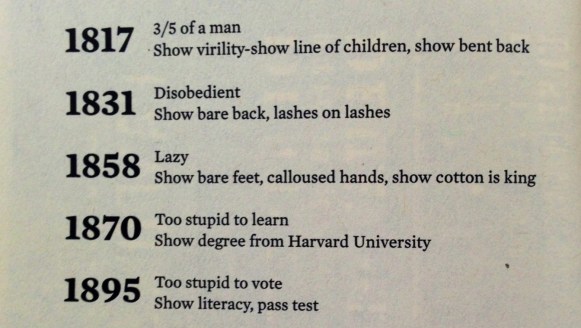
Highlights include Panayotis Pakos’s “Les Innumerables (A Binary Tale),” a Calvinoesque flash that imagines the dream-life of numbers, and Shane Jesse Christmass’s “My Delicate Response to a Child’s Writing Prompt Website” (quick sample: “If there were no television I’d beach my television set down within the dunes…”). Zach Davidson’s “Unstandardized Testing” claims (truthfully?) to present a set of scrambled questions from a trash bin; the testtaker is tasked with creating proper order (sample: “too lazy to do lazy something you are if you are still?”)

The most affecting piece in the collection is Anton Nimblett’s “Show & Tell: An American Game,” an analysis posing as a chronology. I’ll share only the nineteenth century portion, and, at the risk of spoiling, let you know that the story ends with the line “Show birth certificate (again, again, again).”

20130807-130214.jpg

The list-form, along with (or combined with) the second-person POV seems a favorite for “experimental” fiction, which can occasionally be grating (but only when it doesn’t work)—but most of the pieces here work. And if they don’t, there’s something coming up that does.

Despite the disparate tones, approaches, and geographies of its contributors, theNewerYork coheres—the little magazine has a clear (if discursive vision). Good stuff. Check out their website for more. 

The Garden of Eden, Ernest Hemingway’s Tale of Doomed Polyamory

In general, I dislike reviews that frontload context—get to the book, right? So here’s a short review of Ernest Hemingway’s The Garden of Eden: it is stranger than most of what Hemingway wrote, by turns pleasant, uncomfortable, bewildering, and beautiful. And readable. It’s very, very readable. Young people (or older folks; let’s not be prejudiced) working their way through Hemingway shouldn’t put The Garden of Eden on the back-burner in favor of his more famous works, and anyone who might have written off Hemingway as unreflective macho bravado should take a look at some of the strange gender games this novel has to offer. So, that’s a recommendation, okay?

Now on to that context, which I think is important here. See, The Garden of Eden is one of those unfinished novels that get published posthumously, put together by editors and publishers and other book folk, who play a larger role than we like to admit in the finished books we get from living authors anyway. For various reasons, cultural, historical, etc., we seem to favor the idea of the Singular Artistic Genius who sculpts beauty and truth out of raw Platonic forms that only he or she can access (poor tortured soul). The reality of how our books get to us is a much messier affair, and editors and publishers and even literary studies departments in universities have a large hand in this process, one we tend to ignore in favor of the charms of a Singular Artistic Genius. There’s a fascinating process there, but also a troubling one. Editing issues complicate our ideals of (quite literally) stable authority—is this what the author intended?, we ask (New Critics be damned!). David Foster Wallace and Michael Pietsch, Raymond Carver and Gordon Lish, Franz Kafka and Max Brod, Mary Shelley and Percy Shelley . . . not to mention Shakespeare, Chaucer, Beowulf, The Bible, Homer, etc. etc. etc. But you’re here to read about The Garden of Eden, right gentle reader? Mea culpa. I’ve been blathering away. Let me turn the reins over to the estimable talents of E.L. Doctorow, who offers the following context in his 1986 review of the book in The New York Times

Since Hemingway’s death in 1961, his estate and his publishers, Charles Scribner’s Sons, have been catching up to him, issuing the work which, for one reason or another, he did not publish during his lifetime. He held back ”A Moveable Feast” out of concern for the feelings of the people in it who might still be alive. But for the novel ”Islands in the Stream” he seems to have had editorial misgivings. Even more deeply in this category is ”The Garden of Eden,” which he began in 1946 and worked on intermittently in the last 15 years of his life and left unfinished. It is a highly readable story, if not possibly the book he envisioned. As published it is composed of 30 short chapters running to about 70,000 words. A publisher’s note advises that ”some cuts” have been made in the manuscript, but according to Mr. Baker’s biography, at one point a revised manuscript of the work ran to 48 chapters and 200,000 words, so the publisher’s note is disingenuous. In an interview with The New York Times last December, a Scribners editor admitted to taking out a subplot in rough draft that he felt had not been integrated into the ”main body” of the text, but this cut reduced the book’s length by two-thirds.

So, yeah. The version we have of The Garden of Eden is heavily cut, and also likely heavily arranged. But that’s what editors do, and this is the book we have (for now, anyway—it seems like on the year of its 25th anniversary of publication, and the 50th anniversary of Hemingway’s death that Scribner should work toward putting out an unedited scholarly edition) — so I’ll talk about that book a bit.

The Garden of Eden tells the story of a few months in the lives of a young newlywed couple, David Bourne, an emerging novelist, and his wife Catherine, a trust fund baby flitting about Europe. The novel is set primarily on the French Riviera, in the thin sliver of high years between the two big wars. David and Catherine spend most of their days in this Edenic setting eating fine food and making love and swimming and riding bikes and fishing. And drinking. Lots and lots of drinking. Lots of drinking. It all sounds quite beautiful—h0w about a taste?

On this morning there was brioche and red raspberry preserve and the eggs were boiled and there was a pat of butter that melted as they stirred them and salted them lightly and ground pepper over them in the cups. They were big eggs and fresh and the girl’s were not cooked quite as long as the young man’s. He remembered that easily and he he was happy with his which he diced up with the spoon and ate with only the flow of the butter to moisten them and the fresh early morning texture and the bite of the coarsely ground pepper grains and the hot coffee and the chickory-fragrant bowl of café au lait.

Hemingway’s technique throughout the novel is to present the phenomenological contours of a heady world. It’s lovely to ride along with David and Catherine, rich and free and beautiful.

Their new life together is hardly charmed, however. See, Catherine gets a haircut—

Her hair was cropped as short as a boy’s. It was cut with no compromises. It was brushed back, heavy as always, but the sides were cut short and the ears that grew close to her head were clear and the tawny line of her hair was cropped close to her head and smooth and sweeping back. She turned her head and lifted her breasts and said, “Kiss me please.” . . .

“You see, she said. “That’s the surprise. I’m a girl. But now I’m a boy too and I can do anything and anything and anything.”

“Sit here by me,” he said. “What do you want, brother.”

David’s playful response—calling his wife “brother”—covers up some of his shock and fear, but it also points to his underlying curiosity and gender confusion. And indeed, Catherine’s new haircut licenses her to “do anything and anything and anything” — beginning with some strange bed games that night—

He had shut his eyes and he could feel the long light weight of her on him and her breasts pressing against him and her lips on his. He lay there and felt something and then her hand holding him and searching lower and he helped with his hands and then lay back in the dark and did not think at all and only felt the weight and the strangeness inside and she said, “Now you can’t tell who is who can you?”

“No.”

“You are changing,” she said. “Oh you are. You are. Yes you are and you’re my girl Catherine. Will you change and be my girl and let me take you?”

“You’re Catherine.”

“No. I’m Peter. You’re my wonderful Catherine. You’re my beautiful, lovely Catherine. You were so good to change. Oh thank you, Catherine, so much. Please understand. Please know and understand. I’m going to make love to you forever.”

David, partial stand-in for Hemingway, transforms into a girl who feels “something” during sex with Catherine (or, ahem, Peter)—note that that “something” has no clear referent. As their gender inverting games continue (much to David’s horror), Hemingway’s usually concrete language retreats to vague proforms without referents, “it”s without antecedents; his usually precise diction dissolves in these scenes, much as the Bournes’ marriage dissolves each time Catherine escalates the gender inversion. David gives her the nickname “Devil,” as if she were both Eve and Serpent in their Garden. Catherine’s transformations continue as she cuts her hair back even more, and sunbathes all the time so that she can be as dark as possible. She dyes her hair a silver blonde and makes David get his hair cut and dyed the same.

The bizarre behavior (shades of Scott and Zelda?) culminates in Catherine introducing another woman into the marriage. Marita falls in love with both David and Catherine, but her lesbian sex with Catherine only accelerates the latter’s encroaching insanity. David is initially radically ambivalent to the ménage à trois proposed by his wife; he has the good sense to see that a three-way marriage is ultimately untenable and that his wife is going crazy. He vacillates between hostility and love for the two women, but eventually finds a support system in Marita as it becomes increasingly apparent (to all three) that Catherine is depressed and mentally unstable, enraged that David has ceased to write about the pair’s honeymoon adventures on the Riviera. Catherine has been bankrolling David; jealous of good reviews from his last novel, she insists that he write only their story, but David would rather write “the hardest story” he knows—the story of his childhood in East Africa with his father, a big game hunter.

In some of the most extraordinary passages of The Garden of Eden, David writes himself into his boyhood existence, trailing a bull elephant with his father through a jungle trek. David has spotted the elephant by moonlight, prompting his father and his father’s fellow tracker and gun bearer Juma to hunt the old beast. As they trail the animal, David begins to realize how horrible the hunt is, how cruel it is to kill the animal for sport. The passages are somewhat perplexing given Hemingway’s reputation as a hunter. Indeed, this is one of the major features of The Garden of Eden: it repeatedly confounds or complicates our ideas about Hemingway the man’s man, Hemingway the writer, Hemingway the hunter. David describes the wounded, dying elephant—

They found him anchored, in such suffering and despair that he could no longer move. He had crashed through the heavy cover where he had been feeding and crossed a path of open forest and David and his father had run along the heavily splashed blood trail. Then the elephant had gone on into thick forest and David had seen him ahead standing gray and huge against the trunk of a tree. David could only see his stern and then his father moved ahead of him and he followed and they came alongside the elephant as though he was a ship and David saw the blood coming from his flanks and running down his sides and then his father raised his rifle and fired and the elephant turned his head with the great tusks moving heavy and slow and looked at them and when his father fired the second barrel the elephant seemed to sway like a felled tree and came smashing down toward them. But he was not dead. He had been anchored and now he was down with his shoulder broken. He did not move but his eye was alive and looked at David. He had very long eyelashes and his eye was the most alive thing David had ever seen.

David succeeds in writing this “hard” story, and the passages are remarkable in their authenticity—David’s story is a good story, the highlight of the book perhaps; it’s not just Hemingway telling us that David wrote a great story, we actually get to experience the story itself as well as the grueling process by which it was made. Hemingway and his surrogate David show us—make us experience—how difficult writing really is, and then share the fruit of that labor with us. These scenes raise the stakes of The Garden of Eden, revealing how serious David is when he remarks (repeatedly) that the writing is the most important thing—that it outweighs love, it surpasses his marriage. These realizations freight the climax of the novel all the more heavily, but I will avoid anymore spoilers.

The Garden of Eden has some obvious flaws. Marita is underdeveloped at best for such an important character, and her love for David and Catherine remains unexplored, and in fact barely remarked upon. The biggest problem with the book is its conclusion, which feels too pat, too obvious for such a strange, amorphous book. It is here that the presence of an editorial hand seems clearest, to the extent that I wonder if the short little chapter that concludes the novel wasn’t cobbled together from a few stray sentences throughout the manuscript. But The Garden of Eden, despite some shortcomings, is a book well worth reading. The novel complicates not just Hemingway’s reputation, but also our sense of Hemingway’s sense of himself. Recommended.

[Ed. note: Biblioklept originally published a version of this review in August of 2011]

Intertexuality and Structure in Roberto Bolaño’s 2666

the-librarian1

•I had been reading William T. Vollmann’s enormous book Imperial. I bought the book in paperback and then put an illicit copy on my Kindle (this riff is not about the ethics of that move). It’s just easier to read that way, especially at night. At some point in Imperial, probably at some mention of coyotes or polleros—smugglers of humans—I felt a tug in the back of my brain pan, a tug that wanted to pull up Roberto Bolaño’s big big novel 2666—also on my Kindle (also an illicit copy, although I bought the book twice).

•This is how I ended up rereading 2666 straight through. It was unplanned.

•Like many readers, I aim to reread more than I actually end up rereading.

•Truly excellent novels are always better in rereading: richer, fuller, more resonant. Sometimes we might find we’ve thoroughly misread them. (Imagine my horror rereading Lolita in my twenties to discover the vein of evil throbbing through it). Sometimes we find new tones that seemed impossible on the first run through. (I’ve read Blood Meridian at least once a year since the first time I read it, and it keeps getting funnier and funnier). Most of the time, rereading confirms the greatness of the novel, a greatness inhabiting the smallest details. (I’m looking at you Moby-Dick).

•Even a riff should have a thesis, and here’s mine:  2666 has a reputation for being fragmentary and inconclusive—and in some ways, yes, of course it is—but a second full reading of 2666 reveals a book that is cohesive, densely allusive, and thematically precise.

Rereading is one way of stepping back to see the bigger picture that  Bolaño twists together from smaller fragments. Rereading reveals the intertextual correspondences between the books of 2666 (the five books proper, the “Parts,” of course, but also the texts, invented or real, that those books house).

•2666 is also a book about writing.

fire-15661

•To wit: “The Part About Archimboldi,” the fifth and final book of 2666, the book that features Benno von Archimboldi, the writer at the heart of 2666—this final chapter sews together many of the book’s (apparently) loose threads.

•Two problems with the above:

A. Benno von Archimboldi (aka Hans Reiter) is not at the heart of 2666 but rather a shadowy trace slipping through the margins, a ghost-presence that’s always there, but not generative or muscular like a heart. (I’m not sure exactly what I mean by this).

B. “The Part About Archimboldi” most decidedly does not sew together all the loose threads: That’s the reader’s job (or task or pleasure or plight or burden).

•And so then also above (“2666 is also a book about writing”): 2666 is also a book about reading: A book about reading as detective work.

•Who are the heroes of 2666?

They are all detectives of some kind, literal or otherwise.

Literary critics. Journalists. Philosophers. Psychologists. Psychics and fortune tellers. Police detectives. Private detectives. An American sheriff. A rogue politician. Poets. Publishers. Parents. Searchers.

•Archimboldi shows up in the first book of 2666, “The Part About the Critics”; the eponymous critics, literary detectives are searching for him.

How does Archimboldi show up?

Inside a story (the Frisian lady’s) inside a story (the Swabian’s) (inside the story of “Critics,” which is inside the story of 2666).

The Frisian lady asks:

“Does anyone know the answer to the riddle? Does anyone understand it? Is there by chance a man in this town who can tell me the solution, even if he has to whisper it in my ear?”

And Archimboldi answers. He’s a reader, a detective.

•Again, 2666 is a book about writing, and it shares the postmodern feature of calling attention to its own style and construction, yet it never does this in an overtly clever or insufferable fashion: It’s far more sly.

water-15661

•What is the construction or shape of 2666?

A straightforward answer: Five books in an intertextual conversation that seem to loop back around, where the last book prefigures the first book in a strange circuit.

Some possible metaphorical answers:

A void (“Voids can’t be filled,” Archimboldi says).

A labyrinth (the word labyrinth appears 14 times in Wimmer’s translation of 2666).

A mirror (61 times).

An abyss (22 times)

An asylum (43 times; madhouse appears 5 times).

•And then, again: How does Bolaño slyly announce or criticize or puncture his style in 2666?

In Ignacio Echevarria’s “Note to the First Edition” of 2666, he tells us that:

Among Bolaño’s notes for 2666 there appears the single line: “The narrator of 2666 is Arturo Belano.” And elsewhere Bolaño adds, with the indication “for the end of 2666”: “And that’s it, friends. I’ve done it all, I’ve lived it all. If I had the strength, I’d cry. I bid you all goodbye, Arturo Belano.”

Belano is Bolaño’s alter ego, a trace who slips and sails and ducks through the Bolañoverse (he also shows up unnamed in 2666 with his partner Ulises Lima; they manage to father a bastard son, Lalo Cura).

So Belano who narrates 2666 (how?!) is Bolaño: Okay: So? Now?

• I suggested earlier on Biblioklept that 2666 is a grand ventriloquist act, a forced possession, a psychic haunting. Bolaño channels Belano who channels detectives, journalists, poets, writers. Readers.

•The channeling is metatextual or intertextual, a series of transpositions between the various narrators and protagonists and readers (detectives all).

•The passage that I see most frequently cited from 2666 points to its intertextuality.

The passage is likely frequently cited because

A) Ignacio Echevarria cites it in his note at the beginning of 2666 and

B) it describes Bolaño’s project in 2666, both internally (the book as a strange beast, with intertextual readings within its five (plus) parts), and also externally (intertextually against the canon). Here is the passage (from “The Part About Amalfitano”):

One night, while the kid was scanning the shelves, Amalfitano asked him what books he liked and what book he was reading, just to make conversation. Without turning, the pharmacist answered that he liked books like The Metamorphosis, Bartleby, A Simple Heart, A Christmas Carol. And then he said that he was reading Capote’s Breakfast at Tiffany’s. Leaving aside the fact that A Simple Heart and A Christmas Carol were stories, not books, there was something revelatory about the taste of this bookish young pharmacist, who in another life might have been Trakl or who in this life might still be writing poems as desperate as those of his distant Austrian counterpart, and who clearly and inarguably preferred minor works to major ones. He chose The Metamorphosis over The Trial, he chose Bartleby over Moby-Dick,he chose A Simple Heart over Bouvard and Pecuchet, and A Christmas Carol over A Tale of Two Cities or The Pickwick Papers. What a sad paradox, thought Amalfitano. Now even bookish pharmacists are afraid to take on the great, imperfect, torrential works, books that blaze paths into the unknown. They choose the perfect exercises of the great masters. Or what amounts to the same thing: they want to watch the great masters spar, but they have no interest in real combat, when the great masters struggle against that something, that something that terrifies us all, that something that cows us and spurs us on, amid blood and mortal wounds and stench.

•At the risk of belaboring or repeating the last point: Bolaño, ever the canon-maker, the list maker, situates 2666, his final work (he knows it’s his final work) along with “the great, imperfect, torrential works, books that blaze paths into the unknown,” a book that struggles “against that something, that something that terrifies us all, that something that cows us and spurs us on, amid blood and mortal wounds and stench.”

air-15661

•So some metatextual moments that, read intertextually, perhaps (perhaps!) work to outline that “unknown,” that “something” of 2666:

•Near the end of “The Part About Crimes,” a culminating moment, where a female journalist (NB: a female journalist is the first murder victim in “Crimes”) reads the work of the poet/journalist Mercado:

Hernandez Mercado’s style wavered between sensationalism and flatness. The story was riddled with clichés, inaccuracies, sweeping statements, exaggerations, and flagrant lies. Sometimes Hernandez Mercado painted Haas as the scapegoat of a conspiracy of rich Sonorans and sometimes Haas appeared as an avenging angel or a detective locked in a cell but by no means defeated, gradually cornering his tormentors solely by dint of intelligence.

A description of the style of “The Part About the Crimes”: “The story was riddled with clichés, inaccuracies, sweeping statements, exaggerations, and flagrant lies.”

•And, from “The Part About Archimboldi,” a moment where some critics read Ansky’s novel Twilight and assess it:

Professor Stanislaw Strumilin read it. It struck him as hard to follow. The writer Aleksei Tolstoy read it. It struck him as chaotic. Andrei Zhdanov read it. He left it half finished. And Stalin read it. It struck him as suspect.

These are internal criticisms of 2666.

• Another moment from Ansky’s journal that seems to describe “The Part About the Crimes,” 2666, and the Bolañoverse in general:

He mentions names Reiter has never heard before. Then, a few pages on, he mentions them again. As if he were afraid of forgetting them. Names, names, names. Those who made revolution and those who were devoured by that same revolution, though it wasn’t the same but another, not the dream but the nightmare that hides behind the eyelids of the dream.

•While I’m using Ansky’s journal as a pseudo key for the intertextual labyrinth of 2666, let me grab this nugget:

Only in chaos are we conceivable.

(I added the note “thesis” in the electronic margin).

•Or another description of the novel, couched in a description of history:

. . . history, which is a simple whore, has no decisive moments but is a proliferation of instants, brief interludes that vie with one another in monstrousness.

•Another description of 2666 can be found in Bubis’s description of Archimboldi’s second novel:

Lüdicke had yet to come off the presses when Mr. Bubis received the manuscript of The Endless Rose, which he read in two nights, after which, deeply shaken, he woke his wife and told her they would have to publish this new book by Archimboldi.

“Is it good?” asked the baroness, half asleep and not bothering to sit up.

“It’s better than good,” said Bubis, pacing the room.

Then he began to talk, still pacing, about Europe, Greek mythology, and something vaguely like a police investigation, but the baroness fell back asleep and didn’t hear him.

The names of the novels here also suggest something about the structure of 2666The Endless Rose suggests an eternal loop, as does Lüdicke, which etymologically suggests ludic, recursively playful . . . (Again, I’m just riffing here).

•Another description of Archimboldi’s writing, which is of course a description of Bolaño’s 2666:

The style was strange. The writing was clear and sometimes even transparent, but the way the stories followed one after another didn’t lead anywhere: all that was left were the children, their parents, the animals, some neighbors, and in the end, all that was really left was nature, a nature that dissolved little by little in a boiling cauldron until it vanished completely.

earth-15701

•Archimboldi’s name is some sort of secret key to the novel. He invents the name, of course, seemingly on the spot. (Invents is not the right word—rather, he synthesizes the name, cobbles it together from his readings. The name is intertextual).

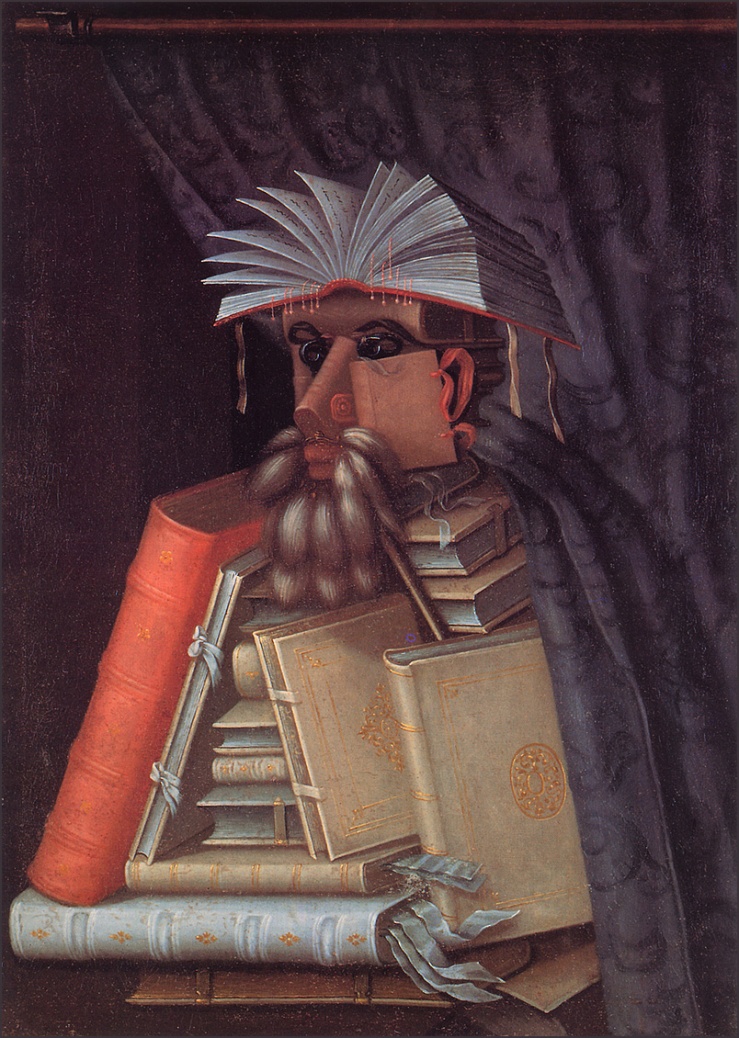
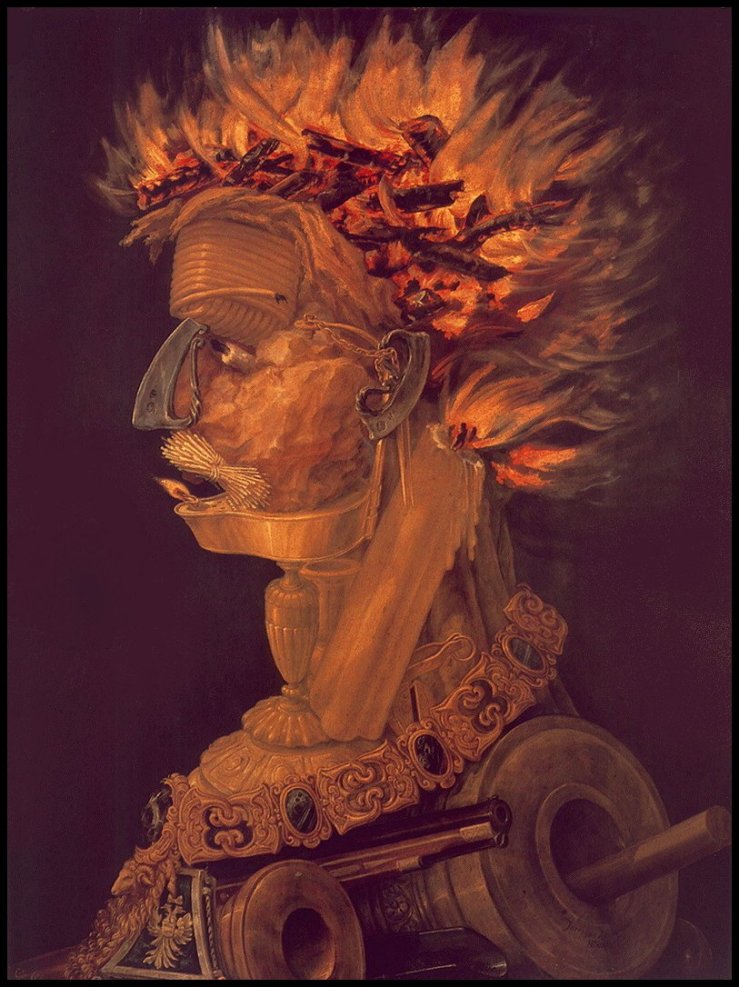
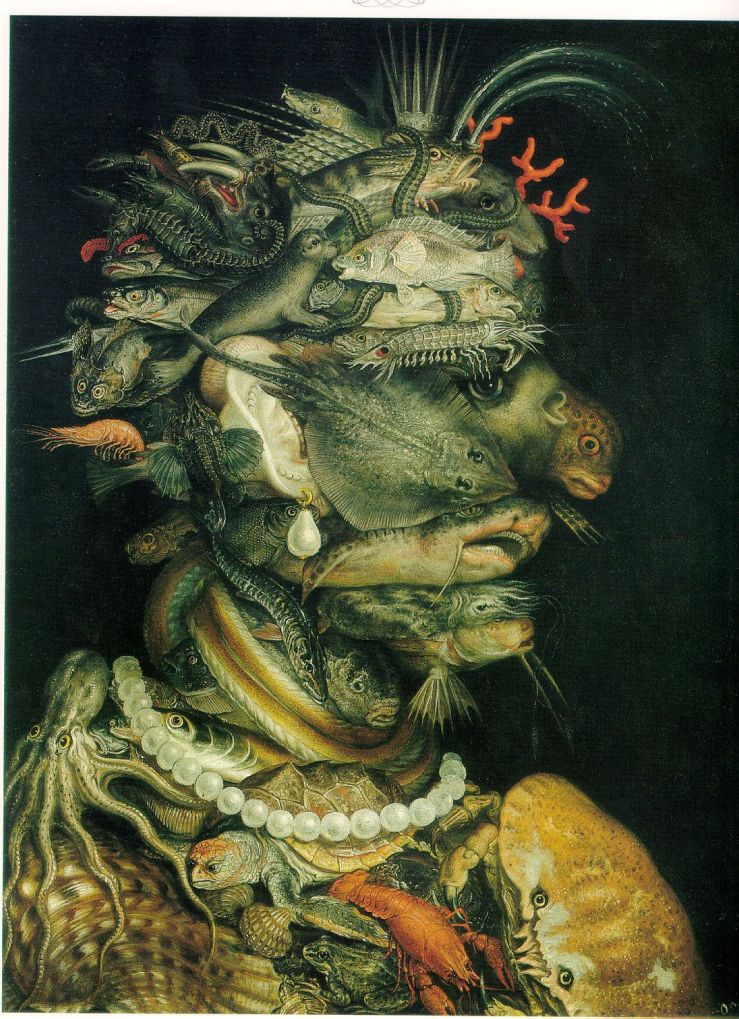
The last name he appropriates from the painter Arcimboldo, whose paintings are instructive in understanding the structure of 2666, a narrative that comprises hundreds of internal discrete narratives that define the shape of the larger picture.  The first name?

“They called me Benno after Benito Juarez,” said Archimboldi, “I suppose you know who Benito Juarez was.”

The dark heart of 2666, site of “Crimes,” is Santa Teresa, a transparent stand-in for Ciudad Juarez.

(Florita Almada, psychic medium and honest detective of “Crimes” channels Benito Juarez, the shepherd boy who became the president of Mexico; I’m tempted to quote here at some length but resist).

•Re: the previous point: I foolishly suggest that Archimboldi’s name is some sort of secret key. I don’t think there is a secret key. Just reading. Rereading.

•I seem to be focusing a lot on “The Part About Archimboldi” in this riff. I riffed about the first three books here, and “The Part About Crimes” here.

•But, still dwelling on “Archimboldi,” there’s a moment in it where an old alpine hermit confesses to murdering his wife by pushing her into a ravine. In some way his confession seems to answer all the puzzles of “Crimes,” all the unresolved abysses, all the falls (literal and metaphorical).  How can I justify this claim? How does a man confessing to a murder in a remote German border town in the 1950s answer the murders in Mexico in the 1990s? Or any of the other murders in the book? I suppose it’s a thematic echo, not a solution. Sweating late at night, reading past midnight, the moment struck me as larded with significance. I’m losing whatever thread I had . . .

•So to end—how to end? Perhaps I’ll raid my first review of 2666, from January, 2009—surely I must have remarked on the end of the book, or on its apparent inconclusiveness—

• —and so I did. And I don’t know if I can do better than this: 

Readers enthralled by the murder-mystery aspects of the novel, particularly the throbbing detective beat of “The Part About The Crimes,” may find themselves disappointed by the seemingly ambiguous or inconclusive or open-ended ending(s) of 2666. While the final moments of “The Part About Archimboldi” dramatically tie directly into the “Crimes” and “Fate” sections, they hardly provide the types of conclusive, definitive answers that many readers demand. However, I think that the ending is perfect, and that far from providing no answers, the novel is larded with answers, bursting at the seams with answers, too many answers to swallow and digest in one sitting. Like a promising, strangely familiar turn in the labyrinth, the last page of the book invites the reader back to another, previously visited corridor, a hidden passage perhaps, a thread now charged with new importance . . . 2666 is a book that demands multiple readings.

It was a good suggestion three years ago and I’ll take it up again.

[Ed. note: Biblioklept originally published this essay in July of 2012; since then, a licit e-book of 2666 has been published].


Sandokan, Nanni Balestrini’s Poetic Examination of Criminal Brutality

Nanni Balestrini’s novella Sandokan, in English translation from Melville House, tells the story of the rise of the Camorra crime syndicate in the small, poverty-stricken cities around Naples. Balestrini’s unnamed narrator occupies a fascinating insider-outsider perspective: one one hand, he, unlike many of his peers, does not join the gang, or “clan,” as its called–in fact, their behavior repulses him. On the other hand, he’s a native of the small town where Francesco Schiavone (aka Sandokan), Antonio Bardellino, and their henchman rule mercilessly, an eye-witness to the brutality and inhumanity of organized crime. The narrator is a sensitive young man who delineates clearly how the crime cartel was able to achieve such economic prosperity and power in the 70s, 80s, and 90s, detailing the various rackets the clan imposed upon the town, like stealing elections, peddling drugs, and manipulating the agribusiness that is the main source of income for average Neapolitan peasants. The narrator also explores why these small towns fall so easily into the terror of organized crime. The main reason: boredom stemming from little or nothing to do.

Balestrini’s narrator’s description of the Camorra is systematic, detailing the awful history and brutal practices of the syndicate in spare, concrete terms. His explications of the clan’s violence is not so much thrilling as  it is ugly, as the narrator always shows how “normal people” (his words) are cheated, killed, or otherwise harmed by the Camorra. The narrator’s tone is often journalistic but never clinical; he always shows what’s at stake for the “normal people,” how they are affected by these crimes. At times the narrator is wryly funny, a tone that results in large part from his observation that the townspeople, the people he grew up around, begin to normalize the violence. It becomes part of their daily lives and affects them so directly that it becomes casual, and the sensitive narrator is one of only a few not to bow to it, ignore it, or take part in it–yet the violence and crime is so overwhelming that to live with it is to live with absurdity. Balestrini employs a punctuation-free rhetorical style in Sandokan that captures the breathless energy and frustration of the narrator. While many readers might balk at the lack of commas, periods, or semi-colons, I found the technique quite liberating. It enhances the immediacy of the narrator’s voice, the rushed sense of importance to his tale. It also promotes sustained readings of the text–I read most of Sandokan in three enthralled sittings.

Sandokan has its cinematic twin in the 2008 film Gomorra, directed by Matteo Garrone. The film, like the book, illustrates the affect that crime has on a range of “normal people,” mostly occupants of a housing project outside of Naples. As in Sandokan, the ordinary citizens find that they have no choice but to choose between sides as an absurd, petty gang war ravages their already decimated landscape. Where Balestrini’s punctuation-free rhetoric allows readers closer access to his narrator’s pathos-driven story, Garrone lets his camera wander freely over the grim landscape without ever imposing any clear narrative structure. It is not until the film’s final third that the five disparate stories he tells coalesce, and even then, it remains unclear who is on whose side. What is clear is that the violence and crime is quickly stealing–and killing–another generation.

In an age where violence is sensationalized and glamorized, particularly in gangster films and TV shows (do I really need to list them?), Sandokan and Gomorra both lay bare the Darwinian cost of crime. In both narratives, the violence is mundane and inescapable, meaningless yet awful, and very, very dark. Neither narrative is didactic in the least–or even hopeful, for that matter–but their is an implicit suggestion that if only there were some alternative to the Camorra–libraries, social clubs, movie houses–there might be another prospect for the young people in this area.

I highly recommend both Sandokan and Gomorra. As an end note, I’d love to see more of Nanni Balestrini’s work come into English translation, perhaps via Antony Shugaar and Melville House, who’ve done a lovely job here.

[Ed. note: Biblioklept published a version of this review in January of 2010]


Suttree, Cormac McCarthy’s Grand Synthesis of American Literature

In his 1992 interview with The New York Times, Cormac McCarthy said, “The ugly fact is books are made out of books. The novel depends for its life on the novels that have been written.” McCarthy’s fourth novel, 1979’s Suttree is such a book, a masterful synthesis of the great literature — particularly American literature — that came before it. And like any masterful synthesis, Suttree points to something new, even as it borrows, lifts, and outright steals from the past. But before we plumb its allusions and tropes and patterns, perhaps we should overview the plot, no?

The novel rambles over several years in the life of Cornelius Suttree. It is the early 1950s in Knoxville, Tennessee, and Suttree ekes out a mean existence on the Tennessee River as a fisherman, living in a ramshackle houseboat on the edge of a shantytown. This indigent life is in fact a choice: Suttree is the college-educated son of an established, wealthy family. His choice is a choice for freedom and self-reliance, those virtues we like to think of, in our prejudicial manner, as wholly and intrinsically American. Suttree then is both Emersonian and Huck Finnian, a reflective and insightful man who finds his soul via a claim to agency over his own individuality, an individuality poised in quiet, defiant rebellion against the conforming forces of civilization. These forces manifest most pointedly in the Knoxville police, a brutal, racist organization, but we also see social constraint in the form of familial duty. One thinks of the final lines of Huckleberry Finn: “I reckon I got to light out for the Territory ahead of the rest, because Aunt Sally she’s going to adopt me and sivilize me and I can’t stand it. I been there before.”

Like Huck, Suttree aims to resist all forces that would “sivilize” him. His time on the river and in the low haunts of Tennessee (particularly the vice-ridden borough of McAnally) brings him into close contact with plenty of other outcasts, but also his conscience, which routinely mulls over its place in the world. Suttree is punctuated by–perhaps even organized by–several scenes of hallucination. Some of these psychotrips result from drunkeness, one comes from accidentally ingesting the wrong kind of mushrooms (or, the right kind, if that’s your thing), and the final one, late in the novel, sets in as Suttree suffers from a terrible illness. In his fever dream, a small nun–surely a manifestation of the guilt that would civilize us–accuses him–

Mr. Suttree it is our understanding that at curfew rightly decreed by law in that hour wherein night draws to its proper close and the new day commences and contrary to conduct befitting a person of your station you betook yourself to various low places within the shire of McAnally and there did squander several ensuing years in the company of thieves, derelicts, miscreants, pariahs, poltroons, spalpeens, curmudgeons, clotpolls, murderers, gamblers, bawds, whores, trulls, brigands, topers, tosspots, sots and archsots, lobcocks, smellsmocks, runagates, rakes, and other assorted and felonious debauchees.

The passage is a marvelous example of McCarthy’s stream-of-consciousness technique in Suttree, moving through the various voices that would ventriloquize Suttree, into the edges of madness, strangeness, and the sublimity of language. The tone moves from somber and portentous into bizarre imagery that blends humor and pathos. This is the tone of Suttree, a language that gives voice to transients and miscreants, affirming the dignity of their humanity even as it details the squalor of their circumstance.

It is among these criminals and whores, transvestites and gamblers that Suttree affirms his own freedom and humanity, a process aided by his comic foil, Gene Harrogate. Suttree meets Harrogate on a work farm; the young hillbilly is sent there for screwing watermelons. After his release, Harrogate moves to a shantytown in Knoxville. He’s the country mouse determined to become the city rat, the would-be Tom Sawyer to Suttree’s older and wiser Huck Finn. Through Harrogate’s endless get-rich-quick schemes, McCarthy parodies that most-American of tales, the Horatio Alger story. Simply put, the boy is doomed, on his  “way up to the penitentiary” as Suttree constantly admonishes. In one episode, Harrogate tries to buy arsenic from “a grayhaired and avuncular apothecary” to poison bats he hopes to sell to a hospital (don’t ask)–

May I help you? said the scientist, his hands holding each other.

I need me some strychnine, said Harrogate.

You need some what?

Strychnine. You know what it is dont ye?

Yes, said the chemist.

I need me about a good cupful I reckon.

Are you going to drink it here or take it with you?

Shit fire I aint goin to drink it. It’s poisoner’n hell.

It’s for your grandmother.

No, said Harrogate, craning his neck suspectly. She’s done dead

Suttree, unwilling father-figure, eventually buys the arsenic for the boy against his better judgment. The scene plays out as a wonderful comic inversion of William Faulkner’s “A Rose for Emily,” from which it is so transparently lifted. McCarthy borrows liberally from Faulkner here, of course, most notably in the language and style of the novel, but also in scenes like this one, or a later episode that plays off Faulkner’s comic-romantic story of a man and a woman navigating the aftermath of a flood, “Old Man.” Unpacking the allusions in Suttree surpasses my literary knowledge or skill, but McCarthy is generous, if oblique, with his breadcrumb trail. Take, for example, the following sentence: “Suttree with his miles to go kept his eyes to the ground, maudlin and muttersome in the bitter chill, under the lonely lamplight.” The forced phrase “miles to go” does not immediately present itself as a reference to Robert Frost’s famous poem, yet the direction of the sentence retreats into the history of American poetry; with its dense alliteration and haunted vowels, it leads us into Edgar Allan Poe territory. Only a few dozen pages later, McCarthy boldly begins a chapter with theft: “In just spring the goatman came over the bridge . . .” The reference to e.e. cummings explicitly signifies McCarthy’s intentions to play with literature. Later in the book, while tripping on mushrooms in the mountains, Suttree is haunted by “elves,” the would-be culprits in Frost’s poem “Mending Wall.” The callback is purposeful, but tellingly, McCarthy’s allusions are not nearly as fanciful as their surface rhetoric might suggest: the goatman does not belong in Knoxville–he’s an archaic relic, forced out of town by the police; the elves are not playful spirits but dark manifestations of a tortured psyche.

Once one spots the line-lifting in Suttree it’s hard to not see it. What’s marvelous is McCarthy’s power to convert these lines, these riffs, these stories, into his own tragicomic beast. An early brawl at a roadhouse recalls the “Golden Day” episode of Ralph Ellison’s Invisible Man; a rape victim’s plight echoes Hubert Selby’s “Tralala”; we find the comic hobos of John Steinbeck’s Cannery Row–we even get the road-crossing turtle from The Grapes of Wrath. A later roadhouse chapter replays the “Circe/Nighttown” nightmare in James Joyce’s Ulysses. Ulysses is an easy point of comparison for Suttree, which does for Knoxville what Joyce did for Dublin. Suttree echoes Ulysses’s language, both in its musicality and appropriation of varied voices, as well as its ambulatory structure, its stream-of-consciousness technique, its rude earthiness, and its size (nearly 600 pages). But, as I argued earlier, there’s something uniquely American about Suttree, and its literary appropriations tend to reflect that. Hence, we find Mark Twain, Herman Melville, Ernest Hemingway, Walt Whitman, Emerson and Thoreau, Emily Dickinson, and William Carlos Williams, to name just a few writers whose blood courses through this novel (even elegant F. Scott Fitzgerald is here, in an unexpected Gatsbyish episode late in the novel).

Making a laundry list of writers is weak criticism though, and these sources–all guilty of their own proud plagiarisms–are mentioned only as a means to an end, to an argument that what McCarthy does in Suttree is to synthesize the American literary tradition with grace and humor, while never glossing over its inherent dangers and violence. So, while it appropriates and plays with the tropes of the past, Suttree is still pure McCarthy. Consider the following passage, which arrives at the end of a drunken, awful spree, Suttree locked up for the night–

He closed his eyes. The gray water that dripped from him was rank with caustic. By the side of a dark dream road he’d seen a hawk nailed to a barn door. But what loomed was a flayed man with his brisket tacked open like a cooling beef and his skull peeled, blue and bulbous and palely luminescent, black grots his eyeholes and bloody mouth gaped tonguless. The traveler had seized his fingers in his jaws, but it was not alone this horror that he cried. Beyond the flayed man dimly adumbrate another figure paled, for his surgeons move about the world even as you and I.

Suttree’s dark vision points directly toward the language of McCarthy’s next novel, 1985’s Blood Meridian, roundly considered his masterpiece. Critics who disagree tend to point to Suttree as the pinnacle of McCarthy’s writing. I have no interest at this time in weighing the books against each other, nor do I think that doing so would be especially enlightening. For all of their sameness, they are very different animals: Suttree provides us intense access to its hero’s consciousness, where Blood Meridian always keeps the reader on the outside of its principals’ souls (if those grotesques could be said to have souls). And while Blood Meridian does display some humor, it is the blackest and driest humor I’ve ever read. Suttree is broader and more compassionate; it even has a fart joke. Blood Meridian, at least in my estimation (and many critics will contend this notion) has no flawed episodes; much of this results from the book’s own internal program–it resists love, compassion, and even human dignity. In contrast, Suttree is punctuated by two deaths the audience is meant to read as tragic, yet I found it impossible to do so. The first is the death of Suttree’s child, whom he has abandoned, along with its mother. As such, he is not permitted to take part in the funeral, observing the process rather from its edges. The second tragedy is the death of Suttree’s young lover in a landslide. The book begs us to empathize with Suttree, just as he often empathizes with the marginal figures in the novel, but ultimately these tragedies are a failed ploy. They underwrite a sublime encounter with death for Suttree, an encounter that deepens and enriches his character while paradoxically freeing him from the burdens of social duty and familial order. McCarthy is hardly alone in such a move; indeed, it seems like the signature trope of American masculine literature to me. It’s the move that Huck Finn wishes to make when he promises to light out for the Territory to escape the civilizing body of Aunt Sally; it’s the ending that Hemingway was compelled to give to Frederic Henry at the end of A Farewell to Arms; it’s all of Faulkner, with his mortification of fatherhood and the dramatic responsibility fatherhood entails. It is a cost analysis that neglects any potential benefits.

But these are small criticisms of a large, beautiful, benevolent novel, a book that begs to be reread, a rambling picaresque of comic and tragic proportions. “I learned that there is one Suttree and one Suttree only,” our hero realizes, but this epiphany is set against a larger claim. Near the end of the novel, Suttree goes to check on an old ragman who he keeps a watchful eye on. He finds the man dead, his shack robbed, his body looted. Despairing over the spectacle’s abject lack of humanity, Suttree cries, “You have no right to represent people this way,” for “A man is all men. You have no right to your wretchedness.” Here, Suttree’s painful epiphany is real and true, an Emersonian insight coded in the darkest of Whitman’s language. If there is one Suttree and one Suttree only, he is still beholden to all men; to be anti-social or an outcast is not to be anti-human. Self-hood is ultimately conditional on others and otherness. To experience the other’s wretchedness is harrowing; to understand the other’s wretchedness and thus convert it to dignity is life-affirming and glorious. Suttree is a brilliant, bold, marvelous book. Very highly recommended.

[Ed. note—Biblioklept originally published a version of this review on November 27, 2010].


Airships, Barry Hannah’s Cult Classic of Violent Humor

In his 1978 collection Airships, Barry Hannah sets stories in disparate milieux, from the northern front of the Civil War, to an apocalyptic future, to the Vietnam War, to strange pockets of the late-twentieth century South. Despite the shifts in time and place, Airships is one of those collections of short stories that feels somehow like an elliptical, fragmentary novel. There are the stories that correspond directly to each other — the opener “Water Liars,” for instance, features (presumably, anyway), the same group of old men as “All the Old Harkening Faces at the Rail.” The old men love to crony up, gossip, tell tall tales. An outsider spoils the fun in “Water Liars” by telling a truth more terrible than any lie; in “Harkening,” an old man shows off his new (much younger) bride. These stories are perhaps the simplest in the collection, the homiest, anyway, or at least the most “normal” (whatever that means), yet they are both girded by a strange darkness, both humorous and violent, that informs all of Airships.

We find that humor and violence in an outstanding trio of Civil War stories (or, more accurately, stories set during the Civil War). The narrator of “Dragged Fighting from His Tomb,” a Confederate infantryman relates a tale of heroic slaughter with a hypberbolic, phallic force. Observe—

I knew the blueboys thought they had me down and were about ready to come in. I was in that position at Chancelorsville. There should be about six fools, I thought. I made the repeater, I killed four, and the other two limped off. Some histrionic plumehead was raising his saber up and down on the top of a pyramid of crossties. I shot him just for fun. Then I brought up another repeater and sprayed the yard.

Later, the narrator defects, switches to the Union, and claims he kills Jeb Stuart, a figure that towers over the Civil War tales. The narrator of “Dragged Fighting” hates Stuart; the narrator of “Knowing He Was Not My Kind Yet I Followed” is literally in love with the General. In contrast to the narrator of “Dragged Fighting,” the speaker in “Knowing” — an avowed “sissy” whom the other soldiers openly detest — hates the violence and madness of war—

We’re too far from home. We are not defending our beloved Dixie anymore. We’re just bandits and maniacal. The gleam in the men’s eyes tells this. Everyone is getting crazier on the craziness of being simply too far from home for decent return. It is like Ruth in the alien corn, or a troop of men given wings over the terrain they cherished and taken by the wind to trees they do not know.

He despairs when he learns of Jeb Stuart’s death. In the final Civil War story, “Behold the Husband in His Perfect Agony,” a Union spy is given the task to communicate news of Stuart’s death through enemy lines. Rather than offering further explication, let me instead point you, dear reader, to more of Hannah’s beautiful prose, of which I have not remarked upon nearly enough. From “Behold the Husband” —

Isaacs False Corn, the Indian, the spy, saw Edison, the Negro, the contact, on the column of an inn. His coat was made of stitched newspapers. Near his bare feet, two dogs failed earnestly at mating. Pigeons snatched at the pieces of things in the rushing gutter. The rains had been hard.

The short, descriptive passage rests on my ears like a poem. Hannah, who worked with Gordon Lish, evinces in his writing again and again that great editor’s mantra that writing is putting one sentence after another.

Although set in the Vietnam War, “Midnight and I’m not Famous Yet” seems an extension of the Civil War stories. In it, an officer from a small Southern town goes slowly crazy from all the killing, yet, like the narrator of “Dragged Fighting,” he presents himself as a warrior. Above all though, he laments that the war has robbed him of some key, intermediary phase of his late youth, a phase he can’t even name—

The tears were out of my jaws then. Here we shot each other up. All we had going was the pursuit of horror. It seemed to me my life had gone straight from teen-age giggling to horror. I had never had time to be but two things, a giggler and a killer.

This ironic sense of a “pursuit of horror” pervades Airships, particularly in the collection’s most apocalyptic visions. “Eating Wife and Friends” posits an America where food shortages and material scarcity leads people to eating leaves and grass — and then each other. In “Escape to Newark,” the environment is wildly out of balance—

In August it’s a hundred fifty degrees. In December it’s minus twenty-five and three feet of snow in Mississippi. In April the big trees explode.

A plan is made to “escape” these conditions via a rocket, but of course there’s not enough fuel to get past Newark. In Airships, modes of flight are transcendent but ultimately transient. Gravity’s pull is heavy stuff.

Just as Hannah’s war stories are not really war stories, his apocalypse tales are really about human relationships, which he draws in humor, pathos, and dark cynicism. In “Green Gets It,” an old man repeatedly attempts his suicide, only to fail again and again. His suicide note, written to his daughter, is scathing and shocking and sad and hilarious and wise–

My Beloved Daughter,

Thanks to you for being one of the few who never blamed me for your petty, cheerless and malign personality. But perhaps you were too busy being awful to ever think of the cause. I hear you take self-defense classes now. Don’t you understand nobody could take anything from you without leaving you richer? If I thought rape would change you, I’d hire a randy cad myself. I leave a few dollars to your husband. Bother him about them and suffer the curse of this old pair of eyes spying blind at the minnows in the Hudson.

Your Dad,

Crabfood

Although Hannah explores the darkest gaps of the soul in Airships, he also finds there a shining kernel of love in the face of waste, depravity, violence, and indifference. This love evinces most strongly perhaps in Airships trio of long stories. These tales, which hover around 30 pages, feel positively epic set against the other stories in the collection, which tend to clock in between five and ten pages. The first long story, “Testimony of Pilot,” details the development of a boyhood friendship over a few decades. It captures the strange affections and rivalries and unnameable bonds and distances that connect and disconnect any two close friends. The second of the long tales is “Return to Return,” a tragicomic Southern drama in the Oedipal vein (with plenty of tennis and alcoholism to boot). As in “Testimony of Pilot,” Hannah finds some measure of redemption, or at least solace, for his characters in their loving friendship, yet nothing could be more unsentimental. The final long story, which closes the collection, is “Mother Rooney Unscrolls the Hurt,” a daring work of stream of consciousness that seems to both respond to — and revise — Katherine Anne Porter’s “The Jilting of Granny Weatherall.” The story concludes (and of course concludes the volume) with a vision of love that corresponds to the imagery of The Pietà, a kind of selflessness that ironically confirms the self as an entity that exists in relation to the pain of others.

I could keep writing of course — I’ve barely touched on Hannah’s surrealism, a comic weirdness that I’ve never seen elsewhere; it is Hannahesque, I suppose. Nor have I detailed Hannah’s evocations of regular working class folk, fighting and drinking and divorcing and raising children (not necessarily in that order). Airships is a world too rich and fertile to unpack in just one review, and I’ve already been blathering too long, I fear, when what I really want  to do is just outright implore you, kind reader, to find it and start reading it immediately. Very highly recommended.

[Editorial note: Biblioklept published a version of this review on March 20th, 2011]

Mikhail Bulgakov’s Novel The Master and Margarita Reviewed

masterandmargarita4

In his introduction to Mikhail Bulgakov’s novel The Master and Margarita, Richard Pevear (who translated the book with Larissa Volokhonsky) notes

the qualities of the novel itself — its formal originality, its devastating satire of Soviet life, and of Soviet literary life in particular, its ‘theatrical’ rendering of the Great Terror of the thirties, the audacity of its portrayal of Jesus Christ and Pontius Pilate, not to mention Satan.

Pevear also offers a concise (if mechanical) summary:

The novel in its definitive version is composed of two distinct but interwoven parts, one set in contemporary Moscow, the other in ancient Jerusalem (called Yershalaim). Its central characters are Woland (Satan) and his retinue, the poet Ivan Homeless, Pontius Pilate, an unnamed writer known as ‘the master’, and Margarita. The Pilate story is condensed into four chapters and focused on four or five large-scale figures. The Moscow story includes a whole array of minor characters. The Pilate story, which passes through a succession of narrators, finally joins the Moscow story at the end, when the fates of Pilate and the master are simultaneously decided.

As you might gather from its translator’s descriptions, there’s a lot going on in The Master and Margarita. 

Bulgakov satirizes early Soviet life, particularly focusing on the phonies and fops who populate Moscow’s art scene. This aspect of the narrative is full of disappearances; characters are taken away forever by the secret police. Bulgakov elides the secret police from the reader, a brilliant rhetorical move that heightens the book’s paranoia. The paranoid comedy edges quickly into horror though as the reality of living in such confined spaces and under such controlled surveillance bleeds into Bulgakov’s fantasy.

Indeed, the realities of life in the Soviet police state (“No papers, no person”) come across as far scarier than the supernatural characters of The Master and Margarita. Woland’s retinue, in particular his cat Behemoth (who seems to grace—can that be the right verb?—the covers of most editions of the novel), imbue the novel with a compelling manic energy. The most memorable sequences for most readers will likely involve Woland’s troupe’s antics, including their wild performance at the Variety Theatre, which climaxes in this bit of comic violence before culminating in a rush of greed and gratuitous nudity:

And an unheard-of thing occurred. The fur bristled on the cat’s back, and he gave a rending miaow. Then he compressed himself into a ball and shot like a panther straight at Bengalsky’s chest, and from there on to his head. Growling, the cat sank his plump paws into the skimpy chevelure of the master of ceremonies and in two twists tore the head from the thick neck with a savage howl.

The two and a half thousand people in the theatre cried out as one. Blood spurted in fountains from the torn neck arteries and poured over the shirt-front and tailcoat. The headless body paddled its feet somehow absurdly and sat down on the floor. Hysterical women’s cries came from the audience. The cat handed the head to Fagott, who lifted it up by the hair and showed it to the audience, and the head cried desperately for all the theatre to hear:

‘A doctor!’

(Don’t worry, Bengalsky gets his head back. Sort of).

Another highlight of the book is the Walpurgis Night episode—Chapter 23, “The Great Ball at Satan’s”—which I’d argue can stand on its own, free of context, as a lovely, dark, bizarre short story. Margarita plays hostess to a seemingly-endless parade of “kings, dukes, cavaliers, suicides, poisoners, gallowsbirds, procuresses, prison guards and sharpers, executioners, informers, traitors, madmen, sleuths, seducers,” who arrive via fireplace, their corpses reanimated to take part in the grand dance. Bulgakov cribs freely from history, populating the episode with condemned persons obscure and infamous alike.

The Walpurgisknacht episode highlights The Master and Margaritastrong Easter/Faust theme, which plays out for several characters who are reborn (figuratively or otherwise). The least interesting of these by far is the master himself. But perhaps this is unfair. It’s entirely plausible that the master is the storyteller of The Master and Margarita. In any case, his unnamed novel (within the text) depicts an alternate version of Jesus of Nazareth’s crucifixion, and it’s here that we find what I take to be The Master and Margarita’s most interesting and complex character, “the fifth procurator of Judea, Pontius Pilate.” The episodes with Pilate (who employs his own secret police, a wonderful parallel to the Soviet setting) offer a kind of moral ballast to the supernatural sequences, which fluctuate between manic-comic anxiety and big-R Romanticism. Of all the souls in turmoil in The Master and Margarita’s, I found the depiction of Pilate’s troubles the most profound.

The Master and Margarita’s lurching structure threatens narrative coherence until the novel’s final moments, when the master meets his creation. The moment is unexpectedly poignant, and does much to amend some of the novel’s ungainliness. The middle sections in particular get bogged down, as Bulgakov subjects his Muscovite extras to all sorts of fates (some more terrible than others). While some of these episodes are funny, and they certainly give the book some of its satirical power, they ultimately read as variations on a theme. I found my eyes glazing over in the novel’s epilogue when Bulgakov decides to check in on the survivors.

I’ve failed to remark on so much of The Master and Margarita, and I’m certain that much of its rich allusive texture was lost on me. (I should point out here how helpful the end notes of my edition were). Persons interested in early Soviet life who have not yet found their way to Bulgakov’s novel will wish to do so (as well as the work of Bulgakov’s contemporary Sigizmund Krzhizhanovsky); the novel also makes a strange but worthy companion piece to William Gaddis’s enormous Faust tale The RecognitionsAlthough The Master and Margarita sags at times, at its finest moments—of which there are many—it is funny, dark, and engrossing.

Cartoon College, A Documentary Featuring Chris Ware, Charles Burns, Art Spiegelman and Other Comics Legends

CCSketchResize

In the opening scene of Josh Melrod and Tara Wray’s new documentary Cartoon College, aspiring cartoonist Ryland Ianelli lays out the reality that, despite all the progress the medium has made as an art form worthy of respect, comic books are still outré:  “It’s gotten easier to talk to people who are open to the idea of comics being worthwhile—but at the point you say, Yes I’m going to school for comics, they’re completely ready to dismiss you.”

Cartoonists have always been outsiders—even in art schools, a traditional gathering spot for outsiders—and it’s this feeling of alienation and displacement that undergirds the emotional platform of Cartoon College. The film is not just about the Center for Cartoon Studies (CSS), a highly-selective two year MFA program founded in 2005 in White River Junction, Vermont, or the cadre of master cartoonists who inspired the school, and, in some cases teach there. For plenty of comix nerds (like me), it’s enough to see masters like Art Spiegelman, Charles Burns, Lynda Barry, and Chris Ware talk about the art, medium, and business of cartooning. But this documentary offers more. Cartoon College succeeds because it tells the genuinely moving and engaging story of its students, self-described outcasts who find a sense of community and even family in the program.

Melrod and Wray take us into the extreme demands of the CSS program. In the first year (“boot camp”), students practice fundamentals—drawing, theory, writing, history. In the second year, the students produce a thesis—a finished work of some kind—to determine if they pass the program and receive an MFA. All this work is to ensure that students “will be ready to face the uncertainty of a career in one of the most labor-intensive, drudgery inducing art forms,” as the film puts it.

The faculty (all distinguished cartoonists,  including Stephen Bissette, James Sturm, and Alec Longstreth, who are featured prominently in the film) repeatedly remind students and audience alike that most of cartooning is labor-intensive drudgery: it’s not really that fun, it requires lots of discipline, and most people can’t cut it. The CSS, like most art schools, employs a workshop technique to help students grow, get feedback—and also, implicitly, as a means of maintaining quality control. Workshop scenes and other critiques are often some of the most painful moments in the film, as they highlight the very personal stakes for the aspiring cartoonists, who quite literally put their lives into their work.

Melrod and Wray wisely compose their narrative around just a few of these students, while giving us enough scenes with others to flesh out the film. Blair Sterrett gives the film a definitive arc. He’s clearly a troubled, struggling artist, trying to channel his former experiences as a Mormon missionary into a thesis, but as the deadline approaches, it’s clear his book’s unfinished. Sterrett’s scenes (particularly an early critique) are very moving, and—a bit of a spoiler—there’s a triumphant feeling when he returns to the CSS to finish his MFA. 

We find another arc in Jen Vaughn, who has too many jobs and too many ideas. Of all the student artists, she seems the most open to the camera, and her self-assured posture by turns belies a greater vulnerability and depth. In one illuminating scene at the MoCCA Fest, Vaughn tries to pique a muted festival goer’s interest in her project Menstruation Station; when he walks away without seeming to say anything we catch a glimpse of weariness bordering on desperation.

There’s also Al Wesolowsky, who at 61 is the oldest student. An archaeologist at Boston University, Wesolowsky tries his hand at the CSS program despite his self-admitted limitations as a draftsman. In some ways he’s the soul of the film. At one point he delivers a brief monologue wherein he describes the loneliness he feels at having no family, but the pleasure he’s found in a makeshift family at CSS.

Loneliness and alienation are perhaps the bedrock themes of comix and cartooning, as anyone who’s read Spiegelman or Ware or Burns—or really any of the master cartoonists interviewed in Cartoon College—can attest. Spiegelman is the first professional to pop up in the film, after the filmmakers have already introduced us to the students, and one of the first comments he makes is that comix allows cartoonists to come into contact with “a bunch of other outcasts.” This sentiment is repeated again and again, by students, teachers, and masters alike; we learn that Ryland Ianelli was voted Prom Queen by the cruel students of his high school; student Casey Bohn tells us that everyone in his small town thought he was “gay or British”; Lynda Barry puts it plain: “Childhood seemed to me like it lasted too long.”

Of all the master cartoonists on screen, I was most captivated by Chris Ware, who comes across as reflective, cerebral, and even philosophical. He points out that cartoonists are always “sifting through generations”,” handing down tropes, skills, ideas. Ware, chronicler of loneliness, perhaps makes the strongest case for cartoonists-as-community.

The idea that the students need to foster a community is reinforced by Bissette, who tells the that they must share contacts, share ideas, and be colleagues. Bissette and the other CSS instructors repeatedly emphasize the publishing dimension of cartooning, paying special attention to the idea that these cartoonists can self-publish. Cartoon College is larded with shots of students hand-crafting their art, and Bissette likens what they are doing to Warhol and his Factory. He also points out that this new generation’s desire is not to draw Spider-Man or Batman but their own creations.

An energetic scene at the MoCCA Fest shows this cottage industry at work, as artists buy and trade for each other’s work. But the instructors and pros are very clear—or try to be clear—about the economic realities most cartoonists will face. Ware and Burns point out that commercial illustration is a necessity to feed their other projects. Juxtaposed with these moments, our students describe their dreams of a comfortable retirement and book deals, a moment undercut by Lynda Barry gleefully pointing out that she makes most of her moeny selling “shit on E-bay.” 

It might have been tempting for Melrod and Wray to cram all the footage they had of famous cartoonists like Barry, Françoise Mouly, Scott McCloud, and others into Cartoon College, but to the filmmakers’ credit they use the masters sparingly. Art Spiegelman tells us at one point that “We think in bursts of language, not in long Jamesian sentences…the number of words that might be able to fit in a speech balloon are the core of a linguistic thought.” The insight is intended for cartooning, but the filmmakers apply it to their medium, letting the camera do much of the work for them,  offering only the most essential moments (like when Charles Burns completes a sketch and the student audience breaks into applause). Cartoon College is at its best when it shows us the difficult experiences of the students intercut with commentary by the seasoned, successful professionals, who understand precisely the pain these people are undergoing. 

Before I started watching Cartoon College, I wondered who it was for. My interest in Spiegelman, Ware, Burns, et al. was enough to prod my interest (and the soundtrack featuring Archers of Loaf, Portastatic, and Tortoise didn’t hurt)—but would the film appeal to, uh, non-geeks? Ultimately, I think the documentary is about the drive toward art and self-expression, and the ways that communities and relationships can form around this drive. Cartoon College offers an intriguing story about real people trying to do something that they love, and I enjoyed that. This is a film about the impetus, motivation, and hard, hard work that goes into the creative process. Great stuff.

Website and trailer:

The Collective Dream of the Chums of Chance (A Short Pynchon Riff)

1. This is one of the most extraordinary passages I’ve read so far in Pynchon’s Against the Day (pages 422-24 of my Penguin hardback).

It comes almost at the end of Iceland Spar, the second of the AtD’s five books, working as a surreal, dream-logic climax to the chapter.

Our heroes the Chums of Chance experience an existential identity crisis, one that makes them wonder if they themselves were mere dreamers, readers of the dime novels that chronicled their adventures, and not, y’know, actual adventurers:

Meantime, now and then in the interstices of what was after all not a perpetual midwestern holiday, the former crew of the Inconvenience became aware of doubts creeping in. What if they weren’t harmonica players? really? If it was all just some elaborate hoax they’d chosen to play on themselves, to keep distracted from a reality too frightening to receive the vast undiscriminating light of the Sky, perhaps the not-to-be-spoken-of betrayal now firmly installed at the heart of the . . . the Organization whose name curiously had begun to escape them . . . some secret deal, of an unspecified nature, with an ancient enemy . . . but they could find no entries in any of the daily Logs to help them remember. . . .

Had they gone, themselves, through some mutation into imperfect replicas of who they once were? meant to revisit the scenes of unresolved conflicts, the way ghosts are said to revisit places where destinies took a wrong turn, or revisit in dreams the dreaming body of one loved more than either might have known, as if whatever happened between them could in that way be put right again? Were they now but torn and trailing afterimages of clandestine identities needed on some mission long ended, forgotten, but unwilling or unable to be released from it? Perhaps even surrogates recruited to stay behind on the ground, allowing the “real” Chums to take to the Sky and so escape some unbearable situation? None of them may really ever have been up in a skyship, ever walked the exotic streets or been charmed by the natives of any far-off duty station. They may only have once been readers of the Chums of Chance Series of boys’ books, authorized somehow to serve as volunteer decoys. Once, long ago, from soft hills, from creekside towns, from libraries that let kids lie on the floor where it’s cool and read the summer afternoons away, the Chums had needed them . . . they came.

WANTED Boys for challenging assignments, must be fit, dutiful, ready, able to play the harmonica (“At a Georgia Camp Meeting” in all keys, modest fines for wrong notes), and be willing to put in long hours of rehearsal time on the Instrument. . . Adventure guaranteed!

So that when the “real” Chums flew away, the boys were left to the uncertain sanctuary of the Harmonica Marching Band Training Academy. . . . But life on the surface kept on taking its usual fees, year by year, while the other Chums remained merrily aloft, kiting off tax-free to assignments all over the world, perhaps not even remembering their “deps” that well anymore, for there was so much to occupy the adventurous spirit, and the others— “groundhogs” in Chums parlance—had known, surely, of the risks and the costs of their surrogacy. And some would drift away from here as once, already long ago, from their wholesome heartland towns, into the smoke and confusion of urban densities unimagined when they began, to join other ensembles playing music of the newer races, arrangements of Negro blues, Polish polkas, Jewish klezmer, though others, unable to find any clear route out of the past, would return again and again to the old performance sites, to Venice, Italy, and Paris, France, and the luxury resorts of old Mexico, to play the same medleys of cakewalks and rags and patriotic airs, to sit at the same café tables, haunt the same skeins of narrow streets, gaze unhappily on Saturday evenings at the local youngsters circulating and flirting through the little plazas, unsure whether their own youth was behind them or yet to come. Waiting as always for the “true” Chums to return, longing to hear, “You were splendid, fellows. We wish we could tell you about everything that’s been going on, but it’s not over yet, it’s at such a critical stage, and the less said right now the better. But someday . . .”

“Are you going away again?”

“So soon?”

“We must. We’re just so sorry. The reunion feast was delicious and much appreciated, the harmonica recital one we shall never forget, especially the ‘coon’ material. But now . . .”

So, once again, the familiar dwindling dot in the sky.

“Don’t be blue, pal, it must’ve been important, they really wanted to stay this time, you could tell.”

“What are we going to do with all this extra food?”

“And all the beer nobody drank!”

“Somehow I don’t think that’ll be a problem.”

But that was the beginning of a certain release from longing, as if they had been living in a remote valley, far from any highways, and one day noticed that just beyond one of the ridge-lines all this time there’d been a road, and down this road, as they watched, came a wagon, then a couple of riders, then a coach and another wagon, in daylight which slowly lost its stark isotropy and was flowed into by clouds and chimney smoke and even episodes of weather, until presently there was a steady stream of traffic, audible day and night, with folks beginning to venture over into their valley to visit, and offering rides to towns nearby the boys hadn’t even known existed, and next thing anybody knew, they were on the move again in a world scarcely different from the one they had left. And one day, at the edge of one of these towns, skyready, brightwork gleaming, newly painted and refitted and around the corner of a gigantic hangar, waiting for them, as if they had never been away, there was their ship the good old Inconvenience. And Pugnax with his paws up on the quarterdeck rail, tail going a mile a minute, barking with unrestrained joy.

2. Long passage, so short riff:

3. First (or third, if my enumeration is honest), let me point out that this passage recalls a similar identity transference that happened earlier in the novel to Reef Traverse when he reads a Chums of Chance novel.

4. Which, to rehash the point of the riff I linked to in point 3 above, is to say that the passage is very much about reader-identification, about the ways that we dream ourselves into the novels we read—that the places they occupy are very real.

So much of Against the Day is about doubling, about secret identities, secret powers, secret lives—the invisible (the word “invisible” pops up again and again and again in this book)—that we can lead these whole other lives in our imagination, and that books fuel these lives, etc.

5. This book of Against the Day is named for Iceland spar, a crystal with double-refraction properties. Earlier, the stage magician/minor character Luca Zombini (“Light Zombie”?) reveals that he’s actually split people into two versions of themselves (evidence of such doppelgangers are scattered throughout the novel) using the mineral in his shows.

When our Chums finally reassume the mantles of their “true identities” we’re told that “they were on the move again in a world scarcely different from the one they had left” — are these the same Chums, the same aircrew, the same adventurers? The adverb “scarcely” seems to work some strange magic here.

6. In any case, their loyal hound Pugnax identifies them as the real McCoy, his “tail going a mile a minute, barking with unrestrained joy.”

I’ll admit to feeling some of that joy myself.

“…a spectral cavalry, faces disquietingly wanting in detail, eyes little more than blurred sockets…” (Another Riff on Thomas Pynchon’s Against the Day)

  1. Another riff on/citation from Thomas Pynchon’s Against the Day.
  2. In this episode, our heroes, Chums of Chance Chick Counterfly (chief science officer) and Darby Suckling (chief horndog) have found their way to an off-brand time machine, managed and (shoddily) maintained by Dr. Zoot (whose doctorate seems unlikely). Dr. Zoot sends the boys (ostensibly) to the future for a brief glimpse:

They seemed to be in the midst of some great storm in whose low illumination, presently, they could make out, in unremitting sweep across the field of vision, inclined at the same angle as the rain, if rain it was—some material descent, gray and wind-stressed—undoubted human identities, masses of souls, mounted, pillioned, on foot, ranging along together by the millions over the landscape accompanied by a comparably unmeasurable herd of horses. The multitude extended farther than they could see—a spectral cavalry, faces disquietingly wanting in detail, eyes little more than blurred sockets, the draping of garments constantly changing in an invisible flow which perhaps was only wind. Bright arrays of metallic points hung and drifted in three dimensions and perhaps more, like stars blown through by the shock waves of the Creation. Were those voices out there crying in pain? sometimes it almost sounded like singing. Sometimes a word or two, in a language almost recognizable, came through. Thus, galloping in unceasing flow ever ahead, denied any further control over their fate, the disconsolate company were borne terribly over the edge of the visible world. . . .

The chamber shook, as in a hurricane. Ozone permeated its interior like the musk attending some mating dance of automata, and the boys found themselves more and more disoriented. Soon even the cylindrical confines they had entered seemed to have fallen away, leaving them in a space unbounded in all directions. There became audible a continuous roar as of the ocean—but it was not the ocean—and soon cries as of beasts in open country, ferally purring stridencies passing overhead, sometimes too close for the lads to be altogether comfortable with—but they were not beasts. Everywhere rose the smell of excrement and dead tissue.

Each lad was looking intently through the darkness at the other, as if about to inquire when it would be considered proper to start screaming for help.

“If this is our host’s idea of the future—” Chick began, but he was abruptly checked by the emergence, from the ominous sweep of shadow surrounding them, of a long pole with a great metal hook on the end, of the sort commonly used to remove objectionable performers from the variety stage, which, being latched firmly about Chick’s neck, had in the next instant pulled him off into regions indecipherable. Before Darby had time to shout after, the Hook reappeared to perform a similar extraction on him, and quick as that, both youngsters found themselves back in the laboratory of Dr. Zoot. The fiendish “time machine,” still in one piece, quivered in its accustomed place, as if with merriment. (403-04)

  1. I think the most obvious interpretation here is that our Chums witness part of a battle of the Great War, which is where Against the Day seems to be heading.

  1. What I find most fascinating, though, is the way that Pynchon moves from the physical to the metaphysical in the series of images the Chums witness.

We get an image of “undoubted human identities, masses of souls, mounted, pillioned, on foot, ranging along together by the millions over the landscape accompanied by a comparably unmeasurable herd of horses” seems simultaneously concrete and metaphysical, specific but also hyperbolic.

The scene continues to tread this line—we witness “a spectral cavalry, faces disquietingly wanting in detail, eyes little more than blurred sockets, the draping of garments constantly changing in an invisible flow which perhaps was only wind.”

On one hand, our disoriented Chums (to whose perspective Pynchon limits us) perceive ghosts here (almost cartoonish ghosts, I might add, of the holes-cut-out-for-eyes variety); on the other hand, the “blurred sockets” suggest gas masks and the “constantly changing” garments could perhaps be the variety of uniforms (and armor) of the soldiers.

Continuing: “Bright arrays of metallic points hung and drifted in three dimensions and perhaps more” — Bullets? Bayonets? Missiles? The concrete image is then likened to “stars blown through by the shock waves of the Creation.” The physical shifts into the metaphysical again as Pynchon sends “the disconsolate company . . . terribly over the edge of the visible world.”

  1. Here, the Chums seem to experience the Great War as an intensely compressed allegorical sensation.
  • The second paragraph in the above citation moves the boys into “a space unbounded in all directions” where they perceive “a continuous roar as of the ocean—but it was not the ocean—and soon cries as of beasts in open country, ferally purring stridencies passing overhead, sometimes too close for the lads to be altogether comfortable with—but they were not beasts.”

  • The Chums have no language to describe what they hear; Pynchon has to mediate the similes available to them in negation. But we (and Darby and Chick, of course) know that this place is no bueno: “Everywhere rose the smell of excrement and dead tissue.”

    1. Where have they gone? Are they still in the midst of war—are the sounds planes, bombs? World War I? WWII, site of that other giant Pynchon novel? Hiroshima? Vietnam? The WTC on 9/11? Where? When?

    1. I take the second paragraph to be a brief homage to the penultimate chapter of H.G. Wells’s slim novel The Time Machine (frequently and directly invoked throughout this particular episode of AtD, btw). At the end of that novella, the time traveler, dispensing with Eloi and Morlock alike, takes his machine to the brink of time, to witness the end of the earth and our solar system: “A horror of this great darkness came on me. The cold, that smote to my marrow, and the pain I felt in breathing, overcame me. I shivered, and a deadly nausea seized me.” The Chums of Chance seem to witness a similar extinction.
    2. Ah, but this is Pynchon, of course—so and how does the episode end? With a gag. In a vaudevillian twist, our players are removed from the stage via hook as the time machine, their audience, quivers “as if with merriment.”

    Despite the zaniness of this exit, keep in mind that our heroes are hooked around their necks, lassoed by a noose of sorts—Pynchon saves them, but at the same time visually suggests their death, linking back to the image of mass extinction at the core of the passage.

    1. The paintings in this riff are by the late Polish artist Zdzisław Beksiński; like all of his work they are untitled.

    “Smite early and often” (Another Riff on Thomas Pynchon’s Against the Day)

    rb
    Image by Samuel Ehrhardt, 1889

    1. The passage I’ll be riffing on today is hardly the funniest or most dazzling piece of writing I’ve encountered so far in Thomas Pynchon’s massive, shaggy novel Against the Day. However, I think this stretch of writing neatly and concisely illustrates the perspective (maybe world view is a better term; hell, we could even go with fancy-pants Weltanschauung here) of who I take to be the novel’s most prominent villain, ruthless robber baron Scarsdale Vibe.

    More significantly, I think this passage illustrates the ways that Pynchon’s big novel analyzes American history and illuminates the contemporary American zeitgeist.

    2. The block quote citations are continuous, although I’ll be interrupting. The passage starts at the very bottom of page 331 and goes through 334 in my hardback Penguin first edition.

    3. Okay, so a bit of context:

    Our scene is mostly a dialogue, or a monologue really, between Scarsdale Vibe and his Other, Foley Walker, who took Scarsdale’s place in the Civil War, took a bullet to the brain, and now, like so many of the characters in Against the Day, has special powers (he can hear voices that tell him how to invest (Scarsdale’s) money in the market).

    Back at Pearl Street, the two Vibes were sitting over brandy and cigars.

    “A tough one to figure, that kid,” Foley opined. “Sure hope we ain’t got another Red in the root cellar like his old man.”

    The “kid” here is hero Kit Traverse, and his old man — the “Red in the root cellar” — is the recently-deceased-on-Scarsdale’s-orders Webb Traverse, the Kieselguhr Kid, enemy of the captains of industry.

    Scarsdale is backing Kit in the hopes that he’ll become “the next Edison” — and not, significantly, the next Tesla.

    5. (Tesla v. Edison—another set of doubles in the book.

    Tesla, Serbian-American, mad magician, prophet of science, seer of the invisible, wants to provide free power for all is clearly allied (in Pynchon’s book, that is) with the unions, the Traverses, labor—the good guys.

    His double, Edison: American-American, reputed idea-thief, dog-electrocuter; Edison, a hustler who sweated out idea after idea, perhaps gracelessly; Edison, whose methods and inventions could generate corporate profits.

    Tesla remarked of Edison, after his death: “he had a veritable contempt for book learning and mathematical knowledge, trusting himself entirely to his inventor’s instinct and practical American sense”).

    6. Note that Scarsdale wouldn’t hesitate to kill Kit:

    “Our duty would be no less clear. There are hundreds of these abscesses suppurating in the body of our Republic,” an oratorical throb creeping into Scarsdale’s voice, “which must be removed, wherever they are found. No other option. The elder Traverse’s sins are documented—once they were brought to light, he was as good as lost. Should there be moral reservations, in a class war, about targeting one’s enemies? You have been in this game long enough to appreciate how mighty are the wings we shelter beneath. How immune we are kept to the efforts of these muckraking Reds to soil our names. Unless—Walker, have I missed something? you aren’t developing a soft spot.”

    As Scarsdale’s was not the only voice Foley had to attend to, he erred, as usual, on the side of mollification. He held out his glowing Havana. “If you can find a soft spot, use it to put this out on.”

    “What happened to us, Foley? We used to be such splendid fellows.”

    “Passage of Time, but what’s a man to do?”

    “Too easy. Doesn’t account for this strange fury I feel in my heart, this desire to kill off every damned socialist and so on leftward, without any more mercy than I’d show a deadly microbe.”

    “Sounds reasonable to me. Not like that we haven’t bloodied up our hands already here.” Scarsdale gazed out his window at a cityscape once fair but with the years grown more and more infested with shortcomings. “I wanted so to believe. Even knowing my own seed was cursed, I wanted the eugenics argument to be faulty somehow. At the same time I coveted the bloodline of my enemy, which I fancied uncontaminated, I wanted that promise, promise unlimited.”

    Foley pretended his narrowing of gaze was owing to cigarsmoke. “Mighty Christian attitude,” he commented at last, in a tone as level as he could make it.

    Here we see Scarsdale’s hatred of organized labor, of anything that impedes on his profits, get tangled into the ideology that underwrites this conflict. He even cites the conflict as “a class war.”  This class war interweaves into his personal life: he is usurping the coveted “bloodline of my enemy” by attempting to adopt Kit.

    7. The scene then takes on a religious dimension, exploring a “Mighty Christian attitude”:

    “Foley, I’m as impatient with religious talk as the next sinner. But what a burden it is to be told to love them, while knowing that they are the Antichrist itself, and that our only salvation is to deal with them as we ought.”

    Pynchon’s villain here sounds like so many figures on the contemporary American Evangelical right, who repeatedly conflate their political/cultural enemies with “Antichrist” as a means to avoid the Jesusian imperative to love the Other.

    8. Remember, wealthy Scarsdale—his father, really—was able to buy a deferment from the Civil War; Foley took his place:

    It did not help Foley’s present mood that he had awakened that morning from a recurring nightmare of the Civil War. The engagement was confined to an area no bigger than an athletic field, though uncountable thousands of men had somehow been concentrated there. All was brown, gray, smoky, dark. A lengthy exchange of artillery had begun, from emplacements far beyond the shadowy edges of the little field. He had felt oppressed by the imminence of doom, of some suicidal commitment of infantry which no one would escape. A pile of explosives nearby, a tall, rickety wood crib of shells and other ammunition began to smolder, about to catch fire and blow up at any moment, a clear target for the cannonballs of the other side, which continued to come in, humming terribly, without pause. . . .

    Foley has actually fought and been wounded and risked. He’s literally put skin in the game.

    In contrast, Scarsdale Vibe was able to continue amassing and controlling wealth—just like other robber barons who bought deferments and then profited from the war (Andrew Carnegie, J.D. Rockefeller, and Jay Gould, just to name a few).

    (Hey, can you think of any wealthy American men in contemporary times who avoided serving in a war but made ludicrous sums as war profiteers?)

    9. Note how Scarsdale, claiming “My civil war has yet to come,” pitches the conflict between capital and labor in terms of a holy war:

    “I didn’t have my war then,” Scarsdale had been saying. “Just as well. I was too young to appreciate what was at stake anyway. My civil war was yet to come. And here we are in it now, in the thick, no end in sight. The Invasion of Chicago, the battles of Homestead, the Coeur d’Alene, the San Juans. These communards speak a garble of foreign tongues, their armies are the damnable labor syndicates, their artillery is dynamite, they assassinate our great men and bomb our cities, and their aim is to despoil us of our hard-won goods, to divide and subdivide among their hordes our lands and our houses, to pull us down, our lives, all we love, until they become as demeaned and soiled as their own. О Christ, Who hast told us to love them, what test of the spirit is this, what darkness hath been cast over our understanding, that we can no longer recognize the hand of the Evil One?

    Note the xenophobia here, the fear that the dark Other with their “garble of foreign tongues” will try “to pull us down, our lives, all we love.” Good thing this poor rich captain of industry will fight for Real America!

    10. Scarsdale, weary from carrying his White Man’s Burden:

    “I am so tired, Foley, I have struggled too long in these thankless waters, I am as an unconvoyed vessel alone in a tempest that will not, will never abate. The future belongs to the Asiatic masses, the pan-Slavic brutes, even, God help us, the black seething spawn of Africa interminable. We cannot hold. Before these tides we must go under. Where is our Christ, our Lamb? the Promise?”

    Seeing his distress, Foley meant only to comfort. “In our prayers—”

    “Foley, spare me that, what we need to do is start killing them in significant numbers, for nothing else has worked. All this pretending—’equality,’ ‘negotiation’—it’s been such a cruel farce, cruel to both sides. When the Lord’s people are in danger, you know what he requires.”

    “Smite.”

    “Smite early and often.”

    And there it is: The ideological veneer of demagoguery quickly gives way to the violent impulses seething underneath. Scarsdale’s Real America has no place for equality and negotiation. Just smiting.

    11. And then quoth Foley:

    “Hope there’s nobody listening in on this.”

    I can’t help but read this as a joke, an echo (pre-echo?) of Nixonian paranoia. The direct recognition that there is a gap between intention at the core and the way that intention is represented (hidden) on the surface (in language, in gesture).

    12. But Scarsdale is unafraid:

    “God is listening. As to men, I have no shame about what must be done.” A queer tension had come into his features, as if he were trying to suppress a cry of delight.

    “But you, Foley, you seem kind of—almost—nervous.” Foley considered briefly. “My nerves? Cast iron.” He relit his cigar, the matchflame unshaking. “Ready for anything.”

    Scarsdale’s God is the god of the white man robber baron Real American capitalist, and “God is listening” not because he is omnipresent but because he is on Scarsdale’s side.

    13. Foley doesn’t quite buy this resolve:

    Aware of the Other Vibe’s growing reluctance to trust reports from out in the field, Foley, who usually was out there and thought he had a good grasp on things, at first resentful and after a while alarmed, had come to see little point these days in speaking up. The headquarters in Pearl Street seemed more and more like a moated castle and Scarsdale a ruler isolated in self resonant fantasy, a light to his eyes these days that was not the same as that old, straightforward acquisitive gleam. The gleam was gone, as if Scarsdale had accumulated all the money he cared to and was now moving on in his biography to other matters, to action in the great world he thought he understood but—even Foley could see—was failing, maybe fatally, even to ask the right questions about anymore.

    Foley, who actually served in war, “who usually was out there,” can see that Scarsdale can only see what he wants to see—the Other Vibe lives in “a moated castle” as a “ruler isolated in self resonant fantasy,” blinded by the lights of his xenophobic ideology, which has moved beyond mere money to pursue some other greater power.

    14. Foley, so far anyway, proves an important contrast, a balance even, to Scarsdale’s zealous evil. Through his eyes we can see the effects that isolation have taken on Scarsdale, who is becoming increasingly paranoid, anxious—crazy even. Scarsdale is completely divided from the men and women who create his wealth—he doesn’t understand (let alone empathize with) the average American—yet he sees himself as the God-appointed, self-created savior of America (an America with no place for equality or negotiation). The ways in which this passage diagnoses certain attitudes in contemporary American politics/big-business strikes me as so transparent that I won’t remark on them at further length. Pynchon’s novel documents the tail-end of the Gilded Age through the end of the Great War, showing us that the conflicts of the past are the conflicts of today—and tomorrow. 

    Riff on Goya’s Painting Highwaymen Attacking a Coach

    highwaymen-attacking-a-coach-1787

    1. Francisco Goya’s Asalto de ladrones — Highwaymen Attacking a Coach in Ingles, 1786-87. Oil on canvas. 169 by 127 cm. Currently in some lucky soul’s private collection.

    2. I love this painting.

    3. It’s easy—and probably correct—to call Goya’s work dark. We can see that in his engraving series The Disasters of War and Caprichos, or his famous works Third of May 1808 or Saturn Devouring His Son. And the darkness, the heaviness, in these works, isn’t just in the subject but also on the canvas, in the grooves of the etchings. The blacks and browns blister; the acid goes to work.

    4. It would be wholly wrong to suggest that Goya only painted the dark—but even his most joyful paintings, like Playing at Giants or The Swing contain a dark kernel. (Or, perhaps, maybe I find that kernel there, suggested by his oeuvre).

    5. The blue skies of Playing at Giants and The Swing both pale in comparison to the top third of Highwaymen Attacking a Coach.

    1

    That beautiful bright blue sky is somehow the darkest aspect of this very dark painting, a terrible, terrible joke, an ironic reminder of glorious nature’s inglorious indifference to misery, suffering, murder, rape.

    6. Moving down—the tree: long, twisting, phallically jutting into the blue sky. It seems to crookedly shift in the wind. Softly echoed by those happy little clouds it takes us down to the vernal forest floor, where we seem to be just-off-the-beaten-path.

    2

    7. I’ll admit to a certain fascination with the concept of highway robbery—the perils of the path, the road as a dangerous place, Barry Lyndon, Robin Hood, etc.—but what Goya gives us here is shock and horror.

    8. If we continue to move our eyes down from that blue sky, we find, just off-center, a gun-wielding usurper perched on a lovely gilded carriage, its mules patiently stalled.

    3

    9. Left to right: Murder victim number one, his jacket open, torn, his ribs and breast bloodied—he’s already a corpse, but his naked skin suggests something even more sinister.

    4

    10. Just beside victim number one, a passenger fights for his life against a bandit brandishing a knife. Their twisted, violent grappling prefigures the threat of rape that lurks under the painting.

    5

    11. To the right of this strange couple, another couple—aristocratic mother-father team—plead for their lives, their palms facing up to that blue sky. The man’s cloak is earth-brown, and the woman’s cape black, but between them rests—I don’t know? Some pink bundle. The hem of the woman’s dress? Something bloodied? The suggestion of infanticide?

    6

    12. We find their guard uselessly sprawled to the right, his worthless sword neatly parallel to the gun under the grappling couple, blood trickling from under his blood-red coat. As Robert Hughes points out in his long biography of Goya, the guard’s corpse figures “the same pose that Goya would repeat several times in future drawings and paintings to indicate a dead body, so that it became part of his shorthand for death”; Hughes goes on to remind us that this sprawl is the same one we can see of “the dead man facedown to the left of the French firing squad in the Tres de Mayo, his hands scrabbling palms-down to the earth.”

    7

    13. Immediately above the guard, and to the viewer’s left of him, stands his likely assassin, his chest bared and his gun (jutting from the pelvis) now confidently trained on our hapless couple.

    8

    14. Gunman #2 is not half so menacing though as his partner who occupies the low dark center of the painting.

    9

    His hat cocked ever-so-slightly to the right, this central bandit, clothed in greenish-gold garb, raises a rope in his left hand. The rope signifies every awful kind of horror the viewer cares (“cares” is not the right verb) to imagine, but it’s the action that bandit performs with his right hand that is somehow the most menacing gesture of the painting: We can almost hear him coo, “Shhhhhhhh…”

    15. And our poor victims? Their hands up, in supplication, what do they have to look to? Perhaps, like the attendant viewer, they return to the sky blue sky.

    z