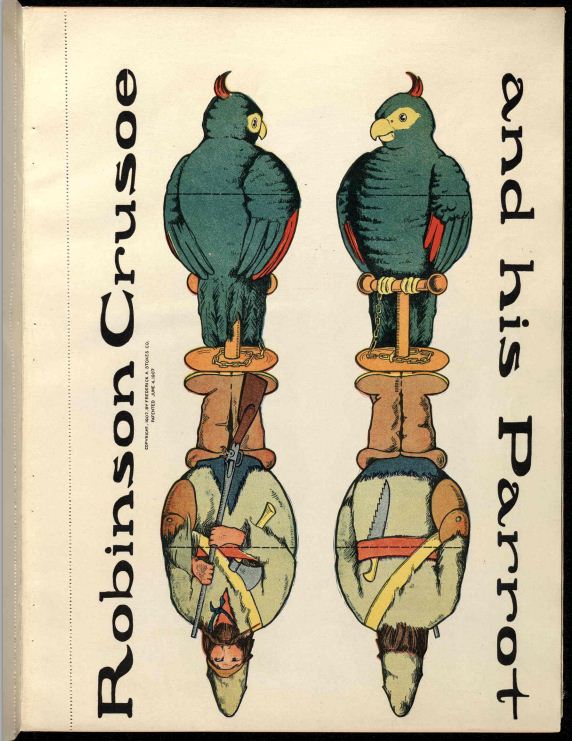
Robinson Crusoe and His Parrot

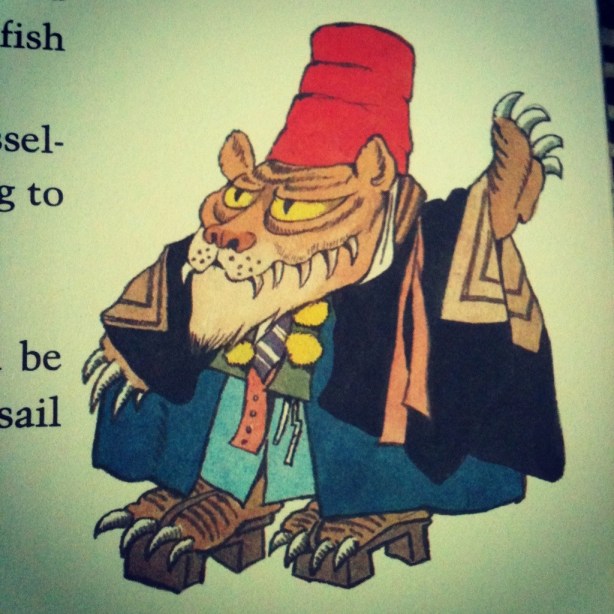
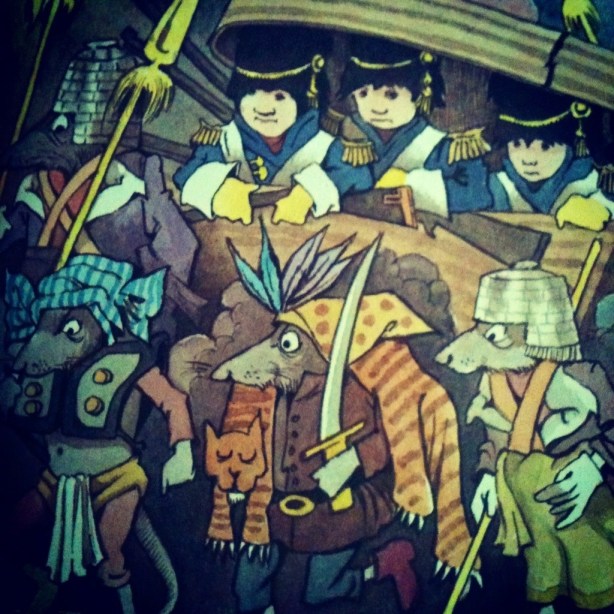
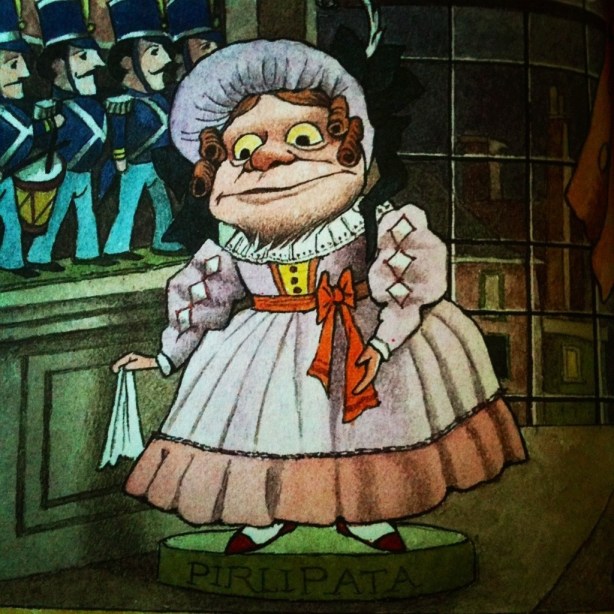
From The Twelve Magic Changelings by M.A. Glen, a 1907 book of children’s cut-outs.

“He was an aphorism writer” (Thomas Bernhard)

He was an aphorism writer, there are countless aphorisms of his, I thought, one can assume he destroyed them, I write aphorisms, he said over and over, I thought, that is a minor art of the intellectual asthma from which certain people, about all in France, have lived and still live, so-called half philosophers for nurses’ night tables, I could also say calendar philosophers for everybody and anybody, whose sayings eventually find their way onto the walls of every dentist’s waiting room; the so-called depressing ones are, like the so-called cheerful ones, equally disgusting.

From Thomas Bernhard’s novel The Loser.


“Radio” — Denis Johnson

“All schools are bad” (Thomas Bernhard)

All schools are bad and the one we attend is always the worst if it doesn’t open our eyes. What lousy teachers we had to put up with, teachers who screwed up our heads. Art destroyers all of them, art liquidators, culture assassins, murderers of students.

From Thomas Bernhard’s novel The Loser.

Flannery O’Connor and Her Marvelous Peacock

(More writers with animals).

Take Vladimir Nabokov’s “Good Reader” Quiz

One evening at a remote provincial college through which I happened to be jogging on a protracted lecture tour, I suggested a little quiz—ten definitions of a reader, and from these ten the students had to choose four definitions that would combine to make a good reader. I have mislaid the list, but as far as I remember the definitions went something like this.

Select four answers to the question what should a reader be to be a good reader:

1. The reader should belong to a book club.
2. The reader should identify himself or herself with the hero or heroine.
3. The reader should concentrate on the social-economic angle.
4. The reader should prefer a story with action and dialogue to one with none.
5. The reader should have seen the book in a movie.
6. The reader should be a budding author.
7. The reader should have imagination.
8. The reader should have memory.
9. The reader should have a dictionary.
10. The reader should have some artistic sense.

The students leaned heavily on emotional identification, action, and the social-economic or historical angle. Of course, as you have guessed, the good reader is one who has imagination, memory, a dictionary, and some artistic sense–which sense I propose to develop in myself and in others whenever I have the chance.

—Vladimir Nabokov. Collected in Lectures on Literature.

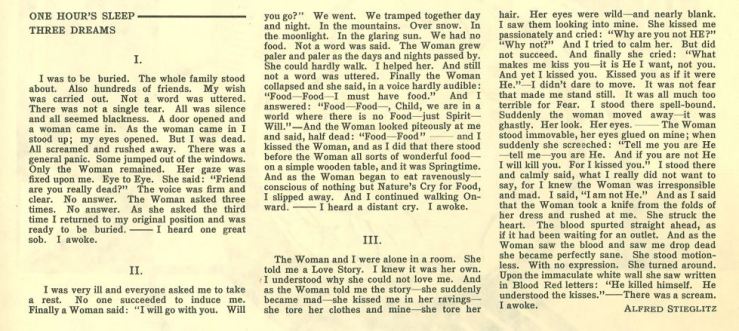
“One Hour’s Sleep—–Three Dreams” — Alfred Stieglitz

From the first issue of 291; via the mighty Ubuweb.

“The Exemplary Happiness That Surely Never Comes Again” — Alvaro Mutis

A woman’s body under the rush of a mountain waterfall, her brief cries of surprise and joy, the movement of her limbs in the brief cries of surprise and joy, the movement of her limbs in the rapid foam that carries red coffee berries, sugar cane pulp, insects struggling to escape the current: this is the exemplary happiness that surely never comes again.

From Alvaro Mutis’s novella The Snows of the Admiral, collected in The Adventures and Misadventures of Maqroll.

Walt Whitman: American Experience (Full Documentary)

“I’m Searching” — Clarice Lispector

The opening paragraph to Clarice Lispector’s novel The Passion According to G.H.

As Yet Nothing Has Happened (Kafka on Revolution)

“Shopping Is a Feeling” — David Byrne

“Hic, hoc, the carrion Crow”

“A Thanksgiving Prayer” — William S. Burroughs

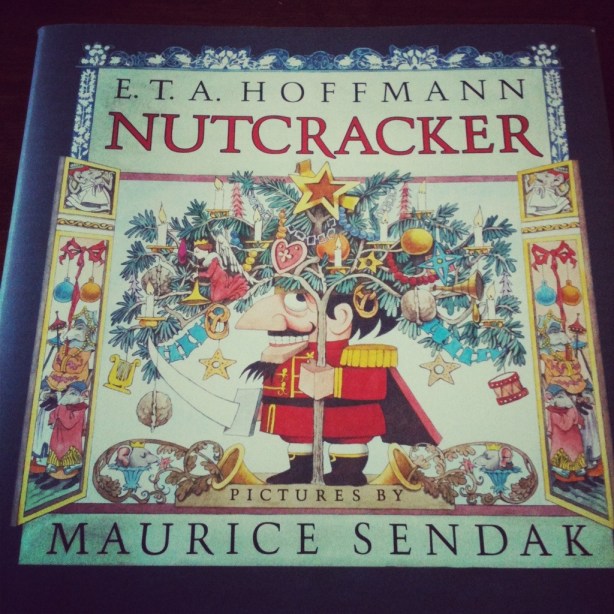
Nutcracker, Illustrated by Maurice Sendak (Book Acquired Some Time in October, 2012)

20121118-123043.jpg

20121118-123054.jpg

20121118-123102.jpg

20121118-123123.jpg

We’ll be running a giveaway contest for one of these beautiful editions of Hoffman’s Nutcracker, featuring illustrations by Maurice Sendak sometime next week.

Enjoy Thanksgiving with Our Literary Recipes Roundup

Fat Kitchen, Jan Steen

***

Enjoy Thanksgiving with our menu of literary recipes:

F. Scott Fitzgerald’s Turkey Twelve Ways

Zora Neale Hurston’s Mulatto Rice

Ian McEwan’s Fish Stew

James Joyce’s Burnt Kidney Breakfast

Herman Melville’s Whale Steaks

Ernest Hemingway’s Absinthe Cocktail, Death in the Afternoon

Vladimir Nabokov’s Eggs à la Nabocoque

Thomas Pynchon’s Banana Breakfast

Cormac McCarthy’s Turtle Soup

Robert Crumb’s Macaroni Casserole

Truman Capote’s Caviar-Smothered Baked Potatoes with 80-Proof Russian Vodka

Emily Dickinson’s Cocoanut Cake

Thomas Jefferson’s Vanilla Ice Cream

Charles Dickens’s Own Punch

Ben Jonson’s Egg Wine

Christmas Bonus:  George Orwell’s Recipes for Plum Cake and Christmas Pudding

In Which Bret Easton Ellis Finally Comes to Understand Women

Bret Easton Ellis took to Twitter last night to share some more of his profound insights.

Here, he sets the stage for us and delivers a powerful thesis (all in under 140 characters!):

And of course, some supporting details (including a bit of biology):

Mr. Ellis even replies to one of his followers! (I like the touch of self loathing):

A rousing conclusion statement:

And a fitting epilogue:

Bravo!