“Meditatio,” Ezra Pound
When I carefully consider the curious habits of dogs
I am compelled to conclude
That man is the superior animal.When I consider the curious habits of man
I confess, my friend, I am puzzled.
“Meditatio,” Ezra Pound
When I carefully consider the curious habits of dogs
I am compelled to conclude
That man is the superior animal.When I consider the curious habits of man
I confess, my friend, I am puzzled.

As the season for giving arrives, Biblioklept reviews three beautiful books that children and adults alike will enjoy.

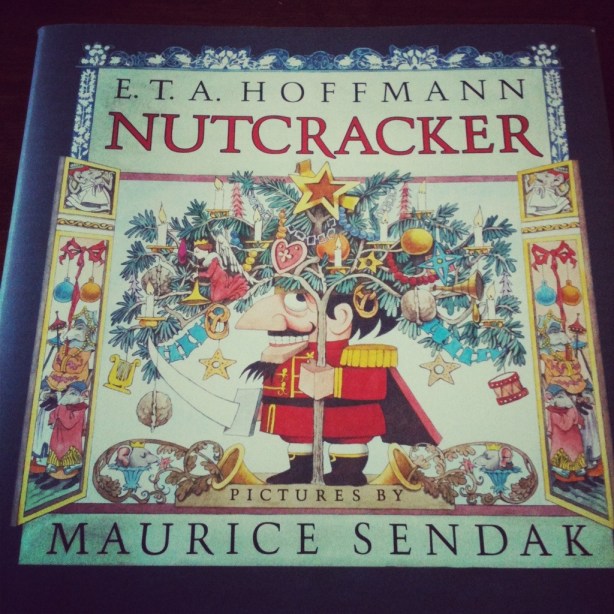
First up is E.T.A. Hoffman’s 1816 Christmas classic Nutcracker in translation by Ralph Manheim and beautifully illustrated by the late Maurice Sendak. In 1983, Sendak designed sets and costumes for the Pacific Northwest Ballet’s adaptation of Nutcracker and in 1984 he translated some of those designs into a book edition.

According to a 2001 profile with NPR, Sendak was initially unsure about working on what he considered “the most bland and banal of ballets.” However, upon reading Hoffman’s original text, Sendak discovered a work full of “weird, dark qualities that make it something of a masterpiece,” an observation he notes in his introduction to Nutcracker.
The NPR profile notes that Sendak intended to bring “Hoffmann’s original story back to audiences, especially by having the main character, a girl named Clara, brought back into the story.” Sendak believed
The whole ballet is about her and for the most part you get her in act one, and then she discreetly disappears for the rest of the work. My feeling is this has to be disturbing to children. . . . [She goes] where the wild things are . . . She is overwhelmed with growing up and has no knowledge of what this means. I think the ballet is all about a strong emotional sense of something happening to her, which is bewildering.

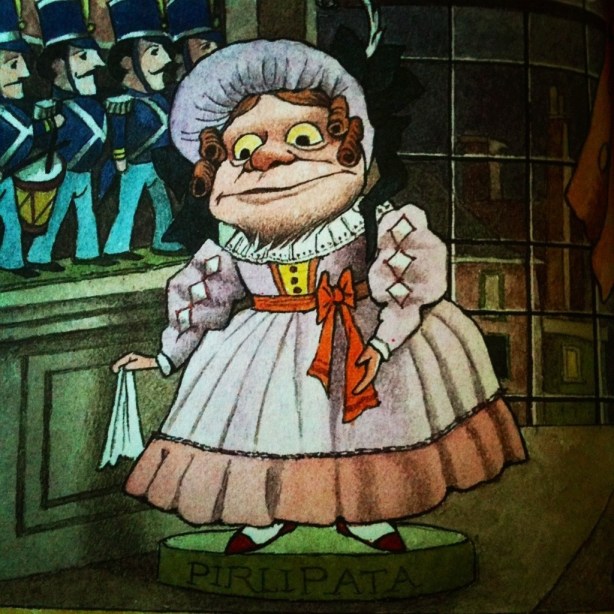
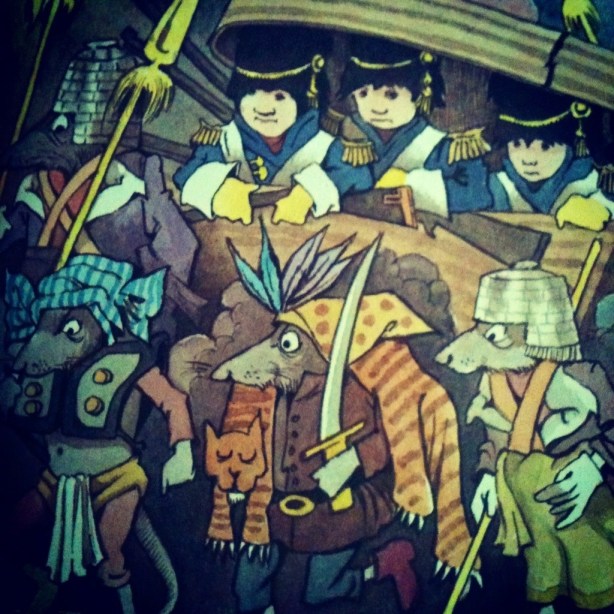
These “strange, weird” qualities—the same tones that made Sendak’s Where the Wild Things Are a classic of children’s literature—are on display in Nutcracker. Hoffman’s text in Manheim’s translation has a wonderfully episodic, even picaresque quality that restores a sense of adventure—and even peril—to the smooth play we might be familiar with sitting through each December.
Nutcracker’s reading level, length, and tone make it likely appropriate for children over eight or nine, but younger children will enjoy reading the story through Sendak’s marvelous and strange illustrations.
Nutcracker is available in a new hardback edition from Random House.

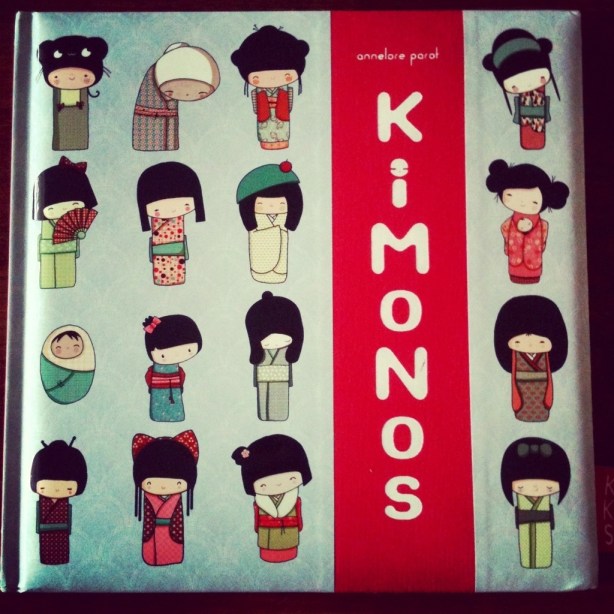
Next up is Annelore Parot’s Kokeshi Kimonos from Chronicle Books.

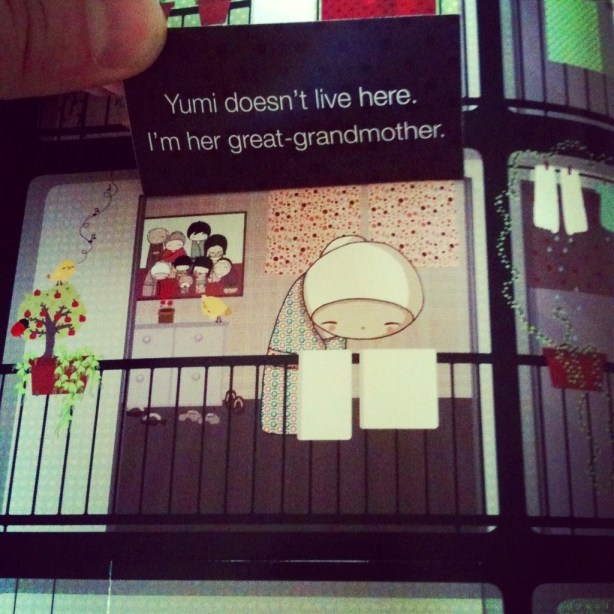
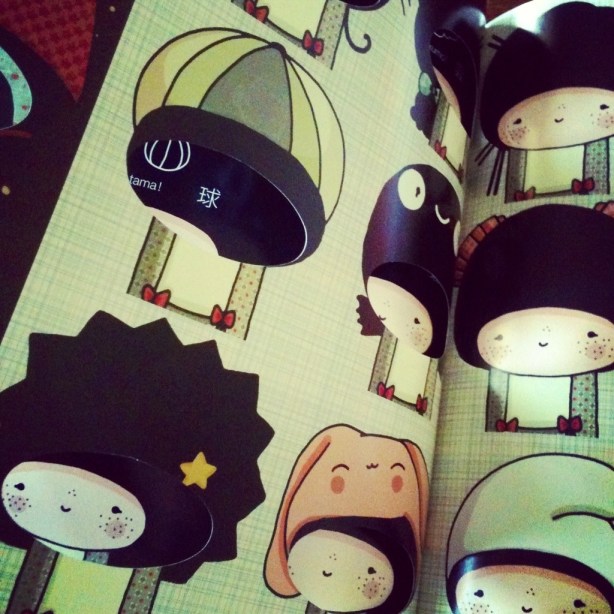
Koskeshi Kimonos is a fun and stylish book that uses kokeshi dolls to showcase facets of Japanese culture including attire and family life. The book features folding flaps, pull out sections, and other interactive features that will appeal to younger children. It’s the sort of aesthetically charming book that adults can enjoy as well.

Kokeshi Kimonos will likely appeal to younger readers—five to nine—and seems particularly suited to girls (although this doesn’t mean boys wouldn’t enjoy it, of course). The cute kokeshis are a wonderful alternative to the sterile, plastic world of Barbie and other facile dolls.

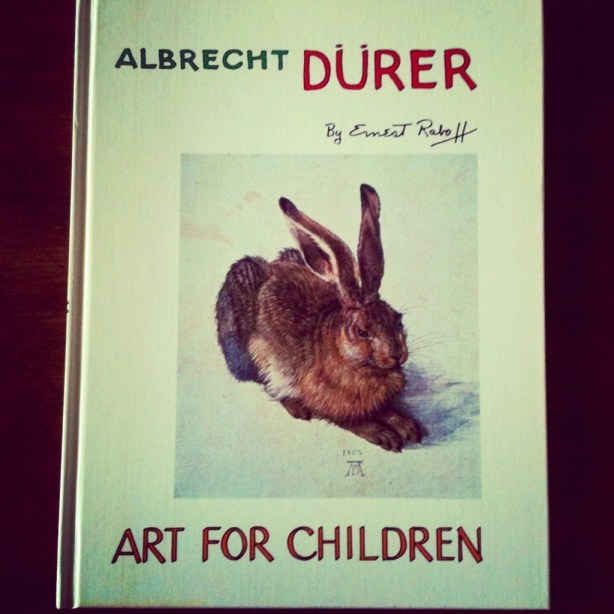
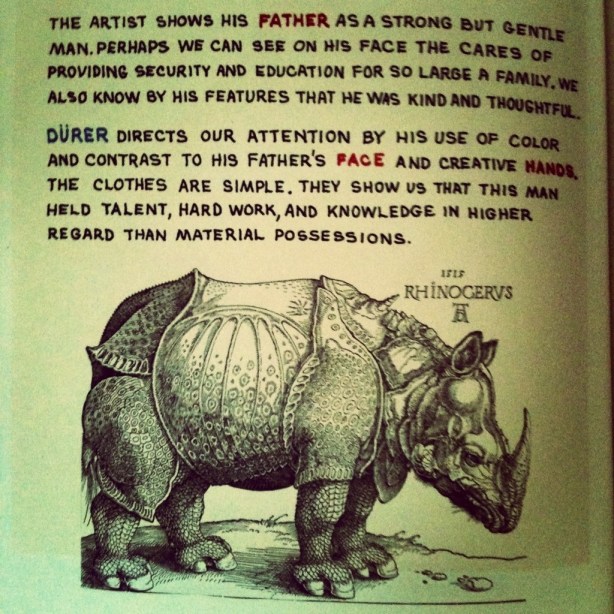
Finally, Ernest Raboff’s Albrecht Dürer, part of his Art for Children series. The book is out of print but not impossible to find.

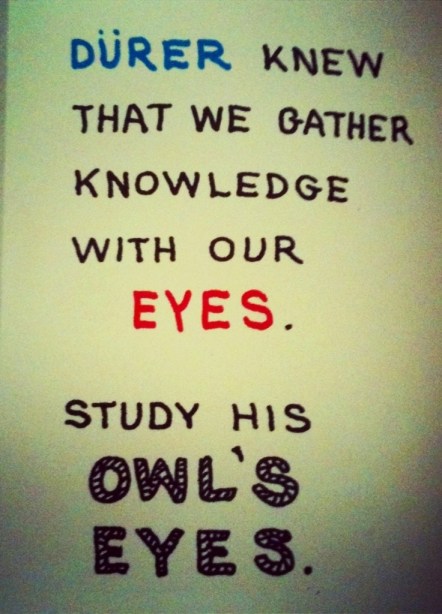
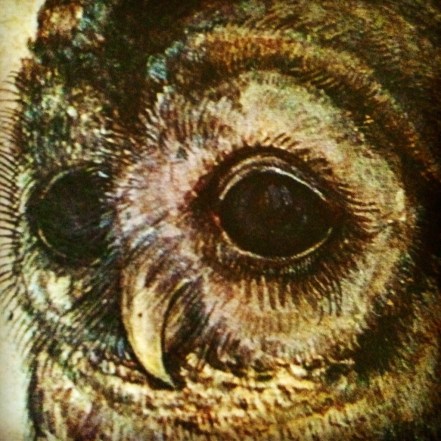
Raboff presents Dürer’s life simply and in clear context, using about a dozen beautiful prints from the German master, as well as many of his etchings. Raboff also hand letters the book, and provides his own sketches and illustrations occasionally to clarify and explain Dürer’s work.

What I love most about Raboff’s book though is the way he integrates elements of art appreciation into his book in subtle, simple ways. Lovely:


If some frail tubercular lady circus rider were to be driven in circles around and around the arena for months and months without interruption in front of a tireless public on a swaying horse by a merciless whip-wielding master of ceremonies, spinning on the horse, throwing kisses and swaying at the waist, and if this performance, amid the incessant roar of the orchestra and the ventilators, were to continue into the ever-expanding, gray future, accompanied by applause, which died down and then swelled up again, from hands which were really steam hammers, perhaps then a young visitor to the gallery might rush down the long stair case through all the levels, burst into the ring, and cry “Stop!” through the fanfares of the constantly adjusting orchestra.
But since things are not like that—since a beautiful woman, in white and red, flies in through curtains which proud men in livery open in front of her, since the director, devotedly seeking her eyes, breathes in her direction, behaving like an animal, and, as a precaution, lifts her up on the dapple-gray horse, as if she were his grand daughter, the one he loved more than anything else, as she starts a dangerous journey, but he cannot decide to give the signal with his whip and finally, controlling himself, gives it a crack, runs right beside the horse with his mouth open, follows the rider’s leaps with a sharp gaze, hardly capable of comprehending her skill, tries to warn her by calling out in English, furiously castigating the grooms holding hoops, telling them to pay the most scrupulous attention, and begs the orchestra, with upraised arms, to be quiet before the great jump, finally lifts the small woman down from the trembling horse, kisses her on both cheeks, considers no public tribute adequate, while she herself, leaning on him, high on the tips of her toes, with dust swirling around her, arms outstretched and head thrown back, wants to share her luck with the entire circus—since this is how things are, the visitor to the gallery puts his face on the railing and, sinking into the final march as if into a difficult dream, weeps, without realizing it.
“Up in the Gallery” by Franz Kafka
“The Lady’s Maid” by Katherine Mansfield
Eleven o’clock. A knock at the door … I hope I haven’t disturbed you, madam. You weren’t asleep – were you? But I’ve just given my lady her tea, and there was such a nice cup over, I thought, perhaps …
… Not at all, madam. I always make a cup of tea last thing. She drinks it in bed after her prayers to warm her up. I put the kettle on when she kneels down and I say to it, “Now you needn’t be in too much of a hurry to say your prayers.” But it’s always boiling before my lady is half through. You see, madam, we know such a lot of people, and they’ve all got to be prayed for – every one. My lady keeps a list of the names in a little red book. Oh dear! whenever some one new has been to see us and my lady says afterwards, “Ellen, give me my little red book,” I feel quite wild, I do. “There’s another,” I think, “keeping her out of her bed in all weathers.” And she won’t have a cushion, you know, madam; she kneels on the hard carpet. It fidgets me something dreadful to see her, knowing her as I do. I’ve tried to cheat her; I’ve spread out the eiderdown. But the first time I did it – oh, she gave me such a look – holy it was, madam. “Did our Lord have an eiderdown, Ellen?” she said. But – I was younger at the time – I felt inclined to say, “No, but our Lord wasn’t your age, and he didn’t know what it was to have your lumbago.” Wicked – wasn’t it? But she’s too good, you know, madam. When I tucked her up just now and seen – saw her lying back, her hands outside and her head on the pillow – so pretty – I couldn’t help thinking, “Now you look just like your dear mother when I laid her out!”
… Yes, madam, it was all left to me. Oh, she did look sweet. I did her hair, soft-like, round her forehead, all in dainty curls, and just to one side of her neck I put a bunch of most beautiful purple pansies. Those pansies made a picture of her, madam! I shall never forget them. I thought to-night, when I looked at my lady, “Now, if only the pansies was there no one could tell the difference.”
… Only the last year, madam. Only after she’d got a little – well – feeble as you might say. Of course, she was never dangerous; she was the sweetest old lady. But how it took her was – she thought she’d lost something. She couldn’t keep still, she couldn’t settle. All day long she’d be up and down, up and down; you’d meet her everywhere, – on the stairs, in the porch, making for the kitchen. And she’d look up at you, and she’d say – just like a child, “I’ve lost it, I’ve lost it.” “Come along,” I’d say, “come along, and I’ll lay out your patience for you.” But she’d catch me by the hand – I was a favourite of hers – and whisper, “Find it for me, Ellen. Find it for me.” Sad, wasn’t it? Continue reading “Read “The Lady’s Maid,” a Short Story by Katherine Mansfield”
(Thanks to Giovanni for sending this in).

This is not a review.
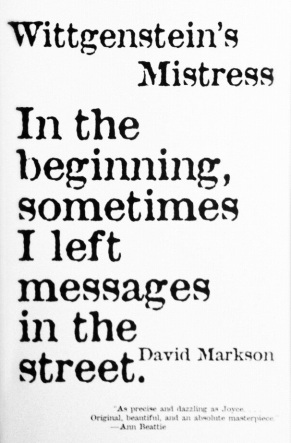
This book was recommended to me.
An experimental, philosophical novel.
I really wanted to like this book.
I had read the reviews & after being unable for a few years to buy it secondhand, I bit the bullet & bought it new.
The beginning is intriguing.
The concept of the book is dead simple.
The idea is this: Kate is a painter; she is the last person on earth, maybe; she is alone in a house on the Long Island beach
Markson picks up Kate’s dialogue in media res and trusts the reader enough to piece together what the heck is going on: she is the last person left on earth and is making her way through it as best she can, telling us her story as she goes.
Short declarative sentences loop feverishly around her brain, repeating themselves, correcting themselves, contradicting themselves, and filling in missing information many pages later.
The narrator’s voice rings true.
It is frustrating, repetitive, and does not offer much in the way of style and language.
No chapter breaks, no real paragraphs even.
Read at random.
This book received 54 rejections before finding a publisher. This I can believe.
Her little apercus are all about observation and remembrance, the real and the false, blah, blah.
(Joyce, Baldwin, Pynchon, Cortazar).
The book was meandering, rambling & jumped all over the place.
Not that oddness is bad.
It never centers on anything.
It’s the type of book best discussed in groups, since it does bring up some interesting themes—the fragility of memory and sanity, the ineffectiveness of language, the impact of philosophy and literature.
There’s nothing for the reader to latch onto and follow, other than the voice.
What about the subtext?
Like Wittgenstein said, “Whereof we cannot speak, thereof we must be silent.”
I am mad. I am crazy. Yesterday I died but returned in time to write this.


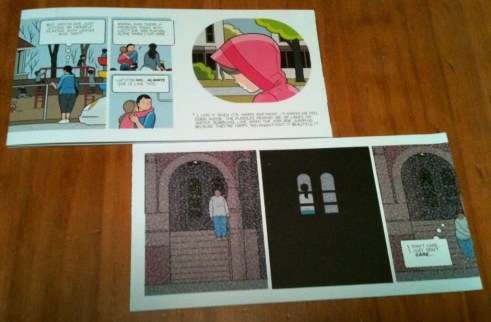
These two shorties in Chris Ware’s Building Stories showcase the novel’s thematic recursion, a recursion doubled in both its metastructure (14 pieces that the reader can read in any order) as well as the structure of many of the individual pieces. In the case of the two parts pictured above, we get Möbius strips that become richer with rereading. The strips seem to twin each other not just in their format, but also in their theme.
Both strips feature Lonely Girl, who perhaps emerges as the dominant protagonist of Building Stories. The one pictured at the top gives a voice to her daughter, a girl who seems to repeat some of her mother’s tendencies toward isolation and depression.

Ware’s strength here (and always elsewhere) is the economy of storytelling: He packs entire short stories into just a few panels, coloring his narrative:

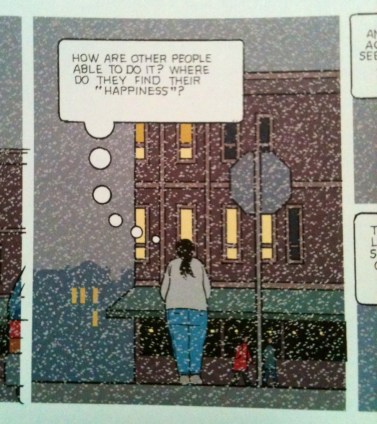
The second loop features a solitary Lonely Girl who trudges through the snowy night in a near-suicidal despair:

Read recursively, the strip dooms Lonely Girl to an endless loop of despair—and it’s at moments like these that I’m happy there are other parts to Building Stories—some kind of existential “out” for our poor heroine.

From “A Conversation with Gordon Lish,” an outstanding interview between the writer/editor and Rob Trucks. The interview is really amazing—Lish talks at length about his writing process, his sense of competition, his friendships with Don DeLillo and Cynthia Ozick, his interest in Julia Kristeva, his feelings for Harold Brodkey and Barry Hannah—and Blood Meridian. Lots and lots of Blood Meridian.
I chose this little nugget because I think it reads almost like a perfect little Lish story—or at least, it seems to perfectly express Lish’s voice, which if you haven’t heard it, my god, get thee to his own reading of his Collected Fictions. Again, the whole interview is well worth your time if you have any interest in Lish. It includes this insight into the man’s fiction:


1. I finished Thomas Bernhard’s 1983 novel The Loser (English transl. Jack Dawson ’91) a few weeks ago and then picked over some of it again this week.
I’m not going to try to unpack all of The Loser here—it’s too thick, too loaded, too layered—its density is monochromatic, or monoglossic really, a monologue that threatens to drown the reader. One big paragraph.
2. The Loser is the second Bernhard novel I’ve read, after Correction, which is an even denser novel: Correction’s sentences are longer, its tone grimmer, its humor less readily apparent.
Correction is a novel about repetition. The Loser reads like a repetition of Correction: Like Correction, The Loser is one long uninterrupted monologue by an unnamed narrator who attempts to puzzle out the motives and meanings of a friend’s recent suicide. As in Correction, the suicide in The Loser (eponymous Wertheimer, whose name recalls Correction’s Roithamer) is a ridiculously wealthy man who obsesses almost incestuously over his sister, repressing her in the process. Like Correction, The Loser focuses on three friends. And like Correction, The Loser is ultimately about how idealism leads to breakdown, insanity, and suicide.
3. (I riffed on Correction here).
4. You might want a plot summary (always my least favorite business of a book review).
Here, straight from the text:
Wertheimer had wanted to compete with Glenn, I thought, to show his sister, to pay her back for everything by hanging himself only a hundred steps from her house in Zizers.
That’s more or less the plot: Our loser’s sister (whom he sought to control and constrain and confine) elopes to Switzerland to marry a Swiss millionaire. This is the proverbial last straw for Wertheimer, whose dream of being a great piano player was decimated the moment he heard Glenn Gould play piano years ago when they attended a conservatory together.
5. That’s like, the Glenn Gould of course—which is what our narrator calls him (that is, the).
Glenn Gould’s perfection—or rather the perfection Wertheimer (and the narrator, through whom Wertheimer lives (as a voice)) affords GG—stymies the pair forever:
Glenn is the victor, we are the failures
GG is their ideal, and the ideal shatters them:
. . . always Glenn Gould at the center, not Glenn but Glenn Gould, who destroyed us both, I thought.
And later:
. . . there’s nothing more terrible than to see a person so magnificent that his magnificence destroys us . . .
6. Glenn Gould has the gall to die of a stroke, upsetting Wertheimer to no end. (Wertheimer’s not upset that Glenn Gould has died—no, he can’t stand the perfection of Glenn Gould’s death)
7. Glenn Gould’s own idealism:
. . .to be the Steinway itself . . .
—an idealized self-erasure; a self that doesn’t think, that doesn’t theorize; a self that only acts.
8. Glenn Gould’s perfection shatters Wertheimer, but when his sister leaves him he starts to go insane:
We have an ideal sister for our needs and she leaves us at exactly the wrong moment . . .
9. More on our loser Wertheimer:
Do you think I could have become a great piano player? he asked me, naturally without waiting for an answer and laughing a dreadful Never! from deep inside.
—and—
. . . ultimately he was enamored of failure . . .
—and—
. . . he was addicted to people because he was addicted to unhappiness.
—and—
My constant curiosity got in the way of my suicide, so he said, I thought.
10. In that last example, we see the layering of The Loser’s narrative: “so he said, I thought.” The novel is entirely the narrator’s internal monologue, moving through time and space freely—yet Bernhard constantly anchors the monologue in these layered attributions. The effect is often jarring, as we experience the narrator move from memory to thought to observation on the present continuous world he is currently experiencing.
Here’s an example:
Parents know very well that they perpetuate their own unhappiness in their children, they go about it cruelly by having children and throwing them into the existence machine, he said, I thought, contemplating the restaurant.
We move from Wertheimer’s observation about throwing children into the “existence machine” to attribution of that thought to Wertheimer (“he”) to another layering of attribution (“I thought”) and then, bizarrely, to the narrator suggesting that he is “contemplating the restaurant” (the narrator’s concrete action for the first half of the book is entering an inn). The narrator simultaneously remembers and observes and contemplates—but there’s a deep anxiety here, I think, a refusal to slow down, to reflect.
11. Or perhaps this is just how “the existence machine”—consciousness—works.
12. More on “the existence machine”:
We exist, we don’t have any other choice, Glenn once said.
—and—(thus Wertheimer):
. . . we don’t exist, we get existed . . .
—and—-
Wertheimer had to commit suicide, I told myself, he had no future left. He’d used himself up, had run out existence coupons.
Existence coupons!
13. If you do not find the citation above (re: “existence coupons”) particularly and absurdly and perhaps cruelly funny, it is likely that you will not enjoy The Loser, a book that I found hilarious.
14. Another humorous passage—our narrator, having entered his “deterioration process,” elects to give away his piano:
I knew I was giving up my expensive instrument to an absolutely worthless individual and precisely for that reason I had it delivered to the teacher. The teacher’s daughter took my instrument, one of the very best, one of the rarest and therefore most sought after and therefore also most expensive pianos in the world, and in the shortest period imaginable destroyed it, rendered it worthless.
15. The Loser, like Correction, is very much about destruction, about breaking down both objects and ideas into a pure, idealized zero.
Take Wertheimer’s book, which echoes the narrator’s piano (and Glenn Gould’s own will to remove himself from the process of playing, to be “the Steinway itself”):
He wanted to publish a book, but it never came to that, for he kept changing his manuscript, changing it so often and to such an extent that nothing was left of the manuscript, of which finally nothing remained except the title, The Loser.
The narrator too plans to write a book, his Glenn Essay:
. . . everything we write down, if we leave it for a while and start reading it from the beginning, naturally becomes unbearable and we won’t rest until we’ve destroyed it again, I thought. Next week I’ll be in Madrid again and the first thing I’ll do is destroy my Glenn Essay in order to start a new one, I thought, an even more intense, even more authentic one, I thought. For we always think we are authentic and in truth we are not.
This is how idealism plays out in The Loser: a process of correction that leads to fragmentation, deterioration, nullification.
The fight against getting existed.
16. The Loser’s narrator repeatedly brings up the clash between idealism (theory) and existence (practice):
In theory he mastered all the unpleasantness of life, all the degrees of desperation, the evil in the world that grinds us down, but in practice he was never up to it. And so he went to pot, completely at odds with his own theories, went all the way to suicide, I thought, all the way to Zizers, his ridiculous end of the line, I thought. In theory he had always spoken out against suicide, deemed me capable of it however without a second thought, always went to my funeral, in practice he killed himself and I went to his funeral. In theory he became one of the greatest piano virtuosos in the world, one of the most famous artists of all time (even if not as famous as Glenn Gould!), in practice he accomplished nothing at the piano, I thought.
There is something simultaneously absurdly hilarious and tragic in the idea that even in his theoretical ideal state, Wertheimer is still not as accomplished as Glenn Gould!
17. For the narrator of The Loser, the tragic space between theory and practice is a deeply existential problem, the problem of the individual consciousness’s relation to other people:
In theory we understand people, but in practice we can’t put up with them, I thought, deal with them for the most part reluctantly and always treat them from our own point of view. We should observe and treat people not from our own point of view but from all angles, I thought, associate with them in such a way that we can say we associate with them so to speak in a completely unbiased way, which however isn’t possible, since we actually are always biased against everybody.
18. Watching some beer-truck drivers in the inn, the narrator undertakes a thought experiment that highlights a will to belong, to relate to others, coupled with the immediate dismissal—the internalized abject rejection—of this idea:
Again and again we picture ourselves sitting together with the people we feel drawn to all our lives, precisely these so-called simple people, whom naturally we imagine much differently from the way they truly are, for if we actually sit down with them, we see that they aren’t the way we’ve pictured them and that we absolutely don’t belong with them, as we’ve talked ourselves into believing, and we get rejected at their table and in their midst as we logically should get after sitting down at their table and believing we belonged with them or we could sit with them for even the shortest time without being punished, which is the biggest mistake, I thought.
19. Note in the later passages of The Loser ( including the two I cite in points 17 and 18) the dominant use of the pronoun we. The narrator’s we might be a simple rhythmic projection, a generalization of the narrator’s own anxieties displaced onto others. At the same time, the narrator’s we seems to hold the ghosts of Glenn Gould and Wertheimer, who possess, haunt, and ventriloquize the narrator’s voice—which is the novel, of course.
20. The Loser seems like a great starting place for someone interested in reading Bernhard. I think it’s a more manageable introduction to his themes than Correction is: the humor is more accessible, the book’s ironies perhaps more apparent, and its sentences are far, far shorter. (I feel the need to clarify: None of these comments should be interpreted as a knock against Correction, which I thought brilliant; neither should these comments be interpreted as a knock against the intelligence and abilities of readers interested in Bernhard).
21. I still have two Bernhards in the stack—Yes and Concrete—but I’ll hold off for a while. Dude’s writing is rewarding but taxing.