From JG Ballard’s interview with The Paris Review; the Martin Bax novel he mentions, The Hospital Ship, is worth your time if you can find it:
INTERVIEWER
Speaking of stimulation, did any of the psychoactive drugs of the sixties give you any clues for your writing?
BALLARD
I suppose I’m a medium-to-heavy drinker, but I haven’t taken any drugs since one terrifying LSD trip in 1967. A nightmarish mistake. It opened a vent of hell that took years to close and left me wary even of aspirin. Visually it was just like my 1965 novel, The Crystal World, which some people think was inspired by my LSD trip. It convinced me that a powerful and obsessive enough imagination can reach, unaided, the very deepest layers of the mind. (I take it that beyond LSD there lies nothing.) Imagination is the shortest route between any two conceivable points, and more than equal to any physical rearrangement of the brain’s functions.
INTERVIEWER
Back in the sixties, Martin Bax and yourself, as editors of Ambit magazine, ran a drug competition.
BALLARD
Dr. Bax and I ran a competition in Ambit for the best prose or poetry written under the influence of drugs, and it produced a lot of interesting material. In general, cannabis was the best stimulant, though some good pieces came out of LSD. In fact, the best writing of all was done by Ann Quin, under the influence of the contraceptive pill.
INTERVIEWER
Dr. Bax is a novelist as well, isn’t he?
BALLARD
Martin is a physician, a research pediatrician, and consultant to a London hospital, and his book The Hospital Ship (published in the States by New Directions) is the most remarkable and original novel I’ve come across since reading William Burroughs.
INTERVIEWER
Burroughs wrote an eccentric and laudatory, in its way, introduction to the American edition of Atrocity Exhibition. Do you know him?
BALLARD
Burroughs, of course, I admire to the other side of idolatry, starting with Naked Lunch, then Ticket, Soft Machine, and Nova Express. I’m less keen on his later books. In his way he’s a genius. It’s a pity that his association with drugs and homosexuality has made him a counterculture figure, but I suppose his real links are with Jack Kerouac, Allen Ginsberg, and the Beats. Still, I think he’s much more of an establishment figure, like Dean Swift, with a despairing disgust for the political and professional establishments of which he is a part. I have met Burroughs quite a few times over the last fifteen years, and he always strikes me as an upper-class Midwesterner, with an inherent superior attitude towards blacks, policemen, doctors, and small-town politicians, the same superior attitude that Swift had to their equivalents in his own day, the same scatological obsessions and brooding contempt for middle-class values, thrift, hard work, parenthood, et cetera, which are just excuses for petit-bourgeois greed and exploitation. But I admire Burroughs more than any other living writer, and most of those who are dead. It’s nothing to do with his homosexual bent, by the way. I’m no member of the “homintern,” but a lifelong straight who prefers the company of women to most men. The few homosexual elements in Crash and Atrocity Exhibition, fucking Reagan, et cetera, are there for reasons other than the sexual—in fact, to show a world beyond sexuality, or, at least beyond clear sexual gender.
Dmitry Samarov is an artist and writer who lives and works in Chicago. After graduating from the School of the Art Institute of Chicago in 1993, Dmitry drove cabs for twelve years. He captured his years as a taxi driver in the stories and art of his first book Hack, which was released last year from the University of Chicago Press. Hack also exists as a blog where Dmitry continues to share his stories.
I first became aware of Dmitry’s work via Twitter; I’d been posting images of readers and books for the past year—one a day—and was thrilled to find his series of bookshelf paintings and his figure paintings. Dmitry was kind enough to talk with me over a series of emails about his art, his writing, and why you’re not likely to see any space vampire paintings from him anytime soon.
You can see more of his work at his website—or better yet, check out one of his upcoming shows if you can: “Dmitry Samarov: Bookshelf Paintings” opens January 11th, 2013, at the Harold Washington Library in downtown Chicago, and “Pictures from a Chicago Cab” opens at the University of Central Missouri on January 23rd.
Books #6 by Dmitry Samarov
Biblioklept: Why do you paint?
Dmitry Samarov: Making pictures is how I talk to the world. I can’t remember ever not doing it. I got in trouble for doodling in 1st Grade back in the Soviet Union and haven’t looked back since. Trying to catch a bit of the way the light changes as the day wears on or the manner in which a girl looks inward as she reads a book or how paperbacks and hardcovers on a shelf lean on each other, all these small moments and many others have occupied my time. Making marks on a surface is a way to record my time here and to show others what I saw. When I do it right they’re able to see something of what they know in my pictures.
Writing about painting is always ultimately futile—the reason one paints something is because he can’t say it and probably vice versa too—but we just can’t seem to help it, can we?
Biblioklept: You bring up your paintings of book shelves and readers—I’m particularly interested in these. Can you talk about how you approach painting figures who are reading? What’s your process? How is painting a reading figure different from a portrait where the figure gazes at the viewer?
DM: I’ve never liked posing sitters. When I paint portraits or figures they are usually friends or family rather than protagonists in a narrative I have in mind, so I like them to choose what they’re doing. If you’re gonna be sitting for an hour or two what’s more natural than to read a book? There aren’t many people who are able to just sit for long periods and when they do it creates a tension. You can see it in Lucian Freud’s great portraits, those people are weary from sitting in his dingy, gray studio. I prefer to paint people in repose—not to the point of pretending that they’re not being looked at—but neither like a bug being examined under glass. Readers are wrapped up in their own inner state rather than working to express some message an artist might be trying to impose. This is as close as I know how to portray a person as they are rather than as I’d like them to be.
Beth by Dmitry Samarov
Biblioklept: So then, for the most part, I’m guessing you don’t photograph the subject and work from that photograph to create the painting. How does painting the sitter “live” (for lack of a better term—if there is one, please let me know!) differ from working from something like a photograph?
DM: I always prefer to work from life. The only things that are from photographs, sketches, or memory are my illustrations and some commissioned pieces. What’s always interested me is looking out at the world and making marks in reaction to what I see. Working from photographs doesn’t allow me to do that. They’re frozen and unnatural. Life never stops the way it does in a photograph. A drawing or painting can acknowledge the passage of time, the light changing, and many other things much better. But, of course, I’m very biased about this.
To me a picture should be a collection of many moments. It’s made in the space between the subject and the artist’s eyes and mind. It’s a conversation, a back-and-forth. I can’t have that same conversation with a photograph or even with one of my own memories for that matter.
Biblioklept: I think your paintings show the energy of that conversation. Can you talk a bit about your book paintings? When did you start painting images of book shelves? Are the shelves your own?
DM: I started doing the book paintings about fifteen years ago and return to them every few years. I think I was looking for a way to do still-life without setting anything up. I like the way the books lean against each other, the crevices formed in the gaps between them, and the way the overall structure and character of a shelf changes over time as books are removed and replaced. It’s also always been funny to me to be painting the outsides of books so much of what a book is is contained between the covers.
The shallow space of a bookshelf also offers a different kind of challenge than the kind of vantage points I usually gravitate to. At times it becomes an almost abstract arrangement of shapes. Despite all that, these are my bookshelves and I have read most of these books. It’s just one more way to engage with them and who wouldn’t want that?
Biblioklept: I’ve tried to photograph all of my bookshelves this year as part of a project on the site and it’s turned out to be much more difficult than I imagined—the way the light hits differently textured covers, and so on.
Since we’ve been talking about books and paintings of books and readers, I’m curious about paintings that you love (or hate) of readers and books—are there any particular paintings that come to mind?
DM: I like a lot of the 19th Century trompe l’oeil paintings by Harnett, Peto, et al. There’s a new thing lately of painting bookshelves with every title clearly visible. I think it’s a kind of showing-off, of letting people know how learned or in-the-know you are. I’m not a fan of that. I use text in some of my paintings but it’s often for visual reasons, if the color of the lettering on a particular spine contrasts in an interesting way with the book next to it, say, I may emphasize that. It’s always in the service of the entire picture rather than some sort of status report. Also the hand-painted Penguin paperback covers.: cute but pretty quickly forgettable.
Mistaken by Dmitry Samarov
Biblioklept: Let’s talk about the intersection of your writing and your illustration. First, I’m curious about Hack. The University of Chicago Press put out a collection of your stories (with illustrations) under that name last year, but you also have earlier versions of Hack in old school zine form, as well as a blog that features new writing. I’m curious how you think of Hack—do you think of it as an ongoing project? A book? A blog? A persona even?
DM: Hack started as a zine around 2000 as a way for me to make sense of my three years driving a cab in Boston (1993-1997). It was called Hack because the license to operate a taxi in Boston was called a Hackney Carriage License and they used to call cabbies hacks in the old days. It was my first attempt at writing outside of school homework assignments and there really wasn’t much writing, it was mostly pictures. Those pictures were a challenge too because, as I’ve said, I work primarily from direct observation and the only way to do these were from memory. These illustrations were made to work together with the words, not to stand on their own and that has continued to be the case through the whole history of Hack.
I started driving a taxi in Chicago in 2003 and revived Hack as a blog late in 2006. To my surprise, it got notice pretty quickly from some in the local press—Whet Moser, then of the Chicago Reader especially—-and my high school pal John Hodgman mentioning it in a magazine didn’t hurt either. That got it noticed by a publicist at University of Chicago Press named Levi Stahl. He bought a copy of my self-published compilation (see the third one down) and eventually pitched Hack as a book to his employers. They published it in October 2011.
I stopped driving last summer and spent a couple of months putting together a second book. It’s all ready to go. I’m just waiting for a publisher to snap it up. The new one expands on a lot of the themes of the first book and spans my entire cab career, from 1993 to 2012. I’m a much better writer from having gone through the editing process on the first book and from the sheer amount of writing in various venues that I’ve done over the last few years.
I don’t know that Hack is/was a persona but it’s certainly gotten me more attention than anything else I’ve done.
Biblioklept: When you were working on the pieces for Hack, did you start with the illustrations or the words?
DM: The illustrations were always first. They were my way into the writing. I went over the phrases I’d use as I was working on the pictures. That’s the way it goes to this day for the most part. I always have been and always will be a painter first.
“You Know Where I’m Going” by Dmitry Samarov
Biblioklept: The pieces of Hack I’ve read seem to channel the stories of your passengers—there’s a lucid straightforwardness about them that I like. How conscientious of style are you when you’re writing? How much do you edit?
DM: I edit a lot. I use as few words as possible. It’s evolved over time of course. When I started I leaned really heavily on ellipses as a transitional device. I cribbed that from Celine’s Death on the Installment Plan. Editing the entries for the first book cured me of that. In general the cab stories take their inspiration from Nelson Algren’s advice to just go out into the streets and listen to the way people speak and to write that down as simply as possible.
At it’s best my writing tries to do what my painting does: to relay what I see and here out in the world. I try my best to stay out of the way because everything out there is so much more interesting than anything I could ever dream up.
Celine by Dmitry Samarov
Biblioklept: You know, I almost referenced Celine in my last question, because the ellipses are clearly a major stylistic device in your self-published version of Hack (and also because I dig your painting Celine). You bring up Algren—what other writers do you admire?
DM: Algren is a real touchstone because he introduced me to Chicago a few years before I even arrived here in 1990 to attend the School of the Art Institute. There are many others. I love Joseph Mitchell’s Up in the Old Hotel and Luc Sante’s Kill All Your Darlings as models for ways of writing different sorts of personal essays. William Gaddis’s books, especially JR, for the way he captures American speech and Cormac McCarthy, especially Suttree, for descriptions of physical environment.
Lately I’ve been looking into forgotten local authors a lot and writing about them at Writers No One Reads. A sense of specific place is very important to me.
I don’t have any aspirations to write fiction but usually, as long as it’s rooted in reality, I’ll probably read it.
Vachel Lindsay by Dmitry Samarov
Biblioklept: You’ve returned to the idea of reality a few times in our conversation, and your paintings and illustrations seem to evoke a strong sense of place. Why is depicting real scenes important to you? I’m guessing we won’t see a series of space vampires from Dmitry Samarov anytime soon . . .
DM: Writers and painters who use space vampires, fantastic worlds, etc. probably just have more imagination than me. Or perhaps the everyday world doesn’t provide them with enough inspiration or subject-matter to say what they need to say. I don’t have that problem. For me just looking out the window for a moment as I type this gives a glimpse of a thousand paintings I could try to paint. What’s out there is within my scope of vision is as limitless as outer space must be to sci-fi writer or a dream must be to a fantasist. The few times I’ve tried to resort to my imagination I’ve found it at once limiting, hopelessly random, and sadly wanting. How could I choose one thing rather than another and what would it matter? There are still many choices to be made when working from what’s before me but it doesn’t feel random and meaningless in the same way. It’s more that I’m pushing against something that’s actually there and it’s pushing back at me.
But maybe I’ll switch to space vampires after I get bored with reality.
Biblioklept: Do you paint or draw every day? Do you write every day?
DM: I try to paint, draw, or write something most days. It’s a much better day when I have than when I haven’t, that’s for sure. The internet has made it possible to share every stray scrap that one comes up with and I’m probably guilty of putting too much out there for others to see, but I’ve always thought of all my work as being public, that part that’s for me is just the doing. After I’m done, it has to sink or swim on its own and for that viewers and readers are needed. The internet is like a big messy studio where (hopefully) over time all the false starts and failures will be forgotten, ignored, or swept away and the worthwhile things will have whatever life they deserve. What I’m trying to say is that most of hat I do is probably crap but that maybe there’s some value in sharing it with others and letting them judge rather than holding things close and only showing them the ones that I’m convinced are good. In any case it’s nearly impossible to say right after finishing a picture whether it’ll speak to people or is just a rehash of something done before or a waste of time I’ve somehow convinced myself to push on with. I hope in twenty or thirty years to look back and be able to say that I’ve made a couple of things that were worthwhile.
Biblioklept: So do you find it hard to judge or evaluate your own work?
DM: Not at the time I’m doing it. I throw away plenty. But with the benefit of, say, a year or five or ten, things I thought weren’t bad turn out to look awful and occasionally, vice versa. As a rule though, I think once I’ve decided to let something out into the world it’s no longer my job to evaluate it. If I thought enough of it not to burn or paint over it it has to try to survive on its own steam.
Martina by Dmitry Samarov
Biblioklept: What are you working on right now?
DM: Well, I finished a second book of illustrated cab stories. It’s called WHERE TO? More Stories from a Hack and covers from when I first drove in Boston in 1993 until the summer of 2012 when I gave my last cab ride. It goes deeper into the inner workings of the cab industry, the people who take cabs, attempts to answer why I decided to drive a cab in the first place. I’m still looking for a publisher for it.
I’ve been writing and illustrating occasional baseball-related pieces for Chicago Side’ssports section, working on illustrations for various other projects, and finishing up my first book review for the Chicago Tribune’s literary supplement, Printers Row, on a recently-reissued forgotten novel called Diversey. Also I have two art shows coming up in January and another in February. On January 11th, “Dmitry Samarov: Bookshelf Paintings” opens at the Harold Washington Library in downtown Chicago. On January 23rd, “Pictures from a Chicago Cab” opens at the University of Central Missouri.
All that and doing my best not to have to go back to a day-job. I haven’t driven a cab in about five-and-a-half months and have really gotten to love not having to leave the house much.
Biblioklept: Have you ever stolen a book?
DM: I used to steal ’em all the time. I had a good scam going when I was school changing price-tags on expensive art books, getting $100 ones for $20 and such. I used to steal a lot of things. I wrote a whole thing about it for The Handshake.
Biblioklept: Can you talk about a particular book you remember stealing?
DM: I stole this beautiful Giacometti book from Powell’s sometime in the early-90s and wound up having to sell it at Myopic Books in the late-90s for much less than it was worth when I was broke and between jobs. I’ve sold off tons of great books and records over the years. I’m neither the most careful collector nor blessed with much foresight as to what might or might not be valuable in the future.
The Russian soldier made his way nervously up the ragged side of the hill, holding his gun ready. He glanced around him, licking his dry lips, his face set. From time to time he reached up a gloved hand and wiped perspiration from his neck, pushing down his coat collar.
Eric turned to Corporal Leone. “Want him? Or can I have him?” He adjusted the view sight so the Russian’s features squarely filled the glass, the lines cutting across his hard, somber features.
Leone considered. The Russian was close, moving rapidly, almost running. “Don’t fire. Wait.” Leone tensed. “I don’t think we’re needed.”
The Russian increased his pace, kicking ash and piles of debris out of his way. He reached the top of the hill and stopped, panting, staring around him. The sky was overcast, drifting clouds of gray particles. Bare trunks of trees jutted up occasionally; the ground was level and bare, rubble-strewn, with the ruins of buildings standing out here and there like yellowing skulls.
The Russian was uneasy. He knew something was wrong. He started down the hill. Now he was only a few paces from the bunker. Eric was getting fidgety. He played with his pistol, glancing at Leone.
“Don’t worry,” Leone said. “He won’t get here. They’ll take care of him.”
“Are you sure? He’s got damn far.”
“They hang around close to the bunker. He’s getting into the bad part. Get set!”
The Russian began to hurry, sliding down the hill, his boots sinking into the heaps of gray ash, trying to keep his gun up. He stopped for a moment, lifting his fieldglasses to his face.
“He’s looking right at us,” Eric said.
The Russian came on. They could see his eyes, like two blue stones. His mouth was open a little. He needed a shave; his chin was stubbled. On one bony cheek was a square of tape, showing blue at the edge. A fungoid spot. His coat was muddy and torn. One glove was missing. As he ran his belt counter bounced up and down against him.
Leone touched Eric’s arm. “Here one comes.”
Across the ground something small and metallic came, flashing in the dull sunlight of mid-day. A metal sphere. It raced up the hill after the Russian, its treads flying. It was small, one of the baby ones. Its claws were out, two razor projections spinning in a blur of white steel. The Russian heard it. He turned instantly, firing. The sphere dissolved into particles. But already a second had emerged and was following the first. The Russian fired again.
A third sphere leaped up the Russian’s leg, clicking and whirring. It jumped to the shoulder. The spinning blades disappeared into the Russian’s throat.
Eric relaxed. “Well, that’s that. God, those damn things give me the creeps. Sometimes I think we were better off before.”
“If we hadn’t invented them, they would have.” Leone lit a cigarette shakily. “I wonder why a Russian would come all this way alone. I didn’t see anyone covering him.”
Lt. Scott came slipping up the tunnel, into the bunker. “What happened? Something entered the screen.”
“An Ivan.”
“Just one?”
Eric brought the view screen around. Scott peered into it. Now there were numerous metal spheres crawling over the prostrate body, dull metal globes clicking and whirring, sawing up the Russian into small parts to be carried away.
“What a lot of claws,” Scott murmured.
“They come like flies. Not much game for them any more.”
Scott pushed the sight away, disgusted. “Like flies. I wonder why he was out there. They know we have claws all around.”
A larger robot had joined the smaller spheres. It was directing operations, a long blunt tube with projecting eyepieces. There was not much left of the soldier. What remained was being brought down the hillside by the host of claws.
“Sir,” Leone said. “If it’s all right, I’d like to go out there and take a look at him.”
“Why?”
“Maybe he came with something.”
Scott considered. He shrugged. “All right. But be careful.”
“I have my tab.” Leone patted the metal band at his wrist. “I’ll be out of bounds.”
There are fifty-three Sundays in 2012. I ran out of book shelves last week.
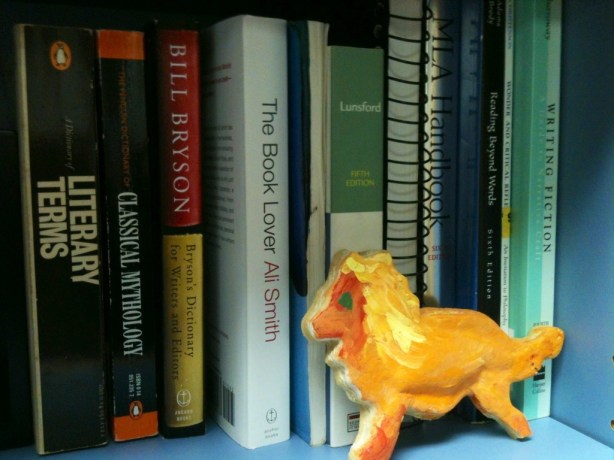
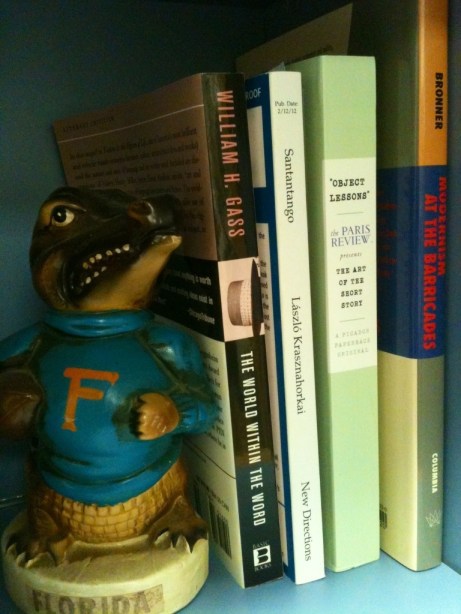
Here are some shelves/books from my office (work).
One wall is floor-to ceiling shelves—the whole wall—but most of the space is filled with files, folders, and professional books.
I tried to picture some of my favorite stuff—dictionaries, guides, and anthologies that remain inspiring.
There is also a little corner where I keep stuff I read in my office—review copies or other books that I work with when I have a spare hour.
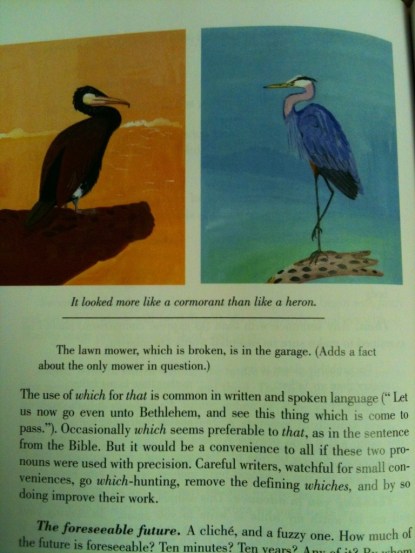
Here’s a shelf (double stacked, as you might be able to see) that gets constantly shifted around. There are a couple of books about usage here that I like to bring into the classroom.
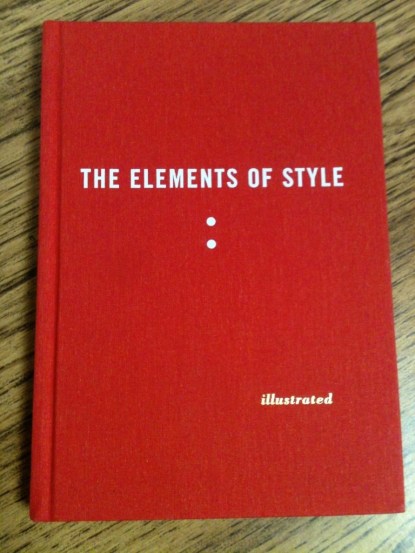
Of course, the best usage guide is Strunk & White’s classic:
This illustrated copy was a gift from some dear friends.
Joseph T. Shipley’s The Origins of English Words: A Discursive Dictionary of Indo-European Roots is a favorite.
I had the audacity to write a book that caused quite a stir. As a consequence I was permitted to interact in a casual manner with people of substance. The doors of serious, elegant households were flung wide open to admit me, which was most certainly to my advantage. All I had to do was stroll right in and take care to behave in an agreeable manner as consistently as possible. Once I set foot in a gathering of at least forty full-blooded celebrities. Just imagine how glorious that was!
The commercial head of an association for practitioners of the fine arts one day invited me, after appropriate deliberation, to become his secretary. “I hope,” he said, “that you will prove just as capable of selling pictures as you are of publishing books!” The offer was too kind to be dismissed out of hand. Accepting this proposal, I resolved that from this moment on I would consider myself fairly remarkable. I felt obliged to remind myself that a person who, upon receiving support, neither feels gratified nor shows his pleasure and gives voice to his satisfaction insults the world at large.
Its plain to see: a keen mind, superior intelligence, a high or the highest level of education and culture should, if this is somehow conceivable, be expected of all secretaries. Even their external appearance must, it goes without saying, be proper and distinguished. One assumes them to be pliant and at the same time clever, suave, gallant and at the same time in every way resolved to achieve commercial success. Elegant manners and glossy social savoir faire number decisively among their inborn qualities.
I don’t know whether I did in fact display all the above-mentioned traits, but I do know that half the city came traipsing through my office. Persons of all dispositions, of every rank and station came barging more or less vigorously into the ministry, I mean headquarters: the cream of society, elegant agents, poor journeymen, sly Gypsies, unruly poets, alarmingly refined ladies, dour princes, strikingly handsome young officers, authors, actresses, sculptors, diplomats, politicians, critics, journalists, theater directors, virtuosos, celebrated scholars, publishers, and wizards in the field of finance. In and out went some who had long since arrived at the top, some who were still groping about the bottom, and others hoping to ascend–both radiantly luminous and somber, gloomy individuals. As in an odd masquerade there entered: young and old, poor and wealthy, healthy and frail, lofty and lowly, merry and morose, happy and unhappy, saucy and shy, cheerful and sad, attractive and hideous, polite and impolite, glorious and shabby, respected and despondent, the proud and the imploring, the famous and the unknown, along with faces, gestures, and figures of all genres.
Art exhibitions are known to have as their goal the advantageous display of works of art and the attracting of buyers. The secretary plays the role of intermediary or go-between, facilitating communication between artists and their extensive, art-infatuated public. It is his task to ensure that a goodly number of bargains are definitively struck, that pictures are industriously sent out the door to buyers. Persons expressing interest in these works might appear on the scene only to swiftly vanish from sight again, unfortunately for good. The secretary must be attentive, as the most unimposing man can unexpectedly prove to be a connoisseur and buyer.
For a time I imagined myself to be exceedingly skillful at the art trade. Unquestionably I was splendidly suited to taking leisurely hackney-cab rides upon pleasantly lively, bright, glittering streets and to spending half and whole hours merrily chatting with jolly artists’ wives. Spirited evenings at the club regularly showed me in top form. I was a master at passing about platters heaped with delicacies, and was a frequent and enthusiastic visitor to and encourager of female painters. In such and similar respects, I acquitted myself gloriously. After the fact, however, I reached the conclusion that I cannot have been a particularly valuable, clever, prudent, and successful secretary for paintings. Specialists in the field were on several occasions seen to shrug their shoulders at the extent of my accomplishments. The head of the firm seemed to find it appealing to speak with his functionary above all on the subject of poetry and the like.
A stately successor soon reduced me to a predecessor and provided me with an occasion to lay down my post, resign my position, delicately make way, and charmingly busy myself elsewhere. Thinking poorly of me or feeling resentful because he had made so bold as to presume talents in me that I did not in fact possess was something that would never have occurred to my benefactor. To demonstrate that he was still of a mind to remain well-disposed toward me, he invited me, with a turn of phrase both courteous and jovial, to join him for supper.
At Christmas a boy lame of a leg goes round the country summoning the devil’s followers, who are countless, to a general conclave. Whoever remains behind, or goes reluctantly, is scourged by another with an iron whip till the blood flows, and his traces are left in blood. The human form vanishes, and the whole multitude become wolves. Many thousands assemble. Foremost goes the leader armed with an iron whip, and the troop follow, “firmly convinced in their imaginations that they are transformed into wolves.” They fall upon herds of cattle and flocks of sheep, but they have no power to slay men. When they come to a river, the leader smites the water with his scourge, and it divides, leaving a dry path through the midst, by which the pack may go. The transformation lasts during twelve days, at the expiration of which period the wolf-skin vanishes, and the human form reappears. This superstition was expressly forbidden by the church. “Credidisti, quod quidam credere solent, ut illæ quæ a vulgo Parcæ vocantur, ipsæ, vel sint vel possint hoc facere quod creduntur, id est, dum aliquis homo nascitur, et tunc valeant illum designare ad hoc quod velint, ut quandocunque homo ille voluerit, in lupum transformari possit, quod vulgaris stultitia, werwolf vocat, aut in aliam aliquam figuram?”–Ap. Burchard. (d. 1024).
From Sabine Baring-Gould’s marvelous volume The Book of Were-Wolves (1865).
There was a time when stone was stone
And a face on the street was a finished face.
Between the Thing, myself and God alone
There was an instant symmetry.
Since you have altered all my world this trinity is twisted:
Stone is not stone
And faces like the fractioned characters in dreams are incomplete
Until in the child’s inchoate face
I recognize your exiled eyes.
The soldier climbs the glaring stair leaving your shadow.
Tonight, this torn room sleeps
Beneath the starlight bent by you.
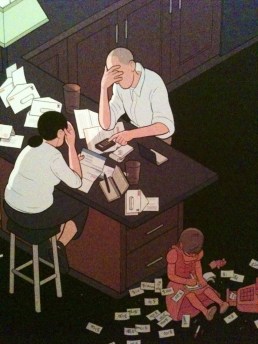
“Disconnect,” one of the longer episodes in Chris Ware’s novel Building Stories, serves as a reminder of Ware’s strength as a prose writer. Wordiness tends to kill illustrated storytelling, at least in my estimation. Sure, there are exceptions—Joe Sacco and Harvey Pekar come to mind—but in general, I think comics are at their best when thought and word bubbles are uncluttered (or nonexistent). Ware clearly understands the economy of his medium, and some of Building Stories’ finest moments have been wordless ones where Ware constructs the story in pure imagery. We can see so much of the plot and themes of “Disconnect” in this full page, for instance:
But Ware also packs plenty of storytelling into his prose in “Disconnect,” where he continues the story of Lonely Girl, who it’s probably better to now call Married Mom—I still think of her as Lonely Girl though, after first really meeting her in “September 23rd, 2000,” an episode ostensibly narrated by her diary. “Disconnect” is a second diary of sorts, her internal narration guiding us subtly through episodes in her life over a series of years. “Disconnect” focuses on LG/MM raising her young daughter against the backdrop of a strained marriage.
Lonely Girl/Married Mom’s observations ring particularly true. She points out that “When your children aren’t around, you miss them with every fiber of your being—but when they are, you just want to get them to bed so you can go read the news or something,” an observation simultaneously profound, disturbing, and banal. When our heroine recalls how her relationship to her pet cat changed after her child was born, I also saw shades of myself: “The day we brought Lucy home, almost to the minute, all applied personality to Miss Kitty evaporated, and we saw her for what she was—an animal—and an animal who we were beholden to feed and house, with, suddenly it seemed, little to offer in return.”
Through Lonely Girl/Married Mom, Ware paints a portrait of modern disconnection and alienation, and, even as we sympathize with the heroine, Ware also allows us to see through her—or rather, to see what she can’t see, or to see what she refuses to see. The effect is an irony that tips into small, banal tragedy.
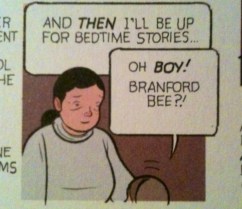
Ware’s prose is usually overshadowed by his gifts as a draftsman, an architect—he’s the builder of Building Stories, a fact that this chapter alludes to, both internally, intertextually, and metatextually. We learn, for example, that Branford the Bee is a story within a story:
This nesting of stories emerges in the final part of “Disconnect,” wherein our aged narrator—addressing her grown daughter—relates a dream:
The scene culminates so beautifully that it brought a little tear to my eye. Most postmodern novels contain (often more than once) their own descriptions, and Building Stories is no exception:
And yet what we see here isn’t postmodern cleverness or empty gimmickry, but the evocation of dream and imagination and desire and creation—the spirit of the book, of what it means to build stories. Reading the final panels of “Disconnect,” I immediately recalled the epigraph to Building Stories (it’s on the interior of the box lid, by the colophon and dedication):