David Simon on The Walking Dead . . . And Newtown

David Simon, the writer and creator behind The WireTreme, and Generation Kill, tries to tackle the tragic Newtown slayings in a post at his blog. There’s a lot of anger in the piece—rightfully so—but I find Simon’s most convincing paragraph to be the following passage, where he breaks down the fear fantasy that drives the ideology behind The Walking Dead:

On television the other evening, I caught a glimpse of a drama in which some future America was overrun by zombies, a thrilling narrative in which survivors could only rely on force of arms to keep the unthinking, unfeeling hordes at bay.  And I realized:  This isn’t mere entertainment, it’s national consensus.  More than that, it’s a well-executed and starkly visual rendering of the collective fear that governs us.  We know that they’re out there:  The less human.  The poor.  The godless.  The frightening other. And they want what we have, they are going to take what we have, and they understand nothing save for a well-placed bullet.  It’s my understanding that the show I encountered is quite popular; in this America, it may even be called populist in its argument — a morality tale that speaks to why we must arm ourselves, and carry those guns with us, and stand our fucking ground; it declares that we can’t rely on collective, utilitarian will to achieve a safe and viable society, that government by the people and for the people is, at this point, an empty catchphrase for fools and weaklings.  No, our future is every man for himself, and a gun in every outstretched hand, and if a classroom of six and seven year olds is the requisite cost every now and then, so be it.

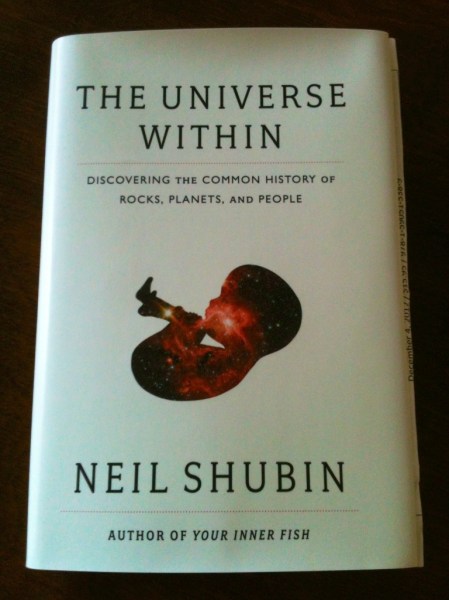
The Universe Within (Book Acquired, 12.15.2012)

20121217-104445.jpgThe Universe Within is new from Pantheon early next year. Their blurb:
From one of our finest and most popular science writers, and the best-selling author of Your Inner Fish, comes the answer to a scientific mystery as big as the world itself: How are the events that formed our solar system billions of years ago embedded inside each of us?

In Your Inner Fish, Neil Shubin delved into the amazing connections between human bodies—our hands, heads, and jaws—and the structures in fish and worms that lived hundreds of millions of years ago. In The Universe Within, with his trademark clarity and exuberance, Shubin takes an even more expansive approach to the question of why we look the way we do. Starting once again with fossils, he turns his gaze skyward, showing us how the entirety of the universe’s fourteen-billion-year history can be seen in our bodies. As he moves from our very molecular composition (a result of stellar events at the origin of our solar system) through the workings of our eyes, Shubin makes clear how the evolution of the cosmos has profoundly marked our own bodies.

PW‘s review:

University of Chicago paleontologist Shubin wrote about the fishy origins of humanity in 2009’s Your Inner Fish. In his new book, he goes farther back and further out, explaining how humans bear the markings of cosmic phenomena; as he puts it, “Written inside us is the birth of the stars.” Here, the author surveys everything from glints in “Greenlandic rocks” to the spreading signs of supernovae to reveal “deep ties to the forces that shaped our bodies.” He demonstrates how mammals owe their “high-energy lifestyle[s]” to oxygen released hundreds of millions of years ago as continents spread apart, and how color vision arose after continental drift cooled the planet, diversified flora, and resulted in biological competition that favored those organisms who could identify nutritious plants according to hue (“Every time you admire a richly colorful view, you can thank India for slamming into Asia”). Shubin is a leading proponent of the fusion of paleontology, developmental genetics, and genomics, and the result of his efforts is a volume of truly inspired science writing. Appropriately vast in scope, Shubin deftly balances breadth and depth in his search for a “sublimely beautiful truth.”


Read “The Fir-Tree,” Hans Christian Andersen’s Depressing Story About the Existential Fate of a Christmas Tree

Hans Christian Andersen’s “The Fir-Tree,” a depressing story about a Christmas tree—

Far down in the forest, where the warm sun and the fresh air made a sweet resting-place, grew a pretty little fir-tree; and yet it was not happy, it wished so much to be tall like its companions— the pines and firs which grew around it. The sun shone, and the soft air fluttered its leaves, and the little peasant children passed by, prattling merrily, but the fir-tree heeded them not. Sometimes the children would bring a large basket of raspberries or strawberries, wreathed on a straw, and seat themselves near the fir-tree, and say, “Is it not a pretty little tree?” which made it feel more unhappy than before. And yet all this while the tree grew a notch or joint taller every year; for by the number of joints in the stem of a fir-tree we can discover its age. Still, as it grew, it complained, “Oh! how I wish I were as tall as the other trees, then I would spread out my branches on every side, and my top would over-look the wide world. I should have the birds building their nests on my boughs, and when the wind blew, I should bow with stately dignity like my tall companions.” The tree was so discontented, that it took no pleasure in the warm sunshine, the birds, or the rosy clouds that floated over it morning and evening. Sometimes, in winter, when the snow lay white and glittering on the ground, a hare would come springing along, and jump right over the little tree; and then how mortified it would feel! Two winters passed, and when the third arrived, the tree had grown so tall that the hare was obliged to run round it. Yet it remained unsatisfied, and would exclaim, “Oh, if I could but keep on growing tall and old! There is nothing else worth caring for in the world!” In the autumn, as usual, the wood-cutters came and cut down several of the tallest trees, and the young fir-tree, which was now grown to its full height, shuddered as the noble trees fell to the earth with a crash. After the branches were lopped off, the trunks looked so slender and bare, that they could scarcely be recognized. Then they were placed upon wagons, and drawn by horses out of the forest. “Where were they going? What would become of them?” The young fir-tree wished very much to know; so in the spring, when the swallows and the storks came, it asked, “Do you know where those trees were taken? Did you meet them?”

Continue reading “Read “The Fir-Tree,” Hans Christian Andersen’s Depressing Story About the Existential Fate of a Christmas Tree”

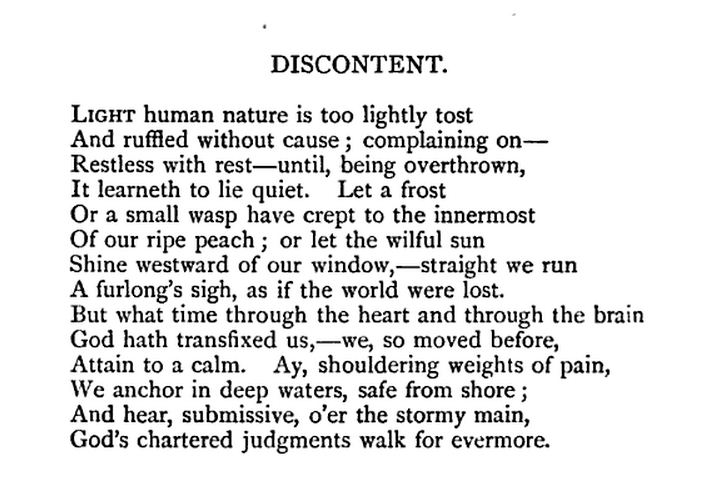
“Discontent” — Elizabeth Barrett Browning

ebb

André Maurois’s Climates (Book Acquired, 12.11.2012)

20121217-104436.jpg

This one looks pretty cool—André Maurois’s 1928 novel Climates. Here’s publisher Other Press’s blurb:

Written in 1928 by French biographer and novelist Andre Maurois, Climates became a best seller in France and all over Europe. The first 100,000 copies printed of its Russian translation sold out the day they appeared in Moscow bookstores. This magnificently written novel about a double conjugal failure is imbued with subtle yet profound psychological insights of a caliber that arguably rivals Tolstoy’s. Here Phillipe Marcenat, an erudite yet conventional industrialist from central France, falls madly in love with and marries the beautiful but unreliable Odile despite his family’s disapproval. Soon, Phillipe’s possessiveness and jealousy drive her away. Brokenhearted, Phillipe then marries the devoted and sincere Isabelle and promptly inflicts on his new wife the very same woes he endured at the hands of Odile. But Isabelle’s integrity and determination to save her marriage adds yet another dimension to this extraordinary work on the dynamics and vicissitudes of love.

I haven’t had time to dip into Climates yet, but it got a compelling write-up in The New Yorker last month. Excerpt:

At first sight, “Climates” is a simple fable. It tells of Philippe Marcenat, the heir to a provincial paper-mill business, who falls in love with the woman of his dreams, Odile Malet. He loses her, but is later loved in turn by Isabelle de Cheverny, a woman not of his dreams at all, although he tries (“Vertigo”-ishly) to make her so. We follow first Philippe and then Isabelle as they reflect on their love. There is a happy ending of sorts, though not for Philippe. Maurois has summarized his first vision of the story, in its bare-bones form, as:

Part 1. I love, and am not loved.

Part 2. I am loved, and do not love.

Put that way, it sounds like a perfectly balanced diptych. In fact, it is neither balanced nor anywhere near simple. Each of these four “love” and “non-love” elements conceals some complication, something moving at cross-purposes to it. Beneath what seems to be love, there lurks tyranny or submission, or a mixture of both. Beneath what seems to be non-love, there is… it’s hard to say what, but something indefinable that looks very much like love.

Read more: http://www.newyorker.com/online/blogs/books/2012/11/the-two-loves-of-andre-maurois.html#ixzz2FKDinsNq


A Wassailing Poem from Robert Herrick

herrick2

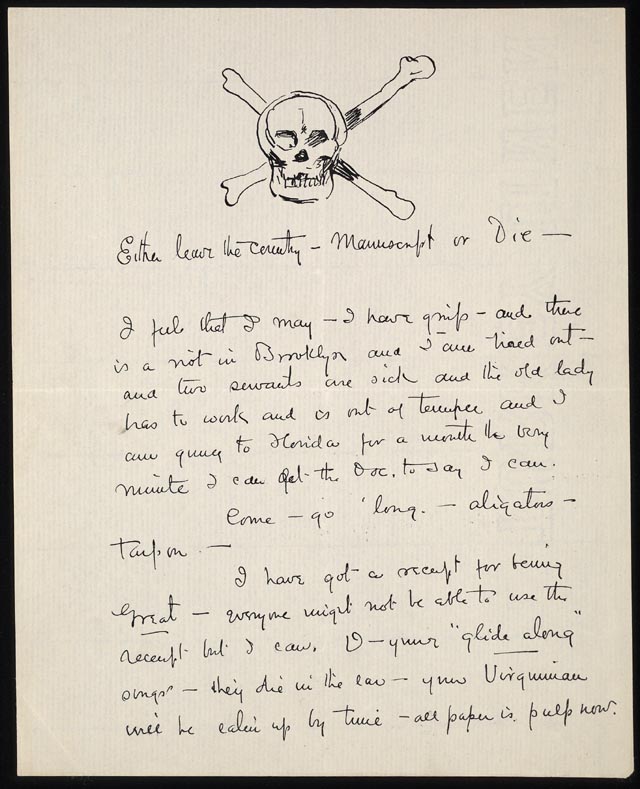
Frederic Remington Letter

at0179.7s

From the LOC:

Two champions of the old West share their common interest in this illustrated letter from sculptor, illustrator, and painter Frederic Remington to writer Owen Wister. Both originally Easterners, the two men had met in 1893 when Wister went to Wyoming for his health. In this letter to his new friend, Remington muses about the instability of his paintings, which may fade in time “like pale molasses,” but he suggests that his new work in bronze–“a cowboy on a bucking broncho”–will “rattle down through all the ages.”


Book Shelves #51, 12.16.2012


Book shelves series #51, fifty-first Sunday of 2012

20121216-092447.jpg

I am very ready for this project to be over. Two more weeks.

At this point, I’ve photographed all book shelves (and other bookbearing surfaces) in the house, but clearly the book shelves aren’t stable.

I mean, structurally, sure, they’re stable.

But their content shifts.

So this week (having three weeks left to fill), I go back to a sitting room in the front of the house where I like to read.

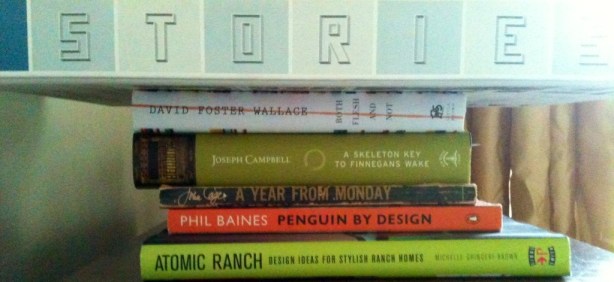
Above, resting on this cabinet, some current reading, including the latest DFW collection and Chris Ware’s Building Stories.

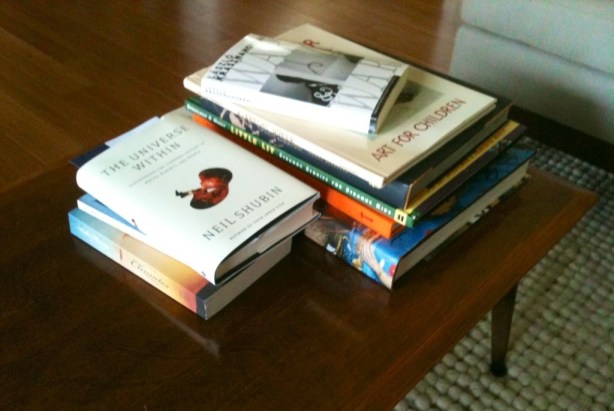
Below, a coffee table (first photographed in #7 of this series):


20121216-092518.jpg

As usual, a few coffee table books, plus several review copies that I need to look at sometime next week:

20121216-092535.jpg

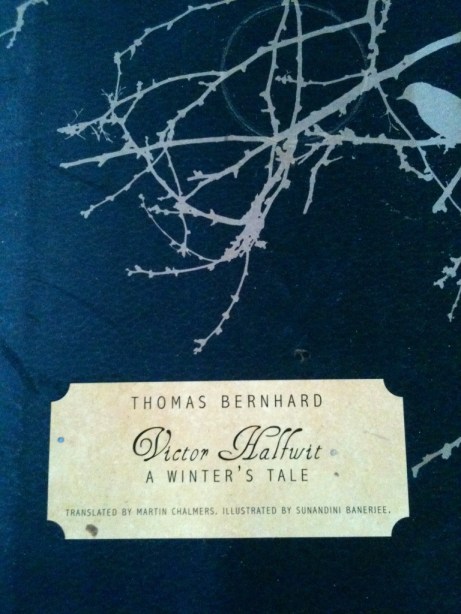
One of the coffee table books is by Thomas Bernhard:

20121216-092544.jpg

To the right of the case, a bin of books—mostly review copies that come in that I plan to write more about:

20121216-092558.jpg


Watch A Day in the Afterlife, a Documentary on Philip K. Dick (BBC, 1994)

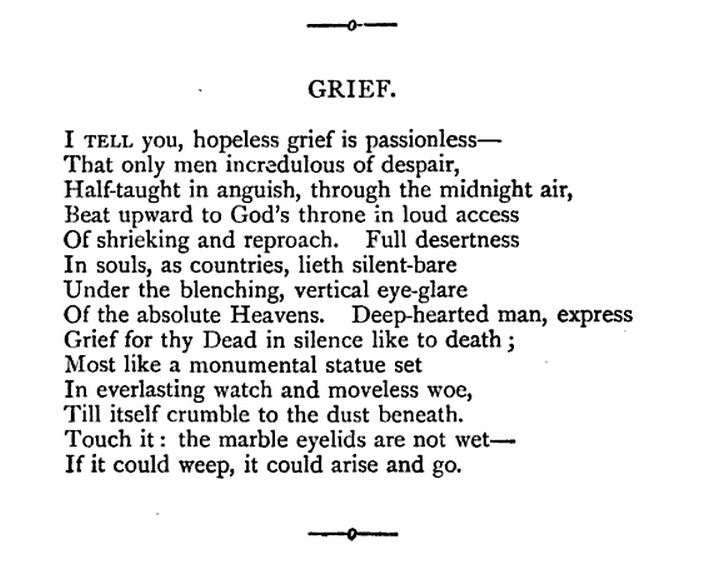
“Grief” — Elizabeth Barrett Browning

grief

This Is Probably the Best Thing We Ran in 2012

Reading Chris Ware’s Building Stories / It All Happened So Fast

20121213-185225.jpg

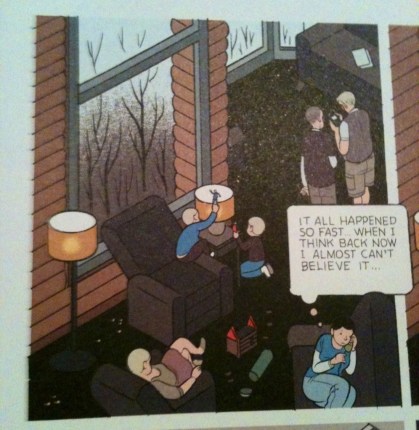
As seems to be the case more often than not in this series of write-ups on reading Chris Ware’s Building Stories, I’ve taken the title from the first line of the first panel (below); you can see the scale of this chapter in folded broadside in the pic above (which also reveals the heart of this episode).

20121213-185234.jpg

This particular episode focuses again on Lonely Girl/Married Mom/The Amputee, who has slowly emerged as the protagonist of Ware’s novel. Here, she deals with the news of her father’s illness, an event that brings her back to her childhood home repeatedly. The motif of homes and buildings evinces again too, of course—it’s a subtle but omnipresent device in Building Stories:

20121213-185305.jpg

20121213-185312.jpg

And as always, Ware’s genius shows in the way he conveys so much truth in the smallest detail. Below he illustrates Lonely Girl’s disconnected relationship with her architect husband in just a panel:

20121213-185243.jpg

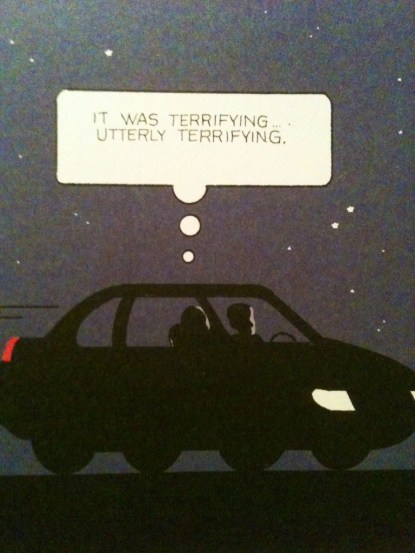
“It All Happened So Fast” is a fair name for this chapter—Ware’s panels illustrate the way that our lives (and the narrativizing of those lives) can become radically compressed, how our memories fail us, how seemingly trivial details anchor themselves to the emotional strata of our personalities even as concrete fact slips away. Still, another title could come from this panel:

20121213-185256.jpg

I’ll close this out by offering three panels that strike me as so utterly real, so wonderfully truthful, that I won’t bother to comment further:

20121213-185321.jpg

20121213-185328.jpg

20121213-185336.jpg

“The Magi,” A Stark Christmas Poem by William Butler Yeats

“The Magi” by William Butler Yeats. A Christmas poem that’s not about Christmas, I guess. I love the final image:

Now as at all times I can see in the mind’s eye,
In their stiff, painted clothes, the pale unsatisfied ones
Appear and disappear in the blue depth of the sky
With all their ancient faces like rain-beaten stones,
And all their helms of silver hovering side by side,
And all their eyes still fixed, hoping to find once more,
Being by Calvary’s turbulence unsatisfied,
The uncontrollable mystery on the bestial floor.


“What inn is this?” — Emily Dickinson

ed

The Bard and the Bird (Shakespeare Portrait) — Bill Sienkiewicz

Anthony Burgess (and Others) on Charles Dickens

JG Ballard on on Psychoactive Drugs and William Burroughs

From JG Ballard’s interview with The Paris Review; the Martin Bax novel he mentions, The Hospital Ship, is worth your time if you can find it:

INTERVIEWER

Speaking of stimulation, did any of the psychoactive drugs of the sixties give you any clues for your writing?

BALLARD

I suppose I’m a medium-to-heavy drinker, but I haven’t taken any drugs since one terrifying LSD trip in 1967. A nightmarish mistake. It opened a vent of hell that took years to close and left me wary even of aspirin. Visually it was just like my 1965 novel, The Crystal World, which some people think was inspired by my LSD trip. It convinced me that a powerful and obsessive enough imagination can reach, unaided, the very deepest layers of the mind. (I take it that beyond LSD there lies nothing.) Imagination is the shortest route between any two conceivable points, and more than equal to any physical rearrangement of the brain’s functions.

INTERVIEWER

Back in the sixties, Martin Bax and yourself, as editors of Ambit magazine, ran a drug competition.

BALLARD

Dr. Bax and I ran a competition in Ambit for the best prose or poetry written under the influence of drugs, and it produced a lot of interesting material. In general, cannabis was the best stimulant, though some good pieces came out of LSD. In fact, the best writing of all was done by Ann Quin, under the influence of the contraceptive pill.

INTERVIEWER

Dr. Bax is a novelist as well, isn’t he?

BALLARD

Martin is a physician, a research pediatrician, and consultant to a London hospital, and his book The Hospital Ship (published in the States by New Directions) is the most remarkable and original novel I’ve come across since reading William Burroughs.

INTERVIEWER

Burroughs wrote an eccentric and laudatory, in its way, introduction to the American edition of Atrocity Exhibition. Do you know him?

BALLARD

Burroughs, of course, I admire to the other side of idolatry, starting with Naked Lunch, then Ticket, Soft Machine, and Nova Express. I’m less keen on his later books. In his way he’s a genius. It’s a pity that his association with drugs and homosexuality has made him a counterculture figure, but I suppose his real links are with Jack Kerouac, Allen Ginsberg, and the Beats. Still, I think he’s much more of an establishment figure, like Dean Swift, with a despairing disgust for the political and professional establishments of which he is a part. I have met Burroughs quite a few times over the last fifteen years, and he always strikes me as an upper-class Midwesterner, with an inherent superior attitude towards blacks, policemen, doctors, and small-town politicians, the same superior attitude that Swift had to their equivalents in his own day, the same scatological obsessions and brooding contempt for middle-class values, thrift, hard work, parenthood, et cetera, which are just excuses for petit-bourgeois greed and exploitation. But I admire Burroughs more than any other living writer, and most of those who are dead. It’s nothing to do with his homosexual bent, by the way. I’m no member of the “homintern,” but a lifelong straight who prefers the company of women to most men. The few homosexual elements in Crash and Atrocity Exhibition, fucking Reagan, et cetera, are there for reasons other than the sexual—in fact, to show a world beyond sexuality, or, at least beyond clear sexual gender.