Brown and the Farrier — A Vignette from Cormac McCarthy’s Blood Meridian


A self-contained episode from late in Cormac McCarthy’s Blood Meridian; this little vignette captures the book’s strange mix of menace and humor:

Noon he was red-eyed and reeking before the alcalde’s door demanding the release of his companions. The alcalde vacated out the back of the premises and shortly there arrived an American corporal and two soldiers who warned him away. An hour later he was at the farriery. Standing warily in the doorway peering into the gloom until he could make out the shape of things within.

The farrier was at his bench and Brown entered and laid before him a polished mahogany case with a brass nameplatebradded to the lid. He unsnapped the catches and opened the case and raised from their recess within a pair of shotgun barrels and he took up the stock with the other hand. He hooked the barrels into the patent breech and stood the shotgun on the bench and pushed the fitted pin home to secure the forearm. He cocked the hammers with his thumbs and let them fall again. The shotgun was English made and had damascus barrels and engraved locks and the stock was burl mahogany. He looked up. The farrier was watching him.

You work on guns? said Brown.

I do some.

I need these barrels cut down.

The man took the gun and held it in his hands. There was a raised center rib between the barrels and inlaid in gold the maker’s name, London. There were two platinum bands in the patent breech and the locks and the hammers were chased with scrollwork cut deeply in the steel and there were partridges engraved at either end of the maker’s name there. The purple barrels were welded up from triple skelps and the hammered iron and steel bore a watered figure like the markings of some alien and antique serpent, rare and beautiful and lethal, and the wood was figured with a deep red feather grain at the butt and held a small springloaded silver capbox in the toe.

The farrier turned the gun in his hands and looked at Brown. He looked down at the case. It was lined with green baize and there were little fitted compartments that held a wadcutter, a pewter powderflask, cleaning jags, a patent pewter capper.

You need what? he said.

Cut the barrels down. Long about in here. He held a finger across the piece.

I cant do that.

Brown looked at him. You cant do it?

No sir. He looked around the shop. Well, he said. I’d of thought any damn fool could saw the barrels off a shotgun.

There’s something wrong with you. Why would anybody want to cut the barrels off a gun like this?

What did you say? said Brown.

The man tendered the gun nervously. I just meant that I dont see why anybody would want to ruin a good gun like this here. What would you take for it?

It aint for sale. You think there’s something wrong with me?

No I dont. I didnt mean it that way.

Are you goin to cut them barrels down or aint ye?

I cant do that.

Cant or wont?

You pick the one that best suits you.

Brown took the shotgun and laid it on the bench. What would you have to have to do it? he said.

I aint doin it.

If a man wanted it done what would be a fair price?

I dont know. A dollar.

Brown reached into his pocket and came up with a handful of coins. He laid a two and a half dollar gold piece on the bench. Now, he said. I’m payin you two and a half dollars.

The farrier looked at the coin nervously. I dont need your money, he said. You cant pay me to butcher that there gun.

You done been paid.

No I aint.

Yonder it lays. Now you can either get to sawin or you can default. In the case of which I aim to take it out of your ass.

The farrier didnt take his eyes off Brown. He began to back away from the bench and then he turned and ran.

When the sergeant of the guard arrived Brown had the shotgun chucked up in the benchvise and was working at the barrels with a hacksaw. The sergeant walked around to where he could see his face. What do you want, said Brown.

This man says you threatened his life.

What man?

This man. The sergeant nodded toward the door of the shed.

Brown continued to saw. You call that a man? he said.

I never give him no leave to come in here and use my tools neither, said the farrier.

How about it? said the sergeant.

How about what?

How do you answer to this man’s charges?

He’s a liar.

You never threatened him?

That’s right.

The hell he never.

I dont threaten people. I told him I’d whip his ass and that’s as good as notarized.

You dont call that a threat?

Brown looked up. It was not no threat. It was a promise. He bent to the work again and another few passes with the saw and the barrels dropped to the dirt. He laid down the saw and backed off the jaws of the vise and lifted out the shotgun and unpinned the barrels from the stock and fitted the pieces into the case and shut the lid and latched it.

What was the argument about? said the sergeant.

Wasnt no argument that I know of.

You better ask him where he got that gun he’s just ruined. He’s stole that somewheres, you can wager on it.

Where’d you get the shotgun? said the sergeant.

Brown bent down and picked up the severed barrels. They were about eighteen inches long and he had them by the small end. He came around the bench and walked past the sergeant. He put the guncase under his arm. At the door he turned. The farrier was nowhere in sight. He looked at the sergeant.

I believe that man has done withdrawed his charges, he said. Like as not he was drunk.
 

“The Flash” — Italo Calvino

The Flash

It happened one day, at a crossroads, in the middle of a crowd, people coming and going.
I stopped, blinked: suddently I understood nothing. Nothing, nothing about anything: I did not understand the reasons for things or for people, it was all senseless, absurd. I laughed.
What I found strange at the time was that I had never realized before; that up until then I had accepted everything: traffic lights, cars, posters, uniforms, monuments, things completely detached from any sense of the world, accepted them as if there were some necessity, some chain of cause and effect that bound them together.
Then my laugh died. I blushed, ashamed. I waved to get people’s attention. “Stop a moment!” I shouted, “there is something wrong! Everything is wrong! We are doing the absurdest things. This cannot be the right way. Where can it end?”
People stopped around me, sized me up, curious. I stood there in the middle of them, waving my arms, desparate to explain myself, to have them share the flash of insight that had suddenly enlightened me: and I said nothing. I said nothing because the moment I had raised my arms and opened my mouth, my great revelation had been as it were swallowed up again and the words had come out any old how, on impulse.
“So?” people asked, “what do you mean? Everything is in its place. All is as it should be. Everything is a result of something else. Everything fits in with everything else. We cannot see anything wrong or absurd.”
I stood there, lost, because as I saw it now everything had fallen into place again and everything seemed normal, traffic lights, monuments, uniforms, towerblocks, tramlines, begggards, processions; yet this did not calm me, it tormented me.
“I am sorry,” I said. “Perhaps it was I who was wrong. It seemd that way then. But everything is fine now. I am sorry.” And I made off amid their angry glares.
Yet, even now, every time (and it is often) that I find I do not understand something, then, instincitively, I am filled with the hope that perhaps this will be my moment again, perhaps once again I shall understand nothing, I shall grasp the other knowledge, found and lost in an instant.

“The Flash,” by Italo Calvino. Collected in Numbers in the Dark.

Aldous Huxley’s Brave New World (Full 1980 BBC Adaptation)

“Sisyphus, Known as the Craftiest of Men” — Roberto Bolaño


Then, incomprehensibly, he began to make faces that in some way linked him to the wife of the writer from Mainz, to such a degree that Bubis thought they must be brother and sister and only thus could one fully understand the presence of the writer and his wife at the meal. It was also possible, thought Bubis, that they were lovers, because it was common knowledge that lovers often began to resemble each other, usually in their smiles, their opinions, their points of view, in short, the superficial trappings that all human beings are obliged to bear until their deaths, like the rock of Sisyphus, yes Sisyphus, known as the craftiest of men, son of Aeolus and Enarete, founder of the city of Ephyra, which is the old name for Corinth, a city that the good Sisyphus turned into the staging ground of his happy misdeeds, because with his characteristic nimbleness of body and intellectual inclination to see every turn of fate as a chess problem or a detective story to unravel, and his instinct for laughter and jokes and jests and cracks and quips and gags and pranks and punch lines and spoofs and stories and gibes and taunts and send-ups and satires, he turned to theft, in other words parting all passersby from their belongings, even going so far as to steal from his neighbor Autolycus, also a thief, perhaps with the remote hope that one who steals from a thief is granted one hundred years of forgiveness, and at the same time smitten by his neighbor’s daughter, Anticlea, because Anticlea was very beautiful, a treat, but the girl had an official suitor, she was promised to Laertes, of subsequent fame, which didn’t daunt Sisyphus, who could count on the complicity of the girl’s father, the thief Autolycus, whose admiration for Sisyphus had sprung up like the regard of an objective and honorable artist for another artist of superior gifts, so that even though it could be said that as a man of honor he remained true to his promise to Laertes, he didn’t look unkindly upon the romantic attentions Sisyphus lavished on his daughter or treat them as disrespect or mockery of his future son-in-law, and in the end his daughter married Laertes, or so it’s said, but only after surrendering to Sisyphus one or two or five or seven times, possibly ten or fifteen times, always with the collusion of Autolycus, who wanted his neighbor to plant the seed of a grandchild as clever as Sisyphus, and on one of these occasions Anticlea was left with child and nine months later, now the wife of Laertes, her son would be born, the son of Sisyphus, called Odysseus or Ulysses, who in fact turned out to be just as clever as his father, though Sisyphus never gave him a thought and continued to live his life, a life of excesses and parties and pleasure, during which he married Merope, the dimmest star in the Pleiades precisely because she married a mortal, a miserable mortal, a miserable thief, a miserable gangster in thrall to his excesses, blinded by his excesses, among which not least was the seduction of Tyro, the daughter of Sisyphus’s brother Salmoneus, whom Sisyphus pursued not because he was interested in Tyro, not because Tyro was particularly sexy, but because Sisyphus hated his own brother and wanted to cause him pain, and for this deed, after his death, he was condemned in hell to push a stone to the top of a hill only to watch it roll down to the bottom and then push it back up to the top of the hill and watch it roll again to the bottom, and so on eternally, a bitter punishment out of all proportion to his crimes or sins, the vengeance of Zeus, it’s said, because on a certain occasion Zeus passed through Corinth with a nymph he had kidnapped, and Sisyphus, who was smarter than a whip, seized his chance, and when Asopus, the girl’s father, came by in desperate search of his daughter, Sisyphus offered to give him the name of his daughter’s kidnapper, but only if Asopus made a fountain spring up in the city of Corinth, which shows that Sisyphus wasn’t a bad citizen or perhaps he was thirsty, to which Asopus agreed and the fountain of crystalline waters sprang up and Sisyphus betrayed Zeus, who, in a blind rage, sent him ipso facto to Thanatos, or death, but Sisyphus was too much for Thanatos, and in a masterstroke perfectly in keeping with his craftiness and sense of humor he captured Thanatos and threw him in chains, a feat within reach of very few, truly very few, and for a long time he kept Thanatos in chains and during all that time not a single human being died on the face of the earth, a golden age in which men, though still men, lived free of the anxiety of death, in other words, free of the anxiety of time, because now they had more than enough time, which is perhaps what distinguishes a democracy, spare time, surplus time, time to read and time to think, until Zeus had to intervene personally and Thanatos was freed and then Sisyphus died.

But the faces Junge was making didn’t have anything to do with Sisyphus, thought Bubis.

From “The Part About Archimboldi,” 2666, by Roberto Bolaño.


List with No Name #1

  1. Bleak House
  2. A Frolic of His Own
  3. Babbitt
  4. Fathers and Sons
  5. The Magic Mountain
  6. Middlemarch
  7. Moll Flanders
  8. The Tin Drum
  9. Life and Fate
  10. R.U.R.
  11. The Dwarf
  12. Zeno’s Conscience

“True Love” — Thomas Bernhard


True Love

An Italian who owns a villa in Riva on Lake Garda and can live very comfortably on the interest from the estate his father left him has, according to a report in La Stampa, been living for the last twelve years with a mannequin. The inhabitants of Riva report that on mild evenings they have observed the Italian, who is said to have studied art history, boarding a glass-domed deluxe boat, which is moored not far from his home, with the mannequin to take a ride on the lake. Described years ago as incestuous in a reader’s letter addressed to the newspaper published in Desencano, he had applied to the appropriate civil authorities for permission to marry his mannequin but was refused. The church too had denied him the right to marry his mannequin. In winter he regularly leaves Lake Garda in mid-December and goes with his beloved, whom he met in a Paris shop-window, to Sicily, where he regularly rents a room in the famous Hotel Timeo in Taormina to escape from the cold, which, all assertions to the contrary, gets unbearable on Lake Garda every year after mid-December.

“True Love,” by Thomas Bernhard. From The Voice Imitator.


RIP Gore Vidal

20120731-234021.jpg

RIP Gore Vidal, 1925-2012

“The Wish To Be a Red Indian” — Franz Kafka

The Wish To Be a Red Indian

If one were only an Indian, instantly alert, and on a racing horse, leaning against the wind, kept on quivering jerkily over the quivering ground, until one shed one’s spurs, for there needed no spurs, threw away the reins, for there needed no reins, and hardly saw that the land before one was smoothly shorn heath when horse’s neck and head would be already gone.

“The Wish To Be a Red Indian” by Franz Kafka.

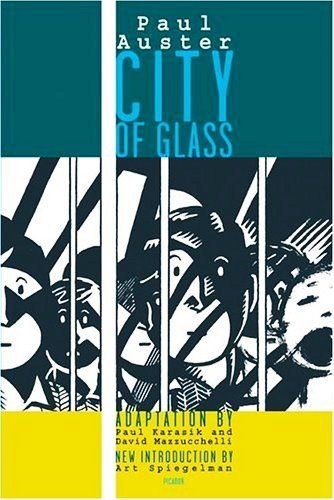
I Review City of Glass, A Comic Book Doppelgänger of Paul Auster’s Postmodern Detective Novel

Paul Auster’s 1985 novel City of Glass explores doubling, shadowing, and what it means to wear another person’s skin, so it’s fitting that the book has its own doppelgänger in the form of a graphic novel by Paul Karasik and David Mazzucchelli (maestro Art Spiegelman served as catalyst and counselor). I should admit upfront that although I’ve read a few of Auster’s books, I haven’t read City of Glass, considered by many to be his masterpiece. I have read Mazzucchelli’s excellent novel Asterios Polyp (and plenty of stuff by overseer Spiegelman), so the adaptation intrigued me. I wasn’t disappointed. I read Karasik and Mazzucchelli’s City of Glass in one brisk sitting and thoroughly enjoyed it. What’s it about?

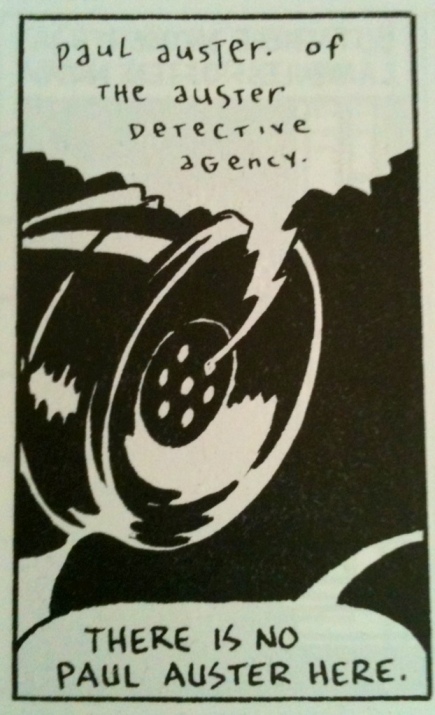
Okay, so there’s this novelist, Quinn (“rhymes with twin”), who, after the death of his wife and son, takes up writing boilerplate detective novels under the pseudonym William Wilson. Late in the book, Quinn (if he’s still Quinn at that point, which I’ll get to) identifies the pseudonym with the “real” name of NY Mets center fielder (and future coach) Mookie Wilson—but savvy readers will also recognize “William Wilson” as the name of an Edgar Allan Poe story about a man haunted by a doppelgänger of himself to the point that he goes insane. In the Poe story, Wilson and his doppelgänger (whose name is, of course, William Wilson as well) share the same birthday, January 19th, which also happens to be E.A. Poe’s birthday (and my brother’s too, although that is not germane to this review). Auster is clearly working from Poe’s story, although he never announces this explicitly (at least not in the comic-bookization). Arthur Hobson Quinn, for example, wrote an exhaustive biography of Poe (published in 1941). Crossing from the real to the fictional, from authorial to character, Auster inserts himself into the story from its outset. At the beginning of the book, protagonist Quinn gets a mysterious call, like something out of the noir novels he writes:

20120728-125217.jpg

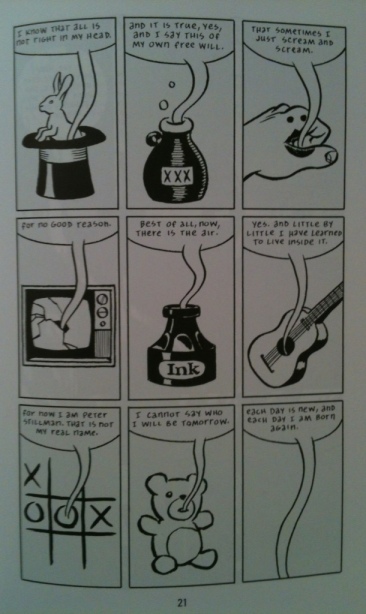
Bored, or perhaps ventriloquized by a force he doesn’t understand, Quinn takes up the identity of detective Paul Auster and agrees to take on a case for Peter Stillman, a man who, as a boy, suffered feralization at the hands of his insane father, who hoped to discover the Ur-language of god through the boy. Stillman’s monologue is one of the highlights of the book, showcasing the malleability of language—and also, significantly, the malleability of speakers:

20120728-125225.jpg

Stillman hires Quinn/Auster to track his father, also named Peter Stillman (Peter is also the name of Quinn’s dead son). Actually, it’s Stillman the Younger”s wife/speech pathologist who hires Quinn/Auster; she’s certain that Stillman the Elder, freshly released from a mental asylum, will return to harm his son.

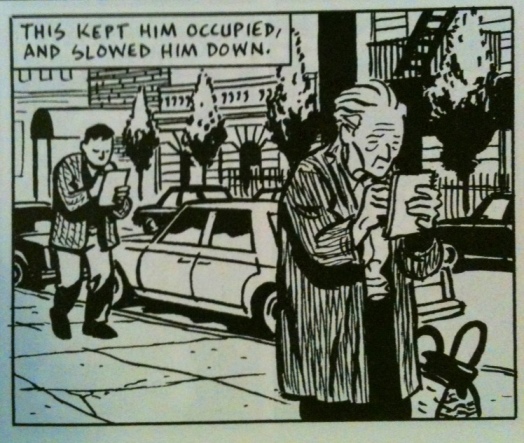
Quinn/Auster slides into the role of Max Work, his noir novel protagonist—or, perhaps more accurately, William Wilson’s noir protagonist—and begins tracking Stillman the Elder (or a version of Stillman the Elder—I won’t spoil the novel’s strangest, most maddening metaphysical gambit here). And, predictably, as Quinn/Auster/Wilson/Work  shadows Stillman Sr., he morphs into yet another doppelgänger:

20120728-125233.jpg

Quinn/Auster/Wilson/Work eventually confronts Stillman, and the pair have a series of fascinating conversations about language, Milton, Humpty Dumpty, and the Tower of Babel. The motifs and themes are telegraphed fairly straightforward here, but also communicated through a lens of madness that comes to dominate the book’s third act—an act that initiates in a meeting between Q/A/W/W and the “real” Paul Auster, a writer who’s working on an essay about the authorship of Don Quixote. The Don Quixote conversation is perhaps too overt, the sort of postmodern cleverness that I increasingly find a big turnoff, but it’s not clumsy or awkward. Still, there’s something mildly irritating about an author tipping his hand and then showing you how he’s tipping his hand.

The third act of City of Glass feels compressed, rushed even, and will definitely disappoint readers who wandered in for a detective stories, hoping for concrete answers and a neat and tidy plot. However, the book’s themes of fantasy and reality, play and work, sanity and madness, and character and author are rich if frustrating in their circuitousness. Mazzucchelli’s art is evocative and fitting, recalling at times the rough-hewn pop art of Raymond Pettibon and the traditional prowess of masters like Kirby and Eisner. (I’ll bring up Spiegelman again too, who introduces the volume. A friend of Auster’s, he brokered the project and oversaw its development, and his work as a creative director here is evident in the book’s cohesion). I imagine fans of Auster’s New York Trilogy, of which City of Glass is the first book, will be interested in checking this one out. Having come first to the graphic novel, I now look forward to reading its doppelgänger, Paul Auster’s City of Glass. Good stuff.

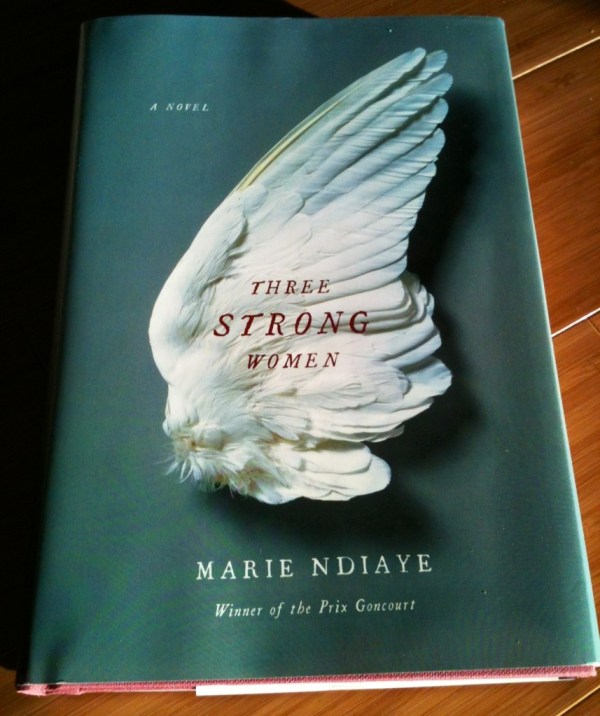
Three Strong Women (Book Acquired, 7.24.2012)


20120724-194511.jpg

Marie NDiaye’s novel Three Strong Women won the Prix Goncourt in 2009 and is now published in English translation (John Fletcher) from Random House. Their blurb:

In this new novel, the first by a black woman ever to win the coveted Prix Goncourt, Marie NDiaye creates a luminous narrative triptych as harrowing as it is beautiful.

This is the story of three women who say no: Norah, a French-born lawyer who finds herself in Senegal, summoned by her estranged, tyrannical father to save another victim of his paternity; Fanta, who leaves a modest but contented life as a teacher in Dakar to follow her white boyfriend back to France, where his delusional depression and sense of failure poison everything; and Khady, a penniless widow put out by her husband’s family with nothing but the name of a distant cousin (the aforementioned Fanta) who lives in France, a place Khady can scarcely conceive of but toward which she must now take desperate flight.

With lyrical intensity, Marie NDiaye masterfully evokes the relentless denial of dignity, to say nothing of happiness, in these lives caught between Africa and Europe. We see with stunning emotional exactitude how ordinary women discover unimagined reserves of strength, even as their humanity is chipped away. Three Strong Women admits us to an immigrant experience rarely if ever examined in fiction, but even more into the depths of the suffering heart.


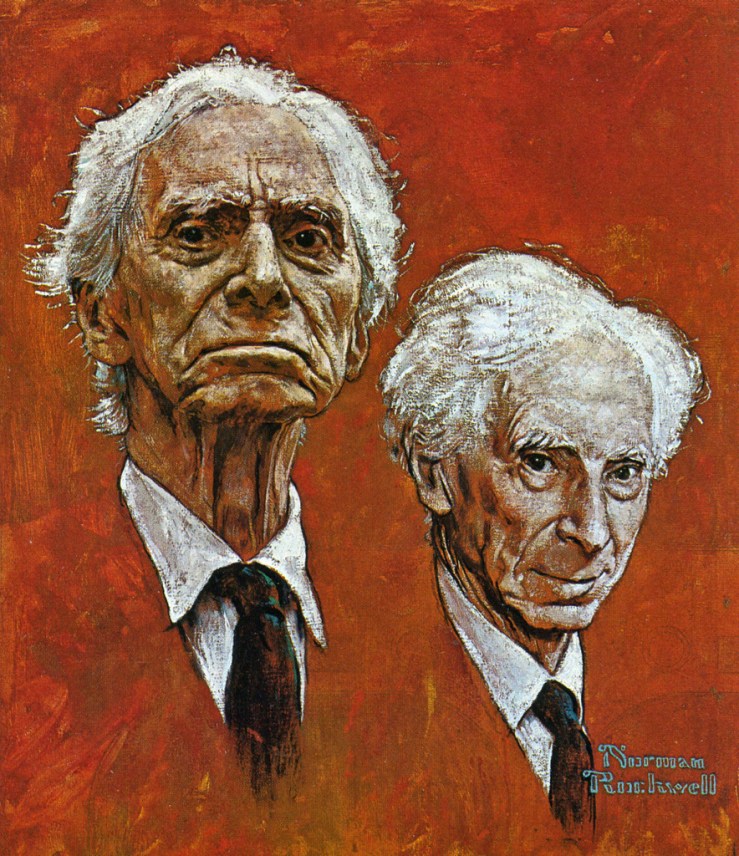
Portrait of Bertrand Russell — Norman Rockwell

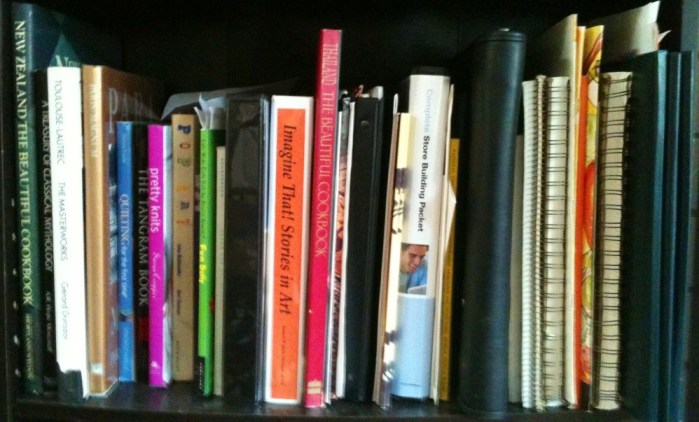
Book Shelves #31, 7.29.2012

20120729-141449.jpg


Book shelves series #31, thirty-first Sunday of 2012

When I started this project I thought it would be a fun way to keep stock of the books that I have, and also a way to perhaps question why I hold on to the books that I hold on to.

I mean, why keep a book after you’ve read it?

Anyway, at times throughout this series I’ve gotten bored, or rushed; other times I’ve thought the idea was stupid, or narcissistic, or something even worse (although I don’t know what).

I like the shelves above the pedestrian, utilitarian jobber that I’ll feature this Sunday and the next: lots of aesthetically pleasing stuff there.

Not so this one, which holds photos and cookbooks and art books and old notebooks and sketchbooks and every kind of etcetera:

20120729-141456.jpg

At least that’s what I thought until I started digging into the cramped top shelf, dutifully bound to this project.

I wound up really enjoying myself, pausing over volumes that I haven’t looked at in ages, like this beauty:

20120729-141509.jpg

I’m not sure if the aesthetic joy of this postcard collection comes across in these lousy iPhone photo shots.

I got this on a trip to London when I was 11. It was just my mom and my brother and I. First we went to Singapore. We were coming back to the States for Christmas, and also to live, eventually. My brother broke his leg in Singapore jumping down some stairs and we didn’t realize it was broken until we got back to Florida.

20120729-141515.jpg

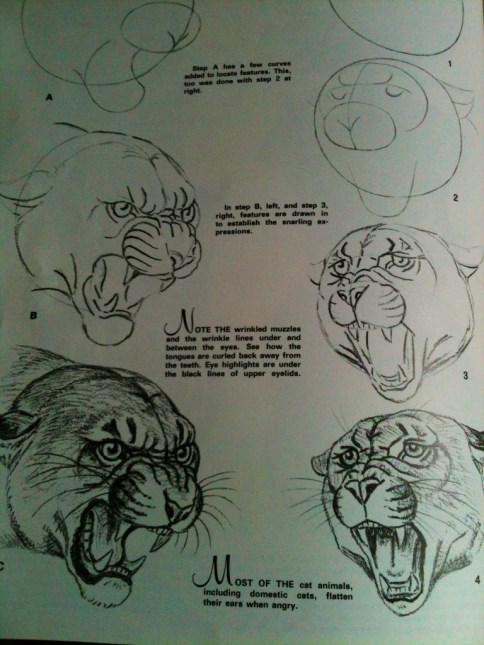
I used to draw and paint all the time, especially as a kid. Mostly animals.

There are at least a dozen skinny books like this on the shelf:

20120729-141522.jpg

I must have done hundreds of these as a kid:

20120729-141546.jpg

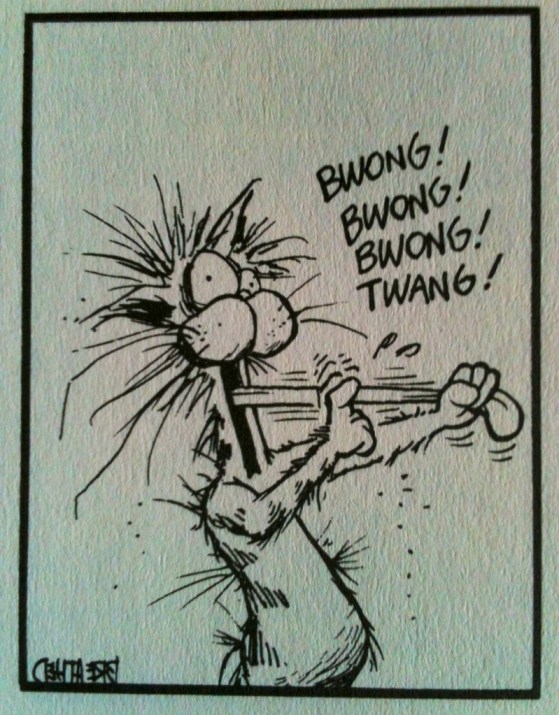
The shelf is also full of old comic strip collections that you probably recognize, like these guys:

20120729-141556.jpg

And this guy (and yes, I have the 7″ record from this collection)

20120729-141601.jpg

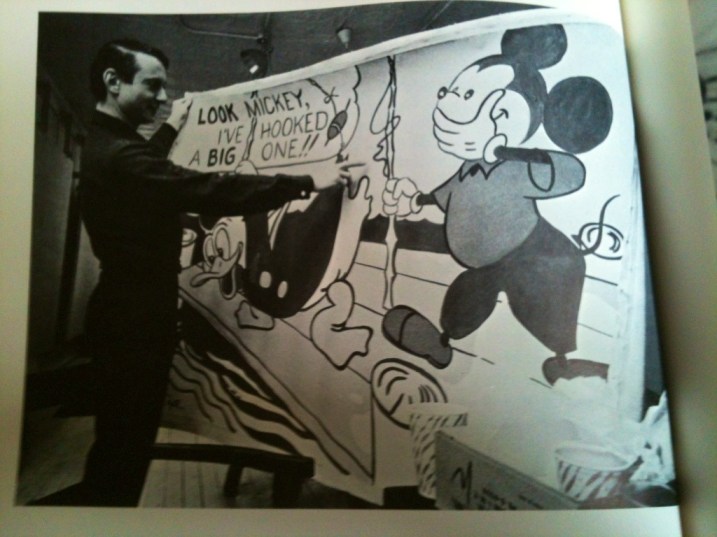
I also spent half an hour revising Rublowsky’s 1965 volume Pop Art, which is kind of fascinating in its contemporary proximity to its subject.

The cover’s not interesting, but Ken Heyman’s photos are; they show the artists in process. This one is kinda famous:

20120729-141609.jpg

And here’s Roy Lichtenstein:

20120729-141616.jpg


“In a House Besieged” — Lydia Davis

In a house besieged lived a man and a woman. From where they cowered in the kitchen the man and woman heard small explosions. “The wind,” said the woman. “Hunters,” said the man. “The rain,” said the woman. “The army,” said the man. The woman wanted to go home, but she was already home, there in the middle of the country in a house besieged.

“In a House Besieged,” from Lydia Davis’s first collection Break It Down (1986); available in The Collected Stories.

Perseus and Medusa — Italo Calvino

At certain moments I felt that the entire world was turning into stone: a slow petrification, more or less advanced depending on people and places but one that spared no aspect of life. It was as if no one could escape the inexorable stare of Medusa. The only hero able to cut off Medusa’s head is Perseus, who flies with winged sandals; Perseus, who does not turn his gaze upon the face of the Gorgon but only upon her image reflected in his bronze shield. Thus Perseus comes to my aid even at this moment, just as I too am about to be caught in a vise of stone— which happens every time I try to speak about my own past. Better to let my talk be composed of images from mythology.

To cut off Medusa’s head without being turned to stone, Perseus supports himself on the very lightest of things, the winds and the clouds, and fixes his gaze upon what can be revealed only by indirect vision, an image caught in a mirror. I am immediately tempted to see this myth as an allegory on the poet’s relationship to the world, a lesson in the method to follow when writing. But I know that any interpretation impoverishes the myth and suffocates it. With myths, one should not be in a hurry. It is better to let them settle into the memory, to stop and dwell on every detail, to reflect on them without losing touch with their language of images. The lesson we can learn from a myth lies in the literal narrative, not in what we add to it from the outside.

The relationship between Perseus and the Gorgon is a complex one and does not end with the beheading of the monster. Medusa’s blood gives birth to a winged horse, Pegasus—the heaviness of stone is transformed into its opposite. With one blow of his hoof on Mount Helicon, Pegasus makes a spring gush forth, where the Muses drink. In certain versions of the myth, it is Perseus who rides the miraculous Pegasus, so dear to the Muses, born from the accursed blood of Medusa. (Even the winged sandals, incidentally, come from the world of monsters, for Perseus obtained them from Medusa’s sisters, the Graiae, who had one tooth and one eye among them.) As for the severed head, Perseus does not abandon it but carries it concealed in a bag. When his enemies are about to overcome him, he has only to display it, holding it by its snaky locks, and this bloodstained booty becomes an invincible weapon in the hero’s hand. It is a weapon he uses only in cases of dire necessity, and only against those who deserve the punishment of being turned into statues. Here, certainly, the myth is telling us something, something implicit in the images that can’t be explained in any other way. Perseus succeeds in mastering that horrendous face by keeping it hidden, just as in the first place he vanquished it by viewing it in a mirror. Perseus’s strength always lies in a refusal to look directly, but not in a refusal of the reality in which he is fated to live; he carries the reality with him and accepts it as his particular burden.

On the relationship between Perseus and Medusa, we can learn something more from Ovid’s Metamorphoses. Perseus wins another battle: he hacks a sea-monster to pieces with his sword and sets Andromeda free. Now he prepares to do what any of us would do after such an awful chore—he wants to wash his hands. But another problem arises: where to put Medusa’s head. And here Ovid has some lines (IV740-752) that seem to me extraordinary in showing how much delicacy of spirit a man must have to be a Perseus, killer of monsters: “So that the rough sand should not harm the snake-haired head (anquiferumque caput dura ne laedat harena), he makes the ground soft with a bed of leaves, and on top of that he strews little branches of plants born under water, and on this he places Medusa’s head, face down.” I think that the lightness, of which Perseus is the hero, could not be better represented than by this gesture of refreshing courtesy toward a being so monstrous and terrifying yet at the same time somehow fragile and perishable. But the most unexpected thing is the miracle that follows: when they touch Medusa, the little marine plants turn into coral and the nymphs, in order to have coral for adornments, rush to bring sprigs and seaweed to the terrible head.

This clash of images, in which the fine grace of the coral touches the savage horror of the Gorgon, is so suggestive that I would not like to spoil it by attempting glosses or interpretations.

From Italo Calvino’s essay “Light,” in Six Memos.

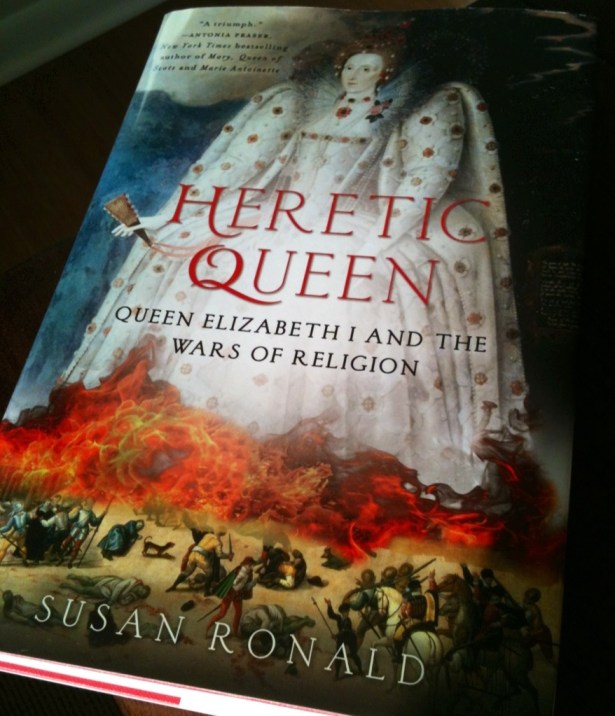
Heretic Queen (Book Acquired, 7.23.2012)


20120724-194358.jpg

Susan Ronald’s Heretic Queen is new in hardback from Macmillan. Their blurb:

Elizabeth’s 1558 coronation procession was met with an extravagant outpouring of love. Only twenty-five years old, the young queen saw herself as their Protestant savior, aiming to provide the nation with new hope, prosperity, and independence from the foreign influence that had plagued her sister Mary’s reign. Given the scars of the Reformation, Elizabeth would need all of the powers of diplomacy and tact she could summon.


Extravagant, witty, and hot-tempered, Elizabeth was the ultimate tyrant. Yet at the outset, in religious matters, she was unfathomably tolerant for her day. “There is only one Christ, Jesus, one faith,” Elizabeth once proclaimed. “All else is a dispute over trifles.” Heretic Queen is the highly personal, untold story of how Queen Elizabeth I secured the future of England as a world power. Susan Ronald paints the queen as a complex character whose apparent indecision was really a political tool that she wielded with great aplomb.


“Bachelor’s Ill Luck” — Franz Kafka


Bachelor’s Ill Luck

It seems so dreadful to stay a bachelor, to become an old man struggling to keep one’s dignity while begging for an invitation whenever one wants to spend an evening in company, to lie ill gazing for weeks into an empty room from the corner where one’s bed is, always having to say good night at the front door, never to run up a stairway beside one’s wife, to have only side doors in one’s room leading into other people’s living rooms, having to carry one’s supper home in one’s hand, having to admire other people’s children and not even being allowed to go on saying: ‘I have none myself,’ modeling oneself in appearance and behavior on one or two bachelors remembered from one’s youth.

That’s how it will be, except that in reality, both today and later, one will stand there with a palpable body and a real head, a real forehead, that is, for smiting on with one’s hand.

“Bachelor’s Ill Luck” by Franz Kafka.


In Which I Review the Cloud Atlas Film Trailer

I liked David Mitchell’s novel Cloud Atlas.

I reviewed it here in some detail, but here’s a brief overview:

Mitchell’s Cloud Atlas comprises six sections, each interrupted by the next section (with the exception of the sixth section), and then commenced again in reverse order (a simpler way to think of this might be a schema: 1-2-3-4-5-6-5-4-3-2-1). Sections 1-6 move forward chronologically and, significantly, each section represents a new literary trend. (Again, perhaps a schema with illustrating examples would work better here; for more detail, check out my review: 1: Melville-2: Modernism-3: Airport novel-4: Contemporary novel (Roth?)-5: Dystopian sci-fi (post-Orwell, shades of PKD)-6: Post-apocalyptic (language games, à la Russell Hoban’s Riddley Walker)). In short, Cloud Atlas is an exercise in several genre styles, glommed onto a few ideas cribbed from Nietzsche: eternal recurrence, master/slave relationships, will to power, all that jazz. Ultimately—and more interestingly, I think—Cloud Atlas is an exercise in postmodernism-as-genre, a sort of critique perhaps (intentional or not), brought into even greater relief when one examines Mitchell’s novels Black Swan Green (a coming of age story) and The Thousand Autumns of Jacob de Zoet (a straight-up historical romance), which are, again, genre exercises.

This leads me up to the film adaptation of Cloud Atlas, the long trailer for which dropped today.

I would embed the goddamn trailer, but it’s been blocked on YouTube and other similar sites by Warner Brothers, who apparently have absolutely no idea how publicity works.

You can watch the trailer here.

[Update] Here’s the trailer:

Did you watch it? Okay. I’m gonna riff a little:

I know that trailers have to advertise films to a wide range of potential audience members, and that often leads to overwrought musical cues and lines pulled out of context and big flashing words in all caps, but damn, this is cheeseball stuff. Mitchell’s Cloud Atlas is a subtle book (at times), one that works best when the readers are allowed to do most of the work. The trailer suggests spectacle over nuance, bombast over substance. But again—just a trailer.

Not that the Wachowskis—who are directing and writing and producing (along with Tom Tykwer, whose films Run Lola Run and Perfume I recall enjoying)—-are known for restraint.

And, while I’m bringing up the Wachowskis: They are most famous for their visual inventiveness (these are the guys who did The Matrix), but great looking films don’t necessarily mean much. I mean, the last film they did was Speed Racer (okay, Cloud Atlas looks a lot more restrained than that fiasco, but still, these guys have major problems with storytelling).

Now, based on the trailer, the filmmakers seem to have done some significant rewrites. In Mitchell’s novel, each section (or sections 1-5, at least), exists as a narrative of some kind—fictional narratives, in a few cases. Each protagonist comes to find him or herself echoing or tracing or otherwise repeating or prefiguring the protagonist of another narrative—but there’s always the recognition of the textuality (and hence, metatextuality) to this patterning. Put another way, these are all characters in stories that are awfully familiar to us, and Mitchell strives to make the reader aware of this textuality: it’s a thoroughly postmodern move. 

The film seems to connect the characters in two ways: 1, it seems to use actors across separate roles (this could work) and 2, it seems to have characters from previous segments interact with each other across segments. I might be misreading the trailer when it comes to point 2 here, but I think that having characters actively puncture the nested narratives of Cloud Atlas is a bad idea. And, even if I am misreading this, the film clearly imposes a unifying style across the narratives—sure the dystopian sci-fi scenes will have different set dressing, etc., than the Pacific journal narrative scenes—but take note of how all the scenes seem to follow a unified visual sensibility. The joy of Mitchell’s novel is the way he plays with, parodies, adores (etc.) the narrative styles he’s reworking. For example, Half-Lives: The First Luisa Rey Mystery reads like a bad airport mystery (or at least a mediocre one). I was hoping that the filmmakers would attempt to do something similar with the film—actually play with the concept of genre, actually manipulate and amplify the distinct genre conventions at work in Mitchell’s book. Which, maybe they do. Again, I know: it’s just a trailer.

But it’s an awfully slick, shiny trailer.

Okay, perhaps I’m griping too much. All the characters seem to be there, and the casting doesn’t seem terrible. My curiosity is piqued, admittedly, but mostly because I want to know how the filmmakers will handle the nested narratives (also: how long will the movie be?). In any case, I’m sure this will be one of those movies where people sigh and say, “Yeah, the book is way better.”