Mitchell’s Cloud Atlas comprises six sections, each interrupted by the next section (with the exception of the sixth section), and then commenced again in reverse order (a simpler way to think of this might be a schema: 1-2-3-4-5-6-5-4-3-2-1). Sections 1-6 move forward chronologically and, significantly, each section represents a new literary trend. (Again, perhaps a schema with illustrating examples would work better here; for more detail, check out my review: 1: Melville-2: Modernism-3: Airport novel-4: Contemporary novel (Roth?)-5: Dystopian sci-fi (post-Orwell, shades of PKD)-6: Post-apocalyptic (language games, à la Russell Hoban’s Riddley Walker)). In short, Cloud Atlas is an exercise in several genre styles, glommed onto a few ideas cribbed from Nietzsche: eternal recurrence, master/slave relationships, will to power, all that jazz. Ultimately—and more interestingly, I think—Cloud Atlas is an exercise in postmodernism-as-genre, a sort of critique perhaps (intentional or not), brought into even greater relief when one examines Mitchell’s novels Black Swan Green (a coming of age story) and The Thousand Autumns of Jacob de Zoet (a straight-up historical romance), which are, again, genre exercises.
This leads me up to the film adaptation of Cloud Atlas, the long trailer for which dropped today.
I would embed the goddamn trailer, but it’s been blocked on YouTube and other similar sites by Warner Brothers, who apparently have absolutely no idea how publicity works.
I know that trailers have to advertise films to a wide range of potential audience members, and that often leads to overwrought musical cues and lines pulled out of context and big flashing words in all caps, but damn, this is cheeseball stuff. Mitchell’s Cloud Atlas is a subtle book (at times), one that works best when the readers are allowed to do most of the work. The trailer suggests spectacle over nuance, bombast over substance. But again—just a trailer.
Not that the Wachowskis—who are directing and writing and producing (along with Tom Tykwer, whose films Run Lola Run and Perfume I recall enjoying)—-are known for restraint.
And, while I’m bringing up the Wachowskis: They are most famous for their visual inventiveness (these are the guys who did The Matrix), but great looking films don’t necessarily mean much. I mean, the last film they did was Speed Racer (okay, Cloud Atlas looks a lot more restrained than that fiasco, but still, these guys have major problems with storytelling).
Now, based on the trailer, the filmmakers seem to have done some significant rewrites. In Mitchell’s novel, each section (or sections 1-5, at least), exists as a narrative of some kind—fictional narratives, in a few cases. Each protagonist comes to find him or herself echoing or tracing or otherwise repeating or prefiguring the protagonist of another narrative—but there’s always the recognition of the textuality (and hence, metatextuality) to this patterning. Put another way, these are all characters in stories that are awfully familiar to us, and Mitchell strives to make the reader aware of this textuality: it’s a thoroughly postmodern move.
The film seems to connect the characters in two ways: 1, it seems to use actors across separate roles (this could work) and 2, it seems to have characters from previous segments interact with each other across segments. I might be misreading the trailer when it comes to point 2 here, but I think that having characters actively puncture the nested narratives of Cloud Atlas is a bad idea. And, even if I am misreading this, the film clearly imposes a unifying style across the narratives—sure the dystopian sci-fi scenes will have different set dressing, etc., than the Pacific journal narrative scenes—but take note of how all the scenes seem to follow a unified visual sensibility. The joy of Mitchell’s novel is the way he plays with, parodies, adores (etc.) the narrative styles he’s reworking. For example, Half-Lives: The First Luisa Rey Mystery reads like a bad airport mystery (or at least a mediocre one). I was hoping that the filmmakers would attempt to do something similar with the film—actually play with the concept of genre, actually manipulate and amplify the distinct genre conventions at work in Mitchell’s book. Which, maybe they do. Again, I know: it’s just a trailer.
But it’s an awfully slick, shiny trailer.
Okay, perhaps I’m griping too much. All the characters seem to be there, and the casting doesn’t seem terrible. My curiosity is piqued, admittedly, but mostly because I want to know how the filmmakers will handle the nested narratives (also: how long will the movie be?). In any case, I’m sure this will be one of those movies where people sigh and say, “Yeah, the book is way better.”
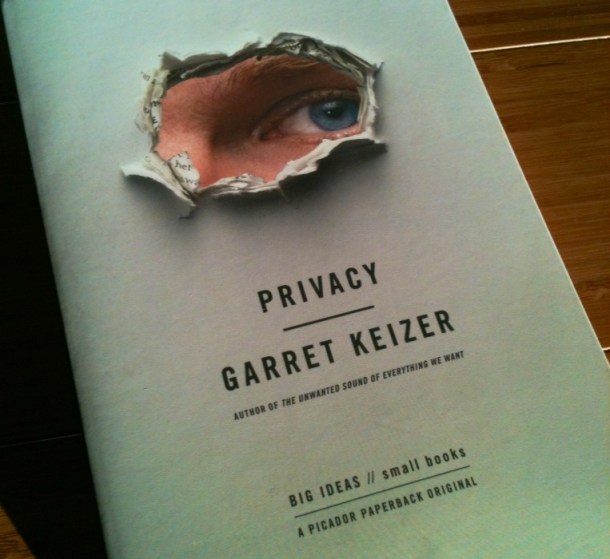
Maybe you saw Garret Keizer on Colbert, or maybe you’ve read his stuff at Harper’s; anyway, his new little book Privacy seems pretty good. I’ve enjoyed all the titles in Picador’s BIG IDEAS // small books so far, and a scan over Privacy suggests another intriguing entry. Full review down the line.
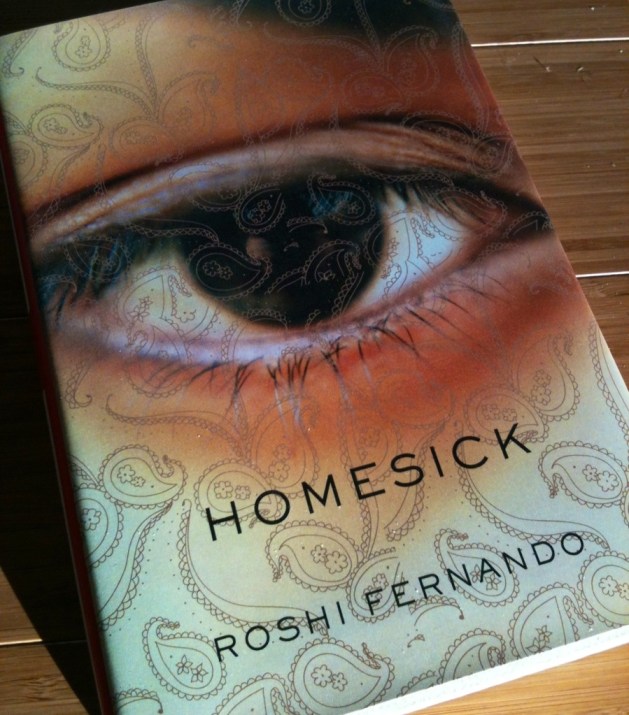
Roshi Fernando’s Homesick came out a few years ago in the UK; it’s now getting the deluxe treatment from Knopf. Their blurb:
In this stunningly assured debut work of fiction, Roshi Fernando weaves together the lives of an extended Sri Lankan family.
At Victor and Nandini’s home in southeast London, the New Year’s Eve celebration is under way. Everyone is gathered around—clinking glasses of arrack and whisky, eating freshly fried poppadoms, listening to baila music—waiting to ring in 1983. Upstairs, The Godfather is playing on repeat for a bedroom filled with teenagers drunk on pilfered wine. And in the middle of it all is sixteen-year-old Preethi, tipsy on youth and friendship and covert cigarettes, desperate to belong.
But what does that mean, to belong? As Preethi moves through her life—befriending the local outcast, revealing her brother’s deepest secret, struggling with her own unhappiness and through a souring marriage—this desire for acceptance remains the one constant, both for her and for everyone she knows.Homesick moves back and forth in time, between London and Sri Lanka, circling the people in Preethi’s world: her brother Rohan; her friends Nil, Clare, Deirdre, and Lolly; her aunty Gertie; and terrible cousin Kumar. Together, they are bound by this shared need to fit in somewhere, this rootless desire for a place to call home.
Gorgeously drawn, told with wit and pathos, this poignant narrative blends love with loss, politics with pop culture, tradition with youthful rebellion. Homesick is rich with insight and a kaleidoscopic view of contemporary immigrant life that introduces us to the work of Roshi Fernando, a remarkable new talent.
I usually sift through these books acquired books before I post, but I haven’t had time to do it thus far with Homesick, so I can’t really comment on the prose. The cover has an eye on it, so it’s here, in this post.
I dreamed of a woman with no mouth, says the man in bed. I couldn’t help smiling. The piston forces the images up again. Look, he tells her, I know another story that’s just as sad. He’s a writer who lives on the edge of town. He makes a living working a riding school. He’s never asked for much, all he needs is a room and time to read. But one day he meets a girl who lives in another city and he falls in love. They decide to get married. The girl will come to live with him. The first problem arises: finding a place big enough for the two of them. The second problem is where to get the money to pay for it. Then one thing leads to another: a job with a steady income (at the stables he works on commission, plus room, board, and a small monthly stipend), getting his papers in order, registering with social security, etc. But for now, he needs money to get to the city where his fianceé lives. A friend suggests the possibility of writing articles for a magazine. He calculates that the first four would pay for the bus trip there and back and maybe a few days at a cheap hotel. He writes his girlfriend to tell her he’s coming. But he can’t finish a single article. He spends the evenings sitting outdoors at the bar of the riding school where he works, trying to write, but he can’t. Nothing comes out, as they say in common parlance. The man realizes that he’s finished. All he writes are short crime stories. The trip recedes from his future, is lost, and he remains listless, inert, going automatically about his work among the horses.
“Among the Horses” by Roberto Bolaño. Section 11 of his poem-novel Antwerp.
Hot Springs:
In a Spring vacation hotel the rain is bad news indeed. The hundred French windows of the great galleries led the eye out to ink-and-water pines snivelling listlessly on to raw brown tennis courts, to desolate hills against soiled white sky. There was “nothing to do” for hotel and resort were one and the same and no indoor activity was promised on the bulletin board until the concert of the Princeton Glee Club Easter Monday. Women who had come to breakfast in riding clothes rushed to the hairdresser instead; at eleven the tap-k’tap of ping-pong balls was the only sound of life in the enormous half empty hotel.
The girl was one of a pair in white skirts and yellow sweaters who walked down the long gallery after breakfast. Her face reflected the discontent of the weather, reflected darkly and resentfully. Looking at her Deforrest Colman thought: “Bored and fierce,” and then as his eyes continued to follow her, “No, proud and impatient. Not that either, but what a face—vitality and hand cuffs—where’s this getting me—liver and bacon, Damon and Pythias, Laurel and Hardy.
One hot evening in Padua they carried him up onto the roof and he could look out over the top of the town. There were chimney swifts in the sky. After a while it got dark and the searchlights came out. The others went down and took the bottles with them. He and Luz could hear them below on the balcony. Luz sat on the bed. She was cool and fresh in the hot night.
Luz stayed on night duty for three months. They were glad to let her. When they operated on him she prepared him for the operating table; and they had a joke about friend or enema. He went under the anaesthetic holding tight on to himself so he would not blab about anything during the silly, talky time. After he got on crutches he used to take the temperatures so Luz would not have to get up from the bed. There were only a few patients, and they all knew about it. They all liked Luz. As he walked back along the halls he thought of Luz in his bed.
Before he went back to the front they went into the Duomo and prayed. It was dim and quiet, and there were other people praying. They wanted to get married, but there was not enough time for the banns, and neither of them had birth certificates. They felt as though they were married, but they wanted everyone to know about it, and to make it so they could not lose it.
Luz wrote him many letters that he never got until after the armistice. Fifteen came in a bunch to the front and he sorted them by the dates and read them all straight through. They were all about the hospital, and how much she loved him and how it was impossible to get along without him and how terrible it was missing him at night.
After the armistice they agreed he should go home to get a job so they might be married. Luz would not come home until he had a good job and could come to New York to meet her. It was understood he would not drink, and he did not want to see his friends or anyone in the States. Only to get a job and be married. On the train from Padua to Milan they quarreled about her not being willing to come home at once. When they had to say good-bye, in the station at Milan, they kissed good-bye, but were not finished with the quarrel. He felt sick about saying good-bye like that.
He went to America on a boat from Genoa. Luz went back to Pordonone to open a hospital. It was lonely and rainy there, and there was a battalion of arditi quartered in the town. Living in the muddy, rainy town in the winter, the major of the battalion made love to Luz, and she had never known Italians before, and finally wrote to the States that theirs had only been a boy and girl affair. She was sorry, and she knew he would probably not be able to understand, but might some day forgive her, and be grateful to her, and she expected, absolutely unexpectedly, to be married in the spring. She loved him as always, but she realized now it was only a boy and girl love. She hoped he would have a great career, and believed in him absolutely. She knew it was for the best.
The major did not marry her in the spring, or any other time. Luz never got an answer to the letter to Chicago about it. A short time after he contracted gonorrhea from a sales girl in a loop department store while riding in a taxicab through Lincoln Park.
“The Tables Turned,” a microfiction from Thomas Bernhard’s The Voice Imitator:
Even though I have always hated zoological gardens and actually find that my suspicions are aroused by people who visit zoological gardens, I still could not avoid going out to Schönbrunn on one occasion and, at the request of my companion, a professor of theology, standing in front of the monkeys’ cage to look at the monkeys, which my companion fed with some food he had brought with him for the purpose. The professor of theology, an old friend of mine from the university, who had asked me to go to Schönbrunn with him had, as time went on, fed all the food he had brought with him to the monkeys, when suddenly the monkeys, for their part, scratched together all the food that had fallen to the ground and offered it to us through the bars. The professor of theology and I were so startled by the monkeys’ sudden behavior that in a flash we turned on our heels and left Schönbrunn through the nearest exit.
Lots of publication series editions here, including this batch of Melville House Art of the Contemporary Novella:
I reviewed most of these and they’re all very good—especially Sandokan.
Some ratty ratty Penguin Classics that I procured from various institutions I won’t name here. The Mallory was a particular obsession for a few years:
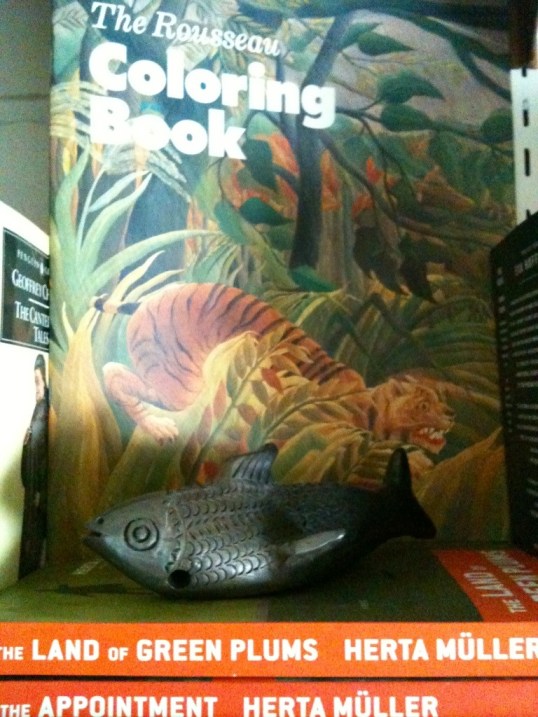
The Rousseau Coloring Book was a gift from a friend to our daughter, but I stole it and put it up here.
I reviewed all of Picador’s BIG IDEAS // small books series; I actually got a new one, Privacy, in the mail the other day. Violence and Humiliation are particularly good.
Next to those: various World of Art series books, most of them my wife’s. (Bonus points if you guess mine correctly):
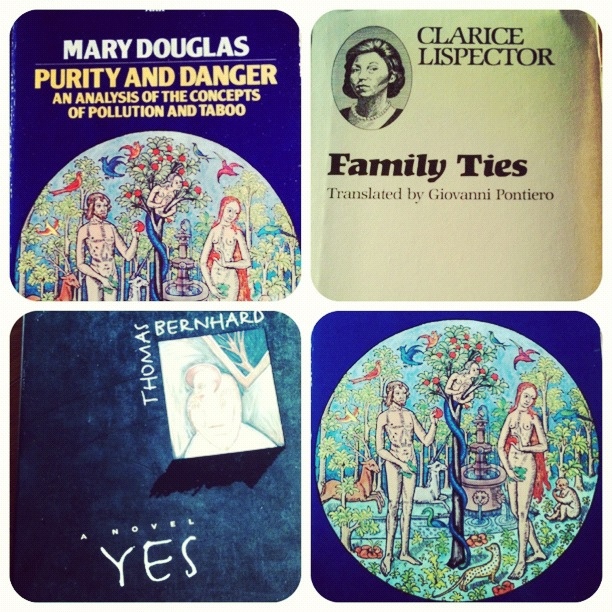
I have no idea why these books are grouped here like this; I’m guessing they were all in the same box when we moved. I know we have multiple copies of several of these:
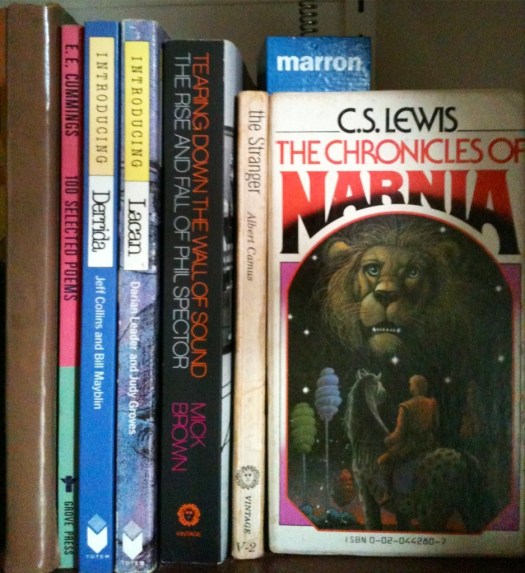
There’s a basket with a Klee book and some mini umbrellas and other stuff, not pictured, and then this lot on the end, including to “Introducing” books that are remainders from my freshman year of college; they are terrible and I should get rid of them. I stole this edition of The Stranger from my high school in the 10th or 11th grade. The Chronicles of Narnia box set was a gift from my aunt when I was like seven or eight:
PRIEST – Then we should not shrink from the worst of all crimes.
DYING MAN – I say nothing of the kind. Let the evil deed be proscribed by law, let justice smite the criminal, that will be deterrent enough; but if by misfortune we do commit it even so, let’s not cry over spilled milk; remorse is inefficacious, since it does not stay us from crime, futile since it does not repair it, therefore it is absurd to beat one’s breast, more absurd still to dread being punished in another world if we have been lucky to escape it in this. God forbid that this be construed as encouragement to crime, no, we should avoid it as much as we can, but one must learn to shun it through reason and not through false fears which lead to naught and whose effects are so quickly overcome in any moderately steadfast soul. Reason, sir – yes, our reason alone should warn us that harm done our fellows can never bring happiness to us; and our heart, that contributing to their felicity is the greatest joy Nature has accorded us on earth; the entirety of human morals is contained in this one phrase: Render others as happy as one desires oneself to be, and never inflict more pain upon them than one would like to receive at their hands. There you are, my friend, those are the only principles we should observe, and you need neither god nor religion to appreciate and subscribe to them, you need only have a good heart. But I feel my strength ebbing away; preacher, put away your prejudices, unbend, be a man, be human, without fear and without hope forget your gods and your religions too: they are none of them good for anything but to set man at odds with man, and the mere name of these horrors has caused greater loss of life on earth than all other wars and all other plagues combined. Renounce the idea of another world; there is none, but do not renounce the pleasure of being happy and of making for happiness in this. Nature offers you no other way of doubling your existence, of extending it. – My friend, lewd pleasures were ever dearer to me than anything else, I have idolized tham all my life and my wish has been to end it in their bosom; my end draws near, six women lovelier than the light of day are waiting in the chamber adjoining, I have reserved them for this moment, partake of the feast with me, following my example embrace them instead of the vain sophistries of superstition, under their caresses strive for a little while to forget your hypocritical beliefs.
NOTE: The dying man rang, the women entered; and after he had been a little while in their arms the preacher became one whom Nature had corrupted, all because he had not succeeded in explaining what a corrupt nature is.
I had been reading William T. Vollmann’s enormous book Imperial. I bought the book in paperback and then put an illicit copy on my Kindle (this riff is not about the ethics of that move). It’s just easier to read that way, especially at night. At some point in Imperial, probably at some mention of coyotes or polleros—smugglers of humans—I felt a tug in the back of my brain pan, a tug that wanted to pull up Roberto Bolaño’s big big novel 2666—also on my Kindle (also an illicit copy, although I bought the book twice).
This is how I ended up rereading 2666 straight through. It was unplanned.
Like many readers, I aim to reread more than I actually end up rereading.
Truly excellent novels are always better in rereading: richer, fuller, more resonant. Sometimes we might find we’ve thoroughly misread them. (Imagine my horror rereading Lolita in my twenties to discover the vein of evil throbbing through it). Sometimes we find new tones that seemed impossible on the first run through. (I’ve read Blood Meridian at least once a year since the first time I read it, and it keeps getting funnier and funnier). Most of the time, rereading confirms the greatness of the novel, a greatness inhabiting the smallest details. (I’m looking at you Moby-Dick).
Even a riff should have a thesis, and here’s mine: 2666 has a reputation for being fragmentary and inconclusive—and in some ways, yes, of course it is—but a second full reading of 2666 reveals a book that is cohesive, densely allusive, and thematically precise.
Rereading is one way of stepping back to see the bigger picture that Bolaño twists together from smaller fragments. Rereading reveals the intertextual correspondences betweenthe books of 2666 (the five books proper, the “Parts,” of course, but also the texts, invented or real, that those books house).
2666 is also a book about writing.
Earth, Giuseppe Arcimboldo
To wit: “The Part About Archimboldi,” the fifth and final book of 2666, the book that features Benno von Archimboldi, the writer at the heart of 2666—this final chapter sews together many of the book’s (apparently) loose threads.
Two problems with the point above:
A. Benno von Archimboldi (aka Hans Reiter) is not at the heart of 2666 but rather a shadowy trace slipping through the margins, a ghost-presence that’s always there, but not generative or muscular like a heart. (I’m not sure exactly what I mean by this).
B. “The Part About Archimboldi” most decidedly does not sew together all the loose threads: That’s the reader’s job (or task or pleasure or plight or burden).
And so then: “2666 is also a book about writing”): 2666 is also a book about reading: A book about reading as detective work.
Who are the heroes of 2666?
They are all detectives of some kind, literal or otherwise.
Literary critics. Journalists. Philosophers. Psychologists. Psychics and fortune tellers. Police detectives. Private detectives. An American sheriff. A rogue politician. Poets. Publishers. Parents. Searchers.
Archimboldi shows up in the first book of 2666, “The Part About the Critics”; the eponymous critics, literary detectives are searching for him.
How does Archimboldi show up?
Inside a story (the Frisian lady’s) inside a story (the Swabian’s) (inside the story of “Critics,” which is inside the story of 2666).
The Frisian lady asks:
“Does anyone know the answer to the riddle? Does anyone understand it? Is there by chance a man in this town who can tell me the solution, even if he has to whisper it in my ear?”
And Archimboldi answers. He’s a reader, a detective.
Swinging back to the previous point: 2666 is a book about writing, and it shares the postmodern feature of calling attention to its own style and construction, yet it never does this in an overtly clever or insufferable fashion: It’s far more sly.
Water, Giuseppe Arcimboldo
What is the construction or shape of 2666?
A straightforward answer: Five books in an intertextual conversation that seem to loop back around, where the last book prefigures the first book in a strange circuit.
Some possible metaphorical answers:
A void (“Voids can’t be filled,” Archimboldi says).
A labyrinth (the word labyrinth appears 14 times in Wimmer’s translation of 2666).
A mirror (61 times).
An abyss (22 times)
An asylum (43 times; madhouse appears 5 times).
How does Bolaño slyly announce or criticize or puncture his style in 2666?
In Ignacio Echevarria’s “Note to the First Edition” of 2666, he tells us that:
Among Bolaño’s notes for 2666 there appears the single line: “The narrator of 2666 is Arturo Belano.” And elsewhere Bolaño adds, with the indication “for the end of 2666”: “And that’s it, friends. I’ve done it all, I’ve lived it all. If I had the strength, I’d cry. I bid you all goodbye, Arturo Belano.”
Belano is Bolaño’s alter ego, a trace who slips and sails and ducks through the Bolañoverse (he also shows up unnamed in 2666 with his partner Ulises Lima; they manage to father a bastard son, Lalo Cura).
So Belano who narrates 2666 (how?!) is Bolaño: Okay: So? Now?
The channeling is metatextual or intertextual, a series of transpositions between the various narrators and protagonists and readers (detectives all).
The passage that I see most frequently cited from 2666 points to its intertextuality.
The passage is likely frequently cited because
A) Ignacio Echevarria cites it in his note at the beginning of 2666 and
B) it describes Bolaño’s project in 2666, both internally (the book as a strange beast, with intertextual readings within its five (plus) parts), and also externally (intertextually against the canon). Here is the passage (from “The Part About Amalfitano”):
One night, while the kid was scanning the shelves, Amalfitano asked him what books he liked and what book he was reading, just to make conversation. Without turning, the pharmacist answered that he liked books like The Metamorphosis, Bartleby, A Simple Heart, A Christmas Carol. And then he said that he was reading Capote’s Breakfast at Tiffany’s. Leaving aside the fact that A Simple Heart and A Christmas Carol were stories, not books, there was something revelatory about the taste of this bookish young pharmacist, who in another life might have been Trakl or who in this life might still be writing poems as desperate as those of his distant Austrian counterpart, and who clearly and inarguably preferred minor works to major ones. He chose The Metamorphosis over The Trial, he chose Bartleby over Moby-Dick,he chose A Simple Heart over Bouvard and Pecuchet, and A Christmas Carol over A Tale of Two Cities or The Pickwick Papers. What a sad paradox, thought Amalfitano. Now even bookish pharmacists are afraid to take on the great, imperfect, torrential works, books that blaze paths into the unknown. They choose the perfect exercises of the great masters. Or what amounts to the same thing: they want to watch the great masters spar, but they have no interest in real combat, when the great masters struggle against that something, that something that terrifies us all, that something that cows us and spurs us on, amid blood and mortal wounds and stench.
At the risk of belaboring or repeating the last point: Bolaño, ever the canon-maker, the list maker, situates 2666, his final work (he knows it’s his final work) along with “the great, imperfect, torrential works, books that blaze paths into the unknown,” a book that struggles “against that something, that something that terrifies us all, that something that cows us and spurs us on, amid blood and mortal wounds and stench.”
Air, Giuseppe Arcimboldo
So some metatextual moments that, read intertextually, perhaps (perhaps!) work to outline that “unknown,” that “something” of 2666:
Near the end of “The Part About Crimes,” a culminating moment, where a female journalist (NB: a female journalist is the first murder victim in “Crimes”) reads the work of the poet/journalist Mercado:
Hernandez Mercado’s style wavered between sensationalism and flatness. The story was riddled with clichés, inaccuracies, sweeping statements, exaggerations, and flagrant lies. Sometimes Hernandez Mercado painted Haas as the scapegoat of a conspiracy of rich Sonorans and sometimes Haas appeared as an avenging angel or a detective locked in a cell but by no means defeated, gradually cornering his tormentors solely by dint of intelligence.
A description of the style of “The Part About the Crimes”: “The story was riddled with clichés, inaccuracies, sweeping statements, exaggerations, and flagrant lies.”
And, from “The Part About Archimboldi,” a moment where some critics read Ivanov’s novel Twilight and assess it:
Professor Stanislaw Strumilin read it. It struck him as hard to follow. The writer Aleksei Tolstoy read it. It struck him as chaotic. Andrei Zhdanov read it. He left it half finished. And Stalin read it. It struck him as suspect.
These are internal criticisms of 2666.
Another moment from Ansky’s journal that seems to describe “The Part About the Crimes,” 2666, and the Bolañoverse in general:
He mentions names Reiter has never heard before. Then, a few pages on, he mentions them again. As if he were afraid of forgetting them. Names, names, names. Those who made revolution and those who were devoured by that same revolution, though it wasn’t the same but another, not the dream but the nightmare that hides behind the eyelids of the dream.
While I’m using Ansky’s journal as a pseudo key for the intertextual labyrinth of 2666, let me grab this nugget:
Only in chaos are we conceivable.
(I added the note “thesis” in the electronic margin).
Or another description of the novel, couched in a description of history:
. . . history, which is a simple whore, has no decisive moments but is a proliferation of instants, brief interludes that vie with one another in monstrousness.
Another description of 2666 can be found in Bubis’s description of Archimboldi’s second novel:
Lüdicke had yet to come off the presses when Mr. Bubis received the manuscript of The Endless Rose, which he read in two nights, after which, deeply shaken, he woke his wife and told her they would have to publish this new book by Archimboldi.
“Is it good?” asked the baroness, half asleep and not bothering to sit up.
“It’s better than good,” said Bubis, pacing the room.
Then he began to talk, still pacing, about Europe, Greek mythology, and something vaguely like a police investigation, but the baroness fell back asleep and didn’t hear him.
The names of the novels here also suggest something about the structure of 2666: The Endless Rose suggests an eternal loop, as does Lüdicke, which etymologically suggests ludic, recursively playful . . . (Again, I’m just riffing here).
Another description of Archimboldi’s writing, which is of course a description of Bolaño’s 2666:
The style was strange. The writing was clear and sometimes even transparent, but the way the stories followed one after another didn’t lead anywhere: all that was left were the children, their parents, the animals, some neighbors, and in the end, all that was really left was nature, a nature that dissolved little by little in a boiling cauldron until it vanished completely.
Fire, Giuseppe Arcimboldo
Archimboldi’s name is some sort of secret key to the novel. He invents the name, of course, seemingly on the spot. (Invents is not the right word—rather, he synthesizes the name, cobbles it together from his readings. The name is intertextual).
The last name he appropriates from the painter Arcimboldo, whose paintings are instructive in understanding the structure of 2666, a narrative that comprises hundreds of internal discrete narratives that define the shape of the larger picture. The first name?
“They called me Benno after Benito Juarez,” said Archimboldi, “I suppose you know who Benito Juarez was.”
The dark heart of 2666, site of “Crimes,” is Santa Teresa, a transparent stand-in for Ciudad Juarez.
(Florita Almada, psychic medium and honest detective of “Crimes” channels Benito Juarez, the shepherd boy who became the president of Mexico; I’m tempted to quote here at some length but resist).
Re: Above: I foolishly suggested that Archimboldi’s name is some sort of secret key. I don’t think there is a secret key. Just reading. Rereading.
But, still dwelling on “Archimboldi,” there’s a moment in it where an old alpine hermit confesses to murdering his wife by pushing her into a ravine. In some way his confession seems to answer all the puzzles of “Crimes,” all the unresolved abysses, all the falls (literal and metaphorical). How can I justify this claim? How does a man confessing to a murder in a remote German border town in the 1950s answer the murders in Mexico in the 1990s? Or any of the other murders in the book? I suppose it’s a thematic echo, not a solution. Sweating late at night, reading past midnight, the moment struck me as larded with significance. I’m losing whatever thread I had . . .
So to end—how to end? Perhaps I’ll raid my first review of 2666, from January, 2009—surely I must have remarked on the end of the book, or on its apparent inconclusiveness—
—and so I did. And I don’t know if I can do better than this:
Readers enthralled by the murder-mystery aspects of the novel, particularly the throbbing detective beat of “The Part About The Crimes,” may find themselves disappointed by the seemingly ambiguous or inconclusive or open-ended ending(s) of 2666. While the final moments of “The Part About Archimboldi” dramatically tie directly into the “Crimes” and “Fate” sections, they hardly provide the types of conclusive, definitive answers that many readers demand. However, I think that the ending is perfect, and that far from providing no answers, the novel is larded with answers, bursting at the seams with answers, too many answers to swallow and digest in one sitting. Like a promising, strangely familiar turn in the labyrinth, the last page of the book invites the reader back to another, previously visited corridor, a hidden passage perhaps, a thread now charged with new importance . . . 2666 is a book that demands multiple readings.
It was a good suggestion three years ago and I’ll take it up again.
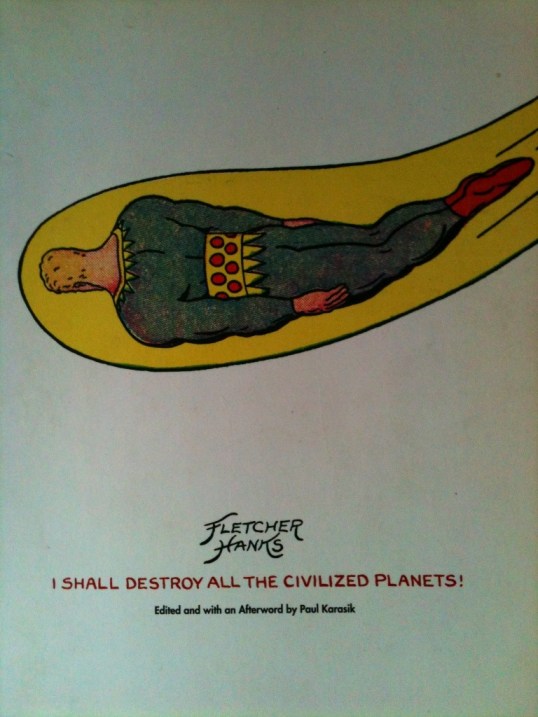
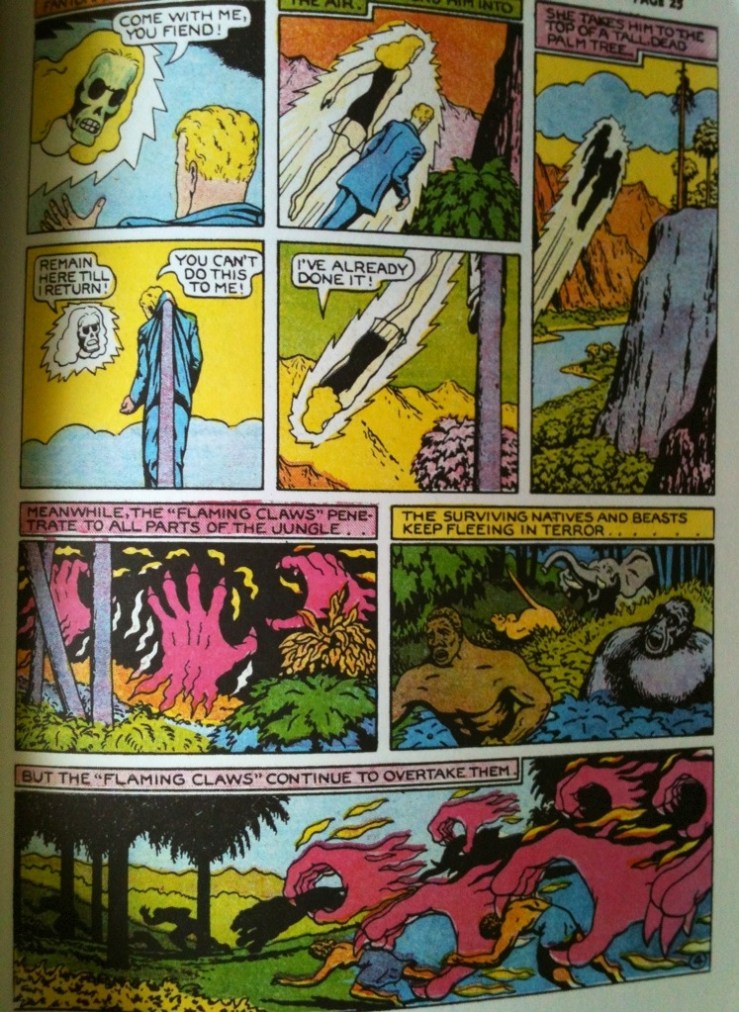
I’ve been wanting to get my mitts on this Fletcher Hanks collection since I first read about it in The Believer five years ago. Finally came across a used copy in pristine shape.
It’s really, really fucking weird. Sample page; full write-up forthcoming:
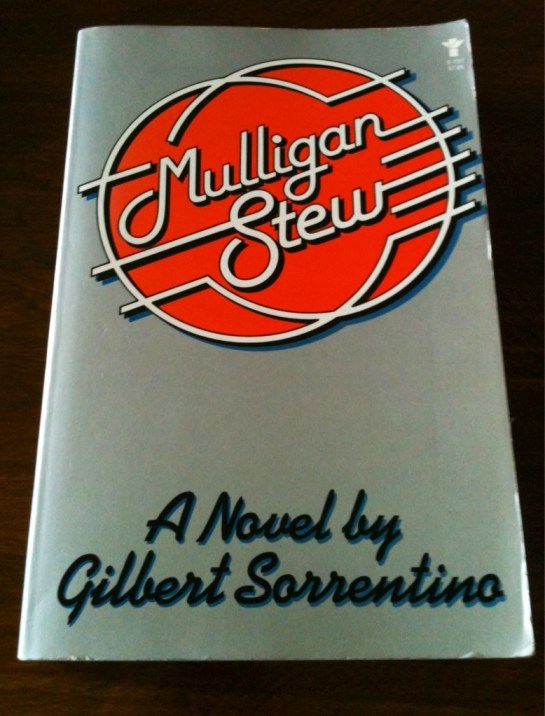
I’ve been itching to read Gilbert Sorrentino’s Mulligan Stew for a while. This copy may or may not be a first edition paperback—the rejection letters in the front are on a different type of paper than the rest of the novel (color/stock). It’s a big book—I’m finishingup a rereading of 2666, so maybe this one will jump in front of Georges Perec’s Life: A User’s Manual. Thoughts?
Neal Stephenson’s 1992 novel Snow Crash opens with an extended scene in which the book’s protagonist races to deliver a pizza on time for the mafia. The scene is thrilling and ridiculous, establishing the book’s frenetic, ironic tone and painting a rough outline of Snow Crash’s milieu. Like many sprawling works of speculative fiction, Snow Crash is more interested in rendering its milieu in vibrant, hyperkinetic color than it is concerned with delivering plot and character development. Snow Crash’s plot is the sort of joyfully convoluted careening mess that makes a reviewer (okay, this reviewer) shudder at the thought of having to successfully paraphrase, so I’m not even going to make an earnest effort. Let’s get to that milieu and the cartoon characters who inhabit it.
Snow Crash is set in the early 21st century, primarily in Los Angeles, which is no longer part of the United States. Actually, there isn’t much of a United States to speak of, really—and not even a municipal Los Angeles, per se. Instead, the terrain is totally privatized. Privatized roads, privatized spaces. People (who can afford to) live in franchised burbclaves protected by hired mercenaries or private militias or robots that keep out the undesirables. (The white folks who live in New South Africa want “racial purity,” while some franchise nations, like Mr. Lee’s Greater Hong Kong are open to anyone who can trade information). Authority is for sale. Conditions are so laissez-faire that the Mafia is truly a Legitimate Business now (complete with their own CosaNostra Pizza University). In fact, all business is legitimate; several times in Snow Crash, a character will refer to “the old days when they had laws.” Without regulation, hyperinflation is the norm; the homeless use trillion-dollar bills to light their campfires.
There’s a hard-edged griminess to the world Stephenson conjures in Snow Crash, but the book is never grim or dour, and instead embraces the anarchic-capitalism it proposes. Perhaps this is because Stephenson’s heroes are such radically exceptional people. The book’s hero is named Hiro Protagonist, the kind of Pynchonian goof that characterizes Snow Crash’s zany tone. Hiro meets the book’s other protagonist, a fifteen year old blonde who goes by Y.T. (“Yours Truly,” although most of the folks tend to hear “whitey”). Y.T. is a Kourier, a skateboarding delivery person who harpoons vehicles to catch a free ride. She helps Hiro deliver that pizza in the opening scene and the two team up after Hiro gives her his business card. It reads: “Last of the Freelance Hackers / Greatest swordfighter in the world / Stringer, Central Intelligence Corporation. Specializing in Software related Intel. (Music, Movies & Microcode.)” Did I neglect to mention that Hiro carries two samurai swords with him wherever he goes?
Hiro’s pretty handy with those swords, but his real skill is hacking, and he spends a good deal of time in the Metaverse, a virtual reality-based internet space where avatars go to bars and chat and sell &c. It’s sort of like a mix between Facebook and World of War Craft. In 1992 (earlier, I suppose), Stephenson’s way ahead of the curve. Here, he describes avatars:
Your avatar can look any way you want it to, up to the limitations of your equipment. If you’re ugly, you can make your avatar beautiful. If you’ve just gotten out of bed, your avatar can still be wearing beautiful clothes and professionally applied makeup. You can look like a gorilla or a dragon or a giant talking penis in the Metaverse. Spend five minutes walking down the Street and you will see all of these.
There are plenty of passages like this, where Stephenson pegs some aspect of internet culture ten years before it actually happens. (I couldn’t help but think about Wikipedia during Hiro’s conversations with a program called Librarian). It’s probably fair to say that the Wachowskis lifted as much from Snow Crash as they did from William Gibson’s cyberpunk trilogies.
While I’m there, I might as well lazily point out that Snow Crash would fit neatly at home on a shelf with Neuromancer or Mona Lisa Overdrive. There’s also a heavy dose of Philip K. Dick weirdness in Snow Crash, particularly when the book settles into its major metaphysical plot about ancient Sumerian gods and goddesses and linguistic viruses and the Tower of Babel. Stephenson’s Snow Crash is zanier than William Gibson’s dark depictions or Dick’s mindmelted milieux, and it would hardly do to call what he does here light—but there is something joyful, playful about his satire. I invoked Pynchon earlier and I’ll do it again; parts of Snow Crash also reminded me of David Foster Wallace’s opus Infinite Jest. Both IJ and SC obsess over the minutest details of speculative technologies and how people might react to such technologies. This is often what sets Snow Crash heads and shoulders above run of the mill cyberpunk. In just one instance, Stephenson parodies the language of bureaucratic speech at length; Y.T.’s mom, who works for what’s left of the Federal Government, is subjected to a memo about toilet paper usage that goes on for pages. The passage is hilarious, and adds absolutely nothing to the plot development—it simply helps to flesh out the contours of the world that Stephenson has imagined.
All of this detailed imagining unfortunately comes at the expense of a plot that only coheres through massive exposition dumps. About a third of the way into the novel, the major conflict is finally established, but only through a dialog between Hiro and the Librarian that reads almost like a catechism. As the book reaches its climax, Hiro actually explains what’s going on to a few of the other major characters—and the reader, of course. It’s a cringe-worthy moment, the sort of rhetorical weakness that smacks of genre fiction; even worse, the plot’s action ultimately hangs on some fairly basic hoary old tropes that wouldn’t be unfamiliar to anyone who’s ever played a video game. The book lags under a juvenile obsession with weapons and badassery in general. And the book’s resolution . . . well, let’s just say that Stephenson sticks the ending, but it all feels too pat and too slight after the dazzling weight of the world that he’s established. Still, at its finest, Stephenson’s prose is zippy, shining, hilarious stuff, and his employment of multiple character perspectives moves the book with an addictive energy. Snow Crash is beach reading for folks who like some humor with their dystopia.
A film adaptation of Snow Crash is supposedly going into production soon, with British director Joe Cornish taking charge. I liked Cornish’s last film Attack the Block, and Snow Crash clearly has a highly-imagistic, cinematic feel to it—but I think a film is not the way to go. Simply put, Snow Crash is too big, too larded with characters and details (so many that I failed to touch on in this review) to translate well onscreen. I think an eight part miniseries on HBO (or a similar network) would be perfect, even if it came at the expense of special effects—-a miniseries would give the filmmakers time to build Stephenson’s nuanced world. I’m afraid otherwise we’ll get a travesty like the adaptation of The Golden Compass, or something like The Hunger Games film, where all but the most basic plot points are elided. But I suppose a miniseries is not as lucrative as a blockbuster film. I hope the filmmakers at least split the book in two. In any case, I’ll be interested to check out the results.