Book Shelves #29, 7.15.2012

20120715-103934.jpg

Book shelves series #29, twenty-ninth Sunday of 2012

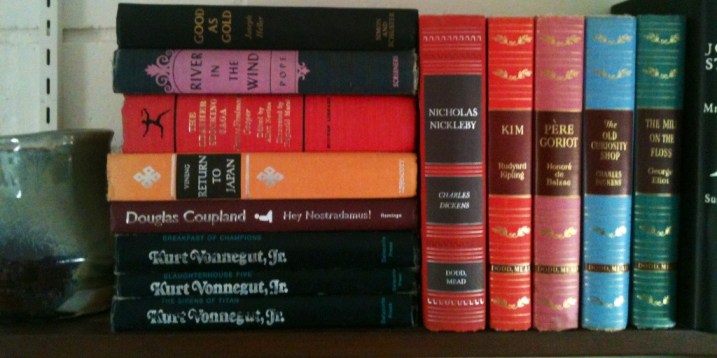
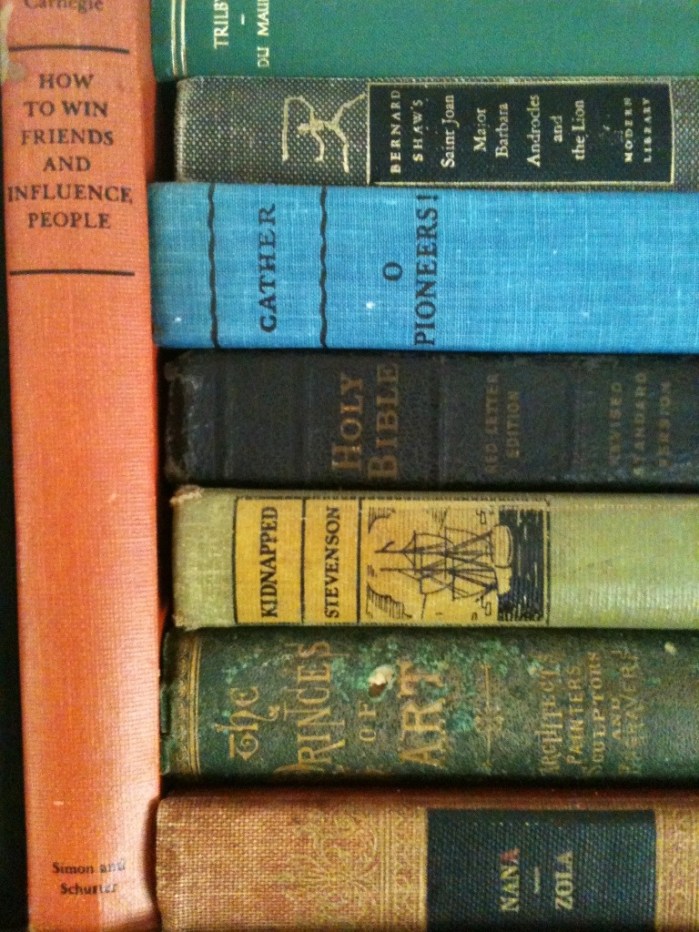
Lots of hardbacks on this long, long shelf. The Vonneguts above were particularly important to me when I was young. They were my father’s. I read them surreptitiously for years and then outright appropriated them at some point. The matching Dodd, Mead hardbacks were rescued from a school I worked at for years. My wife made the vase that serves as a bookend. The copy of Jonathan Strange and Mr. Norrell that doesn’t quite fit in the frame remains unread.

20120715-103943.jpg

The BFG: a classic. I reviewed Wabi Sabi. Next to the Crumb:

20120715-111742.jpg

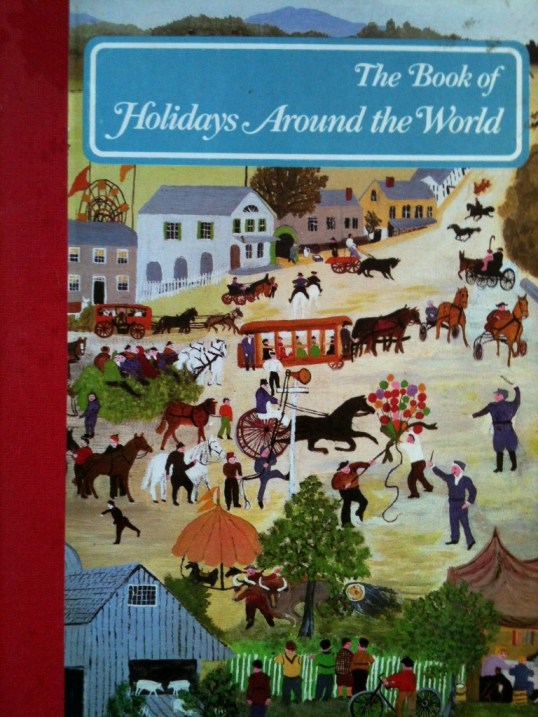
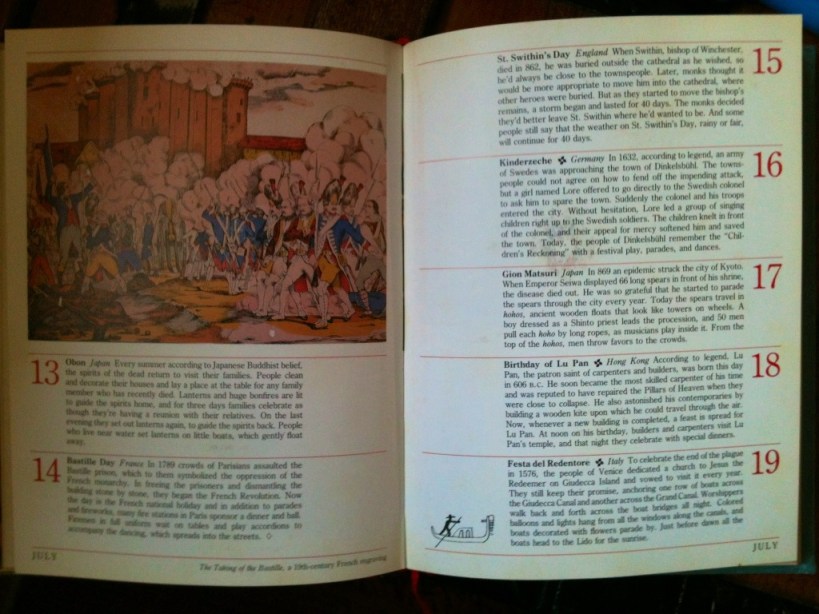
I found Holidays in a box of free books in a library lobby. Love it. Here’s this week’s schedule of holidays:

20120715-111749.jpg

One of my favorite books ever is Mitsou, a book that Balthus did when he was like 10 or 12 or something:

20120715-104032.jpg

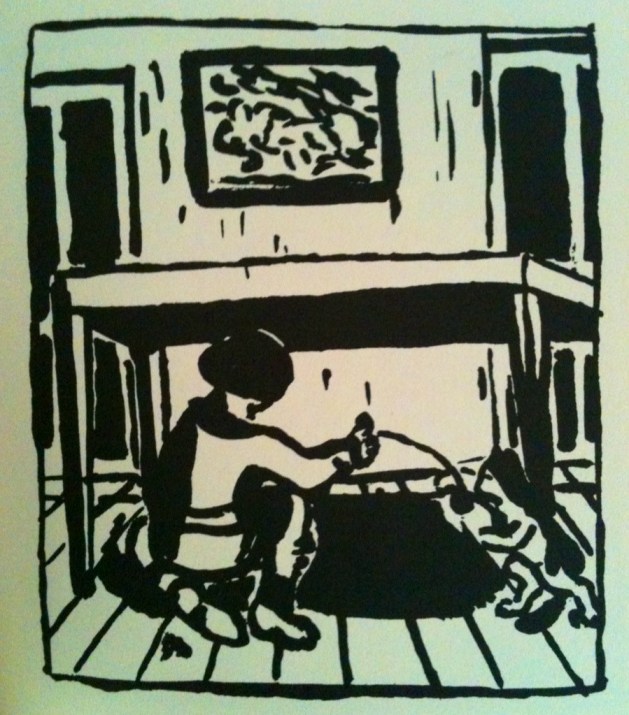
It’s about a young boy who gets a cat and loves the cat and then loses the cat. It’s heartbreaking. Image:

20120715-104040.jpg

And next to this one:

20120715-104015.jpg

Shelf’s end:

20120715-112719.jpg

The World Within: C.G. Jung In His Own Words (1990 Documentary with Archival Footage)

Italo Calvino’s List of Reasons Why We Should Read the Classics

From Italo Calvino’s The Uses of Literature

  1. The classics are the books of which we usually hear people say, “I am rereading . . . ” and never “I am reading . . . “
  2. We use the words “classics” for books that are treasured by those who have read and loved them; but they are treasured no less by those who have the luck to read them for the first time in the best conditions to enjoy them
  3. The classics are books that exert a peculiar influence, both when they refuse to be eradicated from the mind and when they conceal themselves in the folds of memory, camouflaging themselves as the collective or individual unconscious.
  4. Every rereading of a classic is as much a voyage of discovery as the first reading.
  5. Every reading of a classic is in fact a rereading.
  6. A classic is a book that has never finished saying what it has to say.
  7. The classics are the books that come down to us bearing the traces of readings previous to ours, and bringing in their wake the traces they themselves have left on the culture or cultures they have passed through (or, more simply, on language and customs).
  8. A classic does not necessarily teach us anything we did not know before. In a classic we sometimes discover something we have always known (or thought we knew), but without knowing that this author said it first, or at least is associated with it in a special way. And this, too, is a surprise that gives much pleasure, such as we always gain from the discovery of an origin, a relationship, an affinity.
  9. The classics are books which, upon reading, we find even fresher, more unexpected, and more marvelous than we had thought from hearing about them.
  10. We use the word “classic” of a book that takes the form of an equivalent to the universe, on a level with the ancient talismans. With this definition we are approaching the idea of the “total book,” as Mallarmé conceived of it.
  11. Your classic author is the one you cannot feel indifferent to, who helps you to define yourself in relation to him, even in dispute with him.
  12. A classic is a book that comes before other classics; but anyone who has read the others first, and then reads this one, instantly recognizes its place in the family tree.
  13. A classic is something that tends to relegate the concerns of the moment to the status of background noise, but at the same time this background noise is something we cannot do without.
  14. A classic is something that persists as a background noise even when the most incompatible momentary concerns are in control of the situation.


John Searle Talks About Wittgenstein (BBC, 1987)


Books Acquired, 6.25.2012—Or, Here’s What’s New from Picador This Month

20120711-100508.jpg

A nice stack from the good folks at Picador this month, including two new entries in their ongoing Nadine Gordimer reissues. I like the design on the series:

20120711-100530.jpg

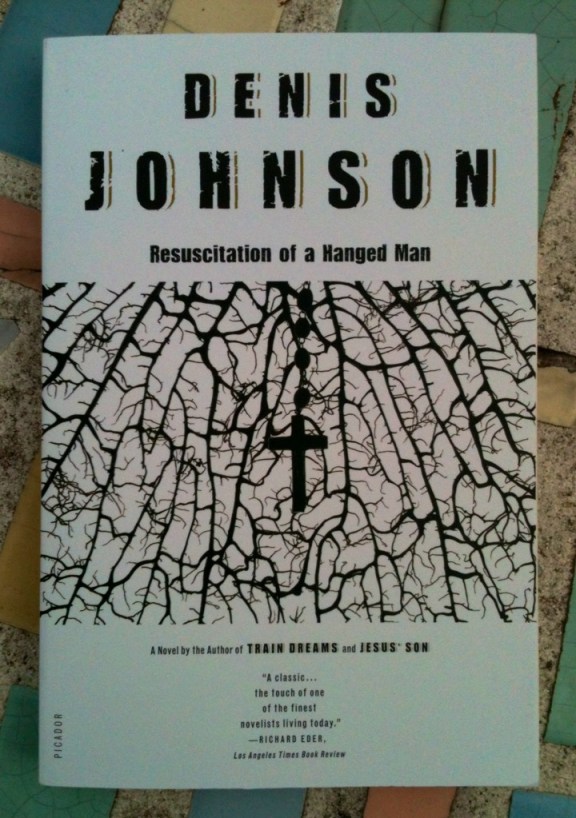
There’s also a reissue of Denis Johnson’s 1991 novel Resuscitation of a Hanged Man, which I haven’t read, but will read soon, because Johnson is just one of those writers I’ll end up reading everything by eventually. From a 1991 NYT review of the novel:

There has never been any doubt about Denis Johnson’s ability to write a gorgeous sentence. The author of “Angels,” “Fiskadoro” and “The Stars at Noon” has become increasingly musical in his prose, and his latest novel, “Resuscitation of a Hanged Man,” depends on such sentences as the primary unit of narrative motion. The novel seems, like a poem, to be written line to line. It is very much a book about one man, one sensibility.

At the outset of the novel, Leonard English, driving to the tip of Cape Cod in the off season, stops for a drink, then spins out of control, running his car onto a traffic island. He ends up taking a taxi to his destination, which is Provincetown. He has attempted suicide before the book’s beginning; now he is moving to the Cape to work for Ray Sands, a private investigator who also owns a small radio station. When we can see him most clearly, English seems very similar to the narrator of the short story — drifting, guilty, in a world of strangers, striving to connect with another person and with his God.

20120711-100537.jpg

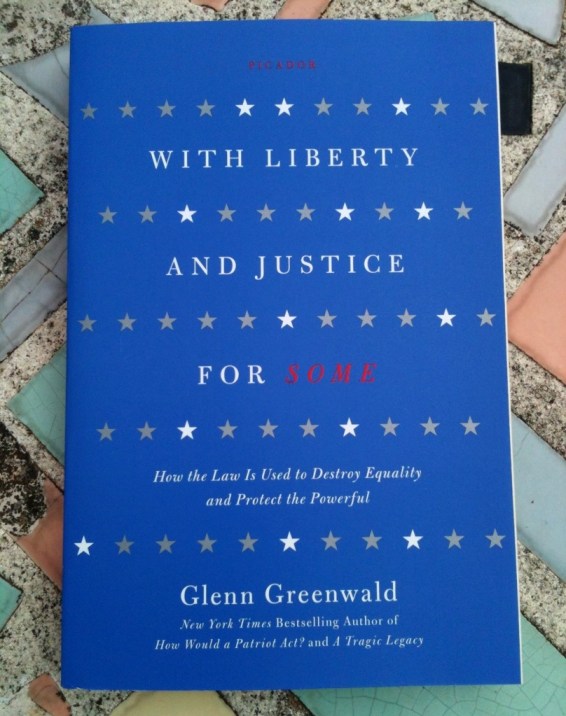
Last year’s With Liberty and Justice for Some is out now in trade paperback. If you are even slightly familiar Glenn Greenwald’s columns at Salon, you’ll likely know what to expect. For those of us predisposed to agree with his analyses, With Liberty and Justice for Some is likely to inspire outrage and a certain kind of fatigue.

20120711-100545.jpg

Here’s an excerpt from an interview between Harper’s Scott Horton and Greenwald:

American history is suffused with violations of equality before the law. The country was steeped in such violations at its founding. But even when this principle was being violated, its supremacy was also being affirmed: resoundingly and unanimously in the case of the founders. That the rule of law—not the rule of men—would reign supreme was one of the few real points of agreement among all the founders. Arguably it was the primary one.

There’s an obvious element of hypocrisy in this fact; espousing a principle that one simultaneously breaches in action is hypocrisy’s defining attribute. But there’s also a more positive side: the country’s vigorous embrace of the principle of equality before law enshrined it as aspiration. It became the guiding precept for how “progress” was understood, for how the union would be perfected.

And the most significant episodes of progress over the next two centuries—the emancipation of slaves, the ending of Jim Crow, the enfranchisement and liberation of women, vastly improved treatment for Native Americans and gay Americans—were animated by this ideal. That happened because “blind justice”—equality before law—was orthodoxy in American political culture. The principle was sacrosanct even when it was imperfectly applied.

The Ford pardon of Nixon changed that, radically and permanently. When President Ford went on national television to explain to an angry, skeptical citizenry why the most powerful political actor would be fully immunized for the felonies he got caught committing, Ford expressly rejected the rule of law. He paid lip service to its core principle—the “law is no respecter of persons”—but then tacked on a newly concocted amendment designed to gut that principle: “but the law is a respecter of reality.”

In other words, if—in the judgment of political leaders—it’s sufficiently disruptive, divisive, or distracting to hold powerful political officials accountable under the law on equal terms with ordinary Americans, then they should be exempt and the rule of law suspended, all in the name of political harmony, of “moving on.” But of course, it willalways be divisive and distracting, by definition, to prosecute the most powerful political leaders, so Ford’s rationale, predictably, created a template for elite immunity.

The rationale for Ford’s pardon of Nixon was subsequently legitimized, and it created a precedent for shielding the most powerful elites from the consequences of their lawbreaking. The arguments Ford offered are the same ones now hauled out over and over whenever it is time to argue why the most powerful among us should not be held accountable: It’s not just for the good of the immunized criminal, but in the common good, to Look Forward, Not Backward. This direct assault on the rule of law was pioneered by the pardon of Richard Nixon.

20120711-100609.jpg

Steve Sem-Sandberg’s The Emperor of Lies is a Swedish novel in English Translation by Sarah Death. Look, I’m generally dismissive of Holocaust fiction because 1) the sheer number of books that come in to Biblioklept World Headquarters that use the Holocaust as a milieu and 2) the tacky and generally lazy way that such books often attempt to manipulate their audiences. Still, The Emperor of Lies seems like it’s probably a sight better than most such books, and it’s gotten generally good reviews, including this one from The Independent (UK), which apparently thinks that a book review of five sentences is fine:

Any writer – let alone one from neutral Sweden – who sets out to place another brick in the vast wall of Holocaust fiction must be deluded or inspired. Astonishing to report: Sem-Sandberg belongs in the tiny second band.

Utterly involving, morally scrupulous, written with a verve and pace that belie its dreadful setting, The Emperor of Lies – in Sarah Death’s masterly translation – really does renew the genre.

Its portrait of resistance and survival in the ghetto of Lodz between 1940 and 1944 focuses on the monstrous enigma of Chaim Rumkowski, despotic overlord of his fellow-Jews. Sem-Sandberg catches his capricious charisma. Other characters, who record their fate or fight it, also shine, while their tragic destiny moves on at mesmerising speed.

Minor Works & Masterpieces — An Excerpt from Bolaño’s Novel 2666

Another stand-alone segment from Roberto Bolaño’s novel 2666—from “The Part About Archimboldi”:

Our hero Reiter (writer!)—who at this moment (or just before it, unbeknownst to the reader) adopts the ridiculous nom de thing Archimboldi (!!!)—secures a rented typewriter from a failed writer, an old man who takes the time to lecture on writing and camouflage and masterpieces and Jesus &c.—and writing as channeling (or maybe a type of divine madness), as a ventriloquist act (which I touched on here). (Perhaps I’m pushing the limits of copyright law here. Look, I think you should all buy and read this book and give copies to loved ones and enemies alike).

“I was a writer,” said the old man.

“But I gave it up. This typewriter was a gift from my father. An affectionate and cultured man who lived to the age of ninety-three. An essentially good man. A man who believed in progress, it goes without saying. My poor father. He believed in progress and of course he believed in the intrinsic goodness of human beings. I too believe in the intrinsic goodness of human beings, but it means nothing. In their hearts, killers are good, as we Germans have reason to know. So what? I might spend a night drinking with a killer, and as the two of us watch the sun come up, perhaps we’ll burst into song or hum some Beethoven. So what? The killer might weep on my shoulder. Naturally. Being a killer isn’t easy, as you and I well know. It isn’t easy at all. It requires purity and will, will and purity. Crystalline purity and steel-hard will. And I myself might even weep on the killer’s shoulder and whisper sweet words to him, words like ‘brother,’ ‘friend,’ ‘comrade in misfortune.’ At this moment the killer is good, because he’s intrinsically good, and I’m an idiot, because I’m intrinsically an idiot, and we’re both sentimental, because our culture tends inexorably toward sentimentality. But when the performance is over and I’m alone, the killer will open the window of my room and come tiptoeing in like a nurse and slit my throat, bleed me dry.

“My poor father. I was a writer, I was a writer, but my indolent, voracious brain gnawed at my own entrails. Vulture of my Prometheus self or Prometheus of my vulture self, one day I understood that I might go so far as to publish excellent articles in magazines and newspapers, and even books that weren’t unworthy of the paper on which they were printed. But I also understood that I would never manage to create anything like a masterpiece. You may say that literature doesn’t consist solely of masterpieces, but rather is populated by so-called minor works. I believed that, too. Literature is a vast forest and the masterpieces are the lakes, the towering trees or strange trees, the lovely, eloquent flowers, the hidden caves, but a forest is also made up of ordinary trees, patches of grass, puddles, clinging vines, mushrooms, and little wild-flowers. I was wrong. There’s actually no such thing as a minor work. I mean: the author of the minor work isn’t Mr. X or Mr. Y. Mr. X and Mr. Y do exist, there’s no question about that, and they struggle and toil and publish in newspapers and magazines and sometimes they even come out with a book that isn’t unworthy of the paper it’s printed on, but those books or articles, if you pay close attention, are not written by them.

“Every minor work has a secret author and every secret author is, by definition, a writer of masterpieces. Who writes the minor work? A minor writer, or so it appears. The poor man’s wife can testify to that, she’s seen him sitting at the table, bent over the blank pages, restless in his chair, his pen racing over the paper. The evidence would seem to be incontrovertible. But what she’s seen is only the outside. The shell of literature. A semblance,” said the old man to Archimboldi and Archimboldi thought of Ansky. “The person who really writes the minor work is a secret writer who accepts only the dictates of a masterpiece. Continue reading “Minor Works & Masterpieces — An Excerpt from Bolaño’s Novel 2666”

Paul Auster’s Winter Journal (Book Acquired Some Time Over the July 4th Holiday)

20120711-100349.jpg

I was pleasantly surprised to find Paul Auster’s forthcoming memoir Winter Journal in the mail after being away for a week. I had mixed feelings about Auster’s last novel Sunset Park, but I dig his nonfiction, and I opened Winter Journal randomly to an episode where the adolescent Auster loses his virginity to a hooker in a passage that’s both tender and funny, so this one seems promising. (It’s also written entirely in the second person pronoun).

Publisher Henry Holt’s blurb:

Facing his sixty-third winter, internationally acclaimed novelist Paul Auster sits down to write a history of his body and its sensations—both pleasurable and painful.

Thirty years after the publication of The Invention of Solitude, in which he wrote so movingly about fatherhood, Auster gives us a second unconventional memoir in which he writes about his mother’s life and death. Winter Journal is a highly personal meditation on the body, time, and memory, by one of our most intellectually elegant writers.

“Have I ever mentioned that Michelangelo practically never took a bath in his life, by the way?” — A Riff from David Markson’s Wittgenstein’s Mistress

A riff on Michelangelo from David Markson’s novel Wittgenstein’s Mistress (the ellipses indicate my edit, not Markson’s):

Have I ever mentioned that Michelangelo practically never took a bath in his life, by the way?

And even wore his boots to bed?

On my honor, it is a well known item in the history of art that Michelangelo was not somebody one would particularly wish to sit too close to.

Which on second thought could very well change one’s view as to why all of those Medici kept telling him don’t bother to get up, as a matter of fact.

. . .

I have just wrapped my head into a towel.

Having gone out for some greens, for a wet salad, this would be because of.

And in the meantime the more I have thought about it, the more sorry I have gotten about what I said.

I mean about Michelangelo, not about Herodotus.

Certainly I would have found it more than agreeable to shake Michelangelo’s hand, no matter how the pope or Louis Pasteur might have felt about this.

In fact I would have been excited just to see the hand that had taken away superfluous material in the way that Michelangelo had taken it away.

Actually, I would have been pleased to tell Michelangelo how fond I am of his sentence that I once underlined, too.

Perhaps I have not mentioned having once underlined a sentence by Michelangelo.

I once underlined a sentence by Michelangelo.

This was a sentence that Michelangelo once wrote in a letter, when he had lived almost seventy-five years.

You will say that I am old and mad, was what Michelangelo wrote, but I answer that there is no better way of being sane and free from anxiety than by being mad.

On my honor, Michelangelo once wrote that.

As a matter of fact I am next to positive I would have liked Michelangelo.

“The Belly of the Whale” — Joseph Campbell

“The Belly of the Whale,” an early chapter of Joseph Campbell’s seminal work The Hero With a Thousand Faces:

The idea that the passage of the magical threshold is a transit into a sphere of rebirth is symbolized in the worldwide womb image of the belly of the whale. The hero, instead of conquering or conciliating the power of the threshold, is swallowed into the unknown, and would appear to have died.

Mishe-Nahma, King of Fishes,

In his wrath he darted upward,

Flashing leaped into the sunshine,

Opened his great jaws and swallowed

Both canoe and Hiawatha.

The Eskimo of Bering Strait tell of the trickster-hero Raven, how, one day, as he sat drying his clothes on a beach, he observed a whale-cow swimming gravely close to shore. He called: “Next time you come up for air, dear, open your mouth and shut your eyes.” Then he slipped quickly into his raven clothes, pulled on his raven mask, gathered his fire sticks under his arm, and flew out over the water. The whale came up. She did as she had been told. Raven darted through the open jaws and straight into her gullet. The shocked whale-cow snapped and sounded; Raven stood inside and looked around.

The Zulus have a story of two children and their mother swallowed by an elephant. When the woman reached the animal’s stomach, “she saw large forests and great rivers, and many high lands; on one side there were many rocks; and there were many people who had built their village there; and many dogs and many cattle; all was there inside the elephant.”

The Irish hero, Finn MacCool, was swallowed by a monster of indefinite form, of the type known to the Celtic world as a peist. The little German girl, Red Ridinghood, was swallowed by a wolf. The Polynesian favorite, Maui, was swallowed by his great-great-grandmother, Hine-nui-te-po. And the whole Greek  pantheon, with the sole exception of Zeus, was swallowed by its father, Kronos. The Greek hero Herakles, pausing at Troy on his way homeward with the belt of the queen of the Amazons, found that the city was being harassed by a monster sent against it by the sea-god Poseidon. The beast would come ashore and devour people as they moved about on the plain. Beautiful Hesione, the daughter of the king, had just been bound by her father to the sea rocks as a propitiatory sacrifice, and the great visiting hero agreed to rescue her for a price. The monster, in due time, broke to the surface of the water and opened its enormous maw. Herakles took a dive into the throat, cut his way out through the belly, and left the monster dead.

This popular motif gives emphasis to the lesson that the passage of the threshold is a form oE self-annihilation. Its resemblance to the adventure of the Symplegades is obvious. But here, instead of passing outward, beyond the confines of the visible world, the hero goes inward, to be born again. The disappearance corresponds to the passing of a worshiper into a temple—where he is to be quickened by the recollection of who and what he is, namely dust and ashes unless immortal. The temple interior, the belly of the whale, and the heavenly land beyond, above, and below the confines of the world, are one and the same. That is why the approaches and entrances to temples are flanked and defended by colossal gargoyles: dragons, lions, devil-slayers with drawn swords, resentful dwarfs, winged bulls. These are the threshold guardians to ward away all incapable of encountering the higher silences within. They are preliminary embodiments of the dangerous aspect of the presence, corresponding to the mythological ogres that bound the conventional world, or to the two rows of teeth of the whale. They illustrate the fact that the devotee at the moment of entry into a temple undergoes a metamorphosis. His secular character remains without; he sheds it, as a snake its slough. Once inside he may be said to have died to time and returned to the World Womb, the World Navel, the Earthly Paradise. The mere fact that anyone can physically walk past the temple guardians does not invalidate their significance; for if the intruder is incapable of encompassing the sanctuary, then he has effectually remained without. Anyone unable to understand a god sees it as a devil and is thus defended from the approach. Allegorically, then, the passage into a temple and the hero-dive through the jaws of the whale are identical adventures, both denoting, in picture language, the life-centering, life-renewing act.

“No creature,” writes Ananda Coomaraswamy, “can attain a higher grade of nature without ceasing to exist.” Indeed, the physical body of the hero may be actually slain, dismembered, and scattered over the land or sea—as in the Egyptian myth of the savior Osiris: he was thrown into a sarcophagus and committed to the Nile by his brother Set, and when he returned from the dead his brother slew him again, tore the body into fourteen pieces, and scattered these over the land. The Twin Heroes of the Navaho had to pass not only the clashing rocks, but also the reeds that cut the traveler to pieces, the cane cactuses that tear him to pieces, and the boiling sands that overwhelm him. The hero whose attachment to ego is already annihilate passes back and forth across the horizons of the world, in and out of the dragon, as readily as a king through all the rooms of his house. And therein lies his power to save; for his passing and returning demonstrate that through all the contraries of phenomenality the Un-create-Imperishable remains, and there is nothing to fear.

And so it is that, throughout the world, men whose function it has been to make visible on earth the life-fructifying mystery of the slaying of the dragon have enacted upon their own bodies the great symbolic act, scattering their flesh, like the body of Osiris, for the renovation of the world. In Phrygia, for example, in honor of the crucified and resurrected savior Attis, a pine tree was cut on the twenty-second of March, and brought into the sanctuary of the mother-goddess, Cybele. There it was swathed like a corpse with woolen bands and decked with wreaths of violets. The effigy of a young man was tied to the middle of the stem. Next day took place a ceremonial lament and blowing of trumpets. The twenty-fourth of March was known as the Day of Blood: the high priest drew blood from his arms, which he presented as an offering; the lesser clergy whirled in a dervish-dance, to the sound of drums, horns, flutes, and cymbals, until, rapt in ecstasy, they gashed their bodies with knives to bespatter the altar and tree with their blood; and the novices, in imitation of the god whose death and resurrection they were celebrating, castrated themselves and swooned.

And in the same spirit, the king of the south Indian province of Quilacare, at the completion of the twelfth year of his reign, on a day of solemn festival, had a wooden scaffolding constructed, and spread over with hangings of silk. When he had ritually bathed in a tank, with great ceremonies and to the sound of music, he then came to the temple, where he did worship before the divinity. Thereafter, he mounted the scaffolding and, before the people, took some very sharp knives and began to cut off his own nose, and then his ears, and his lips, and all his members, and as much of his flesh as he was able. He threw it away and round about, until so much of his blood was spilled that he began to faint, whereupon he summarily cut his throat.

Book Shelves #28, 7.08.2012

20120708-143303.jpg

Book shelves series #28, twenty-eighth Sunday of 2012

Last month, or maybe the month before last, I forget, an anonymous reader accused me of not putting as much into these posts as I used to, which may or may not be true.

But I’m exhausted today—I’ve been out of town for the past week, enjoying a beach vacation with family and friends &c., and yeah, I’m fragged. Got home late late last night, had to clean up, mow the lawn, all that snazz. (The blog has been on autopilot but I’ll try to write up some original content for next week—maybe a review of Moonrise Kingdom. We’ll see).

Anyway, this Sunday finds us in a new room, the converted garage of my 1956 ranch-style home, a room we use as a family room. I’ll look at each shelf pictured above individually and remark on a few books (there’s some good stuff in there), but I’m just too tired. Sorry the pic is so blurry. Feel free to send me a newer iPhone.

There are two book cases below these shelves, and on top of one of these, under a large framed picture of my children that obscures them, are these ratty volumes:

20120708-143311.jpg

The Barth books are a throwback to my early college days, when I simply bought the cheapest volume; I don’t buy mass market paperbacks anymore (okay, maybe rarely). The Shakespeare books are too tall to fit on a shelf full of Shakespeare stuff, although there are a few shelves of Shakespeare stuff in the room. Actually, I’m not really sure why these books are here at all. It’s likely that I hid them behind the aforementioned large framed picture one day while cleaning up and never reshelved. Not a pretty shelf.

John Steinbeck on Work Habits

Mark Twain used to write in bed—so did our greatest poet. But I wonder how often they wrote in bed—or whether they did it twice and the story took hold. Such things happen. Also I would like to know what things they wrote in bed and what things they wrote sitting up. All of this has to do with comfort in writing and what its value is. I should think that a comfortable body would let the mind go freely to its gathering.

You know I always smoke a pipe when I work—at least I used to and now I have taken it up again. It is strange—as soon as a pipe begins to taste good, cigarettes become tasteless. I find I smoke fewer and fewer cigarettes. Maybe I can cut them out entirely for a while. This would be a very good thing. Even with this little change, my deep-seated and perennial cigarette cough is going away. A few months without that would be a real relief.

I have dawdled away a good part of my free time now carving vaguely on a scrap of mahogany, but I guess I have been thinking too. Who knows. I sit here in a kind of a stupor and call it thought.

Now I have taken the black off my desk again, clear down to the wood, and have put a green blotter down. I am never satisfied with my writing surface.

My choice of pencils lies between the black Calculator stolen from Fox Films and this Mongol 2 3/8 F which is quite black and holds its point well—much better in fact than the Fox pencils. I will get six more or maybe four more dozen of them for my pencil tray.

I have found a new kind of pencil—the best I have ever had. Of course it costs three times as much too but it is black and soft but doesn’t break off. I think I will always use these. They are called Blackwings and they really glide over the paper.

In the very early dawn, I felt a fiendish desire to take my electric pencil sharpener apart. It has not been working very well and besides I have always wanted to look at the inside of it. So I did and found that certain misadjustments had been made at the factory. I corrected them, cleaned the machine, oiled it and now it works perfectly for the first time since I have it. There is one reward for not sleeping.

Today is a dawdly day. They seem to alternate. I do a whole of a day’s work and then the next day, flushed with triumph, I dawdle. That’s today. The crazy thing is that I get about the same number of words down either way. This morning I am clutching the pencil very tight and this is not a good thing. It means I am not relaxed. And in this book I want to be just as relaxed as possible. Maybe that is another reason I am dawdling. I want that calmness to settle on me that feels so good—almost like a robe of cashmere it feels.

It has been a good day of work with no harm in it. I have sat long over the desk and the pencil has felt good in my hand. Outside the sun is very bright and warm and the buds are swelling to a popping size. I guess it is a good thing I became a writer. Perhaps I am too lazy for anything else.

On the third finger of my right hand I have a great callus just from using a pencil for so many hours every day. It has become a big lump by now and it doesn’t ever go away. Sometimes it is very rough and other times, as today, it is as shiny as glass. It is peculiar how touchy one can become about little things. Pencils must be round. A hexagonal pencil cuts my fingers after a long day. You see I hold a pencil for about six hours every day. This may seem strange but it is true. I am really a conditioned animal with a conditioned hand.

I am really dawdling today when what I want to write is in my head. It is said that many writers talk their books out and so do not write them. I think I am guilty of this to a large extent. I really talk too much about my work and to anyone who will listen. If I would limit my talk to inventions and keep my big mouth shut about work, there would probably be a good deal more work done.

The callus on my writing finger is very sore today. I may have to sandpaper it down. It is getting too big.

The silly truth is that I can take almost any amount of work but I have little tolerance for confusion.

From John Steinbeck’s 1969 interview in The Paris Review.

Virgil Reading the Aeneid to Augustus and Octavia — Angelica Kauffman

Read “The Old Man at the Bridge,” A Short Story by Ernest Hemingway

“The Old Man at the Bridge” by Ernest Hemingway:

An old man with steel rimmed spectacles and very dusty clothes sat by the side of the road. There was a pontoon bridge across the river and carts, trucks, and men, women and children were crossing it. The mule-drawn carts staggered up the steep bank from the bridge with soldiers helping push against the spokes of the wheels. The trucks ground up and away heading out of it all and the peasants plodded along in the ankle deep dust. But the old man sat there without moving. He was too tired to go any farther.
It was my business to cross the bridge, explore the bridgehead beyond and find out to what point the enemy had advanced. I did this and returned over the bridge. There were not so many carts now and very few people on foot, but the old man was still there.
“Where do you come from?” I asked him.
“From San Carlos,” he said, and smiled.
That was his native town and so it gave him pleasure to mention it and he smiled.
“I was taking care of animals,” he explained. “Oh,” I said, not quite understanding.
“Yes,” he said, “I stayed, you see, taking care of animals. I was the last one to leave the town of San Carlos.”
He did not look like a shepherd nor a herdsman and I looked at his black dusty clothes and his gray dusty face and his steel rimmed spectacles and said, “What animals were they?”
“Various animals,” he said, and shook his head. “I had to leave them.”
I was watching the bridge and the African looking country of the Ebro Delta and wondering how long now it would be before we would see the enemy, and listening all the while for the first noises that would signal that ever mysterious event called contact, and the old man still sat there.
“What animals were they?” I asked.
“There were three animals altogether,” he explained. “There were two goats and a cat and then there were four pairs of pigeons.”
“And you had to leave them?” I asked.
“Yes. Because of the artillery. The captain told me to go because of the artillery.”
“And you have no family?” I asked, watching the far end of the bridge where a few last carts were hurrying down the slope of the bank.
“No,” he said, “only the animals I stated. The cat, of course, will be all right. A cat can look out for itself, but I cannot think what will become of the others.”
“What politics have you?” I asked.
“I am without politics,” he said. “I am seventy-six years old. I have come twelve kilometers now and I think now I can go no further.” “This is not a good place to stop,” I said. “If you can make it, there are trucks up the road where it forks for Tortosa.”
“I will wait a while,” he said, “and then I will go. Where do the trucks go?”
“Towards Barcelona,” I told him.
“I know no one in that direction,” he said, “but thank you very much. Thank you again very much.”
He looked at me very blankly and tiredly, then said, having to share his worry with some one, “The cat will be all right, I am sure. There is no need to be unquiet about the cat. But the others. Now what do you think about the others?”
“Why they’ll probably come through it all right.” “You think so?”
“Why not,” I said, watching the far bank where now there were no carts.
“But what will they do under the artillery when I was told to leave because of the artillery?”
“Did you leave the dove cage unlocked?” I asked. “Yes.”
“Then they’ll fly.”
“Yes, certainly they’ll fly. But the others. It’s better not to think about the others,” he said.
“If you are rested I would go,” I urged. “Get up and try to walk now.”
“Thank you,” he said and got to his feet, swayed from side to side and then sat down backwards in the dust.
“I was taking care of animals,” he said dully, but no longer to me. “I was only taking care of animals.”
There was nothing to do about him. It was Easter Sunday and the Fascists were advancing toward the Ebro. It was a gray overcast day with a low ceiling so their planes were not up. That and the fact that cats know how to look after themselves was all the good luck that old man would ever have.

The Imaginary Portrait of the Marquis de Sade — Man Ray

“I Want a Third Pill” — Slavoj Žižek on The Matrix, Fantasy, Sexuality, and Video Games

“This Schedule In Effect July 5th, 1922” — The Great Gatsby’s House Guests

In Chapter 4 of F. Scott Fitzgerald’s The Great Gatsby, narrator Nick Carraway recounts the names of the rich, shallow, parasitic guests who attended Gatsby’s parties. Nick tells us the list comes from “an old time-table” of names he originally recorded in July 5th—significantly, the day after Independence Day: the day after the hopes and dreams of a new country. From the chapter—-

Once I wrote down on the empty spaces of a time-table the names of those who came to Gatsby’s house that summer. It is an old time-table now, disintegrating at its folds, and headed “This schedule in effect July 5th, 1922.” But I can still read the gray names, and they will give you a better impression than my generalities of those who accepted Gatsby’s hospitality and paid him the subtle tribute of knowing nothing whatever about him.

From East Egg, then, came the Chester Beckers and the Leeches, and a man named Bunsen, whom I knew at Yale, and Doctor Webster Civet, who was drowned last summer up in Maine. And the Hornbeams and the Willie Voltaires, and a whole clan named Blackbuck, who always gathered in a corner and flipped up their noses like goats at whosoever came near. And the Ismays and the Chrysties (or rather Hubert Auerbach and Mr. Chrystie’s wife), and Edgar Beaver, whose hair, they say, turned cotton-white one winter afternoon for no good reason at all.

Clarence Endive was from East Egg, as I remember. He came only once, in white knickerbockers, and had a fight with a bum named Etty in the garden. From farther out on the Island came the Cheadles and the O. R. P. Schraeders, and the Stonewall Jackson Abrams of Georgia, and the Fishguards and the Ripley Snells. Snell was there three days before he went to the penitentiary, so drunk out on the gravel drive that Mrs. Ulysses Swett’s automobile ran over his right hand. The Dancies came, too, and S. B. Whitebait, who was well over sixty, and Maurice A. Flink, and the Hammerheads, and Beluga the tobacco importer, and Beluga’s girls.

From West Egg came the Poles and the Mulreadys and Cecil Roebuck and Cecil Schoen and Gulick the state senator and Newton Orchid, who controlled Films Par Excellence, and Eckhaust and Clyde Cohen and Don S. Schwartze (the son) and Arthur McCarty, all connected with the movies in one way or another. And the Catlips and the Bembergs and G. Earl Muldoon, brother to that Muldoon who afterward strangled his wife. Da Fontano the promoter came there, and Ed Legros and James B. (“Rot-Gut.”) Ferret and the De Jongs and Ernest Lilly — they came to gamble, and when Ferret wandered into the garden it meant he was cleaned out and Associated Traction would have to fluctuate profitably next day.

A man named Klipspringer was there so often and so long that he became known as “the boarder.”— I doubt if he had any other home. Of theatrical people there were Gus Waize and Horace O’donavan and Lester Meyer and George Duckweed and Francis Bull. Also from New York were the Chromes and the Backhyssons and the Dennickers and Russel Betty and the Corrigans and the Kellehers and the Dewars and the Scullys and S. W. Belcher and the Smirkes and the young Quinns, divorced now, and Henry L. Palmetto, who killed himself by jumping in front of a subway train in Times Square.

Benny McClenahan arrived always with four girls. They were never quite the same ones in physical person, but they were so identical one with another that it inevitably seemed they had been there before. I have forgotten their names — Jaqueline, I think, or else Consuela, or Gloria or Judy or June, and their last names were either the melodious names of flowers and months or the sterner ones of the great American capitalists whose cousins, if pressed, they would confess themselves to be.

In addition to all these I can remember that Faustina O’brien came there at least once and the Baedeker girls and young Brewer, who had his nose shot off in the war, and Mr. Albrucksburger and Miss Haag, his fiancee, and Ardita Fitz-Peters and Mr. P. Jewett, once head of the American Legion, and Miss Claudia Hip, with a man reputed to be her chauffeur, and a prince of something, whom we called Duke, and whose name, if I ever knew it, I have forgotten.

All these people came to Gatsby’s house in the summer.

Mark Twain’s Fourth of July Speech in Keokuk, Iowa July 3, 1886

Mark Twain’s Fourth of July speech, delivered in Keokuk, Iowa, 1886—

Ladies and gentlemen: I little thought that when the boys woke me with their noise this morning that I should be called upon to add to their noise. But I promise not to keep you long. You have heard all there is to hear on the subject, the evidence is all in and all I have to do is to sum up the evidence and deliver the verdict. You have heard the declaration of independence with its majestic ending, which is worthy to live forever, which has been hurled at the bones of a fossilized monarch, old King George the III, who has been dead these many years, and which will continue to be hurled at him annually as long as this republic lives. You have heard the history of the nation from the first to the last–from the beginning of the revolutionary was, past the days of its great general, Grant, told in eloquent language by the orator of the day. All I have to do is to add the verdict, which is all that can be added, and that is, ‘It is a successful day.’ I thank the officers of the day that I am enabled to once more stand face to face with the citizens that I met thirty years ago, when I was a citizen of Iowa, and also those of a later generation. In the address to-day, I have not heard much mention made of the progress of these last few years–of the telegraph, telephone, phonograph, and other great inventions. A poet has said, ‘Better fifty years of England than all the cycles of Cathay,’ but I say ‘Better this decade than the 900 years of Methuselah.’ There is more done in one year now than Methuselah ever saw in all his life. He was probably asleep all those 900 years. When I was here thirty years ago there were 3,000 people here and they drank 3,000 barrels of whisky a day, and they drank it in public then. I know that the man who makes the last speech on an occasion like this has the best of the other speakers, as he has the last word to say, which falls like a balm on the audience–though this audience has not been bored to-day–and though I can’t say that last word, I will do the next best thing I can, and that is to sit down.

(More).