Do you remember a fragrance girls acquire in autumn? As you walk beside them after school, they tighten their arms about their books bend their heads forward to give a more flattering attention to you words, and in the little intimate area thus formed, carved into the clear; by an implicit crescent, there is a complex fragrance woven of tobacco, powder, lipstick, rinsed hair, and that perhaps imaginary and certainly elusive scent that wool, whether in the lapels of a jacket or the nap of a j sweater, seems to yield when the cloudless fall sky like the blue bell of I a vacuum lifts toward itself the glad exhalations of all things. This fragrance, so faint and flirtatious on those afternoon walks through the dry leaves, would be banked a thousand-fold on the dark slope of the stadium when, Friday nights, we played football in the city.
“We”—we the school. A suburban school, we rented for some of our home games the stadium of a college in the city of Alton three miles away. My father, a teacher, was active in the Olinger High athletic department, and I, waiting for him beside half-open doors of varnished wood and frosted glass, overheard arguments and felt the wind of the worries that accompanied this bold and at that time unprecedented decision. Later, many of the other county high schools followed our lead; for the decision was vindicated. The stadium each Friday night when we played was filled. Not only students and parents came but spectators unconnected with either school, and the money left over when the stadium rent was paid supported our entire athletic program. I remember the smell of the grass crushed by footsteps behind the end zones. The smell was more vivid than that of a meadow, and in the blue electric glare the green vibrated as if excited, like a child, by being allowed up late. I remember my father taking tickets at the far corner of the wall, wedged into a tiny wooden booth that made him seem somewhat magical, like a troll.
And of course I remember the way we, the students, with all of our jealousies and antipathies and deformities, would be—beauty and boob, sexpot and grind—crushed together like flowers pressed to yield to the black sky a concentrated homage, an incense, of cosmetics, cigarette smoke, warmed wool, hot dogs, and the tang, both animal and metallic, of clean hair. In a hoarse olfactory shout, these odors ascended. A dense haze gathered along the ceiling of brightness at the upper limit of the arc lights, whose glare blotted out the stars and made the sky seem romantically void and intimately near, like the death that now and then stooped and plucked one of us out of a crumpled automobile. If we went to the back row and stood on the bench there, we could look over the stone lip of the stadium down into the houses of the city, and feel the cold November air like the black presence of the ocean beyond the rail of a ship; and when we left after the game and from the hushed residential streets of this part of the city saw behind us a great vessel steaming with light, the arches of the colonnades blazing like portholes, the stadium seemed a great ship sinking and we the survivors of a celebrated disaster. Continue reading ““In Football Season” — John Updike”→
The captured woman asks if I will take her picture.
I shoot four rolls of 35 mm. and then go off very happily to the darkroom. . .
I bring back the contacts and we go over them together. She circles half a dozen with a grease pencil — pictures of herself staring. She does not circle pictures of herself smiling, although there are several very good ones. When I bring her back prints (still wet) she says they are not big enough.
“Not big enough?”
“Can you make enlargements?”
“How big?”
“How big can you make them?”
“The largest paper I have is twenty-four by thirty-six.”
“Good!”
The very large prints are hung around her room with pushpins.
“Make more.”
“For what?”
“I want them in the other rooms too.”
“The staring ones?”
“Whichever ones you wish.”
I make more prints using the smiling negatives. (I also shoot another half dozen rolls.)
Soon the house is full of her portraits, she is everywhere.
There is a sentence in Dr. Johnson’s Life of Gray which might well be written up in all those rooms, too humble to be called libraries, yet full of books, where the pursuit of reading is carried on by private people. “…I rejoice to concur with the common reader; for by the common sense of readers, uncorrupted by literary prejudices, after all the refinements of subtilty and the dogmatism of learning, must be finally decided all claim poetical honours.” It defines their qualities; it dignifies their aims; it bestows upon a pursuit which devours a great deal of time, and is yet apt to leave behind it nothing very substantial, the sanction of the great man’s approval.
The common reader, as Dr. Johnson implies, differs from the critic and the scholar. He is worse educated, and nature has not gifted him so generously. He reads for his own pleasure rather than to impart knowledge or correct the opinions of others. Above all, he is guided by an instinct to create for himself, out of whatever odds and ends he can come by, some kind of whole–a portrait of a man, a sketch of an age, a theory of the art of writing. He never ceases, as he reads, to run up some rickety and ramshackle fabric which shall give him the temporary satisfaction of looking sufficiently like the real object to allow of affection, laughter, and argument. Hasty, inaccurate, and superficial, snatching now this poem, now that scrap of old furniture, without caring where he finds it or of what nature it may be so long as it serves his purpose and rounds his structure, his deficiencies as a critic are too obvious to be pointed out, but if he has, as Dr. Johnson maintained, some say in the final distribution of poetical honours, then, perhaps, it may be worth while to write down a few of the ideas and opinions which, insignificant in themselves, yet contribute to so mighty a result.
Writers may be classified as meteors, planets and fixed stars. A meteor makes a striking effect for a moment. You look up and cry There! and it is gone for ever. Planets and wandering stars last a much longer time. They often outshine the fixed stars and are confounded with them by the inexperienced; but this only because they are near. It is not long before they must yield their place; nay, the light they give is reflected only, and the sphere of their influence is confined to their own orbit—their contemporaries. Their path is one of change and movement, and with the circuit of a few years their tale is told. Fixed stars are the only ones that are constant; their position in the firmament is secure; they shine with a light of their own; their effect to-day is the same as it was yesterday, because, having no parallax, their appearance does not alter with a difference in our standpoint. They belong not to one system, one nation only, but to the universe. And just because they are so very far away, it is usually many years before their light is visible to the inhabitants of this earth.
THE TIME has come that I must tell the events which began in 40 Pest St. The houses which were reddish-black looked as if they had survived mysteriously from the fire of London. The house in front of my window, covered with an occasional wisp of creeper, was as blank and empty looking as any plague-ridden residence subsequently licked by flames and saliv’d with smoke. This is not the way that I had imagined New York.
It was so hot that I got palpitations when I ventured out into the streets—so I sat and considered the house opposite and occasionally bathed my sweating face.
The light was never very strong in Pest Street. There was always a reminiscence of smoke which made visibility troubled and hazy—still it was possible to study the house opposite carefully, even precisely; besides my eyes have always been excellent.
I spent several days watching for some sort of movement opposite but there was none and I finally took to undressing quite freely before my open window and doing breathing exercises optimistically in the thick Pest Street air. This must have blackened my lungs as dark as the houses. One afternoon I washed my hair and sat out on the diminuitive stone crescent which served as a balcony to dry it. I hung my head between my knees ¡and watched a blue-bottle suck the dry corpse of a spider between my feet. I looked up through my lank hair and saw something black in the sky, ominously quiet for an airplane. Parting my hair I was in time to see a large raven alight on the balcony of the house opposite. It sat on the balustrade and seemed to peer into the empty window, then poked its head under its wing apparently searching for lice. A few minutes later I was not unduly surprised to see the double windows open and and admit a woman onto the balcony—she carried a large dish full of bones which she emptied onto the floor. With a short appreciative squawk, the raven hopped down and picked about amongst its unpleasant repast.
The woman, who had hemp-long black hair, wiped out the dish, using her hair for this purpose.
Then she looked straight at me and smiled in a friendly fashion. I smiled back and waved a towel. This seemed to encourage her for she tossed her head coquettishly and gave me a very elegant salute after the fashion of a queen.
“Do you happen to have any bad meat over there that you don’t need?” she called.
“Any what?” I called back, wondering if my ears had deceived me.
“Any stinking meat? Decomposed flesh … meat?”
“Not at the moment,” I replied, wondering if she was trying to be funny.
“Won’t you have any towards the end of the week? If so, I would be very grateful if you would bring it over.”
Literary journals should be a dam against the unconscionable scribbling of the age, and the ever-increasing deluge of bad and useless books. Their judgments should be uncorrupted, just and rigorous; and every piece of bad work done by an incapable person; every device by which the empty head tries to come to the assistance of the empty purse, that is to say, about nine-tenths of all existing books, should be mercilessly scourged. Literary journals would then perform their duty, which is to keep down the craving for writing and put a check upon the deception of the public, instead of furthering these evils by a miserable toleration, which plays into the hands of author and publisher, and robs the reader of his time and his money.
If there were such a paper as I mean, every bad writer, every brainless compiler, every plagiarist from other’s books, every hollow and incapable place-hunter, every sham-philosopher, every vain and languishing poetaster, would shudder at the prospect of the pillory in which his bad work would inevitably have to stand soon after publication. This would paralyze his twitching fingers, to the true welfare of literature, in which what is bad is not only useless but positively pernicious. Now, most books are bad and ought to have remained unwritten. Consequently praise should be as rare as is now the case with blame, which is withheld under the influence of personal considerations, coupled with the maxim accedas socius, laudes lauderis ut absens.
It is quite wrong to try to introduce into literature the same toleration as must necessarily prevail in society towards those stupid, brainless people who everywhere swarm in it. In literature such people are impudent intruders; and to disparage the bad is here duty towards the good; for he who thinks nothing bad will think nothing good either. Politeness, which has its source in social relations, is in literature an alien, and often injurious, element; because it exacts that bad work shall be called good. In this way the very aim of science and art is directly frustrated.
The ideal journal could, to be sure, be written only by people who joined incorruptible honesty with rare knowledge and still rarer power of judgment; so that perhaps there could, at the very most, be one, and even hardly one, in the whole country; but there it would stand, like a just Aeropagus, every member of which would have to be elected by all the others. Under the system that prevails at present, literary journals are carried on by a clique, and secretly perhaps also by booksellers for the good of the trade; and they are often nothing but coalitions of bad heads to prevent the good ones succeeding. As Goethe once remarked to me, nowhere is there so much dishonesty as in literature.
1. “Notes Towards a Mental Breakdown” (1976) / “The Index” (1977)
By the end of the sixties, Ballard had found a style and rhetoric to match his weird futurism. His output of stories slowed down considerably in the ’70s, as he found financial comfort and some measure of fame as a writer. If 1969’s collection The Atrocity Exhibition didn’t cement Ballard as a voice at the forefront of avant-garde fiction, then Crash (1973) surely did. Ballard published four novels in the seventies, and as usual, the stories he composed around the same time often feel like sketches or dress rehearsals for bigger ideas.
The two strongest stories here—or maybe, I should just admit, the stories I like best—are “Notes Towards a Mental Breakdown” and “The Index.” Ballard’s repetitions can often be draining, especially if you read all these stories back to back, but “Notes” and “Index” feel vital, necessary—essential. Yes, of course they belong in that ideal collection I’ve been imagining, The Essential Short Stories of J.G. Ballard. Both stories condense Ballard’s obsessions into short, strange, experiments.
“Notes Towards a Mental Breakdown” reads as a playful but sinister parody of what a fictionalized autobiography of Ballard might look like. The story consists of a single sentence: “A discharged Broadmoor patient compiles ‘Notes Towards a Mental Breakdown,’ recalling his wife’s murder, his trial and exoneration.” Each subsequent paragraph is a numbered footnote, which complicates and disrupts the levels of fictionality and reality that we might expect to inhere in the plot. With its missing mental patients, psycholinguistics, dead, adulterous wife, surrealism, airplanes, etc., “Notes” encapsulates so many of Ballard’s stories to date, yet makes the reader encounter them with fresh perspective. Sample paragraph:
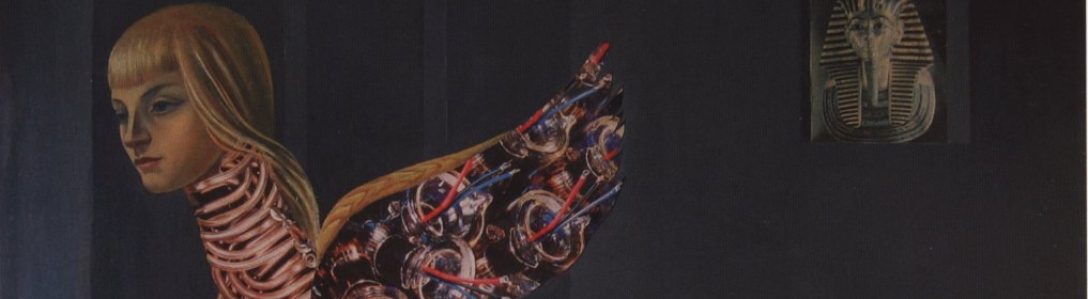
A vital role seems to have been played during these last days by the series of paintings by Max Ernst entitled Garden Airplane Traps, pictures of low walls, like the brick–courses of an uncompleted maze, across which long wings have crashed, from whose joints visceral growths are blossoming. In the last entry of his diary, the day before his wife’s death, 27 March 1975, Loughlin wrote with deceptive calm: ‘Ernst said it all in his comment on these paintings, the model for everything I’ve tried to do… “Voracious gardens in turn devoured by a vegetation which springs from the debris of trapped airplanes… Everything is astonishing, beart–breaking and possible… with my eyes I see the nymph Echo…” Shortly before writing out these lines he had returned to his Hendon apartment to find that his wife had set off for Gatwick Airport with Dr Douglas, intending to catch the 3.15 p.m. flight to Geneva the following day. After calling Richard Northrop, Loughlin drove straight to Elstree Flying Club.
Physician and philosopher, man of action and patron of the arts, sometime claimant to the English throne and founder of a new religion, Henry Rhodes Hamilton was evidently the intimate of the greatest men and women of our age. After World War II he founded a new movement of spiritual regeneration, but private scandal and public concern at his growing megalomania, culminating in his proclamation of himself as a new divinity, seem to have led to his downfall.
After a very short introductory note (which I yanked the above from), “The Index” takes the form of “the index to the unpublished and perhaps suppressed autobiography of a man who may well have been one of the most remarkable figures of the twentieth century.” Ballard crams an analysis of the entire 20th century into the index, with bizarre humor and grand results. Forced to read between the lines, HRH (his royal highness) seems to be present at every single meaningful event of the last century, whether he’s advising Churchill:
Churchill, Winston, conversations with HRH, 221; at Chequers with HRH, 235; spinal tap performed by HRH, 247; at Yalta with HRH, 298, ‘iron curtain’ speech, Fulton, Missouri, suggested by HRH, 312; attacks HRH in Commons debate, 367
Ghandhi:
Ghandi, Mahatma, visited in prison by HRH, 251; discussesBhagavadgita with HRH, 253; has dhoti washed by HRH, 254; denounces HRH, 256
–or Hitler:
Hitler, Adolf, invites HRH to Berchtesgaden, 166; divulges Russia invasion plans, 172; impresses HRH, 179; disappoints HRH, 181
I have to share this entry too:
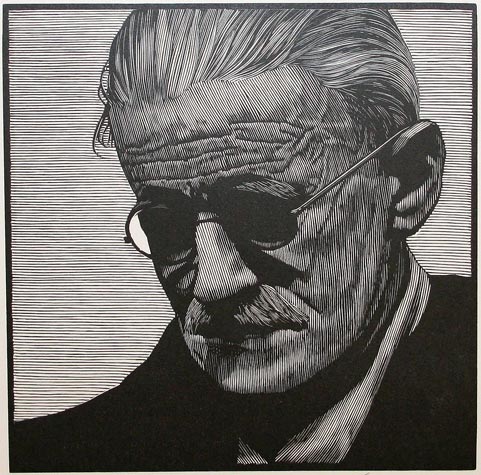
Hemingway, Ernest, first African safari with HRH, 234; at Battle of the Ebro with HRH, 244; introduces HRH to James Joyce, 256; portrays HRH in The Old Man and the Sea, 453
Ballard is at his best when he makes the reader work the hardest (think of “The Beach Murders,” “The Drowned Giant,” or “Why I Want to Fuck Ronald Reagan”), and “The Index” and “Notes” are no exception.
2. “The Greatest Television Show on Earth” (1972) / “The Life and Death of God” (1976)
“The Greatest Television Show on Earth” and “The Life and Death of God” are both composed in a detached, slightly ironic, and highly-omniscient tone that Ballard rarely employs. Most of the time he uses a free indirect style that floats near the harried, paranoid consciousness of one of his (always male) protagonist, constraining the viewpoint to that character. There’s also the occasional first-person voice. It’s worth noting that Ballard’s omniscient voice, usually reserved for wry fables, is one of his strongest (see also: “The Drowned Giant”). This pair of stories—and I do take them as a pair—are thought experiments that ultimately focus on metaphysics, a subject that is somewhat rare in the Ballardverse.
“The Greatest Television Show on Earth” imagines a future (2001!) in which time travel has been perfected and history itself becomes the history channel as billions become addicted to television broadcasts of historical battles. Over time, however, the producers begin to interfere. They try to make history flashier, more violent (sexier?). The story ends with a metaphysical gesture that might be read ironically, although I find it hard to see the conclusion (which I won’t spoil here) as anything other than Ballard’s moralistic reactionary streak alight.
“The Life and Death of God” takes a cue from Voltaire’s quip that if God did not exist it would be necessary to invent him. In this fable/thought experiment, scientists prove beyond doubt (keyword: doubt) that God is real. Ballard imagines a world relieved of radical doubt—a world without faith:
Within two months of the confirmation of the worldwide rumour of God’s existence came the first indications of government concern over the consequences. Industry and agriculture were already affected, though far less than commerce, politics and advertising. Everywhere the results of this new sense of morality, of the virtues of truth and charity, were becoming clear. A legion of overseers, time–keepers and inspectors found themselves no longer needed. Longestablished advertising agencies became bankrupt. Accepting the public demand for total honesty, and fearful of that supreme client up in the sky, the majority of television commercials now ended with an exhortation not to buy their products.
And then things get worse. “The Life and Death” again shows Ballard’s reactionary, elitist stripe, his lack of faith in the so-called common person to make meaning and organize a life without an anchoring center—illusory or otherwise.
3. “The Air Disaster'” (1975) / “Low–Flying Aircraft” (1975) /”The 60 Minute Zoom” (1976) / “The Smile” (1976) / “The Intensive Care Unit” (1977) / “Theatre of War” (1977) / “Having a Wonderful Time” (1978) / “One Afternoon at Utah Beach” (1978) /”Motel Architecture” (1978)
In the order they are listed above, with apologies:
Ballard does cargo cult / Ballard explores child-mutation-as-harbinger-of-new-evolutionary-jump / Ballard does Rear Window (the story anticipates Blue Velvet) / Ballard writes about emotional transference and a sex doll / Ballard mashes up his TV obsessions with his displacement obsessions with his Oedipal obsessions / Ballard imagines a contemporary Civil War in Britain, with American aggressors; there’s a gimmick end here that actually works wonderfully / Ballard’s permanent vacation riff / Ballard writes yet another cheating-wife-leads-to-husband’s-attempt-at-revenge, this time with a Nazi motif / Ballard repeats “Intensive Care Unit,” but mixes it up with voyeurism and a kick of Psycho. (The story anticipates what DeLillo will do a decade later).
Sorry to lump all these together. I probably shouldn’t handle the whole decade of stories at once, but I’m almost finished with this enormous, very long book (dear lord I am ready to be finished) and lumping I shall do. Of this set, “The Intensive Care Unit” and “Theatre of War” are the best, and the most mediocre of the bunch (“Low-Flying Aircraft” and “One Afternoon at Utah Beach”) are better than the mediocre stories of the sixties.
4. “Zodiac 2000” (1978)
Ballard’s most deconstructive, postmodern stories begin with an author’s note, an apologia of sorts, and while I often think these are unnecessary, I’ve also used them to help summarize the stories. So too with “Zodiac 2000”:
An updating, however modest, of the signs of the zodiac seems long overdue. The houses of our psychological sky are no longer tenanted by rams, goats and crabs but by helicopters, cruise missiles and intra–uterine coils, and by all the spectres of the psychiatric ward. A few correspondences are obvious – the clones and the hypodermic syringe conveniently take the place of the twins and the archer. But there remains the problem of all those farmyard animals so important to the Chaldeans. Perhaps our true counterparts of these workaday creatures are the machines which guard and shape our lives in so many ways – above all, the taurean computer, seeding its limitless possibilities. As for the ram, that tireless guardian of the domestic flock, his counterpart in our own homes seems to be the Polaroid camera, shepherding our smallest memories and emotions, our most tender sexual acts. Here, anyway, is an s–f zodiac, which I assume the next real one will be…
If “Zodiac 2000” doesn’t quite work as well as Ballard’s other list-driven/fractured stories, it’s probably because he attempts to screw a plot-driven thriller onto his weird frame. It’s almost as if he has a left-over story that wasn’t quite good enough to sell, and says, hey, I’ve got this idea for a structure, let me mash it all together. In Ballard’s best stuff, frame and content are inseparable; “Zodiac 2000″ is not Ballard’s best” — but it’s still more interesting than his most mediocre.
5. “The Ultimate City” (1976)
Speaking of mediocre: “The Ultimate City” is a very long short story, a novella really, that I invite anyone reading The Complete Short Stories of J.G. Ballard to feel totally okay about skipping. You’ve read this story before, under several different titles, by this point, or maybe you’ll read it later. It’s another thought experiment dressed up as an essay dressed up as an adventure story. At its best there are some good ideas here infused with a heavy dose of environmentalism. At its worst though, “The Ultimate City” is didactic, ponderous, meandering, overstuffed, and redolent of hoary tropes (there’s even a Magical Negro).
6. “The Dead Time” (1977)
1977’s “The Dead Time” is, unless I’m mistaken, Ballard’s first attempt to write directly (if still indirectly) about his experiences as a captive ex-patriot in WWII. Ballard, as is well-known, was interred in a prison camp in Shanghai by the Japanese forces, and this traumatic ordeal undoubtedly underwrites so much of his violent, alienated fiction. If we take Ballard’s childhood internment and the subsequent abject horrors he faced to be the cornerstone of the Ballardverse he would later create, then we must also, significantly, recognize that almost all of Ballard’s fiction up to “The Dead Time” is a displacement and revision of those terrors (which Ballard handled most directly in his mainstream breakthrough, 1984’s Empire of the Sun).
“The Dead Time” focuses on a hero who, released from his Shanghai prison in the final days of WWII, wonders hungry and dissociated through a corpse-and-trash-strewn apocalyptic landscape. He’s charged with the bizarre duty of transporting and then burying a truckload of dead bodies. Little else happens. The tale is, without a doubt, Ballard’s most real, and probably most terrifying story to date:
I tried to pick up another of the corpses, but again my hands froze, and again I felt the same presentiment, an enclosing wall that enveloped us like the wire fence around our camp. I watched the flies swarm across my hands and over the faces of the bodies between my feet, relieved now that I would never again be forced to distinguish between us. I hurled the tarpaulin into the canal, so that the air could play over their faces as we sped along. When the engine of the truck had cooled I refilled the radiator with water from the canal, and set off towards the west.
The narrator’s abject trial continues, and we see in the corpses in his charge the grotesque bits and fragments that have fueled the two previous decades of Ballard’s writing:
Under the cover of darkness – for I would not have dared to commit this act by daylight – I returned to the truck and began to remove the bodies one by one, throwing them down on to the road. Clouds of flies festered around me, as if trying to warn me of the insanity of what I was doing. Exhausted, I pulled the bodies down like damp sacks, ruthlessly avoiding the faces of the nuns and the children, the young amputee and the elderly woman.
As we reach the end of the narrative, our hero remarks,
From this time onwards, during the confused days of my journey to my parents’ camp, I was completely identified with my companions. I no longer attempted to escape them.
It’s difficult not to read here some reconciliation here, as if Ballard is finally ready to write through his formative traumas without the intermediary tropes of science fiction or radical paranoia. What we get here is wonderfully, viscerally real. Fantastic stuff, and clearly part of my ideal Essential collection.
7. On the horizon:
Ballard writes the same story three times in a row! We get one of his best stories, “Answers to a Questionnaire”! And I finish! Yay!





 Biblioklept