Franchise Films, Alternate Worlds, and Why Wong Kar Wai Should Direct the Next Star Wars Film

STAR WARS 3 hartter

News that J.J. Abrams will direct the seventh Star Wars film almost broke the internet yesterday. It’s easy to see why anyone who nerds out over franchise properties would take interest. After all, Abrams helmed the 2009 big-screen reboot of Star Trek, a film that shook the camp and cheese from the franchise’s previous films, replacing it with hip humor, thrilling action, and lots and lots of lens flare. Abrams’s sequel, Star Trek Into Darkness is perhaps the most anticipated franchise film of the year. 

I won’t speculate whether an Abrams Star Wars film will be successful or not—you probably wouldn’t want me to, because I hold the extreme minority opinion that Lucas’s Revenge of the Sith is a deeply profound and moving work of cinema art—but I do think that the choice to hand the next big film in the Star Wars franchise over to Abrams represents the worst in corporate thinking. This goes beyond the playground logic of Abrams swiping all the marbles—he gets both the “Star” franchises!—what it really points to is the bland, safe commercial mindset that guides the corporations who own these franchises. J.J. Abrams is a safe bet. I can more or less already imagine the movie he’ll make.

Star Wars: A New Hope came out in 1977, perhaps at the exact moment that the innovations of the “New Hollywood” movement crested (before Heaven’s Gate crashed the whole damn thing in 1980). The films of this decade—Badlands, The Godfather films, Bonnie & Clyde, Chinatown, Nashville, Dr. Strangelove, etc.—helped to redefine film as art; they also captured and illustrated a zeitgeist that’s almost impossible to define. And while plenty of filmmakers today continue in this spirit, their films are often pushed into the margins. The Hollywood studio system is tangled up in big budget spectacle. I have no problem with this, but at the same time I think that there’s something sad in it all—in the bland safety of having Abrams turn out Star Wars and Star Trek films—it all points to a beige homogeneity.

The problem I’m talking about is neatly summed up by Gus Van Sant in a 2008 interview with The Believer:

So, there were some projects I never really could get going, and one of them was Psycho. It was a project that I suggested earlier in the ’90s. It was the first time that I was able to actually do what I suggested. And the reason that I suggested Psycho to them was partly the artistic appropriation side, but it was also partly because I had been in the business long enough that I was aware of certain executives’ desires. The most interesting films that studios want to be making are sequels. They would rather make sequels than make the originals, which is always a kind of a funny Catch-22.

They have to make Bourne Identity before they make Bourne Ultimatum. They don’t really want to make Bourne Identity because it’s a trial thing. But they really want to make Bourne Ultimatum. So it was an idea I had—you know, why don’t you guys just start remaking your hits.

Lately it seems that the studios trip over themselves to reboot their franchises—the latest Spider-Man film (the one you probably forgot existed) being a choice example of corporate venality. In a way, it’s fascinating that Sam Raimi, something of an outsider director, was allowed to do the first Spider-Man films at all. Of course, now and then a franchise film (or potential franchise film) winds up in the hands of an auteur—take Harry Potter and the Prisoner of Azkaban, for example. Alfonso Cuarón’s third entry in the franchise can stand on its own (it certainly saved the franchise from the tepid visions of Chris Columbus). Even stranger, take Paul Verhoeven’s films RoboCop and Starship Troopers. These films were brilliant subversive satires, and what did Hollywood do to the movies that came after them? These franchises devolved into flavorless, flawed, run of the mill muck.

Of course, entertainment conglomerates have good (economic) reasons to “protect” their product. David Lynch’s Dune remains one of the great cautionary tales in recent cinema history. What could have reinvigorated “New Hollywood” instead proved a disastrous flop.  Dune never panned out as the blockbuster franchise that it could have been; instead, it gets to hang out in a strange limbo, greeting newer arrivals like Chris Weitz’s atrocious adaptation of The Golden Compass and Andrew Stanton’s underrated John Carter from Mars. It’s actually sort of surreal that we even gotDune film by David Lynch, complete with Kyle MacLachlan, Brad Dourif, Jack Nance, and fucking Sting.

What’s even weirder is that Alejandro Jodorowsky tried to adapt Dune, working with artists H.R. Geiger and Moebius. (Jodorowsky also planned to involve Orson Welles, Mick Jagger, and  Karlheinz Stockhausen among others in the film). What a Jodorowsky Dune film might have looked like is a constant source of frustrated fun for film buffs.

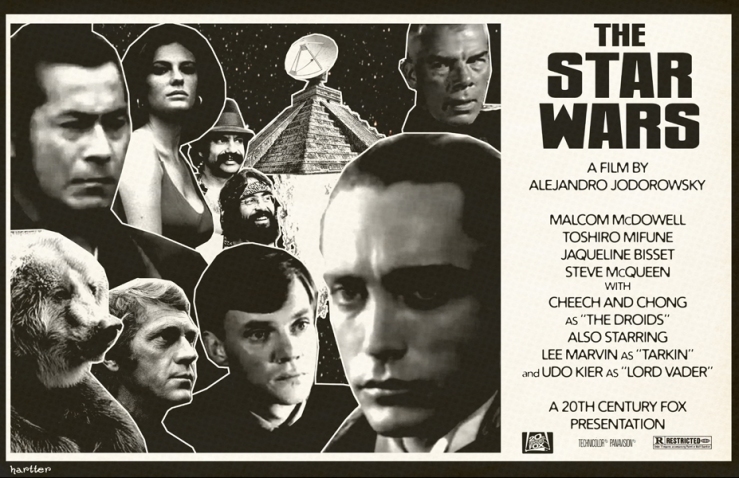
But what about a Star Wars film by Jodorowsky? What might that look like?

the star wars hartter

Sean Hartter imagines such prospects in his marvelous posters for films from an alternative universe. Hartter’s posters—most of which include not just cast and director but also specific studios, producers, and soundtrack composers and musicians—conjure up wonderful could-have-beens. They posit the kind of daring spirit and experimentalism I’d like to see more of from Hollywood franchises.

Most Hollywood franchises revere the illusion of stability in the property—the idea of a constancy of character throughout film to film. Even a franchise like the James Bond films, with its ever-rotating leads, tries to create the guise of a stable aesthetic along with narrative continuity. I would love to see something closer to the Alien franchise, the only line of films I can think of where each film bears the distinctive mark of its respective filmmaker; even if I don’t think Fincher’s Alien 3 is a particularly good film, at least it feels and looks and sounds like a Fincher film and not a weak approximation of a Cameron blockbuster or a stock repetition of Scott’s space horror (and Jeunet’s Resurrection—how weird is that one!).

But back to Bond for a moment—wouldn’t it be great to see Wes Anderson do James Bond, but as a Wes Anderson film? Or Werner Herzog? Or Cronenberg? What would Jane Campion do with Bond? (I’m tempted to add Jim Jarmusch, but he already made an excellent James Bond film called The Limits of Control). I’d love to see a range of auteur versions of the franchise. (Similarly, I’ve recently been fascinated by the way certain cult artists render major corporate franchise characters, like Dave Sim doing Iron Man, or Moebius doing Spider-Man, or Jaime Hernandez doing Wonder Woman). Obviously this fantasy will never happen—the auteur would have to have complete control—a Coen brothers’ Bond film would have to be first and foremost a Coen brothers film, not a 007 film—but hey, just like with Hartter’s posters, it’s fun to pretend.

Imagine a year of James Bond movies, one a month, featuring different directors, actors, studios, production designs. 007 films from Spike Lee, Tarantino, Almodavar, Lynne Ramsay, Lynch, Wong Kar Wai.

What would a Wong Kar Wai James Bond film look like?

What would a Wong Kar Wai Star Wars film look like?

I don’t know. I imagine it would be beautiful and moody and at times impressionistic. I imagine its narrative would tend toward obliqueness. I imagine it might infuriate die-hard fans (I imagine this last part with a big grin). I imagine that it would easily be the most human Star Wars film.

But beyond that, it’s hard to imagine what a Wong Kar Wai Star Wars film might look and sound and feel like because his films are powerful and moving and evoke the kind of imaginative capacity that marks great art, great original and originating art. Put another way, I can’t really imagine what a Wong Kar Wai Star Wars film would look like—which is precisely why I’d love to see one.

Faulkner Pronouncing Yoknapatawpha

“The Stranger” — Katherine Mansfield

“The Stranger” by Katherine Mansfield

It seemed to the little crowd on the wharf that she was never going to move again. There she lay, immense, motionless on the grey crinkled water, a loop of smoke above her, an immense flock of gulls screaming and diving after the galley droppings at the stern. You could just see little couples parading—little flies walking up and down the dish on the grey crinkled tablecloth. Other flies clustered and swarmed at the edge. Now there was a gleam of white on the lower deck—the cook’s apron or the stewardess perhaps. Now a tiny black spider raced up the ladder on to the bridge.

In the front of the crowd a strong-looking, middle-aged man, dressed very well, very snugly in a grey overcoat, grey silk scarf, thick gloves and dark felt hat, marched up and down, twirling his folded umbrella. He seemed to be the leader of the little crowd on the wharf and at the same time to keep them together. He was something between the sheep-dog and the shepherd.

But what a fool—what a fool he had been not to bring any glasses! There wasn’t a pair of glasses between the whole lot of them.

“Curious thing, Mr. Scott, that none of us thought of glasses. We might have been able to stir ’em up a bit. We might have managed a little signalling. ‘Don’t hesitate to land. Natives harmless.’ Or: ‘A welcome awaits you. All is forgiven.’ What? Eh?”

Mr. Hammond’s quick, eager glance, so nervous and yet so friendly and confiding, took in everybody on the wharf, roped in even those old chaps lounging against the gangways. They knew, every man-jack of them, that Mrs. Hammond was on that boat, and that he was so tremendously excited it never entered his head not to believe that this marvellous fact meant something to them too. It warmed his heart towards them. They were, he decided, as decent a crowd of people—Those old chaps over by the gangways, too—fine, solid old chaps. What chests—by Jove! And he squared his own, plunged his thick-gloved hands into his pockets, rocked from heel to toe. Continue reading ““The Stranger” — Katherine Mansfield”

Barry Hannah on Southern Literature

From The Paris Review’s interview with Barry Hannah

INTERVIEWER

Do you think you can still say there is a Southern literature? That people aren’t just hanging onto something that no longer really exists?

HANNAH

Yes. Remember that the South—and this is what people forget—the South is sixteen states and it’s the biggest region. It and the West are enormous country. Of the sixteen states, from Texas on up to Virginia, there is a stamp that means love of language and stories. But that might be the extent of the similarities. Texas lit is nothing like Virginia lit. The Tidelands is nothing like Appalachian. We’re talking about an enormous nation. We’re talking about people who love blacks more than Northerners. We’re talking about people who deeply hate them more than anybody in the world. So, yes, that’s Southern lit but that’s like saying—oh, let us say German lit. Heavily philosophic is what we usually think.

But the Germans also command that you have fun. So we can say certain things about Germans but there are huge varieties, and Germany’s much smaller than the South.


Lars Iyer’s Exodus (Book Acquired, 1.15.2013)

20130120-173952.jpg

Lars Iyer’s latest, Exodus presumably concludes the trilogy that began with Spurious and DogmaExodus picks up the adventures/failures of our tragicomic (anti)heroes Lars and W. Here’s publisher Melville House’s description:

With philosophy professors being moved to badminton departments and gin in short supply — although not short enough—the two hapless intellectuals embark on a relentless mission. Well, several relentless missions. For one, they must help gear a guerrilla philosophy movement — conducted outside the academy, perhaps under bridges — that will save the study of philosophy after the long intellectual desert known as the early 21st-century.

For another, they must save themselves, perhaps by learning to play badminton after all. Gin isn’t free, you know.

Exodus is on deck in my reading stack.  I talked to Lars a few years ago about Spurious (and other stuff), and he brought up the idea of “exodus” (as in the concept, not the book) early on:

As someone who had made some progress as an academic – a journey which implies valuable training as well as compromise and despair – I thought a kind of exodus was necessary, from existing forms of published writing. Leave it all behind!, I told myself. Leave the Egypt of introductory books and academic journals and edited collections behind. Leave the slave-drivers behind, and the sense you have of being a slave. Leave capitalism and capitalist relations behind. Leave behind any sense of the importance of career and advancement. Leave behind those relationships that are modeled on investment and return.

I love the cover on this one.


“…however baby man may brag of his science and skill…” (Moby-Dick)

But though, to landsmen in general, the native inhabitants of the seas have ever been regarded with emotions unspeakably unsocial and repelling; though we know the sea to be an everlasting terra incognita, so that Columbus sailed over numberless unknown worlds to discover his one superficial western one; though, by vast odds, the most terrific of all mortal disasters have immemorially and indiscriminately befallen tens and hundreds of thousands of those who have gone upon the waters; though but a moment’s consideration will teach, that however baby man may brag of his science and skill, and however much, in a flattering future, that science and skill may augment; yet for ever and for ever, to the crack of doom, the sea will insult and murder him, and pulverize the stateliest, stiffest frigate he can make; nevertheless, by the continual repetition of these very impressions, man has lost that sense of the full awfulness of the sea which aboriginally belongs to it.

The first boat we read of, floated on an ocean, that with Portuguese vengeance had whelmed a whole world without leaving so much as a widow. That same ocean rolls now; that same ocean destroyed the wrecked ships of last year. Yea, foolish mortals, Noah’s flood is not yet subsided; two thirds of the fair world it yet covers.

Wherein differ the sea and the land, that a miracle upon one is not a miracle upon the other? Preternatural terrors rested upon the Hebrews, when under the feet of Korah and his company the live ground opened and swallowed them up for ever; yet not a modern sun ever sets, but in precisely the same manner the live sea swallows up ships and crews.

But not only is the sea such a foe to man who is an alien to it, but it is also a fiend to its own off-spring; worse than the Persian host who murdered his own guests; sparing not the creatures which itself hath spawned. Like a savage tigress that tossing in the jungle overlays her own cubs, so the sea dashes even the mightiest whales against the rocks, and leaves them there side by side with the split wrecks of ships. No mercy, no power but its own controls it. Panting and snorting like a mad battle steed that has lost its rider, the masterless ocean overruns the globe.

Consider the subtleness of the sea; how its most dreaded creatures glide under water, unapparent for the most part, and treacherously hidden beneath the loveliest tints of azure. Consider also the devilish brilliance and beauty of many of its most remorseless tribes, as the dainty embellished shape of many species of sharks. Consider, once more, the universal cannibalism of the sea; all whose creatures prey upon each other, carrying on eternal war since the world began.

Consider all this; and then turn to this green, gentle, and most docile earth; consider them both, the sea and the land; and do you not find a strange analogy to something in yourself? For as this appalling ocean surrounds the verdant land, so in the soul of man there lies one insular Tahiti, full of peace and joy, but encompassed by all the horrors of the half known life. God keep thee! Push not off from that isle, thou canst never return!

From “Brit,” Chapter 58 of Herman Melville’s Moby-Dick

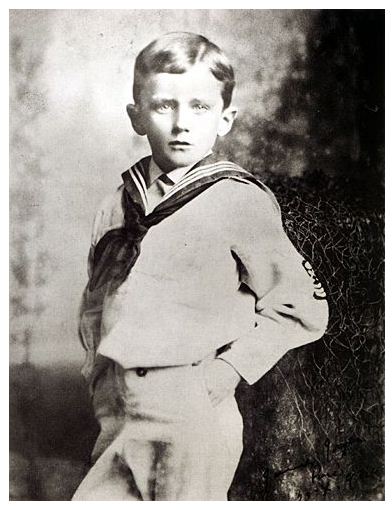
James Joyce, Six Years Old, Rockin’ a Sailor Suit

six year old james joyce

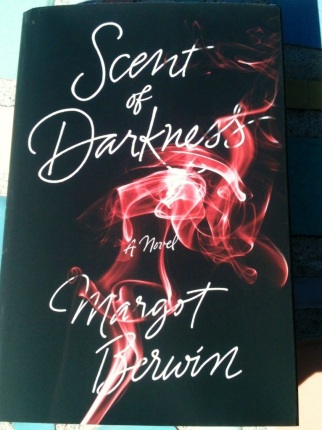
Scent of Darkness (Book Acquired, 1.18.2013)

20130120-174109.jpgScent of Darkness by Margot Berwin. New in hardback from Random House. Their blurb:
In her best-selling debut, Hothouse Flower and theNine Plants of Desire, Margot Berwin brought us to the rain forests of Mexico—to a land of shamans, spirit animals, and snake charmers—in the search for nine rare and valuable plants. Now, with her hotly anticipated second novel, Berwin takes us somewhere darker: deep into the bayous of Louisiana, to a world of fortune-tellers, soothsayers, and potent elixirs. Scent of Darknessis a magical, seductive story about the power of scent, and about what happens when a perfume renders a young woman irresistible.

Evangeline grows up understanding the extraordinary effects of fragrance. Her grandmother Louise is a gifted aromata, a master of scent-making and perfume. When Eva was a girl, Louise carefully explained that lavender under her pillow would make her dream of the man she would marry; eucalyptus would make her taller; almandine, fatter; and jasmine, Louise promised, would wrap her life in a mystery. When Eva is eighteen, Louise leaves her the ultimate gift—a scent created just for her. The small perfume vial is accompanied by a note in Louise’s slanted script: “Do not remove the stopper, Evangeline, unless you want everything in your life to change.”

From the moment Eva places a drop—the essence of fire, leather, rose, and jasmine—on her neck, men dance closer to her, women bury their noses deep into her hair, even the cats outside her bedroom cry to be near her. After a lifetime spent blending into the background, Eva is suddenly the object of intense desire to everyone around her. Strangers follow her down the street; a young boy appears at her door asking for a favor; and two men, one kind and good, the other dark and seductive, fall deeply, madly in love with her. As her greatest gift becomes an unbearable curse, Eva must uncover the secret of her scent and the message her grandmother, the woman who loved her most, wanted to tell her.

A bewitching tale of love, blood, power, and magic, Scent of Darkness is a wildly inventive novel that will seduce the reader’s every sense

This is kinda weird, because there’s another novel named Scent of Darkness, by Christina Dodd. I’m not sure if this book is for me. I don’t know. Bewitched perfume? Maybe.

Download RTÉ’s Superb Audio Production of James Joyce’s Ulysses

patch2James Joyce’s Ulysses might seem like a prohibitively difficult book, but it’s not as hard to read as its reputation suggests. There are any number of strategies for tackling the great tome (although enjoying or experiencing are more fitting verbs here), but one that many readers might overlook is listening to an audio recording.

I’ve tried a few audio versions of Ulysses, and none can hold a candle to RTÉ’s 1982 full cast production. I reviewed it a few years ago, and wrote:

I listened to, absorbed, choked up at, guffawed about, cackled around, and generally loved RTÉ’s 1982 dramatized, soundtracked, sound-effected, lovingly detailed recording of Ulysses, a work crammed with voices to match (if perhaps not equal) Joyce’s big fat work. This recording is not as widely available as LibriVox’s (free) full cast production or Jim Norton’s Naxos reading, but, after sampling both, I’d argue that it’s better. The Irish players bring sensitivity and humor to their roles, but beyond that pathos, the energy of RTÉ’s troupe is what really makes the book sing. Leopold Bloom gets his own voice, as does Stephen Dedalus and Molly (and all the characters). This innovation propels the narrative forward with dramatic power, and clarifies the oh-so indirectness of Joyce’s free indirect style, making the plot’s pitfalls and pratfalls more distinct and defined. There are songs (and dances) and music (and musing) and humming (and hemming and hawing and reverb). There is chanting and chawing and brouhaha. There is chaos and calamity and confusion. There is brilliance and peace and transcendence. It’s all very good, great, wonderful.

You can listen to and/or download the production here (big thanks to reader Eve for sending the link in!).

“Soliloquy on a Park Bench” — Conrad Aiken

“Soliloquy on a Park Bench” by Conrad Aiken

The model for the afternoon hour was an Italian boy–about her own age, she thought. His face had a heavy beauty, sombre as that of the sleeping Medusa, particularly in profile; seen fully, it was a little stupid. But his torso was what most delighted her, and this she drew with careful strong strokes, luxuriating in a new sense of precision. Her pleasure in this was exquisite, was prolonged. “Extraordinary!” she murmured, and found herself oddly frowning at the dark beauty of the skin, the well-muscled shoulders, and arched ribs, in the April sunlight that slanted from the half. shaded window. She was sorry when the hour was over. Miss N, thrusting off her apron, paused beside her and asked if she were going “down town.” She repressed a shade of annoyance–though she liked Miss N–and replied vaguely that she “had some things to do.” This was not true, and she felt a slight contrition when she saw that Miss N was unconvinced and a little hurt. However! . . . She put on her hat and escaped into the soft afternoon.

The parkway invited her–it was vague, it was hazily green with new leaves and buds, the muddy river gleamed sleepily here and there as it curved among flat gardens and under small stone arches, and the drowsy quackings and laconic comments of waterfowls seemed only to add to the immense and melancholy stillness. She caressed affectionately, with a fugitive hand, as she walked, the low stone wall that led to a ridiculously conceited little bridge. She slid two fingers over the white flank of a birch. Further on, she touched her palm, and scratched it, against a barberry frond, on which two elfin red-peppers still hung. . . . Why had she rebuffed Miss N? . . . Well, really, one wanted, sometimes, to be alone. Particularly when one was–what? . . . Her eyes wandered from the word, she paused to watch a duck stand on his head in the still water, and then walked on absorbed. The benches here were too crowded. A nursemaid scolded a child, lifting an angry round eye from her knitting. A small boy was digging in the gravel with a bit of broken glass, murmuring “It’s like this–it’s like this.” A bored perfumed lady waited patiently for her Pomeranian; which suddenly twinkled after her as if on wire springs. . . . The bells in St Matthew’s Church began striking five, and it seemed to her that the slow deep tones hung afterwards among the trees and over the water like a mist. White and purple crocuses were sunning themselves in a corner by a wall–absurd! She felt suddenly like laughing at everything, and then, just as suddenly, for no reason, felt unhappy, as if she had a bird shut ,in her heart who wanted to escape. She found a deserted bench and sat down, at the end nearest the water. Grackles made scraping sounds in the maple tree over her head–scolding at sparrows. Cruel birds, grackles! . . . Who was it that had told her of seeing a grackle pursue a sparrow tirelessly till he had worn it out, and then stab it to death on the ground? . . . How horrible, and in April . . . There was a grackle now. He walked awkwardly by the water’s edge–a bedraggled fellow, getting on in years; but what a beautiful iridescence on his black feathers! . . . It was Fred Thomas who had told her. He always came out to smoke his pipe here after lunch. A curious, a nice thing for a man to do, an unexpected concession–as if the grackle should pause and admire a crocus! She laughed to herself, and half shut her eyes to make a picture of the water, with a round cold cloud in it, and part of the stone arch of a bridge. Continue reading ““Soliloquy on a Park Bench” — Conrad Aiken”

The Worst Poetry I Have Ever Read

At the home of some good friends this past weekend, reclined nicely in a warm armchair, the warmth of various ales coursing through me, I picked off the shelf by my right hand a crumbling first edition of Modern Library’s A Comprehensive Anthology of Modern Poetry, edited by Conrad Aiken. I opened at random and found a small and perhaps undue joy that my stochastic flipping led to sections 10 and 11 of Song of Myself—maybe my favorite parts of Walt Whitman’s longassed poem.

Do you recall these bits? The trapper’s wedding? The runaway slave? The twenty-eight bathers and the woman who spies on them? I read them aloud to the room, ostensibly to the people in the room, but maybe just to myself. Walt Whitman’s storytelling is at its best when he moves most away from himself, when he puts on different hats, wears different ears, strolls around America a bit. I love his free verse in spite of—or even maybe because of—its swollen scope, its tendency toward bombast or even hamminess. O Walt! Get over yourself!—but not really, never change! Song of Myself is one of my favorite novels, or one of my favorite epics, or one of my favorite monologues—whatever it is, it’s one of my favorites (especially taken with doses of Emily Dickinson’s strange potions).

I don’t really know a lot about poetry, despite teaching the study of it in certain literature survey classes.

But hang on, it seems I was telling a story, or at least teasing out an anecdote, or at least going somewhere with all this: So, after riffling through the anthology a bit more, my friend says, Hey, if you want to read some really terrible poetry, check out that book to your right. Here is the book:

20130120-102401.jpg

I had never heard of Walter Benton or his (unintentionally) hilarious volume This Is My Beloved until that moment. So what is it? Combining the worst elements of Whitmanesque free verse with a downright silly conceit that these are diary entries, This Is My Beloved attempts to be the erotic record of a passionate love affair. Benton tries to keep his language sultry, sexy, and sensuous without veering into pornography, but the results are bizarre and grotesque. Here’s an entire page as evidence:

20130120-102411.jpg

“Your breasts are snub like children’s faces”?!

“…your lips match your teats beautifully”?!

And my favorite: “The hair of your arm’s hollow and where your thighs meet / agree completely, being brown and soft to look at like a nest of field mice.” A nest of field mice! Women love to be complimented on their matching pits and pubes, followed by a simile comparing said regions to a rodent’s hovel.

Indeed, Benton loves animal similes for his lady—later he writes: “Yes, your body makes eyes at me from every salient, / promises warm, lavish promises— / curved, colored . . . finished in a warm velvet like baby rabbits.”

But it’s not just the rabbits and mice that are gross. Lines like “We had loved hard—it’s all over your throat and hair” are simply queasy, bad writing. Or this nugget: “The white full moon like a great beautiful whore / solicits over the city, eggs the lovers on / the haves . . . walking in twos to their beds and to their mating. / I walk alone. Slowly. No hurry. Nobody’s waiting.”

Or this snippet:

20130120-102418.jpg

It’s just really, really bad—I mean, at least when Henry Miller is gross, he’s deeply, earnestly gross, abject even, depraved perhaps (recall the famous lines: “I have set the shores a little wider. I have ironed out the wrinkles. After me you can take on stallions, bulls, rams, drakes, St. Bernards. You can stuff toads, bats, lizards up your rectum. You can shit arpeggios if you like, or string a zither across your navel”).

So, to return to my little story, we read most of Benton’s book aloud, doubling over laughing at times at just how wonderfully awful it is. And, wiping the tears from my eyes, I went to my trusty dusty iPhone to do a little background research—surely the world knew of this awful, awful poetry? Surely folks were getting the same giggly fun as happy we from poor Benton’s lurid verse?

And here, really, comes the occasion for this post, the real reason I write: It turns out that folks love this book—in a sincere, earnest, serious way. No fewer than four audio recordings were made of the book, all set to music (the most famous seems to be by Arthur Psyrock); the book has near-perfect five star review averages on both Amazon and Goodreads; and, perhaps most shocking of all, the book has been continuously in print since it was first published in 1949—it’s in its 34th edition (prestigious hardback with prestigious deckle edges, by the way). And of course you can buy an ebook version! (Unlike, say, Georges Perec’s Life A User’s Manual). Even worse, hack crooner Rod McKuen cites Benton as a major influence, so we have that to thank him for as well.

I don’t know. Am I wrong? Is Benton’s stuff actually good? I mean, I’ll concede that I enjoyed reading the book, but only inasmuch as it made me laugh so much. I don’t know. I already admitted I don’t know much about poetry. (As I write this, I pause to watch and listen to Richard Blanco read his inauguration poem “One Day”; I have no idea if it’s good or not). Benton’s verse seems so hammy, clumsy, indelicate; too earnest, too priapic, tripping over its own boners. It reads like a bad cribbing of Whitman and Miller, with an occasional lift from Hemingway. Even worse, it strikes me as amateurish, as the sort of thing that a teen might scrawl in his Moleskine only to cringe at later before hiding it somewhere. I just can’t believe that this book has been in continual publication from a major house (Knopf) for more than a half-century.

But maybe I’m misreading. Maybe I’m cynical. Maybe the poem is beautiful and profound and not icky solipsistic dreck. But I doubt it.

Film Footage of William Faulkner (1952)

“Hollow” — Breece D’J Pancake

“Hollow” by Breece D’J Pancake

Hunched on his knees in front of the three-foot coal seam, Buddy was lost in the back-and-forth rhythm of the truck mine’s relay: the glitter of coal and sandstone in his cap light, the setting and lifting and pouring into the cart that carried the stuff to the mouth of the mine. This was nothing like shaft mining, no deep tunnels or up-and-down man-trips, only the setting, lifting, pouring, only the rumbling of the relay cart and the light-flash from caps in the relay. In the pace of work, he daydreamed his father lowering him into the cistern: many summers ago he touched the cool tile walls, felt the moist air from the water below, heard the pulley squeak in the circle of blue above. The tin of the well-pail buckled under his tiny feet, and he began to cry. His father hauled him up. “That’s the way we do it,” he said, laughing, and carried Buddy to the house.

But that came before everything; before they moved from the ridge, before the big mine closed, before welfare. Now, at the far end of the relay, the men were quiet, and Buddy wondered if they thought of stupid things. From where he squatted he could see the gray grin of light at the mouth of the truck mine, the March wind spraying dust into little clouds. The half-ton relay cart was full now, and the last man in the relay shoved it toward the chute at the mine-mouth on two-by-four tracks.

“Take a break” came from the opening, and as he set his shovel aside to rise from where he knelt at the coal face, Buddy saw his cousin Curtis start through the mine-mouth. Curtis was dragging a poplar post behind him as he crawled past the relay cart toward the face. Buddy watched while Curtis worked the post upright from the floor to catch the weight of the ceiling. It was too short, and Curtis hammered wedges in to tighten the fit.

“Got it?” Buddy asked.

“Hell no, but she looks real pretty.”
Continue reading ““Hollow” — Breece D’J Pancake”

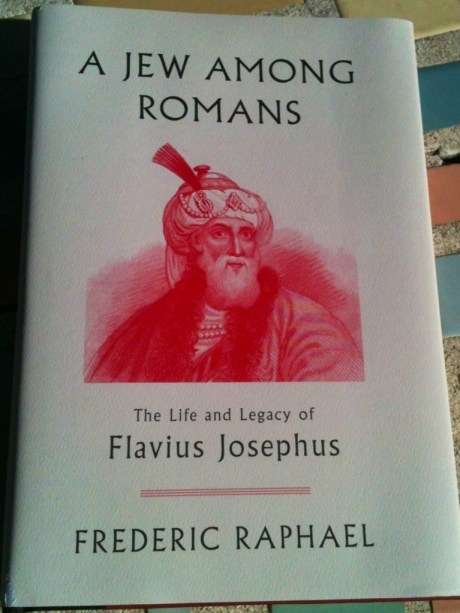
A Jew Among Romans: The Life and Legacy of Flavius Josephus (Book Acquired, 1.14.2013

20130120-174045.jpg

This one looks pretty interesting, and the first chapter was intriguing: A Jew Among the Romans: The Life and Legacy of Flavius Josephus. It’s new in hardback from Random House. Their blurb:

From the acclaimed biographer, screenwriter, and novelist Frederic Raphael, here is an audacious history of Josephus (37–c.100), the Jewish general turned Roman historian, whose emblematic betrayal is a touchstone for the Jew alone in the Gentile world.

Joseph ben Mattathias’s transformation into Titus Flavius Josephus, historian to the Roman emperor Vespasian, is a gripping and dramatic story. His life, in the hands of Frederic Raphael, becomes a point of departure for an appraisal of Diasporan Jews seeking a place in the dominant cultures they inhabit. Raphael brings a scholar’s rigor, a historian’s perspective, and a novelist’s imagination to this project. He goes beyond the fascinating details of Josephus’s life and his singular literary achievements to examine how Josephus has been viewed by posterity, finding in him the prototype for the un-Jewish Jew, the assimilated intellectual, and the abiding apostate: the recurrent figures in the long centuries of the Diaspora. Raphael’s insightful portraits of  Yehuda Halevi, Baruch Spinoza, Karl Kraus, Benjamin Disraeli, Ludwig Wittgenstein, and Hannah Arendt extend and illuminate the Josephean worldview Raphael so eloquently lays out.


“Sweat” — Zora Neale Hurston

“Sweat” by Zora Neale Hurston

It was eleven o’clock of a Spring night in Florida. It was Sunday. Any other night, Delia Jones would have been in bed for two hours by this time. But she was a wash-woman, and Monday morning meant a great deal to her. So she collected the soiled clothes on Saturday when she returned the clean things. Sunday night after church, she sorted them and put the white things to soak. It saved her almost a half day’s start. A great hamper in the bedroom held the clothes that she brought home. It was so much neater than a number of bundles lying around.

She squatted in the kitchen floor beside the great pile of clothes, sorting them into small heaps according to color, and humming a song in a mournful key, but wondering through it all where Sykes, her husband, had gone with her horse and buckboard.

Just then something long, round, limp and black fell upon her shoulders and slithered to the floor beside her. A great terror took hold of her. It softened her knees and dried her mouth so that it was a full minute before she could cry out or move. Then she saw that it was the big bull whip her husband liked to carry when he drove.

She lifted her eyes to the door and saw him standing there bent over with laughter at her fright. She screamed at him.

“Sykes, what you throw dat whip on me like dat? You know it would skeer me–looks just like a snake, an’ you knows how skeered Ah is of snakes.”

“Course Ah knowed it! That’s how come Ah done it.” He slapped his leg with his hand and almost rolled on the ground in his mirth. “If you such a big fool dat you got to have a fit over a earth worm or a string, Ah don’t keer how bad Ah skeer you.”

“You aint got no business doing it. Gawd knows it’s a sin. Some day Ah’m goin’ tuh drop dead from some of yo’ foolishness. ‘Nother thing, where you been wid mah rig? Ah feeds dat pony. He aint fuh you to be drivin’ wid no bull whip.”

“You sho is one aggravatin’ nigger woman!” he declared and stepped into the room. She resumed her work and did not answer him at once. “Ah done tole you time and again to keep them white folks’ clothes outa dis house.”

He picked up the whip and glared down at her. Delia went on with her work. She went out into the yard and returned with a galvanized tub and set it on the washbench. She saw that Sykes had kicked all of the clothes together again, and now stood in her way truculently, his whole manner hoping, praying, for an argument. But she walked calmly around him and commenced to re-sort the things.

“Next time, Ah’m gointer kick ’em outdoors,” he threatened as he struck a match along the leg of his corduroy breeches. Continue reading ““Sweat” — Zora Neale Hurston”

“Were this world an endless plain…” (Moby-Dick)

Were this world an endless plain, and by sailing eastward we could for ever reach new distances, and discover sights more sweet and strange than any Cyclades or Islands of King Solomon, then there were promise in the voyage. But in pursuit of those far mysteries we dream of, or in tormented chase of that demon phantom that, some time or other, swims before all human hearts; while chasing such over this round globe, they either lead us on in barren mazes or midway leave us whelmed.

From “The Albatross,” Chapter 52 of Melville’s Moby-Dick.


Hard Work (Peanuts)

20130120-101954.jpg