Woman in the Mirror — Cagnaccio di San Pietro

facd9e4ac9a239fca6897ab712c7404e

Woman in the Mirror, 1930 by Cagnaccio di San Pietro (1897 – 1946)

Posted in Art

“The Incredible and Sad Tale of Innocent Eréndira and Her Heartless Grandmother” — Gabriel García Márquez”

“The Incredible and Sad Tale of Innocent Eréndira and Her Heartless Grandmother”

by

Gabriel García Márquez

translation by

Gregory Rabassa


Erendira was bathing her grandmother when the wind of her misfortune began to blow. The enormous mansion of moon like concrete lost in the solitude of the desert trembled down to its foundations with the first attack. But Erendira and her grandmother were used to the risks of the wild nature there, and in the bathroom decorated with a series of peacocks and childish mosaics of Roman baths they scarcely paid any attention to the caliber of the wind.

The grandmother, naked and huge in the marble tub, looked like a handsome white whale. The granddaughter had just turned fourteen and was languid, soft-boned, and too meek for her age. With a parsimony that had something like sacred rigor about it, she was bathing her grandmother with water in which purifying herbs and aromatic leaves had been boiled, the latter clinging to the succulent back, the flowing metal-colored hair, and the powerful shoulders which were so mercilessly tattooed as to put sailors to shame.

“Last night I dreamt I was expecting a letter,” the grandmother said.

Erendira, who never spoke except when it was unavoidable, asked:

“What day was it in the dream?”

“Thursday.”

“Then it was a letter with bad news,” Erendira said, “but it will never arrive.”

When she had finished bathing her grandmother, she took her to her bedroom. The grandmother was so fat that she could only walk by leaning on her granddaughter’s shoulder or on a staff that looked like a bishop’s crosier, but even during her most difficult efforts the power of an antiquated grandeur was evident. In the bedroom, which had been furnished with an excessive and somewhat demented taste, like the whole house, Erendira needed two more hours to get her grandmother ready. She untangled her hair strand by strand, perfumed and combed it, put an equatorially flowered dress on her, put talcum powder on her face, bright red lipstick on her mouth, rouge on her cheeks, musk on her eyelids, and mother-of-pearl polish on her nails, and when she had her decked out like a larger than life-size doll, she led her to an artificial garden with suffocating flowers that were like the ones on the dress, seated her in a large chair that had the foundation and the pedigree of a throne, and left her listening to elusive records on a phonograph that had a speaker like a megaphone. Continue reading ““The Incredible and Sad Tale of Innocent Eréndira and Her Heartless Grandmother” — Gabriel García Márquez””

I’m into Shooting in Natural Environments — Dana Schutz

041c0e171d804339

I’m into Shooting in Natural Environments, 2008 — Dana Schutz (b. 1976)

Four Fairies — Michaël Borremans

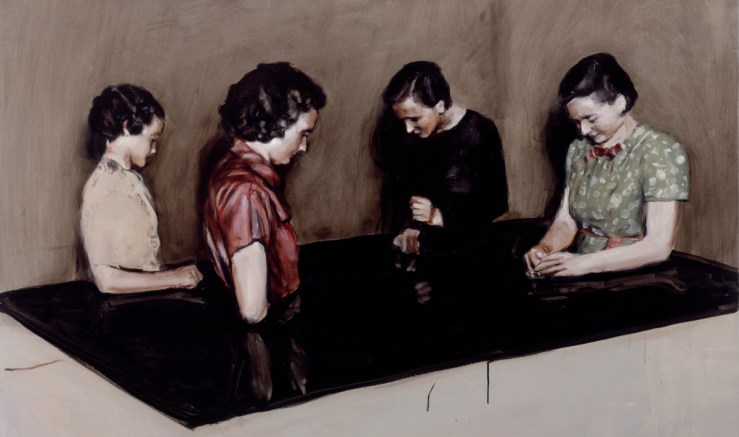
Four fairies

Four Fairies, 2003 by Michaël Borremans (b. 1963)

Vortex — Sharon Sprung

31065-2376695-_22moire_22_oil_on_panel_40x40

Vortex, Sharon Sprung (b. 1953)

Read Breece D’J Pancake’s short story “In the Dry”

“In the Dry”

by

Breece D’J Pancake


He sees the bridge coming, sees the hurt in it, and says aloud his name, says, “Ottie.” It is what he has been called, and he says again, “Ottie.” Passing the abutment, he glances up, and in the side mirror sees his face, battered, dirty; hears Bus’s voice from a far-off time, I’m going to show you something. He breathes long and tired, seems to puff out the years since Bus’s Chevy slammed that bridge, rolled, and Ottie crawled out. But somebody told it that way—he only recalls the hard heat of asphalt where he lay down. And sometimes, Ottie knows. Now and again, his nerves bang one another until he sees a fist, a fist gripping and twisting at once; then hot water runs down the back of his throat, he heaves. After comes the long wait—not a day or night, but both folding on each other until it is all just a time, a wait. Then there is no more memory, only years on the hustle with a semi truck—years roaring with pistons, rattling with roads, waiting to sift out one day. For one day, he comes back.

This hill-country valley is not his place: it belongs to Sheila, to her parents, to her Cousin Buster. Ottie first came from outside the valley, from the welfare house at Pruntytown; and the Gerlocks raised him here a foster child, sent him out when the money-crop of welfare was spent. He sees their droughty valley, cannot understand—the hills to either side can call down rain. Jolting along the pike, he looks at withered fields, corn tassling out at three feet, the high places worse with yellowish leaves. August seems early for the hills to rust with dying trees, early for embankments to show patches of pale clay between milkweed and thistle. All is ripe for fire.

At a wide berm near the farmhouse, he edges his tractor truck over, and the ignition bell rings out until the engine sputters, dies. He picks up his grip, swings out on the ladder, and steps down. Heat burns through his T-shirt under a sky of white sun; a flattened green snake turns light blue against the blacktop.

The front yard’s shade is crowded with cars, and yells and giggles drift out to him from the back. A sociable, he knows, the Gerlock whoop-dee-doo, but a strangeness stops him. Something is different. In the field beside the yard, a sin crop grows—half an acre of tobacco standing head-high, ready to strip. So George Gerlock’s notions have changed and have turned to the bright yellow leaves that bring top dollar. Ottie grins, takes out a Pall Mall, lets the warm smoke settle him, and minces a string of loose burley between his teeth. A clang of horseshoes comes from out back. He weaves his way through all the cars, big eight-grand jobs, and walks up mossy sandstone steps to the door. Continue reading “Read Breece D’J Pancake’s short story “In the Dry””

Mardi Gras — Sean Mellyn

mardi-gras

Mardi Gras, 1998 by Sean Mellyn (b. 1965)

The Day I Quit — Susannah Martin

e7310efcf8d4c593c7f42df44d64564c

The Day I Quit, 2014 by Susannah Martin (b. 1964)

Dick (Perry Bible Fellowship)

pbf300-dick

Roberto Bolaño’s novel The Spirit of Science Fiction reviewed in the The New Yorker 

There’s an interesting review of Roberto Bolaño’s posthumous novel The Spirit of Science Fiction in the The New Yorker  The review’s author, editor and translator Valerie Miles, read Bolaño’s novel through/against the work of the American Beats—William S. Burroughs and Jack Kerouac, specifically. From Miles’ review:

From 2008 to 2014, during the charged emergence of Bolaño in translation, I worked behind the scenes with the writer’s estate, reading through roughly fourteen thousand six hundred papers in his archive and helping to prepare his posthumous work. Bolaño, it should be said, saved everything. His archive includes notebooks, diaries, letters, magazines, war games, postcards, photos, typescripts, newspaper clippings, and an extensive library. (“I even found one of those paper napkins from a bar in Mexico,” his widow, Carolina López, has said, at a press conference.) The wealth of material makes it easy to locate Bolaño’s fixations at a given time, and much of my efforts involved establishing a chronology of when his work was written—a chronology that became a central part of the first exhibition dedicated to his papers, which I curated together with the Centre de Cultura Contemporània de Barcelona, in 2013.

That chronology also shed light on just how much “The Spirit of Science Fiction” was informed by poetry, and specifically by Bolaño’s reading of the Beats. In 1978, around the time Bolaño first began writing fiction in earnest, he wrote in his diary, “I write verses, dream of a novel.” During that time, he read William S. Burroughs daily and often commented on the writer’s work. (Burroughs was the “ice shard that would never melt,” he writes in his essay collection “Between Parentheses,” “the eye that never closes.”) In an early version of “The Spirit of Science Fiction,” Burroughs was the contact person for the young Chileans. Bolaño was also influenced by Burroughs’s approach to structure; he was fascinated by “Naked Lunch” and by the collage-like experimentation of “Nova Express.” He even borrowed some of Burroughs’s methods, riffing on Burroughs’s “cut-up” technique in his own verse.

miles-bolano-and-the-beats

“Kafka. Pure Kafka” (From Ishmael Reed’s The Last Days of Louisiana Red)

img_2323

He was a blonde. He lay in the bed, tossing turning. his room. What was that odor? The pungent odor of middle-class perfume making the air misty. He didn’t feel right. His hair. What on earth was the matter with his hair? It was long and was covering the pillow. The pillows? They had a flower print and were pink. Pink? He rose in his bed and his breasts jiggled. BREASTS? THE BREASTS?? He looked back into the mirror next to the bed and his mouth made a black hollow hole of horror. “O MY GOD. MY GOD.” He was a woman. You know what he said next, don’t you, reader? He’s from New York and so . . . you guessed it! “Kafka. Pure Kafka,” he said. A feeling crept over him. Tingly. What could he do? He felt like screaming, but he couldn’t scream. Was that someone coming coming down the hall? He ran and jumped back into the bed, pulled the covers up to his neck and pretended to be asleep.

From Ishmael Reed’s 1974 novel The Last Days of Louisiana Red. 

Hotel Maid — Alex Colville

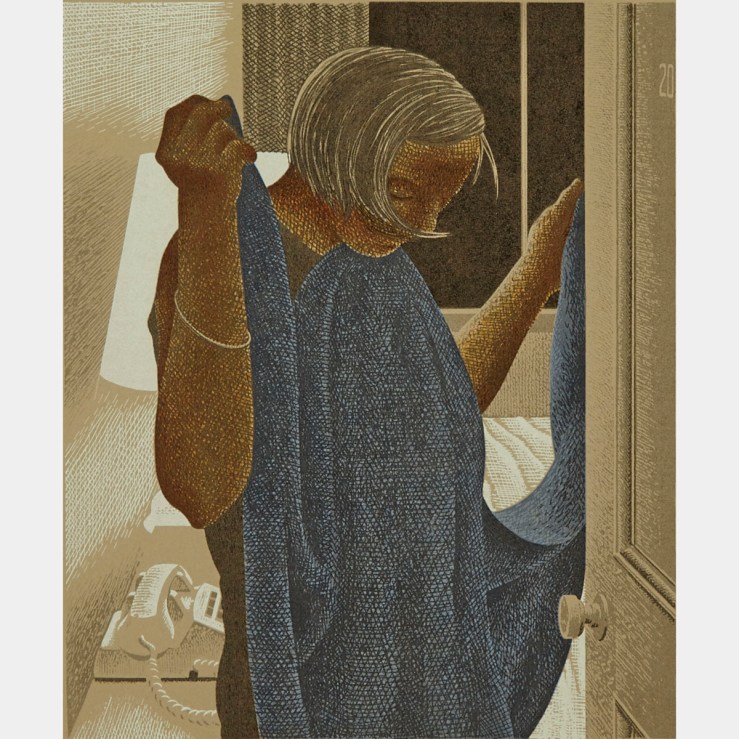
waddingtons-aedc3ce8af14534419f3ce2af45a977f

Hotel Maid, 1978 by Alex Colville (1920-2013)

Blog about Ishmael Reed’s The Last Days of Louisiana Red (Book acquired 27 Feb. 2019)

img_2323

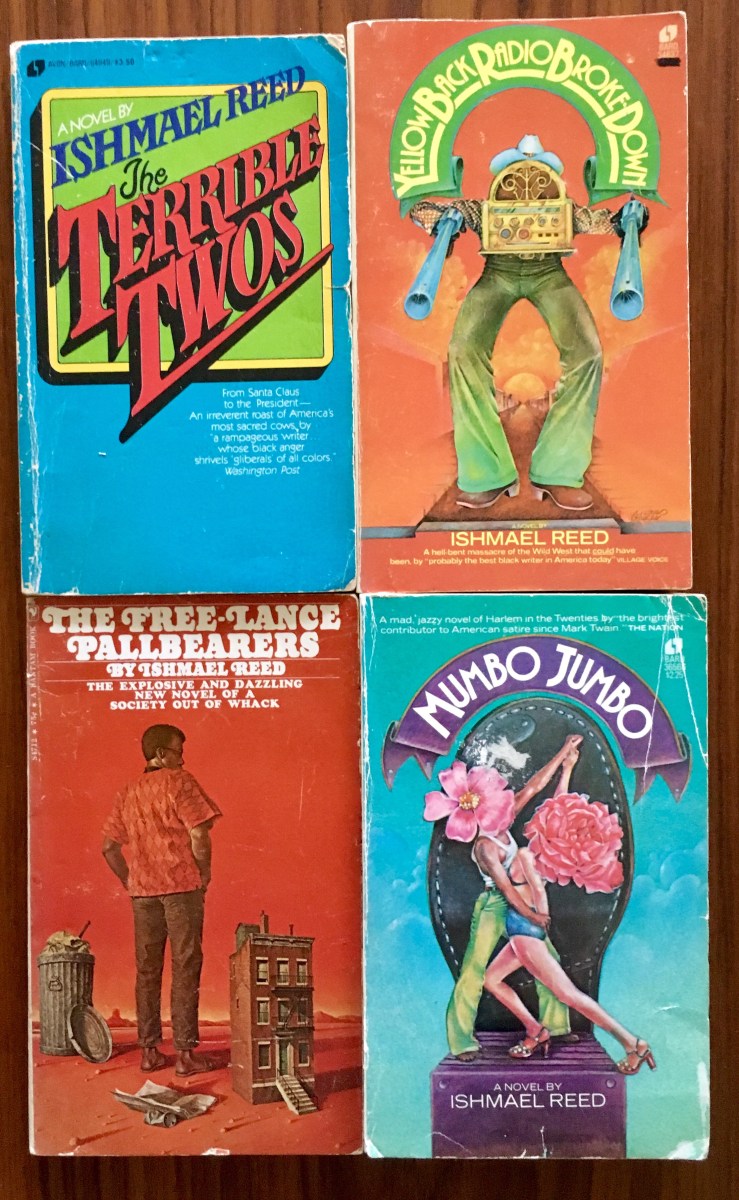
A few weeks ago I went to my favorite used bookstore to pick up a copy of Ishmael Reed’s follow up to Mumbo Jumbo, 1974’s The Last Days of Louisiana Red. The store had a few copies of it, but they were all Dalkey Archive editions with ugly covers and bad binding, so I broke down and ordered a first edition Random House hardback online. (I was tempted to pick up the Avon Bard paperback version to match the covers of the other Reed books I own, which are so beautiful I’ll share them here again):

img_2351

Anyway, I did the design of the hardback the came in, which the jacket flap credits as Reed’s own suggestion. Oh, and it’s an old library book:

img_2349

I read the first half of The Last Days of Louisiana Red this weekend. Reed’s writing is bitter, prescient, zany, and mythological, telegraphed in a range of comic and tragic voices. The chapters are short, and the sentences sting. The plot—well, in Louisiana Red, Reed brings back Papa LaBas the Neo-HooDoo hero of Mumbo Jumbo, and sends him to the West Coast, to Berkeley, Carlifornia to investigate the murder of Ed Yellings. Yellings, a Neo-HooDoo man himself, has discovered the cure for cancer through his mysterious enterprise, the Solid Gumbo Works. Yellings’ gumbo is also a cure for “Louisiana Red,” a poisonous mental disease that afflicts black people in the Americas. Papa LeBas is alternately helped and hindered by Yellings’ adult children: Wolf, Street, Sister, and the provocative and gifted Minnie, who leads a group of militants called the Moochers.

I’m really digging Louisiana Red, which, like the other early Reed novels I’ve read, synthesizes the history, folklore, mythology, and intellectual traditions of the African diaspora into a slapstick satire of USA at the end of the twentieth century. Reed cooks his gumbo with a wide variety of ingredients: voodoo lore and California history bubble in the same pots as riffs on astrology and Cab Calloway’s hit “Minnie the Moocher.” Reed satirizes the Berkeley youth movement, radical feminism, and intellectual hucksterism, all through an allegorical lens—he dares us, often explicitly (by way of a character named Chorus) to read Louisiana Red as an allegorical retelling of Sophocles’ Antigone. While Papa LaBas appears to be the moral center of Reed’s novel, delivering righteous condemnation after righteous condemnation of the Moochers and other persons afflicted with Louisiana Red, Reed nevertheless gives expression to a multitude of opposing viewpoints in the novel. It is a speaking novel, a novel that is both of its time but transcends it, as most of the problems and perils it diagnoses are, unfortunately, still with us. More to come.


Devotion — Egon Schiele

egon_schiele_006

Devotion, 1913 — Egon Schiele (1890-1918)

A review of Lord, João Gilberto Noll’s abject novel of dissolving identity

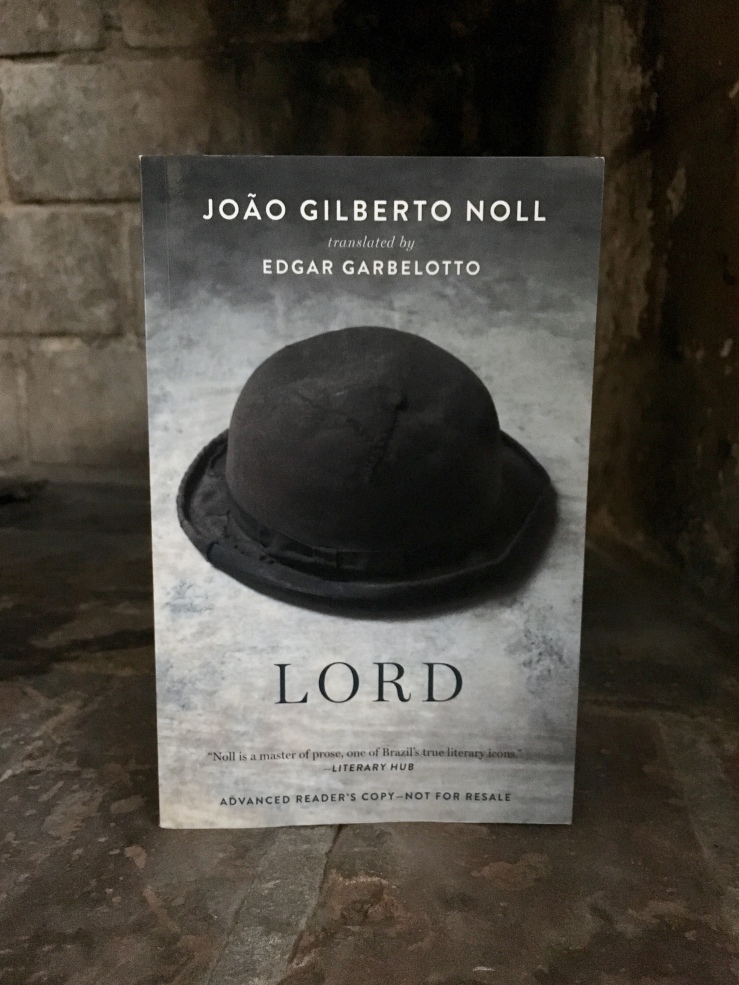
img_2336

João Gilberto Noll’s short novel Lord is an abject and surreal tale of madness. Madness is perhaps not the correct term, although it does point towards Lord’s gothic and abject modes. Perhaps it’s more accurate to say that in Lord, Noll gives us a consciousness dissolving and reconstituting itself, a first-person voice shifting from one reality to the next with absurdly picaresque energy.

That first-person voice is “a Brazilian who wrote books that were mostly well received by critics but not the public.” The Brazilian novelist travels to cold winter London on an unspecified “mission.” Indeed, the mission remains unspecified to both reader and narrator alike, although it does seem to involve an English university. The man who arranges for the narrator to come to London is himself a shifting cipher in Lord, transforming into different entities—at least in the narrator’s (often paranoid) view. We get the sense in Lord that consciousness is always under radical duress, that a state of being might collapse at any time or give way to some other, unknown state of being.

Throughout Lord, Noll dramatizes abject consciousness in turmoil. Early on, the narrator, already feeling uncertain about why he has moved halfway across the world, arrives at a university’s Portuguese department. In a book-lined office, he attempts to stabilize himself through the textual “reality” of printed matter:

The walls were covered with books. I trailed my hand over them as if to confirm the reality I was living in. Though I knew I was not living an unreality per se—like those born out of a simple dream and ending up in a nightmare, which we can only escape from when we wake up sweaty, trembling, and confused.

The irony is that the narrator has not fully comprehended yet that he is living an unreality, that he is actually narrating the nightmare. Noll’s hero is an unfixed voice, a voice that can’t square the signifiers around him with any stable signified meaning in his consciousness.

Slowly (but not too slowly—Lord moves at a steady clip), the narrator embraces this abjection and wills the dissolution of his self and its reformation into some new other. “My tiredness did not demand sleep, but, damn!, how I craved some indistinguishability between bodies, volumes, and formats,” he tells us.

The narrator carries his project of transformation even farther, applying cosmetics and hair dye to alter his appearance and “find a new source for [his] new formation”:

My lack of definition was already greater than me, although I had lost myself and begun to suspect that even my English boss couldn’t do anything to bring me back to me. I needed to keep up this task of being every- one somehow, because without it I wouldn’t even make it as far as the corner: without asking anyone, I happened to have overcome being the individual whom I had mechanically created for other people. I had to find a new source for my new formation, even now in my fifties, and that fountain would come from him, that light brown-haired man with makeup on, who lived in London for the time being without exactly remembering why.

Lord’s narrator takes this new version of himself on various London adventures, most of which are lurid and gross, and many of which are downright horny. Our Brazilian writer (who is slowly unbecoming a Brazilian writer) visits museums and has weird sex encounters, sleeps on the streets and takes a soapy bath with a Professor of Latin American Studies. Lord moves at a rapid and occasionally bewildering pace, giving the narrator’s quest a mock-ironic urgency. In Edgar Garbeletto’s capable English translation from the Portuguese, the paragraphs go on for pages but the sentences are choppy, riddled with colons and dashes, lurches and leaps, falls and stops.

Through this turbulent rhetoric, Lord’s narrator channels other voices, sublimating them into the text proper. The narrator absorbs bits and pieces of the other voices he encounters, dissolving his consciousness into and out of them as he strives for transformation. He also absorbs bits and pieces of bodies—fluids and other detritus, other abject bits of our human borders.

Our narrator is obsessed with borders, but his transgression of them has little to do with a moral framework. For the narrator, moral semblance is simply the result of an “individual…mechanically created for other people.” Rather, the narrator is fascinated by what makes a consciousness conscious. However, he’s not yet willing to cross the ultimate border, despite his fascination. In one little episode of Lord, our hero happens upon a dying man on the street. He watches the man pass from life:

I squeezed his hand. His mouth opened, and I could see the pool of blood that had overflowed his rotten teeth. That death, in some way, in some corner of my mind, gave me tremendous satisfaction. Someone was not afraid to go all the way to the end. To do for others what everyone tried to avoid. I wished I could follow him, but I didn’t have his bravery; I lacked the necessary elements to consummate the act. I needed that hug today.

A strange hug indeed!

The apparent finality of death as cessation-of consciousness holds a certain appeal to Lord’s narrator, whose quest is perhaps to overcome abjection via transformation. But it’s not easy,

It’s not just a snap, man: it’s being stuck in this limbo between staying in England and going back to South America that made me unrecognizable to myself anymore, it didn’t let me transfigure myself, it wouldn’t let me leave this stupid little body here, vomit myself out in disgust, or turn me into someone else.

Indeed, the quest in Lord might be summarized by that phrase: “vomit myself out in disgust.” While the voice in Lord remains untethered by the normal strictures of narrative (or even moral) logic, it is hardly free or disembodied. Indeed, the relationship between bodies and consciousness is perhaps the primary problem of Lord. Our narrator’s voice has a body that can’t catch up to what’s happening in its consciousness. Hence the novel’s preoccupation with the corporeal reality of bodies: blood, urine, semen, sweat, vomit…all the leaking stuff of humanity spurting out, transgressing the apparent borders and showing those borders are but a moral fiction.

In one abject episode, our narrator attempts to dispel London himself from his consciousness:

On a corner in Bloomsbury, a totally unexpected need to vomit hit me. I wiped myself with a sheet of newspaper that was fluttering by. But I couldn’t stop; I realized it was London I was throwing up, London with its ghosts and impossible missions, already entirely unsuccessful.

Tellingly, the narrator grasps a newspaper that just happens to be “fluttering by” to clean himself, to restore the moral fiction of an arranged, presentable self. The newspaper, like the books in the university office, is another nod to Lord’s metatextual motif. The written word proves to be illusory as an anchor in Noll’s novel—it cannot codify consciousness, it cannot fix meaning. Hence, the novel’s strange, disruptive rhetorical program, which takes first-person consciousness and literally deconstructs it.

The fact that Noll’s hero is/was a writer, “a Brazilian who wrote books that were mostly well received by critics but not the public,” suggests another metatextual nod. Lord’s narrator is a strange cipher of Noll himself. In 2004, the year Lord was published, Noll  served as writer-in-residence at the Centre for the Study of Brazilian Culture and Society at King’s College London. But the narrator is a cipher of Noll only—a voice that deconstructs and reconstructs itself, autofiction that dissolves the self.

This abject voice tries to reinvent itself from the outside in, only to vomit the inside back out again. Utter disintegration seems fatally imminent; madness seems inescapable. As one reaches the final pages of Lord, one senses that the narrative might fall apart into nothing—which, to be clear, it doesn’tLord sticks its ending a strangely and suitably satisfying way. I won’t give away the end, but instead reverse the course of my previous sentence: Lord falls apart into something.

Like Quiet Creature on the Corner and Atlantic Hotel (the other Noll books currently available in English translation),  Lord is propelled on its own dream-nightmare logic. It’s fucked-up, gross, abject, and surreal. It’s permeated by a vague horror. Reading it might make parts of your stomach hurt. I like these particular flavors, and I particularly like a book that doesn’t just upset me with its themes and its plot, but also with its style and its rhetoric. Lord certainly isn’t for everyone, but I loved it, and I think that there’s an audience of weirdos out there like me who will really dig this book too. Highly recommended.

João Gilberto Noll’s Lord is new from Two Lines Press. It is the third novel by Noll Two Lines has published. I hope they publish more. 


Battle of Grunwald (Detail) — Jan Matejko

Screenshot 2019-03-02 at 9.02.49 AM

Battle of Grunwald (Detail), 1878 by Jan Matejko (1838-1893)

Read “The Eye of the Sybil,” a short story by Philip K. Dick

“The Eye of the Sybil”

by

Philip K. Dick


How is it that our ancient Roman Republic guards itself against those who would destroy it? We Romans, although only mortals like other mortals, draw on the help of beings enormously superior to ourselves. These wise and kind entities, who originate from worlds unknown to us, are ready to assist the Republic when it is in peril. When it is not in peril, they sink back out of sight — to return when we need them.

Take the case of the assassination of Julius Caesar: a case which apparently was closed when those who conspired to murder him were themselves murdered. But how did we Romans determine who had done this foul deed? And, more important, how did we bring these conspirators to justice? We had outside help; we had the assistance of the Cumean Sibyl who knows a thousand years ahead what will happen, and who gives us, in written form, her advice. All Romans are aware of the existence of the Sibylline Books. We open them whenever the need arises.

I myself, Philos Diktos of Tyana, have seen the Sibylline Books. Many leading Roman citizens, members of the Senate especially, have consulted them. But I have seen the Sibyl herself, and I of my own experience know something about her which few men know. Now that I am old — regretfully, but of the necessity which binds all mortal men — I am willing to confess that once, quite by accident I suppose, I in the course of my priestly duties saw how the Sibyl is capable of seeing down the corridors of time; I know what permits her to do this, as she developed out of the prior Greek Sibyl at Delphi, in that so highly venerated land, Greece.

Few men know this, and perhaps the Sibyl, reaching out through time to strike at me for speaking aloud, will silence me forever. It is quite possible, therefore, that before I can finish this scroll I will be found dead, my head split like one of those overripe melons from the Levant which we Romans prize so. In any case, being old, I will boldly say.

I had been quarreling with my wife that morning — I was not old then, and the dreadful murder of Julius Caesar had just taken place. At that time no one was sure who had done it. Treason against the State! Murder most ugly — a thousand knife wounds in the body of the man who had come to stabilize our quaking society. . . with the approval of the Sibyl, in her temple; we had seen the texts she had written to that effect. We knew that she had expected Caesar to bring his army across the river and into Rome, and to accept the crown of Caesar.

“You witless fool,” my wife was saying to me that morning. “If the Sibyl were so wise as you think, she would have anticipated this assassination.”

“Maybe she did,” I answered.

“I think she’s a fake,” my wife Xantippe said to me, grimacing in that way she has, which is so repulsive. She is — I should say was — of a higher social class than I, and always made me conscious of it. “You priests make up those texts; you write them yourselves — you say what you think in such a vague way that any interpretation can be made of it. You’re bilking the citizens, especially the well-to-do.” By that she meant her own family.

I said hotly, leaping up from the breakfast table, “She is inspired; she is a prophetess — she knows the future. Evidently there was no way the assassination of our great leader, whom the people loved so, could be averted.”

“The Sibyl is a hoax,” my wife said, and started buttering yet another roll, in her usual greedy fashion.

“I have seen the great books –”

How does she know the future?” my wife demanded. At that I had to admit I didn’t know; I was crestfallen — I, a priest at Cumae, an employee of the Roman State. I felt humiliated.

“It’s a money game,” my wife was saying as I strode out the door. Even though it was only dawn — fair Aurora, the goddess of dawn, was showing that white light over the world, the light we regard as sacred, from which many of our inspired visions come — I made my way, on foot, to the lovely temple where I work.

No one else had arrived yet, except the armed guards loitering outside; they glanced at me in surprise to see me so early, then nodded as they recognized me. No one but a recognized priest of the temple at Cumae is allowed in; even Caesar himself must depend on us. Continue reading “Read “The Eye of the Sybil,” a short story by Philip K. Dick”