Read “The Demon Lover,” a short story by Elizabeth Bowen

“The Demon Lover”

by

Elizabeth Bowen


Toward the end of her day in London Mrs. Drover went round to her shut-up house to look for several things she wanted to take away. Some belonged to herself, some to her family, who were by now used to their country life. It was late August; it had been a steamy, showery day: At the moment the trees down the pavement glittered in an escape of humid yellow afternoon sun. Against the next batch of clouds, already piling up ink-dark, broken chimneys and parapets stood out. In her once familiar street, as in any unused channel, an unfamiliar queerness had silted up; a cat wove itself in and out of railings, but no human eye watched Mrs. Drover’s return. Shifting some parcels under her arm, she slowly forced round her latchkey in an unwilling lock, then gave the door, which had warped, a push with her knee. Dead air came out to meet her as she went in.

The staircase window having been boarded up, no light came down into the hall. But one door, she could just see, stood ajar, so she went quickly through into the room and unshuttered the big window in there. Now the prosaic woman, looking about her, was more perplexed than she knew by everything that she saw, by traces of her long former habit of life—the yellow smoke stain up the white marble mantelpiece, the ring left by a vase on the top of the escritoire; the bruise in the wallpaper where, on the door being thrown open widely, the china handle had always hit the wall. The piano, having gone away to be stored, had left what looked like claw marks on its part of the parquet. Though not much dust had seeped in, each object wore a film of another kind; and, the only ventilation being the chimney, the whole drawing room smelled of the cold hearth. Mrs. Drover put down her parcels on the escritoire and left the room to proceed upstairs; the things she wanted were in a bedroom chest. Continue reading “Read “The Demon Lover,” a short story by Elizabeth Bowen”

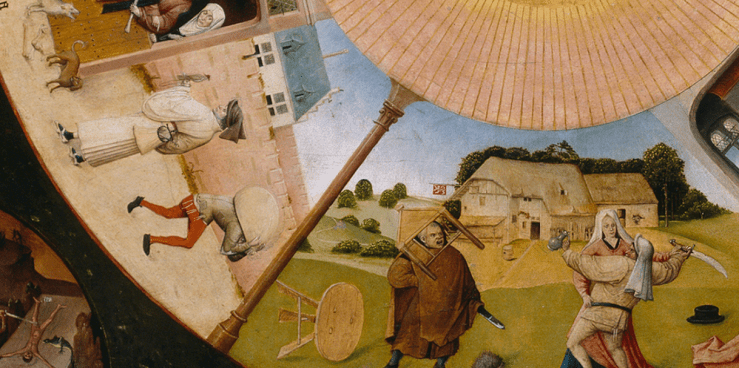
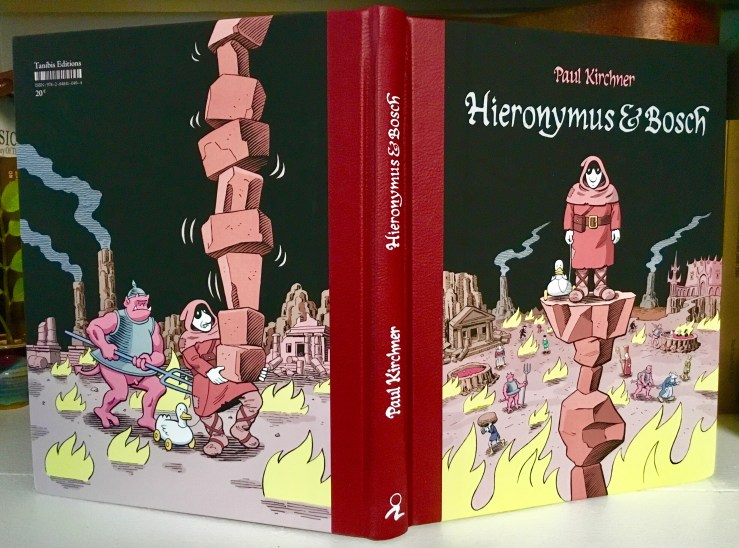
Paul Kirchner’s Hieronymus & Bosch (Book acquired, 17 Oct. 2018)

img_1398

This afternoon, I started putting together a review of Biblioklept fave Paul Kirchner’s latest, Hieronymus & Bosch, and I realized that although I’d written a bit about it recently, I hadn’t put together one of these book acquired posts for it. So this is that post.

l

I really dig the book. It’s goofy and funny and has a lot of soul to it. Kirchner’s hapless hero Hieronymus seems like an extension—with difference—of the commuter, the hero of Kirchner’s bus strips. I hope to have a review up at The Comics Journal soon (where I reviewed Kirchner’s last collection, Awaiting the Collapse), but for now,  here’s publisher Tanibis’s blurb:

Meet the medieval miscreant Hieronymus and his wooden duck Bosch. When Hieronymus commits yet another petty crime, things go badly wrong and both are catapulted into a cartoonish version of Hell. There, lakes are made of lava (or, more often, poop) and an army of mischievous spiky-tailed devils bully the inmates and play impish pranks. Despite many gag-filled attempts at escaping this literal hell, Hieronymus and Bosch always end up being the butt of their trident-wielding guards’ most humiliating and painful jokes.

This book puts together about a hundred one-pagers filled with hilariously surrealistic and scatological gags by American comic book artist Paul Kirchner. Kirchner drew his inspiration from the medieval depictions of Hell by Dante and Hieronymus Bosch (duh!) as well as from the zany, almost sadistic humor of Warner Bros. cartoons like the Road Runner Show. Some of the stories published in this book originally appeared on the Adult Swim website.

Hieronymus & Bosch also evokes Kirchner’s famous comic strip series the bus. However, the bus‘ main character always got out from the practical jokes played on him unharmed, even if a bit confused. Hieronymus & Bosch‘s two heroes get burnt by lava, stabbed with tridents, used as a Q-tip by Satan himself, or just covered in a torrent of poop gushing down from above. Yet they carry on, finding fun where they can and refusing to abandon all hope.

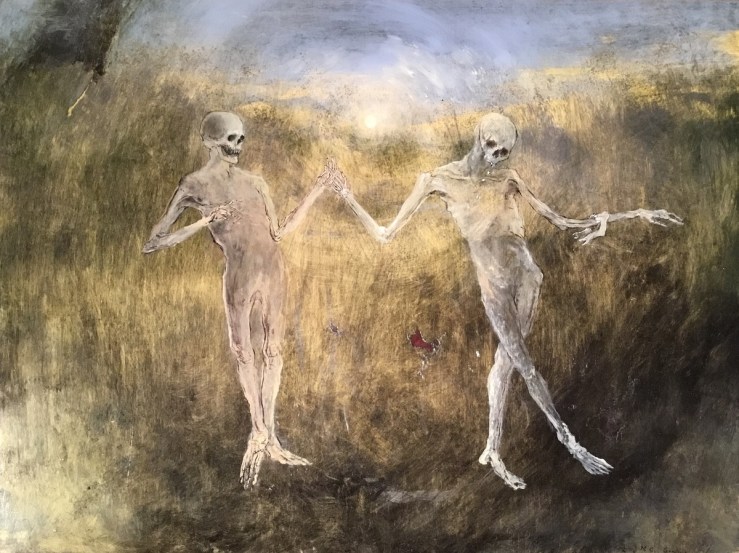
The Happy Couple — Miles Cleveland Goodwin

3f6ae282-8341-4576-929b-4fee6bb3edaf

The Happy Couple, 2018 by Miles Cleveland Goodwin (b. 1980)

Halloween Carnival (detail) — Henrik Martin Mayer

Screenshot 2018-10-11 at 7.15.42 PM

Detail from Halloween Carnival, 1938 by Henrik Martin Mayer (1909-1972)

The writer as a confidence man (William Gaddis)

To turn now–it’s not a different direction; it’s this whole idea of the risk of authorial absence and the risk one takes with the reader putting down the book, saying, “It’s too much trouble, I don’t know what’s going on here.” Refusing to collaborate because it’s not worth the effort. So in that light, the idea of the writer as a confidence man has always appealed to me and to many writers. When you think about it, the number of novels [wherein there is a confidence man is great; one thinks] of Melville and, oh dear, Maugham I think had one. The idea of a confidence man has a great appeal for writers because there is something of the con man in the writer, I think. He’s trying—What? What does the confidence man do?—he is working for this “willing suspension of disbelief.”

An excerpt from William Gaddis’s New York State Writers Institute reading, April 4, 1990

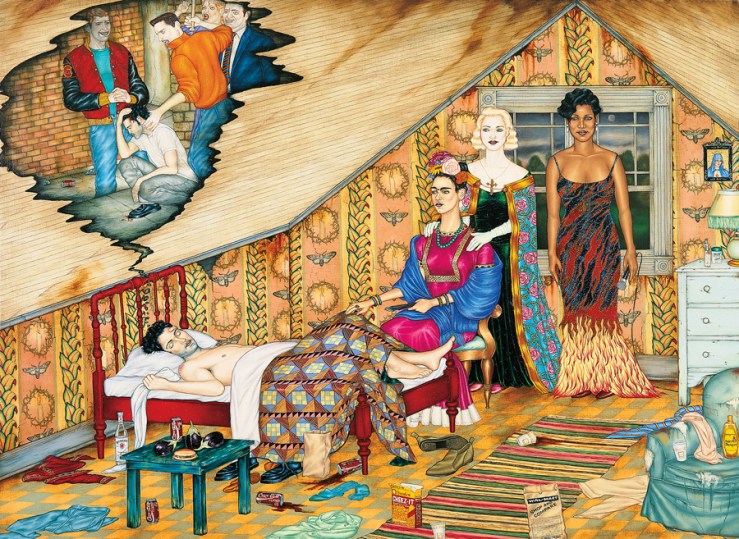
Haunted — Douglas Bourgeois

douglas-bourgeois-haunted2

Haunted, 1990 by Douglas Bourgeois (b. 1951)

Haunted House — Morris Kantor

Screenshot 2018-10-28 at 11.59.29 AM

Haunted House, 1930 by Morris Kantor (1896-1974)

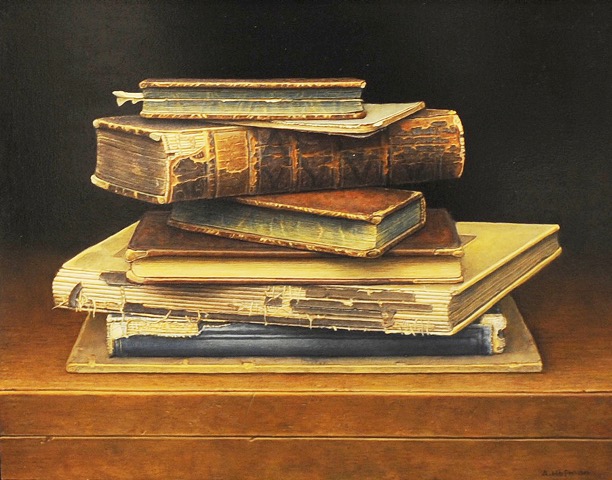
Still Life with Books — Aad Hoffman

boekenstilleven-24-x-30-cm-olieverf-op-paneel

Boekenstilleven (Still Life with Books), 2017 by Aad Hoffman (b. 1944)

Halloween Party — Philip Guston

Screenshot 2018-10-11 at 7.11.48 PM
Halloween Party, 1942 by Philp Guston (1913-1980)

Blog about starting the audiobook version of William Gaddis’s novel The Recognitions

Screenshot 2018-10-27 at 2.12.16 PM

I downloaded the audiobook of version of William Gaddis’s first novel The Recognitions the other afternoon. The recording is 51 hours and 41 minutes long, and read by Nick Sullivan.

I am almost exactly six hours in, over halfway through the novel’s third chapter, an aural space that correlates to page 114 of my 956-page Penguin edition of the novel. In this particular moment, Wyatt Gwyon, the sorta-hero of The Recognitions, rants to his wife Esther about literary modernism. I stopped the book at that particular moment to find that particular passage in my copy of The Recognitions; it was particularly easy to find because I’d already dogeared that particular page.

I’m not sure if I dogeared that particular page when I first attempted The Recognitions in 2009 (I stalled out in the book’s second of three sections, somewhere around page 330 or so), or if I dogeared it on my second (and successful) reading in 2012. And while I’m tempted to focus on the passage I’ve just audited and then reread—a meta-moment where Wyatt raves about Modernism (even making a dig at Hemingway)—I’m more interested in making a few generalizations about the audiobook and the first chapter of The Recognitions.

So a few generalizations:

Nick Sullivan, who reads The Recognitions, is excellent. He’s expressive, and imbues the novel with a wonderful rhythm and vitality, differentiating the voices of each of the characters (no mean feat). I have audited Sullivan’s reading of Gaddis’s second novel JR, which is marvelous, and in many ways taught me to “read” that novel, which is told in almost entirely unattributed dialogue. I would strongly recommend anyone daunted by JR to read it in tandem with Sullivan’s audiobook version.

I would not, however, recommend using the audiobook of The Recognitions for a first go through (unless you intend to use the audiobook chapters after you’ve read the chapters yourself). The Recognitions simply contains a density of information unparalleled in almost any other novel I can think of). You’ll need to attend closely to it to parse the threads that matter in terms of the plot and the threads that are there to build the theme. And unless you’re a polyglot, hearing all the untranslated Latin, Spanish, Italian, and German read aloud does little for comprehension. No, I think The Recognitions is best read slowly, and ideally the reader should take the time to attend to its many allusions and motifs (Steven Moore’s online guide is invaluable here). This isn’t to say that readers need to get every damn little reference to enjoy and appreciate Gaddis’s novel—but it doesn’t hurt to try.

Still, there’ a lot in The Recognitions. The book is wonderful, a work of genius, and this is perhaps one of its faults—it suffers from First Novel Syndrome, the author cramming in all that he can, anxious that the audience Recognize Genius. Gaddis was young when it was published—just 34 (amazing). A much older Gaddis seemed to recognize this, saying the following in 1990:

So, in the work I’ve tried to do, in J R, especially the awful lot of description and narrative interference, as I see it now, in The Recognitions, where I am awfully pleased with information that I have come across and would like to share it with you-so I go on for two pages about, oh, I don’t know, the medieval Church,… the forgery, painting, theories of forgery and so forth, and descriptions, literally, of houses or landscapes. And when I got started on the second novel, which was J R, 726 pages, almost entirely my intention was to get the author out of there, to oblige the characters to create themselves and each other and their story, and all of it in dialogue

Screenshot 2018-10-27 at 2.15.52 PM

The first chapter of The Recognitions, the fruit of an author awfully pleased with information that he has come across, lays out an encyclopedic range of references to literature, art, religion, history, and every other manifestation of culture you might think of. The chapter is impossibly rich, and in some ways, the rest of the novel can never quite match it. Or rather, the rest of the novel teases out the material that Gaddis offers at its outset, threading the material into cables of plot and theme. Or maybe what I’m trying to say is, The first chapter of The Recognitions might be the best first chapter of any novel I can think of.  At 62 pages, it’s almost a novella, and it can arguably stand on its own. Let me borrow my own summary of Chapter I from my 2009 write-up:

The first chapter is the best first chapter of any book I can remember reading in recent years. It tells the story of Rev. Gwyon looking for solace in the Catholic monasteries of Spain after his wife’s death at sea under the clumsy hands of a fugitive counterfeiter posing as a doctor (already, the book posits the inherent dangers of forgery, even as it complicates those dangers by asking who isn’t in some sense a phony). There’s a beautiful line Gaddis treads in the first chapter, between pain, despair, and melancholy and caustic humor, as Gwyon slowly realizes the false limits of his religion. The chapter continues to tell the story of young Wyatt, growing up under the stern care of his puritanical Aunt May, whose religious attitude is confounded by the increasingly erratic behavior of Wyatt’s often-absent father. While deathly ill, Wyatt teaches himself to paint by copying masterworks. He also attempts an original, a painting of his dead mother, but he cannot bear to finish it because, as he tells his father, “There’s something about . . . an unfinished piece of work . . . Where perfection is still possible. Because it’s there, it’s there all the time, all the time you work trying to uncover it.” This problem of originality, of Platonic perfection guides much of the novel’s critique on Modernism.

(The “novel’s critique on Modernism” — well, hey, that’s sort of how I came into this riff—stopping the audiobook six hours in to go track down pages 113-14, where Wyatt attacks Hemingway’s modern prose style). There’s more to the plot of Ch. 1, including a ritual sacrifice that’s easy to miss if you’re not paying close enough attention. There are also numerous references to pipe organs, planting the seeds of The Recognitions’ strange conclusion. But now of course is not the time to write about that conclusion; instead, I’ll conclude by remarking that I saw more of the novel’s form—including its conclusion—in its introduction than I had previously thought was there. And that’s the value in rereading a big novel—recognizing what we previously did not recognize.

Screenshot 2018-10-27 at 2.12.37 PM

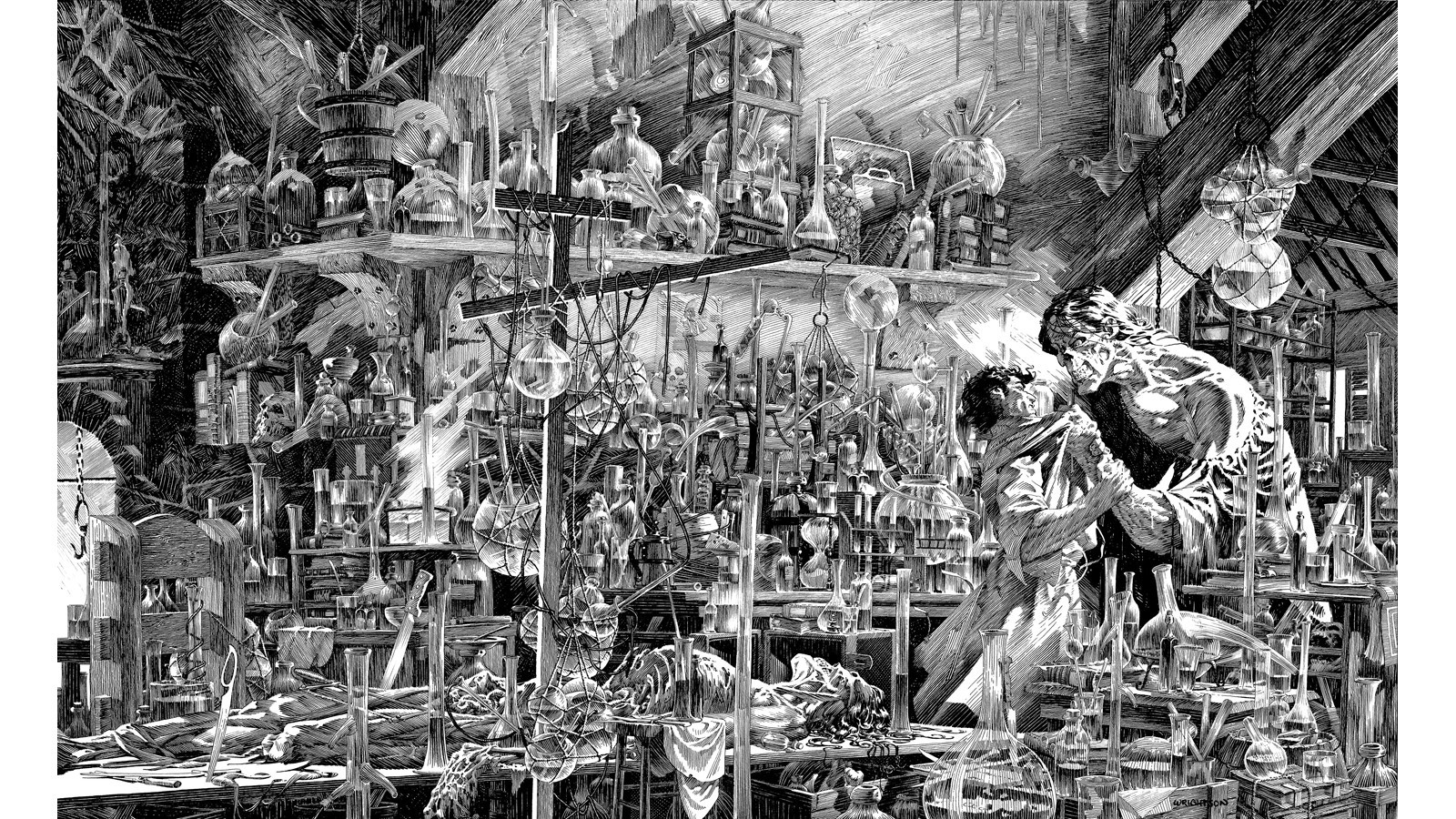
Illustration for Frankenstein — Bernie Wrightson

la-1490458895-xyhoekw71k-snap-image

Screenshot 2018-10-26 at 5.45.25 PMScreenshot 2018-10-26 at 5.45.12 PM

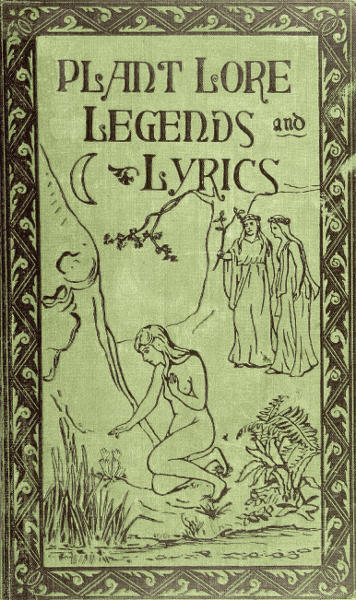
“Plants of the Witches” — Richard Folkard

cover-preview

“Plants of the Witches”

by

Richard Folkard

from

Plant Lore, Legends, and Lyrics: Embracing the Myths Traditions, Superstitions, and Folk-Lore of the Plant Kingdom (1884)


HECATE, the Grecian goddess of the infernal regions, presided over magic and enchantment, and may fairly be styled the goddess, queen, and patroness of Witches and sorcerers. She was acquainted with the properties of every herb, and imparted this knowledge to her daughters Medea and Circe. To this trio of classical Witches were specially consecrated the following herbs:—The Mandrake, the Deadly Nightshade, the Common Nightshade, the Wolfs-bane, the Pontic Azalea, the Cyclamen, the Cypress, Lavender, Hyssop-leaved Mint, the Poley or Mountain Germander, the Ethiopian Pepper, the Corn Feverfew, the Cardamom, the Musk Mallow, the Oriental Sesame, the rough Smilax, the Lion’s-foot Cudweed (a love philtre), and Maidenhair, a plant particularly dear to Pluto. Medea was specially cognisant of the qualities of the Meadow Saffron, Safflower, Dyer’s Alkanet, the clammy Plantain or Fleawort, the Chrysanthemum, and the brown-berried Juniper. All these plants are, therefore, persistently sought for by Witches, who have not only the power of understanding and appreciating the value of herbs, but know also how to render harmless and innocuous plants baleful and deadly. Thus we find that an Italian Witch, condemned in 1474, was shown to have sown a certain noxious powder amidst the herbage near her dwelling, and the unfortunate cows, stricken at first with the Evil Eye, were at length attacked with a lingering but deadly malady. So, again, in the ‘Tempest,’ Shakspeare tells us that in the magic rings traced on the grass by the dance of the Elves, the herbage is imbued with a bitterness which is noisome to cattle. These rings, which are often to be met with on the Sussex Downs, are there called Hag-tracks, because they are thought to be caused by hags and Witches who dance there at night.

It is recorded that, during the period of the Witch persecutions, whoever found himself unexpectedly under an Elder-tree was involuntarily seized with such horror, that he in all probability fell into an ecstatic or hysterical state. Although not one of the trees dedicated to Hecate and her Witch progeny, the Elder appears to have invariably possessed a certain weird attraction for mischievous Elves and Witches, who are fond of seeking the shelter of its pendent boughs, and are wont to bury their satanic offspring, with certain cabalistic ceremonies, beneath its roots.

These satanic children of Witches are elfish creatures, sometimes butterflies, sometimes bumble bees, sometimes caterpillars or worms. They are called good or bad things—Holds or Holdikens. The Witches injure cattle with them; conjure them into the stem of a tree; and, as we have seen, bury them under the Elder-bushes; then, as the caterpillars eat the foliage of the tree, the hearts of those people are troubled of whom the Witches think.

The ill-omened Cercis Siliquastrum, or Judas Tree, is reputed to be specially haunted by Witches, who experience a grim pleasure in assembling around the tree on which the traitorous disciple is said to have hung himself. Perhaps it is they who have spread the tradition that death overtakes anyone who is unfortunate enough to fall into one of these trees.

The Witches of the Tyrol are reputed to have a great partiality for Alder-trees.

Witches are fond of riding about through the air in the dead of night, and perform long journeys to attend their meetings. Matthison tells us that

“From the deep mine rush wildly out

The troop of Gnomes in hellish rout:

Forth to the Witches’ club they fly;

The Griffins watch as they go by.

The horn of Satan grimly sounds;

On Blocksberg’s flanks strange din resounds,

And Spectres crowd its summit high.” Continue reading ““Plants of the Witches” — Richard Folkard”

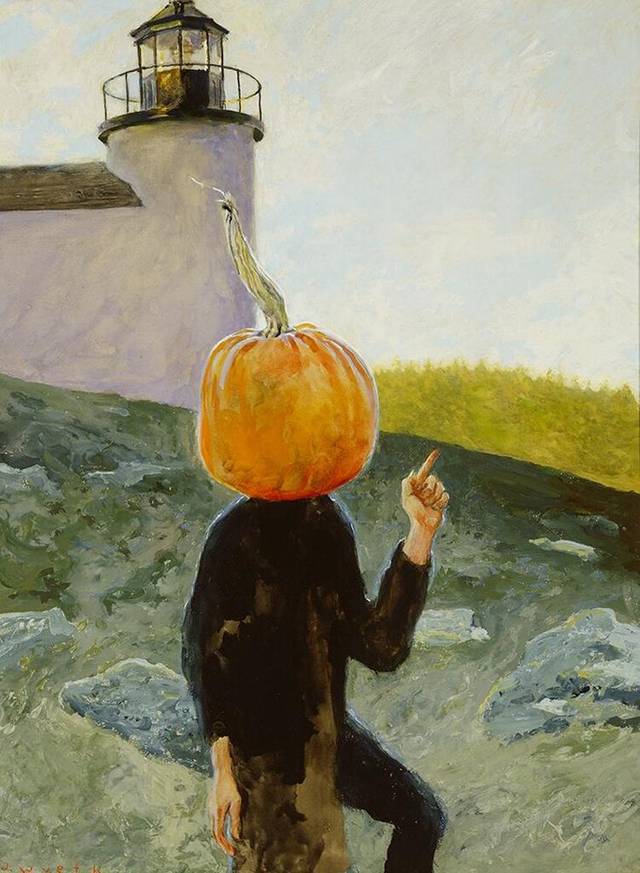
Pumpkinhead Visits the Lighthouse — Jamie Wyeth

Pumpkinhead

Pumpkinhead Visits the Lighthouse, 2000 by Jamie Wyeth (b. 1946)

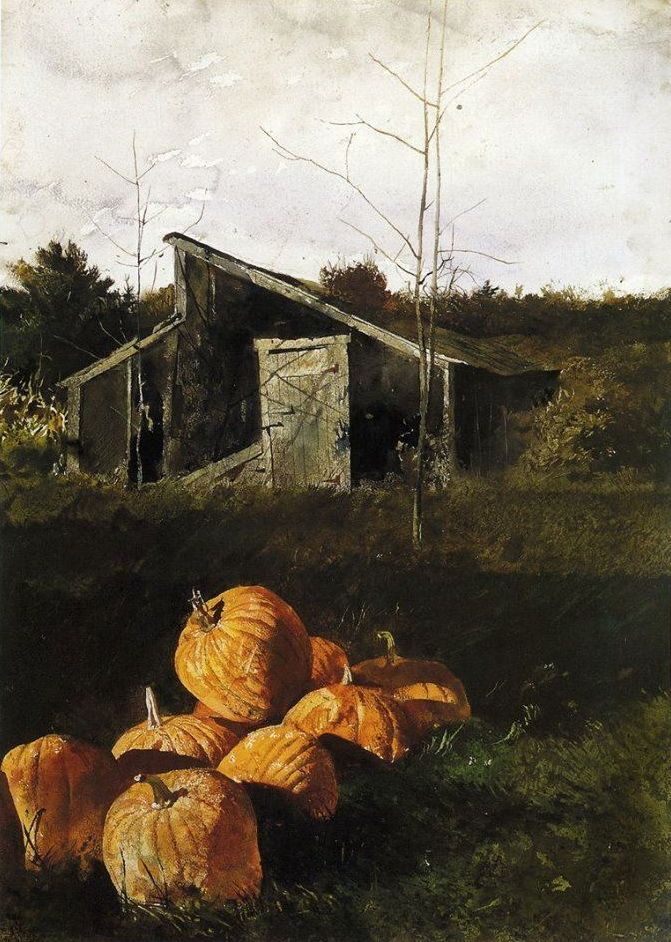
Pumpkins — Andrew Wyeth

98d952664a68cb10328e105c03596a9d

Pumpkins, 1969 by Andrew Wyeth (1917-2009)

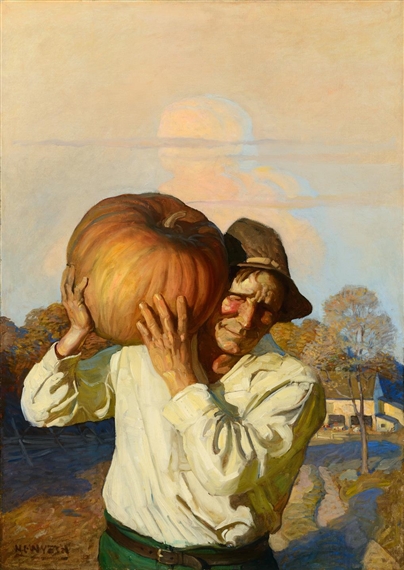
Farmer with Pumpkin — N.C. Wyeth

f93dbb8f-34b3-4d38-8479-d448a7f7b2ec_570

Farmer with Pumpkin, c. 1910 by N.C. Wyeth (1882-1945)

“On the Pleasure Derived from Objects of Terror” — Anna Letitia Aikin

“On the Pleasure Derived from Objects of Terror” (1773)

by

Anna Letitia Aikin


That the exercise of our benevolent feelings, as called forth by the view of human afflictions, should be a source of pleasure, cannot appear wonderful to one who considers that relation between the moral and natural system of man, which has connected a degree of satisfaction with every action or emotion productive of the general welfare. The painful sensation immediately arising from a scene of misery, is so much softened and alleviated by the reflex sense of self-approbation on attending virtuous sympathy, that we find, on the whole, a very exquisite and refined pleasure remaining, which makes us desirous of again being witnesses to such scenes, instead of flying from them with disgust and horror. It is obvious how greatly such a provision must conduce to the ends of mutual support and assistance. But the apparent delight with which we dwell upon objects of pure terror, where our moral feelings are not in the least concerned, and no passion seems to be excited but the depressing one of fear, is a paradox of the heart, much more difficult of solution.

The reality of this source of pleasure seems evident from daily observation. The greediness with which the tales of ghosts and goblins, of murders, earthquakes, fires, shipwrecks, and all the most terrible disasters attending human life, are devoured by every ear, must have been generally remarked. Tragedy, the most favourite work of fiction, has taken a full share of those scenes; “it has supt full with horrors”–and has, perhaps, been more indebted to its tender and pathetic parts. The ghost of Hamlet, Macbeth descending into the witches’ cave, and the tent scene in Richard, command as forcibly the attention of our souls as the parting of Jasseir and Belvidera, the fall of Wolsey, or the death of Shore. The inspiration of terror was by the antient critics assigned as the peculiar province of tragedy; and the Greek and Roman tragedians have introduced some extraordinary personages for this purpose: not only the shades of the dead, but the furies and other fabulous inhabitants of the infernal regions. Collins, in his most poetical ode to Fear, has finely enforced this idea. “Tho’ gentle Pity claims her mingled part, Yet all the thunders of the scene are thine.” The old Gothic romance and the Eastern tale, with their genii, giants, enchantments, and transformations, however a refined critic may censure them as absurd and extravagant, will ever retain a most powerful influence on the mind, and interest the reader independently of all perculiarity of taste. Thus the great Milton, who had a strong bias to these wildnesses of the imagination, has with striking effect made the stories “of forests and enchantments drear,” a favourite subject with his Penseroso; and had undoubtedly their awakening images strong upon his mind when he breaks out,

“Call up him that left half-told
The story of Cambuscan bold; &c.”How are we then to account for the pleasure derived from such objects? I have often been led to imagine that there is a deception in these cases; and that the avidity with which we attend is not a proof of our receiving real pleasure. The pain of suspense, and the irresistible desire of satisfying curiosity, when once raised, for our eagerness to go quite through an adventure, though we suffer actual pain during the whole course of it. We rather chuse to suffer the smart pang of a violent emotion than the uneasy craving of an unsatisfied desire. That this principle, in many instances, may involuntarily carry us through what we dislike, I am convinced from experience. This is the impulse which renders the poorest and most insipid narrative interesting when once we get fairly into it; and I have frequently felt it with regard to our modern novels, which, if lying on my table, and taken up in an idle hour, have led me through the most tedious and disgusting pages, while, like Pistol eating his leek, I have swallowed and execrated to the end. And it will not only force us through dulness, but through actual torture–through the relation of a Damien’s execution, or an inquisitor’s act of faith. When children, therefore, listen with pale and mute attention to the frightful stories of apparitions, we are not, perhaps, to imagine that they are in a state of enjoyment, any more than the poor bird which is dropping into the mouth of the rattlesnake–they are chained by the ears, and fascinated by curiosity. This solution, however, does not satisfy me with respect to the well-wrought scenes of aritificial terror which are formed by a sublime and vigorous imagination. Here, though we know before-hand what to expect, we enter into them with eagerness, in quest of a pleasure already experienced. This is the pleasure constantly attached to the excitement of surprise from new and wonderful objects. A strange and unexpected event awakens the mind, and keeps it on the stretch; and where the agency of invisible beings is introduced, of “forms unseen, and mightier far than we,” our imagination, darting forth, explores with rapture the new world which is laid open to its view, and rejoices in the expansion of its powers. Passion and fancy cooperating elevate the soul to its highest pitch; and the pain of terror is lost in amazement.

Hence the more wild, fanciful, and extraordinary are the circumstance of a scene of horror, the more pleasure we receive from it; and where they are too near common nature, though violently borne by curiosity through the adventure, we cannot repeat it or reflect on it, without an overbalance of pain. In the Arabian Nights are many most striking examples of the terrible joined with the marvellous: the story of Alladin, and the travels of Sinbad, are particularly excellent. The Castle of Otranto is a very spirited modern attempt upon the same plan of mixed terror, adapted to the model of Gothic romance. The best conceived, and most strongly worked-up scene of mere natural horror that I recollect, is in Smollett’s Ferdinand Count Fathom; where the hero, entertained in a lone house in a forest, finds a corpse just slaughtered in the room where he is sent to sleep, and the door of which is locked upon him. It may be amusing for the reader to compare his feelings upon these, and from thence form his opinion of the justness of my theory.

 

Fantasy. You’re imagining things again.