Nude Reading — Robert Delaunay

female-nude-reading-robert-delaunay-1915-94caa32f

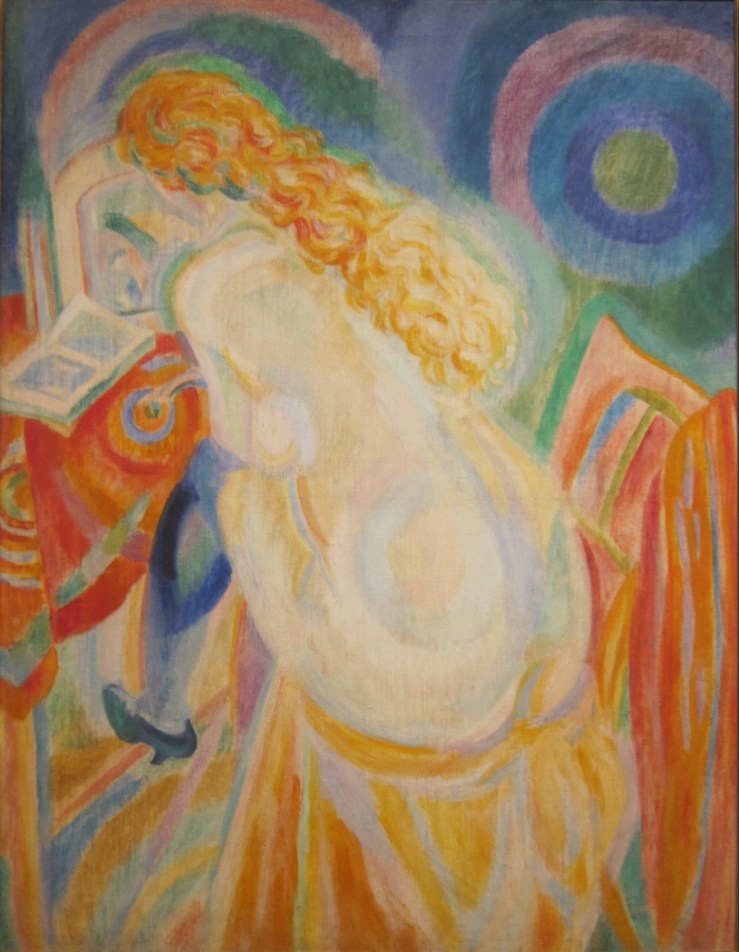
Nude Reading, 1915 by Robert Delaunay (1885-1941)

“Bartleby” is the first great epic of modern Sloth (Thomas Pynchon)

By the time of “Bartleby the Scrivener: A Story of Wall-Street” (1853), acedia had lost the last of its religious reverberations and was now an offense against the economy. Right in the heart of robber-baron capitalism, the title character develops what proves to be terminal acedia. It is like one of those western tales where the desperado keeps making choices that only herd him closer to the one disagreeable finale. Bartleby just sits there in an office on Wall Street repeating, “I would prefer not to.” While his options go rapidly narrowing, his employer, a man of affairs and substance, is actually brought to question the assumptions of his own life by this miserable scrivener — this writer! — who, though among the lowest of the low in the bilges of capitalism, nevertheless refuses to go on interacting anymore with the daily order, thus bringing up the interesting question: who is more guilty of Sloth, a person who collaborates with the root of all evil, accepting things-as-they-are in return for a paycheck and a hassle-free life, or one who does nothing, finally, but persist in sorrow? “Bartleby” is the first great epic of modern Sloth, presently to be followed by work from the likes of Kafka, Hemingway, Proust, Sartre, Musil and others — take your own favorite list of writers after Melville and you’re bound sooner or later to run into a character bearing a sorrow recognizable as peculiarly of our own time.

From Thomas Pynchon’s 1993 essay “Sloth; Nearer, My Couch, to Thee.”

A nest of chimney-swallows was washed down the chimney into the fireplace | Nathaniel Hawthorne’s journal entry for August 1st, 1837

August 1st.–There having been a heavy rain yesterday, a nest of chimney-swallows was washed down the chimney into the fireplace of one of the front rooms. My attention was drawn to them by a most obstreperous twittering; and looking behind the fire-board, there were three young birds, clinging with their feet against one of the jambs, looking at me, open-mouthed, and all clamoring together, so as quite to fill the room with the short, eager, frightened sound. The old birds, by certain signs upon the floor of the room, appeared to have fallen victims to the appetite of the cat. La belle Nancy provided a basket filled with cotton-wool, into which the poor little devils were put; and I tried to feed them with soaked bread, of which, however, they did not eat with much relish. Tom, the Irish boy, gave it as his opinion that they were not old enough to be weaned. I hung the basket out of the window, in the sunshine, and uponlooking in, an hour or two after, found that two of the birds had escaped. The other I tried to feed, and sometimes, when a morsel of bread was thrust into its open mouth, it would swallow it. But it appeared to suffer very much, vociferating loudly when disturbed, and panting, in a sluggish agony, with eyes closed, or half opened, when let alone. It distressed me a good deal; and I felt relieved, though somewhat shocked, when B—- put an end to its misery by squeezing its head and throwing it out of the window. They were of a slate-color, and might, I suppose, have been able to shift for themselves.–The other day a little yellow bird flew into one of the empty rooms, of which there are half a dozen on the lower floor, and could not find his way out again, flying at the glass of the windows, instead of at the door, thumping his head against the panes or against the ceiling. I drove him into the entry and chased him from end to end, endeavoring to make him fly through one of the open doors. He would fly at the circular light over the door, clinging to the casement, sometimes alighting on one of the two glass lamps, or on the cords that suspended them, uttering an affrighted and melancholy cry whenever I came near and flapped my handkerchief, and appearing quite tired and sinking into despair. At last he happened to fly low enough to pass through the door, and immediately vanished into the gladsome sunshine.–Ludicrous situation of a man, drawing his chaise down a sloping bank, to wash in the river. The chaise got the better of him, and, rushing downward as if it were possessed, compelled him to run at full speed, and drove him up to his chin into the water. A singular instance, that a chaise may run away with a man without a horse!

Nathaniel Hawthorne’s journal entry for August 1st, 1837. From Passages from the American Note-Books.

Selections from One-Star Amazon Reviews of Melville’s Moby-Dick

[Ed. note: The following citations come from one-star Amazon reviews of Herman Melville’s novel Moby-Dick. To be very clear, I think Moby-Dick is fantasticbut I also enjoy seeing what people compelled to write negative reviews of the book on Amazon had to say. What follows are selections of one-star Amazon reviews; I’ve preserved the reviewers’ unique styles of punctuation and spelling].


Yechh.

It made for a smashing movie.

If you want to read lots of meaningless whale trivia read the book.

Boy gets whale. Boy loses whale. Boy gets whale. Spawns yawns

I think if you made it into a short comic strip, you would have liked it.

I bought this book for a friend in jail. Alas, he was unable to read it because the font was too small.

Ray Bradbury, who wrote the screenplay for this novel, (a la Gregory Peck) couldn’t even finish the damn thing!

If you like a story with nonessential information and an author that is entirely to verbose, then this book is for you.

I am quite the fan of stories which involve man eating sea creatures, such as Jaws. Moby Dick is nothing compared to such classics, I fear.

Throughout the book, you may read one chapter with some action only to be followed by 5 or 6 chapters of tangents that are not necessary to understand the story.

Moby Dick, was a horrible waiste of time. Along with its wordy paragraphs, it also talked about uninteresting issues. It is also to long, and you don’t hear of them encountering the whale until the end of the book.

The only people who like this book are english teachers who derive a feeling of moral superiority from forcing others to read this incredibly bad novel.

First of all, classiflying it as fiction is a mistake. Probably a good 60% of the book is non-fiction – chapter after chapter dedicated to every imaginable detail of the biology of the whale and every imaginable nuance of whaling.

I love literatur just as much as the next guy but we must face it 100 years or so ago American literature was reall weak and lagging from the rest of the world, perhaps now they’re starting to catch up with writers like Ann Rice and them.

I have seen better writing in a Hallmark card! Boring! Give me a good ole copy of Elvis and Me! A true story that really tugs at your heart strings! I sleep with that one under my pillow! Keep Moby Dick away from my bed!

Those chapters about Ishmael sleeping with whatever his name was and Ishamel had such a good time with the other guy’s arm over him and leg over him that he didn’t know if he was straight or gay any more.

i personally didn’t enjoy the philosophical or deep side of the book, i have read much much better books in that regard.

There is no suspense, and I find the idea of people hunting whales offensive. Offensive with a capital O.

Honestly, Over 400 pages devoted to killing a whale because it ate your hand? Come on.

It is hard to read. like work. Doubt he could get published today.

What is the whales motivation? You dont know.

It is 540somepages of boring whaling details.

No wonder Melville flopped as a writter.

OMG, this is tedious and torture to read.

I HATE this book. Why? It’s BORING!

Moby Ick’s more like it.

Reviews, riffs, anti-reviews, etc., June and July 2018 (and an unrelated griffin)

bibicnsh_ydn_2400x2400
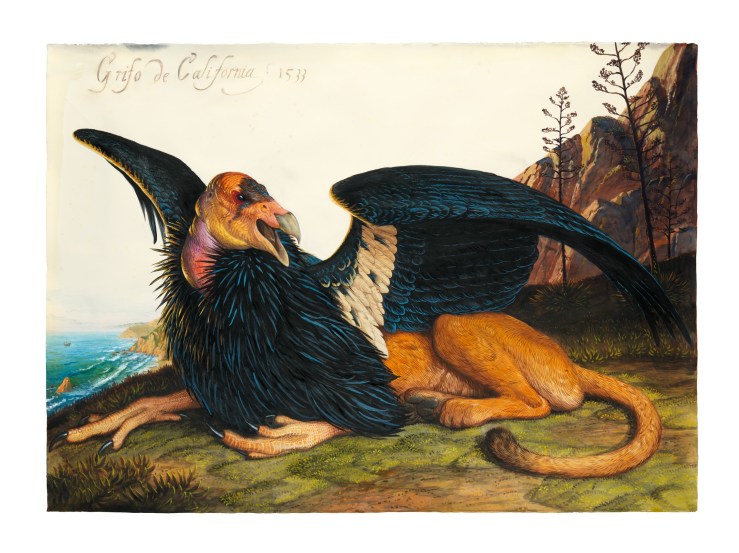
Grifo de California, 2017 by Walton Ford (b. 1960)

Links to reviews, riffs, etc. I wrote in June and July of 2018–

I continued and then apparently abandoned the silly project of trying to write reviews on every film I watched or rewatched this summer:

I hated both Ant-Man and The Disaster Artist, which I made a bad double feature out of.

I loved Lady Bird though.

I took my son to see Pom Poko in the theater as part of the Studio Ghibli Fest 2018 program.

I finally watched David Cronenberg’s film Map to the Stars and was not especially impressed.

I watched Blade Runner 2049 a second time and annotated my original review.

And I watched David Lynch’s film The Elephant Man for the first time in ages and boy is it really really good.

Trying to write about every film I watched what was exhausting and I’m not really sure what I got out of it, if anything. Here are the other films that I remember watching and not writing about:

All eight of the Star Wars films, again, sort of, with my kids.

Samsara (dir. Ron Fricke, 2011)—bought a new TV for the first time in eleven years and used this film to test the screen. Ended up watching it twice.

Thor: Ragnarok (dir. Taika Waititi, 2017)—another one I watched with the kids, although I’m not sure it was for them. It wasn’t for me. A lot of wasted potential in this one.

The Company of Wolves (dir. Neil Jordan, 1984)—I think this one holds up well. I remember renting it for 99 cents from the Hollywood Video next to my apartment in Gainesville, FL in 1997 and thinking it was a work of genius.

Princess Mononoke (dir. Hayao Miyazkai, 1997)—in the theater for the first time, again as part of Ghibli Fest 2018. I wrote about the film here a few years ago.

Under the Skin (dir. Jonathan Glazer, 2014). Watched it again last night on Netflix. I wrote about it here. I like a film that is basically a mood.

Screenshot 2018-07-31 at 8.40.39 PM

I finally read George Eliot’s longass wonderfulass novel Middlemarch  this summer. I wrote about wanting to reread it from about halfway through 

I also wrote about finishing Middlemarch, but edited out a few paragraphs about how much the last paragraphs of Eliot’s novel reminded me of the last lines of Walt Whitman’s Song of Myself.

Screenshot 2018-07-31 at 8.41.11 PM

In what is either strange felicity or my need to connect everything to Whitman, I did connect the end of Song to one of Denis Johnson’s posthumous stories, the title story in The Largesse of the Sea Maiden. 

Writing about “Largesse” was the first of an intended five part series on each of the stories in Johnson’s last book; I wrote about the second story, “The Starlight on Idaho” here and “Strangler Bob” here. (Links to the full texts of those stories are in each of those pieces, by the way).

I recycled a review of Roberto Bolaño’s novella By Night in Chile after I saw its new cover in a Charleston bookstore.

I also wrote about how weak and ineffectual I think George Saunders’ “satire” of Donald Trump, “Little St. Don” is. I see Saunders’ piece as part of an obsolete postmodernist mode that cannot viscerally engage the emerging zeitgeist. I wrote,

But postmodern perspectives have thoroughly soaked our culture (whether we recognize this our not), and good old-fashioned postmodernism-by-numbers isn’t going to work. “Little St. Don” reveals nothing new to its audience, it simply amplifies what they already know and believe, and does so in the very rhetoric that we need to overpower. Literary satire needs to do more than confirm our own morality while lambasting those who perpetrate evil—it needs to invent its own rhetoric, its own form, its own new language.

Screenshot 2018-07-31 at 8.42.52 PM

The Badger’s Song II — Michaël Borremans

bormi0199

The Badger’s Song II, 2015 by Michaël Borremans (b. 1963)

Man Reading a Newspaper — Russell Drysdale

Screenshot 2018-07-31 at 5.45.31 PM.png

Man Reading a Newspaper, 1941 by Russell Drysdale (1912-1981)

The Misfortunes of Silenus (Detail) — Pierro di Cosimo

Screenshot 2018-07-05 at 8.51.12 PM

The Misfortunes of Silenus (detail), c. 1500 by Pierro di Cosimo (1462-1522)

They will not do us any good—the good books (William H. Gass)

gass_01_body

They will not do us any good—the good books—no—if by good we mean good looks, good times, good shoes; yet they still offer us salvation, for salvation does not wait for the next life, which is anyhow a vain and incautious delusion, but is to be had, if at all, only here—in this one. It is we who must do them honor by searching for our truth there, by taking their heart as our heart, by refusing to let our mind flag so that we close their covers forever, and spend our future forgetting them, denying the mind’s best moments. They extend the hand; we must grip it. Spinach never made Popeye strong sitting in the can. And the finest cookbook ever compiled put not one pot upon the stove or dish upon the table. Here, in the library that has rendered you suspect, you have made their acquaintance—some of the good books. So now that you’ve been nabbed for it, you must become their lover, their friend, their loyal ally. But that is what the rest of your life is for. Go now, break jail, and get about it.

From William H. Gass’s essay “To a Young Friend Charged with Possession of the Classics.” Collected in A Temple of Texts.

Visit — Axel Krause

krause-visite2c-20152c-90x160cm-occ88l-auf-leinwand

Visit, 2015 by Axel Krause (b. 1958)

“Lunch” — William T. Vollmann

“Lunch”

by

William T. Vollmann


Faces at lunch, oh, yes, smirking, lordly, bored or weary—here and there a flash of passion, of dreams or loving seriousness; these signs I saw, notwithstanding the sweep of a fork like a Stuka dive-bomber, stabbing down into the cringing salads, carrying them up to the death of unseen teeth between dancing wrinkled cheeks; a breadstick rose in hand, approached the purple lips in a man’s dull gray face; an oval darkness opened and shut and the breadstick was half gone! A lady in a red blazer, her face alert, patient and professionally kind like a psychoanalyst’s, stuck her fork lovingly into a tomato, smiling across the table at another woman’s face; everything she did was gentle, and it was but habit for her to hurt the tomato as little as possible; nonetheless she did not see it. Nodding and shaking her head, she ate and ate, gazing sweetly into the other woman’s face. Finally I saw one woman in sunglasses who studied her arugula as she bit it…It disappeared by jagged inches, while across the table, in her husband’s lap, the baby watched in dark-eyed astonishment. Her husband crammed an immense collage of sandwich components into his hairy cheeks. He snatched up pommes-frites and they vanished in toto. When the dessert cart came, the starched white shoulders of businessmen continued to flex and shine; the faces gazed at one another over emptiness, maybe happier now that they had eaten, unthinking of what they had wrought.

Red Wall — Karoly Ferenczy

red-wall-1910

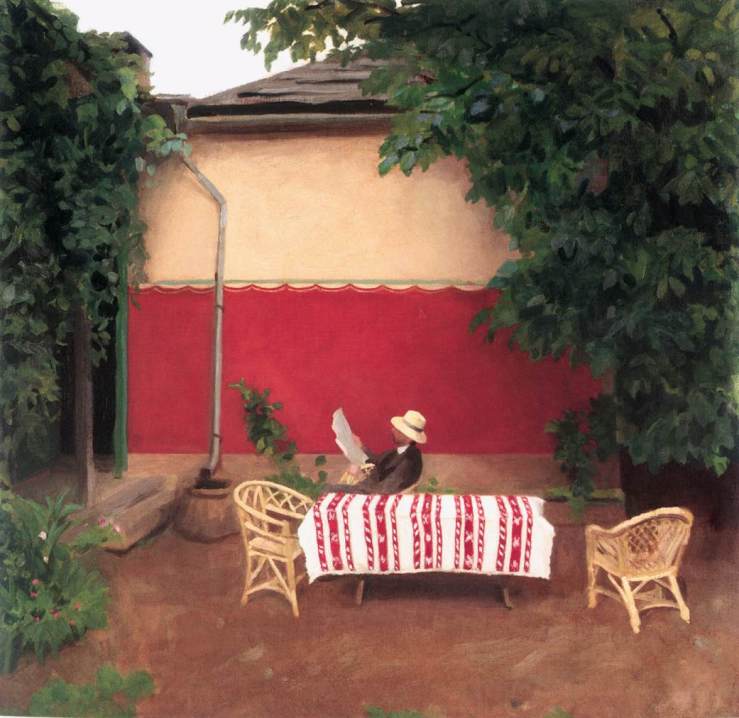
Red Wall, 1910 by Karoly Ferenczy (1862-1917)

Allegory of Inclination — Artemisia Gentileschi

artemisia-gentileschi-allegoria-dell-inclinazione

Allegory of Inclination, 1615 by Artemisia Gentileschi (1593-1653)

Capillary Locomotion — Remedios Varo

capilary motion

Capillary Locomotion, 1959 by Remedios Varo (1908-1963)

A review of Roberto Bolaño’s novella By Night in Chile

djhkew-vaaavpst

Toward the end of the 130 page monologue that is Roberto Bolaño’s novella By Night in Chile, narrator Father Sebastián Urrutia Lacroix claims that “An individual is no match for history.” His statement neatly encapsulates (what might be) the dominant theme of By Night in Chile, namely an individual person’s capacity and ability to correctly–and sanely–somehow measure, attest to, confront, and witness the horror and brutality of history. In this case, Bolaño’s narrator, a Catholic priest–and conservative literary critic (and, of course, failed poet)–Father Urrutia, via a sweeping deathbed confession of sorts, recounts his life story, leading inexorably to Pinochet’s coup and its attendant subsequent draconian reforms and abuses. While it would be a mistake to reduce Bolaño’s rich novella to one conflict, I think the root of Urrutia’s struggle emanates from his inability to come to terms with his role as an intellectual (let alone an artist, critic, or priest) complicit somehow in Pinochet’s crimes. Throughout the book, from the very beginning, Urrutia blames his inner turmoil on a “wizened youth” (I don’t want to spoil this antagonist’s identity, but puzzling out that paradoxical appellation provides a major clue), a kind of idealist who stands apart from the dying priest, mocking and taunting him. After his claim that “An individual is no match for history,” Urrutia avers that “The wizened youth has always been alone, and I have always been on history’s side.” For Urrutia, this is of paramount importance, not just as a Catholic priest (which, it must be pointed out, is a role he doesn’t seem particularly suited for) but also as a literary critic and intellectual: Urrutia wants to systematize and critique history, to be “on the right side of history,” to quote Barack Obama. And yet his own attempt to narrativize his own life ironizes and critiques this very possibility at every turn–he is a sham, a charlatan, motivated and prompted by fear and even hate.

And on that attempt to narrativize a life: I would call By Night in Chile an anti-bildungsroman. Although Urrutia relates a life story, the free flow of psychic impressions that characterizes his telling slip and sail and rock and crash throughout years and over decades, often flowing backwards and forwards, sometimes spending pages on what could only be considered inconsequential minutiae, while at times glossing over the profoundest events with little more than a word or two. It is often what Urrutia does not remark upon that characterizes what is of the greatest importance in this work, and this is a testament to the power of Bolaño’s writing, to his command of voice. In one of the greatest performances of the novel, Urrutia describes the time right before, during, and after Pinochet’s coup. The passage is less than four pages, and for every contemporary action of immediate consequence, Urrutia seems to provide twice as many examples of his retreat into the past: ” . . . the first anti-Allende march was organized, with people banging pots and pans, and I read Aeschylus and Sophocles and Euripides, all the tragedies, and Alkaios of Mytilene and Aesop and Hesiod and Herodotus . . . .” Urrutia doesn’t bother to scrutinize or analyze the visceral reality of history in the making around him, regressing instead to the comfort of established philosophical tradition–the history of Herodotus in favor of the chaos, anarchy, and brutality happening around him. He’s really quite a terrible priest, and as an intellectual he refuses to be engaged. Confident that he will always be “on history’s side,” he refuses to actively even try come to terms with history until he’s dying. And thus we get the narrative of By Night in Chile.

This reckoning with the past takes the form of a long monologue but, as those familiar with Bolaño will attest, there are plenty of other voices here, stories nested within stories like Russian dolls. The force and vitality of Urrutia’s speech is astonishing; one envisions the monologue as a single immediate and discrete exhalation, a stream of memory, the living wail of a dying man. Bolaño’s rhetorical style here conveys this ironic energy. He employs long (very, very long) sentences, sometimes going on for several pages, and often uses little or no transitions between what should be major shifts of space and time. There are plenty of references to writers, of course, many obscure, and more motifs and leitmotifs than I can work out here (or elsewhere, to be honest). I’m going to go out on a limb and suggest that the book is probably even more intense in the original Spanish, although I think Chris Andrews has done a brilliant job translating here, just as he did in Last Evenings on Earth. And since I’ve brought up that book, I’m going to make another suggestion: if you’ve yet to read Bolaño, you should, and Last Evenings of Earth (or 2666 if nearly a thousand pages doesn’t seem too daunting)is probably the best place to start–which is kind of another way of saying that By Night in Chile is not the best entry point to Bolaño–at least not for anyone intimately familiar with Latin American history. It’s not that By Night is particularly challenging or hard to read. However, I think that this particular book will probably be better enjoyed with more context. As Rodrigo Fresán points out in his essay “The Savage Detective,” (published in the March 2007 issue of The Believer), By Night in Chile could be (should be?) read as part of one cohesive book along with Amulet and Distant Star. Indeed, as many critics have pointed out, Bolaño’s works seem to coalesce into one great work, a secret universe parallel to Tolkien’s Middle Earth or Faulkner’s Yoknapatawpha. Urrutia’s voice enriches this universe, but one must have something of a foothold on Bolaño’s themes in order to appreciate the complex ironies of By Night in Chile. Or maybe not. Maybe this is a great entry point to Bolaño. Either way, great book. Highly recommended.


Editorial note: Biblioklept ran the original version of this review in July of 2010. I saw the new cover for By Night in Chile today in a bookstore I was visiting in a town that I do not live in, and the new cover—the picture of which is the only new “content” for this review—is the occasion for republishing this Bolaño review.
Self Portrait as After Party — Julie Heffernan

after20party20cropped

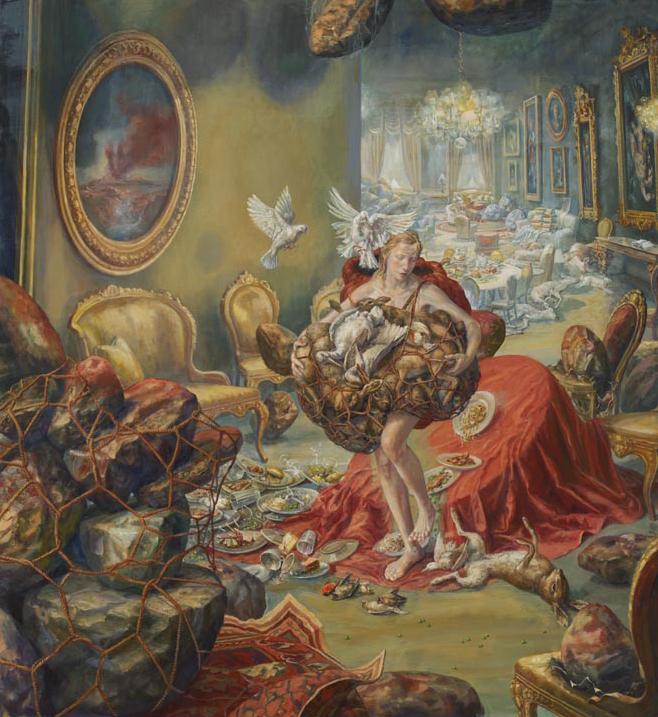
Self Portrait as After Party, 2013 by Julie Heffernan (b. 1956)

Antoine Volodine’s Post-Exoticism in 10 Lessons, Lesson 11 (Book acquired in July, 2018)

img_0454

Even though I haven’t gotten to Minor Angels yet, I went ahead and picked up Antoine Volodine’s Post-Exoticism in Ten Lessons, Lesson Eleven. Publisher Open Letter’s blurb:

Like with Antoine Volodine’s other works (Minor AngelsWe Monks & Soldiers), Post-Exoticism in Ten Lessons, Lesson Eleven takes place in a corrupted future where a small group of radical writers—those who practice “post-exoticism”—have been jailed by those in power and are slowly dying off. But before Lutz Bassmann, the last post-exoticist writer, passes away, journalists will try and pry out all the secrets of this powerful literary movement.

With its explanations of several key “post-exoticist” terms that appear in Volodine’s other books, Lesson Eleven provides a crucial entryway into one of the most ambitious literary projects of recent times: a project exploring the revolutionary power of literature.

Translated from the French by J. T. Mahany

You can read an excerpt from the book here.